Showing posts with label phil niekro. Show all posts

Saturday, December 26, 2020

Phil Niekro, 1939-2020

The knuckleball is the oddest pitch in baseball. It is also the hardest to catch, and catchers hate trying. Nobody has thrown a knuckleball in the major leagues longer, and perhaps no one threw it better, then Phil Niekro.

Philip Henry Niekro was born on April 1st, 1939, in Blaine, Ohio, and grew up in nearby Lansing, Ohio. Both towns are close to the Ohio River, near Wheeling, West Virginia, and about 60 miles southwest of Pittsburgh.

He attended Bridgeport High School, in the nearby town of Bridgeport. Among its other alumni have been Phil's brother Joe Niekro, Boston Celtics basketball legend John Havlicek, Los Angeles Rams linebacker Bill Jobko, and legendary Iowa State University wrestling coach Bobby Douglas.

All 5 were born between 1935 and 1944, and Phil Niekro and Havlicek grew up as close friends.

In 1988, Sports Illustrated published an article by Ron Fimrite titled "The Valley Boys," focusing on the Wheeling Valley, centering on the town of Martins Ferry:

Old-time Pro Football Hall of Famer Clarke Hinkle was a Valley boy. So were Bob Gain and Calvin Jones, Outland Trophy winners as the nation's best college linemen in 1950 and 1955. Chuck Howley, the Dallas linebacker who is the only member of a losing team to have ever won the Super Bowl MVP award, was another one. Bill Jobko (Ohio State) and Bob Jeter (Iowa), both of whom played in the Rose Bowl and later starred in the NFL, were Valley boys. Gene Freese, a big league infielder for many years, was one. And so was Notre Dame football coach Lou Holtz.

But there are six Valley boys who stand above the rest, giants in their sports. Two of them are already Hall of Famers; a third has only to wait his requisite five years for induction; and a fourth, grievously overlooked in the past, may yet get his just due. Another would surely have made the Hall of Fame of his sport were it not for one terrible mistake in his life. The sixth, until early this month, was still playing.

There are two brother combinations in this distinguished group, and all six grew up within seven miles of one another. Four, in fact, were born in Martins Ferry, and though three different high schools are involved, the schools are only minutes apart by car. Two were teammates and best friends.

They all came from immigrant mining families, and they were raised, by today's standards, in primitive circumstances. There were no fast cars in this crowd. No televisions. No rock concerts. Nor, for many years, indoor plumbing. And yet there is not one of them who would trade away the gift of his childhood. They are the pride of the Valley. And they, better than any, reveal the source of its indomitable spirit.

The brothers were Phil and Joe Niekro, and Lou and Alex Groza. Lou was an All-Pro offensive tackle and placekicker for the Cleveland Browns. Alex was a center who helped the University of Kentucky's "Fabulous Five" win the 1948 and 1949 National Championships, and the U.S. Olympic team win the Gold Medal at the 1948 Olympics in London. He was the 1950 NBA Rookie of the Year. The others were Havlicek and Pittsburgh Pirates 2nd baseman Bill Mazeroski.

Havlicek and Lou Groza were already in their respective sports' Hall of Fame. Phil Niekro was elected in 1997, in his 5th year of eligibility. Mazeroski, long hailed as the best defensive 2nd baseman of all time, and the hitter of the home run that won the 1960 World Series, continued to wait until 2001, and was finally elected.

Alex Groza looked like he was on course for the Hall of Fame, before the point-shaving scandal that rocked college basketball in 1951 ensnared Kentucky. Groza and his UK and Indianapolis Olympians teammates Ralph Beard and Dale Barnstable were banned for life by NBA Commissioner Maurice Podoloff. He never worked in the NBA again.

With no other pro league available, he went into coaching, at Bellarmine University in Louisville. His NBA ban did not apply to the ABA, nor did that league respect that ban. Their Kentucky Colonels and San Diego Conquistadors hired him.

Hall of Fame relief pitcher Rollie Fingers was also born nearby, in Steubenville, Ohio, also the hometown of singer-actor Dean Martin. However, when he was a boy, his father moved the family to California, so he did not remain a "Valley Boy."

*

The Niekro brothers' father was a coal miner of Polish descent, who had pitched in semi-pro baseball. A fellow miner taught him how to throw a knuckleball, and he taught his sons. In 1959, Phil signed with the Milwaukee Braves. In 1965, Major League Baseball instituted a draft, and Joe, then attending West Liberty University in West Virginia, was drafted by the Cleveland Indians in 1966. He chose not to sign with them, and was drafted again later in the year, this time by the Chicago Cubs. He made his debut for them in 1967.

By that point, Phil had already made his major league debut, having lost a season by serving in the U.S. Army in 1963, the dawn of the Vietnam War era, although not in combat. It was on April 15, 1964, at Candlestick Park in San Francisco.

He wore the Number 35 that he would wear for every game of his career. In a disaster of an inning for the Braves, the San Francisco Giants scored 10 runs. Phil was the 3rd pitcher the Braves used in the inning, and pitched to 1 batter, Jim Davenport, inducing an inning-ending groundout. The Braves tried to come back, but they didn't make it, and lost 10-8.

He appeared with the Braves in 10 games in 1964, without a decision. He appeared in 41 games in 1965, all but 1 in relief, going 2-3 with 6 saves. The Braves moved to Atlanta for the 1966, and Phil turned out to be not only the last remaining Brave who had played for them in Milwaukee, but the last active player for any team who had played for the Milwaukee Braves.

He split his time between starting and relief in 1966 and 1967, and became a full-time starter in 1968, going 14-12. In 1969, he became the Braves' ace, going 23-13, making his 1st All-Star Game, and helping them win the 1st-ever National League Western Division title. However, he ran out of gas in the 8th inning of Game 1 of the NL Championship Series, and lost to the Mets.

The '69 Division title was an outlier for the Braves, as they were generally out of contention from 1965 to 1981. In spite of that, Phil went 15-14 in 1971, and 16-12 in 1972. In 1973, he went 13-10, and on August 5, pitched the 1st no-hitter for the Braves after the move to Atlanta, against the San Diego Padres.

In 1974, a season which began for the Braves with the record-breaking 715th career home run by Hank Aaron, Phil led the NL with 20 wins, 18 complete games and 302 1/3rd innings pitched. He finished 3rd in the voting for the NL's Cy Young Award, the closest he would come to winning it. In 1973 and '74, Phil and his brother Joe were teammates on the Braves.
Joe (left) and Phil, but knuckleballers

Phil was only 15-15 in 1975, but, with Aaron having gone back to Milwaukee to play for the Brewers, the Braves needed someone as a representative in the All-Star Game -- which was held in Milwaukee -- and Phil was selected.

He went 17-11 in 1976. On May 29, he gave up a home run to his brother Joe, the only home run Joe would ever hit in the major leagues. Joe's son, Lance Niekro, appeared as a 1st baseman with the Giants in the 2003, '05, '06 and '07 seasons. He is now the head coach at Florida Southern University.

With with little support, Phil went 16-20 in 1977. He went 19-18 in 1978, but, despite that win total, led the NL in losses. In 1979, having turned 40, he led it in both wins and losses: With a 21-20 record, he will, most likely, remain the last pitcher in MLB history both win 20 games and lose 20 games in the same season.

Only 5 pitchers in the 150-year history of Major League Baseball have won 20 games in a season after turning 40. Cy Young did it in 1907 and 1908. In the 100 years of the Lively Ball Era, there have been only 4. Grover Cleveland Alexander did it in 1927. In the 60 years of the Expansion Era, there have been only 3. Warren Spahn did it in 1961 and 1963. In the 50+ years of the Divisional Play Era, there have been only 2. Phil Niekro did it in 1979. In the 20 years of the 21st Century, there has been only 1: Jamie Moyer in 2003. So it's that rare.

We have seen a few pitchers hang on longer than most, due to throwing the knuckleball, which puts less stress on the human arm than any other widely-known pitch. These include Hoyt Wilhelm, Charlie Hough, Tom Candiotti and Tim Wakefield. They also include Wilbur Wood, who went 24-20 for the Chicago White Sox in 1972, making him the last pitcher in the American League to both win and lose 20 in the same season.

But only 4 pitchers have gotten to the Hall of Fame having relied on the knuckler: Wilhelm, Jesse Haines, Ted Lyons, and Phil Niekro. Why so few? There are 2 reasons. One is that, because the ball moves around so much, catchers have such trouble catching it. Catchers then complain to their coaches, who tell their managers, who then tend to use pitchers who throw it less.

The other reason is that, if you don't throw it just right, it straightens out, and, as the slowest widely-known pitch, it becomes the easiest to hit. Wakefield used it to great effect for the Boston Red Sox in beating the Yankees in Games 1 and 4 of the 2003 ALCS, but proved the other side of it in relief in Game 7, giving up a Pennant-winning home run on a 69-mile-per-hour pitch to Aaron Boone.

Jim Bouton, who switched to the knuckler after losing his fastball by wrecking his elbow, said, "Coaches don't respect it. You can pitch 7 good innings with a knuckleball, and as soon as you walk a guy, they go, 'See, there's that damn knuckleball." R.A. Dickey, who won the NL Cy Young Award for the Mets in 2012, mainly using it, has said, "It takes a special manager to be able to really trust it, the bad and the good of it. Coaches are quick to banish the pitch after one bad outing."

Charlie Lau, later to be better known as baseball's foremost hitting instructor, once said, "There are two theories about catching the knuckleball. Unfortunately, neither of them work." And Bob Uecker, later to become a great broadcaster, and a good defensive catcher, but couldn't hit to save anybody's life, once said, "The best way to catch a knuckleball is to wait until the ball stops rolling, and pick it up."

In his last season as a major league player, 1967, Uecker was on the Braves, and related this experience in catching Phil: "Niekro struck out a hitter once, and I never touched the ball. It hit me in the shinguard, bounced out to Clete Boyer at 3rd base, and he threw out the runner at 1st. Talk about a weird assist: 2–5–3 on a strikeout."

"Ueck told me if I was ever going to be a winner to throw the knuckleball at all times, and he would try to catch it," Phil said years later. "I led the league in ERA (1.87), and he led the league in passed balls."
Classically, the knuckleball is gripped not with the knuckles,
but with the tips of the index and middle fingers.


Phil kept pitching, and pitching well. Pete Rose, for once not loving being a big-league ballplayer, once said, "I work for 3 weeks to get my swing down pat, and Phil messes it up in one night... Trying to hit that thing is a miserable way to make a living."

Phil kept pitching, and kept getting insufficient support. In 1980, he went 15-18, leading the NL in losses. He was injured for a big chunk of 1981, and went just 7-7. Dale Murphy said, "When we weren't in the hunt, which was more times than not, that didn't stop his attitude and willingness to get out there. I just really admired him and loved being around him."

Bob Hope, a longtime Braves executive -- and no relation to the legendary entertainer of the same name, once a part-owner of the Indians -- said, "During that time frame, the teams weren't always very good. In fact, they were very bad sometimes. But we probably had the three highest-character athletes I've ever met: Phil Niekro, Hank Aaron and Dale Murphy... If you were a charity in Atlanta, you could always count on Phil Niekro participating in some way."

Finally, in 1982, the Braves got going. The team was then owned by broadcast executive Ted Turner, who put them on his network, "SuperStation" WTBS, and he gave them the nickname that somebody gave to the NFL's Dallas Cowboys: "America's Team." As the Chicago Cubs soon would as well, on "superstation" WGN, the Braves developed a national following, not just a regional one. And the revenue came in, allowing Turner to buy better players.

With Murphy coming into his own, winning the 1st of back-to-back NL Most Valuable Player awards, the Braves won the NL West, and Phil went 17-4, leading the NL with an .810 winning percentage. Unfortunately, just 2 outs from Game 1 of the NLCS against the St. Louis Cardinals being an official game, the rain came, and it was suspended, ending Phil's good pitching. It was started from the beginning, and the Cards went on to sweep the Braves, ending their 1st postseason series in 13 years. It would be 9 years before they had another.

Phil went 11-10 for the Braves in 1983. He pitched 201 1/3rd innings. He was 44 years old. And yet, after the season, the Braves released him. He had pitched 20 seasons for them, winning 268 games. In the 150 seasons that this franchise has existed, going back to the 1871 Boston Red Stockings of the National Association, only Warren Spahn (356) and Kid Nichols (331) have won more games for them. No, Greg Maddux didn't, nor did Tom Glavine: Although both won over 300 games, both of their totals are noticeably split with other teams.

*

But the Braves let him go. And the Yankees, needing pitching, signed him for the 1984 season. He went 16-8, making his 5th and last All-Star Game. On July 4, at Arlington Stadium outside Dallas, he struck Larry Parrish of the Texas Rangers out, for his 3,000th career strikeout. He pitched 8 innings, with Jay Howell finishing up, and the Yankees won, 5-0.
In spite of the date posted on this photo,
the milestone was achieved on the road.

In 1985, at age 46, he went 16-12, helping to keep the Yankees in the AL Eastern Division race. On September 15, after 10 seasons with them, the Houston Astros traded Phil's brother Joe Niekro to the Yankees, and they were teammates for a few days. Joe went 2-1 for the Yankees down the stretch.

The Yankees they needed to sweep a season-ending series with the Toronto Blue Jays, at Exhibition Stadium in Toronto, to set up a Playoff for the Division title. They won on Friday night, but lost on Saturday afternoon, to give the Jays the title.

In the Sunday finale, on October 6, he went the distance against the Toronto Blue Jays, gaining his 300th win. The Yankees won, 8-0, with home runs by Don Mattingly, Mike Pagliarulo and Henry Cotto. He allowed only 4 hits, and became the oldest pitcher ever to throw a shutout, a record that stood until Jamie Moyer did it at 47 in 2010. Phil admitted that he did not throw a knuckleball until the last batter, Jeff Burroughs -- himself a longtime veteran, and the AL MVP in 1974.

It was the last game he pitched for the Yankees, as his 2-year contract ran out. Just before the season began, he signed with the Cleveland Indians -- not the closest team to his hometown (that would be the Pittsburgh Pirates), but a team in his home State. The Cleveland metro area still has a significant Polish community, and it really took to "Knucksie."
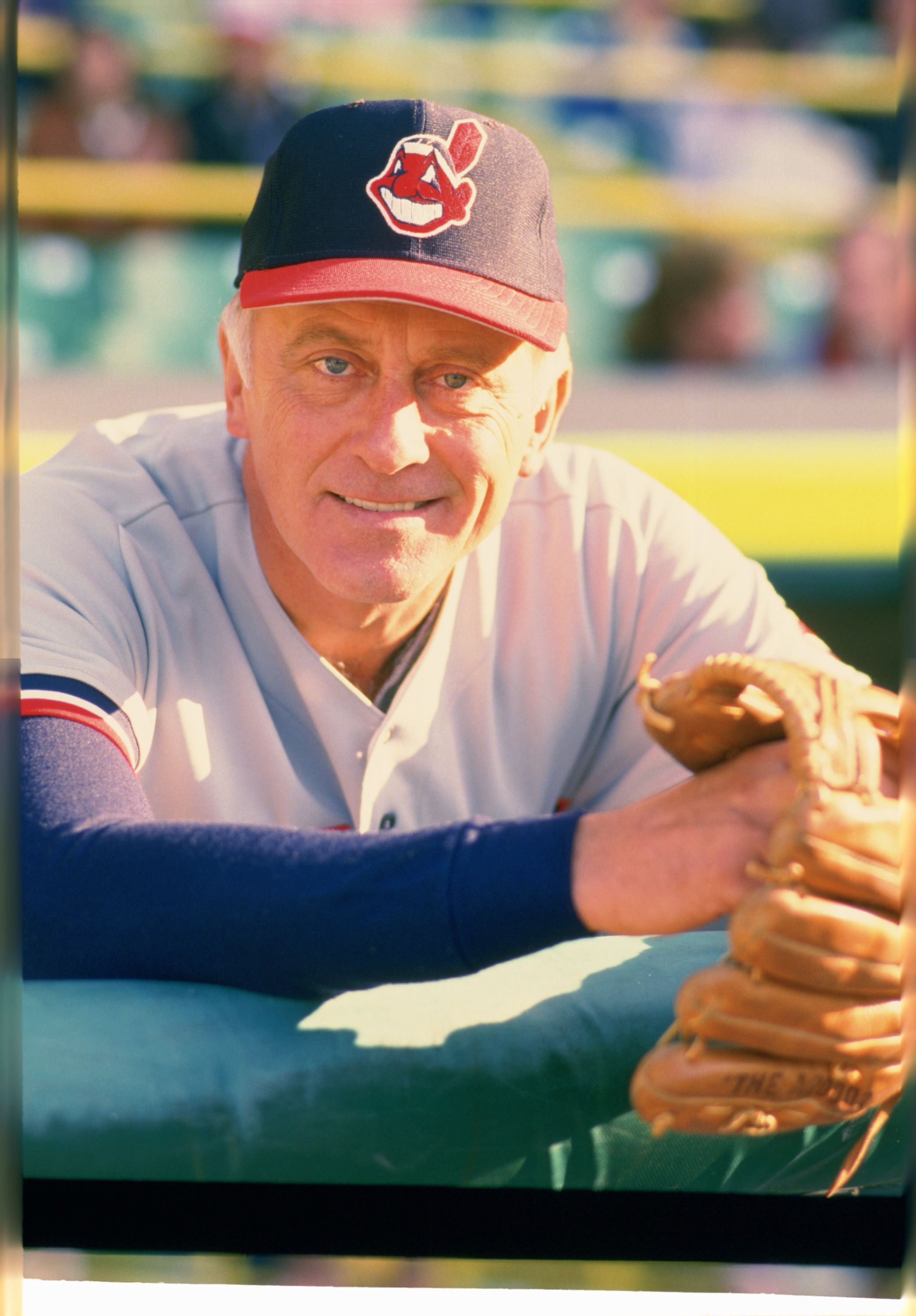
"Cleveland Rocks"? Cleveland knuckles.

He went 11-11 in 1986. In 1987, he was 7-11, and was traded in midseason for the Blue Jays. He made 3 starts, going 0-2, and was released. He was brought back by the Braves, and, on September 27, at Atlanta-Fulton County Stadium, he made one last start. Although he allowed 5 runs in 3 innings, he did not factor in the decision. Oddly, like his 1st appearance, his last appearance was for the Braves in a bad loss to the Giants, albeit at home this time: The Giants won, 15-6.

Phil then retired. At 48, he was the oldest regular player in major league history. This record would hold until 2007, when Julio Franco did so at 49 -- also for the Braves. His 24 seasons without appearing in a World Series is a record, breaking the 23 of Carl Yastrzemski.

He finished his career with 318 wins, more than any knuckleballer, and 274 losses. He ended up winning 121 games after his 40th birthday, more than any other pitcher. His career ERA was 3.35, and his ERA+ was 115. He had 3,342 strikeouts, more than all but 6 pitchers before him, and a WHIP of 1.268. His 5,404 1/3rd innings pitched is the most by any pitcher in the post-1920 Lively Ball Era.

For comparison's sake: Joe, who last appeared in an MLB game in early 1988, finished 221-204 -- giving them a combined total of 539 wins, the most of any brother combination in MLB history. His ERA was 3.59, and his ERA+ was 98. His WHIP was 1.319, and he had 1,747 strikeouts. He appeared in only 1 All-Star Game, in Seattle with the Astros in 1979.

However, in that 1979 season, Joe came in 2nd in the NL's Cy Young Award voting, behind Bruce Sutter. He finished 6th in the NL MVP voting that year, closer than Joe ever came. And, unlike Phil, Joe appeared in a World Series, finally doing so in 1987 with the Minnesota Twins, shortly before his 43rd birthday. He also appeared in the postseason with the 1972 Detroit Tigers and the 1980 and '81 Astros.

*

The Braves elected Phil to their team Hall of Fame, retired his Number 35, and dedicated a statue of him outside Fulton County Stadium. It was moved to Turner Field, and now to Truist Park. Their farm team, the Gwinnett Braves, play at Coolray Field in Lawrenceville, Georgia, and it has a restaurant named Niekro's. It features the Knucksie Sandwich. Pig's knuckles? No, rather, it is something he was known to enjoy: Barbecued pork and cole slaw atop a corn muffin.

The brothers' alma mater, Bridgeport High School in Ohio, named its baseball field The Niekro Diamond, after both of them. They supported the school system with The Niekro Classic, a celebrity golf tournament.
From 1994 to 1997, Phil managed the Colorado Silver Bullets, a women's baseball team sponsored by Colorado-based Coors beer, which has nicknamed is Coors Light beer "the Silver Bullet." He hired Joe as a coach. In their last season, 1997, he was elected to the Baseball Hall of Fame, in his 5th year of eligibility, and the Silver Bullet players accompanied him to Cooperstown for the celebrations.

Like his fellow late Hall-of-Famer, Tom Seaver, and also like Dale Murphy, Phil Niekro was married to a woman named Nancy. They had sons Philip, John and Michael, and grandchildren Chase and Emma. Joe died of a brain aneurysm in 2006, shortly before his 62nd birthday.

MLB Network ran a special, Icons Lost, honoring 6 members of the Hall of Fame who died in 2020: Seaver, Whitey Ford, Bob Gibson, Lou Brock, Al Kaline and Joe Morgan. It aired too soon to include Phil Niekro. He had been diagnosed with cancer, and died on December 26, 2020, at his home in Flowery Branch, Georgia. He was 81 years old.

Dale Murphy, Braves legend: "Nancy and I are deeply saddened by the news today of the passing of Phil Niekro. Knucksie was one of a kind. Friend, teammate, father and husband. Our hearts go out to Nancy Niekro, the kids and grandkids. So thankful for our memories and time together. We'll miss you, Knucksie."

Tom Glavine, another Hall of Fame pitcher for the Braves: "He is, for sur,e one of the most beloved Braves of all time. There's no question about that... I've never heard anybody say they didn't like Knucksie. That says a lot. When you're an athlete or celebrity to some extent, there will inevitably be people who don't like you for whatever reason, even though they don't know you. But you never heard that about Knucksie. Everybody loved him."

John Smoltz, yet another Hall of Fame pitcher for the Braves: "Phil made you feel like you were the only Hall-of-Famer in the building. That is something that he will always be known for... the way he made you smile, the way he made you feel."

Dave Winfield, Hall-of-Famer and Yankee teammate in 1984 and '85: "You get beaten down to learn another Hall of Fame friend Phil Niekro passed away. He was kind, a gentleman, family man, master of his trade and teammate."

Phil Niekro was one of the most distinctive legends in baseball history. And he was exactly the kind of man you would hope such a legend would be.


Wednesday, May 2, 2018

Atlanta's Top 10 Athletes

Larry Wayne Jones Jr. and Henry Louis Aaron

This week, the Mets are in Atlanta to play the Braves.

Atlanta's Top 10 Athletes

No Atlanta Flames players are in the Hockey Hall of Fame. Bernie Geoffrion was a Hall of Fame player in Montreal before becoming an Atlanta coach and executive, but nothing he did in Atlanta is part of his qualifications. The only Atlanta Thrashers in the Hall are Mark Recchi and Chris Chelios, and, between them, they played 60 games for the team. (To put it another way: Chelios played the last 7 games of his career for the Thrashers, out of 1,651, or 0.4 percent of his games.)

Honorable Mention to Atlanta Braves in the Baseball Hall of Fame, but not otherwise making this Top 10: Joe Torre (very good player but elected as a manager) and Bruce Sutter (better known for other teams).

Honorable Mention to Atlanta Hawks in the Basketball Hall of Fame, who didn't otherwise make the Top 10: Walt Bellamy (only 4 seasons), Moses Malone (3) and Dikembe Mutombo (5). All 3 of those guys are better known for playing for other teams.

Morten Andersen played 8 seasons in Atlanta, and is in the Pro Football Hall of Fame, but he was a kicker, and he's better remembered as a member of the Falcons' arch-rivals, the New Orleans Saints.

10 Pete Maravich, guard, Atlanta Hawks, 1970-74. He wasn't a man amongst boys as he was in college, but he was still pretty good in the NBA in the Seventies, first in Atlanta and then in New Orleans, before injuries caught up with him. The Hawks retired his Number 44, and he was named to the Basketball Hall of Fame and the NBA's 50th Anniversary 50 Greatest Players.

9. Deion Sanders, cornerback, Atlanta Falcons, 1989-93. Had he spent his entire career in Atlanta, he would be seriously challenging Hank Aaron for the title of Atlanta's greatest athlete, because Hank didn't spend his entire career in Atlanta, either.

Deion is in the Pro Football Hall of Fame and the Falcons' Ring of Honor, but does not have his Number 21 retired. In 1999, while he was still active, The Sporting News ranked him 37th on their list of the 100 Greatest Football Players. In 2010, the NFL Network promoted him to 34th on their list of the 100 Greatest Players.

8. Claude Humphrey, defensive end, Atlanta Falcons, 1968-78. He made 6 Pro Bowls for the Falcons' Grits Blitz defense, then went to the Eagles and helped them reach Super Bowl XV. He's been elected to the Pro Football Hall of Fame and the Falcons' Ring of Honor.

7. Dominique Wilkins, forward, Atlanta Hawks, 1982-94. Take away Michael Jordan's Nike contract and Scottie Pippen, and what have you got? A dunk artist who never got close to an NBA title. In other words, you've got 'Nique. Nevertheless, he is the greatest contributor to the Hawks in the half-century-plus since Bob Pettit retired (in St. Louis), and his Number 21 is retired. Though that saying about a road being named "The Dominique Wilkins Highway" is just a joke, so people can say that no passing is allowed.

6. Chipper Jones, 3rd base, Atlanta Braves, 1993-2012. A 141 OPS+, 468 home runs thus far, 549 doubles, 2,726 hits, 8 All-Star berths, the 1999 NL MVP, and 12 postseason appearances... but only 1 ring.

Still, if any player is the symbol of the Braves' "dynasty," it's Larry Wayne Jones Jr., not any of their great pitcher. The Braves have retired his Number 10, and he's in the Baseball Hall of Fame.

5. John Smoltz, pitcher, Atlanta Braves, 1988-2008. He may have been the Number 3 pitcher behind Maddux and Glavine for years and years, but he shouldn't take a back seat to anyone. From the ages of 22 to 32, he was one of the best starters in baseball, topping out at 24-8 – winning 29 games counting the All-Star Game and the postseason, most since Denny McLain's 32 in 1968 – with 276 strikeouts in 1996, winning the NL Cy Young Award.

At 33, an injury kept him out all season. From 34 to 37, he was one of the game's best relievers, setting the NL record which still stands with 55 saves in 2002. At 38, 39 and 40, he was again one of baseball's top relievers, going 16-9 in 2006 – though it says something about the way the game has changed that his 16 wins were enough to lead the NL that season.

He was an 8-time All-Star. He won 213 games (losing just 155) and saving 154 others. His career ERA+ is 125, his WHIP 1.176. He is a member of the 3,000 Strikeout Club. And he reached the postseason 14 times (13 with the Atlanta Braves, not counting 2000 when he was hurt all season, and the last with the Cardinals), and his 15 postseason wins are 2nd all-time to Andy Pettitte, against just 4 losses.

However, he has only one World Championship, with the '95 Braves. Don’t blame him, however. In 1991 he pitched 9 shutout innings in Game 7 before the bullpen lost to the Twins. And 2 of those losses were in the World Series to the Yankees, to Pettitte in Game 5 in '96 and Roger Clemens in Game 4 in '99.

The Braves have retired his Number 29. He has been elected to the Baseball Hall of Fame. And a friend of his named Eldrick "Tiger" Woods, who knows something about playing golf in the State of Georgia, says that he was the best golfer in baseball.

4. Phil Niekro, pitcher, Atlanta Braves, 1966-83, with a 1-game return in 1987. The last active player for the Milwaukee Braves, he was the master of the knuckleball, and a member of the 300 Win and 3,000 Strikeout Clubs. With his brother Joe, he formed the winningest brother combination ever. Hall of Fame, Number 35 retired, statue outside Atlanta-Fulton County Stadium moved to Turner Field and SunTrust Park.

3. Tom Glavine, pitcher, Atlanta Braves, 1987-2002, with a brief return in 2008. A 10-time All-Star, he led the National League in wins 5 times. He won the NL Cy Young Award in 1991 and 1998. He helped the Braves reach the postseason 12 times. He won Pennants with the Braves in 1991, 1992, 1995, 1996 and 1998. When they won their only World Series in Atlanta in 1995, he was named the Most Valuable Player.

Met fans will remember his horrendous season finale in 2007 more than how he contributed to their near-Pennant in 2006. Greg Prince, of the blog Faith and Fear In Flushing, named him "The Manchurian Brave" -- as if the Braves, rather than the Phillies (or the Yankees) were the Mets' true rivals. But he won 305 games, with 2,607 strikeouts. The Braves retired his Number 47, and he has been elected to the Baseball Hall of Fame.

2. Greg Maddux, pitcher, Atlanta Braves, 1993-2003. I considered putting him at Number 1, but he didn't spend his entire career in Atlanta, either. An 8-time All-Star, he won 4 straight National League Cy Young Awards, from 1992 to 1995. He won more Gold Gloves for fielding excellence than any other player, 18, from 1990 to 2008 wnning every year but 2003.

He reached the postseason with the Chicago Cubs in 1989, with the Atlanta Braves in 1993 and then every season from 1995 to 2003, and in his last season, 2008, with the Los Angeles Dodgers. He won Pennants with the Braves in 1995, 1996 and 1999, including winning the 1995 World Series.

Despite not having a great fastball, he used an array of breaking pitches to strike out 3,371 batters, and build a record of 355-227, making him the winningest living pitcher. Both the Cubs and the Braves retired his Number 31, and he was easily elected to the Baseball Hall of Fame in his 1st year of eligibility.

1. Hank Aaron, right field, Atlanta Braves, 1966-74. He only spent 9 seasons in Atlanta, but he is still an easy choice. He was a legitimate All-Star in all of those seasons. Of his 3,771 career hits, 1,334 came in Atlanta. Of his 755 career home runs, 335 came in Atlanta, including his 500th, 600th, 700th and 715th.

The Braves retired his Number 44, dedicated a statue of him that is now outside a 3rd separate ballpark, and the addresses of their last 2 ballparks refer to his home run total: Turner Field was at 755 Hank Aaron Way, and SunTrust Park is at 755 Battery Avenue Southeast.

He and Babe Ruth are the only individual players to have an exhibit all to themselves at the Baseball Hall of Fame in Cooperstown, New York, to which he was elected in his 1st year of eligibility. He came in 5th on The Sporting News' list of the 100 Greatest Baseball Players, and was easily elected to the Major League Baseball All-Century Team. In 2002, George W. Bush awarded him the nation's highest civilian honor, the Presidential Medal of Freedom.

Sunday, March 30, 2014

Cleveland's All-Time Baseball Team

It's now clear that I won't get all 30 teams done for this project before Opening Day, which is this coming Monday afternoon. Of course, if I were doing this for football, with all the various positions available, it would take a lot longer.

But an All-Northern Ohio football team would be better than one for baseball. It would also be one of the best regional teams anywhere, because, while Ohio loves its baseball (both the Cleveland and the Cincinnati sides), it is nuts about football.

Nevertheless, I move on:

13. Cleveland’s All-Time Baseball Team

This team consists of players from the northern half of Ohio -- including the northwest corner, the Toledo metropolitan area, which is closer to Detroit than it is to Cleveland, and in fact the Triple-A Toledo Mud Hens have been a Tiger farm team for as long as I can remember.

Still, if you ask a Toledo-area athlete if he would rather accept a scholarship to The... Ohio State University or to the University of Michigan, he would be less likely to say "M Go Blue" and more likely to say, "Go Bucks, Michigan Sucks."

The dividing line is pretty much the northern edge of Interstate 270, the "beltway" around the State capital of Columbus. The State House is 107 miles from Cincinnati's Great American Ballpark, and 142 miles from Jacobs Field, or whatever the Indians are calling it now.

When Jim Tressel, now working for the University of Akron but best known as the head coach at Ohio State, was the head coach at Youngstown State University, about halfway between Cleveland and Pittsburgh, he called the stretch of eastern Ohio and western Pennsylvania between them "The State of Youngstown." It helped with recruiting.

It also seems to have inspired former Rutgers University and Tampa Bay Buccaneers head coach Greg Schiano to call the region that includes the entire States of New Jersey and Delaware, plus the rest of the New York and Philadelphia metropolitan areas, "The State of Rutgers."

This might be a better team than an all-time Indians' squad, and does have a few Indians on it. It certainly has one hell of a pitching staff. But it's also worth noting that not one member of this team played in a major league game after 1987.

1B George Sisler of Akron. Because he starred in the late 1910s and the 1920s, well before the TV era, he has been virtually forgotten. Even in 2004, when Ichiro Suzuki broke his 84-year-old single-season record of 257 hits, it barely got any notice.

Gorgeous George batted .340 -- for a career. He won 2 American League batting titles, batting over .400 both times. He stole 375 bases, 4 times leading the AL. In 1922, he nearly led the St. Louis Browns to the Pennant, and was named AL Most Valuable Player. He was also regarded as the best-fielding 1st baseman of his time. He was, without question, the best player in Browns history.

He played before uniform numbers were worn, so there's no retired number for him. And the Browns moved after the 1953 season to become the Baltimore Orioles, who make no reference at Camden Yards to their St. Louis heritage, so there's no team to remember him. But he was one of the first inductees into the Hall of Fame, in 1939. In 1999, The Sporting News remembered him: On their list of the 100 Greatest Baseball Players, he came in at Number 33.

Honorable Mention to Joe Kuhel of Cleveland Heights. Playing in the AL in the 1930s and ‘40s, he was not going to break through onto the All-Star team with Lou Gehrig, Jimmie Foxx and Hank Greenberg in the way. But the Washington Senator was 3 times a .300 hitter, twice a 100-RBI man, and collected 2,212 hits.

Honorable Mention to Bill White of Warren, who won Gold Gloves and hit well for the St. Louis Cardinals, helping them win the 1964 World Series, before becoming a Yankee broadcaster from 1971 to 1988 and President of the National League from 1989 to 1993. He could have been the 1st black Commissioner... but that would have required the baseball team owners to think forward, and they usually don't do that. He should be in the Hall of Fame for all his contributions.

Honorable Mention also to Fred Merkle, whose baserunning blunder (a.k.a. Merkle's Boner) seemed to cost the New York Giants the 1908 Pennant. Actually, his blown popup in the 12th inning of the deciding Game 8 (yes, Game 8) of the 1912 World Series was much more his own fault, and perhaps more damaging. He had a career OPS+ of 109, and won Pennants with the Giants (1911, '12 and '13), Brooklyn Dodges (1916), and, ironically considering they benefited from his Boner 10 years earlier, the Chicago Cubs (1918). He was a very good player.

2B Bill Mazeroski of Tiltonville. Born in Wheeling, West Virginia, closer to the team he ended up playing for, the Pittsburgh Pirates, although Ohio is Ohio, so he's in the Indians' sphere of influence. He hit the only home run ever to win a Game 7 of a World Series, in 1960. He also won a Series with the Pirates in 1971 -- the only Pirate besides Roberto Clemente to have played on both of those World champions.

He was a member of 7 All-Star teams, won 8 Gold Gloves, and is often considered the greatest-fielding second baseman ever. Hall of Fame, Number 9 retired.

Honorable Mention to Bill Wambsganss of Cleveland. A hometown hero for the Indians, he was a member of their 1920 World Champions, and, of course, pulled off the only triple play in the history of postseason baseball thus far -- an unassisted triple play. He wasn't much of a batter, but in 1920 he stroked 11 triples, and in 1921 and '22, he led the AL in sacrifice hits.

Honorable Mention to Solomon "Sol" White of Bellaire. He played on all-black teams in the late 19th and early 20th Centuries, and in 1907 he wrote what is believed to be the first published history of black baseball, Sol White's History of Colored Baseball. He later became an organizer of black leagues and teams. He was elected to the Hall of Fame in its making-up-for-lost-time election of 2006.

SS Roger Peckinpaugh of Cleveland. He debuted in the majors in 1910 with the Indians, at age 19. In 1914, he was traded to the Yankees, and at the end of the 1915 season, he was named the interim manager for the last 15 games -- at age 23, even younger than Lou Boudreau was when he took over the Indians a generation later.

He went on to help the Senators win their 1st 2 Pennants, winning the World Series in 1924, but he's probably best known now for the 8 errors he made in the '25 Series, including 2 in Game 7, bracketing an RBI, going from goat to hero to goat real fast. He was named Most Valuable Player in the AL in 1925, although this is a predecessor award to the official one recognized by MLB that began in 1931. He would manage the Indians in 2 later terms, but never won another Pennant.

3B Sal Bando of Cleveland. The Captain of the Oakland Athletics dynasty of the early 1970s was a 4-time All-Star, hit 242 homers despite playing most of his home games at the Oakland Coliseum and Milwaukee County Stadium, and twice drove in 100 or more runs. In 1973 he led the AL in doubles and total bases. He later served as general manager of the Indians, while his brother Chris was their catcher.

LF Ed Delahanty of Cleveland. The best of a set of 5 brothers to reach the majors, a record, the others being Frank, Jim, Joe and Tom. He had a lifetime batting average .346, 3 times batted .400, 7 times had 100 RBIs in the Dead Ball Era, hit 522 doubles, had an OPS+ of 152, and collected 2,597 hits. Clearly, he was one of the greatest hitters who ever lived. But he was an alcoholic, and died under mysterious circumstances in 1903. He was only 35. He's in the Hall of Fame, and the Phillies inducted him into the Philadelphia Baseball Hall of Fame.

Honorable Mention to Gene Woodling of Akron. He batted .300 4 times, led the AL in on-base percentage in 1953, and won 5 straight World Series with the Yankees, 1949 to 1953. The Yankees traded him to the Baltimore Orioles after the 1954 season, the trade that brought pitchers Bob Turley and Don Larsen. Unfortunately, he was one of several ex-New York baseball stars brought in to the early Mets, but he was 39 and done. Still, he was a Yankee star and should be remembered.

CF William Ellsworth Hoy of Houcktown. Some called him Billy, because they didn't want to use the usual nickname that deaf people got at the time, which was then used to describe those unable to speak but was becoming a slur meaning stupid. But after learning to speak, he told people, "Call me Dummy."

He first reached the majors in 1886 with the NL version of the Washington Senators, and led the league in stolen bases. He had his best seasons with the Cincinnati Reds, and had a lifetime batting average of .288, and 2,048 hits in just 14 seasons. At the time of his retirement, he held the career record for games played and putouts by a center fielder.

In 1961, at the age of 99, he was invited to throw out the first ball at a World Series game between the Yankees and Reds at Crosley Field, which was built on the site of a previous Reds ballpark in which he played. He got a standing ovation that he could see, if not hear. He died shortly thereafter, and was then believed to be the oldest living former player ever.

He is in the Reds' Hall of Fame, and count me in with the people who believe he should be in Cooperstown, even if the story that he was the originator of baseball umpires’ left hand for balls, right hand for strikes calls is probably untrue.

RF Elmer Flick of Bedford. He started with the Philadelphia Phillies, and led the NL in RBIs in 1900, before becoming one of the NL players raided by the AL. He led the AL in batting, slugging, on-base percentage and triples in 1905; and in runs, triples and stolen bases in 1906. He also led it in stolen bases in 1904 and triples in 1907.

There were no MVP awards or all-star teams in his era, but his lifetime batting average was .313, and his OPS+ a mighty 149. He never appeared in postseason play, so he can't be remembered that way, and there were no uniform numbers to retire in his time, so there's no number of his on the wall at Progressive Field. But he was elected to the Baseball Hall of Fame, and he is honored in the Indians' Hall of Fame in the stadium's Heritage Park, so he won't be completely forgotten.

Honorable Mention to Tommy Henrich of Massillon. He was such a great clutch hitter that Yankee broadcaster Mel Allen nicknamed him Old Reliable. He's probably best known for a strikeout: In Game 4 of the 1941 World Series, he swung and missed for what seemed to be the last out, but Brooklyn Dodger catcher Mickey Owen couldn't hang on to the third strike, and Henrich reached first, starting a Yankee rally that ended with a Series win in the next day’s Game 5.

He led the AL in triples in 1947 and '48. In Game 1 of the 1949 Series, also against the Dodgers, Henrich hit a home run to break up a scoreless duel between Allie Reynolds and Don Newcombe, the first-ever walkoff homer (as we would now call it) in postseason history.

He reached 5 All-Star teams, played on 8 Pennant winners and 7 World Champions from 1937 to 1950. His career OPS+ was 132. He hit 183 home runs despite only playing 11 major-league seasons -- he didn't reach the majors until he was 24 and missed 3 years in the Coast Guard in World War II.

When he died in 2010 at age 96, he was the oldest living ex-Yankee. It's a shame that the Yankees have never given him a Monument Park Plaque.

C Thurman Munson of Canton. The AL Rookie of the Year in 1970, and its MVP in 1976, he is still the only Yankee ever to win both awards. He was the 1st Yankee to be awarded the team captaincy since Lou Gehrig. He won 3 Pennants and 2 World Championships, and was named to 7 All-Star Games.

Let me tell you why I love Thurman: In Game 3 of the 1978 ALCS, when the Yankees most needed a home run from him, he hit the longest home run of his career, appropriately enough into Monument Park. Sadly, he would be the next Yankee to be honored there. His Number 15 is retired.

Utility: Roger Bresnahan of Toledo. He played every position, including pitcher, but is best known as a catcher for the New York Giants. A member of their 1905 World Championship teams, he would have made at least 9 All-Star Games had they been played in his time. He had a lifetime OPS+ of 126. Hall of Fame.

Special Mentions to Moses Fleetwood "Fleet" Walker and his brother Welday Walker of Steubenville, briefly the 1st black players in Major League Baseball before the blacklist came down in 1884; and to Elmer Gedeon of Cleveland, who played 5 games in the outfield for the 1939 Senators, before being killed in World War II.

SP Denton True Young of Newcomerstown. In his 1st professional tryout, he threw a ball so hard it smashed through a fence. His manager said it looked like it had been wrecked by a cyclone. So Dent Young became Cyclone Young, later shortened to Cy Young.

We've all heard the words "Cy Young Award" so many times that the man for whom the most valuable pitcher award is named gets lost in the shuffle. So here's the facts: He pitched for the NL Cleveland Spiders, the Boston Red Sox (winning the 1st World Series in 1903), and the AL Indians. He holds these records, which will be unbreakable until the rules are significantly changed to again favor pitchers and reduce wear and tear on their arms: Most career wins, 511; losses, 313; games started, 815; complete games, 749; innings pitched, 7,355; and batters faced, 29,565. Think about that: Nearly 30,000 times, he faced a big-league batter.

Career winning percentage, .618; ERA, 2.63; ERA+, 138; WHIP, 1.130; no-hitters, 3, including the first perfect game under the 60-feet-6-inches pitching distance in 1904; and strikeouts, 2,803, most ever until Walter Johnson surpassed him.

He was elected to the Hall of Fame in its second class in 1937, and to the MLB All-Century Team in 1999, even though nearly half his career was in the 19th Century. That same year, when The Sporting News announced its 100 Greatest Baseball Players, he came in at Number 14 -- 88 years after his last game, they knew he was more than just the name on an award.

In Boston, on the campus of Northeastern University, roughly on the site of the pitcher’s mound of the Huntington Avenue Grounds, the Red Sox' home before Fenway Park, there is a statue of Young. And his former home in Newcomerstown is a museum in his honor. He pitched before uniform numbers, but I've seen film of him in an old-timers' game wearing Number 29.

SP Richard "Rube" Marquard of Cleveland. When the New York Giants signed him, his bonus was $11,000, a record at the time. The lefty's first few games were poor, and he was mocked as The $11,000 Lemon. Then he found his control, and he became The $11,000 Beauty. He was nicknamed Rube after another superstar lefty pitcher, Rube Waddell.

He won 201 games, and is one of the few pitchers to pitch in the World Series for both the Giants (1911, '12 and '13) and the Dodgers (1916 and '20). He is in the Hall of Fame, but played before uniform numbers.

SP Hubert "Dutch" Leonard of Birmingham. That's Ohio, not Alabama, or Michigan. A master of the knuckleball, well before the Ohio-born Niekro brothers, in 1914 he set a major-league record for lowest ERA in a season, 0.96. His ERA+ that season? A touched-by-God 279. He helped the Boston Red Sox win the World Series in 1915, '16 and '18. He finished with a 139-118 record and an ERA+ of 115.

He should not be confused with a later pitcher, Emil "Dutch" Leonard of Illinois, also a knuckleballer.

SP Urban Shocker of Cleveland. The Yankees traded him to the St. Louis Browns in 1918, and that proved to be a bit of a mistake: They won the Pennant in 1921, '22 and '23, but not in '20 and '24, and Shocker's pitching nearly got the Browns past the Yanks in '22. He won 27 games in '21, and the Yanks undid one of their worst trades with one of their best, getting him back in '25. He then helped them to win the '26 Pennant and the '27 World Series.

He compiled a record of 187-117 with an ERA+ of 124. He was 18-6 in his last full season, 1927, before a heart defect killed him at age 37. He's not in the Hall of Fame, but he should be. And what a great name: Although this man of French-Canadian descent was born Urbain Jacques Schockor, his nom de horsehide makes him sound like a hardcore rapper: "Urban Shocker."

SP Phil Niekro of Blaine. The master of the knuckleball, the last remaining active player for the Milwaukee Braves, and the 1st great pitcher for the Atlanta edition. He was a member of the 300 Win and 3,000 Strikeout Clubs. With his brother Joe (who doesn't quite make this team), he formed the winningest brother combination ever. Hall of Fame, Number 35 retired, and he got a statue outside Atlanta-Fulton County Stadium, which was moved to Turner Field (and will, presumably, be moved to the Braves' new Cobb County ballpark).

The rotation for this Cleveland area team is so strong it has no room for Joe Niekro (who won 221 games), George Uhle of Cleveland (who won an even 200 games, mostly for his hometown Indians), Denny Galehouse of Doylestown and Ned Garver of Ney (both pitching for the only St. Louis Browns Pennant ever in 1944), 2 great pitchers named Sam Jones (Sad Sam of Woodsfield and the 1920s Yankee dynasty, and Toothpick Sam of Stewartsville who in 1955 became the 1st black pitcher who threw a no-hitter in the majors), Dean Chance of Wayne (1964 Cy Young winner -- both Leagues), Steve Stone of Lyndhurst (1980 AL Cy Young winner) and Dave Dravecky of Youngstown (a former All-Star whose comeback story first inspired, then saddened).

Also, while Jim Bagby Jr. was born in Cleveland while his father Jim Sr. pitched for them, and pitched pretty well for the Indians himself, both grew up in Georgia, and would have qualified for the Atlanta team rather than for this one.

Honorable Mention to Ray Brown of Alger, who pitched for the Homestead Grays of the Negro Leagues, and was elected to the Hall of Fame for his contributions. We may not be able to trust the stats we have available, but in 1938, the Pittsburgh Courier, a black paper, suggested 5 Negro League players to the Pirates in a telegram: Brown, Josh Gibson, Buck Leonard, Cool Papa Bell and Satchel Paige. That was pretty good company that Brown was in. The telegram was never answered. Brown was already 39 when Jackie Robinson debuted, and never made it to the majors.

RP Rollie Fingers of Steubenville. He was the fireman -- as was said at the time, not the "closer" -- of the 1970s Oakland Athletics dynasty, before becoming the 1st big-money reliever with the San Diego Padres and then the Milwaukee Brewers, winning the AL MVP in 1981 (28 saves and an ERA of 1.04!). He was on the mound to close out the World Series for the A's in 1972, '73 and '74, and also pitched for the Brewers in the '82 Series.

When he retired, his 341 saves were the most all-time. Both the A's and the Brewers retired his Number 34. He is the only pitcher with a losing record in the Hall of Fame, but who cares about that? When The Sporting News announced its 100 Greatest Baseball Players in 1999, he came in at Number 96. Oh yeah, he had that handlebar mustache. The bullpen could also include Dick Drago of Toledo and Brett Tomko of Cleveland.

MGR Walter Alston of Darrtown. He had just one at-bat as a major league player, a strikeout with the 1936 St. Louis Cardinals. But with the Dodgers, in Brooklyn and Los Angeles, 4 World Series (1955, '59, '63 and '65) and 3 other Pennants (add '56, '66 and '74, plus a lost Playoff in '62).

Tuesday, July 27, 2010

Cleveland's All-Time Baseball Team

The Yankees beat the Cleveland Indians last night, 3-2 at Jacobs Field -- okay, okay, Progressive Field -- but lost to them 4-1 tonight.

Cleveland’s All-Time Baseball Team

This team consists of players from the northern half of Ohio -- including the northwest corner, the Toledo metropolitan area, which is closer to Detroit than it is to Cleveland, and in fact the Triple-A Toledo Mud Hens have been a Tiger farm team for as long as I can remember. Still, if you ask a Toledo-area athlete if he would rather accept a scholarship to The... Ohio State University or to the University of Michigan, he would be less likely to say "M Go Blue" and more likely to say, "Go Bucks, Michigan Sucks."

The dividing line is pretty much the northern edge of Interstate 270, the "beltway" around the State capital of Columbus. The State House is 107 miles from Cincinnati's Great American Ballpark, and 142 miles from Progressive Field.

When Jim Tressel, now the head coach at Ohio State, was the head coach at Youngstown State University, about halfway between Cleveland and Pittsburgh, he called the stretch of eastern Ohio and western Pennsylvania between them "The State of Youngstown." It helped with recruiting. It also seems to have inspired Greg Schiano to call the region that includes the entire States of New Jersey and Delaware, plus the rest of the New York and Philadelphia metropolitan areas, "The State of Rutgers."

This might be a better team than an all-time Indians' squad, and does have a few Indians on it. It certainly has one hell of a pitching staff.

1B Joe Kuhel of Cleveland Heights. Playing in the American League in the 1930s and '40s, he was not going to break through onto the All-Star team with Lou Gehrig, Jimmie Foxx and Hank Greenberg in the way. But the Washington Senator was 3 times a .300 hitter, twice a 100-RBI man, and collected 2,212 hits.

Honorable Mention to Bill White of Warren, who won Gold Gloves and hit well for the St. Louis Cardinals, helping them win the 1964 World Series, before becoming a Yankee broadcaster from 1971 to 1988 and President of the National League from 1989 to 1993. He could have been the 1st black Commissioner... but that would have required the baseball team owners to think forward, and they usually don't do that. He should be in the Hall of Fame for all his contributions.

Honorable Mention also to Fred Merkle, whose baserunning blunder (a.k.a. Merkle's Boner) seemed to cost the New York Giants the 1908 NL Pennant. Actually, his blown popup in the 12th inning of the deciding Game 8 (yes, Game 8) of the 1912 World Series was much more his own fault, and perhaps more damaging. He had a career OPS+ of 109, and won Pennants with the Giants (1911, '12 and '13), Brooklyn Dodges (1916), and, ironically considering they benefited from his Boner 10 years earlier, the Chicago Cubs (1918). He was a very good player.

2B Bill Mazeroski of Tiltonville. Born in Wheeling, West Virginia, closer to the team he ended up playing for, the Pittsburgh Pirates, although Ohio is Ohio, so he's in the Indians' sphere of influence. He hit the only home run ever to win a Game 7 of a World Series, in 1960. He also won a Series with the Pirates in 1971.  He was a member of 7 All-Star teams, 8 Gold Gloves, and is often considered the greatest-fielding 2nd baseman ever.

Hall of Fame, Number 9 retired. This October 13 will be the 50th Anniversary of the day Maz gave Pittsburgh its greatest sports moment, greater than any Steeler Super Bowl, greater than any Penguin Stanley Cup, greater even than the Immaculate Reception. Hopefully, Maz, who seems to be in good health at age 73, will be alive to enjoy it.

Honorable Mention to Bill Wambsganss of Cleveland. A hometown hero for the Indians, he was a member of their 1920 World Champions, and, of course, pulled off the only triple play in the history of postseason baseball thus far -- an unassisted triple play. He wasn’t much of a batter, but in 1920 he stroked 11 triples, and in 1921 and ’22, he led the AL in sacrifice hits.

Honorable Mention to Solomon "Sol" White of Bellaire. He played on all-black teams in the late 19th and early 20th Centuries, and in 1907 wrote what is believed to be the 1st published history of black baseball, Sol White's History of Colored Baseball. He later became an organizer of black leagues and teams. He was elected to the Hall of Fame.

SS Roger Peckinpaugh of Cleveland. He debuted in the majors in 1910 with the Indians, at age 19. In 1914, he was traded to the Yankees, and at the end of the 1915 season, he was named the interim manager for the last 15 games -- at age 23, even younger than Lou Boudreau was when he took over the Indians a generation later.

He went on to help the Senators win their 1st 2 Pennants, winning the World Series in 1924, but he's probably best known now for the 8 errors he made in the '25 Series, including 2 in Game 7, bracketing an RBI, going from goat to hero to goat real fast. He was named Most Valuable Player in the AL in 1925, although this is a predecessor award to the official one recognized by MLB that began in 1931. He would manage the Indians in 2 later terms, but never won another Pennant.

3B Sal Bando of Cleveland. The Captain of the Oakland Athletics' dynasty of the early 1970s, he was a 4-time All-Star, hit 242 homers despite playing most of his home games at the Oakland Coliseum and Milwaukee County Stadium, and twice drove in 100 or more runs. In 1973 he led the AL in doubles and total bases. He later served as general manager of the Indians, while his brother Chris was their catcher.

LF Ed Delahanty of Cleveland. The best of 5 brothers to reach the majors, a record, the others being Frank, Jim, Joe and Tom. Lifetime batting average .346, 3 times batted .400, 7 times had 100 RBIs in the Dead Ball Era, 522 doubles, OPS+ of 152, 2,597 hits. But he was an alcoholic, and died under mysterious circumstances in 1903. He was only 35. He's in the Hall of Fame, and the Phillies inducted him into the Philadelphia Baseball Hall of Fame.

Honorable Mention to Gene Woodling of Akron. He batted .300 4 times, led the AL in on-base percentage in 1953, and won 5 straight World Series with the Yankees, 1949 to 1953. The Yankees traded him to the Baltimore Orioles after the 1954 season, the trade that brought pitchers Bob Turley and Don Larsen. Unfortunately, he was one of several ex-New York baseball stars brought in to the early Mets, but he was 39 and done. Still, he was a Yankee star and should be remembered.

CF William Ellsworth Hoy of Houcktown. Some called him Billy, because they didn't want to use the usual nickname that deaf people got at the time, which was then used to describe those unable to speak but was becoming a slur meaning stupid. But after learning to speak, he told people, "Call me Dummy."

He first reached the majors in 1886 with the NL version of the Washington Senators, and led the league in stolen bases. He had his best seasons with the Cincinnati Reds, and had a lifetime batting average of .288 and 2,048 hits in just 14 seasons. At the time of his retirement, he held the career records for games played and putouts by a center fielder.

In 1961, at the age of 99, he was invited to throw out the first ball at a World Series game between the Yankees and Reds at Crosley Field, which was built on the site of a previous Reds ballpark in which he played. He got a standing ovation that he could see, if not hear. He died shortly thereafter, then believed to be the oldest living former player ever. He is in the Reds' Hall of Fame, and count me in with the people who believe he should be in Cooperstown, even if the story that he was the originator of baseball umpires' left hand for balls, right hand for strikes calls is probably untrue.

RF Elmer Flick of Bedford. He started with the Philadelphia Phillies, and led the NL in RBIs in 1900 before becoming one of the NL players raided by the AL. He led the AL in batting, slugging, on-base percentage and triples in 1905; and in runs, triples and stolen bases in 1906. He also led it in stolen bases in 1904 and triples in 1907. There were no MVP awards or all-star teams in his era, but his lifetime batting average was .313, and his OPS+ a mighty 149.

He never appeared in postseason play, so he can't be remembered that way, and there were no uniform numbers to retire in his time, so there's no number of his on the wall at Progressive Field. But he was elected to the Baseball Hall of Fame, and he is honored in the Indians' Hall of Fame in their Heritage Park, so he isn't be completely forgotten.

Honorable Mention to Tommy Henrich of Massillon. He was such a great clutch hitter that Yankee broadcaster Mel Allen nicknamed him Old Reliable. He's probably best known for a strikeout: In Game 4 of the 1941 World Series, he swung and missed for what seemed to be the last out, but Brooklyn Dodger catcher Mickey Owen couldn't hang on to the 3rd strike, and Henrich reached 1st base, starting a Yankee rally that ended with a Series win in the next day's Game 5.

He led the AL in triples in 1947 and '48. In Game 1 of the 1949 Series, also against the Dodgers, Henrich hit a home run to break up a scoreless duel between Allie Reynolds and Don Newcombe, the 1st-ever walkoff homer (as we would now call it) in postseason history. He reached 5 All-Star teams, played on 8 Pennant winners and 7 World Champions from 1937 to 1950. His career OPS+ was 132. He hit 183 home runs despite only playing 11 major-league seasons -- he didn't reach the majors until he was 24 and missed 3 years in the Coast Guard in World War II.

When he died a few months ago at age 96, he was the oldest living ex-Yankee. It's a shame that the Yankees have never given him a Monument Park Plaque.

C Thurman Munson of Canton. AL Rookie of the Year in 1970, MVP in 1976, still the only Yankee ever to win both awards. The 1st Yankee to be awarded the team captaincy since Lou Gehrig. 3 Pennants, 2 World Championships, 7 All-Star Games.

Let me tell you why I love Thurman: In Game 3 of the 1978 ALCS, when the Yankees most needed a home run from him, he hit the longest home run of his career, appropriately enough into Monument Park. Sadly, he would be the next Yankee to be honored there. Number 15 retired.

Utility: Roger Bresnahan of Toledo. Played every position, including pitcher, but best known as a catcher for the New York Giants. A member of their 1905 World Championship teams, he would have made at least 9 All-Star Games had they been played in his time. Lifetime OPS+ of 126. Hall of Fame.

Special Mentions to Moses Fleetwood "Fleet" Walker and his brother Welday Walker of Steubenville, briefly the 1st black players in Major League Baseball before the blacklist came down in 1884; and to Elmer Gedeon of Cleveland, who played 5 games in the outfield for the 1939 Senators, before being killed in World War II.

SP Denton True Young of Newcomerstown. In his first professional tryout, he threw a ball so hard that it smashed through a fence. His manager said it looked like it had been wrecked by a cyclone. So Dent Young became Cyclone Young, later shortened to Cy Young.

We've all heard the words "Cy Young Award" so many times that the man for whom the most valuable pitcher award is named gets lost in the shuffle. So here's the facts: Most career wins, 511; losses, 313; games started, 815; complete games, 749; innings pitched, 7,355; and batters faced, 29,565. Think about that: Nearly 30,000 times, he faced a big-league batter.

Career winning percentage, .618; ERA, 2.63; ERA+, 138; WHIP, 1.130; no-hitters, 3, including the 1st perfect game under the 60-feet-6-inches pitching distance in 1904; and strikeouts, 2,803, most ever until Walter Johnson surpassed him.

He pitched for the NL Cleveland Spiders, the Boston Red Sox (winning the 1st World Series in 1903), and the AL Cleveland Naps (named for Nap Lajoie, and became the Indians in 1915). He was elected to the Hall of Fame in its 2nd class in 1937, and to the MLB All-Century Team in 1999, even though nearly half his career was in the 19th Century.

In Boston, on the campus of Northeastern University, roughly on the site of the pitcher's mound of the Huntington Avenue Grounds, the Red Sox' home before Fenway Park, there is a statue of Young. And his former home in Newcomerstown is a museum in his honor. He pitched before uniform numbers, but I've seen film of him in an old-timers' game wearing Number 29.

SP Richard "Rube" Marquard of Cleveland. When the New York Giants signed him, his bonus was $11,000, a record at the time. The lefty's first few games were poor, and he was called The $11,000 Lemon. Then he found his control, and he became The $11,000 Beauty. He was nicknamed Rube after another superstar lefty pitcher, Rube Waddell. He won 201 games, and is one of the few pitchers to pitch in the World Series for both the Giants (1911, '12 and '13) and the Dodgers (1916 and '20). Hall of Fame, although he played before uniform numbers.

SP Hubert "Dutch" Leonard of Birmingham. That's Ohio, not Alabama, or Michigan. A master of the knuckleball, well before the Ohio-born Niekro brothers, in 1914 he set a major-league record for lowest ERA in a season, 0.96. His ERA+ that season? A touched-by-God 279. He helped the Boston Red Sox win the World Series in 1915, '16 and '18. Finished with a 139-118 record and an ERA+ of 115. Not to be confused with a later pitcher, Emil "Dutch" Leonard of Illinois, also a knuckleballer.

SP Urban Shocker of Cleveland. The Yankees traded him to the St. Louis Browns in 1918, and that proved to be a bit of a mistake: They won the Pennant in 1921, '22 and '23, but not in '20 and '24, and Shocker's pitching nearly got the Browns past the Yanks in '22. He won 27 games in '21, and the Yanks undid one of their worst trades with one of their best, getting him back in '25, helping them to win the '26 Pennant and the '27 World Series.

He compiled a record of 187-117 win an ERA+ of 124. He was 18-6 in his last full season, 1927, before a heart defect killed him at age 37. He's not in the Hall of Fame, but he should be. And what a great name.

SP Phil Niekro of Blaine. He was the master of the knuckleball, the last remaining active player for the Milwaukee Braves, and the 1st great pitcher for the Atlanta edition. He is a member of the 300 Win and 3,000 Strikeout Clubs. With his brother Joe (who doesn't quite make this team), he formed the winningest brother combination ever. Hall of Fame, Number 35 retired, statue outside Atlanta-Fulton County Stadium moved to Turner Field.

The rotation for this Cleveland area team is so strong, it has no room for George Uhle (won 200 games, mostly for his home-State Indians), Jim Bagby Jr. (born in Cleveland while Jim Sr. pitched for them, and pitched pretty well for them himself), Denny Galehouse and Ned Garver (both pitching for the only St. Louis Browns Pennant ever in 1944), 2 great pitchers named Sam Jones (Sad Sam of the 1920s Yankee dynasty and the Sam who in 1959 became the 1st black pitcher who threw a no-hitter in the majors), Dean Chance, Steve Stone, Bob Knepper and Dave Dravecky.

Honorable Mention to Ray Brown of Alger, who pitched for the Homestead Grays of the Negro Leagues, and was elected to the Hall of Fame for his contributions. We may not be able to trust the stats we have available, but in 1938, the Pittsburgh Courier, a black paper, suggested 5 Negro League players to the Pirates in a telegram: Brown, Josh Gibson, Buck Leonard, Cool Papa Bell and Satchel Paige. That was pretty good company that Brown was in. The telegram was never answered. Brown was already 39 when Jackie Robinson debuted, and he never made it to the majors.

RP Rollie Fingers of Steubenville. He was the fireman -- not the "closer" -- of the 1970s Oakland Athletics dynasty, before becoming the 1st big-money reliever, with the San Diego Padres and then the Milwaukee Brewers, winning the AL MVP in 1981 (28 saves and an ERA of 1.04!).

He was on the mound to close out the World Series for the A's in 1972, '73 and '74, and also pitched for the Brewers in the '82 Series. When he retired, his 341 saves were the most all-time. Both the A's and the Brewers retired his Number 34. He is the only pitcher with a losing record in the Hall of Fame, but who cares about that? Oh yeah, he also had that great handlebar mustache.

The bullpen could also include Dick Drago of Toledo and Brett Tomko of Cleveland.

MGR Walter Alston of Darrtown. One at-bat as a major league player, a strikeout with the 1936 St. Louis Cardinals. But with the Dodgers, in Brooklyn and Los Angeles, 4 World Series (1955, '59, '63 and '65) and 3 other Pennants (add '56, '66 and '74, plus a lost Playoff in '62).

Saturday, July 4, 2009

Come 4th, Yankee Fans

"When, in the course of human events, it becomes necessary for one people to dissolve the political bonds which have connected them with another, and to assume among the powers of the earth, the separate and equal station to which the laws of nature and of nature's God entitle them, a decent respect to the opinions of mankind requires that they should declare the causes which impel them to the separation."

Thomas Jefferson on July 4, 1776? Or a Giant fan switching to the Yankees upon seeing Babe Ruth in 1920? Or Walter O'Malley stealing the Dodgers from Brooklyn in 1957? Or fair-weather fans switching to the Mets in 1969 or 1984? Or back to the Yankees in 1977 or 1996? Or a team owner firing a manager?

In 1903, already a Broadway legend, George M. Cohan wrote and starred in a musical, Little Johnny Jones. It featured a song titled "Yankee Doodle Dandy":

I'm a Yankee Doodle Dandy.
A Yankee Doodle do-or-die.
A real live nephew of my Uncle Sam.
Born on the 4th of July.
I've got a Yankee Doodle sweetheart.
She's my Yankee Doodle Joy.
Yankee Doodle came to London
Just to ride a pony.
I am that Yankee Doodle boy.

George M. Cohan was born on July 3, 1878 – he may have been "a real live nephew of my Uncle Sam," but he wasn't quite "born on the 4th of July."

When that musical hit the Broadway stage, there was a new baseball team in town. It was called the New York Highlanders. Their park, Hilltop Park, was at the highest elevation in Manhattan. They also had a team executive named Joseph Gordon – not to be confused with the later second baseman, Joe "Flash" Gordon – and at the time, the "Gordon Highlanders" was a famous Scottish unit of the British Army.

But "Highlanders" was a long name for the newspapers to fit into their headlines, so the papers generally called the Highlanders "the Americans," since that was already a standard name for teams in the American League, especially when their city already had a team in the National League (and such teams were called "the Nationals").

But "Yankee Doodle Dandy" quickly became the 1903 equivalent of a Number 1 hit. And, with the word "Yankee" having been already tied into the idea of "American," the papers started calling the Highlanders the "Yankees," which could fit into a headline. Better yet, it could be shortened further, to "Yanks." The team made the name official in 1913.

Cohan was born in Providence, Rhode Island. But the man who played him in the film Yankee Doodle Dandy, James Cagney, was a New Yorker. Cohan, as was just about every other celebrity in New York at that time, was courted by Giants manager John McGraw, and so Cohan was a Giants fan. But Cagney was a Yankee Fan, and was even invited to throw out the first ball before a game at Yankee Stadium in the 1981 World Series.

I couldn't find a clip of Cohan himself singing it, but here's Cagney in what might be the film's original 1942 trailer.

*

July 4, 1939. 70 years ago today: Lou Gehrig Appreciation Day. For the first time, a baseball team retires a uniform number, Gehrig's Number 4. It's been debated as to whether people knew Gehrig was dying or just unable to play anymore.

The recorded text is, apparently, not quite word-for-word, if what survives of the film is to be believed. Here's what he apparently said, extrapolating from both sources:

For the past two weeks, you've been reading about a bad break. Today, I consider myself the luckiest man on the face of the earth.

I have been in ballparks for seventeen years and I have never received anything but kindness and encouragement from you fans.

When you look around, wouldn't you consider it a privilege to play with such fine-looking men? Which of you wouldn't consider it the highlight of his career just to associate with them for even one day?

Sure‚ I'm lucky. Who wouldn't consider it an honor to have known Jacob Ruppert? Also‚ the builder of baseball's greatest empire‚ Ed Barrow? To have spent six years with that wonderful little fellow‚ Miller Huggins? Then to have spent the next nine years with that outstanding leader‚ that smart student of psychology‚ the best manager in baseball today‚ Joe McCarthy?

Sure‚ I'm lucky. When the New York Giants‚ a team you would give your right arm to beat‚ and vice versa‚ sends you a gift‚ that's something. When everybody down to the groundskeepers and those boys in white coats remember you with trophies‚ that's something.

When you have a father and mother who work all their lives so that you can have an education and build your body‚ it's a blessing. When you have a wife who has been a tower of strength and shown more courage than you dreamed existed‚ that's the finest I know.

So I close in saying that I might have been given a bad break‚ but I've got an awful lot to live for. Thank you.

In case it matters to you, the Yankees lost the 1st game of that doubleheader to the Washington Senators, 3-2, and won the 2nd game, 11-1.

Like Cohan, Gehrig was immortalized in a 1942 film, Pride of the Yankees. Gary Cooper had never played baseball before – no joke – but he looked a lot like Gehrig and was one of America's finest actors.

Note that in the film version, the speech is very similar, but not exact, the biggest difference being that the key line comes at the end, not near the beginning. Note also that, standing behind Cooper, are Babe Ruth and Bill Dickey, playing themselves. So did 1927 Yankees Bob Meusel and Mark Koenig (who turned out to be the last survivor from the '27 "Murderer's Row"), and sportscasting pioneer Bill Stern.

Two years later, with Gehrig dead, a Monument was scheduled to be dedicated in his memory. But it rained, and the ceremony was postponed to a Sunday doubleheader, which is why the plaque reads "JULY THE FOURTH" even though the dedication came on July 6, 1941.

*

Of course, I don't remember those 4th of Julys. I do remember July 4, 1978, when the Yankees were reeling, and the Red Sox were running away with the American League East, and the Yankees needed to win that day. They needed it very badly.

Dr. Frank Field, on WNBC-Channel 4, on what was then called NewsCenter4, had predicted beautiful weather for the 4th of July. But it rained, all up and down the Eastern seaboard.

The Yanks-Sox game was cancelled, and so were the fireworks on the beach in Point Pleasant Beach, New Jersey, and I was very upset at both things.

People were furious at Field, and when he showed up at the NewsCenter4 studio, he had a noose around his neck. It was a joke. I think.

That Yanks-Sox game was rescheduled for September 7. And that turned out to be a momentous day, and not just because of the death of Keith Moon, the drummer for The Who: It was the beginning of a now-four-game series that was quickly labeled the Boston Massacre. Talk about fireworks: 15-3, 13-2, 7-0 and 7-4. And if you're a Yankee Fan, you know how the 1978 season ended.

I also remember the Yanks-Sox game five years later, on July 4, 1983. It was brutally hot, and the All-Star Game was two days later, and Yankee starter Dave Righetti had been chosen for the team. But Billy Martin, in his third tour of duty as Yankee manager, started Righetti, so he wouldn't be able to pitch in the Midsummer Classic at Comiskey Park. To make matters more stressful for Rags, the game was interrupted a few times by Phil Rizzuto and Frank Messer doing on-field giveaways.

But the Yankees won, 4-0, and Righetti no-hit the hard-hitting Sox, ending with a strikeout of one of the hardest batters to strike out ever, Wade Boggs.

A year later, on July 4, 1984, Phil Niekro, during his brief two-year sojourn with the Yankees, threw a knuckleball past Larry Parrish of the Texas Rangers for his 3,000th career strikeout.

Of course, while George M. Cohan wasn't born on America's Independence Day, George M. Steinbrenner was. The Boss turns 79 today.

Happy Independence Day, everyone – remember how we got and kept that independence, and don't celebrate too hard. I want you to live to see next year's 4th.