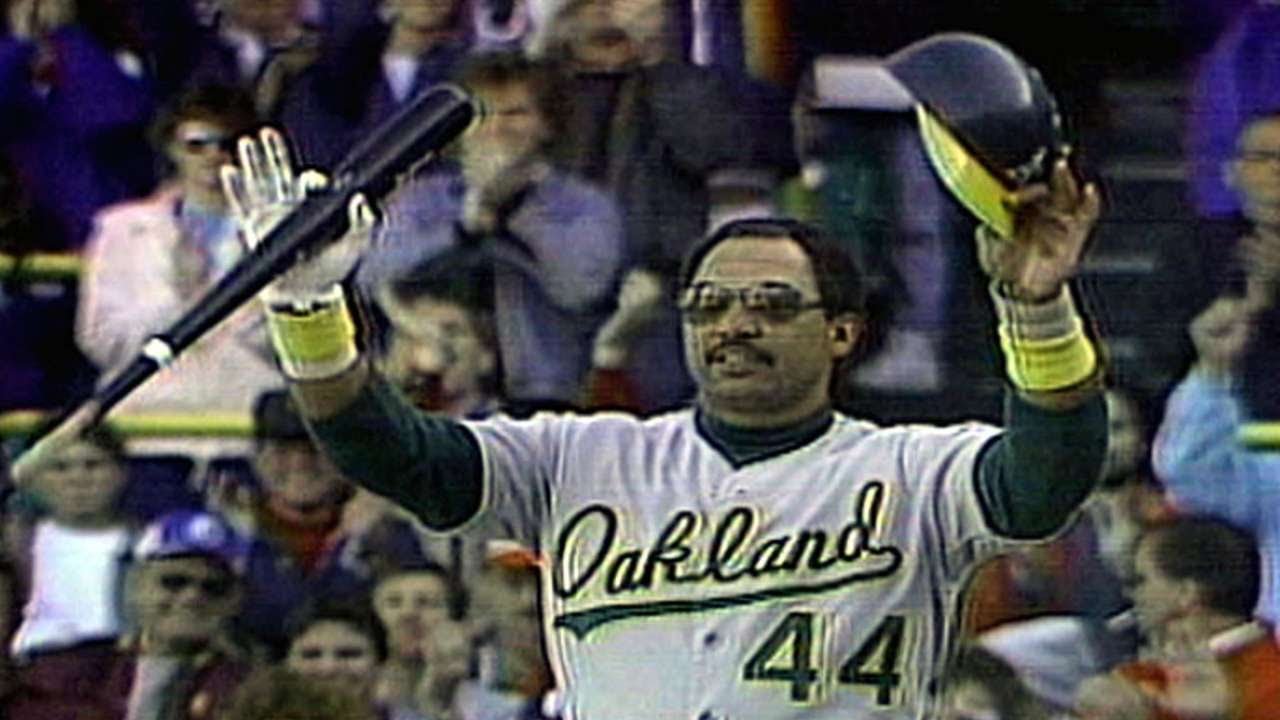
October 4, 1987, 30 years ago: Reggie Jackson plays his last major league game, for the Oakland Athletics against the Chicago White Sox at Comiskey Park in Chicago. He had already announced that this would be his last season.
He doubles home Jose Canseco off Floyd Bannister in the 1st inning, draws a walk against Bannister in the 4th, flies out to center field against Bill Long in the 6th, and then, with 2 out in the top of the 8th, he takes his last at-bat, against Bobby Thigpen. It is not the kind of result you would expect from Reggie Jackson, but it worked:
He strokes a single up the middle, breaking his bat in the process.
He finishes the day 1-for-3 with an RBI, and closes his career with 2,584 hits, including 563 home runs, making him the leading home-run hitter of his generation. But the White Sox win this game, 5-2, thanks to home runs by Ron Hassey and Carlton Fisk.
Last night, I saw a Facebook post showing Reggie giving hitting advice to the current Yankees. And October home runs were delivered by Didi Gregorius, Brett Gardner and Aaron Judge, and the Yankees won to advance to the American League Division Series.
Whatever Mr. October told them, it worked.
*
October 4, 1582: The Gregorian Calendar, ordered by Pope Gregory XIII to account for the differences in the seasons, so that religious holidays like Easter could be properly set, goes into effect in the Catholic world. In other words, tomorrow will not be October 5, but October 15, 1582.
The difference between the outdoing Julian Calendar, set by Julius Caesar in Roman times, and the Gregorian Calendar, is that years divisible by 100 will not be leap years, with a February 29, unless they are also divisible by 400. Example: 1600 and 2000 would be leap years; but 1700, 1800, 1900 and 2100 would not.
The countries led by the Protestant and Eastern Orthodox churches would not adopt it immediately. Prussia would not adopt the Gregorian Calendar until 1610; the rest of Germany, Switzerland, Norway, Denmark, the Netherlands and Belgium, would do so in 1700; the British Empire, including what would be the 1st 13 American States, 1752; Sweden and Finland, 1753; Japan, 1873; Egypt, until then using the Muslim calendar, 1875; Korea, 1876; China and Albania, 1912; Latvia and Lithuania, 1915; Bulgaria, 1916; the Soviet Union, 1918; Romania and Yugoslavia, 1919; Greece, 1923; and Turkey, the last holdout, 1926.
Modern international sport, including such events as the Olympic Games, the various World Cups, and so on would be very difficult to stage without a single unifying calendar.
*
October 4, 1777: The Battle of Germantown is fought in what is now Northwest Philadelphia. Sir William Howe, the British General already known as the man who conquered New York, now conquers the American capital of Philadelphia, routing General George Washington.
All seems lost for the new country and its Continental Army, until later in the month, at Saratoga, New York. Meanwhile, Washington will take his men to nearby Valley Forge, Pennsylvania, where a legend will be born.
This is the greatest defeat anyone calling Philadelphia home has ever suffered. And it has nothing to do with sports. Although the Phillies will have a disaster of their own in October 1977.
October 4, 1810: Eliza McCardle is born in Leesburg, Tennessee, and grows up in nearby Greenville. In 1827, she married Andrew Johnson. Having had no formal education, he credited her with teaching him how to write and perform arithmetic. They had 3 sons and 2 daughters.
In 1864, he was elected Vice President of the United States. On April 15, 1865, Abraham Lincoln died from his assassination, and Andrew was now the 17th President, making Eliza the First Lady. She was 16 at the time of her marriage, making her the youngest-married First Lady ever, although she was 54 when she reached the position.
But she was unable to fulfill the duties of First Lady, as she was already suffering from tuberculosis. The couple's daughter, Martha Johnson Patterson, was the
de facto First Lady until the Johnsons left office on March 4, 1869. Oddly, she outlived her husband, surviving until January 15, 1876, at age 65.
October 4, 1822: Rutherford Birchard Hayes is born in Delaware, Ohio, outside Columbus. In 1876, as Governor of Ohio, a former Congressman and a Union General in the American Civil War, he was elected President under dubious circumstances. But his actual time in office was blameless, and many people credit him with restoring the credibility of the Presidency after the scandals of Andrew Johnson and Ulysses S. Grant (who was personally honest, but made poor choices in friends appointees).
As far as I know, Hayes had nothing to do with baseball, although his time in office, including the 1877, 1878, 1879 and 1880 seasons, was a time of big growth for the game.
October 4, 1830: Belgium declares its independence from the Netherlands. The small, half-French, half-Dutch country has distinguished itself in sports, particularly in soccer and bicycle racing.
October 4, 1867, 150 years ago: At Brooklyn's Satellite Grounds‚ two black teams play a match called "the championship of colored clubs" by the
Daily Union newspaper. The Philadelphia Excelsiors outscore the Brooklyn Uniques‚ 37-24‚ in a game called after 7 innings on account of darkness.
October 4, 1872: Ernest A. Blood is born in Manchester, New Hampshire. From 1915 to 1924, he coached Passaic High School in North Jersey to 200 wins against just 1 loss. From 1919 to 1925, the "Passaic Wonder Five" won 159 consecutive games, believed to be the longest streak in American history. It did not end until after Blood left.
He left for nearby St. Benedict's Prep in Newark, coaching them until 1950, with a record of 421-128, including 5 State Championships. He died in 1955, before the Basketball Hall of Fame was established. He was elected in 1960.
October 4, 1876: The Agricultural and Mechanical College of Texas opens in College Station. In 1963, they made their nickname their official name: Texas A&M University. The "Aggies" have long had stories programs in baseball and football, producing Heisman Trophy winners John David Crow and Johnny Manziel, and producing such baseball greats as Rip Collins, Wally Moon and Chuck Konblauch.
October 4, 1880: At a special National League meeting in Rochester‚ the League prohibits its members from renting their grounds for use on Sundays and from selling alcoholic beverages on the premises. These rules are aimed at the Cincinnati club‚ which has sold beer and rented out the park to amateur teams for Sundays.
This led directly to the formation, with the Cincinnati Reds as founding member, of the American Association in 1882. They became known as the Beer and Whiskey League.
Also on this day, Alfred Damon Runyon is born in Manhattan, Kansas. But it would be Manhattan Island in New York City where he would make his name -- but first, he dropped his first name. Damon Runyon became an icon, associated with the more raffish side of New York, full of gamblers, con men, cops on the take, men on the make.
His stories would be adapted for the film
Little Miss Marker and the musical
Guys and Dolls. Even today, 70 years after his death, when you call someone or something "Runyonesque," people know exactly what you're talking about.
October 4, 1890: James "Deacon" White plays his last professional game, in a career that began in 1868. The 1st batter in the 1st game in the 1st professional league, the National Association, in 1871, he plays 3rd base (having spent the 1st half of his career as a catcher) for the Buffalo Bisons in the Players League, losing 5-0 to the team known as Brooklyn Ward's Wonders, at Olympic Park in Buffalo.
A 2-time National League RBI champion and its 1877 batting champion, he died in 1939, and was elected to the Hall of Fame in 2013 -- the 123-year gap between his last game and his election being a record for any sport through 2017.
October 4, 1891: On the final day of the American Association season, Ted Breitenstein of the St. Louis Browns (the team soon to be known as the Cardinals) throws a no-hitter against the Louisville Colonels in an 8–0 win. It is Breitenstein's 1st major league start. He faced the minimum amount of batters, 27, allowing just one base on balls.
It was also the last no-hitter thrown in the AA, as the league folded following the season.
October 4, 1892, 125 years ago: Amos Rusie of the New York Giants pitches 2 complete-game victories over the Washington Nationals (no connection to the current NL team with the name) at the Polo Grounds‚ winning 6-4 and 9-5.
The next season, the pitching distance will be extended from 50 feet to 60 feet, 6 inches, making achievements in pitching durability a lot harder. Many star pitchers of the time will never be the same, although Rusie will remain successful through the rest of the 1890s. However, it is the speedy pitching of Rusie, the Indiana native known as "the Hoosier Thunderbolt," that lead the NL to believe that a longer pitching distance would be safer for hitters.
October 4, 1895: The 1st U.S. Open golf tournament is held, at the Newport Country Club in Rhode Island. Horace Rawlins, a 21-year-old Englishman, won it.
Brooks Koepka won this year's tournament, at Erin Hills Golf Club, outside Milwaukee. It was his 1st win in a major tournament.
Willie Anderson, Bobby Jones, Ben Hogan and Jack Nicklaus hold the record for the most U.S. Open victories, with 4 each.
Hale Irwin was the oldest winner, at 45 in 1990. The youngest winner was John McDermott, in 1911: He would still be a teenager for a few more weeks. With the death in 2016 of Arnold Palmer, Gene Littler, in 1961, is the earliest surviving former winner. The 2018 tournament will be held from June 14 to 17, at Shinnecock Hills Golf Club in Shinnecock Hills, Suffolk County, on New York's Long Island.
Also on this day, Joseph Frank Keaton is born in Piqua, Kansas. He didn't grow up in any one place, as his parents were traveling vaudeville performers. A fall at the age of 18 months led a friend of the family to say, "That was a real buster!" The friend was Harry Houdini, and the boy was Buster Keaton for the rest of his life.
Roscoe "Fatty" Arbuckle gave him his start in silent films, and he built a career as perhaps the greatest silent comedian after Charlie Chaplin. Orson Welles called his 1926 Civil War film
The General "perhaps the greatest film ever made."
He developed a drinking problem, but recovered from it, and made the transition to talking pictures. Among his last roles were as a time traveler on a 1962 episode of
The Twilight Zone, and in the 1963 cast-of-thousands comedy epic
It's a Mad, Mad, Mad, Mad World.
*
October 4, 1904: Idrottsföreningen Kamraterna Göteborg is founded in Sweden. IFK
Göteborg won the Swedish Championship in 1908, 1918 and 1918, then the national league, the Allsvenskan, 13 times from 1935 to 2007. They've won the Svenska Cupen (Swedish Cup) 7 times since 1979, most recently in 2015.
They are also the only Swedish team ever to win a major European trophy, having won the UEFA Cup (now the UEFA Europa League) in 1982 and 1987. Their closest call in the European Cup/UEFA Champions League is the Semifinals in 1986 and 1993.
October 4, 1905: Just 1 point apart in the batting race on the final day of the season, Cincinnati Reds center fielder Cy Seymour and Pittsburgh Pirates shortstop Honus Wagner played against each other in a doubleheader. Seymour entered the last day with a league-leading .365 average, and Wagner was in 2nd place, batting .364. A very good day at the plate for Honus combined with a poor one for Cy would have reversed their positions.
Seymour had 4 hits in 7 attempts to end up with the NL batting title (.377), while Wagner collected 2-for-7 to end up in 2nd place (.363). Don't weep for Honus, though: He won 8 batting titles.
A newspaper account of the day stated "…10,000 were more interested in the batting achievements of Wagner and Seymour than the games…cheer upon cheers greeted the mighty batsmen upon each appearance at the plate…"
October 4, 1906: The Chicago Cubs beat the Pittsburgh Pirates, 4-0, and notch their 116th win of the season. It remains a major league record, although it was tied in 2001 by the Seattle Mariners. But the Cubs' winning percentage of .763 remains a record for either of the current major leagues. Both the 1906 Cubs and the 2001 M's found out that it doesn't mean a whole lot if you don't win the World Series.
October 4, 1909: Thomas McCall Smith is born in Fenwick, Scotland. On April 9, 1938, he was 1 of 5 players for Lancashire club Preston North End who played in Scotland's stunning 1-0 win over England at Wembley Stadium in London. Three weeks later, those players returned to Wembley, and led Preston to win the 1938 FA Cup.
Tom Smith had previously played for Kilmarnock in Scotland, and later served as their manager. He lived until 1998.
*
October 4, 1910: Frank Peter Joseph Crosetti is born in San Francisco. "The Crow" played for the Yankees from 1932 to 1948, and coached for them from 1949 to 1968. No other uniformed man has been a part of as much baseball title-winning as he has: 23 Pennants and 17 World Championships. (That's 8 Pennants and 7 World Championships as a player, 15 Pennants and 10 World Championships as Yankee 3rd base coach.) He was also a 2-time All-Star
The shortstop was a good fielder, but not much of a hitter, batting .245 lifetime. He did hit a home run off Dizzy Dean, who was running out the string with the Cubs, in Game 2 of the 1938 World Series. He was also the last survivor of the Yankees' 1936 World Series win.
In 1969, wanting to be closer to home on the Pacific Coast -- he'd moved to Stockton, California -- he accepted the 3rd base coach's job with the expansion Seattle Pilots, who included former Yankee pitcher Jim Bouton. Frankie didn't think much of Jim, and the feeling was mutual. A segment in Bouton's book
Ball Four suggests that Crosetti holds the record for "slaps on the ass" given by 3rd base coaches to home run hitters rounding the bases. It's estimated that he waved 16,000 runners home.
When the Pilots moved to Milwaukee to become the Brewers in 1970, Crosetti didn't go with them, coaching with the Minnesota Twins in 1970 and '71, before finally calling it quits. He and the Yankees had a bit of a strained relationship: He never returned to Old-Timers' Day, usually saying he didn't want to fly across the country; and he was the only member of the 1932 Yankees to publicly say that he thought Babe Ruth did not "call his shot" in that year's World Series. He was not the last survivor of the '32 Yanks, though: He died in 2002, and pitcher Charlie Devens outlived him by a year.
October 4, 1913: Washington Senators manager Clark Griffith uses 8 pitchers -- unheard-of in that era -- in an end-of-season farce game with the Boston Red Sox‚ including 5 in the 9th inning. At age 43‚ the former Chicago Cubs hurler pitches an inning himself. Coach John Ryan‚ also 43‚ catches. Griffith also plays right field, where he plays one off his head and misplays Hal Janvrin's liner into an inside-the-park homer.
On the other end of the scale‚ 17-year-old Merito Acosta, a white Cuban who was one of the 1st Hispanic players in the American major leagues, plays left field alongside Walter Johnson in center field. Johnson then comes in for the 8th inning to lob pitches to 2 hitters. Both batters‚ Clyde Engel and Steve Yerkes, lace hits to send Johnson back to center. Then‚ in relief‚ Nats catcher Eddie Ainsmith‚ in his only major league pitching appearance‚ gives up 2 triples to allow the baserunners to score.
The Sox score in the 9th on Hal Janvrin's 2nd inside-the-park homer of the game. Joe Gideon‚ in his only pitching appearance, retires the last 2 batters as Washington wins‚ 10-9‚ beating Fred Anderson who goes the distance.
The 2 runs "allowed" by the Big Train will have historical repercussions: His ERA for the season goes from 1.09 to 1.14‚ and Bob Gibson's 1.12 ERA in 1968 will put Johnson's ERA in 2nd place on the all-time list (in the post-1893 60-feet-6-inches era, anyway). The 8 pitchers sets a MLB record that won't be matched until the Dodgers do it on September 25‚ 1946.
October 4, 1917, 100 years ago: Marvel Keith Harshman is born in Eau Claire, Wisconsin. His parents named him Marvel Keith? That's harsh, man.
Okay, atrocious pun aside, Marv Harshman was a great athlete, winning 13 varsity letters at Pacific Lutheran University in Parkland, Washington, and being drafted by the NFL's Chicago Cardinals. He enlisted in the U.S. Navy instead.
After World War II, he went into coaching, running the baseball, football and basketball programs at Pacific Lutheran, then basketball at Washington State, and then from 1971 to 1985 at the University of Washington. He won 637 games as a college basketball coach, and won the 1984 and 1985 Pacific-10 Conference titles at UW. He died in 2013.
October 4, 1918: At 7:36 PM, the T.A. Gillespie Company Shell Loading Plant, making munitions for the U.S. effort in World War I, explodes on Cheesequake Creek in the Morgan section of Sayreville, Middlesex County, New Jersey.
The fires started could be seen for miles, including across the Arthur Kill in Staten Island. Over 300 buildings were destroyed -- including the company's records, so it's not known for sure how many people died, but the number is believed to be over 100.
I've lived my whole life in Middlesex County, and this is the greatest tragedy ever to befall Central Jersey. Today, the Morgan Marina and a housing development are on the site. It's a gated community, so it might be difficult to visit.
A cemetery, where some of the victims are buried under a large monument, is on Ernston Road on the border between Sayreville and Old Bridge. I used to pass it on the way to a job at a building on Ernston and U.S. Route 9.
It was particularly poignant on April 15, 2009, the 20th Anniversary of the Hillsborough Disaster in England, at which a similar number of people died, 96: Having to walk up Ernston from my bus stop in order to be on time for work at 10:30 AM, I passed the cemetery at 10:06 -- 3:06 PM British time, the time the FA Cup Semifinal between Liverpool and Nottingham Forest was stopped due to the referee realizing what was happening.
*
October 4, 1922: Game 1 of the World Series. The Yankees lead the Giants 1-0 in the bottom of the 8th, but the Giants rally off Bullet Joe Bush, and make a 3-1 winner out of Rosy Ryan.
Also on this day, Donald Eugene Lenhardt is born. He was a utility player who was with the St. Louis Browns when they moved to become the Baltimore Orioles in 1953-54. He served as the 1st base coach for the Red Sox from 1970 to 1973, and then as one of their scouts until 2004. He died in 2014.
October 4, 1923: John Charles Carter is born in the Chicago suburb of Wilmette, Illinois. We knew him as Charlton Heston -- and as historical figures Moses, Marc Antony (in 3 different films), John the Baptist, El Cid, Michelangelo, King Henry VIII, Cardinal Richelieu, William Clark (of Lewis & Clark), Andrew Jackson (in 2 films), General Henry Hooker, Buffalo Bill Cody and General Charles "Chinese" Gordon; and fictional characters Judah Ben-Hur, Peer Gynt and Robert Neville.
He played Ron Catlan, an aging quarterback, in the 1969 film
Number One. In 2010, with the demolition of the original Yankee Stadium complete, I knew -- especially in a city still hurting from the 9/11 attacks -- it would have been wrong, but I wanted to yell his line as Colonel George Taylor, at the end of
Planet of the Apes: "Oh my God. I'm back. I'm home. All the time, it was... We really, finally did it. You maniacs! You blew it up! Ah, damn you! God damn you all to hell!"
Despite his real name, and showing no aversion to science fiction (as Taylor, as Neville in
The Omega Man, and as Detective Frank Thorn in
Soylent Green), Charlton Heston never played John Carter of Mars.
He was dedicated to civil rights, even attending the March On Washington in 1963. But he was a conservative on other issues, and proudly delivered the National Rifle Association's catchphrase when he spoke at its conventions: "The only way you're going to get my gun is to pry it from my cold, dead hands!"
His hands, and the rest of him, became cold and dead in 2008. The status of his gun collection is unknown, but it was likely left to family members.
October 4, 1924: Game 1 of the World Series, the 1st Series game ever to be played in the Nation's Capital. President Calvin Coolidge and First Lady Grace Coolidge attend. She loves baseball. He doesn't.
Walter Johnson, of course, starts for the Washington Senators. But the postseason experience of the New York Giants, who've won their 4th straight Pennant, shows as they tie the game in the 9th and win it in the 12th, 4-3.
Also on this day, 3 legendary football stadiums open. Grant Park Municipal Stadium opens on the shore of Lake Michigan in Chicago. Austin Community Academy High School plays football against Louisville Male High School. Today, we think of Chicago as a football city and Louisville as a basketball city, but Louisville wins 26-0. In 1925, the huge stadium would be renamed Soldier Field.
Also, Michie Stadium opens at the U.S. Military Academy in West Point, Orange County, New York. Named for Captain Dennis Michie, who organized the 1st Army football team in 1890, and was killed in the Spanish-American War in 1898, its 1st game is a 17-0 Army win over St. Louis University.
It seats 38,000, and sits on the west bank of the Hudson River, surrounded by trees, giving it, especially with the leaves changing in mid-season, one of the greatest settings in college football. The playing surface, which has sadly been artificial turf since 1977, has been named Red Blaik Field since 1999, in memory of the man who coached Army to the 1944 and '45 National Championships.
Also opening on this day is Memorial Stadium at the University of Minnesota in Minneapolis. "The Brick House" opens with a 14-0 home win over the University of North Dakota. The Golden Gophers will play there until 1981, then move into the Metrodome, across the Mississippi River and well across town from campus.
The old stadium was demolished in 1992, and the McNamara Alumni Center was built on the site. In 2009, TCF Bank Stadium was built a block away.
October 4, 1925: The baseball regular season ends, and Rogers Hornsby of the St. Louis Cardinals has won the National League Triple Crown, with a .403 batting average, 39 home runs and 143 RBIs. He is the 1st player to win it twice, and only Ted Williams has matched that.
October 4, 1928: Game 1 of the World Series. Bob Meusel hits a home run to make a winner out of Waite Hoyt, and the Yankees beat the St. Louis Cardinals, 4-1.
Also on this day, Thomas Lynch Raymond dies in Newark at age 53. He is the only Mayor of that city to have died in office. He served in 1915 and 1916, and got Port Newark built. He had been elected again in 1925, and began the process of building a new rail terminal to replace the city's Pennsylvania Railroad station with a new Penn Station. It opened in 1935, and the area around it is named Raymond Plaza, with the street to the north named Raymond Boulevard.
October 4, 1929: Leo Sanford (no middle name) is born in Dallas. A linebacker, he was elected to Louisiana Tech's Athletic Hall of Fame, and is 1 of 14 surviving members of the 1958 NFL Champion Baltimore Colts.
*
October 4, 1930: Notre Dame Stadium, the house that Knute Rockne built, opens on the school's campus in South Bend, Indiana. The 1st game is against Southern Methodist University of Dallas. Final score: Catholics 20, Protestants 14.
Notre Dame went undefeated that season, 10-0, and aside from SMU, only Army seriously challenged them, losing 7-6 in front of 110,000 at Soldier Field in Chicago. Notre Dame was retroactively recognized as National Champions.
The season finale, a 27-0 win over USC at the Los Angeles Coliseum on December 6, would turn out to be the last game Rockne ever coached, as he was killed in a plane crash in Kansas on March 31, 1931.
October 4, 1932: Harold Edward Patterson is born in Garden City, Kansas. He might be the greatest football player you've never heard of. This is because he starred in the Canadian Football League.
A receiver and defensive back -- the CFL hung onto single-platoon football a lot longer than the NFL did -- he starred at the University of Kansas and was drafted by the Philadelphia Eagles in 1954, but the Montreal Alouettes offered more money. He was an 11-time All-Star, and was named the CFL's Most Outstanding Player in 1956, setting several League records (most since broken), including 88 catches, and was the 1st CFL player to gain 2,000 yards from scrimmage.
He was controversially traded to the Hamilton Tiger-Cats, and led them to the 1961 and 1967 Grey Cups. In 2006, TSN (The Sports Network, Canada's version of ESPN) named him one of the CFL's 50 Greatest Players, and in 2008 the Alouettes retired his Number 75. He lived to see both of these honors, dying in 2011.
October 4, 1934: Robert Lee Huff is born in Edna Gas, West Virginia -- a company town, I'm presuming, and it's now named Farmington. I can find no record of why he was called Sam. He starred at linebacker for West Virginia University, and along with basketball star Jerry West still ranks as 1 of their 2 greatest athletes. He was a regular All-American and an Academic All-American.
He was a 5-time All-Pro with the New York Giants, the cornerstone of the 1st great NFL defense of the 2-platoon era. He helped the Giants reach 6 NFL Championship Games, although they only won the 1st, in 1956.
In 1960, CBS News'
The Twentieth Century did a feature on him, "The Violent World of Sam Huff," a precursor to NFL Films in that, for the 1st time, non-players got to hear what playing football really sounds like. To put it another way: He was Lawrence Taylor (without the sex and drug scandals) before Lawrence Taylor was even born.
In 1964, he was traded to the Washington Redskins, and has been with them ever since, first as a linebacker, then an assistant coach, and then as a broadcaster, teaming with ex-teammate Sonny Jurgensen until Sam retired in 2012. He was named to the NFL 1950s All-Decade Team, the Pro Football Hall of Fame, the New York Giants Ring of Honor and the Washington Redskins' Ring of Fame.
He is still alive, 1 of 6 surviving players from the 1956 NFL Champions. The others are Rosey Grier, Harland Svare, Dick Modzelewski, Henry Moore and Ben Agajanian.
October 4, 1935: Game 3 of the World Series is a wild one. Chicago Cubs manager Charlie Grimm and 2 of his players, 3rd baseman Woody English and outfielder Tuck Stainback, are thrown out of the game for bench-jockeying. Coach Del Baker of the Detroit Tigers is also thrown out, for arguing a pickoff play at 3rd base. That's 4 uniformed men thrown out of 1 World Series game -- and none was actually playing in the game!
The game goes to 11 innings, and is won 6-5 by the Tigers, on Jo-Jo White's single scoring Marv Owen.
October 4, 1936: Game 4 of the World Series. Carl Hubbell was in the middle of a 24-game regular season winning streak, and Time magazine called this Series "a personal struggle between Hubbell and Gehrig."
Well, Hubbell had won Game 1, but Lou Gehrig homers off him in this Game 4, and the Yankees win, 5-2. Monte Pearson is the winning pitcher, and now the Yankees are 1 win away from taking the Series.
Also on this day, London's police and anti-fascist demonstrators clash with members of the British Union of Fascists in the East End. It was known as the Battle of Cable Street, and it was Britain's 1st message that it would not put up with far-right tyranny. Sadly, in 1938, its government did. Thankfully, in 1939, it stopped.
Also on this day, Charles John Hurley is born in Cork, Ireland. A centreback, in the 1950s, Charlie Hurley starred for South London soccer team Millwall, and was later elected to their team hall of fame. In the 1960s, he starred for North-East club Sunderland, and closed his career with Bolton Wanderers.
While still playing for Sunderland, he managed the Ireland national team, and later managed Berkshire club Reading. In 2007, Millwall fans, who had nicknamed him "The King," voted him their best player ever. In 1979, on the occasion of the club's 100th Anniversary, Sunderland fans -- apparently having already forgotten the team's 1930s glory -- voted him their Player of the Century. He is still alive.
October 4, 1937, 80 years ago: The St. Louis Cardinals trade shortstop Leo Durocher to the Brooklyn Dodgers for Johnny Cooney‚ Joe Stripp‚ Jim Bucher‚ and Roy Henshaw. Durocher, first as shortstop, then as manager, will become the face of the Dodgers for the next 10 years. Then, he will jump to the New York Giants, and become the face that Dodger fans love to hate.
October 4, 1939: Game 1 of the World Series. Red Ruffing of the Yankees and Paul Derringer of the Reds are tied 1-1 at Yankee Stadium, going into the bottom of the 9th. Charlie Keller triples with 1 out. Reds manager Bill McKechnie orders Joe DiMaggio intentionally walked to set up the double play.
But that brings up Bill Dickey, not merely the de facto Yankee Captain in the wake of Lou Gehrig's forced retirement, but the best-hitting catcher who has ever lived. (Shut up, Met fans: Even with steroids, Mike Piazza couldn't carry his jock.) Dickey singles Keller home, and the Yankees win, 2-1. McKechnie's move essentially decides the Series.
*
October 4, 1940: Ten years to the day after Notre Dame Stadium opens, the film Knute Rockne, All-American premieres. Pat O'Brien plays Rockne, and Ronald Reagan plays George Gipp. At 29, he was already too old to play the role.
It wasn't the biggest lie of the movie, though. The film depicts the story Rockne made up for the 1928 Army-Notre Dame game at Yankee Stadium: That of Gipp's 1920 deathbed request to "Win just one for the Gipper."
It made Reagan forever identified with the role, and he was called "The Gipper" all through his political career. Even now, when the Republican Party, for whom he is the greatest icon (Abraham Lincoln being embarrassingly pro-black and anti-Southern), needs a victory, either for a bill or for an election, campaigners say they want to win it "for the Gipper," meaning Reagan.
People who don't know their football history, or have never heard of George Gipp -- and don't know that he was a bum, if one very talented at football -- use the expression. Had the truth about the alcoholic, womanizing, compulsive-gambling, rarely attended classes or Mass Gipp been known in 1940, the movie never would have been made -- and Reagan might never have been elected Governor of California in 1966 or President in 1980.
Also on this day, Victor Edward Hadfield is born in the Toronto suburb of Oakville, Ontario. Vic was born 1 day after his future New York Ranger linemate, Jean Ratelle. Together with Rod Gilbert, they formed the GAG Line (Goal-a-Game), reaching the 1972 Stanley Cup Finals.
Vic scored 323 goals in an NHL career that lasted from 1961 to 1976. He has not yet joined his linemates Gilbert and Ratelle in the Hockey Hall of Fame, but a 2009 book named him Number 20 on a list of 100 Ranger Greats. He now runs a golf driving range. His Number 11 was retired by the Rangers, but for Mark Messier, not for him.
Also on this day, Silvio Marzolini (no middle name) is born in Buenos Aires, Argentina. A centreback, he led hometown club Boca Juniors to 5 league titles from 1962 to 1970, including a "Double" with the Copa Argentina in 1969. He managed them to a league title in 1981. He is still alive.
October 4, 1941: In the 7th inning of a scoreless tie‚ Yankees pitcher Marius Russo bats against Dodger pitcher Fred Fitzsimmons, and launches a line drive off Fat Freddie's kneecap. The ball caroms to shortstop Pee Wee Reese, who throws him out to end the inning. The Yankees score 2 in the 8th off reliever Hugh Casey to win 2-1.
On the official World Series highlight film, it's not clear how bad the injury is. Fitzsimmons is shown limping off the field under his own power -- probably a good thing, since he would have been pretty hard to carry off with all that weight, It turns out that the kneecap is broken.
Once an All-Star for the Giants, who seemed to specialize in beating the Dodgers, he had crossed town to be welcomed by the Flatbush Faithful, and they wouldn't have won the 1941 Pennant without him. But, at age 41, he will pitch in just 1 game in 1942, before accepting his injury and retiring to the coaching ranks and running a Brooklyn bowling alley that was popular with Dodger fans for many years.
Also on this day, 2 very different American writers are born. Roy Alton Blount Jr. is born in Indianapolis, and grows up in Decatur, Georgia. Essentially a humorist, he is tied to sports as a result of his first book, a look at the 1973 Pittsburgh Steelers, a team on the verge of a dynasty, but not quite there: About Three Bricks Shy of a Load.
On the same day, Howard Allen Frances O'Brien is born in New Orleans. Her mother named her Howard after her husband. After she got married, she began using the name Anne Rice, and her books have been published under that name.
She is known for her Vampire Chronicles, featuring the vampire Lestat de Lioncourt. She is a New Orleans Saints fan, and gave an interview to NFL Films in which she discusses the legend that the Saints are cursed because the Superdome was built over a cemetery.
October 4, 1942, 75 years ago: Game 4 of the World Series. Charlie Keller homers, but the Cardinals continue to surprise the Yankees in The Bronx, winning 9-6. The Cards can wrap up the Series tomorrow.
October 4, 1943: James Francis Williams is born in the Santa Barbara suburb of Santa Maria, California. Spelling his nickname as "Jimy" instead of the more traditional "Jimmy," he was a middle infielder who appeared in 14 games for the Cardinals in 1966 and 1967, and did not get a World Series ring when the Cards won the '67 World Series.
In 1989, he managed the Toronto Blue Jays to the American League Eastern Division title. In 1995, as a coach under Bobby Cox, he won a ring with the Atlanta Braves. He managed the Boston Red Sox to the AL Wild Card in 1998 and '99, infamously complaining about the umpiring when the Yankees beat the Sox in the AL Championship Series. He managed the Houston Astros to the National League Wild Card in 2004. In 2008, as a coach under Charlie Manuel, he won a ring with the Philadelphia Phillies, then resigned after the season. For whatever reason, he has not worked in baseball since.
His son Brady Williams is the manager of the Montgomery Biscuits, the Double-A affiliate of the Tampa Bay Rays. His son Shawn Williams is the manager of the Clearwater Threshers, a Class A affiliate of the Phillies.
Also on this day, Karl-Gustav Kaisla is born, despite his German given name, in Helsinki, Finland. He was the referee for the "Miracle On Ice" game between America and the Soviet Union at the 1980 Winter Olympics. He later served as his homeland's supervisor of hockey referees, and died in 2012.
October 4, 1944: The 1st all-St. Louis World Series (and the only one, as it turned out) opens with the Browns‚ as the official visiting team (both teams play at Sportsman's Park)‚ beating the Cardinals 2-1 on George McQuinn's homer. Denny Galehouse is the winning pitcher, while Mort Cooper loses despite allowing just 2 hits.
It is the 1st Series in which all the games are played west of the Mississippi River. There will not be another until 1965, and not another until 1974. The Series is dubbed the Streetcar Series (as opposed to a Subway Series), and is played with no days off.
On the same day, Alfred E. Smith dies of a heart attack -- some would say a broken heart, as his wife had died a few months earlier. He was 70. Governor of New York from 1919 to 1921, and again from 1923 to 1929, he threw out the ceremonial first ball before the 1st game at the original Yankee Stadium in 1923.
He ran for President in 1924, and was nominated by the Democratic Party in 1928, but his Catholicism, his opposition to Prohibition, and the general prosperity under Republican leadership meant he was doomed to lose big to Herbert Hoover. He ran again in 1932, but lost to the man who succeeded him as Governor, Franklin D. Roosevelt. The 2 men, once allies, became bitter rivals. Al went on to run the company that built the Empire State Building, and the film of the dedication ceremony shows Governor Roosevelt enjoying the festivities, but ex-Governor Smith looks like he'd like to jump off.
Today, FDR is remembered as the man who saved the country in the 1930s, and the world in the 1940s. Al Smith is remembered as... the namesake of the Al Smith Dinner, a charity fundraiser run by the Archdiocese of New York every October. In Presidential election years, the nominees of both major parties are invited, and to miss attending is a major faux pas.
On the same day, Anthony La Russa Jr. is born in Tampa. Tony was an inconsequential infielder in the major leagues from 1963 to 1973, but became a very consequential manager. From 1979 to 2011, he won 2,728 games, 15 Division titles (1983 with the Chicago White Sox; 1988, '89, '90 and '92 with the Oakland Athletics, all in the AL West; 1996, 2000, '01, '02, '04, '05, '06, '09, '13 and '14 with the St. Louis Cardinals, all in the NL Central), 6 Pennants (3 in each League), and 3 World Series (1989 with the A's, 2006 and 2011 with the Cards, making him only the 2nd manager after Sparky Anderson to win them in both Leagues.
Unfortunately, his legacy may be a negative one. Not only did he pioneer the use of computers to study baseball statistics, thus leading to constant pitching changes, but he also pioneered, through Dennis Eckersley, using your closer for just the 9th inning.
He is now an executive with the Arizona Diamondbacks. He is in the Hall of Fame, and the Cardinals have retired his Number 10 and elected him to their team Hall of Fame.
October 4, 1945: Jugoslovensko sportsko društvo Partizan, commonly abbreviated as JSD Partizan, is founded in Belgrade, then the capital of Yugoslavia, now the capital of Serbia. It runs several sports teams, the best-known of which is the soccer team known to most of the world as Partizan Belgrade. Their rivalry with cross-town Red Star is one of the most vicious on the planet, in any sport, in any country.
They have won a country-leading 26 national championships in soccer, most recently in 2015, and are the current holders of the Serbian Cup; a country-leading 21 titles in men's basketball, plus the 1992 Euroleague title; a country-leading 7 titles in women's basketball; and a country-leading 20 titles in hockey, including the last 11 in a row.
October 4, 1946: Barney Oldfield dies of a heart attack in Beverly Hills, California. He was 68. He was the 1st great auto racer, and the 1st man recorded as having driven 60 miles per hour -- a mile a minute. He was 1 of the 10 charter inductees in the Auto Racing Hall of Fame.
Also on this day, Gifford Pinchot dies of leukemia in New York, at age 81. In 1905, President Theodore Roosevelt appointed him the 1st Chief of the United States Forest Service. He served as Governor of Pennsylvania from 1923 to 1927, and again from 1931 to 1935.
His terms included the 1923 opening of the University of Pennsylvania's Franklin Field and the construction of their Palestra arena, the 1925 World Series and the 1927 National League Pennant won by the Pittsburgh Pirates, the 1926 NFL Championship won by the Philadelphia-based Frankford Yellow Jackets, the 1931 American League Pennant won by the Philadelphia Athletics, the 1933 construction of 30th Street Station, the 1933 establishments of the Philadelphia Eagles and the Pittsburgh Steelers, and the 1933 law striking down the ban on Sunday sports in Pennsylvania, making the Eagles' and Steelers' franchises viable and probably saving the A's and the Philadelphia Phillies from outright bankruptcy.
Also on this day, Susan Abigail Tomalin is born in Jackson Heights, Queens, New York City, and grows up in nearby Edison, Middlesex County, New Jersey. We know her as Susan Sarandon. Her ex-husband Chris Sarandon, ex-partner Louis Malle, ex-partner Franco Amurri, ex-partner Tim Robbins (with whom she hooked up on the set of the baseball-themed film
Bull Durham), daughter Eva Amurri and son Jack Henry Robbins are all either actors or directors (or both). Another son, Miles Robbins, has yet to enter the family business.
I used to love Susan Sarandon. She was, like me, a baseball fan from Central Jersey. And she was a redhead, which I liked. And she was a bombshell -- at 70, she still looks great. But she's a Mets and Rangers fan. That's 2 strikes right there. And while I didn't mind her support for Bernie Sanders during the 2016 Democratic Primaries, her refusal to support Hillary Clinton -- there has never been a Presidential nominee more like Susan, ever -- is strike 3.
But, like Annie Savoy, her character in
Bull Durham,
she still believes in the Church of Baseball. Then again... "Makin' love is like hittin' a baseball: You just gotta relax and concentrate." Relax
and
concentrate? That's contradictory!
She won an Oscar for playing Sister Helen Prejean, the real-life nun and anti-death penalty activist, in
Dead Man Walking. Susan Sarandon winning an Oscar is not a shock. Susan Sarandon playing a nun?
That is a shock! That's like casting Harvey Fierstein to play JFK!
Also on this day, Michael Glen Mullen is born in Los Angeles. He began his service in the U.S. Navy at the height of the Vietnam War, rose to become the commanding officer of the aircraft carrier USS
Yorktown, the
George Washington Carrier Battle Group, the U.S. Second Fleet, and Chief of Naval Operations. From 2007 to 2011, Admiral Mullen was Chairman of the Joint Chiefs of Staff. He is now retired.
October 4, 1947, 70 years ago: Game 5 of the World Series. It was said of Dodger pitcher Rex Barney that he would be the best pitcher in the world if the plate were high and outside. On this day, he walks 9 Yankees in less than 5 innings -- 1 more than Bill Bevens in 9 innings the day before -- and a Joe DiMaggio homer in the 5th makes the difference, as the Yankees win, 2-1. They can wrap it up tomorrow.
October 4, 1948: In a 1-game playoff for the AL Pennant at Fenway Park‚ the Cleveland Indians beat the Boston Red Sox 8-3, behind 30-year-old rookie knuckleballer Gene Bearden, who wins his 20th game. It was the year of a lifetime for Bearden: He had never been that good before, and he never would be again.
Red Sox manager Joe McCarthy, who had won so much with the Yankees, ignores the well-rested rotation pitchers Ellis Kinder and Mel Parnell to go with journeyman Denny Galehouse, who was 36 years old, and was only 8-7 that season. But it wasn't a totally crazy pick: Galehouse had helped the St. Louis Browns win the 1944 Pennant, so he was used to clutch pitching, and 8-7 isn't a terrible record.
But with the score 1-1 in the 4th‚ Ken Keltner hits a 3-run home run over the left-field fence. Indians shortstop-manager Lou Boudreau gets 4 hits‚ including a pair of homers‚ and finishes the year with just 9 strikeouts.
Who is still alive from this game, 68 years later? For the Indians, only Eddie Robinson, who pinch-hit, and then took over at 1st base, for Allie Clark, the next-to-last survivor of the '48 Indians, who died in 2012; he was a South Amboy, New Jersey native whom the Yankees had traded with Joe Gordon to get Allie Reynolds. For the Red Sox, only Bobby Doerr. Their next-to-last survivor, Tom Wright, died last month.
That same day, in St. Louis‚ Taylor Spink‚ publisher of
The Sporting News, writes in a Baltimore newspaper that Baltimore will have an AL team within two years: "You can put a clothespin in this: Baltimore will be in the American League‚ if not next year‚ then surely in 1950."
In spite of his deep knowledge of the way the game had been working, including no franchises moving to a different city since 1902, he was wrong -- but he turned out to be off by only 4 years. It was his hometown Browns who became the new major-league version of the Baltimore Orioles, following previous major- and minor-league teams with those names. Spink and the NL's Cardinals were tight, and he didn't particularly care whether the Browns moved.
On this same day, Lewis Robert "Hack" Wilson was discovered unconscious after a fall in his Baltimore home. He was suffering from pneumonia and internal hemorrhaging, brought on by years of serious alcohol abuse. He died on November 23. He was only 48 years old.
A star slugger with the Chicago Cubs, in 1930 he had set the National League record of 56 home runs, and the major league record that still stands of 191 runs batted in. He led the NL in home runs 4 times. He had won Pennants with the New York Giants in 1923 and '24, and with the Cubs in 1929. His lifetime batting average was .307. But he couldn't run or field. It was said that he was "shaped like a beer barrel, and not unfamiliar with its contents." He last played in the majors at age 34, with 244 home runs. He should have had a lot more.
He was once the highest-paid player in the NL, with only Babe Ruth in the AL making more money. But because of his drinking and his final illness, he died without a penny to his name. His son Robert refused to claim the body. Ford Frick, then President of the NL, covered the funeral expenses.
Between his fall and his death, he gave an interview to CBS radio, which was reprinted in the newspapers after his death. Charlie Grimm, the Cubs' manager at the time, posted a framed excerpt from that interview in the Cub clubhouse. It is still there:
Talent isn't enough. You need common sense and good advice. If anyone tries to tell you different, tell them the story of Hack Wilson... Kids in and out of baseball who think because they have talent, they have the world by the tail. It isn't so. Kids, don't be too big to accept advice. Don't let what happened to me happen to you.
*
October 4, 1950: With his ace Robin Roberts exhausted, and his Number 2 starter Curt Simmons having been drafted into the Korean War, Philadelphia Phillies manager Eddie Sawyer rolls the dice and starts Jim Konstanty in Game 1 of the World Series against the Yankees at Shibe Park. Sawyer tells the press that it's not quite the gamble that it seems, because Konstanty had pitched long relief during the season, including one game where he went 9 innings. He was about to become the 1st relief pitcher ever to be named either League's Most Valuable Player,
It wasn't Konstanty's fault that the gamble didn't quite pay off: He was fantastic, pitching 8 innings, allowing only 1 run (on a double by Bobby Brown and 2 sacrifice flies) on 4 hits and 4 walks. But Vic Raschi of the Yankees was even better, tossing a shutout with 2 hits and 1 walk, and the Yankees win, 1-0.
The next day, Sawyer starts Roberts on 3 days' rest, and he, too, is magnificent in defeat. The Phils lose the 1st 3 games of the Series, all by 1 run.
October 4, 1951: The Giants have no time to really celebrate their amazing Pennant won the day before, as the World Series gets underway. But momentum is on their side. Monte Irvin steals home in the 1st inning (and, unlike Jackie Robinson 4 years later, the film definitively shows that he was safe) and collects 4 hits. The Giants defeat Allie Reynolds and the Yankees 5-1, with Dave Koslo going all the way at Yankee Stadium.
With Don Mueller missing the World Series due to the ankle he broke in the climactic inning the day before‚ home run hero Bobby Thomson switches to 3rd base, and the Giants field the 1st all-black outfield in a World Series: Irvin in left, soon-to-be Rookie of the Year Willie Mays in center, and Hank Thompson in right. Thompson and Irvin had been the 1st black players for the Giants, both debuting on July 8, 1949: Thompson as a starter, Irvin as a pinch-hitter.
October 4, 1952: Game 4 of the World Series. Allie Reynolds pitches a 4-hit shutout, to top Joe Black, who also allows just 4 hits. Johnny Mize, just 3 months short of his 40th birthday, hits a home run. The Yankees win, 2-0, and tie up the Series.
October 4, 1953: Game 5 of the World Series at Ebbets Field. Mickey Mantle hits a 3rd inning grand slam off Russ Meyer in the 3rd inning‚ and the Yanks hold on to win 11-7 in a game that features 25 hits and 47 total bases.
*
October 4, 1955: For the 1st time, the Brooklyn Dodgers win a World Series. They had been 0-7 in the competition, 0-5 of that against the Yankees. This time, Dem Bums dooed it, and against the Yanks, at Yankee Stadium, to boot.
After losing the World Series to Boston in 1916, to Cleveland in 1920, and to the Yankees in 1941, 1947, 1949, 1952 and 1953; blowing Playoffs for the National League Pennant to St. Louis in 1946 and to the New York Giants in 1951; and blowing Pennants on the last weekend of the season to St. Louis in 1942 and Philadelphia in 1950, the Dodgers had finally won their 1st undisputed World Championship in 55 years, since they finished the 1900 season as National League Champions, with no postseason series available.
But in 1955, it all seemed to come together. True, the Dodgers had traded away 2 of the beloved players who would later be known, in the title of the book that Roger Kahn wrote in remembrance of his days covering them for the
New York Herald Tribune, as "The Boys of Summer": Pitcher Elwyn "Preacher" Roe and 3rd baseman Billy Cox.
The team was in transition: Jackie Robinson was still a factor, but his replacements had arrived in Jim "Junior" Gilliam and Don Zimmer. Ralph Branca, the goat of the 1951 Playoff, had retired, but the Dodgers still had Don Newcombe and Carl Erskine, and they were joined by a hotshot lefty named Johnny Podres. The Dodgers won their first 13 games of the '55 season, and finished 13 games ahead of the preseason favorites, the Milwaukee Braves.
But the Yankees took the first 2 games of the World Series, despite Robinson's steal of home plate in Game 1. But the Dodgers took the next 3 at Ebbets Field. Then the Yankees tied it up. In fact, the home team won each of the first 6 home games. Bad news for the Dodgers, since Game 7 would be at Yankee Stadium. A team with the kind of luck they'd had didn't need no bad omens.
The Boys of Summer were getting old. The younger Dodgers didn’t quite seem ready. The team was in transition, and it did seem like it had been a seamless one; but for veterans like shortstop Pee Wee Reese, 1st baseman Gil Hodges, center fielder Duke Snider and catcher Roy Campanella — along with Robinson, all but Hodges are in the Hall of Fame, and he damn well should be — it seemed like it was now or never.
Podres was the choice of manager Walter Alston, having won Game 3. Yankee manager Casey Stengel, with ace Whitey Ford having pitched brilliantly in Game 6, had to go with Tommy Byrne, a lefty who was occasionally wild, but had come up big for Stengel in several big games.
The Dodgers scored a run in the 4th and another in the 6th, to take a 2-0 lead. But the Yankees got 2 men on in the bottom of the 6th. And Yogi Berra, as much a "Mr. October"” as the Yankees have ever had, was coming up. Yogi had delighted in hitting Series homers off the Dodgers, and would again. To hell with the lefty-on-lefty matchup: Yogi had no fear. And, despite usually being a pull hitter, Yogi hooked the ball down the left-field line, into the corner.
Left field had long been a troublesome position for the Dodgers. Gene Hermanski. Cal Abrams. George "Shotgun" Shuba and Andy Pafko had played it well, but, for whatever reasons, none of them seemed to stick, although Shuba was still on the roster. (In fact, he became the last surviving Dodger from this game.) Now Zimmer was the usual left fielder, though he was a natural infielder.
But Alston had pinch-hit Gilliam for Zimmer, and put Gilliam in at 2nd, replacing the righty-throwing Zimmer in left with lefty-throwing Sandy Amoros, a Cuban whose English was halting but whose play, on this day, changed baseball history.
A righthanded fielder, like Zimmer, never could have caught this ball, no matter how fast he was. But Amoros was fast and lefthanded, and he stuck out his right hand and caught the ball. Then he wheeled it back to the infield. Reese relayed it to Hodges, and Gil McDougald was unable to get back to 1st base in time. Double play end of threat. Just 9 outs to go.
At the time, Doris Kearns was a 12-year-old girl living in Rockville Centre, Long Island, 18 miles east of Ebbets Field. Nearly 40 years later, interviewed for Ken Burns'
Baseball miniseries, award-winning historian Doris Kearns Goodwin would cite Amoros' robbery of Berra and the ensuing rally-killing double play as a sign that the Dodgers would win. "There's always these omens in baseball," she said. Translation: If the Dodgers could get
Yogi out in a key situation, then that was it: The Yankees' luck had run out, and they would not threaten again.
Bottom of the 9th. Two out. Podres has pitched a stomach-churning game: Eight hits, but no runs. The last batter is Elston Howard. Six months earlier, Howard had become the 1st black man to play in a regular-season game for the Yankees, and was now the left fielder and Yogi's backup at catcher. In 1959, they would switch positions, and Ellie would become one of the game's best catchers. In 1955, he was a 26-year-old "rookie,"” having played in the Negro Leagues for a while.
Howard grounded to short. It was so appropriate that it went to Harold Henry Reese, the Dodgers' Captain and senior player. Pee Wee threw it to Gil Hodges, and Hodges, perhaps the best-fielding 1st baseman of his era, had to trap it on the ground to keep it from being an error and bringing the tying run to the plate. But he got it.
Ballgame over. World Series over. With Red Barber having been chased out of Brooklyn by team owner Walter O'Malley after the 1953 season, it was Vin Scully who got to make the announcement over the airwaves: "Ladies and gentlemen, the Brooklyn Dodgers are the World Champions of baseball."
Simple, and correct, with no embellishments or histrionics. Not exactly how Mel Allen, Phil Rizzuto or John Sterling would have described it.
It had been 55 years — or 52 years if you count only from the 1st World Series forward. All the near-misses, all the heartbreak, all the taunts from fans of the Giants and the Yankees? Those things no longer mattered.
"Please don't interrupt," Shirley Povich wrote for the next day's
Washington Post, "because you haven't heard this one before: The Brooklyn Dodgers are World Champions of baseball." (Povich wrote for the
Post from 1924, when Walter Johnson finally pitched them to the World Series, until his death in 1998. His son is the TV journalist Maury Povich.)
And they did it at Yankee Stadium, no less. They never clinched a World Championship at Ebbets Field -- although the Yankees had, in 1941, 1949 and 1952, and would again in 1956. Not until 1963 would the Dodger franchise clinch a World Series win on their home field.
The party in Brooklyn was the biggest since V-J Day ended World War II 10 years earlier, and hasn't been matched since. Scully told the story for Ken Burns'
Baseball: "When we were riding through Manhattan, it was fall. Football was in the air. We came out the other end of the Brooklyn-Battery Tunnel, and it was New Orleans chaos!"
No more "Wait 'Til Next Year," as the
Brooklyn Eagle -- which had, sadly, gone out of business a few months too soon to report on the Dodgers' title -- had first blared in a headline after the 1941 Series. This
was Next Year. So said the back page of the next day's New York
Daily News: "THIS IS NEXT YEAR!"
. The front page of the next day's
Daily News was even more demonstrative: "WHO'S A BUM!" Willard Mullin, who had drawn the original version of the "Dodger Bum" cartoon character, drew him again, a big nearly-toothless smile, for that front page, consisting only of that headline and that drawing.
It would remain the most famous New York headline ever, for 20 years, until the
Daily News did "FORD TO CITY: DROP DEAD" on October 30, 1975. The
New York Post tried to top that with "HEADLESS BODY IN TOPLESS BAR" on on April 15, 1983, but who's kidding who?
Two personnel notes should be made. One is that Mickey Mantle was injured and unable to play in Game 7 for the Yankees. Does that mean the one and only World Series won by the Brooklyn Dodgers should have an asterisk? No: There's no guarantee that Mickey would have made the difference, even though he had hit the Dodgers hard in the '52 and '53 Series, and would again in '56. Although he was one of the true Mr. Octobers, he didn't always have a good Series, and in fact went only 2-for-10 in the 3 Series games he did get into in '55, even if one of those hits was a homer off Podres in Game 3.
The other personnel note is that Jackie Robinson was not put into the lineup in Game 7. The noblest character in the history of baseball was deemed unworthy of this moment by his manager. Alston was not a Jackie Robinson fan. Neither was owner O'Malley. But on the highlight film, you can see Number 42 running onto the field. After all he’d been through, at 36 he still had enough energy to be one of the first men into the celebratory pile, if not enough energy to persuade his manager to put him into the lineup. But can we really argue with the decision? After all, it worked.
There are still 5 living members of the 1955 Brooklyn Dodgers: Carl Erskine, Roger Craig, Ed Roebuck, and 2 lefthanded pitchers worth mentioning.
One was a chunky guy from outside Philadelphia who had starred for the Dodgers' Triple-A farm team, the Montreal Royals, but his entire big-league career consisted of 4 games for Brooklyn in both the '54 and '55 seasons, then 18 more the next season for the Kansas City Athletics. Despite his pitching for that team, he never got on the Kansas City/Bronx shuttle. Maybe it was because, in '56, he got into a fight with Yankee 2nd baseman Billy Martin.
In the middle of the '55 season, he was told by Dodger general manager Emil "Buzzie" Bavasi that he was being sent back down to Montreal. He objected. Bavasi said, "If not you, who should we send down?" The portly portsider said to send down the other lefty, because he had no control. Bavasi told him that the other lefty
couldn't be sent down, because he was a "bonus baby," and under the rules of the time, he had to stay on the major league roster for 2 full seasons, no matter what. This rule was designed to discourage teams from just throwing big (for the time) sums of money at prospects.
The bonus baby was a local boy, a Brooklyn kid who had made his major league debut that season, appearing in 12 games, but hadn't shown anything remarkable yet. He wanted to be an architect, and had so studied at the University of Cincinnati. He also preferred basketball to baseball.
The fat lefty insisted that he was a better pitcher than the bonus baby -- and, 62 years later, he still insists that, at the time, he was better.
Eventually, the bonus baby would get his pitching straightened out, and become one of the very best men ever to mount a pitcher's mound. His name was Sandy Koufax.
The hefty lefty? His name was Tommy Lasorda. In 1977, he and his former antagonist Billy were shaking hands in World Series pregame ceremonies, as fellow, mutually-admiring, Pennant-winning Italian-American managers.
Ironically, it was Lasorda's Dodgers who went back to his old stomping grounds of Montreal and ended the one and only postseason run ever made by the Royals' National League successors, the Expos.
There are 4 living members of the 1955 New York Yankees. Bob Cerv, who died this past April 6, was the last man alive who played in Game 7, on either side. Also on the roster were Ford, Don Larsen (still a year away from his moment in time), Irv Noren and Tom Carroll (a Queens native who was a defensive replacement in 2 games and only played 64 games in the majors, kept on the roster because he was a bonus baby).
October 4, 1955, 3:43 PM Brooklyn Standard Time. Dem Bums had finally dooed it. Two years later, it would all be over. And only one man had imagined such a blasphemy. Unfortunately, the blasphemer was the caretaker of the faith, Walter Francis O'Malley.
In 1962, the Metropolitan Baseball Club of New York — that was the original corporate name of the team we know as the Mets — did something that had previously been done only by hatred of the Yankees: They united the fans of the Brooklyn Dodgers and the fans of the New York Giants. Until 1996, including even the Yankees' quasi-dynasty of 1976-81, the Mets were New York's most popular team.
That is no longer the case, and a person would have to be nearly at least 65 years old to have any memory of the previous National League teams of New York; more like 70 to remember such events as the '55 win and Willie Mays' catch in '54, nearly 75 to accurately remember Bobby Thomson's homer in '51, at least 75 to remember Jackie Robinson’s debut season in '47, about 80 to remember the '41 season that began the Dodgers' renaissance, and at least 85 to remember the Giant teams that won 3 Pennants in the 1930s.
Long time passing.
Also o
n the day that Brooklyn wins the World Series, Jorge Alberto Francisco Valdano Castellanos is born in Las Parejas, Argentina. A forward in soccer, he won his homeland's league with Newell's Old Boys of Rosario in 1974, and moved on to Spain in 1979. After 5 seasons with Real Zaragoza, he was signed by Real Madrid, Spain's premier club. They won the UEFA Cup (now the Europa League) in 1985 and 1986, and La Liga in 1986 and 1987. In 1986, he scored a goal in Argentina's win in the World Cup Final. Later, he managed Real Madrid to the 1995 La Liga title.
He is one of those people who believes that the main purpose of sport is not to win, but to play well. In May 2007, he was quoted in Marca, Spain's biggest football-themed newspaper, saying that soccer (or "football") was headed for a bad place. In particular, he cited the UEFA Champions League Semifinal between English clubs Chelsea and Liverpool, both known for roughhouse tactics and "diving" in the penalty area to falsely win a penalty kick. He was particularly prophetic in mentioning Didier Drogba, the big forward from the Ivory Coast who became one of the biggest winners, but also one of the biggest cheats, in the game:
Chelsea and Liverpool are the clearest, most exaggerated example of the way football is going: Very intense, very collective, very tactical, very physical, and very direct. But, a short pass? Noooo. A feint? Noooo. A change of pace? Noooo. A one-two? A nutmeg? A backheel? Don't be ridiculous. None of that. The extreme control and seriousness with which both teams played the semi-final neutralised any creative license, any moments of exquisite skill.
If Didier Drogba was the best player in the first match, it was purely because he was the one who ran the fastest, jumped the highest and crashed into people the hardest. Such extreme intensity wipes away talent, even leaving a player of Joe Cole's class disoriented. If football is going the way Chelsea and Liverpool are taking it, we had better be ready to wave goodbye to any expression of the cleverness and talent we have enjoyed for a century.
Valdano was Real Madrid's general manager when the club, over his objections, hired Jose Mourinho, manager of that Chelsea team, as its field manager. In 2011, he said, basically, either he goes or I go. Not long thereafter, they were both out of a job. Valdano hasn't worked for a team since, and now broadcasts in Spain for BeIN Sports.
*
October 4, 1956: Johannes Franciscus van Breukelen is born in Utrecht, the Netherlands. This is a reminder that the Dutch were the 1st European settlers of what's now New York, that they named a village "Breukelen," the English renamed it "Brooklyn," and that one of its neighborhoods became "New Utrecht."
Hans van Breukelen was the goalkeeper on the PSV Eindhoven team that dominated Dutch soccer in the 1980s, winning 6 straightEredivisie (Dutch league) titles from 1986 to 1992, winning 3 straight KNVB Beker (Dutch Cup) titles from 1988 to 1990, and, in 1988, winning a European Treble: The league, the cup, and the European Cup. Only one other Dutch team has done that: Ajax Amsterdam in 1972.
But he didn't stop with the club season. In 1988, he was the goalie for the Dutch team that won Euro 1988, the only major tournament that the Netherlands have ever won. He recently served as a member of PSV's board of directors.
October 4, 1957, 60 years ago: The Soviet Union launches Sputnik 1, the world's 1st artificial satellite. This terrifies Americans into thinking, not so much that the Communists are ahead of us in any prestigious "space race," but that, soon, they will be able to attack us from space. Well, it's been 59 years, and they've never attacked us from anywhere. (Spy-on-spy crime excepted, of course.)
The Space Age has begun. Particularly related to this is satellite technology that allows us to see sporting events from anywhere in the world. Today, if you so chose, you could have watched UEFA Champions League soccer, and the American League Wild Card game between the Baltimore Orioles and the Toronto Blue Jays.
Also on this day, Leave It to Beaver premieres on ABC. Somebody once pointed out that the show was a lot less naive than it first appeared, and that the worries of Theodore "Beaver" Cleaver, played by Jerry Mathers, mirrored those of the times; that the show premiered on the day Sputnik 1 was launched, and aired its last episode on June 20, 1963, right after President John F. Kennedy stared down George Wallace over integration at the University of Alabama and proposed the Nuclear Test Ban Treaty, 2 months before Martin Luther King spoke at the March On Washington, and 5 months before Kennedy was assassinated.
Also on this day, William Mark Fagerbakke is born in Fontana, California. After appearing as assistant coach Michael "Dauber" Dybinski on the football-themed ABC sitcom Coach, he appeared on How I Met Your Mother as Marvin Eriksen, Marshall's father -- both fictional natives of Minnesota. Actually, he's best known by millions of kids (and stoners) who know his voice, but not his face: He plays Patrick Star on SpongeBob SquarePants.
October 4, 1958: Game 3 of the World Series. Not for the 1st time, Don Larsen comes through for the Yankees with a shutout when they need a win badly. He allows 6 hits, and a Hank Bauer home run gives him a 4-0 victory over the Milwaukee Braves. The Yankees now trail the Series 2 games to 1.
Also on this day, Sun Devil Stadium opens on the campus of Arizona State University, in the Phoenix suburb of Tempe. Arizona State beats West Texas State College (now known as West Texas A&M University), 16-13.
It has hosted Arizona State football ever since, and was also home to the Fiesta Bowl from 1971 to 2006, the USFL's Arizona Wranglers/Outlaws from 1983 to 1985, and the NFL's Phoenix/Arizona Cardinals from 1988 to 2005. Originally holding 30,450 people, it would rise to a peak capacity of 74,865 in 1989.
It is currently undergoing a renovation, a modernization that will be less costly than building a new stadium from scratch. Capacity has been reduced to 56,232. The Cactus Bowl, which Sun Devil Stadium hosted from 2006 to 2005, is being held at Chase Field, home of baseball's Arizona Diamondbacks, until the renovation is completed in time for the 2018 season.
October 4, 1959: Game 3 of the World Series is played at the Los Angeles Memorial Coliseum, in front of 92,394 fans, a record crowd for a baseball game anywhere. It is the 1st World Series game played in Los Angeles, in the State of California, indeed anywhere west of St. Louis. The Dodgers beat the Chicago White Sox, 3-1.
*
October 4, 1960: Joseph Martin Boever is born in the St. Louis suburb of Kirkwood, Missouri. Nicknamed "Boever the Saver" (it rhymes), the relief pitcher appeared in the 1985 World Series as a rookie for his hometown Cardinals, and was then a journeyman, remaining in the major leagues until 1996.
October 4, 1961: Game 1 of the World Series. Whitey Ford continues his shutout streak, Elston Howard and Bill "Moose" Skowron hit home runs, and the Yankees beat the Cincinnati Reds, 2-0.
October 4, 1962: Game 1 of the World Series is played at Candlestick Park in San Francisco, the 1st World Series game played in Northern California. The Yankees beat the Giants, 6-2. Whitey Ford is the winning pitcher for a record 10th time in Series play, but it will be for the last time, and his record streak of 33 2/3 scoreless World Series innings is stopped.
October 4, 1963: The Twilight Zone airs the episode "Steel," based on a 1956 short story by Richard Matheson. Airing 7 months after former Featherweight Champion Davey Moore died as a result of a fight with Sugar Ramos, and a year and a half after Emile Griffith reclaimed the Welterweight Championship and killed Benny "the Kid" Paret in the process, it takes place in 1974, and posits that robots replaced human boxers after the sport was banned for safety reasons in 1968.
Lee Marvin plays Steel Kelly, a former boxer who manages a robot named Battling Maxo, who breaks down right before a fight. Since he and his trainer can't afford to fix Maxo, Kelly takes his place in the ring, and gets pounded by the robotic opponent.
Also on this day, A.C. Green Jr. is born in Portland, Oregon. Like his father, his initials are just that, and don't stand for anything. A 1990 NBA All-Star, the forward won NBA titles with the Los Angeles Lakers in 1987 and 1988, played for the Phoenix Suns and Dallas Mavericks, and came back to the Lakers to win another title in 2000. His streak of 1,192 consecutive games played, from November 19, 1986 to April 18, 2001, is easily the longest in NBA history. It did not end due to injury or being cut: At age 37, he simply retired. He now runs a youth foundation.
October 4, 1964: One of the most tumultuous seasons in Major League Baseball history comes to a close. The Yankees finish 1 game ahead of the Chicago White Sox, and 2 ahead of the Baltimore Orioles, winning their 29th Pennant, all in the last 44 seasons. As it turns out, it is the last in their Dynasty.
But the National League race remains undecided, thanks to the Philadelphia Phillies' nosedive, and the surges of the Cincinnati Reds and the St. Louis Cardinals.
The Phillies bomb the Reds 10-0. In those pre-Internet, pre-satellite TV days, the 2 teams then join forces, and sit in the visitors' clubhouse at Crosley Field, listening to a radio (which was appropriate, since longtime Reds owner Powel Crosley made his fortune selling radios), hoping that the Cardinals lose to the Mets at Sportsman's Park (since renamed Busch Stadium, the 1st of 3 ballparks to have now had that name), which would keep both teams alive and force a 3-way tie for the Pennant.
Since the possibility had already arisen in 1956, when the Reds, Brooklyn Dodgers and Milwaukee Braves had a close race -- the Dodgers ended up beating the Braves by 1 game and the Reds by 2 -- a plan was already in place: NL President Warren Giles -- who would have to remain neutral, despite having once been the Reds' general manager -- would have drawn lots. The team whose name was written down on the 1st slip of paper he pulled out of a hat or box would be designated "No. 1," followed by "No. 2" and "No. 3." The schedule would have been as follows: No. 1 would have hosted No. 2, then No. 2 would have hosted No. 3, and No. 3 would have hosted No. 1. In other words, all 3 teams would have played each of the other 2 teams, and all 3 teams would have had 1 home game.
If 1 team ended up 2-0, with another 1-1 and another 0-2, the 2-0 team should have been declared the Pennant winner. Instead, the 0-2 team would have been eliminated, and Giles would have drawn another lot to determine home field for a 1-game Playoff. But if all 3 finished 1-1, they would do it all over again.
That's what would have happened over the coming days if the Mets had beaten the Cardinals on October 4, 1964. Here's what actually does happen: The Mets take a 3-2 lead into the 5th inning‚ but the Cards score 3 runs to regain the lead. The Mets score once more, but the Cardinals complete their scoring with 3 in the 8th, to win 11-5. Bob Gibson wins in relief.
For St. Louis‚ it is their 1st Pennant since 1946, 18 years. For Cincinnati, it is a crushing defeat, as, even though they had won the Pennant just 3 years earlier, they wanted to win for their manager, Fred Hutchinson, who was dying of cancer.
For Philadelphia, which hasn't won a Pennant in 14 years, it is even more devastating: The Phils had led by 6 1/2 games with 12 to play, but went on a 10-game losing streak to blow it. The Phillie Phlop would define the franchise for a generation, and even fans who lived long enough to see the titles of 1980 and 2008 remain scarred by it.
Also on this day, Sam Cowan dies of a heart attack while refereeing a charity soccer game in Haywards Heath, West Sussex, England. He was 63. A centreback, he had been the Captain of the Manchester City team that won the 1934 FA Cup. As Captain, he was handed the Cup by King George V.
October 4, 1965: For the 1st time, a Pope delivers a Mass in the Western Hemisphere. Pope Paul VI does so at Yankee Stadium in New York. A crowd of 90,000 attends. It is the only sellout at Yankee Stadium all year long.
I looked it up: No, the Yankees couldn't sell The Stadium out that season. Not on Opening Day, not on Old-Timers' Day, not even in the preceding month on the 1st Mickey Mantle Day. They held their 1st promotion that season, Bat Day, and couldn't sell it out then, either. Nor could the NFL's Giants sell The Stadium out in 1965.
On the same trip, the Pope addresses the United Nations. The theme of both of his speeches is peace: "No more war, never again war. Peace, it is peace that must guide the destinies of people and of all mankind."
The New York branch of the Catholic advocacy group the Knights of Columbus dedicates a plaque in honor of the event, which is hung on the center field wall at The Stadium. It is moved to Monument Park in 1976, and to the new Yankee Stadium in 2009, along with plaques for later Masses delivered by Popes John Paul II and Benedict XVI. While Pope Francis came to New York last October, and delivered Mass at Madison Square Garden (as John Paul II did in 1979, and also at both ballparks), the Yankees still playing home games made a Mass at the new Yankee Stadium logistically impossible.
In 1972, Paul Owens was hired as Phillies general manager. The man who built the Phils' quasi-dynasty of 1976-1983, including their 1980 World Championship and their 1983 Pennant (the latter of which he managed) was nicknamed "The Pope," not just because his name was Paul, but because he looked a bit like Pope Paul VI.
On this same day, Steven Robert Olin is born in Portland, Oregon. A righthanded pitcher with a sidearm delivery, he pitched for the Cleveland Indians, and at the close of the 1992 season, had a record of 16-19, but 48 saves, and had become one of the best relievers in the game.
On March 22, 1993, he was invited by Tim Crews and Bob Ojeda, pitchers the Indians had just acquired from the Los Angeles Dodgers, on a boat that Crews owned near his home, on an off day in Spring Training. The lake was Little Lake Nellie, near Orlando, and as it got dark, Crews, piloting the boat, didn't see a jetty that was sticking out into the lake. Olin was killed instantly (he was only 27 years old), Crews died the next day (he was about to turn 32), and Ojeda missed most of the season with injuries.
On this same day, George Michael Ward Jr. is born in Lowell, Massachusetts. "Irish Micky Ward" won some minor titles in the light welterweight division, and is known for his 3 fights with Arturo "Thunder" Gatti, the 1st at Mohegan Sun Casino in Uncasville, Connecticut, the last 2 at Boardwalk Hall in Atlantic City, a frequent venue for both fighters. Ward only won the 1st, which was named Fight of the Year by The Ring magazine for 2002; the 3rd, Ward's last professional fight, was named Fight of the Year for 2003.
He now manages a gym in Lowell. Boston native Mark Wahlberg played him in the 2010 film The Fighter.
October 4, 1967, 50 years ago: Game 1 of the World Series. Jose Santiago starts for the Boston Red Sox, and hits a home run off Bob Gibson of the St. Louis Cardinals in the 3rd inning. But that's the only run Gibson allows, and the Cardinals win 2-1.
October 4, 1968: Star Trek airs the episode "The Paradise Syndrome." Captain Kirk (William Shatner) is stranded with amnesia on a planet populated by a tribe resembling Native Americans. They confuse him for a god, which his memory loss prevents him from denying, and his subsequent saving of a boy's life reinforces the belief. This allows him to marry Miramanee (Sabrina Scharf), the daughter of the chief.
Her ex-boyfriend, Salish (Rudy Solari), doesn't like it, and takes a knife to him, and cuts his hand, and issues one of the cheesiest lines in Star Trek history: "You bleed! Behold: A god who bleeds!"
For reasons too wonky to get into here, it takes 2 months for the USS Enterprise to save him, but they can't save Miramanee when the tribe turn on husband and wife when the "god" can't stop the "storm."
October 4, 1969: The 1st League Championship Series games are played in Atlanta and Baltimore. The Mets survive homers by Hank Aaron and Tony Gonzalez off Tom Seaver, and score 5 runs off Phil Niekro in the 8th to coast home 9-5. Paul Blair‘' 12th-inning squeeze bunt gives the Orioles a 4-3 win over the Minnesota Twins.
*
October 4, 1970: Janis Joplin dies of a heroin overdose in Los Angeles. She was only 27. Just 16 days earlier, Jimi Hendrix had died of a heroin overdose in London. He was 27. Asked about Jimi's death, Janis said, "There but for the grace of God go I."
Jim Morrison, the lead singer of The Doors, heard about Hendrix' death, and started asking people, "Do you believe in omens?" (In spite of what Doris Kearns Goodwin said, I can find no evidence that Morrison was interested in baseball, although he did attend UCLA's Film School at the time John Wooden began winning basketball's National Championship there.) After Joplin died, Morrison would tell friends, "Believe it or not, you're drinking with number three."
Actually, he was wrong: He was in line to be number four. Alan Wilson, the lead singer of Canned Heat, wasn't as big a star, but he and his band had played at Woodstock. He had died of a barbiturate overdose on September 3. "Blind Owl" was, you guessed it, 27. On July 3, 1971, Jim Morrison died of a drug-and-booze-fueled heart attack at the apart!ent he was renting in Paris. He was 27.
None of this would seem to have anything to do with sports. But drugs would ravage the sports world in the 1970s and '80s. I guess nobody learned from what it had already done to music in the 1950s and '60s.
October 4, 1972: Ted Williams wears a Major League Baseball uniform in an official competitive capacity for the last time. He manages the Texas Rangers, who lose to the Kansas City Royals 4-0. Although he will be a spring training instructor for the Red Sox until age and infirmity makes this impossible, the Splendid Splinter will never be involved in regular-season baseball again.
It is also the last game as Royals manager for Bob Lemon, and the last game played at K.C.'s Municipal Stadium. Previously known as Muehlebach Field, Ruppert Stadium and Blues Stadium, it opened as a minor league park in 1923, and hosted several minor-league and Negro League Pennants, and the Kansas City Chiefs, who won the 1966 and '69 AFL Championships and Super Bowl IV while playing there.
But, seating just 35,000 for baseball and 47,000 for football, it is too small. Arrowhead Stadium had already opened and the Chiefs had moved in. Royals Stadium, now Kauffman Stadium, opened the following spring. Municipal Stadium was demolished in 1976.
Lemon, who will join Williams in the Baseball Hall of Fame by being elected in 1976 (for his pitching with the Indians), will be replaced by Jack McKeon. Williams will be replaced by Whitey Herzog. In 1975, McKeon will be replaced as Royals manager by Herzog, who will lose 3 straight ALCS to the Yankees, managed by the man who replaced McKeon as Rangers manager, Billy Martin. Herzog would finally win 3 Pennants and a World Series with the Cardinals in the 1980s.
Also on this day, Kurt Vincent Thomas is born in Dallas. The basketball forward was the 1995 NCAA scoring leader and its rebounding leader, with Texas Christian University. He also played on both sides of the nasty New York Knicks/Miami Heat rivalry of the late 1990s, playing in the Game 5 brawl in their 1997 Playoff series, but was with the Dallas Mavericks and thus not involved in the Game 4 brawl in their 1998 Playoff series.
He came to the Knicks, and was a member of their 1999 Eastern Conference Champions. He should not be confused with the German composer or the American gymnast-turned-"actor" of the same name.
October 4, 1975: Game 1 is played in both Leagues' Championship Series. The Cincinnati Reds beat the Pittsburgh Pirates 8-3 at Riverfront Stadium, and the Boston Red Sox beat the Oakland Athletics 7-1 at Fenway Park. The winning pitchers are Don Gullett and Luis Tiant.
But it is a sad day in baseball. Indeed, it is a sad week. Just 5 days after the death of Casey Stengel, Joan Whitney Payson, founding owner of the Mets, dies in New York, at the age of 72. This was the worst thing that could happen to the team, as her daughter, Lorinda de Roulet, inherited the team, and let team president M. Donald Grant run it into the ground.
Mrs. Payson, a member of the old-money Whitney family (you may have visited the museum they founded), and also of the old-money Hay family, and a breeder of champion racehorses, was a member of the New York Giants' board of directors. With Grant acting as her proxy, she was the only boardmember to vote against them moving to San Francisco in 1957.
This made her the ideal person for the group trying to establish a new National League team in New York, led by high-profile lawyer William A. Shea, to approach to be the majority owner -- the 1st woman in such a role in baseball history who did not inherit the team from someone else.
It was her idea to hire former Yankee manager Casey Stengel as the Mets' 1st manager. It was also her idea to trade for Willie Mays in 1972, bringing the Giants' legend back to New York. These were great moves in terms of public relations. In terms of on-the-field success, not so much. It was also her idea that no Met should ever again wear Mays' Number 24; with a few brief exceptions, this edict has held, although it hasn't been officially retired.
Grant was already doing pretty much as he pleased as Mrs. Payson became old and ill, breaking up the team that won the 1969 World Series and the 1973 Pennant. He had already traded away Bud Harrelson, Cleon Jones and Tug McGraw. Within weeks of her death, he would trade away Rusty Staub, and would also trade away Jerry Koosman, and, most infamously, Tom Seaver. Shea Stadium's attendance dwindled so much, the Flushing Meadow amphitheatre became known as Grant's Tomb.
Mrs. de Roulet wasn't nearly as quick on the uptake as her mother, but, finally, she had enough, and fired Grant. In 1980, she sold the team to Nelson Doubleday and Fred Wilpon, who rebuilt the team in to the one that won the 1986 World Series. In 1981, they established the New York Mets Hall of Fame. Mrs. Payson and Stengel were the 1st inductees.
In 2003, Bob Murphy, original Met broadcaster, retired. A ceremony was held at the last home game of the season. Mrs. Payson's name was cheered, and huge ovations went up for Seaver and members of the '86 Mets. Only 2 of the guests were booed: Mayor Mike Bloomberg, and Mrs. de Roulet (who is still alive today, at age 85). I was at this game, and sat close enough to see the look on her face. She looked bewildered: She still didn't understand why Met fans hated her. It was because she cared so little about the team. Her mother, the original "Lady Met," was loved because she cared so much.
Also on this day, East Brunswick High School in Middlesex County, New Jersey, destined to become my high school, loses 19-13 to Madison Central High School, the newly-renamed school that had been Madison Township, but, that year, had changed its name when the town, tired of being confused with Madison Borough in Morris County, changed its name to Old Bridge. So why didn't the school change its name to Old Bridge?
EB had actually gone to Madison in back-to-back weeks, since the other school in Old Bridge, Cedar Ridge, did not have its own stadium. Cedar Ridge had also beaten EB, 22-14. This made 1975 the only year in the 2 Old Bridge schools' collective existence, 1969 to 1993, that they both beat us in football. They would be reconsolidated under the name Old Bridge High School in 1994.
Also on this day, Cristiano Lucarelli (no middle name) is born in Livorno, Tuscany, Italy. A forward, he helped Spanish club Valencia win the Copa del Rey (King's Cup) in 1999, Ukrainian club Shakhtar Donetsk win a league and cup "Double" in 2008, and Naples-based Napoli win the Coppa Italia in 2012. For all the years he played in Italy, he never won Serie A, their national league, but he did lead it in scoring in 2005. He now manages Catania, in Sicily, formerly a Serie A fixture, but now stuck in Italy's 3rd division.
October 4, 1976: Alicia Silverstone (no middle name) is born in San Francisco, and grows up in nearby Hillsborough, California. She once played a Batgirl, but that had nothing to do with baseball. Her best-known film is titled Clueless, but it had nothing to do with the managing style of Joe Girardi.
Also on this day, Mauro Germán Camoranesi Serra is born in Tandil, Argentina. Italians are the largest ethnic group in Argentina other than Spaniards, and it is not unusual for Argentines of Italian descent to be signed by Italian soccer teams and to become Italian citizens, and even to play for the Italian national team.
Mauro Camoranesi is one of them. A winner, he helped Turin-based Juventus win Serie A in 2003, and also got them to the UEFA Champions League Final that year. He was a member of the Italy team that won the 2006 World Cup, and also played for them in Euro 2004, Euro 2008 and the 2010 World Cup. He has since managed teams back in his homeland, although he is currently without a club.
October 4, 1977, 40 years ago: Game 1 of the American League Championship Series. Don Gullett hurts his shoulder, has to leave the game early, and the Yankees lose 7-2 to the Kansas City Royals at Yankee Stadium. Although the Yankees will rebound and win the Pennant, and Gullett will start Games 1 (winning) and 5 (losing) of the World Series, he will never be the same, and what looked like a great career is ruined.
Also on this day, a young James Cromwell guest-stars on the M*A*S*H episode "The Last Laugh," as an old buddy of B.J. Hunnicutt (Mike Farrell), who takes the practical jokes too far.
October 4, 1978: Kyle Matthew Lohse (pronounced "Lowsh," rhymes with "gauche") is born in Chico, California. He, current Yankee Jacoby Ellsbury, and former Yankee Joba Chamberlain are the only 3 non-Hispanic players of Native American ancestry currently active in the major leagues.
On June 26, 2015, pitching for the Milwaukee Brewers, he beat the Chicago Cubs at Wrigley Field, making him the 14th pitcher to have beaten all 30 MLB franchises. He closes the 2015 season with a career record of 147-141, including 16-3 with the St. Louis Cardinals in 2012, leading the NL with an .842 winning percentage.
He reached the postseason with the Minnesota Twins in 2002, '03, '04 and '06; the Phillies in 2007; and the Cardinals in 2011 (winning the World Series) and '12. At 38, he shows no signs of being willing to retire, but was released by the Texas Rangers last year, and hasn't been picked up since.
October 4, 1979: Match Game has the following panelists: Robert Pine, Brett Somers, Charles Nelson Reilly, Jamie Lee Curtis, Dick Martin and Betty White. One of the contestants is an interior designer from Wichita, Kansas, who wins 2 games and $6,000 -- about $19,700 in today's money. She also appeared as a contestant on Password Plus the next year, then began to get acting roles. It was Kirstie Alley.
*
October 4, 1980: Mike Schmidt's 2-run home run in the top of the 11th inning gives the Phillies a 6-4 win over the Montreal Expos‚ clinching the NL East title.
The home run is Schmidt’s 48th of the season‚ breaking Eddie Mathews's single-season record for 3rd basemen set in 1953. Alex Rodriguez would break that record, and Ryan Howard would break Schmidt's franchise record for homers in a season.
On the same day, the Yankees clinch their 4th AL East title in 5 seasons‚ beating Detroit 5-2 in the 1st game of a doubleheader. Reggie Jackson hits his 41st home run of the season, and will share the AL home run crown with Ben Oglivie of the Milwaukee Brewers.
In a 17-1 rout of the Minnesota Twins‚ Willie Wilson of the Kansas City Royals becomes the 1st major league player ever to be credited with 700 at-bats in a season. He goes on to post 705 at-bats‚ which remained the highest in the 20th Century. He also sets the AL record for singles in a season with 184‚ eclipsing the mark Sam Rice set in 1925.
Wilson also becomes only the 2nd player in history to collect 100 hits from each side of the plate‚ matching the feat accomplished by Garry Templeton of the St. Louis Cardinals the year before. The loss ends Minnesota's club-record 12-game winning streak.
The Los Angeles Dodgers break a 1-1 tie on a 4th inning home run from Steve Garvey to beat the Houston Astros 2-1. Jerry Reuss outpitches Nolan Ryan. Houston now leads by 1 game with 1 to play.
LaMarr Hoyt pitches the Chicago White Sox to a win over the California Angels‚ 4-2 at Comiskey Park. But the big attraction is designated hitter Minnie Miñoso‚ about to turn 57 (a later source incorrectly suggested 54). Facing Frank Tanana for the 2nd time in 5 years‚ Minnie goes 0-for-2. His appearance‚ thanks to Bill Veeck‚ puts him in with Nick Altrock as a 5-decade man in the major leagues. His next appearance will be for the 1993 St. Paul Saints, run by Bill's son, Mike Veeck.
Also on this day, James Andrew Jones is born in Miami, and grows up in nearby Hialeah, Florida. A forward, James Jones won the NBA Three-Point Shootout in 2011, and won NBA Championships with the Miami Heat in 2012 and 2013, and with the Cleveland Cavaliers in 2016. He served as the secretary-treasurer of the players' union, the National Basketball Players Association, and is now the executive vice president of the Phoenix Suns.
Also on this day, Tomáš Rosický (no middle name) is born in Prague, Czechoslovakia. Known as "the Little Mozart," the attacking midfielder starred for hometown club Sparta Prague, helping them win the Czech First League title in 1999 and 2000.
He moved on to German club Borussia Dortmund, leading them to the Bundesliga title in 2002. Playing for the Czech Republic, he scored 2 goals in a game against the U.S. at the 2006 World Cup in Germany.
He was then sold to North London club Arsenal, upholding the tradition of great players wearing Number 7 for the "Gunners" as Joe Hulme, Freddie Cox, George Armstrong, Liam Brady, David Rocastle, David Platt and Robert Pires.
For years, he struggled with injury, including missing big chunks of the 2007-08 and 2008-09 seasons. He scored a goal to give Arsenal a 1-0 win over North London arch-rivals Tottenham in a 2013 game, and helped them win the 2014 and 2015 FA Cups. He has since been named Captain of the Czech national team, and has returned to Sparta Prague, and Alexis Sánchez, who had worn 17 for 2 years as a teammate of "Rozza," has been given the Number 7 shirt.
October 4, 1981: The Mets fire manager Joe Torre and his entire coaching staff. You can't win without the horses, and, at the time, the Mets did not have the horses.
Also on this day, Freddie Lindstrom dies in Chicago, shortly before his 76th birthday. As a Giants rookie in 1924, a grounder by Earl McNeely hit a pebble and soared over his head, making him an unfair goat in the Washington Senators' 4-3 12th inning victory in Game 7 of the World Series.
Lindstrom made up for it, though, batting .311 in a 13-season career that would see him elected to the Hall of Fame. He won another Pennant with the 1935 Chicago Cubs. Ironically, the Chicago native grew up a White Sox fan. He later managed in the minor leagues, coached the baseball team at Northwestern University in Evanston, and became the postmaster in that town just north of Chicago.
His son Chuck Lindstrom played only 1 major league game, on September 28, 1958, an end-of-season meaningless game for the White Sox. Meaningless for everyone but him, through: He made 2 plate appearances, an RBI triple, and a walk and a run. Now 80 years old, and a former college baseball head coach like his father, he still holds the records (though unofficial, due to an insufficient number of at-bats over a career) for the highest slugging percentage (3.000) and OPS (4.000) in major league history over an entire career. Along with John Paciorek, who went 3-for-3 in an end-of-season game for the 1963 Houston Colt .45's (Astros), he has the distinction of having had one of the best one-game careers in the history of baseball.
Also on this day, Justin Williams (no middle name) is born in Coubourg, Ontario. A right wing, and the grandnephew of former NHL players Zellio Toppazzini and Jerry Toppazzini -- Zellio played for the Rangers, and both played for the Boston Bruins -- he won Stanley Cups with the Carolina Hurricanes in 2006, and the Los Angeles Kings in 2012 and 2014, winning the 2014 Conn Smythe Trophy as Playoff MVP. He is now back with the Hurricanes.
October 4, 1982: Two future MLB players are born outside Los Angeles, although both are related to better-known players.
Anthony Keith Gwynn Jr. is born in Long Beach, California, and grows up in the San Diego suburb of Poway. The son of San Diego Padres legend Tony Gwynn, he debuted as an outfielder with the 2006 Milwaukee Brewers. He played for the Padres, Dodgers and Phillies, and is now the host of the pregame show on Dodgers radio broadcasts. His lifetime batting average was .238, well short of his dad's, but he did play in the postseason with the Brewers in 2008.
Also on this day, Jered David Weaver is born in Northridge, California, and grows up in Simi Valley. He won the Golden Spikes Award, one of the college player of the year awards (along with the Dick Howser Trophy), with Long Beach State in 2004. He has pitched for the Los Angeles Angels of Anaheim since 2006, reaching the postseason in 2007, '08, '09 and '14.
A 3-time All-Star, he led both Leagues in strikeouts in 2010. On May 2, 2012, he pitched a no-hitter against the Minnesota Twins. He retired in August with a career record of 150-98. But, to me, he'll always be the younger brother of Jeff Weaver. I hate Jeff Weaver.
October 4, 1983: Kurtis Kiyoshi Suzuki is born in Wailuki, Hawaii. A catcher with the Atlanta Braves, he reached the postseason with the 2012 Nationals.
Also on this day, Chansi V. Stuckey -- I can't find a reference to what the V stands for -- is born in Warner Robins, Georgia. The receiver was All-Conference at Clemson University, and played for the Jets in 2007 and 2008. But he hasn't played a professional down since 2011, with the Arizona Cardinals. He has since become an actor.
October 4, 1984: Cheers airs the episode "The Rebound." Sam Malone (Ted Danson) has started drinking again after Diane Chambers (Shelley Long) broke up with him in the previous season's finale. Still worried about him, she brings her new boyfriend to help him. He's a psychiatrist, Dr. Frasier Crane. Kelsey Grammer makes his debut in the character that he will play for 20 years over 2 sitcoms.
Noticeable is how much thinner Ernie Pantusso, a.k.a. "Coach," is this season, as Nicholas Colasanto was dealing with heart disease. He filmed his last full episode the next month, and died on February 12, 1985. The character was announced in the next season's premiere as having died a few weeks earlier.
October 4, 1985: The Mets beat the Montreal Expos 9-4, but it's no use, as the St. Louis Cardinals beat the Chicago Cubs, 4-2, and are now 2 games up in the National League East with 3 to play.
The Yankees begin their biggest regular-season series in 5 years, at Exhibition Stadium in Toronto. If they can sweep this 3-game series against the Blue Jays, they will win the American League East. If they lose any of them, it's over.
Jimmy Key, later a Yankee star that many fans have forgotten, starts for the Jays. Ed Whitson, a pitcher many Yankee Fans would like to forget, starts for the Yanks. Neither figures in the decision, and the Jays lead 3-2 going into the 9th inning.
But Butch Wynegar ties it with a 9th inning home run off Toronto closer Tom Henke, a.k.a. "The Exterminator." It sails over the right field fence and bounces on the artificial turf of the football field past the pathetic little high school-style scoreboard the Big X had. Watching on WPIX-Channel 11, I let out a scream that can be heard all the way in Toronto.
A Bobby Meacham single, a Rickey Henderson walk, and an error on a Don Mattingly grounder gives the Yankees a 4-3 win. Rod Scurry is the winning pitcher for the Yankees.
"The Butch Wynegar Game" is set up to be one of my favorite games ever -- if, that is, the Yankees can win the next 2.
October 4, 1986: On the next-to-last day of the season‚ Dave Righetti saves both ends of the Yankees' doubleheader sweep of the Red Sox, 5-3 and 3-1, to give him a major league record 46 saves. Bruce Sutter and Dan Quisenberry had shared the record with 45.
The record is now 62 by Francisco Rodriguez in 2008. For a lefthander, it's 53 by Randy Myers in 1993, and for a Yankee it's 53 by Mariano Rivera in 2004.
Also on this day, the Texas Rangers lose 2-0 to the California Angels at Arlington Stadium. Ranger 2nd baseman Toby Harrah goes 0-for-4. A 4-time All-Star, as recently as 1982, he plays his last game, and is thus the last active member of the Washington Senators, who moved to the Dallas area and became the Rangers in 1972.
October 4, 1987, 30 years ago: On the last day of the regular season‚ the Detroit Tigers beat the 2nd-place Blue Jays 1-0 at Tiger Stadium, to win the AL East title. The Tigers were one game behind the Jays entering their 3-game season-ending showdown‚ and won each game by a single run: 4-3‚ 3-2‚ and 1-0. Frank Tanana outduels Jimmy Key in the finale‚ and Larry Herndon's 2nd-inning home run provides the game's only run.
The Jays had been up by 4 with 7 to go, and blew it. This collapse, on top of their choke in the 1985 ALCS, gives them the nickname "Blow Jays," and they will take until 1992 to get rid of it.
Also on this day, Charlie Hough of the Texas Rangers makes his 40th start of the season. No pitcher has been allowed to accomplish this since, not even a knuckleballer like Hough. The Rangers lose to the Seattle Mariners, 7-4 at Arlington Stadium.
Also on this day, Justin Morrow (no middle name) is born in Cleveland. A right back, in 2012, he helped the San Jose Earthquakes win the MLS Supporters' Shield, and was named to the MLS All-Star Team. In 2016, he helped Toronto FC win the Canadian Championship (Canada's version of the FA Cup) and reach the MLS Cup Final.
October 4, 1988: Game 1 of the NLCS. Finally, after 31 seasons, the half (I'm being charitable here) of New York that wanted revenge on the O'Malley family for moving the Dodgers to Los Angeles has its chance.
The Dodgers lead the Mets 2-0 going into the 9th inning. But rookie Gregg Jefferies leads off with a single, advances to 2nd on a groundout, and Darryl Strawberry doubles off Orel Hershiser to score him.
Dodger manager Tommy Lasorda brings in closer Jay Howell, who walks Kevin McReynolds, strikes out Howard Johnson, and gives up a game-tying single to Gary Carter. McReynolds also tries to score, and knocks the ball away from Mike Scioscia to score the winning run. Mets 3, Dodgers 2.
After the game, David Cone, in a postseason diary he's been hired to write for the New York Daily News, unfavorably compares Howell to both Met closer Randy Myers and high school pitchers. The Dodgers get mad when they see it the next day... and Cone is the Mets' starter for Game 2.
Also on this day, Derrick Martell Rose is born in Chicago. He played for his hometown Bulls starting in 2008, the 1st pick in that year's NBA Draft, and was NBA Most Valuable Player in 2011. That season, he got the Bulls to the Eastern Conference Finals for the 1st time since 1998 -- the 1st time without Michael Jordan since 1975.
But D-Rose has he's been plagued by injury ever since. The Knicks traded for him last Summer, but it was a public-relations nightmare. He was the subject of a rape investigation, but was cleared. He injured his knee again, leading to his 4th surgery in 9 seasons. He feuded with team management. And he flew to Chicago to be with his mother -- without telling Knick management, leading to a few hours of social-media panic over Rose having "disappeared."
The Knicks did not re-sign him, and he signed with the Cleveland Cavaliers, where he will play the 2017-18 season with LeBron James and Dwyane Wade.
October 4, 1989: Secretariat dies of laminitis, a disease that affects the feet of hooved animals such as horses and cows, at Claiborne Farm in Paris, Kentucky. The greatest racehorse of all time, winner of the 1973 Triple Crown, was 19.
On the same day, Dakota Mayi Johnson is born in Austin, Texas. Granddaughter of Tippi Hedren, and daughter of Melanie Griffith and Don Johnson, she recently starred in a film about a woman who accepts a masochistic relationship. I think it was titled Fifty Shades of Ivy: A Cub Fan's Lament.
*
October 4, 1991: The expansion San Jose Sharks play their 1st regular-season game, the 1st by a NHL team from the San Francisco Bay Area since April 4, 1976 (a 5-2 win by the Oakland-based California Golden Seals over the Los Angeles Kings). California native Craig Cox scores the franchise's 1st regulation goal, but they lose to the Vancouver Canucks, 4-3 at the Pacific Coliseum.
Also on this day, the Delta Center opens in downtown Salt Lake City. After the airline's naming rights expired, it would be renamed the EnergySolutions Arena in 2006, and the Vivint Smart Home Arena in 2015. It became, and remains, the home of the NBA's Utah Jazz. It has also been, but is no longer, the home of minor-league hockey teams the Salt Lake Golden Eagles and the Utah Grizzlies, the WNBA's Utah Starzz, and Arena Football's Utah Blaze.
Also on this day, Brett Murphy (no middle name) is born in Worcester, Massachusetts, making it fairly easy for him to play a Boston Red Sox fan, Ryan, in the U.S. version of Fever Pitch.
October 4, 1992, 25 years ago: Willie Randolph plays his last major league game -- not for the Yankees, for whom he was a World Champion 2nd baseman, but for the Mets, the team he grew up rooting for in Brooklyn. He goes 0-for-3 as the Mets lose 2-0 to the Pittsburgh Pirates at Shea Stadium.
Also on this day, Bert Blyleven plays his last major league game. As with Toby Harrah, it's the Rangers against the Angels, only this one is at Anaheim Stadium. Blyleven had been a Ranger, but he finishes his career with the Angels, is knocked out of the box in the 5th inning, and takes the loss at Texas prevails, 9-5.
Despite pitching mostly for weak teams, Bert won 287 games in the major leagues, and his 3,701 strikeouts were then 3rd all-time behind Nolan Ryan and Steve Carlton. He also won World Series pitching for teams in both Leagues: The 1979 Pittsburgh Pirates and the 1987 Minnesota Twins. But it took until 2011 to elect him to the Hall of Fame.
October 4, 1993: Abby Smith (her full name) is born in Portland, Oregon, and grows up in the Dallas suburb of Plano, Texas. She is the starting goalkeeper for the National Women's Soccer Legaue's Boston Breakers, and is considered a key to the U.S. Women's National Team's future.
October 4, 1995: Game 2 of the American League Division Series at Yankee Stadium. It begins at 8:06 PM with Phil Rizzuto throwing out a ceremonial first ball. It includes home runs by Ken Griffey Jr. and Vince Coleman for the Seattle Mariners, and, for the Yankees, Ruben Sierra, Don Mattingly (ABC announcer Gary Thorne: "Aw, hang onto the roof! Goodbye, home run!"), Paul O'Neill and, at 1:22 AM, in the bottom of the 15th inning, through the rain, Jim Leyritz. Yankees 7, Mariners 5.
It is the 1st postseason walkoff at Yankee Stadium since Chris Chambliss won the Pennant 19 years earlier. The Yankees lead the M's 2 games to 0, and need just 1 win in Seattle to take the series. But they won't get it.
Also on this day, The Drew Carey Show airs the episode "Nature Abhors a Vacuum." In it, Drew (playing a fictionalized version of himself) remarks on the Cleveland Indians' reaching their 1st postseason in 41 years, "Finally, it's everyone else's team that sucks!"
October 4, 1997, 20 years ago: Lennox Lewis, recognized by some organizations as the Heavyweight Champion of the World, defends his share of the title at Boardwalk Hall in Atlantic City, knocking Andrew Golota out in the 1st round. Golota had done well at the building formerly known as Convention Hall, but not on this night.
Also on this day, on Saturday Night Live, Tim Meadows debuts his character Leon Phelps, a sex therapist who hosts a talk show titled The Ladies Man.
October 4, 1999: The Mets whitewash the Reds‚ 5-0 at Riverfront Stadium (by this point, renamed Cinergy Field)‚ to become the NL's Wild Card team. Al Leiter hurls a complete game 2-hitter for the win. Rey Ordonez plays his 100th consecutive errorless game, a record for shortstops.
*
October 4, 2000: The West Wing airs its 2nd season premiere, "In the Shadow of Two Gunmen." It picks up from the previous season's cliffhanger, with an assassination attempt against President Jed Bartlet (Martin Sheen). As it turns out, Bartlet is wounded, but the doctors get him out of danger quickly. Not as lucky is White House Deputy Chief of Staff Joshua Lyman (Bradley Whitford), who is shot in the heart, and whose life hangs in the balance for the entire episode.
The episode also serves as a flashback, showing how the team came together, led by Leo McGarry (John Spencer), Bartlet's best friend, a former Congressman from Illinois and a former U.S. Secretary of Labor, unhappy with the Democratic candidates having already announced for the election in question.
Leo recruits Josh, who leaves the campaign of Senate Minority Leader John Hoynes of Texas (Tim Matheson), who is later brought onto the ticket as Vice President; and Toby Ziegler (Richard Schiff). Josh recruits Sam Seaborn (Rob Lowe), and Toby recruits Claudia Jean "C.J." Cregg (Allison Janney).
October 4, 2001: Rickey Henderson hits a home run for the San Diego Padres, allowing him to score his 2,246th career run, passing Ty Cobb as baseball's all-time leader. The Padres beat the Los Angeles Dodgers, 6-3 at Jack Murphy Stadium.
On the same day, Tim Raines Sr. plays left field for the Baltimore Orioles, while Tim Raines Jr. plays center field for them. It is only the 2nd time, and there has never been a 3rd, that a father and son have played in the same major league game. The 1st was Ken Griffey Sr. and Jr. in 1990. The Orioles lose to the Red Sox, 5-4 at Camden Yards.
Also on this day, the Boston Bruins open the new NHL season at the FleetCenter (now known as the TD Garden) with the retirement of the Number 77 of the recently retired Ray Bourque. They beat the Mighty Ducks of Anaheim 4-2.
Also on this day, Blaise Alexander is killed in a crash during the EasyCare 100 at Charlotte Motor Speedway in Concord, North Carolina. He was 25, and should have been early in his career; he'd only had 1 Top 10 finish to that point. Like former Yankee pitcher Mike Mussina, he was a native of Mountoursville, Pennsylvania.
October 4, 2002: The Yankees blow a 6-1 lead as the Angels bounce back for a 9-6 victory, and a 2-games-to-1 lead in their ALDS. Tim Salmon and Adam Kennedy homer for Anaheim, and Francisco Rodriguez again gets the win in relief.
Also on this day, Edgar Munzel dies at age 95. "The Mouse" wrote for the Chicago Herald-Examiner and the Chicago Sun-Times from 1929 to 1973, and was honored with the J.G. Taylor Spink Award, tantamount to election to the Baseball Hall of Fame for sportswriters.
October 4, 2003: For the 1st time in 95 years, the Chicago Cubs win a postseason series. They beat the Atlanta Braves 5-1 at Turner Field, and win their NL Division Series in 5 games.
On the same day, at Pro Player (now Hard Rock) Stadium in the Miami suburbs, Jeff Conine fields Jeffrey Hammonds' single, and throws to Ivan Rodriguez, who survives a collision with J.T. Snow, for the final out of the Florida Marlins' 7-6 win over the San Francisco Giants, winning their NLDS in 4 games.
The Red Sox beat the A's 3-1 on Trot Nixon's walkoff homer in the 11th inning at Fenway Park. This forces a 5th game in their ALCS.
October 4, 2008: Saturday Night Live parodies the Vice Presidential Debate between Senator Joe Biden of Delaware (an unconvincing Jason Sudeikis) and Governor Sarah Palin of Alaska (an uncanny Tina Fey). It also marks the debut of Fred Armisen as Lawrence Welk, showing "lost episodes" of The Lawrence Welk Show -- and why they were "lost."
October 4, 2009: Future Hall-of-Famer Randy Johnson makes his last big-league appearance, at Petco Park in San Diego. At 46, the Big Unit comes in to pitch the 7th inning for the San Francisco Giants, but blows the lead. The Giants beat the San Diego Padres anyway, 4-3, on a 10th inning home run by Pablo Sandoval.
October 4, 2010: The Mets fire field manager Jerry Manuel and general manager Omar Minaya. Firing Minaya was something they should have done at least 2 years earlier.
October 4, 2011: For the 3rd League game in a row, Rafael van der Vaart scores in a North London Derby for Tottenham Hotspur against Arsenal. This time, however, he blatantly cheats, deflecting the ball with his left arm, letting it drop to his feet, and scoring. "Spurs" take a 2-1 win at White Hart Lane, and Rafael becomes known in Arsenal lore as "Hand der Vaart."
October 4, 2012: At the conclusion of their worst season in 47 years, the Red Sox fire Bobby Valentine as manager. He had restored his reputation by managing in Japan, but had ruined it again with the Red Sox.
He soon started over again, becoming the athletic director at Sacred Heart University in Fairfield, Connecticut, not far from his hometown of Stanford. Their athletic program has significantly improved since. However, I don't think he'll ever get hired to manage another team… at least, not on this continent.
October 4, 2014: Game 2 of the NLDS between the San Francisco Giants and the Washington Nationals at Nationals Park is the longest game in postseason history by time: 6 hours and 23 minutes. It also ties the record for longest game by innings, as Brandon Belt hits a home run in the top of the 18th, giving the Giants a 2-1 victory.
Also on this day, Fyodor Cherenkov dies in Moscow, as a result of complications from a head injury sustained in a fall. He was only 55 years old. The midfielder had helped Moscow soccer team Spartak win the Soviet Top League in 1979, 1987 and 1989, and the Russian Premier League in 1993 and the Russian Cup in 1994. "Fedya" was named Soviet Footballer of the Year in 1983 and 1989. He was coaching the Spartak youth teams at the time of his death.
Because of the decline of Soviet football from its 1960s heights (winning the 1st European Championship in 1960 and finishing 3rd at the 1966 World Cup), Cherenkov never played in a World Cup. But English fans noticed him because he led Spartak to defeat Arsenal at Highbury in 1982 and Aston Villa at Villa Park in 1983, both in UEFA Cup matches.
In his book Spartak: A History of the People's Team in the Workers' State, Robert Edelman described him as "the longest-serving and most beloved of all Spartakovsky":
Navigating between midfield and forward, he played with an originality and eccentricity that endeared him to the public. Cherenkov was an enigmatic and fragile personality whose capacity for unexpected improvisation fit the Spartak image of the player as romantic artist. A true original, he was the embodiment of what many of Spartak's male Moscow supporters liked to believe about themselves. Lacking great speed but quick on his feet, small of stature but possessed of great guile, Cherenkov seemed to practice a new kind of masculinity, that of the urban trickster. By the time his Spartak career was over, he was the leading point producer (goal plus pass) in the team's history.
Michael Yokhin, a Russian who writes on soccer for ESPN, eulogized him on their web page:
Fyodor Cherenkov was the ultimate Russian legend, the most idolized player of all time, and the greatest artist imaginable. He was a ray of light in a ruthless and cynical world, a source of pure joy, and a reminder how people should behave. His death at the age of 55 is a great loss.
Cherenkov was loved by everyone, which is surprising, considering he was a Spartak Moscow hero. They are the most popular team in Russia, and thus, naturally, one of the most hated.
Usually, their players are loathed by Dynamo Kiev, CSKA (Moscow) and Zenit (St. Petersburg) fans, but not Cherenkov. He was universally admired, and Spartak away games were celebrated all over the country as people just wanted to go and watch him play.
A statue of Cherenkov has been erected at the team's new Otkrytie Stadium, and one of its stands bears his name.
October 4, 2016: The American League Wild Card Game is held. As the Baltimore Orioles and the Toronto Blue Jays had identical 89-73 records, but the Jays had won the season series 10-9, the Jays hosted the game at the Rogers Centre. For the 1st time, the retractable roof at the building formerly known as the SkyDome is open for a postseason game, making it the Jays' 1st outdoor postseason home game since October 16, 1985.
The game goes to the bottom of the 11th inning, when Eduardo Encarnación hits a walkoff 3-run home run off Ubaldo Jiménez. For reasons known only to him, Orioles manager William Nathaniel Showalter III did not bring his All-Star closer, Zach Britton, into the game. (Buck had previously let David Cone throw 147 pitches in Game 5 of the 1995 ALDS, refusing to bring in Mariano Rivera, and costing the Yankees the series.)
Encarnación joins Bill Mazeroski in the 1960 World Series, Chris Chambliss in the 1976 AL Championship Series, and Aaron Boone in the 2003 ALCS as players who have won a win-or-go-home postseason game with a home run.
October 4, 2017 (happened after I posted this): The Diamondbacks beat the Rockies in the NL Wild Card Game.