
Mario Matthew Cuomo was born June 15, 1932, in the Jamaica section of New York City's Borough of Queens. His parents, Andrea and Immaculata Cuomo, were immigrants from a village near Naples, Italy, running a grocery store in adjacent South Jamaica. Mario was the 3rd and last of their children.
According to my mother, whose own mother was already growing up in South Jamaica (as would, decades later, rapper Curtis Jackson, a.k.a. 50 Cent), most "Italians" in America are actually from descended from immigrants from Sicily.
However, according to When Pride Still Mattered, David Maraniss' superb biography of Vince Lombardi, that's only partly true. A large amount of Italian immigration to America came from Naples on south, from the "heel" and "toe" of "the boot of Italy." This included the Lombardis and the Torres (both of whom, Vince's parents and Joe's grandparents, settled in Brooklyn) and the Cuomos.
Italian-Americans -- and New York's were, to use a Latin expression, the ne plus ultra of this -- have always clung to both halves of their identity, the Old Country and the New World. This is not unique to them, of course: Another Democratic giant of the 1980s, House Speaker Thomas "Tip" O'Neill of Cambridge, Massachusetts (definitely "town, not gown"), told people, "I knew I was Irish before I knew I was American."
Sometimes, this dual identity has helped; sometimes, not. In Cuomo's case, it reminded him of where he came from, no matter how far he went in his life's work. Which was rather far, considering he was born in a lower-middle-class neighborhood near the depth of the Great Depression. It was also far, considering that, while he was a fantastic public speaker, he had, as the old expression goes, "a face made for radio."
(Face it, if George H.W. Bush, who was not a natural politician but looked like a President and knew how to smile and sound friendly, could beat the short, homely son of Greek immigrants Michael Dukakis in 1988, he might have been able to pull out a win against Mario Cuomo in 1992, the way he never really had a chance to do against Bill Clinton.)
But Mario had 2 things going for him: Parents whose belief in the American Dream, and in their children, was unshakable; and one of the keenest minds ever to enter American public life.
*
In 1952, having starred in baseball and basketball in high school, and having attracted attention for his play at St. John's University in Queens, he was signed by the Pittsburgh Pirates for $20,000. Mickey Mantle liked to say that the Yankees got him for $11,000, while the Pirates got Cuomo for $20,000. How'd that work out? Well, unlike Cuomo, Mantle reached the top of his profession, the Hall of Fame... but the Pirates (sans Cuomo) beat the Yankees in the 1960 World Series, the most devastating defeat of Mantle's career.
For all his life, Mario loved baseball. He was interviewed by Ken Burns for his miniseries Baseball, calling it a fair game. "I love the bunt," he said. "I love the idea of the bunt. I love the idea of the sacrifice."
How good was he? At the age of 20, a Pirates scout wrote this in his report: "A below average hitter with plus power. He uppercuts and needs instruction. Has an average arm and is a graceful plus fielder... Potentially the best prospect on the club in my opinion and could go all the way if he improves his hitting to the point of a respectable batting average... From a standpoint of proportion and body symmetry, he is one of the best built boys in our organization."
"A below average hitter" was "Potentially the best prospect on the club"? Really? It's worth noting that, in 1952, the Pirates were horrible. They lost 112 games, most of any major league team between the 1935 Boston Braves and the 1962 Mets. Joe Garagiola was a catcher on that team, and in the 62 seasons since, has told anyone willing to listen that they were worse than the '62 Mets.
Ralph Kiner was the left fielder, and Branch Rickey the general manager, and still they lost 112. Rickey traded Kiner, saying, "We finished 8th with you, we can finish 8th without you" -- with the implication of " ...and your high salary."
A pitcher deep in their minor league system, Ron Neccai, did something no other pitcher has ever done in professional baseball: He struck out 27 batters in a single game. Every single out was a strikeout. The game was also a no-hitter. Desperate, and hoping that calling him up would generate publicity and increase attendance, the Pirates brought Neccai up. He wasn't ready: He went 1-5, and never appeared in the majors again. The '52 Pirates were that kind of team.

A retroactive card. He never actually
appeared on one during his career.
*
Later, another man who would represent New York State in politics, Jack Kemp, would say, "I sustained 11 concussions while playing football. Nothing left to do but to go into politics!"
Mario Cuomo went back to St. John's, and studied law. He married a fellow St. John's student, Matilda Raffa, and the marriage lasted for the rest of his life, 62 years. And, like Frank Sinatra, he rejected advice that he adopt a less-ethnic-sounding surname. He would make it as Mario Cuomo or not at all. (Even if he never quite tested a line from a song Sinatra would eventually record: He made it there, but he never found out if he could "make it anywhere.")
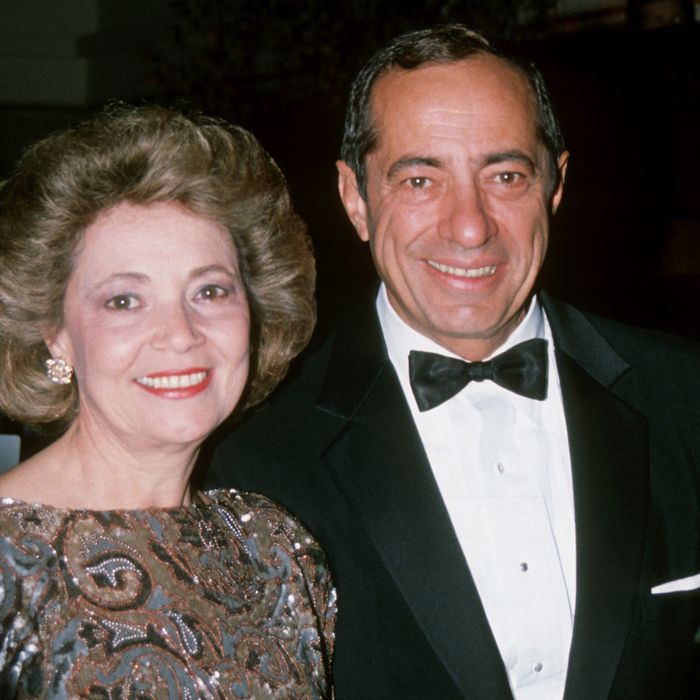
Matilda & Mario
However, when abortion became an issue as the 1970s arrived (it became legal in New York State in 1970, 3 years before it did so nationally), Cuomo split with the Church and supported reproductive rights. This dichotomy -- pro-choice but anti-death penalty -- would endear him to liberals and cause blood-spitting fury among conservatives.
He grew up among people often overlooked, or outright oppressed by the wealthy, including real-estate developers, such as Queens natives Fred and Donald Trump. In the late 1960s, he took up the cause of families in danger of losing their homes in the Queens neighborhood of Corona, near Shea Stadium, to make way for a school. He won, and became a hero in his home Borough.
In 1972, Mayor John Lindsay asked him to mediate a dispute in another Queens neighborhood, Forest Hills. Middle-class residents, proud of their neighborhood being an oasis from the pit of poverty and crime that The City was becoming, opposed the building of low-income housing there. He settled that issue as well.
That led to his first run for office, in 1974. He entered the Democratic Primary for Lieutenant Governor, but lost. But that got the attention of Congressman Hugh Carey of Brooklyn, who was elected Governor at that time, and the following January, Carey appointed Cuomo Secretary of State for the State of New York.
In 1977, with The City's finances still in the process of being settled (largely thanks to Carey), but crime seemingly out of control, the school system a mess, and poverty implacable, Mayor Abe Beame was under siege as he ran for a 2nd term.
There were many candidates for Mayor. Carey asked Cuomo to be his candidate, to run as both a thinking man's candidate and a man of the people, the guys and gals on the streets, especially of the Outer Boroughs. Manhattan Borough President Percy Sutton ran as The Black Candidate. Herman Badillo of The Bronx, the 1st Puerto Rican elected to Congress, ran as The Hispanic Candidate.
Former Manhattan Congresswoman Bella Abzug, who had lost the previous year's Senate Primary to Pat Moynihan, thought she had it made, since she was The Feminist Candidate, The Jewish Candidate and The Liberal Candidate. She thought that all these constituencies would win her the election.
Somebody forgot to tell any of this to Ed Koch, who also represented a Manhattan district in Congress. He also ran as The Jewish Candidate. But he also ran as The Tough Guy, promising to fight crime and to bring the death penalty back to New York -- which, constitutionally, the Mayor couldn't do, but Koch figured some people would let their anger overcome their thinking. Koch certainly didn't look like a tough guy; he looked more like a glad-handing Jewish lawyer, which he certainly was.
Beame, every bit as Jewish as Koch and Abzug, just 5-foot-4 and seeming to shrink with every headline -- including the riot following the blackout of July 13 and the fear of the serial killer calling himself the Son of Sam, who was caught on August 10 -- was left as the candidate of the old bosses and The City's old Democratic Party machine.
That was not something that the people wanted. He was abandoned by the electorate. Sutton and Badillo, the minority candidates, didn't really have a chance, especially after the blackout. That also killed Abzug's chances, which, despite her reputation as something of a flake, had been considered at least good enough to force a runoff election.
Koch was all over the map, politically speaking. His stances on crime and Israel (never mind that foreign policy isn't the responsibility of the Mayor) made him look conservative, and allowed him to appeal to Jews and ethnics in Queens, Brooklyn and Staten Island in ways that Cuomo couldn't, or wouldn't. But his support of civil rights, feminism and gay rights made him look liberal to many voters. When he first ran for Congress in 1972, he called himself "Just a plain liberal." In 1977, running for Mayor, he called himself "a liberal with sanity."
His stance on gay rights could have cost him: He was 52 and had never been married. And someone -- we still don't know who, but both Mario and his son Andrew always denied having anything to do with it -- made up fliers to hand out at political events, saying, "Vote for Cuomo, not the homo." Koch held a grudge against both father and son for the rest of his life.
But he was also smart: He started appearing in public with Bess Myerson, a civil rights activist and, in 1945, the 1st Jewish Miss America. Signs began to appear at Koch rallies: "Bess for First Lady." Speculation began of a wedding at Gracie Mansion. (Bess, who is still alive at age 90, was twice divorced. She never married Koch or anyone else after that, and Koch never married.)
(UPDATE: It was revealed on January 5, 2015 that Bess had died on December 14, 2014, in Santa Monica, California, where she had retired to be close to her daughter. But the general public didn't know this when I wrote this essay.)
As time went by, and his refusal to address the AIDS crisis made gay activists discount his previous support, Koch was "outed" several times, but he always denied that he was gay. Maybe being seen in public with Bess defused the issue, but Koch also said many times that most voters didn't care one way or the other. Or maybe, in liberal New York City, the number of people driven away by the possibility was simply canceled out by the number of people who considered it a bonus.
In the Democratic Primary on September 8, Koch got 19.8 percent of the vote, and Cuomo 18.7, but that was enough to make them the top 2. Beame got 18.0, Abzug 16.6, Sutton 14.4 and Badillo 11.0. Since no candidate got 40 percent, Koch and Cuomo went into a runoff, set for September 19.
Koch won the runoff with 55 percent, and got the Democratic nomination. But the race wasn't over: While State Senator Roy Goodman had defeated radio talk show host Barry Farber for the Republican nomination, New York's four-party system meant that the defeated runners-up could stay in the race: Cuomo was nominated by the Liberal Party, Farber by the Conservative Party.
And then came a deep indignity for Cuomo: Governor Carey, who'd asked him to enter the race in the first place, asked him to drop out for the sake of party unity, and endorse Koch. Cuomo refused. Carey then endorsed Koch, and that settled it: The big argument in Cuomo's favor was that he was Carey's man. Now, Koch was Carey's man. In the general election on November 8, Koch got just under 50 percent of the vote, Cuomo 41, and Goodman and Farber got 4 percent each.
(With the recent deaths of Goodman, Badillo and Cuomo, the only candidate from this epic Mayoralty race still alive is Farber, who's still got a radio show at age 84.)
*
Unlike Koch, however, Cuomo and Carey did not hold grudges. In 1978, Carey ran for a 2nd term, and Cuomo was his running mate, and they were elected Governor and Lieutenant Governor. Carey stepped aside for 1982, and everyone presumed the Governor's Mansion was Cuomo's to lose.
But Koch, overwhelmingly re-elected Mayor in 1981, ran what was essentially a spite campaign for the office. Koch knew The City cold: Within it, he could be brilliant. But, outside The City, he had the tinniest of tin ears imaginable, calling the State capital of Albany "a small town" and the suburbs of New York City "sterile."
He had a point: Albany's population, then as now, was about 100,000, and he was neither the first person nor the last to think of suburbia as boring. But you can't say those things and get elected Governor.
Cuomo won the Primary in a landslide. If Koch was bothered by to whom he lost, he wasn't bothered by what he lost: In his concession speech, he said, "It's not so bad," and, with the silence of the crowd being deafening, went back into full "How'm I doin'?" mode by saying, "And I'm still the Mayor!" The crowd cheered. Cuomo would later say, "New York is the only city in America where the Mayor wants to be Governor, and the Governor wants to be Mayor."
In the fall, in a close race, Cuomo won 50.9 percent of the vote, to beat the Republican nominee, businessman Lew Lehrman, who got 47.5 percent. Stan Lundine, a Congressman from Western New York (to balance the ticket geographically), was elected Lieutenant Governor.
Cuomo never ran for Mayor again -- Koch won a 3rd term in 1985, but was denied a 4th in 1989 -- but was easily re-elected Governor in 1986, against Westchester County Executive Andrew O'Rourke (64 percent to 32), and in 1990 against businessman Pierre Rinfret (51 to 23, with a 3rd-party Conservative getting 20). Lundine remained on his ticket.
Mario's inner circle included 2 names that would have far-reaching political impact: His son, Andrew, who followed his father's lead in becoming a lawyer fighting for poverty and housing issues; and Tim Russert, who would later become a reporter with NBC News and serve as moderator of its Sunday morning news show Meet the Press.
Russert was a native of Buffalo, and a proud fan of the city's football team, the Buffalo Bills. Knowing that everyone knew him as a native of The City, but also that he had to appeal to the entire State, Cuomo learned how to pander to the old industrial towns of Western New York: Buffalo, Rochester, Syracuse, et al.
With the Giants having moved to the Meadowlands of New Jersey in 1976 (before he was Governor) and the Jets having followed them in 1984 (during his 1st term), he frequently referred to the Bills as "the only pro football team in the State of New York." He remained popular in Western New York.
He was popular through most of the State because of his fights for education and environmental issues, and because he fought the policies of President Ronald Reagan that hit the State's industrial North and West hard. This set up the most famous of his renowned speeches, the keynote address at the 1984 Democratic National Convention, at the George Moscone Convention Center in San Francisco. (Moscone was that city's Mayor in 1978, when he and openly gay Supervisor Harvey Milk were assassinated by another Supervisor -- think "City Councilman" -- Dan White.)
Reagan, the foremost Republican President since Theodore Roosevelt, liked to speak of America as what John Winthrop, the 1st colonial Governor of Massachusetts, wanted Boston to be: "A shining city on a hill." Cuomo's response was epic, and proved that Reagan's "Morning Again In America" included a whopping hangover as a result of his pro-rich, anti-everybody-else policies:
A "shining city" is perhaps all the President sees from the portico of the White House and the veranda of his ranch, where everyone seems to be doing well. There’s another part of the city, the part where people can’t pay their mortgages... and middle-class parents watch the dreams they hold for their children evaporate.
This nation is more a tale of two cities than it is just a shining city on a hill. There is despair, Mr. President, in the faces you don't see, in the places you don't visit in your shining city...
We believe we must be the family of America, recognizing that at the heart of the matter, we are bound one to another; that the problems of a retired schoolteacher in Duluth are our problems; that the future of the child — that the future of the child in Buffalo is our future; that the struggle of a disabled man in Boston to survive and live decently is our struggle; that the hunger of a woman in Little Rock is our hunger; that the failure anywhere to provide what reasonably we might, to avoid pain, is our failure...
We Democrats still have a dream... We believe in only the government we need, but we insist upon all the government we need.

Governors of New York, once the largest State of the Union and still the 3rd-largest, historically have been considered for President: Martin Van Buren in 1836 (by then the Vice President), William Seward in 1860 (by then a Senator), Horatio Seymour in 1868, Samuel Tilden in 1876, Grover Cleveland in 1884, Theodore Roosevelt in 1900, Charles Evans Hughes in 1916 (by then a Justice of the Supreme Court), Alfred E. Smith in 1928, Franklin D. Roosevelt in 1932, Thomas E. Dewey in 1944 and '48 (nominated twice), Averell Harriman in 1956, and Nelson Rockefeller in all 3 elections of the 1960s.
But it's worth noting that only Van Buren, Cleveland and the Roosevelts won. (And even TR didn't actually run for President: He was nominated for Vice President, and assumed the office when William McKinley was assassinated. Tilden won, too, but was cheated out of his victory.)
So as Reagan's 2nd term wound down, and none of the potential Democratic candidates for 1988 looked all that appetizing, many people wanted Cuomo. But early in 1987, he took himself out of the running. After former Senator Gary Hart of Colorado had to drop out due to a sex scandal in May 1987, the clamor for Cuomo returned. Again, he refused.
There was a former college baseball star elected President in 1988, but it was the sitting Vice President, George H.W. Bush, a 1st baseman who had helped Yale reach the Final of the College World Series in 1947 and '48 (but lost both times).
In the wake of the Persian Gulf War, Bush's approval rating was 91 percent, and big-name Democrats announced they weren't running, including basketball star turned Senator from New Jersey, Bill Bradley. As the weeks and months of 1991 went by, and the nasty recession caused Bush's poll numbers to plummet, Cuomo made no announcement, other than to say, "I have no plans, and no plans to make plans."
As the year drew to a close, one national poll had him easily leading the Democratic field, and trailing Bush just 48 percent to 43. And it was rumored that he was considering a run. He was mocked as "Hamlet on the Hudson" for this indecisiveness.
But the State legislature, with the Democrats controlling the Assembly and the Republicans the Senate, was deadlocked over the State budget. The filing deadline for the New Hampshire primary was December 20, 1991, and the law said that a candidate was required to hand in a ballot application in person.
Cuomo kept an airplane waiting on the tarmac in Albany as he decided whether to fly to New Hampshire to enter the race. He worked to find a budget agreement -- New York State was long notorious for not getting its budget done on time, and still is -- and, at 3:30 PM, Mario announced, "I cannot turn my attention to New Hampshire while this threat hangs over the head of the New Yorkers I have sworn to put first."
The new frontrunner was Governor Bill Clinton of Arkansas. But a sex scandal hung over him, and many Democratic activists encouraged New Hampshire Democrats to write Cuomo's name in. He ended up getting 4 percent of the vote, while former Senator Paul Tsongas, whose home of Lowell, Massachusetts was just over the State Line from New Hampshire, edged Clinton. It was seen as a victory by Clinton over the "local" candidate.
With Cuomo's support, Clinton won the New York Primary, which ended doubts among Democrats that he could weather the sex, draft and marijuana-use scandals that, in retrospect, were ridiculous as far as judging his fitness for the office. Cuomo even gave Clinton's nominating speech at the Convention, held at Madison Square Garden.
Cuomo did the math, and knew that, in 2000, after 2 terms for Clinton, he'd be 68, and unlikely to win due to his age. While he did get the budget finished, he knew he had missed his best opportunity for the Presidency, and he never ran. He asked Clinton to not consider him for the Vice Presidency. As was widely rumored, Clinton did offer him a seat on the Supreme Court, but he turned it down, recommending instead a fellow New Yorker, Ruth Bader Ginsburg.
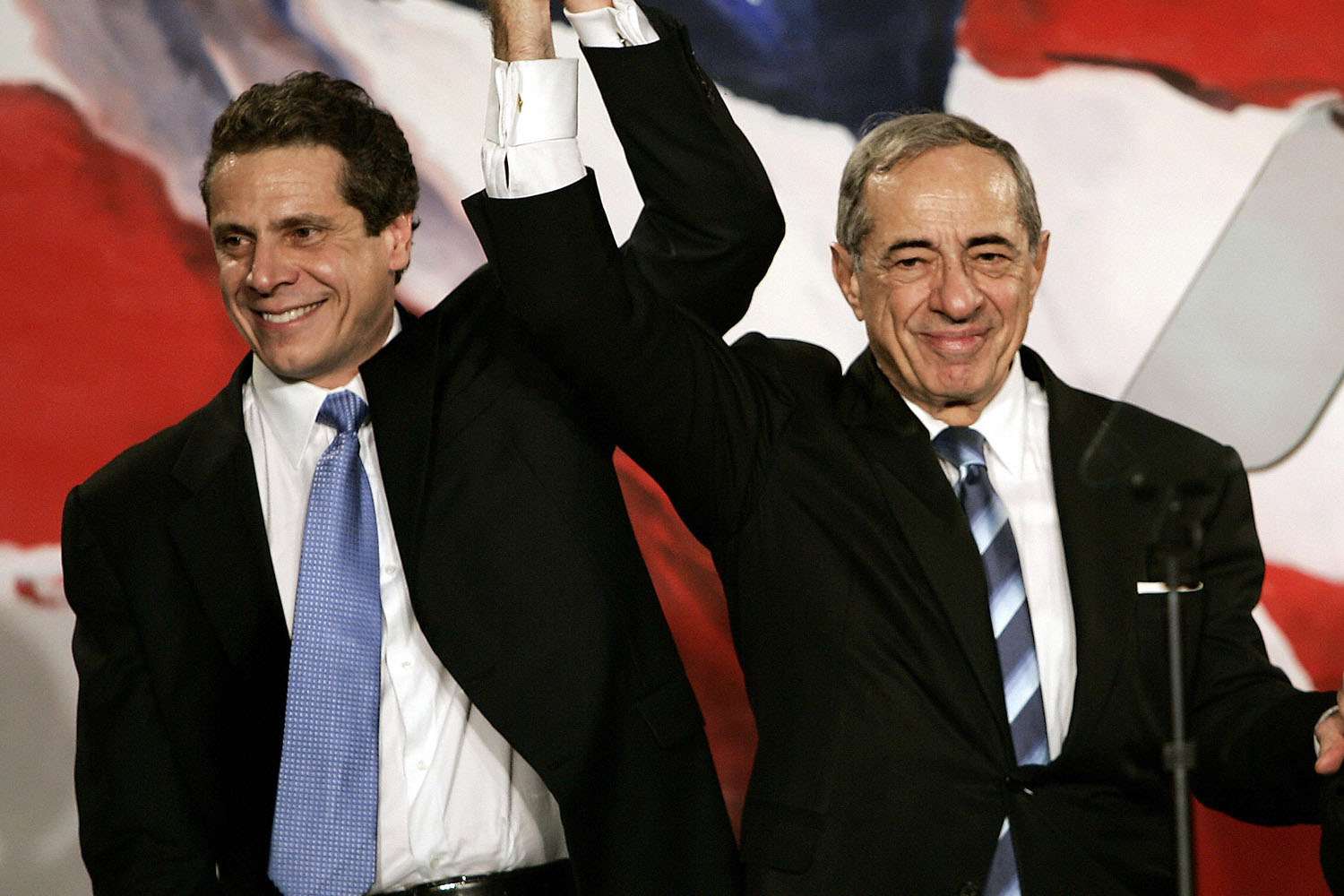
Clinton and Cuomo's friendship broke down in 1994, but was repaired in 1997 when Clinton appointed Andrew Cuomo to be U.S. Secretary of Housing & Urban Development. That would lead to Andrew's election as the State's Attorney General in 2006, and as Governor in 2010 and again this past November, making the Cuomos the only father-son pair ever to serve as Governor of New York.
*
But the political tide turned. A nationwide conservative reaction to Clinton's liberal policies -- which were proven successful, but that was not yet obvious in November 1994 -- led to a Republican landslide that swept away several liberal icons, including House Speaker Tom Foley of Washington State. Mario Cuomo's bid for a 4th term as Governor ended with his defeat to State Senator George Pataki, 49 percent to 45.
Pataki ended up serving 3 terms, before realizing that his own 4th term, were he to seek one in 2006, might end at the hands of the son of the man he beat.
Instead, Andrew ran for Attorney General, and it was the holder of that office, Eliot Spitzer, who won the Governorship. But Spitzer had to resign, and Lieutenant Governor David Paterson realized he couldn't get re-elected, opening the door for Andrew, and for the completion of Mario's vindication, which had been moved forward by the successes of Presidents Clinton and Barack Obama, and by the State's voters finally waking up to the realization that, while a nice guy, Pataki had proven himself to not be up to the job.
Mario Cuomo died yesterday afternoon, mere hours after Andrew was sworn in for his 2nd term, after dealing with heart trouble for 2 months. He was 82. He is survived by Matilda and their 5 children.
Andrew became a member of a 2nd great political family, as he married Kerry Kennedy, daughter of RFK and niece of JFK. That marriage produced 3 daughters -- 2 named Mariah and Cara, for New York-born singer Mariah Carey, and 1 named Michaela. But it ended in divorce, with Kerry becoming the 1st female Kennedy involved in a sex scandal. He now lives with chef and Food Network show host Sandra Lee, although due to his faith, which would not allow him to remarry in a Catholic church, he has not married her.
However, in spite of his re-election, many New Yorkers have soured on Andrew, and his chances of becoming President someday are, for the moment, not good. Though I am curious to see what people would think of a potential President whose potential First Lady was not actually married to him.
Mario's other son, Chris Cuomo, is a journalist, formerly with ABC, and now with CNN. Daughter Maria runs HELP USA, a charitable foundation founded by Matilda, and is married to fashion designer Kenneth Cole. Daughter Margaret Cuomo Maier is a physician, radiologist, and activist in the fight against cancer. And daughter Madeline Cuomo O'Donoghue is an attorney, specializing in family law.
Mario Cuomo was the Governor of the State of New York from the time I was 13 to the time I was 25. Ed Koch was the Mayor of the City of New York from the time I was 8 to the time I was 20. As a result of living in the New York Tri-State Area, I saw them on television just about every day, and I continued to see them on TV long after they left office. They were iconic figures, in ways that the Governors of New Jersey in my childhood -- Brendan Byrne and Tom Kean -- simply weren't, no matter how many times I may have seen them on TV. So it's hard for me to imagine them gone.
They were both great communicators, but in very different ways. Mario Cuomo spoke from the mind and the heart, while Ed Koch spoke from the gut. Each had his way of doing things, and each made his way work -- though not always. When they worked together, it was often a beautiful thing. When they opposed each other, it got ugly.
Ed Koch died a little less than 2 years ago. Now, Mario Cuomo is dead. Life, especially in the New York Tri-State Area, will be a little less inspiring, and a little less fun, without them.
UPDATE: Mario Cuomo was buried at Saint John Cemetery in Middle Village, Queens.
Instead, Andrew ran for Attorney General, and it was the holder of that office, Eliot Spitzer, who won the Governorship. But Spitzer had to resign, and Lieutenant Governor David Paterson realized he couldn't get re-elected, opening the door for Andrew, and for the completion of Mario's vindication, which had been moved forward by the successes of Presidents Clinton and Barack Obama, and by the State's voters finally waking up to the realization that, while a nice guy, Pataki had proven himself to not be up to the job.
Andrew and Mario
Andrew became a member of a 2nd great political family, as he married Kerry Kennedy, daughter of RFK and niece of JFK. That marriage produced 3 daughters -- 2 named Mariah and Cara, for New York-born singer Mariah Carey, and 1 named Michaela. But it ended in divorce, with Kerry becoming the 1st female Kennedy involved in a sex scandal. He now lives with chef and Food Network show host Sandra Lee, although due to his faith, which would not allow him to remarry in a Catholic church, he has not married her.
However, in spite of his re-election, many New Yorkers have soured on Andrew, and his chances of becoming President someday are, for the moment, not good. Though I am curious to see what people would think of a potential President whose potential First Lady was not actually married to him.
Mario's other son, Chris Cuomo, is a journalist, formerly with ABC, and now with CNN. Daughter Maria runs HELP USA, a charitable foundation founded by Matilda, and is married to fashion designer Kenneth Cole. Daughter Margaret Cuomo Maier is a physician, radiologist, and activist in the fight against cancer. And daughter Madeline Cuomo O'Donoghue is an attorney, specializing in family law.
Mario Cuomo was the Governor of the State of New York from the time I was 13 to the time I was 25. Ed Koch was the Mayor of the City of New York from the time I was 8 to the time I was 20. As a result of living in the New York Tri-State Area, I saw them on television just about every day, and I continued to see them on TV long after they left office. They were iconic figures, in ways that the Governors of New Jersey in my childhood -- Brendan Byrne and Tom Kean -- simply weren't, no matter how many times I may have seen them on TV. So it's hard for me to imagine them gone.
They were both great communicators, but in very different ways. Mario Cuomo spoke from the mind and the heart, while Ed Koch spoke from the gut. Each had his way of doing things, and each made his way work -- though not always. When they worked together, it was often a beautiful thing. When they opposed each other, it got ugly.
Ed Koch died a little less than 2 years ago. Now, Mario Cuomo is dead. Life, especially in the New York Tri-State Area, will be a little less inspiring, and a little less fun, without them.
UPDATE: Mario Cuomo was buried at Saint John Cemetery in Middle Village, Queens.


