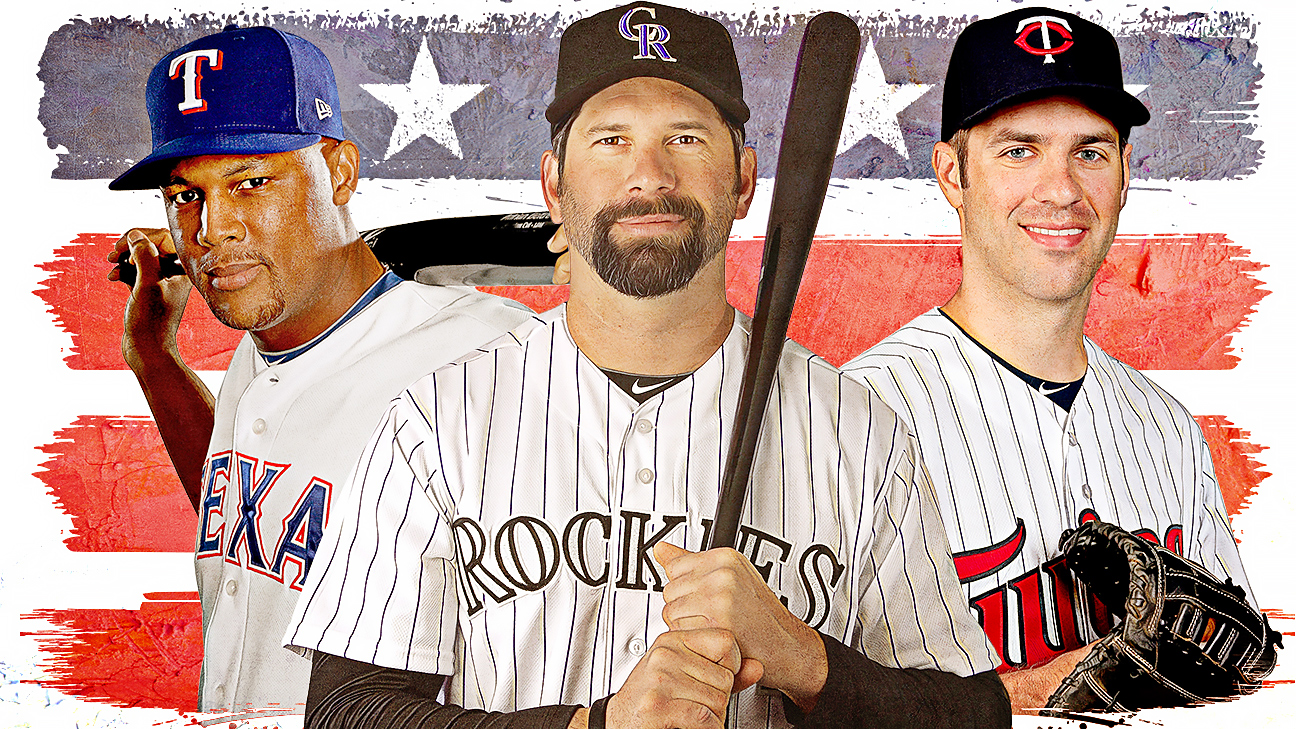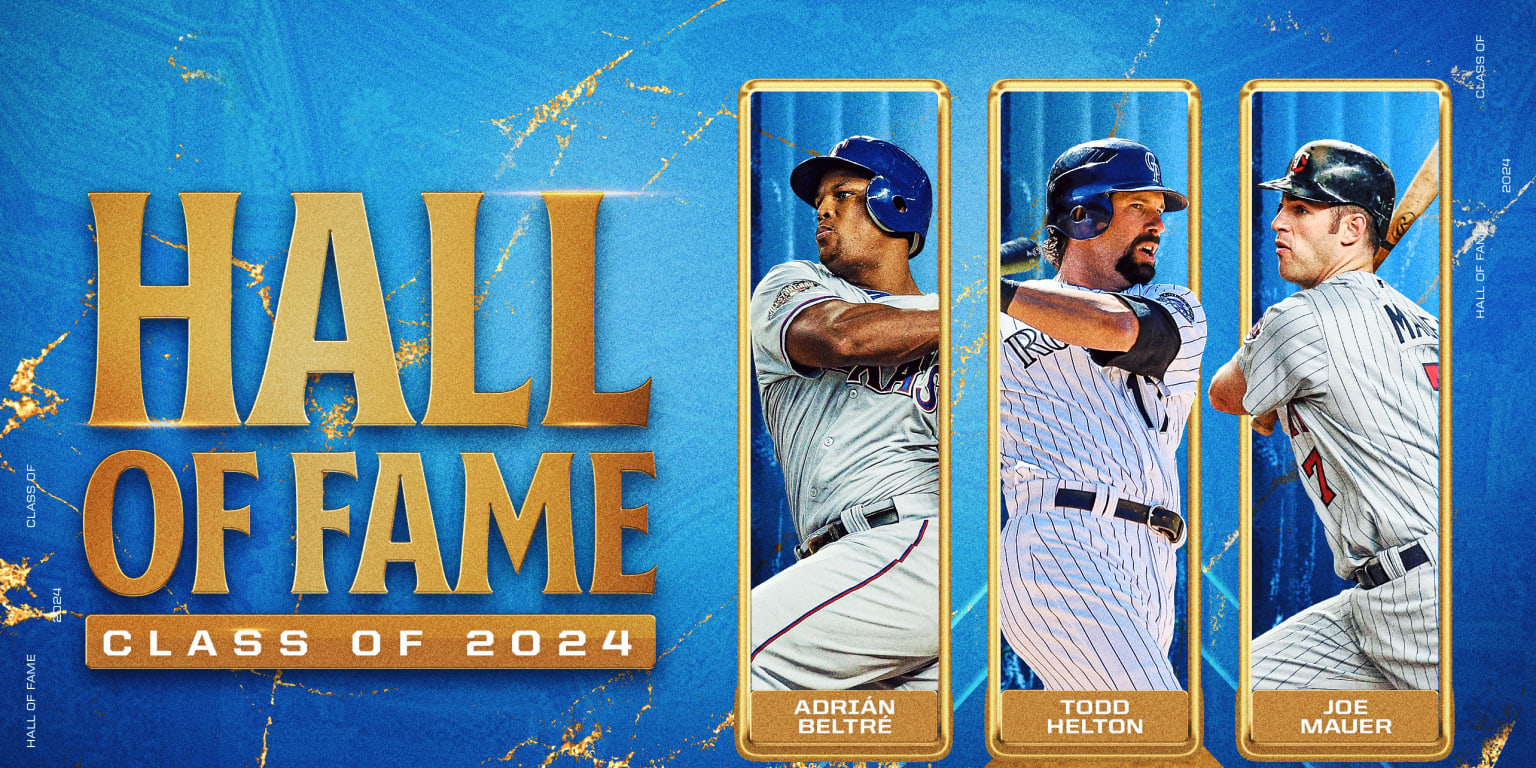
Adrián Beltré, Todd Helton and Joe Mauer have been elected to the Baseball Hall of Fame, voted on by the Baseball Writers' Association of America.
They will be inducted on July 28, at the Clark Sports Center outside Cooperstown, New York, along with Veterans' Committee inductee Jim Leyland.
There have been 23,114 men who have played in Major League Baseball, between the 1st season of 1871 and the most recent season of 2023. There are now 239 of them in the Hall, not counting players who were officially elected in categories other than "Players." That's 1.034 percent -- or 1 out of every 96.7. For those of you who believe the Hall has been "watered down," including too many players who should have stayed in "The Hall of Very Good," 1 out of 97 sounds pretty elite to me.
If we limited it to the top 1.00000000 percent, without going over, that would be 231. Which means we'd only have to kick 8 out. And if there comes a year in which nobody is elected, which has happened a few times, chances are, to keep as close to 1.000 percent without going over, we'd probably have to let 1 of those 8 back in.
For the sake of this list, a player is counted as a Hall-of-Famer with the team if he played at least 4 seasons with them. However, there will be the occasional exception. Teams are ranked in order of most HOFers.
If there is a tie, it will be broken by which team has more players, as opposed to those who were elected in other categories. If there is still a tie, then I go to which has more non-broadcasters. If it's still a tie, which has more players whose contributions were mostly with that club. If it's still a tie, which team has played fewer seasons will be ranked ahead -- since, for example, 5 HOFers is more impressive for a team that's been around since 1977 than it would be for one that's been around since 1961.
Teams that no longer exist in that form will be listed in italics, and will be ranked behind current teams with the same number, regardless of composition.
Players are listed in chronological order of when they arrived at the club, then managers, then broadcasters.
1. New York Yankees, 42: It works out to a little over 1 for every Pennant the team has won:
Clark Griffith (the team's 1st manager, elected as a pitcher and he was still a solid pitcher while he was their manager), Willie Keeler, Jack Chesbro, Frank "Home Run" Baker, Waite Hoyt, Herb Pennock, Babe Ruth, Lou Gehrig, Tony Lazzeri, Earle Combs, Bill Dickey, Red Ruffing, Lefty Gomez, Joe DiMaggio, Joe Gordon, Phil Rizzuto, Yogi Berra, Johnny Mize, Whitey Ford, Mickey Mantle, Enos Slaughter, Jim "Catfish" Hunter, Reggie Jackson, Rich "Goose" Gossage, Dave Winfield, Rickey Henderson, Wade Boggs, Derek Jeter, Mariano Rivera and Mike Mussina.
Also, managers Miller Huggins, Joe McCarthy, Casey Stengel and Joe Torre; owner Jacob Ruppert; executives Ed Barrow and George Weiss; broadcasters Mel Allen, Red Barber, Joe Garagiola, Jerry Coleman (played for the Yankees but elected as a broadcaster, first for the Yankees, then for the Padres) and Tony Kubek (played for the Yankees but elected as a broadcaster).
Bucky Harris managed the Yankees to the 1947 World Championship, but was only their manager for 2 seasons (1947 & '48), so I'm not counting him with the Yankees. In this case, according to the rule I set, I have to count Rickey Henderson as a Yankee. If Lou Piniella is ever elected as a manager, I wouldn't be able to count him as a Yankee HOFer, since he wouldn't be elected as a player, and only managed them for 3 seasons, none of them a title season.
Rizzuto was also a longtime broadcaster. Lee MacPhail was elected for what he did as American League President, not as Yankee general manager. Bernie Williams and Paul O'Neill have dropped off the writers' ballot. They, like Don Mattingly, will, in a few years, become eligible once again, through the Veterans' Committee -- but in all 3 cases, let's not kid ourselves.
And then there's Roger Clemens: Even if he does get in, would you want to count him as a Yankee? George Steinbrenner, being dead, is now eligible through the Veterans' Committee.
Tim Raines was a Yankee for only 3 years, although 2 of them were title seasons. Iván Rodríguez was a Yankee for about 3 minutes. So neither of them can be included here.
2. St. Louis Cardinals, 34: Charlie Comiskey (played for them before managing and owning teams elsewhere), Jake Beckley, Roger Bresnahan, Rogers Hornsby (won a World Series as their player-manager), Jesse Haines, Grover Cleveland Alexander, Jim Bottomley, Charles "Chick" Hafey, Burleigh Grimes, Frankie Frisch (elected as a player, won a World Series as their player-manager), Dizzy Dean, Joe Medwick, Johnny Mize, Enos Slaughter, Stan Musial, Red Schoendienst (elected as player, also managed them to a title), Bob Gibson, Lou Brock, Orlando Cepeda, Steve Carlton (7 seasons), Jim Kaat, Ted Simmons, Bruce Sutter, Ozzie Smith, Lee Smith (4 seasons, so he qualifies here), Scott Rolen.
Also, Miller Huggins (manager, also played several years for the Cards), Billy Southworth (manager, also played for them), Whitey Herzog (manager-executive), Tony LaRussa (manager), Branch Rickey (executive), Harry Caray (broadcaster), Jack Buck (broadcaster), Joe Garagiola (broadcaster).
Jesse Burkett won a batting title with the Cards, but only played 3 seasons with them, so he just misses qualifying. On the other hand, Cepeda didn't even play 3 full seasons with the Cards, but his tenure included the 1967 title and the 1968 Pennant, and he, as much as Gibson, was a symbol of that team, and he may be better remembered as a Cardinal than as a Giants, so I'm bending the rule for him. Leo Durocher was a good player for the Cards, but was elected as a manager and never managed them, so he doesn't qualify here.
Larry Walker was only a Cardinal for a year and a half, so, although that time did include the only Pennant he ever won (2004), he doesn't count for the Cards. Mark McGwire and Jim Edmonds did not qualify on enough ballots, and won't be eligible again until they qualify under the Veterans Committee. Surprisingly, longtime owner Gussie Busch has never been elected.
3. Chicago Cubs, 28: Adrian "Cap" Anson, Mike "King" Kelly, Clark Griffith (elected as a pitcher for them, later a manager and owner elsewhere), Joe Tinker, Johnny Evers, Frank Chance (elected as a player but should have been elected as a manager instead), Mordecai "Three-Finger" Brown, Grover Cleveland Alexander, Hazen "Kiki" Cuyler, Lewis "Hack" Wilson, Charles "Gabby" Hartnett (also managed them to a Pennant), Rogers Hornsby, Billy Herman, Ernie Banks, Billy Williams, Ron Santo, Ferguson Jenkins, Bruce Sutter, Ryne Sandberg, Lee Smith, Andre Dawson, Greg Maddux (spent enough time with them).
Also, Al Spalding (elected as an executive but was also a great pitcher), Frank Selee (manager), Joe McCarthy (manager, managed them to a Pennant before going to the Yankees), Leo Durocher (manager), Jack Brickhouse (broadcaster), Harry Caray (broadcaster).
Sammy Sosa is eligible, but he's not getting in. If Lou Piniella is elected as a manager, I'll have to count him as a Cub HOFer, since he managed them for 4 seasons.
Lou Boudreau was a beloved broadcaster for the Cubs after his playing and managing career, but never played or managed for them, and so I can't count him as a Cub HOFer. Santo was also a longtime broadcaster. Surprisingly, longtime owner Phillip K. Wrigley is not in.
1. New York Yankees, 42: It works out to a little over 1 for every Pennant the team has won:
Clark Griffith (the team's 1st manager, elected as a pitcher and he was still a solid pitcher while he was their manager), Willie Keeler, Jack Chesbro, Frank "Home Run" Baker, Waite Hoyt, Herb Pennock, Babe Ruth, Lou Gehrig, Tony Lazzeri, Earle Combs, Bill Dickey, Red Ruffing, Lefty Gomez, Joe DiMaggio, Joe Gordon, Phil Rizzuto, Yogi Berra, Johnny Mize, Whitey Ford, Mickey Mantle, Enos Slaughter, Jim "Catfish" Hunter, Reggie Jackson, Rich "Goose" Gossage, Dave Winfield, Rickey Henderson, Wade Boggs, Derek Jeter, Mariano Rivera and Mike Mussina.
Also, managers Miller Huggins, Joe McCarthy, Casey Stengel and Joe Torre; owner Jacob Ruppert; executives Ed Barrow and George Weiss; broadcasters Mel Allen, Red Barber, Joe Garagiola, Jerry Coleman (played for the Yankees but elected as a broadcaster, first for the Yankees, then for the Padres) and Tony Kubek (played for the Yankees but elected as a broadcaster).
Bucky Harris managed the Yankees to the 1947 World Championship, but was only their manager for 2 seasons (1947 & '48), so I'm not counting him with the Yankees. In this case, according to the rule I set, I have to count Rickey Henderson as a Yankee. If Lou Piniella is ever elected as a manager, I wouldn't be able to count him as a Yankee HOFer, since he wouldn't be elected as a player, and only managed them for 3 seasons, none of them a title season.
Rizzuto was also a longtime broadcaster. Lee MacPhail was elected for what he did as American League President, not as Yankee general manager. Bernie Williams and Paul O'Neill have dropped off the writers' ballot. They, like Don Mattingly, will, in a few years, become eligible once again, through the Veterans' Committee -- but in all 3 cases, let's not kid ourselves.
And then there's Roger Clemens: Even if he does get in, would you want to count him as a Yankee? George Steinbrenner, being dead, is now eligible through the Veterans' Committee.
Tim Raines was a Yankee for only 3 years, although 2 of them were title seasons. Iván Rodríguez was a Yankee for about 3 minutes. So neither of them can be included here.
Álex Rodríguez and Andy Pettitte are eligible. But because they are Yankees linked to PEDs, they will not get in. The Yankee Doodle Double Standard remains in effect.
2. St. Louis Cardinals, 34: Charlie Comiskey (played for them before managing and owning teams elsewhere), Jake Beckley, Roger Bresnahan, Rogers Hornsby (won a World Series as their player-manager), Jesse Haines, Grover Cleveland Alexander, Jim Bottomley, Charles "Chick" Hafey, Burleigh Grimes, Frankie Frisch (elected as a player, won a World Series as their player-manager), Dizzy Dean, Joe Medwick, Johnny Mize, Enos Slaughter, Stan Musial, Red Schoendienst (elected as player, also managed them to a title), Bob Gibson, Lou Brock, Orlando Cepeda, Steve Carlton (7 seasons), Jim Kaat, Ted Simmons, Bruce Sutter, Ozzie Smith, Lee Smith (4 seasons, so he qualifies here), Scott Rolen.
Also, Miller Huggins (manager, also played several years for the Cards), Billy Southworth (manager, also played for them), Whitey Herzog (manager-executive), Tony LaRussa (manager), Branch Rickey (executive), Harry Caray (broadcaster), Jack Buck (broadcaster), Joe Garagiola (broadcaster).
Jesse Burkett won a batting title with the Cards, but only played 3 seasons with them, so he just misses qualifying. On the other hand, Cepeda didn't even play 3 full seasons with the Cards, but his tenure included the 1967 title and the 1968 Pennant, and he, as much as Gibson, was a symbol of that team, and he may be better remembered as a Cardinal than as a Giants, so I'm bending the rule for him. Leo Durocher was a good player for the Cards, but was elected as a manager and never managed them, so he doesn't qualify here.
Larry Walker was only a Cardinal for a year and a half, so, although that time did include the only Pennant he ever won (2004), he doesn't count for the Cards. Mark McGwire and Jim Edmonds did not qualify on enough ballots, and won't be eligible again until they qualify under the Veterans Committee. Surprisingly, longtime owner Gussie Busch has never been elected.
3. Chicago Cubs, 28: Adrian "Cap" Anson, Mike "King" Kelly, Clark Griffith (elected as a pitcher for them, later a manager and owner elsewhere), Joe Tinker, Johnny Evers, Frank Chance (elected as a player but should have been elected as a manager instead), Mordecai "Three-Finger" Brown, Grover Cleveland Alexander, Hazen "Kiki" Cuyler, Lewis "Hack" Wilson, Charles "Gabby" Hartnett (also managed them to a Pennant), Rogers Hornsby, Billy Herman, Ernie Banks, Billy Williams, Ron Santo, Ferguson Jenkins, Bruce Sutter, Ryne Sandberg, Lee Smith, Andre Dawson, Greg Maddux (spent enough time with them).
Also, Al Spalding (elected as an executive but was also a great pitcher), Frank Selee (manager), Joe McCarthy (manager, managed them to a Pennant before going to the Yankees), Leo Durocher (manager), Jack Brickhouse (broadcaster), Harry Caray (broadcaster).
Sammy Sosa is eligible, but he's not getting in. If Lou Piniella is elected as a manager, I'll have to count him as a Cub HOFer, since he managed them for 4 seasons.
Lou Boudreau was a beloved broadcaster for the Cubs after his playing and managing career, but never played or managed for them, and so I can't count him as a Cub HOFer. Santo was also a longtime broadcaster. Surprisingly, longtime owner Phillip K. Wrigley is not in.
4. Chicago White Sox, 26: Ed Walsh, George Davis, Eddie Collins, Ray Schalk, Red Faber, Ted Lyons, Luke Appling, Minnie Miñoso, Nellie Fox, Luis Aparicio, Early Wynn, Hoyt Wilhelm, Goose Gossage (5 years with them), Carlton Fisk, Harold Baines, Frank Thomas, Tim Raines, Jim Thome, Al Lopez (manager), Tony LaRussa (manager), Charlie Comiskey (owner), Bill Veeck (owner), Jack Brickhouse (broadcaster), Bob Elson (broadcaster), Harry Caray (broadcaster), Ken Harrelson (broadcaster).
Although Clark Griffith pitched for them in their 1st 2 seasons and won the 1st American League Pennant as their manager, those 2 seasons are not enough to qualify with the White Sox. Although Tom Seaver notched his 300th victory with the Pale Hose, he pitched for them in just 3 seasons, and can't be counted as one of their HOFers.
Thome was a White Sock for less than 4 full seasons, but did play for them in 4 seasons, so he counts with them.
New York Giants, 26: Roger Connor, Buck Ewing, Tim Keefe, Mickey Welch, John Montgomery Ward, Roger Bresnahan, Christy Mathewson, Joe McGinnity, George Davis, Richard "Rube" Marquard, Dave Bancroft, Ross Youngs, Frankie Frisch, George "Highpockets" Kelly, Fred Lindstrom, Travis Jackson, Bill Terry, Mel Ott, Carl Hubbell, Johnny Mize, Monte Irvin, Willie Mays, Hoyt Wilhelm.
Also, John McGraw (manager, also played for them), Leo Durocher (manager), Russ Hodges (broadcaster).
Casey Stengel played for the Giants, but was elected as a manager, so I can't count him as a Giant HOFer.
Counting all figures who played or managed at least one game for the Giants, in New York and San Francisco, they have 76, more than any other team; however, many of those were with the club only briefly. But even by my definitions, they are ahead of the arch-rival Dodgers.
5. Boston Red Sox, 24: Jimmy Collins (elected as a player but also managed them to the 1st World Series title in 1903), Cy Young, Tris Speaker, Harry Hooper, Babe Ruth (6 seasons with Sox before going to Yanks), Herb Pennock (7 seasons before Yanks), Red Ruffing (also 7 seasons before Yanks), Joe Cronin (elected as a player, but also managed them to the 1946 Pennant, though unlike Collins had already retired as a player; was also longtime AL President), Rick Ferrell, Jimmie Foxx, Lefty Grove, Bobby Doerr, Ted Williams, Carl Yastrzemski, Carlton Fisk, Jim Rice, Dennis Eckersley, Wade Boggs, Pedro Martinez, David Ortiz.
Also, Dick Williams (manager, no relation to Ted), Tom Yawkey (owner), Curt Gowdy (broadcaster), and Ken Harrelson (broadcaster). "Hawk" only played 2 seasons for Boston, though 1 was the 1967 "Impossible Dream" Pennant season; but he broadcast for them for 7 years, so he counts here.
I am bending the rule slightly for Dick Williams, who only managed 3 seasons for the Red Sox, but 1 of them, 1967, was the most important season in the club's modern history. Luis Aparicio played 3 seasons for the Red Sox, so by my rule he is not eligible to be counted with them. Eckersley, however, played 7 seasons with them, so I have to count him with them, and with their living HOFers for as long as he lives.
It was long suspected that owner Jean Yawkey would become the 1st woman elected to the Hall of Fame, but Effa Manley, who owned the Negro Leagues' Newark Eagles, is in, while Mrs. Yawkey is still out.
Manny Ramirez (500 Home Run Club but known steroid cheat, and not as popular as Ortiz), Roger Clemens (300 Win and 3,000 Strikeout Clubs but suspected steroid cheat) and Curt Schilling (3,000 Strikeout Club but possible steroid cheat) are eligible, but not yet in.
Also, Dick Williams (manager, no relation to Ted), Tom Yawkey (owner), Curt Gowdy (broadcaster), and Ken Harrelson (broadcaster). "Hawk" only played 2 seasons for Boston, though 1 was the 1967 "Impossible Dream" Pennant season; but he broadcast for them for 7 years, so he counts here.
I am bending the rule slightly for Dick Williams, who only managed 3 seasons for the Red Sox, but 1 of them, 1967, was the most important season in the club's modern history. Luis Aparicio played 3 seasons for the Red Sox, so by my rule he is not eligible to be counted with them. Eckersley, however, played 7 seasons with them, so I have to count him with them, and with their living HOFers for as long as he lives.
It was long suspected that owner Jean Yawkey would become the 1st woman elected to the Hall of Fame, but Effa Manley, who owned the Negro Leagues' Newark Eagles, is in, while Mrs. Yawkey is still out.
Manny Ramirez (500 Home Run Club but known steroid cheat, and not as popular as Ortiz), Roger Clemens (300 Win and 3,000 Strikeout Clubs but suspected steroid cheat) and Curt Schilling (3,000 Strikeout Club but possible steroid cheat) are eligible, but not yet in.
6. Pittsburgh Pirates, 24: James "Pud" Galvin, Vic Willis, John "Honus" Wagner, Fred Clarke (elected as a player, also won Pennants as their manager), Jack Chesbro, Jake Beckley, Max Carey, Hazen "Kiki" Cuyler, Waite Hoyt (5 seasons with them), Harold "Pie" Traynor (also managed them), Paul Waner, Lloyd Waner ("Big Poison" and "Little Poison," though Lloyd was actually taller), Joseph "Arky" Vaughan, Al Lopez (elected as a manager but was an All-Star catcher for the Pirates), Ralph Kiner, Bill Mazeroski, Roberto Clemente, Willie Stargell, Bert Blyleven.
Also, Bill McKechnie (manager), Jim Leyland (manager), Barney Dreyfuss (owner), Branch Rickey (executive), Bob Prince (broadcaster).
Blyleven was only a Pirate for 3 seasons, but I'm bending the rule because he was a key cog on their last World Championship team in 1979. Barry Bonds is eligible, but while the stance against steroid cheats is softening, he still, for the moment, falls under the category of, "Who's kidding who?"
Boston Braves, 22: Harry Wright (player and manager), George Wright, Al Spalding, Jim "Orator" O'Rourke, James "Deacon" White, Charlie "Old Hoss" Radbourne, Mike "King" Kelly, John Clarkson, Charles "Kid" Nichols, Cy Young, Hugh Duffy, Tommy McCarthy (he and Duffy were known as "the Heavenly Twins"), Billy Hamilton, Vic Willis, Jimmy Collins, Johnny Evers, Walter "Rabbit" Maranville, Dave Bancroft.
Also, Frank Selee (manager), Bill McKechnie (manager, though with no success with the Braves), Casey Stengel (ditto, also played for Braves), Billy Southworth (manager).
Brooklyn Dodgers, 22: Willie Keeler, Joe Kelley, Richard "Rube" Marquard, Zack Wheat, Burleigh Grimes, Charles "Dazzy" Vance, Joseph "Arky" Vaughan, Billy Herman, Joe "Ducky" Medwick, Harold "Pee Wee" Reese, Gil Hodges, Jackie Robinson, Edwin "Duke" Snider, Roy Campanella, Ned Hanlon (manager), Wilbert Robinson (manager), Leo Durocher (elected as a manager but was also a good player), Walter Alston (manager), Branch Rickey (owner), Walter O'Malley (owner), Red Barber (broadcaster), Vin Scully (broadcaster).
Casey Stengel played 6 seasons for the Dodgers, and was good, but not Hall of Fame good. He managed 3 seasons for them; in spite of their poor performance under him, had he managed them for 1 more season, he would still qualify as one of theirs under my rule. Dick Williams played 5 seasons for them, but was elected as a manager, and never managed the Dodgers. Owner Charles Ebbets is not in.
7. Philadelphia Phillies, 20: Billy Hamilton, Ed Delahanty, Sam Thompson, Grover Cleveland Alexander, Eppa Rixey, Dave Bancroft, Chuck Klein, Richie Ashburn, Robin Roberts, Jim Bunning, Jim Kaat, Steve Carlton, Mike Schmidt, Scott Rolen, Jim Thome, Roy Halladay, Harry Wright (manager), Pat Gillick (executive), By Saam (broadcaster), Harry Kalas (broadcaster).
Thome spent 3 seasons with them, then left, then returned for a 4th, so he counts here. Ashburn was also a longtime broadcaster for the Phils. If Curt Schilling gets in, he can be counted with the Phillies. Pete Rose, of course, is ineligible.
Also, Bill McKechnie (manager), Jim Leyland (manager), Barney Dreyfuss (owner), Branch Rickey (executive), Bob Prince (broadcaster).
Blyleven was only a Pirate for 3 seasons, but I'm bending the rule because he was a key cog on their last World Championship team in 1979. Barry Bonds is eligible, but while the stance against steroid cheats is softening, he still, for the moment, falls under the category of, "Who's kidding who?"
Boston Braves, 22: Harry Wright (player and manager), George Wright, Al Spalding, Jim "Orator" O'Rourke, James "Deacon" White, Charlie "Old Hoss" Radbourne, Mike "King" Kelly, John Clarkson, Charles "Kid" Nichols, Cy Young, Hugh Duffy, Tommy McCarthy (he and Duffy were known as "the Heavenly Twins"), Billy Hamilton, Vic Willis, Jimmy Collins, Johnny Evers, Walter "Rabbit" Maranville, Dave Bancroft.
Also, Frank Selee (manager), Bill McKechnie (manager, though with no success with the Braves), Casey Stengel (ditto, also played for Braves), Billy Southworth (manager).
Brooklyn Dodgers, 22: Willie Keeler, Joe Kelley, Richard "Rube" Marquard, Zack Wheat, Burleigh Grimes, Charles "Dazzy" Vance, Joseph "Arky" Vaughan, Billy Herman, Joe "Ducky" Medwick, Harold "Pee Wee" Reese, Gil Hodges, Jackie Robinson, Edwin "Duke" Snider, Roy Campanella, Ned Hanlon (manager), Wilbert Robinson (manager), Leo Durocher (elected as a manager but was also a good player), Walter Alston (manager), Branch Rickey (owner), Walter O'Malley (owner), Red Barber (broadcaster), Vin Scully (broadcaster).
Casey Stengel played 6 seasons for the Dodgers, and was good, but not Hall of Fame good. He managed 3 seasons for them; in spite of their poor performance under him, had he managed them for 1 more season, he would still qualify as one of theirs under my rule. Dick Williams played 5 seasons for them, but was elected as a manager, and never managed the Dodgers. Owner Charles Ebbets is not in.
7. Philadelphia Phillies, 20: Billy Hamilton, Ed Delahanty, Sam Thompson, Grover Cleveland Alexander, Eppa Rixey, Dave Bancroft, Chuck Klein, Richie Ashburn, Robin Roberts, Jim Bunning, Jim Kaat, Steve Carlton, Mike Schmidt, Scott Rolen, Jim Thome, Roy Halladay, Harry Wright (manager), Pat Gillick (executive), By Saam (broadcaster), Harry Kalas (broadcaster).
Thome spent 3 seasons with them, then left, then returned for a 4th, so he counts here. Ashburn was also a longtime broadcaster for the Phils. If Curt Schilling gets in, he can be counted with the Phillies. Pete Rose, of course, is ineligible.
8. Detroit Tigers, 19: Sam Crawford, Ty Cobb, Harry Heilmann, Henry "Heinie" Manush, Charlie Gehringer, Goose Goslin, Hank Greenberg (the last 3 nicknamed the "G-Men" in those early days of the FBI), Mickey Cochrane (elected as a player, also managed them to 2 Pennants), Hal Newhouser, George Kell, Al Kaline, Jim Bunning, Jack Morris, Alan Trammell, Iván Rodríguez, Hughie Jennings (manager, also played for the team), Sparky Anderson (manager), Jim Leyland (manager), Ernie Harwell (broadcaster).
With Trammell getting in through the Veterans Committee, Lou Whitaker's chances of also doing so increase. Kaline and Kell were also longtime broadcasters. Longtime owners Frank Navin, Walter Briggs and John Fetzer are not yet in. Former executive Will Harridge is in, but for what he did as President of the AL, so I can't count him as a Tiger HOFer.
With Trammell getting in through the Veterans Committee, Lou Whitaker's chances of also doing so increase. Kaline and Kell were also longtime broadcasters. Longtime owners Frank Navin, Walter Briggs and John Fetzer are not yet in. Former executive Will Harridge is in, but for what he did as President of the AL, so I can't count him as a Tiger HOFer.
9. Cincinnati Reds, 19: Bid McPhee, Jake Beckley, Joe Kelley, Sam Crawford, Edd Roush, Eppa Rixey, Ernie Lombardi, Frank Robinson, Johnny Bench, Tony Perez, Joe Morgan, Tom Seaver (6 seasons with Reds), Barry Larkin, Ken Griffey Jr., Scott Rolen (5 seasons), Bill McKechnie (manager), Sparky Anderson (manager), Red Barber (broadcaster), Marty Brennaman (broadcaster).
Pete Rose, of course, is ineligible. John Franco is not yet in, but if he gets in, he pitched enough seasons with the Reds to qualify for this list. If Lou Piniella is elected as a manager, I'll count him as a Reds HOFer: He only managed them for 3 seasons, but 1 was a World Championship season. Miller Huggins played several years for the Reds, but was elected as a Yankee manager.
Longtime owner Powel Crosley and GM Bob Howsam should be in, but they're not. Waite Hoyt broadcast for the Reds, and was beloved in that role, but has not been given the Ford Frick Award, so I can't count him with the Reds.
And while 2 members of the 1st openly professional baseball team, the 1869-70 Cincinnati Red Stockings, are in the Baseball Hall of Fame, Harry and George Wright -- the other Wright Brothers who "invented" something important in American life -- that team was not the same team as the current Reds franchise, which began in the old American Association of 1882 and joined the NL in 1892.
10. Cleveland Guardians, 18: Napoleon "Nap" Lajoie, Elmer Flick, Addie Joss, Tris Speaker (elected as player but also managed them to a title), Stan Coveleski, Joe Sewell, Earl Averill, Bob Feller, Lou Boudreau, Bob Lemon, Larry Doby, Early Wynn, Gaylord Perry, Jim Thome, Al Lopez (manager), Bill Veeck (owner), Jack Graney (broadcaster), Jimmy Dudley (broadcaster).
Barring a major shift in voters' attitudes, Manny Ramirez is probably out of luck. Satchel Paige reached the majors with the Indians, but only pitched 2 seasons for them. So, although I can count him with 3 different Negro League teams on this list, I can't count him with any major league team. Indeed, that fact is the reason I've included the Negro League teams on this list, along with moved and defunct major league teams.
11. Baltimore Orioles, 14: Brooks Robinson, Hoyt Wilhelm, Robin Roberts (4 seasons with O's), Luis Aparicio, Frank Robinson, Jim Palmer, Eddie Murray, Cal Ripken, Roberto Alomar, Harold Baines, Mike Mussina, Earl Weaver (manager), Chuck Thompson (broadcaster), Jon Miller (broadcaster).
Although he won his only World Series with the Orioles, we don't usually associate Aparicio with them, but he did play 5 seasons with them, so, by my own rule, I've got to count him here. Same with Robin Roberts, who played 4 seasons in Baltimore. Rafael Palmeiro is eligible, but he's not getting in.
Frank Cashen should be in as an executive. Dick Williams played enough seasons with the O's to qualify, but was elected as a manager and never managed them, so he doesn't qualify as an O's HOFer.
Philadelphia Athletics, 13: Eddie Plank, Rube Waddell, Frank "Home Run" Baker, Chief Bender, Eddie Collins, Herb Pennock, Al Simmons, Mickey Cochrane, Jimmie Foxx, Lefty Grove, George Kell, Connie Mack (owner-manager), By Saam (broadcaster).
13. Los Angeles Dodgers, 12: Gil Hodges, Duke Snider, Don Drysdale, Sandy Koufax, Don Sutton, Mike Piazza, Adrián Beltré, Walter Alston (manager), Tommy Lasorda (manager), Walter O'Malley (owner), Vin Scully (broadcaster), Jamie Jarrin (broadcaster).
Snider played 5 seasons after the move, Hodges 4, so both count in both Brooklyn and Los Angeles. Steve Garvey is not getting in. Pedro Martinez started out with the Dodgers, but only played 2 seasons for them.
Andruw Jones will be listed with them if he is elected. Don Sutton broadcast for the Braves, but can't be counted among their HOFers. Former owners Bill Bartholomay and Ted Turner are not in, nor do I ever expect them to be elected, but maybe they should be.
14. New York Mets, 11: Nolan Ryan, Tom Seaver, Gary Carter, Mike Piazza, Tom Glavine (5 seasons), Pedro Martinez (4 seasons), Casey Stengel (manager, 4 seasons), Joe Torre (manager), Lindsey Nelson (broadcaster), Bob Murphy (broadcaster), Tim McCarver (broadcaster). So that's 3 broadcasters, 2 managers, and 6 players.
Still, you didn't realize the Mets had so many, did you? And that's without counting Ralph Kiner, who was elected as a Pirates' player, not as a Mets' broadcaster. Nor can you count Richie Ashburn, Duke Snider, Warren Spahn or Willie Mays. And, based on what they did while they were Mets, why would you want to count Eddie Murray, Rickey Henderson or Roberto Alomar?
Ryan did appear for the Mets in at least 1 game for 5 different seasons, including the 1969 World Championship season. So I have to count him here.
I had previously counted Yogi Berra, but while he managed them for 4 seasons, including winning a Pennant, he was elected to the Hall as a player, not as a manager, and so I can't count him as a Met HOFer. Nor can we count Gil Hodges: Though he did manage the team for 4 seasons, including their 1st World Series win, he was elected as a player, not a manager, and his playing for them was a painful end to his career.
As for Torre: Yes, he managed in 4 seasons for them. They were awful then, and there wasn't much he could do about it, but he counts as a Met Hall-of-Famer. Although I notice that, unlike Yogi and Willie, he wasn't invited to the farewell ceremony at Shea Stadium in 2008.
Frank Cashen should be in as an executive. If John Franco is ever elected, you can count him.
Frank Cashen should be in as an executive. If John Franco is ever elected, you can count him.
Washington Senators, 11: Walter Johnson, Stanley "Bucky" Harris (elected as a manager but was also a great player), Sam Rice, Henry "Heinie" Manush, Leon "Goose" Goslin, Joe Cronin (elected as a player but also managed them to a Pennant), Rick Ferrell, Early Wynn, Clark Griffith (owner), Arch McDonald (broadcaster), Bob Wolff (broadcaster).
No, you can't count Ted Williams as a manager.
15. San Diego Padres, 9: Dave Winfield, Ozzie Smith, Rollie Fingers, Goose Gossage, Tony Gwynn, Trevor Hoffman, Dick Williams (manager), Jerry Coleman (broadcaster), Dick Enberg (broadcaster).
Yes, the Wizard and the Goose each played 4 seasons in Mission Valley. Considering how many they have in a comparatively short history, you shouldn't also count Willie McCovey, Gaylord Perry or Roberto Alomar. Longtime owner Ray Kroc, who saved the team from being moved to Washington in 1974, is not in. Steve Garvey, who is not my Padre, is not getting in.
Mark McGwire is eligible, but he's not getting in. Owner Charlie Finley is eligible, but I don't think he'll ever get in, either. I am bending the rule slightly for Williams, who only managed 3 seasons for the A's, but got them into the postseason in all 3, including 2 World Championships.
Kansas City Monarchs (Negro Leagues), 9: Jose Mendez, Leroy "Satchel" Paige, James "Cool Papa" Bell, Wilber "Bullet" Rogan, Norman "Turkey" Stearnes, Andy Cooper (also manager), Hilton Smith, John "Buck" O'Neil (also manager), J.L. Wilkinson (owner).
Bell played 3 seasons for them, but because Negro League players bounced around as much as international soccer players do, and also like club soccer there were often loan deals involved, I'll bend my 4-season rule.
Jackie Robinson played his first season in professional baseball, 1945, with the Monarchs. They were also the first pro team of Ernie Banks. But neither was elected on the basis of anything he did in Kansas City.
17. Minnesota Twins, 8: Harmon Killebrew, Jim Kaat, Tony Oliva, Rod Carew, Bert Blyleven, Kirby Puckett, Joe Mauer, Herb Carneal (broadcaster).
Tom Kelly could be elected as a manager. No, you can't count Dave Winfield, Paul Molitor or Jack Morris: Although hometown heroes, none played 4 seasons with the Twins. Jim Thome played only 2 seasons with them. Founder Calvin Griffith is not in, nor should he be.
Tom Kelly could be elected as a manager. No, you can't count Dave Winfield, Paul Molitor or Jack Morris: Although hometown heroes, none played 4 seasons with the Twins. Jim Thome played only 2 seasons with them. Founder Calvin Griffith is not in, nor should he be.
Montreal Expos, 8: Gary Carter, Andre Dawson, Tim Raines, Larry Walker, Pedro Martinez, Vladimir Guerrero, Dick Williams (manager), Dave Van Horne (broadcaster). Duke Snider cannot be counted for the Expos, although he broadcast for them. He also played in Montreal for the Dodgers' farm team, the Montreal Royals, as did Tommy Lasorda.
Chicago American Giants (Negro Leagues), 8: Andrew "Rube" Foster (also manager and owner), Bill Foster (a.k.a. Willie Foster, Rube's brother), Cristobal Torriente, Pete Hill, George "Mule" Suttles, John Henry "Pop" Lloyd, Norman "Turkey" Stearnes, Willie Wells.
18. San Francisco Giants, 7: Willie Mays, Orlando Cepeda, Willie McCovey, Juan Marichal, Gaylord Perry, Lon Simmons (broadcaster), Jon Miller (broadcaster).
Barry Bonds is eligible, and his rising percentages suggest that he might get in despite his known cheating. And I'm surprised that longtime owner Horace Stoneham isn't in, and that neither is his son-in-law, Charles "Chub" Feeney, a Giant executive who became President of the NL.
19. Houston Astros, 7: Joe Morgan, Nolan Ryan, Craig Biggio, Jeff Bagwell, Gene Elston (broadcaster), Milo Hamilton (broadcaster), Harry Kalas (broadcast 6 seasons for them before joining the Phillies' broadcast team).
Roger Clemens is eligible, but only played 3 seasons with the Astros, and, even with his legal exoneration, it's not clear that he will ever get in.
22. Milwaukee Brewers, 6: Robin Yount, Paul Molitor, Rollie Fingers, Ted Simmons, Bud Selig (owner), Bob Uecker (broadcaster). No, you can't count Hank Aaron, because, while he played 14 seasons in Milwaukee, only 2 of those were for the Brewers.
23. Toronto Blue Jays, 6: Fred McGriff, Roberto Alomar, Roy Halladay, Pat Gillick (executive), Tom Cheek (broadcaster), Tony Kubek (broadcaster). No, you can't count Dave Winfield, Rickey Henderson, Paul Molitor or Frank Thomas. Or Roger Clemens, if he ever gets in.
Baltimore Orioles, AA & NL 1882-1899, 6: John McGraw, Wilbert Robinson, Hughie Jennings, Willie Keeler, Joe Kelley, Ned Hanlon (manager).
While McGraw, Robinson and Jennings were all elected as managers, all could have been elected on the basis of their playing for the old Orioles. Indeed, to this day, McGraw has the highest lifetime batting average of any 3rd baseman, .334. Dan Brouthers played 2 seasons with them, the 1894 and '95 Pennant seasons, but can't be counted with them.
St. Louis Browns, 6: Bobby Wallace, George Sisler, Rogers Hornsby (also managed them), Rick Ferrell, Branch Rickey (executive), Bill Veeck (owner).
Rube Waddell, Goose Goslin, Heinie Manush and Satchel Paige just miss, each having played 3 seasons for the Browns. That was also the length of time that Veeck owned the team, but since he (and his one-at-bat midget Eddie Gaedel) are now the people most identified with this team, I'm bending the rule for him.
Pittsburgh Crawfords (Negro Leagues), 5: Oscar Charleston, Satchel Paige, Josh Gibson, James "Cool Papa" Bell, WIlliam "Judy" Johnson.
24. Seattle Mariners, 5: Edgar Martinez, Randy Johnson, Ken Griffey Jr., Adrián Beltré, Pat Gillick (executive). If Lou Piniella is elected as a manager, I'll have to count him as a Mariner HOFer.
25. Kansas City Royals, 4: George Brett, Whitey Herzog (manager), John Schuerholz (executive), Denny Matthews (broadcaster). Founder-owner Ewing Kauffman, surprisingly, is not in.
Lincoln Giants/Brooklyn Royal Giants (Negro Leagues), 3: Louis Santop, Smokey Joe Williams, John Henry "Pop" Lloyd. Imagine that, a Brooklyn team called the Giants. What the heck, from 1944 to 1948, the NFL had a Boston Yanks (defunct); and, in the 1961-62 season, the NBA had a Chicago team called the Packers (today's Washington Wizards).
Chicago American Giants (Negro Leagues), 8: Andrew "Rube" Foster (also manager and owner), Bill Foster (a.k.a. Willie Foster, Rube's brother), Cristobal Torriente, Pete Hill, George "Mule" Suttles, John Henry "Pop" Lloyd, Norman "Turkey" Stearnes, Willie Wells.
18. San Francisco Giants, 7: Willie Mays, Orlando Cepeda, Willie McCovey, Juan Marichal, Gaylord Perry, Lon Simmons (broadcaster), Jon Miller (broadcaster).
Barry Bonds is eligible, and his rising percentages suggest that he might get in despite his known cheating. And I'm surprised that longtime owner Horace Stoneham isn't in, and that neither is his son-in-law, Charles "Chub" Feeney, a Giant executive who became President of the NL.
19. Houston Astros, 7: Joe Morgan, Nolan Ryan, Craig Biggio, Jeff Bagwell, Gene Elston (broadcaster), Milo Hamilton (broadcaster), Harry Kalas (broadcast 6 seasons for them before joining the Phillies' broadcast team).
Roger Clemens is eligible, but only played 3 seasons with the Astros, and, even with his legal exoneration, it's not clear that he will ever get in.
Homestead Grays (Negro Leagues), 7: Cumberland "Cum" Posey (pitcher, then manager, then owner), Smokey Joe Williams, Josh Gibson, Buck Leonard, James "Cool Papa" Bell, Jud Wilson, Ray Brown.
Oscar Charleston and Judy Johnson each played 2 seasons for them, but I'm not willing to bend the rules THAT much. Gibson was known as the Black Babe Ruth, Leonard as the Black Lou Gehrig, and together they were known as the Thunder Twins or the Dynamite Twins. Williams was sometimes known as Cyclone Joe, sometimes as Smokey Joe (but never as Smokin' Joe, like boxer Frazier).
As for Posey, "Cum" was short for "Cumberland," and it is possible that, like James "Pud" Galvin, his nickname was not considered sexually explicit in his time. As an athlete, he was probably better in football, and Wendell Smith, the leading black sportswriter of the between-the-wars years and a winner of the Hall's Taylor Spink Award for media work, called him "the smartest man in Negro baseball and certainly the most successful."
Newark Eagles (Negro Leagues), 7: George "Mule" Suttles, Ray Dandridge, Leon Day, James "Biz" Mackey (also manager), Monte Irvin, Larry Doby, Effa Manley (owner, the only woman in the Baseball Hall of Fame). Don Newcombe also played for the Eagles, and if his service there is counted, I believe that it makes him worthy of election to the Hall, but he hasn't been elected.
20. Los Angeles Angels of Anaheim, 6: Nolan Ryan, Rod Carew, Reggie Jackson, Bert Blyleven, Vladimir Guerrero, Dick Enberg (broadcaster). Jim Edmonds will have to wait for the Veterans Committee. Founder-owner Gene Autry is not in, but should be. All but Guerrero played for them under the "California Angels" name.
21. Texas Rangers, 6: Ferguson Jenkins, Gaylord Perry, Nolan Ryan, Iván Rodríguez, Adrián Beltré, Eric Nadel (broadcaster). Bert Blyleven pitched just 2 seasons for them. Rafael Palmeiro and Juan Gonzalez are eligible, but who's kidding who? No, you can't count Ted Williams as a manager. And I sure hope former owner George W. Bush is never elected; but, since the team won nothing while he was in control, that seems safe.
Oscar Charleston and Judy Johnson each played 2 seasons for them, but I'm not willing to bend the rules THAT much. Gibson was known as the Black Babe Ruth, Leonard as the Black Lou Gehrig, and together they were known as the Thunder Twins or the Dynamite Twins. Williams was sometimes known as Cyclone Joe, sometimes as Smokey Joe (but never as Smokin' Joe, like boxer Frazier).
As for Posey, "Cum" was short for "Cumberland," and it is possible that, like James "Pud" Galvin, his nickname was not considered sexually explicit in his time. As an athlete, he was probably better in football, and Wendell Smith, the leading black sportswriter of the between-the-wars years and a winner of the Hall's Taylor Spink Award for media work, called him "the smartest man in Negro baseball and certainly the most successful."
Newark Eagles (Negro Leagues), 7: George "Mule" Suttles, Ray Dandridge, Leon Day, James "Biz" Mackey (also manager), Monte Irvin, Larry Doby, Effa Manley (owner, the only woman in the Baseball Hall of Fame). Don Newcombe also played for the Eagles, and if his service there is counted, I believe that it makes him worthy of election to the Hall, but he hasn't been elected.
20. Los Angeles Angels of Anaheim, 6: Nolan Ryan, Rod Carew, Reggie Jackson, Bert Blyleven, Vladimir Guerrero, Dick Enberg (broadcaster). Jim Edmonds will have to wait for the Veterans Committee. Founder-owner Gene Autry is not in, but should be. All but Guerrero played for them under the "California Angels" name.
21. Texas Rangers, 6: Ferguson Jenkins, Gaylord Perry, Nolan Ryan, Iván Rodríguez, Adrián Beltré, Eric Nadel (broadcaster). Bert Blyleven pitched just 2 seasons for them. Rafael Palmeiro and Juan Gonzalez are eligible, but who's kidding who? No, you can't count Ted Williams as a manager. And I sure hope former owner George W. Bush is never elected; but, since the team won nothing while he was in control, that seems safe.
22. Milwaukee Brewers, 6: Robin Yount, Paul Molitor, Rollie Fingers, Ted Simmons, Bud Selig (owner), Bob Uecker (broadcaster). No, you can't count Hank Aaron, because, while he played 14 seasons in Milwaukee, only 2 of those were for the Brewers.
23. Toronto Blue Jays, 6: Fred McGriff, Roberto Alomar, Roy Halladay, Pat Gillick (executive), Tom Cheek (broadcaster), Tony Kubek (broadcaster). No, you can't count Dave Winfield, Rickey Henderson, Paul Molitor or Frank Thomas. Or Roger Clemens, if he ever gets in.
Baltimore Orioles, AA & NL 1882-1899, 6: John McGraw, Wilbert Robinson, Hughie Jennings, Willie Keeler, Joe Kelley, Ned Hanlon (manager).
While McGraw, Robinson and Jennings were all elected as managers, all could have been elected on the basis of their playing for the old Orioles. Indeed, to this day, McGraw has the highest lifetime batting average of any 3rd baseman, .334. Dan Brouthers played 2 seasons with them, the 1894 and '95 Pennant seasons, but can't be counted with them.
St. Louis Browns, 6: Bobby Wallace, George Sisler, Rogers Hornsby (also managed them), Rick Ferrell, Branch Rickey (executive), Bill Veeck (owner).
Rube Waddell, Goose Goslin, Heinie Manush and Satchel Paige just miss, each having played 3 seasons for the Browns. That was also the length of time that Veeck owned the team, but since he (and his one-at-bat midget Eddie Gaedel) are now the people most identified with this team, I'm bending the rule for him.
Pittsburgh Crawfords (Negro Leagues), 5: Oscar Charleston, Satchel Paige, Josh Gibson, James "Cool Papa" Bell, WIlliam "Judy" Johnson.
24. Seattle Mariners, 5: Edgar Martinez, Randy Johnson, Ken Griffey Jr., Adrián Beltré, Pat Gillick (executive). If Lou Piniella is elected as a manager, I'll have to count him as a Mariner HOFer.
25. Kansas City Royals, 4: George Brett, Whitey Herzog (manager), John Schuerholz (executive), Denny Matthews (broadcaster). Founder-owner Ewing Kauffman, surprisingly, is not in.
Milwaukee Braves, 4: Warren Spahn, Eddie Matthews, Hank Aaron, Red Schoendienst. Joe Torre began his playing career with them, but can't be counted here.
Buffalo Bisons (NL 1879-1885), 4: Dan Brouthers, Jim "Orator" O'Rourke, James "Deacon" White, James "Pud" Galvin.
Cuban Giants (Negro Leagues, based in New York), 4: Frank Grant, Sol White, Pete Hill, Bud Fowler. Unlike the later Cuban Stars and New York Cubans, both also based in New York, this 1880s-90s team had no Cubans: They were called "Cuban" so their all-black roster would be better accepted. Grant has been called the best black player of the 19th Century.
Detroit Stars (Negro Leagues), 3: Pete Hill, Andy Cooper, Norman "Turkey" Stearnes. Stearnes now has a statue at Comerica Park, alongside several Tiger greats.
Indianapolis ABCs (Negro Leagues), 3: Oscar Charleston, Ben Taylor, James "Biz" Mackey (also managed them). A later team, the Indianapolis Clowns, was the first professional team of Hank Aaron.
Philadelphia Giants (Negro Leagues), 3: Sol White, Pete Hill, John Henry "Pop" Lloyd.
Philadelphila Hilldale (Negro Leagues), 3: Martin DiHigo, James "Biz" Mackey (also managed them), William "Judy" Johnson.
St. Louis Stars (Negro Leagues), 3: George "Mule" Suttles, James "Cool Papa" Bell, Willie Wells.
Cuban Stars (Negro Leagues, based in New York), 3: Jose Mendez, Martin Dihigo, Alex Pompez (owner).
Cuban Stars (Negro Leagues, based in New York), 3: Jose Mendez, Martin Dihigo, Alex Pompez (owner).
26. Miami Marlins, 3: Jim Leyland (manager), Felo Ramirez and Dave Van Horne (both broadcasters). I'm really bending a rule for Leyland, as he only managed the Marlins for 2 years, but 1 was their 1st Pennant and World Series win. Iván Rodríguez was only a Marlin for 1 season, although it was a World Championship season. If Gary Sheffield gets in, he can be counted as a Marlin, but I don't think he's getting in.
No, you can't count Miami native Andre Dawson, although he did close his career with the club and is now working in their front office. So is Tony Perez, who briefly managed the team, but you can't count him, either.
27. Colorado Rockies, 2: Larry Walker, Todd Helton.
Baltimore Black Sox (Negro Leagues), 2: Jud Wilson, Ben Taylor. This team is not to be confused with the Elite Giants.
Washington/Baltimore Elite Giants (Negro Leagues), 2: James "Biz" Mackey (also manager), Roy Campanella. And that's pronounced EE-light, not the usual Eh-LEET.
Birmingham Black Barons (Negro Leagues), 2: George "Mule" Suttles, Satchel Paige. Willie Mays played his first professional season, 1948, for the Black Barons, but only that 1 season, so he can't be counted here.
Kansas City Stars (Negro Leagues), 2: James "Cool Papa" Bell, Willard Brown.
New York Cubans (Negro Leagues), 2: Martin DiHigo, Alex Pompez. Although DiHigo and Pompez were also involved with the Cuban Stars, and that team was also based in New York, it was not the same team as the New York Cubans. Like several of the Negro League owners, Pompez got some funding from the black organized crime bosses of the era, and eventually turned state's evidence to avoid prison. He later worked as an unofficial scout for the New York/San Francisco Giants, helping to sign Hispanic stars like Orlando Cepeda, Juan Marichal, and the Alou brothers.
Philadelphia Stars (Negro Leagues), 2: James "Biz" Mackey (also manager), Jud Wilson.
Baltimore Black Sox (Negro Leagues), 2: Jud Wilson, Ben Taylor. This team is not to be confused with the Elite Giants.
Washington/Baltimore Elite Giants (Negro Leagues), 2: James "Biz" Mackey (also manager), Roy Campanella. And that's pronounced EE-light, not the usual Eh-LEET.
Birmingham Black Barons (Negro Leagues), 2: George "Mule" Suttles, Satchel Paige. Willie Mays played his first professional season, 1948, for the Black Barons, but only that 1 season, so he can't be counted here.
Kansas City Stars (Negro Leagues), 2: James "Cool Papa" Bell, Willard Brown.
New York Cubans (Negro Leagues), 2: Martin DiHigo, Alex Pompez. Although DiHigo and Pompez were also involved with the Cuban Stars, and that team was also based in New York, it was not the same team as the New York Cubans. Like several of the Negro League owners, Pompez got some funding from the black organized crime bosses of the era, and eventually turned state's evidence to avoid prison. He later worked as an unofficial scout for the New York/San Francisco Giants, helping to sign Hispanic stars like Orlando Cepeda, Juan Marichal, and the Alou brothers.
Philadelphia Stars (Negro Leagues), 2: James "Biz" Mackey (also manager), Jud Wilson.
Providence Grays (NL 1878-1885), 2: John Montgomery Ward, Charlie "Old Hoss" Radbourn. Their 1879 Pennant was managed by original 1869 Cincinnati Red Stocking George Wright, but he only played with them for 2 seasons.
Cleveland Spiders (NL, 1887-1899), 2: Cy Young and Jesse Burkett.
Detroit Wolverines (NL, 1881-1888), 2: Sam Thompson, Ned Hanlon (elected as a manager but played 8 seasons for them). Dan Brouthers and Deacon White played 3 seasons for them.
28. Arizona Diamondbacks, 1: Randy Johnson. If Curt Schilling gets in, he can be counted with them.
29. Tampa Bay Rays, 1: Fred McGriff. With his election, every current MLB team now has at least 1 legitimate Hall-of-Famer.
30. Washington Nationals, 1: Frank Robinson, their 1st manager, was already in the Hall long before MLB returned to D.C., but he did manage for them for 5 years, 1 more than my rules require. But you can't count the HOFers from this franchise's previous incarnation, the Montreal Expos. So of the 30 current teams, they're the last team without a legitimate Hall of Fame player.
Bacharach Giants (Negro Leagues), 1: John Henry "Pop" Lloyd. This team played its home games in Atlantic City, and were named for Harry Bacharach, who was that city's Mayor on and off from 1912 to 1935. He was played by John Rue on the TV series "Boardwalk Empire." Lloyd stayed in Atlantic City after he retired, died there, and a youth baseball facility there is named for him.
Harrisburg Giants (Negro Leagues), 1: Oscar Charleston.
San Antonio Black Bronchos (Negro Leagues, pronounced like Broncos), 1: Smokey Joe Williams.
Kansas City Athletics, none: No player in the Hall of Fame was with the A's in their K.C. tenure for at least 4 seasons. Ken Harrelson played 5 seasons for them, but he was elected as a broadcaster, not a player, so he doesn't count as one of their Hall-of-Famers.