Showing posts with label invincibles. Show all posts

Sunday, June 2, 2019

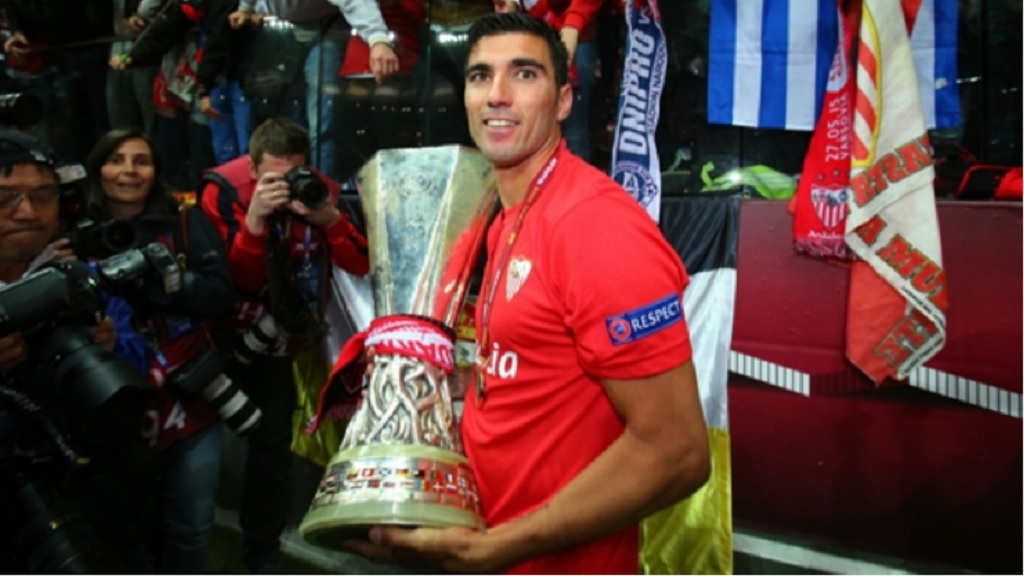
José Antonio Reyes, 1983-2019

Someone had to be the 1st member of Arsenal's "Invincibles" to die. But I didn't expect it to happen this soon, or while he was still an active player.

José Antonio Reyes Calderón was born on September 1, 1983 in Utrera, in the Province of Sevilla (usually written as "Seville" in English-speaking countries), Spain. His parents were Romani, which is what the people popularly known as "Gypsies" prefer to call themselves. At age 10, he was signed to local soccer team Sevilla FC.

In 1999, just 16 years old, he made his senior debut, and helped them reach promotion to La Liga, Spanish soccer's 1st division. Over the next 4 seasons, he scored 22 goals for Sevilla, and helped Spain win the UEFA Under-19 European Championship.

That got the attention of North London team Arsenal, who paid £17 million for him, considered a huge sum for the time. He was 20 years old, and it seemed like he had a great future ahead of him. At first, he did, scoring 2 goals to knock Chelsea out of the 2004 FA Cup, and against them again in the Quarterfinals of the UEFA Champions League, though Arsenal ended up losing. He scored key goals to save Arsenal's unbeaten Premier League season, earning them the nickname "The Invincibles." He made enough appearances in half a season to earn a Premier League winner's medal.

He kept going at the start of the 2004-05 season, scoring in each of the team's 1st 6 League games, helping them to break the record for longest unbeaten run in England's top flight, a streak that reached 49 games. He was named Premier League Player of the Month in August 2004.

But on October 20, 2004, everything changed. Arsenal went to Old Trafford to play Manchester United, with whom they had battled for League supremacy for years: One or the other had won the League every season since 1996.

But United were a dirty team, and they proved it this time: Their English players Wayne Rooney, Rio Ferdinand, and the brothers Gary and Phil Neville, and their Irish captain, Roy Keane, thought the Spanish Reyes was "soft," and targeted him, kicking him in the shins, calves, ankles. United should have been down to 8 men. Instead, the only punishments from referee Mike Riley were 1 yellow card for each of the Neville brothers.

It was a disgusting display, but it worked: Reyes spent most of the game in pain, and was completely intimidated. When Rooney made an obvious dive for a penalty in the 73rd minute, Riley awarded it instead of correctly sending Rooney off with a straight red card. Rooney would add a 2nd goal at the end, closing Arsenal's run at 49 games.

The FA should have fired Riley on the spot. Instead, he has spent the last few years in charge of Premier League referees.

The teams played again at the end of the season, in the 2005 FA Cup Final. Again, the United players kicked Reyes like crazy. Were any of them sent off? No: Reyes was for a 2nd yellow, just before the end of extra time, making him only the 2nd player in the 133-year history of the FA Cup to be sent off in the Final. But Arsenal won on penalties.

Arsenal tailed off in the League in 2005-06, but got all the way to the Champions League Final, in part because of Reyes' goals. He was used as a substitute in the Final, which Arsenal lost to Barcelona. He played for Spain in the 2006 World Cup.

And then, at the start of the next season, he asked not to be used for the Champions League qualifying match against Dinamo Zagreb, because it would have left him "cup-tied": If he were sold to another team in the CL, he could not play for them in the tournament.

Real Madrid had been "tapping him up," trying to convince him to ask for a transfer. This is illegal. Were Real punished? Of course not. Arsenal manager Arsène Wenger had a different idea: A loan swap, with each team giving the other a player to last for the rest of the season. Arsenal got Julio Baptista, and Real got Reyes. On the last day of the 2007 season, Reyes was brought on to substitute for the injured David Beckham, and scored twice against RCD Mallorca, a win that enabled Real to win the La Liga title.

Real got what they wanted out of him, and he went back to Arsenal -- for a moment. Fed up with his unwillingness to play outside Span anymore, Wenger sold him to Atlético Madrid. It made some sense for him to play there, as their stadium was named for their longtime president, Vicente Calderón -- as far as I know, no relation.

The result did not make Reyes' move look justified: He made 26 La Liga appearances, and didn't score a single goal. He was not selected for the Spain team that ended up winning UEFA Euro 2008, or the one that won the 2010 World Cup. In fact, after 2006, he never played a single game for Spain.

For 2008-09, Benfica of Lisbon, Portugal signed him on a loan deal. He wasn't with them for long, and his 2nd tenure at Atlético was considerably better. He helped them win the UEFA Europa League in 2010. In 2012, he went back to Sevilla. Under manager Unai Emery, he helped them win the Europa League 3 straight seasons: 2014, 2015 and 2016. (This is no longer possible: After the 2015-16 season, the Europa League winner qualifies for the next season's Champions League.)
In 2016, he signed with RCD Espanyol, the "other team" in Barcelona, playing just 1 season with them. After missing the 1st half of the 2017-18 season, it was clear that his career was nearing its end. He played for Córdoba, in Spain's 2nd division; for Xinjiang Tianshan, in China; and for Extremadura UD, in west-central Spain, also in the 2nd division.

On July 26, 2014, Arsenal played the New York Red Bulls at Red Bull Arena in Harrison, New Jersey. The Red Bulls won 1-0. Among the many Arsenal shirts I saw was a Number 9 with Reyes' name on it. One fan joked that this New Yorker -- or maybe New Jerseyan -- may have gotten confused, and thought it was another Jose Reyes, the shortstop wearing Number 7 with the Mets.

Officially, José Antonio Reyes was still playing for Extremadura, and was even expected to play today, in their league season finale. But, yesterday morning, June 1, 2019, he was driving between Utrera, his hometown, and Sevilla, when he crashed. He was only 35 years old, and was married to Noelia López, and had daughters Noelia and Triana, and son José Antonio Jr.

Extremadura announced his death, "With a shrunken soul and a broken heart." Sevilla FC announced, "We couldn't be confirming worse news," and called him "an eternal legend." Arsenal said the team was "devastated by the shocking news." Tributes poured in from former teammates, from Arsenal superstar Thierry Henry to Manchester City talisman Sergio Agüero, who played with him at Atlético.

A moment of silence was held before the UEFA Champions League Final, which Liverpool won 2-0 over Tottenham Hotspur, at the Wanda Metroplitano, the new stadium of Atlético.

"Invincible." No player on that team was so often, or so harshly, targeted to be revealed as less than that. Sadly, it has been proven untrue in a shocking way.

UPDATE: His final resting place is not publicly known.

Thursday, April 25, 2019

How Long It's Been: Arsenal Won the Premier League

April 25, 2004, 15 years ago: Never did a tie feel more like a win.

Or, to put it another way: If, as the saying from American football goes, "A tie is like kissing your sister," then this was like doing the deed with your sister's really hot best friend.

On a Sunday afternoon, Chelsea's defeat in the early game meant that Arsenal need only a draw to clinch the Premier League title at White Hart Lane, home of their North London arch-rivals, Tottenham Hotspur, with 4 League games to spare. They jump at the chance, with team captain Patrick Vieira (in only the 3rd minute of the game) and Robert Pires (in the 35th) each scoring a beauty.

But Jamie Redknapp -- whose father Harry would later cause Arsenal some trouble as a manager, including for Tottenham -- hits a screamer of his own. In stoppage time, there is a dive in the box, and referee Mark Halsey stupidly (or corruptly?) awards a penalty. Robbie Keane takes it, and it's 2-2.

Before the game, Arsenal manager Arsène Wenger had told his players that, if they get the point they need, they should not celebrate on the pitch, but rather wait until they were in the dressing room. But, as Thierry Henry later said, after the equalizer, the Spurs fans "celebrated like they won the World Cup Final." (As a part of the France team that did just that in 1998, he would know.)

Play resumes, and when Halsey almost immediately blows his whistle, the Gunners basically say, "Fuck it, we're the Champions," and party along with the Arsenal fans who'd made the 4 1/2-mile trip up the Seven Sisters Road to celebrate. The song, dating back to the 1971 title clincher in the old Football League Division One, goes up:

We won the League (We won the League)
at White Hart Lane! (at White Hart Lane!)
We won the League at White Hart Lane!
We won the League at the Shithole!
We won the League at White Hart Lane!

(Sometimes it's "Shite Hart Lane!")

Arsenal had already crashed out of the FA Cup in the Semifinal against Man United and the Champions League in the Quarterfinal against Chelsea. But they would finish the season unbeaten in League play, something that hadn't been done since the 1st League season, 1888-89 -- 115 years. And when Preston North End did that, it was a 22-game season. This was 38. Or, as Jon Champion, broadcasting the finale, said at the time, "They were, quite literally, unbeatable: Played 38, won 26, drawn 12, lost exactly none!"

So not only had Arsenal now won the League at White Hart Lane as many times as Tottenham had won it there -- as many times as Tottenham had won it anywhere (2, in 1951 and 1961, whereas Arsenal had done it in 1971 and 2004) -- but they'd come up with an unmatched achievement in English football. Tottenham have never done it. Nor have Liverpool, nor Man United, nor Chelsea, nor any other club, since the (much shorter) 1888-89 season and Preston North End. Just The Arsenal.

They would run their streak of unbeaten matches in the League to an all-time record 49, before a Wayne Rooney dive would give Man United a dubious penalty and a dubious win at Old Trafford the following October 24.

Arsenal have not won the Premier League since. They've won the FA Cup in 2005, 2014, 2015 and 2017. They've reached the Final of the League Cup in 2007 and 2018, and of the UEFA Champions League in 2006. They finished 2nd in the Premier League in 2016. But never since, 1st.

They've seriously challenged for the League title -- contrary to what a bunch of damn fools will tell you -- in 2008, 2009, 2010, 2011, 2014 and 2016. But they haven't won it.

Those same damn fools will tell you that not winning the League is "failure." Did I mention they were damn fools?

Since then, the League title has been won by Chelsea 5 times (2005, '06, '10, '15 and '17), Manchester United 5 times (2007, '08, '09, '11 and '13), Manchester City 3 times (2012, '14 and '18), and Leicester City once (2016). The 2019 title will be won by either Man City or Liverpool, as they are neck-and-neck at this moment, and no other team is close.

Arsenal have had long droughts before. They first got into the top flight of English soccer, known until 1992 at the Football League Division One, in 1906, but didn't win it until 1931, 25 years; and had a pair of 18-year droughts, 1953 to 1971 and 1971 to 1989. So a 14-year drought isn't as bad as it sounds, especially since, during that 1st drought, there was also a 17-year trophy drought between the 1953 League title and the 1970 Inter-Cities Fairs Cup; and, during the 2nd drought, the only trophies were the 1979 FA Cup and the 1987 League Cup.

But it's been exactly 15 years since Arsenal won the League. How long has that been?

*

Wenger finally left Arsenal after last season. Did he retire or was he fired? That is still debated, as is the question of whether he left at the right time, or should have left sooner, or should have stayed longer. Clearly, looking at how Unai Emery is managing Arsenal this season (including yesterday's debacle away to West Midlands team Wolverhampton Wanderers), a case can be made that Wenger left too soon -- or, at least, that Arsenal hired the wrong man to replace him.

Only 5 players who played so much as 1 game for Arsenal that season are still playing, anywhere in the world: Ashley Cole (Derby County in England's 2nd division), Jose Antonio Reyes (Extramadura in Spain's 2nd division), Gaël Clichy (İstanbul Başakşehir in Turkey's top division), Michal Papadopulos (Piast Gliwice in Poland's top division), and Justin Hoyte (FC Cincinnati in America). Clichy was the last of the Invincibles to leave Arsenal, in 2011.

Several of them have gone into coaching, and some have even managed: Patrick Vieira runs OGC Nice in France, Sol Campbell manages Macclesfield Town in England’s 4th division, and Thierry Henry bombed as manager of AS Monaco.

Several members have gone into soccer media: The aforementioned Henry, Campbell and Kanu, and also Ray Parlour and Martin Keown.

Football (soccer) legends Bill Nicholson, Juan Carlos Muñoz, Bert Williams, Tom Finney, Bert Trautmann, Eddie Turnbull, Laurie Hughes, Nilton Santos, Nat Lofthouse, Alfredo Di Stéfano, Walter Bahr, Ferenc Puskás, Jimmy Hill, Lawrie Reilly, Djalma Santos, Josef Masopust, Raymond Kopa, Cesare Maldini, Bobby Smith, Bobby Robson, Ray Wilson, Johnny Haynes, Jimmy Armfield, Don Howe, Gordon Banks, Gerry Byrne, Brian Labone, Billy McNeill, Giacinto Facchetti, Eusébio, Jeff Astle, Carlos Alberto, Jinky Johnstone, Alan Ball, George Best, Giorgio Chinaglia, Peter Osgood, Johan Cruijff and Sócrates were all still alive at the time. Now, they're all dead. 

Olivier Giroud, Jamie Vardy and Luis Suarez were 17 years old; Dax McCarty and Lionel Messi were 16 (Dax is listed first because he's older); Sergio Agüero, Robert Lewandowski, Diego Costa, and Mesut Özil were 15; Alex Morgan, Gareth Bale and Toni Kroos were 14; Aaron Ramsey, Eden Hazard and Antoine Griezmann were 13; Jack Wilshere and Neymar were 12; Mario Götze and Paul Pogba were 11; Harry Kane was 10 Dele Alli was 8; Christian Pulisic and Gianluigi Donnaruma were 5; Reiss Nelson was 4; and Emile Smith Rowe was 3.

Unai Emery of Arsenal was playing for Lorca Deportiva in Spain, Domènec Torrent of New York City FC was managing Girona in Spain, and Chris Armas of the Red Bulls was playing for the Chicago Fire.

Barry Trotz of the Islanders was head coach of the Nashville Predators, Pat Shurmur of the Giants was an assistant coach with the Philadelphia Eagles, Adam Gase of the Jets was an assistant coach with the Detroit Lions, David Fizdale of the Knicks was an assistant coach with the Golden State Warriors, and David Quinn of the Rangers and John Hynes of the Devils were both coaching with the U.S. national hockey team.

Mickey Callaway of the Mets was playing for the Texas Rangers, Aaron Boone of the Yankees was under contract to the Yankees but missed the entire season due to injury, Katie Smith of the Liberty was playing for the Minnesota Lynx, and Kenny Atkinson of the Nets was playing in the French basketball league.

Arsenal dethroned Manchester United as Premier League Champions, but Man U would dethrone Arsenal as FA Cup winners. FC Porto won the UEFA Champions League, beginning the rise of Jose Mourinho. This was not a good thing.

The defending Champions of North American sports were the Florida Marlins, the Tampa Bay Buccaneers, the Los Angeles Lakers, the Detroit Red Wings, and the Los Angeles Galaxy. The Heavyweight Champion of the World? It was John Ruiz according to the WBA, Chris Byrd according to the IBF, and, the day before, Vitali Klitschko had won the WBC version.

The Olympic Games have since been held in Greece, Italy, China, Canada, Britain, Russia, Brazil and Korea. The World Cup has since been held in Germany, South Africa, Brazil and Russia.

The idea that corporations were "people," and entitled to the rights thereof, was considered ridiculous. But then, so was the idea that two people of the same gender could marry each other. Massachusetts became the 1st State to legalize same-sex marriage later in that year.

The President of the United States was George W. Bush, running for re-election. Bill Clinton, George H.W. Bush, Jimmy Carter, Gerald Ford, and, for a few more weeks, Ronald Reagan were still alive. So were their wives, and the widow of Lyndon Johnson.

The Governor of the State of New York was George Pataki. The Mayor of the City of New York was Michael Bloomberg. The Governor of the State of New Jersey was Jim McGreevey.

There were still living veterans of World War I, the Mexican Revolution, the Bolshevik Revolution, and the Irish War of Independence. There were still survivors of the Galveston Hurricane of 1900, the General Slocum Fire of 1904, the Great San Francisco Earthquake of 1906, the sinking of the Titanic in 1912, and the Italian Hall Disaster of 1913.

The monarch of Great Britain was Queen Elizabeth II -- that hasn't changed -- and the Prime Minister was Tony Blair. The Mayor of London was Ken Livingstone. The Prime Minister of Canada was Paul Martin. The Pope was John Paul II. The current Pope, Francis, was Cardinal Jorge Mario Bergoglio, and an archbishop in his native Argentina. The holder of the Nobel Peace Prize was Iranian women's and children's advocate Shirin Ibadi. There have since been 3 Presidents of the United States, 4 Prime Ministers of Britain, and 3 Popes.

Major novels of 2004 included Layer Cake by J.J. Connolly, and Boy A by Jonathan Trigell, both of which have been made into major films; and Philip Roth's The Plot Against America, an alternate history showing how fascism could have come to America in the 1940 election. Stephen King published the last 2 books in his 7-book Dark Tower saga. J.K. Rowling published Harry Potter and the Half-Blood Prince, the 6th book in that story. George R.R. Martin published A Feast for Crows, the 4th book in his A Song of Ice and Fire series that inspired the TV show Game of Thrones.

Major films in the Spring of 2004 included Quentin Tarantino's Kill Bill: Vol. 2, Shrek 2, Jersey Girl, Eternal Sunshine of the Spotless Mind, 13 Going on 30, Man On Fire, Mean Girls, The Day After Tomorrow, the Trojan War film Troy; remakes of The Alamo, The Stepford Wives, Dawn of the Dead and Walking Tall; a film version of the comic books Hellboy, The Punisher and Van Helsing, a film version of the 1970s cop show Starsky & Hutch, Harry Potter and the Prisoner of Azkaban (the 4th film in the series), and the documentary Super Size Me.

Star Trek was wrapping up the 3rd season of Enterprise. George Lucas was putting the finishing touches on Star Wars Episode III: Revenge of the Sith, and we all thought that "the saga" was complete. Steven Spielberg was about to release his remake of War of the Worlds. As the actor playing Tarantino in an episode of Epic Rap Battles of History put it, "Due to War of the Worlds, a failure is what I label you. It looked like some sellout bullshit Michael Bay would do."

Daniel Craig was about to be introduced as a new James Bond, one that was absolutely not the same man of the 1962 to 2002 films. Brandon Routh was about to be introduced as Superman, in a film that acted as though Christopher Reeve's Superman III and Superman IV had never happened. Christian Bale was about to be introduced as Batman. Christopher Eccleston was about to be introduced as The Doctor.

TV shows that had recently been introduced included The L Word, Extreme Makeover: Home Edition, Pimp My Ride, Deadwood, Drake & Josh; and, to the world's great detriment, The Apprentice. The American debut of Peppa Pig, already popular in Britain, was a few weeks away.

No one had yet heard of Lisbeth Salander, Bella Swan, Michael Scott, Don Draper, Katniss Everdeen, Walter White, Jax Teller, Richard Castle, Leslie Knope, Sarah Manning, Jane "Eleven" Hopper or Maggie Bell. And most people hadn't heard of the Kardashians, except for the late Robert Kardashian Sr., and maybe (if they counted him as one) the person then known as Bruce Jenner.

The Number 1 song in America was "Yeah!" by Usher, Lil Jon and Ludacris -- and it was ludicrous that such a piece of crap should be in its 9th of 12 weeks at Number 1. The Number 1 song in Britain, the country in question, was listed as "F**k It (I Don't Want You Back)," by Eamon Doyle -- despite his Irish name, not a native of the British isles, but of Staten Island, New York City. And he only used his first name, Eamon. As you might guess, the song was not a hit in America.

Phish announced their breakup. Fantasia Barrino won Season 3 of American Idol, beating, among others, Jennifer Hudson. Paul McCartney was finishing up his album Chaos and Creation in the Backyard. Bob Dylan was working on his album Modern Times. Michael Jackson was too busy defending himself to work on an album.

Inflation was such that what $1.00 bought then, $1.35 would buy now. Given the country in which this occurred, I should add that what £1.00 bought then, £1.50 would buy now. A U.S. postage stamp cost 37 cents, and a New York Subway ride $2.00. The average price of a gallon of gas was $1.92, a cup of coffee $2.15, a McDonald's meal (Big Mac, fries, shake) $6.50, a movie ticket $6.19, a new car $22,068, and a new house $265,300. The Dow Jones Industrial Average closed the preceding Friday at 10,472.84.

In the Spring of 2004, there were terrorist bombings in Karbala, Iraq and the Spanish capital of Madrid. A ceasefire ended the Darfur War. Israel assassinated Ahmed Yassin, the founder of Hamas. And Pat Tillman, who had quit professional football to enlist in the U.S. Army after the 9/11 attacks, was accidentally killed by "friendly fire" during a mission in Afghanistan.

Bulgaria, Estonia, Latvia, Lithuania, Romania, Slovakia and Slovenia were admitted to NATO; while the aforementioned Estonia, Latvia, Lithuania, Slovakia and Slovenia, plus already-NATO members the Czech Republic, Hungary and Poland, and non-NATO members Cyprus and Malta were admitted to the European Union. But as to Cyprus, while the nation's Turks approved a proposal to reunite the island, its Greeks rejected it.

Queen Juliana of the Netherlands, and Tony Randall, and Estee Lauder died. So, within the preceding weeks, had British football legends John Charles and Bob Stokoe. Very few people born at that time have yet become famous, but it's worth noting that hardly anyone had yet heard of Lady Gaga, Bruno Mars, Drake, Rihanna, Adele, Taylor Swift, Justin Bieber, Selena Gomez, Demi Lovato, Miley Cyrus, Nicki Minaj, Cardi B, Ariana Grande, Halsey, any of the Jonas Brothers, any of the members of One Direction, Henry Cavill, Gal Gadot, Chrissy Teigen, Emma Stone, Jennifer Lawrence, or any of the younger actors from Modern Family, Game of Thrones, or the Star Wars and Harry Potter film series.

April 25, 2004. Arsenal Football Club clinched the Premier League title. They have not done it since.

When will it happen again? If you're expecting it to ever happen under Unai Emery, then you have more faith in his vaunted "system" than I do.

Thursday, May 15, 2014

10 Years After Arsenal's Invincibles: Where Are They Now?

May 15, 2004, 10 years ago today: Arsenal defeat Leicester City, 2-1 at Highbury, and complete an undefeated Premier League season.

Only once before had an English team gone through an entire top-flight season without a League loss: Preston North End, in the 1st Football League season, 1888-89. And that was a season of 22 games. Arsenal in 2003-04? As the announcer on that day's broadcast, Jon Champion, said at the final whistle, "Played 38, won 26, drawn 12, lost exactly none!"

The season before, Arsenal manager Arsène Wenger was mocked for saying he dreamed of going an entire League season unbeaten. When it didn't happen, oh, how the English media and fans of other teams laughed at him. But a year later, in 2003-04, he did it. No other manager has.

Like those Preston pioneers, the 2003-04 Gunners became known as "The Invincibles." Their League unbeaten streak, which began late the preceding season, would stretch into the first quarter of the next season, reaching 49 games. The old record of 42 was set by Nottingham Forest in 1977-78.

Where are they now?

1 GK (Goalkeeper) Jens Lehmann, Essen, Germany: Left for Stuttgart in 2008, playing 2 seasons, then retired. Came back to Arsenal as an emergency goalkeeper after all of the keepers they had on their roster got hurt, except for the man who had succeeded Mad Jens as starting goalie: Manuel Almunia -- who, by that point, was so bad that Gooners were calling him "The Clown." Was 41 years old, missing by 8 days becoming the club's oldest player ever. (Jock Rutherford, a winger, was the oldest, in 1926.)

Now 44 and retired for good, he does a lot of charity work.

3 LB (Left Back) Ashley Cole, Stepney, East London, England (of Afro-Caribbean descent): Controversially began the process of leaving Arsenal when he felt insulted by a lowball contract offer, he was transferred to Chelsea early in the 2006-07 season, and was even more successful with them than with Arsenal. Now 33, was just left off England's World Cup roster, and is rumored to be leaving Chelsea as well.

(UPDATE: Signed with Italian capital side AS Roma, moved on to the Los Angeles Galaxy, and in 2019 played for Derby County.)

4 MF (Midfielder) Patrick Vieira, Dakar, Senegal by way of Dreux, France: Had hinted that he wanted to leave for another club for a couple of years, but stuck with Arsenal through 2005. His last acts as a Gunner were to convert the final penalty in the 2005 FA Cup, and then raise the Cup as the winning Captain. Played 5 seasons in Italy: 1 at Juventus of Turin, 4 at Internazionale of Milan. Closed his career with a season back in England at Manchester City.

About to turn 38, he now coaches Man City's reserves. (UPDATE: Later managed of Man City's MLS farm club, New York City FC, and is now back in France as manager of OGC Nice.)

5 CB (Centreback) Martin Keown, Oxford, England: Left at the end of the season. Played 1 more season, with Leicester City and Reading. About to turn 48, now back at Arsenal as a coach, and is a pundit on BBC and Ireland's TV3.

7 MF Robert Pirès, Reims, France (by ancestry, half-Spanish and half-Portuguese): Remained with Arsenal through 2006. Played 4 seasons in Spain for Villareal, and 1 more in England for Birmingham club Aston Villa.

Now 40, Super Rob is involved with several charities, including playing in charity matches. (UPDATE: He came out of retirement to play 2 seasons in the fledgling Indian Super League, for FC Goa. Has since resumed training with Arsenal, giving rise to a rumor that he may move into a coaching capacity with them.)

8 MF Freddie Ljungberg, Vittsjö, Sweden: Remained with Arsenal through 2007, then moved to East London club West Ham United for a season. Played 2 years with the Seattle Sounders, and, in a game away to the New York Red Bulls, became the 1st former Arsenal player I ever saw live. Which, as Freddie the Red himself would say, in his lightly accented but superbly-grasped English, was "fuckin' excellent!" Briefly played for the Chicago Fire, in Scotland for Celtic, and in Japan for Shimizu S-Pulse.

Now 37, is rumored to be coming out of retirement to play in a new league in India. (UPDATE: He and Pires both did so, but injuries limited Freddie to 4 games for Mumbai City, at which point he retired again.)

9 FW (Forward) Jose Antonio Reyes, Utrera, Spain: Like his namesake, former Met shortstop Jose Reyes, ended up a great disappointment. Also like that other Jose Reyes, it was in part due to his own attitude. Arsenal loaned him to Real Madrid in 2006, and sold him to Atletico Madrid a year later. He was on their books for 4 years, but that included a season in Lisbon, Portugal with Benfica.

Now 30, just concluded a season back at his original club, Sevilla, in his native Spain, in which they won the Europa League. (UPDATE: In 2019, plays for Extremadura UD in Spain's 2nd division.)

10 FW Dennis Bergkamp, Amsterdam, the Netherlands: Stayed with Arsenal through 2006 and retired. His testimonial match was the 1st event at the Emirates Stadium when it opened that summer. Now 45, the Dutch Master -- known to many Arsenal fans as God, leading to the lines, "Praise Dennis" and "Dennis, save us" -- is back at his former club, Ajax Amsterdam, as assistant manager to former teammate Frank DeBoer. Has often been rumored to be a successor to Wenger as Arsenal manager. (UPDATE: That didn't happen.)

11 MF Sylvain Wiltord, Neully-sur-Mar, France (of Afro-Caribbean descent): Left Arsenal after the season, playing 8 more seasons in France. Now 40, he is retired.

12 RB (Right Back) Lauren Etame Mayer (like #s 17 & 19 on this list, usually known only by his first name), Kribi, Cameroon by way of Sevilla, Spain: Remained with Arsenal through 2006, playing 3 more seasons in England with Portsmouth and 1 in Spain with Cordoba. Now 37, he has been a pundit on various TV networks.

14 FW Thierry Henry, Les Ulis, France (of Afro-Caribbean descent): Remained with Arsenal through 2007, succeeding Vieira as Captain for 2 years. Moved on to Barcelona, and since 2010 has been the face of the New York Red Bulls -- indeed, of the entire MLS.

Now 35, Titi is no longer the best player in the world, but he's still got it. (UPDATE: Retired after the 2014 season, is now studying to become a coach, and is a pundit on Sky Sports.)

15 MF Ray Parlour, Romford, East London: Left Arsenal after the season. Played 3 seasons with Middlesbrough and Hull City before retiring. Now 41, "the Romford Pelé" is a pundit on the BBC and Radio 5 Live.

17 MF Edu Gaspar, São Paulo, Brazil: Played 1 more season with Arsenal, 4 in Spain with Valencia, and 1 back in Brazil with his original club, São Paulo-based Corinthians. Now 36, he is on temporary leave as that club's director of football, so that he can assist Portuguese star Carlos Quieroz with the Iran national team at the World Cup. (UPDATE: He is now the general coordinator of the Brazil national team.)

18 CB Pascal Cygan, Lens, France: Generally considered the prototype for the "bad Arsenal player who wears the Number 18 shirt," followed by Mikael Silvestre and Sebastien Squillaci. (UPDATE: Nacho Monreal appears to have shattered that jinx.) He still managed to play on the Invincibles, 2 FA Cup winners, and a team that reached the 2006 Champions League Final.

After that Final, joined Pires at Villareal, and after 3 years closed his career at another Spanish club, Cartagena. Now 40, he is out of the game.

19 MF Gilberto Silva, Lagoa da Prata, Brazil: Stayed with Arsenal through 2008. Joined Greek powerhouse Panatinaikos for 3 years, then closed his career back in Brazil with Gremio and Atletico Mineiro, closing his career by (along with the great Ronaldinho) leading them to the Copa Libertadores, South America's equivalent of the European Cup/Champions League.

Now 37, he is not signed to any team, but has not officially retired. (UPDATE: He officially retired in October 2015. As of March 2016, he was not employed with any club.)

22 LB Gaël Clichy, Toulouse, France  (of Afro-Caribbean descent): The youngest and longest-lasting of the players who received a Premier League medal, stayed with Arsenal through 2011, going to Manchester City. Only 28 going on 29, but has barely played for them in their 2012 and 2014 Premier League title wins.

23 CB Sol Campbell, Plaistow, East London (of Afro-Caribbean descent): Remained with Arsenal through 2006. Went to Portsmouth for 3 seasons. Played 1 game for Notts County, made a brief 11-game return to Arsenal, and closed his career with 7 games for Newcastle United.

Now 39, he is not currently involved in the game. (UPDATE: He has gone into politics, and was an unsuccessful candidate for the Conservative Party's nomination for Mayor of London in 2016. He now manages Macclesfield Town in England's 4th division, known as League Two.)

25 FW Nwankwo Kanu, Owerri, Nigeria: Left Arsenal after the season. Stayed 8 more years in England with West Bromwich Albion and Portsmouth. Now 37, he is retired from the game, runs a TV sports network in Nigiera, and is an ambassador for UNICEF.

27 CB Efstathios Tavlaridis, Serres, Greece. Only played in 3 League Cup matches, didn't get a PL winner's medal. Loaned to French club Lille after Arsenal lost the League Cup Semifinal to Middlesbrough, then signed with them and stayed 3 seasons. Now 34, he plays back in Greece for Athens giants Panathinaikos.

28 CB Kolo Touré, Bouaké, Ivory Coast. Stayed with Arsenal through 2009. Played 4 seasons with Manchester City, including alongside his brother Yaya, helping them win the 2011 FA Cup and the 2012 League title. Now 33, he rejuvenated his career this past season with Liverpool. (UPDATE: He closed his playing career with Celtic FC in Glasgow, where Brendan Rodgers was manager. He joined Rodgers' coaching staff, and has followed him to Leicester City.)

30 FW Jérémie Aliadière, Ramboulliet, France: Stayed with Arsenal through 2007, despite loans to Celtic, West Ham United and Wolverhampton Wanderers. Played 3 seasons at Middlesbrough, then returned to France in 2011, with Lorient. Now 31, still plays for them. (UPDATE: He is now retired.)

None of the players listed hereafter made enough Premier League appearances to qualify for a winner's medal.

32 FW Michal Papadopulos, Ostrava, Czech Republic (but of Greek descent): Made just 1 appearance, in the League Cup, as he was on loan from hometown club Banik Ostrava. Now 29, he is with Polish side Zagłębie Lubin, and has never played in Britain again. (UPDATE: He now plays for Polish team Piast Gliwice.)

33 GK Graham Stack, Hampstead, North London (a son of Irish parents, and thus played internationally for the Republic of Ireland): Made 5 League Cup appearances. First Arsenal, and then Reading, loaned him out to several England clubs.

Now 32, has spent the last 2 seasons as the starting goalie for North London club Barnet, who were just relegated out of the Football League to the Conference, the 5th division -- but that's hardly his fault. (UPDATE: He is now on the coaching staff at Hertfordshire team Watford.)

37 MF David Bentley, Peterborough, Cambridgeshire, England: Officially, stayed with Arsenal through 2006, but never lived up to his promise. Was loaned out to Norwich City and Blackburn Rovers before joining Blackburn on a permanent basis. Played 3 seasons for Tottenham, resulting in Arsenal fans serenading him with "Arsenal reject!"

It got worse: That other North London club also got tired of his bad attitude, and continually loaned him out: To Birmingham City, West Ham, Russian club Rostov, and back to Blackburn. So, when those teams (except Rostov, who never came) played at the Emirates, he was serenaded with "Tottenham reject!" (Is that the lowest?)

Now 29, no one seems to want him. What a spectacular failure. (UPDATE: He has officially retired, and runs a restaurant in Marbella, on Spain's Costa del Sol. He has said, "Certain people are built for the life of a footballer, but I don't think I was. I had the tools, but I don't think I had that."

45 RB Justin Hoyte, Leytonstone, North London (of Afro-Caribbean descent): Made 2 League Cup appearances. Stayed with Arsenal through 2008, then spent 5 seasons with Middlesbrough. Now 29, he is with Millwall. His brother Gavin, 6 years younger, also played for Arsenal, but only made 1 senior appearance, and is now with Dagenham & Redbridge. Both brothers played their international football for Trinidad & Tobago. (UPDATE: Justin now plays for MLS expansion team FC Cincinnati, while Gavin is back with D&R.)

51 RB Frank Simek, St. Louis, Missouri (of Czech descent). The 1st North American ever to play for Arsenal in the club's 117-year history (to that point), he made his debut in the League Cup against Wolverhampton Wanderers on December 2, 2003. It turned out to be his only senior appearance for the club.

He was loaned out to fellow Londoners Queens Park Rangers and South Coast club Bournemouth. He played 5 seasons for Yorkshire club Sheffield Wednesday and 3 for Cumbrian club Carlisle United. Now 29, he is a free agent. (UPDATE: Has broken more ground for an American athlete: The 1st one to play in Vietnam, at Sông Lam Nghệ An.)

52 FW John Spicer, Romford, East London: While Parlour came from that neighborhood and played 14 seasons with Arsenal at the senior level, Spicer made just 1 League Cup appearance, and bounced around England for the next 9 years. Now 30, he is a free agent. (UPDATE: He is retired.)

53 MF Jerome Thomas, Wembley, West London (of Afro-Caribbean descent): Made 2 League Cup appearances, and ended up loaned out, before being sold to South London club Charlton Athletic, and made his mark there and at Hampshire club Portsmouth. Now 31, played for South London club Crystal Palace this season. (UPDATE: Injuries forced him into retirement in 2017.)

54 MF Quincy Owusu-Abeyie, Amsterdam, the Netherlands (to parents from Ghana, and has played for their national team): Made 2 League Cup appearances. Stayed with Arsenal through 2006, before being sold to Russian giants Spartak Moscow. Now 28, he is a free agent, last playing a season ago for Panathinaikos. (UPDATE: After 2 seasons in Portugal, he is currently a free agent again.)

55 MF Ólafur Ingi Skúlason, Reykjavik, Iceland: Made just 1 League Cup appearance, then bounced around Britain. Now 31, plays for Belgian club Zulte Wargarem. (UPDATE: He is back with his original team, Fylkir of Reykjavik.)

56 FW Ryan Smith, Islington, North London (of Afro-Caribbean descent): Despite coming from Arsenal's home neighborhood, he never got past the League Cup. Played in MLS for Sporting Kansas City and Chivas USA. Now 27, he is a free agent. (UPDATE: Like Spicer, He is not listed as retired, but hasn't played since 2013.)

57 MF Cesc Fabregas, Barcelona, Spain: Only played in League Cup matches in 2003-04, but was a regular reserve the next season, and started the FA Cup Final, getting a winner's medal. Wenger sold Vieira, essentially to build a team around Fabregas, and it was then that Arsenal's trophy drought began.

Arsenal reached the 2006 CL Final with Fabregas' considerable contributions, but despite occasional spectacular goals and moves, his tenure at Arsenal was a monumental failure. He was a member of the Arsenal team that lost the 2007 League Cup Final, and his injuries cost Arsenal dearly in the 2008, 2009 and 2010 seasons. Within days of each other, he was injured for the 2011 League Cup Final which Arsenal lost, and backheeled a pass that his former club Barcelona was able to convert to a goal, knocking Arsenal out of the Champions League and giving rise to the perception that Cesc was a "double agent" for Barca.

He confirmed 2 years of rumors and tapping-up by his former club Barcelona by whining his way into a strike, with the aim of forcing a sale. He succeeded. In the 3 years since, Barca have won a La Liga title and a Copa del Rey, but also blew 2 Liga titles that they probably should have won, and have failed to reach the CL Final. Maybe Fabregas is a jinx. Certainly, he poisoned the atmosphere at Arsenal: Cesc Mustardgas.

Now, some Arsenal fans want him back. And who, exactly, would he replace in the lineup? Mesut Ozil? Aaron Ramsey? Santi Cazorla? Jack Wilshere? They're all better than Fabregas now. Mikel Arteta? Not really the same position. There's no room for him on the team -- and there shouldn't be any place in the club for someone who stabbed Arsene Wenger, and all Arsenal fans, in the back. The future that he promised turned out to be a mirage.

(UPDATE: Having worn out his welcome at Barca, he accepted a sale to Chelsea, whom he helped to his 1st Premier League title in 2015. So, 3 years after giving Arsenal fans a stab in the back, he gave them a slap in the face. He now plays for AS Monaco.)

Friday, March 21, 2014

One Arsène Wenger, 1,000 Games -- Part II

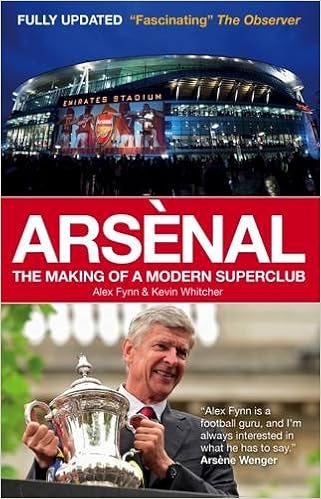
With a name like Arsène, it seemed fitting that Arsène Wenger became the manager of Arsenal football club. Indeed, one of the books about his tenure in North London is titled Arsènal: The Making of a Modern Superclub, by Alex Fynn.

When he arrived in the marble halls of Highbury on September 30, 1996, Wenger and Arsenal needed each other. He needed to prove himself against the best competition imaginable, and they needed a manager who could lead them back to glory.

But there were doubters. More important than in the English media, including the Evening Standard, publisher of the infamous headline "Arsène Who?" were those within the club. As with on a hockey team, on a soccer team, the post of Captain is more important than it is in baseball, basketball, and American football. And the Arsenal Captain, centreback Tony Adams, later admitted, "At first, I thought: What does this Frenchman know about football? He wears glasses and looks more like a schoolteacher. He's not going to be as good as George. Does he even speak English properly?"

Arsène Wenger did, of course, speak English properly. And, in the end, he did more with George Graham's players, including Adams, than Graham did.

*

One reason is that he insisted on a change in lifestyle. Adams, right back Lee Dixon, and midfielders Perry Groves, Paul Merson and Ray Parlour had formed The Tuesday Club. Since Graham didn't hold training (as Allen Iverson would say, "We talkin' 'bout practice") on Wednesdays, the 5 of them "went out on the lash" on Tuesday nights, and alcohol-fueled hijinks ensued, occasionally resulting in criminal activity.

Graham overlooked it, because the players returned to training on Thursday and Friday, and got the job done on Saturday. Adams joined the club in 1983, and Parlour didn't play his 1st senior match until 1992. One time, he and Adams both arrived hungover, and Graham chewed him out. Parlour stood up for himself, and pointed out that Adams was hungover, too. But Graham said, "He does the business for me." In other words, Parlour would also have to get the job done in games. Eventually, he did.

Wenger knew that this could not be sustained, especially since, upon his arrival, Dixon was 32, Adams was about to turn 30, and Merson was 28 -- Parlour was easily the youngest of that bunch, 23. It could not have escaped Wenger's attention that the other member, Groves, had already been out of football for 2 years and away from Arsenal for 4, his sloppy lifestyle ending his career before he turned 30.

He not only changed the way the players warmed up, including added stretching, but streamlined their training-day and game-day diets, introducing pasta and leaner cuts of meat than they'd been used to. And he insisted on reducing their alcohol intake.

Indeed, Adams would soon go into rehab to beat alcoholism, and upon his return insisted that the club go further than even Wenger's recommendations: He asked that alcoholic drinks be banned from the players' lounge. (He would write a memoir titled Addicted, and found a rehab center, Sporting Chance Clinic.) The result was that Adams and Dixon were still playing for Wenger at Arsenal as late as 2002, Parlour until 2004.

But not all the players signed on to this healthier ideal. Merson, in particular, had already been to rehab once, for not just alcohol but cocaine addiction. He and Parlour also had gambling problems. Wenger sold Merson to North-East club Middlesbrough in the 1997 off-season, with 99 (not 100) goals to his Arsenal credit. Eventually, Merse would straighten out his life, and become a TV pundit for the game; but his playing career, for all intents and purposes, was in ruins.

In addition, Wenger saw a team that had, to use a word he likes to use, "quality," but also, as he put it, "a short shelf life." Centreback Steve Bould was almost 34 years old. Goalkeeper David Seaman, then the usual starter for the England national team, was 33 (though it should be noted that, as in hockey, goalies tend to last longer than outfield players). So was forward Ian Wright, who was on his way to becoming the club's all-time leading scorer. Left back Nigel Winterburn was about to turn 33. Like Adams, midfielder David Platt and centreback Martin Keown were 30. Indeed, of the regulars, only Parlour and forward Dennis Bergkamp were under 30 (23 and 27, respectively).

So beyond changing the diet and the exercise, which he needed to do in order to extend the careers of these players, Wenger knew he had to find their replacements as soon as possible. The fact that Vice Chairman David Dein, the man who had recommended Wenger to the Arsenal board, had already brought in Dutch star Bergkamp a year before was a big help.

Before he was able to officially take charge, Wenger recommended to Dein and caretaker manager Pat Rice (who had played on Arsenal's 1971 Double team and captained their 1979 FA Cup winners) that they sign Patrick Vieira, a 20-year-old Senegal-born, France-raised midfielder at AC Milan, who had played for Cannes (although well after Wenger had moved on from that club).

Wenger's 1st acquisition was every bit as important to the new era that was to begin as Bergkamp's vision and flair would be: "Paddy," as Arsenal fans soon called him, was a two-way dynamo, devastating in defense, and setting up and scoring plenty of goals. As more young players came into the club, he essentially became Adams' vice-captain for handling them, and set himself up perfectly to step into the Captain's role when Adams finally retired.

Arsenal finished 3rd in 1997, their best finish in 6 years, since Graham's last title. With a proper Summer transfer window to work with, Wenger went to work, continuing his "French Revolution" by signing 18-year-old forward Nicolas Anelka from Paris Saint-Germain and his former Monaco defensive midfielder Emmanuel Petit. He also reasoned that Bergkamp might work well with Dutch winger Marc Overmars, as they had played together at the mighty Ajax Amsterdam.

It worked beautifully: Trailing Manchester United by 13 points in the Winter, Arsenal stormed back, beating Man U away on a late Overmars goal, took 48 out of a possible 54 points, and clinched the title for the 11th time -- but the 1st time under the Premier League name -- in a home game at Highbury, beating Liverpool-based Everton 4-0, the last goal memorably coming the old Arsenal way, as the centerback pair of Bould and Adams did the business, Bould providing a nice through-ball for the Captain, who slammed it home, and raised his arms in a pose that would be the template for his statue that now stands outside the Emirates Stadium.

Finally having won a League title -- the closest he had previously come was 3rd place with his former club Crystal Palace -- Wright jumped on Adams' back, the happiest man inside Highbury. Arsenal then beat Newcastle United to take the FA Cup, on goals by Overmars and Anelka (2 of the brand-new acquisitions, remember).

Arsène had made his point: Although Scottish, Welsh and Irish managers had done well in the English game, he proved that a "foreign" manager could succeed. And that the League Champions should be a team capable of playing "beautiful football."

Muhammad Ali, who defended the Heavyweight Championship of the World against Henry Cooper at Highbury in 1966, and frequently said of a challenger, "He's too ugly to be the world's champ! The world's champ should be pretty, like me!" would have understood, had he been aware of it at the time. Indeed, Arsenal fans have long mocked Liverpool, the team that dominated the 1970s and '80s, with the song, "Liverpool, hoof the ball!"

It should also be noted that "doing The Double" was a rare thing in England. To that point, it had only been done 7 times, with some notorious close calls, including Arsenal finishing 2nd in the League and losing the FA Cup Final in 1932. Here are the times it's been done, through the 2012-13 season:

1. 1888-89 Preston North End (the 1st season of the League)
2. 1896-97 Aston Villa (Birmingham)
3. 1960-61 Tottenham Hotspur (Arsenal's nearby rivals)
4. 1970-71 Arsenal
5. 1985-86 Liverpool
6. 1993-94 Manchester United
7. 1995-96 Manchester United
---------------------------------------------------------------------------
8. 1997-98 Arsenal
9. 1998-99 Manchester United
10. 2001-02 Arsenal
11. 2009-10 Chelsea (West London)

That's 11 occurrences, 9 since 1960, and 6 have been by Arsenal and Man U. Liverpool and Chelsea, for all their success, have done it just once each. (Arsenal's shocking League title win at Anfield in 1989 was the best-known denial of a Liverpool Double.)

*

After the 1998 Double, Wenger began the process of replacing the Graham team. He sold Wright and Platt, moved Anelka into Wright's role on a regular basis, and brought in Freddie Ljungberg to replace Platt. It almost worked wonders, but Arsenal missed the League title by 1 point, and fell to Man United in the FA Cup Semifinals, as United then went on to shock Bayern Munich in the Champions League Final, winning what remains England's only European Treble.

Wenger then encountered his first sign of trouble, as Anelka, named Young Player of the Year in England, thought he deserved more money. For the 1st time, Wenger had turned a kid with promise into a great player and had gotten ingratitude in return. Having bought Anelka's contract for £500,000, Wenger now sold it to Spanish giants Real Madrid for £22.3 million.

If Anelka thought his point was proven, he was wrong: He has now played for 11 clubs in 18 seasons, and aside from 4 years at Chelsea he has never been with the same club for more than 2 years running. He has also caused trouble with the France national team, and has earned the nickname "Le Sulk."

Wenger sold Bould, and promoted Keown to starter. He also brought in a player he'd managed at Monaco, Thierry Henry, a winger from France of Caribbean descent, whose last club was Turin, Italy superclub Juventus. Wenger turned Henry into a center forward, and he went on to surpass Wright as the club's all-time leading scorer.

He then signed another of Bergkamp's former Ajax teammates, the Nigerian Nightmare, Nwankwo Kanu. Particularly in the club's run to the 2000 UEFA Cup Final, Kanu was a force, and his presence in the Arsenal lineup, and that of the Senegal native Vieira, along with the massive growth in satellite-TV coverage of the Premier League all over the world, made Arsenal the most popular soccer team not just in those men's native countries, but on the entire continent of Africa.

But success wasn't coming at the rate Wenger had hoped. Arsenal lost that 2000 UEFA Cup Final to Istanbul, Turkey-based Galatasaray, finished 2nd to Man United again, and did not do well in the FA Cup. He then sold Overmars and Petit to Spanish giants Barcelona, after that club had already made legally questionable overtures to them -- the 1st time Barca were guilty of "tapping up" Arsenal players, but by no means the last.

He brought in winger Robert Pires from French club Metz -- Spanish mother, Portuguese father, French-trained, and in some ways the ideal Wenger player, hard-working but with beautiful skills. Brazilian star Sylvinho hadn't worked out as Winterburn's replacement at left back, but Ashley Cole was more than ready to come up from the youth team. Arsenal finished 2nd again in 2001, but lost the FA Cup Final to Liverpool, and again qualified for the UEFA Champions League, but did not do well in it.

Changes needed to be made. Wenger found Dixon's replacement in Spanish club RCD Mallorca's Lauren Etame Mayer. Like a Brazilian, the Cameroon native used only his first name professionally. And then came the biggest transfer coup in Arsenal history: Sol Campbell, centreback and Captain of arch-rival Tottenham Hotspur, wanted out of that eternally-dysfunctional club, played out his contract, and came to Arsenal on a free transfer. He would be Adams' replacement.

And in the 2001-02 season, Arsenal played better than ever in the history of the club. They became the first team ever to score in every game of a League season. They didn't lose an away game all season long. Campbell was sensational at the back, Henry equally so up front, Cole came of age, Pires had the season of his life before an injury kept him out of the run-in (a little bit the foreshadowing of later Arsenal teams?), Ljungberg picked up the slack with a great run of goals after Pires' injury, Seaman made unbelievable saves to show he was ready to lead England into that Summer's World Cup (though glory was not to be for the Three Lions), and Bergkamp scored one of the most amazing goals ever seen in a game away to Newcastle.

That Arsenal team may have been even better than the one that went unbeaten 2 years later. It should have won the Treble. Alas, it went out in the Second Group Stage of the Champions League. In their home match against German club Bayer Leverkusen, they scored 2 goals in the 1st 7 minutes en route to a 4-1 win, but only managed a 1-1 draw in the away match. Had any of those 4 home-tie goals been scored, instead, in the away tie, or had the last-minute equalizer by Bayer's Ulf Kirsten been stopped, Arsenal would have advanced to the knockout stage -- and it's worth noting that Bayer got all the way to the Final before being beaten by the "Galaticos" of Real Madrid.

But Arsenal did win the Double, and faster than anyone else had, taking the 2nd half just 4 days after the 1st. (In contrast, they had nearly a month to do that in 1998, and just 5 days in 1971.) Parlour and Ljungberg scored in the 2nd half to beat Chelsea in the Cup Final, and then a 2nd-half goal by forward Sylvain Wiltord, playing only because both Henry and Bergkamp were injured, beat United at Old Trafford for the League clincher with a game to spare.

After this, despite the retirements of Adams and Dixon, Wenger got ambitious. He said he wanted "to win everything." He said he wanted to go an entire League season unbeaten. That didn't happen in 2003, and a late loss to Leeds United cost the Gunners the title, as Man United won again. But they did win the FA Cup, defeating Southampton in the Final on a goal by Pires -- who always seemed to score against Southampton and, much more to Arsenal fans' delight, against Tottenham. (That season also featured a long-distance solo goal by Henry against Tottenham, and his long-distance run back to do a kneeslide in front of the visiting Spurs fans, a pose now recreated in his statue at the Emirates.)

*

But Wenger still thought about going unbeaten all through a season. With German madman Jens Lehmann replacing Seaman in goal, and Ivory Coast native Kolo Toure settling in Keown's former place at the back, Arsenal went for it all in 2003-04.

It didn't work out, as they lost to United in the FA Cup Semifinal and to Chelsea in the Champions League Quarterfinal within a span of 3 days in early April. But in the League? They were unbeaten. Henry, in particular, was on fire, scoring 30 goals in League play alone, including a 4-goal performance against Leeds, the last of which would have been a penalty because he was tripped up in the box, and yet he scored anyway.

There were some draws that shouldn't have happened, but there were also some amazing comebacks against Liverpool, both home and away, and home to Tottenham. They didn't beat United, but came away with draws in both games, including the September game at Old Trafford, where United's players hacked away at Arsenal players' legs and dove in the penalty area, finally winning a bogus penalty in stoppage time -- which Ruud van Nistelrooy clanked off the crossbar, leading to Keown's famous taunting of the horse-faced diving Dutchman.

A 2-2 draw, with Vieira and Pires scoring, was enough for Arsenal to clinch the title at, of all places, White Hart Lane, home ground of Tottenham -- just as Arsenal clinched the old Football League away to Spurs in 1971. Arsenal had now won the League at White Hart Lane as many times as Tottenham had -- as many times as Tottenham had won the League anywhere: 2.

They closed the job on May 15, 2004, with a comeback from 1-0 down to beat Leicester City 2-1. As ITV broadcaster Peter Drury said, "Played 38, won 26, drawn 12, lost exactly none." Preston North End had gone unbeaten in the League in its 1st season, 1888-89, but that was just 22 games; this was 38, and Arsenal earned the same nickname that early Preston team got: The Invincibles. Wenger had achieved a unique feat in English football history, and he had done it not just in a longer season than Preston, but against far tougher competition.

Indeed, it was against the toughest competition the world had yet seen. After all, when Wenger arrived in 1996, there weren't many Continental players in the Premier League; when Arsenal won the 1971 Double, you were considered "foreign" if you were from the British Isles but not from England.

Arsenal's unbeaten streak, which began late in the 2002-03 season after the loss to Leeds, extended to 49 straight games, a new English record, before they went to Old Trafford. This time, United's cheating worked, as 20-year-old (but already balding) Scouse bastard Wayne Rooney performed a perfect dive in the box on Campbell, a penalty was called, and converted. United won, and Arsenal went on to finish 2nd in the League, to Chelsea. Arsenal got their revenge, though, beating United in the FA Cup Final.

The unbeaten string is Wenger's greatest achievement. It is the greatest achievement of any manager in the history of British football.

Building a new stadium -- which also began in the Invincibles season -- isn' impossible. Chelsea and Liverpool, for all their assets, are finding it tough going, but that's due to politics as much as anything else. If Chelsea's Russian oligarch owner Roman Abramovich, or the Fenway Sports Group boys who used their Boston Red Sox gains to buy Liverpool, really wanted to, they could bribe the necessary people and get it done. (It's not like bribery has never worked in Moscow or Boston before.)

But 49 straight games unbeaten in the League? Brian Clough managed 42 at Nottingham Forest in 1977 and '78. Jose Mourinho at Chelsea, 40 -- oddly enough, starting his streak on October 23, 2004, the day before Arsenal's ended. Don Revie did 34 at Leeds United in 1969 and '70. Alex Ferguson managed 29 at Manchester United. So did Liverpool under Kenny Dalglish. Tottenham's longest? 20, under Bill Nicholson in 1967-68.

But 49? In a 38-game season, that's over a year and a quarter, and it was against good teams and bad teams. It was against legendary players from all over the world, and against plonkers whose only skill is injuring others. It was against managers who were considered brilliant, and against those who were determined to frustrate and play for a draw while hoping for a lucky break (or both in some cases).

It was done at home and away, in front of crowds as large as the 70,000 muppets (and 5,000 traveling Gooners) at Old Trashdump, and as small as the 18,000 shoehorned into Loftus Road (West London home ground of Queens Park Rangers, where Southwest London club Fulham were playing while Craven Cottage was being renovated).

It was in spite of injuries, bad weather, opposition cheating, and officiating that was either incompetent or corrupt (the latter two factors finally ending it). For every one of those 49 games, there may have been at least half a dozen reasons why the opposition could have emerged victorious. But until Rooney dove on Sol, none did.

I don't know what the odds are on a Premier League team going 49 straight League games without a loss, but they must be astronomical, even now, 10 years after it was proven possible. And it wasn't "lucky." As Jimmy Fallon said in the noticeably inferior U.S. version of Fever Pitch, you can have a lucky game, but you can't have a lucky career. But it took 50 games for bad luck to triumph over Arsene's brilliance and the players' work and style.

Show me another manager who can do that, in the toughest league in the world. Bayern has now done 50 in Germany, and Milan and Juventus have done 49 in Italy (Milan making it all the way to 58 in 1993) -- but those teams don't face Stokies, Mackems and Brummies. And neither Real Madrid nor Barcelona have done it, with any manager, for all their resources.

When we say there's only one Arsene Wenger, above all other reasons, it's because of this unique achievement.

Part III will follow.