Showing posts with label el tri. Show all posts

Friday, May 29, 2026

May 29, 1966: Estadio Azteca Opens

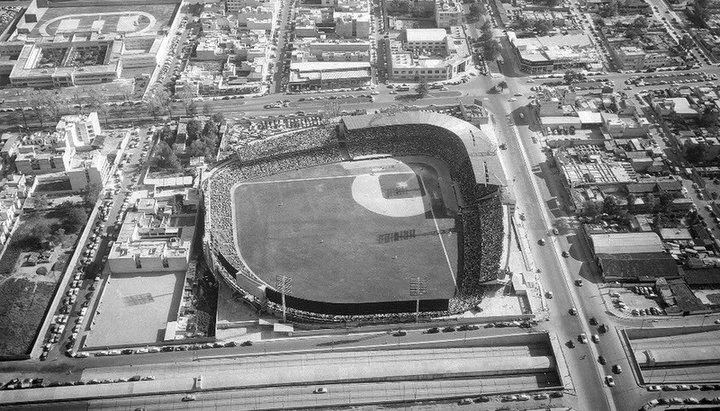
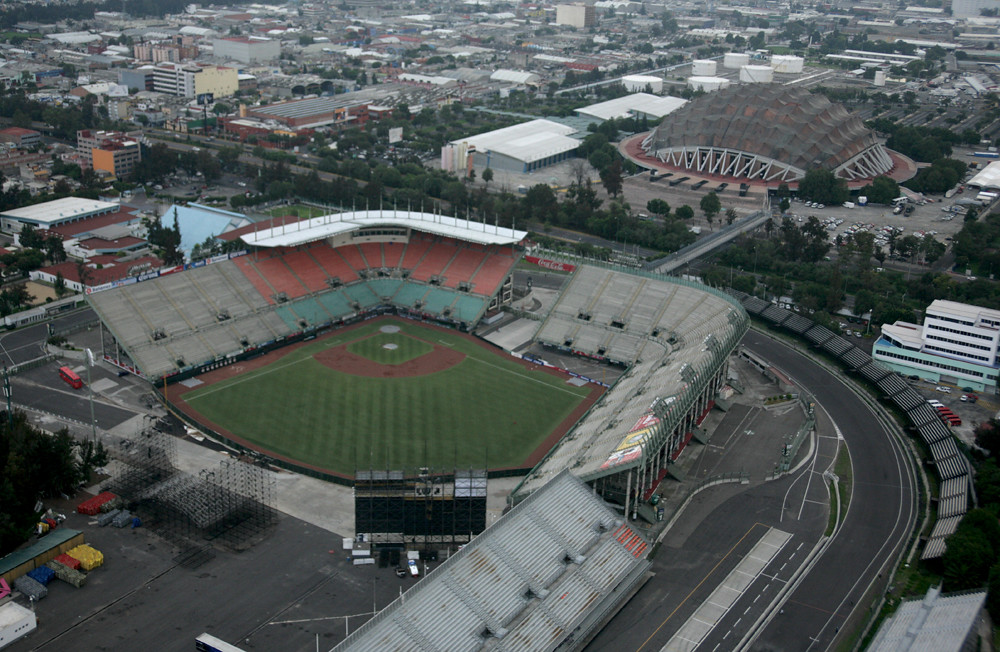
May 29, 1966, 60 years ago: Estadio Azteca opens in Mexico City, about 9 miles south of downtown. Club América takes a 2-0 lead over Italian team Torino F.C., but Torino plays back to a 2-2 draw. President Gustavo Díaz Ordaz of Mexico made the ceremonial first kick, and FIFA President Sir Stanley Rous attended.

The Azteca is the most famous building not just in Mexico, but in all of Central America. Named for the ancient empire that ruled Mexico, it remains the home of the national team and of Club de Fútbol América S.A. de C.V., or simply Club América, the most-loved -- and, like the New York Yankees, the most-hated -- sports team in the country. 

It is older than every Major League Soccer stadium except Providence Park in Portland; every NFL stadium except Lambeau Field in Green Bay; every MLB stadium except Fenway Park in Boston, Wrigley Field in Chicago, and the 2 Los Angeles area ballparks, Dodger Stadium and Angel Stadium; every NBA arena; and every NHL arena.

From a peak of 119,853 fans at a 1968 game, renovations have reduced the soccer seating capacity to an official 87,523, which still makes it larger than all but a few stadiums in the world, including most of those in the U.S. The field is a hybrid of natural grass and artificial fibers, and runs north-to-south.
Known as "El Coloso de Santa Úrsula," the Colossus of Saint Ursula (for the neighborhood it's in), along with the Maracanã in Brazil, it is 1 of 2 stadiums to have hosted 2 World Cup Finals: 1970, in which Brazil beat Italy; and 1986, in which Argentina beat West Germany.

It also hosted the 1970 Semifinal between Italy and Germany that became known as "The Game of the Century"; and the 1986 Quarterfinal between Argentina and England in which Diego Maradona scored what became known as "The Goal of the Century," only 4 minutes after his handball goal that he called "The Hand of God," the most famous cheat in the history of sports on planet Earth.

In addtion to Club América, the Azteca has been the home field for Club Necaxa, who played there from 1966 to 1970, and again from 1982 to 2003 before going to the city of Aguascalientes; Atlante, who played there off and on from 1966 to 2007, before returning permanently to their home base in Cancún; Club de Fútbol Universidad Nacional A.C., a.k.a. Pumas de la UNAM, Pumas or UNAM from 1967 to 1969; Atlético Español from 1970 until they went out of business in 1982; and Cruz Azul (Blue Cross) from 1971 to 1996.

It's also hosted soccer for the 1968 Olympics, the 1975 Pan American Games, the 1993 and 2003 CONCACAF Gold Cups, the 1999 Confederations Cup, and the 2011 Under-17 World Cup. It will host 5 matches of the 2026 World Cup, including 2 Mexico matches, and matches in the Rounds of 32 and 16. (Estadio Olímpico Universitario was the main stadium for the 1968 Olympics, and preceded the Azteca as the national team's stadium.)
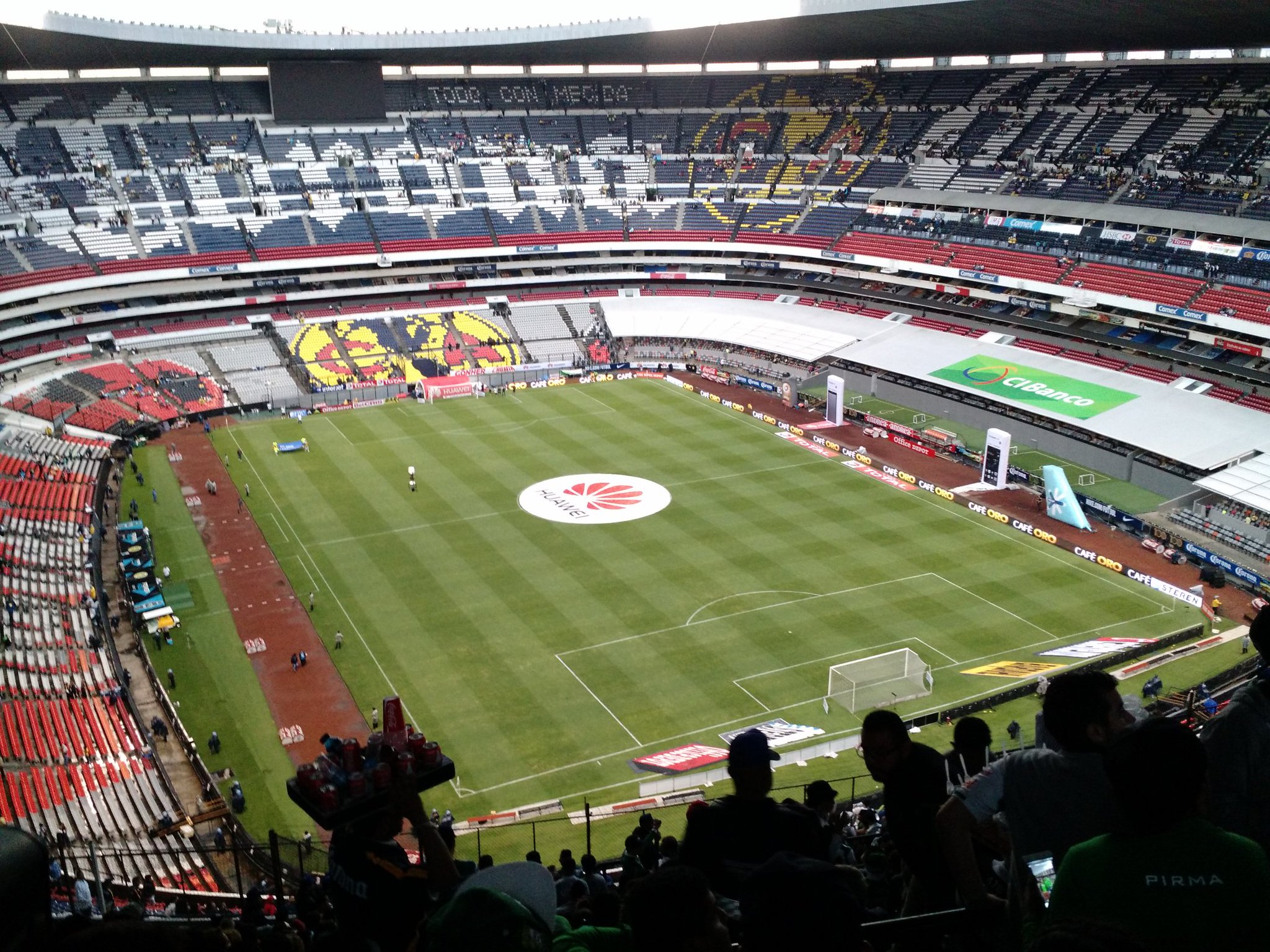
It's hosted our football 10 times. The 1st was on August 15, 1994, in a preseason game in which the Houston Oilers beat the Dallas Cowboys 6-0, in front of the largest crowd in NFL history, 112,376. It's hosted 6 regular-season games, with a 1 each planned for the seasons of 2026, 2027 and 2028.

On February 20, 1993, the stadium's all-time attendance record was set, as 132,247 people saw Mexico's greatest-ever boxer, Julio César Chávez, knock Greg Haugen out to retain the Light Welterweight Championship of the World. The stadium has also hosted concerts, including by Paul McCartney, Michael Jackson and U2; and religious convocations, including the funeral of Chesperito, a legendary Mexican comedian who was a Club América fan.

Mexico City's combination of desert and mountains -- its elevation is higher than that of Denver, "the Mile High City" -- makes for a climate difficult for visiting teams, especially from outside Mexico. It took the U.S. national team 12 tries, until 2012, to get their 1st win over Mexico at the Azteca, and that was in a friendly: As of May 29, 2022, they're still looking for their 1st competitive win there.

Friday, May 24, 2024

May 24, 1934: U.S. Soccer's 1st Game (and Win) vs. Mexico

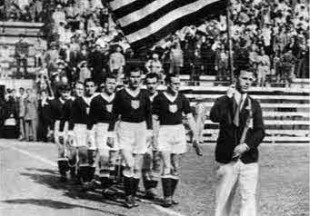
May 24, 1934, 90 years ago: The national soccer teams of the United States of America and the United Mexican States play each other for the 1st time -- not in either country, and not with the result most people would have expected then, or now.

It was in Rome, Italy, and it was for the 16th and last qualifying spot in the FIFA World Cup, which had only been contested once before, in 1930, with Uruguay winning on home soil, beating Argentina in the Final. In that tournament, the U.S. beat Belgium and Paraguay, before losing to Argentina in the Semifinal. It remains the U.S.' best World Cup performance ever.

For 1934, the U.S. squad consisted of the following, many of them immigrants, who nonetheless qualified for this team under the rules of that time:

* Goalkeepers: Julius Hjulian of Sweden and Chicago.

* Defenders: George Moorhouse of Liverpool and New York, Ed Czerkiewicz and Joe Martinelli of Rhode Island, Al Harker of Philadelphia, and Herman Rapp of Stuttgart and Philadelphia.

* Midfielders: Tom Amrhein of Baltimore, Bill Fiedler of Philadelphia, Jimmy Gallagher of Scotland and Cleveland, William Lehman of St. Louis, Tom Lynch of Brooklyn, Tom Florie of Harrison (New Jersey), Peter Pietras of Trenton (New Jersey), and Bill Gonsalves of Fall River (Massachusetts).

* Forwards: Aldo "Buff" Donelli of Pittsburgh, Walter Dick of Scotland and Niagara Falls, Willie McLean of Scotland and Chicago, Werner Nilsen of Norway and St. Louis, and Francis Ryan of Philadelphia.

Donelli also played gridiron football, and later coached in his hometown, both at Duquesne University and with the Pittsburgh Steelers. Moorhouse, Florie, Gallagher and Gonsalves had played for the U.S. team in 1930.

Since the British "Home Nations" of England, Wales, Scotland and Northern Ireland did not participate in the World Cup until 1950, due to a dispute with FIFA, Moorhouse was the 1st native of England to play in the World Cup. Probably because he was trained to play in England, then considered the world's soccer capital, he was named Captain of this team.
George Moorhouse

The game against Mexico was played at the Stadio Nazionale in Rome, which would also host the World Cup Final. Since 1931, it had been the home of soccer team S.S. Lazio. In 1940, it would become the home of Lazio's arch-rivals, A.S. Roma. The Americans won, 4-2, with Donelli scoring all 4 goals.
Aldo "Buff" Donelli

The state of American soccer in 1934 was such that it was operating on what would now be considered a minor-league level. There were plenty of teams in the Northeast, in the Midwest, and on the West Coast, many of them ethnically based: Irish, Scottish, German, Italian, Spanish, Portuguese, Polish, Hungarian, Ukrainian, Jewish.

Given that it was the Great Depression, there was room for the national team to become national heroes, if they could follow up a win over neighboring Mexico with a good performance at the World Cup. That year, the St. Louis Cardinals and the Detroit Tigers both electrified the nation with their play, culminating in an epic World Series that the Cardinals won in Game 7. The Chicago Bears had become heroes of professional football. The Boston Bruins, the New York Rangers and the Chicago Black Hawks had already gotten Americans to cheer hockey. And boxers galore had excited people. If the U.S. soccer team could do well at the World Cup...
Stadio Nazionale

They didn't. Their 1st Round game was against the hosts, and Italy beat them, 7-1. Donelli scored the only U.S. goal. Angelo Schiavio of Bologna F.C. scored 3 goals. The last Italy goal was scored by Giuseppe Meazza of Internazionale Milano, the greatest Italian player of his generation, a man so loved that the home ground of both "Inter" and their rivals A.C. Milan, the greatest sporting venue in the country, known for its neighborhood as the San Siro, is officially named Stadio Giuseppe Meazza.

So there would be no follow-up heroics for the U.S. team. They didn't even qualify for the 1938 World Cup in France. Their next game against Mexico didn't come until 1937, at Parque Asturias in Mexico City, and they lost, 7-2.

It would take until April 28, 1957 for the U.S. to play a home game against Mexico, a Qualifier for the 1958 World Cup, at Veterans Memorial Stadium in Long Beach, California, a 7-2 loss. The next U.S. win wouldn't happen until November 23, 1980, a Qualifier for the 1982 World Cup, at Lockhart Stadium in Fort Lauderdale, Florida, a 2-1 U.S. win. And the U.S. wouldn't beat Mexico in Mexico until August 15, 2012, a 1-0 win in a friendly at the Estadio Azteca in Mexico City. 

In 1953, Roma and Lazio both moved into the Stadio Olimpico, which became the main stadium for the 1960 Olympics. After the move, the Stadio Nazionale, site of the 1934 U.S.-Mexico game, was demolished, and replaced with the Stadio Flaminio in 1959. It was used for the soccer games of the 1960 Olympics, and as the home of both Roma and Lazio in the 1989-90 season, while the Olimpico was demolished and rebuilt for the 1990 World Cup. The Flaminio is now home to Capitolina, a professional rugby team.
Stadio Flaminio

Buff Donelli died in 1994. The last survivor of the 1934 U.S. World Cup team was Al Harker, who lived until 2006. 

Saturday, April 8, 2017

How to Be a U.S. Soccer Fan In Mexico

Believe it or not, the modern-looking city in this photograph is Mexico City, North America's oldest major city.

On Sunday, June 11, the U.S. Men's National Team (USMNT) -- Soccer -- will play arch-rival Mexico at Estadio Azteca in Mexico City.

Mexico will not need to win this game to qualify for the 2018 World Cup in Russia. America might need to win it to qualify.

Before You Go. My recommendation is that you go in numbers -- in a group, the larger, the better. Find a tour package. Now you know why I'm doing this one 2 months in advance.

Do you have a passport? Good. No? You may not have time to get one, unless you're willing to pay extra to get it done quickly.

If you are going to drive in Mexico, you must first obtain Mexican driving insurance. You should contact the Mexican consulate in New York, at 27 East 39th Street.

The exchange rate really favors us, and that was true long before Donald "We're gonna build a wall" Trump took the Presidency: $1.00 = about 18.65 pesos, and 1 peso is a shade over a nickel.

Reserve your hotel before you go. There are plenty of websites that can pick you a good one.

Mexico is dominated by 3 climates: Desert, mountain and jungle. Mexico City is desert, but also mountainous. The high elevation -- 7,350 feet above sea level, or 1.39 miles, making it 39 percent higher than "Mile High" Denver -- and the city's notorious smog may make it difficult to breathe. (It has been reduced significantly since 1990.) However, early projections for mid-June in Mexico City suggest that the notorious Summer heat might not be an issue: For that week, they're saying daytime temperatures should be in the low 80s, and the nighttime temperatures should drop to the mid-50s. That's Fahrenheit: While there, it'll be listed in Celsius, so mid-20s by day, and low 10s by night.

In Spring and Summer, Mexico City is in the same time zone as New York. In Autumn and Winter, they are an hour behind us. So, on this occasion, you won't have to fiddle with your timepieces.

Tickets. Don't even think about the usual procedure. You're not getting tickets from the stadium website, or the Mexican national team website. Go through the U.S. national team website, or through the American Outlaws.

Getting There. It is 2,636 miles from Times Square in Manhattan to Estadio Azteca. The closest border crossing from Mexico City is at Brownsville, Texas, about 700 miles away. When I describe how to get there without flying, you will want to fly. It's fast: About 5 1/2 hours. And cheap: A nonstop flight from Newark Liberty to Aeropuerto Internacional Benito Juárez in Mexico City on United Airlines can currently be had for just over $400. A Metro (subway) ride to the center of town requires 2 transfers, but can be done in a little over half an hour.

There is no passenger rail link between the countries, the way there is between America and Canada. Bus service isn't good: There is 1 Greyhound a day leaving New York's Port Authority Bus Terminal for Mexico City, at 11:00 AM. You would change buses at Richmond at 6:30 that night, Dallas in the middle of the next night, Laredo just before noon on the 3rd day, and over the Border at Nuevo Laredo an hour and a half after that. And you still wouldn't arrive at Mexico City until 5:15 AM on the 4th day. Going back, you'd leave Mexico City at 7:00 PM, and arrive in New York at 3:20 PM 3 days later. Round-trip fare: $482.

Do you want to drive? Did you get the Mexican driving insurance? Okay, now get someone to go with you, so you'll have someone to talk to, and one of you can drive while the other sleeps.

You'll be taking Interstate 78 across New Jersey and into Pennsylvania to Harrisburg, where you'll pick up Interstate 81 and take that through the narrow panhandles of Maryland and West Virginia, down the Appalachian spine of Virginia and into Tennessee, where you'll pick up Interstate 40, stay on that briefly until you reach Interstate 75, and take that until you reach Interstate 59, which will take you into Georgia briefly and then across Alabama and Mississippi, and into Louisiana, where you take Interstate 12 west outside New Orleans. Take that until you reach Interstate 10 outside Baton Rouge.

Keep going into Texas. At Houston, take U.S. Route 59 South. At Victoria, switch to U.S. Route 77 South. Just past Harlingen, turn right onto County Route 509 South, taking that until you reach the Customs station at Los Indios. Answer all their questions truthfully, do whatever they tell you to do, and if you don't screw up, you'll be allowed onto the Free Trade Bridge, over the Rio Grande, into Matamoros, Mexico.

You'll now be on Mexican Federal Highway 2. Route 53 will split off it, and you'll take that until reaching Route 101. When you reach Ciudad Victoria, take Route 9 around the city, as 101 becomes a dangerously twisty road. (Do not drive on 101 at night: Because of drug cartel activity, it is known as the Highway of Death. Only take it during daylight.) You'll get past this part of 101 and rejoin it, continuing south. At Cerritos, turn right on Route 75D. Turn left on Route 57. At San Luis Potosi, take the beltway, Route 57D, and then rejoin 57. At Santiago de Queretaro, take Route 45 South, until it flows into Route 57D again. This will take you into Mexico City.

If you do it right, we're talking about a 41-hour trip -- the last 12 of them in Mexico. That's without rest stops. With them, we're talking about 55 hours. So, yeah, you're either flying or riding with a bus tour. 

Once In the City. Mexico uses the metric system. Distance is measured in centimeters, meters and kilometers; not inches, feet and miles. Weight is measured in grams, including kilo- and milli-. Volume is measured in liters, not quarts or gallons. Temperatures will be listed in Celsius, not Fahrenheit.

Mexico's currency is the peso, which is divided into 100 centavos. Coins come in denominations of 5, 10, 20 (not 25 like ours and Canada's) and 50 centavos; and 1, 2, 5 and 10 pesos. Peso notes, or bills, come in denominations of 20, 50, 100, 200, 500 and 1,000 -- which sounds like a lot, but remember, 1,000 pesos is only about $53.

The name of the nation, pronounced MEH-hee-koh by its people, comes from a name for both the people and the region around the capital. Founded in 1325 as Tenochtitlan, Mexico City is the oldest major city in North America. Through Hernan Cortes' defeat of Montezuma, Spain conquered the Aztec Empire in 1521, and held it as the State of Mexico for 300. Independence came after a long revolution in 1821.

The Mexican-American War of 1846-47 cost them about 1/3rd of their land, what is now the American Southwest: Texas, New Mexico, Colorado, Arizona, Utah, Nevada and California. Mexicans remain unhappy about this, and retain romantic thoughts of a Reconquista of El Norte. (Don't tell Trump -- although he probably already believes it.)

France took over in 1862, due to America being wrapped up in its Civil War and unable to enforce the Monroe Doctrine against European interference in the Western Hemisphere. (Cinco de Mayo, the celebration of the Battle of Puebla on May 5, 1862, is celebrated more in America than in Mexico, mainly because Mexico lost the war.) By 1867, the Second Empire was falling apart, and Benito Juárez reclaimed the nation. But a nasty revolution in the 1910s left the country in chaos, and Mexico remains a nation where corruption is, if not worse than in America, certainly more open.

Like America, Mexico calls its administrative subdivisions "States" (Estados -- it has 31 of them), and has a separate "district" for the national capital (Mexico Distrito Federal, or D.F. -- Day eff-ay -- or "Mexico City" in English). The nation has about 120 million people; the metropolitan area of Mexico City, 20.4 million (a little more than New York); the City itself, 8.9 million (also a little more than New York).
As with American States and Canadian Provinces,
Mexican States have their own separate license plates.

A working knowledge of Spanish will help tremendously. However, people working at Mexico City's downtown hotels will be able to speak with you in English. Don't buy any newspapers unless your Spanish is very good; you're better off reading their English translations online. Like Canada, Mexico has a whopper of a Value Added Tax (IVA in Spanish): 16 percent.

As for the infamous warnings about Mexican water: Unfortunately, they still hold true, and "Montezuma's revenge" (the Latin American name for traveler's diarrhea) is no joke. This link gives you guidelines about how to handle water and food doubts.

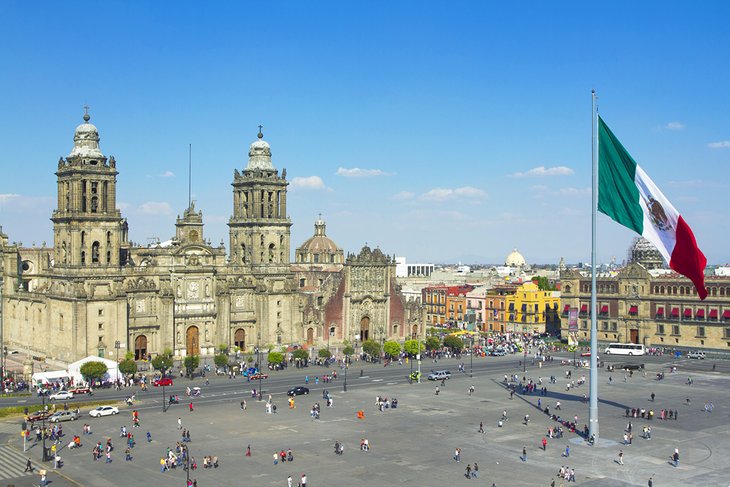
The Zócalo, or the Plaza de la Constitución, is considered the center of Mexico City, the way Times Square is for New York City, City Hall for Philadelphia or Downtown Crossing for Boston. A "zócalo" is the base of a column, which was planned as a monument to the independence movement of 1810 to 1821, but only the base was built. It was made into a giant flagpole, fronted by the Cathedral Metropolitana on the north and the Palacio Nacional on the east.
The Zócalo. Those "twin towers" are the Cathedral Metropolitana.
The Palacio Nacional is to the right.

Mexico City is Latin America's "New York": The center of the media world, both print and broadcast. It's also their "Los Angeles": The center of the film and music worlds.

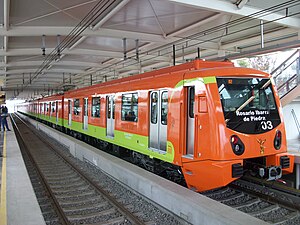
It has a subway system, called the Metro. It uses rechargeable cards, and a single-day ticket costs MXN $5.00 -- about 26 cents U.S., making it one of the cheapest rapid transit systems in the world. Most of Mexico City's main tourist attractions can be accessed by Line 2. Avenue Rio Churubusco is an incomplete Beltway for the city.
A Metro train

No matter how hot it gets, don't even think about going to the beach: The nearest beach town to Mexico City is Túxpam de Rodríguez Cano, in the State of Veracruz, about 180 miles away. Mexico does have famous beach towns, but these are all far away from Mexico City: Acapulco, in the State of Guerrero, 235 miles; Puerto Vallarta, Jalisco, 535 miles; Cancún, Quintana Roo, 1,000 miles.

Going In. Named for the ancient empire that ruled Mexico, the Estadio Azteca opened in 1966, as the home of the national team and of Club de Fútbol América S.A. de C.V., or simply Club América, the most-loved -- and, like the Yankees, the most-hated -- sports team in the country. 

It is older than every MLS stadium except Providence Park, Robert F. Kennedy Stadium and Grant Field (and both of those will have been replaced by the middle of next season); every NFL stadium except the Los Angeles Coliseum and Lambeau Field; every MLB stadium except Fenway Park, Wrigley Field, Dodger Stadium and Angel Stadium; every NBA arena; and every NHL arena.

The official address is Calzada de Tlalpan, 3465, about 9 miles south of downtown. Take the Metro's Line 2 to Tasqueña, and switch to Xochimilco Light Rail Line 1. Get out at Azteca station, and you'll be outside the stadium's east stand.
From a peak of 119,853 fans at a 1968 game, renovations have reduced the soccer seating capacity to an official 87,523, which still makes it larger than all but 21 stadiums in the world, 15 of them in the U.S. The stands, especially in the upper deck, are steep, the kind you might have had to negotiate at the old Yankee Stadium, or maybe at one of those Memorial Stadiums built to honor the dead of World War I from the college whose football team plays there. The field is a hybrid of natural grass and artificial fibers, and runs north-to-south.
Known as "El Coloso de Santa Úrsula," the Colossus of Saint Ursula (for the neighborhood it's in), along with the Maracanã in Brazil, it is 1 of 2 stadiums to have hosted 2 World Cup Finals: 1970, in which Brazil beat Italy; and 1986, in which Argentina beat West Germany.

It also hosted the 1970 Semifinal between Italy and Germany that became known as "The Game of the Century"; and the 1986 Quarterfinal between Argentina and England in which Diego Maradona scored what became known as "The Goal of the Century," only 4 minutes after his handball goal that he called "The Hand of God," the most famous cheat in the history of sports on planet Earth.

In addtion to Club América, the Azteca has been the home field for Club Necaxa, who played there from 1966 to 1970, and again from 1982 to 2003 before going back to the city of Aguascalientes; Atlante, who played there off and on from 1966 to 2007, before returning permanently to their home base in Cancun; Club de Fútbol Universidad Nacional A.C., a.k.a. Pumas de la UNAM, Pumas or UNAM from 1967 to 1969 (more about them in Sidelights); Atlético Español from 1970 until they went out of business in 1982; and Cruz Azul (Blue Cross) from 1971 to 1996 (more about them in Sidelights).

It's also hosted soccer for the 1968 Olympics, the 1975 Pan American Games, the 1993 and 2003 CONCACAF Gold Cups, the 1999 Confederations Cup, and the 2011 Under-17 World Cup. It's hosted our football 3 times: August 15, 1994, a preseason game in which the Houston Oilers beat the Dallas Cowboys 6-0, in front of the largest crowd in NFL history, 112,376; October 2, 2005, the 1st regular-season NFL game in Mexico, Arizona Cardinals 31, San Francisco 49ers 14, in front of 103,467, setting a since-broken NFL regular-season record; and November 21, 2016, the 1st Monday Night Football game played outside the U.S., Oakland Raiders 27, Houston Texans 20, in front of 76,743.

On February 20, 1993, the stadium's all-time attendance record was set, as 132,247 people saw Mexico's greatest-ever boxer, Julio César Chávez, knock Greg Haugen out to retain the Light Welterweight Championship of the World. The stadium has also hosted concerts, including by Paul McCartney, Michael Jackson and U2; and religious convocations, including the funeral of Chesperito, a legendary Mexican comedian who was a Club América fan.

Tours are available, taking 30 to 40 minutes, from 10 AM to 2 PM. However, they are not available on matchdays or on the day before. They cost MX$105 -- about US$5.50.

Food. As I said, eating in Mexico is an iffy proposition. A writer (not credited) at StadiumGuide suggested getting a quesadilla at a concession stand outside the stadium before the game. However, being that the Azteca is arguably the most famous building in all of Central America, I'm guessing they take precautions to make sure they don't have 87,000 cases of food poisoning, even if some of the 87,000 are Yanquis.

There are lots of vendors roaming the aisles, and it may be considerably easier to get something you'd like if you let them come to you, rather than going up to get on line.

Team History Displays. Despite being the stadium of the national team and the most popular club team in the country, there is no display of titles won in the stadium's fan-viewable areas.

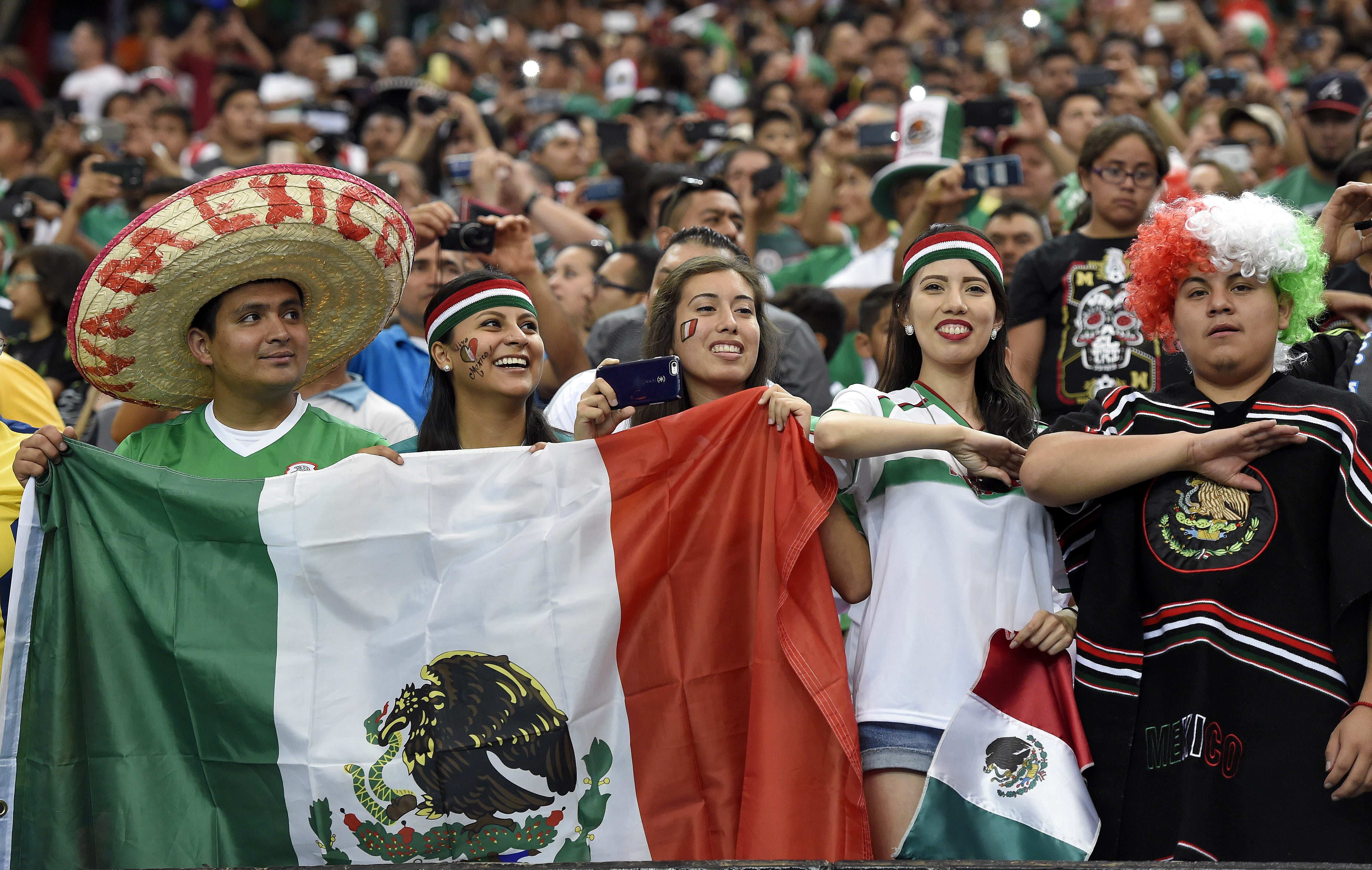
Mexico's national team, known as El Tricolor because it adopted the green-white-red colors of the national flag, or El Tri for short, have won the CONCACAF Gold Cup -- the "continental" championship for North America, Central America, and the Caribbean region combined -- 10 times, including the most recent one in 2015, and 3 of the last 4. (The U.S. has won it 5 times: 1991, 2002, 2005, 2007 and 2013.) El Tri have also won the 1999 Confederations Cup; and the soccer tournaments at the 2012 Olympics; the Pan American Games in 1967, 1975, 1999 and 2011; and finished runners-up in the 1993 and 2001 Copa América.

When El Tri come to the U.S. -- they will be playing Croatia at the Los Angeles Coliseum on May 27, Ireland at the Meadowlands on June 1, and Ghana at the Houston Texans' NRG Stadium on June 28 -- they are joined by hordes of fans, not just crossing the border or flying in, but from Mexican communities all over America. They have particularly made NRG Stadium a 2nd home field.

The USMNT often finds itself outnumbered on its own grounds, particularly in California and Texas. Even fans from other Latin American nations come and, although they normally have no love for Mexico, root against the U.S. (This doesn't just apply to Mexico: I was at the U.S.-Argentina match at the Meadowlands in 2011, a 1-1 tie, and it was almost evenly split between Americans and Hispanics rooting against the U.S.)
El Tri is also the name of Mexico's most famous rock band, led by Alex Lora, formed from his former band, Three Souls in My Mind. He chose an English name and wrote and sang in English because, when the band was founded in 1968, rock and roll was not seen as compatible with Mexican identity. Eventually, he decided that his songs had to be sung in Spanish for his audiences to properly understand him. El Tri split from TSIMM (the initals were used) in 1985, and the rest is history. 

Club América, also known as Las Águilas (the Eagles), celebrated their 100th Anniversary last October. have won 16 league titles, including a record 12 since the 1943 founding of the national league, now known as Liga MX; 11 of those have been since the Azteca opened, most recently in 2014. They've won the Copa MX (the country's version of the FA Cup) a record 6 times, although not since 1974. And they've won the CONCACAF Champions League a record 7 times, including the last 2. (They did not qualify for the 2017 tournament, although the Final will be between 2 Mexican teams, Tigres UANL of Monterrey and CF Pachuca.)
Club América have 3 major rivalries, playing El Super Clásico with C.D. Guadalajara (a.k.a. Chivas), El Clásico Capitalino with UNAM, and El Clásico Joven with Cruz Azul.

Stuff. The Nike Store Azteca is located outside the stadium's east stand. In 2007, Roger Magazine published the nonfiction book Golden and Blue Like My Heart: Masculinity, Youth, and Power Among Soccer Fans in Mexico CityDVDs of the various Liga MX clubs are available at various stores.

During the Game. It has been recommended that you not wear red, white and blue, particularly the USMNT jersey. Well, if you are with a group, you will probably be safe. Belts are not allowed inside the Azteca for soccer games, as they have been used as weapons..

The Mexican fans will be warned to not boo "The Star-Spangled Banner." They will boo it anyway. Don't be shocked: Many a Yankee fan watching us play the Toronto Blue Jays, and many a hockey fan watching an American team play one of the Canadian teams, has booed the performance of "O, Canada." Well, when "Himno Nacional Mexicano" is played, the best thing to do is stand, stay still, and remain silent. They'd probably respect that more than trying to sing it along with them, in Spanish, badly.

A translation of said anthem:

Mexicans, at the cry of war,
make ready the steel and the bridle,
and may the Earth tremble at its core
at the resounding roar of the cannon!


If a referee's call goes against El Tri -- since you're in the Azteca, it is unlikely that a significant call will, but even if it's a less consequential call -- things will be thrown by the Mexican fans. If you can understand shouted Spanish, you will hear how the referee's girlfriend -- or perhaps his mother, or both -- are various forms of livestock.

Do not be surprised if the game goes against us: In more than 70 World Cup qualifying matches played at the Azteca, Mexico have lost only once. The heat, the high altitude, and the noise of the fans are both major factors. Overall, Mexico have won 34 matches against us, we've won 19, and there have been 14 draws. But on Mexican soil, the count is far in Mexico's favor: Mexico 23, U.S. 1, 2 draws. At the Azteca, Mexico 9, U.S. 1, 2 draws. The 1 win? A friendly on August 15, 2012. Contrast that with games on American soil: We've won 9, they've won 2, and there's been 2 draws.

We also beat them in our 1st-ever match against them, in Rome in a qualifier for the 1934 World Cup; and in the 2002 World Cup Round of 16 at Jeonju, Korea, the famous Dos A Cero game. In fact, of our 19 wins over Mexico, 9 have been by the score of 2-0. The next night, on The Tonight Show, Jay Leno joked, "Half of California went into mourning! And the other half said, 'There was a game?'" Suffice it to say, America's attention to soccer has grown tremendously since June 17, 2002.

Assigned to El Tri matches are 4,000 police officers, or 1 for every 25 fans. They use riot shields to ward off projectiles. Visitors are also warned to beware of thrown liquids: "If cold, it's beer; if warm, it's kidney water." Mexican fans, raised Catholic and observing certain doctrines, tend to use the term "Puto" -- slang for "homosexual," in essence the Mexican variation of "faggot." Also, "culero" -- "asshole."

After the Game. If we do somehow win the game, do not celebrate inside the stadium. When you are let out, leave very calmly, keep quiet, and do not taunt anyone. Remember: They know the streets, and hiding places, and they know that you don't know.

Estadio Azteca is located in a predominantly residential area, and there is little entertainment around. So your best bet for a postgame meal is to get back on the light rail, and head back downtown.

There is an "American restaurant" named Times Square. It serves hamburgers and pizza, like you would expect an American eatery to do, and you can get a good solid meal for the American equivalent of $13. It's at Avenue Prado Norte 421, about 5 1/2 miles west of the Zócalo. Not easily reachable by public transit.

Sidelights. Mexico City is a great sports city, and they don't only love soccer. There are 2 other Liga MX teams in the city. Cruz Azul, or Blue Cross, have won 8 league titles, most recently in 1997; 3 Copas Mx, last in 2013; and 6 CONCACAF Champions League titles, last in 2014.

They play at Estadio Azul, seating 34,253 (and, yes, all seats are blue). It was built in 1947, and plans are underway for a replacement, which the club hopes will open in time for the 2018-19 season. The old stadium is at Calle Indiana 255. Mexico's leading bullfighting ring, Monumental Plaza de Toros, is next door. Line 1 to Metrobus Ciudad de los Deportes.

The other is Club de Fútbol Universidad Nacional A.C., a.k.a. Pumas de la UNAM, Pumas or UNAM. They were founded as a team of the National Autonomous University of Mexico, and have won the league 7 times, last in 2011; the Copa MX in 1975; and the CONCACAF Champions League 3 times, last in 1989.

The play at Estadio Olímpico Universitario, which opened in 1952, seats 48,297, and was the main stadium for the 1968 Olympics, including the track & field events: Bob Beamon's record-shattering long jump, Dick Fosbury revolutionizing the high jump with the Fosbury Flop, Jim Hines becoming the 1st man to run the 100 meters in under 10 seconds, and Tommie Smith and John Carlos following up their medal-winning run with their black-gloved salute.
Av. de los Insurgentes Sur and Circuito Escolar. Line 2 to Miguel Ángel de Quevedo, then Bus K1 to Ciudad Universitario.

The Mexican Baseball League (LMB in Spanish) has 16 teams, in North and South Divisions, but only one team played in Mexico City. In 1940, they were founded as the Mexico City Reds, but in 1942, an opponent said, "These Reds, they play like Devils!" And they have been Los Diablos Rojos de México ever since.

They have won 16 Pennants, the last in 2014. Their 1st home was Parque Delta, which was demolished and rebuilt for 1955 as the 25,000-seat Parque Deportivo del Seguro Social. This stadium was also home of Tigres, who groundshared with the Red Devils until they moved to Cancún in 2011. A shopping center named Parque Delta is now on the site of Mexico's most famous baseball park. Avenida Cuauhtémoc 462. Line 3 to Obrero Mundial.
El Seguro Social was replaced with the 26,000-seat Foro Sol (Sun Forum), which opened in 1993 and took in both Rojos Diablos and Tigres in 2000, before Tigres left. (Rojos Diablos and Tigres remain arch-rivals.) It can seat 65,000 for concerts, including the annual Vive Latino rock festival. (Neither Elvis Presley nor the Beatles ever performed in Mexico.)

The 20,000-seat Palacio de los Deportes is across the street from Foro Sol. It opened in 1968, in time to be used for basketball at the 1968 Olympics. On December 6, 1997, it hosted an NBA regular-season game, with the Houston Rockets beating the Dallas Mavericks 108-106. Avenida Viaducto Rio de la Piedad and Avenida Rio Churubusco. Line 9 to Velódromo.
Foro Sol, with Palacio de los Deportes behind it.
Mexican stadium and arena architecture in the 1950s and '60s
was no better than its American counterpart.

In 2014, Rojos Diablos moved into Estadio Fray Nano, which seats only 5,200. Avenida Fernando Iglesias Calderón and Avenida Venustiano Carranza, about a 10-minute walk from their previous home. Line 9 to Mixiuhca. They will move into a new 16,000-seat stadium for the 2018 season, at the Magdalena Mixhuca Sports City, just to the east of Foro Sol. Line 9 to Ciudad Deportiva.
UPDATE: Estadio Alfredo Harp Helú,
named for a major businessman who donated toward its construction,
opened in 2019, and looks like this. Weird.

There is one stadium in Mexico that has hosted regular-season Major League Baseball games, but it's not in Mexico City. Estadio de Béisbol Monterrey, a 27,000-seat stadium opening in 1990, hosted a 3-game series between the Mets and the San Diego Padres (the nominal home team) in August 1996.

The series was moved because the Republican Party wanted to borrow Qualcomm Stadium for the last night of their Convention, but they ended up not using it anyway. The 1st game was notable for the Padres' starting pitcher being Hermosillo native and Los Angeles Dodgers legend Fernando Valenzuela -- and the Padres taking a 15-0 lead before hanging on to win 15-10. The Mets won the 2nd game 7-3, and the Padres took the rubber match, 8-0.

The Padres again played host on Opening Day, April 4, 1999, losing 8-2 to the Colorado Rockies. Av. Manuel L. Barragán. It's 568 miles from Mexico City, 1,449 from San Diego, 490 from Houston, and 140 from the closest border point, at Laredo, Texas. 
Estadio de Béisbol Monterrey

Arena México opened in 1956, and hosted boxing for the 1968 Olympics, including George Foreman's Gold Medal. An earlier building named Arena Modelo was on the site. 189 Calle Dr. Lavist.

UPDATE: North America will jointly host the 2026 World Cup. Mexico's 3 venues will be the Azteca; the 46,232-seat Estadio Akron in Guadalajara, home of Chivas; and the 53,500-seat Estadio BBVA Bancomer, home of C.F. Monterrey.

The most popular U.S. baseball team in Mexico is the Dodgers, largely because of Valenzuela. The Padres, the closest team to the border (16 miles from Petco Park to Garita El Chaparral in Tijuana), are a distant 2nd. Despite recent efforts to market themselves to Phoenix's Mexican-American community and to Mexico itself, the Arizona Diamondbacks are 3rd, and not going to catch the Padres, let alone the Dodgers, anytime soon.

The Phoenix Suns are the most popular NBA team, not so much because of proximity, but because their conscious efforts to reach out to Hispanics in Arizona, and to people in Mexico itself, has already borne more fruit than those of their downtown neighbors, the Diamondbacks. Mexicans don't seem to care about hockey, but they have filled the Azteca for NFL games (regular and pre-season). Unfortunately, as with our own country, their favorite teams appears to be the Dallas Cowboys. As if you, as an American, needed another reason to root against our soccer arch-rivals!

Mexico City has a Six Flags, the most-visited theme park in Latin America. Bus 13-A. It also has its own World Trade Center, at Avenida Insurgentes and Calle Fileadelfia. Bus 1 to Poliforum.

Their version of the Metropolitan Museum of Art is Palacia de Bellas Artes (Palace of Fine Arts), at the eastern end of the park Alameda Central. Line 2 to Bellas Artes. Their version of the Museum of Natural History is Museo Nacional de Antropologia. It is in the park Bosque de Chapultepec (Chapultepec Forest), as are historic Castillo de Chapultepec (Chapultepec Castle), the national auditorium, the national zoo, and Los Pinos, the Presidential residence, Mexico's "White House." Line 7 to Auditorio. There are also museums dedicated to husband-and-wife painters Diego Rivera and Frida Kahlo.

Despite having a civilization considerably older than ours, Mexico's current capitol building is relatively new. The Palacio Legislativo de San Lázaro opened in 1981, and hosts both houses of the Congress of the Union: The lower house, the Chamber of Deputies; and the upper house, the Senate of the Republic. Line 1 to San Lázaro. As I said, the President of Mexico (currently Enrique Peña Nieto, who not only speaks English better than Donald Trump but totally rolled him on who was going to pay for his precious wall) has his residence at Chapultepec, while the Palacio Nacional, on the east front of the Zócalo, is now merely ceremonial.

The tallest building in Mexico City is the 801-foot Torre Reforma (Reform Tower), at Paseo de la Reforma 483, adjacent to the 2 next-tallest, the 771-foot Torre BBVA Bancomer and the 739-foot Torre Mayor (Major Tower). All are just to the east of Bosque de Chapultepec, and overlook it. But none of these is the tallest in the entire country: Mexico's tallest building is Torre KOI, standing 918 feet just outside Monterrey.

(There are 2 buildings in Latin America that are taller: The 984-foot Gran Torre Santiago, in Santiago, Chile; and the 932-foot Trump Ocean Club International Hotel and Tower in Panama City, Panama. Big surprise: Trump has been sued for plagiarizing the design of a hotel in Dubai.)

A list of movies and TV shows filmed and/or set in Mexico City would be to extensive for this guide. But most of them are produced by and for Mexicans, and most Americans wouldn't recognize them, unless they understand Spanish fluently and watch telenovelas on Univision or Telemundo.

*

Seeing the U.S. national soccer team play away to Mexico can be very difficult, and even carries with it the kind of danger you almost never see in American sports, not even in rivalries like Yankees-Red Sox or Duke-North Carolina. But if you read this guide carefully, you should be able to avoid trouble.

If you have any trouble at all, do not hesitate to contact the U.S. EmbassyPaseo de la Reforma 305. Bus 76-A. Phone+52 55 5080 2000.

Saturday, November 12, 2016

Why I Should Have Been Trump's Guy -- And Why I'm Not

Last night, the U.S. national soccer team lost 2-1 to Mexico. On home soil, in Columbus, Ohio. On a goal in the 89th minute (not quite "at the death," but close). The winning goal for Mexico was scored by Rafa Marquez, an execrable person.

It was the 1st game for the national side after Donald Trump's election, and we lose to Mexico at home. How's that "Make America great again" stuff workin' out for ya?

Why do Trump's supporters hate Mexicans so much? Have they ever seen a game played by the Mexican national soccer team? Known as El Tricolor, or El Tri for short, because of the Mexican tricolor flag (green, white, red), their fans are known for, among other things, homophobic chants. You'd think Trump fans would like Mexicans for that!

I was a bit concerned that, motivated by Trump's "win" -- the popular vote is still being counted, but, at last check, Hillary Clinton was leading by 573,000 votes, more than Al Gore beat George W. Bush by in 2000 -- the racists would make some kind of statement in the game. After all, it is Mexico.

There was no incident. Indeed, the 2 teams stood for the National Anthems together, in harmony. (With each other, if not with the music. How well they sang is a matter of opinion.) And both teams' fans behaved themselves to the point where there's been no mention of unpleasantness in the media.

When Mexico won, their fans celebrated like human beings. When America lost, our fans did not act on their disappointment with violence, or even abuse.

*

Okay, that's enough humor. I want to get serious.

I am a middle-aged white person without a college degree. Finding a job has been difficult. Finding a good job -- one with the combination of a good wage, good benefits, and a boss who isn't a jackass, and all 3 of these are important -- has been, thus far, impossible.

For a time, I lived in New Brunswick, New Jersey. New Brunswick is home to Rutgers University, and its very diverse student body. It would be understandable if I thought, "Why are those people getting this great education so they can better themselves, and I'm stuck?

New Brunswick has a large community of immigrants, especially from Central and South America. Mexico is the leader among nations from which these people come, but hardly the only one. Ironically, this Spanish-speaking community is centered on French Street.

I lived a couple of blocks from this community, and had to go into it on a regular basis. For the most part, their people either treated me decently or left me alone. Not once did any of them harass me. Not once did any of them go out of their way to insult me.

But there were times when I wondered what was wrong with them. Once, I woke up and tried to make breakfast, and saw that I was out of cereal. So I looked for the closest grocery store. New Brunswick seems to have everything but a decent supermarket -- not one manned by Anglophones, anyway.

But, I figured, if the Mexican supermarket had what I wanted, fine. My money's as good there as anyone else's. It's not like I had to convert it to pesos.

I walked in, looked around, and saw no cereal boxes. None. Not even from companies based in Latin America that I'd never heard of before. Other products, yes; cereal, no.

It did not occur to me until now that maybe Central Americans don't eat cereal for breakfast, and thus cereal is not something on which their stores here would make a profit. Okay, I get that now.

But I wanted cereal. So what did I do? I walked up to the cash register, and asked the man there, "Excuse me: Where's the cereal?" A simple question, asked politely, with no reference made to his race, his religion, or his national status -- or to my own, for that matter.

He glared at me. As if to say, "How dare you speak English in my establishment?"

I tried to think of the Spanish word, or phrase, that means "breakfast cereal." I couldn't think of it. (I know it now: "Cereales para el desayuno.") I tried, "Corn flakes." Nothing. "Kellogg's." Nothing. "Breakfast." Nothing. I tried miming eating cereal, thinking that might get through to him. He seemed to get angrier and angrier, as if my unwillingness (or, rather, my inability) to speak Spanish was equivalent to pissing on the graves of his ancestors and wiping my sweaty body with his national flag.

Finally, I left. I found a place that made the classic Jersey breakfast: The pork roll, egg and cheese sandwich. (The Taylor company, which invented the thing, calls it "pork roll." They don't call it "Taylor ham," so no one else should, either.)

I also worked in New Brunswick during this period. I frequently saw empty bottles of Corona and Corona Light beer. This is understandable. It is, effectively, the Mexican Coors: Cheap beer, and you get what you pay for.

But it's not all being drunk by Mexican immigrants. Rutgers students drink it, because it's cheap. Same reason they drink Coors: They don't care about quality, they don't even really care about taste. They just want the buzz. And, for a 19-year-old college sophomore, it's a lot easier to find a 21-year-old college senior to buy them beer than it is to find someone with a good marijuana connection.

But in addition to bottles of Corona, the streets of New Brunswick (at least, away from downtown) were also frequently littered with cans of Modelo. Modelo is Corona's parent company (actually, now, Anheuser-Busch is), and Mexicans and Central Americans make up nearly all of their buying public. Americans don't drink it -- mainly because most of us have never heard of it.

In addition, I saw lots of flyers stapled to telephone poles and billboards, saying, "SE RENTA UN CUARTO." Room for rent. And these rooms often had 4 or 5 people ending up living in them. In 1 room. That is neither safe, nor sanitary. But it is all they can afford.

If you've been paying attention, you'll notice I have not yet used the word "illegal." Or the word "citizen." Or the word "amnesty." Because, based on my experience alone, the words weren't even relevant. It didn't matter to me whether they were living in the country legally: They were doing things that were harmful, to themselves as much as others.

If my exposure to Mexicans while living near them was all I knew about the country and its people, I would have developed a very negative attitude toward Mexicans in general.

But, at the time, I had a job where I was not only interacting with Mexicans living in and around New Brunswick, but working with them. And the vast majority of them couldn't have been nicer. Working in customer service, I didn't have a choice; You have to be nice to the customers, or they won't come back, and the store won't make money. But I was happy to be nice to them.

When it's not required by my job, my personal policy is to start out by treating people as if they are ladies or gentlemen, and intelligent, and honest, and trustworthy -- unless and until they show me that they're not. Thus, when the Mexican customers turned out to be pleasant, it was very easy for me to return the favor. You get what you give, and they gave politeness, so I gave it back -- not just because it was a job requirement, but because it's a good default position.

But I saw those immigrants, not knowing (or caring) whether they were legal or not. And I saw myself not getting very far. It would have been very easy to ignorantly make the jump to, "These people are the reason I'm not getting anywhere. And so are the liberal politicians who make it easy for them, and for black people, and Muslims, but not for me, or for people like me."

*

And it would have been equally easy for me to say, "George W. Bush isn't doing something about it, so I won't vote for him." And then, "John McCain isn't talking about this, so I won't vote for him." And then, "Mitt Romney isn't talking about this, so I won't vote for him."

And then not voting at all, because the alternative was to vote for the Democrats. Liberals. Socialists. Communists. Terrorist-enablers. Soft on crime. Immoral. Pro-abortion. Letting the gays do whatever they want. Letting women take things that have always belonged to men. Letting nonwhites take things that have always belonged to me and my people.

Never mind that there are millions of people who could say the above -- but have one thing about themselves that should invalidate it. Maybe they're of Mexican or Arab descent. Maybe they're gay. Maybe they've got a friend who needed an abortion, or some other medical procedure, but couldn't get it because they couldn't afford it.

And it would have been very easy for me to say, "Finally, finally, here is Donald Trump! Here's a guy who hasn't been part of the process that has been screwing me and mine over! He's not a liberal Democrat, wasting my tax money on illegal immigrants and social programs to help people other than me! He's not a conservative Republican, taxing the many to enrich the few! He's not part of the system! He owes nothing to anyone! He doesn't owe the unions or the feminists or the gun-grabbers or the gays! But he also doesn't owe Wall Street or the banks! He's never let me down! He won't let me down! He won't let America down! He'll shake things up! He'll get things done! He'll make America great again!"

Nobody ever pressed Trump on the obvious question: "If you believe that America is no longer great, then exactly when did that happen?" Also, he never released his tax returns, so we don't know what he owes, or to whom he owes it.

It would have been easy for me to fall for Trump's bullshit. For building a wall on the U.S.-Mexican border. For banning all Muslims from entering the country. For bringing back manufacturing jobs.

Building a wall wouldn't close the other ways immigrants get in illegally. Including his current wife. It's like the easy answer to the argument Ronald Reagan made about a missile shield: Eventually, someone is going to build a better missile. Your shield, designed to make nuclear missiles obsolete, will, itself, become obsolete. There are already tunnels under the border. The wall is still just an idea, and it's already obsolete. It's a 21st Century Maginot Line.

Banning Muslims from entering the country will do nothing to reduce the number of Americans murdered by the biggest murderer of American citizens, which is white men with guns.

And the manufacturing jobs aren't coming back, just like most of the blacksmiths went out of business when the automobile became easier to buy.

But the people who fell for Trump's bullshit don't get that. They really believe they can bring back the time when America was great. For those of us who grew up in the 1980s, when Reagan was President, it's a mirage.

But for those who grew up in the 1960s or earlier, there are 2 ways to bring back those boom times. One is to bring back the top tax rate of 70 percent. And the other is to bring back labor unions. Reagan sure as hell didn't do either of those things. George Bush the father didn't. George Bush the son didn't. You think Trump is going to do them? He could, but he won't, because he doesn't want to.

*

Doug Saunders wrote an article for The Globe and Mail, a Toronto-based national newspaper of Canada, suggesting that the real reason Trump won is "white extremism." Actually, he undermined that title, but correctly explained the real problem: Proximity, or lack thereof. (UPDATE: The link is now dead. Sorry.)

Essentially, he said that people who live in all-white, or mostly-white, communities near minority communities, sealing themselves off, segregating themselves from the blacks, the Hispanics, the Muslims, the gay neighborhoods, the college campuses, tend to believe the lies about those communities, because they don't get to see the truth. That these people are human beings, and that they are entitled to the same rights that you have.

This includes people who should know better, including a woman Saunders cites in the article: She lives in the Tampa Bay region, a diverse place, and her husband is an immigrant. (The article doesn't say from where, but if he was Hispanic, or a Muslim from any country, I'd hope that Saunders would have said so.) Saunders claims that he's staying in Ybor City, a hip area in Tampa hopping with young people and hipsters. Essentially, Tampa Bay's Hoboken or Williamsburg.

And this white woman (never mind her immigrant husband), living in a gated community on the St. Petersburg side of the bay, warns him about how dangerous it is, saying she wouldn't go anywhere near it.

That's right. She wouldn't. He would, and did, because he knows those people.

"In other words," Saunders says, "proximity is a bigger driver of extremism than is actual experience: It is not economic decline or immigration that cause people to become right-wing radicals, but proximity to those things, from a vantage of white security that feels threatened by the unknown."

By Saunders' estimation, New Brunswick, Highland Park, Piscataway and Edison, with their multiracial, multiethnic communities, should have gone for Hillary Clinton on Tuesday; while North Brunswick, Metuchen, and my hometown of East Brunswick, all mostly-white, better-off, near the poor urban area and hearing about it, but not in it, should have gone for Trump. And I should have been one of the overlooked, forgotten white people that should have gone for Trump, and helped E.B. to do so.

*

Except Hillary won East Brunswick by over 3,000 votes. She won North Brunswick by more than a 2-to-1 margin -- all those Italian-American "Democrats for Nixon," "Reagan Democrats" and "9/11 Democrats" either died off, moved out, or got outnumbered by blacks, Hispanics and South Asians who had moved in over the years. She also won Metuchen overwhelmingly. "The Brainy Boro" lived up to its nickname.

Overall, Hillary won Middlesex County with 60 percent of the vote. She won New Jersey with 55 percent, Trump 42, Gary Johnson 2 and Jill Stein 1.

Perhaps New Jersey is a bad example. After all, we get New York City news broadcasts, and are thus exposed to diversity. And South Jersey gets the same from Philadelphia.

But wait: Monmouth and Ocean Counties, down the Shore, also get them. So does West Jersey. And they went for Trump.

But the growth there hasn't been in the cities, or the towns on the actual Shore, which tend to be more liberal. A perfect example of this is the Southernmost County: While Cape May City is liberal -- welcoming to minorities and gays, sort of New Jersey's answer to Fire Island or Martha's Vineyard -- Cape May County is very rural and very conservative. This is a place where U.S. Route 9, leading to the Delaware-bound Cape May Ferry, is named for an old Congressman, Charlie Sandman, who was so conservative he voted not to approve Articles of Impeachment against Richard Nixon. He lost his seat to Bill Hughes in 1974, but once he retired in 1994, the County, and the Congressional District as a whole, has voted Republican ever since.

So it's not proximity. It's interaction. If you've seen "The Other," and seen that they're human beings as you are, with hopes and fears as you have (if not the same hopes and/or fears), then you begin to accept them. Are they different? Yes. Is that a bad thing? Not necessarily.

In Ball Four, his diary of the 1969 baseball season, Jim Bouton wrote that white ballplayers and black ballplayers, even if they didn't grow up with people of the other race, began to socialize together once they were teammates. "It turns out," Bouton said, "that the way to bring people together is to stick them in a hotel room in Cleveland."

There was a Broadway play a few years ago, written by David Mamet. Not a musical. It was titled simply Race. It helped give Kerry Washington, now the star of the TV show Scandal, her big break. In it, a black man asks a white man, "Do you think all black people are stupid?" And the white man says, "No, I think all people are stupid. I don't think black people are exempt."

I can relate: To borrow an old saying, I love humanity, but I don't much like people.

I try to judge people on an individual basis. I'm a white Methodist cishet man of Polish descent. If you're a decent person, then your gender, race, religion, orientation, whatever other category won't matter to me. If you're a douche, it wouldn't matter if you're otherwise an exact copy of me. (Although I, too, can be a douche at times. But only if somebody brings it on.)

Not gender. Not race. Not religion. Not sexual orientation or identity. Not on what you are, but on who you are, and how you try to be.

And that's why I'm not Trump's guy.

Not just because too many people who voted for him are bigots. No, it's not about them. It's about him.

I'm not one of Trump's guys, because he's a douche. And he will never be my President.

*

Days until the U.S. national soccer team plays again: 3, this Tuesday, 9:00 PM, away to Costa Rica, in a CONCACAF Qualifying Match for the 2018 World Cup. They'd better win it if they want to qualify for the World Cup.

Days until The Arsenal play again: 7, next Saturday, at 7:30 AM U.S. Eastern Time, away to Manchester United and their equally evil manager, Jose Mourinho.

Days until Rutgers University plays football again: 7, next Saturday night at 8:00, home to Penn State. Today, they got beat 49-0 by Michigan State, which, like Rutgers, went into the game 2-7. Who is the mental acrobat who thought getting Rutgers into the Big Ten was a good idea?


Days until East Brunswick High School plays football again: 12. On Thursday night -- not a Friday, due to the New Jersey State Teachers' Convention having closed our public schools on that day -- they beat Perth Amboy 34-0, advancing to 2-7. Leaving only their annual Thanksgiving beatdown at the hands of the Purple Bastards.

Days until the next East Brunswick-Old Bridge Thanksgiving game: 12, on Thursday morning, November 24, at the purple shit pit on Route 9. 

Days until the New Jersey Devils play another local rival: 29. Their 1st game this season with the New York Rangers will be on Sunday night, December 11, at Madison Square Garden. Their 1st game this season with the Philadelphia Flyers will be on Thursday night, December 22, at the Prudential Center. By a quirk in the schedule, the New York Islanders, a team they usually play several times a season, don't show up on the slate until Saturday night, February 18, 2017, at the Prudential Center.

Days until the New York Red Bulls play again: Unknown, but if schedule patterns hold, it will be on Sunday, March 5, 2017, which is 113 days from now. Yesterday, they were eliminated from the MLS Cup Playoffs by the Montreal Impact.

Days until the Red Bulls next play a "derby": Unknown. We may not see the 2017 MLS schedule for weeks, so we don't know when we'll next play New York City FC, the Philadelphia Union, D.C. United or the New England Revolution.

Days until the Yankees' 2017 season opener: 141, on Sunday, April 2, at 8:00 PM, away to the Tampa Bay Rays. Under 5 months.

Days until the Yankees' 2017 home opener: 149, on Monday, April 10, at 1:00 PM, home to the Rays.

Days until the next Yankees-Red Sox series: 164, on Tuesday, April 25, 2017, at 7:00 PM, at Fenway Park.

Days until the next North London Derby: 168, on Saturday, April 29, 2017, at White Hart Lane. Under 5 months. It could be moved to the next day, Sunday, April 30, to accommodate the TV networks. It is also possible that Arsenal could face Tottenham again sooner than that, through an FA Cup pairing.

Days until the next World Cup kicks off in Russia: 579, on June 14, 2018. A little over 19 months. The U.S. team will probably qualify for it, but with Jurgen Klinsmann as manager, particularly in competitive matches such as World Cup Qualifiers, rather than in friendlies, you never know.

Days until the 2018 Congressional election: 724.

Days until the Baseball Hall of Fame vote is announced, electing Mariano Rivera: 800, on January 9, 2019. A little over 2 years, or 26 months.

Days until the Baseball Hall of Fame vote is announced, electing Derek Jeter: 1,152, on January 8, 2020. A little over 3 years, or 38 months.

Days until the next Summer Olympics begins in Tokyo, Japan: 1,350, on July 24, 2020. Under 4 years, or 45 months.

Days until the 2020 Presidential election: 1,483.