Showing posts with label bill fitch. Show all posts

Tuesday, July 21, 2020

Top 10 Worst Managers/Head Coaches in New York Sports History

Once again, I'm going to limit "history" to 1920 on forward, since we have a much more detailed record of what they've done, and it's also the beginning of baseball's Lively Ball Era, the founding year of the NFL (with the Giants having been founded in 1925), and the 1st full decade of the NHL (with the Rangers having been founded in 1926).

This exempts the worst manager in Yankee history, statistically speaking, Harry Wolverton, who managed them for just 1 season, 1912, and went 50-102. Say this for George Steinbrenner: Of all the guys he hired and fired as manager, he didn't allow any of them to stay long enough to do serious damage.

It also exempts, though hardly absolves, Hal Chase, whose fixing of games as Yankee 1st baseman in 1910 led manager George Stallings to tell the owners, "Either he goes, or I go." Since Chase was easily the team's best and most popular player, Stallings was treated like an NBA coach who'd run afoul of the local prima donna player, and sent packing. And Prince Hal was named manager, for the end of 1910 and all of 1911.

Some great players, such as Rogers Hornsby and Lou Boudreau, were a lot better as managers when they had themselves as players. Chase the manager didn't do very well with Chase the player, and was fired, for Wolverton. It would be 1917 before new ownership hired Miller Huggins as the first successful Yankee manager.

Note that these are not necessarily managers (in baseball) or head coaches (in the other sports) who put up losing seasons, but the list also includes those who had presumably good teams that blew it late in the regular season or in the postseason.

Note also that, since they won with the Yankees, Torre and Casey Stengel are excused for their awful performances managing National League teams in New York (both with the Mets, Casey also with the Dodgers).

I'm also limiting this to the 4 major league sports, which means college coaches, the leaders of the WNBA's Liberty and pro soccer's Cosmos, Arrows and MetroStars/Red Bulls are off the hook. (Terry Shea, Craig Littlepage, Mike Jarvis, Pat Coyle, and Juan Carlos Osorio, you can all thank me later.) And expansion-team coaches (such as Casey with the Mets, and those of the early Titans/Jets, Nets, Islanders and Devils) get a free pass, because of the odds being stacked against them.

I could find no Devils coach who lasted long enough to have more than one significant postseason failure without also winning a Stanley Cup, unless you want to count Lou Lamoriello himself, who was a really good coach at Providence College but not at the NHL level.

Although I have said on a number of occasions that Rex Ryan failed as Jet coach, he got them to 2 AFC Championship Games.  And, theoretically, he could turn it around.

Furthermore, let's exempt the 9 current coaches:

* Luis Rojas of the Mets, Joe Judge of the Giants and Lindy Ruff of the Devils are all newly hired, so we have nothing to go on. (Ruff is the only one of these who's ever been a top man anywhere before, and he got the Buffalo Sabres to the 1999 Stanley Cup Finals -- but that was 21 years ago.)

* Mike Miller of the Knicks and Jacque Vaughn of the Nets are still, officially, interim head coaches. "Caretaker managers," as they would say in English soccer. Vaughn might still be head coach of the Nets whenever the 2020-21 NBA season begins, but the Knicks are already publicly looking for a replacement for Miller.

* Adam Gase of the Jets is about to enter his 2nd season, and, given what he had to work with in his 1st season, 7-9 was not bad at all.

* David Quinn of the Rangers and Barry Trotz of the Islanders are each in their 2nd season with their current team, and they had them playing well before the Coronavirus shutdown hit. Both will be in the expanded NHL Playoffs about to begin.

* Aaron Boone of the Yankees has had 2 seasons, and has made the Playoffs both times. He could be doing better, but he's certainly \not doing badly.

So here's the Top 10 -- or the Bottom 10, if you prefer:

10. Allie Sherman, Giants, 1961-68. 57-51-4, .528. Doesn't look like such a bad record, does it? Well, in 1961, he inherited a team that had already been to 3 of the last 5 NFL Championship Games, and had won the title in 1956.

He got them back to the title game in each of his first 3 seasons. He lost the 1961 title game to the Green Bay Packers, 37-0 in the snow at Lambeau Field. He lost the 1962 title game to the Packers, 16-7 on a frozen field at Yankee Stadium. The Packers were 13-1 that season. He lost the 1963 title game to the Chicago Bears, 14-10 on a frozen surface at Wrigley Field, with quarterback Y.A. Tittle injured during the game. Can't fault him for any of those losses.
Then everybody seemed to get old at once in 1964, including Tittle and Frank Gifford playing their final seasons. From 1964 onward, he was 24-43-3 for a .364 percentage, and in 1968, the fans at Yankee Stadium sang, "Goodbye, Allie" to the tune of "Good Night, Ladies," a precursor to "Joe Must Go," "Ray Must Go," and "Fi-re Ko-tite! (Clap, clap, clap-clap-clap!)" Still, Allie did get them to those title games, and he faced a better team each time.

Allie was a rare lefthanded quarterback, getting the Philadelphia Eagles to a 2nd place finish in 1944, but he was relegated to backup duty in 1947, and it was Tommy Thompson who, starting that year, got them to 3 straight title games, winning in '48 and '49, neither of which Allie was involved in, because he'd been cut after '47.

Allie's replacement was Alex Webster. He had been a very good player, once the G-Men's all-time leading rusher. But, as coach, he didn't have a whole lot to work with, and ended up going 29-40-1 from 1969 to 1973.

The truth is, no Giant coach has lasted particularly long with a bad record. Bill Arnsparger, hailed as a genius for building the Miami Dolphins' "No-Name Defense" that reached 3 Super Bowls and won 2, replaced Webster as Giant coach from 1974 to 1976, and had the worst record in team history, 7-28. But he had even less to work with by that point, and also had the chaotic stadium situation to deal with.

Ray Handley went 8-8 his 1st season, and 6-10 the next, but he was only there for 2 seasons, not long enough to truly do some damage, so he doesn't get on this list. Nor does the other "Must Go" guy, Joe Walton of the 1983-89 Jets: He got them to the Playoffs twice, despite being in the same division at the same time as the Don Shula & Dan Marino Miami Dolphins and a pretty good New England Patriots team coached by Raymond Berry. It was the rise of Marv Levy's Buffalo Bills that really doomed Walton.

More recent Giant coaches? Ben McAdoo went 13-15 in 2016 and '17, and Pat Shurmur went 9-23 in 2018 and '19. But they were dealing with an aging team and a front office that wasn't really with it. I can't put either of them on this list. And even Jet coaches like Eric "Mangenius" Mangini and Rex Ryan weren't bad enough to make this list. Disappointing, certainly. Bad, no.

9. Phil Watson, Rangers, 1955-59. 119-124-52, .492.  Through the 2020 season, he remains the only man to coach the Rangers at least 4 full seasons with an overall losing record. He did, however, win 2 Stanley Cups as a player, with the 1940 Rangers and the 1944 Montreal Canadiens.
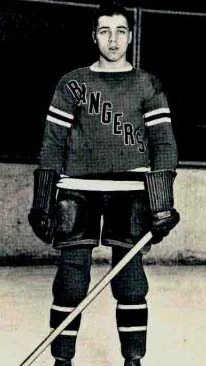
Watson as a Ranger player

8. John Hynes, Devils, 2015-19. He had a good goalie in Cory Schneider, a Hart Trophy winner in Taylor Hall, a legend in Patrik Elias, and decent players like Travis Zajac, Adam Henrique, Andy Greene, Kyle Palmieri, Jordin Tootoo, Eric Gelinas, Michael Cammalleri, Miles Wood, Sami Vatanen, Brian Boyle...

And he made the Playoffs once in 4 seasons, and left the Devils worse off than when he arrived, going 150-159-45 -- and, since you should really count those 45 overtime and/or shootout losses as losses, that's actually 150-203, for a percentage of .425. Pathetic.
After all the work put in by Lou Lamoriello, Hynes effectively made the Devils a Mickey Mouse operation again.

. Mike Milbury, Islanders, 2 terms between 1995 and 1999. 57-112-24, .358. Perhaps his biggest problem was that, at the time, the Atlantic Division had very strong teams in New Jersey, Philadelphia, Pittsburgh, Washington, and, sometimes, Madison Square Garden.

Or, perhaps, his biggest problem was Islander ownership not having money to spend on good players. Or, perhaps, his biggest problem was that his general manager was an idiot. Who was his general manager? Mike Milbury.
He was, however, a decent player with the Boston Bruins, reaching the 1977 and '78 Stanley Cup Finals.

6. Isiah Thomas, Knicks, 2006-08. 56-108, .341. Only 2 seasons, so I can't rank him higher. (Or would that be "lower"?) And, let's face it, like Milbury, he had an idiot for a general manager. Of course, like Milbury, his general manager was himself. But, although he was a true all-time great as a player with the Detroit Pistons, as Knick boss, he was an embarrassment, on the basketball court, in civil court, and in the court of public opinion.
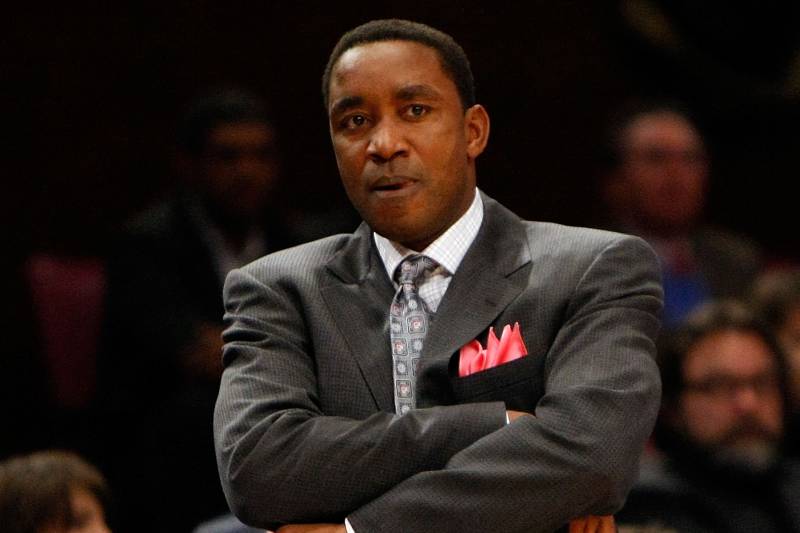
It got so bad that Isaiah Thomas, no relation and with a different spelling, got booed at The Garden when he played there for the Sacramento Kings. Like former Islander and Toronto Maple Leaf goalie Felix Potvin, who always heard the "Potvin sucks!" chant from Ranger fans, he must have wondered, "What did I do? I've never done anything to these people!"

The true problem was that, as long as Charles Dolan had a job, James Dolan had a job; as long as James had a job, Isiah the GM had a job; and as long as Isiah the GM had a job, Isiah the coach had a job. Finally, James -- with prodding from Charles, perhaps? -- fired Isiah from both roles.

5. Eddie Donovan, Knicks, 1961-65. 84-194, .302. He was just 43 years old when he left the head coach's post, and never coached another game in the NBA. However, let the record show that, at the time, the NBA's Eastern Division was dominated by Red Auerbach's Boston Celtics and Wilt Chamberlain's Philadelphia Warriors.
Let it also show that Donovan became the team's general manager and, with head coach Red Holzman, built the 1970 and 1973 NBA Champions. So while he's on the list of the Top 10 Worst Coaches, he is also one of the Top 10 Best Executives.

4. Bill Fitch, Nets, 1989-92. 83-163, .337. He won 944 games in NBA regular-season play, which is 8th all-time. He got the Cleveland Cavaliers to their 1st-ever Eastern Conference Finals in 1976, won a World Championship with the Boston Celtics in 1981, and got the Houston Rockets to the Finals in 1986, and if the Celtics didn't have one of the best teams ever that season he might've won another title.

But he also lost 1,106 regular-season games, more than any coach before him, and the last 2 NBA teams who thought he could be trusted were the Nets and the Los Angeles Clippers, the 2 "little brother teams." Only in his last season with the Nets did he get close to .500, 40-42. (Lenny Wilkens now has more losses, but Lenny also once had the most wins, and, like Don Nelson who has surpassed him in that regard, is well over .500.)
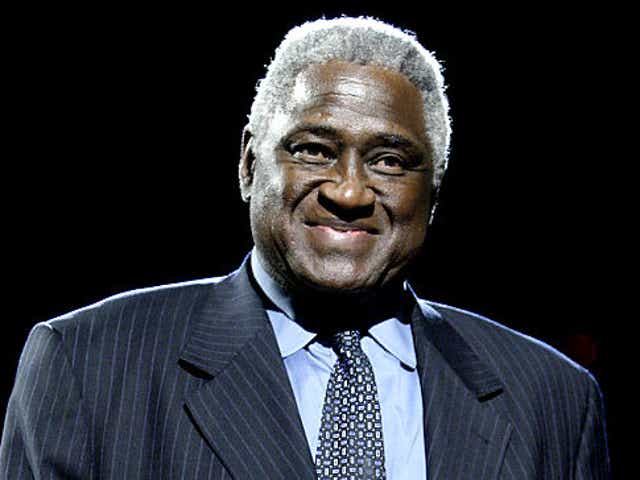
3. Willis Reed, Knicks 1977-79 and Nets 1987-89. 82-124, .398. He was a truly great player for the Knicks, but great players often don't make good coaches. Aside from Stephon Marbury, he may be the only man ever to so badly cock up both area NBA franchises.
2. Charlie Dressen, Dodgers, 1951-53. 298-166, .642. A baseball season was 154 games back then, and in each of his 3 seasons, Dressen got the Dodgers to at least a 157th game. And he won 64 percent of his regular-season games. So how could he be so high on this list? Observe:

* 1951: The Dodgers led the National League by 13 games on August 11. They blew it, and faced their arch-rivals, the New York Giants, in a best 2-out-of-3 playoff. We all know how that ended: Bobby Thomson hits one out off Ralph Branca, and "The Giants win the Pennant!"

Dressen had Branca and Carl Erskine in his bullpen. Erskine had a great curve, but Dressen brought in Branca, who had only a fastball, to face Thomson, who couldn't hit anything but a fastball, and who had already homered off Branca in the first game of the playoff. Branca didn't lose that Pennant, Dressen did.

* 1952: The Dodgers won the Pennant, but lost the World Series to the Yankees in 7 games. True, the Dodgers were without their best pitcher, Don Newcombe, who was serving in the Korean War -- but so was the Yankees' best pitcher, Whitey Ford. And Dressen trusted Billy Loes twice, with disastrous results.

* 1953: The Dodgers won 104 games, tying a franchise record that still stands, and ran away with the Pennant.  Again, they lost to the World Series to the Yankees. Dressen still didn't have Newcombe, and the Yankees had Ford back (but then, Ford was serving in '51 and Newcombe hadn't yet been drafted), and Dressen trusted Johnny Podres 2 years too soon in Game 5, where he got rocked, and trusted Erskine too little in Game 6, and pulled him too early and the Yanks clinched.
After the '53 season, Dressen's wife told him to demand a 3-year contract from Dodger owner Walter O'Malley. O'Malley's policy was to give his managers only 1-year contracts, figuring it would motivate them more. Mr. and especially Mrs. Dressen wanted the security. O'Malley wanted the control and the fear factor. He fired Dressen, not for his mismanaging, but for his impudence. O'Malley hired Walter Alston, and 2 years later, the Dodgers finally won it all. (In fact, it was on October 4, 1955, 55 years ago today.)

Still, as my Grandma, an old Dodger fan from Queens would say, "Oh, that Dressen! He was so
stupid!" I tried to tell her Bobby Valentine, who managed the Mets from 1996 to 2002, was dumber. She wouldn't buy it. She was right: Bobby V made his share of mistakes, but never got the chance to make as many big ones as Dressen. (However, if I were making this list for Boston, Bobby V would be on the list, even if he did manage there for only 1 season.)

1. Rich Kotite, Jets, 1995-96. Here we go, the one we cannot top. Or "bottom," as the case may be. Born in Brooklyn, grew up on Staten Island, went to that Borough's Wagner College, played tight end for the Giants from 1967 to 1972, not at all a bad player.  But he did play for 2 guys on this list, Sherman and Webster. And he was an assistant coach under Joe "Must Go" Walton. Were these bad omens?

In 1991 and '92, he got the Philadelphia Eagles into the Playoffs. In 1993, 8-8 wasn't enough to get in. In 1994, he got the Eagles off to a 7-2 start. Then, trailing the Dallas Cowboys by 17 points in the 4th quarter on a soggy afternoon, James Joseph scored a touchdown to pull the Eagles within 24-13. Kotite decided to go for the two-point conversion. Huh? Going for 1 would've gotten them within 10, just a touchdown and a field goal from a tie; going for 2 would've gotten them within 9, but the touchdown they still needed could've been the time to go for 2. The Eagles didn't get it, and lost.

During the post-game press conference, Kotite went the Milli Vanilli route, and blamed it on the rain: "I must have read my chart wrong. It must have gotten wet." You mean you knew it was raining, and didn't have a protective sheet over the chart to keep it dry? How about this: Don't rely on the chart, dumbass! Down by 15, maybe you go for 2; down by 11, no way!

The Eagles lost all their remaining games, finished 7-9, missed the Playoffs, and Kotite was fired. Crap like this is what makes people in Philly go up to cops and say, "Officer, I want to report a crime: The Eagles are killing me!"

On January 4, 1995, a date which lives in infamy, Jets owner Leon Hess announced that he had hired Kotite to be the team's head coach and, effectively, also its GM. Why Kotite? Well, he was a local guy, and a blue-collar guy who could appeal to local fans. But Hess knew that Kotite had led the Eagles to a couple of Playoff berths. Words that Hess should have guessed would outlive him: "I'm 80 years old. I want results now!"

He got results, all right. In 1995, the Jets went 3-13. One of those losses was the 1st win in franchise history for the expansion Carolina Panthers. (While the Panthers did reach the NFC Championship Game the next season, that 1st year, they were only 4-12.)

Miami dropped 52 points on them; Oakland, 47. They got held to 7 points by New England, 3 points by Atlanta, and in their last 2 games of the season, they got held to 6 points by Houston and shut out at home by New Orleans. They only drew 28,885 for that game. Don't tell me that it was Christmas Eve, and the day after the Giants' "Snowball Bowl": NFL fans will sit through anything. Not once all season did the Jets get a home attendance over 69,000.

In 1996, the Jets had the worst season in the history of Tri-State Area football, 1-15. The only win came in Week 9, October 27, 31-21 away to Arizona. They didn't give up more than 36 points in any game, but gave up at least 31 points in 10 games. They got held to 6 points by the Giants and Denver, and 7 by Indianapolis.

On the one hand, it wasn't as bad as it looked: They only lost to Philadelphia by 1, Buffalo and Miami by 3 each, Jacksonville and New England by 4 each, Indianapolis by 5, and the Giants by 7. On the other hand, that means they had a legitimate chance to go 8-8, and couldn't get the job done.

Two days before the team's '96 finale, GM Kotite fired coach Kotite. The last 2 home games before this, the Jets drew 21,731 and 29,176; knowing that it was his last game, they came out 49,933 strong for the finale.

Owner Hess then hired Bill Parcells, and got much better results, although Hess died before Parcells could get the ultimate result for the Jets, like he did twice for the Giants.

Kotite was just 54 years old when he left Weeb Ewbank Hall, but has never again even been hired as an assistant coach. Anywhere. Not the pros, not college, not even in high school.  However, at age 77, he has been a contributor to various NFL Network broadcasts.

In 2004, in a book titled The Great Philadelphia Sports Debate, co-authors Glen Macnow and Angelo Cataldi, both hosts on Philly's sports-talk radio station WIP, took the question of who was the worst coach in Philadelphia sports history. Macnow said it was Doug Moe, who'd been a good coach with the Denver Nuggets, but was a disaster in his half-season with the 76ers. After Macnow's 2 pages detailing this choice, Cataldi said, "No, the worst coach in Philadelphia sports history was Rich Kotite," and then provided an explanation that any prosecutor would love to have thought of for his closing argument.

Think about this: The worst team in the history of Philadelphia sports was the Quakers, who played one season in the NHL, 1930-31, and finished 4-36-4, for a "winning" percentage of .136 that makes the decades of ineptitude of the Phillies (pre-Charlie Manuel), A's and Eagles look brilliant by comparison. The worst single-season team in that city was the 1972-73 76ers, 9-73, .110.

In his last 39 games as an NFL head coach, with 2 different sets of players, Rich Kotite was 4-35. That's a percentage of .103. In neither case, of the '94 Eagles or the '95 and '96 Jets, could he use the excuse of leading an expansion team, or not having a lot of money to spend. (Eagles owner Jeff Lurie was a Hollywood studio head, Hess was an oilman, both were billionaires, and, besides, the NFL has a salary cap, which means you can't spend like the Yankees or Manchester City.)

Nor were his Eagles and his Jets beset by long-term injuries to multiple key players. Nor was there trouble in the locker rooms: The Jets may have had Keyshawn Johnson in '96, but he wasn't causing trouble at the time. And blaming the media or the fans doesn't change the fact that Kotite put himself in position to get ripped by the media and booed by the fans.

There is no viable excuse to explain it: Rich Kotite is the worst head coach in the sports histories of both Philadelphia and New York.

Sunday, April 7, 2019

Basketball Hall-of-Famers by Team, 2019 Edition

Congratulations to the newest members of the Basketball Hall of Fame: Bobby Jones, Sidney Moncrief, Paul Westphal, Jack Sikma, Vlade Divac, player/coach/executive Al Attles, and coach Bill Fitch.

Congratulations also to the family of the late Carl Braun, the 1950s Knick star whose shooting practice led to him saying, "Swish!" as the ball hit nothing but net, inspiring Knick broadcaster Marty Glickman to use it in broadcasts, and later Warner Wolf to use it on 11:00 news broadcasts. Braun's election is long overdue.

*

For this list, I'm only including NBA players, coaches and executives, not guys who got in mostly on the basis of their college or pre-NBA pro tenure. I'm also relaxing the 4-season rule that I put in for baseball and pro football, because a lot of guys were with teams for less than that but were still vital contributors to an NBA title with a team.

I'm also amending my separate-cities rule to include all Nets -- "New York" (Long Island), "New Jersey" and "Brooklyn," ABA and NBA -- as the same franchise. And I'm not doing this because I still root for them. At the moment, I remain an NBA free agent, a fan without a team.


Players are listed in chronological order of their arrival with the team.

Ties broken by most players, then by fewest seasons in the league (more HOFers per year), then by most non-broadcasters.


1. Boston Celtics, 25: Bob Cousy (also a broadcaster), Chuck Cooper, Ed Macauley, Bill Sharman, Frank Ramsey, Tommy Heinsohn (elected as player & a coach, was also a broadcaster), Bill Russell (player & coach), Sam Jones, K.C. Jones (player & coach), Tom "Satch" Sanders, John Havlicek, Bailey Howell, Jo Jo White, Dave Cowens, Larry Bird, Nate "Tiny" Archibald, Kevin McHale, Robert Parish, Dennis Johnson, Dino Radja, Ray Allen, Walter Brown (founder & owner), Red Auerbach (coach & executive), Bill Fitch (coach), Johnny Most (broadcaster).

Hard to believe the Celtics don't have the most. That won't last, though: Due to having won the 2008 title, Kevin Garnett and Paul Pierce will probably be elected, and Rajon Rondo might be.


Don Nelson played for the Celtics, but was elected as a coach, and has never coached the Celtics, so he can't be counted here.

2. New York Knicks, 23: Carl Braun, Harry Gallatin, Dick McGuire (player, coach & executive), Nat "Sweetwater" Clifton, Richie Guerin, Tom Gola, Willis Reed, Walt "Clyde" Frazier, Bill Bradley, Dave DeBusschere, Jerry Lucas, Earl "the Pearl" Monroe, Spencer Haywood, Bernard King, Patrick Ewing, Joe Lapchick (coach), Red Holzman (coach), Pat Riley (coach), Ned Irish (owner), Marty Glickman (broadcaster), Bob Wolff (broadcaster), Marv Albert (broadcaster), John Andariese (broadcaster).

Hubie Brown coached the Knicks, but was elected as a broadcaster, and not for the Knicks. Phil Jackson played for the Knicks, but was elected as a coach, and has never coached them. His maneuvers as team president haven't yet been Hall-worthy, either. Larry Brown only coached one season, possibly the worst of his career, partly the fault of general manager Isiah Thomas. Because he never played for the Knicks, and he was not elected as an executive, you can't count Isiah as a Knick HOFer -- and why would you want to?

3. Los Angeles Lakers, 17: Elgin Baylor, Jerry West (player & executive), Gail Goodrich, Wilt Chamberlain, Kareem Abdul-Jabbar, Jamaal Wilkes, Earvin "Magic" Johnson, Bob McAdoo, James Worthy, Vlade Divac, Shaquille O'Neal, Bill Sharman (coach), Pat Riley (coach), Phil Jackson (coach), Tex Winter (assistant coach), Jerry Buss (owner), Chick Hearn (broadcaster).

Kobe Bryant will join them, since his Colorado incident has been unofficially swept under the rug by the NBA establishment. Rod Hundley played for the Lakers, but was elected as a Utah Jazz broadcaster.

4. Philadelphia 76ers, 15: Hal Greer, Chet Walker, Wilt Chamberlain, Billy Cunningham (player & coach), Julius "Doctor J" Erving, Bobby Jones, Maurice Cheeks, Moses Malone, Charles Barkley, Allen Iverson, Alex Hannum (coach), Jack Ramsay (coach), Larry Brown (coach), Harvey Pollack (executive), Bill Campbell (broadcaster).

Doug Collins, who both played for the Sixers and was their head coach, has been elected as a broadcaster, but not for the Sixers, and thus can't be counted with them. Dolph Schayes was the team's 1st coach after it moved from being the Syracuse Nationals in 1963, but can't be counted as a Sixers' HOFer.

5. Detroit Pistons, 14: Bailey Howell, Dave DeBusschere, Dave Bing, Bob Lanier, Isiah Thomas, Joe Dumars, Adrian Dantley, Dennis Rodman, Grant Hill, Chuck Daly (coach), Larry Brown (coach), Fred Zollner (owner), William Davidson (owner), Bob Wolff (broadcaster). If Grant Hill is ever elected, it will be for what he did at Duke, but he can be counted here.

6. San Francisco/Golden State Warriors, 13: Guy Rodgers, Wilt Chamberlain, Al Attles (player, coach and executive), Nate Thurmond, Rick Barry, Jamaal Wilkes, Robert Parish, Chris Mullin, Mitch Richmond, Sarunas Marciulionis, Don Nelson (coach), Pete Newell (executive), Rick Welts (executive).

Since they've only moved within the San Francisco Bay Area since 1962 (San Francisco to Oakland in 1971, and will move back to San Francisco for the 2019-20 season), I'm counting them as a single team.

Bill King was the longtime radio voice of all 3 Oakland teams -- the Athletics, the Raiders and the Warriors -- but, for all the respect he earned, strangely, never received any of sport's Hall of Fame's award for broadcasters during his lifetime, and still hasn't since his death.

As for Steph Curry and Kevin Durant, they certainly look like they're headed for Hall qualification. Klay Thompson, Draymond Green and Andre Iguodala are also possibilities.

7. Chicago Bulls, 12: Chet Walker, Artis Gilmore, Jerry Sloan, Michael Jordan, Scottie Pippen, Dennis Rodman, Phil Jackson (coach), Tex Winter (coach), Jerry Reinsdorf (owner), Rod Thorn (executive), Jerry Krause (executive), Jim Durham (broadcaster).

Jerry Sloan was elected for his coaching with the Utah Jazz, not for his playing with the Bulls, although he could, conceivably, join the few people elected to the Hall as both a player and a coach. If he does, he'd be the 1st one elected as a coach first.


8. Houston Rockets, 11: Elvin Hayes, Calvin Murphy, Moses Malone, Ralph Sampson, Hakeem Olajuwon, Clyde Drexler, Charles Barkley, Yao Ming, Dikembe Mutombo, Tracy McGrady, Bill Fitch (coach). Oddly, former player and coach Rudy Tomjanovich has not yet been elected.

St. Louis Hawks, 9: Bob Pettit, Cliff Hagan, Ed Macauley, Slater Martin, Alex Hannum (player-coach), Clyde Lovellette, Lenny Wilkens, Zelmo Beaty, Richie Guerin.

Philadelphia Warriors, 9: Joe Fulks, Paul Arizin, Andy Phillip, Neil Johnston, Tom Gola, Guy Rodgers, Wilt Chamberlain, Eddie Gottlieb (founder & owner), Bill Campbell (broadcaster).

9. Milwaukee Bucks, 9: Oscar Robertson, Kareem Abdul-Jabbar, Sidney Moncrief, Bob Lanier, Jack Sikma, Ray Allen, Don Nelson (coach), Wayne Embry (executive), Eddie Doucette (broadcaster).

10. Phoenix Suns, 9: Connie Hawkins, Paul Westphal, Charles Barkley, Jason Kidd, Steve Nash, Grant Hill, Jerry Colangelo (owner), Rick Welts (executive), Al McCoy (broadcaster).

Rochester Royals, 7: Al Cervi (player & coach), Bob Davies, Red Holzman, Arnie Risen, Bobby Wanzer, Maurice Stokes, Les Harrison (owner). Holzman was elected as a Knicks coach, but could have been elected as a player anyway, so I'm counting him here.


11. Indiana Pacers, 8: Roger Brown, Mel Daniels, George McGinnis, Reggie Miller, Chris Mullin, Bob "Slick" Leonard (coach), Jack Ramsay (coach), Larry Brown (coach). Although Larry Bird was a head coach and executive for them, that's not why he was elected, and so he can't be counted here.

12. Portland Trail Blazers, 6: Bill Walton, Clyde Drexler, Arvydas Sabonis, Scottie Pippen, Jack Ramsay (coach), Bill Schonely (broadcaster). Pippen was only a Blazer for 3 seasons, but that included a trip to the Western Conference Finals, when they were probably cheated out of the NBA Finals by the Lakers, so I'm counting him here.

Minneapolis Lakers 6: George Mikan, Jim Pollard, Vern Mikkelsen, Slater Martin, Clyde Lovellette, John Kundla (coach). Essentially, their starting 5 and their head coach for their 5 NBA Championships in 6 seasons, 1949-54. Bud Grant, the Hall of Fame coach of the Minnesota Vikings, also played for the Minneapolis edition of the Lakers, but obviously he can't be counted here.


13. Denver Nuggets, 6: Bobby Jones, Dan Issel, David Thompson, Alex English, Dikembe Mutombo, Larry Brown (coach).

Seattle SuperSonics, 5: Lenny Wilkens (player & coach), Spencer Haywood, Jack Sikma, Dennis Johnson, Gary Payton.

14. Miami Heat, 5: Alonzo Mourning, Shaquille O'Neal, Gary Payton (2 years, they wouldn't have won the 2006 title without him, so I'm relaxing the rule for him), Ray Allen (2 years, they wouldn't have won the 2013 title without him, so I'm relaxing the rule for him), Pat Riley (coach & executive). Dwyane Wade and LeBron James will be elected. Tim Hardaway and Chris Bosh also might be.

15. Atlanta Hawks, 5: Walt Bellamy, Pete Maravich, Dominique Wilkens, Dikembe Mutombo, Lenny Wilkens (coach). 'Nique and Lenny spell their names differently, and are not related. Lenny played for the Hawks, but that was in St. Louis.

Fort Wayne Pistons, 5: Bobby McDermott, Andy Phillip, Bob Houbregs, George Yardley, Fred Zollner (owner).

16. Utah Jazz, 5: Adrian Dantley, John Stockton, Karl Malone, Jerry Sloan (coach), Rod Hundley (broadcaster).

17. New York/New Jersey/Brooklyn Nets, 5: Julius Erving, Drazen Petrovic, Jason Kidd, Rod Thorn (executive), Bill Raftery (broadcaster). Eventually, Vince Carter will be added. As should Buck Williams, but he probably won't make it.

No, you can't count Rick Barry (played briefly for them in the ABA), Billy Cunningham (ditto), Lou Carnesecca (coached them to an ABA Division title between stints at St. John's), Larry Brown (coached them 2 seasons), Chuck Daly (ditto), or even, due to his later broadcast work for the Nets, Marv Albert (appropriately, on the network named YES!).

Baltimore Bullets, 4: Buddy Jeannette (player-coach), Gus Johnson, Earl Monroe, Wes Unseld. There were actually 2 separate teams with this name, 1947-54 and 1963-73. Unseld spent most of his career with the franchise in Washington, but played 5 seasons with them in Baltimore.

Cincinnati Royals, 4: Jack Twyman, Wayne Embry, Oscar Robertson, Jerry Lucas.

18. Washington Bullets/Wizards, 4: Elvin Hayes, Wes Unseld, Bernard King, Mitch Richmond. No, you can't count Michael Jordan.

19. San Antonio Spurs, 4: George Gervin, Artis Gilmore, David Robinson, Larry Brown (coach). Tim Duncan, Manu Ginobili and coach Gregg Popovich will join them, and Tony Parker might.

Syracuse Nationals, 4: Al Cervi (player & coach), Dolph Schayes, Earl Lloyd, Danny Biasone (owner, whose idea for the 24-second shot clock may have made the NBA's long-term survival possible).

20. Cleveland Cavaliers, 4: Wayne Embry (player & executive), Lenny Wilkens (coach), Bill Fitch (coach), Joe Tait (broadcaster). LeBron James, of course, will be added eventually.

21. Orlando Magic, 3: Shaquille O'Neal, Tracy McGrady, Grant Hill.

22. Dallas Mavericks, 3: Steve Nash, Jason Kidd, Don Nelson (coach). Dirk Nowitzki will make it.

23. Sacramento Kings, 2: Nate "Tiny" Archibald, Mitch Richmond.

24. Toronto Raptors, 2: Tracy McGrady, Lenny Wilkens (coach). Vince Carter will probably be elected, and can be counted as a Raptor. No, you can't count Isiah Thomas as a Raptors executive -- and why would you want to?

Buffalo Braves, 2: Bob McAdoo, Jack Ramsay (coach).

25. Charlotte Hornets, 1: Alonzo Mourning. No, you can't count owner Michael Jordan.

New Orleans Jazz, 1: Pete Maravich. He only played half of the team's first season in Utah, yet he has his Number 7 retired by both the Jazz and the Pelicans.

San Diego Clippers, 1: Bill Walton. His tenure with his hometown team was riddled with injury, but he qualifies.

26. Los Angeles Clippers, 1: Bill Fitch (coach). He just got elected, and he was their head coach for 4 seasons, so he qualifies. No, you can't count longtime executive Elgin Baylor. Nor can you count Bill Walton, who hardly played for the franchise, and left before they were moved from San Diego to Los Angeles. If Chris Paul or Blake Griffin is elected, either can be counted with this franchise.

27. Oklahoma City Thunder, none: A bit too soon to tell, but Kevin Durant and Russell Westbrook could be their 1st 2 HOFers.

28. New Orleans Pelicans, none: If Chris Paul is elected, he can be counted with this franchise, even though he only played for them as the Hornets.
29. Memphis Grizzlies, none: So far, the only player who's played for the Grizzlies and been elected is Allen Iverson, and he was there only briefly. No, you can't count Jerry West for his time as a Grizzlies executive. Nor can you count Hubie Brown for his time as their head coach. If Pau Gasol is elected, he can be counted, although he'll most likely be remembered mainly as a Laker.
30. Minnesota Timberwolves, none: No, you can't count Kevin McHale (coach & executive). You can, when he is elected, count Kevin Garnett. If Christian Laettner is ever elected, it will be for what he did at Duke, but he can be counted here.

Thursday, February 21, 2013

Top 10 Worst Coaches in New York Sports History (through 2012)

NOTE: Through the conclusion of the 2025 NFL season, I see no reason to update this list. Not even for Aaron Boone.

As an Arsenal fan, I've been hearing and reading some portion of the "Gooner" fanbase treating
Arsène Wenger as if he is completely responsible for the club's decline.

First of all, the club is not in decline.  Most clubs would consider the last 8 years, trophyless though they are, the most glorious period in their recent history.  Second of all, while he is not above criticism, he is hardly wholly, or even primarily, to blame.

But "The Top 5 Reasons You Can't Blame Arsène Wenger for Arsenal Not Winning a Trophy Since 2005" is a post for another time.

The way his own club's fans -- still a minority, but a very vocal and nasty minority -- have been treating him reminds me of the way some fans around here, in the New York Tri-State Area, have treated some of theirs:

* Allie Sherman of the 1960s Giants: "Goodbye, Allie!"
* Joe Walton of the 1980s Jets: "Joe Must Go!"
* Ray Handley of the early 1990s Giants: "Ray Must Go!"
* Rich Kotite of the mid-1990s Jets: "Fi-re Ko-tite! (Clap, clap, clap-clap-clap!)"
* Isiah Thomas of the mid-2000s Knicks: "Don't hate the team, hate the coach!"
* Joe Torre of the Yankees in 2006 and '07, easily the closest local parallel to Wenger: "Time to retire, Joe!"
* Willie Randolph of the Mets in 2007 and '08: "Witless Willie, the Yankee!"
* Joe Girardi of the current Yankees: "Burn the binder! (Clap, clap, clap-clap-clap!)"

Then, of course, there was Leo Durocher, who was loved by Brooklyn Dodger fans and hated by baseball Giant fans when he managed the Dodgers from 1938 to 1948, and then switched to the Giants, and from 1948 to 1955 was loved by Jints fans and hated worse by Bums fans than he ever was by Jints fans.  He was a traitor, a turncoat, a Judas.

But unlike those others, Leo the Lip never had to face his own fans telling him, in the words of the immortal Ralph Kramden, as played on The Honeymooners by real-life Giant fan (though born and raised a Brooklynite) Jackie Gleason, "Get out. Get out! GET OUUUUUUUUT!!

As Ralphie Boy's pal Ed Norton, played by Art Carney, would say, "Shee-eesh! What a grouch!"

Well, you'd be a grouch, too, if you'd had to put up with some of those fans.

I decided to update this list, first made a little over 2 years ago.

I'm going to limit "history" to 1920 on forward, since we have a much more detailed record of what they've done, and it's also the beginning of baseball's Lively Ball Era, the founding year of the NFL (with the Giants having been founded in 1925), and the first full decade of the NHL (with the Rangers having been founded in 1926).

This exempts the worst manager in Yankee history, statistically speaking, Harry Wolverton, who managed them for just 1 season, 1912, and went 50-102.  Say this for George Steinbrenner: Of all the guys he hired and fired as manager, he didn't allow any of them to stay long enough to do serious damage.

It also exempts, though hardly absolves, Hal Chase, whose fixing of games as Yankee 1st baseman in 1910 led manager George Stallings to tell the owners, "Either he goes, or I go." Since Chase was easily the team's best and most popular player, Stallings was treated like an NBA coach who'd run afoul of the local prima donna player, and sent packing. And Prince Hal was named manager, for the end of 1910 and all of 1911.

Some great players, such as Rogers Hornsby and Lou Boudreau, were a lot better as managers when they had themselves as players. Chase the manager didn't do very well with Chase the player, and was fired, for Wolverton. It would be 1917 before new ownership hired Miller Huggins as the first successful Yankee manager.

Note that these are not necessarily managers (in baseball) or head coaches (in the other sports) who put up losing seasons, but the list also includes those who had presumably good teams that blew it late in the regular season or in the postseason.

Note also that, since they won with the Yankees, Torre and Casey Stengel are excused for their awful performances managing National League teams in New York (both with the Mets, Casey also with the Dodgers).

I'm also limiting this to the 4 major league sports, which means college coaches, the leaders of the WNBA's Liberty and pro soccer's Cosmos, Arrows and MetroStars/Red Bulls are off the hook. (Terry Shea, Craig Littlepage, Mike Jarvis, Pat Coyle, and Juan Carlos Osorio, you can all thank me later.) And expansion-team coaches (such as Casey with the Mets, and those of the early Titans/Jets, Nets, Islanders and Devils) get a free pass, because of the odds being stacked against them.

I could find no Devils coach who lasted long enough to have more than one significant postseason failure without also winning a Stanley Cup, unless you want to count Lou Lamoriello himself, who was a really good coach at Providence College but not at the NHL level.

Not quite making this list is Jerry Manuel, Mets, 2008-10. At 204-213, .489, he wasn't good, but he only had 2 1/2 seasons, and, let's face it, the Torre of 1996-2003 was not going to win a Pennant with what Met general manager Omar Minaya gave Manuel. This also absolves Randolph.

Although I have said on a number of occasions that Rex Ryan has failed as Jet coach, he does, at this point, still have a winning record, 34-30, and he got them to 2 AFC Championship Games.  And, theoretically, he could turn it around.  So let's exempt the 9 current coaches:

* Ryan: Though another losing season in 2013, and he's likely canned, and might make the next edition of the list.
* Girardi: A World Series win means he'll never be on this list.
* Tom Coughlin of the Giants: 2 Super Bowl wins means he'll never be on it.
* Peter DeBoer of the Devils: Getting them from a Playoff miss to 2 wins away from the Stanley Cup in just 1 year should keep him off the list.
* Terry Collins of the Mets: The current team mess is hardly his fault.
* Jack Capuano of the Islanders: Ditto.
* Mike Woodson of the Knicks: The jury is still way out on him.
* P.J. Carlesimo of the Nets: He's done pretty well since taking over from Avery Johnson, who also doesn't make this list.  And...
* John Tortorella of the Rangers: Though, with the talent he's had, he is approaching the list.

10. Allie Sherman, Giants, 1961-68. 57-51-4, .528. Doesn't look like such a bad record, does it? Well, in 1961, he inherited a team that had already been to 3 of the last 5 NFL Championship Games, and had won the title in 1956.

He got them back to the title game in each of his first 3 seasons. He lost the 1961 title game to the Green Bay Packers, 37-0 in the snow at Lambeau Field. He lost the 1962 title game to the Packers, 16-7 on a frozen field at Yankee Stadium. The Packers were 13-1 that season. He lost the 1963 title game to the Chicago Bears, 14-10 on a frozen surface at Wrigley Field, with quarterback Y.A. Tittle injured during the game. Can't fault him for any of those losses.

Then everybody seemed to get old at once in 1964, including Tittle and Frank Gifford playing their final seasons. From 1964 onward, he was 24-43-3 for a .364 percentage, and in 1968, the fans at Yankee Stadium sang, "Goodbye, Allie" to the tune of "Good Night, Ladies," a precursor to "Joe Must Go," "Ray Must Go," and "Fi-re Ko-tite! (Clap, clap, clap-clap-clap!)" Still, Allie did get them to those title games, and he faced a better team each time.

Allie just turned 90. He was a rare lefthanded quarterback, getting the Philadelphia Eagles to a 2nd place finish in 1944, but he was relegated to backup duty in 1947, and it was Tommy Thompson who, starting that year, got them to 3 straight title games, winning in '48 and '49, neither of which Allie was involved in, because he'd been cut after '47.

9. Mike Milbury, Islanders, 2 terms between 1995 and 1999. 57-112-24, .358. Perhaps his biggest problem was that, at the time, the Atlantic Division had very strong teams in New Jersey, Philadelphia, Pittsburgh, Washington, and, sometimes, Madison Square Garden. Or, perhaps, his biggest problem was Islander ownership not having money to spend on good players. Or, perhaps, his biggest problem was that his general manager was an idiot. Who was his general manager? Mike Milbury.

He was, however, a decent player with the Boston Bruins, reaching the 1977 and '78 Stanley Cup Finals.

8. Phil Watson, Rangers, 1955-59. 119-124-52, .492.  Through the 2013 season, he remains the only man to coach the Rangers at least 4 full seasons with an overall losing record. He did, however, win 2 Stanley Cups as a player, with the 1940 Rangers and the 1944 Montreal Canadiens.

7. Alex Webster, Giants, 1969-73. 29-40-1, .420. Allie's replacement had been a very good player, once the G-Men's all-time leading rusher. Maybe putting him on this list is a little harsh, because he didn't have a whole lot to work with.

But no Giant coach who lasted that long had a record that bad. And by the way, Handley went 8-8 his 1st season, and 6-10 the next, but he was only there for 2 seasons, not long enough to truly do some damage, so he doesn't get on this list. Nor does the other "Must Go" guy, Walton of the 1983-89 Jets: He got them to the Playoffs twice, despite being in the same division at the same time as the Don Shula & Dan Marino Miami Dolphins and a pretty good New England Patriots team coached by Raymond Berry. It was the rise of Marv Levy's Buffalo Bills that really doomed Walton.

6. Isiah Thomas, Knicks, 2006-08. 56-108, .341. Only 2 seasons, so I can't rank him higher. (Or would that be "lower"?) And, let's face it, like Milbury, he had an idiot for a general manager. Of course, like Milbury, his general manager was himself. But, although he was a true all-time great as a player with the Detroit Pistons, as Knick boss, he was an embarrassment, on the basketball court, in civil court, and in the court of public opinion.

It got so bad that Isaiah Thomas, no relation and with a different spelling, got booed at The Garden when he played there for the Sacramento Kings. Like former Islander and Toronto Maple Leaf goalie Felix Potvin, who always heard the "Potvin sucks!" chant from Ranger fans, he must have wondered, "What did I do? I've never done anything to these people!"

The true problem was that, as long as Charles Dolan had a job, James Dolan had a job; as long as James had a job, Isiah the GM had a job; and as long as Isiah the GM had a job, Isiah the coach had a job. Finally, James -- with prodding from Charles, perhaps? -- fired Isiah from both roles.

5. Eddie Donovan, Knicks, 1961-65. 84-194, .302. He was just 43 years old when he left the head coach's post, and never coached another game in the NBA. However, let the record show that, at the time, the NBA's Eastern Division was dominated by Red Auerbach's Boston Celtics and Wilt Chamberlain's Philadelphia Warriors.

Let it also show that Donovan became the team's general manager and, with head coach Red Holzman, built the 1970 and 1973 NBA Champions. So while he's on the list of the Top 10 Worst Coaches, he is also one of the Top 10 Best Executives.

4. Bill Fitch, Nets, 1989-92. 83-163, .337. He won 944 games in NBA regular-season play, which is 8th all-time. He got the Cleveland Cavaliers to their 1st-ever Eastern Conference Finals in 1976, won a World Championship with the Boston Celtics in 1981, and got the Houston Rockets to the Finals in 1986, and if the Celtics didn't have one of the best teams ever that season he might've won another title.

But he also lost 1,106 regular-season games, more than any coach before him, and the last 2 NBA teams who thought he could be trusted were the Nets and the Los Angeles Clippers, the 2 "little brother teams." Only in his last season with the Nets did he get close to .500, 40-42. (Lenny Wilkens now has more losses, but Lenny also once had the most wins, and, like Don Nelson who has surpassed him in that regard, is well over .500.)

3. Willis Reed, Knicks 1977-79 and Nets 1987-89. 82-124, .398. A truly great player for the Knicks, but great players often don't make good coaches. Aside from Stephon Marbury, he may be the only man ever to so badly cock up both area NBA franchises.

2. Charlie Dressen, Dodgers, 1951-53. 298-166, .642. A baseball season was 154 games back then, and in each of his 3 seasons, Dressen got the Dodgers to at least a 157th game. And he won 64 percent of his regular-season games. So how could he be so high on this list? Observe:

1951: The Dodgers led the National League by 13 games on August 11. They blew it, and faced their arch-rivals, the New York Giants, in a best 2-out-of-3 playoff. We all know how that ended: Bobby Thomson hits one out off Ralph Branca, and "The Giants win the Pennant!" Dressen had Branca and Carl Erskine in his bullpen. Erskine had a great curve, but Dressen brought in Branca, who had only a fastball, to face Thomson, who couldn't hit anything BUT a fastball, and who had already homered off Branca in the first game of the playoff. Branca didn't lose that Pennant, Dressen did.

1952: The Dodgers won the Pennant, but lost the World Series to the Yankees in 7 games. True, the Dodgers were without their best pitcher, Don Newcombe, who was serving in the Korean War -- but so was the Yankees' best pitcher, Whitey Ford. And Dressen trusted Billy Loes twice, with disastrous results.

1953: The Dodgers won 104 games, tying a franchise record that still stands, and ran away with the Pennant.  Again, they lost to the World Series to the Yankees. Dressen still didn't have Newcombe, and the Yankees had Ford back (but then, Ford was serving in '51 and Newcombe hadn't yet been drafted), and Dressen trusted Johnny Podres 2 years too soon in Game 5, where he got rocked, and trusted Erskine too little in Game 6, and pulled him too early and the Yanks clinched.

After the '53 season, Dressen's wife told him to demand a three-year contract from Dodger owner Walter O'Malley. O'Malley's policy was to give his managers only one-year contracts, figuring it would motivate them more. Mr. and Mrs. Dressen wanted the security. O'Malley wanted the control and the fear factor. He fired Dressen, not for his mismanaging, but for his impudence. O'Malley hired Walter Alston, and 2 years later, the Dodgers finally won it all. (In fact, it was on October 4, 1955, 55 years ago today.)

Still, as my Grandma, an old Dodger fan from Queens would say, "Oh, that Dressen! He was so stupid!" I tried to tell her Bobby Valentine was dumber. She wouldn't buy it. She was right: Bobby V made his share of mistakes, but never got the chance to make as many big ones as Dressen. (However, if I were making this list for Boston, Bobby V would be on the list, even if he did manage there for only 1 season.)

1. Rich Kotite, Jets, 1995-96. Here we go, the one we cannot top. Or "bottom," as the case may be. Born in Brooklyn, grew up on Staten Island, went to that Borough's Wagner College, played tight end for the Giants from 1967 to 1972, not at all a bad player.  But he did play for 2 guys on this list, Sherman and Webster. And he was an assistant coach under Joe "Must Go" Walton. Were these bad omens?

In 1991 and '92, he got the Philadelphia Eagles into the Playoffs. In 1993, 8-8 wasn't enough. In 1994, he got the Eagles off to a 7-2 start. Then, trailing the Dallas Cowboys by 17 points in the 4th quarter on a soggy afternoon, James Joseph scored a touchdown to pull the Eagles within 24-13. Kotite decided to go for the two-point conversion. Huh? Going for 1 would've gotten them within 10, just a touchdown and a field goal from a tie; going for 2 would've gotten them within 9, but the touchdown they still needed could've been the time to go for 2. The Eagles didn't get it, and lost.

During the post-game press conference, Kotite went the Milli Vanilli route: He blamed it on the rain: "I must have read my chart wrong. It must have gotten wet." You mean you knew it was raining, and didn't have a protective sheet over the chart to keep it dry? How about this: Don't rely on the chart, dumbass! Down by 15, maybe you go for 2; down by 11, no way!

The Eagles lost all their remaining games, finished 7-9, missed the Playoffs, and Kotite was fired. Crap like this is what makes people in Philly go up to cops and say, "Officer, I want to report a crime: The Eagles are killing me!"

On January 4, 1995, a date which lives in infamy -- and not just because it marked the first day as Speaker of the House for Newt Gingrich -- Jets owner Leon Hess announced that he had hired Kotite to be the team's head coach and, effectively, also its GM. Why Kotite? Well, he was a local guy, and a blue-collar guy who could appeal to local fans. But Hess knew that Kotite had led the Eagles to a couple of Playoff berths. Words that Hess should have guessed would outlive him: "I'm 80 years old. I want results now!"

He got results, all right. In 1995, the Jets went 3-13. One of those losses was the first win in franchise history for the expansion Carolina Panthers. (While the Panthers did reach the NFC Championship Game the next season, that first year they were only 4-12.) In 1996, the Jets had they worst season in the history of Tri-State Area football, 1-15. Two days before the team's '96 finale, GM Kotite fired coach Kotite. Owner Hess hired Bill Parcells, and got much better results, although Hess died before Parcells could get the ultimate result for the Jets, like he did twice for the Giants.

Kotite was just 54 years old when he left Weeb Ewbank Hall, but has never again even been hired as an assistant coach. Anywhere. Not the pros, not college, not even in high school.  However, having recently turned 70, he has been a contributor to various NFL Network broadcasts.

In 2004, in a book titled The Great Philadelphia Sports Debate, co-authors Glen Macnow and Angelo Cataldi, both hosts on Philly's sports-talk radio station WIP, took the question of who was the worst coach in Philadelphia sports history. Macnow said it was Doug Moe, who'd been a good coach with the Denver Nuggets, but was a disaster in his half-season with the 76ers. After Macnow's 2 pages detailing this choice, Cataldi said, "No, the worst coach in Philadelphia sports history was Rich Kotite," and then provided an explanation that any prosecutor would love to have thought of for his closing argument.

Think about this: The worst team in the history of Philadelphia sports was the Quakers, who played one season in the NHL, 1930-31, and finished 4-36-4, for a "winning" percentage of .136 that makes the decades of ineptitude of the Phillies (pre-Charlie Manuel), A's and Eagles look brilliant by comparison. The worst single-season team in that city was the 1972-73 76ers, 9-73, .110.

In his last 39 games as an NFL head coach, with 2 different sets of players, Rich Kotite was 4-35. That's a percentage of .103. In neither case, of the '94 Eagles or the '95 and '96 Jets, could he use the excuse of leading an expansion team, or not having a lot of money to spend. (Eagles owner Jeff Lurie was a Hollywood studio head, Hess was an oilman, both were billionaires, and, besides, the NFL has a salary cap which means you can't spend like the Yankees or Manchester City.)

Nor were his Eagles and his Jets beset by long-term injuries to multiple key players. Nor was there trouble in the locker rooms: The Jets may have had Keyshawn Johnson in '96, but he wasn't causing trouble at the time. And blaming the media or the fans doesn't change the fact that Kotite put himself in position to get ripped by the media and booed by the fans.

There is no viable excuse to explain it: Rich Kotite is the worst head coach in the sports histories of both Philadelphia and New York.