Showing posts with label paul westphal. Show all posts

Thursday, June 4, 2026

June 4, 1976: Triple Overtime at the Boston Garden

Gar Heard's shot

June 4, 1976, 50 years ago: Game 5 of the 1976 NBA Finals is played at the Boston Garden. It’s been called the greatest game in NBA history.

The Boston Celtics made Paul Westphal the 10th pick in the 1972 NBA Draft. In his rookie season, 1972-73, the Celtics went 68-14, still the best record in team history. But they lost the Eastern Conference Finals to the New York Knicks. In 1974, coached by former Celtic star Tommy Heinsohn, they went all the way, beating the Milwaukee Bucks in the Finals. Westphal had a ring in his 2nd season.

But he would not have a place on the Celtics. In 1975, they traded him and a pair of 2nd round draft picks to the Phoenix Suns for Charlie Scott. With a starting five of Westphal and Ricky Sobers at guard, Garfield Heard and Curtis Perry at forward, and Alvan Adams at center, with guard Dick Van Arsdale and center Dennis Awtrey coming off the bench, coach John MacLeod's Suns made the Playoffs for only the 2nd time in team history, beating the Seattle SuperSonics and the defending NBA Champion Golden State Warriors, and advancing to their 1st NBA Finals.

And the Finals would be against Westphal's former team, the Celtics. Heinsohn had a starting five of guards Scott and Jo Jo White, forwards John Havlicek (who'd been with the Celtics since the 1962-63 title) and Paul Silas, and center Dave Cowens, and a bench that included forward Don Nelson, who'd been with them since their 1966 title, Heinsohn's team was strong and battle-hardened.

Surprising no one, the 1st 4 games were all won by the home teams: The Celtics won Games 1 and 2 at the Boston Garden, 98-87 and 105-90; while the Suns won Games 3 and 4, the 1st finals games in Arizona in any sport, at the Arizona Veterans Memorial Coliseum, the 1st saddle-roofed arena in North America, 105-98 and 109-107.

Game 5, at the Boston Garden, has gone down in legend. The Celtics jumped out to a 36-18 lead after 1 quarter, and led 61-45 at the half. But the Suns came back, closed to within 77-72 after 3 quarters, and regulation ended 95-95.

The 1st overtime could not find a winner, ending 101-101. Havlicek appeared to have hit a game-winning shot at the end of the 2nd overtime, making it 111-110 Boston. The fans incorrectly thought the game was over, and stormed the court. When referee Richie Powers tried to get it cleared, a Celtic fan assaulted him. The fan was arrested.

Westphal knew he had 2 seconds left. The recently-folded American Basketball Association had the 3-point field goal, but the NBA would not adopt it until 1979. And the Suns had to inbound the ball under their own basket, and get the ball all the way down the court, 94 feet.
Paul Westphal

Westphal called timeout -- knowing that the Suns didn't have any left. This resulted in a technical foul, giving the Celtics a single free throw, which White made, making it 112-110 Boston. But now, the Suns could inbound at halfcourt, in the hope of trying the game. It was the basketball equivalent of the football tactic of running the ball out of your own end zone, giving the other team 2 points for a safety, but giving your punter more room. It was the kind of tactic that would later make Scottish soccer manager George Graham say, "If it works, you're a hero. And if it doesn't work, you're a villain."

Perry made the inbound pass to Heard, who fired a turnaround jumper at the top of the key, over Nelson. He made it, sending the game to a 3rd overtime. Broadcasting the game on CBS, Brent Musberger yelled, "I don't believe it!" Even after the Bill Russell era, seasoned observers were not used to seeing the Celtics pushed this hard on their own parquet floor.
Gar Heard

But the Suns were exhausted, despite the Celtics' starting 5 averaging 50 minutes, to the Suns' 46, with Heard topping out at 61 minutes out of the 63. The Celtics took control from the opening tipoff of the 3rd overtime, taking a 128-122 lead. The Suns closed to 128-126, but that was as close as they got.

Scoring for the Celtics: White 33, Cowens 26, Havlicek 22, Silas 17, Jim Ard and Glenn McDonald each with 8, Nelson and Steve Kuberski each with 4, and Kevin Stacom played 3 minutes without attempting a shot.
Jo Jo White

For the Suns: Westphal and Sobers each scored 25, Perry 23, Adams 20, Heard 17, Awtrey 7, Van Arsdale 5, Nate Hawthorne 4, and Phil Lumpkin and Keith Erickson did not score, although Lumpkin had 4 assists and a rebound, and Erickson had an assist. Pat Riley, who, like Erickson, had been a reserve on the Los Angeles Lakers' 1972 title, did not get into the game, despite it lasting 63 minutes.

Emotionally drained, the Suns did not recover, and lost Game 6 at home, 87-80, and the Celtics were World Champions again.

Maybe both teams were drained: No player on either roster ever won another title, Havlicek retiring in 1978 with 8. The Celtics got old in a hurry, and needed a serious rebuild. If Kuberski's name doesn't mean anything to you, note this: He was the last Celtic to wear Number 33 before Larry Bird.

The Suns missed the Playoffs the next season, but they didn't need as much tinkering as the Celtics did. They made the Playoffs every season from 1978 to 1985, including returns to the Conference Finals in 1979 and 1984. In 1993, Westphal would coach them to the Western Conference title, but they lost the NBA Finals to the Chicago Bulls. That Finals, too, would have a triple-overtime game, Game 3 in Chicago. That one, the Suns won. So 2 NBA Finals games have gone to three overtimes, and the Phoenix Suns have been in both of them. 

Westphal, Havlicek, Cowens, Scott and White would be elected to the Basketball Hall of Fame. So would the Suns' Riley and the Celtics' Nelson, each as coaches.

The Suns reached the NBA Finals again in 2021, but none of the games went to overtime. They lost to the Milwaukee Bucks. The Celtics have since been to 9 Finals, winning in 1981, 1984, 1986, 2008 and 2024; and losing in 1985, 1987, 2010 and 2022.

Referee Richie Powers died in 1998, Nate Hawthorne in 2005, Celtic backup guard Jerome Anderson (who did not play in this game) and Phil Lumpkin in 2009, Jo Jo White in 2018, John MacLeod and John Havlicek in 2019, Tommy Heinsohn in 2020, Paul Westphal in 2021, Paul Silas in 2022, and Dick Van Arsdale in 2024.

Still alive from this game, 50 years later: Celtic players Dave Cowens, Don Nelson, Charlie Scott (also known by his Muslim name, Shaheed Abdul-Aleem), Jim Ard, Tom Boswell, Steve Kuberski, Glenn MacDonald, Ed Searcy and Kevin Stacom; and Suns players Pat Riley, Gar Heard, Alvan Adams, Dennis Awtrey, Ricky Sobers, Curtis Perry, Keith Erickson and John Wetzel.

Sunday, January 3, 2021

Paul Westphal, 1950-2021

The Phoenix Suns have just begun their 53rd season in the National Basketball Association. The 1st major league sports team in Arizona, they have made the Playoffs in 28 of their 1st 52 seasons. It used to be better: It was 28 of their 1st 42. They have now gone longer without making the Playoffs than any other team.

But their success has been limited. They have only made the NBA Finals twice: Once with Paul Westphal as their star player, and once with him as their head coach.

Paul Douglas Westphal was born on November 30, 1950 in Torrance, California, outside Los Angeles. He attended Aviation High School in Redondo Beach. Opened in 1957, the school was closed in 1982, due to budget cuts forced by California's stupid anti-tax Proposition 13. Among its other notable graduates are former Chicago Cubs pitcher Bill Caudill, ESPN broadcaster Michele Tafoya, and University of Southern California quarterback Tim Green, named Most Valuable Player of the 1985 Rose Bowl.

Westphal, named the high school Player of the Year in 1968, also went to USC. While it is the signature college football team not just in Los Angeles, but in the entire region west of the Rocky Mountains, its intracity rival UCLA, the University of California at Los Angeles, has the far more successful basketball program.

Not that USC hasn't had some success. Their stars have included Jack Gardner in the 1930s; Alex Hannum, Tex Winter and Bill Sharman in the 1940s; Gus Williams in the 1970s; Harold Miner and Brian Scalabrine in the 1990s; O.J. Mayo in the 2000s; and Nikola Vučević in the 2010s. Gardner, Hannum, Winter and Sharman are, like Westphal, in the Basketball Hall of Fame. Like Westphal, Scalabrine would wear Number 44 with the Boston Celtics.  

They've won their league, now known as the Pacific-12 Conference, 7 times, but not since 1985, and only that once since 1961. The following year, John Wooden coached UCLA to their 1st appearance in the Semifinal of the NCAA Tournament, what would later be called the Final Four. He led them to the National Championship every year from 1964 to 1975, except 1966 and 1974. This included all 4 years that Westphal was at USC, 1969 to 1972.

*

The Boston Celtics made Westphal the 10th pick in the 1972 NBA Draft. In his rookie season, 1972-73, the Celtics went 68-14, still the best record in team history. But they lost the Eastern Conference Finals to the New York Knicks. In 1974, they went all the way, beating the Milwaukee Bucks in the Finals. Westphal had a ring in his 2nd season.

But he would not have a place on the Celtics. In 1975, they traded him and 2 2nd round draft picks to the Phoenix Suns for Charlie Scott. With a starting five of Westphal and Dick Van Arsdale at guard, Garfield Heard and Curtis Perry at forward, and Alvan Adams at center, and coached by John MacLeod, they made the Playoffs for only the 2nd time in team history, beating the Seattle SuperSonics and the defending NBA Champion Golden State Warriors, and advancing to their 1st NBA Finals.

And the Finals would be against Westphal's former team, the battle-tested Celtics. Surprising no one, the 1st 4 games were all won by the home teams: The Celtics won Games 1 and 2 at the Boston Garden, 98-87 and 105-90; while the Suns won Games 3 and 4, the 1st finals games in Arizona in any sport, at the Arizona Veterans Memorial Coliseum, the 1st saddle-roofed arena in North America, 105-98 and 109-107.

Game 5, at the Boston Garden on June 4, 1976, is regarded as one of the greatest games in NBA history. The Celtics jumped out to a 36-18 lead after 1 quarter, and led 61-45 at the half. But the Suns came back, closed to within 77-72 after 3 quarters, and regulation ended 95-95.

Overtime could not find a winner, ending 101-101. John Havlicek appeared to have hit a game-winning shot at the end of the 2nd overtime, making it 111-110 Boston. The fans incorrectly thought the game was over, and stormed the court. When referee Richie Powers tried to get it cleared, a Celtic fan assaulted him. (The fan was arrested.)

Westphal knew he had 2 seconds left. The American Basketball Association had the 3-point field goal, but the NBA would not adopt it until 1979. But the Suns had to inbound the ball under their own basket, and get the ball all the way down the court, 94 feet.

Westphal called timeout -- knowing that the Suns didn't have any left. This resulted in a technical foul, giving the Celtics a single free throw, which Jo Jo White made, making it 112-110 Boston. But now, the Suns could inbound at halfcourt, in the hope of trying the game. Perry made the inbound pass to Heard, who fired a turnaround jumper at the top of the key. He made it, sending the game to a 3rd overtime.

Broadcasting the game on CBS, Brent Musberger yelled, "I don't believe it!" Even after the Bill Russell era, seasoned observers were not used to seeing the Celtics pushed this hard on their own floor.

The Celtics took control, taking a 128-122 lead. The Suns closed to 128-126, but that was as close as they got. Emotionally drained, the Suns did not recover, and lost Game 6 at home, 87-80, and the Celtics were World Champions again.

The next 5 seasons, 1976-77 to 1980-81, Westphal made the NBA All-Star Game. He was one of the top guards in the game. Just after the 1980 season, the Suns traded him to the Seattle SuperSonics for fellow All-Star Dennis Johnson. He went from a desert city with a team named the Suns to the American city most known for rain.
But the trade didn't work out for the Sonics: They missed the Playoffs, and Westphal played out his contract. The Knicks signed him as a free agent, and he became the next in a never-ending line of players who, as it turned out, couldn't "save the Knicks." He returned to the Suns for a final season in 1983-84, and retired, with a points-per-game average of 15.6.

*

Married to Cindy and the father of 2 children, Westphal began coaching in the 1985-86 season, at the school now known as Arizona Christian University. It is a private Christian school in Phoenix, as is Grand Canyon College, to which he moved the following season. In 1988, he led them to the NAIA Championship -- effectively, NCAA Division IV.

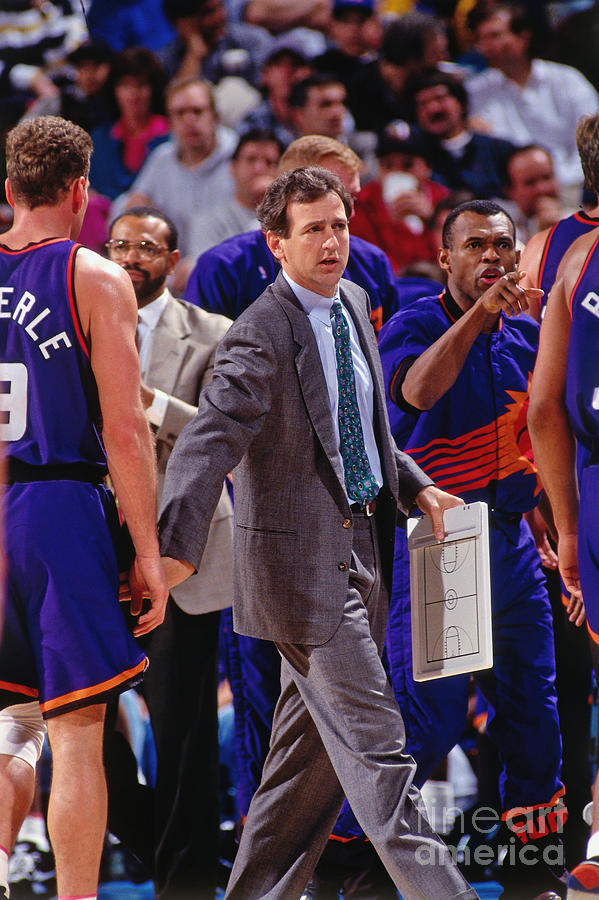
That led Lowell Gibbs "Cotton" Fitzsimmons, by then head coach of the Suns, hired Westphal as an assistant coach. In 1992, Fitzsimmons retired, and Westphal was named head coach. The timing was great: The Suns not only moved into a new arena, the American West Arena (its naming rights recently expired, so it is now officially just "Phoenix Suns Arena"), but they had Kevin Johnson, Dan Majerle and Danny Ainge, and had acquired one of the best players of the time, Charles Barkley.
Westphal's Suns marched through the Playoffs, beating the Los Angeles Lakers, the San Antonio Spurs and the Seattle SuperSonics, reaching the NBA Finals. There, they faced the 2-time defending Champion Chicago Bulls, and had home-court advantage for the series. It didn't help: Michael Jordan and company won the 1st 2 games in Phoenix, 100-92 and 111-108.

Game 3 in Phoenix was a classic. It was only the 2nd triple-overtime game in NBA Finals history -- and the Suns played in both. This time, they won, 129-121 at the Chicago Stadium. The Bulls won Game 4, 111-105. The Suns managed to take Game 5 in Chicago, 108-98, but the Bulls triumphed in a tough Game 6, 99-98. That was June 20, 1993, and the Suns haven't played an NBA Finals game since.

Westphal couldn't get the Suns that far again, and was fired in 1996. He coached high school ball for 2 years, then was named head coach in Seattle, lasting until 2000. From 2001 to 2006, he was the head coach at Pepperdine University in Malibu, California, winning a share of the 2002 West Coast Conference title.

He spent the 2006-07 season as a broadcaster in the game, the 2007-08 season as an assistant coach with the Dallas Mavericks, and the 2008-09 season in the Mavs' front office. From 2009 to 2012, he had his last head coaching job, with the Sacramento Kings. From 2014 to 2016, he was an assistant with the Brooklyn Nets, under Lionel Hollins, a member of the Portland Trail Blazers' 1977 NBA Champions, who had been assistant to Westphal on the Suns. Overall, as a head coach, Westphal was 159-98 (.619) in college and 597-318 (.533) in the NBA.
Westphal and Hollins

USC retired his Number 25. The Suns retired his Number 44, and elected him to their Ring of Honor. He was elected to the Basketball Hall of Fame as a player in 2019.

Shortly thereafter, he was diagnosed with cancer. He died yesterday, January 2, 2021, at the age of 70.

He is the Phoenix Suns' greatest legend, and will likely remain so until they finally win their 1st NBA Championship.

Sunday, April 7, 2019

Basketball Hall-of-Famers by Team, 2019 Edition

Congratulations to the newest members of the Basketball Hall of Fame: Bobby Jones, Sidney Moncrief, Paul Westphal, Jack Sikma, Vlade Divac, player/coach/executive Al Attles, and coach Bill Fitch.

Congratulations also to the family of the late Carl Braun, the 1950s Knick star whose shooting practice led to him saying, "Swish!" as the ball hit nothing but net, inspiring Knick broadcaster Marty Glickman to use it in broadcasts, and later Warner Wolf to use it on 11:00 news broadcasts. Braun's election is long overdue.

*

For this list, I'm only including NBA players, coaches and executives, not guys who got in mostly on the basis of their college or pre-NBA pro tenure. I'm also relaxing the 4-season rule that I put in for baseball and pro football, because a lot of guys were with teams for less than that but were still vital contributors to an NBA title with a team.

I'm also amending my separate-cities rule to include all Nets -- "New York" (Long Island), "New Jersey" and "Brooklyn," ABA and NBA -- as the same franchise. And I'm not doing this because I still root for them. At the moment, I remain an NBA free agent, a fan without a team.


Players are listed in chronological order of their arrival with the team.

Ties broken by most players, then by fewest seasons in the league (more HOFers per year), then by most non-broadcasters.


1. Boston Celtics, 25: Bob Cousy (also a broadcaster), Chuck Cooper, Ed Macauley, Bill Sharman, Frank Ramsey, Tommy Heinsohn (elected as player & a coach, was also a broadcaster), Bill Russell (player & coach), Sam Jones, K.C. Jones (player & coach), Tom "Satch" Sanders, John Havlicek, Bailey Howell, Jo Jo White, Dave Cowens, Larry Bird, Nate "Tiny" Archibald, Kevin McHale, Robert Parish, Dennis Johnson, Dino Radja, Ray Allen, Walter Brown (founder & owner), Red Auerbach (coach & executive), Bill Fitch (coach), Johnny Most (broadcaster).

Hard to believe the Celtics don't have the most. That won't last, though: Due to having won the 2008 title, Kevin Garnett and Paul Pierce will probably be elected, and Rajon Rondo might be.


Don Nelson played for the Celtics, but was elected as a coach, and has never coached the Celtics, so he can't be counted here.

2. New York Knicks, 23: Carl Braun, Harry Gallatin, Dick McGuire (player, coach & executive), Nat "Sweetwater" Clifton, Richie Guerin, Tom Gola, Willis Reed, Walt "Clyde" Frazier, Bill Bradley, Dave DeBusschere, Jerry Lucas, Earl "the Pearl" Monroe, Spencer Haywood, Bernard King, Patrick Ewing, Joe Lapchick (coach), Red Holzman (coach), Pat Riley (coach), Ned Irish (owner), Marty Glickman (broadcaster), Bob Wolff (broadcaster), Marv Albert (broadcaster), John Andariese (broadcaster).

Hubie Brown coached the Knicks, but was elected as a broadcaster, and not for the Knicks. Phil Jackson played for the Knicks, but was elected as a coach, and has never coached them. His maneuvers as team president haven't yet been Hall-worthy, either. Larry Brown only coached one season, possibly the worst of his career, partly the fault of general manager Isiah Thomas. Because he never played for the Knicks, and he was not elected as an executive, you can't count Isiah as a Knick HOFer -- and why would you want to?

3. Los Angeles Lakers, 17: Elgin Baylor, Jerry West (player & executive), Gail Goodrich, Wilt Chamberlain, Kareem Abdul-Jabbar, Jamaal Wilkes, Earvin "Magic" Johnson, Bob McAdoo, James Worthy, Vlade Divac, Shaquille O'Neal, Bill Sharman (coach), Pat Riley (coach), Phil Jackson (coach), Tex Winter (assistant coach), Jerry Buss (owner), Chick Hearn (broadcaster).

Kobe Bryant will join them, since his Colorado incident has been unofficially swept under the rug by the NBA establishment. Rod Hundley played for the Lakers, but was elected as a Utah Jazz broadcaster.

4. Philadelphia 76ers, 15: Hal Greer, Chet Walker, Wilt Chamberlain, Billy Cunningham (player & coach), Julius "Doctor J" Erving, Bobby Jones, Maurice Cheeks, Moses Malone, Charles Barkley, Allen Iverson, Alex Hannum (coach), Jack Ramsay (coach), Larry Brown (coach), Harvey Pollack (executive), Bill Campbell (broadcaster).

Doug Collins, who both played for the Sixers and was their head coach, has been elected as a broadcaster, but not for the Sixers, and thus can't be counted with them. Dolph Schayes was the team's 1st coach after it moved from being the Syracuse Nationals in 1963, but can't be counted as a Sixers' HOFer.

5. Detroit Pistons, 14: Bailey Howell, Dave DeBusschere, Dave Bing, Bob Lanier, Isiah Thomas, Joe Dumars, Adrian Dantley, Dennis Rodman, Grant Hill, Chuck Daly (coach), Larry Brown (coach), Fred Zollner (owner), William Davidson (owner), Bob Wolff (broadcaster). If Grant Hill is ever elected, it will be for what he did at Duke, but he can be counted here.

6. San Francisco/Golden State Warriors, 13: Guy Rodgers, Wilt Chamberlain, Al Attles (player, coach and executive), Nate Thurmond, Rick Barry, Jamaal Wilkes, Robert Parish, Chris Mullin, Mitch Richmond, Sarunas Marciulionis, Don Nelson (coach), Pete Newell (executive), Rick Welts (executive).

Since they've only moved within the San Francisco Bay Area since 1962 (San Francisco to Oakland in 1971, and will move back to San Francisco for the 2019-20 season), I'm counting them as a single team.

Bill King was the longtime radio voice of all 3 Oakland teams -- the Athletics, the Raiders and the Warriors -- but, for all the respect he earned, strangely, never received any of sport's Hall of Fame's award for broadcasters during his lifetime, and still hasn't since his death.

As for Steph Curry and Kevin Durant, they certainly look like they're headed for Hall qualification. Klay Thompson, Draymond Green and Andre Iguodala are also possibilities.

7. Chicago Bulls, 12: Chet Walker, Artis Gilmore, Jerry Sloan, Michael Jordan, Scottie Pippen, Dennis Rodman, Phil Jackson (coach), Tex Winter (coach), Jerry Reinsdorf (owner), Rod Thorn (executive), Jerry Krause (executive), Jim Durham (broadcaster).

Jerry Sloan was elected for his coaching with the Utah Jazz, not for his playing with the Bulls, although he could, conceivably, join the few people elected to the Hall as both a player and a coach. If he does, he'd be the 1st one elected as a coach first.


8. Houston Rockets, 11: Elvin Hayes, Calvin Murphy, Moses Malone, Ralph Sampson, Hakeem Olajuwon, Clyde Drexler, Charles Barkley, Yao Ming, Dikembe Mutombo, Tracy McGrady, Bill Fitch (coach). Oddly, former player and coach Rudy Tomjanovich has not yet been elected.

St. Louis Hawks, 9: Bob Pettit, Cliff Hagan, Ed Macauley, Slater Martin, Alex Hannum (player-coach), Clyde Lovellette, Lenny Wilkens, Zelmo Beaty, Richie Guerin.

Philadelphia Warriors, 9: Joe Fulks, Paul Arizin, Andy Phillip, Neil Johnston, Tom Gola, Guy Rodgers, Wilt Chamberlain, Eddie Gottlieb (founder & owner), Bill Campbell (broadcaster).

9. Milwaukee Bucks, 9: Oscar Robertson, Kareem Abdul-Jabbar, Sidney Moncrief, Bob Lanier, Jack Sikma, Ray Allen, Don Nelson (coach), Wayne Embry (executive), Eddie Doucette (broadcaster).

10. Phoenix Suns, 9: Connie Hawkins, Paul Westphal, Charles Barkley, Jason Kidd, Steve Nash, Grant Hill, Jerry Colangelo (owner), Rick Welts (executive), Al McCoy (broadcaster).

Rochester Royals, 7: Al Cervi (player & coach), Bob Davies, Red Holzman, Arnie Risen, Bobby Wanzer, Maurice Stokes, Les Harrison (owner). Holzman was elected as a Knicks coach, but could have been elected as a player anyway, so I'm counting him here.


11. Indiana Pacers, 8: Roger Brown, Mel Daniels, George McGinnis, Reggie Miller, Chris Mullin, Bob "Slick" Leonard (coach), Jack Ramsay (coach), Larry Brown (coach). Although Larry Bird was a head coach and executive for them, that's not why he was elected, and so he can't be counted here.

12. Portland Trail Blazers, 6: Bill Walton, Clyde Drexler, Arvydas Sabonis, Scottie Pippen, Jack Ramsay (coach), Bill Schonely (broadcaster). Pippen was only a Blazer for 3 seasons, but that included a trip to the Western Conference Finals, when they were probably cheated out of the NBA Finals by the Lakers, so I'm counting him here.

Minneapolis Lakers 6: George Mikan, Jim Pollard, Vern Mikkelsen, Slater Martin, Clyde Lovellette, John Kundla (coach). Essentially, their starting 5 and their head coach for their 5 NBA Championships in 6 seasons, 1949-54. Bud Grant, the Hall of Fame coach of the Minnesota Vikings, also played for the Minneapolis edition of the Lakers, but obviously he can't be counted here.


13. Denver Nuggets, 6: Bobby Jones, Dan Issel, David Thompson, Alex English, Dikembe Mutombo, Larry Brown (coach).

Seattle SuperSonics, 5: Lenny Wilkens (player & coach), Spencer Haywood, Jack Sikma, Dennis Johnson, Gary Payton.

14. Miami Heat, 5: Alonzo Mourning, Shaquille O'Neal, Gary Payton (2 years, they wouldn't have won the 2006 title without him, so I'm relaxing the rule for him), Ray Allen (2 years, they wouldn't have won the 2013 title without him, so I'm relaxing the rule for him), Pat Riley (coach & executive). Dwyane Wade and LeBron James will be elected. Tim Hardaway and Chris Bosh also might be.

15. Atlanta Hawks, 5: Walt Bellamy, Pete Maravich, Dominique Wilkens, Dikembe Mutombo, Lenny Wilkens (coach). 'Nique and Lenny spell their names differently, and are not related. Lenny played for the Hawks, but that was in St. Louis.

Fort Wayne Pistons, 5: Bobby McDermott, Andy Phillip, Bob Houbregs, George Yardley, Fred Zollner (owner).

16. Utah Jazz, 5: Adrian Dantley, John Stockton, Karl Malone, Jerry Sloan (coach), Rod Hundley (broadcaster).

17. New York/New Jersey/Brooklyn Nets, 5: Julius Erving, Drazen Petrovic, Jason Kidd, Rod Thorn (executive), Bill Raftery (broadcaster). Eventually, Vince Carter will be added. As should Buck Williams, but he probably won't make it.

No, you can't count Rick Barry (played briefly for them in the ABA), Billy Cunningham (ditto), Lou Carnesecca (coached them to an ABA Division title between stints at St. John's), Larry Brown (coached them 2 seasons), Chuck Daly (ditto), or even, due to his later broadcast work for the Nets, Marv Albert (appropriately, on the network named YES!).

Baltimore Bullets, 4: Buddy Jeannette (player-coach), Gus Johnson, Earl Monroe, Wes Unseld. There were actually 2 separate teams with this name, 1947-54 and 1963-73. Unseld spent most of his career with the franchise in Washington, but played 5 seasons with them in Baltimore.

Cincinnati Royals, 4: Jack Twyman, Wayne Embry, Oscar Robertson, Jerry Lucas.

18. Washington Bullets/Wizards, 4: Elvin Hayes, Wes Unseld, Bernard King, Mitch Richmond. No, you can't count Michael Jordan.

19. San Antonio Spurs, 4: George Gervin, Artis Gilmore, David Robinson, Larry Brown (coach). Tim Duncan, Manu Ginobili and coach Gregg Popovich will join them, and Tony Parker might.

Syracuse Nationals, 4: Al Cervi (player & coach), Dolph Schayes, Earl Lloyd, Danny Biasone (owner, whose idea for the 24-second shot clock may have made the NBA's long-term survival possible).

20. Cleveland Cavaliers, 4: Wayne Embry (player & executive), Lenny Wilkens (coach), Bill Fitch (coach), Joe Tait (broadcaster). LeBron James, of course, will be added eventually.

21. Orlando Magic, 3: Shaquille O'Neal, Tracy McGrady, Grant Hill.

22. Dallas Mavericks, 3: Steve Nash, Jason Kidd, Don Nelson (coach). Dirk Nowitzki will make it.

23. Sacramento Kings, 2: Nate "Tiny" Archibald, Mitch Richmond.

24. Toronto Raptors, 2: Tracy McGrady, Lenny Wilkens (coach). Vince Carter will probably be elected, and can be counted as a Raptor. No, you can't count Isiah Thomas as a Raptors executive -- and why would you want to?

Buffalo Braves, 2: Bob McAdoo, Jack Ramsay (coach).

25. Charlotte Hornets, 1: Alonzo Mourning. No, you can't count owner Michael Jordan.

New Orleans Jazz, 1: Pete Maravich. He only played half of the team's first season in Utah, yet he has his Number 7 retired by both the Jazz and the Pelicans.

San Diego Clippers, 1: Bill Walton. His tenure with his hometown team was riddled with injury, but he qualifies.

26. Los Angeles Clippers, 1: Bill Fitch (coach). He just got elected, and he was their head coach for 4 seasons, so he qualifies. No, you can't count longtime executive Elgin Baylor. Nor can you count Bill Walton, who hardly played for the franchise, and left before they were moved from San Diego to Los Angeles. If Chris Paul or Blake Griffin is elected, either can be counted with this franchise.

27. Oklahoma City Thunder, none: A bit too soon to tell, but Kevin Durant and Russell Westbrook could be their 1st 2 HOFers.

28. New Orleans Pelicans, none: If Chris Paul is elected, he can be counted with this franchise, even though he only played for them as the Hornets.
29. Memphis Grizzlies, none: So far, the only player who's played for the Grizzlies and been elected is Allen Iverson, and he was there only briefly. No, you can't count Jerry West for his time as a Grizzlies executive. Nor can you count Hubie Brown for his time as their head coach. If Pau Gasol is elected, he can be counted, although he'll most likely be remembered mainly as a Laker.
30. Minnesota Timberwolves, none: No, you can't count Kevin McHale (coach & executive). You can, when he is elected, count Kevin Garnett. If Christian Laettner is ever elected, it will be for what he did at Duke, but he can be counted here.