Showing posts with label andrew jackson. Show all posts

Tuesday, March 4, 2025

March 4, 1825: The Inauguration of John Quincy Adams

March 4, 1825, 200 years ago: John Quincy Adams, son of John Adams, the 2nd President of the United States, is Inaugurated as the 6th President of the United States, in the House of Representatives Chamber of the U.S. Capitol Building.

John C. Calhoun, the outgoing U.S. Secretary of War, is sworn in as Vice President.

Certainly, Adams was qualified for the office. He had been a U.S Senator from Massachusetts; U.S. Minister to the Netherlands, Prussia (Germany), Russia and Britain; and Secretary of State under the previous President, James Monroe.

But he becomes President under controversial circumstances, having not won the popular vote or the initial Electoral Vote, and having been elected by the U.S. House of Representatives thanks to a competitor, Speaker of the House Henry Clay, throwing Adams his support, in what appears to have been a quid pro quo, as Adams appointed Clay to be Secretary of State -- at the time, tantamount to being named heir presumptive as President -- allowing him to win over the man who led in both the popular and the Electoral Vote, General Andrew Jackson.

Sworn in by Chief Justice John Marshall, he is the only President to swear the Oath of Office with his hand on a book other than a Bible, using a book of laws. And, as the 1st President who could not be counted among the "Founding Fathers," he changed the fashion of the ceremony: Instead of long hair tied in a queue, he had his hair cut short; and instead of the traditional knee breeches, he wore long trousers.

As Thomas Jefferson had, following the previous most contentious election, he tried a conciliatory tone in his Inaugural Address, saying, "The collisions of party spirit which originate in speculative opinions or in different views of administrative policy are in their nature transitory." He noted his status as the 1st minority-vote President by saying, "I am deeply conscious of the prospect that I shall stand more and oftener in need of your indulgence."

His Presidency was a failure. The Democratic Party wanted nothing to do with him, and what had become the National Republican Party discovered that the natural contentious personality common to the Adams men was rather strong in him. He got very little done, and when his rematch with Andrew Jackson came in 1828, he was soundly defeated.

In 1830, he became the 1st former President to be elected to the House of Representatives. He served a District outside Boston, becoming the House's leading advocate for the abolition of slavery, until his death in 1848.

Sunday, February 9, 2025

February 9, 1825: The Corrupt Bargain

Left to right: Henry Clay, John Quincy Adams, Andrew Jackson

October 26, 1824: Andrew Jackson finishes 1st in the Presidential election, both in the popular vote and in the Electoral Vote. But he doesn't get a majority of either: The Electoral Vote goes 99 for Jackson, America's greatest living military hero and a servant of Tennessee in both houses of Congress; 84 for John Quincy Adams, the Secretary of State to outgoing President James Monroe and the son of President John Adams; 41 for William H. Crawford, then Secretary of War; and 37 for Henry Clay, then the Speaker of the House of Representatives.

According to the Constitution of the United States, this throws the election into said House. This had happened only once before, in 1800, when John Adams lost, but it wasn't clear as to whom: Thomas Jefferson and Aaron Burr finished in a tie, and the House chose Jefferson.

February 9, 1825, 200 years ago today: The election is held. Crawford dropped out due to ill health, but didn't throw his support to anyone. Clay knew he didn't have a chance, and that he didn't like either remaining man. But he at least trusted Adams, and despised Jackson. So he threw his support to Adams, who won, 87-74, making him the 6th President of the United States.

Adams then appointed Clay to be his Secretary of State. At the time, this, rather than the Vice Presidency, was tantamount to being chosen as heir apparent. Adams had served as Secretary of State under Monroe, Monroe had so served James Madison, Madison had so served Jefferson, and Jefferson had so served George Washington, though was not his immediate successor.

Jackson and his supporters cried foul: The term "corrupt bargain" entered the American lexicon.

But despite his anger, Jackson did the right thing: Instead of acting like an ass, like Donald Trump did, he went home, and said little, and let his supporters paint him as the wronged man. This allowed him to remake the Democratic-Republican Party, whose members had usually called themselves "Republicans" to this point, as the Democratic Party, and to paint himself as the reasonable alternative, provided that Adams' Presidency did not go well.

It didn't. By most standards, Adams' Presidency was a disaster. He called for an ambitious agenda that included federally funded infrastructure projects, the establishment of a national university, and engagement with the countries of Latin America, but Congress refused to pass many of his initiatives. With other countries, he may have been the greatest diplomat America has ever had; with Congress, diplomacy did him no good. Sadly, both traits were inherited from his father.

Jackson rode a wave of popular frenzy, and won the rematch in 1828. This was despite a very dirty campaign, in which both he and his wife were libeled. Rachel Jackson died between the election and the Inauguration, and "Old Hickory" swore revenge against his enemies, thinking them responsible.

His 1st term was dominated by "The Petticoat Affair." Led by Floride Calhoun, wife of Vice President John C. Calhoun, the wives of Jackson's Cabinet members socially ostracized Secretary of War John Eaton and his wife, Peggy Eaton. Their private history, to put it politely, resembled that of Andrew and Rachel Jackson.

Thinking of Rachel, Jackson took the Eatons' side. Hoping to quell the controversy, Secretary Eaton resigned in 1831, and Jackson ended up firing and replacing every other member of his Cabinet -- except for his Secretary of State, who was a widower, and had stood up for the Eatons. His name was Martin Van Buren. In 1832, running for re-election, Jackson dumped Calhoun from the ticket, and got Van Buren nominated for Vice President. They overwhelmingly beat Clay in the election. Jackson later appointed Eaton to be Military Governor of Florida and U.S. Minister to Spain. Clay would run for President again in 1844, losing for a 3rd time, to James K. Polk.

One unintended consequence of all this: Jackson's 2nd Attorney General, and later his 4th Secretary of the Treasury, was Roger Taney. In 1836, Jackson appointed him Chief Justice of the U.S. Supreme Court. In 1857, in Dred Scott v. Sandford, Taney ruled that black people were not American citizens, even if born free. Taney died before the abolition of slavery.

But the Taney appointment might not be Jackson's worst decision. In 1830, he signed the Indian Removal Act, which displaced tens of thousands of Native Americans from their ancestral homelands east of the Mississippi, and resulted in thousands of deaths. It was a horrible thing to do, and Native Americans have hated him ever since. Some won't take a $20 bill, because his picture is on it. They'll take two tens, or four fives, or a ten and two fives, or even twenty singles, but not a twenty.

It's worth mentioning, though, that, at the time, while the Indian Removal Act was opposed by such Congressional figures as Clay and Jackson's Tennessee rival, David Crockett (despite his status as a folk hero thanks to a 1950s TV show, he was never called "Davy" in his lifetime), nobody came up with a better idea. And Jackson's justification was that, had the Natives stayed, they would have been wiped out by white men, anyway. There was no good answer, including doing nothing.

Jackson faced a challenge to the integrity of the federal union when South Carolina threatened to nullify a high protective tariff set by the federal government. Jackson threatened the use of military force to enforce the tariff, but the crisis was defused when the tariff was amended.

In 1832, he vetoed a bill by Congress to reauthorize the Second Bank of the United States, correctly arguing that it was a corrupt institution. In 1835, Jackson became the only President to pay off the national debt, and the 1st to survive an assassination attempt. When he left office after 2 terms on March 4, 1837, he was still immensely popular, but also widely hated. And he still was both when he died on June 8, 1845.

Four different men who held the Presidency have called Jackson their favorite President: Franklin Roosevelt, Harry Truman, Lyndon Johnson and Donald Trump. Trump put a portrait of Jackson in the Oval Office. It was suggested that he did so because Jackson was a fellow racist.

What would Jackson have thought of Trump? A big businessman? A dealer with big banks? A draft dodger? A man who treated his wives badly? A crook? A traitor? When he left office, Jackson was asked if he had any regrets. He said, "I regret I was unable to shoot Henry Clay or to hang John C. Calhoun." The distinction being that he considered Clay a common criminal, worthy of being shot; and Calhoun a traitor, where the traditional penalty is hanging.

Many locations in America have been named for Jackson, including the capital of Mississippi; Jacksonville, the largest city (but not the seat of the largest metropolitan area) in Florida; a city in Tennessee, whose name became the title of a hit song by country music legends June Carter & Johnny Cash; the town in Ocean County, New Jersey, where Six Flags Great Adventure, one of the country's leading theme parks, is located, including a frontier theme that Jackson himself might have appreciated; and Jackson Heights, a neighborhood in Queens, New York City. Counties in 21 States have been named for him, including in Missouri, which also has a Hickory County, named for his nickname.

New York City has a high school and an elementary school named for Jackson. Oddly, neither is in Jackson Heights: The high school is in Cambria Heights, and the public school is in Flushing. There are also Andrew Jackson High Schools in Miami and, as you might expect, in Jacksonville, Florida; and in his home State of South Carolina, in Kershaw, in the Waxhaws from whence he came.

The USS President Jackson was an attack transport that served the U.S. Navy from 1941 to 1955. The USS Andrew Jackson was a submarine, in service from 1963 to 1989. A Jackson Highway ran from Chicago to New Orleans, although it has mostly been phased out.

Among the actors who have played Jackson: Lionel Barrymore twice, in The Gorgeous Hussy in 1936, with Joan Crawford as Peggy Eaton, and Lone Star in 1952; Hugh Sothern in The Buccaneer, a film about the Battle of New Orleans and the pirate Jean Lafitte, in 1938; Brian Donlevy in The Remarkable Andrew in 1942; Charlton Heston twice, in The President's Lady in 1953, with Susan Hayward as Mrs. Eaton, and in a 1958 remake of The Buccaneer; Basil Ruysdael in Davy Crockett, King of the Wild Frontier in 1955; Wesley Addy in The Adams Chronicles in 1976; and Kris Kristofferson in Texas Rising in 2015.

In 2008, Michael Friedman created the musical Bloody Bloody Andrew Jackson, a comedic look at the man and the myth. It reached Broadway in 2010, starring Benjamin Walker, who would double down in 2012, taking the title role in the film Abraham Lincoln: Vampire Hunter.

Jackson's portrait has appeared on the $20 bill since 1928. Since 2016, there has been a plan to replace him on the bill with abolitionist Harriet Tubman. It hasn't happened yet.

Saturday, May 27, 2023

May 27, 1823: American Eclipse vs. Sir Henry

Edward Troye's painting of American Eclipse

May 27, 1823, 200 years ago: The 1st great "match race" – one horse vs. another – in American history is held, at the Union Course.

It was North vs. South: American Eclipse, of New York, named for the legendary British racehorse for whom horse racing's Eclipse Awards are named, and already regarded as the finest racehorse in the country, but, at the age of 9, old for a thoroughbred; vs. Sir Henry, of Virginia.

Among the 60,000 people in attendance were General Andrew Jackson, hero of the War of 1812, military Governor of the Florida Territory, and, elected in 1828, the 7th President of the United States; the current Vice President, Daniel D. Tompkins, a native of nearby Scarsdale, New York, and the man for whom Tompkins Square Park in Manhattan would be named; Aaron Burr, the disgraced former New York politician who had served as Thomas Jefferson's 1st Vice President.

The President at the time, James Monroe, did not come. Nor did the Governor of the State of New York, Joseph C. Yates; nor did the Mayor of the City of New York, Stephen Allen. And, no, neither Burr nor Jackson challenged the other to a duel.

The conditions were that it would be 3 heats, of 4 miles each -- a staggering sum by modern standards. Sir Henry won the 1st heat, by 1 length. It was the 1st time that American Eclipse had ever been defeated. He rebounded to win the 2nd heat. Both horses were tired in the 3rd heat, but American Eclipse won by 3 lengths.
The painting is definitely of the Union Course.
It may be of the 3rd and final heat
between American Eclipse and Sir Henry.

American Eclipse had won. The North had won. The South didn't like that, but there was nothing they could do about it. American Eclipse was a made horse, and Sir Henry wasn't. They just had to sit there and take it.

If you're wondering why I borrowed the line from Goodfellas, it's because the Union Course, which opened in 1821, closed in 1872, having been surpassed in prestige by other area racetracks, was in what is now Woodhaven, Queens. It was between 78th and 85th Streets, and Jamaica and Atlantic Avenues. The track was so long that it would take too long to say what's on the site now: It's mostly housing, but some retail, and at least 3 churches.

American Eclipse lived until 1847, at the age of 33, which is old for a thoroughbred.

Tuesday, November 2, 2021

The Future Ain't What It Used to Be

November 2, 2001, 20 years ago: A statue of head coach Joe Paterno is dedicated outside the east stand of Beaver Stadium on the campus of Pennsylvania State University in State College, Pennsylvania. It calls him "Joseph Vincent Paterno: Educator, Coach, Humanitarian."

On July 22, 2012, 6 months after his death, and 8 months after the scandal that forever tarnished his name, the statue was removed, since it was being called a roadblock in the healing process.
As Yogi Berra, an Italian-American sports figure a year older than Paterno, once put it, "The future ain't what it used to be." How right he was:

* Joe Paterno not only wasn't running a clean program, as was so often said, but he ran one that, in a way, was dirtier than any Southeastern Conference or Southwest Conference program ever was.

* O.J. Simpson killed his ex-wife and another person, and then went to prison -- on a totally different charge.

* Pete Rose was permanently banned from baseball.

* Many of the villains of "professional wrestling" turned out to be great guys in real life, while Hulk Hogan was exposed as a massive jackass.

* Michael Jackson was accused of molesting children, and died at age 50.

* Bill Cosby went to prison.

* Dustin Diamond (Screech from Saved By the Bell) turned out to be a jerk and a sex fiend, and died at age 44.

* Arnold Schwarzenegger and Jesse Ventura got elected Governor -- and Ventura turned out to be the better one.

* Donald Trump became President. And while I could have guessed that he would have gotten 746,000 Americans killed (at last count), I would've guessed it was through a war rather than a pandemic.

* And people like Dennis Miller, James Woods, Roseanne Barr, and the brothers Randy and Dennis Quaid, whom we thought were on our side, turned out to be on the same side as Trump.

Of course, to answer Bowling for Soup's famous question, "And when did Ozzy become an actor?" that's easy: He's been playing Ozzy Osbourne since 1970.

*

November 2, 1769: A Spanish exploration party sails into San Francisco Bay, the 1st European settlers to visit. In 1776, the Presidio of San Francisco is founded.

November 2, 1792: Voting begins in America's 2nd Presidential election. Incumbent President George Washington is essentially unopposed, and wins all 15 States for 132 Electoral Votes. Vice President John Adams is also re-elected.

November 2, 1795: James Knox Polk is born in Pineville, North Carolina, now a suburb of Charlotte. He lives most of his life in and around Columbia, Tennessee, now a suburb of Nashville. He graduated from the University of North Carolina, well before the invention of basketball. However, UNC still beats Duke: Its Presidential connection is that Richard Nixon graduated from its law school.

A member of the U.S. House of Representatives from Tennessee from 1825 to 1839, Speaker of the House from 1835 to 1839, and Governor of Tennessee from 1839 to 1841, Polk was elected President in 1844. Texas was annexed right before his Inauguration, so he doesn't get credit for adding Dallas, Houston and San Antonio. But in 1846, he launched the Mexican-American War, which was essentially won in a year and a half. Having achieved his ambitions, he kept his promise to not run for re-election, contracted cholera, and died on June 15, 1849, just 3 months after leaving office -- the shortest ex-Presidency ever.

Cities whose teams are possible because of his expansionism are San Francisco, Oakland, San Jose, Los Angeles, Anaheim, San Diego, Phoenix, Salt Lake City and, now, Las Vegas.

*

November 2, 1804: Thomas Jefferson is re-elected President. The Democratic-Republican defeats the Federalist Party nominee, Charles Cotesworth Pinckney, a hero of the War of the American Revolution and a delegate to the Constitutional Convention. Oddly, the only office he held under the Constitution was one previously held by Jefferson: U.S. Minister to France. (Today, we would say, "Ambassador.")

The popular vote was not counted by every State in those days. Jefferson won 162 Electoral Votes. Pinckney won just 14, carrying only 2 States, and his native South Carolina was not one of them: He won Connecticut and Delaware, which both tended to go Federalist for as long as that party existed. Pinckney would be nominated again in 1808, but lose to Jefferson's Secretary of State, James Madison.

November 2, 1821, 200 years ago: William Adams Richardson is born outside Boston in Tyngsborough, Massachusetts. A lawyer and judge, he served as U.S. Secretary of the Treasury from March 17, 1873 to June 3, 1874, under President Ulysses S. Grant. During this time, the Panic of 1873 struck the American stock market, and he issued $26 million in paper money to meet demand. It eased the immediate emergency, but what became known as the Long Depression began, lasting 5 years.

He resigned over the Sanborn Incident, which involved favoritism and profiteering in the collection of unpaid taxes. Grant let him save face by accepting a judgeship on the U.S. Court of Claims, now part of the U.S. Court of Appeals. He became its Chief Justice in 1885, and held that post until he died in 1896.

November 2, 1832: Andrew Jackson is re-elected President, defeating his arch-rival, Henry Clay. It's a landslide: "Old Hickory" wins 54 percent of the vote and 219 Electoral Votes, to Clay's 37 percent and 49 Electoral Votes.

November 2, 1847: Charles James Sweasy is born in Newark, New Jersey. The 2nd baseman on the 1st openly professional baseball team, the 1869-70 Cincinnati Red Stockings, he later played for several teams in the National Association and the National League, including winning the NA Pennant with the 1873 Boston Red Stockings, which featured some of his former Cincinnati teammates, and were the forerunners of the Atlanta Braves. He returned to Newark, and died in 1908, age 60.

November 2, 1852: Franklin Pierce is elected the 14th President of the United States. The Democratic nominee, who had served New Hampshire in both houses of Congress, defeats the Whig Party nominee, General Winfield Scott, a hero of the recent Mexican-American War, 254 Electoral Votes to 42. Pierce took almost 51 percent of the popular vote, Scott almost 44 percent.

Scott, a.k.a. Old Fuss and Feathers, won only 4 States: Whig strongholds Massachusetts, Connecticut, Kentucky (home State of the late Whig leader Henry Clay) and Tennessee (ironically, the home State of such Democratic icons as Andrew Jackson and James K. Polk, who were both dead and thus unable to campaign for Pierce).

But as the Pierce family made its way to Washington for the Inauguration, their train derailed outside Andover, Massachusetts. Franklin and his wife Jane escaped with minor injuries, but their 11-year-old son Benjamin, their only surviving child, was killed. Franklin never recovered from this loss, and his drinking got out of control, making him the 1st alcoholic President. He may also have been the worst President, taking actions that turned the Civil War from a possibility into an inevitability.

November 2, 1865: Warren Gamaliel Harding is born in Blooming Grove, now a part of North Bloomfield Township, Ohio, outside Columbus. November 2 remains the only day on the calendar to be a birthday of 2 Presidents. That will remain the case no matter who wins next Tuesday.

He lived most of his life in nearby Marion, ran a newspaper, and was elected Lieutenant Governor and then a U.S. Senator. Elected President in 1920, he died in office on August 2, 1923, as the Teapot Dome scandal began to swirl around his Administration.

He got off easy with the law (2 of his Cabinet officers went to prison), but not with history (he is generally regarded as one of the worst, and dumbest, Presidents ever, and that's before you get into his womanizing).

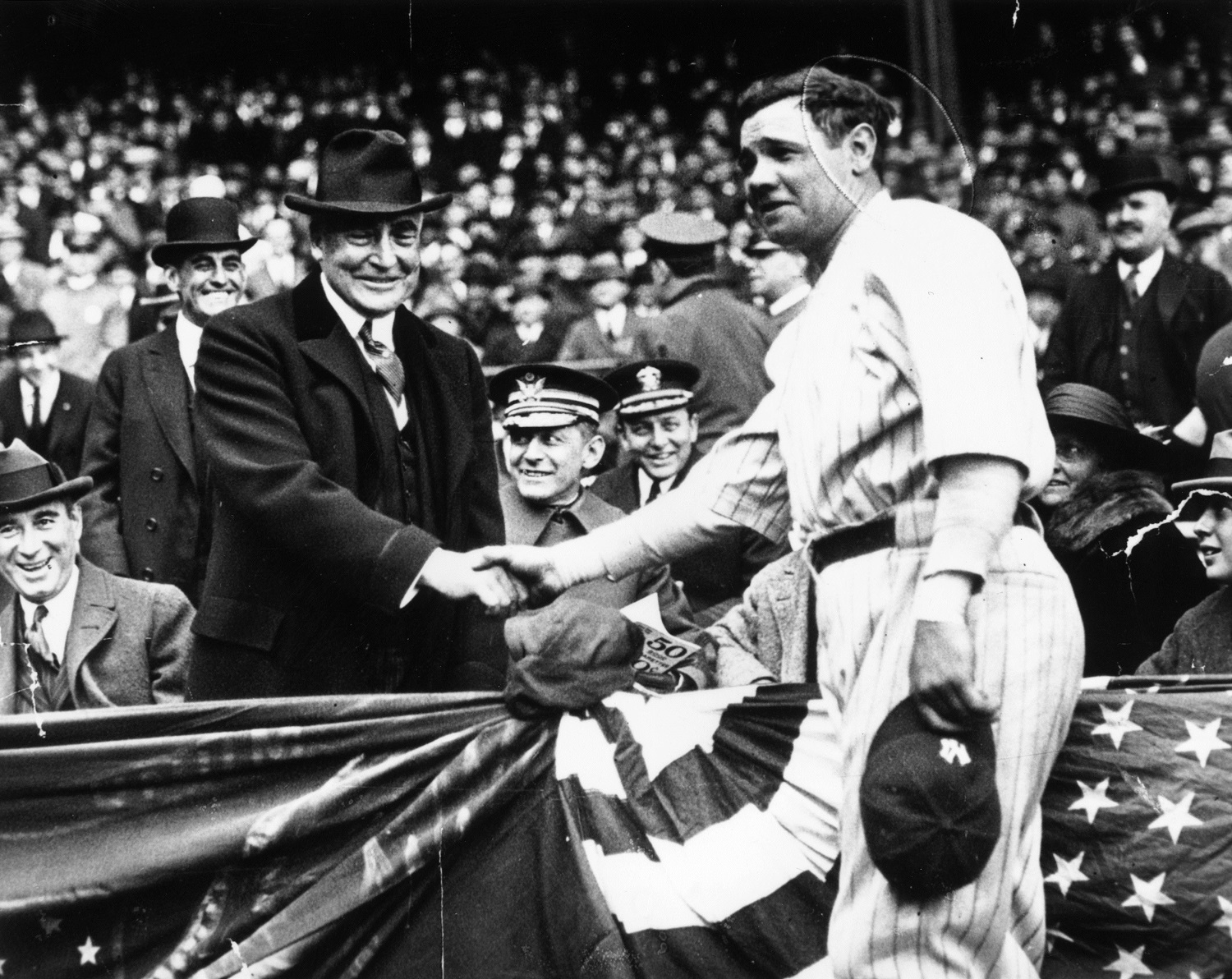
He was a big baseball fan, and on Opening Day of the 1923 season, as the Yankees visited Washington to face the Senators, he threw out the ceremonial first ball, and shook hands with Babe Ruth.
November 2, 1880: James Abram Garfield is elected the 20th President of the United States, in one of the narrowest races ever. In fact, in terms of total popular vote, it remains the closest ever. The Republican nominee, who had served Ohio in both houses of Congress, won 4,446,158 votes. The Democratic nominee, a hero General of the Civil War, Winfield Scott Hancock (named for the losing candidate of 1852), won 4,444,260 -- a margin of 1,898 votes. (Garfield had also been a General in the Civil War.)

But it's Electoral Votes that matter, although that was also rather close: Garfield won 214 to Hancock's 155. Each man won 19 States. Whether the Republicans stole the votes of any State, as they had for Rutherford B. Hayes 4 years earlier, has never been proven.

Garfield was inaugurated on March 4, 1881. On July 2, he was shot. He could have survived, but his doctors' incompetence led to an inability to find the bullet, and a subsequent infection that killed him on September 19. Only William Henry Harrison died earlier upon his Inauguration than Garfield's 200 days.

His opponent, known as Hancock the Superb and The Thunderbolt of the Army of the Potomac for his heroism at the Battle of Gettysburg in 1863, developed diabetes, chose not to run again in 1884, and died in 1886.

Chester Arthur, Garfield's Vice President and successor, also got sick, with kidney disease, did not run for a term of his own in 1884, and died in 1886. Samuel Tilden, cheated out of the Presidency in 1876, did not run in 1880 or 1884, and he, too, died in 1886. None of them lived to see what would have been the end of the Garfield-Arthur ticket's 2nd term -- or that of Hancock and his running mate, Congressman William H. English of Indiana. He lived until 1896.

November 2, 1881, 140 years ago: The American Association of Professionals is founded, challenging the National League, with the motto "Liberty to All." The members are St. Louis‚ Cincinnati‚ Louisville‚ Allegheny‚ Athletic (Philadelphia)‚ and Atlantic (Brooklyn). This AA has officially, for many years, been considered by Major League Baseball to be a "major league."

The AA elects H.D. McKnight as its president. It votes to honor the NL blacklist in the case of drunkenness, but not to abide by the NL reserve clause. The new league will rely on home gate receipts‚ visiting teams getting just a $65 guarantee on the road‚ as opposed to the NL's policy of giving 15 cents from each admission to the visitors. The AA will allow Sunday games‚ liquor sales‚ and 25-cent tickets (about $6.50 in today's money)‚ all prohibited by the NL (which then charged 50 cents for all games).

Six of their clubs would eventually join the National League. Two would be contracted out of existence in 1900: The Louisville Colonels and the original Baltimore Orioles. The other 4 are still in business today, albeit under other names: The St. Louis Browns (St. Louis Cardinals), the Cincinnati Red Stockings (Cincinnati Reds), the Pittsburgh Alleghenys (Pittsburgh Pirates), and the Brooklyn Grays (who replaced the Atlantics in 1884, and are known today as the Los Angeles Dodgers).

November 2, 1889: North Dakota is admitted to the Union as the 39th State. At the same time, South Dakota is also admitted, as the 40th State. This is the only time 2 States have been admitted on the same day, and it begins a 10-day stretch in which 4 States are added.

Neither State has any major league teams, and very few professional teams at any level, due to being so sparsely populated: Between them, they have only 1.6 million people, and aside from Mount Rushmore, which is outside Rapid City, South Dakota, they don't have much in the way of tourist attractions.

For the most part, the Dakotas are considered part of the Minneapolis-St. Paul sports "market," and most people there are Twins and Vikings fans, though western South Dakota has a noticeable presence of Denver Broncos fans.

*

November 2, 1903: Travis Clayton Jackson is born in Waldo, Arkansas. The shortstop played on the New York Giants' Pennant winners of 1922, '23, '24, '33 and '36, winning the World Series in 1922 and '33.

He managed in the minor leagues from 1936 to 1960. In 1982, he was elected to the Baseball Hall of Fame, in his 45th year of eligibility -- the longest any player has had to wait, and still live to see his election. He died in 1987.

November 2, 1912: Cornelius Alexander McGillicuddy Jr. is born in Philadelphia. Like his father, he never actually legally changed his name to "Mack." But he became known as Connie Mack Jr.

By the time Connie Sr. became majority owner of the Philadelphia Athletics in 1937, Connie Jr. was managing the concessions at Shibe Park. In 1938, he was named assistant treasurer. But there was a dispute in the family: Connie's sons from his 1st marriage, Earle and Roy, believed that they would be handed control of the team when their father either died or retired, and this appears to have been Connie's plan as well; but Connie's 2nd wife Katherine and their son Connie Jr. were adamant that Connie Jr. would run the team.

In 1950, when the father's 50th Anniversary as team manager became a massive flop, as his senility had become obvious, the sons, united for one of the few times in their lives, ganged up on their father, allied themselves with the other owners, the heirs of the Shibe family, and stripped their father of his power, making him owner but nothing else.

But that was the end of their getting along. Later in 1950, Earle and Roy bought Connie Jr. out, and the financial maneuvers they needed to do so were the death knell of the A's in Philadelphia. Connie Jr. moved to Florida, ran a successful shrimp business there, and lived until 1996, long enough to see his son Connie Mack III elected to the U.S. Senate as a Republican from Florida. His grandson, Connie Mack IV, has served in the U.S. House of Representatives. Still, while their names appeared on the ballot as "Connie Mack," legally, the family name remains McGillicuddy.

*

November 2, 1920
: Richard Alan Sisler is born in St. Louis, where his father, George Sisler, is one of the greatest players in baseball, with the St. Louis Browns. Dick would go on to become a decent player himself, playing 1st base like his father, and later the outfield, batting .276 in a career that lasted from 1946 to 1953.

As a rookie with the 1946 St. Louis Cardinals, he played on a World Series winner. In 1950, he hit a 10th-inning home run on the last day of the season to give the Philadelphia Phillies their only National League Pennant between 1915 and 1980. He was an All-Star that season.

He later served as a coach, helping the Cincinnati Reds win the 1961 Pennant, and stepped in as their manager in 1964 when Fred Hutchinson was dying of cancer, nearly taking them to another Pennant. With some irony, they were battling his former Pennant-winners, the Cardinals and the Phillies, for it, and the Cards ended up beating both the Reds and the Phils by 1 game.

He managed the Reds in the 1965 season, and then never managed again, despite his managerial record being a fine 121-94, .562. But he coached for the Cardinals on their Pennant teams of 1967 (winning another World Series) and 1968, and later for the San Diego Padres under John McNamara and the Mets under Joe Torre. He later worked as a minor-league instructor with the Cardinal system, and died in 1998.

Dick's brother, Dave Sisler, would be a major league pitcher. Another brother, George Sisler Jr., wouldn't make the major leagues, but was a longtime baseball executive.

Also on this day, the Ocoee Massacre takes place, in Ocoee, Florida, about 12 miles west of Orlando. When black people tried to vote in that day's Presidential election, won by Warren Harding, they were attacked, and most of their owned homes and businesses were burned down. There were an estimated 35 deaths, and it has been called "the single bloodiest day in modern American political history."

I learned about this massacre... this year, on its 100th Anniversary. It wasn't taught to me in any school.

There is no point in doing a "Scores On This Historic Day" post for the event: The baseball season was over, the football season was in midweek, the NHL season didn't start until December 22, and the NBA wasn't founded until 1946.

November 2, 1921, 100 years ago: William Mosienko (no middle name) is born in Winnipeg. A 5-foot-8 right wing for the Chicago Blackhawks, he's in the Hockey Hall of Fame and the Manitoba Hockey Hall of Fame. On March 23, 1952, he scored 3 goals in just 21 seconds, still an NHL record, as the Hawks beat the New York Rangers 7-6 at Chicago Stadium. He died in 1994.

November 2, 1928: Leon Joseph Hart is born in Pittsburgh. A 2-way end, he helped Notre Dame win National Championships in 1946, 1947 and 1949, and was awarded the 1949 Heisman Trophy, denying the previous year's winner, Doak Walker of Southern Methodist, back-to-back wins.

He was drafted by the Detroit Lions, and helped them win the NFL Championship in 1952, 1953 and 1957, playing alongside fellow Heisman winners Walker and Howard "Hopalong" Cassidy of Ohio State (1955). He only made 1 Pro Bowl, in 1951. He was elected to the College Football Hall of Fame, and died in 2002.

Also on this day, William Raymond Daniel is born in Swansea, Wales. A centreback, Ray Daniel played for North London club Arsenal in the 1952 FA Cup Final, despite having a broken arm. Walley Barnes' injury in that game forced him to leave the pitch, but Daniel played on, leaving Arsenal with essentially 9 men, 2 at the back, and they lost to Newcastle United.

But Daniel missed only 1 match in the 1952-53 season, and Arsenal edged Preston North End in the closest title race in Football League history. He then went to Sunderland (who know a thing or two about hating Newcastle), and played for both of the big clubs in Wales, Cardiff City and Swansea Town (now Swansea City). He later worked for the postal service, and lived until 1997.

November 2, 1937: A benefit game -- effectively, an all-star game -- is held for the family of the late Montreal Canadiens legend Howie Morenz at the Montreal Forum. Morenz had broken his leg in a game the preceding January, and then died of a heart attack in March, often blamed on the near-party atmosphere his former teammates kept bringing to his hospital room.

The Howie Morenz Memorial Game featured a combined team of the 2 Montreal clubs, the Canadiens and the Maroons. (The Great Depression finally caught up with the Maroons, and they went out of business at the conclusion of the 1937-38 season.) Canadiens Hall-of-Famers in this game included Aurel Joliat, Toe Blake, and Babe Siebert -- who would drown in a boating accident 2 years later, and whose family would be the subject of the next NHL benefit game, also at the Forum. The Maroons included Frank "King" Clancy, at the end of the line after a Hall of Fame career with the Ottawa Senators and the Toronto Maple Leafs.

The Montreal team played an All-Star team made up of the rest of the NHL, including Hall-of-Famers: From the Leafs, Red Horner, Charlie Conacher and Harvey "Busher" Jackson; from the New York Rangers, Frank Boucher; from the New York Americans, David "Sweeney" Schriner and Leafs legend Clarence "Hap" Day; from the Boston Bruins, Clarence "Tiny" Thompson, Eddie Shore and Aubrey "Dit" Clapper; and from the Detroit Red Wings, Ebenezer "Ebbie" Goodfellow and Marty Barry. The 2 representatives from the Chicago Black Hawks, Johnny Gottselig and Harold "Mush" March, aren't in the Hall, but should be.

The Canadiens retired Morenz's Number 7, and then the Montreal All-Stars lost to the NHL All-Stars 6-5. The attendance was 8,683, not a sellout, but $26,595 (Canadian) was raised for the Morenz family. That's about $493,562 in current Canadian dollars, or $398,475 in U.S. dollars at the current exchange rate.

Morenz's son, Howie Morenz Jr., was 10 years old at the time, and was presented with his father's jersey. He went on to play professionally, but bad eyes kept him from reaching the NHL, and he became an executive in the food supply industry, before dying in 2015, at age 88.

Howie's daughter Marlene married a later Canadiens Hall-of-Famer, Bernie "Boom-Boom" Geoffrion. Their son Dan Geoffrion played for the Canadiens, the Quebec Nordiques and the Winnipeg Jets. And Dan's son Blake Geoffrion played for the Nashville Predators before coming to the Canadiens, honoring his grandfather Boom-Boom (whose Number 5 is retired) and his great-grandfather the Stratford Streak (number 7) by wearing Number 57. Unfortunately, a head injury ended his playing career in 2013.

Bernie died in 2006. Dan is now a scout for the Leafs. And Blake is now an executive in the Columbus Blue Jackets' organization.

*

November 2, 1941
, 80 years ago: John Maguire Dowd is born outside Boston in Brockton, Massachusetts. From 1969 to 1978, he worked as an investigator for the U.S. Department of Justice. In 1989, Major League Baseball hired him to investigate the charge that Pete Rose had bet on baseball. He uncovered overwhelming evidence confirming it.

In 2017, he was hired by Donald Trump to defend him against charges relating to Trump's relationship to the Russian government. In a weird turn of events, one of the lawyers Dowd recommended to Trump was named Ty Cobb, a former U.S. Attorney in Maryland, and apparently a distant relative of the man whose record for most hits in a Major League Baseball career was broken by Rose. But in 2018, first Dowd, and then Cobb, left Trump's legal team, citing Trump's choices to ignore their legal advice.

November 2, 1946, 75 years ago: The NBA's Boston Celtics play their 1st game, losing 59-53 to fellow New Englanders the Providence Steamrollers at the Rhode Island Auditorium.

The Steamrollers, named for a defunct NFL team, would only last the 1st 3 NBA seasons. The Celtics would take a few years to get untracked, but became the NBA's dominant franchise, winning 16 titles in 30 seasons from 1957 to 1986, and a 17th in 2008. They and the New York Knicks are the only original NBA franchises still playing in their original city.

Also on this day, Thomas Marian Paciorek is born in Detroit. An outfielder and 1st baseman, Tom appeared in the major leagues from 1970 to 1987, batting .282. He played in the 1974 World Series with the Los Angeles Dodgers, was an All-Star with the Seattle Mariners in 1981, and was a Met for half of 1985. He has since broadcast for several teams, including the Chicago White Sox, and the 2000 season for his hometown Tigers, although he never played for them.

A few people on baseball-themed pages on Facebook -- never on Twitter -- have seen my name, "Pacholek," and asked if I'm related to Tom Paciorek. While I am also of Polish descent, there is no connection between us. It's as if these people can't even read the difference in spelling. Or maybe they're just too intellectually lazy to notice.

November 2, 1949: David Bruce Wohl is born in Flushing, Queens, New York City, and -- like me, 20 years later -- grows up in East Brunswick, Middlesex County, New Jersey. A lefthanded quarterback, he led East Brunswick High School to its 1st 2 Conference Championships in football, in 1965 and 1966, also winning a share of the Central Jersey Group IV Championship in the latter year.

But his best sport was basketball. He played at the University of Pennsylvania, leading them to the Ivy League Championship in 1970 and 1971. He played the 1971-72 season for the Philadelphia 76ers, early in the 1972-73 season for the Portland Trail Blazers, a year for the Buffalo Braves, and from 1974 to 1976 with the Houston Rockets.

He played for the Nets in their 1st 2 seasons in the NBA: 1976-77, their last season at the Nassau Coliseum as the New York Nets; and 1977-78, their 1st season at the Rutgers Athletic Center as the New Jersey Nets. As the only EBHS graduate ever to play in the NBA, his Number 12 was the 1st ever retired by our basketball team.

He went into coaching, and served as an assistant with the Nets, the Milwaukee Bucks, and the Los Angeles Lakers, winning an NBA Championship ring as Pat Riley's assistant in 1985. He was hired to coach the Nets, and ran them for 3 seasons. He set up a Martin Luther King Day doubleheader for January 19, 1987. The opener was the Nets vs. the Lakers, and the nightcap was his alma mater, EBHS (I was a senior, and attended), against Perth Amboy, a good team then and the top team in the County when he played. The Nets lost, but EB won.

He later served as an assistant coach with the Miami Heat (before Riley got there), the Sacramento Kings, the Los Angeles Clippers, the Lakers again, the Orlando Magic, the Boston Celtics, and the Minnesota Timberwolves. He has since served as general manager of the Clippers and the Oklahoma City Thunder. He is currently out of the game. He should not be confused with the comic book writer David Wohl, creator of Witchblade.

*

November 2, 1951
, 70 years ago: Jackie Robinson, who starred in football at the school, but left before receiving his degree, is named the grand marshal of UCLA's Homecoming Parade. The next day, with Robinson on hand, UCLA upsets then-Number 9-ranked California 21-7 at the Los Angeles Coliseum.

November 2, 1968: It looks like President Lyndon Johnson's bombing halt in Vietnam is going to give the election to Vice President Hubert Humphrey, the Democratic nominee. So former Vice President Richard Nixon, the Republican nominee, tells campaign aide H.R. Haldeman, who wrote it down, to "throw a monkey wrench into it."

So he calls Anna Chennault, an official of the anti-Communist "China Lobby" and widow of Claire Chennault, beloved by the Nationalist Chinese for his role in the Army Air Force during World War II. And she calls called Bui Dai, the South Vietnamese Ambassador, to the Paris Peace Talks, and tells him, "Hold on. We are going to win." In other words, you'll get a better deal from a President Nixon than from a President Humphrey. And the peace talks stalled. And Nixon won in a squeaker.

From 1969 onward, the official count of the U.S. service dead in Vietnam is 21,264 – 36 percent of all deaths. "Madame Chennault" and Richard Nixon can be blamed for this.

November 2, 1971, 50 years ago: The Baltimore Orioles' Pat Dobson pitches a no-hitter against the Tokyo-based Yomiuri Giants‚ winning 2-0 at Korakuen Stadium. It is the 1st no-hitter in the history of exhibition games between Japanese and American teams. The Orioles compile a record of 12-2-4 on the tour.

Also on this day, Bryan Fortay (as far as I know, no middle name) is born in Jersey City, Hudson County, New Jersey, and grows up in East Brunswick, Middlesex County. He was 2 years behind me at East Brunswick High School, and I experienced the hype around the most heralded quarterback in County history -- even more than Joe Theismann of neighboring South River.

He more than just a good quarterback. He was the top punter in the State, and returned an interception 79 yards for a touchdown. He was a member of our 1987 County Champion basketball team, and got us back to the Final in 1989, scoring over 1,000 career points.

As a sophomore in 1986, he got us to the Conference Championship, but we missed the Playoffs. As a junior in 1987, he got us another Conference Championship and into the Playoffs, but we got clobbered in the Semifinals by arch-rival Madison Central (now known as Old Bridge). As a senior in 1988, we got destroyed by Madison in the regular season (so, no threepeat) and beaten solidly again in the Playoffs.

That didn't seem to hurt his stock, as Jimmy Johnson wanted him for the University of Miami. But Johnson left for the Dallas Cowboys, and new coach Dennis Erickson had a different pet project, Gino Torretta. Bryan got a 1989 National Championship ring, but as Torretta's backup. He transferred to Rutgers, and did all right there, including a last-play touchdown to win a Halloween thriller over Virginia Tech, 50-49 in 1992.

But the NFL wasn't interested, He was not drafted. The CFL didn't seem to be interested, either. He was signed by the Frankfurt Galaxy in NFL Europe, and in 1995 played for them and for the Miami Hooters of the Arena Football League.

But that was it. He came back to New Jersey, and, last I heard, was still working with his father, breeding horses in Monmouth County. Not a bad living, but not what we were told to expect. 

November 2, 1974: The Rutgers football team loses 9-7 to Connecticut at Rutgers Stadium. They will not lose another "home game" for nearly 3 years, until Penn State beat them at the Meadowlands on September 2, 1977. They won't lose again at Rutgers Stadium for 4 years, until November 25, 1978, against Colgate University.


*

November 2, 1981, 40 years ago: 
Sharod Lamar White is born in Charleston, South Carolina. A receiver, Roddy White starred at the University of Alabama at Birmingham, and made 4 Pro Bowls with the Atlanta Falcons. In a career lasting from 2005 to 2015 he caught 808 passes for 10,863 yards and 63 touchdowns. The Falcons have inducted him into their Ring of Honor. He is now eligible for the Pro Football Hall of Fame.

November 2, 1991, 30 years ago:  James Richard Garoppolo is born in the Chicago suburb of Arlington Heights, Illinois. "Jimmy G" backed up Tom Brady on the New England Patriots, winning rings despite not taking a snap in either Super Bowl XLIX or LI. He is now the starting quarterback for the San Francisco 49ers, and led them to the 2019 NFC Championship, but lost Super Bowl LIV to the Kansas City Chiefs.

November 2, 1994: Jonathan Stanley Loáisiga Estrada is born in Managua, Nicaragua. Known professionally as Jonathan Loaisiga, and nicknamed "Lasagna," the righthanded pitcher made his major league debut with the Yankees in the 2018 season. He was injured for much of 2019, had a decent season in 2020, but was inconsistent in 2021. If he's going to help make the difference for the Yankees in 2022 and beyond, his control and his health will need to improve further.

November 2, 1995: The Yankees name Joe Torre as their new manager‚ replacing Buck Showalter. George Steinbrenner thought he was the guy. The New York Daily News didn't think so: Citing his lackluster managerial record up until then, and also the circus that tended to surround Steinbrenner, especially where managers were concerned, they printed the headline "CLUELESS JOE."

You know the rest of the story. World Champions in his 1st season, 1996. Wild Card in 1997. World Champions in 1998, winning more games than any team ever had in a regular season and postseason combined, 125, including a 4-game sweep in the World Series. World Champions in 1999, including the best postseason record of the 1995-present Division Series era, 11-1. World Champions in 2000, beating the Mets in the World Series. American League Champions in 2001, missing another title by 1 run. Division Champions in 2002. AL Champions in 2003, with the dramatic AL Championship Series win over the Boston Red Sox.

Then, of course, the downturn, the kind of things that the Daily News probably expected when it printed the headline. A shocking ALCS loss in 2004. Pathetic performances in the AL Division Series in 2005, 2006 and 2007.

Joe got lowballed by George's heirs, of both the family and the business variety: His sons Hank and Hal, Yankee brass Randy Levine and Lonn Trost, and general manager Brian Cashman. He walked out, and managed the Los Angeles Dodgers to a pair of Division titles, before taking a job in Major League Baseball's office.

Joe and the House of Steinbrenner made up. He's been elected to the Baseball Hall of Fame, and is honored in Monument Park at the new Yankee Stadium.

November 2, 1996, 25 years ago: Toni Stone dies in the Oakland suburb of Alameda, California at age 75. Born Marcenia Lyle Stone in Bluefield, West Virginia, she was the 1st woman to play in the Negro Leagues, playing 2nd base for the Indianapolis Clowns in 1953. She also played for the Kansas City Monarchs in 1954.

Her replacement as the Clowns' 2nd baseman was also a woman, Connie Morgan, who lasted until 1955. She also lived until 1996. One other woman played in the Negro Leagues, Mamie Belton (later known by her married name, Mamie Johnson), who pitched for the Clowns from 1953 to 1955, and lived until 2017.

Also on this day, Saturday Night Live debuts the sketch "The Culps." Will Ferrell plays balding, bearded Marty Culp, and Ana Gasteyer plays his wife Bobbi Mohan-Culp, middle school music teachers who are hopelessly unhip. The sketch runs for 6 years, and it never becomes good. The Will Ferrell era really was the worst of SNL.

November 2, 1997: The Negro Leagues Baseball Museum, founded in 1990, moves into its current building in Kansas City, just a few blocks from the site of Kansas City Municipal Stadium, the home of the Kansas City Monarchs (and also MLB's Athletics, 1955-67; and Royals, 1969-72).

Among the exhibits is the Field of Legends, a "baseball field" with statues of 12 figures from Negro League history. Each position on the field is manned by a player generally considered to be the best player the Negro Leagues ever had at it: Pitcher Leroy "Satchel" Paige, catcher Josh Gibson, 1st baseman Walter "Buck" Leonard, 2nd baseman John Henry "Pop" Lloyd, shortstop William "Judy" Johnson, 3rd baseman Ray Dandridge, left fielder James "Cool Papa" Bell, center fielder Oscar Charleston, and right fielder Leon Day.

The batter is Martín Dihigo. On either side are the "managers": Andrew "Rube" Foster, a former pitcher who founded the Negro National League in 1920; and John "Buck" O'Neil, whose interview for Ken Burns' 1994 Baseball miniseries made him the semi-official voice of the Negro Leagues until his death in 2006. All are in the Baseball Hall of Fame, except for O'Neil, and his absence makes no sense at all.

*

November 2, 2004: A groundskeeper finds a grenade in the Wrigley Field turf. Police bomb and arson investigators are called to evaluate the right field discovery. The rusty, hollowed-out shell turns out to be harmless, and its origins remain a mystery.

Also on this day, George W. Bush achieves -- due to shenanigans in Ohio, I won't say "wins" -- a 2nd term as President, defeating the Democratic nominee, Senator John F. Kerry of Massachusetts. Although Kerry was a rich liberal Catholic from Massachusetts with the initials JFK, and as a young man had met President John F. Kennedy, he was no Jack Kennedy.

During the campaign, Bush ran as the man who was fighting to avenge the 9/11 attacks, while his fellow Republicans mocked Kerry for saying that Democratic leadership could "reduce terrorism to the level of a nuisance."

By 2016, after 8 years of Barack Obama as President, 4 years of Hillary Clinton as Secretary of State, and 4 years of Kerry himself as Secretary of State, Kerry had been proven correct: They have reduced terrorism, at least against American targets, at home and abroad, to the level of a nuisance.

November 2, 2009: Game 5 of the World Series. Trying to stave off elimination at home at the hands of the Yankees, the defending World Champion Philadelphia Phillies back Cliff Lee with a 6-1 lead after 3 innings, thanks to 2 home runs by Chase Utley (a future Met villain) and another by Raul Ibanez (a future Yankee hero). Utley's shots tie him with Reggie Jackson for the record for most home runs in a single World Series: 5.

The Phillies lead 8-2 after 7, but the Yankees come storming back, and close to within 8-6 with the tying runs on in the 9th. As the Fox cameras panned Citizens Bank Park, I could see the looks on the faces of Phillies fans. They weren't thinking of how they'd won the Series the year before, or in 1980. Most of them remembered the Series defeat of 1993. Many remembered the Playoff disaster of 1977. Some remembered September "Phillie Phlop" of 1964. They all at least knew of the earlier team disasters. They all seemed to be saying, "Oh, no, it's happening again!"

But Ryan Madson gets the final out for the save, and the Phillies would play Game 6 in New York 2 nights later.

November 2, 2042, only 21 years from today: According to the 1993 Star Trek: Deep Space Nine episode "If Wishes Were Horses," this was the day that baseball died.

It was Game 7 of the World Series, and only 300 people attended, perhaps a side effect of World War III having gone on since 2026 (only 6 years from now), in the Star Trek chronology. Buck Bokai, the man who broke Joe DiMaggio's record of a 56-game hitting streak in 2026, hit a home run in the bottom of the 11th inning, and the London Kings won.

I am a devoted Trekkie. Not so much that I dress up (or "cosplay") and go to conventions, but enough that I dismiss the J.J. Abrams films of 2009-16 and the current CBS series Star Trek: Discovery as "alternate timelines" and "non-canon." But one big problem I have with Star Trek is their account of the death of baseball, at a time when I could well still be alive. (I would be 72 years old.)

In contrast, another science-fiction TV series of the 1990s, Space Precinct, showed the 42,000-seat Tokyo Dome jammed with spectators for Game 1 of the 2040 World Series between the Yankees and the Yomiuri Giants. I'd much prefer that scenario.

Before that 1993 DS9 episode, non-canon novels suggested that Major League Baseball had continued well beyond 2042. Spock's World by Diane Duane stated that Ambassador Sarek of Vulcan, eventually to become Spock's father, visited Earth in 2180, and attended a World Series game. Crisis On Centaurus by Brad Ferguson said that the 2265 World Series was played between the Tokyo Giants (presumably, the former Yomiuri Giants) and the Moscow Dynamos (presumably, an offshoot of the sports club known in the 20th Century for its successes in soccer and ice hockey).  

Sunday, October 31, 2021

October 31, 1961: Throwing Baseball Away to Own the Libs

Rickwood Field

I have said before that Halloween is the demarcation line: The end of October, the last month of the baseball season. Or, since 2001, it is sometimes, instead, the last full month. It can get cold by October 31, and even sooner. It can even snow: We had snow in Central Jersey on October 29, 2011. And, of course, Hurricane Sandy clobbered us on October 29, 2012. And with the falling leaves being very slick and raising the potential for accidents (pedestrian and vehicular), no bad-weather day in October feels as bad as a bad-weather day in November, which starts tomorrow.

One particular past Halloween has come up for a rather sickening anniversary:

October 31, 1961, 60 years ago: A federal judge rules that laws in the city of Birmingham‚ Alabama against integrated playing fields are illegal‚ eliminating the last barrier against integration in the Class AA Southern Association.
Rather than allow black players into their league, the SA team owners vote to be cowardly bastards and shut the league down.
This is typical of conservatives, especially in the South: Screw over the people we hate, even if it means screwing over our own people. Or, in today's political terms, throwing baseball away to own the libs. 
In 1964, the original South Atlantic League (a.k.a. the SAL or "Sally League") filled the void, renaming itself the Southern League, and allowed integration. The Western Carolinas League became the new South Atlantic League.

Charlie Finley, a Birmingham native who, by this point, owned the Kansas City Athletics, put a new team in Birmingham's historic Rickwood Field, and named them the Birmingham A's. Many of the players who became part of the "Swingin' A's" dynasty of the early 1970s played in Birmingham, including Reggie Jackson, who says it was his first exposure to full-scale racism. The A's won the SL Pennant in 1967, but, by that time, Reggie had been promoted to the big-league club, which moved to Oakland the next season.


In 1976, the A's contract with Birmingham ran out, and baseball did not return to Rickwood Field until 1981, when the Detroit Tigers brought a team in, and brought back the name of the previous team, the Birmingham Barons.


Built in 1910, Rickwood is the oldest standing baseball stadium in the world, and still hosts games, including annual "throwback" games by the Barons and Negro League reenactors. Because of its old-time architecture, the films Cobb, Soul of the Game and 42 have all used it (the last of those using it as the CGI-aided base for all the 1947 National League parks, including Ebbets Field).


The Barons moved into suburban Hoover Metropolitan Stadium in 1988. While it still hosts the SEC baseball tournament, the Barons moved again in 2013, to Regions Field, downtown. They have won 13 Pennants: In the old Southern League in 1906, 1912, 1914, 1928, 1929, 1931 and 1958; in the new Southern League as the A's in 1967, and in 1983, 1987, 1993, 2002 and 2013. The Birmingham Black Barons, who also played at Rickwood, won Negro League Pennants in 1942 and 1948, the latter with a 17-year-old kid from the neighboring town of Fairfield, named Willie Mays.


*

October 31, 1451: This is the traditional date given for the birth of Christoforo Colombo, in Genoa, Italy. The English-speaking world knows him as Christopher Columbus. Whether you treat him as a great explorer or a sadistic slavemaker is up to you. "Nice Peter" Shukoff played him in Epic Rap Battles of History, against "Epic Lloyd" Ahlquist as Star Trek's James T. Kirk.

October 31, 1517: Martin Luther writes Disputation on the Power of Indulgenceschallenging some Roman Catholic Church doctrines as being contradictory to Christian teaching, and sends them to Albert of Brandenburg, Archbishop of Mainz. This paper becomes known as the Ninety-five Theses, and sparks the Protestant Reformation.

Apparently, the fact that it was October 31, All Hallows Eve or "Hallowe'en," as the day was once written, had nothing to do with it.

According to legend, he also nailed a copy of his paper to the door of All Saints' Church in Wittenburg, a.k.a. the Schlosskirche (Castle Church). If this happened, it was not on this date, more likely a few days later. No account from Luther's lifetime quotes him as having admitted that the story of him nailing the Theses to the church door is true. The 1st written account of the story comes from a man writing after Luther's death, and who had not arrived in Wittenberg until the year after the event.

Luther was persecuted by his superiors in the Church for years, leading to a trial in Worms (pronounced "Verms"), outside Frankfurt. On April 18, 1521, he told his accusers, "I cannot and will not recant anything, since it is neither safe nor right to go against conscience. May God help me. Amen."


As with the nailing of the Theses to the door, there is no contemporary evidence that he preceded, "May God help me. Amen" with, "Hier stehe ich, ich kann nicht anders" -- which, depending on who's translating it from Medieval German into Modern English, becomes either "Here I stand. I can do no other" or "Here I stand. I cannot do otherwise." (Google Translate turns it into "Here I stand, I can't help it.")


He was convicted on May 25. His literature was banned, it was made a crime for anyone in Germany to give him food or shelter, and it was made legal to kill him. Some Christians, huh?


He was sheltered, taken to Wartburg Castle at Eisenach, in Thuringia. He was said to have disappeared, possibly been murdered. But he kept writing, including translating the New Testament from ancient Greek not into Latin, the language of the Catholic Church, but German. William Tyndale would be executed in England for translating the Bible into English in 1536, 15 years later.


Luther stayed there for 10 months, until March 1522. Eventually, his conviction was essentially set aside. In 1525, he married a former nun, Katharina von Bora. He was 41, she was 26, and they would go on to have 3 sons and 3 daughters. He lived until 1546, at the age of 62.


Above and beyond the Ninety-five Theses being the birth certificate of Protestantism, leading to my own Methodist faith, this is an important moment to me for another reason: The 95 Theses have been called "The First Blog."


*

October 31, 1795: John Keats (no middle name) is born in Moorgate, in what is now Central London. One of the finest poets who ever lived, he died of tuberculosis in 1821, only 25 years old.

October 31, 1800: America holds its 4th Presidential election. John Adams, the 2nd President of the United States and the Federalist Party's nominee, becomes the 1st President ever to be defeated for re-election. He gets 65 Electoral Votes, to the 73 of the Democratic-Republican Party's nominee, his old friend from the Continental Congress, now his arch-rival, outgoing Vice President Thomas Jefferson.


Except, under the law of the time, Jefferson's Vice Presidential nominee, Aaron Burr, former Senator from New York, also got 73 Electoral Votes, and claimed an equal right to be President, since he was tied with Jefferson for 1st place. 
The election was thus, as constitutionally prescribed, sent to the U.S. House of Representatives, resulting in tie vote after tie vote. 

Finally, Alexander Hamilton, who had been the nation's 1st Secretary of the Treasury under George Washington (while Jefferson was the 1st Secretary of State), and the leader of the Federalists -- but, being foreign-born, ineligible for the Presidency himself -- decided that Jefferson, a man he personally liked but politically despised, was a better choice than Burr, whom he considered unsuitable on all levels. Hamilton told his supporters to support Jefferson, and they did, electing Jefferson the 3rd President on February 17, 1801.

That was not why Burr ultimately challenged Hamilton to a duel, but it didn't help. In 1804, after the 12th Amendment was ratified, and Electoral Votes for President and Vice President were counted separately, Jefferson dumped Burr from the ticket. Burr ran for Governor of New York, but Hamilton, also a New Yorker, campaigned against him, and he lost the nomination.


Accusation and counter-accusation made the feud irreconcilable, and that's why the duel happened. It happened across the Hudson River in Weehawken, New Jersey, not far from what's now the Jersey entrance to the Lincoln Tunnel, because dueling was legal in New Jersey but not in New York.


It was July 11, 1804. Hamilton didn't actually want to kill Burr, but, since it was a matter of honor, he couldn't refuse the duel. So Hamilton fired his shot into the air. Burr fired directly at Hamilton, who was hit, and died in agony the next day.

October 31, 1828: Voting begins in a Presidential election. Andrew Jackson, victorious General of the War of 1812, former military Governor of Florida Territory, and servant of Tennessee in both houses of Congress, gets his revenge on incumbent President John Quincy Adams for the 1824 election and its "corrupt bargain," when Jackson finished 1st in both the popular vote and the Electoral Vote, by 3rd place finisher Henry Clay threw his support to Adams in exchange for the post of Secretary of State.

This time, Adams had to run on his record, which was not well-received, and the election wasn't close enough to steal. Jackson, the nominee of the Democratic-Republican Party (soon to be renamed simply the Democratic Party), got 56 percent of the vote, carrying 15 States for 178 Electoral Votes. Adams, the nominee of the National Republican Party (later to "evolve" into the Whig Party), got less than 44 percent, carrying 9 States for 83 Electoral Votes. Jackson becomes the 7th President of the United States.

But the election was as nasty as any we've ever had, with Jackson, his wife Rachel, and even his long-dead mother being libeled by the National Republicans and their partisan newspapers. Rachel soon dies of a heart attack at age 61, the only woman who lived to see her husband elected President, but did not become First Lady.

Jackson never forgives his opponents, and, while his Presidency had some achievements, he did a great deal of governing by spite. Sound familiar? No so fast: Jackson was always faithful to his wife, and he was a brave soldier who defended his country against all comers, and he was not a criminal, and he was thin. So he was not another Donald Trump.

October 31, 1853: Stephen W. McKeever -- I can find no record of what the W stands for -- is born in Brooklyn. He and his brother Ed bought a half-share of the Brooklyn Dodgers in 1912, with Charles Ebbets keeping the other half.

The McKeever brothers had a construction business, and, with Ebbets' money backing it, they (along with their workers) literally built Ebbets Field. Ebbets died in 1925, and Ed caught a cold at the funeral, which developed into pneumonia, and he died 12 days after Ebbets did.


Steve lived on until 1938. His death threw the Dodgers' ownership into doubt, and the result was the rise of Walter O'Malley. 


*

October 31, 1864: Nevada is admitted to the Union as the 36th State, a.k.a. the Silver State. President Abraham Lincoln wanted its silver revenues to win the American Civil War. Turns out, he didn't need them.

Nevada has been a part of the Union for a century and a half. But, due to gambling and other issues, no Nevada city, including Las Vegas, had ever been granted a team in any major sports league -- not even MLS or the WNBA (if you consider those "major").


That changed last year, as the NHL granted its 31st franchise to Las Vegas and its new arena, the T-Mobile Center, to begin play this season, as the Vegas Golden Knights. The the owners' 1st choice, "Black Knights," was rejected because it would be too close to that of the Chicago Blackhawks. Also, the Monty Python references would never have stopped.


In addition, Mark Davis, owner of the Oakland Raiders since the death of his father Al, has gotten permission from the NFL to move them to Vegas as the Las Vegas Raiders in 2019. He has already received the copyright on the name. He says he wants to "make the Silver State the Silver & Black State."

October 31, 1891, 130 years ago: The University of Kansas and the University of Missouri play each other in football for the 1st time, and Kansas wins, 22-10. This becomes the most-played college football rivalry west of the Mississippi River.

Originally called the Border War, and evoking memories of proslavery raids before and during the Civil War, by the 2004 the schools agreed to rename it the Border Showdown in the wake of the 9/11 attacks and the Iraq War. (Colorado State and Wyoming, however, still call their rivalry the Border War. CSU fans would rather beat Wyoming than Colorado.)


In 2007, a T-shirt created by a Missouri alumnus gained national attention. It depicted the 1863 burning of Lawrence, seat of KU ("UK" is correct, but "KU" is preferred) following the raid of Confederate guerrilla William Quantrill and his Bushwhackers, who included Jesse and Frank James. The image of Lawrence burning was paired with the word "Scoreboard" and a Mizzou logo. On the back of the shirts, Quantrill was quoted, saying, "Our cause is just, our enemies many." Some Kansas fans interpreted these shirts as supporting slavery. KU supporters returned fire with a shirt depicting abolitionist John Brown, perpetrator of the anti-slavery Pottawottamie Massacre, with the words, "Kansas: Keeping America Safe From Missouri Since 1854."


Missouri's move from the Big 12 Conference to the Southeastern Conference (I'm guessing Colonel Quantrill and his latter-day apologists would approve) ended the football edition of the rivalry after the 2011 season. They've agreed to start playing each other again in 2025. The current all-time results are disputed, due to a controversial ruling on the 1960 game: Missouri say they lead 57-54-9, while Kansas give themselves 1 more win, thus giving Missouri a slim lead of 56-55-9.
October 31, 1896, 125 years ago: Ethel Waters (no middle name) is born outside Philadelphia in Chester, Pennsylvania. She became one of the top jazz singers of all time. In 1950, ABC made her the 1st black actress to star in a TV series, Beulah. She quit after one season, finding the scripts degrading. For a 1961 guest appearance on Route 66, she became the 1st black person of either gender to be nominated for an Emmy Award in a dramatic role, and the 1st black woman to be nominated for any Emmy. She lived until 1977.
*

October 31, 1900: Ban Johnson, founder and President of the American League, writes a letter to National League President Nick Young. In it, he offers a deal for peaceful coexistence: Accept the AL as a "major league," and it won't pursue NL players. This was possible because the NL had contracted from 12 to 8 teams for the 1900 season. Johnson was willing to let his 8 teams leave the NL teams alone and respect their contracts. He had room to do this, so he could afford to give up the chance to "raid" NL rosters.


Young refused the deal. In retaliation, Johnson defined this as Young being willing to let any of his League's players be raided, and authorized his teams' owners to raid any NL team for any player they wanted. These ended up including future Hall-of-Famers Cy Young, Jimmy Collins, Napoleon Lajoie, Sam Crawford, Elmer Flick, Clark Griffith, Jack Chesbro and Willie Keeler.


The "war" between the Leagues raged for 2 years, until the NL, with a new President, Harry Pulliam, accepted the AL in 1903. After this deal, Johnson agreed to accept the reserve clause and respect all NL contracts.


Also on this day, Robert Calvin Hubbard is born in Keytesville, Missouri. Cal Hubbard is unique: The only man in the Baseball and Pro Football Halls of Fame. He's also in the College Football Hall of Fame. That makes it sound like he was a great player in 2 sports.


Actually, he was a great player in only 1: He was elected to Canton as perhaps the greatest tackle of his era (playing on offense and defense), and to Cooperstown as an umpire. At 6-foot-2 and 253 pounds, he was huge for his era of football, and few baseball players dared to argue with him.

He was a 4-time All-Pro, and a member of 4 NFL Champions: The 1927 Giants, and the 1929, '30 and '31 Green Bay Packers. Grantland Rice named him to his All-Time All-America team for how he starred at Centenary College in Louisiana. He was named to the Sports Halls of Fame of both Missouri and Louisiana, to the Packers' team Hall of Fame, and to the NFL's 1920s All-Decade Team and to its 50th and 75th Anniversary Teams.

October 31, 1903: A train carrying the Purdue University football team to its annual game with in-State rival Indiana University hits a coal train on the north side of Indianapolis, killing 17 people, including 14 players. The game is canceled.

The uninjured tried to help the others. Some got out and got the stationmaster to send a warning to the next train coming down the track, saving many more lives. Among these heroes were the President of Purdue University, Winthrop E. Stone.

Purdue's football and baseball captain, Harry Leslie, was pronounced dead at the scene. At the funeral home, the mortician was ready to begin the embalming process, when he found a pulse: Leslie was alive. He teetered on the brink of death for weeks, but recovered, becoming a folk hero. With some irony, he went to Indiana University's law school, became a bank president, Speaker of the Indiana House of Representatives, and in 1928 was elected Governor. But he was a Herbert Hoover Republican, and did very little to help during the Depression, and was voted out in 1930. He died for sure in 1937.

Aside from the World War I years of 1918 and '19, 1903, the year of the Purdue Wreck, was the only time Purdue and Indiana have not met in football since the rivalry began in 1891. Since 1925, they have played each other for a trophy known as the Old Oaken Bucket. Purdue leads the rivalry, 74-42-6. In just the "Bucket Games," Purdue leads 60-32-3.

Also on this day, the University of Michigan football team comes to Minneapolis to play the University of Minnesota. Michigan coach Fielding Yost, while a football genius, was a bit paranoid, and thought opposing fans might poison his water. So he sent student manager Thomas B. Roberts to buy something and bring it to him. He went to a local variety store and spent 30 cents on a 5-gallon earthenware jug. The game ended in a 6-6 tie.

Afterward, Minnesota custodian Oscar Munson discovered, in his Scandinavian accent, "Yost left his yug." Supposedly, they contacted Yost and said, "Come and win it back." They didn't even try until 1909, when they did win it back.

Ever since, the jug -- which is not little and not brown -- has been painted maize & blue with Michigan's winning scores on one side, and maroon & gold with Minnesota's winning scores on the other, and gone to the winner. Michigan dominates the rivalry 76-25-3, including the battle for the Little Brown Jug 72-23-2.

This rivalry means little to Michigan, because they have absolutely dominated it. Michigan went 18-2-1 from 1895 to 1932, 14-2-1 from 1943 to 1959, and has gone 44-4 since 1968, including 18 straight from 1987 to 2004. Minnesota won 9 straight from 1934 to 1942.

Also on this day, Hampden Park opens in Glasgow, and becomes Scotland's national stadium. The previous facility with the name had been home to Queen's Park Football Club, the 1st professional sports team in Scotland, since 1873.

Queen's Park have played on the current site since 1903, the Scottish Cup Final has been held there since 1904, the national team has used it as their main home since 1906, and the Scottish Claymores of NFL Europe played there from 1998 to 2004.

The east and north stands of the stadium were redeveloped as all-seater in 1994, in time for Glasgow team Celtic to use Hampden while their own Celtic Park was redeveloped in the 1994-95 season. The rest of the stadium was upgraded by 1999. A record crowd of 149,415 saw a Scotland vs. England game in 1937, but the capacity is now 51,866.

Hampden hosted the Final of the European Cup in 1960 (Real Madrid beating Eintracht Frankfurt), 1976 (Bayern Munich beating Saint-Étienne), and 2002 (by which point the tournament had been renamed the UEFA Champions League, with Real Madrid beating Bayer Leverkusen). It has been chosen as a venue for Euro 2020. 

*

October 31, 1913: The Lincoln Highway, America's 1st coast-to-coast highway, is dedicated, running from Times Square in New York to Lincoln Park in San Francisco.

In New Jersey, this included the New York Central Railroad's ferry to the Weehawken Terminal (replaced by the Lincoln Tunnel in 1937); Pershing Road, 5th Street (now 49th Street), Hudson Blvd. (now John F. Kennedy Blvd.) and Communipaw Avenue in Jersey City; the Newark Plank Road (now Truck Route 1 & 9) in Kearny; Ferry Street, Market Street, Broad Street and Frelinghuysen Avenue in Newark; what's now New Jersey Route 27 through Elizabeth, Linden, Rahway, Woodbridge, Edison, Metuchen, Highland Park, New Brunswick, North Brunswick, South Brunswick, Franklin, Plainsboro and Princeton; and U.S. Route 206 in Princeton, Lawrence, and Trenton, where the Highway turns and crosses the Delaware River into Pennsylvania via the Calhoun Street Bridge.

It goes down into Philadelphia. From there, what was the Lincoln Highway pretty much becomes concurrent with U.S. Route 30 all the way out to Wyoming, including Pittsburgh, Chicago and Omaha.

The federal highway system -- the "U.S. Routes," indicated by black numbers on a white shield on a black background -- pretty much took the place of the early American highways in the 1920s. By the 1950s, the Interstate Highway System pretty much replaced those, and Interstate 80, essentially connecting the George Washington and San Francisco-Oakland Bay Bridges, has taken the New York-to-San Francisco role formerly held by the Lincoln Highway.

October 31, 1915: Luella Jane Nossett is born in Vincennes, Indiana, and grows up in Gary, Indiana. We knew her as Jane Jarvis.

She played the organ at Braves games at Milwaukee County Stadium, and was hired by the Mets, playing from Shea Stadium's opening in 1964 until 1980. She played the team's theme song, "Meet the Mets," as they took the field to start the game. Before "Take Me Out to the Ball Game" and "God Bless America" (and, in the Mets' case, "Lazy Mary" by Lou Monte) became staples of the 7th inning stretch, she played "The Mexican Hat Dance" to get the fans to clap along.


Despite her advanced age, she returned for Shea's finale in 2008, and died in 2010.

*
October 31, 1931, 90 years ago: Daniel Irvin Rather Jr. is born in Wharton, Texas, outside Houston. The longtime CBS News reporter, anchor of The CBS Evening News from 1981 to 2004, walked off the set in anger just before a remote broadcast from Miami, where Pope John Paul II had begun a rare U.S. tour, when a U.S. Open tennis match was being broadcast into the time scheduled for the newscast. He was upset that the news was being but into to make room for sports, and discussed it with the sports department.
The match, between Steffi Graf and Lori McNeil, ended at 6:32 PM, earlier than expected, but Rather had disappeared. So over 100 affiliates were forced to broadcast 6 minutes of dead air. The next day, Rather apologized for leaving the anchor desk.

The following year, when Rather asked then Vice President George H.W. Bush about his role in the Iran-Contra Affair during a live interview, Bush responded by saying, "Dan, how would you like it if I judged your entire career by those 7 minutes when you walked off the set in New York?"


Bush deflected. He was wrong: What Rather did embarrassed his network; but America deserved to know what Bush did, if anything in Iran-Contra. At age 90, Rather is still publicly opposed to Republican corruption -- more than ever, now that he doesn't have CBS' corporate-controlled sponsors looking over his shoulder.
October 31, 1935: John B. Barrow (I can find no reference to what the B. stands for) is born in Delray Beach, Florida. A 2-way tackle, he was an All-Southeastern Conference selection at the University of Florida, and was drafted by the Detroit Lions. But the Hamilton Tiger-Cats of the Canadian Football League offered more money, and he signed with them.

A mistake? Maybe: The Lions won the NFL Championship in 1957, his rookie season. But the Ticats also won their League that season, and again in 1963, 1965 and 1967. That last year, as the nation celebrated its Centennial, Barrow was named Canadian football's Lineman of the Century. He made 6 CFL All-Star Teams, and later served as general manager of the Toronto Argonauts.


He was named to the University of Florida Athletic and Canadian Football Halls of Fame, and to the CFL's 50 Greatest Players by TSN (The Sports Network, Canada's version of ESPN) in 2006. He died in 2015, at age 79.

By a weird coincidence, another John Barrow was born on October 31, 1955, 20 years later, also in the South, in Athens, seat of the University of Georgia. He graduated from that school, but was not an athlete there. He served as a Democrat in the U.S. House of Representatives from 2005 to 2015, winning 5 terms before being defeated for a 6th.
October 31, 1936, 85 years ago: Madison Square Garden -- the 3rd one, on 8th Avenue between 49th and 50th Streets, then still fairly knew, but known to my generation as "The Old Garden" -- hosts its greatest moment. And it had nothing to do with sports.

It is 3 days before a Presidential election. President Franklin Delano Roosevelt, the incumbent Democrat, is running for re-election. The Republican nominee is the Governor of Kansas, Alfred M. Landon. Landon is not the problem: His campaign was rather inoffensive.

Considerably more offensive are the charges that many have made against Roosevelt and his series of programs for lifting the country out of the Great Depression, programs he put under the umbrella term "The New Deal." FDR summarized these, in a more palatable way, in a speech to the nation over the radio networks of the time, a.k.a. one of his "Fireside Chats," on June 28, 1934:

A few timid people, who fear progress, will try to give you new and strange names for what we are doing. Sometimes they will call it "Fascism," sometimes "Communism," sometimes "Regimentation," sometimes "Socialism." But, in so doing, they are trying to make very complex and theoretical something that is really very simple and very practical.

A story FDR liked to tell as he ran for a 2nd term in 1936 was this:

A wealthy man in a fine suit and top hat fell into deep water. He didn't know how to swim, and was on the verge of drowning. Hearing his cries, another man dove into the water, and saved him, as his top hat floated away. The man who had almost drowned regained his breath, and, for a moment, seemed grateful.

Three years later, though, he returned, and denounced his rescuer for not saving his hat, too!


The very rich, and their hired spokesmen, said FDR was trying to "destroy capitalism." Sound familiar? Their successors have said it about every Democratic Presidential nominee since, including Barack Obama, both Bill and Hillary Clinton, and, now, Joe Biden.

Presidential candidates have frequently held rallies close to the election, sometimes in New York, sometimes in their hometowns. John F. Kennedy had his at the Boston Garden in 1960. Bill Clinton, having already had the Democratic Convention at the 4th and current version of The Garden, had one at the Meadowlands Arena 2 days before.

FDR, from Hyde Park, in Dutchess County, actually closer to Albany than to Midtown Manhattan, did have a home in Manhattan, so New York, for practical purposes, could be called his hometown. And so he had his close-to-Election Day rally at The Garden, arguably already, even though it did not use the slogan for decades to come, the world's most famous arena.

We had to struggle with the old enemies of peace -- business and financial monopoly, speculation, reckless banking, class antagonism, sectionalism, war profiteering. They had begun to consider the Government of the United States as a mere appendage to their own affairs. We know now that Government by organized money is just as dangerous as Government by organized mob.

Never before in all our history have these forces been so united against one candidate as they stand today. They are unanimous in their hate for me -- and I welcome their hatred.


I should like to have it said of my first Administration that in it the forces of selfishness and of lust for power met their match. I should like to have it said of my second Administration that in it these forces met their master! ...


Here is an amazing paradox! The very employers and politicians and publishers who talk most loudly of class antagonism and the destruction of the American system now undermine that system by this attempt to coerce the votes of the wage earners of this country. It is the 1936 version of the old threat to close down the factory or the office if a particular candidate does not win. It is an old strategy of tyrants to delude their victims into fighting their battles for them.


FDR went on in this vein for some time. Tweaking the details, this speech could be given by a Democratic leader today, 85 years later.

Today, the forces of selfishness, of greed, and of bigotry -- against women, various religions, gay people, and the poor in general -- are united behind Donald Trump.

Trump has, in the past, claimed to be a Yankee fan. Can we deport him to Red Sox Nation?

Also on this day, Eugene Maurice Orowitz is born in Forest Hills, Queens, and grows up in the Philadelphia suburb of Collingswood, Camden County, New Jersey. He was a track star at Collingswood High School, with the longest javelin throw by any high schooler in the country in 1954. He won a track scholarship to the University of Southern California, but hurt his shoulder, ending his track career

Already in Los Angeles anyway, he became an actor. We tend not to remember who won the Gold Medal in the javelin at the Olympics in 1956 (Egil Danielsen of Norway) or 1960 (Viktor Tsybulenko of the Soviet Union), but we remember "Ugy" Orowitz by the name he adopted by then: Michael Landon. Funny, but Little Joe Cartwright, Charles "Pa" Ingalls and angel John Smith didn't look Jewish!


He was also a frequent panelist on the original Match Game on NBC in the 1960s, and when it was revived on CBS, he was the 1st panelist introduced on the 1st show, on July 2, 1973. It was a bit odd to see his nameplate read "Mike." I'd never heard anyone call him "Mike Landon." Then again, I'd never heard anyone call him "Ugy Orowitz," either!


*

October 31, 1941, 80 years ago: Lucious Brown Jackson is born in San Marcos, Texas. A forward, Luke Jackson was an Olympic Gold Medalist for the U.S. at Tokyo in 1964, an NBA All-Star in 1965, and a member of the 1967 NBA Champion Philadelphia 76ers. He is still alive.

Also on this day, Edward Wayne Spiezio is born outside Chicago in Joliet, Illinois. A 3rd baseman, he was a member of the St. Louis Cardinals' World Series winners of 1964 and 1967 and their Pennant winners of 1968. He was left unprotected in the 1969 expansion draft, and hit the 1st home run in San Diego Padres history. He remained with the Padres until 1972, and then finished his career that year with the Chicago White Sox.


He is 1 of 12 surviving members of the 1967 World Champions, and attended a ceremony honoring them on their 50th Anniversary at Busch Stadium in 2017. His son Scott Spiezio was an infielder who won World Series with the 2002 Anaheim Angels and the 2006 Cardinals. As far as I know, Ed and Scott Spiezio are the only father and son to have both won the World Series with the same team.


Also on this day, Ronnie Wickers is born in Chicago. He's been going to Chicago Cubs games since he was a boy, and around 1958 or so, he started his familiar, "Cubs, woo! Cubs, woo!" chant. He has become known as Ronnie Woo Woo, and is a Chicago icon. He has lived long enough to see the Cubs win a World Series, and still goes to games.

Also on this day, Lincoln Borglum admits defeat, and declares that his father Gutzon Borglum's masterwork, Mount Rushmore outside Rapid City, South Dakota, is finished. The faces of Presidents (left to right) George Washington, Thomas Jefferson, Theodore Roosevelt and Abraham Lincoln, had been finished (in, respectively, 1934, 1936, 1939 and 1937), but the rest of it, which was meant to include them down to the waist, was not, except for the lapels on Washington's jacket. Gutzon had died earlier in the year, and there just wasn't enough money to do it all.

Also on this day, the USS Reuben James, a destroyer named for a U.S. Navy hero of the First Barbary War in 1804, is sunk by a German U-boat off the coast of Iceland. There were 100 deaths, and only 44 survivors.

This was an act of war, as America had not yet entered World War II. It was at least the 2nd, and possibly the 3rd, attack by the Kriegsmarine on the U.S. Navy, and certainly the 2nd in which American sailors had been killed. Still, FDR does not as Congress for a Declaration of War on Nazi Germany, because he knew he couldn't get it. Folksinger Woody Guthrie wrote "The Sinking of the Reuben James" about it.

On April 1, 1943, a new destroyer named Reuben James was christened. It was decommissioned only 4 years later, after the War ended. A 3rd ship with the name, a frigate, served from 1982 to 2013.

Also on this day, More Fun Comics #73 is published, debuting the character of Roy Harper, teenage sidekick to the costumed crimefighter Green Arrow. Harper is also an expert archer, and yet his superhero name, Speedy, suggests he should be a sidekick to the Flash. Oliver Queen gave him the name because he managed to stop a couple of crooks before Ollie could even put his Green Arrow costume on. October 31 is later retconned as the character's birthday.

In 1967, Speedy joined the Teen Titans, along with other teenage sidekicks: Dick Grayson (Batman's Robin), Donna Troy (Wonder Woman's Wonder Girl), Wally West (the Flash's Kid Flash) and Garth Curry (Aquaman's Aqualad).

In August 1971, in Green Lantern #85 -- the comic usually showed team-ups between the title hero and Green Arrow -- Harper was revealed to have a drug addiction, and this was considered a landmark moment in comic book history. It was a 2-part story: The 1st part was titled "Snowbirds Don't Fly," the 2nd "They Say It'll Kill Me... But They Won't Say When."

The preceding May, The Amazing Spider-Man #96 introduced a drug story, without the approval of The Comics Code Authority, taking a risk of a huge backlash. It didn't happen, so DC did the Speedy story, and got the Authority's approval. The difference with the Spider-Man story is that it was an actual superhero, rather than the acquaintance of one, who had a drug addiction.

In 1983, Roy Harper fell in love with Jade Nguyen, a Eurasian assassin known as Cheshire, instead of capturing her. Cheshire gave birth to his daughter, Lian Harper. Roy changed his superhero name to Arsenal in 1993 (the North London soccer team of that name, also wearing red, did not publicly comment) and Red Arrow in 2005, becoming a full member of the Justice League under that last name. He was played by Colton Haynes on The CW's superhero series Arrow.

October 31, 1942: Maurice Richard makes his NHL debut. Wearing Number 15 for the Montreal Canadiens -- just like Gordie Howe with the Detroit Red Wings 4 years later, each taking on their iconic Number 9 in their 2nd season -- he plays in the Habs' 3-2 win over the Boston Bruins at the Montreal Forum.

The man eventually known as the Rocket would score the 1st of his 544 goals 8 days later, against the New York Rangers. Playing from 1942 to 1960, he held the NHL career scoring record from 1952, when he passed Nels Stewart with 325, until 1963, when Gordie Howe surpassed him, and Howe's 801 was surpassed by Wayne Gretzky in 1994, and he finished with 894. However, it's important to note that Gretzky played in seasons of 80 to 84 games. Richard began playing 50-game seasons, going to 60 in 1946-47, and going to 70 in 1949-50. He died in 2000, age 78.


Also on this day, David Arthur McNally is born in Billings, Montana. Dave McNally pitched a complete game to clinch the 1966 World Series for the Baltimore Orioles, and won another game and hit a grand slam in it to help them win it in 1970. His career won-lost record was a sterling 184-119.


But he's best known as one of the two pitchers, along with Andy Messersmith, who played the 1975 season without a contract to test the legality of the reserve clause. McNally, by then with the Montreal Expos, had been injured, had a successful ranch in his native Montana, and was ready to retire anyway, so he was an ideal player to make the test, since he didn't need the money. The clause was overturned.


McNally retired to his ranch and a car dealership, and wrote a memoir, A Whole Different Ball Game. He was a member of the Baltimore Orioles Hall of Fame and the Montana Sports Hall of Fame, and died of cancer in 2002.


Also on this day, Bing Crosby hits Number 1 with "White Christmas." On Halloween. And you thought the Christmas season started too early these days! The song will remain Number 1 until January 16, 1943.


Also on this day, David Ogden Stiers is born in Peoria, Illinois. Best known as Major Charles Emerson Winchester III, the fabulously wealthy, pompous but sometimes surprisingly human surgeon on 
M*A*S*H, he has spent much of the last few years doing voiceovers for PBS documentaries – in his real voice, not in Charles' Boston Brahmin accent. Stiers died in 2018.
The 1980 episode "A War for All Seasons" depicted life at the 4077th Mobile Army Surgical Hospital from December 31, 1950 to January 1, 1952 -- not the only episode to wreak havoc with the show's continuity. One plot was a bet that Corporal Max Klinger (Jamie Farr), the company clerk, had with the commanding officer, Colonel Sherman Potter (Harry Morgan), that Klinger's favorite major league team, the Brooklyn Dodgers (not to be confused with his hometown minor-league team, the Toledo Mud Hens), would win the National League Pennant, rather than Potter's favorite team, his fellow Eastern Missourians the St. Louis Cardinals.

Since they hope the Korean War will be over by the 4th of July, a date on which, according to superstition (fact frequently did not hold that up), the team leading goes on to win the Pennant, the bet is that the Dodgers will be ahead of the Cards on that date. They were. Indeed, Dem Bums led the whole Senior Circuit by 8 1/2 games. 


Properly paid, but now forced to acknowledge that they'd still be in Korea by October, Klinger then offers Potter 2-1 odds, the Dodgers against the entire rest of the League for the Pennant. Potter offers a bet that Klinger can't cover. Winchester, having no interest in baseball despite being a Bostonian, does have an interest in money, and notes that Klinger's predictions have come true thus far. So he covers Klinger's bet. Which becomes bets with several other soldiers in camp.


As the Dodgers stretch their lead to 13 1/2 games on August 11, Charles' greed goes into overdrive, and he raises the odds to 6-1. Potter raises his bid to $100, or $600 to Charles -- about $6,480 in today's money, so this was a tidy sum, even by the standards of a Winchester. And that was just to Potter, not what he stood to owe in total if the Dodgers blew it.


When the New York Giants catch the Dodgers and force a Playoff, everyone's listening to Armed Forces Radio, and Winchester paces the compound wearing a Brooklyn Dodger cap -- not an easy thing for a soldier stationed overseas to get in 1951, even a rich one, and rich men tended not to be Dodger fans. After Bobby Thomson hits the home run that means, "The Giants win the Pennant!" Winchester swears revenge on Klinger. We never find out of if he gets it.


October 31, 1943: Louis Brian Piccolo is born in Pittsfield, Massachusetts, but grows up in Fort Lauderdale, Florida, making him a Southerner by osmosis. Dropping his first name, the All-American running back from Wake Forest University in Winston-Salem, North Carolina overcame his natural prejudice to help his black Chicago Bears teammate Gale Sayers come back from a devastating knee injury, then developed lung cancer and died at age 26.


Shortly before Piccolo's death, Sayers was given the NFL's Most Courageous Man award for winning the 1969 rushing title on a knee with no cartilage in it. At the award ceremony, he said he didn't deserve the award, because Piccolo was showing more courage. "I love Brian Piccolo," he said, "and tonight, when you get down on your knees to pray, I want you to ask God to love him, too."


The Bears retired Piccolo's Number 41. In the 1971 film Brian's Song, Piccolo was played by James Caan, and Sayers by Billy Dee Williams, career-making roles for both men.
October 31, 1946, 75 years ago: Stephen Rea (no middle name) is born in Belfast, Northern Ireland. He starred in The Crying Game and was nominated for an Oscar for it. He's best known in the U.S. as Inspector Eric Finch, a good guy who figures out, to his horror, that the guys he's working for are really the bad guys, in V for Vendetta
It was because of that film that he was the only actor besides Colin Firth that I recognized from the original, British soccer, version of Fever Pitch. He played a school governor who was, as he is in real life, an Arsenal fan.

October 31, 1947: Frank Charles Shorter is born in Munich, Germany, where his father was serving with the U.S. Army. He grew up in Middletown, Orange County, New York, and won the Olympic marathon in 1972 -- in Munich. He finished 2nd in Montreal in 1976.
Thanks to his '72 win, the Boston Marathon was reborn as an event the whole country wanted to watch, and the New York City Marathon, which started the year before, took off. Along with Jim Fixx and his Jim Fixx's Book of Running, Shorter is probably more responsible than anyone for the rise of recreational running in America. I leave it to you to decide whether that's a good thing.
He has been elected to the United States Olympic Hall of Fame, the USA National Track and Field Hall of Fame, the National Distance Running Hall of Fame, and the Colorado Sports Hall of Fame. He lives in Boulder, Colorado, home of the University of Colorado, where a statue of him stands outside the football stadium, Folsom Field. It's made of bronze, so, now, he has a Gold, a Silver and a Bronze. Since 1979, in that city, he has run a 10-kilometer race, the Bolder Boulder. And by "run," I mean he organizes it and participates in it.
October 31, 1948: John Milton Rivers is born in Miami. We know him as Mickey Rivers. Roger Kahn, an English major at New York University, and the author of The Boys of Summerlater wrote October Men, about the 1977 and '78 Yankees, of whom Mick the Quick was such a big part. Kahn wrote that Rivers might be the only man named for John Milton who has never heard of Milton's epic poem, Paradise Lost.
Like his coach Yogi Berra, Mickey is something of a wacky philosopher. His best known line is, "Ain't no sense worrying 'bout things you got control over. 'Cause, if you got control, ain't no sense worrying. And ain't no sense worrying 'bout things you got no control over. 'Cause, if you got no control, ain't no sense worrying." I can't argue with that. I wouldn't know how.

He debuted with the team then known as the California Angels in 1970. In 1974, he led the American League in triples. In 1975, he led in triples again, and also in stolen bases, swiping 70. That remains the highest total of any player for a California-based baseball team other than Maury Wills and Rickey Henderson.

On December 11, 1975, general manager Gabe Paul pulled off one of the greatest trades in Yankee history, sending unhappy superstar Bobby Bonds to the Angels, and getting Rivers and Ed Figueroa. Instantly, he'd gotten rid of a malcontent and gained a superb leadoff man who would bat .299 with 93 stolen bases in nearly 4 years as a Yankee, and a solid starting pitcher who would win 55 games over the next 3 years. The same day, Paul swung Willie Randolph, Dock Ellis and Ken Brett from the Pittsburgh Pirates for Doc Medich. Good day for the Yankees.

In 1976, Mick and finished 3rd in the AL Most Valuable Player voting, and batted .348 in the AL Championship Series against the Royals, sparking the Yankees to their 1st Pennant in 12 years. In 1977, he 
hit .391 in the ALCS, also against the Royals. He tailed off in 1978, but hit .455 in yet another ALCS against Kansas City, making 3 straight Pennants. And this time, unlike in the '76 and '77 Fall Classics, he batted .333 in the '78 World Series, to get the Yankees to back-to-back titles.

If the ESPN miniseries The Bronx Is Burning, about the 1977 Yankees, in which he was played by standup comedian Leonard Robinson, is any indication, Mick had serious money problems, due to lavish spending and gambling. If this had been publicly known at the time, it could have been very bad.


On July 30, 1979, the Yankees traded him to the Texas Rangers for lefty slugger Oscar Gamble. He played for the Rangers through the 1984 season, and retired. Since then, he has turned his love of betting on racehorses into training them. He and his wife Mary had a son, Mickey Jr., who played in the Rangers organization, and a daughter, Rhonda, who's a teacher. He still comes back to Yankee Stadium for Old-Timers' Day nearly every season, and remains a fan favorite.
*
October 31, 1950: The Rochester Royals defeat the Washington Capitols, 78-70, at the Edgerton Park Arena in Rochester. (It was demolished in the late 1950s.) Arnie Risen scores 20 for the home team, as they begin a season that will bring their 1st NBA Championship.

They had previously won the title in the National Basketball League in 1945. They will become the Cincinnati Royals in 1957, the Kansas City Kings in 1972, and the Sacramento Kings in 1985. Their long-term future in Sacramento is now settled, as they've opened a new arena.


Earl Lloyd, a forward wearing Number 11, scores 2 baskets and 2 free throws for the Capitols, for a total of 6 points. It doesn't sound like much, but his mere presence in the game makes him the NBA's 1st black player.


Chuck Cooper had been the 1st black player drafted, by the Boston Celtics, but, the way the schedule worked out, Earl beat him to the court by 1 day. Chuck should not be confused with another early black star, Charles "Tarzan" Cooper, who played for the New York Renaissance (a.k.a. the Rens) in the 1930s. Nat "Sweetwater" Clifton, formerly of the Rens and the Harlem Globetrotters, had been the 1st black player actually signed, by the New York Knicks, but Earl beat him to the court by 4 days.


Earl Lloyd was born in 1928 in Alexandria, Virginia, across the Potomac River from Washington, D.C. His hometown team, having fired coach Red Auerbach in 1949, was 10-25 on January 9, 1951, and folded, leaving the nation's capital without an NBA team for the next 22 years. Lloyd was then drafted, and served in the Korean War.


Discharged in 1952, "the Big Cat" (also the nickname of Baseball Hall-of-Famer Johnny Mize, then wrapping up his career with the Yankees) played for the Syracuse Nationals until 1958, and the Detroit Pistons from then until his retirement in 1960. He averaged 8.4 points per game in his 9 NBA seasons. The Pistons then hired him as a scout. In 1968, they named him the 1st black assistant coach in the NBA, and the 2nd black head coach (after Bill Russell of the Celtics) and 1st non-playing black head coach in 1972. But the Pistons were awful then, and his career coaching record was just 22-55.


He worked for the Detroit school system, helping students find jobs, then did the same thing for a company run by Pistons Hall-of-Famer Dave Bing. He retired to Tennessee. In 2003, the Basketball Hall of Fame elected him as a "contributor," for his historical prominence. In 2007, T.C. Williams High School, the integrated Alexandria school into which his former all-black school, Parker-Gray, had been consolidated (a tale told in the football-themed film Remember the Titans), named their new gym's court after him. He was also elected to the Virginia Sports Hall of Fame, and died in 2015, a few weeks short of his 87th birthday.


Also on this day, John Franklin Candy is born in Newmarket, Ontario, outside Toronto. In the closing minutes of Super Bowl XXIII, when the Cincinnati Bengals had just scored to take the lead, the San Francisco 49ers were nervous, when quarterback Joe Montana pointed out of the huddle to the stands and said, "Isn't that John Candy?" The question relaxed the players, and Montana drove them for the winning touchdown.


Candy played Cubs broadcaster Cliff Murdoch in Rookie of the Year, and I give him a lot of credit for playing someone similar to, but not a total caricature of, Cubs broadcasting legend Harry Caray. On the other side of Chicago, he shot a scene at the old Comiskey Park in its closing days for Only the Lonely. Considering his weight, I'm not surprised that he died young (43), but I'm still sorry about it. He gave us a lot, but, based on how he switched from comedy to pathos in Planes, Trains and Automobiles, he had a lot more to give.


Also on this day, Margaret Jane Pauley is born in Indianapolis. Dropping her first name, she was the longtime co-host of The Today Show on NBC, and is married to Doonesbury cartoonist Garry Trudeau. She recently took over for the retiring Charles Osgood as the host of CBS Sunday Morning.


October 31, 1951
, 70 years ago: Nicholas Lou Saban Jr. is born in Fairmont, West Virginia. It will surprise no fans of Southeastern Conference football to learn that Nick Saban has Halloween as his birthday. The son of legendary football coach Lou Saban, Nick hasn't yet moved around to as many coaching jobs, but he has moved around with considerably less ethics than his father.
He did, however, lead Louisiana State to the 2003 National Championship, and Alabama to the 2009, 2011, 2012, 2015 and 2017 editions. He's won 9 Southeastern Conference Championships, in 2001 and 2003 at LSU; and in 2009, 2012, 2014, 2015, 2016, 2018 and 2020 at Alabama. (Alabama lost, oddly, to LSU in 2011, thus denying them a place in the SEC Championship Game, but because they were Number 2 in the final rankings, they still got into the National Championship Game.) He and Bear Bryant, with Kentucky and Alabama, are the only coaches to win SEC Championships at 2 different schools. He also won a Mid-American Conference at the University of Toledo in 1990.

His career record currently stands at 263-66-1. Alabama is currently 7-1, holding the Number 3 ranking, after losing Number 1 following a loss to Texas A&M.
October 31, 1959: Louisiana State University hosts the University of Mississippi at Tiger Stadium in a foggy Baton Rouge. LSU comes into the game ranked Number 1, Ole Miss Number 3. Late in the 4th quarter, Ole Miss leads 3-0.

Jake Gibbs, Ole Miss' quarterback and punter, and later a catcher for the Yankees, punts, and Billy Cannon, who led LSU to the National Championship the year before, returns it 89 yards, breaking 7 tackles and running the last 60 yards untouched through the fog, for a touchdown that wins the game, 7-3. It becomes known as "Billy Cannon's Halloween Run," and it effectively clinches the Heisman Trophy for him.


But LSU lost to the University of Tennessee the next week, 14-13, as Cannon was stuffed on an attempt for a 2-point conversion, costing LSU a 2nd straight national title. A rematch with Ole Miss was set up for the Sugar Bowl, and Ole Miss won.


*

October 31, 1961
, 60 years ago: Hurricane Hattie makes landfall in Central America, killing over 300 people.

Also on this day, Lawrence Joseph Mullen Jr. is born in Dublin, Ireland. Larry Mullen Jr. is the drummer for the band U2.


Also on this day, Peter Robert Jackson is born in Wellington, New Zealand. He directed the Lord of the Rings film trilogy, including winning the Academy Awards for Best Picture and Best Director for the 2003 finale, The Return of the King. He also directed the 2005 remake of King Kong, and The Lovely Bones
He recently made The Beatles: Get Back, a documentary about the making of their album Let It Be, using footage from the previous documentary based on it, some of it not used.
October 31, 1962: The Number 1 song in America on this Halloween is "Monster Mash," credited to Bobby "Boris" Pickett and the Crypt-Kickers. Pickett was a 24-year-old native of the Boston area who loved horror films, and had a nightclub act where he would sing doo-wop songs while imitating such actors as Boris Karloff, who played the monster in the 1931 version of Frankenstein, and the title character in the 1932 version of The Mummy; and Bela Lugosi, who played the title character in the 1931 version of Dracula.
In May 1962, he wrote and recorded as a parody of dance crazes like the Twist and the Mashed Potato -- hence, "Monster Mash." He was signed by Gary Paxton, who ran Garpax Records and had been the lead singer of The Hollywood Argyles, who hit Number 1 in 1960 with a novelty song about a comic strip caveman, "Alley Oop." The piano player on "Monster Mash" was a young Leon Russell.
The key to the joke is one that I didn't get for years: In the 1950s, Karloff had a kids' show on New York radio station WNEW, so his voice became familiar to the Baby Boom generation, even though he had hardly any lines as the Frankenstein Monster. (Remember: Frankenstein was the mad scientist, though the name is often mistakenly given to the Monster.) In 1958, Karloff came full circle, playing the scientist in Frankenstein 1970. So it wasn't odd for Pickett to play Karloff as the scientist in the song -- even though, at the end, Igor, "you impetuous young boy," sounds more like the Monster than the classic scientist's hunchbacked assistant.
One thing Pickett didn't do was use the word "antipasto," which, due to the impression of another horror-themed radio show host, John Zacherle, "the Cool Ghoul," became the word to use when imitating Karloff, who died in 1969, 3 years after narrating the TV special How the Grinch Saved Christmas. Another thing he didn't do was pronounce the location of his work a "la-BORE-a-tory" like an Englishman like Karloff would, instead of "LAB-oratory."
Pickett never had another serious hit, although "Monster Mash" being overused every late October meant that he never had to work another day in his life, which ended in 2007. Zacherle made it until 2016, age 98.
October 31, 1963: A propane leak at a concession stand at the Indiana State Fair Coliseum causes an explosion that kills 74 people during a Holiday On Ice show.

Opened in 1939, the 6,800-seat building still stands, known as the Indiana Farmers Coliseum. It was the 1st home of the Indiana Pacers, from 1967 to 1974, and they won the American Basketball Association title there in 1970, 1972, and 1973.


It has also been home to a series of minor-league hockey teams. The Indianapolis Capitals won the Calder Cup, the championship of the American Hockey League, in 1942 and 1950. The Indianapolis Ice won the Turner Cup, the championship of the International Hockey League, in 1990; and the Ray Miron Cup, the championship of the Central Hockey League, in 2000. The Indiana Ice won the Clark Cup, the championship of the United States Hockey League, in 2009 and 2014. The current team is called the Indy Fuel.


Also on this day, Fredrick Stanley McGriff is born in Tampa. In 1982, the Yankees traded LP1st baseman Fred McGriff, young pitcher Mike Morgan and outfielder Dave Collins to the Toronto Blue Jays for pitcher Dale Murray and 3rd baseman Tom Dodd. Dodd did play 1 year in the majors, but for Baltimore. Murray got hurt and never contributed to the Yankees, either. Collins was pretty much finished.


In contrast, in 2001, 19 years after the trade, Morgan pitched against the Yankees in the World Series for the Arizona Diamondbacks, and McGriff was also still active. By trading him, the Yankees essentially traded 493 home runs for nothing. It was a horrible trade.


Or was it? McGriff was 19 at the time, and did not reach the majors for another 4 years. Had he done so with the Yankees, he would have smacked right into Don Mattingly at his peak. And the Yankees seemed to be loaded with designated hitters and pinch-hitters at that time. They may not have had any place to put him.


McGriff was involved in some other big trades: The Jays traded him to the San Diego Padres in 1990, a trade which brought them Joe Carter and Roberto Alomar, key figures in their 1992 and '3 World Champions; and the Padres sent him to the Atlanta Braves as part of their 1993 "fire sale," a pure "salary dump."


McGriff hit the 1st home run at the Rogers Centre (then called the SkyDome) in 1989. With the Jays that season and the Padres in 1992, McGriff became the 1st player in the post-1920 Lively Ball Era to lead both leagues in home runs. He helped the Braves win the World Series in 1995, and later played for his hometown Tampa Bay Rays. He served as the head baseball coach at Jesuit High School in Tampa, Lou Piniella's alma mater, and now works in the Rays' front office and hosts a sports-themed radio show in Tampa.


He has been eligible for the Baseball Hall of Fame since the election of January 2010. He has not yet made it. He fell just 7 homers short of the magic 500 Club, and has a career OPS+ of 134. He has never been seriously suspected of steroid use. Baseball-Reference.com's Hall of Fame Monitor, on which a score of 100 is a "Likely HOFer," has him at exactly 100, meaning he should make it. Their Hall of Fame Standards, on which a score of 50 matches the "Average HOFer," has him at 48, meaning he falls slightly short.


According to B-R, his 10 Most Similar Batters (weighted toward players of the same position) includes 5 HOFers: Willie McCovey, Willie Stargell, Jeff Bagwell, Frank Thomas and Billy Williams; a guy not yet eligible who has a decent shot, Paul Konerko; a guy now eligible who could get in, Carlos Delgado; and 3 guys who would probably make it if they weren't tainted by steroids: David Ortiz, Jason Giambi and Gary Sheffield. (At this point, Ortiz may make it in even though everybody knows he's a big fat lying cheater.)
He was always popular – ESPN's Chris Berman took the public-service-announcement character of "McGruff the Crime Dog" and nicknamed McGriff "Crime Dog." And he was on winning teams. So why hasn't he been elected? He is a member of the Florida Sports Hall of Fame, and his son Erick McGriff played wide receiver at the University of Kansas.
Also on this day, according to the movie Halloween, Michael Myers, despite being only 6 years old, kills his older sister and babysitter, Judith, in their home in Haddonfield, Illinois. (There is a Borough of Haddonfield in the Philadelphia suburbs of Camden County, South Jersey, but the one in the Halloween movies, presumably a suburb of Chicago, does not actually exist.) 
*
October 31, 1964: East Brunswick High School, later to be my high school, but at this point in only its 4th season of varsity football, plays on Halloween for the 1st time. This is also their 1st game against neighboring school Edison. EB wins, 29-0.

Also on this day, Marcel van Basten is born in Utrecht, the Netherlands. Better known as Marco van Basten, the striker starred for Ajax Amsterdam, winning League Championships in 1982, '83 and '85 and the Dutch Cup in '83, '86 and '87 – meaning they won "The Double" in 1983. He moved on to AC Milan in Italy, winning Serie A in 1988, '92 and '93, and back-to-back European Cups (now the Champions League) in 1989 and '90. He led the Netherlands to the European Championship in 1988.


Despite an ankle injury that essentially ended his career at age 28, 3 times he was named European Player of the Year, and the magazine France Football placed him 8th in a poll of the Football Players of the Century. He has managed both Ajax and the Netherlands national team, and is now a technical director at FIFA, the world governing body for the sport.
*
October 31, 1970: East Brunswick defeats Cedar Ridge of Old Bridge, 29-0. Cedar Ridge was in its 2nd season of varsity football, and had yet to win a game.
Also on this day, Stephen Christopher Trachsel is born in Oxnard, California. In 1996, the Chicago Cubs pitcher was named to the All-Star Team. On September 8, 1998, Steve gave up Mark McGwire's steroid-aided 62nd home run.

But just 20 days later, he was the winning pitcher for the Cubs over the San Francisco Giants in the Playoff for the NL Wild Card berth. Since the Cubs only made the Playoffs 4 times in the 61 seasons between 1946 and 2006, this makes him a Wrigleyville hero for all time. He also pitched for the Mets, winning the NL East with them in 2006. He now lives outside San Diego.


October 31, 1971
, 50 years ago: Elgin Baylor of the Los Angeles Lakers announces his retirement due to a knee injury, early in his 14th season in the NBA. The Lakers lose to the Golden State Warriors, 109-105 at The Forum in Inglewood. They are 6-3 in the young season, and it's beginning to look like the chance for an NBA title has passed them by, following 8 losses in the NBA Finals, including 1959, Baylor's rookie season, in Minneapolis.
This turns out not to be the case: Their next game, on November 5, starts them on a record inning streak that will result in a title.
October 31, 1978: In the 1st movie in the Halloween franchise, premiering 6 days earlier, this is the day on which Michael Myers escapes from the psychiatric institution where he was being kept, and begins his killing spree.
*
October 31, 1980: Harold McLinton is hit by a car and killed on Interstate 295 in Washington, D.C., after stopping to help another driver with a flat tire. He was only 33, and just 2 years into retirement from a career as a linebacker with the Washington Redskins.
He was a member of the Redskins team that won the 1972 NFC Championship, but lost Super Bowl VII. On the franchise's 70th Anniversary in 2002, he was named one of the 70 Greatest Redskins.
Also, this was "The Night the Cylons Landed." That's the title of this 2-part episode, which has a Halloween storyline, of Galactica 1980, the ill-fated sequel to the original version of the science fiction series Battlestar Galactica, which aired on ABC on April 13 and 20, 1980.
As with E.T.: The Extra-Terrestrial 2 years later, landing on Earth on or near Halloween helps to prevent a panic, since everyone believes the aliens are simply people in costumes. This also worked for the "transgenics" on a 2001 episode of Dark Angel, taking place in the year 2020.

October 31, 1981
, 40 years ago: Having already blown a shot at the Central Jersey Group IV Playoffs in last week's loss to Cedar Ridge, East Brunswick loses again, 29-22 to Edison, which was favored anyway, and ended up winning the Middlesex County Athletic Conference title.
Also on this day, Michael Anthony Napoli is born in the Miami suburb of Hollywood, Florida. The 1st baseman is best remembered for his time with the Red Sox, with whom he made the 2012 All-Star Game and won * the 2013 World Series. He also won an AL West title with the 2009 Los Angeles Angels, a Pennant with the Rangers in 2011, and a Pennant with the Indians in 2016.
He has an unusual distinction, having led the AL in errors at 2 different positions: Catcher in 2009 and 1st base in 2016. He is now a coach with the Chicago Cubs.
Also on this day, in the Harry Potter franchise, Harry's parents, Lily & James Potter, are murdered by Lord Voldemort. Harry was just 1 year old.
October 31, 1983: George Halas dies at age 88. He was the founder of the Chicago Bears, for all intents and purposes the founder of the NFL, and even a pretty good player by the standards of his time. As part of their 100th Season celebrations, the Bears named him to their 100 Greatest Players.
He was formerly the winningest coach in NFL history (324), and no coach in the history of professional football has won as many league championships, 8: 1921, 1932, 1933, 1940, 1941, 1943, 1946 and 1963.

To put it another way: When he was first involved with the NFL, the President was Woodrow Wilson, Chicago was best known as the site of America's most famous fire, most people didn't yet have cars or telephones, there were no objects being launched into space by any nation, radio broadcasting was a few weeks away from being introduced, movies were silent, the Yankees had never won a Pennant, the NHL was new, there was no professional basketball to speak of, and professional football was a small-time thing.

When he was last involved with the NFL, the President was Ronald Reagan, there had been 4 different British monarchs and 7 different Popes, Chicago was known as the home of Al Capone and Mayor Richard J. Daley and his demonstrator-beating cops, pretty much everybody had telephones, pretty much everybody who didn't live in a city where it wasn't necessary had a car, many even had personal computers, space shuttles were being launched and returned, the Yankees had won 33 Pennants, the and NFL was a titan of television and America's favorite pro sports league.


One of his last acts as owner was to hire former Bears star Mike Ditka as head coach, and Ditka would lead them to a 9th World Championship in 1985. When asked by Bob Costas in the locker room after that Super Bowl XX if he thought of "Papa Bear," he said, "I always think of Coach Halas."


This was in spite of Halas having a reputation for being cheap, which led a younger Ditka to say, "George Halas throws nickels around like manhole covers." It was also Halas' cheapness that kept the Bears in Wrigley Field, with a football capacity of just 47,000, in spite of Soldier Field having over 65,000 seats and lights, because he didn't want to pay the rent the City of Chicago was demanding. The Bears didn't move there until 1971, when the money available to teams on Monday Night Football, which couldn't be played at then-lightless Wrigley, more than offset the cost of the rent.


In spite of his infamous penuriousness, when the aforementioned Brian Piccolo got sick, Halas paid all his medical expenses and for his funeral. He died on what would have been Piccolo's 40th birthday.


An NFL Films documentary from 1977, Their Deeds and Dogged Faith, showed Halas walking through the Bears' practice facility at suburban Lake Forest, Illinois (the main building is now named Halas Hall), and announcer John Facenda said it was "like visiting Mount Vernon and seeing George Washington still surveying the grounds."


The NFC Championship Trophy is named for him, and, after his death, the Bears put the initials GSH, for George Stanley Halas, on their left sleeves. Unique among NFL teams, they have retained this tribute to their founder on their uniforms. (Even the Pittsburgh Steelers didn't keep Art Rooney's initials on a patch for more than one season.)


He had planned to hand the team over to his son George Jr., but "Mugs" predeceased him in 1979. Upon Papa Bear's death, his daughter Virginia handed control to her husband, Ed McCaskey. Unfortunately, Big Ed handed a lot of control over to his and Virginia's son, George's grandson, Mike McCaskey, who ran the franchise into the ground before Big Ed took it back and handed it over to another son, George Halas McCaskey.


Big Ed has since died, but Virginia is still alive, and is the sole owner of Da Bears. At 98, she is, as was her father before her, the oldest owner in the NFL. She and son George have entrusted team president Ted Phillips with operational control.


October 31, 1986: East Brunswick High School plays John P. Stevens High School of Edison in football. The last 2 years, Stevens had beaten EB in the Central Jersey Group IV Championship Game. EB had won the Conference title in 1984, Stevens in 1985. This game would go a long way toward deciding the 1986 edition.

Stevens went into the game with a 22-game winning streak, and it was their Homecoming, on Halloween, with 5,000 green & gold fans baying for our Green & White blood. It was not to be, as Da Bears spoiled the Halloween party 17-12. What a fantastic game. What a fantastic night.

EB won its last 2 games, then waited for the results on Thanksgiving, as we wrapped up our season earlier. Stevens lost to crosstown rival Edison High, thus throwing the title to us. They then lost the State Final to Middletown North, ending their bid for 3 straight.

Stevens had long been our most difficult opponent, but, historically, have been succeeded by Piscataway, Sayreville and Old Bridge. Conference realignment means we don't even play them every season anymore, although we opened the 2020 season with a resounding victory over them. And, t
he way the calendar worked out, EB would not play on Halloween again for 17 years.

*
October 31, 1991, 30 years ago: Bad weather hits the U.S. A storm over the New England States became known as "The Perfect Storm," inspiring a feature film of that title. 
That storm killed 13 people. It also caused another storm to, literally, stop cold over the Midwest, resulting in a Halloween Blizzard that dumped up to 3 feet of snow and killed 22 people.
October 31, 1992: Rutgers plays Virginia Tech in a Halloween Homecoming thriller, in the next-to-last game at the old Rutgers Stadium. The stars were quarterback Bryan Fortay of East Brunswick, running back Bruce Presley of Highland Park, tight end Jim Guarantano of Lodi, and receiver Chris Brantley of Teaneck. RU wins on the final play, 50-49. Yes, that score is in football, not basketball.

October 31, 1994: The NFL's oldest rivalry is played in a chilly, windy Halloween rainstorm at Soldier Field in Chicago, broadcast on Monday Night Football. ABC's announcers got it right:

Frank Gifford, former New York Giants running back: "Guys, we've got some weather. This is about as bad as I've seen it in a long time."


Al Michaels, never a pro athlete, acknowledging the holiday: "I don't know whether we should've dressed up as the Three Stooges or the Three Frozen Turkeys tonight!"


Dan Dierdorf, former offensive tackle for the St. Louis Cardinals, 2 years away from joining Gifford in the Pro Football Hall of Fame: "Some people think we're the Three Blind Mice. Tonight, I think it's the Three Drowned Rats!" 


ABC later put up a film from the October 25, 1976 Monday Night Football game between St. Louis and Washington at a rainy, muddy Robert F. Kennedy Stadium, a game Gifford broadcast and Dierdorf played in. The Redskins won it 20-10.

For this game, both teams wear "throwback uniforms" (with modern protection, of course) as part of the NFL's 75th Season celebration. The Chicago Bears wear the 1925 uniforms made famous by Red Grange. The Green Bay Packers wear the uniforms of their 1936 NFL Championship team, led by Cal Hubbard and Don Hutson.


The Packers lead 14-0 at halftime. Then, a long-overdue ceremony is held, as the Bears retire the Number 40 of running back Gale Sayers -- on what would have been Brian Piccolo's 51st birthday -- and the Number 51 of linebacker Dick Butkus.


Both were drafted by the Bears in 1965, and played into the early 1970s, and sometimes looked as if they were the only decent players on the team. But both battled knee injuries and became all-time legends. Walter Payton, who succeeded Grange and Sayers as the Bears' greatest running back, was also on hand.

Introducing the honorees was Mike McCaskey, grandson of Bears founder George Halas and son of owners Virginia and Ed McCaskey, who was seen as having broken up the great Bear team of the 1980s. He was heavily booed.


After the ceremony, the crowd, held to 47,381 due to the weather, almost disappears, not wanting to stick around to see a mediocre Bears team get beat. Which they do, as the Packers win, 33-6.


October 31, 1997: The Washington NBA team makes its debut under the Wizards name, having dropped "Bullets" because of the District of Columbia's reputation as "the murder capital of America."


Chris Webber and Juwan Howard, formerly of the University of Michigan's "Fab Five," combine for 32 points, but it's not enough, as the Wiz fall to the Detroit Pistons, 92-79 at the Palace of Auburn Hills. Grant Hill leads all scorers with 25 points, and Lindsey Hunter adds 23.


Also on this day, Marcus Rashford (no middle name) is born in Manchester. The forward helped Manchester United win the FA Cup in 2016, and, within days, scored on his England debut, and became the youngest England player ever to do so. Already, Man U's idiot fans were calling him "the next Thierry Henry." Despite that exaggeration, he also helped Man U win the Europa League in 2017. He helped England reach the Semifinal of last year's World Cup, its best performance in 28 years.
In 2020, he was made a Member of the Order of the British Empire (MBE), not for his playing achievements, but for his work against homelessness hunger and poverty in Britain.
October 31, 1998: On this day, within the Star Trek chronology, Harmon Buck Gin Bokai is born in the Marina del Rey section of Los Angeles. A switch-hitting shortstop, Buck Bokai debuted with the London Kings in 2015, not yet 17 years old, and led them to one of the greatest seasons in baseball history, presumably winning the World Series. In 2026, he broke Joe DiMaggio's record of a 56-game hitting streak.
In 2032, he led the Kings to another Pennant, but they lost the World Series to the Yankees in 6 games. He continued to play until 2042, at age 44, and hit a home run in Game 7 to win the Series for the Kings. But only 300 people paid to attend, and Major League Baseball suspended play, never to return.

While never specified, a reason could be that, according the Star Trek 
chronology, World War III had been waged since 2026, with an eco-terrorist attack that killed 37 million people, and would continue until 2053, devastating Earth, and making professional sports a luxury the world could not afford. By the time Bokai died in 2132, age 134, Earth had rebuilt as a near-utopian society.

The 2026 breaking of DiMaggio's record was cited by Data (Brent Spiner) in the 1988 Next Generation episode "The Big Goodbye," but he was interrupted before he could give the player's name. In the 1993 Deep Space Nine episode "The Storyteller," Bokai's name was mentioned, and Ricardo Delgado, who worked on set design for the show, decided that, since Captain Benjamin Sisko (Avery Brooks) was a fan of baseball and eventually worked to revive interest in it, he should have a baseball card in his office. Delgado had Greg Jein, a model maker for the show, pose in a uniform, and the character was named after the title character in the 1984 movie The Adventures of Buckaroo Banzai.


For a later episode in 1993, "If Wishes Were Horses," a simulation of Bokai appears on the station, interacting with Sisko and his son Jake (Cirroc Lofton). The Bokai simulation was played by Keone Young, who bore a striking resemblance to Jein.


In real life, the Kansas City Royals won the 2015 World Series. As of the conclusion of the 2020 season (which only had 60 regular-season games), DiMaggio's record still stands, and there are no plans to expand MLB, although the Yankees and the Red Sox played 2 games against each other at the London Olympic Stadium in 2019, in the hopes of boosting Britain's minimal interest in the sport.


Whether we have a World War III by 2026 is pretty much up to Donald Trump, and to those who could stop him if they have the will. Two of the big problems I have with the Star Trek mythos is the spectre of World War III and its resultant death of baseball.


I prefer to think of the 1994-95 science fiction series Space Precinct, which takes place in 2040, and shows no sign of a worldwide war, but does show the Yankees playing Game 1 of the World Series against the Yomiuri Giants at a Tokyo Dome that is absolutely packed.


*


October 31, 2001, 20 years ago: Game 4 of the World Series. It's not just Halloween -- the 1st time a Major League Baseball game has been played on the day, due to the 9/11 postponements -- it's also a night of a Full Moon. 

During batting practice at Yankee Stadium, Arizona Diamondbacks 1st baseman Mark Grace, who so long played for the Chicago Cubs without winning a Pennant and is enjoying his 1st World Series, can be seen on the official Series highlight film looking up, and saying, "Full Moon! You know what that means: Strange things happen!"
The Yankees trail the Diamondbacks 3-1 in the bottom of the 9th, and are about to fall behind in the World Series by the same margin of games. This is due in large part to the fine pitching of Curt Schilling, who was asked about the "mystique" of Yankee Stadium. He said, "Mystique, Aura, those are dancers in a nightclub." (Three years later, pitching for Boston, he would prove he was still not intimidated by Yankee Stadium, saying, "I can't think of anything better than making 55,000 Yankee fans shut up.") Schilling had outpitched the Yankees' Orlando "El Duque" Hernandez. Grace had homered for the Snakes, Shane Spencer for the Yankees.

Byung-Hyun Kim, a "submarine" style pitcher from Korea, tries to close the Yankees out. But Paul O'Neill singles, and, after Bernie Williams strikes out, Tino Martinez comes to the plate as the Yankees' final hope. Tino electrifies the crowd by slamming a drive toward the right-center-field Bleachers. The home run ties the game, and sends it into extra innings.


On the video, a fan in the front row of the Bleachers tries to catch the ball, but it bounces off his hand. Now, imagine you are that fan: Are you excited that the Yankees have come back in this World Series game, or are you mad that you were unable to catch this historic homer (and probably hurt your hand in the process)?


As the clock strikes midnight, for the 1st time ever, Major League Baseball game is played in the month of November. It is the bottom of the 10th, and Derek Jeter steps to the plate against Kim. A fan holds up a sign saying, "Mr. November." Michael Kay, broadcasting this game for the Yankees, has asked, "How did he know to hold up that sign for Jeter?" The answer is easy: He didn’t hold it up specifically for Jeter. Jeter was just the batter when the clock struck 12, making him the first batter for whom it could be held up.


At 12:03 came a typical Jeter hit, an inside-out swing to right-center, and it just... barely... got over the fence for a game-winning home run. Kay yells out, "See ya! See ya! See ya!" Yankees 4, Diamondbacks 3. The Series was tied. The old ballyard was shaking. The "Yankee Mystique" had struck again. It is hits like this that got Jeter the nickname "Captain Clutch."


The next night, the 1st game to officially be played in the month of November, a fan made up a sign that said, "BASEBALL HISTORY MADE HERE" on what looked like an ancient scroll. Another fan made up a sign that said, "MYSTIQUE AND AURA APPEARING NIGHTLY." (Two years later, in what became known as the Aaron Boone Game, that same fan made up one that said, "MYSTIQUE DON’T FAIL ME NOW." It didn't.)


*
October 31, 2008: For the 1st time since conference realignment in 1975, my alma mater, East Brunswick High School, plays New Brunswick in football, at Memorial Stadium in New Brunswick. Both teams had recently won State Championships in their respective enrollment groups, but both were struggling this season.
This was the 1st time I had ever had to go through a security checkpoint at a high school football game, despite having previously gone to games at Memorial Stadium, and also to games in Perth Amboy, Paterson and Bayonne. Apparently, there'd been an increase in local gang activity. East Brunswick got an early lead, and hung on to beat New Brunswick 26-21.

After the game, I walked to the New Brunswick train station -- not fearing for my safety -- and took a train to New York, so that I could take the overnight bus to Boston. I like to do that at this time of year, to see the changing of the leaf colors in New England, and also because, while I despise its sports teams, I like Boston as a city. Nothing particularly eventful happened to me in Boston, and I got home okay.


But before I could get on the Greyhound out of Boston, I saw New York on Halloween Night. I didn't get to see the Greenwich Village Halloween Parade (that had happened earlier), but I saw lots of costumes. The Dark Knight was still in theaters, so there were a lot of Batman-themed costumes. I saw 4 Jokers, 3 Batmen, and 1 Catwoman -- an incredibly tight Catwoman costume made of rubber. Worn by a man. Some things cannot be unseen.


Outside Port Authority Bus Terminal, I saw a guy on a bicycle. He was wearing a Superman costume. Why would Superman need a bike?


October 31, 2009: Game 3 of the World Series, at Citizens Bank Park in Philadelphia. Alex Rodriguez's fly ball in the right-field corner becomes the subject of the 1st instant replay call in World Series history. The Yankee 3rd baseman's hit, originally ruled a double, is correctly changed by the umpires to a home run, after the replay clearly shows the ball going over the fence before striking a television camera and bouncing back to the field.

It figures that A-Rod's 1st World Series home run would be controversial, even though all he did was hit the ball. But it does help make the difference, as the Yankees win, 8-5, and take a 2-games-to-1 lead in the Series, retaking home-field advantage after the Phillies won Game 1.


Also on this day, Sam Zell sells the Chicago Cubs to Tom Ricketts. At last, the Cubs have an owner with both the means and the desire to win the World Series.


Also on this day, soccer teams Arsenal and Tottenham Hotspur play a North London Derby that I like to call "45 Seconds of Hell."


The game is scoreless until the 43rd minute, when Robin van Persie scores for Arsenal. It takes about 40 seconds to restart the game, and almost immediately, Cesc Fàbregas takes the kickoff, goes through Spurs' defense like a hot knife through butter, and scores. Dispirited, Spurs have nothing for the rest of the game, and Arsenal win, 3-0.


This game is treasured by Arsenal fans, a.k.a. Gooners (a takeoff on the club's nickname, the Gunners), even though both Fàbregas (in August 2011) and van Persie (in July 2012) would whine their way off the team: The former to his former club Barcelona, the latter to Manchester United.


Cesc was largely forgiven for his treachery by Gooners, until Barcelona no longer wanted him, and he begged Wenger to take him back. Wenger refused, because treason is forever. Then Cesc signed with Chelsea, and Arsenal fans finally woke up to his treachery, and began calling him "the Snake." RVP, or "the Dutch skunk" as the author of Arseblog has dubbed him, has never been forgiven. (Like Ashley Cole, he also gets called "Judas.")
October 31, 2014: Due to a scandal that echoes the one at Penn State 2 years earlier, the football team at Sayreville War Memorial High School in Middlesex County, New Jersey has its season cancelled, and its remaining games forfeited.
This was supposed to be the day of its game against neighboring East Brunswick, my alma mater. This enables E.B. to get enough wins to make the State Playoffs for the only time in the 2010s. Sayreville quickly recovered, as if the whole thing had never happened. But it did.

October 31, 2015: Game 4 of the World Series at Citi Field. Tim McGraw, country music superstar and son of Met legend Tug McGraw, both sings the National Anthem and throws out the ceremonial first ball. As far as I know, no other person has ever been given both honors at a major league game. Unlike his famously lefthanded father, he throws righthanded.


Michael Conforto's home run gives the Mets a 2-0 lead in the 3rd inning, and another Conforto homer in the 5th makes it 3-1. He is the only Met ever to hit 2 home runs in a World Series game. As late as the top of the 8th, they lead the Kansas City Royals 3-2.


But for the 4th straight game -- actually, the 5th, since they did it in Game 5 back in 2000 -- the Mets blow a lead in a World Series game. Tyler Clippard walks the 1st 2 Royals in the 8th. With Jeurys Familia brought in to pitch, Daniel Murphy, the Mets' biggest postseason hero thus far, makes a key error that allows the tying run to score. Mike Moustakas singles home the go-ahead run, and the Royals tack on another. Yoenis Cespedes, the other big Met hero of the season, gets doubled off 1st base following a soft line drive to end it, in a 5-3 Royals win.


The Mets had thrilled the baseball world the last 3 months. Now, they were clowning their way to an ignominious defeat.
October 31, 2018: The world's tallest statue is dedicated in Kevadia, in the State of Gujarat, India. Known as the Statue of Unity, the 597-foot monument honors Vallabhbhai Patel, on the 143rd anniversary of his birth, for his work in bringing India's principalities together to form a unified nation.