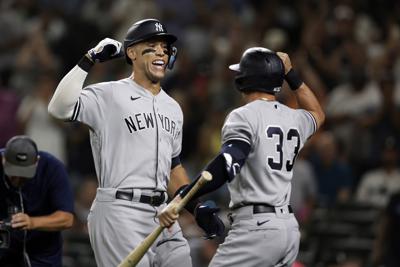
From the weekend series between the Yankees and the Mets, certain things should have been learned:
* The Yankees are the best team in baseball.
* The Yankees are, at the very least, far and away the best baseball team in the New York Tri-State Area.
* The Mets are a joke. Not 3 years removed from a World Series appearance, and not 2 years removed from a Playoff game, they are a shadow of their late-Obama era selves.
* It is not hard to hit in Citi Field. The Yankees have hit well there many times. It's only the Mets who seem to have trouble hitting there. Which is odd, since they have 81 games to try it every season.
* If Brian Cashman was not going to trade any of his precious prospects for Justin Verlander in 2017, then he sure as hell is not going to trade any of them for Jacob deGrom in 2018. Especially given that Verlander has already excelled in pitching in the American League. We've seen many "great pitchers" in the National League discover that pitching is harder in the AL, including some Yankees, and also including former Met R.A. Dickey.
*
The Friday night game was typical of deGrom's season thus far. He didn't allow a hit until the 4th inning. Through 5 innings, he had allowed only a single and a walk. And he led 1-0, because, as he so often does, Masahiro Tanaka allowed a home run in the 1st inning, to Brandon Nimmo. The Mets had scored only 1 run for him thus far, but it looked like it would be enough.
Then came the top of the 6th. deGrom got Miguel Andujar to ground out. Then Tanaka's spot in the order came up. Yankee manager Aaron Boone spent the majority of his playing career in the National League, and knew Tanaka had reached base exactly twice -- a single in 2014 and a walk in 2015 -- in 25 major league plate appearances. But he took a chance anyway.
It paid off, as Tanaka hit a ground ball to 2nd base. Asdrubal Cabrera handled it properly, and threw it to 1st base, where Adrian Gonzalez did not handle it properly. From 2006 to 2016, for the San Diego Padres, the Boston Red Sox, and the Los Angeles Dodgers, "A-Gon" was one of the best power hitters in baseball. But he's been beset by injuries, he's stopped hitting, he was never a good fielder, and he just turned 36.
Adrian Gonzalez may wear Number 23 and play 1st base in New York, but he's no Don Mattingly. And, because he'd blown this play, Tanaka was on 1st.
Gleyber Torres, Cashman's prize prospect, singled. Brett Gardner drew a walk to load the bases. And here come Da Judge. Aaron Judge has reached the point where he knows that you don't have to hit the ball 400 feet every time up. Sometimes, a sacrifice fly will do. This time, a sac fly did, and the game was tied.
But Tanaka got hurt running home. He's been placed on the Disabled List. It's not as bad as Chien-Ming Wang, 10 years to the month before, but, once again, the National League looks like assholes for not adopting the designated hitter. (In Interleague Play, the home team's League makes the rules.)
Jonathan Holder got the Mets out 1-2-3 in the 6th. Boone should have left him in, but, apparently, he brought Joe Girardi's binder with him, and brought Chad Green in for the 7th. Green a pair of 2-out singles, but worked out of the jam.
With 2 out in the 8th, Torres singled, and Gardner hit a home run. Dellin Betances got the Mets out 1-2-3 in the 8th. Giancarlo Stanton added a home run in the 9th. Understandable, since no opposing player has hit more home runs at Citi Field than he has. He also hit the stadium's longest home run so far, a 468-footer with the Miami Marlins on May 30, 2015.
As he so often does, Aroldis Chapman made the 9th inning more interesting than it needed to be, but got the job done: He hit Nimmo with a pitch, allowed a single to Cabrera to bring the tying run up with nobody out, then got Michael Conforto to fly out to deep center, got former Yankee Todd Frazier to ground into a force play, and got Jay Bruce to fly to right.
Yankees 4, Mets 1. WP: Green (4-0), because the game was still tied when Tanaka left. SV: Chapman (16). LP: deGrom (4-1).
*
On Saturday night, once again, the Mets scored in the 1st inning. And, once again, they blew the lead. This time, it was 3-0, off Domingo German, including home runs by Frazier and Cabrera.
German settled down after that, and Torres hit a home run in the 3rd inning. Andujar hit one in the 6th, tying the game, and that would be it for Steven Matz.
New Met manager Mickey Callaway brought in Anthony Swarzak. Swarzak is, in baseball parlance, a bum. The Yankees figured this out in 2016, releasing him at age 31. The Mets picked him up at 32. And the 1st batter he faced was Judge, who crushed his delivery to left field.
Yankees 4, Mets 3. WP: David Robertson (5-2). SV: Chapman (17). LP: Swarzak (0-1).
*
The Sunday night game was what Met fans were hoping to get for deGrom's start. The Yankees got only 3 hits all game long, a single by Greg Bird and 2 singles by Andujar. Funny how Luis Severino has only lost 2 games all year, but they're to the 2 teams that Yankee Fans hate the most: The Boston Red Scum and the Mutts. He gave up a home run to Frazier, and that was that.
Mets 2, Yankees 0. WP: Seth Lugo (2-1). SV: Swarzak?!? Yes, Swarzak (1). LP: Severino (9-2).
So the Mets salvaged a game at home, when they had a chance at a sweep.
But, as we've established, the Yankees are the best team in New York (at least), while the Mets are a joke.
And are the Yankees, or their fans, supposed to show sympathy for the Mutts and their hard-luck hurler deGrom? We just lost a pitcher at least as good as he is, Tanaka, because their stupid League won't get with the modern world and allow the DH. To Hell with sympathy for the Mets!
Showing posts with label adrian gonzalez. Show all posts
Monday, June 11, 2018
Tuesday, March 18, 2014
San Diego's All-Time Baseball Team
In 1978, the San Diego Padres had 4 future Hall-of-Famers on their roster:
* Gaylord Perry. He was already a member of the 3,000 Strikeouts Club, and would become a member of the 300 Wins Club. That season, he became the oldest Cy Young Award winner (39, a record since broken), and the first man to win it in both Leagues.
* Rollie Fingers, the first man with 300 saves.
* Dave Winfield, eventually a member of the 3,000 Hit Club and a hitter of 465 home runs. And...
* Ozzie Smith, who stole 580 bases, and became the most renowned (though not the best) defensive shortstop ever.
But they won only 84 games, and finished 4th in the NL West, because the Division then had the Los Angeles Dodgers in the middle of a superb era, the Cincinnati Reds near the end of their Big Red Machine era, and the San Francisco Giants having their best season between 1971 and 1987.
To make matters worse, they were playing in a cavernous football stadium in the middle of nowhere (San Diego/Jack Murphy/Qualcomm Stadium, and this was well before a light rail line was built out to Mission Valley), and their uniforms were hideous.
Steve Garvey, then a Dodger and later a Padre (but not, as the joke eventually went, my Padre), said, "In Los Angeles, I looked at myself in the mirror, and I looked like an American flag. Here, I look like a taco." (A little latent anti-Hispanic bigotry there, Steverino?)
The Padres had the aforementioned Hall-of-Famers, and later had 3,000 Hit Club member Tony Gwynn. They've got a loyal fan base and a terrific new ballpark in downtown San Diego, one of the most beautiful cities in America. They've have won Pennants in 1984 and 1998, and NL West titles in 1984, '96, '98, 2005 and '06. They've had 8 postseason appearances in 45 seasons, better than once every 6 seasons -- a proportion bettered only by the Yankees, Dodgers (in L.A. only), Braves (in Atlanta only), Athletics (in Oakland only), Arizona Diamondbacks, Twins (in Minnesota only), Tampa Bay Rays and Nationals (in Washington only).
But they've never won a World Series. In fact, their record in postseason games is 12-22 -- just 1-8 in World Series play.
This is a franchise with some things to be proud of. And the city's/region's all-time native team is pretty good, too, with a few good 3rd basemen, some good outfielders including perhaps the best player who ever played left field. The pitching, however, is a bit inconsistent: Capable of great performances, including in the postseason, but not totally reliable.
Note: While he played only for the Padres in the majors, and played both baseball and basketball at San Diego State University, Tony Gwynn was born in Los Angeles, and grew up in adjacent Long Beach, and is thus geographically ineligible for this team.
His son, Tony Gwynn Jr., grew up in the San Diego suburb of Poway while his father played for the Padres, so he's geographically eligible. But, given that his career OPS+ is 74 (as opposed to his father's mighty 132), and that he didn't play last season and is now trying to hang on with the Philadelphia Phillies, I think we can rule out Tony Jr. for this squad.
24. San Diego's All-Time Baseball Team
To be geographically eligible, a player has to have grown up in San Diego County or Imperial County, California. And, since San Diego is the closest MLB city to Hawaii and the PCL's Hawaii Islanders were a Padres farm team from 1971 to 1982, I'm including Hawaii in their region as well. This is an area with a combined population of about 4.7 million people.
1B Adrian Gonzalez of Chula Vista. Since signing that huge contract with the Red Sox, his reputation has taken a big hit. He's with the Dodgers now, and has added last year's National League Western Division title to the one he won with his hometown Padres in 2006. His lifetime batting average is .294, OPS+ 135, 235 home runs, 6 100-RBI seasons (and had 99 in another), 4 All-Star berths and 2 Gold Gloves. He turns 32 in May, so he's got a chance to build up his career stats to Hall of Fame level.
Honorable Mention to Eric Karros, born in Hackensack, New Jersey, but grew up in San Diego and went to Patrick Henry High School. He was NL Rookie of the Year in 1992, had 5 100-RBI seasons, and hit 284 homers, 270 of them with the Dodgers, making him the all-time leader for the Los Angeles portion of the team. (Duke Snider remains the overall franchise leader, hitting 371 for Brooklyn, 18 for Los Angeles, 14 in 1963 for the Mets and 4 in 1964 for, of all teams, the Giants, totaling 407.)
In spite of this, Karros was never named to the NL All-Star Team. He's now a studio analyst for Fox Sports' baseball broadcasts.
2B Bret Boone of Placentia. (That's "Placentia," not "Placenta.") His big-league debut, on August 19, 1992 with the Seattle Mariners, made his family the 1st 3-generation family in Major League Baseball. Batting-wise, he's the best in the family so far: 2 .300 seasons, 9 seasons with at least 25 doubles, 252 home runs, 3 100-RBI seasons (leading the American League with 141 in 2001), and 3 All-Star appearances.
While not quite the fielder his father Bob was behind the plate, he did win 4 Gold Gloves. He helped the Reds win the 1995 NL Central title and the Braves the 1999 NL Pennant, then went back to Seattle and was the biggest bat in their 116-win AL West Championship season in 2001. He is eligible for the Hall of Fame, but I don't think he'll ever make it. But the Mariners have a team Hall of Fame, and he should go into that.
SS Alan Trammell of Kearny H.S. in San Diego. It takes a lot to play 20 years in Detroit. Ask Al Kaline, Gordie Howe, Alex Delvecchio, Steve Yzerman and Nicklas Lidstrom. Like them, Tram did it in style. He was a big force in the Tigers' revival from the age-related collapse of the Kaline-era team, and helped the win the 1984 World Series (he was the Series MVP) and the 1987 AL East title, while keeping them in the Pennant race nearly every year from 1983 to 1993, averaging 92 wins a season from 1983 to 1988.
He appeared in 6 All-Star Games, won 4 Gold Gloves, had an OPS+ of 110, 2,365 hits, 412 doubles, 185 homers (pretty good for a shortstop of the 1980s), a .333 batting average in postseason play, and was one of the last really good shortstops before Cal Ripken changed the perception of the position from a skinny, often short guy who was there mainly for his glove to a big one with power.
The Tigers have not officially retired his Number 3, which was previously worn by Hall-of-Famer Mickey Cochrane and another All-Star shortstop, Dick McAuliffe, but neither have they given it back out, except for when Trammell was a coach and then manager (with considerably less success) and briefly for Gary Sheffield.
On Baseball-Reference.com's Hall of Fame Monitor, where 100 = a "Likely HOFer," he's at 118, and that's just for his hitting. But on their Hall of Fame Standardsm, where the "Average HOFer" is at 50, he's at 40. He's been eligible for the Hall since 2002, and his longtime double-play partner Lou Whitaker a year longer than that. By all rights, both should be in. Maybe if Tiger broadcaster Ernie Harwell, also a songwriter and poet, had given the pair a memorable poem, like the one that got "Tinker to Evers to Chance" all in at the same time, they'd have gotten in.
3B Graig Nettles of San Diego H.S. Played for Billy Martin in both Minnesota and New York -- and not only survived, but thrived. With a .248 lifetime batting average, he'll probably never get into the Hall of Fame, but his career OPS+ was 110. He hit 390 home runs, and while he did play home games at the old Yankee Stadium for 9 full seasons and Metropolitan Stadium and Atlanta-Fulton County Stadium for 1 each, he also played 3 at Cleveland Municipal Stadium, 2 at Shea Stadium (while Yankee Stadium was being renovated) and 3 at Jack Murphy Stadium for his hometown Padres.
He appeared in the postseason 7 times, 5 with the Yankees (1976, '77, '78, '80 and '81) and 1 each with the Twins (1969) and Padres (1984). He made 6 All-Star Games. He hit 32 home runs to lead the AL in 1976, and hit 37 in 1977 (although Jim Rice hit 39 to lead the League). His 2,226 career hits included 390 homers.
He received only 2 Gold Gloves, but had to compete against Brooks Robinson for them for the 1st half of his career and George Brett (with whom he famously had a fight in Game 5 of the '77 ALCS) for much of the 2nd half. His spectacular plays in Game 3 turned the '78 World Series around, and got the Yankees their 2nd straight title. He helped his hometown team win their 1st Pennant in 1984.
As I said, he's not in the Hall of Fame. The Yankees retired his Number 9 after he left -- but for Roger Maris. He doesn't yet have a Plaque in Yankee Stadium's Monument Park, although he did get a YES Network Yankeeography. Still, he was the greatest Yankee 3rd baseman until Alex Rodriguez arrived. And he's a member of the San Diego Hall of Champions.
Honorable Mention to Bob Elliott of El Centro. Not to be confused with the comedian of the same name who starred with Ray Goulding (himself a Boston baseball fan, but for the Red Sox rather than Elliott's Braves) in a long-running radio comedy team, and became the father of comedian Chris Elliott.
This Bob Elliott -- who I originally had with the San Francisco team, as he was born there, but he grew up in El Centro, in Imperial County -- was a 6-time All-Star with the Pittsburgh Pirates and the Braves. OPS+ of 124, 2,061 hits, 6 100-RBI seasons. 1947 NL MVP, and helped the Braves win their last Boston Pennant in 1948.
Honorable Mention to Troy Glaus of Carlsbad. He was only 34 when he retired, but hit 320 home runs and had a 119 OPS+, despite playing most of his home games in Anaheim, helped the Angels win the 2002 World Series, and also reached the postseason with the 2004 Angels, the 2009 St. Louis Cardinals and the 2010 Braves. In 2000, he led the American League with 47 homers. He had 4 100-RBI seasons and just missed 2 others.
Honorable Mention to Ray Boone of Herbert Hoover H.S. in San Diego. A rookie with the 1948 Cleveland Indians, he got into just 7 games that season, but one was in the World Series, so he got a ring. With the Indians and Tigers, he had 4 20-homer seasons, 2 100-RBI seasons (leading the AL with 116 in 1955), and made 2 All-Star teams. And he became the patriarch of MLB's 1st 3-generation family, living to see son Bob become one of the great catchers and grandsons Brett and Aaron both become ballplayers who, shall we say, had their moments. Speaking of which...
Honorable Mention to Aaron Boone of Villa Park. (Why he went to Villa Park H.S. and brother Bret went to Placentia H.S., I don't know.) Statistically speaking, he's the least accomplished of the 4 members of his family to make it to the bigs so far. But he did help the Reds reach a postseason berth (sort of, the 1999 Wild Card play-in game that they lost to the Mets), and he had 2 20-homer seasons.
On July 31, 2003, the Reds traded him to the Yankees. He did next to nothing for the Yankees in August and September, and most of October. Then he hurt his knee in the off-season, and he was gone. He missed the entire 2004 season, but came back in 2005. He needed open-heart surgery in 2009, and still came back sooner from that than Jose Reyes did from a hamstring pull.
He has now retired, but there are those 2 big homers he hit as a Yankee in one week, the second in the World Series, although he was 2-for-20 in that Series otherwise. But the moment of 12:16 AM on October 17, 2003 is one that will live forever. Thank you, Aaron.
Honorable Mention to Hank Blalock of Rancho Bernardo H.S. in San Diego. He also hit a big home run in 2003, winning the All-Star Game for the AL. Too bad it ended up not helping the Yankees in the Series, the home-field advantage being ignored by the Marlins. A solid slugger for the Texas Rangers, a weird series of injuries ended his career before he turned 30. He hit 153 home runs, but should have had a chance at many more.
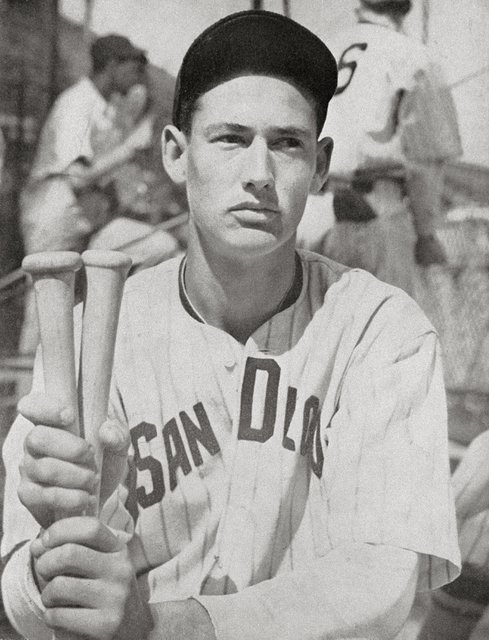
LF Ted Williams of Herbert Hoover H.S. in San Diego. Yes, that photo above is Ted Williams wearing a San Diego Padres uniform, although it's the Padres of the Pacific Coast League, the team the National League club replaced in 1969. It was taken in 1937, and he was either 17 or 18 (depending on whether the photo was taken before or after August 30).
No, he wasn't "the greatest hitter who ever lived." Babe Ruth was, and Ted was the first to admit it, in his 1995 book Ted Williams' Hit List. But he got his wish: People pointed at him and said he was the greatest. They have a pretty good case.
He had a .344 lifetime batting average, highest of any player whose career began after 1917. He had an OPS+ of 190, higher than anyone in history except Ruth. He appeared in 17 All-Star Games, including a walkoff homer in 1941 and a memorable one off Rip Sewell's blooping "eephus pitch" in 1946 at his home ground of Fenway Park.
He collected 2,654 hits, including 525 doubles and 521 home runs, despite missing 3 seasons (at age 24, 25 and 26) due to World War II and most of 2 others (at age 33 and 34) in the Korean War (where he was a Marine pilot, in a squadron with future astronaut John Glenn, and got shot down and nearly killed).
He won 6 batting titles, including with a .406 average at age 23 in 1941, still the last .400 average in the majors; and a .388 at age 39 in 1957 that is the 2nd-highest for a full season since 1941. He won 2 Triple Crowns, in 1942 and 1947, and 2 Most Valuable Player awards, in 1946 and 1949. (When Ted deserved the MVP and when not is a debate for another time.) And he had 2 of the best nicknames ever: The Splendid Splinter and Teddy Ballgame.
The Red Sox retired his Number 9, and erected 2 statues of him outside Fenway Park: One showing him giving his cap to a boy, the other with his 1940s teammates and fellow war veterans Dom DiMaggio, Bobby Doerr and Johnny Pesky. He was elected to the Hall of Fame and the All-Century Team. When The Sporting News announced its 100 Greatest Baseball Players in 1999, he came in at Number 8.
He wrote the book on hitting -- literally: The Science of Hitting, published in 1969, remains the best book ever written on the subject. Check out this excerpt. And Ted Williams' Hit List (1995) is as good a book on the history of great hitters as we're ever likely to have, at least until someone provides a thoughtful way of looking at the steroid era.
He inspired writers as varied as novelist John Updike (Hub Fans Bid Kid Adieu) and scientist Stephen Jay Gould (The Extinction of the .400 Hitter). And if that wasn't enough of a legacy, his work for the Jimmy Fund of the Dana Farber Cancer Institute turned it from a local charity in Boston into a nationally-known powerhouse for helping sick children.
Honorable Mention to Brian Giles. Not the mediocre infielder for the 1980s Mets and Indians. This one, whose brother Marcus was also an All-Star, had a 136 OPS+ and 287 home runs, and reached the postseason 3 times with the Indians and twice with his hometown Padres.
Honorable Mention to Carlos Quentin of University H.S. in San Diego. Now playing for his hometown Padres, he's a 2-time All-Star, and has 150 home runs in what amounts to 6 full seasons. He's 31, so he could build that up.
Somewhat Honorable Mention to Kevin Mitchell of Clairemont H.S. in San Diego. He helped the Mets win the World Series as a 24-year-old rookie left fielder/3rd baseman. Just 45 days after that Series ended, on December 11, 1986, they traded him to the Padres for left fielder Kevin McReynolds.
I joke a lot about "the Curse of Kevin Mitchell," but the Mets have not only had close calls and failures, but they've come in some bizarre ways. Anyway, Mitchell and his hometown team didn't benefit from being reunited, so they traded him to the Giants, where he helped them win the NL West in 1987 and then, in an MVP season, the Pennant in 1989.
But he would never approach his '89 performance again, and as his weight rose, his performance dropped. At age 30 he had his last season of 400 plate appearances. His career OPS+ was 142, but he finished with just 234 home runs. At least Dwight Gooden has since admitted that he made up that cat story...
CF Adam Jones of Samuel Morse H.S. in San Diego. Not to be confused with the criminal football player also known as "Pacman," this is the 2-time Gold Glove winner for the Baltimore Orioles. He's just 28, but he already has 174 and 140 homers. He also plays really well against the Yankees, which pisses me off.
Honorable Mention to Shane Victorino of Wailuku, Hawaii. Sorry, Sid Fernandez and Benny Agbayani (who both wore Number 50 with the Mets, in honor of the 50th State), but he is now the greatest baseball player ever to come from the Aloha State.
Known as the Flyin' Hawaiian, he is a 2-time All-Star, a 4-time Gold Glove, twice led the NL in triples, and has now won World Series with the Phillies (2008) and the Red Sox (2013). To give you an idea of how big that is: In 9 combined seasons with him, the Phils and BoSox have won 2 World Series; in 225 combined seasons without him, they've won just 8.
I also could have chosen Brady Anderson of Carlsbad. Sure, he was a 3-time All-Star. Sure, he was a 3-time All-Star. Sure, he had a 109 career OPS+. Sure, he had a 109 career OPS+. Sure, he had 1,661 hits, including 338 doubles and 210 homers. And, sure, he helped the Orioles nearly reach the Playoffs in 1989 and got them there in 1996 and 1997. But...
Look, here's his home run totals from 1992 to 2000: 21, 13, 12, 16, 50, 18, 18, 24, 19. Can you pick out the season in which Brady Anderson used steroids? Cheater!
RF Clifford Carlton "Gavvy" Cravath of Escondido. The first native of the San Diego area to reach the majors, with the 1908 Red Sox, while playing back home he hit a ball that killed a seagull -- in Spanish, un gaviota. "Gaviota" became "Gavvy." He starred for the Los Angeles Angels of the PCL and, like Ted Williams (and also Willie Mays), the Minneapolis Millers of the American Association, before finally becoming a big-league regular at age 31 with the 1912 Phillies.
He won 6 home run titles, hitting 119 in just 7 full seasons at the tail end of the Dead Ball Era. He had 3 100-RBI seasons. He helped the Phillies win their 1st Pennant in 1915. His career batting average was .287, and his OPS+ was 151! He last played in the majors 94 years ago, last played in the high minors 92 years ago, and died 51 years ago, but he's on the Philadelphia Baseball Wall of Fame at Citizens Bank Park, and really should be considered for Cooperstown.
C Bob Boone of Crawford H.S. in San Diego. Since I have his father Ray, and his sons Bret and Aaron, on this team, I might as well have him, too. A 5-time All-Star and 7-time Gold Glove winner, he reached the postseason 7 times, 5 with the Phillies (including catching Tug McGraw's strikeout of Willie Wilson to finish their 1st-ever World Championship in 1980) and 2 with the then-California Angels.
His 2,225 games behind the plate are a record for an NL catcher, and his major-league record has been surpassed only by Carlton Fisk and Ivan Rodriguez (cough-steroids-cough). He is a member of the Philadelphia Baseball Wall of Fame.
Bob is also the manager of this team, almost by default, for getting the Kansas City Royals to their last 2nd-place finish in 1995. The only other managers from the San Diego area are Williams (who did get the Washington Senators to a winning record in 1969), Cravath, Bob Skinner, his son Joel Skinner (neither made this team as a player), and former Yankee catcher and A's manager Bob Geren.
SP Ewell Blackwell of Bonita. Known as the Whip because of his pitching motion, he went 22-8 for the Cincinnati Reds in 1947. That included 16 straight wins. The 8th was a no-hitter, and in the 9th he almost tied teammate Johnny Vander Meer's record of back-to-back no-hitters, but with 2 outs to go, a ground ball through his legs, which he couldn't get to because of his height and thin frame, was scored a hit.
Due to injury, he only had 2 other big seasons, 17-15 in 1950 and 16-15 in 1951. He was then traded to the Yankees and helped them win the 1952 and 1953 World Series. And the Reds elected him to their team Hall of Fame.
SP Don Larsen of Point Loma H.S. in San Diego. Does a 3-21 pitcher ever have any hope? Larsen did, after the 1954 season, when the Orioles traded him to the Yankees along with Bob Turley in the biggest MLB trade ever, 18 men switching teams. In 1956, Larsen went 11-5 and helped the Yankees win the World Series. Especially in Game 5, when he put up the greatest pitching performance ever: A perfect game, against the powerful Brooklyn Dodgers. It's still the only no-hitter in World Series history, and 1 of only 2 ever pitched in postseason play.
He also helped the Yanks win the Pennant in '55 and '57 and the Series in '58. After the '59 season, he was sent to the Kansas City Athletics as part of the deal for Roger Maris. He came back to briefly haunt the Yankees by winning a game against them for the Giants in the 1962 Series. His career record was just 81-91, but take away '54 and an awful 1-10 season for the A's in 1960, and he was a strong 77-60.
SP David Wells of Point Loma H.S. in San Diego. What are the odds of 2 pitchers from the same high school both pitching perfect games for the same major league team in the same ballpark? It happened at Yankee Stadium on October 8, 1956 to Larsen, and again on May 17, 1998 to David Wells.
Larsen was a thin righthander, Wells the prototypical "portly portsider." But both were a bit eccentric and both liked their booze. Larsen was basically a pitcher who was only as good as his support. Wells, on the other hand, was a big reason why 6 different teams reached a total of 11 postseasons with him: The 1989, '91 and '92 Toronto Blue Jays (1992 World Champions); the 1995 Cincinnati Reds; the 1996 Baltimore Orioles; the 1997, '98, 2002 and '03 New York Yankees (1998 World Champions, including Game 1 where he beat his hometown Padres); the 2005 Boston Red Sox; and the 2006 Padres. Overall, he was 10-5 with a 3.17 ERA in postseason play.
A 3-time All-Star, he had a career record of 239-157, a 108 ERA+, and a WHIP of 1.266. He'll probably never get into the Hall of Fame, but he was a winner.
SP Cole Hamels of Rancho Bernardo H.S. in San Diego. At age 30, he's already slowed down a little, but he's still pretty accomplished. He's 99-74, with an amazing WHIP of 1.141 and a nifty ERA+ of 123. He's helped the Phillies win 5 Division titles, 2 Pennants, and the 2008 World Series, in which he was MVP. If he can stay healthy, he'll win a lot more games. Which brings me to...
SP Mark Prior of University H.S. in San Diego. In 2003, just 23 years old, he went 18-6 with a 2.43 ERA, 245 strikeouts and a 1.103 WHIP, and helped his team reach the NLCS. His future seemed limitless. Unfortunately, his team was the Chicago Cubs. Having won Game 2 against the Marlins, Prior was pitching in Game 6 when the Steve Bartman incident happened, and the Cubs went from 3-0 up to 8-3 down. Fellow Cub phenom Kerry Wood looked like he might win Game 7, but...
It was all downhill from there for both of them. Both were stricken with injuries, and Prior last threw a pitch in the majors in 2006, shortly before his 26th birthday. Career record, 42-29, ERA+ of 124. He tried a comeback with several teams, including the Yankees (as did Wood, who did pitch a few times in Pinstripes) and his hometown Padres, but didn't get back to the majors, ending his career with just 106 MLB appearances. He finally announced his retirement late last year, and is now working in the Padres' front office.
Honorable Mention -- already -- to Stephen Strasburg of Santee. He missed most of the 2011 season due to injury after a spectacular start to 2010, so, in order not to have a repeat of pitchers like Prior and Wood, the Washington Nationals limited him to 159 innings in 2012.
He made the All-Star team with a 15-6 record, and they reached the postseason for the 1st time since 1981, when they were the Montreal Expos. But they didn't let him pitch in the postseason. I wonder what they would have given to have him pitch just 1 inning -- specifically, the top of the 9th in Game 5 of the NL Division Series against the Cardinals. It might have meant Washington's 1st Pennant since 1933.
He's only 29-19, but his ERA+ is 132, and his WHIP is 1.073. He's only 25. I hope the Nats aren't so skittish about him that they screw him up, like the Yankees did with Joba Chamberlain. It is possible to be too cautious.
RP Heath Bell of Tustin. He didn't reach the majors until he was 26, and didn't become a full-time closer until he was 31. But, pitching for the Padres, led the NL in saves in 2009 with 42, and while it wasn't enough to lead the League the next season, he saved 47.
Now with the Tampa Bay Rays, he's got 168 career saves. It's worth remembering the Mets traded him, after the 2006 season, to the Padres, along with Royce Ring, for Jon Adkins and Ben Johnson. In 2007, and again in 2008, the Mets missed the Playoffs by 1 game despite leading the NL East going into September. Gee, you think they could have used Heath Bell, if not as the closer, then at the very least as a setup man for Billy Wagner? Another bonehead Met trade.
* Gaylord Perry. He was already a member of the 3,000 Strikeouts Club, and would become a member of the 300 Wins Club. That season, he became the oldest Cy Young Award winner (39, a record since broken), and the first man to win it in both Leagues.
* Rollie Fingers, the first man with 300 saves.
* Dave Winfield, eventually a member of the 3,000 Hit Club and a hitter of 465 home runs. And...
* Ozzie Smith, who stole 580 bases, and became the most renowned (though not the best) defensive shortstop ever.
But they won only 84 games, and finished 4th in the NL West, because the Division then had the Los Angeles Dodgers in the middle of a superb era, the Cincinnati Reds near the end of their Big Red Machine era, and the San Francisco Giants having their best season between 1971 and 1987.
To make matters worse, they were playing in a cavernous football stadium in the middle of nowhere (San Diego/Jack Murphy/Qualcomm Stadium, and this was well before a light rail line was built out to Mission Valley), and their uniforms were hideous.
Steve Garvey, then a Dodger and later a Padre (but not, as the joke eventually went, my Padre), said, "In Los Angeles, I looked at myself in the mirror, and I looked like an American flag. Here, I look like a taco." (A little latent anti-Hispanic bigotry there, Steverino?)
The Padres had the aforementioned Hall-of-Famers, and later had 3,000 Hit Club member Tony Gwynn. They've got a loyal fan base and a terrific new ballpark in downtown San Diego, one of the most beautiful cities in America. They've have won Pennants in 1984 and 1998, and NL West titles in 1984, '96, '98, 2005 and '06. They've had 8 postseason appearances in 45 seasons, better than once every 6 seasons -- a proportion bettered only by the Yankees, Dodgers (in L.A. only), Braves (in Atlanta only), Athletics (in Oakland only), Arizona Diamondbacks, Twins (in Minnesota only), Tampa Bay Rays and Nationals (in Washington only).
But they've never won a World Series. In fact, their record in postseason games is 12-22 -- just 1-8 in World Series play.
This is a franchise with some things to be proud of. And the city's/region's all-time native team is pretty good, too, with a few good 3rd basemen, some good outfielders including perhaps the best player who ever played left field. The pitching, however, is a bit inconsistent: Capable of great performances, including in the postseason, but not totally reliable.
Note: While he played only for the Padres in the majors, and played both baseball and basketball at San Diego State University, Tony Gwynn was born in Los Angeles, and grew up in adjacent Long Beach, and is thus geographically ineligible for this team.
His son, Tony Gwynn Jr., grew up in the San Diego suburb of Poway while his father played for the Padres, so he's geographically eligible. But, given that his career OPS+ is 74 (as opposed to his father's mighty 132), and that he didn't play last season and is now trying to hang on with the Philadelphia Phillies, I think we can rule out Tony Jr. for this squad.
24. San Diego's All-Time Baseball Team
To be geographically eligible, a player has to have grown up in San Diego County or Imperial County, California. And, since San Diego is the closest MLB city to Hawaii and the PCL's Hawaii Islanders were a Padres farm team from 1971 to 1982, I'm including Hawaii in their region as well. This is an area with a combined population of about 4.7 million people.
1B Adrian Gonzalez of Chula Vista. Since signing that huge contract with the Red Sox, his reputation has taken a big hit. He's with the Dodgers now, and has added last year's National League Western Division title to the one he won with his hometown Padres in 2006. His lifetime batting average is .294, OPS+ 135, 235 home runs, 6 100-RBI seasons (and had 99 in another), 4 All-Star berths and 2 Gold Gloves. He turns 32 in May, so he's got a chance to build up his career stats to Hall of Fame level.
Honorable Mention to Eric Karros, born in Hackensack, New Jersey, but grew up in San Diego and went to Patrick Henry High School. He was NL Rookie of the Year in 1992, had 5 100-RBI seasons, and hit 284 homers, 270 of them with the Dodgers, making him the all-time leader for the Los Angeles portion of the team. (Duke Snider remains the overall franchise leader, hitting 371 for Brooklyn, 18 for Los Angeles, 14 in 1963 for the Mets and 4 in 1964 for, of all teams, the Giants, totaling 407.)
In spite of this, Karros was never named to the NL All-Star Team. He's now a studio analyst for Fox Sports' baseball broadcasts.
2B Bret Boone of Placentia. (That's "Placentia," not "Placenta.") His big-league debut, on August 19, 1992 with the Seattle Mariners, made his family the 1st 3-generation family in Major League Baseball. Batting-wise, he's the best in the family so far: 2 .300 seasons, 9 seasons with at least 25 doubles, 252 home runs, 3 100-RBI seasons (leading the American League with 141 in 2001), and 3 All-Star appearances.
While not quite the fielder his father Bob was behind the plate, he did win 4 Gold Gloves. He helped the Reds win the 1995 NL Central title and the Braves the 1999 NL Pennant, then went back to Seattle and was the biggest bat in their 116-win AL West Championship season in 2001. He is eligible for the Hall of Fame, but I don't think he'll ever make it. But the Mariners have a team Hall of Fame, and he should go into that.
SS Alan Trammell of Kearny H.S. in San Diego. It takes a lot to play 20 years in Detroit. Ask Al Kaline, Gordie Howe, Alex Delvecchio, Steve Yzerman and Nicklas Lidstrom. Like them, Tram did it in style. He was a big force in the Tigers' revival from the age-related collapse of the Kaline-era team, and helped the win the 1984 World Series (he was the Series MVP) and the 1987 AL East title, while keeping them in the Pennant race nearly every year from 1983 to 1993, averaging 92 wins a season from 1983 to 1988.
He appeared in 6 All-Star Games, won 4 Gold Gloves, had an OPS+ of 110, 2,365 hits, 412 doubles, 185 homers (pretty good for a shortstop of the 1980s), a .333 batting average in postseason play, and was one of the last really good shortstops before Cal Ripken changed the perception of the position from a skinny, often short guy who was there mainly for his glove to a big one with power.
The Tigers have not officially retired his Number 3, which was previously worn by Hall-of-Famer Mickey Cochrane and another All-Star shortstop, Dick McAuliffe, but neither have they given it back out, except for when Trammell was a coach and then manager (with considerably less success) and briefly for Gary Sheffield.
On Baseball-Reference.com's Hall of Fame Monitor, where 100 = a "Likely HOFer," he's at 118, and that's just for his hitting. But on their Hall of Fame Standardsm, where the "Average HOFer" is at 50, he's at 40. He's been eligible for the Hall since 2002, and his longtime double-play partner Lou Whitaker a year longer than that. By all rights, both should be in. Maybe if Tiger broadcaster Ernie Harwell, also a songwriter and poet, had given the pair a memorable poem, like the one that got "Tinker to Evers to Chance" all in at the same time, they'd have gotten in.
3B Graig Nettles of San Diego H.S. Played for Billy Martin in both Minnesota and New York -- and not only survived, but thrived. With a .248 lifetime batting average, he'll probably never get into the Hall of Fame, but his career OPS+ was 110. He hit 390 home runs, and while he did play home games at the old Yankee Stadium for 9 full seasons and Metropolitan Stadium and Atlanta-Fulton County Stadium for 1 each, he also played 3 at Cleveland Municipal Stadium, 2 at Shea Stadium (while Yankee Stadium was being renovated) and 3 at Jack Murphy Stadium for his hometown Padres.
He appeared in the postseason 7 times, 5 with the Yankees (1976, '77, '78, '80 and '81) and 1 each with the Twins (1969) and Padres (1984). He made 6 All-Star Games. He hit 32 home runs to lead the AL in 1976, and hit 37 in 1977 (although Jim Rice hit 39 to lead the League). His 2,226 career hits included 390 homers.
He received only 2 Gold Gloves, but had to compete against Brooks Robinson for them for the 1st half of his career and George Brett (with whom he famously had a fight in Game 5 of the '77 ALCS) for much of the 2nd half. His spectacular plays in Game 3 turned the '78 World Series around, and got the Yankees their 2nd straight title. He helped his hometown team win their 1st Pennant in 1984.
As I said, he's not in the Hall of Fame. The Yankees retired his Number 9 after he left -- but for Roger Maris. He doesn't yet have a Plaque in Yankee Stadium's Monument Park, although he did get a YES Network Yankeeography. Still, he was the greatest Yankee 3rd baseman until Alex Rodriguez arrived. And he's a member of the San Diego Hall of Champions.
Honorable Mention to Bob Elliott of El Centro. Not to be confused with the comedian of the same name who starred with Ray Goulding (himself a Boston baseball fan, but for the Red Sox rather than Elliott's Braves) in a long-running radio comedy team, and became the father of comedian Chris Elliott.
This Bob Elliott -- who I originally had with the San Francisco team, as he was born there, but he grew up in El Centro, in Imperial County -- was a 6-time All-Star with the Pittsburgh Pirates and the Braves. OPS+ of 124, 2,061 hits, 6 100-RBI seasons. 1947 NL MVP, and helped the Braves win their last Boston Pennant in 1948.
Honorable Mention to Troy Glaus of Carlsbad. He was only 34 when he retired, but hit 320 home runs and had a 119 OPS+, despite playing most of his home games in Anaheim, helped the Angels win the 2002 World Series, and also reached the postseason with the 2004 Angels, the 2009 St. Louis Cardinals and the 2010 Braves. In 2000, he led the American League with 47 homers. He had 4 100-RBI seasons and just missed 2 others.
Honorable Mention to Ray Boone of Herbert Hoover H.S. in San Diego. A rookie with the 1948 Cleveland Indians, he got into just 7 games that season, but one was in the World Series, so he got a ring. With the Indians and Tigers, he had 4 20-homer seasons, 2 100-RBI seasons (leading the AL with 116 in 1955), and made 2 All-Star teams. And he became the patriarch of MLB's 1st 3-generation family, living to see son Bob become one of the great catchers and grandsons Brett and Aaron both become ballplayers who, shall we say, had their moments. Speaking of which...
Honorable Mention to Aaron Boone of Villa Park. (Why he went to Villa Park H.S. and brother Bret went to Placentia H.S., I don't know.) Statistically speaking, he's the least accomplished of the 4 members of his family to make it to the bigs so far. But he did help the Reds reach a postseason berth (sort of, the 1999 Wild Card play-in game that they lost to the Mets), and he had 2 20-homer seasons.
On July 31, 2003, the Reds traded him to the Yankees. He did next to nothing for the Yankees in August and September, and most of October. Then he hurt his knee in the off-season, and he was gone. He missed the entire 2004 season, but came back in 2005. He needed open-heart surgery in 2009, and still came back sooner from that than Jose Reyes did from a hamstring pull.
He has now retired, but there are those 2 big homers he hit as a Yankee in one week, the second in the World Series, although he was 2-for-20 in that Series otherwise. But the moment of 12:16 AM on October 17, 2003 is one that will live forever. Thank you, Aaron.
Honorable Mention to Hank Blalock of Rancho Bernardo H.S. in San Diego. He also hit a big home run in 2003, winning the All-Star Game for the AL. Too bad it ended up not helping the Yankees in the Series, the home-field advantage being ignored by the Marlins. A solid slugger for the Texas Rangers, a weird series of injuries ended his career before he turned 30. He hit 153 home runs, but should have had a chance at many more.
LF Ted Williams of Herbert Hoover H.S. in San Diego. Yes, that photo above is Ted Williams wearing a San Diego Padres uniform, although it's the Padres of the Pacific Coast League, the team the National League club replaced in 1969. It was taken in 1937, and he was either 17 or 18 (depending on whether the photo was taken before or after August 30).
No, he wasn't "the greatest hitter who ever lived." Babe Ruth was, and Ted was the first to admit it, in his 1995 book Ted Williams' Hit List. But he got his wish: People pointed at him and said he was the greatest. They have a pretty good case.
He had a .344 lifetime batting average, highest of any player whose career began after 1917. He had an OPS+ of 190, higher than anyone in history except Ruth. He appeared in 17 All-Star Games, including a walkoff homer in 1941 and a memorable one off Rip Sewell's blooping "eephus pitch" in 1946 at his home ground of Fenway Park.
He collected 2,654 hits, including 525 doubles and 521 home runs, despite missing 3 seasons (at age 24, 25 and 26) due to World War II and most of 2 others (at age 33 and 34) in the Korean War (where he was a Marine pilot, in a squadron with future astronaut John Glenn, and got shot down and nearly killed).
He won 6 batting titles, including with a .406 average at age 23 in 1941, still the last .400 average in the majors; and a .388 at age 39 in 1957 that is the 2nd-highest for a full season since 1941. He won 2 Triple Crowns, in 1942 and 1947, and 2 Most Valuable Player awards, in 1946 and 1949. (When Ted deserved the MVP and when not is a debate for another time.) And he had 2 of the best nicknames ever: The Splendid Splinter and Teddy Ballgame.
The Red Sox retired his Number 9, and erected 2 statues of him outside Fenway Park: One showing him giving his cap to a boy, the other with his 1940s teammates and fellow war veterans Dom DiMaggio, Bobby Doerr and Johnny Pesky. He was elected to the Hall of Fame and the All-Century Team. When The Sporting News announced its 100 Greatest Baseball Players in 1999, he came in at Number 8.
He wrote the book on hitting -- literally: The Science of Hitting, published in 1969, remains the best book ever written on the subject. Check out this excerpt. And Ted Williams' Hit List (1995) is as good a book on the history of great hitters as we're ever likely to have, at least until someone provides a thoughtful way of looking at the steroid era.
He inspired writers as varied as novelist John Updike (Hub Fans Bid Kid Adieu) and scientist Stephen Jay Gould (The Extinction of the .400 Hitter). And if that wasn't enough of a legacy, his work for the Jimmy Fund of the Dana Farber Cancer Institute turned it from a local charity in Boston into a nationally-known powerhouse for helping sick children.
Honorable Mention to Brian Giles. Not the mediocre infielder for the 1980s Mets and Indians. This one, whose brother Marcus was also an All-Star, had a 136 OPS+ and 287 home runs, and reached the postseason 3 times with the Indians and twice with his hometown Padres.
Honorable Mention to Carlos Quentin of University H.S. in San Diego. Now playing for his hometown Padres, he's a 2-time All-Star, and has 150 home runs in what amounts to 6 full seasons. He's 31, so he could build that up.
Somewhat Honorable Mention to Kevin Mitchell of Clairemont H.S. in San Diego. He helped the Mets win the World Series as a 24-year-old rookie left fielder/3rd baseman. Just 45 days after that Series ended, on December 11, 1986, they traded him to the Padres for left fielder Kevin McReynolds.
I joke a lot about "the Curse of Kevin Mitchell," but the Mets have not only had close calls and failures, but they've come in some bizarre ways. Anyway, Mitchell and his hometown team didn't benefit from being reunited, so they traded him to the Giants, where he helped them win the NL West in 1987 and then, in an MVP season, the Pennant in 1989.
But he would never approach his '89 performance again, and as his weight rose, his performance dropped. At age 30 he had his last season of 400 plate appearances. His career OPS+ was 142, but he finished with just 234 home runs. At least Dwight Gooden has since admitted that he made up that cat story...
CF Adam Jones of Samuel Morse H.S. in San Diego. Not to be confused with the criminal football player also known as "Pacman," this is the 2-time Gold Glove winner for the Baltimore Orioles. He's just 28, but he already has 174 and 140 homers. He also plays really well against the Yankees, which pisses me off.
Honorable Mention to Shane Victorino of Wailuku, Hawaii. Sorry, Sid Fernandez and Benny Agbayani (who both wore Number 50 with the Mets, in honor of the 50th State), but he is now the greatest baseball player ever to come from the Aloha State.
Known as the Flyin' Hawaiian, he is a 2-time All-Star, a 4-time Gold Glove, twice led the NL in triples, and has now won World Series with the Phillies (2008) and the Red Sox (2013). To give you an idea of how big that is: In 9 combined seasons with him, the Phils and BoSox have won 2 World Series; in 225 combined seasons without him, they've won just 8.
I also could have chosen Brady Anderson of Carlsbad. Sure, he was a 3-time All-Star. Sure, he was a 3-time All-Star. Sure, he had a 109 career OPS+. Sure, he had a 109 career OPS+. Sure, he had 1,661 hits, including 338 doubles and 210 homers. And, sure, he helped the Orioles nearly reach the Playoffs in 1989 and got them there in 1996 and 1997. But...
Look, here's his home run totals from 1992 to 2000: 21, 13, 12, 16, 50, 18, 18, 24, 19. Can you pick out the season in which Brady Anderson used steroids? Cheater!
RF Clifford Carlton "Gavvy" Cravath of Escondido. The first native of the San Diego area to reach the majors, with the 1908 Red Sox, while playing back home he hit a ball that killed a seagull -- in Spanish, un gaviota. "Gaviota" became "Gavvy." He starred for the Los Angeles Angels of the PCL and, like Ted Williams (and also Willie Mays), the Minneapolis Millers of the American Association, before finally becoming a big-league regular at age 31 with the 1912 Phillies.
He won 6 home run titles, hitting 119 in just 7 full seasons at the tail end of the Dead Ball Era. He had 3 100-RBI seasons. He helped the Phillies win their 1st Pennant in 1915. His career batting average was .287, and his OPS+ was 151! He last played in the majors 94 years ago, last played in the high minors 92 years ago, and died 51 years ago, but he's on the Philadelphia Baseball Wall of Fame at Citizens Bank Park, and really should be considered for Cooperstown.
C Bob Boone of Crawford H.S. in San Diego. Since I have his father Ray, and his sons Bret and Aaron, on this team, I might as well have him, too. A 5-time All-Star and 7-time Gold Glove winner, he reached the postseason 7 times, 5 with the Phillies (including catching Tug McGraw's strikeout of Willie Wilson to finish their 1st-ever World Championship in 1980) and 2 with the then-California Angels.
His 2,225 games behind the plate are a record for an NL catcher, and his major-league record has been surpassed only by Carlton Fisk and Ivan Rodriguez (cough-steroids-cough). He is a member of the Philadelphia Baseball Wall of Fame.
Bob is also the manager of this team, almost by default, for getting the Kansas City Royals to their last 2nd-place finish in 1995. The only other managers from the San Diego area are Williams (who did get the Washington Senators to a winning record in 1969), Cravath, Bob Skinner, his son Joel Skinner (neither made this team as a player), and former Yankee catcher and A's manager Bob Geren.
SP Ewell Blackwell of Bonita. Known as the Whip because of his pitching motion, he went 22-8 for the Cincinnati Reds in 1947. That included 16 straight wins. The 8th was a no-hitter, and in the 9th he almost tied teammate Johnny Vander Meer's record of back-to-back no-hitters, but with 2 outs to go, a ground ball through his legs, which he couldn't get to because of his height and thin frame, was scored a hit.
Due to injury, he only had 2 other big seasons, 17-15 in 1950 and 16-15 in 1951. He was then traded to the Yankees and helped them win the 1952 and 1953 World Series. And the Reds elected him to their team Hall of Fame.
SP Don Larsen of Point Loma H.S. in San Diego. Does a 3-21 pitcher ever have any hope? Larsen did, after the 1954 season, when the Orioles traded him to the Yankees along with Bob Turley in the biggest MLB trade ever, 18 men switching teams. In 1956, Larsen went 11-5 and helped the Yankees win the World Series. Especially in Game 5, when he put up the greatest pitching performance ever: A perfect game, against the powerful Brooklyn Dodgers. It's still the only no-hitter in World Series history, and 1 of only 2 ever pitched in postseason play.
He also helped the Yanks win the Pennant in '55 and '57 and the Series in '58. After the '59 season, he was sent to the Kansas City Athletics as part of the deal for Roger Maris. He came back to briefly haunt the Yankees by winning a game against them for the Giants in the 1962 Series. His career record was just 81-91, but take away '54 and an awful 1-10 season for the A's in 1960, and he was a strong 77-60.
SP David Wells of Point Loma H.S. in San Diego. What are the odds of 2 pitchers from the same high school both pitching perfect games for the same major league team in the same ballpark? It happened at Yankee Stadium on October 8, 1956 to Larsen, and again on May 17, 1998 to David Wells.
Larsen was a thin righthander, Wells the prototypical "portly portsider." But both were a bit eccentric and both liked their booze. Larsen was basically a pitcher who was only as good as his support. Wells, on the other hand, was a big reason why 6 different teams reached a total of 11 postseasons with him: The 1989, '91 and '92 Toronto Blue Jays (1992 World Champions); the 1995 Cincinnati Reds; the 1996 Baltimore Orioles; the 1997, '98, 2002 and '03 New York Yankees (1998 World Champions, including Game 1 where he beat his hometown Padres); the 2005 Boston Red Sox; and the 2006 Padres. Overall, he was 10-5 with a 3.17 ERA in postseason play.
A 3-time All-Star, he had a career record of 239-157, a 108 ERA+, and a WHIP of 1.266. He'll probably never get into the Hall of Fame, but he was a winner.
SP Cole Hamels of Rancho Bernardo H.S. in San Diego. At age 30, he's already slowed down a little, but he's still pretty accomplished. He's 99-74, with an amazing WHIP of 1.141 and a nifty ERA+ of 123. He's helped the Phillies win 5 Division titles, 2 Pennants, and the 2008 World Series, in which he was MVP. If he can stay healthy, he'll win a lot more games. Which brings me to...
SP Mark Prior of University H.S. in San Diego. In 2003, just 23 years old, he went 18-6 with a 2.43 ERA, 245 strikeouts and a 1.103 WHIP, and helped his team reach the NLCS. His future seemed limitless. Unfortunately, his team was the Chicago Cubs. Having won Game 2 against the Marlins, Prior was pitching in Game 6 when the Steve Bartman incident happened, and the Cubs went from 3-0 up to 8-3 down. Fellow Cub phenom Kerry Wood looked like he might win Game 7, but...
It was all downhill from there for both of them. Both were stricken with injuries, and Prior last threw a pitch in the majors in 2006, shortly before his 26th birthday. Career record, 42-29, ERA+ of 124. He tried a comeback with several teams, including the Yankees (as did Wood, who did pitch a few times in Pinstripes) and his hometown Padres, but didn't get back to the majors, ending his career with just 106 MLB appearances. He finally announced his retirement late last year, and is now working in the Padres' front office.
Honorable Mention -- already -- to Stephen Strasburg of Santee. He missed most of the 2011 season due to injury after a spectacular start to 2010, so, in order not to have a repeat of pitchers like Prior and Wood, the Washington Nationals limited him to 159 innings in 2012.
He made the All-Star team with a 15-6 record, and they reached the postseason for the 1st time since 1981, when they were the Montreal Expos. But they didn't let him pitch in the postseason. I wonder what they would have given to have him pitch just 1 inning -- specifically, the top of the 9th in Game 5 of the NL Division Series against the Cardinals. It might have meant Washington's 1st Pennant since 1933.
He's only 29-19, but his ERA+ is 132, and his WHIP is 1.073. He's only 25. I hope the Nats aren't so skittish about him that they screw him up, like the Yankees did with Joba Chamberlain. It is possible to be too cautious.
RP Heath Bell of Tustin. He didn't reach the majors until he was 26, and didn't become a full-time closer until he was 31. But, pitching for the Padres, led the NL in saves in 2009 with 42, and while it wasn't enough to lead the League the next season, he saved 47.
Now with the Tampa Bay Rays, he's got 168 career saves. It's worth remembering the Mets traded him, after the 2006 season, to the Padres, along with Royce Ring, for Jon Adkins and Ben Johnson. In 2007, and again in 2008, the Mets missed the Playoffs by 1 game despite leading the NL East going into September. Gee, you think they could have used Heath Bell, if not as the closer, then at the very least as a setup man for Billy Wagner? Another bonehead Met trade.
Friday, August 24, 2012
It Could Be Worse: We Could Be Red Sox Fans
The Yankees are not in a good spot right now. But it could be worse.
Philadelphia native (and, presumably, Phillies fan) Bill Cosby told a story about how, when he was first doing standup in Las Vegas clubs, he got to gambling one day, and was losing. He was down to the last $200 that he could sign for. So he went to the roulette wheel, and, with $200 worth of chips, covered every spot on the wheel. That meant that, wherever the ball landed, he would not only get his money back, but he would win whatever anyone else had bet on the wheel. "It can't get any worse," he told himself.
What do you think happened? The ball spun out of the wheel and landed on the floor. Nobody won. His last $200 was gone.
Moral of the story? Coz says, "Don't ever say, 'It can't get any worse.' 'Worse' is rough."
UPDATE: This post was written before we found out how bad Cosby really was.
*
The Yankees have had some bad teams over the years: 103 losses in 1908, 102 losses in 1912, 7th place out of 8 in 1925, 10th out of 10 in 1966, 9th the following year, 6th out of 7 in 1982 (just one year after a Pennant, mind you), 6th out of 6 in 1990.
These kinds of seasons have not happened since 1992, the last season in which the Yankees entered September without a shot at the Playoffs. For most teams, coming close to the Playoffs and just missing would be a decent season. For most teams, reaching the Playoffs and losing in the Division Series (baseball's quarterfinals) would be a good season. For Yankee Fans, World Championship or bust, such seasons are busts.
The Yankees have also had some embarrassing moments. Some of these moments have been kept quiet during the careers of the figures in question: The carousings of Babe Ruth and Mickey Mantle, Joe DiMaggio palling around with Mafia figures.
Some have become public. There was the animus between original owners Frank Farrell and Bill Devery, the shenanigans of Hal Chase in the early 1910s, State Senator (and future Mayor) Jimmy Walker (who certainly had no place to lecture someone on sobriety, alcoholic or romantic) publicly chastising the Babe in 1922, and Jake Powell's infamous racist radio interview in 1938.
There was Larry MacPhail's drunken tirade at the 1947 World Championship victory party, the trading of Vic Power after the 1953 season and the ridiculous, false reason behind it, the Copacabana Incident of 1957, and the way Roger Maris was treated in 1961 and onward.
There was the Fritz Peterson and Mike Kekich family swap of 1973, George Steinbrenner's tangential involvement in Watergate that nearly got him sent to federal prison, the 3-way feud between George, Billy Martin and Reggie Jackson, Billy's boozing continuing to be a problem literally until the moment of his death in 1989, the way George treated other managers, and George's banishment (later reduced to a suspension) in 1990.
There was the late-night antics of David Wells, the personal life of Alex Rodriguez, the various controversies surrounding Roger Clemens, the way Joe Torre was pushed out in 2007, and, of course, the most embarrassing of all, the home runs that turn out not to be after being declared as such by Mel Allen, Phil Rizzuto and, in this generation, John Sterling.
(In Mel's case, I'm not old enough to remember him messing up, "Going, going, gone!", and am relying on anecdotes. In the Scooter's case, I kid because I love, and he admitted it when he goofed: "No, why don't I just shut up!" In Sterling's case, I like the guy, but he's done it too many times, getting my hopes up with, "That ball is high! It is far! It is... " and instead of "gone!" following it up with "a foul ball!" or "caught at the wall!")
Other teams have had embarrassing, and even despicable moments. In 1993, the Mets were bad. Not as bad as they were in their early days, 1962 to 1965, or even in the late 1970s, when M. Donald Grant had broken up the team that won Pennants in 1969 and 1973 (plus the World Series in the former and very nearly again in the latter), and the team was so bad and so uninteresting that only 9,740 fans came out per home game in 1979, and Shea Stadium was nicknamed "Grant's Tomb."
But Vince Coleman, once the golden boy speedster of Whitey Herzog's St. Louis Cardinals, threw a firecracker in the Dodger Stadium parking lot, and it hit a toddler girl. Bret Saberhagen, a World Series MVP with the Kansas City Royals and a 2-time Cy Young Award winner, squirted bleach at reporters, giving a whole new meaning to the phrase "Bleacher Bum."
No, there was no drunken trashing of the plane on the flight home, as there was in 1986 when the Mets won the Pennant in Houston. And as far as I know, none of them were drunken drivers, although Dwight Gooden was still on the team in 1993 -- compared to most of them, he was, at the time, well-behaved. But the '93 Mets weren't just bad on the field, they were juvenile delinquents. And, unlike in '86, they weren't good enough to get away with it in '93. (The Phillies were that good in '93, and did get away with a lot -- and it wasn't just Lenny Dykstra, the man who links the '86 Mets to the '93 Phils.)
*
But the Boston Red Sox...
In 1969, Red Sox pitcher Steve Renko said, "Some teams go everywhere together. We get off the plane and go to 25 separate cabs." In the next few years, this would lead Peter Gammons, then making his name in the Boston Globe, to write, "Twenty-five men came to the ballpark, played a game, and took twenty-five cabs home." In other words, the Sox may have been a team, but they had no togetherness. This may have been an exaggeration.
Jason Gay of the Wall Street Journal wrote last week that the current Red Sox are more like "25 players, 25 strollers." As in, they're babies.
In 1940, several Cleveland Indians players complained to team owner Alva Bradley about manager Oscar "Ossie" Vitt. (In 1937, Vitt had managed a Yankee farm team, the Newark Bears, to one of the greatest performances in minor league history. As a big-league skipper, he wasn't nearly so good.) Mel Harder, a great pitcher who was personally insulted by Vitt, told Bradley, "We think we have a good chance to win the Pennant, but we'll never win it with Vitt as manager. If we can get rid of him, we can win. We feel sure about that."
Whatever points they had to make were lost when Bradley blabbed to the local media, and the team became known as the Cleveland Crybabies. They missed the Pennant by 1 game -- no Divisional play or Wild Cards in those days.
Last week, supposedly, a bunch of Red Sox players went to team management and complained about manager Bobby Valentine, who has already run Kevin Youkilis, one of the most popular players among Sox fans, out of town. And that decision has backfired.
This is after the Sox' monumental collapse last September, when they led the AL East most of the way, and ended up not making the Playoffs at all thanks to a calamitous last 3 games in Tampa Bay, especially the last night.
Manager Terry Francona and general manager Theo Epstein were made the scapegoats, but the biggest problem players -- such as pitchers Josh Beckett and John Lackey -- were allowed to stay, because their contracts were too fat to be moved. So was that of outfielder Carl Crawford, who just had to be shut down for the season due to another injury.
Here's what I wrote last December 1, about the Sox' decision to hire Bobby V:
Now, he's going to manage the Boston Red Sox, a team with quite a few strengths, but also a lot of problems, including big egos, big stomachs, big injuries, and big psychological issues.
And while it's true that, if you can handle the media in New York, you can handle the media anywhere, the truth is that the New York media already knew and liked him from his playing days with the Mets; the Boston media does not really know him all that well, and, as is usually the case with outsiders in that oh-so-insular city, is unlikely to give him the benefit of the doubt.
And speaking of Boston being an insular city, what do you think the Boston fans will think of Bobby Valentine? Suppose the Red Sox get off to a start like they had this season. Will they give him a pass, saying, "Give him a chance, he inherited a mess and he needs time to straighten it out"?
Even if they do, which would only be fair, suppose the Sox have a finish resembling the one they had this season. Results do matter. Will the Chowdaheads say, "Give him a break, he's only had one full season"? Or will they throw him to the wolves?
Silly question: Sox fans can be rather wolfish themselves -- and that's a quality that many of them not only admit that they have, but they tend to enjoy it!
To paraphrase David Byrne, Bobby Valentine may ask himself, "How did I get here? This is not my beautiful ballpark! This is not my beautiful team!"
Now, the chickens have come home to roost, and Bobby V lives in the chicken shack. And his team is laying eggs. At least if he were a farmer, he could use the eggs.
How long before he starts muttering, like Wilford Brimley, playing Pop Fisher, the old, bedraggled manager in The Natural, "I shoulda been a farmer... "?
Now we find out that only 4 Red Sox players went to the funeral of Sox legend Johnny Pesky.
To his credit, David Ortiz, whom I have slammed in this blog as much as I've slammed any person, not only went, but said the right thing about it to Sox station WEEI: "The funeral is the last goodbye you give to a friend. There's no way you're a friend with somebody, that person passes away, and you're not going to show up at his funeral."
The Sox aren't just losing, they're an unholy mess, both on the field and off. To borrow a line from Met fan Jerry Seinfeld, "The whole system's breaking down!"
The blog Obnoxious Boston Fan tells as much of the sordid story as the Globe's length limit will allow.
It's hard for me to feel sorry for New England sports fans. Their behavior since 1999, the 1st time the Yankees and Red Sox played each other in the postseason (unless you count the 1978 Boston Tie Party), has ranged from ridiculous at the least to outright despicable at the most.
But I'm not sure even they deserve this. Losing, yeah. A team that, intentionally or not, embarrasses them at every turn?
True, the Yankees are in a tough situation right now, made tougher by the fact that, as rumored yesterday, Ivan Nova has, indeed, gone on the Disabled List; and also by the Tampa Bay Rays winning last night, cutting the Yanks' AL East lead to just 2 1/2 games.
Injured players such as CC Sabathia (pitching tonight against the Indians in Cleveland), Alex Rodriguez, and, possibly before the season runs out, Andy Pettitte, are coming back.
The Yankees are in a tough spot, but I'd rather be 2 1/2 up than 2 1/2 back.
The Red Sox? With all that payroll, they're 7 games under .500, 13 1/2 games out of 1st, and 8 1/2 games out of a Playoff berth.
Last night, they lost at home to the Whatever They're Calling Themselves This Season Angels of Anaheim, 14-13. The Sox led 6-0 after 2 innings, tied the game in the 9th, scored in the bottom of the 10th to get themselves to within 1, but couldn't finish the job.
Someone told me that this was the 1st time in the 112-year history of the ballclub that the Red Sox scored 13 runs in a game and still lost. That may be true. I thought I remembered an August 2009 game where the Yankees clobbered them at Fenway on a Friday night, 20-13. But the score that night was "only" 20-11. And the Sox won the next day, 14-1. But the Yanks claimed the finale, 8-4.
Now we find out that Beckett and Adrian Gonzalez -- who was considered an AL MVP candidate exactly one year ago -- have been placed on waivers. I wonder if anyone will pick them up?
*
Yes, the Yanks are in a slump now. But as the Coz taught us, it can always get worse.
And this time, I don't even have to cite the current Mets. Even if they did just get swept at home in 4 straight by a Colorado Rockies team that came into the series on a pace to lose 100 games.
At least the Mets figured out, finally, after 2010, that they had to blow it all up and start over. And, as bad as they are now, they are better off than they were 2 years ago.
The Red Sox? They still need to blow it all up. While Ortiz is still there, there's no more Manny, no more Tek, no more Trot, no more Pedro, no more Youk, nor more Paps. No more Theo, no more Tito.
The Era of Big Papi is over.
And, unless payroll becomes a problem for the Rays, or the Baltimore Orioles can prove themselves more than one-year wonders, it will be the Rays that battle the Yankees for AL East supremacy for some time to come.
UPDATE: I spoke too soon. The Sox came back and won the World Series * in 2013.
Philadelphia native (and, presumably, Phillies fan) Bill Cosby told a story about how, when he was first doing standup in Las Vegas clubs, he got to gambling one day, and was losing. He was down to the last $200 that he could sign for. So he went to the roulette wheel, and, with $200 worth of chips, covered every spot on the wheel. That meant that, wherever the ball landed, he would not only get his money back, but he would win whatever anyone else had bet on the wheel. "It can't get any worse," he told himself.
What do you think happened? The ball spun out of the wheel and landed on the floor. Nobody won. His last $200 was gone.
Moral of the story? Coz says, "Don't ever say, 'It can't get any worse.' 'Worse' is rough."
UPDATE: This post was written before we found out how bad Cosby really was.
*
The Yankees have had some bad teams over the years: 103 losses in 1908, 102 losses in 1912, 7th place out of 8 in 1925, 10th out of 10 in 1966, 9th the following year, 6th out of 7 in 1982 (just one year after a Pennant, mind you), 6th out of 6 in 1990.
These kinds of seasons have not happened since 1992, the last season in which the Yankees entered September without a shot at the Playoffs. For most teams, coming close to the Playoffs and just missing would be a decent season. For most teams, reaching the Playoffs and losing in the Division Series (baseball's quarterfinals) would be a good season. For Yankee Fans, World Championship or bust, such seasons are busts.
The Yankees have also had some embarrassing moments. Some of these moments have been kept quiet during the careers of the figures in question: The carousings of Babe Ruth and Mickey Mantle, Joe DiMaggio palling around with Mafia figures.
Some have become public. There was the animus between original owners Frank Farrell and Bill Devery, the shenanigans of Hal Chase in the early 1910s, State Senator (and future Mayor) Jimmy Walker (who certainly had no place to lecture someone on sobriety, alcoholic or romantic) publicly chastising the Babe in 1922, and Jake Powell's infamous racist radio interview in 1938.
There was Larry MacPhail's drunken tirade at the 1947 World Championship victory party, the trading of Vic Power after the 1953 season and the ridiculous, false reason behind it, the Copacabana Incident of 1957, and the way Roger Maris was treated in 1961 and onward.
There was the Fritz Peterson and Mike Kekich family swap of 1973, George Steinbrenner's tangential involvement in Watergate that nearly got him sent to federal prison, the 3-way feud between George, Billy Martin and Reggie Jackson, Billy's boozing continuing to be a problem literally until the moment of his death in 1989, the way George treated other managers, and George's banishment (later reduced to a suspension) in 1990.
There was the late-night antics of David Wells, the personal life of Alex Rodriguez, the various controversies surrounding Roger Clemens, the way Joe Torre was pushed out in 2007, and, of course, the most embarrassing of all, the home runs that turn out not to be after being declared as such by Mel Allen, Phil Rizzuto and, in this generation, John Sterling.
(In Mel's case, I'm not old enough to remember him messing up, "Going, going, gone!", and am relying on anecdotes. In the Scooter's case, I kid because I love, and he admitted it when he goofed: "No, why don't I just shut up!" In Sterling's case, I like the guy, but he's done it too many times, getting my hopes up with, "That ball is high! It is far! It is... " and instead of "gone!" following it up with "a foul ball!" or "caught at the wall!")
Other teams have had embarrassing, and even despicable moments. In 1993, the Mets were bad. Not as bad as they were in their early days, 1962 to 1965, or even in the late 1970s, when M. Donald Grant had broken up the team that won Pennants in 1969 and 1973 (plus the World Series in the former and very nearly again in the latter), and the team was so bad and so uninteresting that only 9,740 fans came out per home game in 1979, and Shea Stadium was nicknamed "Grant's Tomb."
But Vince Coleman, once the golden boy speedster of Whitey Herzog's St. Louis Cardinals, threw a firecracker in the Dodger Stadium parking lot, and it hit a toddler girl. Bret Saberhagen, a World Series MVP with the Kansas City Royals and a 2-time Cy Young Award winner, squirted bleach at reporters, giving a whole new meaning to the phrase "Bleacher Bum."
No, there was no drunken trashing of the plane on the flight home, as there was in 1986 when the Mets won the Pennant in Houston. And as far as I know, none of them were drunken drivers, although Dwight Gooden was still on the team in 1993 -- compared to most of them, he was, at the time, well-behaved. But the '93 Mets weren't just bad on the field, they were juvenile delinquents. And, unlike in '86, they weren't good enough to get away with it in '93. (The Phillies were that good in '93, and did get away with a lot -- and it wasn't just Lenny Dykstra, the man who links the '86 Mets to the '93 Phils.)
*
But the Boston Red Sox...
In 1969, Red Sox pitcher Steve Renko said, "Some teams go everywhere together. We get off the plane and go to 25 separate cabs." In the next few years, this would lead Peter Gammons, then making his name in the Boston Globe, to write, "Twenty-five men came to the ballpark, played a game, and took twenty-five cabs home." In other words, the Sox may have been a team, but they had no togetherness. This may have been an exaggeration.
Jason Gay of the Wall Street Journal wrote last week that the current Red Sox are more like "25 players, 25 strollers." As in, they're babies.
In 1940, several Cleveland Indians players complained to team owner Alva Bradley about manager Oscar "Ossie" Vitt. (In 1937, Vitt had managed a Yankee farm team, the Newark Bears, to one of the greatest performances in minor league history. As a big-league skipper, he wasn't nearly so good.) Mel Harder, a great pitcher who was personally insulted by Vitt, told Bradley, "We think we have a good chance to win the Pennant, but we'll never win it with Vitt as manager. If we can get rid of him, we can win. We feel sure about that."
Whatever points they had to make were lost when Bradley blabbed to the local media, and the team became known as the Cleveland Crybabies. They missed the Pennant by 1 game -- no Divisional play or Wild Cards in those days.
Last week, supposedly, a bunch of Red Sox players went to team management and complained about manager Bobby Valentine, who has already run Kevin Youkilis, one of the most popular players among Sox fans, out of town. And that decision has backfired.
This is after the Sox' monumental collapse last September, when they led the AL East most of the way, and ended up not making the Playoffs at all thanks to a calamitous last 3 games in Tampa Bay, especially the last night.
Manager Terry Francona and general manager Theo Epstein were made the scapegoats, but the biggest problem players -- such as pitchers Josh Beckett and John Lackey -- were allowed to stay, because their contracts were too fat to be moved. So was that of outfielder Carl Crawford, who just had to be shut down for the season due to another injury.
Here's what I wrote last December 1, about the Sox' decision to hire Bobby V:
Now, he's going to manage the Boston Red Sox, a team with quite a few strengths, but also a lot of problems, including big egos, big stomachs, big injuries, and big psychological issues.
And while it's true that, if you can handle the media in New York, you can handle the media anywhere, the truth is that the New York media already knew and liked him from his playing days with the Mets; the Boston media does not really know him all that well, and, as is usually the case with outsiders in that oh-so-insular city, is unlikely to give him the benefit of the doubt.
And speaking of Boston being an insular city, what do you think the Boston fans will think of Bobby Valentine? Suppose the Red Sox get off to a start like they had this season. Will they give him a pass, saying, "Give him a chance, he inherited a mess and he needs time to straighten it out"?
Even if they do, which would only be fair, suppose the Sox have a finish resembling the one they had this season. Results do matter. Will the Chowdaheads say, "Give him a break, he's only had one full season"? Or will they throw him to the wolves?
Silly question: Sox fans can be rather wolfish themselves -- and that's a quality that many of them not only admit that they have, but they tend to enjoy it!
To paraphrase David Byrne, Bobby Valentine may ask himself, "How did I get here? This is not my beautiful ballpark! This is not my beautiful team!"
Now, the chickens have come home to roost, and Bobby V lives in the chicken shack. And his team is laying eggs. At least if he were a farmer, he could use the eggs.
How long before he starts muttering, like Wilford Brimley, playing Pop Fisher, the old, bedraggled manager in The Natural, "I shoulda been a farmer... "?
Now we find out that only 4 Red Sox players went to the funeral of Sox legend Johnny Pesky.
To his credit, David Ortiz, whom I have slammed in this blog as much as I've slammed any person, not only went, but said the right thing about it to Sox station WEEI: "The funeral is the last goodbye you give to a friend. There's no way you're a friend with somebody, that person passes away, and you're not going to show up at his funeral."
The Sox aren't just losing, they're an unholy mess, both on the field and off. To borrow a line from Met fan Jerry Seinfeld, "The whole system's breaking down!"
The blog Obnoxious Boston Fan tells as much of the sordid story as the Globe's length limit will allow.
It's hard for me to feel sorry for New England sports fans. Their behavior since 1999, the 1st time the Yankees and Red Sox played each other in the postseason (unless you count the 1978 Boston Tie Party), has ranged from ridiculous at the least to outright despicable at the most.
But I'm not sure even they deserve this. Losing, yeah. A team that, intentionally or not, embarrasses them at every turn?
True, the Yankees are in a tough situation right now, made tougher by the fact that, as rumored yesterday, Ivan Nova has, indeed, gone on the Disabled List; and also by the Tampa Bay Rays winning last night, cutting the Yanks' AL East lead to just 2 1/2 games.
Injured players such as CC Sabathia (pitching tonight against the Indians in Cleveland), Alex Rodriguez, and, possibly before the season runs out, Andy Pettitte, are coming back.
The Yankees are in a tough spot, but I'd rather be 2 1/2 up than 2 1/2 back.
The Red Sox? With all that payroll, they're 7 games under .500, 13 1/2 games out of 1st, and 8 1/2 games out of a Playoff berth.
Last night, they lost at home to the Whatever They're Calling Themselves This Season Angels of Anaheim, 14-13. The Sox led 6-0 after 2 innings, tied the game in the 9th, scored in the bottom of the 10th to get themselves to within 1, but couldn't finish the job.
Someone told me that this was the 1st time in the 112-year history of the ballclub that the Red Sox scored 13 runs in a game and still lost. That may be true. I thought I remembered an August 2009 game where the Yankees clobbered them at Fenway on a Friday night, 20-13. But the score that night was "only" 20-11. And the Sox won the next day, 14-1. But the Yanks claimed the finale, 8-4.
Now we find out that Beckett and Adrian Gonzalez -- who was considered an AL MVP candidate exactly one year ago -- have been placed on waivers. I wonder if anyone will pick them up?
*
Yes, the Yanks are in a slump now. But as the Coz taught us, it can always get worse.
And this time, I don't even have to cite the current Mets. Even if they did just get swept at home in 4 straight by a Colorado Rockies team that came into the series on a pace to lose 100 games.
At least the Mets figured out, finally, after 2010, that they had to blow it all up and start over. And, as bad as they are now, they are better off than they were 2 years ago.
The Red Sox? They still need to blow it all up. While Ortiz is still there, there's no more Manny, no more Tek, no more Trot, no more Pedro, no more Youk, nor more Paps. No more Theo, no more Tito.
The Era of Big Papi is over.
And, unless payroll becomes a problem for the Rays, or the Baltimore Orioles can prove themselves more than one-year wonders, it will be the Rays that battle the Yankees for AL East supremacy for some time to come.
UPDATE: I spoke too soon. The Sox came back and won the World Series * in 2013.
Labels:
adrian gonzalez,
bill cosby,
bobby valentine,
boston red sox,
josh beckett,
mets,
yankees
Monday, July 11, 2011
Top 5 Reasons the All-Star Home Run Derby Needs to Stop
5. It's tainted. Let's get the obvious one out of the way first. The steroid revelations have put a cloud over the home run that the meanest of protests from John McGraw and Ty Cobb against Babe Ruth could ever do.
It has been won 9 times by a player a steroid user either caught (Barry Bonds, Jason Giambi, Miguel Tejada, David Ortiz -- in his case after he was revealed to have been caught), confessed (Wally Joyner, Mark McGwire), or seriously suspected (Juan Gonzalez, Sammy Sosa, Luis Gonzalez).
How many times, Ed Rooney? "Nine times!"
4. The winners often get hurt. From a Yankee perspective, this happened to Jason Giambi after he won it in 2002. It also happened to not-yet-Yankee Bobby Abreu when he won it in 2005.
3. It's a one-dimensional competition. The NHL doesn't get much right in its All-Star Weekend, but it has a skills competition that involves hardest shot, most accurate shot, and fastest skater. Does baseball have a hitting to all fields competition? A fielding skills competition? A running competition? A pitching for speed or accuracy competition? No.
2. Where are the stars? I understand putting in guys who are having great home-run seasons this season, like Jose Bautista and Adrian Gonzalez.
But... Robinson Cano? I love the guy, but he's a well-rounded player who's not known for either the number or the distance of his home runs. Prince Fielder is in it, but neither of the Phillies' big boomers, Ryan Howard and Chase Utley, is. I understand that Josh Hamilton has a good reason not to participate this time, and that Alex Rodriguez is hurt and Albert Pujols is still working his way back in from injury.
But the biggest name other than those who's in it is... David Ortiz? And he's the American League's Captain in this contest? So MLB is rewarding him for hitting a lot of home runs, for long distance, and in big moments -- which we now know he did by cheating, and getting caught, and lying about it, thus getting exposed as a liar and a cheater.
If this were my childhood, it would be like Reggie Jackson, Johnny Bench and Mike Schmidt not appearing, while Graig Nettles, who led the AL with 32 in 1976 and finished 2nd to Jim Rice the next year with 37, but had already been caught "corking" his bat with Super Balls, being allowed in. Along with the rather surly Dave Kingman, who at least qualified on length and frequency.
Or, if this were 50 years ago, having Roger Maris, but Mickey Mantle being hurt, Willie Mays not bothering to show up, Hank Aaron not being invited (at that point in his career, he was considered more likely to bat .400 than to hit 500 home runs, let alone 715), and being left with... (consults the list of players on the 1960 TV show titled Home Run Derby)... Bob Cerv, Gus Triandos and Wally Post. Good players, but hardly among the first few names you'd think of. Come to think of it, Post would have been an improvement on some of the 2011 participants.
In essence, the Home Run Derby has become MLB's answer to the NBA All-Star Game's Slam Dunk Contest. Which was played out long before the NBA's best dunkers started dropping out of it.
1. It lends it self to flukes. I can't say it's ever been won by a bad hitter, or a guy who "didn't hit home runs." But of the 25 times it's been held, the average number of career home runs by the winner has been 409. Not 500, and not that much over 400. Taking out Ryan Howard, who at age 31 has 268 and will almost certainly be a threat to reach 500; Prince Fielder, who at 27 has 213 and will also probably make a serious run at 500; the average becomes 424. But this still includes such winners as:
* Justin Morneau, 2008, who has 185 at age 30, which gives him a shot at 400, but not 500.
* Wally Joyner, 1986, who, to be fair, probably looked like a threat for 500 at the time, but ended up with just 204.
* Bobby Abreu, 2005, who, while a very good hitter for average, currently has 277, and at age 37 has to worry about topping 300, let alone 400.
* Eric Davis, 1989, a very good all-around player, but not really renowned as a slugger even then, and saw his career ended too soon with injuries, and finished with 282.
* Ryne Sandberg, 1990, except for the injuries fits the same description as Davis -- right down to the exact number, 282.
* Garret Anderson, 2003, another pretty good player, but hardly a Hall-of-Famer like Sandberg, or a guy who might have made it if not for injuries like Davis, who finished with 287.
* Miguel Tejada, 2004, who got caught using steroids, and still has 302, and at 37 is unlikely to add a lot more.
* Luis Gonzalez, 2001, who retired with 354 homers -- 57 of them that season, and his best total other than that was 31. He has publicly denied using steroids, but who's kidding who? He wasn't the only '01 Diamondback to be suspected, and a couple have confessed. The Yankees would like that 2001 title back.
* David Ortiz, 2010, who, in spite of his proven blatant cheating, has (for the moment) just 368 home runs -- less than Red Sox icons Jimmie Foxx, Ted Williams, Carl Yastrzemski, Jim Rice, even Dwight Evans.
So what is winning the Home Run Derby really worth? Heck, when Morneau won it in 2008, the guy they were really talking about is the one he beat out for the title, Josh Hamilton. He's 30, but has only 104 -- and I'll be shocked if he reaches 400, and he may not even get to 300.
The Home Run Derby is like fireworks on the 4th of July: It's flashy, but it's not what the celebrations are all about, and can come back to burn you. And, unlike said fireworks, really adds noting the the festivities.
As Tony Kornheiser and Michael Wilbon, of the Washington Post and ESPN's Pardon the Interruption, would say, the Home Run Derby is in a gots to go situation.
It has been won 9 times by a player a steroid user either caught (Barry Bonds, Jason Giambi, Miguel Tejada, David Ortiz -- in his case after he was revealed to have been caught), confessed (Wally Joyner, Mark McGwire), or seriously suspected (Juan Gonzalez, Sammy Sosa, Luis Gonzalez).
How many times, Ed Rooney? "Nine times!"
4. The winners often get hurt. From a Yankee perspective, this happened to Jason Giambi after he won it in 2002. It also happened to not-yet-Yankee Bobby Abreu when he won it in 2005.
3. It's a one-dimensional competition. The NHL doesn't get much right in its All-Star Weekend, but it has a skills competition that involves hardest shot, most accurate shot, and fastest skater. Does baseball have a hitting to all fields competition? A fielding skills competition? A running competition? A pitching for speed or accuracy competition? No.
2. Where are the stars? I understand putting in guys who are having great home-run seasons this season, like Jose Bautista and Adrian Gonzalez.
But... Robinson Cano? I love the guy, but he's a well-rounded player who's not known for either the number or the distance of his home runs. Prince Fielder is in it, but neither of the Phillies' big boomers, Ryan Howard and Chase Utley, is. I understand that Josh Hamilton has a good reason not to participate this time, and that Alex Rodriguez is hurt and Albert Pujols is still working his way back in from injury.
But the biggest name other than those who's in it is... David Ortiz? And he's the American League's Captain in this contest? So MLB is rewarding him for hitting a lot of home runs, for long distance, and in big moments -- which we now know he did by cheating, and getting caught, and lying about it, thus getting exposed as a liar and a cheater.
If this were my childhood, it would be like Reggie Jackson, Johnny Bench and Mike Schmidt not appearing, while Graig Nettles, who led the AL with 32 in 1976 and finished 2nd to Jim Rice the next year with 37, but had already been caught "corking" his bat with Super Balls, being allowed in. Along with the rather surly Dave Kingman, who at least qualified on length and frequency.
Or, if this were 50 years ago, having Roger Maris, but Mickey Mantle being hurt, Willie Mays not bothering to show up, Hank Aaron not being invited (at that point in his career, he was considered more likely to bat .400 than to hit 500 home runs, let alone 715), and being left with... (consults the list of players on the 1960 TV show titled Home Run Derby)... Bob Cerv, Gus Triandos and Wally Post. Good players, but hardly among the first few names you'd think of. Come to think of it, Post would have been an improvement on some of the 2011 participants.
In essence, the Home Run Derby has become MLB's answer to the NBA All-Star Game's Slam Dunk Contest. Which was played out long before the NBA's best dunkers started dropping out of it.
1. It lends it self to flukes. I can't say it's ever been won by a bad hitter, or a guy who "didn't hit home runs." But of the 25 times it's been held, the average number of career home runs by the winner has been 409. Not 500, and not that much over 400. Taking out Ryan Howard, who at age 31 has 268 and will almost certainly be a threat to reach 500; Prince Fielder, who at 27 has 213 and will also probably make a serious run at 500; the average becomes 424. But this still includes such winners as:
* Justin Morneau, 2008, who has 185 at age 30, which gives him a shot at 400, but not 500.
* Wally Joyner, 1986, who, to be fair, probably looked like a threat for 500 at the time, but ended up with just 204.
* Bobby Abreu, 2005, who, while a very good hitter for average, currently has 277, and at age 37 has to worry about topping 300, let alone 400.
* Eric Davis, 1989, a very good all-around player, but not really renowned as a slugger even then, and saw his career ended too soon with injuries, and finished with 282.
* Ryne Sandberg, 1990, except for the injuries fits the same description as Davis -- right down to the exact number, 282.
* Garret Anderson, 2003, another pretty good player, but hardly a Hall-of-Famer like Sandberg, or a guy who might have made it if not for injuries like Davis, who finished with 287.
* Miguel Tejada, 2004, who got caught using steroids, and still has 302, and at 37 is unlikely to add a lot more.
* Luis Gonzalez, 2001, who retired with 354 homers -- 57 of them that season, and his best total other than that was 31. He has publicly denied using steroids, but who's kidding who? He wasn't the only '01 Diamondback to be suspected, and a couple have confessed. The Yankees would like that 2001 title back.
* David Ortiz, 2010, who, in spite of his proven blatant cheating, has (for the moment) just 368 home runs -- less than Red Sox icons Jimmie Foxx, Ted Williams, Carl Yastrzemski, Jim Rice, even Dwight Evans.
So what is winning the Home Run Derby really worth? Heck, when Morneau won it in 2008, the guy they were really talking about is the one he beat out for the title, Josh Hamilton. He's 30, but has only 104 -- and I'll be shocked if he reaches 400, and he may not even get to 300.
The Home Run Derby is like fireworks on the 4th of July: It's flashy, but it's not what the celebrations are all about, and can come back to burn you. And, unlike said fireworks, really adds noting the the festivities.
As Tony Kornheiser and Michael Wilbon, of the Washington Post and ESPN's Pardon the Interruption, would say, the Home Run Derby is in a gots to go situation.
Thursday, August 26, 2010
San Diego's All-Time Baseball Team
The San Diego Padres have already had their last series of the season against the Mets -- unless the Mets go on another "miracle" run and face the National League Western Division-leading Padres in the Playoffs. But the Padres start a series not that far from me tonight, against the Phillies at Citizens Bank Park.
Last night, playing at their (relatively) new home, PETCO Park, the Padres lost to the Arizona Diamondbacks. They were wearing throwback uniforms, copies of their 1978-79 uniforms.
In 1978, the Padres had 4 future Hall-of-Famers on their roster: Gaylord Perry, a member of the 300 Wins and 3,000 Strikeouts Club, who that season became the oldest Cy Young Award winner (39, a record since broken) and the first man to win it in both Leagues; Rollie Fingers, the first man with 300 saves; Dave Winfield, a member of the 3,000 Hit Club who hit 465 home runs; and Ozzie Smith, who stole 580 bases and became the most renowned (though not the best) defensive shortstop ever.
But they won only 84 games and finished 4th in the NL West, because the Division then had the Los Angeles Dodgers in the middle of a superb era, the Cincinnati Reds near the end of their Big Red Machine era, and the San Francisco Giants having their best season between 1971 and 1987.
To make matters worse, they were playing in a cavernous football stadium in the middle of nowhere (San Diego/Jack Murphy/Qualcomm Stadium, and this was well before a light rail line was built out to Mission Valley), and their uniforms were hideous. Steve Garvey, then a Dodger and later a Padre (but not, as the joke eventually went, my Padres), said, "In Los Angeles, I looked at myself in the mirror, and I looked like an America flag. Here, I look like a taco." (A little latent anti-Hispanic bigotry there, Steverino?)
The Padres had the aforementioned Hall-of-Famers, and also 3,000 Hit Club member Tony Gwynn. They've got a loyal fan base and a terrific new ballpark in downtown San Diego, one of the most beautiful cities in America. They've have won Pennants in 1984 and 1998, and NL West titles in 1984, '96, '98, 2005 and '06, and are leading the NL West again in 2010. If they hold their lead, currently at 6 games, it will be their 9th postseason appearance in 42 seasons, a little better than once every 5 seasons -- a proportion bettered only by the Yankees, Dodgers (in L.A. only), Braves (in Atlanta only), Athletics (in Oakland only), Diamondbacks and Twins (in Minnesota only). But they've never won a World Series. In fact, their record in postseason games is 12-22 -- just 1-8 in World Series play.
This is a franchise with some things to be proud of. And the city's/region's all-time native team is pretty good, too, with a few good third basemen, a deadly left fielder, and some serious dealers on the mound.
But note that, while he played only for the Padres in the majors, and played both baseball and basketball at San Diego State University, Tony Gwynn was born in Los Angeles and grew up in adjacent Long Beach, and is thus geographically ineligible for this team.
His son, Tony Gwynn Jr., grew up in the San Diego suburb of Poway while his father played for the Padres, and now plays for the Padres himself. So he's geographically eligible... but, given that his career OPS+ is 79 (as opposed to his father's mighty 132), and that he's 27 and thus not likely to significantly improve, I think we can rule out Tony Jr. for this squad.
San Diego's All-Time Baseball Team
To be geographically eligible, a player has to have grown up in San Diego County or Imperial County, California.
1B Adrian Gonzalez of Chula Vista. Since joining the Padres in 2006, his OPS+ of 137 has already led them to 1 NL West title, and they appear to be heading to another. He's had 157 homers in the last 5 years, and 2 100-RBI seasons (and had 99 in a 3rd), 3 All-Star berths and 2 Gold Gloves... and you probably didn't even know any of this until now. That's what playing in San Diego, rather than up the coast in L.A., will get you. Unless the Padres win the Pennant.
Honorable Mention to Eric Karros, born in Hackensack, Bergen County, New Jersey, but grew up in San Diego and went to Patrick Henry High School. He was NL Rookie of the Year in 1992, had 5 100-RBI seasons, and hit 284 homers, 270 of them with the Dodgers, making him the all-time leader for the Los Angeles portion of the team. (Duke Snider remains the overall franchise leader, hitting 371 for Brooklyn, 18 for Los Angeles, 14 in 1963 for the Mets and 4 in 1964 for, of all teams, the Giants, totaling 407.)
In spite of this, Karros was never named to the NL All-Star Team. He's now a studio analyst for Fox Sports' baseball broadcasts.
2B Bret Boone of Placentia. (That's "Placentia," not "Placenta.") His big-league debut, on August 19, 1992 with the Seattle Mariners, made his family the first 3-generation family in Major League Baseball.
Batting-wise, he's the best in the family so far: 2 .300 seasons, 9 seasons with at least 25 doubles, 252 home runs, 3 100-RBI seasons (leading the American League with 141 in 2001), and 3 All-Star appearances. While not quite the fielder his father Bob was behind the plate, he did win 4 Gold Gloves.
He helped the Reds win the 1995 NL Central title and the Braves the 1999 NL Pennant, then went back to Seattle and was the biggest bat in their 116-win AL West Championship season in 2001. He will be eligible for the Hall of Fame next year, but I don't think he'll make it. But the Mariners have a team Hall of Fame, and he should go into that.
SS Alan Trammell of Kearny High School in San Diego. It takes a lot to play 20 years in Detroit. Ask Al Kaline, Gordie Howe, Alex Delvecchio and Steve Yzerman. Like them, Tram did it in style. He was a big force in the Tigers' revival from the age-related collapse of the Kaline-era team, and helped the win the 1984 World Series (he was the Series MVP) and the 1987 AL East title, while keeping them in the Pennant race nearly every year from 1983 to 1993, averaging 92 wins a season from 1983 to 1988.
He appeared in 6 All-Star Games, won 4 Gold Gloves, had an OPS+ of 110, 2,365 hits, 412 doubles, 185 homers (pretty good for a shortstop of the 1980s), a .333 batting average in postseason play, and was one of the last really good shortstops before Cal Ripken changed the perception of the position from a skinny, often short guy who was there mainly for his glove to a big one with power.
The Tigers have not officially retired his Number 3, which was previously worn by Hall-of-Famer Mickey Cochrane and another All-Star shortstop, Dick McAuliffe, but neither have they given it back out, except for when Trammell was a coach and then manager (with considerably less success). On Baseball-Reference.com's Hall of Fame Monitor, where 100 = a "Likely HOFer," he's at 118, and that's just for his hitting. But on their Hall of Fame Standards, where the "Average HOFer" is at 50, he's at 40.
He's been eligible for the Hall since 2002, and his longtime double-play partner Lou Whitaker a year longer than that. By all rights, both should be in. Maybe if Tiger broadcaster Ernie Harwell, also a songwriter and poet, had given the pair a memorable poem, like the one that got "Tinker to Evers to Chance" all in at the same time.
3B Graig Nettles of San Diego H.S. Played for Billy Martin in both Minnesota and New York -- and not only survived, but thrived. With a .248 lifetime batting average, he'll probably never get into the Hall of Fame, but his career OPS+ was 110. While he did play home games at Yankee Stadium for 9 full seasons and Metropolitan Stadium and Atlanta-Fulton County Stadium for 1 each, he also played 3 at Cleveland Municipal Stadium, 2 at Shea Stadium (while Yankee Stadium was being renovated) and 3 at Jack Murphy Stadium for his hometown Padres.
He appeared in the postseason 7 times, 5 with the Yankees (1976, '77, '78, '80 and '81) and 1 each with the Twins (1969) and Padres (1984). He made 6 All-Star Games. He hit 32 home runs to lead the AL in 1976, and hit 37 in 1977 (although Jim Rice hit 39 to league the League). His 2,226 career hits included 390 homers.
He received only 2 Gold Gloves, but had to compete against Brooks Robinson for them for the 1st half of his career and George Brett (with whom he famously had a fight in Game 5 of the '77 ALCS) for much of the 2nd half. His spectacular plays in Game 3 turned the '78 World Series around, and got the Yankees their 2nd straight title. He helped his hometown team win their 1st Pennant in 1984.
As I said, he's not in the Hall of Fame. The Yankees retired his Number 9 after he left -- but for Roger Maris. He doesn't yet have a Plaque in Yankee Stadium's Monument Park, although he did get a YES Network Yankeeography. Still, he was the greatest Yankee 3rd baseman until Alex Rodriguez arrived. And he's a member of the San Diego Hall of Champions.
Honorable Mention to Troy Glaus of Carlsbad. He's having a good rebound year with the Braves, but is better-remembered as an Anaheim Angel, helping them win the 2002 World Series. At age 33, he currently has 320 home runs.
Honorable Mention to Ray Boone of Herbert Hoover High School in San Diego. A rookie with the 1948 Cleveland Indians, he got into just 7 games that season, but one was in the World Series, so he got a ring. With the Indians and Tigers, he had 4 20-homer seasons, 2 100-RBI seasons (leading the AL with 116 in 1955), and made 2 All-Star teams.
And he became the patriarch of MLB's 1st 3-generation family, living to see his son Bob become one of the great catchers, and his grandsons Brett and Aaron both become ballplayers who, shall we say, had their moments. Speaking of which...
Honorable Mention to Aaron Boone of Villa Park. (Why he went to Villa Park High School and brother Bret went to Placentia High School, I don't know.) Statistically speaking, he's the least accomplished of the 4 members of his family to make it to the bigs so far. But he did help the Reds reach their last postseason berth (sort of, the 1999 Wild Card play-in game that they lost to the Mets), and he had 2 20-homer seasons.
On July 31, 2003, the Reds traded him to the Yankees. He did next to nothing for the Yankees in August and September, and most of October. Then he hurt his knee in the off-season, and he was gone. He missed the entire 2004 season, but came back in 2005. He needed open-heart surgery in 2009, and still came back sooner from that than Jose Reyes did from a hamstring pull.
He has now retired, but there are those 2 big homers he hit as a Yankee in one week, the second in the World Series, although he was 2-for-20 in that Series otherwise. But the moment of 12:16 AM on October 17, 2003 is one that will live forever. Thank you, Aaron.
Honorable Mention to Hank Blalock of Rancho Bernardo High School in San Diego. He also hit a big home run in 2003, winning the All-Star Game for the AL. Too bad it ended up not helping the Yankees in the Series, the home-field advantage being ignored by the Marlins. A solid slugger for the Texas Rangers, he has battled injury for a while, including this season with the Tampa Bay Rays. They may make the Playoffs, but chances are he won't be available. Still, at age 29 he's already got 153 homers.
LF Ted Williams of Herbert Hoover H.S. in San Diego. No, he wasn't "the greatest hitter who ever lived." Babe Ruth was, and Ted was the first to admit it. But he got his wish: People pointed at him and said he was the greatest.
He had a .344 lifetime batting average, highest of any player whose career began after 1917. He had an OPS+ of 190, higher than anyone in history except Babe Ruth. He appeared in 17 All-Star Games, including a walkoff homer in 1941 and a memorable one off Rip Sewell's blooping "eephus pitch" in 1946 at his home ground of Fenway Park. He collected 2,654 hits, including 525 doubles and 521 home runs, despite missing 3 seasons (at age 24, 25 and 26) due to World War II and most of 2 others (at age 33 and 34) in the Korean War (where he was a Marine pilot, in a squadron with future astronaut John Glenn, and got shot down and nearly killed).
He won 6 batting titles, including a .406 at age 23 in 1941 that is still the last .400 average in the majors, and a .388 at age 39 in 1957 that is the 2nd-highest for a full season since 1941. He won 2 Triple Crowns, in 1942 and 1947, and 2 Most Valuable Player awards, in 1946 and 1949. (When Ted deserved the MVP and when he didn't is a debate for another time.) Andhe had 2 of the best nicknames ever: The Splendid Splinter and Teddy Ballgame.
Hall of Fame, All-Century Team. Statue outside Fenway Park. He wrote the book on hitting -- literally: The Science of Hitting (published 1969) remains the best book ever written on the subject. Check out this excerpt. And his Ted Williams' Hit List (1995) is as good a book on the history of great hitters as we're ever likely to have, at least until someone provides a thoughtful way of looking at the steroid era.
He inspired writers as varied as novelist John Updike (Hub Fans Bid Kid Adieu) and scientist Stephen Jay Gould (The Extinction of the .400 Hitter). And if that wasn't enough of a legacy, his work for the Jimmy Fund of the Dana Farber Cancer Institute turned it from a local charity in Boston into a nationally-known powerhouse for helping sick children.
Somewhat Honorable Mention to Kevin Mitchell of Clairemont High School in San Diego. He helped the Mets win the World Series as a 24-year-old rookie left fielder/3rd baseman. Just 45 days after that Series ended, on December 11, 1986, they traded him to his hometown Padres for left fielder Kevin McReynolds. I joke a lot about "the Curse of Kevin Mitchell," but the Mets have not only had close calls and failures, but they've come in some bizarre ways.
Anyway, the Padres didn't benefit much from Mitchell, either, trading him to the San Francisco Giants, where he helped them win the NL West in 1987 and then, in an MVP season, the Pennant in 1989. But he would never approach his '89 performance again, and as his weight rose, his performance dropped. At age 30 he had his last season of 400 plate appearances. His career OPS+ was 142, but he finished with just 234 home runs. At least we can be sure that Dwight Gooden was making up that cat story...
Honorable Mention to Brian Giles. Not the mediocre infielder for the 1980s Mets and Indians. This one, whose brother Marcus was also an All-Star, has a 136 OPS+ and 287 home runs, and reached the postseason 3 times with the Indians and twice with his hometown Padres. He announced his retirement prior to 2010 spring training, but at 39 I wouldn't rule out a comeback.
CF Adam Jones of Samuel Morse High School in San Diego. Not to be confused with the criminal football player also known as "Pacman," this is the defending center field Gold Glove winner for the Baltimore Orioles. He's just 24 and already has 68 career doubles, 16 triples and 48 homers. He also plays really well against the Yankees, which pisses me off. But although it seems early to put him on this list, I didn't find another CF who was good enough -- despite finding a bunch of good LFs.
RF Clifford Carlton "Gavvy" Cravath of Escondido. The 1st native of the San Diego area to reach the majors, with the 1908 Red Sox, while playing back home he hit a ball that killed a seagull -- in Spanish, un gaviota. "Gaviota" became "Gavvy."
He starred for the Los Angeles Angels of the Pacific Coast League and the Minneapolis Millers of the American Association, before finally becoming a big-league regular at age 31 with the 1912 Phillies. He won 6 home run titles, hitting 119 in just 7 full seasons at the tail end of the Dead Ball Era. He had 3 100-RBI seasons. He helped the Phillies win their 1st Pennant in 1915. Career batting average .287, OPS+ 151!
He last played in the majors 90 years ago, last played in the high minors 88 years ago, and died 47 years ago, but he's on the Philadelphia Baseball Wall of Fame at Citizens Bank Park, and really should be considered for Cooperstown.
C Bob Boone of Crawford H.S. in San Diego. A 5-time All-Star and 7-time Gold Glove winner, he reached the postseason 7 times, 5 with the Philadelphia Phillies (including catching Tug McGraw's strikeout of Willie Wilson to finish their 1st-ever World Championship in 1980) and 2 with the then-California Angels. His 2,225 games behind the plate are a record for an NL catcher, and his major-league record has been surpassed only by Carlton Fisk and Ivan Rodriguez (cough-steroids-cough). He is a member of the Philadelphia Baseball Wall of Fame.
Bob is also the manager of this team, almost by default, for getting the Kansas City Royals to their last 2nd-place finish in 1995. The only other managers from the San Diego area are Williams (who did get the Washington Senators to a winning record in 1969), Cravath, Bob Skinner, his son Joel Skinner (neither made this team as a player), and current A's manager Bob Geren (though he does have them in 2nd place as of this writing).
SP Jim Wilson of San Diego. The San Diego State graduate had some rotten luck: He debuted with the Red Sox in 1945, pitched just 1 game in their 1946 Pennant season, and didn't make it to the World Series roster, and then got stuck with 3 failed franchises: The St. Louis Browns, Philadelphia Athletics and Boston Braves.
He stayed with the Braves in their move to Milwaukee, but was traded back to the Browns, by that point the Orioles, before the 1957 Pennant. Went to the Chicago White Sox and had his best season with them in 1957, going 15-8 and helping them finish 2nd, but only pitched one more year before the Sox released him -- and then won the Pennant the next year. Still, he went 86-89 for mostly lousy teams, and made 3 All-Star squads.
SP Don Larsen of Point Loma High School in San Diego. Does a 3-21 pitcher ever have any hope? Larsen did, after the 1954 season, when he got traded to the Yankees along with Bob Turley in the biggest MLB trade ever, 18 men switching teams. In 1956, Larsen went 11-5 and helped the Yankees win the World Series. Especially in Game 5, when he put up the greatest pitching performance ever: A perfect game, against the powerful Brooklyn Dodgers. It's still the only no-hitter in postseason history.
He also helped the Yanks win the Pennant in '55 and '57 and the Series in '58. After the '59 season he was sent to the Kansas City Athletics as part of the deal for Roger Maris. He came back to haunt the Yankees by winning a game against them for the Giants in the 1962 Series. His career record is just 81-91, but take away '54 and an awful 1-10 season for the A's in 1960, and he was a strong 77-60.
SP Mark Langston of San Diego. Three times, he led the AL in strikeouts, but the Mariners didn't want to pay his salary, so they traded him -- to the Montreal Expos, for an as-yet-unknown Randy Johnson, among others. He went 12-9 as a rent-a-pitcher for the Expos, and then they let him get away to the Angels, whom he gave 8 seasons, becoming perhaps their 2nd-best starter ever after Nolan Ryan.
He helped his hometown Padres win the Pennant in 1998, then thought he had Tino Martinez struck out in Game 1, before giving up a tremendous grand slam. He was signed by the Indians afterward, thinking they were going to face the Yankees in the postseason again, and thinking, "The Yankees can't hit lefthanders, especially in the postseason." (This idea by the Indians also didn't work the next few years with Chuck Finley.) Langston was 38 and done, but he did win 179 games and strike out 2,464 batters.
SP David Wells of Point Loma High School in San Diego. What are the odds of 2 pitchers from the same high school both pitching perfect games for the same major league team in the same ballpark? It happened at Yankee Stadium on October 8, 1956 to Don Larsen, and against on May 17, 1998 to David Wells. Larsen was a thin righthander, Wells the prototypical "portly portsider." But both were a bit eccentric (nicknamed Gooney Bird and Boomer, respectively), and both liked their booze.
Larsen was basically a pitcher who was as good as his support. Wells, on the other hand, was a big reason why 6 different teams reached a total of 11 postseasons with him: The 1989, '91 and '92 Toronto Blue Jays (1992 World Champions); the 1995 Cincinnati Reds; the 1996 Baltimore Orioles; the 1997, '98, 2002 and '03 New York Yankees (1998 World Champions, including Game 1 where he beat his hometown Padres); the 2005 Boston Red Sox; and the 2006 Padres. Overall, he was 10-5 with a 3.17 ERA in postseason play. Career record of 239-157. He'll probably never get into the Hall of Fame, but he was a winner.
SP Cole Hamels of Rancho Bernardo High School in San Diego. He's just 26, but already 55-44 in the majors, with a fine WHIP of 1.185. In his first 3 full seasons, the Phillies won 3 Division titles, 2 Pennants, and the 2008 World Series, in which he was MVP. Despite injuries that have limited him to 7-10 this season, his ERA is just 3.47 -- an ERA+ of 119, just below his career figure of 121. Write his season, and the Phils', off at your peril. And if he can stay healthy, he'll win a lot more games. Which brings me to...
Honorable Mention to Mark Prior of University High School in San Diego. In 2003, just 23 years old, he went 18-6 with a 2.43 ERA, 245 strikeouts and a 1.103 WHIP, and helped his team reach the NLCS. His future seemed limitless. Unfortunately, his team was the Chicago Cubs. Having won Game 2 against the Marlins, Prior was pitching in Game 6 when the Steve Bartman incident happened, and the Cubs went from 3-0 up to 8-3 down. Fellow Cub phenom Kerry Wood looked like he might win Game 7, but...
It was all downhill from there for both of them (although Wood is now a setup reliever with the Yankees, so there's hope for him). Both were stricken with injuries, and Prior last threw a pitch in the majors in 2006, shortly before his 26th birthday. Career record, 42-29, ERA+ of 124. He tried a comeback with his hometown Padres, but didn't get back to the majors. He's now with the Orange County Flyers of the independent (non-major-league-affiliated) Golden Baseball League. He's 30. Can a comeback possibly happen?
Note that San Diego native Stephen Strasburg is not on this team. Not after 12 starts, just 68 innings pitched. And, since he's most likely going to be out until the start of the 2012 season, it might be a long time before he gets on it.
RP Heath Bell of Tustin. He didn't reach the majors until he was 26, and didn't become a full-time closer until he was 31. But, pitching for the Padres, he led the NL in saves last season with 42 and is leading this season with 37 so far. He's currently 5-0 with a 1.84 ERA. He's not going to make Padres fans forget Trevor Hoffman, but if they hold on and win the NL West, they'll certainly remember him forever.
Last night, playing at their (relatively) new home, PETCO Park, the Padres lost to the Arizona Diamondbacks. They were wearing throwback uniforms, copies of their 1978-79 uniforms.
In 1978, the Padres had 4 future Hall-of-Famers on their roster: Gaylord Perry, a member of the 300 Wins and 3,000 Strikeouts Club, who that season became the oldest Cy Young Award winner (39, a record since broken) and the first man to win it in both Leagues; Rollie Fingers, the first man with 300 saves; Dave Winfield, a member of the 3,000 Hit Club who hit 465 home runs; and Ozzie Smith, who stole 580 bases and became the most renowned (though not the best) defensive shortstop ever.
But they won only 84 games and finished 4th in the NL West, because the Division then had the Los Angeles Dodgers in the middle of a superb era, the Cincinnati Reds near the end of their Big Red Machine era, and the San Francisco Giants having their best season between 1971 and 1987.
To make matters worse, they were playing in a cavernous football stadium in the middle of nowhere (San Diego/Jack Murphy/Qualcomm Stadium, and this was well before a light rail line was built out to Mission Valley), and their uniforms were hideous. Steve Garvey, then a Dodger and later a Padre (but not, as the joke eventually went, my Padres), said, "In Los Angeles, I looked at myself in the mirror, and I looked like an America flag. Here, I look like a taco." (A little latent anti-Hispanic bigotry there, Steverino?)
The Padres had the aforementioned Hall-of-Famers, and also 3,000 Hit Club member Tony Gwynn. They've got a loyal fan base and a terrific new ballpark in downtown San Diego, one of the most beautiful cities in America. They've have won Pennants in 1984 and 1998, and NL West titles in 1984, '96, '98, 2005 and '06, and are leading the NL West again in 2010. If they hold their lead, currently at 6 games, it will be their 9th postseason appearance in 42 seasons, a little better than once every 5 seasons -- a proportion bettered only by the Yankees, Dodgers (in L.A. only), Braves (in Atlanta only), Athletics (in Oakland only), Diamondbacks and Twins (in Minnesota only). But they've never won a World Series. In fact, their record in postseason games is 12-22 -- just 1-8 in World Series play.
This is a franchise with some things to be proud of. And the city's/region's all-time native team is pretty good, too, with a few good third basemen, a deadly left fielder, and some serious dealers on the mound.
But note that, while he played only for the Padres in the majors, and played both baseball and basketball at San Diego State University, Tony Gwynn was born in Los Angeles and grew up in adjacent Long Beach, and is thus geographically ineligible for this team.
His son, Tony Gwynn Jr., grew up in the San Diego suburb of Poway while his father played for the Padres, and now plays for the Padres himself. So he's geographically eligible... but, given that his career OPS+ is 79 (as opposed to his father's mighty 132), and that he's 27 and thus not likely to significantly improve, I think we can rule out Tony Jr. for this squad.
San Diego's All-Time Baseball Team
To be geographically eligible, a player has to have grown up in San Diego County or Imperial County, California.
1B Adrian Gonzalez of Chula Vista. Since joining the Padres in 2006, his OPS+ of 137 has already led them to 1 NL West title, and they appear to be heading to another. He's had 157 homers in the last 5 years, and 2 100-RBI seasons (and had 99 in a 3rd), 3 All-Star berths and 2 Gold Gloves... and you probably didn't even know any of this until now. That's what playing in San Diego, rather than up the coast in L.A., will get you. Unless the Padres win the Pennant.
Honorable Mention to Eric Karros, born in Hackensack, Bergen County, New Jersey, but grew up in San Diego and went to Patrick Henry High School. He was NL Rookie of the Year in 1992, had 5 100-RBI seasons, and hit 284 homers, 270 of them with the Dodgers, making him the all-time leader for the Los Angeles portion of the team. (Duke Snider remains the overall franchise leader, hitting 371 for Brooklyn, 18 for Los Angeles, 14 in 1963 for the Mets and 4 in 1964 for, of all teams, the Giants, totaling 407.)
In spite of this, Karros was never named to the NL All-Star Team. He's now a studio analyst for Fox Sports' baseball broadcasts.
2B Bret Boone of Placentia. (That's "Placentia," not "Placenta.") His big-league debut, on August 19, 1992 with the Seattle Mariners, made his family the first 3-generation family in Major League Baseball.
Batting-wise, he's the best in the family so far: 2 .300 seasons, 9 seasons with at least 25 doubles, 252 home runs, 3 100-RBI seasons (leading the American League with 141 in 2001), and 3 All-Star appearances. While not quite the fielder his father Bob was behind the plate, he did win 4 Gold Gloves.
He helped the Reds win the 1995 NL Central title and the Braves the 1999 NL Pennant, then went back to Seattle and was the biggest bat in their 116-win AL West Championship season in 2001. He will be eligible for the Hall of Fame next year, but I don't think he'll make it. But the Mariners have a team Hall of Fame, and he should go into that.
SS Alan Trammell of Kearny High School in San Diego. It takes a lot to play 20 years in Detroit. Ask Al Kaline, Gordie Howe, Alex Delvecchio and Steve Yzerman. Like them, Tram did it in style. He was a big force in the Tigers' revival from the age-related collapse of the Kaline-era team, and helped the win the 1984 World Series (he was the Series MVP) and the 1987 AL East title, while keeping them in the Pennant race nearly every year from 1983 to 1993, averaging 92 wins a season from 1983 to 1988.
He appeared in 6 All-Star Games, won 4 Gold Gloves, had an OPS+ of 110, 2,365 hits, 412 doubles, 185 homers (pretty good for a shortstop of the 1980s), a .333 batting average in postseason play, and was one of the last really good shortstops before Cal Ripken changed the perception of the position from a skinny, often short guy who was there mainly for his glove to a big one with power.
The Tigers have not officially retired his Number 3, which was previously worn by Hall-of-Famer Mickey Cochrane and another All-Star shortstop, Dick McAuliffe, but neither have they given it back out, except for when Trammell was a coach and then manager (with considerably less success). On Baseball-Reference.com's Hall of Fame Monitor, where 100 = a "Likely HOFer," he's at 118, and that's just for his hitting. But on their Hall of Fame Standards, where the "Average HOFer" is at 50, he's at 40.
He's been eligible for the Hall since 2002, and his longtime double-play partner Lou Whitaker a year longer than that. By all rights, both should be in. Maybe if Tiger broadcaster Ernie Harwell, also a songwriter and poet, had given the pair a memorable poem, like the one that got "Tinker to Evers to Chance" all in at the same time.
3B Graig Nettles of San Diego H.S. Played for Billy Martin in both Minnesota and New York -- and not only survived, but thrived. With a .248 lifetime batting average, he'll probably never get into the Hall of Fame, but his career OPS+ was 110. While he did play home games at Yankee Stadium for 9 full seasons and Metropolitan Stadium and Atlanta-Fulton County Stadium for 1 each, he also played 3 at Cleveland Municipal Stadium, 2 at Shea Stadium (while Yankee Stadium was being renovated) and 3 at Jack Murphy Stadium for his hometown Padres.
He appeared in the postseason 7 times, 5 with the Yankees (1976, '77, '78, '80 and '81) and 1 each with the Twins (1969) and Padres (1984). He made 6 All-Star Games. He hit 32 home runs to lead the AL in 1976, and hit 37 in 1977 (although Jim Rice hit 39 to league the League). His 2,226 career hits included 390 homers.
He received only 2 Gold Gloves, but had to compete against Brooks Robinson for them for the 1st half of his career and George Brett (with whom he famously had a fight in Game 5 of the '77 ALCS) for much of the 2nd half. His spectacular plays in Game 3 turned the '78 World Series around, and got the Yankees their 2nd straight title. He helped his hometown team win their 1st Pennant in 1984.
As I said, he's not in the Hall of Fame. The Yankees retired his Number 9 after he left -- but for Roger Maris. He doesn't yet have a Plaque in Yankee Stadium's Monument Park, although he did get a YES Network Yankeeography. Still, he was the greatest Yankee 3rd baseman until Alex Rodriguez arrived. And he's a member of the San Diego Hall of Champions.
Honorable Mention to Troy Glaus of Carlsbad. He's having a good rebound year with the Braves, but is better-remembered as an Anaheim Angel, helping them win the 2002 World Series. At age 33, he currently has 320 home runs.
Honorable Mention to Ray Boone of Herbert Hoover High School in San Diego. A rookie with the 1948 Cleveland Indians, he got into just 7 games that season, but one was in the World Series, so he got a ring. With the Indians and Tigers, he had 4 20-homer seasons, 2 100-RBI seasons (leading the AL with 116 in 1955), and made 2 All-Star teams.
And he became the patriarch of MLB's 1st 3-generation family, living to see his son Bob become one of the great catchers, and his grandsons Brett and Aaron both become ballplayers who, shall we say, had their moments. Speaking of which...
Honorable Mention to Aaron Boone of Villa Park. (Why he went to Villa Park High School and brother Bret went to Placentia High School, I don't know.) Statistically speaking, he's the least accomplished of the 4 members of his family to make it to the bigs so far. But he did help the Reds reach their last postseason berth (sort of, the 1999 Wild Card play-in game that they lost to the Mets), and he had 2 20-homer seasons.
On July 31, 2003, the Reds traded him to the Yankees. He did next to nothing for the Yankees in August and September, and most of October. Then he hurt his knee in the off-season, and he was gone. He missed the entire 2004 season, but came back in 2005. He needed open-heart surgery in 2009, and still came back sooner from that than Jose Reyes did from a hamstring pull.
He has now retired, but there are those 2 big homers he hit as a Yankee in one week, the second in the World Series, although he was 2-for-20 in that Series otherwise. But the moment of 12:16 AM on October 17, 2003 is one that will live forever. Thank you, Aaron.
Honorable Mention to Hank Blalock of Rancho Bernardo High School in San Diego. He also hit a big home run in 2003, winning the All-Star Game for the AL. Too bad it ended up not helping the Yankees in the Series, the home-field advantage being ignored by the Marlins. A solid slugger for the Texas Rangers, he has battled injury for a while, including this season with the Tampa Bay Rays. They may make the Playoffs, but chances are he won't be available. Still, at age 29 he's already got 153 homers.
LF Ted Williams of Herbert Hoover H.S. in San Diego. No, he wasn't "the greatest hitter who ever lived." Babe Ruth was, and Ted was the first to admit it. But he got his wish: People pointed at him and said he was the greatest.
He had a .344 lifetime batting average, highest of any player whose career began after 1917. He had an OPS+ of 190, higher than anyone in history except Babe Ruth. He appeared in 17 All-Star Games, including a walkoff homer in 1941 and a memorable one off Rip Sewell's blooping "eephus pitch" in 1946 at his home ground of Fenway Park. He collected 2,654 hits, including 525 doubles and 521 home runs, despite missing 3 seasons (at age 24, 25 and 26) due to World War II and most of 2 others (at age 33 and 34) in the Korean War (where he was a Marine pilot, in a squadron with future astronaut John Glenn, and got shot down and nearly killed).
He won 6 batting titles, including a .406 at age 23 in 1941 that is still the last .400 average in the majors, and a .388 at age 39 in 1957 that is the 2nd-highest for a full season since 1941. He won 2 Triple Crowns, in 1942 and 1947, and 2 Most Valuable Player awards, in 1946 and 1949. (When Ted deserved the MVP and when he didn't is a debate for another time.) Andhe had 2 of the best nicknames ever: The Splendid Splinter and Teddy Ballgame.
Hall of Fame, All-Century Team. Statue outside Fenway Park. He wrote the book on hitting -- literally: The Science of Hitting (published 1969) remains the best book ever written on the subject. Check out this excerpt. And his Ted Williams' Hit List (1995) is as good a book on the history of great hitters as we're ever likely to have, at least until someone provides a thoughtful way of looking at the steroid era.
He inspired writers as varied as novelist John Updike (Hub Fans Bid Kid Adieu) and scientist Stephen Jay Gould (The Extinction of the .400 Hitter). And if that wasn't enough of a legacy, his work for the Jimmy Fund of the Dana Farber Cancer Institute turned it from a local charity in Boston into a nationally-known powerhouse for helping sick children.
Somewhat Honorable Mention to Kevin Mitchell of Clairemont High School in San Diego. He helped the Mets win the World Series as a 24-year-old rookie left fielder/3rd baseman. Just 45 days after that Series ended, on December 11, 1986, they traded him to his hometown Padres for left fielder Kevin McReynolds. I joke a lot about "the Curse of Kevin Mitchell," but the Mets have not only had close calls and failures, but they've come in some bizarre ways.
Anyway, the Padres didn't benefit much from Mitchell, either, trading him to the San Francisco Giants, where he helped them win the NL West in 1987 and then, in an MVP season, the Pennant in 1989. But he would never approach his '89 performance again, and as his weight rose, his performance dropped. At age 30 he had his last season of 400 plate appearances. His career OPS+ was 142, but he finished with just 234 home runs. At least we can be sure that Dwight Gooden was making up that cat story...
Honorable Mention to Brian Giles. Not the mediocre infielder for the 1980s Mets and Indians. This one, whose brother Marcus was also an All-Star, has a 136 OPS+ and 287 home runs, and reached the postseason 3 times with the Indians and twice with his hometown Padres. He announced his retirement prior to 2010 spring training, but at 39 I wouldn't rule out a comeback.
CF Adam Jones of Samuel Morse High School in San Diego. Not to be confused with the criminal football player also known as "Pacman," this is the defending center field Gold Glove winner for the Baltimore Orioles. He's just 24 and already has 68 career doubles, 16 triples and 48 homers. He also plays really well against the Yankees, which pisses me off. But although it seems early to put him on this list, I didn't find another CF who was good enough -- despite finding a bunch of good LFs.
RF Clifford Carlton "Gavvy" Cravath of Escondido. The 1st native of the San Diego area to reach the majors, with the 1908 Red Sox, while playing back home he hit a ball that killed a seagull -- in Spanish, un gaviota. "Gaviota" became "Gavvy."
He starred for the Los Angeles Angels of the Pacific Coast League and the Minneapolis Millers of the American Association, before finally becoming a big-league regular at age 31 with the 1912 Phillies. He won 6 home run titles, hitting 119 in just 7 full seasons at the tail end of the Dead Ball Era. He had 3 100-RBI seasons. He helped the Phillies win their 1st Pennant in 1915. Career batting average .287, OPS+ 151!
He last played in the majors 90 years ago, last played in the high minors 88 years ago, and died 47 years ago, but he's on the Philadelphia Baseball Wall of Fame at Citizens Bank Park, and really should be considered for Cooperstown.
C Bob Boone of Crawford H.S. in San Diego. A 5-time All-Star and 7-time Gold Glove winner, he reached the postseason 7 times, 5 with the Philadelphia Phillies (including catching Tug McGraw's strikeout of Willie Wilson to finish their 1st-ever World Championship in 1980) and 2 with the then-California Angels. His 2,225 games behind the plate are a record for an NL catcher, and his major-league record has been surpassed only by Carlton Fisk and Ivan Rodriguez (cough-steroids-cough). He is a member of the Philadelphia Baseball Wall of Fame.
Bob is also the manager of this team, almost by default, for getting the Kansas City Royals to their last 2nd-place finish in 1995. The only other managers from the San Diego area are Williams (who did get the Washington Senators to a winning record in 1969), Cravath, Bob Skinner, his son Joel Skinner (neither made this team as a player), and current A's manager Bob Geren (though he does have them in 2nd place as of this writing).
SP Jim Wilson of San Diego. The San Diego State graduate had some rotten luck: He debuted with the Red Sox in 1945, pitched just 1 game in their 1946 Pennant season, and didn't make it to the World Series roster, and then got stuck with 3 failed franchises: The St. Louis Browns, Philadelphia Athletics and Boston Braves.
He stayed with the Braves in their move to Milwaukee, but was traded back to the Browns, by that point the Orioles, before the 1957 Pennant. Went to the Chicago White Sox and had his best season with them in 1957, going 15-8 and helping them finish 2nd, but only pitched one more year before the Sox released him -- and then won the Pennant the next year. Still, he went 86-89 for mostly lousy teams, and made 3 All-Star squads.
SP Don Larsen of Point Loma High School in San Diego. Does a 3-21 pitcher ever have any hope? Larsen did, after the 1954 season, when he got traded to the Yankees along with Bob Turley in the biggest MLB trade ever, 18 men switching teams. In 1956, Larsen went 11-5 and helped the Yankees win the World Series. Especially in Game 5, when he put up the greatest pitching performance ever: A perfect game, against the powerful Brooklyn Dodgers. It's still the only no-hitter in postseason history.
He also helped the Yanks win the Pennant in '55 and '57 and the Series in '58. After the '59 season he was sent to the Kansas City Athletics as part of the deal for Roger Maris. He came back to haunt the Yankees by winning a game against them for the Giants in the 1962 Series. His career record is just 81-91, but take away '54 and an awful 1-10 season for the A's in 1960, and he was a strong 77-60.
SP Mark Langston of San Diego. Three times, he led the AL in strikeouts, but the Mariners didn't want to pay his salary, so they traded him -- to the Montreal Expos, for an as-yet-unknown Randy Johnson, among others. He went 12-9 as a rent-a-pitcher for the Expos, and then they let him get away to the Angels, whom he gave 8 seasons, becoming perhaps their 2nd-best starter ever after Nolan Ryan.
He helped his hometown Padres win the Pennant in 1998, then thought he had Tino Martinez struck out in Game 1, before giving up a tremendous grand slam. He was signed by the Indians afterward, thinking they were going to face the Yankees in the postseason again, and thinking, "The Yankees can't hit lefthanders, especially in the postseason." (This idea by the Indians also didn't work the next few years with Chuck Finley.) Langston was 38 and done, but he did win 179 games and strike out 2,464 batters.
SP David Wells of Point Loma High School in San Diego. What are the odds of 2 pitchers from the same high school both pitching perfect games for the same major league team in the same ballpark? It happened at Yankee Stadium on October 8, 1956 to Don Larsen, and against on May 17, 1998 to David Wells. Larsen was a thin righthander, Wells the prototypical "portly portsider." But both were a bit eccentric (nicknamed Gooney Bird and Boomer, respectively), and both liked their booze.
Larsen was basically a pitcher who was as good as his support. Wells, on the other hand, was a big reason why 6 different teams reached a total of 11 postseasons with him: The 1989, '91 and '92 Toronto Blue Jays (1992 World Champions); the 1995 Cincinnati Reds; the 1996 Baltimore Orioles; the 1997, '98, 2002 and '03 New York Yankees (1998 World Champions, including Game 1 where he beat his hometown Padres); the 2005 Boston Red Sox; and the 2006 Padres. Overall, he was 10-5 with a 3.17 ERA in postseason play. Career record of 239-157. He'll probably never get into the Hall of Fame, but he was a winner.
SP Cole Hamels of Rancho Bernardo High School in San Diego. He's just 26, but already 55-44 in the majors, with a fine WHIP of 1.185. In his first 3 full seasons, the Phillies won 3 Division titles, 2 Pennants, and the 2008 World Series, in which he was MVP. Despite injuries that have limited him to 7-10 this season, his ERA is just 3.47 -- an ERA+ of 119, just below his career figure of 121. Write his season, and the Phils', off at your peril. And if he can stay healthy, he'll win a lot more games. Which brings me to...
Honorable Mention to Mark Prior of University High School in San Diego. In 2003, just 23 years old, he went 18-6 with a 2.43 ERA, 245 strikeouts and a 1.103 WHIP, and helped his team reach the NLCS. His future seemed limitless. Unfortunately, his team was the Chicago Cubs. Having won Game 2 against the Marlins, Prior was pitching in Game 6 when the Steve Bartman incident happened, and the Cubs went from 3-0 up to 8-3 down. Fellow Cub phenom Kerry Wood looked like he might win Game 7, but...
It was all downhill from there for both of them (although Wood is now a setup reliever with the Yankees, so there's hope for him). Both were stricken with injuries, and Prior last threw a pitch in the majors in 2006, shortly before his 26th birthday. Career record, 42-29, ERA+ of 124. He tried a comeback with his hometown Padres, but didn't get back to the majors. He's now with the Orange County Flyers of the independent (non-major-league-affiliated) Golden Baseball League. He's 30. Can a comeback possibly happen?
Note that San Diego native Stephen Strasburg is not on this team. Not after 12 starts, just 68 innings pitched. And, since he's most likely going to be out until the start of the 2012 season, it might be a long time before he gets on it.
RP Heath Bell of Tustin. He didn't reach the majors until he was 26, and didn't become a full-time closer until he was 31. But, pitching for the Padres, he led the NL in saves last season with 42 and is leading this season with 37 so far. He's currently 5-0 with a 1.84 ERA. He's not going to make Padres fans forget Trevor Hoffman, but if they hold on and win the NL West, they'll certainly remember him forever.
Subscribe to:
Posts (Atom)