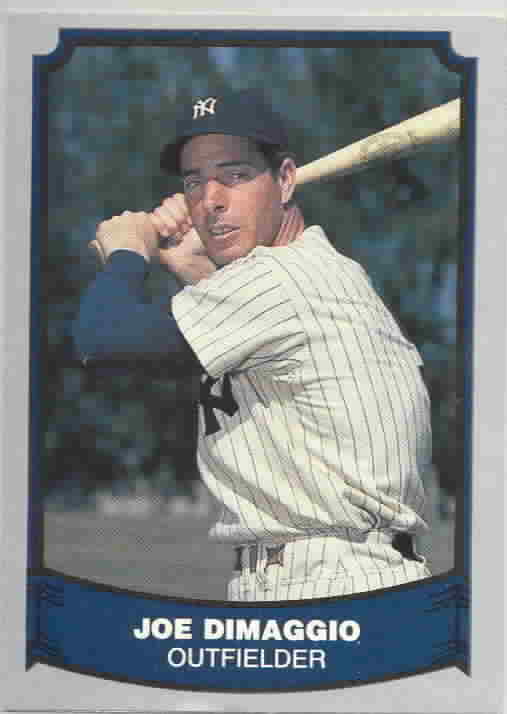
No other player in the history of the game has topped 44. Willie Keeler did that in 1897, and Pete Rose did it in 1978. Since Rose, no player has even done 40: Paul Molitor did 39 in 1987. Jimmy Rollins did 38 in 2006, and his Philadelphia Phillies teammate Chase Utley did 35 that same year.
In today's New York Daily News, Chuck Modiano claims that the streak is bogus, because it was achieved in all-white baseball.
This is just plain stupid. It is every bit as ignorant as the racism that he says is responsible for the streak.
Let me cite his points, and demolish them:
1. Joe DiMaggio did not face the best pitchers in baseball in 1941. Modiano specifically cites Satchel Paige and Hilton Smith, both Negro League legends who are now in the Baseball Hall of Fame, along with DiMaggio. DiMaggio called Paige the best pitcher he ever faced, and Modiano calls 1941 Smith's best season: 11-1 with an ERA of 0.92 in official league games.
Now, I realize that I can't cite Red Ruffing and Lefty Gomez, Yankee teammates that Joe, obviously, wasn't going to face. But he did face Bob Feller and Ted Lyons, both Hall-of-Famers. They won 526 games between them -- despite both of them missing time due to World War II and pitching in front of non-contenders for much of their careers. (Lyons was near the end, but Feller missed maybe his peak years, nearly 4 full.) To say, as Modiano did, that, "Joe DiMaggio never had to face a player of Satchel Paige's caliber during his streak" is monumental ignorance.
And, by the way, it works the other way, too. True, DiMag didn't face Paige or Smith. And Feller and the other white pitchers didn't face Josh Gibson, Buck Leonard, and the other great Negro League hitters of the time. But Paige and Smith didn't face DiMag. Nor did they face Ted Williams. Nor did they face Jimmie Foxx. Nor did they face Hank Greenberg. Nor did they face Joe Medwick. Nor did they face Johnny Mize.
By the dawn of the 1950s, it was obvious that the best players in the Negro Leagues would also be among the best players in the previously all-white major leagues. But the average player in the Negro Leagues was not as good as the average player in the majors.
We saw evidence, if not proof, of this when players who had put up big numbers in the high minors reached the majors, and it just wasn't the same. Joe Hauser and Joe Bauman were both serious sluggers in what we would now call Class AAA ball. But Hauser was a flop in the majors, and Bauman never even got there.
Lots of players excel in the minors, but not in the majors. We Yankee Fans can cite Hensley "Bam-Bam" Meulens. Met fans can cite Gregg Jeffries. Satchel Paige proved that, at age 42, he could get major league hitters out. We have no such evidence for Hilton Smith.
Smith could have been another Bob Feller, had he been allowed to pitch in the majors. He also could have been another Daisuke Matsuzaka, thrilling but ultimately disappointing. He also could have been another Kerry Wood, showing promise but getting derailed by injury.
He also could have been another David Clyde, sabotaged by the way his manager, coaches and front office handled him. He also could have been another Denny McLain, whose bad attitude doomed him (although McLain was also plagued by injury). He also could have been another Sam McDowell or Dwight Gooden, a great young pitcher who ended up ruined by substance abuse (although there's no record of Smith being an alcoholic or a drug addict). He also could have been another Todd Van Poppel, a hyped prospect who simply didn't pan out.
Perhaps a more accurate, and certainly a more contemporary, parallel is to Clint Hartung. Being white, Hartung, a.k.a. the Hondo Hurricane, was eligible to appear in the major leagues before 1947, although that's the year he actually did make his major league debut. While serving in World War II, he played on various military baseball teams, and probably faced competition of a level similar to the Negro Leagues or the high minors: A few great players, mostly ordinary ones, including some that wouldn't have made the majors regardless of their race. On those teams, Hartung went 25-0 as a pitcher and batted .567.
But he only lasted 6 seasons for the New York Giants. He was average at best at both pitching and hitting. He was no Babe Ruth, as a hitter or as a pitcher, nor was he going to become one. (UPDATE: Nor was he ever going to become a Shohei Ohtani.) True, he was a member of their 1951 Pennant winners, the dubious "Miracle of Coogan's Bluff." But his biggest contribution was pinch-running for an injured Don Mueller right before Bobby Thomson hit the Shot Heard 'Round the World. A 2012 Bleacher Report article named Hartung baseball's all-time biggest bust (divided by hype, that is).
Hilton Smith didn't get the chance to even be as good as Clint Hartung was, but how do we know he would have been better? It would be nice to know, but we don't, and we can't. So citing his absence, and those of Satchel Paige and other black pitchers, as a reason that Joe DiMaggio was able to get a hit in 56 straight games is disingenuous.
There's something else to consider: There was no Interleague play in 1941. Even if Paige, Smith, Smokey Joe Williams or whichever other Negro League pitcher of that time was good enough to make the majors had been allowed to play, there's no guarantee that they would have ended up in the American League to face DiMaggio.
At least, until the World Series: DiMaggio faced the Giants' Carl Hubbell and Hal Schumacher in the 1936 and 1937 World Series; Dizzy Dean and Bill Lee (no relation to the later Red Sox pitcher of that name) of the Chicago Cubs in the 1938 Series; the Cincinnati Reds' talented staff of Bucky Walters, Paul Derringer and Johnny Vander Meer in the 1939 Series; and Whitlow Wyatt and Kirby Higbe of the Brooklyn Dodgers in the 1941 Series.
With teams playing intraleague opponents 22 times each in the regular season, that could mean 4 or 5 appearances against a good pitcher in your own League, but none against one in the other. Satchel Paige could have been every bit as lights-out for the Dodgers as he was for the Kansas City Monarchs, and, at least as far as DiMaggio was concerned, it wouldn't have mattered a damn from May 15 to July 16; not until October 2, when the World Series began, long after the streak ended.
2. How Chase Utley's Streak Ended. The last big streak in Major League Baseball was by Utley, in 2006: 35 games. The pitchers who ended the streak were Orlando "El Duque" Hernandez (a black Cuban), Darren Oliver (a black American) and Pedro Feliciano (a Puerto Rican who probably would have been considered too dark-skinned to play in 1946). It was another 10 games before Utley was held hitless by an all-white pitching combination.
Well, gee, it's been over 30 years since I've had a basic math course, but 35 + 10 = 45, and 45 < 56, dumbass.
Look at the Cleveland Indian pitchers who stopped DiMaggio's streak on July 17, 1941: Al Smith and Jim Bagby Jr. Smith was an All-Star once, in the wartime-depletion year of 1943. Bagby was also an All-Star that year, and in 1942. But neither of them was a great pitcher, even briefly.
It doesn't take a great pitcher to stop a streak. When Pete Rose tied the National League record with a 44-game streak in 1978, the Atlanta Braves pitchers that stopped him were Larry McWilliams and Gene Garber. (Dave Campbell also pitched for the Braves in that game, but did not face Rose.) Garber was a very good reliever, but McWilliams was a nobody.
3. One-Hit Wonder: Joe's Streak Was Very Vulnerable. Modiano mentions that Joe had multiple hits in only 22 of the 56 games.
All this stat means is that Joe still managed to get it done on days when he wasn't "in the zone." That makes the streak more remarkable, not less.
4. Joe Was Shielded from Afro-Latinos, Too. Now, Modiano is simply repeating himself. We've been over this. You might as well say that Satch was shielded from Italian-Americans.
Besides, it's not like DiMaggio said, "I won't play against (whatever word he would have used for black men at the time) or (whatever word he would have used for Latin men at the time)." He didn't have a choice. And if he had spoken up, and said, "Let them play in organized baseball," do you think it would have made a difference? Not as long as Kenesaw Mountain Landis was Commissioner, it wouldn't have.
5. How Bob Gibson Changed White Baseball History. Willie McCovey wasn't this much of a Stretch. Modiano cites St. Louis Cardinals ace Gibson shutting down Mickey Mantle of the Yankees in the 1964 World Series and Carl Yastrzemski of the Boston Red Sox in the 1967 World Series.
Damn. This one is so easy, a caveman could do it. Hell, it's so easy, a Met fan could do it!
First of all, while the Yankees lost to Gibson in Games 5 and 7 of the '64 Series, they also beat him in Game 2 -- in St. Louis, no less. And Gibson lost Game 7 of the 1968 World Series, also in St. Louis, to the Detroit Tigers, who had some serious holes in their lineup, even taking "The Year of the Pitcher" into account.
Bob Gibson was great. But he was not unbeatable. No pitcher is.
Second of all, if Modiano wants us to discount DiMaggio's 56-game hitting streak because he didn't face black or Latino pitchers, then what are we to make of Gibson's also mind-boggling 1.12 ERA in 1968?
Gibson faced batters of all races, right? White, black, Hispanic.
Wrong. Bob Gibson never faced an Asian batter. He never faced an Ichiro Suzuki or a Hideki Matsui. (UPDATE: Or a Shohei Ohtani.)
Sadaharu Oh was at the peak of his career with the Tokyo-based Yomiuri Giants. Suppose the Yankees' 1st baseman in 1964 was not the overrated Joe Pepitone, but Oh, who was named the Most Valuable Player in Japan's Central League that season.
Oh, who would hit 868 home runs over the course of his career in Japanese baseball. Oh, who was lefthanded, and would have been aiming at the 310-foot right field fence at St. Louis' Sportsman's Park in Games 1, 2, 6 and 7; and at the 296-foot right field fence at the pre-renovation old Yankee Stadium in Games 3, 4 and 5.
Even if Gibson did manage to shut Oh down, that doesn't mean the other Cardinal pitchers would have had any more luck against him in '64 than they had against the Mick, or in '67 than they did against Yaz. Which reminds me: Mantle did hit one out against Gibson in Game 7, for all the good it did. (The Cardinals won, 7-5.)
Oh, who would hit 868 home runs over the course of his career in Japanese baseball. Oh, who was lefthanded, and would have been aiming at the 310-foot right field fence at St. Louis' Sportsman's Park in Games 1, 2, 6 and 7; and at the 296-foot right field fence at the pre-renovation old Yankee Stadium in Games 3, 4 and 5.
Even if Gibson did manage to shut Oh down, that doesn't mean the other Cardinal pitchers would have had any more luck against him in '64 than they had against the Mick, or in '67 than they did against Yaz. Which reminds me: Mantle did hit one out against Gibson in Game 7, for all the good it did. (The Cardinals won, 7-5.)
The hole in Modiano's Reason Number 5 is big enough to drive a truck though -- a truck built by Ford, or a truck built by Mitsubishi .
*
If you want to argue that DiMaggio had an advantage in not playing against black, Hispanic, or, to be fair, Asian pitchers, you also have to consider several other things:
* He did it playing mostly day games, in the heat of Summer afternoons, not in the cool of the evening. Along the same line:
* He did it in a less comfortable uniform than the ones players wear today. You ever wear a wool shirt in May, June or July? I don't recommend it. Joe was carrying several extra pounds of sweat by the time he made his last plate appearance every game.
* He did it while playing on rock-hard infields that didn't exactly let him utilize his speed to the best of his ability.
* He did it in harder ballparks. The pre-renovation Yankee Stadium was 461 feet to center field, 457 to left-center, 415 to straightaway left. Cleveland Municipal Stadium, where the streak ended, was 320 feet to the left field pole, but 380 feet to straightaway left. Sportsman's Park was 351 feet to the left field pole. Griffith Stadium in Washington was 402 feet to the left field pole.
Shibe Park in Philadelphia was, like Griffith Stadium, small in number of seats, but huge in outfield space. Comiskey Park in Chicago was no friend to hitters. Briggs Stadium (later renamed Tiger Stadium) in Detroit was much friendlier to lefthanded hitters than to righthanded ones. True, he got to play up to 11 games a season in Boston's Fenway Park, but those were the only 11 games, out of 154, that he got to play in a ballpark favorable to his swing.
* He did it while playing center field at that Yankee Stadium. Not easy on his legs. Legs are kind of important in hitting.
* He did it while riding on trains. You think 6 hours on a plane from New York to Los Angeles is rough? Try 24 hours on a train from New York to St. Louis.
* They changed the rules on him. Sort of. He was told the record was 41, by George Sisler of the St. Louis Browns in 1922. But someone checked, and, while Sisler did hold the AL record, the major league record was held by Willie Keeler of the old National League version of the Baltimore Orioles. He did 44 straight in 1897, a record already discounted because it was before "the modern era." (1941 - 1897 = 44. 2016 - 44 = 1972. Does 1972 sound "pre-modern" to you?)
* His favorite bat was stolen. Between games of a doubleheader in Washington that stood to be Games 41 and 42 of the streak, somebody swiped his bat. Probably for a souvenir, not to hurt his chances. Joe reclaimed a bat that Tommy Henrich had borrowed from him, and got to 42. He later got the preferred bat back.
* Finally, Joe carried the Yankees on his back with the streak. When it began, they were in 4th place, 6 1/2 games out, under .500, and seemed to be going nowhere. When it ended, they were in 1st place, and stayed there.
In short, he did it against conditions that would have made today's coddled players run in stark terror.
Every player is bound by the rules that he has at the time. (Except for the 21st Century Boston Red Sox, apparently. They can do whatever the hell they want, and won't be punished.) Joe DiMaggio in 1941 had to bat against the pitchers that were available to him, just as did Willie Keeler in 1897, George Sisler in 1922, Pete Rose in 1978, Paul Molitor in 1987, Jimmy Rollins and Chase Utley in 2006, and anybody who might manage a long streak this season.
Give me whatever reasons you want why DiMaggio's 56-game hitting streak is dubious, and I can give you a reason why any other achievement, by an athlete that you admire, is dubious.
You want to say that Satchel Paige and Hilton Smith haven't gotten their just due as baseball heroes? Go ahead. You've got an excellent case.
You want to say that Joe DiMaggio, or any other white baseball player before the arrival of Jackie Robinson, gets more than his just due as a baseball hero? Go ahead -- but prepare for a rebuttal.
I don't know that Ty Cobb would have been able to get a hit off his black contemporary Rube Foster. Nor do I know that Christy Mathewson would have been able to shut down Oscar Charleston.
I do know that Cobb got a few hits off Walter Johnson. I do know that Mathewson was able to get Honus Wagner out much more often than not.
I do know that Joe DiMaggio did something that no one, with the same "advantages" that he had, including white privilege, ever did before. And that no one, with steroids or any other "advantage," has done since.
It's okay to ask what DiMaggio would have done against black pitchers.
But it is stupid to say that he got the streak because he didn't have to face them.
It is every bit as ignorant as the racism that made that excuse possible.
*
If you want to argue that DiMaggio had an advantage in not playing against black, Hispanic, or, to be fair, Asian pitchers, you also have to consider several other things:
* He did it playing mostly day games, in the heat of Summer afternoons, not in the cool of the evening. Along the same line:
* He did it in a less comfortable uniform than the ones players wear today. You ever wear a wool shirt in May, June or July? I don't recommend it. Joe was carrying several extra pounds of sweat by the time he made his last plate appearance every game.
* He did it while playing on rock-hard infields that didn't exactly let him utilize his speed to the best of his ability.
* He did it in harder ballparks. The pre-renovation Yankee Stadium was 461 feet to center field, 457 to left-center, 415 to straightaway left. Cleveland Municipal Stadium, where the streak ended, was 320 feet to the left field pole, but 380 feet to straightaway left. Sportsman's Park was 351 feet to the left field pole. Griffith Stadium in Washington was 402 feet to the left field pole.
Shibe Park in Philadelphia was, like Griffith Stadium, small in number of seats, but huge in outfield space. Comiskey Park in Chicago was no friend to hitters. Briggs Stadium (later renamed Tiger Stadium) in Detroit was much friendlier to lefthanded hitters than to righthanded ones. True, he got to play up to 11 games a season in Boston's Fenway Park, but those were the only 11 games, out of 154, that he got to play in a ballpark favorable to his swing.
* He did it while playing center field at that Yankee Stadium. Not easy on his legs. Legs are kind of important in hitting.
* He did it while riding on trains. You think 6 hours on a plane from New York to Los Angeles is rough? Try 24 hours on a train from New York to St. Louis.
* They changed the rules on him. Sort of. He was told the record was 41, by George Sisler of the St. Louis Browns in 1922. But someone checked, and, while Sisler did hold the AL record, the major league record was held by Willie Keeler of the old National League version of the Baltimore Orioles. He did 44 straight in 1897, a record already discounted because it was before "the modern era." (1941 - 1897 = 44. 2016 - 44 = 1972. Does 1972 sound "pre-modern" to you?)
* His favorite bat was stolen. Between games of a doubleheader in Washington that stood to be Games 41 and 42 of the streak, somebody swiped his bat. Probably for a souvenir, not to hurt his chances. Joe reclaimed a bat that Tommy Henrich had borrowed from him, and got to 42. He later got the preferred bat back.
* Finally, Joe carried the Yankees on his back with the streak. When it began, they were in 4th place, 6 1/2 games out, under .500, and seemed to be going nowhere. When it ended, they were in 1st place, and stayed there.
In short, he did it against conditions that would have made today's coddled players run in stark terror.
Every player is bound by the rules that he has at the time. (Except for the 21st Century Boston Red Sox, apparently. They can do whatever the hell they want, and won't be punished.) Joe DiMaggio in 1941 had to bat against the pitchers that were available to him, just as did Willie Keeler in 1897, George Sisler in 1922, Pete Rose in 1978, Paul Molitor in 1987, Jimmy Rollins and Chase Utley in 2006, and anybody who might manage a long streak this season.
Give me whatever reasons you want why DiMaggio's 56-game hitting streak is dubious, and I can give you a reason why any other achievement, by an athlete that you admire, is dubious.
You want to say that Satchel Paige and Hilton Smith haven't gotten their just due as baseball heroes? Go ahead. You've got an excellent case.
You want to say that Joe DiMaggio, or any other white baseball player before the arrival of Jackie Robinson, gets more than his just due as a baseball hero? Go ahead -- but prepare for a rebuttal.
I don't know that Ty Cobb would have been able to get a hit off his black contemporary Rube Foster. Nor do I know that Christy Mathewson would have been able to shut down Oscar Charleston.
I do know that Cobb got a few hits off Walter Johnson. I do know that Mathewson was able to get Honus Wagner out much more often than not.
I do know that Joe DiMaggio did something that no one, with the same "advantages" that he had, including white privilege, ever did before. And that no one, with steroids or any other "advantage," has done since.
It's okay to ask what DiMaggio would have done against black pitchers.
But it is stupid to say that he got the streak because he didn't have to face them.
It is every bit as ignorant as the racism that made that excuse possible.