"Worse: You're in Texas!" – Chris Rock
-- Nurse Betty
The Brooklyn Nets on this coming Friday night, and the New York Knicks on March 30, will travel to face the Dallas Mavericks, in what Texas native Molly Ivins – frequently sarcastically – called The Great State.
An example of her writing: "In the Great State, you can get 5 years for murder, and 99 for pot possession." (I once sent the late, great newspaper columnist an e-mail asking if it could be knocked down to 98 years if you didn’t inhale. Sadly, she never responded.)
If there is one thing that fans of 31 out of the 32 NFL teams can agree on, it's that they hate the Cowboys. Or, as is said from New York to San Francisco, from Seattle to Miami, and especially in Philadelphia and Washington, "Dallas Sucks!"
That hatred is considerably reduced in basketball. Aside from fans of the other Texas teams, the Houston Rockets and San Antonio Spurs, and possibly the Oklahoma City Thunder, I don't think anybody particularly hates the Mavericks. Their owner, Mark Cuban, maybe... although, in my book, he's the best thing about Dallas, because he angers people who deserve to be made angry.
Before You Go. It's not just The South, it's Texas. This is the State that elected George W. Bush, Rick Perry, Greg Abbott and Bill Clements Governor; Dick Armey, Tom DeLay, Ron Paul and Louie Gohmert to the House of Representatives; and Phil Gramm and Ted Cruz to the Senate -- and thinks the rest of the country isn't conservative enough. This is the State where, in political terms, somebody like Long Island's conservative Congressman Peter King is considered a sissy. This is a State that thinks that poor nonwhites don't matter at all, and that poor whites only matter if you can convince them that, no matter how bad their life is, they're still better than the (slur on blacks) and the (slur on Hispanics).
So if you go to Dallas for this game, it would be best to avoid political discussions. And, for crying out loud, don't mention that, now over half a century ago, a liberal Democratic President was killed in Dallas. They might say JFK had it comin' 'cause he was a (N-word)-lovin' Communist. (Some people have included Clint Murchison, father of Clint Murchison Jr., the Cowboys' original owner, in the conspiracy theories, due to JFK's interest in eliminating a tax break known as the oil-depletion allowance.)
No. I'm not kidding. I've never been to Texas, but I've seen enough Texans elsewhere, in actual meetings and on TV, to know that there are some of them who think like this -- and, among their own people, they will be less likely to hold back. So don't ask them what they think. About anything.
At any rate, before we go any further, enjoy Lewis Black's R-rated smackdown of Rick Perry and the State of Texas as a whole.
At least you'll be going in the winter, so you won't have to deal with the usual Texas heat and humidity. Still, before you go, check the websites of the Dallas Morning News and the Fort Worth Star-Telegram (the "Startle-gram") for the weather. Right now, they're talking about it being in the low 70s during daylight on Friday, but dropping to the high 40s by gametime. You may need to bring a jacket, but not a winter jacket.
Texas is in the Central Time Zone, 1 hour behind New York. (The exception is the southwestern corner, including El Paso, which borders New Mexico, so it's in the Mountain Time Zone.) Adjust your timepieces accordingly.
Despite Texas' seeming foreignness (and that's before you factor in the Mexican-American influence, which improves things) and its embrace of its treasonous Confederate past, you don't need a passport to visit, and you don't need to change their money.
Tickets. The Mavericks averaged 20,187 fans last season. This season, it's down to 20,116. That's still an average of more than a sellout. Getting tickets will be tough.
In the Lower Level, the 100 sections, seats are $167 between the baskets and $67 behind them. In the Platinum Level, the 200 sections, they're $87 between and $68 behind. In the Upper Level, the 300 sections, they're $30 between and just $10 behind, far from the action, but a bargain.
Getting There. It is 1,551 miles from Midtown Manhattan to downtown Dallas. So unless you want to be cooped up for 24-30 hours, you... are... flying.

Dallas' Union Station
Amtrak offers the Lake Shore Limited (a variation on the old New York Central Railroad’s 20th Century Limited), leaving Penn Station at 3:40 PM Eastern Time and arriving at Chicago’s Union Station at 9:45 AM Central Time. Then switch to the Texas Eagle at 1:45 PM, and arrive at Dallas’ Union Station (400 S. Houston Street at Wood Street) the following morning at 11:30. It would be $536 round-trip, and that’s with sleeping in a coach seat, before buying a room with a bed on each train. That would push it close to $2,000.As with American Airlines, Dallas is actually Greyhound’s hometown, or at least the location of its corporate headquarters: 205 S. Lamar Street at Commerce Street, which is also the address of their Dallas station. If you look at Greyhound buses, you’ll notice they all have Texas license plates. So, how bad can the bus be?
Well, it is cheaper: $424 round-trip, and advanced purchase can get it down to $314. But it won’t be much shorter: It's a 40-hour trip, and you'll have to change buses at least twice, in Richmond, Virginia (and I don't like the Richmond station) and either Atlanta or Memphis.
Oh... kay. So what about driving? As I said, over 1,500 miles. I would definitely recommend bringing a friend and sharing the driving. The fastest way from New York to Dallas is to get into New Jersey, take Interstate 78 West across the State and into Pennsylvania, then turn to Interstate 81 South, across Pennsylvania, the “panhandles” of Maryland and West Virginia, and across the Shenandoah Valley of Virginia into Tennessee, where I-81 will flow into Interstate 40. Take I-40 into Arkansas, and switch to Interstate 30 in Little Rock, taking it into the Dallas-Fort Worth metropolitan area, a.k.a. "The Metroplex." Between the forks of Interstate 35, I-30 is named the Tom Landry Freeway, after the legendary Cowboys coach.
Once you get across the Hudson River into New Jersey, you should be in New Jersey for about an hour, Pennsylvania for 3 hours, Maryland for 15 minutes, West Virginia for half an hour, Virginia for 5 and a half hours (more than the entire trip will be before you get to Virginia), 8 hours and 15 minutes in Tennessee, 3 hours in Arkansas, and about 3 hours and 45 minutes in Texas.
Taking 45-minute rest stops in or around (my recommendations) Harrisburg, Pennsylvania; Charlottesville, Virginia; Bristol, on the Virginia/Tennessee State Line; Nashville and Memphis, Tennessee; Little Rock and Texarkana, Arkansas; and accounting for overruns there and for traffic at each end of the journey, and we’re talking 31 hours. So, leaving New York at around 7:00 Eastern Time on Saturday morning, you should be able to reach the Metroplex at around 1:00 Central Time on Sunday afternoon, giving you 2 hours before kickoff.
But it would be better to leave on Friday afternoon, reach the area on Saturday night, and get a hotel. Fortunately, AT&T Stadium is in Arlington, midway between the downtowns of Dallas and Fort Worth. Well before either the Rangers or the Cowboys set up shop in Arlington, Six Flags Over Texas did so, as the original theme park in the Six Flags chain (opening in 1961), and so there are plenty of hotels available nearby. They’re also likely to be cheaper than the ones in downtown Dallas.
Once In the City. Dallas (population about 1,250,000, founded in 1856) was named after George Mifflin Dallas, a Mayor of Philadelphia and Senator from Pennsylvania who was James K. Polk's Vice President (1845-49). Fort Worth (about 800,000, founded in 1849) was named for William Jenkins Worth, a General in the War of 1812 and the Mexican-American War. And Arlington (375,000, founded in 1876) was named for the Virginia city across the Potomac River from Washington, D.C., as a tribute to Confederate General Robert E. Lee.
The population of the entire Metroplex is about 6.8 million and climbing, although when you throw in Oklahoma, southern Arkansas and northern Louisiana, the total population of the Cowboys' "market" is about 19 million -- a little less than the New York Tri-State Area, and soon it will surpass us.
Commerce Street divides Dallas street addresses into North and South. Beckley Avenue, across the Trinity River from downtown, appears to divide them into East and West. The sales tax in the State of Texas is 6.25 percent, in Dallas County 8.25 percent, and in Tarrant County (including Arlington and Fort Worth) 8 percent even.
Dallas Area Rapid Transit (DART) runs buses and light rail trains. A 2-hour pass costs $2.50, and a day pass is $5.00 local and $10.00 regional (if you want to go beyond Dallas to Arlington or Fort Worth).
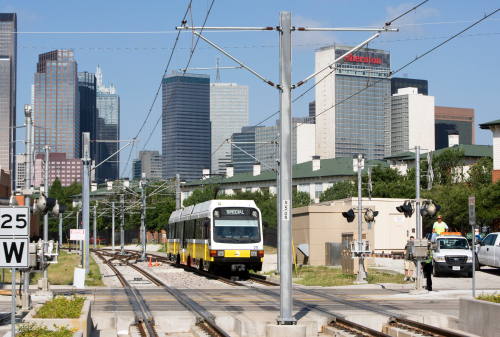
Green Line train just outside downtown
Going In. The NBA’s Dallas Mavericks and the NHL’s Dallas Stars play at the American Airlines Center, or the AAC. Not to be confused with the American Airlines Arena in Miami (which was really confusing when the Mavs played the Heat in the 2006 and 2011 NBA Finals), it looks like a cross between a rodeo barn and an airplane hangar. It is 1 of 10 arenas that is currently home to both an NBA team and an NHL team.
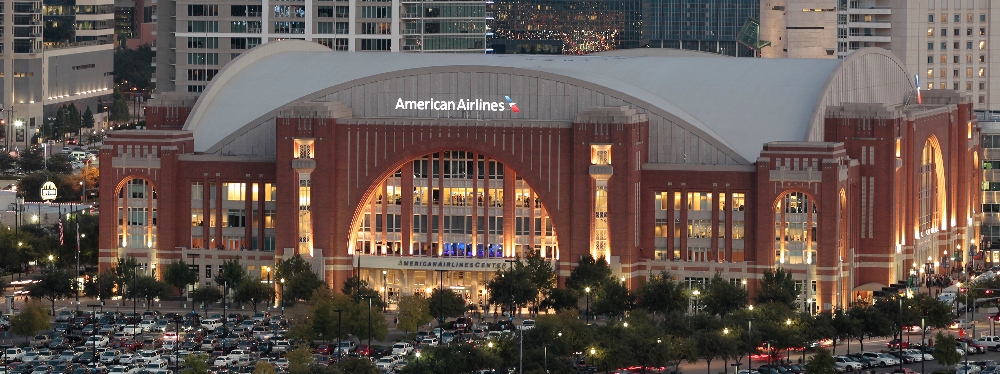
Since you're most likely to arrive from downtown, by either car or train, you're likely to enter from the south. The court runs northwest-to-southeast.

Food. Going along with the "Everything is big in Texas" idea, you would think that the Mavericks' arena would have lots of concession stands and big portions. You would also think they would rely heavily on Southwest and Tex-Mex food. They don't disappoint in those regards.
Going with the Southwest/Tex-Mex theme, they have stands labeled Grill Zone, High Steaks (a play on "high stakes" gambling), Stampede Station, Taco Bueno. There's a basketball-themed stand called Fast Break and a hockey-themed stand called Center Ice. They have a Pizza Hut, and as far as I know they have the only venue in North American major league sports with a 7-Eleven. As for locations within the arena, click this link.
Team History Displays. The Mavericks were founded in 1980, meaning that I can remember a time before they existed. Nevertheless, they have some history. Since the mid-1980s, they have been a Playoff contender more often than not, despite a horrible 1992-93 season in which they went 11-71, and flirted with the 1973 Philadelphia 76ers' record-worst 9-73.
They've won Division titles in 1987, 2007 and 2010. They've won the Western Conference title twice, in 2006 and 2011. Both times, they faced the Miami Heat in the NBA Finals, losing in 2006 but winning in 2011.

No man who played for the Mavericks was named to the NBA's 50th Anniversary 50 Greatest Players in 1996, although Don Nelson, who was soon to be named their head coach, was named to the 10 Greatest Coaches. Only 3 men who've played for the Mavericks have yet been elected to the Basketball Hall of Fame, and, between them, they played what amounted to 3 full seasons, all near the ends of their careers: Alex English, Adrian Dantley and Dennis Rodman. Nelson has also been elected.
Almost certainly, Nowitzki will be elected, and Nash and Kidd also have good chances. Peja Stojakovic closed his career with the Mavs' 2011 title, and he could be elected to the Hall, but it would be based on what he did with the Sacramento Kings, who have retired his Number 16, which the Mavs almost certainly won't do, since he was there so briefly.
You don't usually think of Dallas having much of a literary tradition -- or of Texans being functionally literate -- but there are a few books about the Mavericks. The sports staff of The Dallas Morning News put together the 2011 title tribute The Will To Win. Rob Mahoney wrote Mavericks Stampede: Dirk Leads Dallas to the 2011 NBA Championship. In 2014, Bill Redban wrote Nowitzki's entry in the NBA's The Inspirational Story of Basketball Superstar... series.
Team owner Mark Cuban wrote How to Win at the Sport of Business: If I Can Do It, You Can Do It. And Sean Huff wrote the biography Mark Cuban: The Maverick Billionaire. He's so much of a "maverick" that the baseball establishment has stepped in to stop buying a team. He's already tried and failed to buy the Chicago Cubs and his hometown Pittsburgh Pirates. It's not that he doesn't have enough money: He certainly does. It's not that he wouldn't make even more money, for himself and the league, as an owner: He almost certainly would. It's not that he'd be unwilling to promote the sport: He would be. It's that he's not one of them, and never will be. (This is also why they won't let Hall-of-Famer Reggie Jackson lead a group to buy a team: His group has already tried and failed to buy 2 of the teams for whom he's played, the Oakland Athletics and the Los Angeles Angels of Anaheim.)
The NBA put out an official DVD retrospective of the 2011 Finals, which the Mavericks won for, so far, their only title.
During the Game. A November 13, 2014 article on DailyRotoHelp ranked the NBA teams' fan bases, and listed the Mavericks' fans at 8th, citing Cuban's commitment to keeping the team competitive, and being a fan draw himself, thus keeping them coming in. Taking into account the bandwagon factor that still infects Cowboys fandom, and Texans' natural affinity for football, the Mavs may be the most popular sports team within the Metroplex.
Dallas Mavericks fans don't like the Houston Rockets, or the San Antonio Spurs, or the Phoenix Suns, or the Oklahoma City Thunder, or the fans of any of those. They may not like New Yorkers, but they don't have any specific problems with Knicks or Nets fans. Wearing your team's gear probably won't get you in trouble.
And, this being a sports arena, you're gonna get searched, and so is everyone else, so Texas' infamously lenient gun laws will be rendered useless. You're not going to get shot. Even JFK and J.R. Ewing wouldn't have gotten shot at the American Airlines Center.
The Mavericks hold auditions for singing the National Anthem, rather than having a regular singer. The group Bamface recorded a theme song for them, "Finishing What They Started." Unfortunately, their fans have no chant more interesting than, "Let's go, Mavs!"
The Mavericks have 2 mascots: A blue horse named Champ -- a maverick can be definied as "an unorthodox or independent-minded person," but also as "an unbranded calf (cow) or yearling (horse)" -- and Mavs Man, who appears to be a man made out of basketballs.

After the Game. Dallas has a bit of a bad reputation when it comes to crime, but you'll be pretty far from it. The Victory Park area, including the arena, is well-protected. As long as you don't make any snide remarks about the Mavericks or any liberal political pronouncements, safety will not be an issue.
Buffalo Joe's, at 3636 Frankford Avenue, is the local Giants fan bar. But it's 22 miles due north of downtown Dallas. Even further, the Cape Buffalo Grille, at 17727 Addison Road in Addison, 28 miles northeast of AT&T Stadium, has been described by a Giant fan as "a lifesaver for people from New York and New Jersey." Humperdink's, at 6050 Greenville Avenue in north Dallas, seems to be the local home of Jet fans.
If you visit Dallas during the European soccer season, as we are now in, the best-known "football pub" in town is Trinity Hall, at 5321 E. Mockingbird Lane, just off the SMU campus. Blue Line to Mockingbird Station.
Sidelights. Despite their new rapid-rail system, Dallas is almost entirely a car-friendly, everything-else-unfriendly city. Actually, it's not that friendly at all. It’s a city for oil companies, for banks, for insurance companies, things normal Americans tend to hate. Despite its reputation for far-right political craziness, Texas still prides itself on its hospitality to visitors; and, as one Houston native once put it, "Dallas is not in Texas." In fact, most Texans, especially people from Fort Worth (and, to a slightly lesser extent, those from Houston) seem to think of Dallas the way the rest of America thinks of New York: They hate it, and they think that it represents all that is bad about their homeland. Until, that is, they need a win. Or money.
Before the AAC opened in 2001, the Mavericks and Stars both played at the Reunion Arena. This building hosted the 1984 Republican Convention, where Ronald Reagan was nominated for a 2nd term as President. To New York Tri-State Area fans, it is probably best remembered as the place where Jason Arnott’s double-overtime goal won Game 6 and gave the New Jersey Devils the 2000 Stanley Cup over the defending Champion Stars. The 1986 NCAA Final Four, won by Louisville over Duke, was held there.
 It was demolished in November 2009, 5 months before Texas Stadium was imploded. The arena didn't even get to celebrate a 30th Anniversary. 777 Sports Street at Houston Viaduct, downtown, a 10-minute walk from Union Station.
The Major League Soccer club FC Dallas (formerly the Dallas Burn) play at Toyota Stadium, at 9200 World Cup Way in the suburb of Frisco. It’s 28 miles up the Dallas North Tollway from downtown, so forget about any way of getting there except driving. The U.S. soccer team has played there twice, both against Guatemala, a win and a loss.
The Dallas Sportatorium was built in 1935 to host professional wrestling, burned down in 1953 (legend has it that it was arson by a rival promoter), was rebuilt as a 4,500-seat venue, and continued to host wrestling even as it was replaced by larger arenas and fell into a rat-infested, crumbling decline, before a 2001 fire (this one was likely the result of the neglect, rather than arson) finally led to its 2003 demolition. Elvis Presley sang there early in his career, on April 16, May 29, June 18 and September 3, 1955. The site is now vacant. 1000 S. Industrial Blvd. at Cadiz Street, just south of downtown.
The Dallas Memorial Auditorium opened in 1957, and hosted some Chaparrals games. The Beatles played there on September 18, 1964. Elvis sang there on November 13, 1971; June 6, 1975; and December 28, 1976. It is now part of the Kay Bailey Hutchison Convention Center, named for Texas' 1st female U.S. Senator. 650 S. Griffin Street, downtown.
Elvis also sang in Fort Worth, at the Tarrant County Convention Center, now the Fort Worth Convention Center, on June 18, 1972; June 15 and 16, 1974; and June 3 and July 3, 1976. 1201 Houston Street. A short walk from the Fort Worth Intermodal Transportation Center.
Globe Life Ballpark (formerly known as The Ballpark In Arlington, AmeriQuest Field and Rangers Ballpark) is at 1000 Ballpark Way, off Exit 29 on the Landry Freeway. It sits right between Six Flags and AT&T Stadium. Across Legends Way from the ballpark is a parking lot where the original home of the Rangers, Arlington Stadium, stood from 1965 to 1993. It was a minor-league park called Turnpike Stadium before the announcement of the move of the team led to its expansion for the 1972 season. AT&T Stadium, the new home of the Cowboys, is at 1 AT&T Way. The 2 stadiums are 7/10ths of a mile apart.
If you got a hotel near the various Arlington attractions, you're in luck: The Arlington Entertainment District Trolley goes to the area hotels and to the stadiums and theme parks. But if your hotel is in Dallas, you'll have to take Trinity Rail Express (TRE) to Centerport Station, and then transfer to bus 221, and take that to Collins & Andrew Streets. And even then, you'd have to walk over a mile down Collins to get to the stadium. The whole thing is listed as taking an hour and 50 minutes.
But at least it's now possible to get from Dallas to a Cowboy game and back without spending $50 on taxis. So how much is it? From Union Station to Centerport, each way, is $2.50. I don't know what the zones are for the bus, but a Day Pass is $5.00, meaning that getting there and back could top out at $10, which is reasonable considering the distance involved.
Originally named Cowboys Stadium, but nicknamed the Palace In Dallas, the Death Star, Jerry World and Jerr-assic Park, it has now hosted a Super Bowl, an NCAA Final Four (2014, Connecticut over Kentucky), some major prizefights and concerts, and, as mentioned, the 2010 NBA All-Star Game.
The Cowboys offer tours of this Texas-sized facility, which will make the new Yankee Stadium seem sensible by comparison.
Texas vs. Oklahoma is held at the Cotton Bowl every 1st Saturday in October, and that’s only because that’s the weekend when the Texas State Fair is held, as the stadium is in Fair Park. (Just look for the statue of "Big Tex" -- you can't miss him.) While it doesn’t seem fair that Oklahoma’s visit to play Texas should be called a “neutral site” if it’s in the State of Texas, the fact remains that each school gets half the tickets, and it’s actually slightly closer to OU’s campus in Norman, 191 miles, than it is from UT’s in Austin, 197 miles. The address is 3750 The Midway.
Next-door is the African-American Museum of Dallas. 1300 Robert B. Cullum Blvd., in the Fair Park section of south Dallas. Bus 012 or 026, or Green Line light rail to Fair Park station. Be advised that this is generally considered to be a high-crime area of Dallas.
Before there was the Texas Rangers, and before the Dallas-Fort Worth Spurs minor league team that opened Turnpike/Arlington Stadium in 1965, there were the Dallas team alternately called the Steers, the Rebels, the Eagles and the Rangers; and the Fort Worth Cats. Dallas won Texas League (Double-A) Pennants in 1926, 1929, 1941, 1946 and 1953. They played at Burnett Field, which opened in 1924, and was abandoned after the Dallas Rangers and the Fort Worth Cats merged to become the Spurs in 1965. Currently, it's a vacant lot. 1500 E. Jefferson Blvd. at Colorado Blvd. Bus 011.
The Cats won TL Pennants in 1895, 1905, 1906, 1920, 1921, 1922, 1923, 1924, 1925, 1930, 1937, 1939 and 1948. Those 6 straight Pennants in the Twenties became a pipeline of stars for the St. Louis Cardinals, and the 1930 Pennant featured Dizzy Dean and a few other future members of the Cards' 1930s "Gashouse Gang."
The Cats played at LaGrave Field, the first version of which opened in 1900, and was replaced in 1926, again after a fire in 1949, and one more time in 2002, as a new Fort Worth Cats team began play in an independent league. 301 NE 6th Street. Trinity Railway Express to Fort Worth Intermodal Transit Center, then Number 1 bus.
One more baseball-themed place in Texas that might interest a New York sports fan: Due to his cancer treatments and liver transplant, Mickey Mantle, who lived in Dallas during the off-seasons and after his baseball career, spent the end of his life at the Baylor University Medical Center. 3501 Junius Street at Gaston Avenue. Bus 019.
If there’s 2 non-sports things the average American knows about Dallas, it’s that the city is where U.S. President John F. Kennedy was assassinated on November 22, 1963, and where Ewing Oil President J.R. Ewing was shot on March 21, 1980. Elm, Main and Commerce Streets merge to go over railroad tracks near Union Station, and then go under Interstate 35E, the Stemmons Freeway – that’s the “triple underpass” so often mentioned in accounts of the JFK assassination.
The former Texas School Book Depository, now named The Sixth Floor Museum at Dealey Plaza, is at the northwest corner of Elm & Houston Streets, while the “grassy knoll” is to the north of Elm, and the west of the Depository. Like Ford’s Theater, where Abraham Lincoln was assassinated in 1865, and the area surrounding it in Washington, the area around Dealey Plaza is, structurally speaking, all but unchanged from the time the President in question was gunned down, an oddity in Dallas, where newer construction always seems to be happening.
John Fitzgerald Kennedy was shot in downtown Dallas and died, while John Ross Ewing Jr. was shot in downtown Dallas and lived. Where’s the justice in that? J.R. was shot in his office at Ewing Oil’s headquarters, which, in the memorable opening sequence of Dallas, was shown to be in the Renaissance Tower, at 1201 Elm Street, 6 blocks east of Dealey Plaza. The actual incident, however, was filmed on a Hollywood soundstage, so if you show up and ask to see J.R.'s office, you'll be out of luck.
The Renaissance Tower was Dallas’ tallest building from 1974 to 1985. In real life, it is the headquarters for Neiman Marcus. Bank of America Plaza, a block away on Elm at Griffith Street, is now the tallest building in Dallas, at 921 feet, although not the tallest in Texas (there’s 2 in Houston that are taller). Dallas' most familiar structure -- aside from AT&T Stadium, the Texas School Book Depository and Dallas' Southfork Ranch -- is the Reunion Tower, 561 feet high, part of the Hyatt Regency complex. 300 Reunion Blvd. at Young Street, just to the west of Union Station and to the southwest of Dealey Plaza.
The real Southfork Ranch is at 3700 Hogge Drive (that’s pronounced “Hoag”) in Parker, 28 miles northeast of the city. (Again, you’ll need a car.) It’s not nearly as old as the Ewing family’s fictional history would suggest: It was built in 1970, only 8 years before the series premiered. It’s now a conference center, and, like the replica of the Ponderosa Ranch that Lorne Greene had built to look like his TV home on Bonanza, it is designed to resemble the Ewing family home as seen on both the original 1978-91 series and the 2012-14 revival. It is open to tours, for an admission fee of $9.50.
The Dallas area is also home to 2 major football-playing colleges: Southern Methodist University in north Dallas, which, as alma mater of Laura Bush, was chosen as the site of the George W. Bush Presidential Library; and Texas Christian University in Fort Worth.
The Dallas area is also home to 2 major football-playing colleges: Southern Methodist University in north Dallas, which, as alma mater of Laura Bush, was chosen as the site of the George W. Bush Presidential Library; and Texas Christian University in Fort Worth.
SMU played at Ownby Stadium (when not playing at the Cotton Bowl) from 1926 to 1998. The Dallas Tornado of the old North American Soccer League also played there from 1976 to 1979. It was demolished, and replaced with the 32,000-seat Gerald F. Ford stadium. (No relation to the 1974-77 President who'd been a star center on the University of Michigan football team, this Gerald Ford is a billionaire banker who gave $42 million of his own money to build it.) 5800 Ownby Drive.
The Bush Library is at 2943 SMU Blvd. & North Central Expressway, a 5-minute walk from Ford Stadium, Moody Coliseum, and the university bookstore, which, like so many university bookstores, is a Barnes & Noble (not named for Dallas character Cliff Barnes).
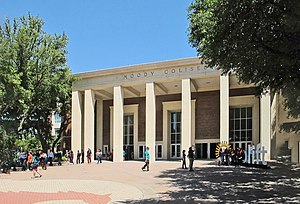
SMU is also home to Moody Coliseum, home court of their basketball team. The Dallas Chaparrals played ABA games there from 1967 until 1973, when they became the San Antonio Spurs. 6024 Airline Road. All SMU locations can be accessed by the Blue or Red Line to Mockingbird Station.
SMU has produced players like Doak Walker, Forrest Gregg, Dandy Don Meredith, and the "Pony Express" backfield of Eric Dickerson and Craig James (both now TV-network studio analysts), while TCU has produced Slingin' Sammy Baugh, Jim Swink and Bob Lilly. Both schools have had their highs and their lows, and following their 1987 "death penalty" (for committing recruiting violations while already on probation), and their return to play in 1989 under Gregg as coach, SMU are now what college basketball fans would call a "mid-major" school.
Ironically, TCU, normally the less lucky of the schools, seriously challenged for the 2009, 2010 and 2014 National Championships, but their own "mid-major" schedule doomed them in that regard. TCU's Amon G. Carter Stadium hosted the U.S. soccer team's 1988 loss to Ecuador. 2850 Stadium Drive. Trinity Rail Express to Fort Worth Intermodal Station, transfer to Bus 7 to University & Princeton, then walk 6 blocks west.
Aside from Dallas, TV shows that have shot in, or been set in, the Dallas area include Walker, Texas Ranger, Prison Break, the new series Queen of the South (based on a Mexican telenovela), and the ridiculous, short-lived ABC nighttime soap GCB (which stood for "Good Christian Bitches").
Movies about, or involving, the JFK assassination usually have to shoot in Dallas: The 1983 NBC miniseries Kennedy with Martin Sheen, JFK, Love Field, Ruby, Watchmen, LBJ (with Bryan Cranston as the Texan who succeeded him), and the Hulu series 11/22/63, based on Stephen King's fantasy novel.
Other movies shot in the city include the 1962 version of State Fair, Bonnie and Clyde, Mars Needs Women, Logan's Run, The Lathe of Heaven, Silkwood, Tender Mercies, Places in the Heart, The Trip to Bountiful, Born on the Fourth of July, Problem Child, My Heroes Have Always Been Cowboys (not about the football team), The Apostle, Boys Don't Cry, Dallas Buyers Club, the football films Necessary Roughness and Any Given Sunday, and, of course, the porno classic Debbie Does Dallas. However, it might surprise you to know that RoboCop, which was set in a Detroit that was purported to be in a near future when the city was even worse than it then was in real life, was filmed in Dallas. What does that say about Dallas? (To me, it says, "This is another reason why Dallas sucks.")
*
Texas is a weird place, and the Dallas-Fort Worth Metroplex is no exception. But it’s a pretty good area for sports, and it even seems to have finally embraced baseball as something more than something to do between football seasons.
If you can afford it, go, and help your fellow Knicks or Nets fans make the Mavericks feel like they’re in the Big Apple. But remember to avoid using the oft-heard phrase “Dallas Sucks.” The city does, the team doesn't. At any rate, in this case, keep the truth to yourself!
During the Game. A November 13, 2014 article on DailyRotoHelp ranked the NBA teams' fan bases, and listed the Mavericks' fans at 8th, citing Cuban's commitment to keeping the team competitive, and being a fan draw himself, thus keeping them coming in. Taking into account the bandwagon factor that still infects Cowboys fandom, and Texans' natural affinity for football, the Mavs may be the most popular sports team within the Metroplex.
Dallas Mavericks fans don't like the Houston Rockets, or the San Antonio Spurs, or the Phoenix Suns, or the Oklahoma City Thunder, or the fans of any of those. They may not like New Yorkers, but they don't have any specific problems with Knicks or Nets fans. Wearing your team's gear probably won't get you in trouble.
And, this being a sports arena, you're gonna get searched, and so is everyone else, so Texas' infamously lenient gun laws will be rendered useless. You're not going to get shot. Even JFK and J.R. Ewing wouldn't have gotten shot at the American Airlines Center.
The Mavericks hold auditions for singing the National Anthem, rather than having a regular singer. The group Bamface recorded a theme song for them, "Finishing What They Started." Unfortunately, their fans have no chant more interesting than, "Let's go, Mavs!"
The Mavericks have 2 mascots: A blue horse named Champ -- a maverick can be definied as "an unorthodox or independent-minded person," but also as "an unbranded calf (cow) or yearling (horse)" -- and Mavs Man, who appears to be a man made out of basketballs.
Champ and Mavs Man
Buffalo Joe's, at 3636 Frankford Avenue, is the local Giants fan bar. But it's 22 miles due north of downtown Dallas. Even further, the Cape Buffalo Grille, at 17727 Addison Road in Addison, 28 miles northeast of AT&T Stadium, has been described by a Giant fan as "a lifesaver for people from New York and New Jersey." Humperdink's, at 6050 Greenville Avenue in north Dallas, seems to be the local home of Jet fans.
If you visit Dallas during the European soccer season, as we are now in, the best-known "football pub" in town is Trinity Hall, at 5321 E. Mockingbird Lane, just off the SMU campus. Blue Line to Mockingbird Station.
Sidelights. Despite their new rapid-rail system, Dallas is almost entirely a car-friendly, everything-else-unfriendly city. Actually, it's not that friendly at all. It’s a city for oil companies, for banks, for insurance companies, things normal Americans tend to hate. Despite its reputation for far-right political craziness, Texas still prides itself on its hospitality to visitors; and, as one Houston native once put it, "Dallas is not in Texas." In fact, most Texans, especially people from Fort Worth (and, to a slightly lesser extent, those from Houston) seem to think of Dallas the way the rest of America thinks of New York: They hate it, and they think that it represents all that is bad about their homeland. Until, that is, they need a win. Or money.
Before the AAC opened in 2001, the Mavericks and Stars both played at the Reunion Arena. This building hosted the 1984 Republican Convention, where Ronald Reagan was nominated for a 2nd term as President. To New York Tri-State Area fans, it is probably best remembered as the place where Jason Arnott’s double-overtime goal won Game 6 and gave the New Jersey Devils the 2000 Stanley Cup over the defending Champion Stars. The 1986 NCAA Final Four, won by Louisville over Duke, was held there.
The Major League Soccer club FC Dallas (formerly the Dallas Burn) play at Toyota Stadium, at 9200 World Cup Way in the suburb of Frisco. It’s 28 miles up the Dallas North Tollway from downtown, so forget about any way of getting there except driving. The U.S. soccer team has played there twice, both against Guatemala, a win and a loss.
The Dallas Sportatorium was built in 1935 to host professional wrestling, burned down in 1953 (legend has it that it was arson by a rival promoter), was rebuilt as a 4,500-seat venue, and continued to host wrestling even as it was replaced by larger arenas and fell into a rat-infested, crumbling decline, before a 2001 fire (this one was likely the result of the neglect, rather than arson) finally led to its 2003 demolition. Elvis Presley sang there early in his career, on April 16, May 29, June 18 and September 3, 1955. The site is now vacant. 1000 S. Industrial Blvd. at Cadiz Street, just south of downtown.
The Dallas Memorial Auditorium opened in 1957, and hosted some Chaparrals games. The Beatles played there on September 18, 1964. Elvis sang there on November 13, 1971; June 6, 1975; and December 28, 1976. It is now part of the Kay Bailey Hutchison Convention Center, named for Texas' 1st female U.S. Senator. 650 S. Griffin Street, downtown.
Elvis also sang in Fort Worth, at the Tarrant County Convention Center, now the Fort Worth Convention Center, on June 18, 1972; June 15 and 16, 1974; and June 3 and July 3, 1976. 1201 Houston Street. A short walk from the Fort Worth Intermodal Transportation Center.
About 19 miles west of downtown Dallas, and 15 miles east of downtown Fort Worth, in Arlington, in Tarrant County, are the new homes of the Texas Rangers and the Dallas Cowboys.
Globe Life Ballpark (formerly known as The Ballpark In Arlington, AmeriQuest Field and Rangers Ballpark) is at 1000 Ballpark Way, off Exit 29 on the Landry Freeway. It sits right between Six Flags and AT&T Stadium. Across Legends Way from the ballpark is a parking lot where the original home of the Rangers, Arlington Stadium, stood from 1965 to 1993. It was a minor-league park called Turnpike Stadium before the announcement of the move of the team led to its expansion for the 1972 season. AT&T Stadium, the new home of the Cowboys, is at 1 AT&T Way. The 2 stadiums are 7/10ths of a mile apart.
Public transportation is a relatively new idea in Texas. While Dallas has built a subway and light rail system, and it has a bus service (get a Day Pass for $5.00), until recently, Arlington was the largest city in the country with no public transportation at all.
If you got a hotel near the various Arlington attractions, you're in luck: The Arlington Entertainment District Trolley goes to the area hotels and to the stadiums and theme parks. But if your hotel is in Dallas, you'll have to take Trinity Rail Express (TRE) to Centerport Station, and then transfer to bus 221, and take that to Collins & Andrew Streets. And even then, you'd have to walk over a mile down Collins to get to the stadium. The whole thing is listed as taking an hour and 50 minutes.
But at least it's now possible to get from Dallas to a Cowboy game and back without spending $50 on taxis. So how much is it? From Union Station to Centerport, each way, is $2.50. I don't know what the zones are for the bus, but a Day Pass is $5.00, meaning that getting there and back could top out at $10, which is reasonable considering the distance involved.
Originally named Cowboys Stadium, but nicknamed the Palace In Dallas, the Death Star, Jerry World and Jerr-assic Park, it has now hosted a Super Bowl, an NCAA Final Four (2014, Connecticut over Kentucky), some major prizefights and concerts, and, as mentioned, the 2010 NBA All-Star Game.
It hosts several special college football games: The annual Cotton Bowl Classic, the annual Cowboys Classic, the annual Arkansas-Texas A&M game, the Big 12 Championship, and, on January 12, 2015, it hosted the 1st National Championship game in college football's playoff era: Ohio State 42, Oregon 20.
Mexico's national soccer team has now played there 6 times -- the U.S. team, only once (a CONCACAF Gold Cup win over Honduras in 2013). The national teams of Brazil and Argentina, Mexican clubs Club America and San Luis, and European giants Chelsea and Barcelona have also played there.
Mexico's national soccer team has now played there 6 times -- the U.S. team, only once (a CONCACAF Gold Cup win over Honduras in 2013). The national teams of Brazil and Argentina, Mexican clubs Club America and San Luis, and European giants Chelsea and Barcelona have also played there.
Don’t bother looking for the former home of the Cowboys, Texas Stadium, because "the Hole Bowl" was demolished in 2010. If you must, the address was 2401 E. Airport Freeway, in Irving. The Cowboys reached 7 Super Bowls, winning 5, while playing there, made their Thanksgiving Day home game an annual classic, and became "America's Team" there. So many games were broadcast from there that some people joked that CBS stood for Cowboys Broadcasting Service. SMU played some home games there, and the U.S. soccer team played there once, a 1991 loss to Costa Rica.
The Cowboys’ first home, from 1960 to 1970, was the Cotton Bowl, which also hosted the Cotton Bowl game from 1937 to 2009, after which it was moved to AT&T Stadium. It also hosted some (but not all) home games of Southern Methodist University between 1932 and 2000, some games of soccer’s 1994 World Cup, and 7 U.S. soccer games, most recently a draw to Mexico in 2004.
But it’s old, opening in 1930, and the only thing that’s still held there is the annual “Red River Rivalry” game between the Universities of Texas and Oklahoma, and the "Heart of Dallas Bowl," a very minor game.
Texas vs. Oklahoma is held at the Cotton Bowl every 1st Saturday in October, and that’s only because that’s the weekend when the Texas State Fair is held, as the stadium is in Fair Park. (Just look for the statue of "Big Tex" -- you can't miss him.) While it doesn’t seem fair that Oklahoma’s visit to play Texas should be called a “neutral site” if it’s in the State of Texas, the fact remains that each school gets half the tickets, and it’s actually slightly closer to OU’s campus in Norman, 191 miles, than it is from UT’s in Austin, 197 miles. The address is 3750 The Midway.
Next-door is the African-American Museum of Dallas. 1300 Robert B. Cullum Blvd., in the Fair Park section of south Dallas. Bus 012 or 026, or Green Line light rail to Fair Park station. Be advised that this is generally considered to be a high-crime area of Dallas.
This year, the WNBA team formerly known as the Detroit Shock
and the Tulsa Shock becomes the Dallas Wings, and begins play at the College
Park Center. Opening in 2012, this 7,000-seat arena hosts the athletic teams of
the University of Texas at Arlington. 601 S. Pecan Street, about 2 miles
southwest of the Rangers’ and Cowboys’ stadiums. TRE to Centerport, MAX Bus to
Center & Border.
The Major League Soccer club FC Dallas (formerly the Dallas Burn) play at Toyota Park at 9200 World Cup Way in the suburb of Frisco. It’s 28 miles up the Dallas North Tollway from downtown, so forget about any way of getting there except driving. It hosted the MLS Cup Final in 2005 and 2006, and the U.S. soccer team has played there 3 times: A win and a loss against Guatemala, and a win this past July 7 against Honduras.
Before there was the Texas Rangers, and before the Dallas-Fort Worth Spurs minor league team that opened Turnpike/Arlington Stadium in 1965, there were the Dallas team alternately called the Steers, the Rebels, the Eagles and the Rangers; and the Fort Worth Cats. Dallas won Texas League (Double-A) Pennants in 1926, 1929, 1941, 1946 and 1953. They played at Burnett Field, which opened in 1924, and was abandoned after the Dallas Rangers and the Fort Worth Cats merged to become the Spurs in 1965. Currently, it's a vacant lot. 1500 E. Jefferson Blvd. at Colorado Blvd. Bus 011.
The Cats won TL Pennants in 1895, 1905, 1906, 1920, 1921, 1922, 1923, 1924, 1925, 1930, 1937, 1939 and 1948. Those 6 straight Pennants in the Twenties became a pipeline of stars for the St. Louis Cardinals, and the 1930 Pennant featured Dizzy Dean and a few other future members of the Cards' 1930s "Gashouse Gang."
The Cats played at LaGrave Field, the first version of which opened in 1900, and was replaced in 1926, again after a fire in 1949, and one more time in 2002, as a new Fort Worth Cats team began play in an independent league. 301 NE 6th Street. Trinity Railway Express to Fort Worth Intermodal Transit Center, then Number 1 bus.
One more baseball-themed place in Texas that might interest a New York sports fan: Due to his cancer treatments and liver transplant, Mickey Mantle, who lived in Dallas during the off-seasons and after his baseball career, spent the end of his life at the Baylor University Medical Center. 3501 Junius Street at Gaston Avenue. Bus 019.
Merlyn Mantle died in 2009, and while it can be presumed that Mickey's surviving sons, Danny and David, inherited his memorabilia, I don't know what happened to their house, which (I've been led to believe) was in a gated community and probably not accessible to the public anyway; so even if I could find the address, I wouldn't list it here. (For all I know, one or both sons may live there, and I've heard that one of them -- Danny, I think -- is a Tea Party flake, and even if he wasn't, the family shouldn't be disturbed just because you're a Yankee Fan and their father was one of the Yankees.)
If you truly wish to pay your respects to this baseball legend: Mickey, Merlyn, and their sons Mickey Jr. and Billy are laid to rest at Sparkman-Hillcrest Memorial Park Cemetery. Also buried there are Tom Landry, tennis star Maureen Connolly, oil baron H.L. Hunt, Senator John Tower, Governor and Senator W. Lee "Pappy" O'Daniel, bluesman Freddie King, actress Greer Garson and Mary Kay Cosmetics founder Mary Kay Ash. 7405 West Northwest Highway at Durham Street. Red Line to Park Lane station, then 428 Bus to the cemetery.
If you truly wish to pay your respects to this baseball legend: Mickey, Merlyn, and their sons Mickey Jr. and Billy are laid to rest at Sparkman-Hillcrest Memorial Park Cemetery. Also buried there are Tom Landry, tennis star Maureen Connolly, oil baron H.L. Hunt, Senator John Tower, Governor and Senator W. Lee "Pappy" O'Daniel, bluesman Freddie King, actress Greer Garson and Mary Kay Cosmetics founder Mary Kay Ash. 7405 West Northwest Highway at Durham Street. Red Line to Park Lane station, then 428 Bus to the cemetery.
If there’s 2 non-sports things the average American knows about Dallas, it’s that the city is where U.S. President John F. Kennedy was assassinated on November 22, 1963, and where Ewing Oil President J.R. Ewing was shot on March 21, 1980. Elm, Main and Commerce Streets merge to go over railroad tracks near Union Station, and then go under Interstate 35E, the Stemmons Freeway – that’s the “triple underpass” so often mentioned in accounts of the JFK assassination.
The former Texas School Book Depository, now named The Sixth Floor Museum at Dealey Plaza, is at the northwest corner of Elm & Houston Streets, while the “grassy knoll” is to the north of Elm, and the west of the Depository. Like Ford’s Theater, where Abraham Lincoln was assassinated in 1865, and the area surrounding it in Washington, the area around Dealey Plaza is, structurally speaking, all but unchanged from the time the President in question was gunned down, an oddity in Dallas, where newer construction always seems to be happening.
John Fitzgerald Kennedy was shot in downtown Dallas and died, while John Ross Ewing Jr. was shot in downtown Dallas and lived. Where’s the justice in that? J.R. was shot in his office at Ewing Oil’s headquarters, which, in the memorable opening sequence of Dallas, was shown to be in the Renaissance Tower, at 1201 Elm Street, 6 blocks east of Dealey Plaza. The actual incident, however, was filmed on a Hollywood soundstage, so if you show up and ask to see J.R.'s office, you'll be out of luck.
The Renaissance Tower was Dallas’ tallest building from 1974 to 1985. In real life, it is the headquarters for Neiman Marcus. Bank of America Plaza, a block away on Elm at Griffith Street, is now the tallest building in Dallas, at 921 feet, although not the tallest in Texas (there’s 2 in Houston that are taller). Dallas' most familiar structure -- aside from AT&T Stadium, the Texas School Book Depository and Dallas' Southfork Ranch -- is the Reunion Tower, 561 feet high, part of the Hyatt Regency complex. 300 Reunion Blvd. at Young Street, just to the west of Union Station and to the southwest of Dealey Plaza.
The real Southfork Ranch is at 3700 Hogge Drive (that’s pronounced “Hoag”) in Parker, 28 miles northeast of the city. (Again, you’ll need a car.) It’s not nearly as old as the Ewing family’s fictional history would suggest: It was built in 1970, only 8 years before the series premiered. It’s now a conference center, and, like the replica of the Ponderosa Ranch that Lorne Greene had built to look like his TV home on Bonanza, it is designed to resemble the Ewing family home as seen on both the original 1978-91 series and the 2012-14 revival. It is open to tours, for an admission fee of $9.50.
Dallas values bigness, but unless you count Southfork and Dealey Plaza, it isn't big on museums. The best known is the Dallas Museum of Art, downtown at 1717 N. Harwood Street at Flora Street. Nearby is the Perot Museum of Nature and Science, named for ol' H. Ross himself, at 2201 N. Field Street at Broom Street.
The Dallas area is also home to 2 major football-playing colleges: Southern Methodist University in north Dallas, which, as alma mater of Laura Bush, was chosen as the site of the George W. Bush Presidential Library; and Texas Christian University in Fort Worth.
The Dallas area is also home to 2 major football-playing colleges: Southern Methodist University in north Dallas, which, as alma mater of Laura Bush, was chosen as the site of the George W. Bush Presidential Library; and Texas Christian University in Fort Worth.
SMU played at Ownby Stadium (when not playing at the Cotton Bowl) from 1926 to 1998. The Dallas Tornado of the old North American Soccer League also played there from 1976 to 1979. It was demolished, and replaced with the 32,000-seat Gerald F. Ford stadium. (No relation to the 1974-77 President who'd been a star center on the University of Michigan football team, this Gerald Ford is a billionaire banker who gave $42 million of his own money to build it.) 5800 Ownby Drive.
The Bush Library is at 2943 SMU Blvd. & North Central Expressway, a 5-minute walk from Ford Stadium, Moody Coliseum, and the university bookstore, which, like so many university bookstores, is a Barnes & Noble (not named for Dallas character Cliff Barnes).
SMU is also home to Moody Coliseum, home court of their basketball team. The Dallas Chaparrals played ABA games there from 1967 until 1973, when they became the San Antonio Spurs. 6024 Airline Road. All SMU locations can be accessed by the Blue or Red Line to Mockingbird Station.
Moody Coliseum
SMU has produced players like Doak Walker, Forrest Gregg, Dandy Don Meredith, and the "Pony Express" backfield of Eric Dickerson and Craig James (both now TV-network studio analysts), while TCU has produced Slingin' Sammy Baugh, Jim Swink and Bob Lilly. Both schools have had their highs and their lows, and following their 1987 "death penalty" (for committing recruiting violations while already on probation), and their return to play in 1989 under Gregg as coach, SMU are now what college basketball fans would call a "mid-major" school.
Ironically, TCU, normally the less lucky of the schools, seriously challenged for the 2009, 2010 and 2014 National Championships, but their own "mid-major" schedule doomed them in that regard. TCU's Amon G. Carter Stadium hosted the U.S. soccer team's 1988 loss to Ecuador. 2850 Stadium Drive. Trinity Rail Express to Fort Worth Intermodal Station, transfer to Bus 7 to University & Princeton, then walk 6 blocks west.
Aside from Dallas, TV shows that have shot in, or been set in, the Dallas area include Walker, Texas Ranger, Prison Break, the new series Queen of the South (based on a Mexican telenovela), and the ridiculous, short-lived ABC nighttime soap GCB (which stood for "Good Christian Bitches").
Movies about, or involving, the JFK assassination usually have to shoot in Dallas: The 1983 NBC miniseries Kennedy with Martin Sheen, JFK, Love Field, Ruby, Watchmen, LBJ (with Bryan Cranston as the Texan who succeeded him), and the Hulu series 11/22/63, based on Stephen King's fantasy novel.
Other movies shot in the city include the 1962 version of State Fair, Bonnie and Clyde, Mars Needs Women, Logan's Run, The Lathe of Heaven, Silkwood, Tender Mercies, Places in the Heart, The Trip to Bountiful, Born on the Fourth of July, Problem Child, My Heroes Have Always Been Cowboys (not about the football team), The Apostle, Boys Don't Cry, Dallas Buyers Club, the football films Necessary Roughness and Any Given Sunday, and, of course, the porno classic Debbie Does Dallas. However, it might surprise you to know that RoboCop, which was set in a Detroit that was purported to be in a near future when the city was even worse than it then was in real life, was filmed in Dallas. What does that say about Dallas? (To me, it says, "This is another reason why Dallas sucks.")
Texas is a weird place, and the Dallas-Fort Worth Metroplex is no exception. But it’s a pretty good area for sports, and it even seems to have finally embraced baseball as something more than something to do between football seasons.
If you can afford it, go, and help your fellow Knicks or Nets fans make the Mavericks feel like they’re in the Big Apple. But remember to avoid using the oft-heard phrase “Dallas Sucks.” The city does, the team doesn't. At any rate, in this case, keep the truth to yourself!