Monday, March 31, 2014

Chicago White Sox' All-Time Regional Team

Sam Rice

The 1st time around, in the summer of 2010, in making out the all-time teams from the Cubs' and White Sox' regions, the easy part for me was deciding what part of Illinois a particular player was from: North, which meant they were either in the Cubs' or White Sox' territory; or South, which meant I had probably already listed them with, or considered and then rejected them for, the St. Louis Cardinals.

The hard part was deciding whether to put a player who qualifies for Chicago's region on the Cubs' or Sox' all-time regional team. If they -- whether from Illinois, Iowa or Indiana -- were associated with one or the other, it was easy. If they publicly stated a youthful preference for either team, that also helped.

If neither of those factors applied, then I had to guess. From Illinois, and north of the Chicago River? Cubs. South of it? Sox. In that western region of Northern Illinois between the river's branches? Split it down the middle. If I guessed wrong – if a guy was from, say, Bolingbrook, and I listed him with the Sox team, and he actually grew up a Cub fan, well, tough cookies, he should have told me.

Then there were the other 2 States. Iowa was easy: Despite its connection to the White Sox through the film Field of Dreams, Des Moines, the State Capital, is home to the Triple-A Iowa Cubs since 1981 – although Des Moines was a White Sox farm club, the Iowa Oaks, from 1973 to 1980! As for Indiana, the southwestern tail, including Evansville and Terre Haute, I gave to the Cardinals, while the southern half, including the city of Indianapolis, will go to the Cincinnati Reds.

But the northwestern quarter is White Sox territory. How do I know? That's in tribute to Jean Shepherd, the legendary author and radio show host, whose book In God We Trust, All Others Pay Cash became the basis for the film A Christmas Story, which he narrated. (He also played a middle-aged man at the department store who told Ralphie, based on his younger self, where the real back of the line was.) Although filmed in Cleveland, that city is a stand-in for Chicago, and his home town was Hammond, Indiana, just across the State Line.

Jean Shepherd liked to say, "If I was a colonel in some horrible war, and I needed volunteers for a suicide mission to take an enemy pillbox, I'd call out, 'Any of you White Sox fans? Follow me!' And those White Sox fans would follow me, and we'd take that pillbox! Because White Sox fans are special. Fifty years without a Pennant? A hundred years? Doesn't matter. We're loyal."

So loyal that, when the new ballpark was rising across 35th Street in 1990, fans hung a banner from the upper deck of the old one, reading, "WE LOVE THIS COMISKEY PARK." And with the White Sox in the AL West race until nearly the end of that season, attendance spiked, and some fans hung a banner that read, "YUPPIE SCUM GO BACK TO WRIGLEY."

White Sox fans hate the Cubs, and especially Cub fans, a lot more than Cub fans hate the White Sox and their fans. To a Cub fan, a White Sox fan is a greasy, dirty, uncouth hood who likes heavy metal and marijuana -- an image probably ingrained due to the South Side's gritty reputation and Disco Demolition Night in 1979.

To a White Sox fan, a Cub fan is a prissy, effete intellectual who is willing to accept losing so long as he has his ivy and his beer -- and, occasionally, his marijuana. In other words, except for the substance abuse part, George Will.

Jean Shepherd has been dead for a few years, but I'll bet he didn't like George Will. Will is still alive, and I'll bet he was never a Jean Shepherd fan, either. Will has long been a part of what Shepherd would have called "creeping meatballism."

I think part of the Cub/Sox divide -- that is, the Sox fans hate the Cubs and their fans more than the Cub fans hate the Sox and their fans -- is partly due to the Cub-Cardinal rivalry. Cub fans have someone they hate more than they hate the White Sox.

The move of the Milwaukee Brewers, considerably closer to Chicago than St. Louis is, to the National League has killed the Sox-Brewers rivalry, which was never all that strong, but neither has it made Cub fans hate the Brewers all that much. In contrast, Brewers fans have grown to hate Cub fans, mainly because they were probably already sick of hearing about Cub fans, Wrigley Field and Harry Caray on "Superstation" WGN.

Hopefully, the White Sox' 2000s resurgence under manager Ozzie Guillen (now gone) and general manager Kenny Williams (since kicked upstairs) will help them build rivalries with AL Central opponents Detroit, Cleveland and Minnesota, and they can have better attendance as a result of both the winning and the rivalries.

After all, the Sox won a Pennant in 2005, something the Cubs still haven't done since 1945; and won the World Series that season, something the Cubs still haven't done since 1908. And yet the Sox are still "the Second Team in the Second City." The Cubs have outdrawn the Sox every season since 1993 -- even though the Sox won the AL West (in their last season before realignment). Actually, that's not that strange, as in 1984, with the Sox coming off an AL West title, they outdrew the Cubs that season even as the Cubs won the old NL East.

But the Sox' per-game attendance has not never surpassed their 2006 peak of 36,511. The Cubs topped that for 10 straight years before not doing so last season, 32,626, their lowest in 15 years; while the White Sox were down to 21,832, their lowest in 11 years.

So what does a team have to do? Maybe the White Sox need to put this lineup out there:

10. The Chicago White Sox All-Time Regional Team

1B Ted Kluszewski of Argo, Illinois. Big Klu was best known as a Cincinnati Red, and they retired his Number 18, and have dedicated a statue to him outside Great American Ballpark, their post-Riverfront Stadium home. In 1954, he was 2nd in the National League's Most Valuable Player voting behind Willie Mays, and led the NL with 49 homers and 141 RBIs. He had a 123 career OPS+, 7 .300 seasons (and just missed 2 others), 5 100-RBI seasons, and 279 career home runs, despite injuries taking their toll to the point where his last full season came at age 31.

He didn't win a Pennant with the Reds, but he was acquired by his "hometown" White Sox to provide a little pop to their "Go-Go" squad that won the team's first Pennant in 40 years. He hit 2 home runs in the ChiSox's 11-0 Game 1 win over the Los Angeles Dodgers, and another in their Game 6 loss. Along with a homer by Sox catcher Sherman Lollar in Game 4, these would be the only homers hit by a Chicago player in World Series play between Phil Cavarretta in Game 1 in 1945 and Joe Crede in Game 1 60 years later.

Klu finished his career with the American League's expansion Los Angeles Angels in 1961, as his former club the Reds were winning the NL Pennant. He coached for the Reds until heart trouble forced him to retire, and he died in 1988. One of the most popular players in Cincinnati history, and well-deserved.

An urban legend is that the misspelling of his name in a box score as "KLUSEWSXI" (or something like that) is what led White Sox owner Bill Veeck to start putting players' names on the backs of their jerseys in 1960. What is not a legend is that, due to his biceps (no weight training then, either), he had to cut off the sleeves of his Reds jerseys so they'd fit him. This began the trend of the sleeveless, vest-style jerseys often seen in the 1960s, most notably worn by the Pittsburgh Pirates in the 1960 World Series.

2B Ben Zobrist of Eureka, Illinois. He's also played a bit of right field and shortstop, but has played more at 2nd base, and if I didn't pick him, I'd have to cheat a little, and take Dickie Thon, who grew up in Puerto Rico, but was born in South Bend, Indiana while his father was teaching at Notre Dame.

He'll be 33 in May, but he's already a 2-time All-Star, has a career OPS+ of 117, has 3 20-homer seasons, twice has gotten to 91 RBIs, has had at least 28 doubles in each of the last 5 seasons (topping out, so far, at 46 in 2011) led the AL in sacrifice hits in 2010, and has helped the Tampa Bay Rays to reach all 4 of their postseason appearances (2008, '10, '11 and '13, including the 2008 World Series).

SS Billy Rogell of Fenger H.S. in Chicago. I originally had Robin Yount as the shortstop on this team, but while he was born in Danville, he didn't grow up in Illinois. Fortunately, I found Rogell, who could also play 3rd base and 2nd base.

They didn't give out Gold Gloves in Rogell's day, but he would have won a few. He wasn't a great hitter, but he did bat .303 for the Detroit Tigers in 1931. In 1934, he batted .296 and hit only 3 home runs, but had 100 runs batted in -- part of the only infield in baseball history to all have at least 100 RBIs.

He helped the Tigers win the 1934 Pennant and the 1935 World Series. He hit only 42 homers, but had 256 doubles in what amounted to 10 full seasons. He stayed in the Detroit area after he retired, and in 1999, when Tiger Stadium closed, he was involved in the closing ceremony. He died in 2003, age 98.

3B Oswald "Ossie" Bluege of Carl Schurz H.S. in Chicago. No Washington baseball team has ever won a Pennant without him -- and, at the rate the Nationals are handling Stephen Strasburg, that's likely to remain the case for a while. He helped the Senators win the 1924 World Series and the 1925 and 1933 AL Pennants.

Known mainly for his glove, it didn't help him that the Senators' ballpark, Griffith Stadium, had notoriously faraway fences which limited power-hitting potential. Had the All-Star Game begun sooner, he would have made more than the one he reached in 1935. He is honored on the Washington Wall of Stars at Nationals Park.

LF Greg Luzinski of Niles, Illinois. The Bull was a 4-time All-Star for the Phillies, and in 1975 he led the NL in RBIs with 120, total bases with 322 and intentional walks with 17, and finished 2nd in the MVP voting to Joe Morgan. The next year, the Phillies began a string of 4 NL East titles in 5 years, culminating with the 1980 World Championship. It wasn't one of his best seasons, as his weight began to catch up with him, and the Phils saw their future and decided it included Lonnie Smith (born in Chicago, but grew up in L.A.).

Fortunately, Luzinski's hometown White Sox picked up him, although the joke was that Comiskey Park's obstructed-view seats included any along 1st base when he played there. Still, in 1983, he clubbed 32 homers at a pitchers' park, and helped the White Sox to their only 1st-place finish between 1959 and 1993.

He finished with 307 home runs, served a few years as the head baseball coach at Holy Cross High School in Delran, New Jersey, and now runs Bull's BBQ stand at Citizens Bank Park, where he's also honored on the Philadelphia Baseball Wall of Fame.

CF Kirby Puckett of Calumet City, Illinois. It was humbling to see a fat guy hustle this much. For a generation, as Harmon Killebrew and Rod Carew had been before him, he was the Minnesota Twins. He helped them with the 1987 World Series, and in Game 6 of the 1991 Series, he saved the Twins with a great catch and a walkoff homer in the bottom of the 11th, leading to their Game 7 win. He reached 10 All-Star Games, won the 1989 AL batting title (a rare feat for a righthanded hitter), and led the AL in hits 4 times.

He was so admired in Minnesota that the address of the Metrodome was changed to 34 Kirby Puckett Place, the Twins retired his Number 34, and they dedicated a statue of him outside their new ballpark, Target Field, when it opened in 2010. He was elected to the Hall of Fame despite playing only 12 seasons, with a .318 lifetime batting average, a 124 OPS+, 2,304 hits and 207 home runs. When The Sporting News announced its 100 Greatest Baseball Players in 1999, he came in at Number 86.

Regrettably, glaucoma ended his career when he was just 36 years old. Things went from bad to worse. His weight ballooned, and his health suffered. He was arrested on a morals charge, and, though acquitted, his reputation was forever stained by a Sports Illustrated article which seemed intent on convicting him in the court of public opinion -- written by Frank Deford, who should have accepted the jury's verdict and not risked his own fine reputation.

Kirby suffered a stroke and died in 2006, age 45 -- aside from Lou Gehrig, the youngest already-elected Hall-of-Famer ever to die. Every time I see Tony Gwynn now, and see how much weight he's gained, I worry he'll suffer the same fate -- medically, that is, not judicially. Kirby was also the man who gave Don Mattingly the nickname "Donnie Baseball" after seeing how much batting practice he took.

Honorable Mention to Curtis Granderson of Lansing, Illinois. He is unlikely to reach the postseason again unless the Mets get rid of him, but he's already made it 4 times, with the 2006 Tigers (Pennant), and the 2010, '11 and '12 Yankees. He just turned 33, and is already a 3-time All-Star, with a 117 OPS+ and 217 home runs. He's led the AL in triples twice and RBIs once.

RF Sam Rice of Morocco, Indiana. A teammate of Bluege's on the Senators' 1924 World Champions and '25 and '33 Pennant winners, Edgar Charles Rice (not sure why he became "Sam") is one of several great players virtually forgotten because their team no longer exists in its current form. (They became the Twins in 1961.)

He collected 2,987 hits, the closest any player has gotten to 3,000 without getting it. (Unless you count Stan Ross, the Bernie Mac character in Mr. 3000.) Rice later said, "The truth of the matter is I did not even know how many hits I had. A couple of years after I quit, (Senators owner) Clark Griffith told me about it, and asked me if I'd care to have a comeback with the Senators and pick up those 13 hits. But I was out of shape, and didn't want to go through all that would have been necessary to make the effort. Nowadays, with radio and television announcers spouting records every time a player comes to bat, I would have known about my hits and probably would have stayed to make 3,000 of them."

He had a .322 lifetime batting average, a 112 OPS+, 498 doubles, 184 triples, and 351 stole bases. When this Hall-of-Famer is remembered at all, he is remembered for an amazing catch he made in the 1925 World Series, robbing Earl Smith of the Pirates of a home run to preserve the Senators' win in Game 3. He fell over the short fence at Griffith Stadium, then emerged with the ball. The Pirates and their fans were sure he'd dropped the ball as he tumbled over the fence, but the umpire ruled he had possession, so the ball was dead even if Rice did lose the ball when he fell. Too bad there's no film of this catch: While a highlight film did capture some action in that Series, the catch is not part of it.

DH Jim Thome of Bartonville, Illinois. The Thome-nator is our generation's Harmon Killebrew, albeit lefthanded: A big, chunky guy with enormous power, he started at 3rd base, couldn't field there, but his bat had to be in the lineup, and he was moved to 1st, a little better.

He went from the Cleveland Indians to the Phillies, where he helped revitalize that franchise, before injuries led to the rise of Ryan Howard. That made Thome expendable, and he went to his home-State White Sox as a DH (an option not available to Killebrew until he was 36), and bounced-back big-time from his Philly injury. He went from team to team in his latter years, including a brief return to the Phillies in 2012, his last season.

He made 5 All-Star teams. His career OPS+ is an amazing 147. He hit 612 home runs, meaning he trails only Hank Aaron, Babe Ruth, Willie Mays and Ken Griffey Jr. among honest players -- and Barry Bonds, Sammy Sosa and Mark McGwire among steroid users. Did Thome use steroids? Many have speculated, none have proven; after all, he had pretty much the same body type throughout his career, and aside from 2005 he was remarkably injury-free and consistent, hitting at least 30 homers every season but that one from 1996 to 2008.

He was a winner, too. He made 10 postseason appearances: With the Indians in 1995, '96, '97, '98, '99 and 2001; the White Sox in 2008; the Dodges in 2009; the Twins in 2010; and closed his career with the Orioles in the 2012 AL Division Series. Only Manny Ramirez (steroids), Bernie Williams, Derek Jeter, Albert Pujols, Reggie Jackson (who played when there were just 2 postseason rounds) and Mickey Mantle (who played when there was just the World Series) have more postseason homers than Thome's 17. David Ortiz (steroids) also has 17.

For all that, though, he played on just 2 Pennant winners, the 1995 and '97 Indians, and he never won a ring. And with 2,548 strikeouts, he nearly surpassed Reggie as the all-time leader there. But, barring a steroid outing, he'll make the Hall of Fame (he'll be eligible in 2018), and the Indians should retire his Number 25, as he is their all-time home run leader with 334.

That's Thome as a White Sock in the photo above. He has since been hired by their front office. Last November, after a tornado struck Washington, Illinois, just 15 miles from his hometown, he and his wife donated $100,000 to relief efforts.

C Tom Haller of Lockport, Illinois. A University of Illinois graduate, he was one of the few players to be a good one on both sides of the Giant-Dodger rivalry (especially since the revival of the Brooklyn edition of the Dodgers in 1941, never mind both clubs' move to the West Coast).

A 2-time All-Star, he had 18 homers and 55 RBIs with the 1962 Giants, despite being a rookie, only 331 plate appearances, and playing his home games in wind-swept Candlestick Park. The Giants won the Pennant that year, and it certainly wasn't Haller's fault that the Giants had near-misses in '65 and '66 -- particularly in the latter year, when he had career highs with 27 homers and 67 RBIs.

For a catcher in his era, playing most of his home games in Candlestick and Dodger Stadium, 134 homers was pretty good, and his 113 career OPS+ reflects this. He closed his career in 1972 with one more postseason appearance, backing up Bill Freehan on the AL East-winning Detroit Tigers. He once caught a game where his brother Bill Haller, a longtime NL umpire, was behind the plate; there is now a rule that an umpire cannot be assigned to a game where a relative is eligible to play or manage.

SP Urban "Red" Faber of Cascade, Iowa. A member of the White Sox teams that won the 1917 World Series and the 1919 Pennant, an injury prevented him from appearing in the 1919 World Series; his catcher Ray Schalk said that, had Faber been available, he would have taken starts from either Eddie Cicotte or Lefty Williams, and the fix would've been a lot tougher to pull off.

Bouncing back, he won 23 games in 1920, and after the "Eight Men Out" were suspended and later banned for life, he won 25 games in 1921 and 21 in 1922, and led the AL in ERA both seasons, despite the decimated Pale Hose winning just 62 and 77 games respectively as a team.

He was basically a .500 pitcher for the rest of his career, as the team's inadequacy caught up to him. But his career record of 254-213 is backed by an ERA+ of 119. He's in the Hall of Fame, although the White Sox have never retired the Number 18 he hung around long enough to wear.

SP Paul "Dizzy" Trout of Sandcut, Indiana. He won 20 games in 1943 and 27 in 1944 (leading the AL with a 2.18 ERA) for the Tigers, forming a superb righty-lefty tandem with MVP Hal Newhouser. He won Game 4 of the 1945 World Series, which the Tigers won in 7. When the Yankees', Red Sox' and Indians' best players came back from the War, the Tigers' performance suffered, and Trout was a part of that, although he did go 13-5 in 1950 when the Tigers finished 2nd, their best performance between 1945 and 1961. His career record was just 170-161, but his ERA+ was a strong 124.

His son Steve Trout became a lefthanded pitcher for both Chicago teams (but was a bust with the Yankees and Seattle Mariners afterward), and although I considered him for this team, his career record of 88-92 and a 96 ERA+ weren't good enough. Steve's son Steven Trout was briefly a minor league infielder.

SP Bob Friend of West Lafayette, Indiana. Having grown up in the town that's home to Purdue University, he went to that school before reaching the majors. He's the only pitcher ever to lose 200 games in the majors without winning 200: 197-230. But that was mainly due to the Pittsburgh Pirates being terrible for most of his tenure, including their disastrous 52-112 season in 1952, when Friend was 7-17. When they got good, so did he.

He went 22-14 in 1958, and in their 1960 World Championship season he went 18-12. He had another 18-win season in 1962 and 17 the next year. But he got old in a hurry. In 1966, he closed his career by becoming the first player ever to play for the Yankees and the Mets in the same season. (In 1977, Dave Kingman became the 2nd, although he started the season with the Mets, then went to the Padres and Angels before the Yanks became his 4th team of the season.)

SP Jim O'Toole of Leo H.S. in Chicago. His career was relatively brief, with an injury knocking him out at age 30. In Ball Four, Jim Bouton wrote of O'Toole trying a comeback with the expansion 1969 Seattle Pilots, and ending up with a semi-pro team back in the Chicago area. But he went 19-9 for the Cincinnati Reds as they won the 1961 Pennant, and 17-7 in 1964 as they nearly did it again. He was 98-84 for his career, and deserved better.

SP Mark Mulder of South Holland, Illinois. Another one knocked out early by injury, he had his last full season at age 27 and he retired in 2008 at 30. But in 2001, at 23, he went 21-8 for the Oakland Athletics, and 19-7 the next season. How many guys win 40 games over a 2-year span in this era of 5-man rotations -- especially at age 25?

Part of Oakland's "Big 3" along with Tim Hudson and Barry Zito, he helped the A's reach the postseason in each of his first 4 seasons (2000-03), and was 88-40 from 2001 to 2005. The injury that struck in 2006 did not stop him from winning that year's World Series with the St. Louis Cardinals, but it did limit his career record to just 103-60, still a fine .632 percentage.

Dishonorable Mention to Denny McLain of Mount Carmel H.S. in Chicago. He could have been the most talented of these pitchers. In fact, Dennis Dale McLain could have been one of the greatest pitchers of all time. The White Sox had this native South Sider in their system, but let him go to the Tigers.

Huge mistake: In 1964, at age 20, he was just 4-5, but with a stronger lineup behind him, his 1.210 WHIP might've helped put the White Sox over the top, as they finished 1 game behind the Yankees. He blossomed to 16-6 in '65 and 20-14 in '66, and in '67, when the White Sox finished just 3 games behind the Red Sox, the Tigers finished just 1 back, due in large part to McLain's 17 wins.

Considering that the White Sox have won just 2 Pennants since 1919, what do you think their fans would have given to have 2 of his '64 wins, and 2 of his '67 wins? It would have doubled their Pennant haul since the Black Sox scandal, and maybe the 1964-67 White Sox would be better remembered than the beloved but ill-fated 1969 Cubs.

In 1968, the Year of the Pitcher, McLain went 31-6, which makes him, since the death of Smokey Joe Wood in 1985, the only living person to win 30 games in a major league season. His ERA was 1.96, and his WHIP was 0.905, so he didn't just benefit from the Tigers' hitting. They won the World Series that year, despite him being outdueled by Bob Gibson of the Cardinals in Games 1 and 4 -- McLain did win Game 6 on 2 days' rest. He was named the AL's MVP and Cy Young Award winner. In 1969, he went 24-9, and in a tie vote shared the AL Cy Young with Mike Cuellar.

Denny McLain was 25, great, charismatic, and enormously popular. He was 114-57. He had gigs playing the organ in Las Vegas hotels, and a recording contract as a result, with 2 decent-selling albums already under his belt. And he was married to the daughter of Hall-of-Famer Lou Boudreau. He had it all. The sky was the limit.

He did not reach the sky. Legal trouble and injuries meant that his career would end just before the 1973 season, right after his 29th birthday, and he went just 21-41 the rest of the way, for a total of 131-91, although his career WHIP remained fine at 1.163. He was traded to the Washington Senators, then the Oakland Athletics, and finally the Atlanta Braves. When he was able to pitch without pain, he was still great, but that became rarer and rarer, until he could no longer pitch at all.

The pain of his shoulder became nothing compared to what happened when he trusted the wrong people and made the wrong business moves. Twice, he was convicted of crimes and served time in prison, including once after he had seemingly rehabilitated himself by becoming a popular host on a Detroit sports-talk station. His second conviction was later reversed, but only after he'd been in the joint for a few years. He just turned 70, and now writes a column for In Play!, a Detroit-based sports magazine.

In an amazing twist of events, McLain's last big-league appearance was on September 12, 1972, for the Braves against the Reds. The last batter he ever faced in the majors? Pete Rose, eventually even more scandalous. Rose never batted against Roger Clemens, as they were in different Leagues. In his last season as a player, 1986, Rose managed against a rookie named Barry Bonds, but they never played in the same game.

RP Ed Farmer of Evergreen Park, Illinois. A journeyman, he did manage to save 30 games for his hometown White Sox in 1980. But his luck was bad: He left the Phillies right before they started winning NL East titles, the Orioles right before their 1979 AL Pennant, the Brewers just as they were getting good, the White Sox right before their 1983 AL West title, and the Phils decided to get him back, then traded him in a deadline deal that helped them win the 1993 NL Pennant. He's now a broadcaster for the White Sox.

RP Don Stanhouse of Du Quoin, Illinois. Now, here is a twist of events: When McLain went from Washington to Oakland, one of the guys he was traded for was Stanhouse, then a mere prospect. But the Senators, who then became the Texas Rangers, didn't know what to do with this stereotypically weird pitcher.

They sent him to the Montreal Expos, where he did well as both a starter and a reliever. Then they sent him to the Orioles, and he did great for them out of the pen, helping them win the 1979 Pennant. He became a very popular figure, for his success and his weirdness, gaining the nickname "Stan the Man Unusual."

But an injury knocked him out (is there an echo?), and he was basically finished at 30. In 1991, when the Orioles closed Memorial Stadium, they invited several former players back for the finale, and each wore a uniform contemporary to his period in Baltimore. Stanhouse was the only one who wore one of those hideous bright orange Oriole jerseys with black lettering. Why? Because he was Stan the Man Unusual, that's why. (He was only 40: Given good health, he could still have been pitching.)

MGR Charlie Comiskey of Chicago. While playing for the team then known as the St. Louis Brown Stockings of the American Association (they moved to the NL in 1892 and became the Cardinals in 1901 as their uniform color changed, and are not to be confused with the AL's St. Louis Browns), he practically invented the way the position of 1st base was played.

As player-manager, he led the proto-Cards to 4 straight AA Pennants from 1885 to 1888. "The Old Roman" helped found the American League, and, leaving the managing to others, the White Sox he owned won the first AL Pennant in 1901, the World Series in 1906 and 1917, and another Pennant in 1919.

How much he knew of the 1919 World Series fix has been debated. What's not debated is that he was a cheap bastard -- in spite of the fact that he was, himself, a player and a damn good one by the standards of his time. How cheap? His players were already called the Black Sox by 1917, not for the fix that was yet to come, but because their uniforms were always dirty, since Comiskey wouldn't shell out the cash to get them laundered on the road.

The ballpark he built in 1910 would bear his name, and beyond his death in 1931, his family would continue to own the team in full until 1959 and still in a small part today. He was not a good person. But for his contributions to the game, as a player, a manager and an owner, he does deserve his place in the Hall of Fame. Although the White Sox' new home no longer bears his name as the old one did, and is now called U.S. Cellular Field, the park has a statue of him, and a concession stand called Old Roman's Pizza -- even though Comiskey was Irish, not Italian.

Chicago Cubs' All-Time Regional Team

The first time around, in the summer of 2010, in making out the all-time teams from the Cubs' and White Sox' regions, the easy part was deciding what part of Illinois a particular player was from: North, which meant they were either in the Cubs' or White Sox' territory; or South, which meant I had probably already listed them with, or considered and then rejected them for, the St. Louis Cardinals.

The hard part was deciding whether to put a player who geographically qualifies for Chicago's in general on the Cubs' or Sox' all-time regional team. If they -- whether from Illinois, Iowa or Indiana -- were associated with one or the other, it was easy. If they publicly stated a youthful preference for either team, that also helped.

If neither of those factors applied, then I had to guess. From Illinois, and north of the Chicago River? Cubs. South of it? Sox. In that western region of Northern Illinois between the river’' branches? Split it down the middle. If I guessed wrong – if a guy was from, say, Bolingbrook, and I listed him with the Sox team, and he actually grew up a Cub fan, well, tough cookies, he should have told me.

Then there were the other 2 States. Iowa was easy: Despite its connection to the White Sox through the film Field of Dreams, Des Moines, the State Capital, is home to the Triple-A Iowa Cubs since 1981 – although Des Moines was a White Sox farm club, the Iowa Oaks, from 1973 to 1980!

As for Indiana, the southwestern tail, including Evansville and Terre Haute, I gave to the Cardinals, while the southern half, including the city of Indianapolis, will go to the Cincinnati Reds. But the northwestern quarter is White Sox territory. Still, if a player from any of those three States -- whose names resulted in an old minor league in the region being called "the Three-I League" -- was associated with either the Cubs or the White Sox, then I overrode the secondary geographical reasons I've outlined above.

In 1981, folksinger Steve Goodman, author of the song "The City of New Orleans," wrote "A Dying Cub Fan's Last Request." Sadly, he actually was a dying Cub fan: He had leukemia, and died in September 1984, just after accepting an offer from the team to throw out the ceremonial first ball at one of their NLCS games, the first postseason games to be played at Wrigley Field since 1945.

Do they still play the blues in Chicago
when baseball season rolls around?
When the snow melts away
do the Cubbies still play
in their ivy-covered burial ground?

When I was a boy
they were my pride and joy
but now they only bring fatigue
to the home of the brave, the land of the free
and the doormat of the National League.


11. Chicago Cubs' All-Time Regional Team

"I've got season tickets to watch the angels play now," Steve sang, "and that's just what I'm gonna do. But you, the living, you're stuck here with the Cubs, so it's me that feels sorry for you."

Maybe Steve will feel better, knowing that, where he is, he can watch this team -- even though some of these players are still alive.

1B Phil Cavarretta of Lane Technical H.S. in Chicago. This hometown hero batted .293 with 118 RBIS and led the NL in hits in 1944, and in batting and slugging in 1945, winning the MVP that season. With the Cubs, he won NL Pennants in 1935 (as a rookie), 1938 and 1945. He died on December 18, 2010, at the age of 94. He was the last living player who had played against Babe Ruth, in 1935 for the Cubs against the Boston Braves.

Dishonorable Mention to Adrian Constantine "Cap" Anson of Marshalltown, Iowa. Statistically, this is a no-brainer. His lifetime batting average was .334, his career OPS+ was 142, 8 times led the NL in RBIs, 3,012 hits – the first ever to 3,000, and 3,435 hits if you count his National Association years (1871-75, before the White Stockings/Colts/Orphans/Cubs were founded in 1876), including 582 doubles.

He batted .388 with 100 RBIs at age 42, and .331 with 90 RBIs at 44. He won NL Pennants in 1876, 1880, 1881, 1882, 1885 and 1886, player-manager on all but the first. And he was one of the people who brought the word of baseball all over the country, including his "invention" of spring training, when he brought the White Stockings to Hot Springs, Arkansas in 1886, to "boil the beer out of them."

But because Cap was the force behind baseball drawing the color barrier in 1887, he has to be regarded as one of the game's villains. He could be a Doctor Jekyll, but also a Mister Hyde.

2B Gene Baker of Davenport, Iowa. He was called up to the Cubs in September 1953, at age 28, after having played in the Negro Leagues – as did Ernie Banks, although Baker had also starred for the Cubs' top farm team of the time, the Pacific Coast League's Los Angeles Angels. The 2 of them made their debuts together, becoming the Cubs' 1st black players. Banks became "Mr. Cub" and a Hall-of-Famer. Baker became an All-Star in 1955, playing in all 154 games. In 1960, he was a reserve on the World Champion Pittsburgh Pirates.

Honorable Mention to Emil Verban of Lincoln, Illinois. In 1975, a group of Cub fans based in Washington, D.C. formed the Emil Verban Society. He was picked as the epitome of a Cub player, competent but obscure, and typifying the Chicago work ethic. Verban initially believed he was being ridiculed, but his ill feeling disappeared several years later when he was flown to Washington to meet President Ronald Reagan, who had been a Cub broadcaster in the 1930s and was eventually a Society member, at the White House.

While Verban was obscure, he was hardly ordinary. After a few years of bouncing around the low minors, he played well for the Columbus Redbirds, a St. Louis Cardinals farm team, in 1943, and in 1944, as World War II began to really thin out big-league rosters, the Cards called him to the big club, and he helped them win the World Series as a 28-year-old rookie.

With most of the good players coming back in 1946, the Cards traded him – could have been a good move, as they won another Series – to the Philadelphia Phillies, and he made the NL All-Star team in '46 and '47. The Phils traded him to the Cubs, and he only spent 2 years with them, making him an odd choice for a fan club's name regardless of how good he was. He finished with a .272 batting average, although he did bat .280 in a Cub uniform.

SS Lou Boudreau of Harvey, Illinois. Cub fans know him best as a broadcaster. But he was a basketball star at Bradley University in Peoria, and played in the National Basketball League, the Midwest-based league that produced the Minneapolis Lakers (now Los Angeles), the Fort Wayne Pistons (now Detroit), the Syracuse Nationals (now the Philadelphia 76ers), the Rochester Royals (now the Sacramento Kings) and the Buffalo Bisons (now the Atlanta Hawks).

It was because he was captain of his college and pro basketball teams that he suggested to Cleveland Indians owner Alva Bradley that he be named manager of the Indians when the office opened up for the 1942 season -- even though Boudreau was just 24 years old. There had been a pair of 23-year-old interim managers earlier in baseball, but Boudreau became, and remains, the youngest permanent manager in baseball history.

To be honest, he wasn't a very good manager, as he later proved with the Boston Red Sox and Kansas City Athletics. The only time Lou Boudreau the manager did well was when he had Lou Boudreau the shortstop. A 7-time All-Star, he was baseball's best shortstop in the 1940s (eventually succeeded in that regard by Phil Rizzuto, who also became a broadcaster), leading the American League in batting in 1944 and doubles in 1941, '44 and '47. Lifetime batting average .295, OPS+ 120, 2 100-RBI seasons, and all this while playing most of his home games at League Park (great park for a lefty hitter, but not for a righthanded one like Boudreau) and the place usually known as "cavernous Cleveland Municipal Stadium."

In 1948, he batted .355 (and it wasn't enough to lead the League), with 18 homers and 106 RBIs, and led the Indians to the Pennant, needing to beat the Red Sox in a one-game Playoff at Fenway Park to do it. He hit 2 home runs in that game. The team then stayed in Boston to play the Braves in the first 2 games of the World Series, and won it, still Cleveland's last title. At age 31, Boudreau was a player-manager who'd won the World Series -- still the last one ever to do that. (Pete Rose got the Cincinnati Reds to 2nd place in the NL West in '85 and '86.)

But he only played 1 more full season, and a change in ownership led to his firing as a manager and his trade as a player -- to the Red Sox, where he floundered and retired. But he's in the Hall of Fame, and the Indians retired his Number 5. His daughter Sharyn married pitcher Denny McLain. And that's Lou in the photo above, in his brief stint managing the Cubs, before moving into their broadcast booth.

3B Freddie Lindstrom of Lane Technical H.S. in Chicago. He is often considered one of the players who got into the Hall of Fame solely because his former New York Giants teammate Frankie Frisch was on the Hall's Committee on Veterans -- the "Frisch Five" usually consist of Giants Lindstrom, George "Highpockets" Kelly, Dave Bancroft and Ross Youngs, and St. Louis Cardinal teammate Jesse Haines -- and sometimes ridiculed for not one but two grounders that hit a pebble and soared over his head in Game 7 of the 1924 World Series (when he was a rookie, just short of his 19th birthday).

Actually, Lindstrom was one of the top players of is era, probably the 2nd-best 3rd baseman behind Pie Traynor of the Pittsburgh Pirates. His lifetime batting average was .311, his OPS+ 109. In 1928 he led the NL with a strong 231 hits, and he got that many again in 1930 (although he didn't lead the League, as his Giant teammate Bill Terry set an NL record that still stands with 254). He had 2 100-RBI seasons, and helped the Giants win the Pennant in 1924 and his hometown Cubs to do it in 1935. But he was already in decline, and played his last game a year later at 30.

He later managed a Giants farm team, the Knoxville Smokies of Tennessee, to Southern Association Pennants in 1940 and '41. (He could've still been playing, as he was just 35 in '41.) His son Charlie Lindstrom played 1 game in the majors, as a catcher for his hometown White Sox in 1958.

LF Cliff Floyd of South Holland, Illinois. Injuries prevented him from having a full season since 2005, and he played his last game in 2009. But he had a 119 career OPS+, 340 doubles and 233 homers, despite playing most of his home games in pitchers' parks: The Olympic Stadium in Montreal, whatever they're calling the Marlins/Dolphins stadium this year, and Shea Stadium in New York.

He helped 4 different teams reach the postseason: The 1997 Florida Marlins (World Champions), the 2006 Mets (NL East Champs and 1 run from a Pennant), the 2007 Cubs (NL Central Champs) and the 2008 Tampa Bay Rays (AL Pennant). He was never great, but, when healthy, he was very useful.

CF Kenny Lofton of East Chicago, Indiana. Speaking of making the postseason, few players have ever done it like this guy: The Indians in 1995, '96, '98, '99, 2001 and '07; the Atlanta Braves in 1997; the San Francisco Giants in 2002; the Cubs in 2003; the Yankees in 2004; and the Los Angeles Dodgers in 2006. That includes Pennants in 1995 and 2002 (and, very nearly, 2003 with his hometown Cubs, alas, Steve Bartman; and, very nearly, 2004 with the Yankees, alas, Kevin Brown). That's 6 different teams reaching the postseason 11 times in 17 seasons. And that doesn't count the Indians being in position to win the AL Wild Card when the Strike of '94 hit, or 2005 when he was with the Phillies and they just missed the NL Wild Card. He's one of these guys that "seem to get followed around by winning teams."

Of course, you can also say that a lot of teams wanted to get rid of him, including the Braves getting rid of him after just 1 year, and the Indians then signed him back. And accounts of the 2004 Yankees suggest that he was not missed when he left: They were willing to trade him for Felix Rodriguez. (Who?) Naturally.

But he wasn't just along for the ride on those teams: His lifetime batting average was .299, his OPS+ 107, he collected 2,428 hits including 383 doubles, 116 triples and 130 homers, and 622 stolen bases -- 15th all-time, 12th from 1900 onward, 9th in the post-1920 Lively Ball Era, 8th in the post-1947 Integration Era, 7th in the post-1969 Divisional Play Era, and the leader among players who began their career after 1985. (Juan Pierre is 8 steals behind him, but enters the 2014 season as a free agent, and may be done.) He made 6 All-Star teams and won 3 Gold Gloves.

Lofton is now eligible for the Hall of Fame. According to Baseball-Reference.com, the HOF Monitor, where a "Likely HOFer" is at 100, has him at 91; the HOF Standards, where an "Average HOFer" is at 50, has him at 42. That's borderline at best. But B-R's, 10 Most Similar Batters includes Harry Hooper, Max Carey and Fred Clarke (who are in); Ken Griffey Jr. and Ichiro Suzuki (who will be in, barring steroid revelations); and Tim Raines (who should be in already). Lofton has a chance.

RF Mike Marshall of Buffalo Grove, Illinois. No, not the relief pitcher who set records for games pitched in a season that still stand in both Leagues, although that one also played for the Dodgers. This was an outfielder who made the NL All-Star Team in 1984, and helped the Dodgers win NL West titles in 1983 and '85 and the '88 World Series, before receiving the kiss of death: He went to the Mets, in a "My Headache For Your Headache Trade," with Alejandro Pena, for Juan Samuel.

Samuel had a few good years left, but becoming a Met pretty much ended Marshall's effectiveness. He hit 137 homers before the trade, and was only 29; he hit just 11 afterward, and, beset by injuries, played his last big-league game at 31. He has since been a manager and executivewith independent minor league teams in California and Arizona.

C Jim Sundberg of Galesburg, Illinois. A 6-time Gold Glover with the Texas Rangers, he is probably the finest defensive catcher the AL has had in my lifetime (and I don't want to hear about that pudgy steroid-user the Rangers had later). A 3-time All-Star, he never reached the postseason with the Rangers, but won a ring with the Kansas City Royals in 1985. Not a great hitter, he did bat .291 in 1977 and 4 times hit at least 10 home runs, keeping in mind that, at the time, the Rangers played in Arlington Stadium, a frying pan of a ballpark that was no friend to hitters. He now works in the Rangers' front office, and is a member of their team Hall of Fame.

The starting rotation comes next, and the entry for the first pitcher on it is rather long, but his story is very involved. Please, bear with me, because it's worth the telling.

SP Al Spalding of Byron, Illinois. One of the true pioneers of baseball, for good and for ill. In 1865, at age 15, he was already pitching for one of the top teams in the Midwest. Two years later, he was being paid to play, I mean to clerk, in Chicago.

In 1871, with the founding of the National Association, the first all-professional league, he joined the Boston Red Stockings, some of whose players had been on the first openly professional team, the 1869-70 Cincinnati Red Stockings (hence the name). This team, forerunners of the Boston, then Milwaukee, then Atlanta Braves, won the NA Pennant in 1872, '73, '74 and '75, during which Albert Goodwill Spalding won 204 games, losing 53, with a 2.21 ERA, and also batted .323, playing the outfield or 1st base when he didn't pitch.

The success of the Red Stockings was one of the reasons the NA collapsed. In 1876, the National League was formed by Spalding and William Hulbert, including the Chicago White Stockings, which the two men also owned, thus allowing Spalding to "come home." Half the Boston roster was lured there by Spalding. This team, forerunners of the Cubs, won the first NL Pennant (seriously), and Spalding batted .312, went 47-12 as a pitcher, and was also the manager and part-owner. (He probably would have sold hot dogs while the White Stockings were batting, had they been invented yet.) After this, though, he began to lose interest in playing, and at age 26 he played his last game.

At the time he pitched, the pitcher's box (there was not yet a "mound") was just 45 feet from home plate, and all pitching was underhand (though not necessarily underhanded, meaning with trickery). Can I really say that Spalding would have been a great pitcher from 60 feet, 6 inches, and from 15 (or, after 1969, 10) inches up, throwing overhanded? It's hard to say, because quite a few pitchers who were great up until 1893 (went it went from 50 feet to 60 1/2) weren't that good afterward.

But I have no doubt that he was as great an athlete as there was at the time, and as he was a brilliant businessman, I have no qualms about his ability to learn to adapt to modern conditions, and to become an All-Star under the modern rules. The hard part would probably be convincing this man of the 1870s to get into the bucket seat of the DeLorean!

At the time he hung up his shoes (I don't know if they were "spikes" back then, but whatever the footwear was then called, his company made them), he was already a millionaire (and these were Rutherford B. Hayes dollars, as sports historian Bert Randolph Sugar would have said), because the NL was exclusively using baseballs made by the sporting-goods company that still bears the Spalding name. (Not until a century later, in 1977, would both leagues switch to Rawlings.)

Spalding published the 1st annual official guidebook on baseball, and in 1888-89 organized and led the first world tour by baseball teams. (He was 38, so he could still have been playing.) By this time, no one could doubt the phrase that had already been in use for roughly 30 years: Baseball was America's "national pastime." He died in 1915, one of the wealthiest men in America.

The downside? He also helped to establish baseball's reserve clause, thus making him a titan of management and an enemy to the labor of which he was once a part. (Thus, along with having been a dominant player in his sport, setting the stage for Wayne Gretzky and Mario Lemieux.) In so doing, he helped to break the Players' League revolt of 1890, keeping the upper hand with management for the next 85 years.

He also accepted his 1st baseman-manager Cap Anson's 1887 insistence that the game be all-white, and this held for 60 years. He traded away players like Mike "King" Kelly and John Clarkson because they had too much fondness for drink and women, and his moralizing led directly to the breakup of the Cub champions of the mid-1880s, where they didn't win another Pennant for 20 years. And he appointed the commission that was meant to determine the origins of baseball, forming the fraudulent myth of Abner Doubleday being the game's inventor.

Spalding was one of the first men inducted into the Hall of Fame, but it's thanks to him, as much as to anybody else (certainly not at all to General Doubleday), that the Hall is in Cooperstown, New York, and not in Manhattan, or Hoboken, or The Bronx, or even his adopted hometowns of Boston or Chicago, any of which would be more appropriate than the nice but damn near inaccessible little village in the Catskills!

SP Joe McGinnity of Cornwall, Illinois. He only pitched 10 seasons (ages 28 to 37, so it's not like he wore himself out, he just got discovered late), but his nickname of the Iron Man (or Iron Joe) was still fitting, as not only did he work in a foundry in the off-season (the Theodore Roosevelt years were not a time of big salaries for ballplayers), but for pitching both ends of doubleheaders. In 1903, he did this 3 times, winning all 6 games. He won the 1900 NL Pennant with the Brooklyn Superbas (forerunners of the Dodgers), and the 1904 Pennant and 1905 World Series with the New York Giants.

He won 87 games for the Eastern League's Newark Indians (as a player-manager), so, combined with the 46 games he won for Brooklyn and the 151 he won with the Giants (despite pitching in the Polo Grounds, which even then had short distances to the foul poles), he won 284 games for New York Tri-State Area teams. He won 246 games (against just 142 losses) in 10 years in the majors, and another 216 in the minors, his last at age 54.

He threw his first professional pitch during the Presidency of William McKinley and his last during that of Calvin Coolidge, starting when Cap Anson was newly-retired and ending when Lou Gehrig and Mel Ott were rookies. Move over, Robert Downey Jr., this is the real Iron Man.

SP Rick Reuschel of Camp Point, Illinois. Between Fergie Jenkins in 1972 and Greg Maddux in 1992, this portly knuckleballer was the only Cub pitcher to win 20 games in a season. It was 1977, and it helped keep the Cubs in the NL East race until August. (They tailed off, surprise, and finished 81-81.) He left the Cubs and returned to help them win the 1984 Division title, then to the Giants where they won the 1987 NL West title and the 1989 Pennant. The knuckler helped him go 19-11 at age 39 and 17-8 at 40.

He won 214 games, and would have won a lot more if he hadn't had to pitch for some awful Cub teams as well as a couple of good ones. His brother Paul Reuschel also pitched for the Cubs. His Giants teammate Scott Garrelts of Buckley, Illinois almost made this team, but he divided his career between starting and relieving and an injury ended it early, so I couldn't make him either one of these starters or the reliever.

SP Larry Gura of Joliet, Illinois. Began and ended his career with the Cubs, but never did much for them, or for the Yankees. In 1976, the Yankees traded him to the Kansas City Royals for Fran Healy, and that may have been a mistake, especially since Healy was an ordinary defensive catcher who couldn't hit and hasn't been much of a broadcaster, either.

Gura became part of a KC bullpen, and in 1978 the rotation, that won 3 straight AL West titles and gave the Yankees fits in the ALCS. He won 18 games during the Royals' Pennant year of 1980 and did it again in 1982. But in 1985, he got hit with awful luck, getting hurt, and getting traded from the Royals to the Cubs... just after the Cubs won their 1st NL East title ever and right before the Royals finally won the World Series. He was done after that season, but his career record is a fine 126-97, pretty good considering he was only a full-time starter between the ages of 30 and 36.

SP Mike Boddicker of Norway, Iowa. He was a pretty good prospect for the Baltimore Orioles under Earl Weaver, but it wasn't until Earl retired (the first time) and made way for Joe Altobelli to manage that Boddicker blossomed, going 16-8 for the 1983 O's, helping them win the World Series. He won 20 in 1984, but the team began its decline after a generation of nearly always contending and often winning titles.

He started the 1988 season as part of that awful O's team that lost their first 21 games, but he got a reprieve, getting traded to the Red Sox and helping them win AL East titles in 1988 and '90. A trade to Kansas City after that season was the beginning of the end, but he went 134-116 with a 108 ERA+. For much of my youth, he was one of the best pitchers in the game.

RP Dan Plesac of Crown Point, Indiana. Another guy who had bad luck with his teams. He got to the Milwaukee Brewers after their early-1980s glory days, got to the Cubs after their 1980s Division titles, left them before their 1998 Wild Card win, got to the Pirates after their early-1990s Division titles, got to the Toronto Blue Jays after their early-1990s World Series wins, got traded away from the Arizona Diamondbacks right before their 2001 World Championship, and released by the Phillies before they started winning NL East titles.

Still, he managed 158 saves (including 124 in his first 5 seasons with the Brewers), and remained in the majors as a lefty bullpen specialist until he was 41, and still had a 2.70 ERA in his last season.

MGR Joe Girardi of Peoria, Illinois. He doesn't make this team as a catcher (though I will always love that triple he hit off Greg Maddux to start the 3-run inning that won Game 6 and thus the 1996 World Series for the Yankees), but he's now won Manager of the Year in the NL (2006 Marlins) and a Pennant and World Series from the AL (2009 Yankees). He's managed the Yankees to 4 Playoff berths, 3 Division titles, and a World Championship. As with his predecessor, guy name of Torre, he's proved he's not just an average Joe.

Philadelphia's All-Time Baseball Team

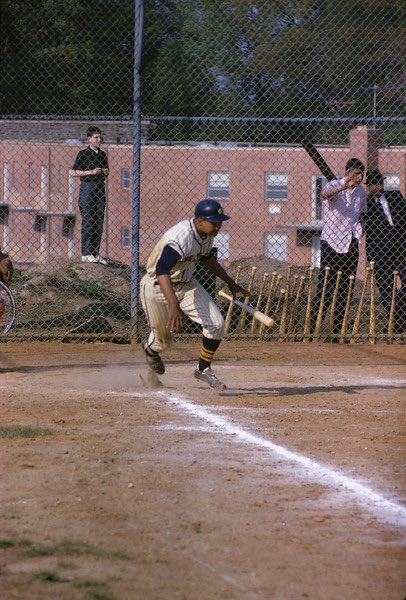
Reggie Jackson playing baseball for Cheltenham High School,
outside Philadelphia, Spring 1964. The color is real.

Angelo Cataldi, the morning man on all-sports radio station 610 WIP says of Philadelphia, "This town is wired for football."

I disagree. Pennsylvania is definitely a football State, but Philadelphia is a basketball city.

And yet, the city has a long and storied baseball history.

Note that I didn't say the stories were all good.

12. Philadelphia's All-Time Baseball Team

The Phillies' region is Pennsylvania between the Delaware and Susquehanna Rivers, New Jersey south of Interstate 195 plus the State capital of Trenton, and the entirety of Delaware.

Despite the fact that the Trenton Thunder are a Yankee farm team, the city is 30 miles from Philly and 60 miles from New York, and I usually see more people wearing Phils gear than Yankee gear at Thunder games (supposedly, more than half their season-ticket base lives across the river in Bucks County, Pennsylvania), so I'm counting players from Trenton as being in Philly's region, with one exception that I'll make when I do the Yankees' all-time regional team.

Each of these figures is from Pennsylvania unless otherwise stated. This team has got plenty of power, and if you're thinking about outpitching them, think again.

1B Mickey Vernon of Eddystone, Delaware County. How unlucky was this guy? He always seemed to be with losing teams, or with winning teams, before or after but never during.

He spent the majority of his career with the Washington Senators: "First in war, first in peace, and last in the American League." He got to the Cleveland Indians after they won the 1948 World Series, went back to Washington, went to Boston after the Red Sox' 1946-51 period of contention, went back to Cleveland after their 1954 Pennant, went to the Milwaukee Braves after their 1957 and '58 Pennants. And while he did play the last 9 games of his career with the 1960 Pittsburgh Pirates, he was not included on the World Series roster and did not get a ring.

But he won the AL batting title in 1946 and 1953, led the AL in doubles in 1946, '53 and '54, had a career OPS+ of 116, and collected 2,495 hits, 490 of them doubles. He hit only 172 homers, but probably would have had a lot more if he hadn’t played so many games at Griffith Stadium, Cleveland Municipal, and as a lefty at Fenway Park.

It would be nice if he were in the Hall of Fame. Alas, he's not, and the Senators are no longer around to retire any of the numbers he wore for them (more games in Number 3 than any other). He is, however, honored in the Washington Hall of Stars display at Nationals Park.

Honorable Mention to Andre Thornton of Phoenixville, Chester County. Though born in Tuskeegee, Alabama, he's a Delaware Valley man, who had a 122 OPS+, and 253 homers despite playing most of his home games at Cleveland Municipal Stadium. He was a 2-time All-Star who had 2 (very nearly 3) 100-RBI seasons. One of the most decent baseball men of his era, he is a member of the Cleveland Indians Hall of Fame.

2B Eddie Stanky of Northeast Philadelphia. Leo Durocher, his manager for the Brooklyn Dodgers and later the New York Giants, said of him, "He can't hit, he can't run, and he can't throw. All he can do is beat you." He won Pennants with the Dodgers in 1947, the Boston Braves in 1948, and the Giants in 1951. (The reason the Dodgers traded him after '47 is that he wouldn't get along with Jackie Robinson. He had a house and business interests in Alabama, and went coward on that basis.)

He was just a .268 hitter lifetime, but drew 996 walks in just 7 full seasons, leading the NL 3 times and thus in on-base percentage twice. He made 3 All-Star teams. He also managed in the majors, but the closest he came to a Pennant was with the 1967 Chicago White Sox, 3 games back but in 4th place.

SS Hugh Jennings of Pittston, Luzerne County. I had to go back a ways for the shortstop on this team, but found a good one. He starred on the NL Champion Baltimore Orioles of 1894, '95 and '96 with John McGraw and Willie Keeler, and also played with them on the 1899 and 1900 NL Champion Brooklyn Superbas (forerunners of the Dodgers). Brooklyn wouldn't win another major-league World Championship without him as a player until 1955, and Baltimore not until 1966.

I could also have made Jennings the manager of this team, as he led the Detroit Tigers to the 1907, '08 and '09 Pennants. He later became one of McGraw's coaches on the Giants, and briefly subbed for him as manager in the 1924 and '25 seasons. Known for, and by, his shout of "Ee-yah!", and for being hit with more pitches than any player in baseball history (287), he is in the Hall of Fame.

3B George "Whitey" Kurowski of Reading, Berks County – not to be confused with Reading in Berkshire, England. A 4-time All-Star, he played on 4 Pennant winners for the St. Louis Cardinals, and was a key figure in 2 World Series. In Game 5 in 1942, he hit a 9th-inning home run at Yankee Stadium to give the Cards the lead, enabling them to clinch. But in Game 2 in 1943, also at Yankee Stadium, Johnny Lindell slid into 3rd base, and kicked away a throw that would have nailed him, and the Yankees won that game and the next 3 to win the Series.

Kurowski also played on the Cards' World Series winners in 1944 and 1946, although an injury finished him at age 31. His lifetime batting average was .286, and he had a 125 OPS+. He only played 6 full seasons, but had 100 RBIs in 2 of them.

Honorable Mention to William Julius "Judy" Johnson of Wilmington, New Castle County, Delaware. Because he played in the Negro Leagues, mostly for the Philadelphia Hilldales, we can only guess as to how good he really was, but he impressed the Hall of Fame's Committee on the Negro Leagues to elect him to the Hall.

He was also the 1st person inducted into the Delaware Sports Hall of Fame. The home of the Carolina League's Wilmington Blue Rocks, the only professional team in Delaware at the moment, is named Judy Johnson Field at Daniel S. Frawley Stadium (Frawley being the Mayor who brought minor-league ball back to Wilmington).

LF Leon "Goose" Goslin of Salem, Salem County, New Jersey. The only South Jersey native in the Hall of Fame, he had a .316 lifetime batting average, an OPS+ of 128, 2,735 hits, 500 doubles, 173 triples, 248 homers, 12 100-RBI seasons, the 1928 AL batting title at .379, and played in the World Series with the Washington Senators in 1924 (won) and '25 (lost), and the Detroit Tigers in 1934 (lost) and ’35 (his bottom of the 9th single won Game 6 and the Series). When The Sporting News announced its 100 Greatest Baseball Players in 1999, he came in at Number 89.

Honorable Mention to Del Ennis of Olney, North Philadelphia. A hometown hero, he led the NL in RBIs in 1950, 1 of 7 100-RBI seasons for him, and was the biggest bat on the 1950 Pennant-winning Phillies "Whiz Kids." An injury knocked him out age 34, but he hit 288 home runs, 259 of them as a Phillie, making him the franchise's all-time leader until Mike Schmidt came along. With a career OPS+ of 117, and over 2,000 hits, he is a member of the Philadelphia Baseball Wall of Fame.

Honorable Mention to George Case of Trenton, Mercer County, New Jersey. A graduate of The Peddie School, a prep school in Hightstown, Case played most of his career with the Washington Senators, and led the AL in stolen bases 6 times. The closest he came to a Pennant was in 1945, when the Senators finished a game behind the Tigers. But in an era when few players ran like that, he stood out.

CF Mike Trout of Millville, Cumberland County, New Jersey. Yes, already. The Los Angeles Angels of Anaheim star is just 22, and has played only 2 full seasons in the majors, but look at them. In the 1st, 2012, he batted .326, led the AL in runs, stolen bases and OPS+, was named Rookie of the Year. In the 2nd, 2013, he batted .323, led the league in runs and walks, and came close to a 100-RBI season. In each year, he made the All-Star Team and finished 2nd in the MVP voting. He's already hit 62 home runs and stolen 86 bases. He's already the greatest player ever to come from Cumberland County.

Looking at the rest of that part of New Jersey that tilts toward Philadelphia rather than New York, aside from Goslin’s Salem, Case’s Mercer and Trout's Cumberland, the best player from South Jersey's Counties are:

Atlantic County: John Henry "Pop" Lloyd, who was born in Florida but grew up and played part of his professional career in Atlantic City, where a local park is named for him, and is one of the Negro Leaguers in the Hall of Fame. Unfortunately, since I don't have big-league stats for this man, often called the greatest shortstop in Negro League history, I can't make him a starter on this team.

Burlington County: See below.

Camden County: Ray Narleski of Collingswood, a star reliever for the 1950s Indians including their 1954 Pennant winners.

Gloucester County: Abram Harding "Hardy" Richardson of Clarksboro, an 1880s star with 2 teams that no longer exist, the NL's Buffalo Bisons and Detroit Wolverines, winning the 1887 Pennant with Detroit, while Dan Meyer of Woolwich is currently pitching for the Florida Marlins.

RF Carl Furillo of Stony Creek Mills, Berks County. Grew up just outside Reading, and with his powerful right arm became known as the Reading Rifle. His love of scungilli also got him the nickname "Skoonj."

At the bottom of the scoreboard in right field at Ebbets Field was a sign, posted by a man who would ride that sign's fame to the Presidency of first the New York City Council and then the Borough of Brooklyn: "HIT SIGN WIN SUIT. ABE STARK. Brooklyn's Leading Clothier." With Dixie Walker and then Furillo playing right field, it was believed that Mel Ott was the only player to hit that sign on the fly. When it was suggested to Stark that he give Furillo a free suit, for having saved him from having to give out so many, he did.

Furillo was a good hitter, too: Lifetime batting average .299, OPS+ of 112, 5 times a .300 hitter including the 1953 NL batting title at .344. He played on 7 Pennant winners with the Dodgers, including the 1955 (Brooklyn) and 1959 (Los Angeles) World Championships.

Even more notably, he retired due to injury in 1960, and sued the Dodgers over not telling him how bad his injury was… and won. Imagine that, suing Dodger owner Walter O’Malley, the most powerful man in baseball (who pulled the strings for Commissioner Ford Frick), and himself a lawyer, and winning! Furillo went to work for Otis Elevators, and helped install the elevators in the World Trade Center as it went up in the late 1960s and early 1970s.

DH Reginald Martinez Jackson of Wyncote, Bucks County. I was going to put Reggie in right field, even with his glove, but I couldn't resist putting Furillo in there. Because of when and where I first came into sports awareness, Reggie remains my favorite athlete of all time.

With the Oakland Athletics, New York Yankees and California Angels (as the Anaheim franchise was then known), he reached 11 postseasons, winning 6 Pennants (and just missing 3 others by a game) and 5 World Championships: 1972, '73 and '74 with the A's, and 1977 and '78 with the Yanks. He is the only man to win World Series MVP awards with 2 teams, with the '73 A's and the '77 Yanks, featuring his 5 homers in the latter Series, 3 in the clinching Game 6. His career total is 563, making him the leader among all players born between 1936 (Harmon Killebrew) and 1963 (Mark McGwire).

Hall of Fame, Number 9 retired by the A's, Number 44 retired and Monument Park plaque dedicated by the Yanks. (The Angels have a team Hall of Fame, but Reggie has not yet been elected to it or had his Number 44 retired by them.) When The Sporting News announced its 100 Greatest Baseball Players in 1999, he came in at Number 48. They call him Mr. October, but he remains a man for all seasons.

C Roy Campanella of Nicetown, North Philadelphia. Don't let the name fool you: For as long as I can remember, "Nicetown" has been a ghetto and not very nice. But Campy was. In the 1940s with the Baltimore Elite Giants of the Negro Leagues, and in the 1950s with the Brooklyn Dodgers, he built a Hall of Fame career, including 3 NL MVPs, 5 Pennants and the 1955 World Championship.

A car crash ended his career and paralyzed him for life at age 36, but for years, Dodger fans said he was better than Yogi Berra across town. He remained on the Dodger payroll until his death in 1993, long after the Dodgers moved to Los Angeles, and his Number 39 was retired, along with Jackie Robinson’s 42 and Sandy Koufax's 32, in a 1972 ceremony at Dodger Stadium, the 1st numbers retired by the franchise. When The Sporting News announced its 100 Greatest Baseball Players in 1999, he came in at Number 50.

Mike Piazza of Norristown, Montgomery County is not on this team. Never mind the steroid accusations, for which we have every bit as much proof as we do for his nemesis, Roger Clemens: He couldn't play the position of catcher, and Campy was a better hitter. He can be the righthanded platoon at DH with the lefthanded Reggie.

Honorable Mention to Doug Allison of Philadelphia: He was the catcher on the 1st openly professional team, the 1869-70 Cincinnati Red Stockings, and lasted long enough to be a member of the 1879 NL Champion Providence Grays. He is also the earliest known player to use a glove, using buckskin mittens to protect his hands with the 1870 Red Stockings.

Honorable Mention also to Allison's teammate, Dick Hurley of Honesdale, Wayne County, who is listed as the "substitute" for the 1869-70 Red Stockings. It seems the position he most played in pro ball after leaving Cincinnati was right field. Not all that well, apparently: He appears to have last played for the 1872 Washington Olympics of the National Association, not a good team even by the standards of the Ulysses S. Grant Administration.

SP Christopher "Christy" Mathewson of Factoryville, Wyoming County. Was he the greatest pitcher of them all? We'll never know how he would have done in the Lively Ball Era, unlike Walter Johnson and Grover Cleveland Alexander who pitched well into the 1920s. But "Big Six" (he was 6-foot-1 when that was considered very tall) was, from 1901 to 1914, probably the greatest pitcher the planet had yet seen.

His 373 wins are tied for 3rd all-time, 1st in NL play, with Alexander. (Cy Young's 511 were split between the Leagues, and Walter Johnson had 417, all in the AL.) A 2.13 ERA, an ERA+ of 136, so he was 36 percent better in ERA than the pitchers of his time. WHIP 1.058 -- that is sick. His 2,507 strikeouts were 2rd all-time behind Young at the time of his retirement. His 79 shutouts were a record until surpassed by Johnson.

He pitched the Giants to the 1904 Pennant, and in 1905 pitched 3 shutouts as the Giants won the World Series over the Philadelphia Athletics. But that was his last title: The Giants just missed the Pennant in 1908 (Mathewson started the "playoff" forced by Fred Merkle's Boner and lost it), and they lost the World Series in 1911, 1912 (Mathewson lost the deciding Game 8) and 1913. Still, he was the most beloved player of his day.

Exposure to poison gas while training for World War I, and the subsequent Spanish flu epidemic, both damaged his lungs, and when tuberculosis struck, he never had a chance. He died in 1925, just 45 years old, and a nation mourned.

He was one of the 1st 5 players elected to the Hall of Fame in 1936 -- the only one already dead. (Ty Cobb, Babe Ruth, Honus Wagner and Johnson were still alive.) Although he played before uniform numbers were worn, the Giants, long after moving to San Francisco, placed an "NY" alongside their retired numbers, first at Candlestick Park and then at AT&T Park. He was elected to the All-Century Team. That same year, when The Sporting News announced its 100 Greatest Baseball Players, he came in at Number 7.

He also played football at Bucknell University, and their stadium is named for him. His brother Henry also briefly pitched in the majors.

SP Ed Walsh of Plains, Luzerne County. "Big Ed Walsh?" Hall-of-Famer Sam Crawford said of the great Chicago White Sox spitballer. "You talk about spitballs? I think that ball disintegrated, and came back together when the catcher got a hold of it! I swear, when it went past the plate, it was just the spit went by!"

It was an easy thing to believe: Then a legal pitch, Walsh used the spitter to win 195 games against just 126 losses, with a career WHIP of exactly 1.000 and an all-time record low ERA of 1.82 -- for an ERA+ of 146, so he wasn't just taking advantage of the Dead Ball Era.

In 1906, he helped the White Sox win the World Series in a big upset over the crosstown Cubs. In 1908, he went 40-15, pitching a 20th Century record 484 innings. That included a 15-strikeout performance late in the season against the Cleveland Indians -- but Walsh lost the game, because opposing pitcher Addie Joss threw a perfect game. (Ty Cobb's Tigers edged them both for the Pennant.)

In 1910, architect Zachary Taylor Davis supposedly consulted Walsh on how to design the Sox' new home, and this is believed to be why Comiskey Park, for all of its 80-year life, was a pitchers' park. (Davis would also design what became Wrigley Field in 1914.) After back-to-back 27-win seasons in 1911 and '12, Walsh appeared to lose it, having had his last good season at age 31. Still, he's in the Hall of Fame.  When The Sporting News announced its 100 Greatest Baseball Players in 1999, he came in at Number 82.

He died on May 26, 1959 -- the day Harvey Haddix outdid both Walsh and Joss by pitching a perfect game for 12 innings, and losing the game in the 13th! Big Ed's son, Ed Walsh Jr., also pitched for the White Sox, while Big Ed was a Sox coach, though not nearly as well.

SP Stan Coveleski of Shamokin, Northumberland County. "There was nothing strange in those days about a twelve-year-old Polish kid working in the mines for 72 hours a week at a nickel an hour," he said late in life. "What was strange is that I ever got out of there."

He pitched for the hometown Athletics, but was sold because Connie Mack and the Shibe brothers needed the money. Big mistake. He was the ace of the 1920 World Champion Indians, and also pitched in the Series for the 1925 Washington Senators (though they lost) and the 1928 Yankees (they won). He went 216-142 for his career, and he was elected to the Hall of Fame. He lived his post-baseball life in South Bend, Indiana, where the minor-league ballpark is named Stanley Coveleski Regional Stadium and is home to the South Bend Silver Hawks.

SP Orel Hershiser of Cherry Hill, Burlington County, New Jersey. Born in Buffalo, New York, but a graduate of Cherry Hill High School East. Putting together a superb career record of 204-150, he reached the postseason with the Dodgers in 1985 and '88 (and almost in '91, and would have again if the Strike of '94 hadn't hit), the Indians in '95, 96 and '97, the Giants in '98 and the Mets in '99.

He went 23-8 with a 2.26 ERA in 1988, including pitching a record 59 consecutive scoreless innings to close the regular season. He was one of the rare pitchers who deserved a regular-season MVP, it went instead to his teammate Kirk Gibson; while Gibson is remembered for his walkoff homer in Game 1 of the World Series, Hershiser won Games 2 and 5 (the clincher) to take the Series MVP. He was 8-3 with a 2.59 ERA in postseason play. He is now a broadcaster with ESPN, and is generally regarded as one of the smartest men in baseball.

Does he deserve to be in the Hall of Fame? He’s been eligible since 2006. Baseball-Reference.com's HOF Monitor has him at 90 of 100, meaning he comes close but doesn't get in; and their HOF Standards have him at 34 out of 50, meaning he doesn't come all that close. Of their 10 Most Similar Pitchers, only 2, Catfish Hunter and Dazzy Vance, are in; the others include Bob Welch, Kevin Brown, Vida Blue and Dave Stieb.

SP Mike Mussina of Montoursville, Lycoming County. From 1991 to 2000, "Moose" won 147 games and lost just 81 for the Orioles, with an ERA+ of 130 and a WHIP of 1.175. He helped them reach the ALCS in 1996 and '97. Once he retired from the game, he was elected to their team Hall of Fame.

He left the O's for their rivals, the Yankees, where he won another 123 games and lost just 72. In total, he went 270-153, a winning percentage of .638. He never won a World Series, although he did pitch in the 2001 and 2003 editions for the Yankees. He went 20-9 in 2008, finally winning 20 at age 39, and then retired. (Maybe it was for the best: I was at the 2009 Old-Timers' Game at Yankee Stadium II, and he pitched in it, and he was awful, letting guys in their 50s and 60s get hits off him, and David Cone had to come in to bail him out; 4 years older, Coney had better stuff that day than the Moose.)

Mussina is now eligible for the Hall of Fame, but didn't get in this time. As video producer Sean C. Dunn, who sponsors Mussina's Baseball-Reference.com page, points out, there's only 6 pitchers with at least that many wins and a better winning percentage. In chronological order: John Clarkson, Christy Mathewson, Grover Cleveland Alexander, Lefty Grove, Roger Clemens and Randy Johnson. B-R's HOF Monitor has him at 121 (meaning he absolutely should be in), and their HOF Standards have him at 54 (which also qualifies him).

Honorable Mention to SP William "Bucky" Walters of Germantown, North Philadelphia. He pitched for his hometown Phillies from 1934 to 1938, in Baker Bowl with its dilapidated condition and a 280-foot right-field fence. Needing cash, the Phils traded him to the Cincinnati Reds, and that was the best thing that could have happened to him.

In 1939 the Reds won the Pennant, and in 1940 they won the World Series. Walters led the NL in wins, ERA, ERA+, innings pitched, WHIP, fewest hits per 9 IP and complete games in both seasons, going 49-21 – not counting going 2-0 in the '40 Series, although he was 0-2 in the '39 edition. He also led the NL in strikeouts in '39. He went 27-11 in '39, 22-10 in '40, and 23-8 in '44.

His career record was 198-160 ,with an ERA+ of 115, and if he hadn't pitched all those games for a lousy team in a lousy ballpark, he'd probably have about 230 wins and he might be in the Hall of Fame. The Reds have elected him to their team Hall of Fame, although his Number 31 remains in circulation. (John Franco, for one, wore it for the Reds.)

Honorable Mention to Curt Simmons of Egypt, Lehigh County. Another local guy on the Phillies, he was the 2nd-best pitcher on the 1950 "Whiz Kids," going 17-8, but with the Korean War raging, he was drafted right before the regular season ended, costing him an appearance in the World Series (and, quite possibly, denying the Phils a good chance at beating the Yankees).

He got another chance at glory in 1964, going 18-9 at age 35, helping the Cardinals win the Series over the Yankees, but had to beat the Phillies with that amazing comeback (and Phils choke) to do it. He won 193 games in his career, and would have won a lot more had he not spent the first half of his career with the Phils.

Honorable Mention to Bobby Shantz of Pottstown, Montgomery County. Officially, he was 5-foot-6. Unofficially, he was the last in a long line of great pitchers for his hometown Philadelphia Athletics. In 1951, with an A's team that won only 70 games, he went 18-10, and he was just getting warmed up. In 1952, with the A's winning just 79 and finishing 4th, he went 24-7 with a 2.48 ERA (an ERA+ of 159) and a 1.048 WHIP. He was named AL MVP that season, ahead of World Champion Yankees like Mickey Mantle and Yogi Berra.

After moving to Kansas City, the cash-strapped A's traded him to the Yankees, and in 1957 he led the AL in ERA with 2.45, helping the Yankees win the Pennant. Becoming a reliever, he was a major factor in the Yanks winning the 1958 World Series. He ended his career back in his home market; unfortunately, this was with the 1964 Phillies.

He finished 119-99, a good record considering he was mainly a reliever from age 31 onward. He is a member of the Philadelphia Baseball Wall of Fame, although his plaque is now at the Philadelphia Athletics Historical Society display in Spike's Trophies in Northeast Philly.

Honorable Mention to Danny McDevitt of Hallstead, Susquehanna County, near the New York State Line in the northeastern corner of Pennsylvania. He had only a 22-27 career record, but he did pitch a shutout to win the last game ever played at Ebbets Field, a 2-0 Brooklyn win over Pittsburgh. He was also on the Los Angeles staff that won the 1959 World Series.

In 2007, he threw out the first ball before a Brooklyn Cyclones game to commemorate the 50th Anniversary of the Dodgers' forced farewell to the Borough.

Honorable Mention to Chris Short of Milford, Kent County, Delaware. There have been 52 MLB players born in The First State, and the greatest of them -- aside from Judy Johnson, for whom we don't have reliable stats -- is probably Short, another pitcher for the '64 Phils. He won 135 games in he major leagues, all but 3 for the Phils, and is in the Philadelphia Baseball Wall of Fame.

RP Bruce Sutter of Mount Joy, Lancaster County. Injury limited him to only 1 full season after age 32, but from 1976 to 1984 (ages 23 to 31), he was as good a reliever as there ever was. In 1977, with a good but not great Chicago Cub team, he went 7-3 with 31 saves, a 1.34 ERA and a 0.857 WHIP. He pitched 107 innings, struck out 129, and walked just 23 (only 16 unintentionally). That's unreal. In 1979 with 37, he tied the NL single-season record for saves; in 1984 with 45, he broke it.

He went to the Cubs' arch-rivals, the St. Louis Cardinals, and led them to the 1982 World Series against the Milwaukee Brewers, striking out Gorman Thomas for the last out. The Cards traded him to the Atlanta Braves prior to 1985, and they would pay dearly for that as they lost the Series in ’85 and again in '87. But maybe, due to his injuries, Sutter couldn’t have helped.

He finished with 300 saves (2nd all-time behind Rollie Fingers at that point and the most in the NL), an ERA+ of 136 and a WHIP of 1.140. In 2006, he was elected to the Hall of Fame, and the Cards retired his Number 42 (which, of course, he wore before it was retired for all of baseball for Jackie Robinson).

MGR and GM Dallas Green of Newport, New Castle County, Delaware. A mediocre pitcher for the Phillies, going 2-1 with a 5.79 ERA, mostly in relief, for the infamous 1964 squad, he redeemed himself as their manager, leading them to their 1st World Championship in 1980. He also led the Phils to the 1st-half NL East title in the strike-split 1981 season, before the Chicago Cubs hired him away to be their general manager. As such, he made the trade that brought Ryne Sandberg to Chicago, and the Cubs won the 1984 and 1989 NL East crowns as a result of his deals. He later managed both the Yankees and the Mets, neither with success.

For the last few years, he has been back in Philadelphia as a special adviser to the Phils. He is a member of the Philadelphia Baseball Wall of Fame, and the fact that he led both the Phillies and the Cubs, perennial losers, to more than one postseason berth suggests that he belongs in Cooperstown as well. Certainly, the Phillies should retire his Number 46.

Tommy Lasorda of Norristown was also a mediocre pitcher before managing, but I didn't make him the manager of this team, for one simple reason: I don't like him. Okay, maybe for a second simple reason: Dallas Green might bite my head off otherwise. What's Tommy gonna do, sit on me?

Wilmington, New Castle County natives Robert Ruliph Morgan Carpenter Jr. and his son Robert III, a.k.a. "Bob" and "Ruly" Carpenter, who owned the Phillies from the 1940s to the 1980s, are the owners of this team.

Sunday, March 30, 2014

How to Be a Yankee Fan in Houston -- 2014 Edition


The Yankees start the 2014 season in Houston, the same city in which they ended the 2013 season.

It still seems strange to me to see the Houston Astros in the American League, just as it's strange to see the Milwaukee Brewers in the National League. But, that's the way it is now.

I should have gotten this done sooner, as the opener is at 7:10 PM Eastern Time on Tuesday, giving you about 2 days to get there, if you are inclined to go. And this Tuesday, Wednesday and Thursday are the only games the Yankees will play in Houston this season.

So this is my only chance to do this -- and since technical difficulties stopped me from doing it for Houston last season, I have to do it now.

Disclaimer: I have never been to Texas, let alone to Houston, so all of this information is secondhand at best, although much of it comes from the Astros' own website.

Before You Go. The Houston Chronicle is predicting daytime temperatures in the high 70s and low 80s, and nighttime temperatures from the mid-60s to the low 70s, plus a 20 percent chance of rain on Tuesday. This won't matter during the game, since the retractable roof will likely be closed in order to keep out Houston's infamous heat and humidity anyway -- making you glad you're going in April, not later in the year. But you won't be indoors for the entire visit, so dress accordingly and bring an umbrella.

Houston is in the Central Time Zone, so you’ll be an hour behind New York time. Although Texas was a Confederate State, you won't need to bring your passport or change your money.

Tickets. The Astros averaged 20,394 fans per game last season, which was actually up from their 2012 figure, despite having the worst season, record-wise, in club's history. But then, even at their all-time peak, in 2006 and 2007, in the wake of the preceding 2 seasons being the first one in which they ever won a postseason series and the first one in which they ever won a Pennant, they topped out at 37,000 seats, leaving them nearly 5,000 short of the park's current listed capacity of 42,060 seats. Getting tickets for the opener might be a problem, but for the other 2, it should not be.

In spite of using "Dynamic Pricing," due to it being the Yankees in town, tickets are considerably cheaper than we're used to in New York. Forget the Dugout Boxes and Field Boxes, but Mezzanine seats are $56 for the opener and half that, $28, for the other games; upper "View Deck I" seats are $37 and $23, "View Deck II" are $34 and $23, and there is a special "Outfield Deck" section where seats for $25 and $19.

Getting There. It’s 1,629 miles from Times Square in New York to downtown Houston, and 1,637 miles from Yankee Stadium to Minute Maid Park. You’re probably thinking that you should be flying.

The good news: Flying to Houston can be done for as little as $453. Considering how far it is, that is relatively cheap. The bad news: Your flight won't be nonstop: You'll have to change planes in either Dallas or Charlotte to get to Houston George Bush Intercontinental Airport. (That's named for the father, not the son.)

There are only 2 ways to get there by train. One is to change trains in Chicago, and then change to a bus in Longview, Texas. The other is to change trains twice, in Washington and New Orleans, and then stay overnight in New Orleans. No, I'm not making that up. You don't want that -- and don't be fooled by the fact that Houston's Union Station and the ballpark are next-door to each other, because Amtrak uses a different station a mile away. So let's just forget Amtrak, and move on.

Greyhound allows you to leave Port Authority Bus Terminal at 8:15 PM tonight, and arrive at Houston at 1:25 on Tuesday, a trip of 42 hours and 10 minutes. But that would require changing buses in Richmond (an hour and 5-minute layover), Atlanta (also 1:05) and New Orleans (45 minutes). It also includes layovers of 25 minutes in Raleigh, 1:10 in Charlotte, and then there's Alabama, with half an hour in Montgomery and an hour and 10 minutes in Mobile. Then 20 minutes in Baton Rouge. And you'd have to leave tonight, Sunday, in order to make it by the Tuesday night game. It's $415 round-trip, so you're better off spending a little extra and flying. The Houston Greyhound station is at 2121 Main Street, a mile and a half from the ballpark.

If you actually think it’s worth it to drive, get someone to go with you so you’ll have someone to talk to and one of you can drive while the other sleeps. You’ll be taking Interstate 78 across New Jersey and into Pennsylvania to Harrisburg, where you'll pick up Interstate 81 and take that through the narrow panhandles of Maryland and West Virginia, down the Appalachian spine of Virginia and into Tennessee, where you'll pick up Interstate 40, stay on that briefly until you reach Interstate 75, and take that until you reach Interstate 59, which will take you into Georgia briefly and then across Alabama and Mississippi, and into Louisiana, where you take Interstate 12 west outside New Orleans. Take that until you reach Interstate 10. Once in Texas, Exit 770 will get you to downtown Houston.

If you do it right, you should spend about an hour and a half in New Jersey, 3 hours in Pennsylvania, 15 minutes in Maryland, half an hour in West Virginia, 5 and a half hours in Virginia, 3 hours and 45 minutes in Tennessee, half an hour in Georgia, 4 hours in Alabama, 2 hours and 45 minutes in Mississippi, 4 hours and 30 minutes in Louisiana and 2 hours in Texas. Including rest stops, and accounting for traffic, we’re talking about a 40-hour trip.

Even if you’re only going for one game, no matter how you got there, get a hotel and spend a night. You’ll be exhausted otherwise. Trust me, I know: Trains and buses are not good ways to get sleep.

Once In the City. Houston was founded in 1836 as Allen's Landing, and was renamed for Sam Houston, "the Father of Texas." There are 2.1 million people in the city proper, making it the 4th-largest in America, and 6.2 million in the metropolitan area, making it 5th.

The sales tax in the State of Texas is 6.25 percent, but in the City of Houston it goes up to 8.25 percent. The city doesn't appear to have a "centerpoint," where the address numbers start at 1, but there is a Main Street, running northeast/southwest.

There is a light rail system, called METRORail, but you probably won't need it to get from a downtown hotel to the ballpark. One zone is $1.25, and the price rises to $4.50 for 4 zones, so a daypass is a better bargain at $3.00.

Going In. Minute Maid Park is in Downtown Houston. The mailing address is 501 Crawford Street. Parking is $15. Crawford Street bounds the left field side, Texas Avenue the 3rd base side, Hamilton Street the 1st base side and Congress Street the right field side. The ballpark points due north, but that won't matter, since its only "open" side, left field, has a window that doesn't face any neat-looking skyscrapers.

Unlike the Astrodome, "the Juice Box" has real grass. Also unlike its infamous predecessor, it is definitely a hitter's park. The left-field pole is just 315 feet from home plate, with the Crawford Boxes (named for the street) above. Left-center is 362, deep left-center is 404, center is 436, right-center is 373, and the right-field pole is 326.

Originally named Enron Field when it opened in 2000, the park was nicknamed Ten Run Field -- before Enron became the largest bankruptcy ever to that point, and Coca-Cola bought the naming rights and stuck the Minute Maid brand name, which it owned, on the stadium.

This change in the stadium name, but not in the propensity for offense, led Yankee broadcaster John Sterling, during an Interleague game there, to tell partner Charlie Steiner, "You know, Charlie, I understand that, at Minute Maid Park, the balls are juiced." To which Steiner said, "Ah, that's just pulp fiction."

Left field features a CITGO sign, but that and the 315-foot distance are the only things that will remind anyone of Fenway Park in Boston. While a rail line does go past Fenway, the Red Sox don't incorporate that into the park. Here, they do, with an old-style steam locomotive chugging past for each Astro home run.

Center field features Tal's Hill, an incline in the mode of Cincinnati's old Crosley Field. It's named for Tal Smith, longtime Astro executive. And, like the pre-renovation old Yankee Stadium and Tiger Stadium in Detroit, the flagpole is on the field and in play. Above the Hill is the Phillips 66 Home Run Pump, a mockup of an old-style gasoline pump that displays how many Astro home runs have been hit there since the 2000 opening.

The foul poles have Chick-fil-A cows on them, reading "EAT MOR FOWL," as opposed to the chain's usual "EAT MOR CHIKN." When an Astro hits one of these "fowl poles" on the fly, every fan in attendance gets a coupon for a free chicken sandwich. Hunter Pence, now with the San Francisco Giants, was the first to hit the left-field pole, and former Met Kazuo Matsui was the first to hit the right-field pole.

Food. Being a “Wild West” city, you might expect Houston to have Western-themed stands with “real American food” at its ballpark. Being a Southern State, you might also expect to have barbecue. And you would be right on both counts. They have Tex-Mex food at Goya Latin Cafe and La Cantina at Section 119, El Real Fajita at 131, Kickin' Nachos at 114 and 427, Maverick Smokehouse at 124 and 410, Taqueria and Grille at 216, and Rosa's Cantina at 411 (almost certainly named for the place in the Marty Robbins song "El Paso," even if that is on the other side of the State).

They work the train theme with All Aboard at 109, Union Station at 113, Dining Car Grill at 125, Whistle Stop Libations at 218 and Chew Chew Express at 416.

There’s also stands with baseball-themed names: Baseball Bar at 207 and Little Biggs Slider Cart at 111. Chinese food is at Larry's Big Bamboo at 118 and Little Bamboo at 422, and there are 5 Papa John's Pizza stands. And there are several Blue Bell Ice Cream stands.

Team History Displays. The Astros, like the Mets, celebrated their 50th Anniversary season in 2012, so they now have plenty of history. However, also like the Mets, it's a very hit-and-miss history. They have made the postseason 9 times, but only won 1 Pennant, in 2005. Stanchions representing that Pennant, their NL Western Division titles of 1980 and '86, and their NL Central Division titles of 1997, '98, '99 and 2001 are on the left-field wall.

The club's retired numbers crown the scoreboard in right field. Officially, there are 9 of them: 32, 1960s pitcher Jim Umbricht, who died of cancer while still a young player; 40, 1970s pitcher Don Wilson, who also died while still active; 24, 1960s-70s outfielder Jimmy Wynn; 25, 1970s outfielder Jose Cruz; 49, 1970s pitcher, 1990s manager, and on-again-off-again broadcaster Larry Dierker; 34, 1980s pitcher Nolan Ryan, a Houston-area native; 33, 1980s pitcher Mike Scott; and the 2 men who got the Astros through their 1990s and 2000s postseason berths, 5, 1st baseman Jeff Bagwell, and 7, 2nd baseman Craig Biggio.

The universally-retired 42 for Jackie Robinson, who was already elected to the Hall of Fame before the Astros ever played a game, is also on that wall. This is somewhat appropriate, seeing as how the Astros were the first MLB team to play in a former Confederate State, acknowledging that the arrival of Robinson and other nonwhite players was a good thing.

Not on that wall, and not officially retired, but neither have they been reissued, are the 17 of 2000s 1st baseman Lance Berkman, and the 57 of 1990s pitcher Darryl Kile, who died while with the St. Louis Cardinals in 2002. The Astros do not have a team Hall of Fame.

Ryan and Roger Clemens, born in Ohio but grew up in the Houston suburbs with Ryan as his hero, were named to the Major League Baseball All-Century Team in 1999, although Clemens hadn't yet thrown a pitch for the Astros. That same year, they and Joe Morgan were named to The Sporting News' 100 Greatest Players. Were that list to be done again, Biggio might make it, while Bagwell would have an outside shot.

Stuff. Minute Maid Park has a Team Store in the left field corner of the ballpark, selling standard team-store gear. This being Texas, cowboy-style hats with the team logo are available.

A 50th Anniversary (1962-2012) team video is available, and so is a CD of longtime Astro broadcaster Milo Hamilton (who is probably best known not for any of his Astros' calls but for calling Hank Aaron's 715th home run while with the Braves). But since the Astros have only been in 1 World Series (2005), and got swept in it, don't look for the official highlight video. The only way you'll see highlights of their 2005 Pennant run is on the anniversary DVD.

As for books about the team, Sara Gilbert (not the Roseanne actress) has published a 50th Anniversary retrospective, with the not-very-imaginative title of The Story of the Houston Astros. Jose De Jesus Ortiz and former Astro catcher Brad Ausmus commemorated the 2005 Pennant season with Houston Astros: Armed and Dangerous.

During the Game. If you were wearing Dallas Cowboy gear to a Houston Texans game, you might be in trouble. But Astro fans aren't especially hostile to New Yorkers, so safety won't be an issue.

The Astros' mascot is Orbit, a "little green man" alien, tying in with the Astrodome's space-age theme. When the new park opened, he was replaced with Junction Jack, a jackrabbit dressed in an old-time railroad engineer's uniform, tying in with the train theme. But fans wanted Orbit back, and in 2013, he returned and Jack was dumped.

During the 7th inning stretch, after playing "Take Me Out to the Ballgame," the Astros play that classic Texan song "Deep in the Heart of Texas." They do not appear to have a postgame victory song.

After the Game. Houston is a comparatively low-crime city, and as long as you behave yourself, they'll probably behave themselves, win or lose.

Across Texas Avenue at Hamilton Street, opposite the home plate entrance, is -- yet another ordinary name -- Home Plate Bar and Grill. As far as I can tell, it's the only bar around the park with a baseball-themed name. A block down Hamilton, at Franklin Street, is a place with a much better name: Joystix. Sadly (if you're looking to have drinks and fun after the game), this is a place that sells old pinball machines and video games, not a 1980s nostalgia place (which would tie in with the Astros' most successful period until 1997), not a combination 1980s-style mall (or beach boardwalk) arcade and modern bar. It's probably just as well: Can you imagine the combination of Pac-Man and beer (or worse, Missile Command and whiskey)?

Lucky's Pub appears to be the go-to bar for New Yorkers living in the Houston area. It is at 801 St. Emanuel Street at Rusk Street, 5 blocks from Minute Maid Park, adjacent to BBVA Compass Stadium, the new home of MLS' Houston Dynamo.

I can find no mention of a place in Houston for expatriate New Yorkers, not even a place where Giants or Jets fans living there go to watch their boys on autumn Sundays.

Sidelights. In 1965, the Astrodome opened, and was nicknamed "The Eighth Wonder of the World." It sure didn't seem like an exaggeration: The first roofed sports stadium in the world. (Supposedly, the Romans built stadia with canvas roofs, but that's hardly the same thing.) The Astros played there until 1999, and then moved into Enron Field/Minute Maid Park for the 2000 season. The AFL/NFL's Oilers played at the Astrodome from 1968 to 1996, when they moved to Tennessee to become the Titans.

In 2002, the new NFL team, the Houston Texans, began play next-door to the Astrodome, at NRG Stadium, which, like Minute Maid Park, has a retractable roof. Suddenly, the mostly-vacant Astrodome seemed, as one writer put it, like a relic of a future that never came to be. (This same writer said the same thing of Shea Stadium and, across Roosevelt Avenue, the surviving structures of the 1964 World's Fair.)

Once, the Astrodome was flashy enough to be the site of movies like The Bad News Bears in Breaking Training and Murder at the World Series. (Both in 1977. In the latter, the Astros, who had never yet gotten close to a Pennant, played the Series against the Oakland Athletics, who had just gotten fire-sold by owner Charlie Finley.)

The Astrodome also hosted the legendary 1968 college basketball game between Number 1 UCLA (with Kareem Abdul-Jabbar, then still Lew Alcindor) and Number 2 University of Houston (whose Elvin Hayes led them to victory, before falling to UCLA in that year's Final Four), the 1971 Final Four (UCLA beating Villanova in the Final), and the cheese-tastic 1973 tennis match between Billie Jean King and Bobby Riggs, the "Battle of the Sexes."

Elvis Presley sang there on February 27, 1970 and on March 3, 1974. It hosted Selena's last big concert before her murder in 1995, and when Jennifer Lopez starred in the film version, it was used for the re-creation. In 2004, the same year NRG (then Reliant) Stadium hosted the Super Bowl (which was won by... Janet Jackson, I think), the Astrodome was used to film a high school football playoff for the film version of Friday Night Lights; the old Astros division title banners can be clearly seen.

Today, though, the Astrodome seems, like the Republican Party that held a ridiculously bigoted Convention there in 1992, stuck in the past, and not just because they renominated failed President George H.W. Bush. The former Eighth Wonder of the World is now nicknamed the Lonely Landmark, and while it served as a shelter for people displaced from New Orleans by Hurricane Katrina in 2005, since 2008, when it was hit with numerous code violations, only maintenance workers and security guards have been allowed to enter. The stadium's future is not clear: Some officials are worried that demolishing it would damage the new stadium and other nearby structures.

NGR Stadium -- the name was just changed from Reliant Stadium -- hosted the 2011 Final Four (Connecticut beating Butler in the Final), and will host it again in 2016. It will host Super Bowl LI in February 2017.

It was built roughly on the site of Colt Stadium, which was the baseball team's home in their first 3 seasons, 1962, '63 and '64, when they were known as the Houston Colt .45's (spelled with the apostrophe), before moving into the dome and changing the name of the team. The climate-controlled stadium was necessary because of not just the heat and the humidity, but because of the mosquitoes. Sandy Koufax of the Los Angeles Dodgers said, "Some of those mosquitoes are twin-engine jobs."

Later, seeing the artificial turf that was laid in the Astrodome for 1966 after the grass died in the first season, due to the skylights in the dome having to be painted due to the players losing the ball in the sun, Koufax said, "I was one of those guys who pitched without a cup. I wouldn't do it on this stuff. And Dick Allen of the Philadelphia Phillies, looking at the first artificial field in baseball history, said, "If a horse can't eat it, I don't want to play on it."

The Astrodome hosted a 1988 match between the national soccer teams of the U.S. and Ecuador, which Ecuador won. NRG Stadium has hosted 2 such matches, a 2008 draw with Mexico and a 2011 win over Panama. The Mexico team has made it a home-away-from-home, playing several matches there.

The NRG complex, including the Astrodome, is at 8400 Kirby Drive at Reliant Parkway. Number 700 bus.

The NBA's Houston Rockets played at the Summit, later known as the Compaq Center, from 1975 to 2003. It's been converted into the Lakewood Church Central Campus, a megachurch presided over by Dr. Joel Osteen. 3700 Southwest Freeway at Timmons Lane. Number 53 bus.

The Houston Aeros, with Gordie Howe and his sons Mark and Marty, won the World Hockey Association championships of 1974 and 1975, while playing at the Sam Houston Coliseum, before moving into the Summit in 1975 and folding in 1978. The Beatles played there on August 19, 1965. It was built in 1937 and demolished in 1998. It replaced Sam Houston Hall, where the 1928 Democratic Convention nominated Governor Alfred E. Smith of New York, who thus became the 1st Catholic nominated for President by a major party.

The Hobby Center for the Performing Arts is now on the site. 801 Bagby Street, at Rusk Street, downtown.

The nearest NHL team to Houston is the Dallas Stars, 242 miles away. If Houston had an NHL team, its metropolitan area would rank 10th in population in the NHL.

The Houston Oilers played at Jeppesen Stadium from 1960 to 1964. They won the 1960 AFL Championship Game there, won the 1961 title game on the road, and lost the 1962 title game there -- and, as the Oilers and the Tennessee Titans, haven't gone as far as the rules allowed them to since 1961. Built in 1942, it became Robertson Stadium, and was the former home of the University of Houston football team and the former home of MLS' Houston Dynamo. The new Houston Football Stadium has been built at the site. 3874 Holman Street at Cullen Blvd. Number 52 bus.

The Dynamo have moved to BBVA Compass Stadium, at 2200 Texas Avenue at Dowling Street. Within walking distance of downtown. On January 29, 2013, it hosted its first U.S. national team match, a draw with Canada.

The Oilers played the 1965, '66 and '67 seasons at Rice Stadium, home of Rice University. Although built in 1950 and probably already obsolete, it seated a lot more people than did the Astrodome, and so Super Bowl VIII was played there instead of the Astrodome in January 1974, and the Miami Dolphins won it -- and haven't won a Super Bowl since. It has been significantly renovated, and Rice still uses it. University Blvd. at Greenbriar Street, although the mailing address is 6100 S. Main Street. Number 700 bus.

Before there were the Astros, or even the Colt .45's, there were the Houston Buffaloes. The Buffs played at Buffalo Stadium, a.k.a. Buff Stadium, for most of their history, from 1928 to 1961, when the Colt .45's made them obsolete. They were a farm team of the St. Louis Cardinals, and as a result in its last years Buff Stadium was renamed Busch Stadium. The Cardinal teams of the 1930s that would be known as the "Gashouse Gang" came together in Houston, with Dizzy and Daffy Dean, Joe Medwick, Pepper Martin and Enos Slaughter. Later Buff stars included Cleveland Indians 3rd baseman Al Rosen, Pittsburgh Pirates pitcher Wilmer "Vinegar Bend" Mizell, Negro League legend Willard Brown, Cardinal MVP Ken Boyer, and Phillies shortstop Ruben Amaro Sr.

Wanting to lure in more customers but also to beat the infamous Houston heat, lights were installed in 1930, 5 years before any major league park had them. The Buffs won 8 Texas League Pennants: 1928, 1931, 1940, 1947, 1951, 1954, 1956 and 1957. The stadium was at the southwest corner of Leeland Street & Cullen Blvd., about 2 1/2 miles southeast of downtown. A furniture store is on the site now. Number 20 bus.

The tallest building in Houston, and in all of Texas, is the JPMorgan Chase Tower, formerly the Texas Commerce Tower. It was built in 1982 at 600 Travis Street at Texas Avenue, downtown, and stands 1,002 feet tall, rising 75 stories above the concrete over the bayou.

Houston's version of New York's American Museum of Natural History is the Houston Museum of Natural Science, in Hermann Park, at Main Street and Hermann Park Drive. The Houston Museum of Fine Arts is at 1001 Bissonnet Street, just 5 blocks away. Both can be reached by the Number 700 bus.

Of course, the name "Houston" is most connected with two things: Its namesake, the legendary Senator, Governor and war hero Sam Houston, and the Johnson Space Center, the NASA control center named after President Lyndon B. Johnson, who, as Senate Majority Leader, wrote the bill creating NASA and the Space Center, because he thought it would bring a lot of jobs and money to Houston (and he was right). Most historic sites relating to Sam, however, are not in the city that bears his name. As for reaching the Johnson Space Center, it's at 1601 NASA Parkway and Saturn Lane. The Number 249 bus goes there, so if you don't have a car, Houston, you won't have a problem.

Although Houston is the post-Presidential home for George H.W. and Barbara Bush, his Presidential Library is at Texas A&M University, 100 miles away in College Station.

The Alley Theatre, downtown at 615 Texas Avenue, opened in 1968, and in 1976 hosted the Vice Presidential debate between Senators Walter Mondale and Bob Dole. This is where Dole named World War I, World War II, and the Korean and Vietnam Wars as "all Democrat wars" -- forgetting that the Republicans wanted America to get into all but World War II, and didn't want that one because they liked the Nazis' anti-union status; and that it was actually the Republicans who got us into Vietnam.

There have been a few TV shows set in Houston, but the only one that lasted was Reba, starring country singer Reba McIntire. But it was filmed in Los Angeles, so if you're a fan, you won't find the house in Houston. Films set in Houston, in addition to the sports-themed ones, include Brewster McCloud (which also used the Astrodome), Logan's Run (which used the Houston Hyatt Regency for some scenes), Telefon (set there but filmed in California), Terms of Endearment, Reality Bites, and, perhaps most iconically, Urban Cowboy.

*

Houston can be hot, but it's a good sports town, and, best of all, it's not Dallas. So there can be a good old time in the hot town tonight.