Friday, November 16, 2012

Ballplayers Who Won Rookie of the Year and MVP

1947 and 1949: Jackie Robinson, 2nd base, Brooklyn Dodgers (1st base in '47, 1st time ROY was awarded)
1951 and 1954: Willie Mays, center field, New York Giants (also 1965 with San Francisco Giants)
1949 and 1956: Don Newcombe, pitcher, Brooklyn Dodgers (also won 1st-ever Cy Young Award in '56)
1956 and 1961: Frank Robinson, right field, Cincinnati Reds (also 1966 with Baltimore Orioles)
1958 and 1967: Orlando Cepeda, 1st base, St. Louis Cardinals (won ROY with Giants)
1959 and 1969: Willie McCovey, 1st base, San Francisco Giants
1968 and 1970: Johnny Bench, catcher Cincinnati Reds (also won MVP in 1972)
1963 and 1973: Pete Rose, left field, Cincinnati Reds (2nd base in '63)
1975: Fred Lynn, center field, Boston Red Sox (1st player ever to win both in the same season)
1970 and 1976: Thurman Munson, catcher, New York Yankees
1967 and 1977: Rod Carew, 1st base, Minnesota Twins (2nd base in '67)
1982 and 1983: Cal Ripken, shortstop, Baltimore Orioles
1977 and 1987: Andre Dawson, right field, Chicago Cubs (won ROY with Montreal Expos)
1986 and 1988: Jose Canseco, right field, Oakland Athletics *
1991 and 1994: Jeff Bagwell, 1st base, Houston Astros
2001: Ichiro Suzuki, right field, Seattle Mariners (won both)
2001 and 2005: Albert Pujols, 1st base, St. Louis Cardinals (also won MVP in 2008 & '09)
2005 and 2006: Ryan Howard, 1st base, Philadelphia Phillies
2006 and 2011: Justin Verlander, pitcher, Detroit Tigers (also won Cy Young in '11)
2007 and 2011: Ryan Braun, left field, Milwaukee Brewers
2010 and 2012: Buster Posey, catcher, San Francisco Giants
(UPDATE since this piece was written in 2012)
2010 and 2014: Mike Trout, center field, Los Angeles Angels (also won MVP in 2016)
2012 and 2015: Bryce Harper, right field, Washington Nationals
2015 and 2016: Kris Byrant, 3rd base, Chicago Cubs

Only Newcombe and Verlander have won all 3 big awards: The Rookie of the Year, the MVP and the Cy Young Award.

Munson is the only Yankee to do it. The award wasn't available until 1947, so Babe Ruth, Lou Gehrig and Joe DiMaggio were never eligible for it.  Mickey Mantle had a troubled rookie season in 1951. Derek Jeter was Rookie of the Year in 1996, but has never been awarded the MVP. He is, however, the only player ever to be named MVP of the All-Star Game and the World Series in the same year, 2000.

Thursday, November 15, 2012

Top 10 Worst MLB MVP Decisions

Today, the Most Valuable Player awards were to be announced for baseball's American and National Leagues.

No question, Miguel Cabrera deserved the American League's award: He won the Triple Crown, and his team won the Pennant. Easy choice, in spite of a superb season by Rookie of the Year Mike Trout of the Whatever They Called Themselves This Season Angels of Anaheim.

In the National League, for the 1st time since Johnny Bench in 1972, it went to a catcher, Buster Posey of the World Champion San Francisco Giants.  No argument here, either.

For this list of the top 10 worst MVP picks, I'm not going to base my decisions on whether a player was later outed for using steroids. For a good reason At the time, we didn't know. Whereas, every year, we do know who wins each League's Pennant.

It's why Joe DiMaggio was the AL MVP in 1941 and '47, Joe Gordon in '42, Phil Rizzuto in '50 and Yogi Berra in '51 – and not Ted Williams in any of those seasons.  In each of those seasons, the Yankees won the Pennant, and Williams' Boston Red Sox did not.

Williams won 2 MVPs: 1946, when the Sox did win the Pennant; and '49, when the Yanks beat the Sox out by 1 game, but there really was no one single Yankee who stood out to the point where you could say, "This was, in lower-case letters, the most valuable player in the American League, so we should make him, in Capital Letters, the Most Valuable Player in the American League."

Maybe Joe Page, but in '49, no one was ready to make a relief pitcher the MVP, especially on a team that already had DiMaggio, Rizzuto and Tommy Henrich, and the rising Berra.

In contrast, a year later, on a team that hadn't come close to a Pennant in 35 years, Jim Konstanty of the Philadelphia Phillies got the NL MVP, ahead of teammates Richie Ashburn and Robin Roberts, both future Hall-of-Famers but then both young guys – hence the team nickname, the Whiz Kids.

Remember: It's "Most Valuable Player" – not "Most Outstanding Player." Giving it to Ted in '46 was obvious. Giving it to him in '49 is excusable.  Giving it to him in '41, '42, '47, '50 or '51 – or even '48, when Lou Boudreau was both shortstop and manager of the World Champion Cleveland Indians (no, that's not a misprint) – would have been wrong, wrong, wrong.

For each of the sets of stats I'm giving, it's as follows: Batting average/on-base percentage/slugging percentage (now sometimes known as "the slashes"), OPS, OPS+, home runs, runs batted in (RBIs).

10. 1934 AL: Mickey Cochrane over Hank Greenberg. True, Cochrane had a good year, became the best catcher the Detroit Tigers ever had, and was also their manager. But Cochrane was .320/.428/.412, .840, 117, 2, 76. Only 76 RBIs for an MVP that wasn't a pitcher? In fact, that 117 was Cochrane's lowest OPS+ between 1927 and 1935. In contrast, Greenberg was .339/.404/.600, 1.005, 156, 26, 139.

Yes, a Tiger deserved the MVP, because they won the Pennant, while the Yankees, with Lou Gehrig winning the franchise's 1st Triple Crown (and only Mickey Mantle has done it in Pinstripes since) and Lefty Gomez going 26-5 (among all New York pitchers, only Don Newcombe's 27 in 1956 has even matched it since). But it should have been Hammerin' Hank -- a man who had that nickname before Hank Aaron was even born.

9. Four separate Chicago Cubs:

9A. 1952 NL: Hank Sauer over Robin Roberts and Joe Black. Sauer had a great year, but his Cubs finished 5th, 77-77. Roberts won 28 games, a figure since only matched, let alone surpassed, by Denny McLain's 31 in 1968. But he finished 2nd in the voting, and the Phils finished 4th: By their standards, 87 wins was a great year, but they were 9 1/2 behind the Brooklyn Dodgers.

The Dodgers had Black, a Plainfield, New Jersey native who'd been in the Negro Leagues until that year, and he helped them beat out the arch-rival New York Giant by 4 1/2 games. He went 15-4 with a 2.15 ERA, a 171 ERA+, a 1.005 WHIP, and that year became the first rookie to start Game 1 of a World Series -- and he won it, beating the Yankees in a complete-game 4-2 victory.

Black finished 3rd in the MVP voting, pretty good for a reliever, and it would have then been a record if Konstanty hadn't won it in 1950. He did, at the least, win the Rookie of the Year award -- though he was already 28.

If you don't want to say a pitcher deserves the MVP, Gil Hodges led the Dodgers with 32 homers and 102 RBIs. And yet, his 142 OPS+ was only 2nd on the team, to the 149 of... Jackie Robinson, not really known as a slugger (19 homers, 75 RBIs, but a .308 BA).

9B. 1958 NL: Ernie Banks over Willie Mays and Hank Aaron.  It's no fault of "Mr. Cub" that, as songwriter and Cub fan Steve Goodman put it, "The last time the Cubs won a National League Pennant was the year we dropped the bomb on Japan." That's 1945. The Cubs finished 5th in 1958, 20 games behind the Pennant-winning Milwaukee Braves.

So it doesn't really matter that Banks put up these sensational figures: .313/.366/.614, .980, 155, 47, 129. (Remember, at Wrigley Field, the wind blows out half the time, but it blows in the other half, so 47 homers there is great, but not as sensational as it looks.) Mays' figures were .347/.419/.583, 1.002, 165, 29 and 96.  Aaron was .326/.386/.546, .931, 152, 30 and 95. So he had at least as good a year at the plate as Banks and Mays. And he won his 1st Gold Glove (in the first season that they were given out to players in both Leagues). And he won the Pennant.

So it should have been Hank, not Willie or Ernie, who got the MVP. This would have made back-to-back MVPs for the Hammer; instead, 1957 (when he literally won the Pennant, his walkoff homer sealing the clinching victory) was his only MVP, deserved or otherwise.

9C. 1959 NL: Ernie Banks over Eddie Mathews and Duke Snider. The Cubs finished 74-80, despite Banks having another great year: .304/.374/.596, .970, 156, 45, 143. Aaron won the batting title, as he did in 1956, but Matthews finished 2nd in the MVP voting with these numbers: .306/.390/.593, .983, 168, 46, 114.

But it was the Dodgers, in their 2nd year in Los Angeles, winning the 1st Pennant and 1st World Series for any team west of St. Louis, so one of them should get the MVP. Wally Moon finished 3rd in the voting, behind Banks and Mathews, but the real MVP was the Duke of Flatbush, now back in his hometown. (Actually, he was, literally, straight outta Compton.) His numbers: .308/.400/.535, .935, 140, 28, 88. It was his last great season: He had 3 more good ones, and then got old in a hurry. Moon's numbers: .302/.394/.495, .890, 129, 17 and 74.

9D. 1987 NL: Andre Dawson over Ozzie Smith and Jack Clark. Dawson's great season after he was let go by the Montreal Expos was sensational, but the Cubs collapsed, going from being only 3 1/2 games out on June 23 to 9 out but still in 2nd place as late as July 11, to dead last and 18 1/2 games out at the end on October 4.

In contrast, the Pennant-winning Cardinals had Ozzie Smith finish 2nd in the voting and Jack Clark finish 3rd. Statistically, Clark had the better year.

8. 1986 NL: Mike Schmidt over Glenn Davis (2nd), Gary Carter (3rd), Keith Hernandez (4th), Kevin Bass (7th) and Mike Scott (10th). Schmidt's Phillies finished 21 1/2 games behind the Mets, but there was no single standout player on what was a very well-balanced team (from the neck down, anyway). Carter had the edge in home runs (24-13) and RBIs (105-83), but Hernandez had it in the other major categories, including BA (.310-.255) and OPS+ (140-115). From the Houston Astros, winning the NL West, Davis and Cy Young Award winner Scott split their votes.

Schmidt had a great individual season at age 37: .290/.390/.547, .937, 153, 37 and 119, so naming him the Most Outstanding Player would have been totally justifiable. But Most Valuable? In 1980, when the Phillies finally won the whole thing, yes; in 1986, no.  

7. 1947 NL: Bob Elliot over Ewell Blackwell, Johnny Mize, Bruce Edwards, Jackie Robinson and Ralph Kiner. No question, Elliot had a great year: .317/.410/.517, .927, 147, 22, 113. He arguably had a better year the next season, when the Braves won their last Pennant in Boston (but he only finished 13th in the voting, as Stan Musial had a monster year in spite of the Cards coming nowhere near first place).

But was he the most valuable player in the NL in 1947? Hardly, as Blackwell won 16 straight for the Cincinnati Reds (including coming within 2 outs of back-to-back no-hitters), Mize hit 51 home runs for the New York Giants, as did Kiner for the Pittsburgh Pirates, and Edwards and Robinson helped the Dodgers win the Pennant.

After the season, Dodger 1st baseman Dixie Walker, reflecting on having signed the failed petition to keep Robinson off the team, said that Robinson did more to help them win the Pennant than anyone other than Edwards. Bruce Edwards? To be fair, Edwards did give the Dodgers the best year any catcher of theirs had had since Mickey Owen dropped that 3rd strike in 1941, and he did make the All-Star Team.

But Robinson was the difference-maker: Above and beyond what he did for society at large, he was the biggest reason the Dodgers beat the Cards out for the Pennant.

6. Multiple Barroids. The choice of Barry Bonds over Albert Pujols in 2002 is completely understandable, in that we didn't yet have the evidence that he was cheating, and Bonds and the San Francisco Giants did win the Pennant that year. And I won't quibble with the ones he got with the Pirates and in that first season with the Giants, 1993. But these are quite quibbleworthy:

6A. 2001 NL: Barry Bonds over Sammy Sosa *, Luis Gonzalez * and Albert Pujols. The Arizona Diamondbacks won the Pennant, and Gonzalez hit 57 home runs -- to win the Brady Anderson Award for "How the hell did this guy hit that many homers?"

Pujols won Rookie of the Year, and giving a player both MVP and ROY in the same season doesn't seem right. Although, in the AL that same season, Ichiro Suzuki got both, but that was doubly dumb, since the Seattle Mariners didn't win the Pennant, and he was no more a "rookie" in 2001 than Joe Black was in 1952.

Sosa finished 2nd in the voting, Gonzalez 3rd, and Pujols 4th. If you ignore the steroid use, or remember that you didn't really know then, it should be Gonzalez. If you want to throw the book at the cheaters, then, until evidence comes forward implicating him (I doubt that he did it), it's Pujols.

6B. 2003 NL: Barry Bonds over Albert Pujols (2nd), Gary Sheffield * (3rd), Jim Thome (4th), Javy Lopez (5th) and Mike Lowell (11th).  The Giants did make the Playoffs, but it was the Florida Marlins who won the Pennant and the World Series. They had one player whose offensive stats stood out, Lowell: 128 OPS+, 32 homers, 105 RBIs.

6C. 2004 NL: Barry Bonds over Adrian Beltre (2nd), Albert Pujols (3rd), Scott Rolen (4th) and Jim Edmonds (5th).  The Cardinals won the Pennant, but their MVP votes were split between Pujols, Rolen and Edmonds. Beltre's Dodgers won the NL West, so he was a justifiable candidate. Bonds, stats be damned, was not, because the Giants didn't make the Playoffs. I would have voted for Pujols.

5. 1937 AL: Charlie Gehringer over Joe DiMaggio. No question Gehringer was a great player, one of the top 5 or 6 2nd basemen who ever lived. And he led the major leagues with a .371 batting average that season, and had a 144 OPS+.

But Joe D was .346/.412/.673, 1.085, led the AL with 418 total bases, 151 runs, and 46 homers, and had 167 RBIs -- which wasn't enough to lead the League! (Gehringer's teammate Hank Greenberg had 183, one off Lou Gehrig's AL record which still stands.) And the Yankees won the World Series, while the Tigers, though in 2nd place with a respectable 89 wins, finished 13 games back.

4. Three A-Rods.  This is not about steroids, this is about winning:

4A. 2003 AL: Alex Rodriguez over Carlos Delgado (2nd) and Jorge Posada (3rd).  The Texas Rangers finished last, the Yankees won the Pennant. It should have been the Yankees' highest-finishing player, and that was Posada.

4B. 2005 AL: Alex Rodriguez over David Ortiz * (2nd), Vladimir Guerrero (3rd), Manny Ramirez * (4th), Travis Hafner (5th) and Paul Konerko (6th). The Yankees did win the AL East, but the Red Sox (Ortiz & Ramirez), Los Angeles Angels (Guerrero) and White Sox (Konerko) also made the Playoffs. The Angels and ChiSox made the ALCS, and the ChiSox went all the way. It should have been Konerko.

4C. 2007 AL: Alex Rodriguez over Magglio Ordonez (2nd), Vladimir Guerrero (3rd), David Ortiz (4th) and Mike Lowell (5th).  gain, the Yankees did not win the Pennant. The Red Sox of Ortiz and Lowell did, and Ortiz had the better stats. We now know that he was a big fat lying cheating bastard -- but the combination of stats and title doesn't lie.

3. 1962 NL: Maury Wills over Willie Mays. No question, Wills had one of the most memorable individual seasons in baseball history, setting a new record for stolen bases as the stat had been defined for the 20th Century, 104.

But who's kidding who? Mays' team won the Pennant. And check the numbers. Wills: .299/.347/.373, '720, 99 (that's slightly less than average), 6, 48. True, he was a leadoff man, but an MVP needs to have more than 48 RBIs, even in a pitcher's park like the newly-opened Dodger Stadium.

Mays: .304/.384/.615, .999, 165, 49 (leading the NL in homers), 141. Or, to put it another way: Mays didn't have 97 RBIs, he had 97 more RBIs than the guy who was named the MVP. I don't feel like looking this up and checking for sure, but I'll bet it's never otherwise happened since the modern MVP award was created in 1931. And the Say Hey Kid did this while his personal life was falling apart, as he was going through a messy divorce.

But Wills played in Los Angeles with the L.A. media machine drumming up support for him, while Mays played in San Francisco. Can you imagine the MVP fuss that would have been made had these teams stayed in New York? 

2. 1978 AL: Jim Rice over Ron Guidry. This vote was a disgrace, justifiable only if you believe a pitcher should never win the MVP. Rice got 352 points, including 20 1st-place votes; Guidry, 291 and 8 1st-place votes.

Seriously? The vote was settled in the bottom of the 9th of the Bucky Dent Game: Rice hit a fly ball that moved Rick Burleson to 3rd, but couldn't score him. Had he hit it just a little farther, it would have been a walkoff homer, and Guidry's incredible season would have gone for naught. Rice led the AL with a .600 SLG, .970 OPS, 157 OPS+, 213 hits, 15 triples, 46 homers, 139 RBIs, and 406 total bases, most in the AL since DiMaggio in '37. Most Outstanding Player? Pretty hard to argue against.

But "Most Valuable Player"? Only an idiot would say so. Ron Guidry went 25-3, the 25th being the Boston Tie Party. And it was no fluke, as he was in the middle of a 4-year stretch where he went 76-28. His ERA of 1.74 is the lowest of any Yankee in the post-1920 Lively Ball Era. (It also led the majors, and he led the majors in ERA the next season, too.)

His ERA+ was an insane 208. His WHIP was a mind-boggling 0.946. His hits per 9 innings was 6.1 He didn't have a no-hitter, but he had 3 2-hitters in the last few weeks. He tied an AL record for lefthanders with 9 shutouts. He set Yankee records for strikeouts in a game (18 vs. the Angels on June 17) and in a season (248 -- Whitey Ford still holds the club career record). Because of the way the schedule worked out, he only pitched once each in the AL Championship Series and the World Series, and was tired, but he got wins in both.

Think about it this way: Rice's "WAR" -- Wins Above Replacement -- was 7.4. In other words, if the Red Sox had an average player in left field in 1978, they would have gone from 99 wins to 92, from tied for 1st place with the Yankees after Game 162, to 7 out and 3rd place behind also the Milwaukee Brewers.

Guidry was 25-3. Even that out, to 14-14, and the 11-game drop from 100 puts the Yankees at 89 wins, and 4th place behind the Red Sox, Brewers and Baltimore Orioles. Now, does anybody still think Rice was more valuable in 1978 than Guidry?

Until Rice gives that MVP trophy to Guidry, I don't want to hear another goddamned Red Sox fan say Ted Williams was robbed -- in any season.


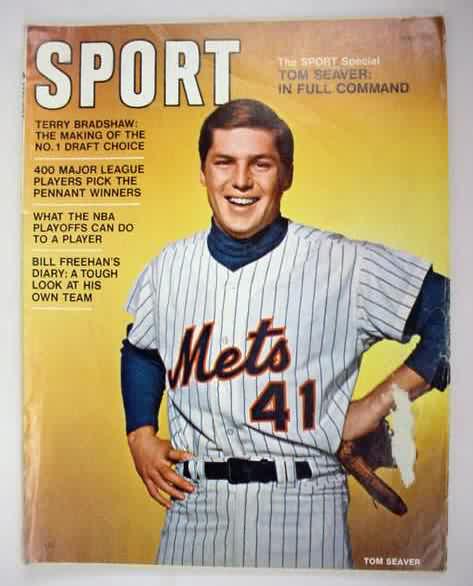
1. 1969 NL: Willie McCovey over Tom Seaver and Hank Aaron. McCovey had a great year, but the Giants lost the NL West title to the Atlanta Braves, for whom Aaron had a great year as well.

Seaver had the best, and most valuable, season any Met has ever had. His 25 wins have only been matched by one New York pitcher since, Guidry. His ERA was 2.21, only .01 higher than the year before, in spite of the pitcher's mound having been lowered from 15 to 10 inches for that season. Nobody knew what WHIP was then, but Seaver's was 1.039, and he led the NL in fewest hits per 9 innings: 6.7.

And he did that without being an overwhelming strikeout pitcher, at least in that season: He fanned 208 batters, but his 5 times leading the NL in strikeouts and his 8 seasons with more Ks than he had in '69 were all still to come. (His 289 Ks in 1971 remain a record for any NYC-based pitcher in the 60 feet, 6 inches era, 1893 to the present.)

To this day, no Met player has ever won the NL MVP -- not Seaver, not Tommie Agee in '69, not Rusty Staub in '73, not Dwight Gooden in '85, not any Met in '86, not Darryl Strawberry in '88, not Mike Piazza in 1999 or 2000, not Jose Reyes or David Wright in '06, none. Seaver did receive the Cy Young Award in '69, and would get it again in '71 and '75.

But when you consider what he meant to the franchise -- hell, one of his nicknames was "The Franchise" -- Tom Terrific's 1969 performance may have been the single most valuable season any New York ballplayer ever had.

Even more than Guidry in '78.

*

Days until the Devils play again: Who knows. All NHL games have been cancelled through November 30 -- and the Winter Classic, set to be played on New Year's Day between Detroit and Toronto at the University of Michigan's 111,000-seat stadium, has been canceled. As in 2004-05, we may not have a season at all.

Days until the Devils play another local rival: Who knows.

Days until East Brunswick High School plays football again: 1, tomorrow night, home to Freehold Township, in a "consolation game" for those teams that did not qualify for the State Playoffs, usually held between teams of similar records. Both teams go into the game at 2-6. Because of continuing electricity issues from Hurricane Sandy, this past weekend, for the first time in EBHS' 52-season football history, a game was cancelled outright and forfeited. It's just as well: We haven't beaten Piscataway in 22 years, and we weren't going to do it this time even if our players had been able to get in all necessary practice time.
Days until Arsenal play another competitive match: 2. See the following answer.
Days until the next North London Derby: 2, this Saturday, at the Emirates Stadium. Beat The Scum! The return fixture will be on Saturday, March 2, 2013, at White Hart Lane.
Days until Rutgers plays football again: 2, this Saturday afternoon, away to the University of Cincinnati, a key game that may decide the Big East Conference title. This past Saturday, Rutgers came from 7-0 down to beat Army, 28-7 at home. Of course it's good to win, but what does it say about our future soldiers if they can't even beat Rutgers?
Days until the next East Brunswick-Old Bridge Thanksgiving clash: 7. Next Thursday morning, we get our annual Turkey Day beatdown by the Purple Bastards.

Days until the U.S. National Soccer Team plays again: 83, on February 6, 2013, away to Honduras, in the last, "Hexagonal" round of CONCACAF World Cup Qualifiers, for the region that encompasses North America, Central America, and the Caribbean nations. If they finish 1st or 2nd in this group of 6 -- and they definitely should win, certainly should finish no worse than 2nd behind Mexico -- they qualify for the 2014 World Cup. Yesterday, a 93rd-minute strike from substitute Mix Diskerud -- a U.S. citizen born in Norway, where he plays for national power Rosenborg -- forged a 2-2 tie with Russia, in the southern Russian city of Krasnodar.

Days until the Red Bulls play again: Unknown for sure, since the 2013 MLS schedule has not yet been released. But, if the pattern holds, it will be on the 3rd weekend in March. If it is on the Saturday of that weekend, March 16, then that would be 132 days. About 4 months.
Days until the Red Bulls next play a "derby," against either the New England Revolution, the Philadelphia Union or D.C. United: Also unknown, until the schedule is released. Most likely, the season opener will not be against one of those teams.
Days until the Yankees play again: 137, on Monday, April 1, at 1:05 PM, at home at Yankee Stadium II, against the Boston Red Sox. Under 5 months. Beat The Scum!
Days until the next Yankees-Red Sox series begins: See the previous answer.
Days until Alex Rodriguez collects his 3,000th career hit: 290 (estimated around September 1, 2013). Under 10 months.
Days until Super Bowl XLVIII at the Meadowlands: 444 (February 2, 2014). Under 14 months. Of course, we have no idea who the opposing teams will be. The possibility exists that either the Giants or the Jets could be in it -- or both. To this day, no team has ever played a Super Bowl in its own stadium -- in spite of multiple hostings by Miami, New Orleans and various California teams. Only 2 have done so in their home metro area: The 1979-80 Los Angeles Rams, whose home field was then the L.A. Coliseum, and they lost to Pittsburgh at the Rose Bowl in Pasadena; and the 1984-85 San Francisco 49ers, whose home field, then as now, was Candlestick Park, and they beat Miami at Stanford Stadium in Palo Alto, which had a much larger capacity than Candlestick.
Days until the 2014 Winter Olympics: 449 (February 7, 2014).
Days until the 2014 World Cup in Brazil: 574 (June 12, 2014). Under 19 months.
Days until Alex Rodriguez hits his 700th career home run: 639 (estimated, around September 15, 2014). About 22 months.
Days until the 2016 Olympics in Rio de Janeiro, Brazil: 1,359 (August 5, 2016). Under 4 years.
Days until Alex Rodriguez hits his 756th career home run to surpass all-time leader Hank Aaron: 1,415 (estimated -- I'm guessing around the end of 2016, around September 30).
Days until Alex Rodriguez hits his 763rd career home run to become as close to a "real" all-time leader as we are likely to have: 1,627 (estimated -- estimating 28 home runs a year, taking his recent injury into account, I'm guessing around April 30, 2017, at age 41). Under 4 1/2 years -- if he can. And even if he does, will he still be a Yankee when he does it? Your guess is as good as mine -- and his.

Monday, November 12, 2012

How Long It's Been: A Brooklyn Team Played a Home Game

Yesterday, the Brooklyn Nets beat the Orlando Magic, 82-74, at their new home, the Barclays Center, in front of a crowd of 16,523 -- about 1,200 short of a sellout.

The Knicks' great start has overshadowed the Nets' arrival in Brooklyn -- perhaps the surest sign yet that the Knicks will never, ever, ever give up their role as the Tri-State Area's top basketball team.

After all, if the Nets couldn't do it in New Jersey in 2002 and '03, when they were reaching the NBA Finals and the Knicks were as bad as the franchise has ever been, when will they do it?

What they have done is bring major league sports back to Brooklyn. They opened on November 3, 2012, defeating the Toronto Raptors, 107-100 -- after their intended lid-lifter, against the Knicks, was postponed due to the effects of Hurricane Sandy and the ensuing nor'easter.

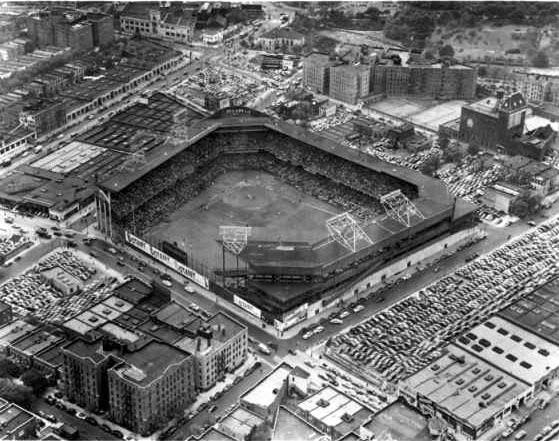
The last home game played by a major league sports team representing Brooklyn was on September 24, 1957, a 2-0 win for the Brooklyn Dodgers over the Pittsburgh Pirates at Ebbets Field, on a crowd depressed to 6,702 by the as-yet-unconfirmed rumor that the club was moving to Los Angeles, the aging of the roster to a 3rd-place finish, and the fact that it was on a Tuesday night against a middle-of-the-pack opponent. Danny McDevitt pitched a shutout.

You can see in the photo above why Walter O'Malley wanted out, of the ballpark if not out of the Borough entirely, as he would later claim. It had just 31,497 seats and 750 parking spaces. And no major highway access, so the people who did come by car had to go mostly on city streets. And even the nearest Subway station required a 10-minute walk. Even if he wasn't angry at the black neighborhood Flatbush was becoming, Ebbets Field was still obsolete and would soon be more a hindrance than a help to the Dodgers.

If O'Malley had gotten what he originally said he wanted, there would still have been a Dodger Stadium opening by 1962 -- but it would have been in Brooklyn, at Atlantic & Flatbush Avenues, across from the Long Island Rail Road Terminal -- where the Nets' Barclays Center is today.

September 24, 1957, to November 3, 2012. That's 55 years, 1 month and 10 days. How long has that been?

*

From the 1957 Brooklyn Dodgers, the following players are still alive: Don Newcombe, Carl Erskine, Don Zimmer, Roger Craig, Ed Roebuck, Jim Gentile, Randy Jackson (not the Jackson 5 singer or the American Idol host), Rod Miller, Fred Kipp, and Brooklyn natives Sandy Koufax and Joe Pignatano. Of these, Zim, Craig and Koufax would have significant roles on the 1st L.A. Pennant of 1959; but by their 1963 title, only Koufax would still be there.

From that year's New York Giants: Willie Mays, Red Schoendienst (not usually thought of as a Giant, but he was there in '57), Johnny Antonelli, Stu Miller, Mike McCormick, Ozzie Virgil Sr., Daryl Spencer, Gail Harris, Eddie Bressoud, Foster Castleman, Ray Crone, Al Worthington, Pete Burnside, Joe Margoneri, and John William McCall, who never appeared in the majors again, and, despite being from San Francisco and having the nickname of "Windy," would not appear for the Giants at Candlestick Park. Some of these players lasted to the Giants' 1st San Francisco Pennant in 1962.

From the '57 Yankees: Yogi Berra, Whitey Ford, Jerry Coleman, Don Larsen, Bobby Richardson, Tony Kubek, Bob Turley, Bobby Shantz, Johnny Kucks, Art Ditmar, Ralph Terry, Jerry Lumpe, Zeke Bella and Bobby Del Greco.

From the football version of the New York Giants, survivors of the 1957 team are: Frank Gifford, Sam Huff,  Dick "Little Mo" Modzelewski, Harland Svare, Dick Yelvington, Bill Austin (not the player of the same name who would soon be an All-American at Rutgers), Bobby Epps, Bob Schnelker, John Martinkovic, Bob Clatterbuck, Ed Crawford, Walt Yowarsky, and 93-year-old former placekicker Ben Agajanian -- who, along with the devastating linebacker Hardy Brown, was 1 of only 2 men to play in the All-America Football Conference, the National Football League and the American Football League.

From the 1957-58 New York Knicks: Manhattan native and Iona graduate Richie Guerin, Willie Naulls, Kenny Sears, Mel Hutchins, Guy Sparrow (no relation to later Knick and Paterson, New Jersey native Rory Sparrow), and Brooklyn native Brendan McCann.

From the 1957-58 New York Rangers: Andy Bathgate, Harry Howell, Bill Gadsby, Dean Prentice, Leapin' Lou Fontinato, Dave Creighton, Gerry Foley, Jean-Guy Gendron, Andy Hebenton, Ivan Irwin, Danny Lewicki, Park MacDonald, Larry Popein, and Red Sullivan.

There were, as yet, no New York Jets, or Islanders, or New Jersey Devils, or Nets in any part of the Tri-State Area. Indeed, from the original 1982-83 Devils, Brent Ashton, Aaron Broten, Murray Brumwell, Dave Cameron, Joe Cirella, Larry Floyd, Paul Gagne, Jeff Larmer, Jan Ludvig, Shawn MacKenzie, Merlin Malinowski, Glenn Merkosky, Mike Moher, Randy Pierce, Joel Quenneville, Steve Tambellini and Pat Verbeek hadn't even been born yet.

There was a Major League Baseball team in Kansas City, but it wasn't the Royals, it was the Athletics. Prior to that, there were no major league teams west of St. Louis -- the Dodgers and Giants were about to change that. There were still none south of St. Louis, Cincinnati and Washington. There was a baseball team in Washington, but it was in the American League and it wasn't the Nationals, it was the Senators. There was a team in Milwaukee, and it was in the National League, but it wasn't the Brewers, it was the Braves.

Los Angeles, San Francisco, Oakland, San Diego, Seattle, Dallas, Houston, Denver, Phoenix, Seattle, Toronto, Atlanta, Miami and Tampa were all still minor-league cities. So was Montreal, for whom big-league ball has since come and gone.

Every Major League Baseball park had lights, except Wrigley Field in Chicago. But none of them had artificial turf, or a roof, retractable or otherwise. There was still an MLB team that had never played a black player, the Boston Red Sox.

Fenway Park in Boston and Wrigley Field in Chicago are the only 2 ballparks in use in 1957 that were still in use in 2012 -- or in 2000, for that matter. The NFL stadium still in use is Lambeau Field in Green Bay, and it just opened. And no NBA or NHL arena in use then is still used by the team that called it home in 1957-58, although a few are still standing.

And while the Cubs were already advertising their home ground as "Beautiful Wrigley Field," hardly anybody thought of Fenway as wonderful -- mainly because every team, except for Baltimore and Milwaukee, was playing in a stadium built before World War II. Having a ballpark that opened in 1913, as Ebbets Field had, was no big deal at that time: The Red Sox, Giants, Phillies, Senators, Tigers, Chicago White Sox, Cincinnati Reds and Pittsburgh Pirates were all then playing in ballparks built that year or earlier.

Ty Cobb, Tris Speaker, Nap Lajoie, and of the 1890s Baltimore Orioles, William Jones "Boileryard" Clarke, were still alive. So was at least 1 player from every team that had ever won the World Series, except for the 1905 New York Giants, whose last survivor, Bill Dahlen, had died in 1950. He, Hugh Duffy, Cy Young, Connie Mack and Honus Wagner had only been dead for a few years.

The defining baseball stars of my childhood? Carl Yastrzemski had just arrived at the University of Notre Dame. Pete Rose and Willie Stargell were in high school. Tom Seaver, Rod Carew and Steve Carlton were in junior high. Reggie Jackson, Thurman Munson, Johnny Bench, Nolan Ryan, Carlton Fisk and Mike Schmidt were in grade school. George Brett was in kindergarten.

Tom Coughlin, now head coach of the football Giants, was 11 years old. Terry Collins of the Mets was 8. Mike D'Antoni of the Knicks was 6. Joe Girardi of the Yankees, Avery Johnson of the Nets, John Tortorella of the Rangers, Jack Capuano of the Islanders and Peter DeBoer of the Devils weren't born yet.

There was an NFL team in Baltimore, but it wasn't the Ravens. It was the Colts, and they had yet to win a title. Few people outside Maryland had yet heard of their 2nd-year quarterback, Johnny Unitas. The NFL had already expanded to the West Coast, but not yet to the South, including Texas. Iconic teams such as the Dallas Cowboys, Oakland Raiders, Miami Dolphins and Denver Broncos did not yet exist. There were 2 teams in Chicago -- the Cardinals not yet having moved to St. Louis, let alone Arizona -- and, as I pointed out earlier, one in New York, the Giants.

The defending champions of the NFL were the Giants. The team that would win the NFL Championship in 1957 was the Detroit Lions -- who, since then, not only haven't won another title, but only once in those 55 years have they even gotten to the round of 4 (losing the 1991 NFC Championship Game 51-10 to the Washington Redskins).

In the NBA, the Boston Celtics had just won their 1st Championship. In the NHL, it was the Montreal Canadiens, and their star Maurice Richard was mere days away from becoming the 1st NHL player with 500 goals -- today, there are 42 players who have done that, 27 of them having exceeded the Rocket's former record of 544.

Wilt Chamberlain was starting his junior year at the University of Kansas, having gotten them to the National Championship game the previous spring, losing in triple overtime to North Carolina. Joe Namath had just started high school. Walt Frazier was in junior high school. Bobby Orr was in grade school. So was Kareem Abdul-Jabbar, and he was still Lew Alcindor. Lawrence Taylor, Magic Johnson, Larry Bird, Michael Jordan, Wayne Gretzky, Mario Lemieux, Patrick Roy, Steve Yzerman, Scott Stevens and Martin Brodeur weren't born yet.

The Heavyweight Champion of the World was Floyd Patterson. Two months earlier, he had defended his title at the Polo Grounds, knocking out Tommy Jackson. Muhammad Ali was 14 -- and he was still Cassius Clay. Mike Tyson, like Patterson a Brooklynite trained by Cus D'Amato, wasn't born yet.

The Olympic Games had never yet been broadcast on American television. They have since been held in America 5 times, Canada and Japan 3 times; twice each in Italy, Austria and France; and once each in Mexico, Germany, Russia, Bosnia, Korea, Spain, Norway, Australia, Greece, China and Britain.

Real Madrid of Spain had recently won the European Cup, beating Fiorentina of Florence, Italy, 2-0. The World Cup has since been held in Mexico and Germany twice, and once each in America, England, Sweden, Chile, Argentina, Spain, Italy, France, Japan, Korea and South Africa.

Manchester United, led by manager Matt Busby's "Busby Babes," won the Football League title, but were denied "The Double" in the FA Cup Final, when Birmingham-based Aston Villa beat them 2-1 when United goalkeeper Ray Wood was injured, and replaced by centreback Jackie Blanchflower, brother of Tottenham captain Danny. There were  no substitutions allowed in those days, so United played from the 6th minute on with 10 men, until Wood, broken cheekbone and all, returned to the goal for the last 7 minutes (which was allowed under the rules of the time).

Villa haven't won the Cup since. United would make it to the next season's Final, but only after the greatest tragedy any British soccer team has ever suffered to its organization. (Not to be confused with a disaster in the stands.)

There were only 48 States: Alaska and Hawaii were both within 2 years of Statehood. There were then 22 Amendments to the Constitution of the United States. The Civil Rights Act of 1957 had just been passed, but segregation and enforced prayer in public schools were still legal. There was no Voting Rights Act, no Medicare, no Medicaid, no Fair Housing Act, no Environmental Protection Agency, no Title IX, and no legalized abortion. Gay rights? Seriously? Rock Hudson, Montgomery Clift, Tab Hunter and Richard Chamberlain were jammed into the closet.

The President of the United States was Dwight D. Eisenhower, and on the night of the last game at Ebbets Field, "Ike" cut short a vacation in Newport, Rhode Island (then considered a rich man's resort) to come back to Washington and announce on TV and radio that he had ordered the 101st Airborne to Little Rock, Arkansas, and federalized the Arkansas National Guard, to integrate that city's Central High School, to enforce the federal law that racial segregation in public schools was unconstitutional. It was Ike's finest hour -- since 1945, anyway.

Richard Nixon was Ike's Vice President. Herbert Hoover, Harry Truman, and Eleanor Roosevelt were still alive -- Grace Coolidge had died a few weeks earlier. John F. Kennedy and Lyndon Johnson were in the U.S. Senate, and Gerald Ford was in the U.S. House of Representatives. Jimmy Carter was running a peanut farm, George H.W. Bush an oil company, and the one and only film that co-starred Ronald Reagan and his wife, then still billed as Nancy Davis, had recently premiered: Hellcats of the Navy. Neither Carter, nor Reagan, nor Bush had ever yet run for office. Bush's son was 11. So was Bill Clinton. Barack Obama wasn't born yet.

The Governor of the State of New York was Averell Harriman. The Governor of New Jersey, about to be re-elected was Robert Meyner. The Mayor of the City of New York was Robert F. Wagner Jr., who somehow got re-elected a few weeks later, despite losing 2 Major League Baseball teams.

Under the law of the time, the man next in line to be Mayor was the President of the City Council. His name was Abe Stark, and he rose to prominence by having a sign advertising his clothing store at the base of the Ebbets Field scoreboard: "HIT SIGN WIN SUIT." Thanks to the fielding of the aforementioned Carl Furillo, and before that of Dixie Walker, Stark only had to award one free suit to an opposing player: Mel Ott of the Giants. Someone suggested that, due to Furillo having saved Stark from having to give out free suits, he should give Furillo one. He did.

Lester Pearson, Secretary of State of Canada, was just awarded the Nobel Peace Prize, for his efforts to end the previous year's Suez Canal crisis. In 1963, he would become his country's Prime Minister. The current Prime Minister was John Diefenbaker; of Britain, Harold Macmillan. Queen Elizabeth II was the monarch of both nations. That hasn't changed, but she was only 31 years old at the time.

The Pope was Pius XII. The current Pope, Benedict XVI, was then Father Joseph Ratzinger, a graduate student at Ludwig-Maximilian University in Munich. There have since been 11 Presidents of the United States, 11 Prime Ministers of Britain and 6 Popes.

Major novels of 1957 included Letter from Peking by Pearl S. Buck, The Wapshot Chronicle by John Cheever, The Guns of Navarone by Alistair MacLean, The Sandcastle by Iris Murdoch, Dr. Seuss' classics The Cat in the Hat and How the Grinch Stole Christmas, Ian Fleming's James Bond story From Russia with Love, and On the Road by Jack Kerouac, the defining novel of The Beat Generation. It had been published on September 5, 1957, just 19 days before the Ebbets Field finale.

Howl and Other Poems by Allen Ginsberg, Kerouac's close friend and fellow Beat, had gone on trial for obscenity. I can see how it would be considered obscene. But, by far, the most obscene book of 1957 was Atlas Shrugged, by Ayn Rand. Who was an atheist, in case you didn't know. In fact, she despised Christianity, because of Jesus' message of helping the poor and the sick. Didn't stop her from accepting Social Security when she got old, though. "Who is John Galt"? An economic terrorist.

Only the preceding year had C.S. Lewis finished his Chronicles of Narnia series, and J.R.R. Tolkein his Lord of the Rings series. Ernest Hemingway, William Faulkner and John Steinbeck were still alive and writing novels. J.D. Salinger hadn't yet dropped out of the public eye, while Thomas Pynchon hadn't yet entered it or dropped out of it.

The fiction careers of Norman Mailer, James Baldwin, Kurt Vonnegut and Truman Capote were well underway. Joseph Heller had seen chapters of Catch-22 serialized, but the entire novel wouldn't be published until 1961. John Updike and Ken Kesey had not yet been published. Maya Angelou had just entered pop culture -- as a singer, having recorded her 1st album, a collection of calypso songs.

Anne Rice was in high school. Stephen King and Tom Clancy were 10 years old. George R.R. Martin was 9. John Grisham was 2. J.K. Rowling wasn't born yet. No one had yet heard of Modesty Blaise, Arthur Dent, Jason Bourne or Kinsey Millhone.

No one had yet heard of Holly Golightly, Harry "Rabbit" Angstrom, Atticus Finch, John Yossarian, George Smiley, Jean Brodie, Modesty Blaise, The Doctor, Alex Portnoy, John Rambo, Spenser: For Hire, George Smiley, the Punisher, Rocky Balboa, T.S. Garp, Arthur Dent, Jason Bourne, Hannibal Lecter, Celie Harris, Kinsey Millhone, Forrest Gump, John McClane, Alex Cross, Bridget Jones, Robert Langdon, Bella Swan, Lisbeth Salander or Katniss Everdeen.

The superhero genre had gotten a boost, with a new version of speedster The Flash. But Stan Lee had yet to begin his Marvel Comics revolution, so, as yet, there was no Fantastic Four, Spider-Man, Hulk, Thor, Iron Man, X-Men or Daredevil.

Kerouac's On the Road will finally be released as a film in U.S. theaters on December 21, 2012. You know, the day that the Mayans predicted the end of the world. If Jack were still alive today, at age 90, he'd probably say, "Man, that figures."

But 1957 was a big year for movies. It began with the death of Humphrey Bogart and ended with that of French film pioneer Charles Pathé.  But it also featured the births of Mario Van Peebles, John Turturro, Spike Lee, Paul Reiser, Daniel Day-Lewis, Judge Reinhold, Frances McDormand, Kelly McGillis, Cameron Crowe, Melanie Griffith, Denis Leary, Stephen Fry, Daniel Stern, Rachel Ward, Ethan Coen, Dolph Lundrgen, Michael Clarke Duncan, and Steve Buscemi, who will be in the aforementioned production of On the Road (but not as Kerouac/Sal Paradise or Neal Cassady/Dean Moriarty).

Gregory Peck and Lauren Bacall starred in Designing Woman, her 1st film after losing Bogie, which had nothing to do with the later TV series of a similar title. Alec Guinness and William Holden starred in The Bridge on the River Kwai, with its whistled "Colonel Bogey March" -- "DA dum... da da da DA DA DA, da da... "; Cary Grant and Deborah Kerr in An Affair to Remember; Jerry Lewis in his 1st film without Dean Martin, The Delicate Delinquent; Spencer Tracy and Katharine Hepburn in Desk Set; Rock Hudson in a film version of Hemingway's A Farewell to Arms; Dorothy McGuire and Fess Parker in Old Yeller; Doris Day and John Raitt (Bonnie's father, who'd been in the original Broadway version) in The Pajama Game; Grant, Frank Sinatra, and, in her big break as far as the U.S. was concerned, Sophia Loren in The Pride and the Passion; and Andy Griffith getting his big break in A Face in the Crowd, in which he plays the kind of character that Andy Taylor would have told Opie to stay away from -- and Ben Matlock never would have defended.

Gunfight at the O.K. Corral, a stylized version of the 1881 Arizona shootout with no pretense of accuracy, featured Burt Lancaster as Wyatt Earp, Kirk Douglas as Doc Holliday, future Star Trek doctor DeForest Kelley as Morgan Earp, Jack Elam as Tom McLowery, and a young Dennis Hopper as Billy Clanton.

Can you imagine Tony Randall and Jayne Mansfield together? In 1957, they were, in Will Success Spoil Rock Hunter? Baseball star Jimmy Piersall's book Fear Strikes Out was adapted into a film that launched Anthony Perkins to stardom -- but playing someone mentally disturbed may have typecast him.

James Cagney played Lon Chaney Sr. in The Man of a Thousand Faces. Jimmy Stewart played Charles Lindbergh in The Spirit of St. Louis. Joanne Woodward, soon to be Mrs. Paul Newman, was in The Three Faces of Eve, although the subject of the book and film, Chris Sizemore, relapsed and would have 23 different personalities until she was finally cured. Akira Kurosawa transplanted Shakespeare's Macbeth to Japan, calling it Throne of Blood, with Japan's most popular postwar actor, Toshiro Mifune, in the role of the Scottish warlord-turned-royal usurper.

Sinatra starred in The Joker Is Wild, as Joe E. Lewis, a singer whose voice is ruined when a Mob enforcer punches him in the throat, but finds a second career as a comedian. Elvis Presley starred in Loving You and Jailhouse Rock.

And Zero Hour! starred Dana Andrews, Sterling Hayden, Linda Darnell, and football legend Elroy "Crazylegs" Hirsch. This is the film, intended to be serious, upon which the disaster spoof Airplane! was based. ("Airplane? What is it?" It's a motorized conveyance for traveling quickly through the air, but that's not important now.)

TV shows debuting for the 1957-58 season included Perry Mason, Maverick, Leave It to Beaver, Zorro, Have Gun, Will Travel, and, in what must have been shocking for the Ike Age, the 1st version of a show revived 1985-92 and again 1999-currently: Divorce Court. And NBC introduced its peacock logo, designed to show that the program you were watching was in color. Fat lot of good that did, as it would be over a decade before a majority of American homes had color TV sets.

Gene Roddenberry had already begun writing for television. George Lucas was 13 years old. Barry Nelson, on U.S. television in 1954, was still the only man to have played a live-action James Bond. George Reeves was starring in the TV series The Adventures of Superman. Robert Lowery was the most recent live-action Batman, and that was in the 1949 serial Batman and Robin.

William Shatner, Sean Connery and Roger Moore were already acting. Adam West had just appeared in his 1st film, a Boris Karloff horror film titled Voodoo Island. September 24 was a day before September 25, the birthday of Juliet Prowse, who was about to turn 21; Michael Douglas, 13; Mark Hamill, 6; Christopher Reeve, 5; and Heather Locklear, Will Smith, and Douglas' future wife Catherine Zeta-Jones, who weren't born yet.

No one had yet heard of The Chipmunks, Yogi Bear, Ben Cartwright, Fred Flintstone, Andy Taylor, Rob Petrie, George Jetson, Jed Clampett, Richard Kimble, Jacques Clouseau, Napoleon Solo, Underdog, Gomez Addams, Herman Munster, Willy Gilligan, Felix Unger and Oscar Madison, Maxwell Smart, Hawkeye Pierce, HAL 9000, Lieutenant Columbo, Monty Python, Scooby-Doo, Big Bird, Carol Brady, Mary Richards, Keith Partridge, Archie Bunker, Fred Sanford, Bob Hartley, Kwai Chang Caine, Theo Kojak, Arthur Fonzarelli, Barney Miller, Basil Fawlty, Howard Beale, J.R. Ewing, Mork from Ork, Jake and Elwood Blues, William Adama, Arnold Jackson, Ken Reeves, Mario and Luigi, Derek "Del Boy" Trotter, Sam Malone, Christine Cagney and Mary Beth Lacey, He-Man, Edmund Blackadder, Goku, the Teenage Mutant Ninja Turtles, the Thundercats, Bart Simpson, Hayden Fox, Zack Morris, Dale Cooper, The Seinfeld Four, Buffy Summers, Fox Mulder, Andy Sipowicz, Ross Geller and Rachel Greene, Doug Ross, Alan Partridge, Xena, Ash Ketchum, Carrie Bradshaw, Tony Soprano, Jed Bartlet, Master Chief, Jack Bauer, Omar Little, Michael Bluth, Leroy Jethro Gibbs, Rick Grimes, Michael Scott, Don Draper, Jax Teller, Walter White, Richard Castle and Leslie Knope.

Robert Kardashian was 13 years old. Bruce Jenner was about to turn 8. The woman each would end up marrying, then named Kristen Mary Houghton, was a toddler, about to turn 2.

The Number 1 song in America was "That'll Be the Day" by the Crickets, whose lead singer was Buddy Holly. The aforementioned Elvis Presley had dominated the year: By the time it was over, he would have 4 singles -- "Too Much," "All Shook Up," "(Let Me Be Your) Teddy Bear" and "Jailhouse Rock" -- that would hold the Number 1 spot for 33 of the calendar year's 52 weeks. John Lennon and Paul McCartney had just met in Liverpool. Bob Dylan was in high school. Freddie Mercury was 12. David Bowie and Elton John were 10. Billy Joel and Bruce Springsteen were 8. Michael Jackson, Prince and Madonna were born the next year.

Inflation has been such that what $1.00 would buy then, $8.14 would buy now. A U.S. postage stamp cost 3 cents, and a Subway ride in New York was 15 cents. The average price of a gallon of gas was 28 cents, a cup of coffee 32 cents, a McDonald's meal (cheeseburger, fries, shake) 49 cents, a movie ticket 61 cents, a new car $2,100, and a new house $12,220. The Dow Jones Industrial Average closed that day at 462.87.

Computers? Get outta here! They could take up the entire side of a building. And nobody expected them to get any smaller anytime soon. Steve Jobs, Bill Gates and Tim Berners-Lee were 2 years old. The tallest building in the world was the Empire State Building. Diners Club had introduced the credit card, but American Express had not yet popularized it. There were no automatic teller machines. 


There were artificial kidneys, but no artificial hearts. Transplanting a kidney was possible, but not a heart, lung or liver. There was no birth-control pill, and no Viagra.

Telephone numbers were still based on "exchanges," based on the letters on a rotary dial. So a number that, today, would be (718) 293-6000 (this is the number for the Yankees' ticket office, so I’m not hurting anyone's privacy), would have been CYpress 3-6000. There were no ZIP Codes, either. They ended up being based on the old system: The old New York Daily News Building, at 220 East 42nd Street, was "New York 17, NY"; it became "New York, NY 10017."

In the early Autumn of 1957, in addition to the events previously mentioned, the Space Age began when the Soviet Union launched the world's 1st artificial satellite, Sputnik 1, sending the free world into a panic over the possibility that the Commies could now bomb us from space. (It never happened, but we didn't know that at the time.) A little later, the Soviets launched Sputnik 2, containing the 1st living space traveler, a female part-husky/part-terrier dog named Laika. The capsule was too hot, and she died from heatstroke. She was doomed anyway, as they expected her oxygen to run out after 6 days, which is what they reported as happening.

Toyota began exporting cars to America. In an unrelated story, the Ford Motor Company introduced the Edsel. It was a flop. The Mackinac Bridge in Michigan and the 1st tube of the Hampton Roads Bridge-Tunnel in Virginia opened.

West Side Story debuted on Broadway. Just off Broadway, at the Park Sheraton Hotel (now the Park Central), where The Jackie Gleason Show (including his Honeymooners sketches) was filmed, America's biggest Mob boss, Albert Anastasia, was rubbed out.

King Haakon VII of Norway, and Christian Dior, and Louis B. Mayer died. Gloria Estefan, and Fran Drescher, and comedian and Mr. 3000 star Bernard "Bernie Mac" McCullough were born.

September 24, 1957. For the last time, or so we thought, a major league sports team played a home game in Brooklyn.

Now, it has happened again. It remains to be seen whether this is a good thing, for either the team or for the Borough. So far, there is excitement. But will there be competitive results to their liking? Stay tuned.

Friday, November 9, 2012

Top 5 Reasons You Can't Blame Mitt Romney for Losing the 2012 Presidential Election -- Or... Can You?

Last political-themed post of the year -- I hope.  (You probably do, too.)

ESPN used to do a series called The Top 5 Reasons You Can't Blame... The idea was to look at sports figures who committed momentary in-game blunders, or made questionable in-game or business decisions, or courted controversy; and then to see if they were truly to blame for the bad things that followed, or if the other factors at work should be considered, possibly letting them off the hook.

The show would open with "the case of the prosecution," showing why, to use 3 examples from baseball...

* Harry Frazee was blamed for selling Babe Ruth from the Boston Red Sox to the Yankees in 1919.

* Walter O'Malley was blamed for moving the Brooklyn Dodgers to Los Angeles in 1957.

* Bill Buckner was blamed for the Red Sox losing the 1986 World Series.

Then host Brian Kenny would begin "the case for the defense" with, in his words, "a few reasons that did not make the cut. We call them 'The Best of the Rest.'" Then ESPN would go to commercial, and Kenny would begin the countdown with Reason Number 5. Usually, it wouldn't be very convincing, but it would make you think that, indeed, there were other factors that may have contributed to the competitive defeat or public-relations disaster.

Kenny would then say, "Have we begun to change your mind yet?" Or "Did that reason grab you? If not, here's Reason Number 4." It would usually be more compelling than Reason Number 5. Then there would be another commercial break, and, upon return, Reason Number 3. This would usually be fascinating, something that would either seem obvious in retrospect, but blatantly forgotten shortly after the fact; or something that didn't seem obvious at the time, but, once you thought about it, you realized, "Hey, yeah, that is a good reason that (such-and-such awful result) happened!"

Kenny would say, "Have we begun to change your mind yet? If so, here's more food for thought: Reason Number 2." And Number 2 would almost certainly be obvious, as in, "How could you have overlooked this fact?" ESPN would go to one more commercial break, come back, and recap Reasons 5 through 2. Then Kenny would lead into Reason Number 1, and it would be terribly convincing. Examples:

* The team that won deserved to win, because they were simply better than the team that lost, even if they did great a break.

* The disaster occurred in Game 6, when the losing team could still have rendered it meaningless by winning Game 7.

* The seeds of defeat were planted well before the big public event.

* A guy previously thought of as a hero, or thought of as a peripheral player, or even not thought about in connection with the event at all, is revealed to have been the biggest factor of all. Example: New York City construction czar Robert Moses was not actively involved in sports, but preferred to build a stadium in Flushing Meadow, Queens, rather than in downtown Brooklyn, thus convincing O'Malley that he couldn't stay in Brooklyn, and thus shouldn't stay in New York, so he might as well move to Los Angeles, where there was big money to be made -- but also leading to the stadium that became home to the Mets and the early Jets.

Then, with Reason Number 1 seemingly completing the vindication of the blamed party, Kenny would say, "There you have it: The Top 5 Reasons You Can't Blame (the subject of the episode) for (whatever it was he did or caused to happen). Maybe we changed your mind, maybe we didn't. But, hopefully, we made you think about things in a new light." And the closing credits would be shown, with a brief mention of the aftermath of the event, including, if the blamed person was still alive, what he was doing now. (The series ran from April 2005 to April 2007.)

The show had one flaw: It wasn't a true "trial." That is, it showed the case for both sides, but it presumed a verdict of Not Guilty. True, in the American legal system, one is "presumed innocent until proven guilty." But, in some cases, the Top 5 Reasons were not enough to overcome the blamed person's true guilt.  This was true for the following installments, in chronological order of their having happened:

* You can blame Walter O'Malley for moving the Dodgers. If he was such a "visionary" for moving his team to L.A., then he should have been enough of a visionary to find a way around Robert Moses. O'Malley was only a visionary when his vision helped himself: His vision may have helped to make Dodger fans in Southern California, but it didn't help the Dodger fans in the city where they already were.

* You can blame Art Modell for moving the Cleveland Browns to become the Baltimore Ravens in 1995.  Unlike many team owners, he never publicly threatened to move the club if he didn't get a new stadium from the City, County or State government.  He didn't point the gun at them and said, "Give me what I want, or I'll shoot!" He just shot. He had money problems? With all the revenue sharing in the NFL, with all the League's TV money, with all the League's merchandising, I don't care what kind of stadium lease you got: If you're an NFL team owner, and you're losing money, then you're too stupid to own a professional sports team. It's just like running a casino: Unless you're letting someone rob you blind, you shouldn't be losing money in that venture. (You reading this, Donald Trump, you lying son of a bitch?)

* You can blame Bobby Knight for his outbursts. Whatever good he's done, and he's done a lot, Coach Knight should have found ways to control his temper sooner. Knight hit a cop during a tournament in Puerto Rico in 1979 -- he was 39 years old. Okay, things happen: John Chaney was 62 when he burst into John Calipari's press conference following a Temple-UMass game and threatened to kill him and "kick your ass!" But we haven't seen Chaney do stuff like that time and time again: Either he doesn't, or he's been smart enough (or lucky enough) to keep it away from prying eyes. So Knight did what he did at age 39. Hey, I'm 42, and I lose my temper sometimes. But Knight shouldn't have been throwing a chair across the court at age 44. He should not have been choking a player at 59. He should not have been hitting a player on the chin at 66. Much sooner, he should have gotten help.

* Same with Barry Bonds for "being Barry Bonds." Whatever made him surly, he could have worked on it. And he chose to cheat. He could have said, "Look at McGwire. Look at Sosa. Now look at me. I don't use steroids, and I won't. I think they do. Hate me for saying it, but I'm clean, and I can prove it. Can they?" Instead, he decided to start cheating the way they did.

* Same with Terrell Owens and his "over-the-top celebrations." They were a conscious choice. Maybe they were merely an annoyance, not a harm, and thus we made a bigger deal out of them than we should have. But he could have chosen not to do them, and he did them anyway.

* You can blame Charles Barkley for saying, "I am not a role model." Baseball star Bob Gibson once said, "Why do I have to be a role model for your kid? You be a role model for your kid." But shortly after Barkley's commercial first appeared, Dominique Wilkins wrote an opinion piece for Sports Illustrated, explaining why athletes, whether they like it or not, are role models, both positively and negatively.

* You can blame Anna Kournikova for not winning a singles title. There was a lot of good competition at the time. But, come on: No one's asking her to go from winning 2 majors to 3, as was the case for when this series looked at Greg Norman and explained why he couldn't be blamed for winning more "Grand Slam" golf tournaments. (2 British Opens, plus 2 legendary Masters collapses.) It's not that Kournikova didn't win more majors. It's not that she didn't win one major. It's that she didn't win a single tournament on the WTA tour. Ever. You'd think the law of averages (which is probably more of a theory than a "law") would have worked in her favor one time: Injuries to some competitors, illness to another, a bad week to a couple of them, setting up a final between her and some previously unknown girl who's caught lightning in a bottle, and there's the opportunity, and she seizes it, and, boom, she's standing on the clay court at Roland Garros holding up the French Open trophy. (The clay surface is another quirky thing that tends to derail players who are good on other surfaces, so that's why I chose it as the one that she might have won, given enough other circumstances.) But she didn't even get lucky. Not even once. Not one major, not one singles tournament of any kind. True, it does say something for her talent that she won tournaments, including majors, in doubles. But that's not what people are watching for.

At the end of the program, they should have had a "jury" of 12 sports experts -- ex-athletes, coaches and pundits, possibly an official (referee/umpire) or two, none of whom was directly involved and thus was impartial -- to deliver a verdict: No, you can't blame the blamed person or group; or, Yes, you can.

*

Now... Barack Obama has defeated Mitt Romney to be re-elected President of the United States. Assuming no medical or ethical calamity (either of which is possible, but neither of which is likely), Obama will serve out a 2nd term, and the 45th President of the United States will take office at noon on January 20, 2017. Not on January 20, 2013.

Is it Romney's own fault that he lost? He lied, and when it was proven that he was lying, he doubled down on his lies. He flip-flopped on issue after issue, domestic and foreign. He let slip a lot of things he wished people had not heard him say: He was "the gaffe that keeps on giving." And he seems congenitally unable to connect with people on a personal level.

And he turned his ability to make money -- notice I said "make," not "earn," because I don't think he's ever earned a penny in his life -- into a qualification for the Presidency.

Remember when Sarah Palin said, "I can see Russia from my house!"? Actually, no, you don't, because she didn't say that: That was Tina Fey in her impersonation. What Palin said was that you can see Russia from Alaska. Given good weather, and standing on a certain spot of land in her State, this is true. But she made it sound like a qualification she had for dealing with foreign policy. It wasn't. True, the Governor of Alaska does have to deal with the closest countries: Canada on one side, Russia on the other. This could, conceivably (if there were no overriding circumstances -- and, in her case, there were plenty of them), have qualified her to be U.S. Ambassador to Canada, or even to Russia. But she was not qualified to be Secretary of State, let alone President.

So it is with Romney's ability to make money: It qualifies him to be a CEO. But Romney never grasped one essential fact: We weren't electing a CEO to run a business. We were electing a President to run a government. Businessmen can't run governments.

Michael Bloomberg has proven that Republican businessmen can't do it: New York City is worse off than it was when he became Mayor. Jon Corzine proved that Democratic businessmen can't do it, either: New Jersey was worse off when he left the Governorship than when he came in. Romney's business experience, even if it was completely moral (and it was far from that), was completely irrelevant to being President of the United States.

And his only previous experience in public office -- elective or appointive -- was one term as Governor of Massachusetts.  He had one accomplishment: A Statewide version of "universal" health care. And he had to repudiate it because it was the basis for President Obama's Affordable Care Act, a.k.a. "Obamacare." "Romneycare," if not exactly the same thing at the State level, was practically the same thing at the State level. And he couldn't be nominated in the Republican Primaries if he didn't repudiate it.  So he repudiated his one accomplishment as Governor.

And Governor of Massachusetts was a job he did so poorly that he didn't even run for re-election, because he knew he would lose to Deval Patrick, a black former U.S. Assistant Attorney General who was so much like then-U.S. Senator Barack Obama that they even shared a speechwriter. If Romney had run for re-election as Governor and lost, his chances of ever becoming President would have vaporized 6 years ago, rather than 6 days or 6 weeks or 6 months ago.

True, Richard Nixon lost for Governor of California, and came back 6 years later to be elected President -- but Mitt Romney is not Richard Nixon. And, as Dick Smothers would say, That was not a compliment.

When Nixon ran in 1968, he had already been Vice President, and served in both houses of Congress. He already had a national profile and a national following, whereas Romney did not. Nixon's foreign policy awareness consisted of more than knowing where his money was stashed. Nixon had the advantage of circumstances causing the Democratic Party to implode, whereas Romney ran against a Democratic Party totally united behind Obama. And... Nixon was more honest than Romney. True, Nixon told a lot of lies in the early phase of his career, but the bulk of the political damage caused by his lies destroyed his Presidency. In contrast, Romney's lies destroyed his chance at the Presidency.

Or... did they?

The Top 5 Reasons You Can't Blame Mitt Romney for Losing the 2012 Presidential Election

Here's some reasons that didn't make the cut: The Best of the Rest.

* George W. Bush. He will hang over the GOP like Jacob Marley's ghost for a long time to come -- like Jimmy Carter did over the Democratic Party from 1980 to 1992 (but not afterward, thanks to Bill Clinton, no matter how hard Republicans have since tried), like Herbert Hoover did over the Republican Party from 1932 to 1980, when Ronald Reagan finally liberated them), like Woodrow Wilson did over the Democrats from 1920 to 1932 (when Franklin Roosevelt exorcised the ghost), like the Civil War did over the Democrats from 1864 to 1912 (when Wilson moved them into the 20th Century).

Voters may believe that Obama hasn't done enough to restore the economy, but they know damn well that he didn't cause the crash and the recession. Bush did. Conservative businessmen did. And Romney, as he kept telling us, was a conservative businessman.

* Bill Clinton. His Convention speech gave Obama a huge boost, and his campaign appearances in States like Ohio and Florida helped a lot. If Al Gore had swallowed his pride and asked Clinton, then still President, to make one joint appearance with him in Miami in the first week of November 2000, Gore would have won Florida by such a margin that Jeb Bush couldn't have stolen it, and Gore would have been unquestionably victorious overall.

* Seal Team Six. Upon Obama's orders, they killed Osama bin Laden. If they had failed, it would have been Obama's "Desert One." (The failed attempt to rescue the hostages from Iran in April 1980.) It would have made the Carter-Obama comparisons a lot more honest. Instead, Obama got a victory that, no matter what Romney and his surrogates said about Benghazi, essentially took foreign policy off the table, because they had no chance to beat Obama on the issue.

* Hurricane Sandy. True, every State affected by it was going to go for Obama anyway. But Obama's response, a polar opposite from Bush's on Hurricane Katrina in 2005, and his bipartisan work with Governor Chris Christie of New Jersey, made him look like a man who cared enough to help, was flexible enough to reach across the aisle, and competent enough to get things done.

Is Romney flexible? Certainly. Is he competent enough? Possibly. Does he care enough? Don't make me laugh, and if you think he does, recall "the 47 Percent Video." Obama's response to Sandy didn't turn a single State affected by it -- that was unnecessary -- but it helped him nationally.

* The Wives. No, this is not a joke about Romney's religion. His being a member of the Church of Jesus Christ of Latter-Day Saints -- the official name for the Mormons -- in the end, did not make him look like a loon. (Mormons have some beliefs that I consider strange, but, heck, they're not Scientologists. And not all Scientologists are as loopy as Tom Cruise or John Travolta.) No, Romney has just one wife, just as his father did. (But not his grandfathers.) Nor did it make evangelical Protestants abandon him for Obama: I guess they'd rather vote for a Mormon than a black liberationist/Muslim/Communist-therefore-atheist. (I wish they'd pick one lie and go with it.)

This is a reference to Michelle Obama and Ann Romney. Ann may have helped "humanize" Mitt with her Convention speech, but thereafter, she acted like a petulant rich chick who thought everyone not rich was beneath her. In contrast, Michelle Obama acted like a fun person who wants you to have fun, too -- and all she asks in return is that you eat right and exercise. She won't force you, as was suggested. Michelle acted like her life would have been complete if Barack loses, or if he'd lost in 2008, or even if he'd never entered politics. Whereas Ann acted like she had to be First Lady.

We want our First Ladies to appear like living in the White House is nice, but they don't need it. Mamie Eisenhower, Lady Bird Johnson, Pat Nixon, Betty Ford, Rosalynn Carter, Barbara Bush, Laura Bush, they all seemed to be regular people. Even Jacqueline Kennedy, who most certainly was not "regular people," didn't act like living in the White House was some divine right of hers. Nancy Reagan, on the other hand, acted as thought it was her divine right.  Hillary Clinton often came off as someone who thought so; her softening of her own image was a big reason why Bill won in 1996, and why she was elected to the Senate in 2000 and came close to the Democratic nomination in 2008. The far right tried to paint Michelle as an entitled woman, which turned out to be ridiculous. Ann really is like that, and that only fed into Mitt's image as an out-of-touch rich guy.

Before I get down to the Top 5, let me take one potential reason off the table: Vice Presidential nominee Paul Ryan. True, the Congressman from Wisconsin didn't help bring his home State into the Romney column. But that's because, despite a lot of Republicans' hopes, and a few pundits bold predictions, Wisconsin was never going to vote for Romney. Governor Scott Walker's survival of his recall was more of a backlash against the movement to recall him, for not wanting to wait until the next election in November 2014.

(Face it, the only reason Gray Davis was recalled as Governor of California is because of the celebrity of Arnold Schwarzenegger. If Ahnold had never appeared in a movie, the idea of getting rid of Davis would have had some appeal, but once actual names were put up as potential replacements, he could have survived to serve out his 2nd term.)

Ryan is a far-right extremist. He's a liar. He's a top-level douchebag. But he's not a reason Romney lost. It was suggested that another "finalist" for the slot, Senator Rob Portman of Ohio, might have made the difference. No: Romney would still have lost the Electoral Vote if he'd won Ohio. Same with Senator Marco Rubio of Florida. In fact, Romney could have won Ohio and Florida, and he still would have lost, in both the popular vote and the Electoral Vote.

And even if you think Ryan did hurt Romney, remember: Romney chose him. He could have chosen someone else. So if you blame Ryan, you should blame Romney, too.

Now, the Top 5 Reasons:

5. It's the Economy, Stupid. James Carville's 1992 line for Bill Clinton still works. As I said, people still blame Bush and other "conservative businessmen" for causing the bad economy, much more than they blame Obama for not getting back to where it was in mid-2007, let alone where it was in 2000 before the tech bubble burst.

And it was getting better, in spite of all the GOP's obstructionism: Unemployment, which Obama did not cause to go to 10 percent, was now down below 8 percent. 750,000 jobs lost per month became job growth for 32 months in a row. The Dow Jones was down to 6,500 after the crash; it was double that, 13,000, on Election Day.

And people got it: "The massive debt" wasn't Obama's fault, not by a long shot, it was due to the tax cuts and the wars that Bush didn't pay for; and the debt that Obama did add on was necessary to clean up the mess Bush left. Blaming Obama for the deficit was like blaming the Yankees' pitching for their 2012 Playoff loss: It wasn't perfect, but it wasn't the problem.

4. The Republican Base.  hey're the ones who pushed Romney into disavowing his greatest (if not, as I've suggested, "only") accomplishment in his only political job. They're the ones who pushed him into abandoning his pro-choice -- or, as Ted Kennedy called it in their 1994 Senate battle, his "multiple-choice" -- stance on abortion. They're the ones who made him sound like Dick Cheney on foreign policy. They're the ones who pushed him to the hard right on immigration and gay rights, when he'd previously been a moderate on the former and at least willing to discuss the latter.

Primary opponents Rick Perry, then Newt Gingrich, and finally Rick Santorum worked so hard to pain Romney as "Massachusetts Moderate Mitt" -- trying to make him sound like John Kerry or, God forbid, Michael Dukakis, and even invoking the State as the only won one in 1972 by the late George McGovern -- that Romney had to come out and not only act like, but actually come out and say he was, someone who was "severely conservative."

"Severely." That one word, more than "I like being able to fire people," or "47 percent," or "Ten thousand bucks?" or even "Let Detroit go bankrupt," may have doomed him. You may not hear any other observer of the election say it. But "severe" has connotations of "bad," "harsh," "harmful." You hear of a man in a hospital being "severely injured," a soldier being "severely wounded."

The lunatics who use religion as a justification for their greed, or as an excuse for bigotry, pushed Romney away from the center-right man he'd been, more or less continuously, from 1994 to 2008. But since it became clear that McCain was not going to win in November 2008, he became "severely conservative" -- until that stopped working, because (as I'll return to later), Obama's campaign machine basically said, "Yeah, he is, and here's what that means."

The last time Romney looked like he had a real chance to win was after the first debate, when Obama looked tentative and underprepared, and Romney sounded like a prepared, reasonable, competent moderate. If he'd been that from the moment he clinched the nomination onward, he would have had a very good chance of winning. But if he'd been that during the Republican Primaries, he wouldn't have gotten out of New Hampshire with his candidacy intact.

Thinking he needed to appease the hard right may also have been a reason why Romney chose Ryan as the Vice Presidential nominee, instead of a more moderate conservative, such as Portman, or Governor Kelly Ayotte of New Hampshire.

3. The So-Called "Liberal Media." In 2000, they let the Bush team paint their man as honest and Gore as a liar. The voices stepping forward to defend Gore and to expose Bush as the real liar, as an intellectual lightweight, as a man monumentally underprepared for the Presidency, were too timid, or courageous enough but without enough power to spread their message.

In 2004, the same thing: The media let Bush lie through his teeth about himself and Kerry, to the point where Kerry (rather than Bush) looked like the elitist who was unfit to command our troops, and Bush looked like an average guy with the strength to lead our nation (both bull).

In 2008, the economic crash made the media's job easier: The facts showed the GOP couldn't be trusted, and McCain's efforts to lie about Obama were halfhearted; he's just not that kind of guy, although the kind of guy he is, isn't someone I could ever vote for.

This time, Romney and his surrogates told lie after lie after lie, and the Obama campaign struck back, saying, "Here's the truth," and showing the truth... and the media told the story.

For half a century, since Nixon blamed the media for his 1962 loss, when a Republican loses, or thinks he's going to lose, he and his supporters blame "the liberal media." Usually for "taking him out of context." Even in 1964, a Barry Goldwater supporter was filmed yelling at a newspaper reporter, "Don't quote what he says, say what he means!" It never occurs to these candidates to not say things that they know are untrue, or represent their true feelings but could be taken out of context. Instead of blaming the media for telling the story, try blaming yourself for making the story available.

Which leads directly to...

2. James Carter IV.  For 32 years, the GOP have been painting his grandfather, Jimmy Carter, as a political, military and moral weakling. Yes, Sunday school teacher Jimmy Carter is, in their words, a moral weakling, for letting the excesses of the 1970s be the excesses of the 1970s. Never mind that these things began under Nixon, often as a backlash against his policies, and steamrolled under Gerald Ford. Never mind that Carter could no more control what went on inside the doors at Studio 54 and Plato's Retreat than he could control what went on inside the doors at OPEC meetings.

That's been the line since 1980: Carter is a Democrat, and he's weak, therefore Democrats are weak, they're soft on immorality, soft on crime, soft on drugs, soft on defense, soft on Communism, soft on terrorism. Reagan is a Republican, and he's strong, therefore Republicans are strong. It was easy to compare Walter Mondale to Carter in 1984: He was Carter's Vice President. The Carter years were fresh enough in 1988 to make Michael Dukakis "another Jimmy Carter" and have it work.

But after 8 years of a highly (though hardly completely) successful liberal Democratic President, Bill Clinton, the comparison of Obama to Carter, endlessly repeated in conservative opinion pieces, was stupid. Especially since Carter's attempt to rescue the hostages in Iran failed, while Obama's similar attempt to kill Osama bin Laden succeeded.

If either 2012 candidate was "Ronald Reagan" when it came to defending this nation, it was Obama. (Never mind that Reagan's arms sales made Osama bin Laden's rise possible.) No, Romney was no Reagan: Reagan was likeable, Romney is not. And, as Seinfeld's George Costanza taught us, "It's not a lie if you believe it." Reagan said a lot of bull, but he seemed to believe it; Romney couldn't convince people to believe his lies. So Romney was no Reagan, and Obama was no Carter.

So it was appropriate that James Carter, a freelance filmmaker, was the one who filmed that banquet at which Romney denounced "47 percent of Americans" as moochers who the Republican couldn't reach, and thus didn't have to care about.

It became the Internet equivalent of the late-in-the-campaign banquet in 1884, attended by James G. Blaine, finally winning the Republican nomination on his 3rd try, after being branded as corrupt as hell (which he was). A speaker at that banquet was the Rev. Samuel Burchard, who denounced the Democrats as "the party of rum, Romanism and rebellion." Meaning they would not stand for prohibition, they were led by Catholics, and most of the Confederates in the Civil War were Democrats. That word got out, and it cost Blaine New York, which that State's Governor, Democratic nominee Grover Cleveland, might not have won after a sex scandal had damaged his campaign. It made all the difference, and Cleveland won.

James Carter, standing in for his now 88-year-old grandpa, like Banquo's ghost at Macbeth's royal feast, captured the moment, and spread it, and Romney looked like a different Massachusetts man: Charles Emerson Winchester III (played by David Ogden Stiers on M*A*S*H), who once told an investigator for a McCarthyist Congressman, "Sir, I am so conservative, I make you look like a New Dealer." "Cholls" was rich, elitist, bigoted (he openly detested the Irish and the Italians), and thought the slightest hardship was beneath him. And he had the ego to match.

As the series wore on, he became a bit more human and less of a caricature. (Which was Larry Linville's reason for leaving his role as Winchester's predecessor, Frank Burns: He didn't want to be an unlikeable sanctimonious far-right hypocrite forever. As with Stiers, the other castmembers have said Linville was a great guy offscreen.) Romney isn't a very intelligent man, but he has enough brains to realize he didn't want to sound like Charles -- or like another rich guy to whom he was often compared, Thurston Howell III (played by Jim Backus on Gilligan's Island -- and at least he would occasionally loan nice things to the other castaways and rewrote his will to include them).

It deeply offends Romney when people attack him for having gobs of money, or question whether he got it fairly. But he figured out that he couldn't look like the guy who writes off 47 percent of the country: "I care about 100 percent of Americans." He had to say it. Even though he didn't believe it, and the vast majority of that near-majority didn't believe it.

But if James Carter hadn't been there to film that moment, we never would have known that Romney said it. It would have been as if Nixon's Oval Office tapes had never been revealed until after he completed his 2nd term in January 1977. Instead, the tapes were revealed in July 1973, Nixon was forced to hand them over in August 1974, and he had to resign almost immediately thereafter. And, unlike Nixon, Romney didn't have the option to "burn the tapes." He never had possession, let alone ownership, of the clip. But now, he will have it stuck to him for the rest of his life.

So that's 2 ghosts: George W. Bush, as that of Jacob Marley; and Jimmy Carter, as that of Banquo. You could add a third, that of George Romney, the late former Governor of Michigan, whose 1968 run for President short-circuited, but who really was a moderate Republican -- and released his tax returns in full, unlike his son. We may never find out what Mitt was hiding -- but now, it doesn't matter, because he's lost. Now, it only matters to the historians, if they're curious enough.

Of course, none of the above factors would have made a damn bit of difference if it wasn't for Reason Number 1.

1. Barack Obama.  Whatever you think of him, personally or politically, he ran a great campaign. He defined Romney before Romney could define him. He demolished Romney's attempts to define him as socialist, as weak on foreign policy, as someone who "doesn't believe in America," as somehow is "not really one of us."

Moreover, it's very hard to beat an incumbent President, even with an economy that is still growing slowly.  The Rose Garden strategy" didn't work for Ford in 1976, or the elder Bush in 1992; but it did work for Reagan in 1984, Clinton in 1996, and the younger Bush in 2004. It worked for Obama in 2012.

Obama not only campaigned to keep his job, he continued to do his job. Whether it was on keeping the government running, or keeping the auto industry afloat, or passing health care reform, or ending the Iraq War, or killing bin Laden, or biding his time instead of diving right into the Arab Spring, people saw him do what Presidents do. Individual observers didn't have to agree with what he was doing, but they still saw him do it, still saw him "be President."

Romney looked like a President, for sure; but he didn't act like a President. Obama was able to show what Michael Douglas (whose wife I still love) said in The American President, after Richard Dreyfus (a liberal in real life) spent most of the movie playing a stand-in for Bob Dole, and closing every speech with, "My name is Bob Rumson, and I'm running for President!" Near the end of the film, Douglas defended his actions and those of his girlfriend, Sydney Ellen Wade, played by Annette Bening, closing with, "This is a time for serious people, Bob, and your 15 minutes are up. My name is Andrew Shepherd, and I am the President."

If Obama hadn't defended himself, and gone on offense, like Clinton -- if he'd rolled over like Kerry, Gore, Dukakis, Mondale, McGovern and Hubert Humphrey -- he'd now be packing for Chicago and Honolulu. Instead, Romney is unpacking, and staying in Belmont and Park City.

*

Well, there's the evidence for both sides. What's my verdict?

Guilty. Romney had his chances to win. And he threw them away, because he wasn't man enough to stand up to the right-wingers, and be who he really was: Bill Maher's kind of Republican, "a mean old man who's going to watch my money," not one who'll let bigotry run free, let polluters write environmental laws, and throw our soldiers' lives away in stupid wars.

Those who say Obama doesn't really have a mandate are wrong: As their own beloved Rush Limbaugh used to say, "A one-vote victory is a mandate."

But if Obama doesn't have a mandate, then neither do they. Their candidate lost. They blew a chance to take control of the Senate. And while they held control of the House, they lost seats, their majority cut in half.

There was little McCain could do in 2008. The disaster of the economy ruined any chance he had. Had McCain been 62 then, instead of 72, he could have gone to the GOP and said, "I took a bullet for you. You owe me another shot." (That worked for Tom Dewey in 1948 -- through the Convention, anyway. Same for Democrat Adlai Stevenson in 1956.)

But there were so many things Romney could have done differently. He made his choices. As Billy Joel would say, "Don't look for answers. You took your chances. Don't ask me why."

Romney should give due credit to Obama. But he should also blame himself. Not the media (including, in a way, James Carter). Not his party's base. Not his staff. Himself.

This election was won. But as the GOP's last President (for a long time to come?) would say, "Make no mistake about it." This election was lost. In November 2010, in July 2011, even, possibly, as late as early October 2012, it was Romney's election to lose. And he lost it.

Fair and square. Not because Obama was fair and he was square. But because Romney turned himself from a candidate with a lot of potential into someone who refused to make the question on that Time cover go away.

Or to put it another way, there's a story that President Clinton told about an old woman named Pearl. (Also quoted by Stephen King, somewhat altering the Bible's story of Job.) Pearl knows she's going to die soon, and she says, "God, I lived a good life. I didn't drink. I didn't smoke. I didn't use drugs. I didn't gamble. I honored my parents. I was good to my brother and my sister. I stayed a virgin until I married my husband. I never cheated on him. I took care of him when he got old and died. I raised our children well. I taught them to love You and keep Your Commandments. I gave to the poor. I went to church every Sunday.

"But now, I'm an old woman, and I'm going to die soon. I'm poor. I have just a few dollars in the bank. Social Security isn't enough to live on. My children never come to see me, and go against everything I taught them, living wicked lives. All my friends are dead. I have nothing left. Why, God, why? Why me?"

And there's a clap of thunder, and out of the sky comes a basso profundo voice with an echo, saying, "Well, Pearl, there's just something about you that pisses me off."

Even for those people who don't think that Mitt Romney is a liar, or an elitist, there seems to be something about him that pisses them off.

Whereas, even those people who think that Barack Obama hasn't been a good President, a lot of them still like him.

Democrats used to get mad at people who voted for Ronald Reagan, or George W. Bush, even though they disagreed with those men's policies, because they liked them.

Bill Maher said it when Bush ran in 2000: "People like Al Gore's ideas, they just don't like him." And it was the same way in 2004 with John Kerry.

In 2008, even people who tended to not like Republicans tended to like John McCain. It's probably the only reason he didn't suffer a Mondale '84, McGovern '72, Goldwater '64, Landon '36 type loss, not just a landslide but a mudslide.

Sometimes, Presidential opponents make up, and even work together afterwards. It helps if the winner is now out of office. Wendell Willkie worked with Franklin Roosevelt. Gerald Ford worked with Jimmy Carter. George H.W. Bush has worked with Bill Clinton. Even McCain has voiced support for Obama on an issue or two.

I can't imagine Obama and Romney wanting to work with each other.

Because I think there's something about Willard Mitt Romney that just... pisses... Obama... off.

See? Barack Hussein Obama really is one of us. A true American.