Wednesday, February 16, 2011

Dumbest Met Fan Ever

For much of my life, I've been saying that Met fans are dumb. I even wrote a song about it... with help from Billy Joel.

Okay, it's not completely fair, and it's not universal. There are many smart people who are also Met fans. My grandmother was a Met fan. George Plimpton was a Met fan. Roger Angell is a Met fan. Jerry Seinfeld, Susan Sarandon, Jon Stewart, these people are all very smart and all Met fans.

But this guy takes the cake, and burns down the bakery. He does no favors for any of the preceding.

I'll give him a pass on saying Darryl Strawberry was his favorite player from the 1969 team, instead of the 1986 team. That's easy enough to futz up. Although, if you're a fan of a team that has won only 2 World Series -- and there are 10 current teams that haven't won at least that many, 12 if you discount titles won before teams moved to their current cities -- you should be able to tell the 2 apart.

But Francesca roasts him. And the mook still never explained why the Mets are "a great franchise."

They're "magical"? What the hell does that mean? It seems like the magic hasn't been back for years.

They're "exciting"? Big deal: On any given day, any given sports team can be exciting. And I've seen plenty of games -- by the Mets, the Yankees, and many other teams in several sports -- that have produced exciting games that they have lost.

Surely, Game 7 of the 2006 NLCS, which the caller brought up (Francesa did not), was exciting, a 1-1 tie in the 9th preserved by Endy Chavez's catch, but ruined by Yadier Molina's homer and Carlos Beltran's called strikeout.

Game 6 of the 1999 NLCS, that back-and-forth game in Atlanta that ended with Kenny Rogers walking Andruw Jones to force home the Pennant-losing run, was one of the most exciting sporting events I've ever seen.

And Games 1 and 5 of the 2000 World Series, I don't think I've ever seen a sporting event that excited me as much as those 2, due to my love of the Yankees and my hatred for the Mets... and the Mets lost both of those, in rather dramatic fashion, to the Yankees.

"Exciting" does not necessarily bring with it "successful" -- or "great," which, as the caller seemed to be suggesting, was his point.

Look, as I said, on any given day, the Mets can be very exciting. I saw some very good games at Shea Stadium. I've seen 2 games at Citi Field, and both were good. (And both were Met wins, too, both with Mike Pelfrey pitching very well.)

But that doesn't make the Mets "a great franchise."

The Yankees had some legendary battles with the Kansas City Royals in the late Seventies and early Eighties, filled with dramatics, homers, fights, and even a little chicanery. Are the Royals are great franchise? Not for a generation.

Then there's the Philadelphia Phillies. Are they a great franchise? Today, that's an easy answer: Yes. But at the dawn of the 21st Century, when they were stuck at the Vet, with a new ballpark still only a plan, and a team that could best be described as Curt Schilling, Bobby Abreu, and 23 underachievers (Scott Rolen and Pat Burrell certainly were at the time), were the Phillies a great franchise then? Not by a long shot, and if anyone had predicted a Pennant for them within 10 years, they would have been laughed out of the room.

How about the Atlanta Braves, once thought of as the Mets' biggest rivals? Today, sure, they've got all those division titles, the 1995 World Championship, and the great TV contract with TBS. But 20 years ago, just before the 1991 season, when they were coming off a last-place finish and hadn't won a Pennant since 1958, when they were still in Milwaukee? What did they have then? No Pennants in Atlanta, a lousy stadium, a bunch of prospects but little hope, a nice TV contract and Ted Turner's money and ambition. That was it... for a little while longer. On Opening Day 1992, the Braves could have been called "a great franchise." Not on Opening Day 1991.

Look, it's possible that the moves the Mets made this offseason might make something special happen. As Joaquin Andujar used to say, baseball can be summed up in one word: "Youneverknow." And, within 9 months -- if the World Series goes to a Game 7, it will be on October 27, the 25th Anniversary of the Mets' last World Series win -- the Mets could, legitimately, again be called "a great franchise."

At the moment? That's more laughable than anything Seinfeld and Stewart have ever said.

No, not all Met fans are dumb. But that caller? Dumbest Met fan I've ever heard.

Top 10 Yankee First Basemen

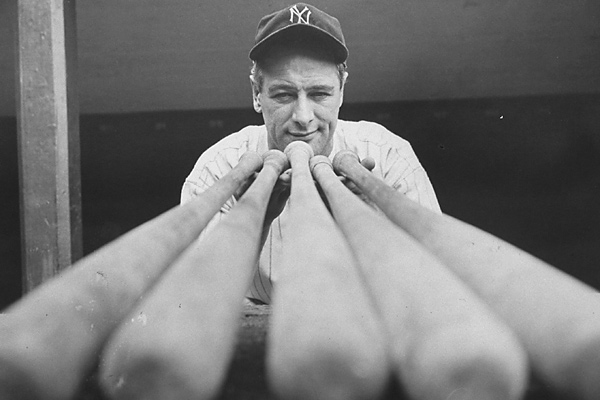
The batteries are done. As Tony Reali would say on ESPN, Let's go around the horn!

Honorable Mention to Bob Watson. He was only a Yankee for 2 seasons and the start of a 3rd, 1980-82, but batted .307 in '80, his only full season in The Bronx, and was the general manager who built the 1996 World Champions.

10. Mark Teixeira, 2009-present. He'll be 31 shortly after Opening Day, and has had only 2 full seasons in Pinstripes. But they've been fantastic seasons: In 2009, he led the AL with 39 homers and 122 RBIs, batting .292; in 2010, he dipped to .256, but still hit 33 homers with 108 RBIs. That's 72 homers as a Yankee, 275 overall. His 2 100-RBI seasons with the Yankees makes 7 overall. His OPS+ was 141in '09 and 125 in '10, and it's 134 for his career.

It's too early to say that he'll get Number 25 retired, a Plaque in Monument Park, and election to the Hall of Fame. But I wouldn't bet against any of those.

9. Johnny Mize, 1949-53. He put up big numbers for the St. Louis Cardinals and New York Giants before being acquired by the Yanks, and at age 36, most people thought he was done. Manager Casey Stengel thought otherwise, and the Big Cat was an All-Star twice more, with a 116 OPS+ as a Yankee. (That's well below his career OPS+ of 158, which got him, albeit belatedly, into the Hall of Fame.)

He was with the Yankees 5 seasons, and they won the World Series all 5. He wore Number 10 as a Cardinal, 3 as a Giant before going off to World War II and 15 after coming back. As a Yankee, he wore 36, probably the best Yankee to wear the number until David Cone.

8. Wally Pipp, 1915-25. He's remembered today as the man whose headache -- possibly as a result of getting beaned in those pre-batting helmet days -- allowed Lou Gehrig to step in and not miss a game for 14 years. This led to anyone thinking about asking for a day off to worry about "getting pipped." It's not fair, because Pipp was, by the standards of his time, a very good player.

He led the AL in home runs in 1916 and '17 -- albeit, in those last few years of the Dead Ball Era, with 12 and 9 homers in those seasons. He led the AL with 19 triples in 1924, his last full season as a Yankee. He batted .300 3 times and just missed 2 others. He hit 311 doubles despite playing his last game at age 35 (he closed his career with the Cincinnati Reds from 1926 to '28) and in the parks of the time, most of which had faraway center field fences.

And, yes, he helped the Yankees win the 1921 and '22 Pennants and the '23 World Series. He is worth remembering, and for his presence, not just his absence, whatever the real cause.

7. Chris Chambliss, 1974-79. The 1971 AL Rookie of the Year came to the Yankees on April 26, 1974 in a controversial trade that sent 4 party-boy pitchers to the Cleveland Indians. With Watergate in the headlines, some called the trade the Friday Night Massacre. But it was a great trade: None of the guys going to Cleveland did anything for the Indians, while the Yankees got Chambliss and Dick Tidrow, a versatile pitcher without whom the 1976, '77 and '78 Pennants would not have been won.

Nor would they have been won without Chambliss. He gave the Yankees their first really reliable 1st baseman since Moose Skowron -- say what you want about Joe Pepitone, but "reliable" is not an adjective that comes to mind. You need 17 homers in a season? You need 90 RBIs? You need a good glove at 1st? Chambliss was your man.

He was an All-Star in 1976, and he gave the season its exclamation point on October 14, hitting a home run to win Game 5 of the ALCS and then Pennant over the Kansas City Royals. He also hit a home run that tied Game 6 of the 1977 World Series, setting up The Reggie Jackson Show. Speaking of Reggie, he was in the ABC booth for that '76 ALCS, assisting Keith Jackson and Howard Cosell, and he said it was a shame that there was no MVP award for the ALCS at the time: Chambliss batted .512 with 2 homers and 8 RBIs, meaning that if the award had been in place, he might have won it even without his capper. Overall, he batted .282 as a Yankee, and his career postseason average was nearly identical, .281. He hit 185 homers, 79 as a Yankee.

The Yankees sent him to the Toronto Blue Jays after the 1979 season, to get Rick Cerone to fill the catching void caused by the death of Thurman Munson, while Watson came in to play 1st in 1980 and '81. But the Jays foolishly traded Chambliss to the Atlanta Braves for outfielder Barry Bonnell, who did nothing in Toronto. Chambliss helped the Braves win the NL West in 1982 (their only postseason appearance from 1969 to 1991), and forged a friendship with manager Joe Torre that led to being hired as Torre's hitting instructor when he managed the St. Louis Cardinals and later the Yankees.

Chambliss was recently hired as the hitting instructor for the Seattle Mariners. His Number 10 has been retired by the Yankees, albeit for Phil Rizzuto. But he should be remembered as a fine player, and not just for one amazing moment, a hot bat on a cold night in The Bronx.

6. Joe Pepitone, 1962-69. The Brooklyn native played his last big-league game at age 32. He said that once his father, his biggest fan, died, he began to lose interest. Clearly, he was one of these guys who was more interested in being a star than in being a great athlete. He knew he'd blown it: He titled his memoir Joe, You Coulda Made Us Proud.

He sure could have. After a cup of coffee in '62, the Yankees traded Moose Skowron to make room for him, and, for a while, it worked. He was an All-Star the next 3 seasons, helping the Yankees win Pennants in '63 and '64, hitting a grand slam in Game 6 of the '64 Series.

But that was the high-water mark, and he was only 24. Despite 3 Gold Gloves and 219 homers (166 as a Yankee), Joe played himself out of baseball, and I don't mean on the field: Times Square when he was with the Yankees, Rush Street when he was with the Chicago Cubs, and the Ginza in his brief, scandalous (over there, anyway) tenure in Japan. His post-baseball life has had its difficulties as well. He now lives on Long Island, and has kept his nose (and liver) clean for about 15 years.

Fast facts with which you can amaze your friends: Like John Lennon, Joe Pepitone was born on October 9, 1940, made his "big-league debut" in 1962, was a huge star by 1964, but left his "group" in 1969. Too bad Joe never found his "Yoko": He's been divorced 3 times. But at least he's alive, which is not true of John, and back in the good graces of Yankee management, for whom he does public-relations work. He will never get a Monument Park Plaque, or Number 25 retired in his honor. But he's doing okay now, and that's not something that could always be said of him.

5. Jason Giambi, 2002-08. Okay, the Giambino, shall we say, had help. Unlike those lying and cheating bastards David Ortiz, Mark McGwire, Ivan Rodriguez and Luis Gonzalez, all of whom contributed to Yankee postseason defeats, Giambi was man enough to admit it and stop.

He recently turned 40, and re-signed with the Colorado Rockies, so they, as well as he, think he's not done yet. He has 415 career home runs, 209 with the Yankees. He helped the Yankees to the postseason 6 straight times, and his 2 homers kept the Yankees in Game 7 of the 2003 ALCS against the Roid Sox long enough for the alleged Curse of the Bambino to work one last time. (Unless you count that 13-inning dance of death of July 1, 2004, featuring Derek Jeter flying into the stands -- and I don't count it as part of The Curse.)

He hit at least 30 homers in 5 Yankee seasons, and had 100 or more RBIs in 3. He's a 5-time All-Star, 3 as a Yankee. He flopped in the '03 World Series (.235) and the '06 ALDS (.125), but overall he's got a .911 OPS in postseason play.

He'll never make the Hall of Fame or Monument Park, and his Number 25 stands a much better chance of being retired for Teixeira than for Giambi (or Pepitone), but it's unfair to call Giambi's tenure in Pinstripes a failure. After all, he was better over those particular seasons than Tino Martinez was.

4. Bill "Moose" Skowron, 1954-62.  The nickname had nothing to do with his size: As a kid, he got a crewcut, and someone said it made him look like Benito Mussolini. He still has a crewcut today, only now his hairline has receded to the point where it looks okay.

A 6-time All-Star, he hit 211 home runs (165 as a Yankee) in spite of playing his entire career in pitcher's parks, particularly as a right-handed hitter in the pre-renovation Yankee Stadium, with its 402 feet to straightaway left, 457 to left-center and 461 to center. In spite of those dimensions, Moose still hit 28 home runs in 1961 -- joining with Roger Maris' 61 and Mickey Mantle's 54 to produce 143 home runs, still the highest total ever by 3 teammates. He was also a great fielder for a big man.

He won 8 Pennants (1955, '56, '57, '58, '60, '61, '62 and '63 -- the last after being traded to the Los Angeles Dodgers to make room for Pepitone) and 5 World Championships (1956, '58, '61, '62 and '63 -- 4 with the Yanks, 1 with the Dodgers). He is also one of the few players to hit World Series home runs for both leagues, including a grand slam in Game 7 of the '56 Series against the Dodgers in the last postseason game ever played in Brooklyn.

Moose, once again living near his native Chicago, is a member of the National Polish-American Hall of Fame -- that's for all walks of life, not just sports. Na zdrowie, Moose. I have another reason for liking him: We share a birthday, December 18, albeit 39 years apart.

(Another player with that birthday, Gino Cimoli, died this week. He was an outfielder who hit 40 doubles for the '59 Cards, and his 15 triples for the Kansas City Athletics led the AL in '62.)

3. Don Mattingly, 1982-95. Only Number 3? This is the New York Yankees. We are about winning World Championships. He never even won a postseason series. Donnie Regular Season Baseball.

But if I'm going to be completely fair, I not only have to say all of that, but I have to say all of this: The guy did more than anybody in those years to get the Yankees there, and, talk of mythical sports-related curses aside, it wasn't his fault that it didn't happen.

His 145 RBI in 1985 were the most by a Yankee since Joe DiMaggio in 1948. His .352 batting average in 1986, although not enough to win the AL batting title as his .343 was in 1984, is the highest by a Yankee in a full season since Mickey Mantle in 1956. (Paul O'Neill batted .359 in strike-shortened 1994.) His 238 hits in 1986 are a Yankee record (breaking the 231 by Earle Combs in 1927). He's probably the best-fielding 1st baseman in Yankee history (although see Wally Pipp above), winning 9 Gold Gloves.

No, he never won a World Series, a Pennant, or a postseason series. And he was far from, as Michael Kay of the YES Network puts it, "the most popular athlete in New York history." But Don Mattingly earned his Monument Park Plaque and the retirement of his Number 23.

2. Tino Martinez, 1996-2001, with a brief comeback in 2005. The Bamtino ahead of Donnie Baseball? Blasphemy! No, it's not, and I'll give you 4 reasons why: 1996, 1998, 1999 and 2000. In 1997 -- oddly, not one of the Yanks' Pennant years -- he had 141 RBIs, and his 44 homers were the most by a Yankee between Roger Maris (and Mickey Mantle) in 1961 and Alex Rodriguez in 2005. He hit 339 home runs, 192 as a Yankee. And he hit 2 of the most dramatic homers in Yankee history, the grand slam that won Game 1 of the 1998 World Series, and the homer that sent Game 4 of the 2001 Series to extra innings.

Tino will never make the Hall of Fame. Baseball-Reference.com lists his "10 Most Similar Batters" as Lee May, Gil Hodges, George Foster, Paul Konerko, Boog Powell, Joe Adcock, Jack Clark, Willie Horton, Norm Cash and Derrek Lee. Konerko has a shot at the Hall (he'll be 35 in March and already has 365 homers despite playing his entire career in pitcher's parks), and Hodges should be in, but none of the others ever will be. And at the rate Robinson Cano is going, he's a much more likely candidate to get Number 24 retired for him.

But Tino deserves a Monument Park Plaque. As much as anyone else, he was one of the guys who got the Yankees over the hump in 1996, and kept them there into the dawn of the 21st Century.

1. Lou Gehrig, 1923-39. When Major League Baseball and MasterCard did the balloting for the All-Century Team in 1999, Gehrig got the most votes. Even more than Babe Ruth.

How do you sum up Gehrig briefly? Said All-Century Team. Hall of Fame. His Number 4 was the first to be retired in all of baseball. A Monument -- not a Plaque -- in Monument Park. First Yankee to win the Triple Crown.

Illness stopped him just short of 500 homers and 2,000 RBI. His brief callup in 1923 did not allow him to play in that year's World Series, but he played for the Yankees in 7 World Series (1926, '27, '28, '32, '36, '37 and '38), winning all but the 1st and as Captain for the last 4 of those. Moreover, when people think "Yankee Captain," the 1st name that comes to mind is not Derek Jeter or Thurman Munson or, God forbid, Mattingly: It's Lou Gehrig.

That's almost certainly due to the film The Pride of the Yankees starring Gary Cooper. The film doesn't really hold up well: Cooper looked like Gehrig, but didn't sound like him, and had never played baseball in his life. While it's not really a movie about a baseball player, it's a love story between Lou and Eleanor (played by Teresa Wright), and the leading man's job happened to be that of baseball player.

But the story is timeless, because Lou was timeless. The Iron Horse still runs, if only in our memories. A person would have to be about 75 years old now to have seen him play, and closer to 80 to remember him at his peak. But because of the movie, and because the Yankees have been so good at presenting their history, this man who died 70 years ago this June is still with us. Lou Gehrig lives.

Tuesday, February 15, 2011

Top 10 Yankee Catchers

Talk going around spring training that if the St. Louis Cardinals don't give Albert Pujols a contract extension by noon tomorrow, he'll test the free-agent market at the end of the season.

Pujols has been the face of the franchise the last 10 years, lifting them out of the cloud of Mark McGwire. As far as anyone knows, he's clean. He gives all the appearance of being a good guy. And he has hit like hell. By the time he's done, he can give earlier Card legends Rogers Hornsby and Stan Musial, and also Willie Mays and Hank Aaron, a run for their money for the title of greatest offensive player in National League history. (Barry Bonds, of course, is ineligible; and even if McGwire's stats were clean, he was only in the NL for 4 years and change.)

Cardinal owner Bill DeWitt Jr. maybe be a filthy rich Republican campaign contributor, but that doesn't mean he's dumb. He's not going to let Albert Pujols, currently the best hitter in the game (if not necessarily the best all-around player), play for anyone else.

*

Now that that's out of the way, in honor of pitchers and catchers having reported, and the Top 10 Yankee Pitchers having been done yesterday, here are...

Top 10 Yankee Catchers

This will be a considerably shorter list. And that's a good thing, since it reflects the luck and longevity the Yankees have had with their catchers.

10. Jake Gibbs, 1962-71. The best quarterback the University of Mississippi has ever had -- at least, the best one not named Manning -- he chose baseball because he could make more money. But he didn't get more than a cup of coffee in the majors until 1966 and was only the starter in '67 and '68.

He probably would have been better off if he'd gone to the NFL -- or the AFL, which was a possibility at the time. He was drafted by the NFL's Cleveland Browns and the AFL's Houston Oilers. Still, somebody has to round out the Top 10.

9. Rick Cerone, on and off 3 times 1980-90. Brought in from the Toronto Blue Jays for Chris Chambliss in order to replace Thurman Munson, he helped the Yankees win the AL East in 1980 (he actually finished 7th in the MVP voting) and the Pennant in '81. But that was it, and he never again had more than 300 plate appearances in a season.

I remember listening to Max Kinkel's All Night Radio show on WCBS-FM one night in 1987 (it was a music show, but he talked about sports a lot), and he was talking to someone about the Yankees, ripping Mark Salas, saying, "To me, Salas just could not call a game." The caller said that Cerone, then in his 2nd go-around, could, and Max said, "Well, Cerone can call a game, but Cerone can't throw the ball!"

After his playing career, which also included a stopover with the Mets, Cerone, a Newark native and a graduate of Seton Hall University, was one of the founders of the reborn Newark Bears minor-league team.

8. Joe Girardi, 1996-99. Speaking of the Mets, as we all know, in nearly 50 years, no Met pitcher has ever thrown a no-hitter. But a few Mets-to-be and lots of former Mets have. Girardi caught 2 such no-hitters, by Dwight Gooden in 1996 and David Cone in 1999.

He was also one of the cornerstones of the Yanks' 1996 revival, including a triple off Greg Maddux that started a 3-run rally that won Game 6 of the World Series and the Series itself. Considering that he was known for his defense, usually capable of 40-50 RBI per year but no more than that, and that he was built like the stereotypical old-time catcher and not expected to run well (though he did steal 13 bases in '96), I said at the time that hitting a triple off Maddux in the World Series was the baseball equivalent of Buster Douglas knocking out Mike Tyson.

He guided the Yanks' pitching staff until Jorge Posada was ready, and it surprised no one when he became a big-league manager. He kept a Florida Marlins team starved of payroll near .500 most of the 2006 season, got the NL Manager of the Year award, and got fired for his trouble.

Named Yankee manager in 2008, he led them to the 2009 World Championship, and, with the retirements of Joe Torre, Lou Piniella and Bobby Cox, is up there with Tony LaRussa and Mike Scioscia as one of the game's most repsected managers.

7. Mike Stanley, 1992-95. At first, it looked like he was going to be a big part of the Yanks' 1990s revival, batting .305 with 24 homers and 85 RBIs for the 1993 squad that hung close to the Blue Jays until mid-September. He hit .300 again in strike-shortened '94 and made the All-Star Team in '95.

But he was granted free agency, and the Yankees didn't lift a finger to re-sign him, a move that left some Yankee Fans (like me) quite puzzled, and some very angry. The Red Sox jumped at the chance, and he gave them a very solid season and much of another before a rare trade between the teams briefly brought him back in 1997. (The trade was ultimately a wash, the only other player worth mentioning being Tony Armas Jr., who the Sox soon put in the trade that brought in Pedro Martinez from the Montreal Expos.)

The Yanks may have known what they were doing, though: They got Girardi, they had Posada on the way up, and while Stanley was still productive until 2000 (he then retired at age 37), Girardi was a little younger, Posada considerably so.

6. Wally Schang, 1921-25. He came up with the Philadelphia Athletics in time to play in the 1913 and '14 World Series, winning the former. But Connie Mack's breakup of his dynasty sent him to the Red Sox in 1917, where he won another Series in 1918. Harry Frazee's breakup of his dynasty meant that Schang was one of those who, in large measure, made the 1921-28 Yankees an extension of the 1912-18 Red Sox.

He helped the Yankees win their 1st 3 Pennants and their first World Series in 1923. Schang batted .300 6 times, but only twice with the Yankees. Trading him to the St. Louis Browns in 1926 looks like a bad trade, but they got a pretty good pitcher for him, George Mogridge.

Oddly, the "Murderer's Row" Yankees of 1926, '27 and '28 did not have a solid player at catcher, the most important position on the field. (An oddity unmatched in sports until the Chicago Bulls won 6 NBA Championships in the 1990s despite their centers being the good, but hardly great, Bill Cartwright and Luc Longley.) Pat Collins, Mike Gazella, Benny Bengough... these were not good players, but the Yanks managed to win 2 World Series, very nearly 3, with them behind the plate until Bill Dickey became the full-time catcher in 1929.

Schang wrapped up his career with the Detroit Tigers in 1931, and that's the only season that he wore a uniform number. Interestingly, it was the number that Bill Dickey was already making synonymous with Yankee catchers, 8.

5. Elston Howard, 1955-67. Why so low? Actually, due to Yogi already being there, Elston, the first black Yankee, was mainly the Yankees' starting left fielder until 1959. But then he became the best catcher in the game. He was the first black man to win the AL's MVP award, in 1963 -- this after several had won it in the NL. Mickey Mantle and Roger Maris were hurt much of that season, and Elston carried that team, helping Whitey Ford win 24 games and young Jim Bouton win 21.

With the Yankee dynasty having collapsed, Elston was traded to the Boston Red Sox in 1967, and helped them win their "Impossible Dream" Pennant. It's a very strange thing to look at that World Series highlight film and see Ellie in a Red Sox uniform, standing with Roger Maris in a Cardinal uniform.

In 1969, he returned to the Yankees as the AL's first black coach. His death due to a heart ailment in 1980 probably prevented him, at the rate George Steinbrenner was hiring and firing, from becoming New York's first black manager, a distinction that would later go to Willie Randolph with the Mets. The Yankees have still never had a black manager, but they retired Ellie's Number 32 and dedicated a Plaque to him in Monument Park.

4. Thurman Munson, 1969-79. In 1970, his 1st full season, he won the AL's Rookie of the Year. In 1976, he won the MVP. Thanks to Derek Jeter having been robbed in both 1999 and 2009, Thurman remains the only Yankee ever to win both of those awards. (There was no ROY until 1947, denying guys like Ruth, Gehrig and DiMaggio, and Mantle's 1st season was troubled.)

In spite of injury after injury, the first man trusted with the Yankees' official Captaincy since Lou Gehrig put together 3 straight seasons, 1975-77, of at least a .300 batting average and 100 RBIs. That streak ended in '78, but he made up for it by leading the team to its 3rd straight Pennant and back-to-back World Championships.

The thing I love the most about Thurman is that, at the moment when the Yankees most needed a home run from him, he hit the longest home run of his career. It was Game 3 of the '78 ALCS, bottom of the 8th, trailing 4-3 to the Kansas City Royals, and Doug Bird hung a curveball, and Thurman sent it 470 feet into Monument Park.

Sadly, the next person enshrined in Monument Park would be Thurman himself, the victim of a plane crash on August 2, 1979. George Steinbrenner, his fellow native of the Cleveland area, immediately ordered the retirement of his Number 15 (which had also been worn by Yankee greats Red Ruffing, Tommy Henrich and Tom Tresh), and a year later his Plaque was ready.

3. Jorge Posada, 1995-present. There are those who say that Posada isn't a very good catcher. Many of those will say that Mike Piazza of the Mets and Jason Varitek of the Red Sox were better. These people are fools.

Jorge is a legend. He caught David Wells' perfect game in 1998. He hits from both sides of the plate with power. He hits home runs in World Series games. His double ended the big 3-run rally that tied up Game 7 of the 2003 ALCS and set up Aaron Boone's Pennant-winning homer. He's raised a bundle of money for charity. And he's married to Laura Posada. This last factor cannot be discounted in discussing Jorge's greatness. He will get a Plaque in Monument Park, and if any later Yankee ever wears Number 20, it will be a crime. (Sorry, Bucky Dent.)

2. Bill Dickey, 1928-46. He took the title of "greatest catcher ever" away from Mickey Cochrane, and was, unusual for a catcher, one of the 10 best hitters in baseball. He was not on the roster of the 1928 World Series, but he helped the Yankees win 8 Pennants (1932, '36, '37, '38, '39, '41, '42 and '43) and 7 World Series (losing only in '42).

He was Lou Gehrig's best friend on the team, and played himself in The Pride of the Yankees. That scene where a teammate questions Gehrig's effort, not realizing that ALS is overtaking him, and Dickey punches the guy out? That really happened.

After Gehrig's illness-forced retirement in 1939, there was no official Yankee Captain until Munson, 37 years later. But Dickey was very much an unofficial captain, leading the Yankees to their 106-win season in '39, leading them through the Joe DiMaggio streak season of '41, and taking them to the '43 title when several players, including DiMaggio, Tommy Henrich and Phil Rizzuto, were off fighting World War II. (Dickey himself went into the service for the next 2 seasons.)

He came back in '46, briefly replaced Joe McCarthy as manager, and was one of Casey Stengel's coaches from 1949 to '60. His greatest accomplishment may actually have been making Yogi Berra an even better catcher than himself: As Yogi said, "Bill Dickey is learning me all his experiences."

1. Lawrence "Yogi" Berra, 1946-63. It's hard to look at Dickey's stats and say Yogi was better, but Dickey played in a hitter-friendly era, while Yogi played in a pitcher-friendly era. He won 3 AL MVPs, 1951, '54 and '55. Somebody once argued that, due to his hitting and handling a pitching staff that was constantly changing and yet constantly winning, Yogi might be the most valuable player the Yankees have ever had.

And, like Dickey, Yogi became sort of an unofficial captain, particularly from 1956, when Rizzuto was unceremoniously and callously released, and 1961, when new manager Ralph Houk began to insist that Mantle take more of a leadership role -- not as a slap against Yogi, but more in order to make Mickey finish growing up, and it wasn't entirely a fool's errand.

Nobody won more Pennants than Yogi: 14 (1947, '49, '50, '51, '52, '53, '55, '56, '57, '58, '60, '61, '62, '63 and '64). Nobody won more World Series: 10 (1947, '49, '50, '51, '52, '53, '56, '58, '61 and '62 -- in all of sports, only Bill Russell in basketball and Henri Richard in hockey have 11). He still holds the records for most World Series games, at-bats and hits.

In 1972, Yogi was elected to the Hall of Fame. Dickey had been elected in 1955. Upon Yogi's election, the Yankees retired Number 8 for both men. (Dickey wore 33 as a coach while Yogi was the catcher.) In 1988, both men were awarded Plaques in Monument Park.

And Yogi was a good manager: He got the Yankees to the 1964 Pennant, and the Mets to the 1973 Pennant. Not only did he have to make both teams come from behind in the process, but it made him the only manager ever to take both teams to the World Series. (I will Broadway Joe Namath guarantee you that there will never be another in my lifetime.) He lost in Game 7 both times, but there's no shame in losing a World Series to Bob Gibson and Lou Brock -- or to Reggie Jackson and Catfish Hunter, for that matter.

Today, people my age and younger know Yogi only as an elder statesman of baseball and as the guy who says funny things, often in TV commercials. They're not old enough to remember him as a manager, let alone as a player. But he was one of the true greats of the game, well before he became known for his "Yogi-isms."

Monday, February 14, 2011

Top 10 Yankee Pitchers

Rest in peace, Chuck Tanner, 1929-2011. Once an outfielder who homered in his 1st at-bat for the 1955 Milwaukee Braves, he nearly managed the Chicago White Sox to an AL West title in 1972 (Dick Allen, AL MVP that season, called him his favorite manager), and nearly managed the Oakland Athletics to an AL West title in 1976 (despite Charlie Finley already having broken up the team some).

The New Castle, Pennsylvania native managed his "hometown" Pittsburgh Pirates to what is still their last Pennant, winning the 1979 World Series with Hall-of-Famers Willie Stargell and Bert Blyleven, plus Dave "Cobra" Parker and Bill "Mad Dog" Madlock.

Good man, good manager, good teams... wacky uniforms.

*

Having gotten that bit of unhappy news out of the way, and having properly saluted its subject...

Today is February 14, a wonderful day, filled with love and hope.

Pitchers and catchers report to the Yankees' spring training complex in Tampa, Florida.

In honor of the day, I present my picks for

Top 10 Yankee Pitchers

I'll do the top 10 of the other positions in the next few days.

Honorable Mentions

Eddie Lopat, 1948-55. One of the "Big 3" of the late Forties and early Fifties, along with Allie Reynolds (see below) and...

Vic Raschi, 1946-53. Steady Eddie and the Springfield Rifle backed up the Superchief to form as good a 1-2-3 punch as any baseball team has ever had. They didn't have the longevity of the 1990s-2000s Atlanta Braves of Greg Maddux, Tom Glavine and John Smoltz, but they won more in that less time. And they far outclass the early 2000s Oakland Athletics "Big 3" of Barry Zito, Mark Mulder and Tim Hudson.

Mel Stottlemyre, 1964-74. Talk about bad luck: He was the right kind of pitcher, for the right team, but both arrived and, due to a rotator cuff injury that could probably have been properly repaired with today's medicine, left at the wrong time. But he's the best pitching coach of recent times (rest in peace, Johnny Sain, Mel's predecessor as such), having put together the staffs of both the 1980s Mets and the 1990s Yankees.

Albert "Sparky" Lyle, 1972-78. Along with Rollie Fingers, Bruce Sutter and -- to Sparky's dismay -- Goose Gossage, he redefined the role of the relief pitcher in the Scintillating Seventies. Cy Young Award winner in 1977 (the 1st AL reliever to win it). Just don't give him a cake on his birthday. Unlike Yankee prospect turned Met joke Marv Throneberry, the problem is not that he would drop it.

Jim "Catfish" Hunter, 1975-79. He was a Hall-of-Famer, and a Yankee for 5 years, but was only really available for 2 and parts of 2 others: 1975, '76, the 1st half of '77 and the 2nd half of '78. I love the guy, but, in all honesty, I couldn't put him on this list.

Dave Righetti, 1981-90. He came to the Yankees in the 1978-79 offseason, in the trade that sent Sparky to the Texas Rangers.  He was the AL Rookie of the Year in 1981, helping the Yankees win the Pennant. He pitched a no-hitter against the Boston Red Sox on the 4th of July 1983. He became a reliever, and set a record of 46 saves in 1986. (It's still a record for AL lefthanders.) He saved 252 games (a record for lefties later broken by John Franco), 224 as a Yankee. He never became the great pitcher everyone hoped, though. The San Jose native grew up as a San Francisco Giants fan, and has been their pitching coach since 2000. This past fall, the Giants won the World Series, finally getting themselves, and Rags, a ring.

Jimmy Key, 1993-96. Another guy who's probably kept out of the Top 10 due to not being in Pinstripes long enough. But, along with Paul O'Neill and Wade Boggs, he was one of 3 big 1992-93 acquisitions that signaled that the rebuilding was not only underway, it was succeeding. He started and won Game 6 of the 1996 World Series that finished the job of bringing the Yankees back -- though it was his last game for the team.

David Cone, 1995-2000. He wouldn't make either the Mets' or Yanks' all-time starting rotation, but put the two of them together, and you have one of the great New York pitchers of all time, and a guy who should be in the Hall of Fame. (He is now eligible.)

David Wells, 1997-98 and 2002-03. His tenures were brief. His performances were memorable. He wasn't perfect (except on May 17, 1998), but he was a winner.

Orlando Hernandez, 1998-2002 (with a brief comeback in 2004). El Duque wasn't with us long, but he'll be long remembered.

Mike Mussina, 2001-08. He helped the Yanks win 2 Pennants, made several other postseason appearances possible, and won 20 games at age 40. A classy guy, but his dates of arriving and leaving do kind of make him the Don Mattingly of pitchers. Still, put his work for the Baltimore Orioles and the Yankees together, and he should be elected to the Hall of Fame. (He'll be eligible in January 2014.)

CC Sabathia? He's only had 2 years in Pinstripes so far, although they've been superb. I have no doubt he'll break into the Top 10 by the time he's done. Let's hope that's a long wait.

I will not give an Honorable Mention to Roger Clemens, even though his statistical performance deserves it. The pitcher does; the man does not.

10. Herb Pennock, 1923-33. The Boston Red Sox had him before that, and after that. Too bad for them. He was one of many players the Red Sox let go to the Yankees in the 1920s, along with Babe Ruth. He won 241 games, 162 for the Yankees, only 62 for the Sox. He helped the Yankees win their 1st 4 World Series (1923, '27, '28 and '32). Had there been a Cy Young Award in his time, he might have won it in 1923, '24 and '26.

The Philadelphia-area native started his career with the Philadelphia Athletics, and ended his life as general manager of the Philadelphia Phillies. Sadly, in that role, he was a major and enthusiastic part of the Phillies' hideous attitude on race relations. Nevertheless, his pitching made him a deserving member of the Hall of Fame. The Yankees have never put him in Monument Park, nor retired a number for him. He played in the era before numbers were worn, then, when it was a new phenomenon, he didn't have a regular number, wearing 11, 12 and 16 at various times.

9. Rich "Goose" Gossage, 1978-83. His bulk, his fearsome stare (later augmented with a nasty biker mustache), his blinding speed and his willingness to pitch inside made him the 1st truly intimidating modern reliever. He honed his craft with the Chicago White Sox, then spent a year with the Pittsburgh Pirates, giving Yankee Fans a taste of what was to come by pitching in that retina-burning Pirate black-and-gold uniform at the old Yankee Stadium in the 1977 All-Star Game.

In 1978, he got off to a rough start in Pinstripes, but straightened out to become the 1st pitcher ever to throw the final out of a Division Title clincher (the AL East Playoff against the Red Sox, a.k.a. the Bucky Dent Game, a.k.a. the Boston Tie Party), a Pennant clincher (Game 4 of the ALCS against the Kansas City Royals) and a World Series clincher (Game 6 against the Los Angeles Dodgers).

Unfortunately, bad trades and injuries -- including the plane-crash death of Thurman Munson in 1979 -- made 1978 his only ring season, although he was sensational in helping the Yankees win the 1981 Pennant. He moved on to help the San Diego Padres win a Pennant in 1984. He's finally in the Hall of Fame, although the Yankees have not yet retired his Number 54 or given him a Monument Park Plaque.

8. Waite Hoyt, 1921-30. A Brooklyn native, he was the 1st native New Yorker to be a Hall-of-Fame quality Yankee.  He was another that Red Sox owner Harry Frazee sent to the Pinstripes, like the Babe. Hoyt knew how important the Babe was, particularly to ballplayers' salaries: "Every kid, when he goes to bed at night, should say, 'God bless Mommy, God bless Daddy, and God bless Babe Ruth.'"

He won 237 games, 157 as a Yankee. He was a member of the Yankees' 1st 6 Pennant winners (1921, '22, '23, '26, '27 and '28) and 1st 3 World Champions (1923, '27 and '28). Had there been a Cy Young Award in his time, he, rather than Pennock, almost certainly would have won it in 1927 and '28. He appeared in the 1931 World Series for the Athletics, and was still a pretty good pitcher for the Pittsburgh Pirates in the mid-1930s. He finished his career with his hometown Dodgers. Later became a beloved broadcaster for the Cincinnati Reds.

He is in the Hall of Fame. He is not in the Yankees' Monument Park, but the Reds elected him to their team Hall of Fame. He was another player who was with the Yankees at the time numbers were first used in 1929, and wore both 11 and 12, neither of which is retired for him.

7. Allie Reynolds, 1947-54. Known as the Superchief, for his Native American heritage and a fastball that reminded a sportswriter of the fast Super Chief train of the Santa Fe Railroad, it was his blessing to arrive in The Bronx just as the Yankees were embarking on a great new era; but it was his curse to arrive 30 years too soon to become one of the great relief pitchers ever.

He had the talent to be a great reliever, and he had the mentality: He could have out-Goosed Rich Gossage. He was tough, and he was mean: He once went to 3 balls and no strikes on a batter, and hit him with the 4th pitch, telling the media after the game, "If I'm gonna put him on, I might as well hurt him." But he was good enough to justify the faith of manager Casey Stengel, who wasn't afraid to pitch him every 4th day and often bring him in for relief duty in between.  He was 131-60 as a Yankee, 182-107 overall.

In 8 seasons with the Yanks, he was a member of 6 Pennant winners, winning the World Series every time. In Game 1 of the '49 Series, he outdueled Don Newcombe and rode a Tommy Henrich walkoff to win, 1-0. In 1951, he pitched 2 no-hitters, the only Yankee to do so in a career, let alone in a single season. He could have won the Cy Young Award in 1949, and he would have won it in 1952.

A back injury forced him to retire, and his energy investments in his native Oklahoma meant he didn't need the Yankees' money. He was the 1st great Sooner for the Yanks, before Mickey Mantle and Bobby Murcer. And while his Number 22 has not been retired, he does have a Plaque in Monument Park. (Lopat and Reynolds do not.) He's not in the Hall of Fame, but if Joe Tinker, Johnny Evers and Frank Chance could be elected together, then the Yankees' "Big 3" of this period -- Reynolds, Eddie Lopat and Vic Raschi -- deserve consideration for the same.

6. Andy Pettitte, 1995-2010. (Well, 1995-2003 and 2007-10.) "Average Andy"? No way. He won 240 games, 203 for the Yankees. Twice, he won 21 games in a season despite pitching in the Five-Man Rotation Era. He won more games as a Yankee lefty than any pitcher except for the one at Number 1 on this list. He has a career winning percentage .635. He won 7 games in Division Series play, 7 in the League Championship Series, and 5 in the World Series, including the 1998 and 2009 World Series clinchers, for a total of 19 postseason wins, the all-time record (18 of those for the Yankees, 1 during his sojourn with his hometown Houston Astros).

He'll be eligible for the Hall of Fame in January 2016. His Number 46 should be retired, and his Monument Park Plaque should already be on order.

UPDATE: He came out of retirement in 2012, and pitched through 2013. He's gotten his number retirement and his Plaque, and will not be eligible for the Hall in 2019.

5. Vernon "Lefty" Gomez, 1930-42. Instead of the Red Sox, his acquisition came from the Yankees' unofficial "farm system" relationship with the Pacific Coast League's San Francisco Seals. He went 189-102, although his last solid season was at age 32. In 1934, he went 26-5, and those 26 wins have not been matched by any Yankee pitcher since. (Don Newcombe's 27 in 1956 mark the only time any New York-based pitcher has matched or surpassed it since.) He probably would have won the Cy Young Award in 1932, '34 and '37. He holds the record for most career World Series games won without losing any, 6-0.

He is in the Hall of Fame and Monument Park. He wore Number 11 for most of his Yankee career, although the number is not retired, not for him or for anyone else.

4. Ron Guidry, 1975-88. The Louisiana native preferred "Gator" as a nickname to "Louisiana Lightning" and "the Ragin' Cajun." But the way he pitched, a better thing to call him would be "Sir."

He holds the Yankee record for most strikeouts in a season (248 in 1978) and a game (18 against the California Angels on June 17 of that season). He went 25-3 with a 1.74 ERA that season, including 3 2-hit shutouts in September, one of those being in the 3rd game of the 4-game Fenway Park sweep known as the Boston Massacre. The 25th win was, of course, in the Playoff against the Sox. He also won Game 4 of the ALCS (the Pennant-clincher) and, though exhausted and far from his best (and with serious help from Graig Nettles putting on a fielding clinic at 3rd base), Game 3 of the World Series.

Of course, he won the Cy Young Award that season. That Jim Rice of the 2nd-place Red Sox got the MVP that season is a travesty: If ever a pitcher was "the most valuable player in his league," it was Ron Guidry in 1978.

Guidry had one flaw: The worst pickoff move I have ever seen. I remain convinced that he wrecked his arm with all those pickoff moves. He had his last good season at age 34 (22 wins in 1985, a total no New York pitcher -- Yankee or Met -- has reached since), and was done at 37. But his career record is a sparkling 170-91, with a 119 ERA+ and a 1.184 WHIP. He was 5-2 with a 3.02 ERA in postseason play, including 3-1 with a sizzling 1.69 in the World Series, helping the Yankees win it all in '77 and '78 and the Pennant in '81.

He will probably never make the Hall of Fame, not even through the Veterans' Committee, but the Yankees have retired his Number 49 and awarded him a Plaque in Monument Park.

3. Charles "Red" Ruffing, 1930-46. Red Sox fans can't blame Frazee for this one, as he sold the team in 1923 and died in 1929. It was subsequent Sox ownership that traded Ruffing to the Yankees for Cedric Durst and, probably more important in that 1st full year of the Great Depression, $50,000 cash. It seemed like a good deal for the Sox at the time, as Ruffing went just 39-96 for some terrible teams... although his ERA+ was a not-particularly-bad 92.

As a Yankee, Ruffing went 231-124, with a 120 ERA+, and was a member of 8 Pennant winners (1932, '36, '37, '38, '39, '40, '41 and '42) and 7 World Championships (winning the World Series in all but the last of those). Had there been a Cy Young Award in his day, he could have won it in '38 and '39, and possibly also in '32 and '36.

He remains the winningest righthanded pitcher in Yankee history -- in fact, of all the righthanders in New York baseball history, only Christy Mathewson has won more. (373 -- Tom Seaver won 311, but "only" 198 as a Met.) He is in the Hall of Fame. He mostly wore Number 15 for the Yankees, but that number has been retired for someone else. He was honored in Monument Park in 2004, well after his death, and, for the moment, is the most recent player so honored. (George Steinbrenner has since been honored, but, of course, George was not a player.)

2. Mariano Rivera, 1995-present. I seriously considered putting Mo in at Number 1, especially since I've seen his entire career, whereas the other serious candidate for Number 1 is someone I only saw on old films. I just couldn't do it. Not even for the Panamanian Strongman. The Silent Assassin. The Sandman. The man who, like 1930s-40s Yankee outfielder Tommy Henrich, could have been nicknamed Ol' Reliable.

He is the all-time leader in ERA+, 205. His career ERA is 2.23. His career WHIP is 1.003. He has 559 saves, the most in AL history, and only Trevor Hoffman has more among NLers. (He just retired with 601, 42 more than Mo, so Mo has a shot at breaking the record this year.) He has 42 saves in the postseason. He has the lowest ERA in postseason history, 0.71.

He is the most important player for the Yankees from the 1980s onward -- even more than Derek Jeter. Without Mo, the Yankees might not have won any Pennants since 1981; with him, they have won 7 so far (1996, '98, '99, 2000, '01, '03 and '09) while winning 5 World Series (1996, '98, '99, 2000 and '09).

At age 41, he looks like he hasn't lost much from his peak. When it is all over -- and I sure hope the Yankees have a solid closer ready to step in when it is -- he will get his Number 42 retired (the last remaining player allowed to wear it after it was retired for all of baseball for Jackie Robinson), his election to the Hall of Fame, and his Monument Park Plaque. And, on top of everything else, he's a Hall of Fame human being as well.

1. Edward "Whitey" Ford, 1950-67. They called him "The Chairman of the Board" and "The Money Pitcher," and a man would have to be a serious money pitcher to rank ahead of the great Mariano Rivera.

Born in Manhattan, raised in Queens, he has the best career ERA of any starting pitcher in the post-1920 Lively Ball Era, 2.75, and the best winning percentage of any pitcher with at least 300 decisions, 236-106 for .690. Those 236 wins also make him the winningest pitcher in Yankee history, in spite of Casey Stengel's tendency to not only throw him against the tough teams of the era, but also to hold him back a day, or move him up to throw him on short rest, against said teams. As good as the Yankees were, Whitey raised their winning percentage.

The Cy Young Award was not established until 1956, right after Cy Young died, and it did not get awarded in each league until 1967, Whitey's last season. If it had been in place when Whitey started, he would have won it in the AL in 1955, '56 and '63. He did win the both-leagues award in '61.

He missed 2 seasons due to serving in the Korean War, but he still won 11 Pennants (1950, '53, '55, '56, '57, '58, '60, '61, '62, '63 and '64) and 6 World Series (1950, '53, '56, '58, '61 and '62). He holds a slew of World Series records including 10 wins (against 8 losses, also a record). His 33 2/3 consecutive scoreless innings are still a World Series record, although Rivera made it no longer a postseason record.

Hall of Fame, Number 16 retired, Monument Park. But the greatest tribute Whitey could have received came from my Grandma. A Dodger-turned-Met fan, she hated the Yankees of the Forties and Fifties. Hated Joe DiMaggio. Hated Mickey Mantle. Hated Yogi Berra. Hated Billy Martin -- and hated him even more as a manager, because he was a "hothead." (Her word, and quite accurate.) Really, really hated Casey Stengel.

But there were 2 Yankees she loved: Phil Rizzuto and Whitey Ford. She loved them because they were little guys but tough, and always seemed to come through when the spotlight was brightest. The fact that, like her, they came from Queens might have had something to do with it.

Friday, February 11, 2011

Sympathy, and Hope, for the Devils

Please allow Jacques Lemaire... and perhaps also Patrik Elias, Brian Rolston, Jason Arnott, Ilya Kovalchuk, Colin White and Andy Greene, to reintroduce themselves. They are men of wealth and taste. (UPDATE: Given how he ended up leaving the Devils, we now know that Kovalchuk's taste is very questionable.)

And, with the infusion of young talent like Mark Fraser, Mark Fayne, Henrik Tallinder, Adam Mair, Nick Palmieri and Mattias Tedenby, the New Jersey Devils have gotten off the deck, and started winning, and gaining ground on the Eastern Conference.

Their last 3 games have been wins, the last 2 coming from behind by a goal late in the 3rd period and winning in overtime.

Tuesday night, it was 3-2 over the Carolina Hurricanes in Raleigh. Last night, it was 2-1 over the Toronto Maple Leafs in Toronto.

Ilya Kovalchuk, about whom so much fuss was made in the off-season due to the size and makeup of his contract and how difficult it was to get it approved by the league office, scored the winner last night against the Make Beliefs. I'm beginning to think "Kovalchuk" is Russian for "Alka-Seltzer." When he scored that goal, oh what a relief it was.

These last 3 wins have been with Johan Hedberg in goal, as Martin Brodeur got hurt in the win against the Canadiens this past Sunday in Montreal. There is still no timetable on his return from a sprained knee.

The Devils have now won 3 straight, 5 out of their last 6, and 12 of their last 15. And both of their recent losses were in overtime (to the same team, the Florida Panthers), so they even got points in those games. Meaning they've gotten points in each of their last 13, 24 of a possible 26 points.

They play again tonight, at home at the Prudential Center, against the San Jose Sharks. Then the Hurricanes at home again on Wednesday, then a week from tonight at home against The Scum, followed by another game the next day in Raleigh, for their 3rd game against the currently-8th-seeded Canes in a span of 12 days.

*

I haven't done a countdown in the new year yet. Here goes:

Days until Yankees' pitchers & catchers report: 3, this coming Monday. Finally, a reason for me to look forward to February 14.

Days until the Devils play another local rival: 7, as I said, a week from tonight, against The Scum. RANGERS SUCK! They next play the Islanders on Sunday, March 6, a matinee at the Nassau Coliseum. Their next game against the Flyers is Friday, April 1, at home. Appropriate that they would play the Broad Street Bozos and their fool fans on April Fool's Day.

Days until the next North London Derby: Unknown. It was supposed to be Saturday, February 26, at White Hart Lane. But the League Cup Final (a.k.a. the Carling Cup Final) is the next day, at the new Wembley Stadium in London, and Arsenal advanced, to play Birmingham City. So the Derby had to be postponed. It could very well happen in May, which means, as Arsenal have twice before (1971 and 2004), they have a chance to clinch the league title at the ground of their most hated, and hating, rivals.

Days until the Red Bulls play regular-season soccer again: 36, the season opening at home at Red Bull Arena in Harrison, Saturday, March 19, against the Seattle Sounders.

Days until the Yankees' Opening Day: 48, Thursday, March 31, at Yankee Stadium II, against the Detroit Tigers.

Days until the next Yankees-Red Sox series begins: 56, Friday, April 8, at Fenway Park. Just 8 weeks. Under 2 months.

Days until the Red Bulls play another "derby": 57, Saturday, April 9, against the Philadelphia Union at PPL Park in Chester, Pennsylvania. They next play their biggest long-term rivals, D.C. United, on Thursday, April 21, at Robert F. Kennedy Stadium in Washington. And they next play the team that SHOULD be their biggest rival, due to the whole New York-New England thing, the New England Revolution, on Saturday, June 11, at Red Bull Arena.

Days until Derek Jeter collects his 3,000th career hit: 123. About 4 months. (estimated: June 14, 2011)

Days until Rutgers plays football again: 200, on Thursday, September 1, home to North Carolina Central. Not UNC, a.k.a. Chapel Hill. Not N.C. State. North Carolina Central. They're in Durham, almost certainly set up as a black people's counterpoint to once-segregated Duke University in the same city. This is another chance for RU to play a historically black college (as we've recently done with Howard, Morgan State and Norfolk State), give them a huge payday, rack up a lopsided win, and hear their great band while booing our own usually good band for being inadequate by comparison. Because the Big East Conference still hasn’t set its conference schedule for 2011, this opener is 1 of only 5 Rutgers games that are yet set. The others are as follows: At North Carolina on September 10, home to Ohio University (thank God it’s not Ohio State) on September 24, home to Navy on October 15, and against Army at the new Yankee Stadium on November 12. In fact, aside from the Yankee Stadium date, every date is in flux, due to the whims of the TV networks: September 3, 10, 17 and 24; October 1, 8, 15, 22 and 29; November 5, 19 and 26; and December 3.

Days until East Brunswick High School plays football again: 208, on Friday night, September 9, 2011, and the opponent and location are TBD.

Days until the Rutgers-Army football game at Yankee Stadium: 275.

Days until the next East Brunswick-Old Bridge Thanksgiving clash: 286.

Days until the last Nets game in New Jersey: 437 (estimated).

Days until the 2012 Olympics begin in London: 493.

Days until Alex Rodriguez collects his 3,000th career hit: 841 (estimated).

Days until Alex Rodriguez hits his 700th career home run: 963 (estimated).

Days until Super Bowl XLVIII at the Meadowlands: 1,088.

Days until Alex Rodriguez hits his 756th career home run to surpass all-time leader Hank Aaron: 1,583 (estimated).

Days until Alex Rodriguez hits his 763rd career home run to become as close to a "real" all-time leader as we are likely to have: 1,697 (estimated).

Wednesday, February 9, 2011

A Few R.I.P.s, Including the Other Neil Young: 1944-2011

Nice win by the Devils last night. Under 3 minutes to play, trailing the Carolina Hurricanes 2-1 at home, and they tie it up, and then win it 3-2 in overtime. This is important because the Canes would be, if the current standings hold, the 8th seed in the Eastern Conference Playoffs, and it was the first of 3 games the Devils play against them in the next 2 weeks. Gotta put the pressure on.

The Devils have gotten better since the firings of coach John MacLean (sorry, Johnny Mac, I know it wasn't all your fault) and captain Jamie Langenbrunner (and former captain Patrik Elias may not have gotten the C back, but he has improved a lot since the trade). They've climbed out of the Atlantic Division basement (have fun down there, Islanders), and now look like a Playoff team. But they've got a long way to go.

*

Roy Hartsfield died 3 weeks ago. He wasn't much of a ballplayer, spending only 3 years in the majors, all with the Braves, their last 3 years in Boston. But he moved on to the Dodger organization, was one of their top scouts, and won Pacific Coast League Pennants managing the Spokane Indians and the Hawaii Islanders. He was the first manager of the Toronto Blue Jays, from 1977 to 1999, although the expansion team lost 318 games in those seasons. A native of rural Georgia, Hartsfield was 85 when he died in a town down there, appropriately named Ball Ground.

George Crowe died 3 days later. He was a teammate of Hartsfield on the '52 Braves, stayed with them as they moved to Milwaukee, and was one of the first black players for the Cincinnati Reds and the St. Louis Cardinals. He was an All-Star in 1958, and once held the record for most career pinch-hit home runs, with 14. (The record now belongs to Matt Stairs, with 23.)

He was also a sensational basketball player. In 1939, graduating from Franklin High School in Indianapolis, Crowe was the first recipient of the highest honor the State of Indiana can bestow on one of its citizens: "Mr. Basketball." Subsequent winners have included Oscar Robertson, Dick and Tom Van Arsdale (the twins shared the award in 1961), Kent Benson, Steve Alford, Glenn "Big Dog" Robinson and Greg Oden. Crowe played on a semipro basketball team in Los Angeles with a Pasadena native who, like him, also played baseball, first in the Negro Leagues and then in the majors: Jackie Robinson. Crowe died at age 89.

Gus Zernial died 2 days after Crowe. He hit more home runs than any player whose last name begins with a Z. Big deal? Try 237 home runs, which is 237 more home runs than most of us will hit in the majors. In 1951, he led the American League in homers and RBIs. In 1953, he peaked with 42 homers, although that didn't lead the League. He was the last great slugger for the Philadelphia Athletics, and moved with them to Kansas City. His career OPS+ was 116.

In 2003, when Interleague play finally brought the Oakland version of the A's back to Philadelphia for their first game in the city since 1954, Zernial was one of the Athletics invited to take part in a pregame ceremony at Veterans Stadium, along with 1952 AL Most Valuable Player Bobby Schantz. I was there that day, and it was a good way for the city to finally do what it never had the chance to do almost half a century earlier: Say goodbye to what remains the most successful sports team in the city's history. (The A's won 9 Pennants and 5 World Series. Philadelphia football teams have won a combined 4 NFL titles, the Warriors and 76ers have 4 NBA titles between them, and the Flyers 2 Stanley Cups.) A native of Beaumont, Texas, Zernial died at age 87.

And Woodrow Thompson "Woodie" Fryman died last week. A lefthanded reliever, he did a lot of difficult things. He pitched for the Phillies in their last few years at Connie Mack Stadium. He pitched for Billy Martin. He pitched home games at Tiger Stadium. He pitched home games at Wrigley Field. And he played for the Montreal Expos.

As a starter, he had 5 seasons where he won at least 12 games, despite pitching for some lousy teams. As a reliever, he saved 45 games for the Expos from 1979 to 1982, at ages 39 to 42. The Kentucky native never appeared in a World Series, although he did reach the postseason with the '72 Tigers and '81 Expos. He was 70.

*

And Neil Young died. No, not the Canadian rock star. This was a sports legend.

Neil James Young was born on February 17, 1944 in Manchester, England. From his bedroom window, he could see Maine Road, the stadium of Manchester City Football Club.

The joke goes that everybody from Manchester supports Man City, while it's only people from outside Manchester that support Manchester United, especially foreigners attracted by Man United's constant winning from 1993 onward. This is a gross exaggeration, but, within the City of Manchester, Man City remain the most popular soccer team. Sorry, forgot to "speak English" there: The most popular football club.

Neil Young played for youth team Manchester Boys, and was signed by Man City at age 15. In 1961, he made his debut for the club, but they were relegated from the Football League's Division One to its Division Two. In 1965, legendary Arsenal centreback Joe Mercer was named their manager. He brought Malcolm Allison in as his assistant. Joe and "Big Mal" got City back to the top flight in 1966, making moves like taking Neil from the left wing to a forward position.

With a defense anchored by Captain Tony Book, Mike Doyle, and goalkeeper Harry Dowd, and an attack of Colin Bell, Mike Summerbee, Francis Lee and Young, Man City won the League in 1968. In the regular-season finale, needing a win to take the title, they beat Newcastle United 4-3, with Young scoring twice and having another disallowed for offside.

In 1969, they reached the Final of the FA Cup, England's national tournament, against Leicester City. Young scored the only goal of the game, in the 24th minute. At this point -- 3 months before Woodstock, and just over a year before the massacre at Kent State University led to the writing of a classic song -- Neil Young the soccer player was a much bigger figure than Neil Young the rocker.

In 1970, Man City won the League Cup, although Young did not play in the Final. As holders of the FA Cup, they were entered in the European Cup Winners' Cup (a tournament since folded into the UEFA Europa League), and reached the Final. This time, Young did play, against Polish side Gornik Zabrze. He scored, and was going for another when he was brought down for a penalty. Franny Lee scored it. Those goals were enough to give City the Cup, 2-1.

(Lee took City's penalties then. He was also one of the 1st players in the English league accused of diving. The joke was that he was actually Chinese and that his real name was "Lee Won Pen.")

Early the next season, Neil's brother Chris died, and this affected him both emotionally and on the field. He was never the same player. He made his last appearance for City a year later, and played for Preston North End and Rochdale before retiring in 1975.

With his 1st wife, Margaret, he had a son and 2 daughters. He later married a woman named Susan and had another daughter, and still later married a woman named Carmen. But he never found a permanent job, trying managing a sporting goods store and insurance sales. He developed cancer and died on February 3, not quite 67 years old.

*

May they all rest in peace, and take their places in the great ballpark in the sky. Okay, Gus, let's see if you can hit Woodie's curve.

Monday, February 7, 2011

Top 10 Pregame National Anthems... and Bottom 10

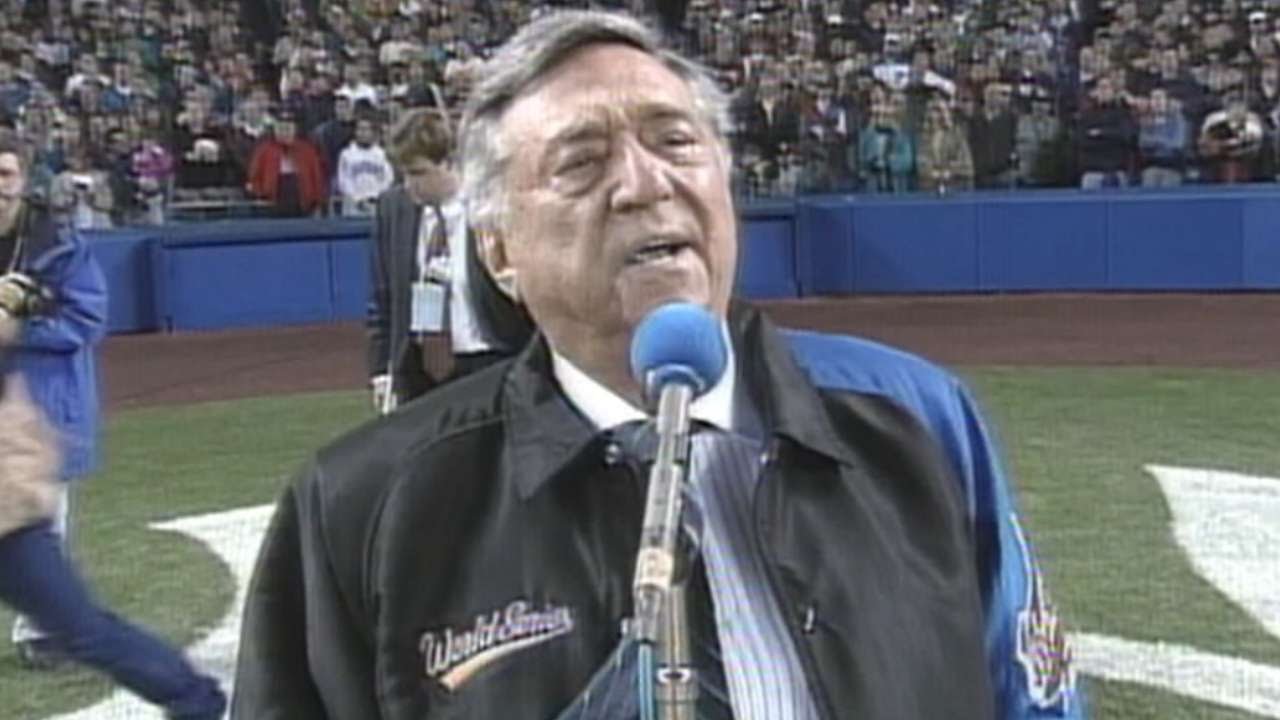
Robert Merrill at Yankee Stadium, 1996 World Series

Can I possibly let Xtina off the hook? Nope. But since it's only about 25 hours old as I type this, her version hasn't "stood the test of time," so I'll give her a slight break. Besides... She wasn't trying to disgrace her country or its National Anthem. She just blew it. It's a misdemeanor. Read... and move on.

Bottom 10

All of these are what somebody (I forget who) named "Star-Mangled Banners."

10. Christina Aguilera, Super Bowl XLV, Cowboys Stadium, Arlington, Texas, February 6, 2011. It's not just that she goofed the words, it's that she decided to "style" it. Come on, Christina, we know you can sing like that, but it's the National Anthem, in front of the biggest TV audience you'll ever have. Unless you sing at the World Cup, and both Shakira and Alicia Keys managed to get that right. (Of course, neither actually sang a national anthem at that time.)

9. Frank Drebin, regular-season baseball game, Anaheim Stadium (now Angel Stadium), Anaheim, California, early in 1988. I could use the excuse that he's not a professional singer. I could use the excuse that he was actually trying to impersonate an umpire, rather than the opera singer he was introduced as. I could use the excuse that the actor who played him, Leslie Nielsen, was Canadian -- although the character was all-American. Instead, I'll use the excuse that it was only a movie, The Naked Gun.

Very funny movie, except... O.J. Simpson played a cop, and Reggie Jackson played a "Manchurian Candidate"-type killer. Remember? "I... must kill... the Queen." Fortunately, Drebin stopped Mr. October from making the Prince of Wales become King Charles III far too early.

All that was missing was for the actress playing Elizabeth II to say, "Ricardo Montalban brainwashed Reggie Jackson to kill me? Lieutenant Drebin, surely, you can't be serious?" "I am serious, and, please, Your Majesty, don't call me 'Shirley.'"

Note that both Reggie and Jay Johnstone, who came to bat for the Seattle Mariners during the movie, were already retired at the time.

8. Jesse McCartney, Pepsi 500, Auto Club Speedway, Fontana, California, October 11, 2009. For the purpose of this post, I'm counting auto racing as a "sport." (May George Carlin, if he turned out to be wrong and God let him into Heaven, forgive me.) He skipped the "what so proudly we hailed" part. Let's just say that Jesse isn't related to Paul McCartney, not by blood or by talent.

7. Scott Stapp, Ford 400, Homestead-Miami Speedway, Homestead, Florida, November 20, 2005. On 2 occasions (the 1995 World Series in Atlanta, and a Monday Night Football game in Charlotte), I heard South Carolina native (thus "near" both cities) Darius Rucker, the lead singer of Hootie & the Blowfish, sing the anthem. It sounded, well, like Hootie & the Blowfish singing the National Anthem.

Not as much as the Creed singer did, though. Even the NASCAR drivers were wincing. And... "As the twilight's last gleaming"? Idiot. I don't think he'll be welcomed with arms wide open into another such event.

6. R. Kelly, Middleweight Championship fight, Bernard Hopkins vs. Jermain Taylor II, Las Vegas, Nevada, December 3, 2005. A man then under indictment on child pornography charges is singing the National Anthem before a sporting event? Well, it's not like it was a high school girls' basketball game...

"By the twilight's last gleaming"? If that was the only thing wrong with it, he probably would have gotten away with it -- pun intended. But it got worse from there. R. Kelly tried to sound like Marvin Gaye, and ended up sounding like a damn fool. Scoop Jackson of ESPN said, "It was enough to make Jeff Kent turn black. Or John Chaney turn white." This version should have stayed... wait for it... "trapped in the closet."

5. Caroline Marcel, Canada vs. U.S. junior hockey game, Le Colisee, Quebec City, Quebec, Canada, April 24, 2005. To be fair, she had to sing 2 anthems, 1 of a country not her own, and that anthem in her 2nd language. Still, she should have known the words to "The Banner."

But she mixed it up early, said, "I'm sorry," turned, and went back into the tunnel to find the lyrics. She got booed. Mind you, this was in Quebec, so this wasn't Americans booing the botching of their anthem, this was French-Canadians, her own people.

She came back, and... she fell. Okay, it was on ice, and she wasn't wearing skates. Still... That had to be the most embarrassing Anthem ever. At least, for a professional singer. At least, for one not named Michael Bolton.

4. Michael Bolton, American League Championship Series Game 4, Fenway Park, Boston, Massachusetts, October 13, 2003. Not the most disgraceful thing that's ever happened at Fenway, not even that week. (Game 3 was when Pedro Martinez tried to kill Don Zimmer and Karim Garcia, and threatened to kill Jorge Posada. Still hasn't even been arrested, much less prosecuted, for that.)

But after "o'er the ramparts we watched," he looked at his hand! He had crib notes for the National Anthem! That's worse than Sarah Palin's crib notes for one of her political speeches. That's even worse than George's "crib notes for sex" in the Seinfeld episode "The Move"!

The Red Sox fans booed the hell out of him. For once, I agree with them! Besides... it's Michael Bolton.

3. Jimi Hendrix, Woodstock Music & Art Festival, Yasgur's Farm, Bethel, New York, August 18, 1969. I know this one has become iconic, but I hate it. I don't know what point Jimi was trying to make with it, but I really, really hate it.

Yet when Brian May, the guitarist for Queen (as fate would have it), played "God Save the Queen" at Buckingham Palace for Queen Elizabeth's Golden Jubilee (marking 50 years on the throne) in 2002, it was electric, and it was rock, but it was very respectful, and it got a tremendous ovation.

2. Roseanne Barr -- or Roseanne Arnold, or just "Roseanne," or whatever she was calling herself at that point -- regular-season baseball game, Jack Murphy Stadium, San Diego, California, July 25, 1990. It was the screeching. It was the gestures. It was the crotch-grab and the spit at the end.

San Diego is a city noted as a major homeport for the U.S. Navy. She pushed a lot of buttons, and pushed a lot of envelopes. That day, she really pushed her luck.

1. Carl Lewis, regular-season NBA game, Brendan Byrne Arena, East Rutherford, New Jersey, December 25, 1993. Merry Christmas, everyone, here's your present: The worst "Star-Spangled Banner" ever! What makes this the worst one is that he was really, really, trying to get it right, but... His voice cracked at "And the rockets'... red glare! Uh-oh!" Unless you're Buddy Holly or Jimmie Rodgers, you should not include the words "Uh-oh!" in a song.

He may have been the greatest track & field performer ever, and he may be a New Jersey native (although from Willingboro, the Phillies/Eagles/76ers/Flyers side, not the Yankees/Giants-Jets/Nets/Devils side), but that doesn't give him a pass for this.

Top 10

You'll notice Whitney Houston's rendition before Super Bowl XXV is not on this list. That's because she was lip-synching. Automatic disqualification.

10. Lucy Lawless, regular-season NHL game, Arrowhead Pond (now Honda Center), Anaheim, California, October 22, 1997. She really can sing, and does a mean version of "Total Eclipse of the Heart." And, as a native of New Zealand, she almost certainly didn't grow up knowing the words to The Banner.

But that's not what made this one memorable. She sang it wearing an Uncle Sam top hat (well, if you're going to wear a hat during the National Anthem, which you're not supposed to do... ), and a star-spangled bustier that would have made Wonder Woman blush. (By the way, Lynda Carter is an amazing singer, too.)

At the end of the song, Lucy had what would later be called "a wardrobe malfunction." She finished the song with one of her "Xena" yells. Whether she was already aware of the malfunction when she did that yell is not clear. But then, who's going to tell the Warrior Princess that she futzed up the National Anthem? Not me. Especially now that she's also been a Cylon on the new Battlestar Galactica.

9. Kelsey Grammer, MLB All-Star Game, Veterans Stadium, Philadelphia, Pennsylvania, July 9, 1996. Kelsey Grammer? Frasier Crane? I know NBC wanted to promote its shows, but... Kelsey Grammer? "Hey, baby, I hear the blues a-callin', tossed salads and scrambled eggs, quite stylish." Kelsey Grammer to sing the anthem? Are you freakin' kiddin' me?

No, they weren't: He was great! He really can sing. (And play the piano, although he sang a cappella on this occasion.) It really put Fox's later show-promotions to shame, including Lea Michele of Glee doing "America the Beautiful" at the Super Bowl just passed.

8. Faith Hill, MLB All-Star Game, Coors Field, Denver, Colorado, July 7, 1998. She wore a jersey of the host team, the Colorado Rockies. A maternity jersey, the 1st time I'd ever seen that. I'd also never heard a visibly pregnant woman sing the Anthem before. Is that fair, adding your baby's vocal power to your own? Faith didn't need it. Her daughter Maggie was born later that year.

Faith is married to another country music superstar, Tim McGraw, the son of a baseball legend, Tug McGraw. Although I've never heard Tim sing the Anthem. (No video of him singing it appears to be on YouTube.) Together, Faith and Tim now have 3 children.

7. Carrie Underwood, Super Bowl XLIV, Sun Life Stadium, Miami Lakes, Florida, February 7, 2010. The American Idol voters don't always get it right, but they sure got it right when they chose her. The people selecting Anthem singers must agree, because they've chosen her many times, including for the 2006 MLB All-Star Game in Detroit and the 2007 World Series in Denver.

The original Idol, Kelly Clarkson, also does very well with it. She sang the Anthem at the 1st game at the new Yankee Stadium, which puzzled me: I knew they couldn't get Robert Merrill, who died in 2004, but I figured they'd go with a New York native, and Kelly is from Texas. Her performance was excellent; I certainly can't complain about its quality. 

But I would have preferred a New Yorker such as Alicia Keys, who did come to the Stadium in the World Series to sing "Empire State of Mind" with Jay-Z.

6. Marvin Gaye, NBA All-Star Game, The Forum, Inglewood, California, February 13, 1983. "The Star-Spangled Banner" is listed in some hymn books, but Marvin turned it into a gospel song. And, unlike R. Kelly, he made it sound both funky and respectful. This is a lot of people's choice as the best Anthem ever.

Because he was so loved and, at least publicly, had such a classy image, Marvin had been invited to sing the Anthem many times before, including at Game 4 of the 1968 World Series in Detroit, a good choice since he was signed to that city's Motown Records, but, on that occasion, he sang it totally straight. And he was great. But the next day, the Anthem was sung in a way that, like Hendrix' version a year later, would change it forever.

5. José Feliciano, World Series Game 5, Tiger Stadium, Detroit, Michigan, October 7, 1968. He sang it in a way no one had heard before. He sang it while wearing dark glasses. (He is blind.) He sang it while wearing long hair. (In America, it was 1968; in "Baseball America," take whatever the actual year is and subtract 10 years.) And he sang it while a scary-looking German shepherd was by his side. (His seeing-eye dog.)

People were furious. They thought this little Puerto Rican kid was un-American. Never mind that Puerto Ricans are American citizens.

As Gaye was the day before, and as Detroit native Margaret Whiting was before Game 3, he was selected for the performance by Tigers broadcaster Ernie Harwell, who was a a published songwriter, an ordained minister, and a Marine Corps veteran of World War II. You gonna question his patriotism? Or his taste in music?

Ernie knew what he was doing, and, for the rest of his life, he stuck up for Jose, whose career was hurt by this for years, until he was asked to sing the theme song for the NBC sitcom Chico and the Man in 1974, starting a comeback that has made him a much-admired performer ever since.

When Ernie died in 2010, Jose was invited back to sing the anthem at Comerica Park, the Tigers' new home, at their next home game. He sang it the same way, his voice still clear after 42 years, and he got a massive ovation. As well he should have back in 1968. But America was just too on edge that year for something so American, yet so different.

4. Julie Anthony, Opening Ceremony, Olympic Games, Stadium Australia, Sydney, New South Wales, September 15, 2000. This was the Australian anthem, "Advance Australia Fair." She had previously been selected to sing it at the country's Bicentennial celebration on January 1, 1988.

I'd never heard "Advance Australia Fair" before that Opening Ceremony, and it was wonderful. Maybe it was her talent, maybe it was the similarity of the name, but she reminded me of Julie Andrews.

3. Beyoncé Knowles, Super Bowl XXXVIII, Reliant Stadium, Houston, Texas, February 1, 2004. Maybe it was because she was in her hometown. Or maybe she wanted to show Janet Jackson who was the best singer in the stadium that night. Or maybe she's just great. But she knocked it out of the park. (If you don't mind me mixing my sports metaphors.)

Of course, in order to remember this one, you'll have to put Janet's own performance at that game's halftime show out of your mind. Not easy.

2. Robert Merrill, Yankee Stadium, Bronx, New York, 1969 to 2003. For a generation of Yankee Fans, my generation, he was the singer of "The Star-Spangled Banner." And he always played it straight, even on Old-Timers' Day, when he wore a Yankee uniform with the Number 1 1/2 on it.

Cleveland Indian fans may speak up for Rocco Scotti, and people who remember the Brooklyn Dodgers may mention Gladys Gooding, singing and playing the Ebbets Field organ, but Robert Merrill was the best regular anthem-singer of them all.

In this country, anyway.

1. Roger Doucet, Montreal Forum and Olympic Stadium, Montreal, Quebec, 1970 to 1981. He sang the anthems at Canadiens and Expos games. When he sang "The Star-Spangled Banner," he didn't sound so good. In fact, to me, he sounded drunk. Then again, we took the music for our anthem from "To Anacreon In Heaven," an English drinking song. So maybe it's not so inappropriate.

But when he sang "O, Canada," I've never heard an anthem sung better. He would begin by singing in French, facing the east stands of the Forum, since the East End of Montreal is the more French, more "Quebec nationalist" side of town. In mid-song, he would turn and face the west stands, since the West End is the more English, pro-stay-in-Canada side.
Roger Doucet at the Montreal Forum

He died of cancer in 1981, but his version was so revered that a clip of it was played at the Canadiens' last game at the Forum in 1996. The Yankees didn't even do that for Robert Merrill.