Elmer Gedeon
This is long. It needs to be. I hope you'll bear with me.
Today is November 11. It was on November 11, 1918, that the Armistice was signed to end World War I in victory for the Allies. In America, the date became known as Armistice Day, and later received its present name of Veterans Day. In the British Commonwealth, it is called Remembrance Day.
On April 22, 2004, former Arizona Cardinals safety and U.S. Army Corporal Pat Tillman was killed in action in Afghanistan in the War On Terror. It was a shock, because America is not used to its athletes dying in wars.
The risk was far greater in the draft era, 1940 to 1973. Some of the true greats served in combat.
D-Day, June 6, 1944: The U.S. Navy had a young sailor named Lawrence Peter Berra, already "Yogi" but not yet a big-leaguer. The Army had Leon Day, already a legend in the Negro Leagues.
Hank Bauer and Ralph Houk both fought at the Battle of Guadalcanal. Red Ruffing lost toes in a hunting accident, and was already 36 at the time of Pearl Harbor, but volunteered anyway. Jerry Coleman flew a fighter plane for the Marines.
Phil Rizzuto went into the Navy, and, according to a story he liked to tell, was told he’d be sent to New Guinea. He thought that was great: He heard "Guinea," and figured the place would be full of his fellow Italians. Wow, did he turn out to be wrong! "I was the worst sailor the Navy ever had," he said. "I was always seasick."
In 1943, the Yankees were missing already-established big-leaguers Joe DiMaggio, Joe Gordon, George Selkirk, Tommy Henrich, Charlie Keller and Marius Russo. But Bill Dickey, Billy Johnson, Johnny Lindell, and that season's American League Most Valuable Player, pitcher Spurgeon "Spud" Chandler, were still available, and they led the Yankees to win the World Series that year.
As yet unknown to the Yankees, future stars Berra, Joe Collins, Bob Kuzava, Cliff Mapes, Vic Raschi, and a pair of players who would achieve Hall of Fame credentials for other teams before finishing their careers with Yankee glory, Johnny Mize and Enos Slaughter, were also serving.
By Opening Day 1944, nearly everyone who played for the Yanks' 1941 World Championship team was in Army green, Navy blue, or Marine whatever color they damn well please. A cartoon that appeared in a baseball magazine of the time did a feature on Dickey, serving in the Navy despite being 37, and it said, "Dickey's presence means that the two greatest catchers ever are with the Blues (Mickey Cochrane's the other). But if you want to see to it that the Axis does the catching in this war, buy more War Bonds!"
Little did anyone know, the Navy actually had the three greatest catchers of all time: Cochrane, Dickey and Berra. I think Johnny Bench, the only catcher since who approaches those three, was in the National Guard doing part-time service in the late Sixties.
Gordon, Bob Lemon and Al Rosen all served, and were members of the 1948 World Champion Cleveland Indians. Gordon had already been a star 2nd baseman for the Yankees; Lemon as manager and Rosen as general manager who make the Yankees into World Champions in 1978.
In addition to those listed above, Yankees who served in World War II include:
* Army: Johnny Broaca, Allie Clark, Clint Courtney, Charlie Devens, Irv Noren, Fred Sanford (again, not the Redd Foxx character), Steve Sundra, Butch Wensloff.
* Navy: Joe Beggs, Jumbo Brown, Sammy Byrd, Tommy Byrne, Ben Chapman, Tom Ferrick, Tom Gorman, Rollie Hemsley, Andy High, Bobby Hogue, Gus Niarhos, Jack Phillips, Ray Scarborough, Ken Sears, Frank Shea, Gene Woodling.
* Army Air Force, forerunner of the U.S. Air Force: Johnny Gerlach, Myril Hoag, Joe Ostrowski, Gerry Priddy, Charlie Silvera, Johnny Sturm, Vito Tamulis.
* Coast Guard: "Ol' Reliable" Tommy Henrich, Randy Gumpert, Aaron Robinson.
Although they're usually remembered as playing for teams other than the Yankees, the Pinstripes can also count among their WWII veterans All-Stars like Ewell Blackwell, Jim Hegan, Jim Konstanty, Johnny Sain, Bobby Schantz, Virgil Trucks, Mickey Vernon, and longtime Angels coach Jimmie Reese, who, briefly in 1930, roomed with Babe Ruth – or, as at least one of the Babe's roommates said, didn't room with him, but rather roomed with his suitcase.
The oddest name on the list of Yankees who served in World War II is 1 of only 2 Major League Baseball players, that I can find, who served in both World Wars. (I'll mention the other one when I get to the subject of World War I.) This one was the Yankees' regular right fielder toward the end of the 1919 season, but only for that brief time, and is sometimes put into the trivia question, "Who was the Yankees' right fielder before Babe Ruth?" It's only slightly true. But he was there. Still, he's better known for something else. Founding the National Football League and what is, for a lot of people, still its signature team, the Chicago Bears. His name was George Halas.
And by the time he went back into the Navy in World War II with the rank of Captain, he had already led the Bears to 5 NFL Championships as head coach. While he served, they would give him his 6th as an owner, in 1943. Right after he got out, in 1946, he led them to a 7th. In 1963, he coached them to an 8th, and after his death, one of the star players on that ’63 team, Mike Ditka, would coach them to a 9th.
*
New York Giants (baseball) who served in WWII were: Army: Andy Cohen, Monte Kennedy, Dave Koslo, Dusty Rhodes, Wes Westrum and Hoyt Wilhelm. Navy: Walker Cooper, Herman Franks, Don Liddle, Hank Thompson. Army Air Force: Harry Danning, Clint Hartung, Sheldon "Available" Jones, Sal Yvars and… Bobby Thomson. Coast Guard: Sid Gordon, Bill Rigney and Hank Sauer. Marines: Alvin Dark. Merchant Marine: Whitey Lockman.
The list of Brooklyn Dodgers who served in the War is quite long, and includes several of the "Boys of Summer": Duke Snider, Pee Wee Reese, Gil Hodges, Carl Furillo, Billy Cox, Joe Black, Clem Labine. And, of course, U.S. Army Lieutenant Jack Roosevelt Robinson.
Presaging Rosa Parks 11 years later, Jackie Robinson got on a bus at an Army base in 1944 and was ordered by the driver, an enlisted man, to go to the back of the bus. He refused, and reminded the driver that he outranked him. The driver got on the bus' radio, and called the Military Police. The MPs arrested Lt. Robinson. He was court-martialed. He was acquitted, because there was no Army regulation forcing a black soldier to the back of an Army bus.
But the Army decided Jackie was a "troublemaker," and mustered him out with an honorable, but suspicious discharge. Good thing they did, because it enabled him to join the Kansas City Monarchs of the Negro Leagues for the 1945 season, which enabled him to be found by Dodger scout Clyde Sukeforth, and the rest is history. Still, even if Jackie hadn't been the one to reintegrate the game, this story would still have to be told.
Also: Army: Cal Abrams, Jack Banta, Rex Barney, Zeke Bonura, Bobby Bragan, Bruce Edwards, Dee Fondy, Lonny Frey, Al Gionfriddo, Kirby Higbe, Dixie Howell, Russ Meyer, Dale Mitchell, Bobby Morgan, Van Lingle Mungo, Pete Reiser. Navy: Frankie Baumholtz, Al Campanis (yes, that Al Campanis), Larry French, Marv Grissom, Buddy Hassett, Joe Hatten, Billy Herman, Cookie Lavagetto, Vic Lombardi, Eddie Miksis, Mickey Owen, Clarence “Ace” Parker. Air Force: Jimmy Brown, Johnny "Spider" Jorgenson, and future big-league manager Gene Mauch. Marines: Dan Bankhead. Coast Guard: Gene Hermanski.
And, though the War was over for 17 years before the Mets began play, there are a few WWII veterans with Met connections: Berra and Spahn, who each briefly played for Casey Stengel on the 1965 Mets; Bob Scheffing, the general manager who built the 1969 World Champions and 1973 National League Pennant winners, and 3 Met managers: Francis "Salty" Parker, Joe Frazier (not the boxer) and George Bamberger.
*
A total of 36 members of the Baseball Hall of Fame were also World War II veterans. In addition to Yankees Berra, Dickey, DiMaggio, Gordon, Lemon, Mize, Rizzuto, Ruffing, and Slaughter; Dodgers Herman, Robinson, Reese and Snider (but, as yet, not Hodges), and Giant Wilhelm, they are:
* Army: Luke Appling, Leon Day, Bobby Doerr, Red Schoendienst, Warren Spahn, executive Larry MacPhail, and umpires Billy Evans (already retired from umpiring at the War’s outbreak) and Nestor Chylak (not yet in the majors).
* Navy: Mickey Cochrane, Eddie Collins (both already retired as players before they went in as officers), Larry Doby, Bob Feller (who has become the voice of veteran ballplayers in his old age), Charlie Gehringer, Ralph Kiner, Stan Musial, and executive Lee MacPhail (Larry's son).
* Air Force: Hank Greenberg.
* Marines: Ted Williams, Ted Lyons (though he was already 41 when the war began) and executive Bill Veeck.
* Coast Guard: Umpire Al Barlick. Spahn and Chylak were both at the Battle of the Bulge in December 1944, the largest battle in terms of manpower in the history of man's inhumanity to man.
Also, Hall of Fame broadcasters Coleman, Joe Garagiola, Bob Murphy, Jack Brickhouse and Ernie Harwell. That Coleman and Brickhouse were Marines, I can easily believe: Both were, and the still-living Coleman still is, the tough-as-nails type. Harwell is a little harder to believe. He seems so kind and gentlemanly. He is an ordained minister, so maybe he was a Marine chaplain.
My favorite wartime baseball story involves Ted Lyons. Here was a pitcher who won 259 games, all for the Chicago White Sox, from 1923 to 1942. Yankee manager Joe McCarthy said, "If he had pitched for the Yankees, he would have won 400 games." Certainly, he would have won over 300. The White Sox retired his Number 16, and he is in the Hall of Fame.
But he enlisted at age 42. When he got out, he pitched just five more games in 1946 and hung 'em up, winning a 260th game. But while in the Army, he pitched for a team of ex-players in his Division, and they faced an Army Air Force team whose leader was the Yankee Clipper himself, Joltin' Joe. "I got into the Army to get away from DiMaggio," Lyons supposedly said, "and here he is!"
*
A total of 19 major leaguers served in the U.S. Coast Guard, the often-forgotten "fifth branch" of the U.S. Armed Forces. Probably the best known of these, aside from Henrich, was Wally Westlake, who survived the War and went on to win the 1948 World Series and the 1954 American League Pennant as an outfielder with the Cleveland Indians.
Keller was one of 8 major leaguers who served in the U.S. Merchant Marine, as were Giant outfielder Whitey Lockman and Indian pitcher Jim Bagby Jr..
Moe Berg, of Belleville, New Jersey, served in the OSS, the Office of Strategic Services, the forerunner of the CIA. He spoke several languages, including German and Japanese – rather handy when your wartime opponents are Germany and Japan.
He went on the Winter 1935 baseball tour of Japan, officially more as a translator than as a catcher, but, upon request from what was then the Department of War (which became the Department of Defense in 1947), took a few "home movies" in anticipation of a potential war with Japan. Yes, it was being talked about even in 1935, 4 years after they started fighting China, 2 years before they started bombing in full 4 years before the War started in Europe, and 6 years before Pearl Harbor.
I should also mention 1st baseman Hank Biasatti and pitcher Dick Fowler, who served in the Canadian Army. Pitchers Joe Krakauska and Phil Marchildon, who served in the Royal Canadian Air Force. And pitcher Adrian Zabala, who served in the Cuban Army.
*
Ray Flaherty was a baseball umpire who reached the Pro Football Hall of Fame as a two-way end for the New York Giants (1927 and 1934 NFL Champions), and a coach for the Washington Redskins (1937 and 1942 NFL Champions). The aforementioned Ace Parker is better known for having played for the football team named the Brooklyn Dodgers, and is the oldest living member of the Pro Football Hall. And 1920s football legend Ernie Nevers, a charter inductee into Canton, also played Major League Baseball.
*
As far as can be determined, 405,399 Americans died in the military service in World War II – this includes combat wounds, disease and accidents – and 2 were Major League Baseball players, for however brief a time:
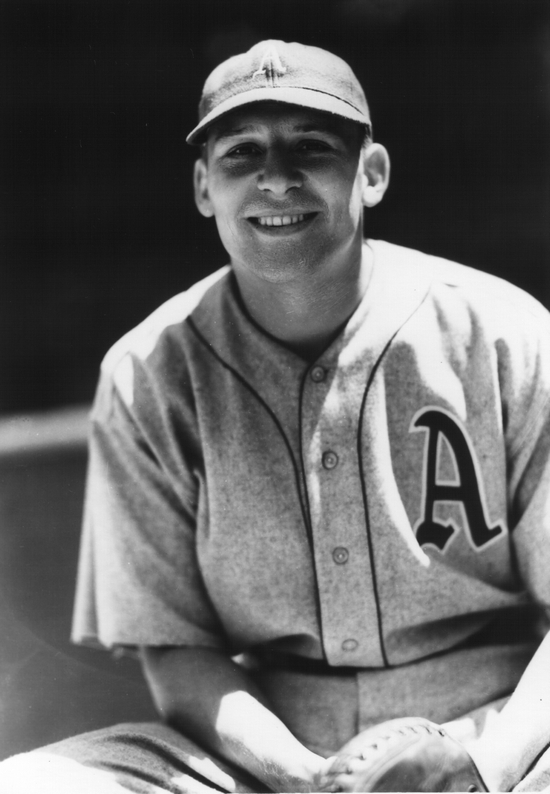
Elmer John Gedeon: Born April 15, 1917, just days after the U.S. entry into World War I. He was born and raised in Cleveland, in a neighborhood that had been home to immigrants from the Sudetenland, the region of Czechoslovakia that Hitler demanded in the Fall of 1938 because it had so many ethnic Germans living there.
Gedeon starred in baseball, football and track at the University of Michigan. He played 5 games as an outfielder for the Washington Senators in 1939, but spent all of the 1940 season in the minors, and was drafted into the Army in 1941.
He trained as a bomber pilot, and was decorated for bravery after his plane crashed in 1942. Captain Elmer Gedeon was ultimately shot down and killed while piloting a B-26 bomber on a mission over Saint-Pol France on April 20, 1944. He was just past his 27th birthday. He is buried at Arlington National Cemetery.
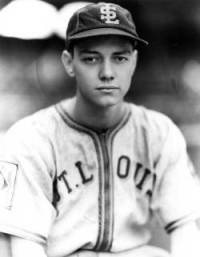
Harry Mink O'Neill: Born May 8, 1917, also in the early days of America's participation in World War I. He was born and raised in Philadelphia, and was signed by his hometown Athletics. He played even less than Gedeon did, just one game, also in the 1939 season. He went into the Marine Corps, and 1st Lieutenant Harry O'Neill was one of those who fell in the assault on Iwo Jima, on March 6, 1945.
Harry O'Neill
Two other players who served are particularly worth mentioning, because of how they returned to the majors against long odds:
Bert Shepard was a pitcher and a pilot, and he was shot down over Germany. A German Army doctor was able to save his life, but not his right leg, and had to amputate. After the war, he wanted to get back into the game, and Senators owner Clark Griffith, himself a former star pitcher, was impressed enough to sign him as a pitching coach.
On August 4, 1945, in what turned out to be the last few days of the War, the Senators were getting clobbered by the Red Sox, and, as a game in the second of four straight doubleheaders forced by wartime travel restrictions, the Senators needed pitchers. Shepard pitched 5 1/3rd innings of relief, allowing just 3 hits and 1 run.
He never appeared in another game, but remained an active athlete, winning golf and running competitions for amputees with prosthetics into his 70s. In 1993,
This Week In Baseball did a feature on him, where he was reunited with the German doctor who saved his life at the POW camp hospital. Shepard died in 2008, just short of his 88th birthday.
Lou Brissie was also a lefthanded pitcher, who had been scouted by Connie Mack of the A's before the war. He was also shot down, but was brought back to a U.S. base, and heard doctors saying, "This leg has to come off." Unlike Shepard, he was conscious and able to protest, saying he was a baseball player and begging them not to remove the leg. It took 23 surgeries, but he was able to keep his leg and walk on it again.
He reached the majors in 1947, and pitched for the A's against the Red Sox. But Ted Williams hit a line shot off his leg, hitting a steel plate that was helping hold his bone together. As it was late in the season and both teams were out of the race, attendance was low, and the CLANG! of horsehide on metal rang throughout the ballpark.
Brissie went down, and Ted rushed over to him, and, well aware of what his fellow veteran had gone through, was among those who helped him back up. Brissie was all right, and laughed, "Damn it, Ted, pull the ball!"
Brissie would later pitch for the Indians, remaining in the majors until 1953. He later served as the national director for American Legion Baseball (appropriate, considering his combined athletic and military background), and is now 85 years old. The great sportswriter Ira Berkow has a new book out about him:
The Corporal Was a Pitcher: The Courage of Lou Brissie.
(UPDATE: Lou Brissie died on November 25, 2013, at the age of 89.)
Shepard wore Number 34 in his brief time with the Senators, as did Gedeon, who also appears to have worn 35. O'Neill wore 30 in his single appearance. Brissie wore 17 in his single 1947 appearance, then wore 19 for the A's and 12 for the Indians. But, with the Senators and A's both having moved, there is no team to retire their numbers or erect "Monument Park"-style plaques for them at their ballparks. However, there is a Philadelphia Athletics Historical Society which houses a museum in Hatboro, Pennsylvania, and it has tributes to O’Neill and Brissie.
While he's still alive, Brissie should be inducted into the Cleveland Indians Hall of Fame and given a plaque at Heritage Park, behind center field at Jacobs Field (Progressive Field). And now that the Washington Nationals have moved the Washington Wall of Stars from Robert F. Kennedy Stadium to Nationals Park, and erected statues of Frank Howard, Josh Gibson and Walter Johnson (replacing the monument that stood outside Griffith Stadium and is now outside Walter Johnson High School in nearby Bethesda, Maryland), perhaps they can memorialize Gedeon and Shepard.
*
There were 23 NFL players killed in World War II. Two were New York Giants, and they were later honored with plaques on the wall of the center-field (east end-zone) blockhouse at the Polo Grounds: Lieutenant Al Blozis, a tackle who played 3 seasons, killed in France in 1945 (and his Number 32 was retired by the Giants); and Lieutenant Jack Lummus, an end who played one season, killed at Iwo Jima.
Al Blozis
Pro Football Hall-of-Famers who served in World War II: The aforementioned George Halas, Ernie Nevers, Ray Flaherty and Ace Parker; Cliff Battles, Chuck Bednarik, Tony Canadeo, Charley Conerly, Lou Creekmur, Art Donovan, "Bullet" Bill Dudley, Weeb Ewbank, Tom Fears, Len Ford, Danny Fortmann, Frank Gatski, Otto Graham, Bud Grant, Lou Groza, Clark Hinkle, Elroy "Crazy Legs" Hirsch, Tom Landry, Marv Levy, Sid Luckman, Wellington Mara, Gino Marchetti, George McAfee, Johnny "Blood" McNally, Marion Motley, Leo Nomellini, Joe "the Jet" Perry, Pete Pihos, Dan Reeves (the Rams' owner, not the later Broncos coach), Andy Robustelli, Tex Schramm, Joe Stydahar, Charlie Trippi, Norm Van Brocklin, Bob Waterfield and Arnie Weinmeister.
Heisman Trophy winners Davey O'Brien, Nile Kinnick, Tommy Harmon, Bruce Smith (not the later Outland Trophy winner and all-time NFL sacks leader), Frankie Sinkwich, Angelo Bertelli, Les Horvath, Doc Blanchard, Glenn Davis and Leon Hart would also serve, and Kinnick would be lost in a flight accident at sea.
*
The War also took a lot of hockey players, including Boston Bruins linemates Milt Schmidt, Woody Dumart and Bobby Bauer. All 3 were of German descent, and were called the Kraut Line. When the War began, it was renamed after their common hometown in Ontario: The Kitchener Line.
Ironically, this was also a rename, as the city had been known, due to its German immigrant population, as Berlin. It was renamed for Field Marshal Horatio Herbert Kitchener, 1st Kitchener, a.k.a. Lord Kitchener, Britain's Secretary of State for War in World War I, who had been killed when his ship hit a German mine in 1916, and whose image was then used as the British Empire's recruiting poster – the poster that formed the basis for America's "Uncle Sam" "I WANT YOU for U.S. Army" poster. Eventually, all 3 Kraut/Kitchener Liners had enlisted in the Royal Canadian Air Force, and all 3 resumed their Hall of Fame careers afterward.
*
The Korean War, June 24, 1950 to July 27, 1953, also took a lot of players, including several WWII vets. Williams was one, serving in a Marine air unit with a hotshot who gunned down a number of North Korean and Chinese planes. His name was John Glenn, and I think he went on to something else, something really far-out. Oh yeah: The U.S. Senate. Ted wasn't so lucky: At one point, he was shot down, but managed to land his plane back in friendly territory. Still, his hearing was damaged from all the noise he endured.
Jerry Coleman was flying for the Marines again, too. He was lucky. A man in his air unit was not, blown up right in front of Jerry. He seems like one of the "happy warriors" of baseball, but much of his life has been dark, and this was a truly awful moment for him.
The Yankees lost Whitey Ford and Billy Martin to service in Korea. The Dodgers lost Don Newcombe – in fact, in 1952, the Yanks and Dodgers played each other in the Series, but neither had the services of arguably their best pitcher, as Whitey and Newk were both unavailable. Whitey missed 1951 and '52, Newk missed '52 and '53.
The Yanks were lucky in two respects: They were never missing both Coleman and Martin at the same time, so they always had a reliable 2nd baseman; and due to a high school football injury, and then to the injury that shredded his knee in the '51 Series, Mickey Mantle was classified 4-F, so he never had to serve.
Willie Mays of the Giants wasn't as lucky: He was called up early in '52, and missed the rest of that year and all of '53. He was discharged in time to get to spring training in '54, to lead the Giants to what is still their last World Championship. Two other Hall-of-Famers served in Korea: Ernie Banks in the Army and Eddie Mathews in the Navy.
Curt Simmons, the Phillies' Number 2 starter in their 1950 "Whiz Kids" Pennant season, was drafted just short of the end of the regular season, and as a result the Phillies nearly blew the Pennant to the Dodgers, and were really strapped when they did get into the World Series against the Yankees, who swept them.
Simmons did get a measure of revenge, getting out of Korea alive, and lasting in the majors long enough to pitch for the St. Louis Cardinals team that beat the Yankees in the 1964 World Series. Ironically, the Cards had to beat the collapsing Phillies to do it.
There were 4 Pro Football Hall-of-Famers who served in Korea: Al Davis, Dick "Night Train" Lane, Ollie Matson and Mike McCormack.
Other familiar football names who served in Korea: Bill Austin, Cloyce Box, Marion Campbell, Bud Carson, Erick Casares, Bob Gain, Arnie Galiffa, George "Cookie" Gilchrist, Don Heinrich, Vic Janowicz (Heisman winner), Charlie "Choo Choo" Justice, Eddie LeBaron, Gene "Big Daddy" Lipscomb, Ken McAfee (George's son), Clay Matthews (father of Clay Jr. and Bruce), "Big Ed" Modzelewski, Les Richter, Gordy Soltau, Art Spinney, Jack Stroud, Ray Wietecha.
*
Korea took a lot of players. Vietnam was another matter. There were 3.4 million American men who served in the armed forces during the Vietnam era – depending on whose figures you believe, starting in either 1954, 1959, 1961 or 1964, and ending in 1973 or 1975. This included several athletes, including Yankees Tony Kubek and Bobby Murcer, who missed time due to military service, but never went into combat. Jim Lonborg served in the Army Reserve, and all through the Red Sox 1967 "Impossible Dream" season, could have been called up. He wasn't.
The only big-league baseball player who served in combat was Roy Gleason. The native of Temecula, California appeared in 8 games in 1963 for the Los Angeles Dodgers, his "hometown team,"” mostly as a pinch-runner. But it was enough for the team, which won the World Series that year, to give him a World Series ring. He had one at-bat, and doubled. He wore Number 36, the same number that Korean War vet Newcombe wore for the Brooklyn edition of the Dodgers.
He never got back to the majors, and was drafted in 1967. Sergeant Gleason was wounded in 1968, and, sometime between the shot that hit him and the hospital that saved him, he lost his World Series ring. In 2003, as part of a veterans' celebration at Dodger Stadium, then-manager Jim Tracy gave him a replacement ring.
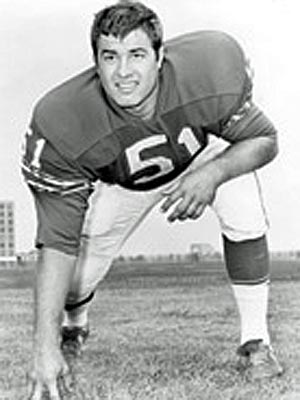
Pro football wasn't so lucky: The game lost 2 players in Vietnam. For a long time, it was believed to be 1. On July 21, 1970, Lieutenant Bob Kalsu, an All-American guard at the University of Oklahoma who played for the Buffalo Bills in 1968 before being drafted, was killed at Base Ripcord.
Bob Kalsu
After NFL Films did a piece on him, someone wrote to them and informed them that there was another: Major Don Steinbrunner, who was briefly a tackle with the Cleveland Browns in 1953. (Not "Steinbrenner," though he did play for The Boss' hometown team.) He was shot down over Kontum on July 20, 1967. It's likely that his NFL tenure, which was during the Korean War rather than Vietnam, confused the researchers.
Kalsu wore Number 51, but although the Bills have elected Kalsu to their Wall of Fame, they tend not to retire uniform numbers, and his 51 remains in circulation. So does the 84 worn with the Browns by Steinbrunner.
Other NFLers who served in Vietnam include Hall-of-Famers Ray Nitschke, Roger Staubach and Charlie Joiner. The Navy produced Heisman winners Staubach and Joe Bellino; the Army produced Pete Dawkins, and while he chose to stay in the service, he was a genuine combat hero and rose to the rank of General. Rocky Bleier nearly lost his leg in Vietnam, but came back to help the Pittsburgh Steelers win 4 Super Bowls.
*
Let me take a step back. According to the U.S. Veterans' Administration, the following figures are accurate (or are accurate estimates) for all our wars:
* War of the American Revolution, April 19, 1775 to September 3, 1783: There are believed to have been 217,000 total servicemembers, 4,435 battle deaths. More likely, far more died from disease, hunger and the elements (for example, cold at Valley Forge and Morristown, heat at Monmouth) and on British prison ships than as a result of battle wounds and injuries.
* War of 1812, June 1, 1812 to January 8, 1815: 286,000 served, 2,260 killed.
* Indian Wars, semi-officially listed as being from 1817 to 1898: 106,000 served, 2,000 killed.
* Mexican-American War, April 25, 1846 to February 2, 1848: 78,000 served, 1,733 killed.
* American Civil War, April 12, 1861 to April 9, 1865: 2.2 million served, 364,511 killed. Of course, that's just the Americans. Throw in the traitors in gray, and the totals become: 3.3 million served, and a believed 625,000 killed
* Spanish-American War, February 15 to August 12, 1898: 307,000 served, 2,446 killed.
* World War I, April 6, 1917 to November 11, 1918: 4.7 million served, 116,516 killed. There is one surviving U.S. veteran of World War I. His name is Frank Buckles, he is 108 years old, and he lives in West Virginia. (UPDATE: He died on February 27, 2011, just after his 110th birthday.)
Canada also has one left, named John Babcock, 109. He did not serve in combat, and has lived in Spokane, Washington since 1920. And Great Britain has one survivor, Claude Choles, who later moved to Australia and served with their Navy in World War II. Pierre Picault was the last survivor from France, dying on November 20, 2008; from Imperial Germany, Wilhelmine Germany, "the enemy," the last was Erich Kastner, who served as a Major in the Luftwaffe in World War II, was
not charged with war crimes, and became a judge. He died on January 1, 2008.
(UPDATE: John Babcock died on February 18, 2010, age 109. Claude Choles, the last surviving combat veteran, died on May 5, 2011, age 110. I later learned that the last British survivor, and the last surviving veteran of any country, in World War I, was Florence Green, of the Women's Air Force, who lived until February 4, 2012, just short of her 111th birthday.)
* World War II, December 7, 1941 to August 14, 1945: 16.1 million served, 405,399 killed, 2.3 million are said to still be alive, as we are now 70 years past the beginning of the War, coming up on 68 years since Pearl Harbor, and 64 years past V-E Day and V-J Day. A 25-year-old who enlisted after Pearl Harbor and a 17-year-old kid who lied about his age to get into the War toward the end, as the "extremes," means that surviving WWII vets are between the ages of 80 and 93.
If WWII veterans die at the same rate as WWI veterans did, the last survivor should live to about 110 years old; if a 17-year-old kid lied about his age to get in just before victory in the Spring and Summer of 1945, then he would have been born in 1928, which means the last of these "old soldiers" would "just fade away" around the year 2038.
* Korean War, June 24, 1950 to July 27, 1953: 5.7 million served, 54,246 killed, 2.3 million still alive. A 25 at the beginning and a 17 at the end, they're between 73 and 83. The last one should still be alive in 2046.
* Vietnam War, and I'll use the dates for the Gulf of Tonkin Incident, August 4, 1964, and the Fall of Saigon, April 30, 1975: 8.7 million served, 58,209 killed, 7.1 million living veterans. A 25 at the beginning and a 17 at the end, they’re between 51 and 70. We should still have living Vietnam veterans in 2088.
* Persian Gulf War, August 2, 1990 to March 3, 1991: 2.3 million served, 382 killed.
* War On Terror, since September 11, 2001: The latest counts I can find for U.S. dead is 858.
* Iraq War, since March 19, 2003: The latest count I can find for U.S. dead is 4,328; as with Afghanistan, I can't find an estimate for total U.S. servicemembers who served there.
Total U.S. war deaths, 1775 to 2009, over 1.3 million. Total living veterans, wartime and peacetime, 23.4 million.
*
Two Major League Baseball players served in both World Wars: George Halas, as I previously mentioned; and Hank Gowdy, catcher for the Boston Braves' 1914 "Miracle" World Series win, who became the first player to enlist in World War I, and re-enlisted in World War II.
Larry MacPhail served in both World Wars, later claiming to have parachuted behind enemy lines in Germany in an attempt to kidnap Kaiser Wilhelm II. He said he failed because the Emperor wasn't home. His proof? A Prussian-style spiked helmet that he claimed he'd swiped from the Kaiser's rural castle, which he used as an ashtray. Do I believe the story? Even Larry didn't believe it until he started drinking. He could have gotten that helmet from any number of sources.
Baseball Hall-of-Famers who served in WWI: Army: Grover Cleveland Alexander, Ty Cobb, Waite Hoyt, George "Highpockets" Kelly, Larry MacPhail, Christy Mathewson, Sam Rice, Branch Rickey, Eppa Rixey, Joe Sewell, George Sisler, Negro Leaguers Oscar Charleston and "Bullet" Joe Rogan, future National League President Warren Giles, and future Commissioner, U.S. Senator and Governor of Kentucky Albert B. "Happy" Chandler. Navy: Red Faber, Burleigh Grimes, Harry Heilmann, Rabbit Maranville, Rube Marquard, Herb Pennock, Tris Speaker, Casey Stengel, and umpire Jocko Conlan. Marines: Eddie Collins.
As far as I can tell, no professional baseball players died in any U.S.-involved war prior to World War I. But 5 major leaguers did die in "The War to End All Wars."
Edward Leslie Grant, born May 21, 1883, played 3rd base in the majors from 1905 to 1915, finishing with the New York Giants. There was no All-Star Game at the time, but if there had been, "Harvard Eddie" might have been selected for one. On October 5, 1918, Captain Eddie Grant was killed in the Argonne Forest of France. He was 35.
Eddie Grant
On Memorial Day, May 29, 1921, a monument was placed in center field of the Polo Grounds, in front of the blockhouse. This was the beginning of a series of plaques that would eventually include baseball Giants John McGraw, Christy Mathewson and Ross Youngs; football Giants and WWII victims Al Blozis and Jack Lummus; and, oddly, former New York Mayor Jimmy Walker, a crook but a big Giants fan. This presaged the Yankee Stadium Monument Park by a few years.
After the Giants left New York, the plaque was removed from the stone monument, and lost. The Giants have finally erected a replica at AT&T Park in San Francisco, but some fans have attributed their inability to win a World Series in their second city to "The Curse of Captain Eddie." There's also an Edward L. Grant Memorial Highway, but in The Bronx, near Yankee Stadium, not in Manhattan near the site of the Polo Grounds.
Ralph Edward Sharman, born April 11, 1895, played just 13 games as an outfielder for the Philadelphia Athletics in 1917. He went right into the Army after the season, and drowned in the Alabama River while on a training maneuver, on May 24, 1918. He was 23.
Robert Gustave Troy, born August 27, 1888, played just 1 game, pitching for the Detroit Tigers in 1912. On October 7, 1918, "Bun" Troy was killed at Petit Majouym, France. Ironically, fighting to protect France from Germany, he was himself born in Germany, in Wurzach. He was 30.
Alexander Thomson Burr, born November 1, 1893 in Chicago, was a real-life "Moonlight Graham." He played in 1 game, in 1914, in center field for the Yankees, and did not come to bat. On October 12, 1918, he crashed a plane into a lake in France. He was just short of 25. Despite being the only Yankee ever killed in a war fought by his country, no mention of him has ever been shown in the concourses, the Monument Park, or any other part of either the old or the new Yankee Stadium. He has been totally forgotten by the team.
La Verne Ashford Chappell, born February 19, 1890, played five season in the outfield, 1913 to 1917, for the White Sox, Indians and Braves. In 1916, Larry Chappell was sent to the Indians as the "player to be named later" in the trade that got the White Sox "Shoeless" Joe Jackson. On November 8, 1918, 3 days before the Armistice, he died of the Spanish Flu epidemic that was raging through the world, and ended up killing twice as many people – military and civilian alike – as the war. He was 28.
Grover Cleveland Alexander, already a heavy drinker, was traumatized by his service in World War I. The shelling damaged his hearing, and he developed epilepsy (probably originally misdiagnosed as "shell shock"), and his drinking became heavier than ever.
But even he was better off than the man with whom he shares the National League record for most career victories, 373. Captain Christopher Mathewson was in a chemical-weapons unit with Captain Tyrus Cobb. Cobb got out of the war without any harm, but Matty didn't: A training accident socked him with poison gas. He also fell victim to the Spanish Flu, and while he survived both, his lungs were severely weakened. This led to him becoming especially susceptible to tuberculosis, and he died in 1925, only 45 years old.
*
As of November 11, 2009, the most recent Major League Baseball player killed in battle – or believed to have been – is U.S. Air Force Major Bob Neighbors.
Robert Otis Neighbors was born November 9, 1917, during World War I. He appeared in 7 games as a shortstop for the St. Louis Browns, all in 1939. He served in World War II and got out alive (although a brother was killed), but also served in the Korean War.
On August 8, 1952, his B-26 was shot down. He was 34. His body was never recovered, and he was officially classified as KIA, killed in action, after the Truce of Panmunjom ended the war in 1953.
Bob Neighbors
Bob Neighbors had only a brief stay in the majors, in 1939, before going back to the minors. Just like Elmer Gedeon and Harry O'Neill. And, also like them, he played for a team that no longer exists. There is no team to retire his uniform number. In fact, there's no team to even ask about his number: In his book
Now Batting, Number... , Jack Looney lists several members of the '39 Browns whose numbers appear not to have been recorded, and Neighbors is one of them.
Baseball-Reference.com doesn't have a number for him, either.
He could easily have stayed forgotten. Things like this are why veterans' groups use the phrase, "Lest We Forget."
*
In memory of Staff Sergeant George Goldberg (1906-1984); his brothers, Abraham and Aaron Goldberg, and their sister, Rose, who all served in the Army in World War II, although I don't have a record of their ranks, or their dates of birth and death, for any other than my grandfather.
S/Sgt. George Goldberg, USA
In memory of Sergeant Michael F. Pacholek (1914-1971), also U.S. Army World War II.
And in honor of Specialist 4th Class John M. Pacholek, U.S. Army, serving in the Vietnam era though they placed him in Korea, the site of what was then "the last war." Had they sent him to Vietnam, I might not be here today. Since I am here, I choose to be one of those who speaks up for these veterans.
Forgetting is not an option.