Tuesday, November 4, 2025

Major League Sports Team Rankings (If You Count Moves)

Note: This includes Major League Baseball, the National Football League, the National Basketball Association, and the National Hockey League. If a team currently in one of those leagues won a title in a previous league, that gets counted as a trip to the Finals, but not as a World Championship. It does not include the Women's National Basketball Association, Major League Soccer, or the National Women's Soccer League.

But it counts all titles won by a franchise, even if it moved. Ties broken by titles won in another league (if any), then by whether a move was involved, then by most Finals appearances, then by Semifinals appearances, then by most recent World Championship.

1. New York Yankees, 27 World Series
2. Montreal Canadiens, 24 Stanley Cups
3. Boston Celtics, 18 NBA Championships
4. Los Angeles Lakers, 17 NBA Championships, including 5 as Minneapolis Lakers
5. Atlanta Braves, 16 MLB Championships including 13 as Boston Braves and 1 as Milwaukee Braves, including 4 World Series, 6 Finals, 13 Semifinals
6. Sacramento Athletics, 9 World Series including 5 as Philadelphia Athletics and 4 as Oakland Athletics, 15 Finals
7. St. Louis Cardinals, 13 MLB Championships including 11 World Series, 23 Finals
8. Toronto Maple Leafs, 13 Stanley Cups, 21 Finals
9. Green Bay Packers, 13 NFL Championships including 4 Super Bowls, 16 Finals
10. Los Angeles Dodgers, 12 MLB Championships including 4 as Brooklyn Dodgers, including 9 World Series
11. Detroit Red Wings, 11 Stanley Cups
12. Boston Red Sox, 10 World Series
13. San Francisco Giants, 10 MLB Championships including 7 as New York Giants, 8 World Series, 16 Finals, 18 Semifinals
14. Chicago Bears, 9 NFL Championships including 1 Super Bowl
15. New York Giants, 8 NFL Championships including 4 Super Bowls, 20 Finals
16. Chicago Cubs, 7 MLB Championships including 3 World Series, 17 Finals
17. Golden State Warriors, 7 NBA Championships including 2 as Philadelphia Warriors
18. Pittsburgh Pirates, 7 MLB Championships including 5 World Series, 9 Finals
19. Boston Bruins, 6 Stanley Cups, 20 Finals
20. Chicago Blackhawks, 6 Stanley Cups, 12 Finals
21. New England Patriots, 6 Super Bowls, 11 Finals
22. Pittsburgh Steelers, 6 Super Bowls, 8 Finals
23. Chicago Bulls, 6 NBA Championships, 6 Finals
24. Detroit Pistons, 5 World Championships including 3 NBA Championships and 2 NBL Championships as Fort Wayne Pistons, 11 Finals
25. Cincinnati Reds, 5 World Series, 10 Finals, 13 Semifinals
26. Washington Commanders, 5 NFL Championships including 3 Super Bowls as Washington Redskins, 11 Finals including 1 as Boston Redskins, 12 Semifinals, only the 12th as Washington Commanders 
27. Philadelphia Eagles, 5 NFL Championships including 2 Super Bowls, 9 Finals
28. Edmonton Oilers, 5 Stanley Cups, 9 Finals, 13 Semifinals
29. Dallas Cowboys, 5 Super Bowls, 8 Finals
30. San Francisco 49ers, 5 Super Bowls, 7 Finals
31. San Antonio Spurs, 5 NBA Championships, 6 Finals, 14 Semifinals
32. Pittsburgh Penguins, 5 Stanley Cups, 6 Finals, 10 Semifinals
33. Cleveland Browns, 4 NFL Championships, none of them Super Bowls, 12 Finals
34. New York Rangers, 4 Stanley Cups, 11 Finals
35. Kansas City Chiefs, 4 Super Bowls, 8 Finals including 1 AFL Championship as Dallas Texans
36. Detroit Tigers, 4 World Series, 7 Finals
37. Indianapolis Colts, 4 NFL Championships including 3 as Baltimore Colts, 2 Super Bowls, 6 Finals, 9 Semifinals
38. Detroit Lions, 4 NFL Championships, none of them Super Bowls, 5 Finals, 8 Semifinals including 1 as Portsmouth Spartans
39. New York Islanders, 4 Stanley Cups, 5 Finals, 7 Semifinals
40. Los Angeles Rams, 4 NFL Championships including 1 as Cleveland Rams and 1 as St. Louis Rams, including 2 Super Bowls, 10 Finals
41. Denver Broncos, 3 Super Bowls, 8 Finals
42. Baltimore Orioles, 3 World Series, 7 Finals including 1 as St. Louis Browns
43. Minnesota Twins, 3 World Series including 1 as Washington Senators, 6 Finals, 9 Semifinals
44. Miami Heat, 3 NBA Championships, 6 Finals, 8 Semifinals
45. Chicago White Sox, 3 World Series, 5 Finals, 7 Semifinals
46. New Jersey Devils, 3 Stanley Cups, 5 Finals, 7 Semifinals
47. Las Vegas Raiders, 3 NFL Championships, all as Super Bowls, 2 as Oakland Raiders and 1 as Los Angeles Raiders, 5 Finals
48. Tampa Bay Lightning, 3 Stanley Cups, 4 Finals
49. Colorado Avalanche, 3 Stanley Cups, 4 Finals including 1 WHA Championship at Quebec Nordiques
50. Philadelphia 76ers, 3 NBA Championships including 1 as Syracuse Nationals, 9 Finals, 12 Semifinals
51. Philadelphia Flyers, 2 Stanley Cups, 8 Finals
52. Philadelphia Phillies, 2 World Series, 7 Finals, 12 Semifinals
53. New York Knicks, 2 NBA Championships, 6 Finals, 15 Semifinals
54. Cleveland Guardians, 2 World Series, 6 Finals, 9 Semifinals, all but the 9th Semifinal as Cleveland Indians
55. Houston Astros, 2 World Series, 5 Finals, 11 Semifinals
56. New York Mets, 2 World Series, 5 Finals, 9 Semifinals
57. Oklahoma City Thunder, 2 NBA Championships including 1 as Seattle SuperSonics, 5 Finals, 8 Semifinals
58. Miami Dolphins, 2 Super Bowls, 5 Finals, 7 Semifinals
59. Kansas City Royals, 2 World Series, 4 Finals, 8 Semifinals
60. Houston Rockets, 2 NBA Championships, 4 Finals, 8 Semifinals
61. Milwaukee Bucks, 2 NBA Championships, 3 Finals, 9 Semifinals
62. Toronto Blue Jays, 2 World Series, 3 Finals, 8 Semifinals
63. Los Angeles Kings, 2 Stanley Cups, 3 Finals, 5 Semifinals
64. Arizona Cardinals, 2 NFL Championships as Chicago Cardinals, 3 Finals, 4 Semifinals
65. Baltimore Ravens, 2 Super Bowls, 2 Finals, 5 Semifinals
66. Tampa Bay Buccaneers, 2 Super Bowls, 2 Finals, 4 Semifinals
67. Florida Panthers, 2 Stanley Cups, 3 Finals, 3 Semifinals
68. Miami Marlins, 2 World Series, 2 Finals, 2 Semifinals
69. Dallas Stars, 1 Stanley Cup, 5 Finals including 2 as Minnesota North Stars
70. Atlanta Hawks, 1 NBA Championship, 4 Finals, all as St. Louis Hawks, 14 Semifinals
71. St. Louis Blues, 1 Stanley Cup, 4 Finals, 8 Semifinals
72. Washington Wizards, 1 NBA Championship as Washington Bullets, 4 Finals including 1 as Baltimore Bullets, 5 Semifinals
73. Cleveland Cavaliers, 1 NBA Championship, 4 Finals, 4 Semifinals
74. Carolina Hurricanes, 1 Stanley Cup, 3 Finals including 1 WHA Championship as New England Whalers, 8 Semifinals
75. Portland Trail Blazers, 1 NBA Championship, 3 Finals, 7 Semifinals
76. Seattle Seahawks, 1 Super Bowl, 3 Finals, 4 Semifinals
77. Calgary Flames, 1 Stanley Cup, 3 Finals, 4 Semifinals
78. Texas Rangers, 1 World Series, 3 Finals, 3 Semifinals
79. Sacramento Kings, 1 NBA Championship as Rochester Royals, 2 Finals, 10 Semifinals including 4 as Rochester Royals, 4 as Cincinnati Royals, 1 as Kansas City Kings
80. Dallas Mavericks, 1 Super Bowl, 2 Finals, 5 Semifinals
81. Anaheim Ducks, 1 Stanley Cup, 2 Finals, 5 Semifinals
82. Vegas Golden Knights, 1 Stanley Cup, 2 Finals, 4 Semifinals
83. Arizona Diamondbacks, 1 World Series, 2 Finals, 3 Semifinals
84. Washington Capitals, 1 Stanley Cup, 2 Finals, 2 Semifinals
85. Denver Nuggets, 1 NBA Championship, 1 Final, 6 Semifinals
86. Los Angeles Angels, 1 World Series, 1 Final, 6 Semifinals
87. New York Jets, 1 Super Bowl, 1 Final, 6 Semifinals
88. New Orleans Saints, 1 Super Bowl, 1 Final, 3 Semifinals
89. Washington Nationals, 1 World Series, 1 Final, 2 Semifinals including 1 as Montreal Expos
90. Toronto Raptors, 1 NBA Championship, 1 Final, 1 Semifinal
91. Buffalo Bills, 6 Finals including 2 AFL Championships
92. Indiana Pacers, 5 Finals including 3 ABA Championships
93. Brooklyn Nets, 4 Finals including 2 ABA Championships
94. Minnesota Vikings, 4 Finals
95. Winnipeg Jets, 3 Finals including 3 WHA Championships
96. Phoenix Suns, 3 Finals, 10 Semifinals
97. Tennessee Titans, 3 Finals including 2 AFL Championships as Houston Oilers, 7 Semifinals
98. Cincinnati Bengals, 3 Finals, 4 Semifinals
99. Vancouver Canucks, 3 Finals, 3 Semifinals
100. Los Angeles Chargers, 2 Finals as San Diego Chargers including 1 AFL Championship, 7 Semifinals
101. Utah Jazz, 2 Finals, 6 Semifinals, 17 Quarterfinals
102. Buffalo Sabres, 2 Finals, 6 Semifinals, 15 Quarterfinals
103. Carolina Panthers, 2 Finals, 4 Semifinals, 7 Quarterfinals
104. Atlanta Falcons, 2 Finals, 4 Semifinals, 6 Quarterfinals
105. Orlando Magic, 2 Finals, 4 Semifinals, 5 Quarterfinals
106. San Diego Padres, 2 Finals, 3 Semifinals
107. Tampa Bay Rays, 2 Finals, 2 Semifinals
108. San Jose Sharks, 1 Final, 4 Semifinals
109. Milwaukee Brewers, 1 Final, 3 Semifinals, 8 Quarterfinals, 11 Playoff Berths
110. Ottawa Senators, 1 Final, 3 Semifinals, 7 Quarterfinals
111. Nashville Predators, 1 Final, 1 Semifinal, 5 Quarterfinals
112. Colorado Rockies, 1 Final, 1 Semifinal, 4 Quarterfinals
113. Seattle Mariners, 4 Semifinals
114. Jacksonville Jaguars, 3 Semifinals, 6 Quarterfinals
115. Minnesota Timberwolves, 3 Semifinals, 3 Quarterfinals
116. Los Angeles Clippers, 1 Semifinal, 9 Quarterfinals including 3 as Buffalo Braves
117. Memphis Grizzlies, 1 Semifinal, 4 Quarterfinals
118. Utah Mammoth, 1 Semifinal as Phoenix Coyotes
119. Houston Texans, 6 Quarterfinals
120. Charlotte Hornets, 3 Quarterfinals
121. New Orleans Pelicans, 2 Quarterfinals
122. Minnesota Wild, 1 Quarterfinal, 14 rounds of 16
123. Columbus Blue Jackets, 1 Quarterfinal, 6 rounds of 16
124. Seattle Kraken, 1 Quarterfinal, 1 round of 16

Major League Sports Team Rankings (If You Don't Count Moves)

"We were Number 6. Then we moved.
Now, we're Number 123."

Note: This includes Major League Baseball, the National Football League, the National Basketball Association, and the National Hockey League. If a team currently in one of those leagues won a title in a previous league, that gets counted as a trip to the Finals, but not as a World Championship. It does not include the Women's National Basketball Association, Major League Soccer, or the National Women's Soccer League.

It only counts teams in their current metropolitan areas. In other words, the Los Angeles Dodgers just won their 8th World Championship, not their 9th -- or, if you count 1890, 1899 and 1900, as you could if you counted teams in all their cities, their 12th.

Ties broken by titles won in another league (if any), then by most Finals appearances, then by Semifinals appearances, then by most recent World Championship.

1. New York Yankees, 27 World Series
2. Montreal Canadiens, 24 Stanley Cups
3. Boston Celtics, 18 NBA Championships
4. St. Louis Cardinals, 13 MLB Championships including 11 World Series, 23 Finals
5. Toronto Maple Leafs, 13 Stanley Cups, 21 Finals
6. Green Bay Packers, 13 NFL Championships including 4 Super Bowls, 16 Finals
7. Los Angeles Lakers, 12 NBA Championships
8. Detroit Red Wings, 11 Stanley Cups
9. Boston Red Sox, 10 World Series
10. Chicago Bears, 9 NFL Championships including 1 Super Bowl
11. New York Giants, 8 NFL Championships including 4 Super Bowls, 20 Finals
12. Los Angeles Dodgers, 8 World Series, 14 Finals
13. Chicago Cubs, 7 MLB Championships including 3 World Series, 17 Finals
14. Pittsburgh Pirates, 7 MLB Championships including 5 World Series, 9 Finals
15. Boston Bruins, 6 Stanley Cups, 20 Finals
16. Chicago Blackhawks, 6 Stanley Cups, 12 Finals
17. New England Patriots, 6 Super Bowls, 11 Finals
18. Pittsburgh Steelers, 6 Super Bowls, 8 Finals
19. Chicago Bulls, 6 NBA Championships, 6 Finals
20. Cincinnati Reds, 5 World Series, 10 Finals, 13 Semifinals
21. Washington Commanders, 5 NFL Championships including 3 Super Bowls, 10 Finals, 12 Semifinals
22. Philadelphia Eagles, 5 NFL Championships including 2 Super Bowls, 9 Finals
23. Edmonton Oilers, 5 Stanley Cups, 9 Finals, 13 Semifinals
24. Golden State Warriors, 5 NBA Championships, 9 Finals, 12 Semifinals
25. Dallas Cowboys, 5 Super Bowls, 8 Finals
26. San Francisco 49ers, 5 Super Bowls, 7 Finals
27. San Antonio Spurs, 5 NBA Championships, 6 Finals, 14 Semifinals
28. Pittsburgh Penguins, 5 Stanley Cups, 6 Finals, 10 Semifinals
29. Cleveland Browns, 4 NFL Championships, none of them Super Bowls, 12 Finals
30. New York Rangers, 4 Stanley Cups, 11 Finals
31. Detroit Tigers, 4 World Series, 7 Finals
32. Kansas City Chiefs, 4 Super Bowls, 6 Finals
33. New York Islanders, 4 Stanley Cups, 5 Finals, 7 Semifinals
34. Detroit Lions, 4 NFL Championships, none of them Super Bowls, 5 Finals, 7 Semifinals
35. Denver Broncos, 3 Super Bowls, 8 Finals
36. Baltimore Orioles, 3 World Series, 6 Finals, 11 Semifinals
37. San Francisco Giants, 3 World Series, 6 Finals, 8 Semifinals
38. Miami Heat, 3 NBA Championships, 6 Finals, 8 Semifinals
39. Detroit Pistons, 3 NBA Championships, 5 Finals, 13 Semifinals
40. Chicago White Sox, 3 World Series, 5 Finals, 7 Semifinals
41. New Jersey Devils, 3 Stanley Cups, 5 Finals, 7 Semifinals
42. Tampa Bay Lightning, 3 Stanley Cups, 4 Finals
43. Colorado Avalanche, 3 Stanley Cups, 3 Finals
44. Philadelphia Flyers, 2 Stanley Cups, 8 Finals
45. Los Angeles Rams, 2 NFL Championships including 1 Super Bowl, 7 Finals, 14 Semifinals
46. Philadelphia Phillies, 2 World Series, 7 Finals, 12 Semifinals
47. New York Knicks, 2 NBA Championships, 6 Finals, 15 Semifinals
48. Atlanta Braves, 2 World Series, 6 Finals, 13 Semifinals
49. Philadelphia 76ers, 2 NBA Championships, 6 Finals, 12 Semifinals
50. Cleveland Guardians, 2 World Series, 6 Finals, 9 Semifinals
51. Houston Astros, 2 World Series, 5 Finals, 11 Semifinals
52. New York Mets, 2 World Series, 5 Finals, 9 Semifinals
53. Miami Dolphins, 2 Super Bowls, 5 Finals, 7 Semifinals
54. Kansas City Royals, 2 World Series, 4 Finals, 8 Semifinals
55. Houston Rockets, 2 NBA Championships, 4 Finals, 8 Semifinals
56. Milwaukee Bucks, 2 NBA Championships, 3 Finals, 9 Semifinals
57. Toronto Blue Jays, 2 World Series, 3 Finals, 8 Semifinals
58. Minnesota Twins, 2 World Series, 3 Finals, 6 Semifinals
59. Los Angeles Kings, 2 Stanley Cups, 3 Finals, 5 Semifinals
60. Baltimore Ravens, 2 Super Bowls, 2 Finals, 5 Semifinals
61. Tampa Bay Buccaneers, 2 Super Bowls, 2 Finals, 4 Semifinals
62. Florida Panthers, 2 Stanley Cups, 3 Finals, 3 Semifinals
63. Miami Marlins, 2 World Series, 2 Finals, 2 Semifinals
64. St. Louis Blues, 1 Stanley Cup, 4 Finals, 8 Semifinals
65. Cleveland Cavaliers, 1 NBA Championship, 4 Finals, 4 Semifinals
66. Dallas Stars, 1 Stanley Cup, 3 Finals, 8 Semifinals
67. Portland Trail Blazers, 1 NBA Championship, 3 Finals, 7 Semifinals
68. Seattle Seahawks, 1 Super Bowl, 3 Finals, 4 Semifinals
69. Calgary Flames, 1 Stanley Cup, 3 Finals, 4 Semifinals
70. Washington Wizards, 1 NBA Championship, 3 Finals, 3 Semifinals
71. Texas Rangers, 1 World Series, 3 Finals, 3 Semifinals
72. Carolina Hurricanes, 1 Stanley Cup, 2 Finals, 6 Semifinals
73. Oklahoma City Thunder, 1 NBA Championship, 2 Finals, 5 Semifinals
74. Dallas Mavericks, 1 Super Bowl, 2 Finals, 5 Semifinals
75. Anaheim Ducks, 1 Stanley Cup, 2 Finals, 5 Semifinals
76. Indianapolis Colts, 1 Super Bowl, 2 Finals, 5 Semifinals
77. Vegas Golden Knights, 1 Stanley Cup, 2 Finals, 4 Semifinals
78. Arizona Diamondbacks, 1 World Series, 2 Finals, 3 Semifinals
79. Washington Capitals, 1 Stanley Cup, 2 Finals, 2 Semifinals
80. Denver Nuggets, 1 NBA Championship, 1 Final, 6 Semifinals
81. Los Angeles Angels, 1 World Series, 1 Final, 6 Semifinals
82. New York Jets, 1 Super Bowl, 1 Final, 6 Semifinals
83. New Orleans Saints, 1 Super Bowl, 1 Final, 3 Semifinals
84. Washington Nationals, 1 World Series, 1 Final, 1 Semifinal
85. Toronto Raptors, 1 NBA Championship, 1 Final, 1 Semifinal
86. Buffalo Bills, 6 Finals including 2 AFL Championships
87. Indiana Pacers, 5 Finals including 3 ABA Championships
88. Brooklyn Nets, 4 Finals including 2 ABA Championships
89. Minnesota Vikings, 4 Finals
90. Winnipeg Jets, 3 Finals including 3 WHA Championships
91. Phoenix Suns, 3 Finals, 10 Semifinals
92. Cincinnati Bengals, 3 Finals, 4 Semifinals
93. Vancouver Canucks, 3 Finals, 3 Semifinals
94. Utah Jazz, 2 Finals, 6 Semifinals, 17 Quarterfinals
95. Buffalo Sabres, 2 Finals, 6 Semifinals, 15 Quarterfinals
96. Carolina Panthers, 2 Finals, 4 Semifinals, 7 Quarterfinals
97. Atlanta Falcons, 2 Finals, 4 Semifinals, 6 Quarterfinals
98. Orlando Magic, 2 Finals, 4 Semifinals, 5 Quarterfinals
99. San Diego Padres, 2 Finals, 3 Semifinals
100. Tampa Bay Rays, 2 Finals, 2 Semifinals
101. San Jose Sharks, 1 Final, 4 Semifinals
102. Milwaukee Brewers, 1 Final, 3 Semifinals, 8 Quarterfinals, 11 Playoff Berths
103. Tennessee Titans, 1 Final, 3 Semifinals, 8 Quarterfinals, 10 Playoff Berths
104. Ottawa Senators, 1 Final, 3 Semifinals, 7 Quarterfinals
105. Arizona Cardinals, 1 Final, 2 Semifinals
106. Nashville Predators, 1 Final, 1 Semifinal, 5 Quarterfinals
107. Colorado Rockies, 1 Final, 1 Semifinal, 4 Quarterfinals
108. Atlanta Hawks, 4 Semifinals, 20 Quarterfinals
109. Seattle Mariners, 4 Semifinals, 6 Quarterfinals
110. Jacksonville Jaguars, 3 Semifinals, 6 Quarterfinals
111. Minnesota Timberwolves, 3 Semifinals, 3 Quarterfinals
112. Los Angeles Clippers, 1 Semifinal, 6 Quarterfinals
113. Memphis Grizzlies, 1 Semifinal, 4 Quarterfinals, 14 Playoff berths
114. Sacramento Kings, 1 Semifinal, 4 Quarterfinals, 11 Playoff berths
115. Los Angeles Chargers, 1 Semifinal, 2 Quarterfinals
116. Houston Texans, 6 Quarterfinals
117. Charlotte Hornets, 3 Quarterfinals
118. New Orleans Pelicans, 2 Quarterfinals
119. Minnesota Wild, 1 Quarterfinal, 14 rounds of 16
120. Columbus Blue Jackets, 1 Quarterfinal, 6 rounds of 16
121. Seattle Kraken, 1 Quarterfinal, 1 round of 16
122. Las Vegas Raiders, 1 Playoff berth
123. Sacramento Athletics, no Playoff berths in 1 season
124. Utah Mammoth, no Playoff berths in 1 season

Sunday, November 2, 2025

Top 10 Closest Calls to Winning the World Series (Without Winning It)

Last night, the Los Angeles Dodgers beat the Toronto Blue Jays, 5-4 in 11 innings at the Rogers Centre in Toronto, to win Game 7 and the World Series.

The Dodgers thus won their 8th World Championship, their 9th counting their 1955 title as the Brooklyn Dodgers. By winning back-to-back World Series, they joined these teams in the achievement: The 1907-08 Chicago Cubs, the 1910-11 and 1929-30 Philadelphia Athletics, the 1915-16 Boston Red Sox, the 1921-22 New York Giants, the 1972-74 Oakland Athletics (3 straight), the 1975-76 Cincinnati Reds, the 1992-93 Blue Jays; and the New York Yankees in 1927-28, 1936-39 (4 straight), 1949-53 (5 straight), 1961-62, 1977-78, and 1998-2000 (3 straight).

The Blue Jays were 2 outs away in the top of the 9th, when Miguel Rojas hit a home run to tie the game. In the 10th, Rojas made a key defensive play, throwing a runner out at the plate. In the 11th, Will Smith hit a home run. So, does this game go down in history as The Miguel Rojas Game, or the Will Smith Game?

As hard as both teams fought in this postseason, it was pretty clear that whichever team won would have fully earned the title of the best team in baseball. But, let's be honest: The Jays choked.

As a Star Trek fan, I noted that the Blue Jays had scored 4 runs, and that I hadn't seen a "Blue Jay 4" so ineffective since the callsign the plane of Captain John Christopher, played by Roger Perry, in the 1967 time-travel-themed episode "Tomorrow Is Yesterday."

Top 10 Closest Calls to Winning the World Series (Without Winning It)

Honorable Mention: All teams that had a lead in Game 7 and still ended up losing, even if they're not in the Top 10:

1958 Milwaukee Braves: 24 outs away, lost to the New York Yankees.

1947 Brooklyn Dodgers: 16 outs away, lost to the New York Yankees.

1946 Boston Red Sox: 14 outs away, lost to the St. Louis Cardinals.

1987 St. Louis Cardinals, 14 outs away, lost to the Minnesota Twins.

1982 Milwaukee Brewers, 12 outs away, lost to the St. Louis Cardinals.

1979 Baltimore Orioles, 11 outs away, lost to the Pittsburgh Pirates.

1940 Detroit Tigers: 9 outs away, lost to the Cincinnati Reds.

2019 Houston Astros: 8 outs away, lost to the Washington Nationals.

1975 Boston Red Sox: 7 outs away, lost to the Cincinnati Reds.

10 (Tie). 1925 Washington Senators: 4 outs away in Game 7, lost to the Pittsburgh Pirates.

10 (Tie). 1960 New York Yankees: 4 outs away in Game 7, lost to the Pittsburgh Pirates.

9. 2016 Cleveland Indians: 4 outs away in Game 7, lost in 10 innings to the Chicago Cubs.

8. 1924 New York Giants: 4 outs away in Game 7, lost in 12 innings to the Washington Senators.

7. 2001 New York Yankees: 2 outs away with 2 men on base in Game 7, lost to the Arizona Diamondbacks.

6. 1997 Cleveland Indians: 2 outs away with 2 men on base in Game 7, lost in 11 innings to the Florida Marlins. The team now known as the Cleveland Guardians rank "ahead" of the '01 Yankees because they got 2 more chances.

5. 2025 Toronto Blue Jays: 2 outs away with the bases empty in Game 7, lost to the Los Angeles Dodgers.

4. 1912 New York Giants: 2 outs away in the 10th in Game 8, after being 7 outs away in Game 7. This ranks them "ahead" of the 2025 Jays. Lost to the Boston Red Sox. (Game 2 was called due to darkness while tied.)

3. 1986 Boston Red Sox: 1 strike away -- in Game 6. And then, 11 outs away in Game 7. Lost both games, and the Series, to the New York Mets. As bad as it was, as much as it's thought of as the biggest meltdown in baseball history, there are 2 teams that, technically, came closer to winning it without winning it:

2. 2002 San Francisco Giants: 6 outs away -- in Game 6. And then, 22 outs away in Game 7. Lost both games, and the Series, to the Anaheim Angels. Blowing 2 such chances ranks them "ahead" of the '86 BoSox. But not ahead of:

1. 2011 Texas Rangers: 1 strike away -- in Game 6, in the 9th. Then, still in Game 6, 2 outs away in the 10th. Then they took the lead in the top of the 1st in Game 7, but the St. Louis Cardinals came right back in the bottom of the 1st, tied it, and went on to win.

November 2, 1995: The Yankees Hire "Clueless" Joe Torre

November 2, 1995, 30 years ago: The New York Yankees name Joe Torre as their new manager‚ replacing Buck Showalter.
Torre had been a good catcher with the Milwaukee and Atlanta Braves in the 1960s, a decent 1st baseman for the St. Louis Cardinals in the early 1970s, and a very good hitter throughout his playing career.
His managing was another matter. He managed the New York Mets in the late 1970s, and he didn't have much to work with. He managed the Braves in the early 1980s, and got them to a Division title in 1982 and almost to another in 1983, but that was it. He managed the Cardinals in the 1990s, and didn't get too far.
The Cardinals fired him in 1995, and he thought he'd never manage again. "I'd run out of teams," he said, noting that he'd played for 3 teams, and managed all of them. He'd been a broadcaster between his Braves and Cardinals jobs, and figured he'd go back into the broadcast booth, and that's how he'd finish out his days in baseball.
Then George Steinbrenner called to offer him the Yankee managing job. Joe had never played in the American League, let alone managed in it. But George thought he was the guy.
The New York Daily News didn't think so: Citing his lackluster managerial record up until then, and also the circus that tended to surround Steinbrenner, especially where managers were concerned, they printed the headline "CLUELESS JOE," a play on early baseball star "Shoeless" Joe Jackson. As a Yankee Fan, I will admit: I was very skeptical about this hire.
The results: World Champions in his 1st season, 1996. Wild Card in 1997. World Champions in 1998, winning more games than any team ever had in a regular season and postseason combined, 125, including a 4-game sweep in the World Series. World Champions in 1999, including the best postseason record of the 1995-present Division Series era, 11-1. World Champions in 2000, beating the Mets in the World Series. American League Champions in 2001, missing another title by 1 run. Division Champions in 2002. AL Champions in 2003, with the dramatic AL Championship Series win over the Boston Red Sox.
Then, of course, the downturn, the kind of things that the Daily News probably expected when it printed the headline. A shocking ALCS loss in 2004. Pathetic performances in the AL Division Series in 2005, 2006 and 2007.
Joe got lowballed by George's heirs, of both the family and the business variety: His sons Hank and Hal, Yankee brass Randy Levine and Lonn Trost, and general manager Brian Cashman. He walked out, and managed the Los Angeles Dodgers to a pair of Division titles, before taking a job in Major League Baseball's office.
Joe and the House of Steinbrenner made up. He's been elected to the Baseball Hall of Fame, and is honored in Monument Park at the new Yankee Stadium.
The Daily News called him "CLUELESS JOE." They get reminded of that more than they do of "FORD TO CITY: DROP DEAD." 

November 2, 1965: John Lindsay Is Elected Mayor of New York

November 2, 1965, 60 years ago: John Vliet Lindsay, a liberal Republican Congressman, is elected Mayor of New York City. He defeats the Democratic nominee, City Comptroller Abraham D. Beame.

A few days short of his 43rd birthday at the time of his election, he had served in World War II, in battles in both the European and the Pacific Theaters of Operations, rising to the rank of 1st Lieutenant in the U.S. Army. In 1958, he was elected to Congress, representing the East Side of Manhattan, the district nicknamed the Perfumed Stockade, and re-elected in 1960, '62 and '64.

He was handsome and well-spoken, and, up to this point, people found him eminently likable. His basic decency allowed him to connect with liberals, moderates and minorities. However, he was elected as a plurality Mayor in a 3-way race. He got the nominations of the Republican and Liberal Parties, and got 45 percent of the vote. Democratic nominee Beame got 41 percent.

William F. Buckley Jr., publisher of National Review magazine and founder of the Conservative Party of the State of New York, got 13 percent, despite the fact that he didn't even live in the City, said he didn't want to. He even said he didn't want the job: He just wanted to make a point that conservatives should have a choice between Democrats and liberal Republicans.

Lindsay would proclaim, "New York is a fun city." and was lampooned as "Mayor Linseed" on the Batman TV series that soon premiered. (The equivalent to Governor Nelson Rockefeller would be "Governor Stonefellow.") But Fun City would not respond well to him: The day of his Inauguration, January 1, 1966, was the day the Transport Workers Union's contract ran out, and the Subway employees went on strike. After 11 days, Lindsay caved in to the union, and his support never recovered.

Seeming to have pandered to civil rights groups and the antiwar movement, and responding too slowly to a blizzard early in 1969, his own party dumped him for re-election that year. But he secured the Liberal Party's nomination in New York State's odd four-party structure, and rode the "miracles" of the Mets and Jets to victory.

But his 2nd term was even more troubling than his 1st, as the City spiraled downward in crime and corruption that, try as he might, he couldn't stop. I've often thought that Lindsay and Rockefeller, also a liberal Republican, should have switched jobs: Rocky could have governed what University of Massachusetts historian Vincent J. Cannato, writing in 2002 about about Lindsay's terms, titled The Ungovernable City; while Lindsay would have been better off in Albany.

But many people thought Lindsay was merely using the Mayoralty as a stepping-stone for the Presidency -- a charge also leveled at Rockefeller. In the end, neither ever came close to it. Indeed, dumped by the Republicans, Lindsay ran in the Democratic Primaries in 1972, and was laughed out of the race. My mother, a City native, likes to say that she knew Lindsay was really a Democrat before he did.

Lindsay did not dare run for a 3rd term in 1973. Having regained the Comptroller's post in 1969, Abe Beame ran for Mayor again, and was elected. But things got even worse, and he wouldn't even get nominated for a 2nd term. Lindsay was ill for a long time, lost his fortune due to his medical bills, and died at age 79 at the end of 2000. Beame died a few days later, at 94, also a tragic figure.

Saturday, November 1, 2025

November 1, 2015: The Mets: Blow-for-Five

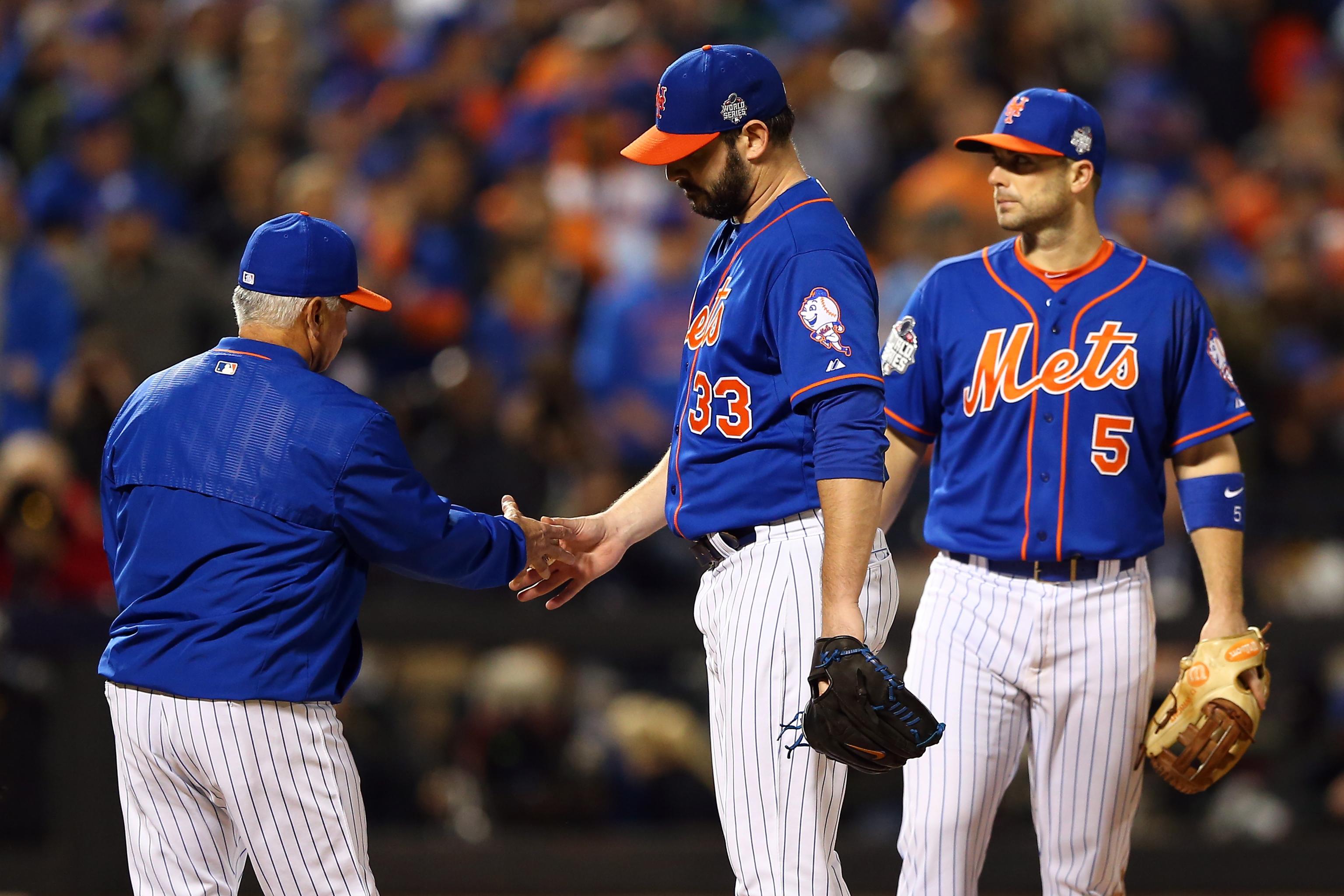
Left to right: Manager Terry Collins, Matt Harvey, David Wright

November 1, 2015, 10 years ago: Game 5 of the World Series is played at Citi Field in Flushing, Queens, New York City. Curtis Granderson hits a home run in the bottom of the 1st inning, giving the New York Mets a 1-0 lead over the Kansas City Royals. The Mets make it 2-0 in the 6th, and Matt Harvey holds that lead into the top of the 9th.
But the Mets pull off a unique feat: They blow leads in every single game of a World Series. This includes Game 3, which they came back to win, anyway. Only the Mets, right?
Harvey convinces manager Terry Collins to leave him in, and he walks the leadoff hitter, Lorenzo Cain. Cliché Alert: Walks can kill you, especially the leadoff variety. Eric Hosmer doubles Cain home, and Collins now pulls Harvey for Jeurys Familia. A groundout gets Hosmer to 3rd, and a fielding blunder by the Mets (surprise, surprise) results in the tying run coming home.
Familia's 8 blown saves in a single postseason ties the record set by Robb Nen of the 2002 San Francisco Giants. Unlike Familia, Nen does have a World Series ring, with the 1997 Florida Marlins.
The game goes to the 12th inning. Royals catcher Salvador Pérez singles off Addison Reed. Royals manager Ned Yost sends Jarrod Dyson in to pinch-run for him. Christian Colón singles him home, and then Collins brings in the unrelated Bartolo Colón, and the 42-year-old corpulent proven steroid cheat melts down. It remains the worst extra-inning performance in the 119-year history of the World Series. The Royals win the game, 7-2, and win their 2nd World Series, their 1st in 30 years.
Here's the tale of woe: 
* Game 1, at Kauffman Stadium in Kansas City: Mets 4, Royals 3, going to the bottom of the 9th; Royals win, 5-4 in 14 innings.
* Game 2, at Kauffman Stadium: Mets 1, Royals 0, going to the bottom of the 5th; Royals 7, Mets 1. 
* Game 3, the 1st World Series game ever played at Citi Field: Mets 2, Royals 1 after 1 inning; Royals 3, Mets 2 after 2 innings; Mets 9, Royals 3 for a final score. So they did blow the lead, but still came from behind to win.
* Game 4, at Citi Field: Mets 3, Royals 2, going to the top of the 8th; Royals 5, Mets 3.
* Game 5, at Citi Field: Mets 2, Royals 0, going to the top of the 9th: Royals 7, Mets 2 in 15 innings.
The Royals proved what the New York Yankees had proven in the regular season, what Chase Utley of the Los Angeles Dodgers proved in the National League Division Series, and what nobody else, not the other Dodgers, nor the Chicago Cubs in the NL Championship Series, seemed willing to prove: Stand up to the Mets, and they will fold. This pattern held in 2016, as the Mets reached the NL Wild Card game, but lost it.
In the 1995 Star Trek: Deep Space Nine episode "Past Tense, Part II," partly set in the year 2024, Commander (later Captain) Benjamin Sisko, a baseball fan despite living in the 24th Century, gave his opinion that the greatest baseball team of all time was the 2015 London Kings, pointing out that it was the rookie season of Japanese-American shortstop Harmon "Buck" Bokai. This suggests that the Kings won the 2015 World Series. Another person in the scene says the greatest team ever was the 1999 Yankees.
The scene came closer to getting it right than anyone could have expected: The Yankees did go on to win the World Series in 1999, going 11-1 in the postseason, following their 114-48 regular season and 11-2 postseason of the year before; and the 2015 World Series was won by a team with a regal name. But "Royals" is not "Kings," and Kansas City is not London. (They do call themselves "The Paris of the Plains," though.)
Other Trek episodes had the Yankees beating the London Kings in the World Series in 2032, and losing to them in 2042, after which -- possibly due to World War III being fought in the show's timeline -- baseball had so badly dropped in popularity that it was stopped, a major problem I have with Star Trek.
However, despite the Yankees' real-life 2 regular-season games with the Boston Red Sox in London in 2019, and future London Series games planned, I seriously doubt that MLB will put a team in London by 2032, or even 2042. But at least the sport should remain popular well beyond then.
Another piece of science fiction, Back to the Future Part II, released in 1989, said that the Chicago Cubs won the 2015 World Series, a 4-game sweep over a Miami team not named, but with an alligator as its logo. The Cubs did reach the NLCS in 2015, but got swept by the Mets, then won the World Series the next year. But when a Miami team was created, the Florida Marlins, in 1993, it was in the NL, and it ended up embarrassing the Cubs in the 2003 NLCS.

In World Series play, the Mets are 0-5 in Game 1s, 2-3 in Game 2s, 5-0 in Game 3s, 2-3 in Game 4s, 2-3 in Game 5s, 1-1 in Game 6s, and 1-1 in Game 7s. Since October 27, 1986, when they beat the Boston Red Sox in Game 7 of the World Series, they have gone just 2-8 in World Series play, their only wins coming in Game 3s at home. And, since November 1, 2015, they have never played another World Series game. 

November 1, 1950: The Attempted Assassination of President Harry Truman

November 1, 1950, 75 years ago: President Harry Truman faces an assassination attempt. The Truman family is staying at Blair House, across Pennsylvania Avenue from the White House, while the White House is being renovated. Oscar Collazo and Griselio Torresola, Puerto Rican independence activists, approached Blair House with guns, hoping that killing Truman would help their cause.
Blair House

Collazo shot D.C. police officer Donald Birdzell. He survived, and lived until 1991. Secret Service Agent Vincent Mroz heard this, came outside, and shot Collazo in the chest. He survived. Torresola shot White House Police Officer Leslie Coffelt. He then shot Officer Joseph Downs, but Downs was able to get up and secure a door into the house. He survived, and lived until 1978.

Torresola was reloading when Truman, having heard the shots, made a potentially terrible mistake, and looked outside his 2nd floor window, exposing him to the shooters. Secret Service Agents shouted at him to get away. He did.


Coffelt managed to return fire, hitting Torresola in the head and killing him instantly. But Coffelt was mortally wounded, and died 4 hours later. He was the 1st person ever to, as the Secret Service's saying goes, "take a bullet for the President."
Officer Leslie Coffelt

Collazo was convicted and sentenced to death. Truman, a World War I veteran who said he wasn't scared, because had already "been shot at by professionals," commuted Collazo's sentence to life imprisonment. In 1979, President Jimmy Carter further commuted his sentence to time served, which turned out to be 29 years. He returned to Puerto Rico, continued to support its independence, and died in 1994.

Truman served out his term until January 20, 1953, did not run for another, and retired to his home in Independence, Missouri, outside Kansas City. He died on December 26, 1972. Agent Mroz, who had played football at the University of Michigan, was the last survivor of the incident, living until 2008.

Trying to tie this event to more recent events: In 1948, the White House was seen to be in such poor condition that a major renovation was necessary. It took 4 years, including most of Truman's 2nd term, requiring him and his family to stay at Blair House, although the West Wing, including the Oval Office, were retained. It was done through proper channels, and not on the whim of the incumbent President. It wasn't like the recent demolition of the East Wing by Donald Trump.

Also, the assassination attempt on Truman was real, not staged.