Friday, September 8, 2023

September 8, 1973: "Super Friends" Premieres

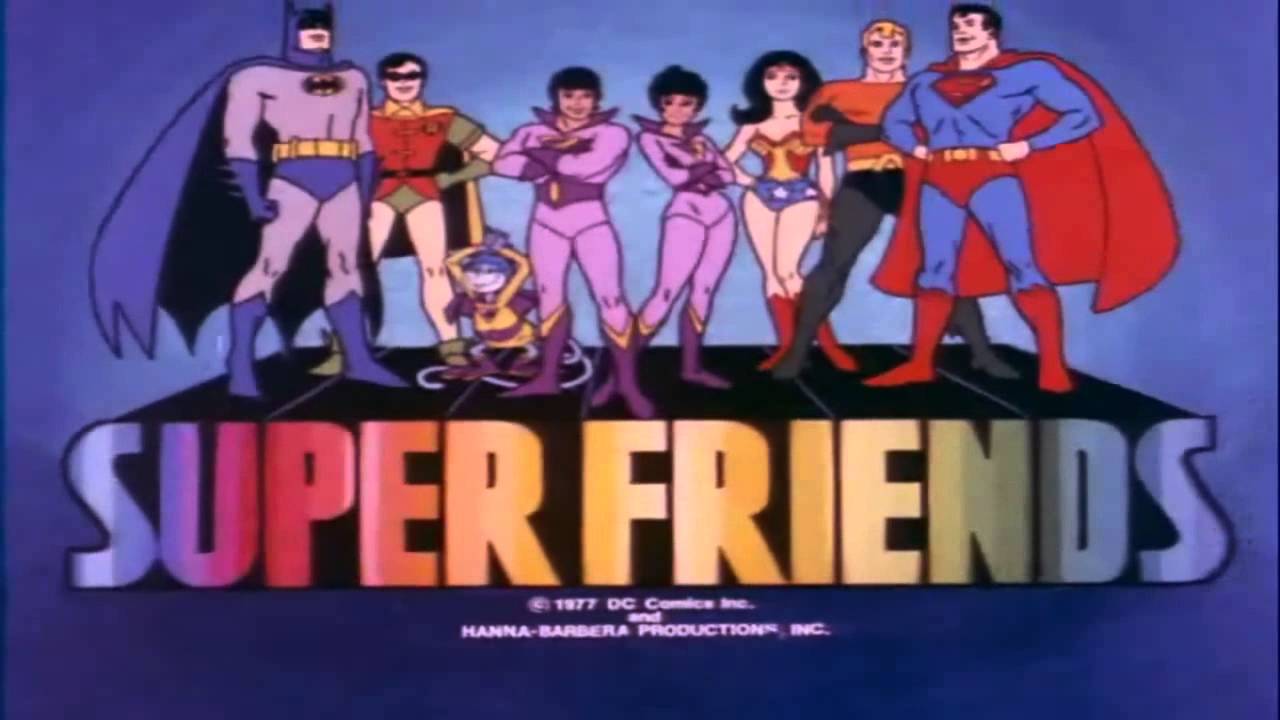
Left to right: Wonder Dog, Aquaman, Robin, Batman,
Superman, Wonder Woman, Wendy and Marvin.
Note the early '70s bell-bottom pants on both teenagers.

September 8, 1973, 50 years ago: Super Friends premieres on ABC, based on the superheroes of DC Comics. Produced by Hanna-Barbera Productions, it runs in one form or another until 1986. The animation was crude by today's standards, but, as a kid, I didn't care.

The original series, narrated by Ted Knight, a.k.a. Ted Baxter of The Mary Tyler Moore Show -- "Later, at the Hall of Justice... " -- was kid-centric. Wendy Harris (voiced by Sherry Alberoni) and Marvin White (Frank Welker) were ordinary teenagers, who had no powers, but considered themselves superheroes, or at least detectives, in training.

They had a dog named Wonder Dog (also voiced by Welker, who specialized in voicing cartoon dogs), whose only special abilities were a higher intelligence than most dogs and, sort of, the ability to talk. They were taken in by the Super Friends, who can be recognized as a subset of the Justice League.

It's understandable that the show used Superman (Danny Dark), Batman (Olan Soule), Robin (Casey Kasem) and Wonder Woman (Shannon Farnon). After all, Kal-El/Clark Kent, Bruce Wayne and Princess Diana of Themiscyra/Diana Prince are what are now called "the DC Trinity"; and, as the original Robin, Dick Grayson was Batman's sidekick. It had only been 5 years since the Adam West Batman series had gone off the air, and this version of the Dynamic Duo was more like West and Burt Ward than like later "Dark Knights" and their "Boy Wonders."

Less obvious as a choice to round out the main superhero cast was Aquaman (Norman Alden). For those of you who only know later versions, showing him with long hair and looking more like Marvel Comics' Thor -- or in the darker-skinned, dark-haired, long-haired, tattooed version played by Jason Momoa in the DC Extended Universe movies -- his appearance as a very pale white man with short but curly hair might seem like an anachronism.

There were occasional visits from other superheroes. Knight also voiced The Flash. Alden also voiced Green Arrow and Plastic Man. But each of these characters appeared in only one episode. In flashback sequences, we saw Superman's Kryptonian parents, Jor-El (Kasem) and Lara (Farnon); and his earthly parents, Jonathan Kent (Soule) and Martha Kent (Farnon again).

In later versions, Dark would also play Batman's ally, Gotham City Police Commissioner James Gordon. Farnon would also play Wonder Woman's mother, Queen Hippolyta; Superman's girlfriend and Daily Planet co-worker, Lois Lane; and, from Greek mythology, goddess of love Aphrodite and monster Medusa.

Super Friends taught me to read closing credits. I noticed that Robin sounded an awful lot like Shaggy from Scooby-Doo, Where Are You? So I looked at the credits of both shows, and wrote them down, and found two names in common: Kasem and Welker. When I found out from other shows that Welker was also the voices of Fred from Scooby, Astro from The Jetsons, Dynomutt the Dog Wonder (with Laugh-In's Gary Owens as the Batman-like Blue Falcon) and the title character in Jabberjaw, that narrowed him down to Marvin and Wonder Dog, and showed me that Kasem was Robin.

In the 1976-77 TV season, ABC's The Krofft Supershow had Electra Woman and Dyna Girl, played by soap opera star Deidre Hall and car pitchwoman (as "Mean Mary Jean") Judy Strangis, respectively. This show copied Wonder Woman by having female superheroes, copied Batman by having an older hero and a younger sidekick with a corny catchphrase ("Electra-Wow!"), and copied Superman by making them reporters in civilian life. And Alden, the voice of Aquaman, played Frank Heflin, who was less their version of Batman and Robin's butler/all-around tech whiz Alfred than he was Oscar Goldman to their Six Million Dollar Man and Bionic Woman.

Only one season of 16 episodes of Super Friends was made, although they continued to be shown in reruns. But the ABC success of Lynda Carter's Wonder Woman series and Electra Woman and Dyna Girl, and The Shazam/Isis Hour on CBS, gave ABC and Hanna-Barbera the idea to try again.

In 1977, they brought us The All-New Super Friends Hour. Noting that the core audience was a little older, Wendy, Marvin and Wonder Dog were phased out. Phased in were the Wonder Twins. They were teenagers, from the planet Exor, and they were obviously geared toward not just older kids and teenagers, but Trekkies, because they looked like Vulcans: Vaguely Asian faces, the same hairstyles, and pointed ears.
Left to right: Batman, Robin, Gleek, Zan,
Jayna, Wonder Woman, Aquaman, Superman

Unlike Wendy, Marvin and Wonder Dog, Zan (Michael Bell) and Jayna (Liberty Williams) had powers. Not a mind-meld or a nerve pinch like Vulcans. When they touched their hands, and said, "Wonder Twin powers, activate!" Jayna could say, "Shape of... " any animal, and transform into that animal. Zan could say, "Form of... " any version of water, from ice to boiling water to fog to a solid wall of liquid water.

Suddenly, Aquaman's sea-based powers didn't seem so silly: Zan was mainly comic relief. But if that wasn't enough, they had a pet monkey named Gleek (also voiced by Bell), with a rubber tail that could be used as a weapon and, if he spun it in the air like a helicopter's rotor, he could use to fly.

It still wasn't a full Justice League of America, but there were, again, cameos from other heroes, usually one guest appearance per episode. Barney Phillips took over as The Flash (the Barry Allen version). Michael Rye voiced Green Lantern (the Hal Jordan version). Jack Angel voiced Hawkman, and Farnon voiced Hawkgirl (never "Hawkwoman"). Wally Burr voiced The Atom.

Then there were the heroes created just for this series, having never before appeared in comic books. This was an attempt to appear diverse, or, as we would now say, multicultural. But the characters, all too often, seemed like stereotypes anyway.

While there were black superheroes before this, including DC's electric-powered Black Lightning and the John Stewart version of Green Lantern, they didn't use any of them for Super Friends. They wanted to use Black Lightning, but there was a legal wrinkle that prevented them from doing so. So, they created Black Vulcan (Buster Jones). No, it wasn't a black version of Star Trek's Mr. Spock: Basically, he was Black Lightning, with electric powers and a somewhat different black-and-gold costume. That and the name allowed them to meet the legal requirements. (The original Vulcan was the Roman name for the god of fire, known as Hephaestus to the ancient Greeks.)

The Asian hero was Samurai (also Jack Angel), who had wind-based powers, similar to the DC character Red Tornado. And there was a Native American hero, Apache Chief (also Michael Rye). He could grow to enormous size, which also gave him super strength and near-invulnerability. But their costumes were little better than how John Wayne would have imagined their peoples.
Clockwise from top: Superman, Hawkman, Samurai, Green Lantern,
Robin, Batman, Wonder Woman, Aquaman, Flash,
Jayna, Zan, Gleek, Black Vulcan and Apache Chief.
The Hall of Justice was based on Union Terminal in Cincinnati,
hometown of the owners of Hanna-Barbera Productions,
Taft Broadcasting (and related to President William Howard Taft).

For the 1978-79 season, Challenge of the Superfriends (one word) was made. Now, the denizens of the Hall of Justice are a full 11-member Justice League of America (JLA): Superman, Batman, Robin, Wonder Woman, Aquaman, Flash, Green Lantern, Hawkman, Black Vulcan, Samurai and Apache Chief. (But no Green Arrow, Plastic Man, Hawkgirl or Wonder Twins. By this point, Plastic Man had gotten his own show.)

And now, they had regular enemies, with a headquarters looking like Star Wars character Darth Vader's helmet (come on, let's call a spade a spade) rising out of a swamp: The Legion of Doom. Its members:

* Lex Luthor (Stanley Jones), arch-enemy of Superman. (In this series, Jones also did the voices of Superman's fathers, Jor-El and Jonathan Kent. What Sigmund Freud would have thought of that, I have no idea.)

* Bizarro (Bill Callaway), imperfect duplicate of Superman.

* Brainiac (Ted Cassidy, formerly Lurch on The Addams Family and the narrator of the opening sequence to CBS' The Incredible Hulk), robotic enemy of Superman. (Cassidy died of heart trouble during the season, only 46 years old.)

* Mr. Mxyzptlk (another Frank Welker role), magical enemy of Superman.

* Solomon Grundy (Jimmy Weldon), an incredibly strong and durable zombielike creature that debuted in the 1940s as an enemy of the "Golden Age" Green Lantern, Alan Scott, but later became an enemy of Superman and, occasionally, other heroes.

* The Toyman (another Frank Welker role), enemy of Superman, but hardly on the same level as the preceding.

* The Riddler (Michael Bell, also Zan and Gleek), enemy of Batman. (The Riddler was chosen because they couldn't get the legal rights to use the Joker or the Penguin. It's just as well: The Riddler is smarter than either one.)

* The Scarecrow (Don Messick), enemy of Batman. (Messick was also the original voice of Scooby-Doo.)

* The Cheetah (Marlene Aragon), catlike arch-enemy of Wonder Woman.

* Black Manta (also Ted Cassidy), arch-enemy of Aquaman.

* Sinestro (also Don Messick), arch-enemy of Green Lantern.

* Gorilla Grodd (Stanley Ralph Ross), a member of The Flash's "Rogues Gallery." (Ross had been a writer on the 1966-68 Batman series, and a co-creator of the 1975-79 Wonder Woman series.)

* Captain Cold (Dick Ryal), also a Flash enemy. (In a flashback sequence, Ryal also voiced Abin Sur, the dying Green Lantern who gave his power ring to Hal Jordan.)

* The Pied Piper (Bob Hastings), also a Flash enemy.

* Giganta (Ruth Forman), a giantess created for the series. Being a woman, she would seem to be an opponent for Wonder Woman. However, an episode explained that she got her powers at the same time, and from the same source, that Apache Chief got his, making for a dual origin story.

New versions of the series would continue until 1986, by which point I was too old to watch. But there would be live-action versions to come, with Superman getting 4 movies and 2 TV shows (Superboy and Lois & Clark: The New Adventures of Superman, plus a Supergirl movie), Batman getting 4 movies, and The Flash getting a single-season TV series on CBS. There would be the NBC special Legends of the Superheroes in 1979, which had the first live-action versions of The Flash, Green Lantern, The Atom and Hawkman. However, a typically small TV special-effects budget rendered it ridiculous.

Superman: The Movie came out in late 1978, and when Lois Lane (Margot Kidder) meets Superman (Christopher Reeve) for the first time, she asks him, "Who are you?" Not yet having been named Superman (in this version, it was Lois who gave him the name in her article), he says simply, "A friend." It may not have been intentional, but, in hindsight, it seems like an "Easter Egg" for Super Friends fans like me.

In 1992, Batman: The Animated Series would launch "The DC Animated Universe," which ran until 2006. Among the other series included in it were Superman: The Animated Series, The New Batman Adventures, Batman Beyond (set in a future with an elderly Bruce Wayne training a teenager, Terry McGinnis, to be a new, updated Batman, rather than the latest in a long line of Robins), Justice League and Justice League Unlimited. These shows were definitely meant for older kids, who would understand the dark themes of the Batman mythos, not little kids.

A 1997 Justice League of America movie would have only second-tier heroes, including the first live-action version of J'onn J'onzz, the Martian Manhunter, because getting the legal rights to use Superman, Batman and Wonder Woman would have been prohibitively expensive. Between 2005 and 2010, The CW's Superman prequel series Smallville would feature the first live-action versions of Aquaman, Green Arrow, and the Wonder Twins, plus new versions of some other heroes.

And, in 2020, in the last episode of The CW's Crisis On Infinite Earths, a Justice League consisting of Superman (Tyler Hoechlin), Supergirl (Melissa Benoist), Batwoman (Ruby Rose), The Flash (Grant Gustin), the White Canary (Caity Lotz), the Martian Manhunter (Dorian Harewood) and Black Lightning (Cress Williams) gathered for the first time, with an empty seat at the table in memory of Green Arrow (Stephen Amell), who had sacrificed his life to restart the multiverse.

Their building looked like the Hall of Justice. And at the end, while the old Super Friends theme played, the camera panned up to an open cage marked "GLEEK." I have to say, despite having just turned 50, I got a kick out of that.

Wednesday, September 6, 2023

Home Runs Are Fun, But...

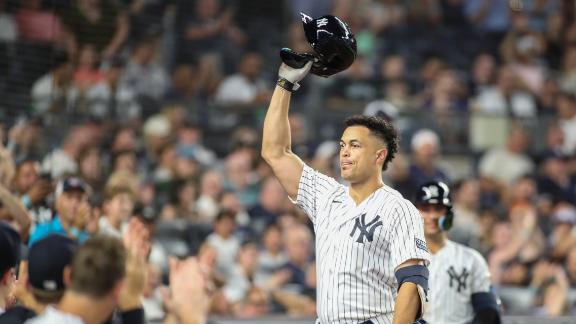
Last night, the Yankees beat the Detroit Tigers, 5-1 at Yankee Stadium. Gerrit Cole pitched very well. Giancarlo Stanton hit his 400th career home run.

Since 2010, the Yankees have had these players on their roster, with these career home run totals (accurate as of yesterday's games for those still active):

Carlos Beltrán 435
Andruw Jones 434
Giancarlo Stanton 400
Lance Berkman 366
Curtis Granderson 344
Jay Bruce 319
Matt Holliday 316 
Raúl Ibañez 305
Andrew McCutchen 299
Mark Reynolds 298
Anthony Rizzo 295
Brian McCann 282
Josh Donaldson 276
Vernon Wells 270
Eric Chavez 260
Aaron Judge 250

Not one of those players has won a Pennant with the Yankees.

I only included players with as many home runs as Judge, or more. Joey Gallo is at 198. I also didn't include players who had won at least 1 Pennant with the Yankees, like Alex Rodriguez (696), Mark Teixeira (409) and Derek Jeter (260).

Home runs are fun. But what wins games, and wins titles, is situational hitting, good pitching and good defense.

You know this. I know this. Brian Cashman doesn't seem to know this. Maybe Hal Steinbrenner knows this; but, if he does, he doesn't care.


Monday, September 4, 2023

If They Had Done This a Month or Two Ago...

Well, well, well: The Yankees took 3 out of 4 in Detroit (and were 1 run away from a sweep), and took 3 straight in Houston. And gave good signs for the future.

The Friday night win over the Astros, featuring the home-run-hitting debut of Jasson Domínguez, was followed on Saturday by a shaky start by Luis Severino, but Jhony Brito pitched 3 2/3rds innings of scoreless relief to qualify as the winning pitcher.

In the 2nd inning, the Ozzies struck: Oswald Peraza singled Giancarlo Stanton home to keep the bases loaded, and Oswaldo Cabrera drew a walk to force Anthony Volpe home. Aaron Judge hit a home run in the 3rd inning. The Yankees tacked on 2 more runs in the 5th, and that was enough: Yankees 5, Astros 4.

Last night was the ESPN Sunday night game. Aaron Boone decided to go with an "opener game," starting Michael King. Except he went 5 innings, allowing just 1 run, 5 hits, and no walks. Tommy Kahnle, Jonathan Loáisiga and Clay Holmes combined for 4 innings, no runs, 2 hits, no walks. So that's how you beat the Cheat-stros: Don't walk anybody, all game long.

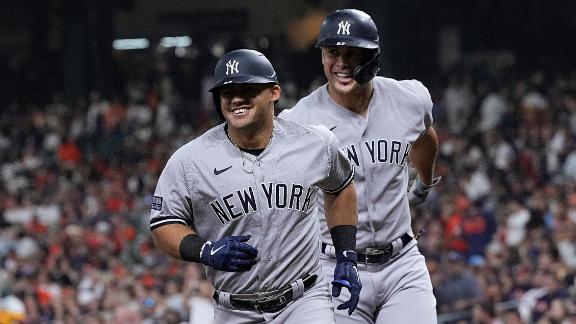
It was 1-0 Astros with 1 out in the top of the 6th, when Cabrera singled, and DJ LeMahieu doubled him home. Judge struck out, but Domínguez hit one out, making him only the 4th Yankee ever to hit 2 home runs in his 1st 3 major league games. There were 3 more runs in the 9th, including a home run by Gleyber Torres. Yankees 6, Astros 1. It was the Yankees' 1st sweep of the Astros since 2013, and their 1st in Houston since 2002.

An optimist would say that this is the highlight of the season, and that it portends well for the rest of the way and for next season.
A pessimist would say it's too little, too late, and, as far next season, Brian Cashman will find a way to futz it up.
A realist would say he doesn't know, and is tired of hearing, let alone making, predictions about this team.

So, here we are, Labor Day, and not only is there no holiday doubleheader as in days of yore, but neither the Yankees nor the Mets are even scheduled for today. Tomorrow, the Yankees start a homestand, 3 with Detroit, then 3 with Milwaukee.

They are 68-69, 8 1/2 out of the last American League Playoff berth. Their "Tragic Number" to be eliminated is 18.

If they had brought up Domínguez and the other kinds a month or two ago...

September 4, 1993: Jim Abbott Pitches a No-Hitter -- With One Hand

September 4, 1993, 30 years ago: The New York Yankees host the Cleveland Indians at Yankee Stadium. The Yankees are in a tight race for the American League Eastern Division title with the Toronto Blue Jays, the defending World Champions, who lead them by 2 games.

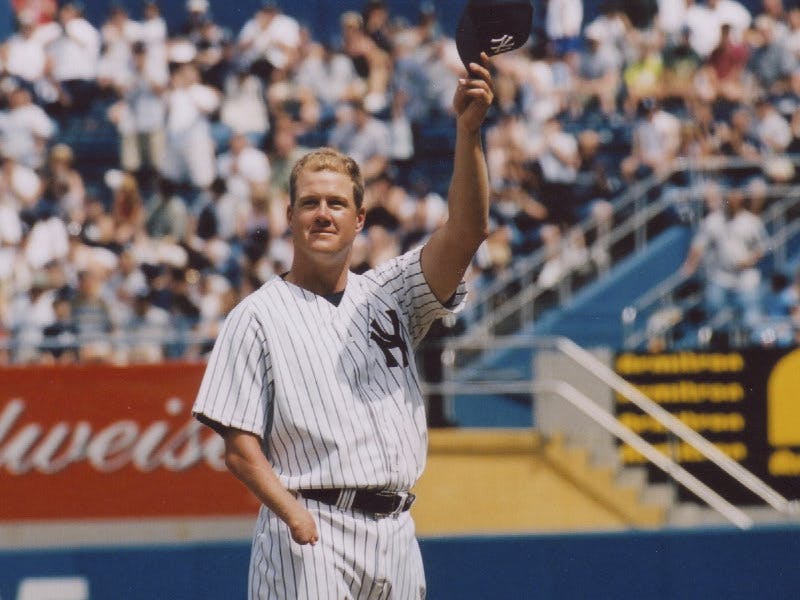
Jim Abbott was the Yankees' starting pitcher. That he was in the major leagues at all was stunning: He was born on September 19, 1967, in Flint, Michigan -- with only one hand. His right hand was a stub with 2 small vestigial fingers on it.

"As a kid, I really wanted to fit in," Abbott said. "Sports became a way for me to gain acceptance. I think this fueled my desire to succeed. I truly believe that difficult times and disappointments can push us to find abilities and strengths we wouldn't know existed without the experience of struggle."

When preparing to pitch the ball, Abbott would rest his glove on the end of his right forearm. After releasing the ball, he would quickly slip his left hand into the glove, usually in time to field any balls that a two-handed pitcher would be able to field. Then he would secure the glove between his right forearm and torso, slip his hand out of the glove, and remove the ball from the glove, usually in time to throw out the runner at first or sometimes even start a double play.

At all levels, teams tried to exploit his fielding disadvantage by repeatedly bunting to him. But he had become so skillful at the glove switch that bunting usually didn't work any more than it did on any other pitcher.

Batting was not an issue for Abbott for the majority of his career, since the American League uses the designated hitter. But in a Spring Training game in 1991, he hit a triple off Rick Reuschel.

But he had to get there first. At Flint Central High School -- which also produced sprinter and Oakland Athletics "designated runner" Herb Washington, and former U.S. Senator Don Riegle -- he not only pitched, but played quarterback on the football team. In 1985, he was drafted by the Toronto Blue Jays, but chose to go to the University of Michigan instead.

This turned out to be a good move: He helped the Wolverines win 2 Big 10 titles, and in 1987 became the 1st baseball player to win the James E. Sullivan Award as the top amateur athlete in America. He also won the Golden Spikes Award, 1 of 2 player of the year awards in college baseball. (The other, generally considered to be baseball's "Heisman Trophy," is the Dick Howser Trophy, named for the Florida State legend and former Yankee shortstop, coach and manager, who led the Kansas City Royals to win the 1985 World Series.) Baseball was a demonstration sport at the 1988 Olympics in Seoul, Korea, and Abbott won the Gold Medal game. Michigan elected him to their Athletic Hall of Fame, and retired his Number 31.

In 1988, his draft status having lapsed because of his time in college, he was drafted again, by the California Angels. In 1989, he made the team out of Spring Training without playing a single minor-league game, and went 12-12. In 1991, despite the Angels finishing at .500 at 81-81, he went 18-11, and finished 3rd in the voting for the AL Cy Young Award.

After the 1992 season, the Angels traded him to the Yankees, for 1st baseman J.T. Snow, and pitchers Russ Springer and Jerry Nielsen. The pitchers never really made it, but Snow, not needed in New York because of Don Mattingly, became an All-Star. In contrast, going into September 4, 1993, Abbott was just 9-11. The Yankees needed a better performance from him if they were going to make the Playoffs.

He began this game by walking Kenny Lofton, but got Félix Fermín to ground into a double play. He walked Randy Milligan in the 2nd, but stranded him. Mike Gallego led off the bottom of the 3rd with a walk off Bob Milacki, was singled to 2nd by Wade Boggs, and was singled home by Dion James. There were 2 bad throws on the play, and Boggs and James were also able to score. The Yankees led, 3-0.

Abbott walked Milligan again to start the 5th, but got another double play, this one grounded into by future Boston Red Sox slugger and Yankee nemesis Manny Ramírez. Randy Velarde hit a home run in the bottom of the 5th, to extend the Yankees' lead to 4-0. Abbott walked Junior Ortiz in the 6th, and Jim Thome in the 8th, but stranded both of them.

The tension was building. Abbott, whose very presence in the major leagues had made a little history, was 3 outs away from making the story even better: Pitching a no-hitter is one of those achievements that is said to allow a player to "achieve baseball immortality." And the Yankees needed the win, and, with the lineup that the Indians were building, which would win 6 Division titles, including 2 Pennants, over the next 8 years, and the short porch in right field at the old Yankee Stadium, a 4-run lead with 3 outs to go was not completely safe.

Abbott got Lofton to ground to 2nd. He got Fermín to fly to center. And he got the dangerous Carlos Baerga to ground to short. Velarde threw to Mattingly, and the game was over: The Yankees had the win, and Abbott had the no-hitter.
WABC-Channel 7's Eyewitness News went with
"Hey, Abbott!" which was Lou Costello's greeting
for comedy partner Bud Abbott.
The Daily News went with a play on "Yankee Doodle Dandy."

The Blue Jays lost, 4-2 to the California Angels at Anaheim Stadium. (The home team is now named the Los Angeles Angels, and the stadium is now known as Angel Stadium of Anaheim.) Paul Molitor went 2-for-4 with an RBI, and Rickey Henderson went 1-for-4, but it wasn't enough for the Jays. So the Yankees closed to within 1 game. The next day, again, the Yankees won and the Jays lost, so there was a tie for 1st, at 78-60.

However, the Yankees tailed off, going 10-14 down the stretch, including losing 2 of 3 to the Jays in Toronto, and the Jays ended up winning the Division by 7 games, before going on to repeat as World Champions. Abbott finished at 11-14 with a 4.37 ERA. This was the last completed season before Major League Baseball began a new setup of 3 Division plus a Wild Card Playoff team in each League, so the Yankees were out of luck -- this time.

But the 1993 season was a turning point: After 4 straight bad seasons, the rebuilding effort had begun to pay off. The Yankees led the AL East by 6 1/2 games when the Strike of '94 hit, won the AL Wild Card in '95, and started a new dynasty in '96.

Jim Abbott would not be a part of it, however: A free agent after the 1994 season, he signed with the Chicago White Sox, who soon traded him back to the Angels. He was released in Spring Training in 1997, but was re-signed by the White Sox in 1998. In 1999, he pitched for the Milwaukee Brewers, so he had to bat for the 1st time in a regular-season game. In 21 at-bats, he had 2 hits, both for RBIs, and both off Jon Lieber of the Chicago Cubs, although not in the same game.

After the season, Abbott retired with an 87-108 record, a 4.25 ERA, and a 1.433 WHIP. If all you knew were those stats, and the no-hitter, you might say he was an ordinary pitcher who had one extraordinary day. But because of what he had to overcome, every day that he pitched was an extraordinary day.

Saturday, September 2, 2023

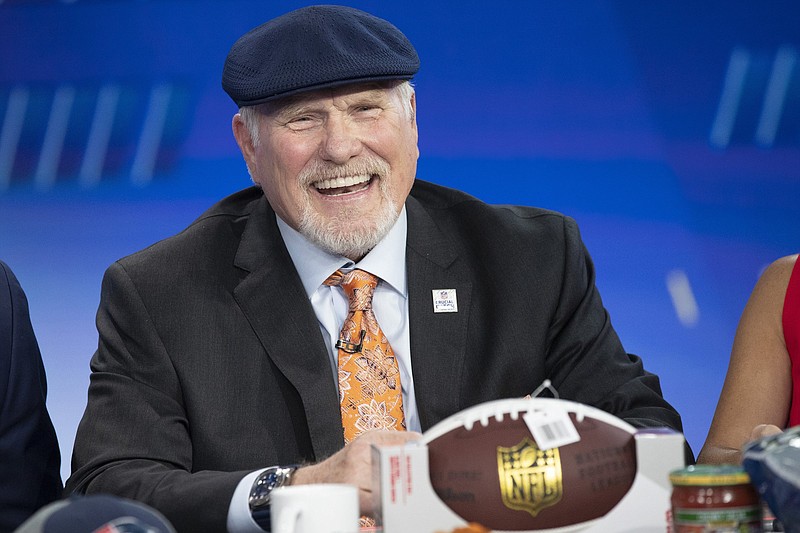
Happy 75th Birthday, Terry Bradshaw!

September 2, 1948, 75 years ago: Terry Paxton Bradshaw is born in Shreveport, Louisiana. The quarterback from Louisiana Tech was the 1st pick in the 1970 NFL Draft. He led the Pittsburgh Steelers into 4 Super Bowls, won them all, and was named the Most Valuable Player in 2 of them. Opponents called him dumb. He proved himself to be smarter than they were, as long as he had a football in his hand.

He made 3 Pro Bowls, and was named the NFL’s MVP in 1978. In 1979, he and fellow Pittsburgh World Champion Willie Stargell of the Pirates were named Sportsmen of the Year by Sports Illustrated magazine. He has been named to the College and Pro Football and Louisiana Sports Halls of Fame, the NFL’s 1970s All-Decade Team, and the Steelers' Hall of Honor. The Steelers have not officially retired his Number 12, but no Steeler has worn it since.

In 1999, The Sporting News ranked him 44th on their list of the 100 Greatest Football Players. In 2010, the NFL Network ranked him 50th on their list of the 100 Greatest Players. Forget Tom Brady: The fact that Bradshaw went 4-0 in Super Bowls, and never had to cheat, shows that he is the only TB12.

All that was before he became a studio analyst with CBS, and then with Fox. Like baseball pitcher Dizzy Dean before him, Terry figured out, both as a player and a broadcaster, that if people think you're a dumb silly hick, use it to your advantage before they can use it to theirs. He has become America's favorite country bumpkin, and was the 1st former athlete to get a star on the Hollywood Walk of Fame.
He has survived depression and cancer, is now married for the 4th time, and owns a ranch in Texas where he breeds horses. His 2 daughters are involved with the ranch, and both met their husbands through the business. Erin recently presented him with his 1st grandchild.

Happy Birthday, TB. May there be many more.

Life On Mars

The Yankees had a good chance to sweep a 4-game series away to the Detroit Tigers. They won the 1st 3. But they lost the 4th in the 10th inning. Had they lost any of the other games, in any other way, it would have felt a lot better. But losing the last game, beyond what would normally be the last inning, was a bit disheartening.

It could be joked that their punishment for playing so poorly before this was that they had to go to Detroit, and that their punishment for losing this game was that they had to go to Texas. And face the Houston Astros, the Chicken Fried Cheats, the Red Sox South, at Minute Maid Park. And, despite what some blithering idiots say about the new Yankee Stadium, Minute Maid Park is a lot closer to being "a little league field." Especially with the Astros' cheating.

In what seemed like an act of desperation, general manager Brian Cashman made his initial September call-ups, players who would be ineligible for the Playoffs if the Yankees made it, which they won't. Included among these is the most highly-touted Yankee prospect since Gleyber Torres: A young man whose play is so otherworldly, he is known as El Marciano: "The Martian."

Jasson Domínguez, no middle name, was born on February 7, 2003 in Esperanza, in the Dominican Republic. That's right: When Aaron Boone, now his manager hit that home run, Domínguez was all of 8 months old. And, like the House of El crest on Superman's costume that resembles the letter S, the name of his hometown, "Esperanza," means "Hope."

His father, Felix, is a Yankee Fan, and named him after Jason Giambi. Bad choice. Like Elvin "Mutt" Mantle did for his son Mickey, Felix taught Jasson to switch-hit. He throws righthanded. He started as a catcher before being moved to the outfield.

Jasson Domínguez was ranked as the top prospect eligible to sign with an MLB team in the 2019–2020 international class. He signed with the Yankees for a franchise record $5.1 million signing bonus on July 2, 2019. The hype has been unrelenting since, but, of course, one must take any hype around a Yankee "prospect" with a grain, a pinch, or even an entire mine's worth of salt, because so many of them flame out, and so many others have been screwed up by Yankee management.

He did not play at all in 2020, due to the cancellation of the minor league baseball season resulting from the COVID pandemic, and instead trained at a baseball academy in Santiago, in the Dominican. He began the 2021 season in extended Spring Training, played in the 2021 All-Star Futures Game, was promoted to the Class A Tampa Tarpons after that, played in the Futures Game again in 2022, and was promoted to the Class A Hudson Valley Renegades and then the Class AA Somerset Patriots.

He started this season with Somerset. In 109 games with them, he batted .254 with 15 home runs and 66 RBIs. On August 22, he was promoted to the Class AAA Scranton/Wilkes-Barre RailRiders. In 9 games with them, he batted .419 with 19 RBIs, although he didn't hit a home run. With little left to lose, it was announced on Wednesday afternoon that he would make his major league debut last night, September 1, 2023. He wore Number 89. Presumably, he will eventually get a lower number. Then again, Aaron Judge still wears 99.

With little left to lose, the Yankees played with this starting lineup, at these ages, against the execreble Astros last night:

26 1B DJ LeMahieu, 35
99 RF Aaron Judge, 31
11 SS Anthony Volpe, 22
27 DH Giancarlo Stanton, 33
89 CF Jasson Domínguez, 20
12 3B Isiah Kiner-Falefa, 28
88 C Austin Wells, 24, also making his MLB debut
80 LF Everson Pereira, 22, his 11th MLB appearance
91 2B Oswald Peraza, 23

The starting pitcher was Carlos Rodón, Number 55, age 30, and a tremendous disappointment since his acquisition. The opponents were the Astros, in Houston, and their starting pitcher, Justin Verlander, recently reacquired from the Mets, and, since his days with the Tigers, a tough opponent for the Yankees -- and, of course, everyone else.

So it was a "What else have we got to lose?" game. It seemed more like a game for a weird occurrence than a win. A weird occurrence such as a player hitting a home run in his 1st at-bat.

vGoing into last night's game, 134 players had hit a home run in their 1st MLB at-bat. They include 2 Hall-of-Famers: Earl Averill and, oddly, a man renowned as a great relief pitcher, Hoyt Wilhelm. They also include such notables as 1950s New York Giants star Whitey Lockman, future World Series-winning manager Chuck Tanner, future Yankee broadcaster Bill White, star Oakland Athletics shortstop (but not exactly a slugger) Bert Campaneris, 1980s All-Star 3rd basemen Tim Wallach and Gary Gaetti, and 1980s All-Star 1st baseman Will Clark. Not including active players, 22 of the players to have done it never hit another homer in the big leagues.

There had been 5 Yankees to do it: John Miller in 1966, Marcus Thames in 2002, Andy Phillips in 2004, and, in back-to-back at-bats in 2016, Tyler Austin and Aaron Judge. Of those, Judge was the only one who amounted to anything.

LeMahieu led off the game with a home run. After Judge and Volpe grounded out, Stanton drew a walk. And Domínguez, batting lefthanded against the righthanded Verlander, hit one to the opposite field, into the Crawford Boxes in left field. It was 3-0 Yankees before the cheats even came to bat.

José Abreu hit a home run for the Astros to lead off the bottom of the 2nd. But Judge led off the top of the 3rd with a single. After a Volpe floyout, Stanton hit a home run. It was 5-1 Yankees. The Astros got a run back in the bottom of the 3rd, but Judge led off the top of the 5th with a home run, the 250th of his career.

Rodón got through the 5th with the lead. Randy Vásquez pitched a scoreless 6th and 7th. Wandy Peralta and Jonathan Loáisiga combined for a scoreless 8th, and Loáisiga pitched a perfect 9th. Yankees 6, Astros 2.

This is, arguably, the highlight of the Yankees' season thus far. They are now 66-69. They need to go 15-12, playing at a 90-win pace, over the rest of the season, to finish at .500.

The Martian gave the Yankees hope -- if not for the season, then maybe the next. There may be "life on Mars," and maybe even in The Bronx.

Friday, September 1, 2023

September 1, 1983: The Soviet Union Shoots Down Korean Air Lines Flight 007

The Boeing 737-230B that later served as KAL007,
at Zurich International Airport in Switzerland, 1980.

September 1, 1983, 40 years ago: A particularly chilly moment in the Cold War. Korean Air Lines Flight 007 (or KAL007 for short), a Boeing 737-230B jet plane, having taken off from John F. Kennedy International Airport New York, and refueled in Anchorage, Alaska, is headed for the South Korean capital of Seoul.

It never gets there: It goes off course, crossing the Kamchatka Peninsula, part of the section of eastern Russia known as Siberia, which it was not authorized to do. This is noticed by the Soviet Union Air Defense Forces. It then crosses Sakhalin Island, the largest island under Soviet control. This is also unauthorized. Both crossings were almost certainly mistakes.

But tensions were already high. President Ronald Reagan had been building up America's nuclear missile presence, at home and abroad. Military exercises in the Pacific had gotten the Soviets' attention. They suspected that KAL007 might have been a spy plane. A commander ordered it shot down. A Soviet Su-15 interceptor did so. There were 269 people on board, including Representative Larry McDonald of Georgia. They all died.

The late Summer and the Autumn of 1983 was the most tense time in the Cold War since the Cuban Missile Crisis of October 1962. It also included a false alarm that nearly led the Soviets to launch nuclear missiles on September 26, the military exercise known as Able Archer 83 that fooled the Soviets into thinking NATO was preparing for a first strike in the 2nd week of November, and ABC's broadcast of the TV-movie The Day After on November 20.

Things calmed down after that. Soviet leader Yuri Andropov died in early 1984. His replacement, Konstantin Chernenko, died a year later. Reagan found it much easier to deal with the next leader, Mikhail Gorbachev. His reforms, liberation movements around Eastern Europe, and some of Reagan's policies led to the end of the Soviet Union and the Cold War in 1991.

Gimpo International Airport, frequently mentioned on the TV show M*A*S*H, was replaced as Seoul's main airport in 2001, by Incheon International Airport. Korean Air Lines retired flight number 007. They now use flight numbers 82, 85 and 250 in flights between JFK and Incheon, and technology is such that they no longer need to refuel at Anchorage.

Anatoly Kornukov, the General who ordered the shootdown, was never punished. Indeed, after the fall of the Soviet Union in 1991, he remained a senior figure in the Russian Air Force, serving as its Commander-in-Chief from 1998 until 2002. He died in 2014.
Major Gennadiy Osipovich, the pilot who fired the air-to-air missile that brought KAL007 down, was not told that the plane was a civilian one until 13 years later. He is still alive.

Country singer Lee Greenwood has said that he wrote the song "God Bless the U.S.A." in response to this incident. It was used so often during the Persian Gulf War of early 1991 that it's easy to forget that it's an older song.

President Reagan announced on September 16, 1983, that the Global Positioning System (GPS) would be made available for civilian use, free of charge, once completed in order to avert similar navigational errors in the future. Perhaps that would have happened eventually, but it was a step forward in the computer revolution.