Timing is everything. Yesterday was the scheduled date of the Golden Days Committee of the Baseball Hall of Fame, to consider players who debuted in Major League Baseball from 1950 to 1969. But the COVID-19 epidemic postponed that vote.
This was something that could have been done by videoconference. The vote could have been announced. And one of the players who was considered a possible electee was Dick Allen. He could have known he was officially a Hall-of-Famer -- or, at the least, a Hall-of-Famer-elect.
Now, he never will. At least, not on this plane of existence.
Richard Anthony Allen was born on March 8, 1942 in Wampum, Pennsylvania, about 40 miles northwest of Pittsburgh. His brother, Harold "Hank" Allen, was an outfielder who played in the major leagues from 1966 to 1973, including his last 2 seasons, when he and Dick were teammates on the Chicago White Sox. Another brother, Ron Allen, played 7 games, all in August 1972, as a 1st baseman with the St. Louis Cardinals. He starred in basketball at Youngstown State University.
Hank is now 80, and a scout for the Houston Astros -- ironically, based in the Maryland suburbs of Washington, D.C., home of the Washington Nationals, who beat the Astros in the 2019 World Series. Ron is a few days short of turning 77.
Dick, known in his youth as Richie Allen, had been signed by the Philadelphia Phillies in 1960, for a $70,000 bonus. The scout who signed him was John Ogden, a former pitcher for the St. Louis Browns, who would later say that Richie was the only player he ever saw who hit a ball as hard as Babe Ruth.
In 1963, he reached Class AAA ball, with the Arkansas Travelers of the International League. He was the 1st black player for the Little Rock-based team (which now plays across the river in North Little Rock), and racist residents staged protest parades. In spite of this, he hit 33 home runs, had 97 RBIs, and led the IL with 299 total bases.
That got him an end-of-season callup, at age 21. He made his debut on September 6, 1963. Wearing Number 32, playing left field and batting 5th, he struck out against Denny Lemaster in the 2nd inning, grounded into a double play in the 4th, doubled in the 7th, and was pinch-hit for in the 9th. The Phillies beat the Milwaukee Braves, 2-0 at Milwaukee County Stadium.
The 1964 season could have been one of the greatest in Phillies history. Instead, it became a nightmare. They led the National League most of the way. Now wearing Number 15, Richie made an alarming 41 errors at 3rd base, and struck out a League-leading 138 times. (It doesn't sound like much now, but, for the time, it was a lot. To put that in perspective: Mickey Mantle struck out more than any player before him, but his peak for a season was 126.) But he batted .318, got 201 hits, including 38 doubles, a League-leading 13 triples, 29 home runs and 91 RBIs.
He led the NL with 352 total bases and 125 runs scored. Not that anyone knew about this stat at the time, but his OPS+ was 162. And it wasn't just that he hit home runs: They were among the longest ever seen at Philadelphia's Connie Mack Stadium. Not since Jimmie Foxx was hitting them for the Athletics in the 1930s had the ballpark, then named Shibe Park, seen such prodigious clouts. He hit balls over the roof of the double-decked bleachers in left field, and even hit one to the opposite field, over the high right-field scoreboard.
Richie was a runaway winner of the NL's Rookie of the Year award -- but only finished 7th in the Most Valuable Player voting. His teammate, right fielder Johnny Callison, finished 2nd to Ken Boyer of the St. Louis Cardinals. (Allen was black, while Callison and Boyer were white.) It's been said that if the Phillies had won the Pennant, Callison would have won the MVP.
But the Phillies didn't win the Pennant. They led by 6 1/2 games with 12 to play, meaning their Magic Number to clinch was down to 6. But they went on a 10-game losing streak from September 21 to September 30, and blew it. They finished 1 game behind Boyer's St. Louis Cardinals, as did the Cincinnati Reds. The Phillie Phlop would define the franchise for a generation, and even fans who lived long enough to see the titles of 1980 and 2008 remain scarred by it.
Allen played every inning of every one of those 10 games, a total of 93 innings. (One game in the streak went 12 innings.) He had 44 plate appearances, 41 official at-bats, 17 hits for a batting average of .414, plus 2 walks for an on-base percentage of .432; 4 doubles, a triple and a home run, for a slugging percentage of .634; and 5 RBIs. He got at least 1 hit in 9 of the 10 games. He did make 2 errors, 1 in the 1st game of the streak and 1 in the last.
Nobody on the team played better during those 10 games than "the Wampum Walloper" did. If the Phillies had won the Pennant by 1 game, we'd have spent the last 56 years talking about how he carried the team on his back, the way Carl Yastrzemski did for the Red Sox 3 years later -- and Yaz was 28 at that point, whereas Dick was just 22 at this one. He might have been regarded as a hero from Day One.
Years later, interviewed for a documentary titled Baseball's Greatest Pennant Races, he asked a big question: "What one game could we have won in April, or May, that would have made the difference?" In other words, had the Phillies won such a game, and instead lost 9 out of 10 at the end of September, they would have forced a Playoff with the Cardinals, and had a chance to face the Yankees in the 1964 World Series.
It's funny how things work out. In 1964, the Phillies won 92 games, but missed the Pennant, and are considered a failure. In 1967, the Boston Red Sox won 92 games, and won the Pennant, and are considered a great iconic team, even though they lost the World Series. In 1980, the Phillies won 91 games, but, because they won the World Series, they are considered the greatest team in franchise history. (At least, until the 2008 title.)
*
One reason the Phillies didn't win the Pennant was that they didn't have enough of a home-field advantage. The North Philadelphia race riot of August 28 to 30, 1964 made white fans, already leery of the now mostly-black neighborhood surrounding Connie Mack Stadium, even more nervous about coming out to support the team in person, even with a Pennant on the line.
And so, the notorious Philadelphia boo-birds came out in 1965, and heckled the players who had failed the year before. None more so than Allen, who, being black, was an easier target than white players like Callison and pitchers Jim Bunning and Chris Short.
On May 29, he crushed a home run off Larry Jackson of the Chicago Cubs, over the roof. It was measured at 529 feet. Willie Stargell, who would end up hitting the longest home runs ever hit at a few ballparks, including Connie Mack Stadium's replacement, Veterans Stadium, said, "Now I know why they boo Richie all the time: When he hits a home run, there's no souvenir."
On July 9, left fielder Frank Thomas -- no connection to the black slugger of the same name for the later Chicago White Sox -- made a racist remark. Richie responded. Thomas took his bat, and hit Richie in the shoulder. Richie was not injured, and they were separated.
Philadelphia was already a cauldron of racial tension, and Phillies management had already had a nasty history on the subject, including manager Ben Chapman's repulsive taunting of Jackie Robinson in 1947, and becoming the last team in the National League to desegregate, 10 years later. They released Thomas the day after the incident, and told every other player to keep quite under penalty of a fine.
Since none of the players, most of whom were willing to back Richie up, weren't allowed to talk, many fans saw it as a young black player costing a veteran white player his job. The Philadelphia media blowing a story out of proportion is nothing new, and it took Thomas' side. The booing of Richie escalated.
In 2009, Dick Allen sat for an interview on the MLB Network's Studio 42 with Bob Costas. He said that he and Thomas had made peace, and were now good friends. Thomas, who only played 1 more season after the incident, retired at age 37, and is still alive, at 91.
Had the Phillies won the Pennant in 1964, the ugly incident the next season might not have happened. If it had, a lot more people would have taken Allen's side. The Phillies might have been able to put together another Pennant run or two. Allen probably wouldn't have been run out of town (or tried to get himself run out of town), and maybe the Phillies' return to glory in the late 1970s could have happened sooner.
Dick made the All-Star Team in 1965, the 1st of 7 times he would do so. In 1966, he batted .317, hit 40 home runs (which remained a career high) and had 110 RBIs (which didn't). His OPS+ was a stunning 181. He finished 4th in the MVP voting, behind Roberto Clemente, Sandy Koufax and Willie Mays.
But things began to go wrong. He developed drinking and gambling problems. On August 24, 1967, he injured his hand, pushing it through the headlight of his car, a 1950 Ford. He said it happened because he was trying to push a car that had run out of gas. It was presumed by those who knew him that he had lost his temper and punched the headlight.
Two tendons were cut, and a nerve was severed. Doctors at Temple University hospital operated on the hand for 5 hours, and gave him a 50-50 chance of ever playing again. He was 25.
He did resume playing, and hitting. In the 122 games he did play that season, he batted .307, led the NL with a .404 on-base percentage, had 174 OPS+, hit 23 homers and had 77 RBIs. In 1968, his batting average tailed off to .263, but he hit 33 homers and had 90 RBIs.
Also on 1968, he recorded a song, "Echoes of November," with a vocal group called The Ebonistics. The name on the label was "Rich Allen." Although he got some critical praise for the song, it was not a national Top 40 hit.
The 1969 season was supposed to be the last for Connie Mack Stadium, as Veterans Stadium was supposed to open for 1970. But construction delays pushed it back. The fans who came out to the old ballyard booed Richie more than ever.
His fielding had never improved, either. Finally, like fellow sluggers Harmon Killebrew and Dick Stuart in those pre-designated hitter days, he was moved to 1st base, the position where it was thought he would do the least amount of damage.
He began sticking his finger in the dirt at 1st base, writing. One day, it was "RICHIE ALLEN." Another, it was "HI MOM." Another, it was "BOO," right back at the fans booing him. And others. This was noticed, and people began to come out to see what he would write.
As for his name: He had been called "Dick" since he was a kid. But, for some reason, possibly as a connection with an earlier Phillies star, Richie Ashburn, Allen was nicknamed "Richie." Finally, in 1969, he started to demand to be called "Dick."
And the broadcaster, who was born Don Richard Ashburn, backed him up on it, calling Richie "a little boy's name." A few sportswriters shortened "Richie" to "Rich," but no one in the Delaware Valley would call him "Dick." One writer began to print his name as "Dick (Don't call me Richie!) Allen."
On June 24, the Phillies were scheduled to play a twi-night doubleheader with the Mets at Shea Stadium. (The Mets, on their way to their "Miracle" World Series win, won both games, 2-1 and 5-0.) But he chose to indulge his love of horse racing, and took his .318 batting average out to Monmouth Park, down the Jersey Shore. He owned a horse named Trick Fire, and it was racing that day. It did not win. The traffic getting back to New York was bad, and he was late to the ballpark. He was suspended indefinitely, and it wasn't lifted for a month.
On July 19, he met with Phillies owner Bob Carpenter, who promised to trade him after the season. The next day, 2nd baseman Cookie Rojas said, "This must be the greatest day in history: The astronauts come down on the Moon, and Richie Allen comes down to earth."
He was activated for a series away to Houston, and it wasn't until July 30 before he played in Philly again. By this point, he had joined the growing ranks of players who had grown sideburns, but his were bigger than most, and he became the 1st player since the early 20th Century to have a mustache.
White Philly fans didn't like that. The racist barbs flew. So did other objects: Ice cubs from drinks, fruit smuggled into the ballpark, even batteries. He began to wear a batting helmet on the field, and his teammates nicknamed him "Crash Helmet," soon shortened to "Crash," which became the title of his 1989 memoir.
And this would be the cover photo
for Crash: The Life and Times of Dick Allen.
On September 7, pitcher Jim Bouton, newly traded from the Seattle Pilots to the newly Playoff-contending Houston Astros, wrote in the diary that became the book Ball Four:
There was a rumor abroad in the land that the Astros were going to get Richie Allen from the Phillies and some of the Astros were against it. They said he's a bad guy to have on a ballclub. Humpf. I wonder what the Astros would give to have him come to bat just fifteen times for us this season. It might mean a pennant.
If I could get Allen I'd grab him and tell everybody that he marches to a different drummer and that there are rules for him and different rules for everybody else. I mean what's the good of a .220 hitter who obeys the curfew? Richie Allen doesn't obey the rules, hits 35 home runs and knocks in over 100. I'll take him.
Then again, Bouton also marched to a different drummer.
Dick would sometimes write "OCT. 2" in the dirt. Soon, a banner was hung in Connie Mack Stadium, reading, "SOON RICHIE OCT. 2" -- the date of the last game of the season. When that game was played, as if to prolong the agony, it went 12 innings, before the Phillies lost, 3-2 to the Cardinals at Busch Memorial Stadium. Dick finished the season batting .288 with 32 home runs and 89 RBIs -- despite missing a month, and not due to injury.
*
Five days later, on October 7, 1969, Dick got his wish, and the Philly fans did, too. Dick, Rojas and pitcher Jerry Johnson were traded to the Cardinals, for center fielder Curt Flood, outfielder Byron Browne, pitcher Joe Hoerner and catcher Tim McCarver. Essentially, this was a "my headache for your headache" trade: Flood and McCarver had been complaining about how they were being treated by Cardinal owner Gussie Busch.
Ironically, Dick's part in the trade wasn't the controversial part. He reported to Cardinal training camp in St. Petersburg, Florida without complaint, and was received warmly by teammates and management. Broadcaster Jack Buck called him "Dick Allen" on the air from day one.
Dick hit 34 home runs with 101 RBIs for the Cards in 1970. The fans voted him the starting 1st baseman for the NL in the All-Star Game. On his return to Philadelphia on May 21, he was cheered by the home fans, and even hit a home run. The Philly fans cheered that, too. (The Phils won, 4-3, so the Philly fans went home completely satisfied.)
Baseball may have been in turmoil, but Allen, for once, was not.
The controversial part of the trade involved Flood: Like Allen, he believed (with some reason) that Philadelphia is a racist city, and refused to report to the Phillies training camp in Clearwater, Florida. He wrote to Commissioner Bowie Kuhn, telling him he has the right to ply his trade wherever he likes under American labor laws, and that the reserve clause, which binds a player to a single team in perpetuity unless he is released, or traded (in which case, he becomes the property of the new team, as was the case here), is unconstitutional.
The case would take 2 years, by which point the Phils, tiring of the delays, traded Flood's rights to the Washington Senators, to whom he did report, and proved to be so rusty from his yearlong holdout that he just plain retired. The case went all the way to the Supreme Court, which upheld the owners' position. It would take another 3 years for an arbitrator, agreed to by both sides, to strike the reserve clause down for good.
Despite having a really good season by almost anybody's standards, the Cards let Dick go after just 1 year. They sent him to the Los Angeles Dodgers, for 2nd baseman Ted Sizemore, who had been the 1969 NL Rookie of the Year, and catcher Bob Stinson. General manager Bing Devine said that Dick did everything the Cards could have wanted from him, but 2nd baseman Julián Javier was getting older and needed to be replaced. (He was only 34. Was Devine covering for management?)
This was one of a series of really dumb trades the Cards made in the 1970s: Over the course of the decade, they had, but got rid of, such players as Steve Carlton, Rick Wise, Jerry Reuss and Reggie Smith. From 1969 to 1981, they didn't make the Playoffs once.
For the Dodgers in 1971, Dick batted .295, his 23 home runs, and had 90 RBIs. If there was any problem behind the scenes, it wasn't publicized. And yet, he was traded again. Dick complained that Dodger owner Walter O'Malley wanted the players to attend public-relations functions that he thought were a waste of time. Nobody said that to Walter O'Malley, and he showed Allen who the biggest dick in Southern California was. The Dodgers, a rare thing for them, needed pitching, so they sent Dick to the Chicago White Sox for Tommy John.
As a result, Dick led 4 different teams in home runs over the course of 4 consecutive seasons. That had never happened before, and it hasn't happened since.
In 1972, the White Sox were in trouble. For most of the last 25 years, they were the most successful team in Chicago, although "success" was relative. Since 1945, the only Pennant won by a Chicago team was by the "Go-Go White Sox" of 1959. But the Cubs had a near-miss in 1969, and were now the toast of the town.
And Arthur and John Allyn, the brothers who had bought the White Sox from Bill Veeck in 1961, were short on cash. John bought Arthur out in 1969, but didn't have the money to sign big players, or even to keep Comiskey Park in good shape.
The brothers nearly sold the team to Lamar Hunt, with the idea of moving them either to Kansas City, which had just lost the Athletics to Oakland and where Hunt owned the Chiefs; or to Dallas, Hunt's hometown. They also nearly sold the team to Bud Selig, who intended to move it up the coast of Lake Michigan to his hometown of Milwaukee. But the other American League team owners blocked this move.
By 1972, Selig had bought the Seattle Pilots and made them the Milwaukee Brewers, Kansas City had gotten the Royals, and the Dallas area had gotten the Texas Rangers. John Allyn was running out of possible places with rich owners but without a major league team. But if attendance didn't pick up soon, he would have to sell, and the White Sox would have to be moved.
Except Allyn got what he wanted: A drawing card named Dick Allen. Reunited with his brother Hank, he batted .308, and led the AL in the following categories: On-base percentage with .420, slugging percentage with .603, OPS+ with 199, home runs with 37 (a franchise record), 113 RBIs, and even 99 walks. (He also struck out 126 times, but that did not lead the League.) On July 31, in a game against the Minnesota Twins, he hit 2 inside-the-park home runs -- and he was not known for his speed. He stole 20 bases in 1967, and 19 in 1972, but only 29 in the 4 seasons in between.
He also appeared on one of Sports Illustrated's
most fondly-remembered covers -- and was not jinxed by it.
Nancy Faust, the Comiskey Park organist, would play "Jesus Christ Superstar" when Dick came to the plate. If his reputation and his 42-ounce bat (no player would dare bring such a club up to the platter today) hadn't already scared the pitcher, the music would have.
He was named an All-Star again, and the AL's MVP, only the 2nd South Sider ever to win the award since its 1931 inception, following Nellie Fox in the Pennant season of 1959. The Sox won 87 games, finishing 5 1/2 games behind the A's in the AL Western Division. They drew an average of 15,290 fans per game, their highest in 8 years -- but still 1,300 per game less than the Cubs, despite Ernie Banks having retired.
The Chicago fans loved Dick. He loved them. What he did not love was artificial turf. From 1971 to 1975, the Pale Hose experimented with "Sox Sod": Artificial turf in the infield, and on the sidelines up to the bases, and real grass out to the outfield fence.
By this point, the owner of some racehorses as well as a bettor on them, Dick said of artificial grass, "If a horse can't eat it, I don't want to play on it." The White Sox were the 1st team in the AL to have the plastic stuff, but would be joined by Kansas City in 1973. Peaking in 1977 and '78, 11 out of 26 teams would have it. In 1971, Dick's last year before being traded to the White Sox, more than half of the NL, 7 out of 12 teams, had it. No wonder he was glad to get out of the NL.
When Dick got his MVP in November 1972, he was respected by his teammates, accepted by his employers, loved by the fans, admired throughout baseball, on a team expected to contend for the postseason for years to come, and only 30 years old. His future seemed bright. As it turned out, baseball would never be so good again.
On June 28, 1973, he was batting .316, with 16 homers and 41 RBI, when he took the field for the White Sox against the team then known as the California Angels, in Anaheim. Mike Epstein had grounded out, and crashed into Dick at 1st base. The collision broke Dick's fibula. He tried to come back on July 31, but after 3 games, he decided it hurt too much to continue, and he missed the rest of the season. The White Sox were only a game behind the A's when he got hurt, but ended the season 17 games back with a losing record. Somehow, they managed to draw even more fans than the year before.
In 1974, the White Sox picked up Ron Santo, the longtime 3rd baseman for the crosstown Cubs. He wasn't happy on the South Side, and retired after the season. He and Dick did not get along, and Dick wanted out. On September 14, he was batting .301, had 88 RBIs, and was leading the League with 32 home runs -- and he went home. He said he was retired. Despite his early exit, he remained the AL leader in home runs.
The White Sox traded him to the Atlanta Braves for a player to be named later and a mere $5,000. And you think NFL teams these days are eager to get rid of Antonio Brown?
Dick wouldn't report to the Braves. On May 7, 1975, they traded his rights, and catcher Johnny Oates, to, of all teams, the Phillies, for outfielder Barry Bonnell, catcher Jim Essian (who ended up as the player to be named later that went to the White Sox to complete the earlier trade), and $150,000.
Times had changed in Philadelphia. After the 1970 season, the Phillies left creaky old 33,000-seat Connie Mack Stadium in the hardscrabble North Philadelphia ghetto, and moved to the 62,000-seat Veterans Stadium at the South Philadelphia Sports Complex, where they weren't in a bad neighborhood -- they weren't in any neighborhood. The Vet, The Spectrum, and John F. Kennedy Stadium were 3 islands in a sea of parking.
The Carpenter family still owned the Phillies, but owner Bob had turned over operation of the team to his son, Robert Ruliph Morgan Carpenter III. Ruly Carpenter had installed Paul Owens as general manager, and the organization was rebuilt from top to bottom. By 1975, the team was ready to contend again, and if Dick Allen could produce the way he had when healthy from 1964 to 1974, who knew what could happen?
He was talked into coming back. Philly fans cheered him the way they had in 1964. His injured leg didn't allow him to hit like he once did, and he finished with a .233 average, the lowest of his career. But he managed to hit 12 home runs, some of them long ones, with 62 RBIs.
In 1976, in just 339 plate appearances, he brought his average up to .268, hit 15 home runs, and had 49 RBIs. Led by 3rd baseman Mike Schmidt, left field Greg Luzinski, shortstop Larry Bowa, 2nd baseman Dave Cash, and ace pitcher Steve Carlton, the Phillies won the NL Eastern Division, their 1st trip to the postseason in 26 years. The entire Delaware Valley caught "Phillies Fever" -- which even became the title of a disco record featuring some of the Phillies players, although Dick did not resume his music career to be a part of it.
Left to right: Mike Schmidt, Dick Allen, Greg Luzinski
The Phils were swept by the defending World Champion Cincinnati Reds in the NL Championship Series. In what turned out to be his only postseason appearance, Dick went 2-for-9, with no RBIs.
But old patterns developed. There were days when he didn't show up. In August, he accused manager Danny Ozark of platooning the team's black players, to the point where none of them could really get a good season going. On November 5, 1976, he was released, never to play for the Phillies again. Times had changed: Instead of a big deal being made of it, it was hardly noticed at all.
Without Dick, the Phillies won the Division again in 1977 -- and lost the NLCS to the Dodgers, in shocking fashion. And they won the Division again in 1978 -- and again lost to the Dodgers. In 1979, they fell apart, and Ozark was fired. New manager Dallas Green led essentially the same team, with a few new callups, with less tolerance for shenanigans but also the complete fairness that Ozark refused to show, to the franchise's 1st World Championship.
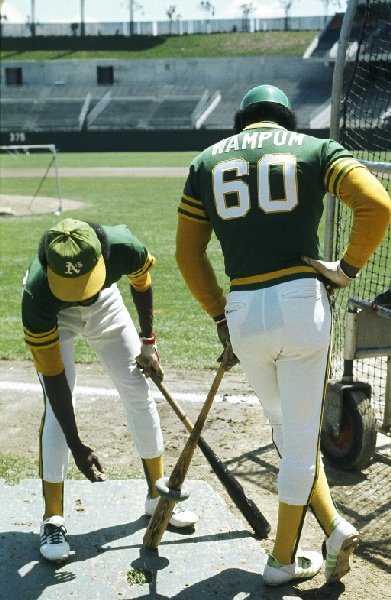
Dick signed with the A's for 1977, and team owner Charles O. Finley, who liked quirky personalities (being one himself) and weird actions (being guilty of a few), received an unusual request: Dick wanted the unusually high uniform number of 60, and instead of his last name "ALLEN" on the back, wanted to put the name of his hometown there, "WAMPUM." This was to honor his school: Wampum High, Class of 1960. Charlie O. went along with this.
The Wampum Walloper at the Oakland Coliseum.
The batboy is a 15-year-old Oakland kid that Charlie Finley
had hired to do odd jobs. His name was Stanley Burrell.
The A's players thought he looked like a young Hank Aaron,
so they called him "Hammer." He would later be known as MC Hammer.
Things started off pretty well: He got 9 hits in his 1st 19 at-bats, with 2 homers and 10 RBIs. As late as May 2, he was batting .311 with 4 homers and 22 RBIs. But it was a last gasp: He went 0-for-his-next-20, dropping to .245. After a 2-hit game on May 28, he went 5-for-38. And the A's, having lost their best players to free agency and Finley's bad trades following 5 straight AL West titles and 3 straight World Series wins, had fallen apart, and were losing.
On June 19, at his old stomping grounds of Comiskey Park, the White Sox swept the A's in a doubleheader, 2-1 and 5-1. Dick hit a double in the 8th inning of the opener. In the 7th inning of the nightcap, he was sent up to pinch-hit for Tony Armas, and struck out against Francisco Barrios. When the team got back to Oakland, he left. He never officially "retired," but that strikeout against Barrios would be his last at-bat. He was only 35 years old.
*
Dick went into training racehorses full-time. He managed to begin his recovery from alcohol and gambling. He and his wife Willa had a daughter named Terri, who died young, but he continued to rebuild his life. He published his memoir, and made more money from that than he did with the horses.
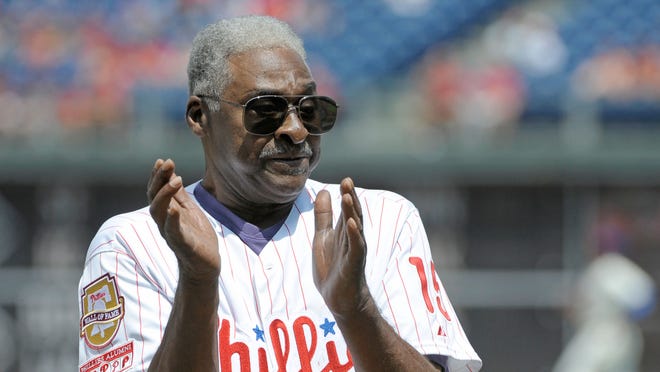
In 1994, coming off a Pennant season, the Phillies brought him back, as a Spring Training instructor and a "community fan representative." They inducted him into the Philadelphia Baseball Wall of Fame that year, and returned -- on time, every time -- for every induction ceremony thereafter.
The one time I ever saw him in person was in 2011, for John Kruk's induction at Citizens Bank Park. I was in Philadelphia, and decided to go to that night's Phillies game, not knowing it was Wall of Fame Night. Dick and Jim Bunning, the Hall of Fame pitcher by then a U.S. Senator from Kentucky, were there to represent the Connie Mack Stadium era. A few of the 1970s and '80s Phillies, including Schmidt and Carlton, were on hand. Kruk was the 2nd honoree from the 1993 "Macho Row" Pennant winners, and the 1st, Darren Daulton, gave his introduction speech.
It was a bit weird to see the pre-1993 players in the current uniforms, including Dick. But he got a standing ovation when he was introduced. Anybody who had booed him in 1969 either was dead or had come to the conclusion that it was foolish to do so any longer.
He attended the closing ceremony at Veterans Stadium in 2003, and was invited to throw out the first ball before some of the Phillies' postseason games in their 2007 to 2011 run of glory. In 2010, he was elected to the Philadelphia Sports Hall of Fame.
At that time, he said, "I get stopped all the time by these fellows whose dads had taken them to the ballpark. I appreciate them... You see how things turn around? You see how rewarding it is? I'm proud of this city. It's in my heart."
*
Dick became eligible for election to the Baseball Hall of Fame via the Baseball Writers Association of America in 1983, but never came close. In 2014, he first appeared on the ballot for the Hall of Fame's Golden Era Committee, one of the committees that resulted from the splitting-up of the former Veterans Committee. He missed election by one vote.
Does he deserve election? For peak value, he was sensational. In the 11 seasons from 1964 to 1974, he hit 319 home runs. Only 4 players topped that: Hank Aaron (391), Harmon Killebrew (336), Willie Stargell (335) and Willie McCovey (327) -- all in the Hall, and all but Killebrew got in the 1st time they were eligible. Allen's OPS (not OPS+) over that stretch was .940. Only Aaron topped that, and barely: .941.
Career on-base percentage: .378. Slugging percentage: .534. OPS+: 156. Since 100 is exactly average, that means that, over the course of his career, he was 56 percent better at producing runs than the average player at the time.
There are only 18 players whose career OPS+ is higher. One of those is Mike Trout, who is still active, and could drop from his current 176 to below 156. Another 3 are Dan Brouthers, Pete Browning and Dave Orr, who played in the very different game before 1900. Two others are Barry Bonds and Mark McGwire, and they cheated.
That leaves 12 guys legitimately ahead of Dick Allen in proven run-producing ability: Babe Ruth (the all-time leader at 206), Ted Williams, Lou Gehrig, Rogers Hornsby, Mickey Mantle, Shoeless Joe Jackson, Ty Cobb, Jimmie Foxx, Hank Greenberg, Stan Musial, Johnny Mize and Tris Speaker.
To put it another way: These are the players of Allen's time or later who are ahead of him, without having cheated: Mike Trout. That's it. That's the list.
Or, to put it another way: Here are the next 10 guys who debuted in 1959 or later: Frank Thomas (the Big Hurt, not Dick's former Phillies teammate), Manny Ramirez, Jeff Bagwell, Joey Votto, Mike Schmidt, Miguel Cabrera, Edgar Martinez, Willie McCovey, Willie Stargell and Jim Thome (at 147).
Of all of those names listed above, the only ones not in the Hall are the cheaters Bonds, McGwire and Ramirez; the still-active Trout, Votto and Cabrera; Jackson, ineligible due to his ban for throwing the 1919 World Series, which really should have been lifted long ago; and Browning and Orr, who have fallen victim to the Hall's tendency to overlook 19th Century players, which is a problem, because, while the game was different, it wasn't that different.
Here's some names not on that list, because Allen is ahead of them: Willie Mays, Hank Aaron, Joe DiMaggio, Albert Pujols, David Ortiz (in spite of his cheating), Alex Rodriguez (ditto), Reggie Jackson and Bryce Harper.
He made 7 All-Star Games, and won both a Rookie of the Year award and an MVP. Here's a list of players, other than Dick, for whom all 3 of those things are true, keeping in mind those achievements became possible in 1939, 1947 and 1931, respectively: Willie Mays, Cal Ripken, Rod Carew, Pete Rose, Johnny Bench, Frank Robinson, Mike Piazza, Tom Seaver, Albert Pujols, Andre Dawson, Mike Trout, Thurman Munson. That's 12 guys. Munson was killed in a plane crash at age 32. Pujols and Trout are still alive. Rose is ineligible for the Hall because he was permanently banned for gambling. The other 8 are in.
But Dick played just 15 seasons, and his overall career statistics don't look as impressive: A .292 batting average; 1,848 hits, including 320 doubles, 79 triples and 351 home runs; and 1,119 RBIs.
Baseball-Reference.com, a website which is your friend, whether you know it or not, has a Hall of Fame Monitor, on which a "Likely HOFer" is at 100. Dick is at 99, under by the slimmest of margins. They also have a category called Hall of Fame Standards, weighted more toward career achievement, on which the "Average HOFer" is at 50. Dick is at 39, falling well short.
They also have "Similarity Scores." According to them, the 10 players who are, offensively speaking, the most statistically similar to Dick Allen are, in descending order: Ryan Braun, Lance Berkman, Reggie Smith, Ellis Burkes, Brian Giles, Nelson Cruz, Jermaine Dye, George Foster, Fred Lynn and Tim Salmon.
Not one of those players is in the Hall. Certainly, Foster and Lynn looked like they would make it for most of their careers, but tailed off. (In Lynn's case, largely due to injury.) But I can't stay that any of those guys is on the "Yes" side of "Maybe."
Put it all together, and, at least based on the stats, I'm sorry, but Dick Allen does not look like a worthy member of the Baseball Hall of Fame. I would be happy for him and his fans if he got in, but the stats don't make it obvious that he should be.
And the "intangibles" don't help: He made just one postseason appearance, and never played in a World Series. He was never considered a leader, but was considered, fairly or otherwise, a malcontent and a troublemaker. But he was being judged by the standards that white baseball had set for black players. How the hell was that fair?
What if the 1960s Phillies had done what Jim Bouton had suggested in Ball Four? Feeling more appreciated, and playing his entire career in Philadelphia, including in the hitter-friendly Veterans Stadium instead of the pitcher-friendly Comiskey Park with the Chicago White Sox from 1972 to 1974, Dick would have hit more than 351 career home runs. Could he have gotten to 400? Probably. 450? Probably not. But would 400 to 450, along with whatever the additional hits have helped his team to win, been enough to get him into the Hall of Fame? Maybe.
In spite of the difficulties he gave his managers, the two men who managed him the longest had only good things to say about him. Asked if Dick's behavior ever had a negative influence on the Phillies while he was their manager, Gene Mauch said, "Never. Dick's teammates always liked him. I'd take him in a minute." And Chuck Tanner of the White Sox said, "Dick was the leader of our team, the captain, the manager on the field. He took care of the young kids, took them under his wing. And he played every game as if it was his last day on Earth."
Goose Gossage's 1st season in the major leagues was 1972, with the White Sox, making him a teammate of Dick in his best season. He said, "I've been around the game a long time, and he's the greatest player I've ever seen play in my life. He had the most amazing season I've ever seen. He's the smartest baseball man I've ever been around in my life. He taught me how to pitch from a hitter's perspective, and taught me how to play the game right. There's no telling the numbers this guy could have put up if all he worried about was stats. The guy belongs in the Hall of Fame."
Mike Schmidt, who considered Allen to be a mentor, may have said it best: "Dick was a sensitive Black man who refused to be treated as a second-class citizen. He played in front of home fans that were products of that racist era, racist teammates and different rules for whites and Blacks. Fans threw stuff at him, and thus Dick wore a batting helmet throughout the whole game. They yelled degrading racial slurs. They dumped trash in his front yard at his home. In general, he was tormented, and it came from all directions. And Dick rebelled."
In his memoir, Clearing the Bases, Schmidt said, definitively, "The baseball writers used to claim that Dick would divide the clubhouse along racial lines. That was a lie. The truth is that Dick never divided any clubhouse."
John S. Middleton is the leader of the current ownership group of the Phillies, and owns 48 percent of the team. He grew up outside Philadelphia. His favorite player at the time was Dick Allen. He decided to make an exception to the team's policy of only retiring numbers of players already in the Hall of Fame. On September 3, 2020, in a ceremony at Citizens Bank Park -- broadcast and streamed, but no fans let in due to the COVID-19 epidemic -- he retired Dick's Number 15.
Dick said, "I thank the City of Philadelphia. Even though it was rough, I've made some friends along the way."
It was the last appearance of Dick Allen in a major league ballpark. Unknown to most people, he had cancer. He died yesterday afternoon, December 7, 2020, at his home in Wampum, Pennsylvania. He was 78 years old.
Glen Macnow, of Philadelphia's all-sports radio station WIP, called him "a man before his time - adored by young Phillies fans in the '60s, if not by their parents. A great slugger who deserved to get into the HOF while he could appreciate it."
Let the truth be known.