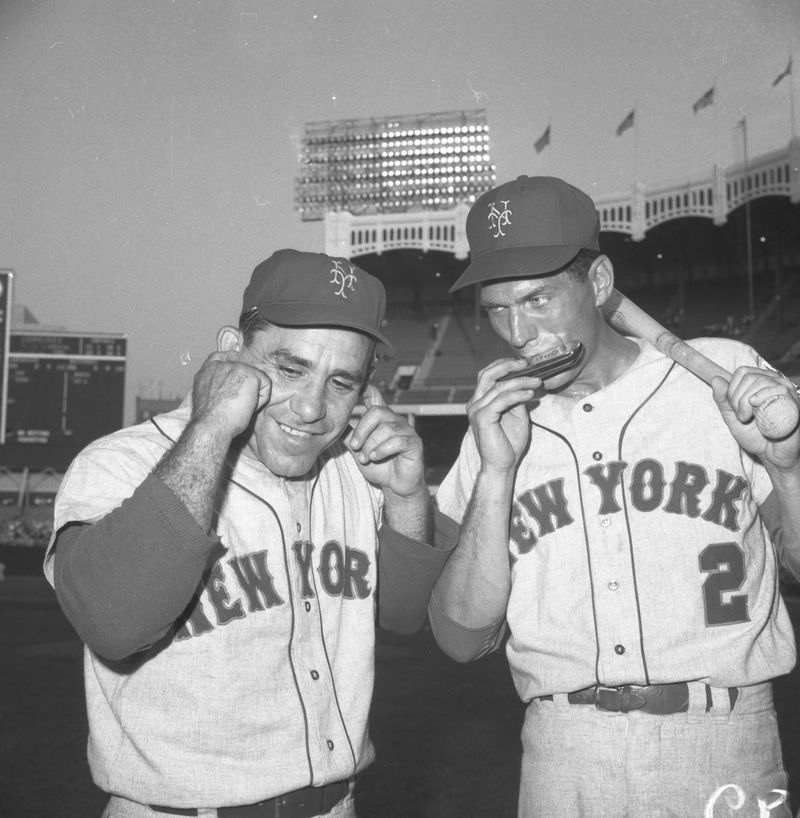
May 12, 1925, 90 years ago: Lawrence Peter Berra is born in St. Louis. He grew up in the Gateway City at the same time as 5 members of the U.S. team that shocked England at the 1950 World Cup: Goalkeeper Frank Borghi, right back Harry Keough, centre-half Charlie Colombo, inside right Gino Pariani, and outside right Frank Wallace (born Valicenti). Left half Walter Bahr of Philadelphia, father of Super Bowl-winning placekickers Matt and Chris, is now the last living man who played in that game, 65 years ago.
He lived across the street from Joe Garagiola, who also became a major league catcher, and a Hall of Fame broadcaster. Also living nearby was another future major leaguer, New York Giant infielder (and also, occasionally, catcher) Bobby Hofman.
When Larry Berra was 11 years old, he played in a baseball game on a sandlot field that didn't have dugouts. So the players all sat on the ground. Larry sat there with his arms and legs folded. He and his friends had recently seen a movie about India, and one of the characters in it was a yogi, and Hofman said to him, "You look like a yogi."
He's been Yogi ever since. A few years back, Bob Costas asked him what his wife Carmen calls him. He said, "She calls me Yogi. If she calls me Lawrence, I know I'm in trouble."
And, just as the makers of the Baby Ruth candy bar had to concoct a story that it wasn't named after Babe Ruth in order to avoid paying the Babe royalties for the use of his name, Hanna-Barbera Productions officially said that the cartoon character Yogi Bear wasn't named after Yogi Berra. Berra didn't take legal action, knowing that he'd get better publicity if he left the ridiculous lie alone. Because he was "smarter than the average bear."
Top 10 Yogi Berra Moments
These are in chronological order.
1. The Best Brothers Ever. Yogi said his older brothers Mike and Tony were better ballplayers than he was. On the list of things great ballplayers said (or may have said) that seem as if they can't possibly be true, it's up there with Willie Mays, a quarterback who wouldn't get recruited by white colleges, saying he was better in football (or any sport) than he was in baseball.
Pietro Berra, the boys' father, was an Italian immigrant. So was Giuseppe DiMaggio of San Francisco. Giuseppe forbid his boys to play baseball, saying they were going to go to work. His oldest son Vince disobeyed him, played for the San Francisco Seals of the Pacific Coast League, came back, and slammed a wad of cash on the kitchen table. Seeing more money at once than he'd ever had in his life, Giuseppe welcomed Vince back, and also let sons Joe and Dom play pro ball.
Pietro Berra was a bit more intransigent. When the St. Louis Cardinals were interested in Mike, he was underage, and he needed his father to sign his contract with him. The father told him, "No, you are not going to play baseball. You are going to go to work." So he went to work, and would never know how far he would have gone in baseball.
A little later, the Cards were interested in Tony. At this point, Tony was underage, and needed his father to sign his contract with him. But Pietro told him, "No, you are not going to play baseball. You are going to go to work." So he went to work, and would never know how far he would have gone in baseball.
A little later, the Yankees were interested in Lawrence -- or "Lawdie," as his parents called him in their accent. Again, the underage son needed the father to sign the contract with him. But Pietro told him, "No, you are not going to play baseball. You are going to go to work."
This time, Mike and Tony stepped in. At this point, both were not only working, but married, and living together -- and both were past their 21st birthday. They told their father that if he didn't co-sign Lawdie's contract, they would. And that, if he threw Lawdie out of the house for this, he could come and live with them.
Pietro realized that his elder sons were not bluffing. He had been outmaneuvered. He co-signed the contract. The rest is history -- or, as Yogi's future manager Casey Stengel would say, "And you could look it up."
Yogi still says his brothers were better ballplayers than he was. We'll never know, but, given what Yogi did, it's incredibly unlikely.
2. D-Day. There were 156,000 men who were in the Allied landing force in Normandy, France on June 6, 1944, arguably the pivotal day in human history. As of last night's games, according to
Baseball-Reference.com (a website which is your friend, whether you know it or not), there have been 18,484 men who have played Major League Baseball. Only 1 man is in both categories: Seaman Lawrence Peter Berra, USN.
Yogi was a gunner's mate on the U.S.S.
Bayfield, an attack transport ship. He was just past his 19th birthday, and until signing his Yankee contract to play minor-league ball -- a journey interrupted by his service in World War II -- he had never been outside St. Louis before, not even going across the Mississippi River into Illinois, just for the sake of visiting another State. And now, here were all these Nazis, ready to kill him, even though they didn't know he existed. You'd think he would have been terrified.
He might have been the most composed guy on either side of the English Channel. He recalled seeing the rockets being fired by both sides: "To me, it looked like the 4th of July." He got through it, and through the entire War, without a scratch.
Not so lucky was Lieutenant James Montgomery Doohan of the Canadian Royal Artillery. He killed a few Nazis on Juno Beach, and had his right middle finger shot off. That's right: He literally gave the Nazis the finger. That's why, whenever he was shown operating machinery as Scotty on
Star Trek, he did so with his left hand.
3. Breaking Up the Biggest Trade. Yogi debuted in the major leagues on September 22, 1946, in the 1st game of a doubleheader with the Philadelphia Athletics at the original Yankee Stadium. Batting 8th, catching, and wearing Number 38, he went 2-for-4, including a 2-run home run off Jesse Flores, the 1st of 358 homers he would hit in the major leagues -- still a record for anyone 5-foot-8 or shorter. The Yankees won, 4-3, behind Yogi's homer and the pitching of Spurgeon "Spud" Chandler.
Legend has it that Yankee co-owner Larry MacPhail and Boston Red Sox owner Tom Yawkey -- who had just won his 1st American League Pennant -- got together after the season and, as both men liked to do, got drunk.
They retained enough lucidity to realize that Joe DiMaggio, a righthanded hitter, was losing lots of hits in Yankee Stadium's left field and center field, known as "Death Valley" -- long outs that might be home runs over the high but close left field wall at Fenway Park. (The wall's advertising signs were about to come down, resulting in it being clear, with the green-painted tin seen underneath, leading to the nickname the Green Monster.) This trade would also reunited Joe with his brother Dom, who was with the Red Sox.
Likewise, Ted Williams, a lefthanded hitter, was losing lots of hits in Fenway's expansive right and center fields, hits that might be home runs to the "short porch" in right field at Yankee Stadium.
So the 2 powerful drunks wrote up the trade of all time on a cocktail napkin: They would trade Ted Williams for Joe DiMaggio. Regardless of whether the trade would have worked out, if that napkin had survived, how much would it be worth today?
What's that, you say? The trade never happened? That's right: In the morning, sobered up, Yawkey decided -- forgetting that the Yankee Clipper was a great fielder and a great baserunner, and that the Splendid Splinter was, by his own admission, neither -- that Ted was worth more than Joe. So he called MacPhail up, and demanded that he throw in a player he liked. He couldn't think of the player's name, but knew he was a decent hitter and a good left fielder, and could also catch a little. MacPhail realized that Yawkey was talking about Yogi, and put the kibosh on the deal.
The next season, when Yogi would likely have won the AL Rookie of the Year award had there been one at the time, the St. Louis Browns, desperate for attendance as always, hosted Yogi Berra Night at Sportsman's Park, welcoming the hometown hero as he came in with the Yankees. He told the crowd, "I'd like to thank everybody for making this day necessary." He meant "possible."
This quote, which Yogi repeated upon his election to the Baseball Hall of Fame in 1972, was reported in the next day's newspapers, and is definitive proof that Yogi did not start saying weird things after listening to Stengel, as they hadn't met yet.
Perhaps Yogi should have included Tom Yawkey and his hubris among those who had made that day necessary.
4. All His Experiences. Yogi wasn't a natural behind the plate. Although, now wearing Number 35, he hit the 1st pinch-hit home run in World Series history, off Ralph Branca of the Brooklyn Dodgers, in Game 3 of the 1947 World Series -- a game the Yankees lost anyway, though they won the Series in 7 games -- the Dodgers ran rampant on him, successfully challenging his arm and his positioning. He didn't get much better in 1948, either.
So when Stengel became Yankee manager in 1949, he hired Bill Dickey as a coach. Dickey was then regarded, along with Mickey Cochrane, as 1 of the 2 greatest catchers who ever lived. Stengel told Dickey to teach Yogi everything he knew about catching. To show Yogi that he trusted him, Casey even gave Yogi Dickey's old uniform number, 8. (Dickey was given 33.)
Yogi's improvement was quick, and when asked why, he said, "Bill Dickey is learning me all his experiences."
He should have said, "Bill Dickey is teaching me everything from his experience." I suspect that Yogi may have gotten the expression from Dizzy Dean, the Cardinals pitcher who had become a broadcaster for both St. Louis teams. Diz once read, on the air, a letter from a teacher who said he shouldn't use the word "ain't" on the air, because it was bad for children to hear that. He told the teacher, "A lot o' folks who ain't sayin' 'ain't' ain't eatin'. So, teach, you learn 'em English, and I'll learn 'em baseball."
I suspect that Yogi was one of the people that Dizzy "learned baseball." Who knows, Dizzy might also be the reason Yogi ended up saying things like, "Nobody ever goes there anymore, it's too crowded," and, "Pair up in threes," and, "A nickel ain't worth a dime anymore."
5. Five in a Row. Dickey's experiences must have worked: Yogi, along with the pitching, was the biggest reason the Yankees won the 1949 Pennant, starting a string of 5 straight World Championships. The 1953 World Series ring has a diamond inside a number 5. Whitey Ford has said that's his favorite World Series ring.
When the Yankees won 3 straight World Series in 1998, 1999 and 2000, Derek Jeter told Yogi he'd catch up with him. When the Yankees lost the Series in 2001, Yogi (who couldn't have been happy about that) told Jeter, "Now, ya gotta start over."
Jeter may have been cheated out of 3 AL Most Valuable Player awards: In 1999, 2006 and 2009. Yogi might also have been cheated out of 3: In 1949, 1952 and 1953. But he actually did win 3: In 1951, 1954 and 1955. It's been suggested that Yogi is the most valuable Yankee of all time. Certainly, he's the most underrated.
All tolled, Yogi played in 14 World Series, winning 10 of them. Both records that, well, if Jeter wasn't going to break them, it sure looks like nobody will.
6. If the World Were Perfect. Yogi once said, "If the world were perfect, it wouldn't be." Meaning that a perfect world would be boring. One man who was definitely not boring was Don Larsen, a pitcher so off-kilter in the head he was nicknamed Gooney Bird. (Or Gooney for short.)
In Game 5 of the 1956 World Series, Larsen pitched a no-hitter against the Dodgers. Yogi caught it. Years later, he said, "It never happened before, and it still hasn't." He's right, sort of: While no longer the only no-hitter in postseason history, it's still the only one in World Series history. And it wasn't just a no-hitter, it was a perfect game. Larsen threw exactly what Yogi called, on every one of his 97 pitches, and it worked.
Two days later -- a Subway Series, so there was no need for a travel day -- Yogi hit 2 home runs, powering the Yankees to a 9-0 win in Game 7. Yogi hit 3 homers and had 10 RBIs in the Series.
7. The Businessman. Yogi looked dumb, and his "Yogi-isms" made him sound dumb. This was far from the case. While still active players, he and teammate Phil Rizzuto opened a clothing store and a bowling alley, both in New Jersey.
By this point, the Scooter lived in Hillside, and Yogi lived in Upper Montclair, where his next-door neighbor was naval engineer and New Jersey Devils founding owner John McMullen. The store, the bowling alley, other business interests, and, yes, his salary -- the most he ever made in a season was $65,000, but that was a big sum for the early Sixties -- allowed him to buy a big house.
Rizzuto called it a mansion. Yogi said, "It's just a big house with rooms." Giving directions to it, he once said, "When you come to a fork in the road, take it." The house was between the prongs of the fork, so this wasn't just Yogi being Yogi.
Yogi's familiar face, lovable personality and way with words led him to being hired as a pitchman for all kinds of products. He seemed to specialize in drinks: As early as 1957, he did
an ad for Florida orange juice. (Sorry, no "Yogi-isms" in this one.) He also did ads for
Yoo-Hoo chocolate drink and Miller Lite beer -- or, as it was known at the time, "Lite beer from Miller." This
1987 commercial included a rather confused pre-
Seinfeld Jason Alexander.
Sadly, in 1960, he did an
ad for Camel cigarettes. (Cigarette advertising was banned from American TV in 1971.) He must've quit smoking at some point, because he's still alive at 90. (Then again, DiMaggio smoked until dying of lung cancer at 84.) So maybe Yogi doesn't need
Aflac insurance. But, what the heck, they gave him a check -- which was just as good as money.
My favorite Yogi commercial doesn't appear to be on YouTube: "What's your favorite Entenmann's?" Yogi's favorite also happens to be mine: In a line that, like the Aflac and Miller lines, was clearly written for him in his style, he said, "That's easy: Chocolate chip cookies. You can taste how good they are just by eating 'em!" (A takeoff on his line, "You can observe a lot by watching.")
8. The Harmonica Incident. In 1959, Yogi and left fielder Elston Howard had their positions switched by Stengel. Talking about how the sun combine with the old Stadium's roof, he said, "It gets late early out there."
He was still a key figure on Pennant-winning teams. But after the 1963 season, Yogi was 38 and clearly slowing down. And, with Ralph Houk, his former backup catcher, being moved up from field manager to general manager, Yogi was offered the job of managing the Yankees.
There were those who thought that Yogi was too much of a softie to manage, especially players he'd played with. On August 20, 1964, the Yankees were in a dogfight for the Pennant with the Chicago White Sox and the Baltimore Orioles, and had just been swept by the ChiSox in 4 straight. The tension on the bus from Comiskey Park back to O'Hare Airport was so thick, it could have been cut with a knife.
Reserve infielder Phil Linz pulled out a harmonica he'd begun learning how to play. Yogi, sitting at the head of the bus, heard it, and yelled back, "Whoever's playing that thing, shove it up your ass!" Linz didn't hear what he said, and asked Mickey Mantle what Yogi said. Being a wisenheimer, Mickey said, "He said, 'Play it louder.'" So Linz did.
Yogi got up, walked down the aisle of the bus, saw Linz, and said, "I thought I told you to shove that thing up your ass." Linz said, "If you want it shoved up my ass, why don't
you shove it there?" He flipped the instrument to Yogi... who slapped it down.
There are 2 versions of what happened next. One is that everyone saw that Yogi could mean business, and that the respect for him as a manager developed. The other, which is more believable, is included in Peter Golenbock's book
Dynasty, and is backed up by the surviving '64 Yanks all saying that respect for Yogi was never an issue. This version says that the slapped-down harmonica bounced off Joe Pepitone's leg. Pepi then fell into the aisle in mock agony, rolling around on the floor of the bus like a Spanish soccer player (with the bad hair to match). Everyone cracked up -- and loosened up.
With respect for Yogi restored, or the tension shattered, whichever is true, the Yankees went on a tear. They flew to Boston and lost 2 more, then won 28 of their last 39, including an 11-game winning streak from September 16 to 26, and won the Pennant, winning 99 games, beating the White Sox by 1 game and the O's by 2. Yogi had won his 1st Pennant as a manager, and he wasn't even 40.
But they lost the Series -- ironically, to Yogi's boyhood team, the Cardinals. And Yankee management fired him, which they were determined to do even if he won the Series. "That's baseball," he said. At least they told him to his face. That would not be the case the 2nd time he was fired as Yankee manager.
9. It Ain't Over. By this point, Casey was managing the expansion Mets. He hired Yogi as a coach. He even put Yogi in 4 games, where he went 2-for-9. Clearly, he was done. When Casey retired in that 1965 season, Met management kept Yogi on, as a drawing card as much as anything else.
He was still a Met coach during the 1969 "Miracle" season. Asked about the Mets' World Series upset over the Baltimore Orioles, he said, "We were overwhelming underdogs." It sounds funny, but it was absolutely true. When manager Gil Hodges died of a heart attack on the even of the 1972 season, Yogi was named manager.
On August 5, 1973, the Mets were in 6th and last place in the National League Eastern Division, 11 1/2 games out. A few days earlier, a reporter asked Yogi if the Mets were out of it, and he said, "It ain't over 'til it's over."
Yogi's syntax may have been cold, but the Mets got hot, winning 34 of their last 53. On August 26, they were still in 5th place, behind the Pittsburgh Pirates, St. Louis Cardinals, Chicago Cubs, and even the 5th-year expansion Montreal Expos -- but were only 6 1/2 games back. From then on, they won 24 of their last 33, including a 7-game streak from September 18 to 25, and won the Division with an 82-79 record --the worst record of any 1st-place team in baseball history (in a full season of at least 154 games, anyway). Then they upset the Cincinnati Reds for the Pennant.
In Game 3 of the NL Championship Series against the Cincinnati Reds, Pete Rose slid hard into Bud Harrelson to break up a double play, and then shoved the much smaller man, starting a bench-clearing brawl. When Rose went back out to left field the next inning the fans in Shea Stadium's left field stands threw garbage onto the field at Rose. Yogi and Willie Mays, then playing out the string with the Mets, went out there, and told the fans to stop, or else the game would be forfeited to the Reds. They listened, and the Mets won the Pennant in 5 games.
They lost the Series in 7 to the Oakland Athletics, though. To this day, there are Met fans who blame Yogi for losing the Series, for starting ace Tom Seaver on 3 days' rest in Game 6, instead of saving him for Game 7 on full rest. This is nonsense: If you have Tom Seaver, you send him out to close it out. Tom didn't get the job done that day, although a smart baseball fan would credit the A's for getting it done. (Don't forget, they had Reggie Jackson, who homered in Game 6 and Game 7, building his reputation as "Mr. October.")
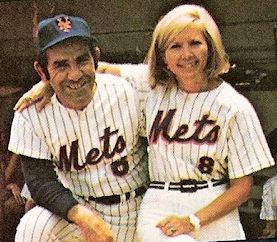
Yogi and Carmen, circa 1973:
"We have a great time together, even when we're not together."
If Met fans held a grudge against Yogi then, they seem to have stopped: On back-to-back Sundays in September 2008, he attended the closing ceremonies of both New York ballparks. He got a thunderous ovation at the old Yankee Stadium, and then a nice reception at Shea Stadium.
Eventually, Yogi began to tell people, "I try to say, 'It
isn't over 'til it's over.'" I guess the influence that Dizzy Dean still had on him ain't goin' away.
10. The Exile and the Restoration. Mets president M. Donald Grant, right up there with Brooklyn Dodger owner/mover Walter O'Malley and Yankee owner George Steinbrenner as the most hated man in the history of New York baseball, fired Yogi as Met manager in 1975. Unlike many Met fans -- especially after Grant forced Seaver out 2 years later -- Yogi never held a grudge against him.
His Yankee teammate Billy Martin had just been hired as Yankee manager for the 1st time, and brought Yogi to his coaching staff. Through 9 managerial changes by Steinbrenner, including Billy 3 times, Yogi stayed. After George fired Billy for the 3rd time, he promoted Yogi to manager for the 1984 season.
The Detroit Tigers ran away with the AL East in 1984, en route to a title. But the Yankees won 87 games, a respectable total, especially considering Yogi hadn't managed in 9 years. Everyone was optimistic for 1985, and George publicly promised that Yogi would be given the whole season. He wasn't: The Yankees lost 10 of their 1st 16, and George fired Yogi.
In retrospect, competitively, it was the right thing to do: George brought Billy back for the 4th time, and, despite not quite having enough pitching all season long, the team ended up winning 97 games, finishing 2 games behind the Toronto Blue Jays. That wasn't the problem. George breaking his promise wasn't the problem, either.
The problem was that, unlike Houk in 1964 and Grant in 1975, George didn't call Yogi up to his office and tell him face-to-face, man-to-man. Nor did George go down to Yogi's office to tell him himself. Instead, he sent team scout Clyde King -- a former major league pitcher who had briefly been Yankee manager himself in 1982 -- to tell Yogi.
This time, Yogi held a grudge. Not against King, but against George. He swore he would never set foot in Yankee Stadium again as long as George owned the team.
As the years went by, he kept this promise. In 1988, George thought he could lure Yogi back by dedicating a Plaque for him in Monument Park. He did this for Dickey as well -- Number 8 had been jointly retired for them in 1972. Dickey was 81, in a wheelchair, and had to come from Arkansas to be there -- and he went. Yogi was 63, in good health, and George could've sent limousines to pick up Yogi and his family, and they'd be at Yankee Stadium in an hour, if only he'd accept the invitation. He didn't.
In 1995 and 1996, the Yankees were back in the postseason. George invited Yogi to throw out a ceremonial first ball. He refused. In 1997, the 1st Yankees-Mets Interleague series was played at Yankee Stadium. Again, George invited Yogi. Again, Yogi refused. In 1998, an Interleague series was held at Shea for the 1st time. The Mets invited Yogi. No grudge here: Wearing a Mets cap, Yogi, 73, threw out a perfect strike of a first ball.
That same year, a group of Yogi's friends opened the
Yogi Berra Museum & Learning Center, on the campus of Montclair State University, not far from his home. This was a very big deal, as not many athletes have museums in their honor while they're still alive. (Interestingly, Dizzy Dean was one, in his adopted hometown of Jackson, Mississippi, although it's gone now, its exhibits moved to become art of the Mississippi Sports Hall of Fame, also in the State capital of Jackson.)
The next spring, DiMaggio was dying. George went to visit Joe at the hospital in Florida that now has a children's wing that bears his name, due to his donations. George asked Joe if there was anything he could do for him. Joe told him to make up with Yogi.
Not long after that, Yankee broadcaster Suzyn Waldman talked to Carmen, and Carm said her great regret was that, unlike Yogi's children, his grandchildren had never seen him at Yankee Stadium in a Yankee uniform. So Suzyn went to talk to George, and said, "I'd like to talk to you about Yogi." And George, still rattled by his visit with DiMaggio, said, "Why, what's wrong?" Suzyn said she knew, at that point, that a reconciliation was possible.
A meeting was set up at the Yogi Museum. In front of the media, George said, "I'm sorry." Yogi said the perfect thing to say in the situation: "It's over."
George invited Yogi to throw out the first ball on Opening Day, an honor usually given to DiMaggio, who had died on March 8. Later in the season, Yogi wore his old Number 8 uniform for the 1st time in 14 years, on Old-Timers' Day.
In June 1999, I visited the Museum for the 1st time. I wrote on the comment card, "I'm glad I came. If I hadn't come, I wouldn't have known what I wasn't missing." I got a nice postcard back, complimenting me on my choice of words, and advertising future events.
One such event was a bus trip from the Museum to The Stadium for Yogi Berra Day on July 18, 1999. I thought about it... and decided not to go. On the one hand, it was brutally hot that day, almost 100 degrees. On the other hand, I missed maybe the greatest day in Yankee history -- and as Yogi might say, I'm not just whittling Dixie.
Yogi got all kinds of gifts, and read a heartfelt speech that was totally on the level, no Yogi-isms. Then Yogi caught a ceremonial first ball from Don Larsen. Then, with Yogi and Don both watching, David Cone pitched a perfect game. Coney remarked that there was a Number 8 marked behind home plate, and he had thrown 88 pitches. It was a real "You can't make this stuff up" moment. After the game, the scoreboard put up one of Yogi's best-known lines: "It's deja vu all over again."
Yogi and Carm, not long before her death in 2014.
*
Today, there was a party for Yogi at the Museum. There was recently a break-in at the Museum, and several priceless artifacts were stolen. The Yankees and Mets organizations both chipped in to pay for replicas, which were presented at the party; however, the originals have yet to be recovered.
Carmen got sick a few years ago, and they had to move from the Montclair house -- which was listed for $888,888, appropriately enough, and sold quickly -- to a nursing home. Soon, it was clear that advancing age had left Yogi frail enough that he was no longer living there just for her.
She died on March 6, 2014, at age 85, after 65 years of marriage. They raised 3 sons, Larry, Dale (who also played in the majors, including on the Yankees under his father) and Tim (a receiver at the University of Massachusetts who briefly played with the Baltimore Colts as a kick returner in 1974 -- no, he didn't wear Number 88, instead wearing 84). Tim runs the company that handles Yogi's business affairs, named LTD Enterprises for them (Larry, Tim, Dale). Yogi and Carm had 11 grandchildren, including Lindsay Berra, who now writes for MLB.com.
It's hard for Yogi to get around these days. When he's introduced on Old-Timers' Day, it's always last, together with Whitey Ford, who's in a bit better shape but is still 86, on a golf cart. He looks so old, and very weak. (UPDATE: On Old-Timers Day 2015, Yogi wasn't well enough to attend.)
But he's still very much with it. According to
his granddaughter, Lindsay Berra, who writes for MLB.com, she asked him about Tom Brady's "Deflategate." She said that "Gramp" said, "If you're going to cheat, it's better if you don't get caught."
Last year's birthday party at the Yogi Museum
L to R: Jorge Posada, Yogi, Reggie "Indiana" Jackson, Joe Girardi.
He likes to say, "I really didn't say everything I said." Well, less important than what he's said is who he's been. He's an American treasure.
And thank God he's not yet a buried treasure. Happy Birthday, Yoag.