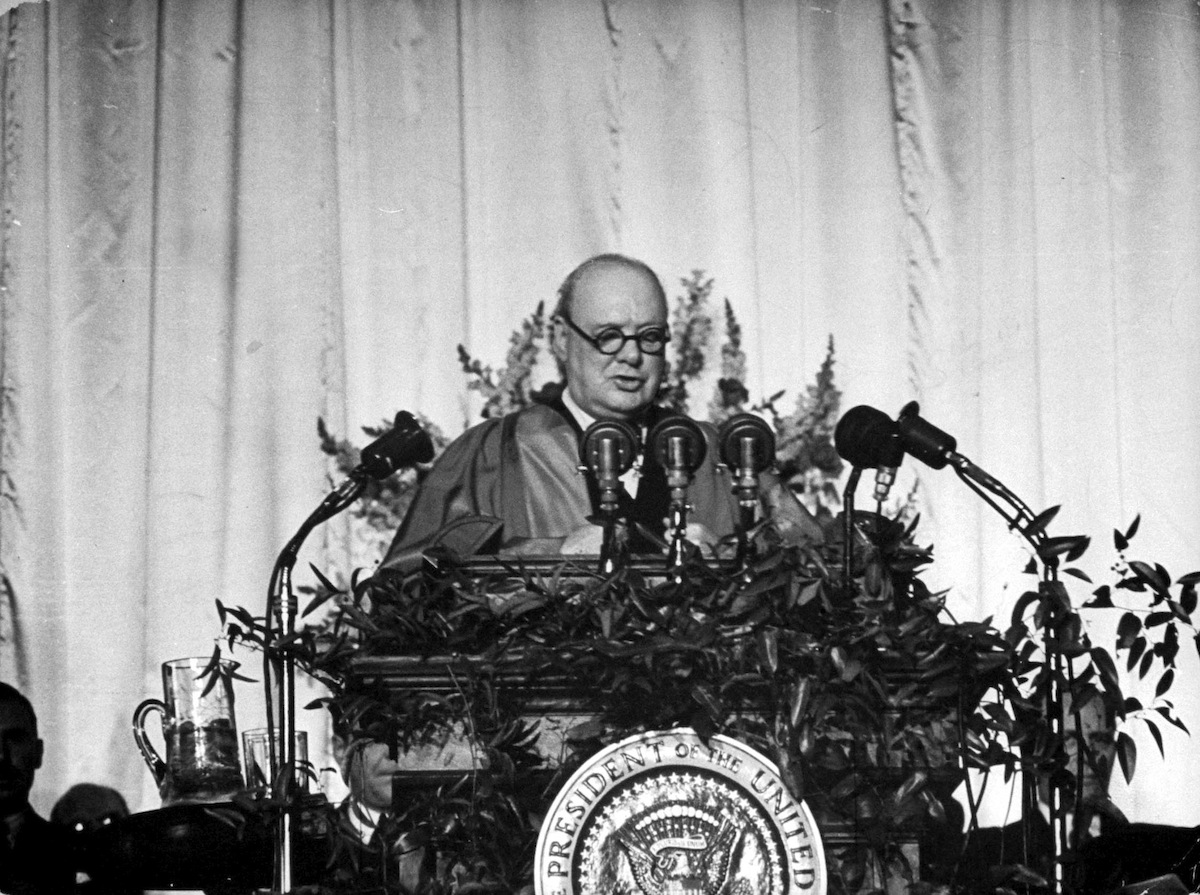
March 5, 1946, 80 years ago: Winston Churchill, as he had done many times before, turns a phrase that sticks in the collective consciousness of Western civilization.
Shortly after meeting with the new President of the United States, Harry Truman, at the Potsdam Conference outside Berlin in July 1945, he had to stand for election in Britain. His Conservative Party lost, and he had to resign as Prime Minister, although he was still Party Leader. He had more free time than before, and visited America the next year.
The British capital building is known as the Palace of Westminster. In Fulton, in Truman's home State of Missouri -- 111 miles west of St. Louis, 150 miles east of Kansas City, 23 miles southeast of the University of Missouri at Columbia, and 24 miles northeast of the State Capitol in Jefferson City -- there is a Westminster College. It offered Churchill an honorary degree, hoping he would come, accept, and deliver one of his rousing speeches, inspiring donations to the school. They couldn't have been more thrilled, because this is pretty much the only thing the school is known for today.
With Truman in attendance, Churchill gave a speech he had titled "Sinews of Peace." But that would not be the phrase anybody remembered.
Even by the time of the Yalta Conference in the Crimea in February 1945, when Churchill and the dying President Franklin D. Roosevelt met with Soviet Premier Joseph Stalin, the Soviet Union's Red Army was occupying much of Eastern Europe. After pushing Nazi Germany back, there was little willingness to start a World War III with Communism before World War II with Fascism was over. Churchill came up with a plan, but he knew it would never see the light of day. He proved this by naming it "Operation Unthinkable."
The term "iron curtain" had been used to describe safety curtains, installed on theater stages to slow the spread of fire. In 1918, Vasily Rozanov, an anti-Communist writer opposing the Bolshevik Revolution, wrote a book titled The Apocalypse of Our Time. When translated into English in 1920 -- Rozanov having died in the Russian famine then still ongoing -- Churchill would have read Rozanov's words as:
Already having both a taste for the theatrical and a predisposition to oppose Communism, Churchill would have approved of Rozanov's metaphors.
Germany had long been fond of iron metaphors. The founder of the German Empire, Otto von Bismarck, had begun the unification process with an 1862 speech titled "Blood and Iron" (Blud und Eisen), and so was known as "The Iron Chancellor." The country's top military decoration was the Iron Cross. And Adolf Hitler often invoked the legacy of Bismarck by speaking of "Blood and Iron" (or, alternatively, "Iron and Blood") So the Nazis, too, used the phrase "Iron Curtain."
A 1943 magazine named Signal discussed "the iron curtain that more than ever before separates the world from the Soviet Union." Nazi propaganda minister Joseph Goebbels wrote in Das Reich, on February 25, 1945, that, if Germany should lose the war, "An iron curtain would fall over this enormous territory controlled by the Soviet Union, behind which nations would be slaughtered." In that, if in little else, he was right.
Churchill's first recorded use of the term "iron curtain" came in a May 12, 1945 telegram he sent to Truman, regarding his concern about Soviet actions, stating "[a]n iron curtain is drawn down upon their front. We do not know what is going on behind." In another telegram to Truman, on June 4, he wrote of "...the descent of an iron curtain between us and everything to the eastward."
Now, at Westminster College, with Truman seated on the stage behind him, Churchill spoke of this new "border":
From Stettin in the Baltic to Trieste in the Adriatic, an iron curtain has descended across the continent. Behind that line lie all the capitals of the ancient states of Central and Eastern Europe: Warsaw, Berlin, Prague, Vienna, Budapest, Belgrade, Bucharest and Sofia. All these famous cities and the populations around them lie in what I must call the Soviet sphere, and all are subject, in one form or another, not only to Soviet influence, but to a very high, and in some cases increasing, measure of control from Moscow.
Film of this speech shows that, at the words "iron curtain," he made a downward slashing motion with his left hand -- or, if you prefer, his left wing -- providing another fitting metaphor.
Churchill was a little off, geographically: Stettin, soon to be renamed Szczecin, as it was now part of Poland, was on the new border between Poland and East Germany; and Berlin, divided into 3 Allied and 1 Soviet sector, was to the west of that; while Trieste is in northeast Italy, on the border with what was then Yugoslavia, and is now Slovenia.
And Churchill (and, to be fair, Truman as well) did not yet realize that Yugoslavia's dictator, Josip Broz Tito, while he was a true believer in Communism, had already broken with Stalin, and thus his country was on the West's side of the Iron Curtain. And in 1955, Austria broke with the Soviets, and got away with it.
Nevertheless, the term had been used. The Cold War was on. As for that term, it appears to have been first used by George Orwell, in his 1945 essay, "You and the Atomic Bomb": He described a world living in fear of nuclear destruction, which he described as a "permanent state of 'cold war.'" Bernard Baruch, an advisor to Presidents Roosevelt and Truman, used the phrase in a speech on April 16, 1947, saying: "Let us not be deceived: We are today in the midst of a cold war." Later that year, journalist Walter Lippman wrote a book titled Cold War, which helped solidify the term's use in the public consciousness.
On March 5, 1953, 7 years later to the day after Churchill's speech, Stalin died. But the Iron Curtain would live on until 1989 when, one by one, the countries behind it lifted their portions of it.
The term would be adapted. The borders between North and South Korea, and North and South Vietnam, and the Sea of Japan between Japan and Red China, became known as the Bamboo Curtain. And in America, black writers suggested that there was a Cotton Curtain that separated the segregationist Southern States from the rest of the country.
Maybe a line can be drawn across New Jersey, westward from the Outerbridge Crossing in Perth Amboy, along State Route 440, to Interstate 287, to where it meets U.S. Route 22 in Bridgewater, on west to the Delaware River in Phillipsburg, and that can be the Pork Roll Curtain, as an unofficial divider between people south of it, who call the processed meat by its legal name, "pork roll"; and people north of it, who call it by its incorrect and officially (if not enforced) illegal name, "Taylor ham."


