The Rutgers University football team blew another 2nd half lead yesterday, falling to Indiana University, 33-27 at home. They are now 2-7.
Next Saturday, they will play in East Lansing, Michigan, against Michigan State University, who also fell to 2-7 today, losing to the University of Illinois. Aside from their shot at each other, neither may win another game this season.
This is a far cry from last season, in which MSU won the Big Ten title. They also won it just 2 years before that. So, most likely, MSU will crush RU.
Before You Go. Michigan weather can be bad. The website of the local newspaper, the
Lansing State Journal, is predicting that it won't be. They're saying that Saturday afternoon should be in the low 60s, and nighttime temperatures should be in the mid-40s, with no rain or snow.
UPDATE: A January 30, 2019 article in
Thrillist said that Michigan was 2nd only to Minnesota in how bad Winter was -- noting that people in Alaska, which came in 3rd, were "different" and could handle what is obviously worse in terms of statistics: "Winter in Michigan begins well before Thanksgiving and stretches far past Easter, which makes for four-to-six wearisome months of always-gray, always-cold, always-drizzly, but-rarely-snowy-in-a-good-way misery.
Michigan is in the Eastern Time Zone, so you won't have to fiddle with your timepieces.
Tickets. Spartan Stadium seats 75,005 people, and it usually sells out. Getting tickets could be tough. According to
the MSU Athletics website, some seats are still available. Lower Level Sideline seats are $80. Lower Level End Zone seats and Upper Level seats (they're only on the sidelines) are $50.
Getting There. It's 677 road miles from Times Square to the Michigan State campus, and the same distance from Rutgers Stadium to Spartan Stadium. Knowing this, your first inclination will be to fly. Except that Lansing isn't a big city. You could get a round-trip flight from Newark Liberty International Airport to Capital Region International Airport for around $600, but you'll have to change planes at O'Hare in Chicago. Not Detroit, which is between New York and Lansing, but Chicago, which is further than you want to go.
There is no direct service on Amtrak from New York to Lansing or East Lansing. You'd have to take Amtrak's
Lake Shore Limited from Penn Station at 3:40 on Thursday afternoon, arrive in Chicago at 9:45 (10:45 Eastern) on Friday morning, then transfer to the
Blue Water at 4:00 (5:00 Eastern), and arrive in Lansing at 8:54. That's $268 -- each way. So the train is no good.
How about the bus? A Greyhound leaves Port Authority Bus Terminal at 5:15 PM Friday, gives you an hour-and-a-half stopover in Cleveland starting at 2:35 AM Saturday, and reaches Detroit at 7:20 AM. Then you have to change buses, boarding at 8:00, and will arrive in East Lansing at 9:50, 2 hours and 10 minutes before kickoff. The return trip leaves at 6:15 PM, and arrives back in New York at 11:45 AM on Sunday. Round-trip fare is $232.
Feel like driving? It will help if you can get someone to go with you, and share the chore. Take Interstate 80 West until Toledo, Ohio, then Interstate 75 North to the Detroit suburbs, then Interstate 275 North, until reaching Interstate 96 in Novi. Take I-96 West to Exit 106B, to Interstate 496 West, to Exit 8, to U.S. Route 127 North, and then turn east to Kalamazoo Street. The University will be a mile and a half ahead.
If you do it right, you should spend about an hour and a half in New Jersey, 5 hours and 15 minutes in Pennsylvania, 3 hours in Ohio, and 2 hours in Michigan. That's 11 hours and 45 minutes. Counting rest stops, preferably halfway through Pennsylvania, and in the suburbs of Cleveland and Toledo, and accounting for traffic in New York, Cleveland and Detroit, it should be about 13 and a half hours.
Once In the City. Michigan was the 26th State admitted to the Union, on January 26, 1837. Its name comes from the Ojibwe (usually known to the white man as "Chippewa") word mishigamaa, meaning "large water," and the State -- both the Lower Peninsula, a.k.a. "The Mitten," and the Upper Peninsula, a.k.a. the U.P, whose residents are known as Yoopers -- are surrounded by water. Michigan is the only State that touches 4 of the 5 Great Lakers, all but Ontario: Superior, Huron, Michigan and Erie.
The French settled it in 1622, looking for furs, and, they sure found them, doing a lot of hunting. And fishing. As Gordon Lightfoot sang in "The Wreck of the
Edmund Fitzgerald," "The islands and bays are for sportsmen," and the State's license plates once read, "Sportsman's Paradise." The current plates have the Lakes, the Detroit skyline, woods, and the Mackinac Bridge. Statehood was achieved in 1837.
Lansing, and by extension East Lansing, was named for the original settlers' hometown, in the Finger Lakes region of Central New York State. It was settled in 1835, and became the capital of the State of Michigan in 1847, over concerns that Detroit, on the border with Canada, might once again, as it was in the War of 1812, be taken by British troops. Lansing was not only further inland, but roughly in the center of the State -- almost geographically, and definitely population-wise, and has remained so.
Lansing is home to 114,000 people, East Lansing about 48,000 (that's permanent residents, not counting MSU students), and the metropolitan area, known as "Mid-Michigan," about 534,000. The sales tax in the State of Michigan is 6 percent, and does not go up in either the City of Lansing, the City of East Lansing, or the County of Ingham.
The centerpoint of Lansing is the intersection of Capitol Avenue, which divides streets into East and West, and Michigan Avenue, which divides them into North and South. The State House is in the middle of a park at the southwest corner of this intersection.
The State House in Lansing
The Capital Area Transportation Authority, or CATA (a wild cat is its logo), provides local bus service. The Number 1 bus goes from Michigan and Grand Avenues to the Grand River and Abbot Road, a block away from the MSU Student Union, and usually takes 17 minutes, although you should count on it being longer on gameday. The fare is $1.25 each way.
The city was founded at the confluence of the Grand and Red Cedar Rivers. East Lansing is on the south bank of the Red Cedar River. The Agricultural College of the State of Michigan was founded in 1855, and became a national model for land-grant colleges. Its start as an ag school leads University of Michigan fans still still call MSU a "cow college."
It became Michigan Agricultural College in 1909, Michigan State College of Agriculture and Applied Science (the campus still has a smokestack with "MSC" painted on it), and Michigan State University in 1964. When the University of Chicago dropped its sports programs in 1946, Michigan State applied to fill the gap, and made the Big Ten Conference a 10-team league once more. (It's now 14, counting Rutgers.)
The City of East Lansing is about 78 percent white, 11 percent Asian, 7 percent black, and 4 percent Hispanic. It has been spared the racial violence of some of Michigan's other cities. Detroit will never escape the stigma of the 12th Street Riot in July 1967. But it previously had race riots in 1863 and 1943. Even Benton Harbor, in Western Michigan, on the east coast of Lake Michigan, had race riots in 1960, 1966, 1967, 1990 and 2003.
In relation to the heart of the Michigan State campus, the State House in Lansing is 4 miles to the west, the arch-rival University of Michigan in Ann Arbor is 64 miles to the southeast, downtown Detroit is 89 miles to the southeast, the University of Notre Dame is 159 miles to the southwest, downtown Chicago is 221 miles to the southwest, and the Mackinac Bridge is 232 miles to the north.
Interstates 69 (north), 496 (east) and 96 (south and west) combine to form a "beltway" around Lansing. I-496 separates Lansing and East Lansing.
ZIP Codes in the Lansing area start with the digits 488 and 489, and the Area Code is 517. Michigan State's nearest major league city, as you might have guessed, is Detroit, whose teams dominate the Lansing area in terms of popularity: Spartan Stadium is 82 miles from the Pistons' Palace of Auburn Hills, and 89 miles from the Tigers' Comerica Park, the Lions' Ford Field, and the Red Wings' Joe Louis Arena. The nearest Major League Soccer team is the Chicago Fire, 225 miles away. (The Columbus Crew are 248 miles away.) It's also worth noting that MSU's School of Law was moved to the campus in 1998, because its original law school was in Detroit, and was demolished to make way for Comerica Park.
Aside from the football players I'll mention later, notable Michigan State athletes include:
* Baseball: Robin Roberts '47, Mike Marshall '65, Steve Garvey '68, Kirk Gibson '79, and Mark Mulder '98. Also former Houston Astros owner Drayton McLane '59.
* Basketball: Earvin "Magic" Johnson (left after the 1979 National Championship without graduating), Kevin Willis '84, Scott Skiles '86, Steve Smith '91, Eric Snow '95, Mateen Cleaves 2000, Zach Randolph (left after the 2001 season without graduating), Draymond Green '12, and Adreian Payne '14.
* Hockey: Brothers Kelly Miller '85 and Kip Miller '90, Rod Brind'Amour '89, Anson Carter '96, and Ryan Miller 2002. Also John H. McConnell '49, founding owner Columbus Blue Jackets; Pat Foley '77, longtime broadcaster for the Chicago Blackhawks.
* Olympic Gold Medalists: Fred Alderman, 4x400-meter relay, 1928; Clarke Scholes, 100-meter freestyle swimming, 1952; Ken Walsh, 4x100-meter freestyle and 4x100-meter medley swimming, 1968; Linda Gustavson, 4x100-meter freestyle swimming, 1968; and Savatheda Fynes, 4x100-meter freestyle swimming, 2000.
Notable MSU graduates in other fields include:
* Journalism: Ray Stannard Baker 1889, Susan Spencer '68, Dick Cooper '69, Thom Hartmann '73, James C. Moore '74, Jay Schadler '74, Chris Hansen '81, Jemele Hill '97.
* Literature: Russell Kirk '40, Jim Harrison '60, Tom McGuane '62, Richard Ford '66, Beverly Jenkins '73, Timothy Zahn '73, Bob Wood '80 (author of
Dodger Dogs to Fenway Franks and
Big Ten Country), Josh Kilmer-Purcell '91, and Tyler Oakley 2011.
* Acting: Robert Urich, Anthony Heald '71 and Jackie "the Joke Man" Martling, all '71; Jon-Erik Hexuman '80. Also director Michael Cimino '59. James Caan, Chad Everett, Tom Sizemore and Sam Raimi attended, but did not graduate.
* Politics, representing Michigan unless otherwise stated: U.S. Secretary of Commerce Frederick H. Mueller 1914, Governor George Ariyoshi of Hawaii '49, Governor Tony Earl of Wisconsin '58, Governor James Blanchard '64, Congressman and Budget Director David Stockman '68 (the man who advocated, then blew the whistle on, Reaganomics), Governor John Engler '71, Senator Tim Johnson of South Dakota '71, Senator Debbie Stabenow '72, Senator Spencer Abraham '74, and former Prime Minister Lee Wan-Koo of South Korea '84.
Going In. Spartan Stadium is a half-mile, 10-minute southerly walk from the MSU Union, over the Red Cedar River. The official address is 325 W. Shaw Lane. Parking is available at Munn Intramural Field, 2 blocks west of the stadium, for $20. This being the Big Ten, tailgating is heavily encouraged.
The stadium was named College Field when it opened with 14,000 seats in 1923, renamed Macklin Field with 26,000 seats in 1935, and Spartan Stadium in 1956. It was expanded to 51,000 seats after the success brought by head coach Clarence "Biggie" Munn, and by 1957, with further success brought by Hugh "Duffy" Daugherty, it was expanded 76,000. Officially, capacity is currently 75,005.
John Macklin was head coach from 1911 to 1915, and is generally considered to be the man who put the team on the college football map. Munn was head coach from 1947 to 1953, and won the 1952 National Championship. He was succeeded by Daugherty, and during his tenure, 1954 to 1972, the team became known as "Duffy's Toughies" and won the National Championship in 1965.
The field is aligned north-to-south. It was natural grass until 1969, when MSU became the 1st Big Ten school to switch to the plastic stuff, but they went back to the real thing in 2002, and it has remained so.
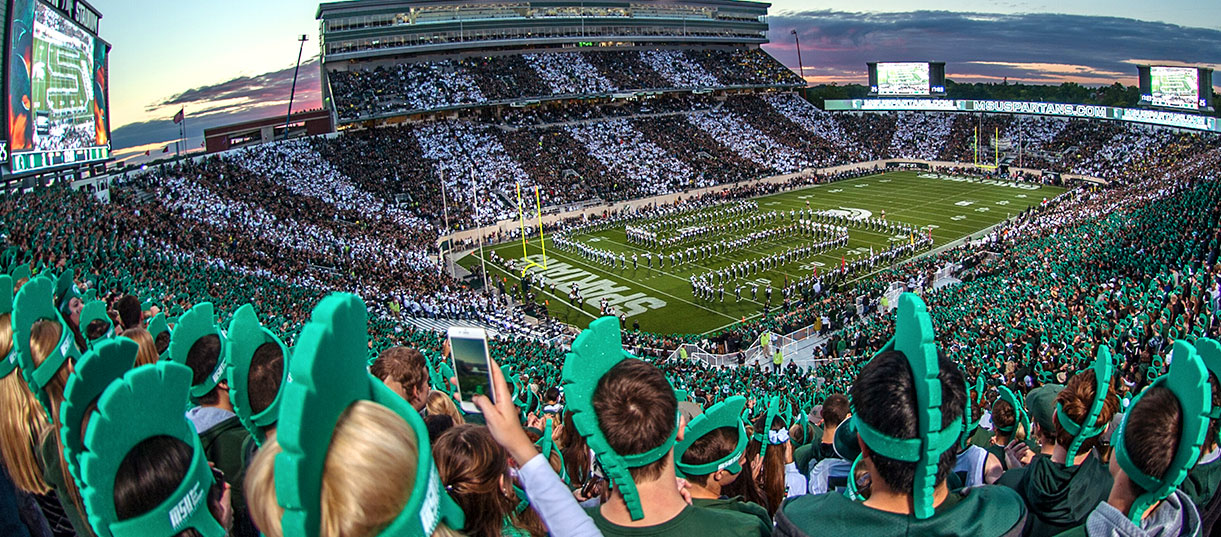
Fans wearing foam "Spartan helmets"
The stadium has also hosted concerts, notably by the Rolling Stones in 1994 and U2 in 2011. On October 6, 2001, a hockey rink was installed on the field, for the MSU hockey team's season opener against Michigan. It was billed as "The Cold War," and the game, between Number 1-ranked MSU and Number 4-ranked UM ended in a 3-3 tie. This was the beginning of the outdoor hockey revolution in North America, and the crowd of 74,554 was the largest ever to see a hockey game anywhere in the world, until 2010, when the same schools met at Michigan Stadium, 104,173.
Food. If tailgating didn't feed you enough, there are loads of concession stands throughout the stadium. Most of them are on the main level, in particular in the end zone concourses.
The north end has Smokestack BBQ, Grand Grillin', a sausage stand called Spartanville, Gourmet Pretzel (like there is such a thing), Kosher Dogs, and Coney Island (hot dogs made in the Michigan and Ohio style, with chili, not in the style of the actual Coney Island in Brooklyn, with mustard and
maybe sauerkraut).
The south end has Smokestack BBQ, Spartanville, Gourment Pretzels, Sparty's Pizza & More, Chicken-n-Waffles (apparently, another "delicacy" common to Michigan and Ohio), The Stadium Grill and Mama's Tacos.
The east sideline, which is the visiting team's bench side, has a Subway and a dessert stand named Fun Foods. The west sideline, the MSU bench side, has Spartanville and Fun Foods. All over, including the east side upper deck, has "Fan Favorites," including Pepsi products and Tim Hortons donuts, baked goods and coffee drinks. The west side upper deck has Smokestack BBQ and Sparty's Pizza & More.
Team History Displays. Michigan State claims 6 National Championships, in 1951, 1952, 1955, 1957, 1965 and 1966 (all of them disputed); 11 Conference Championships, in 1903, 1905 (shared), 1953, 1965, 1966, 1978 (shared), 1987, 1990 (shared), 2010 (shared), 2103 and 2015 (winning the Big Ten Championship Game in the last 2); and 3 Divisional titles, in 2011, 2013 and 2015. Plaques honoring these achievements are on the concourses, not in the field area.
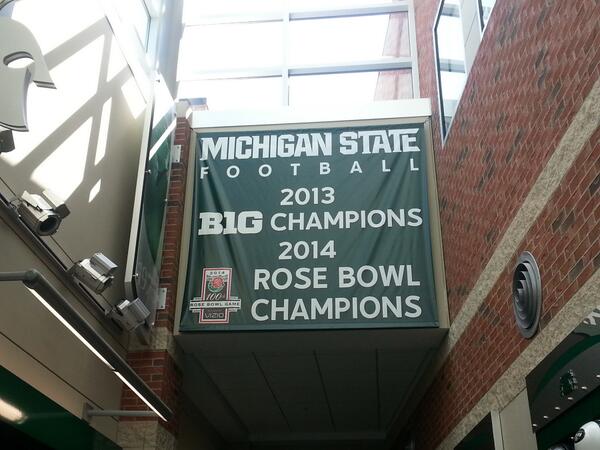
A banner honoring MSU's 2013 Big Ten title
MSU has won the Rose Bowl in 1954, 1956, 1988 and 2014. They also won New Year's Day (or January 2) bowl games in 2000 (Citrus), 2012 (Outback) and 2015 (Cotton).
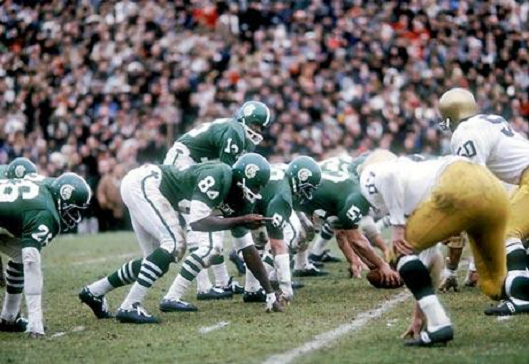
Despite their 1965 team being declared National Champions before the bowl games, they lost the 1966 Rose Bowl to UCLA. The Big Ten then had a rule prohibiting a team from going to the Rose Bowl in back-to-back seasons, and another rule saying that only their Rose Bowl representative could go to a bowl game, and so Number 1 MSU went undefeated, despite their "Game of the Century" tie with Number 2 Notre Dame at Spartan Stadium, but didn't go to a bowl game, and they shared the National Championship with Notre Dame.
Despite their 1978 team, which included future baseball star Kirk Gibson, sharing the Big Ten title with Michigan and beating them in Ann Arbor, they were on probation, and prevented from going to the 1979 Rose Bowl, which Michigan, naturally, lost.
The Spartans have 6 retired numbers. Of these, 3 are from the 1965 and '66 National Champions: 26, running back Clinton Jones; 90, linebacker George Webster; and 95, defensive end Charles "Bubba" Smith. From the 1951 National Champions, 78, two-way tackle Don Coleman. From the 1987 Big Ten Champions, 48, linebacker Percy Snow.
They have also retired Number 46 for John Hannah. This is not the Hall of Fame guard for the New England Patriots, who went to the University of Alabama. Rather this is for John A. Hannah, who served the University for 46 years, including 28 years, 1941 to 1969, as its President. More than any person, the school that MSU is today is due to his vision.
While these numbers are not on display in the field area, the concourse has a display for the MSU Athletic Hall of Fame.
There are 23 Michigan State figures in the Michigan Sports Hall of Fame, located at Cobo Hall in downtown Detroit. The football players are, in chronological order by year of graduation: Lynn Chadnois '50, Earl Morrall '55, Herb Adderley '61, Fred Arbanas '61, Ed Budde '63, Don Coleman, Sonny Grandelius, Bubba Smith '66, Brad Van Pelt, George Webster '66, Giants linebackers Brad Van Pelt '73 and Carl Banks '84, and coaches Clarence "Biggie" Munn (1947-53), Hugh "Duffy" Daugherty (1954-72) and George Perles (1983-94).
One MSU football player in this Hall, Kirk Gibson, from the 1978 Big 10 Champions, went on to become a baseball legend. Also in this Hall, and the Baseball Hall of Fame, is MSU's Robin Roberts. Basketball figures in this Hall are Magic Johnson, Greg Kelser and coach from the 1979 National Champions; Mateen Cleaves and coach Tom Izzo from the 2000 National Champions; Ralph Simpson and Steve Smith.
Other notable football players include: Peter Gent '64 (author of
North Dallas Forty), Joe DeLamielleure '73, Larry Bethea '77, Morten Andersen '82, Andre Rison '89, Mark Ingram '96, Mushin Muhammad '96, Plaxico Burress 2000, T.J. Duckett '02, Kirk Cousins '11, and Le'Veon Bell (left after the 2013 season without graduating).
Michigan State plays for 4 trophies: The Paul Bunyan Trophy with Michigan (they trail the series 36-26-2 with the trophy at stake, 68-35-5 overall, and the Wolverines currently hold the trophy); the Megaphone Trophy with Notre Dame (they trail 48-29-1, but Michigan State currently holds it), the Old Brass Spittoon with Indiana (they lead the series 45-12-1, but Indiana currently holds it), and the Land Grant Trophy with Penn State (the series is tied 14-14-1, with Penn State holding it).
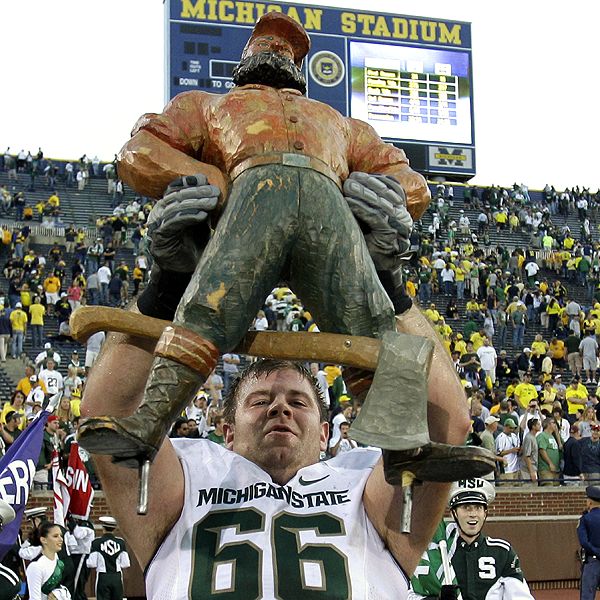
What every Spartan dreams of: Beating the Wolverines at Ann Arbor
and taking home the Paul Bunyan Trophy.
(UPDATE: Standings of said rivalries through the 2020 season: Michigan State trails Michigan 71-37-5, and 38-28-2 for the Paul Bunyan Trophy; trails Notre Dame 47-29-1, and 33-27-1 for the Megaphone; lead Indiana 48-17-2, 48-14-1 for the Old Brass Spittoon; and is tied with Penn State 17-17-1, leading 14-11 for the Land Grant Trophy.)
Stuff. Souvenir stands are all over. MSU stuff is also available at the Student Book Store, at 421 E. Grand River Avenue on the north side of the river; and at the Spartan Bookstore, at 427 N. Shaw Lane, a block east of the stadium. Foam Spartan helmets are available.
Unlike their Big Ten rivals Michigan, Ohio State and Penn State, and their not-really-Big Ten rivals Notre Dame, Michigan State football hasn't yet produced enough words on paper to depopulate a forest. Tom Shanahan's 2014 book Raye of Light: Jimmy Raye, Duffy Daugherty, the Integration of College Football, and the 1965-66 Michigan State Spartans, tells of the team's greatest era. The school newspaper, The State News, published Reaching Higher: Mark Dantonio and the Rise of Michigan State Football earlier this year. And, telling the tale of Earvin "Magic" Johnson and the school's 1st National Championship in basketball (followed by 2000), Fred Stabley Jr. and Tim Staudt wrote Tales of the Magical Spartans: A Collection of Stories from the 1979 Michigan State NCAA Basketball Champions.
DVDs are available of the 1979 and 2000 basketball National Championship Games, and of the 2014 Rose Bowl. In 2008, the school released the DVD The Greatest Stories of Michigan State Basketball.
During the Game. Your safety should not be an issue. MSU fans don't like the University of Michigan. They don't like Ohio State. They don't like Notre Dame. But they should have no problem with Rutgers. Certainly, they didn't the last time Rutgers visited, in 1988, in MSU's 1st game after the previous season's Rose Bowl win -- which RU won.
In 1925, the school wanted to drop "Aggies" as their mascot, since they had outgrown their "cow college" roots. Perry J. Fremont, a former athlete at the school, suggested "Spartans," and local sportswriters began using it. Since then, Spartans they have been. In 1941, a terra cotta statue named The Spartan, or "Sparty," was dedicated on campus, at the southern foot of the Kalamazoo Street Bridge. In 2005, it was moved to the stadium, and a new bronze version of Sparty replaced the original.
The new Sparty statue, considerably more
anatomically correct than the game mascot version
During graduation season, graduates and their families tend to pose for pictures with the statue. Newly-married couples also tend to do it. And during the week prior to playing Michigan, members of the MSU Marching Band undertake Sparty Watch, guarding the statue from vandalism by Wolverine fans. And, before every game, players and coaches walk from their locker room at the Kellogg Center to Spartan Stadium, and toss pennies at the new statue.
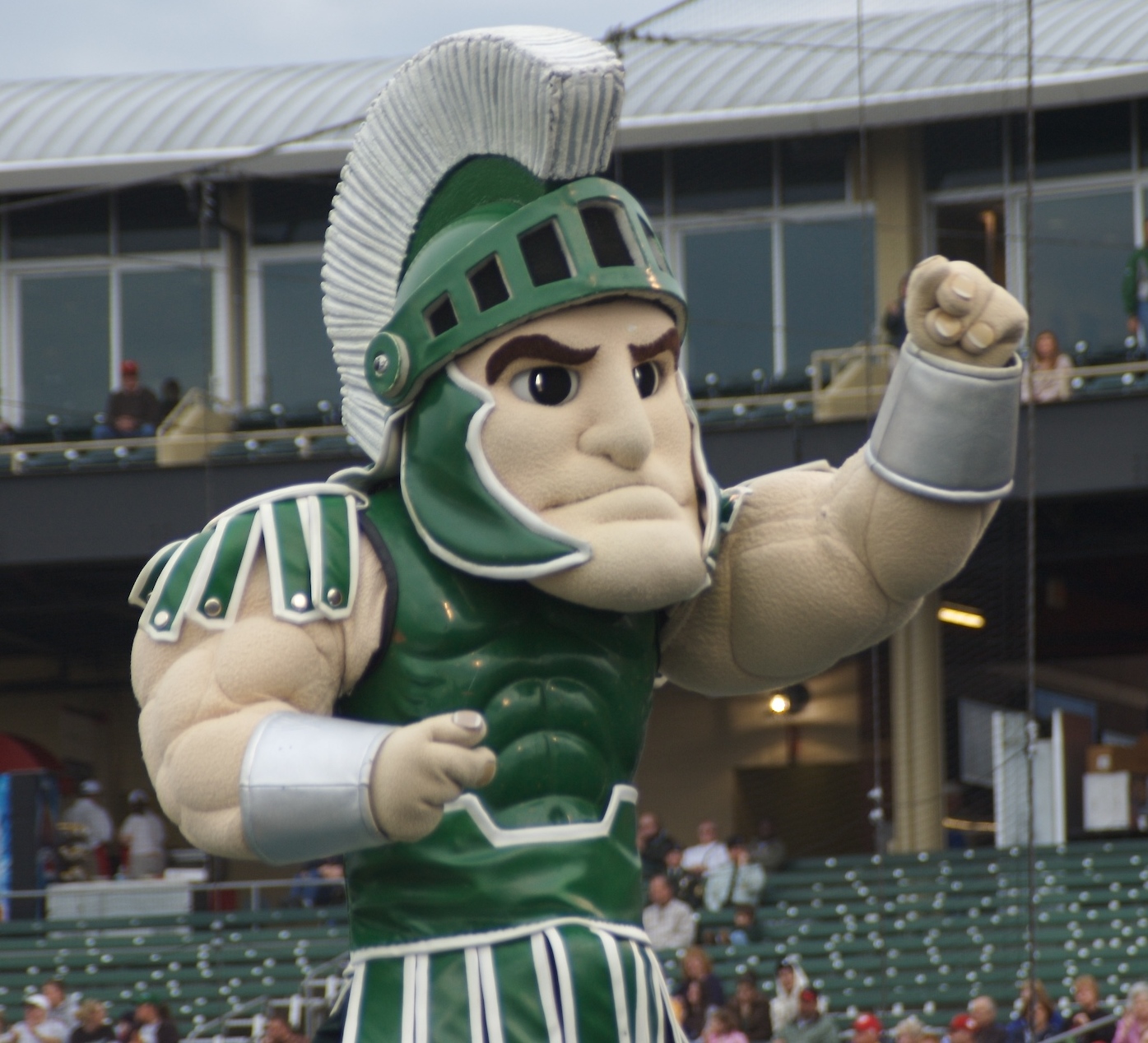
In 1989, a foam costume "Sparty" was introduced as a mascot, although his uniform more resembles that of the army of ancient Rome, over 300 after Sparta's glory days.
Sparty, apparently pleased to have passed his latest steroid test
The MSU Marching Band will play the National Anthem. They will also, about 100 times a game, play "
Victory for MSU," formerly known as "The MSU Fight Song." This season, in conjunction with the protest by San Francisco 49ers quarterback Colin Kaepernick, some MSU players have stood with raised fists during the Anthem, a la Tommie Smith and John Carlos in the 1968 Olympics. Coach Mark Dantonio has stood up for them.
Just before kickoff, the public address announcer gives the weather forecast, and, regardless of how good it is, shouts, and the home fans shout with him, "It's a beautiful day for football!"
Since the film
300, based on the story of "The 300 Spartans" at the Battle of Thermopylae in 490 BC, was released in 2007, clips from it have been shown during the players' introductions, while "Thunderstruck" by AC/DC plays. A clip of Gerard Butler as King Leonidas shouting, "Spartans: What is your profession?" is played when the opponent faces a 3rd down. The crowd answer, "Ha-ooh! Ha-ooh! Ha-ooh!" -- the reverse of the U.S. Army shout, "Hoo-ah!" -- while punching the air as if they were thrusting spears as in the movie. Butler, a Scotsman used to the kind of football known as soccer, was invited to an MSU football game, and, on October 16, 2010, led the team onto the field, and led the chant himself.
In 1977, Zeke the Wonder Dog began catching frisbees at halftime of MSU football games. As each Zeke gets too old or dies, new ones replace him.
After the Game. Again, your safety should not be an issue. Just don't rub it in if Rutgers actually wins, or speak too well of the Michigan Wolverines, and the Spartan fans will let you leave in peace.
Across the Red Cedar River, Grand River Avenue, and the 3 or so blocks north of it, are home to several eateries that should still be open after the game ends at around 3:30 PM. They do have Dunkin Donuts in Michigan, and there's one at 3415 E. Saginaw Street, about halfway between the campus and downtown Lansing.
In 1988, Bob Wood, a Michigan State graduate, went to games at all 10 schools then in the Big Ten, and chronicled it in his book
Big Ten Country, a sequel to his earlier book
Dodger Dogs to Fenway Franks, when he went to all 26 major league ballparks in 1985. He cited Bagel Fragel as having the best breakfast in East Lansing, but it is no longer in business. He said Dagwood's Tavern & Grill had the best burger, and it is still open, at 2803 E. Kalamazoo Street, about a mile and a half west of the stadium. He said Dooley's was the best bar, and while the building is still there and it's still a bar, it's now known as Harper's. 131 Albert Avenue, 2 blocks north of Grand River Avenue.
If you're a soccer fan, and are interested in watching your favorite European club before heading out to the game (which would be difficult if it's a 10 AM Eastern Time start, as RU-MSU starts at 12 noon), the leading soccer bar in the Lansing area is the FieldHouse, at 213 Ann Street, 2 blocks north of Grand River Avenue and a 15-minute walk from Spartan Stadium.
Sidelights. Munn Ice Arena is located at 1 Chestnut Road, on the west side of the stadium. It is home to MSU's hockey team, National Champions in 1966, 1986 and 2007. (Michigan has won it in 1948, '51, '52, '53, '55, '56, '64, '96 and '98; Michigan Tech in 1962, 1965 and 1975; Lake Superior State in 1988, 1992 and 1994; and Northern Michigan in 1991.)
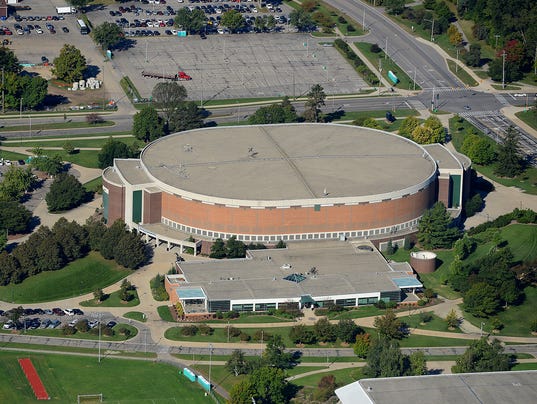
To the west of that is the (relatively) new basketball arena, the Breslin Student Events Center, at 534 Birch Road. It is currently undergoing renovations, to be completed in time for the 2018-19 season.
Breslin Center
To the north of Munn Arena is the old arena, Jenison Field House, home of Spartan basketball from 1940 to 1989, at 223 Kalamazoo Street. Just to the east of that is Drayton McLane Baseball Stadium, named for the grocery executive who owned the Houston Astros during their most successful years. And across from that, at the southern foot of the Kalamazoo Street Bridge over the Red Cedar River, is the heart of the MSU campus, the Sparty Statue.
Jenison Field House, a.k.a. the House of Magic
Michigan State honors 10 individuals from its basketball program with banners representing retired numbers. From the 1950s: 24, Johnny Green. From the 1979 National Champions: 33, Earvin "Magic" Johnson; 32, Greg Kelser; 31, Jay Vincent; and a banner for head coach George "Jud" Heathcote. From the 1980s: 4, Scott Skiles; 21, Steve Smith; and Heathcote. From the early 1990s, following the 1989 opening of the Breslin Center: 24, Shawn Respert; and Heathcote, who retired in 1995 after 19 seasons. From the 2000 National Champions: 12, Mateen Cleaves; and 42, Morris Peterson. As Tom Izzo is still the head coach, he is not yet so honored.
At 534,000 people, the Mid-Michigan region can't support a major league team in any sport. They have a minor-league soccer team, 2 minor-league basketball teams, and a minor-league baseball team. The Lansing Lugnuts, since 2005 a farm team of the Toronto Blue Jays, play in the Class A Midwest League, at the 7,527-seat Cooley Law School Stadium, at 505 E. Michigan Avenue.
UM and MSU opened the ballpark in 1996, although Cooley Law School is the law school of Western Michigan University, in Kalamazoo, 75 miles southwest of downtown Lansing. The ballpark was recently upgrade, with the slogan, "Same Nuts, New Shell."
From 1943 to 1954, the All-American Girls' Professional Baseball League provided an alternative to Major League Baseball. Michigan had 2 teams in the League. The Grand Rapids Chicks won Pennants in 1947 and 1953. They played at South High School, which closed in 1968. The building still stands, as the Gerald R. Ford Job Corps Center, named for the city's most famous son. 110 Hall Street SE.
And the Kalamazoo Lassies won the League's last Pennant, in 1954. They played at Lindstrom Field, at 3100 Portage Street. Stores are on the site now.
The Michigan State University Museum is at W. Circle Drive and Auditorium Road. Elvis Presley gave concerts in Michigan in Detroit, Pontiac, Kalamazoo, Saginaw and, sure to make MSU people unhappy, Ann Arbor, but never in Lansing or East Lansing. The Beatles played Detroit, but that was it.
Gerald Ford was from Grand Rapids, and is the only Michigan native to become President, but he not only went to the University of Michigan, he was an All-America football player there. Thomas E. Dewey was nominated by the Republican Party in 1944 and 1948, and was born and raised in Owosso, but he, too, went to UM.
MSU does, however, have a Presidential connection. On October 19, 1992, it hosted a debate between George H.W. Bush, Bill Clinton and Ross Perot. It was held at the Wharton Center for the Performing Arts, at 750 E. Shaw Lane, about a mile southeast of Spartan Stadium.
The State Capitol reaches a height of 267 feet. There is one building in the Lansing area taller: The Boji Tower, across Capitol Avenue at 124 West Allegan Street, is 297 feet high. Not particularly tall.
Michigan's State motto is, "If you seek a pleasant peninsula, look around you." It is surrounded on 3 sides by Great Lakes: Michigan to the west, Huron to the north and northeast, and Erie to the southeast. It has various protrusions into the water, and many islands, leading singer Gordon Lightfoot to say, "The islands and bays are for sportsmen."
Two areas of the State are renowned by beachgoers. South Haven, "the Catskills of the Midwest," is on the shore of Lake Michigan, 123 miles southwest of East Lansing. Mackinac Island (pronounced MACK-in-aw, not MACK-in-ack), over the Mackinac Bridge (the Mighty Mac), is closed to car traffic, and must be reached by ferry from Mackinac City. It is Michigan's Hamptons, its Cape May, its Martha's Vineyard. 229 miles north of East Lansing.
*
Michigan State is struggling in football, despite being defending Big Ten Champions. They may be just what the doctor ordered for Rutgers. Then again, Rutgers could be just what MSU needs. Either way, it could be a fun visit.