Just when you thought it was safe to be optimistic about the Yankees again...
They reached .500 by beating those pesky Toronto Blue Jays on Tuesday night, extending their winning streak to 6.
But it would end there. The Wednesday night game was unusual in that the Yankees scored 4 runs and still lost. Chase Headley hit his 3rd home run of the season, and Austin Romine his 1st. But Russell Martin hit 2. This is not a good thing, because he doesn't play for the Yankees anymore. Headley got 1 other hit, and Didi Gregorius got 3. That was all the Yankees got.
Ivan Nova had pitched well lately, but not this time. His strikeout-to-walk ratio of 8-2 was good, but he gave up 4 runs in less than 7 innings. The bullpen was worse: Chasen Shreve and Nick Goody are simply not good enough to pitch in the major leagues.
Blue Jays 8, Yankees 4. WP: Marco Estrada (2-2). No save. LP: Nova (3-2).
*
Yesterday's game was a rare 4:05 PM home start. (A game starting at 4:05 Eastern Time is not surprising if it's on the West Coat, making it 1:05 Pacific.) CC Sabathia pitched very well, going 7 innings, allowing 2 runs, neither of them earned (thanks to an error by Gregorius), on 2 hits and 1 walk, striking out 7.
The Yankees simply didn't back him up. And, again, he fell victim to 1 bad inning, although it wasn't that bad: 2 runs in the 3rd.
The Yankees actually took a 1-0 lead in the 1st, on Starlin Castro's 6th home run of the season. But the Yankees wasted a 1-out walk by Brian McCann in the 2nd, Romine grounded into a double play to wipe out 1-out singles by Headley and Gregorius in the 5th, wasted a 1-out walk by Aaron Hicks in the 6th, wasted a 2-out walk by Headley in he 7th, wasted a leadoff single by Jacoby Ellsbury in the 8th, and went out weakly in the 9th.
This time, Joe Girardi used Dellin Betances in the 8th and Aroldis Chapman in the 9th, going against his type (i.e. "Do whatever the hell the Binder tells me to do"), and using good relievers when behind. Chapman allowed a run.
Blue Jays 3, Yankees 1. WP: Happ (6-2). SV: Antonio Osuna (10). LP: Sabathia (3-3).
*
So now, the Yankees fly down to face the Tampa Bay Rays. Here are the projected pitching matchups:
* Tonight, 7:05: Masahiro Tanaka vs. Jeremy Archer.
* Tomorrow, 4:10: Michael Pineda vs. Matt Moore.
* Sunday, 1:10: Nathan Eovaldi vs. Jake Odorizzi.
Come on you Bombers!
Showing posts with label russell martin. Show all posts
Friday, May 27, 2016
Wednesday, March 26, 2014
Canada's All-Time Baseball Team
Okay, there are lots of people in Quebec who would still prefer a returned Expos. And there may be a few people in Western Ontario, near Windsor, who prefer the Detroit Tigers. And there may be a few people in Manitoba who like the Minnesota Twins. And there may be a few people in Saskatchewan and Alberta who prefer the Colorado Rockies. And there's probably a lot of people in and around Vancouver who like the Seattle Mariners.
But I'm putting the entire Dominion of Canada into the Toronto Blue Jays' "market," thus putting Canada at 17th in the MLB rankings.
17. Canada's All-Time Baseball Team
Although the Jays have only had that one good period, 1985 to 1993, their predecessors, the Triple-A Toronto Maple Leafs, for whom the legendary hockey team was named, won Pennants in 1897, 1902, 1912, 1917, 1918, 1926, 1934, 1960, 1965 and 1966, the last 2 of these helping to produce some of the Boston Red Sox players who won the 1967 “Impossible Dream” Pennant.
And while the Expos only reached the postseason once, as second-half National League Eastern Division Champions in 1981, and had the best record in baseball when the Strike of '94 hit, their predecessors, the Triple-A Montreal Royals, won Pennants in 1898, 1935, 1945, 1946, 1948, 1951, 1952, 1955 and 1958, all but the first 2 as the top farm team of the Brooklyn Dodgers.
Can an all-time All-Hoser Team measure up to that? Possibly: Canada has 34 million people, and 243 natives have reached the major leagues.
1B Justin Morneau of New Westminster, British Columbia. He's one of those guys about him you can now say, "It's funny how these winning teams keep following him around." He spent 10 seasons with the Twins, and they made the postseason in 6 of them. Last year, he was traded to the Pittsburgh Pirates, and they reached the postseason for the first time in 21 years.
He was named American League Most Valuable Player in 2006, and nearly was again in 2008. He's a 4-time All-Star with a career OPS+ of 121, 221 home runs, and 4 100+ RBI seasons. He turns 33 in May, so he should remain productive for the time being. (In fact, he was born on a good day for baseball: May 15, 1981 was the day of Len Barker's perfect game.)
Honorable Mention to Joey Votto of Toronto. It seems silly to not have him as the starter, since he's one of the top 5 players in the game right now. He's got just as many MVPs (NL 2010) and All-Star berths as Morneau, a Gold Glove (which Morneau doesn't yet have), a higher career OPS+ (155), and is hitting home runs at a better rate (157 in just 6 full seasons).
And he has helped the Cincinnati Reds reach 3 of the last 4 postseasons. But these teams I'm making are weighted toward career achievement. If the Reds win a Pennant before Votto surpasses Morneau in terms of career numbers (if he does, as now seems likely), then I'll reassess.
2B Sherry Robertson of Montreal, Quebec. It was said that the only reason the Washington Senators kept him around as a coach was because he was the adopted son of owner Clark Griffith -- and thus the adoptive brother of the next owner, Calvin Griffith. There was even a rumor that the Twins, whom the "old Senators" became in 1961, had retired his uniform Number 47 (which he never wore as a player, and the rumor was shattered by Jack Morris in the Twins' 1991 World Championship season.)
But Robertson wasn't a terrible player. In 1949, he hit 11 home runs and had 42 RBIs, despite playing only 110 games, and his home games in Griffith Stadium, which had distant fences and was terrible for hitters. And second base is a very weak position for Canada.
SS Arthur Irwin of Toronto, Ontario. Pickings were slim at shortstop as well, and I had to go back to the 1880s to find this guy, but he was a productive hitter for a time and a good baserunner. He played on 2 Pennant winners, the 1884 National League Champion Providence Grays (best known for pitcher Charlie "Old Hoss" Radbourn) and the only Players' League Champions, the 1890 Boston Red Stockings.
3B Corey Koskie of Outbank, Manitoba. In 2001, his 26 homers and 103 RBIs were one of the things that boosted Twins attendance, and may have helped them avoid being contracted. He later helped the Twins win the 2003 and '04 AL Central Division titles.
LF Jason Bay of Trail, British Columbia. It's easy to laugh now, but he was once one of the best players in the game. A 3-time All-Star, he was NL Rookie of the Year with the 2004 Pirates, and has 222 home runs, 4 100-RBI seasons, and a 121 OPS+. And he did help the Red Sox reach the 2008 and '09 postseasons, before signing that embarrassing contract with the Mets. He is currently a free agent after being released by the Mariners after the first half of last season, and at age 35 1/2, this Canada goose may be cooked.
Honorable Mention to James "Tip" O'Neill of Woodstock, Ontario. The "Woodstock Wonder" was the first great Canadian-born baseball player, and as a result the annual award for the country's best baseball player is named for him. A career .326 hitter with an OPS+ of 144, he had 3 100-RBI seasons in a pitcher's era.
He was an original New York Giant in 1883, but made his mark with the St. Louis Browns of the American Association, the team that would become not the AL's Browns, but the NL's Cardinals, winning 4 straight Pennants, 1885-88. In 1887, he led the AA in batting (.435), runs, hits, total bases, doubles, triples, home runs and RBIs -- possibly the best hitting year that 10-year league ever had.
If he could have done anything close to his 19th Century career numbers within a 20th Century framework, he could have been a Hall-of-Famer. As it is, Baseball-Reference.com has him at 112 on their HOF Monitor, where 100 means you should be in; while they have him at 33 on their HOF Standards, where 50 means you should be in. How he would have fared in the era of international, multiracial opposition, night games and coast-to-coast travel is a mystery, but, clearly, he had talent. (He also started the tradition of men named O'Neill with 2 L's being nicknamed "Tip," as with the legendary Boston Congressman Thomas P. O'Neill Jr.)
On my original team, my left fielder was Jeff Heath a very good hitter who made 2 All-Star teams, had 2 100-RBI seasons, and 5 times received votes in the MVP balloting. Twice while playing for the Cleveland Indians, he led the AL in triples, in 1938 and 1941. But while he was born in Fort William, Ontario, he grew up in Seattle.
CF Terry Puhl of Melville, Saskatchewan. An All-Star in 1978, his 1st full season in the majors, he hit 13 homers and drove in 55 runs despite playing his home games in the Astrodome, helping the Houston Astros reach their first postseason. A .282 career hitter, with a 112 OPS+, he also stole 217 bases thanks partly to his natural speed, and partly to that awful Astrodome carpet. In short, he was a natural fit for the 1980s Astros.
He actually played more right field in his 14 seasons with the Astros (plus one more, 1991, with the Kansas City Royals), but center field is another weak position for Canadians: Only 2 other men born in that country played the position much in the majors, and not for long. I considered moving 1930s Yankee All-Star George "Twinkletoes" Selkirk of Huntsville, Ontario, or more recent slugger Matt Stairs of St. John, New Brunswick over from right field, but I decided Puhl was a better choice, as he was a good defensive outfielder, I've never seen footage of Selkirk in the field, and Stairs has never been all that mobile. So Selkirk and Stairs will have to be backups in RF to…
RF Larry Walker of Maple Ridge, British Columbia. He could be the greatest hitter the Great White North has ever produced, and is easily the best Canadian player to play for a Canadian team (the Expos). He has a .313 lifetime batting average, 3 batting titles (peaking at .379 in 1999, 1 of 4 times he hit .350 or higher), a 140 OPS+, 471 doubles and 383 home runs (a lot hit in the thin air of Denver, though), 5 100-RBI seasons, 5 All-Star berths, 7 Gold Gloves, and the 1997 NL MVP.
He helped the Rockies reach the postseason in 1995, only their 3rd season of play, and the Cardinals to get there in 2004 (his only World Series appearance) and '05. He is now eligible for the Hall of Fame, but hasn't come close to being elected. His B-R HOF Monitor is 148, and his HOF Standards are 58, both meaning he should obviously be in. If the voters are holding Coors Field against him, they also need to remember that he played 5 years in the Montreal Olympic Stadium, which wasn't exactly a homerdome.
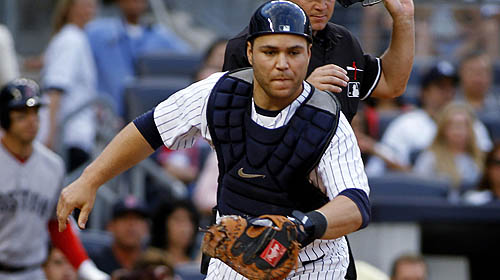
C Russell Martin of Montreal, Quebec. No, he's not the Yankees' catcher anymore, but he's still one of the best defensive catchers in baseball (he's won a Gold Glove), and he's still got some power (enough to be a 3-time All-Star). And he's been to 6 of the last 8 postseasons: 2006, '08 and '09 with the Los Angeles Dodgers, 2011 and '12 with the Yankees, and 2013 with the Pirates. Yeah, another one of those guys that winning teams seem to follow around.
Honorable Mention to George Gibson of London, Ontario. Not much of a hitter (.236, OPS+ a mere 81, never topped 52 RBIs), but he must have been good defensively, because he stuck around the majors for 14 seasons, and was a member of 2 Pennant winners: He helped the Pirates win the 1909 World Series against Ty Cobb's Tigers, then got the Giants into the 1917 Series which they lost to the Chicago White Sox with Shoeless Joe Jackson. Gibson is also the manager of this team, almost by default. (No, De Fault is not a village in Quebec.)
SP Russ Ford of Brandon, Manitoba. The 1st Ford to be a great pitcher for the Yankees wasn't Whitey. Russ was one of the trickiest pitchers of his time, throwing a knuckleball, a spitball, and a pitch he claimed to have discovered accidentally, the "emery ball." He threw a warmup pitch that hit a post, noticed a scuff on the ball, and saw that it curved funny afterward. From that point onward, he carried an emery board with him in his back pocket, to "doctor the ball." Like the spitball, the emery ball was outlawed in 1920.
He won 48 games for the Highlanders, as the Yankees were then known, in 1910 & '11. He bolted for the Federal League in 1914, winning 21 for the Buffalo team that year and leading the FL in winning percentage and, although these 2 categories weren't known at the time, ERA+ and WHIP. But he tumbled from 21-6 to 5-9 in 1915, suggesting an injury.
Despite going 16-9 for the high minors' Denver Bears in 1916, the next season was his last in pro ball, and he was done at age 34. (Although I can find no record of it, he may have missed the 1918 season, and part of 1917, due to serving in World War I, and then been so stale after the Armistice that he simply couldn't catch on anywhere.) He went 99-71 in his major league career, with an ERA+ of 124 and a WHIP of 1.154.
SP Ferguson Jenkins of Chatham, Ontario. The only Canadian thus far elected to the Baseball Hall of Fame, he won 284 games, and is a member of the 3,000 Strikeout Club. He only made 3 All-Star teams, and never reached the postseason, mainly because he played for some snakebit franchises: The Phillies, the Cubs, the Rangers and the Red Sox. But he had 7 20-win seasons -- including 6 in a row. But he did have 7 20-win seasons, including 6 in a row. One of these was 1971, when he got the NL Cy Young Award.
SP Reggie Cleveland of Swift Current, Saskatchewan. Okay, not the best Reggie in baseball in the 1970s -- or even the 2nd-best, that would be Reggie Smith. And he was sub-.500 for his career, 105-106. Still, he's 1 of only 4 Canadian-born pitchers to win 100 games in the majors, and he did help the Red Sox win the 1975 AL Pennant.
SP Kirk McCaskill of Kapuskasing, Ontario. His career W-L record resembles Cleveland's, 106-108. But he did last 12 seasons in the majors, and helped the California Angels get to within 1 strike of the AL Pennant in 1986, and the White Sox to within 2 games of the 1993 Pennant.
SP Ryan Dempster of Gibbons, British Columbia. He'll be 37 in May, but he's not ready to pack it in. He's a 2-time All-Star who, unlike Fergie Jenkins, has reached the postseason with the Cubs and the Red Sox -- think about that combination! In fact, he got to the postseason with the Cubs in back-to-back seasons, 2007-08, and won a ring * with last year's Red Sox.
Like Cleveland and McCaskill, he's just under .500 for his career (132-133), but from 3 seasons as the Cubs' closer (including those 2 trips to the postseason), he's also got 87 saves.
I originally had Erik Bedard as one of the starters on this team, but, while born in Navan, Ontario, he grew up in Norwalk, Connecticut.
RP John Hiller of Scarborough, Ontario. In 1968, he was in the bullpen for the Tigers' World Championship team. He suffered a heart attack at age 28, and missed the entire 1971 season, and wasn't able to contribute much to their 1972 AL East title. But in 1973, he saved 38 games, a new major league record that stood for 12 years, and went 10-5. The next season, as the Tigers got old in a hurry, he only saved 13, but went 17-14, making the All-Star team. He ended up winning 87 games and saving 125 others.
Honorable Mention to Claude Raymond of St. Jean, Quebec, who bounced around the majors in the 1960s, including an All-Star berth with the 1966 Astros, before being picked up by the expansion Expos in 1969, making him the first Canadian-born player (French or otherwise) to play for a Canada-based team. In fact, the Expos' first stadium, Jarry Park, was built on the site of a sandlot where he had played as a boy.
Raymond later became the Expos' French voice on radio from 1972 until their "death" in 2004. This did not, however, make him the first Canadian-born broadcaster in the majors. Jack Graney of St. Thomas, Ontario was the first former player -- a left fielder with the Indians from 1908 to 1922, including their 1920 World Championship -- to become a broadcaster, also for the Indians.
Also available for the Canadian bullpen is Rheal Cormier of Moncton, New Brunswick, who pitched 16 years in the majors, and actually won more games as a reliever (40) than he did as a starter (31).
Now, you might be asking about Eric Gagne of Montreal. No. He cheated, and he got caught. As such, he was much closer to Sammy Sosa, who never would have amounted to much if he hadn't cheated, than to Barry Bonds or Alex Rodriguez, who didn't need to cheat but did anyway.
*
Best players from each Province, going West to East:
British Columbia: Larry Walker of Maple Ridge.
Alberta: Mike Johnson of Edmonton, a pitcher who spent 5 years straddling the new millennium with the Expos.
Saskatchewan: Terry Puhl of Melville.
Manitoba: Russ Ford of Brandon.
Ontario: Fergie Jenkins of Chatham.
Quebec: Russell Martin of Montreal.
New Brunswick: Matt Stairs of Fredericton.
Nova Scotia: Charles "Pop" Smith of Digby, an infielder who played for several teams, mostly the Pirates, from 1880 to 1891.
Prince Edward Island: Vern Handrahan of Charlottetown, a pitcher for the 1964-1966 Kansas City Athletics, is easily the best of the 3 men from PEI to make it to the majors.
No player born in Newfoundland and Labrador, or in any of Canada's Territories (Yukon, Northwest, Nunavut), has ever reached the major leagues.
*
In case you're a hockey fan (and if you're not, what the hell is wrong with you, eh?), here are my picks for the best hockey players from each of the Provinces and Territories:
Nunavut Territory: As yet, no player from there has reached the NHL.
Yukon Territory: Peter Sturgeon of Whitehorse, 6 games with the 1980 and '81 Colorado Rockies, not the Denver baseball team but the hockey team that, in 1982, became the New Jersey Devils. Byron Baltimore is the only other Yukon native to reach the NHL, and while neither scored a goal, Sturgeon, at least, got an assist.
Northwest Territory: Geoff Sanderson of Hay River, easily the best of the 5 NT players who've made it, scoring 355 goals for several teams, playing the longest for the Hartford Whalers.
British Columbia: Joe Sakic of Burnaby. Steve Yzerman was born in Cranbrook, but grew up in Ottawa, Ontario. Scott Niedermayer, born in Edmonton, grew up in Cranbrook, but, for career achievement, I can't put him ahead of Sakic.
Alberta: Mark Messier of Edmonton. And remember: He's not only the Hair Club Team Captain, he's also a client!
Saskatchewan: Gordie Howe of Floral.
Manitoba: Bobby Clarke of Flin Flon.
Ontario: Bobby Orr of Parry Sound. Yes, ahead of Wayne Gretzky of Brantford -- and I place Howe ahead of both of them.
Quebec: Maurice Richard of Montreal.
New Brunswick: Don Sweeney of St. Stephen, an All-Star defenseman with the Boston Bruins in the 1990s.
Nova Scotia: Al MacInnis of Port Hood.
Prince Edward Island: Gerard Gallant of Summerside, who scored 211 goals, mostly for the Detroit Red Wings, including 4 30-goal seasons.
Newfoundland and Labrador: Keith Brown of Corner Brook, a defenseman who helped the Chicago Blackhawks win several Division titles.
But I'm putting the entire Dominion of Canada into the Toronto Blue Jays' "market," thus putting Canada at 17th in the MLB rankings.
17. Canada's All-Time Baseball Team
Although the Jays have only had that one good period, 1985 to 1993, their predecessors, the Triple-A Toronto Maple Leafs, for whom the legendary hockey team was named, won Pennants in 1897, 1902, 1912, 1917, 1918, 1926, 1934, 1960, 1965 and 1966, the last 2 of these helping to produce some of the Boston Red Sox players who won the 1967 “Impossible Dream” Pennant.
And while the Expos only reached the postseason once, as second-half National League Eastern Division Champions in 1981, and had the best record in baseball when the Strike of '94 hit, their predecessors, the Triple-A Montreal Royals, won Pennants in 1898, 1935, 1945, 1946, 1948, 1951, 1952, 1955 and 1958, all but the first 2 as the top farm team of the Brooklyn Dodgers.
Can an all-time All-Hoser Team measure up to that? Possibly: Canada has 34 million people, and 243 natives have reached the major leagues.
1B Justin Morneau of New Westminster, British Columbia. He's one of those guys about him you can now say, "It's funny how these winning teams keep following him around." He spent 10 seasons with the Twins, and they made the postseason in 6 of them. Last year, he was traded to the Pittsburgh Pirates, and they reached the postseason for the first time in 21 years.
He was named American League Most Valuable Player in 2006, and nearly was again in 2008. He's a 4-time All-Star with a career OPS+ of 121, 221 home runs, and 4 100+ RBI seasons. He turns 33 in May, so he should remain productive for the time being. (In fact, he was born on a good day for baseball: May 15, 1981 was the day of Len Barker's perfect game.)
Honorable Mention to Joey Votto of Toronto. It seems silly to not have him as the starter, since he's one of the top 5 players in the game right now. He's got just as many MVPs (NL 2010) and All-Star berths as Morneau, a Gold Glove (which Morneau doesn't yet have), a higher career OPS+ (155), and is hitting home runs at a better rate (157 in just 6 full seasons).
And he has helped the Cincinnati Reds reach 3 of the last 4 postseasons. But these teams I'm making are weighted toward career achievement. If the Reds win a Pennant before Votto surpasses Morneau in terms of career numbers (if he does, as now seems likely), then I'll reassess.
2B Sherry Robertson of Montreal, Quebec. It was said that the only reason the Washington Senators kept him around as a coach was because he was the adopted son of owner Clark Griffith -- and thus the adoptive brother of the next owner, Calvin Griffith. There was even a rumor that the Twins, whom the "old Senators" became in 1961, had retired his uniform Number 47 (which he never wore as a player, and the rumor was shattered by Jack Morris in the Twins' 1991 World Championship season.)
But Robertson wasn't a terrible player. In 1949, he hit 11 home runs and had 42 RBIs, despite playing only 110 games, and his home games in Griffith Stadium, which had distant fences and was terrible for hitters. And second base is a very weak position for Canada.
SS Arthur Irwin of Toronto, Ontario. Pickings were slim at shortstop as well, and I had to go back to the 1880s to find this guy, but he was a productive hitter for a time and a good baserunner. He played on 2 Pennant winners, the 1884 National League Champion Providence Grays (best known for pitcher Charlie "Old Hoss" Radbourn) and the only Players' League Champions, the 1890 Boston Red Stockings.
3B Corey Koskie of Outbank, Manitoba. In 2001, his 26 homers and 103 RBIs were one of the things that boosted Twins attendance, and may have helped them avoid being contracted. He later helped the Twins win the 2003 and '04 AL Central Division titles.
LF Jason Bay of Trail, British Columbia. It's easy to laugh now, but he was once one of the best players in the game. A 3-time All-Star, he was NL Rookie of the Year with the 2004 Pirates, and has 222 home runs, 4 100-RBI seasons, and a 121 OPS+. And he did help the Red Sox reach the 2008 and '09 postseasons, before signing that embarrassing contract with the Mets. He is currently a free agent after being released by the Mariners after the first half of last season, and at age 35 1/2, this Canada goose may be cooked.
Honorable Mention to James "Tip" O'Neill of Woodstock, Ontario. The "Woodstock Wonder" was the first great Canadian-born baseball player, and as a result the annual award for the country's best baseball player is named for him. A career .326 hitter with an OPS+ of 144, he had 3 100-RBI seasons in a pitcher's era.
He was an original New York Giant in 1883, but made his mark with the St. Louis Browns of the American Association, the team that would become not the AL's Browns, but the NL's Cardinals, winning 4 straight Pennants, 1885-88. In 1887, he led the AA in batting (.435), runs, hits, total bases, doubles, triples, home runs and RBIs -- possibly the best hitting year that 10-year league ever had.
If he could have done anything close to his 19th Century career numbers within a 20th Century framework, he could have been a Hall-of-Famer. As it is, Baseball-Reference.com has him at 112 on their HOF Monitor, where 100 means you should be in; while they have him at 33 on their HOF Standards, where 50 means you should be in. How he would have fared in the era of international, multiracial opposition, night games and coast-to-coast travel is a mystery, but, clearly, he had talent. (He also started the tradition of men named O'Neill with 2 L's being nicknamed "Tip," as with the legendary Boston Congressman Thomas P. O'Neill Jr.)
On my original team, my left fielder was Jeff Heath a very good hitter who made 2 All-Star teams, had 2 100-RBI seasons, and 5 times received votes in the MVP balloting. Twice while playing for the Cleveland Indians, he led the AL in triples, in 1938 and 1941. But while he was born in Fort William, Ontario, he grew up in Seattle.
CF Terry Puhl of Melville, Saskatchewan. An All-Star in 1978, his 1st full season in the majors, he hit 13 homers and drove in 55 runs despite playing his home games in the Astrodome, helping the Houston Astros reach their first postseason. A .282 career hitter, with a 112 OPS+, he also stole 217 bases thanks partly to his natural speed, and partly to that awful Astrodome carpet. In short, he was a natural fit for the 1980s Astros.
He actually played more right field in his 14 seasons with the Astros (plus one more, 1991, with the Kansas City Royals), but center field is another weak position for Canadians: Only 2 other men born in that country played the position much in the majors, and not for long. I considered moving 1930s Yankee All-Star George "Twinkletoes" Selkirk of Huntsville, Ontario, or more recent slugger Matt Stairs of St. John, New Brunswick over from right field, but I decided Puhl was a better choice, as he was a good defensive outfielder, I've never seen footage of Selkirk in the field, and Stairs has never been all that mobile. So Selkirk and Stairs will have to be backups in RF to…
RF Larry Walker of Maple Ridge, British Columbia. He could be the greatest hitter the Great White North has ever produced, and is easily the best Canadian player to play for a Canadian team (the Expos). He has a .313 lifetime batting average, 3 batting titles (peaking at .379 in 1999, 1 of 4 times he hit .350 or higher), a 140 OPS+, 471 doubles and 383 home runs (a lot hit in the thin air of Denver, though), 5 100-RBI seasons, 5 All-Star berths, 7 Gold Gloves, and the 1997 NL MVP.
He helped the Rockies reach the postseason in 1995, only their 3rd season of play, and the Cardinals to get there in 2004 (his only World Series appearance) and '05. He is now eligible for the Hall of Fame, but hasn't come close to being elected. His B-R HOF Monitor is 148, and his HOF Standards are 58, both meaning he should obviously be in. If the voters are holding Coors Field against him, they also need to remember that he played 5 years in the Montreal Olympic Stadium, which wasn't exactly a homerdome.
C Russell Martin of Montreal, Quebec. No, he's not the Yankees' catcher anymore, but he's still one of the best defensive catchers in baseball (he's won a Gold Glove), and he's still got some power (enough to be a 3-time All-Star). And he's been to 6 of the last 8 postseasons: 2006, '08 and '09 with the Los Angeles Dodgers, 2011 and '12 with the Yankees, and 2013 with the Pirates. Yeah, another one of those guys that winning teams seem to follow around.
Honorable Mention to George Gibson of London, Ontario. Not much of a hitter (.236, OPS+ a mere 81, never topped 52 RBIs), but he must have been good defensively, because he stuck around the majors for 14 seasons, and was a member of 2 Pennant winners: He helped the Pirates win the 1909 World Series against Ty Cobb's Tigers, then got the Giants into the 1917 Series which they lost to the Chicago White Sox with Shoeless Joe Jackson. Gibson is also the manager of this team, almost by default. (No, De Fault is not a village in Quebec.)
SP Russ Ford of Brandon, Manitoba. The 1st Ford to be a great pitcher for the Yankees wasn't Whitey. Russ was one of the trickiest pitchers of his time, throwing a knuckleball, a spitball, and a pitch he claimed to have discovered accidentally, the "emery ball." He threw a warmup pitch that hit a post, noticed a scuff on the ball, and saw that it curved funny afterward. From that point onward, he carried an emery board with him in his back pocket, to "doctor the ball." Like the spitball, the emery ball was outlawed in 1920.
He won 48 games for the Highlanders, as the Yankees were then known, in 1910 & '11. He bolted for the Federal League in 1914, winning 21 for the Buffalo team that year and leading the FL in winning percentage and, although these 2 categories weren't known at the time, ERA+ and WHIP. But he tumbled from 21-6 to 5-9 in 1915, suggesting an injury.
Despite going 16-9 for the high minors' Denver Bears in 1916, the next season was his last in pro ball, and he was done at age 34. (Although I can find no record of it, he may have missed the 1918 season, and part of 1917, due to serving in World War I, and then been so stale after the Armistice that he simply couldn't catch on anywhere.) He went 99-71 in his major league career, with an ERA+ of 124 and a WHIP of 1.154.
SP Ferguson Jenkins of Chatham, Ontario. The only Canadian thus far elected to the Baseball Hall of Fame, he won 284 games, and is a member of the 3,000 Strikeout Club. He only made 3 All-Star teams, and never reached the postseason, mainly because he played for some snakebit franchises: The Phillies, the Cubs, the Rangers and the Red Sox. But he had 7 20-win seasons -- including 6 in a row. But he did have 7 20-win seasons, including 6 in a row. One of these was 1971, when he got the NL Cy Young Award.
SP Reggie Cleveland of Swift Current, Saskatchewan. Okay, not the best Reggie in baseball in the 1970s -- or even the 2nd-best, that would be Reggie Smith. And he was sub-.500 for his career, 105-106. Still, he's 1 of only 4 Canadian-born pitchers to win 100 games in the majors, and he did help the Red Sox win the 1975 AL Pennant.
SP Kirk McCaskill of Kapuskasing, Ontario. His career W-L record resembles Cleveland's, 106-108. But he did last 12 seasons in the majors, and helped the California Angels get to within 1 strike of the AL Pennant in 1986, and the White Sox to within 2 games of the 1993 Pennant.
SP Ryan Dempster of Gibbons, British Columbia. He'll be 37 in May, but he's not ready to pack it in. He's a 2-time All-Star who, unlike Fergie Jenkins, has reached the postseason with the Cubs and the Red Sox -- think about that combination! In fact, he got to the postseason with the Cubs in back-to-back seasons, 2007-08, and won a ring * with last year's Red Sox.
Like Cleveland and McCaskill, he's just under .500 for his career (132-133), but from 3 seasons as the Cubs' closer (including those 2 trips to the postseason), he's also got 87 saves.
I originally had Erik Bedard as one of the starters on this team, but, while born in Navan, Ontario, he grew up in Norwalk, Connecticut.
RP John Hiller of Scarborough, Ontario. In 1968, he was in the bullpen for the Tigers' World Championship team. He suffered a heart attack at age 28, and missed the entire 1971 season, and wasn't able to contribute much to their 1972 AL East title. But in 1973, he saved 38 games, a new major league record that stood for 12 years, and went 10-5. The next season, as the Tigers got old in a hurry, he only saved 13, but went 17-14, making the All-Star team. He ended up winning 87 games and saving 125 others.
Honorable Mention to Claude Raymond of St. Jean, Quebec, who bounced around the majors in the 1960s, including an All-Star berth with the 1966 Astros, before being picked up by the expansion Expos in 1969, making him the first Canadian-born player (French or otherwise) to play for a Canada-based team. In fact, the Expos' first stadium, Jarry Park, was built on the site of a sandlot where he had played as a boy.
Raymond later became the Expos' French voice on radio from 1972 until their "death" in 2004. This did not, however, make him the first Canadian-born broadcaster in the majors. Jack Graney of St. Thomas, Ontario was the first former player -- a left fielder with the Indians from 1908 to 1922, including their 1920 World Championship -- to become a broadcaster, also for the Indians.
Also available for the Canadian bullpen is Rheal Cormier of Moncton, New Brunswick, who pitched 16 years in the majors, and actually won more games as a reliever (40) than he did as a starter (31).
Now, you might be asking about Eric Gagne of Montreal. No. He cheated, and he got caught. As such, he was much closer to Sammy Sosa, who never would have amounted to much if he hadn't cheated, than to Barry Bonds or Alex Rodriguez, who didn't need to cheat but did anyway.
*
Best players from each Province, going West to East:
British Columbia: Larry Walker of Maple Ridge.
Alberta: Mike Johnson of Edmonton, a pitcher who spent 5 years straddling the new millennium with the Expos.
Saskatchewan: Terry Puhl of Melville.
Manitoba: Russ Ford of Brandon.
Ontario: Fergie Jenkins of Chatham.
Quebec: Russell Martin of Montreal.
New Brunswick: Matt Stairs of Fredericton.
Nova Scotia: Charles "Pop" Smith of Digby, an infielder who played for several teams, mostly the Pirates, from 1880 to 1891.
Prince Edward Island: Vern Handrahan of Charlottetown, a pitcher for the 1964-1966 Kansas City Athletics, is easily the best of the 3 men from PEI to make it to the majors.
No player born in Newfoundland and Labrador, or in any of Canada's Territories (Yukon, Northwest, Nunavut), has ever reached the major leagues.
*
In case you're a hockey fan (and if you're not, what the hell is wrong with you, eh?), here are my picks for the best hockey players from each of the Provinces and Territories:
Nunavut Territory: As yet, no player from there has reached the NHL.
Yukon Territory: Peter Sturgeon of Whitehorse, 6 games with the 1980 and '81 Colorado Rockies, not the Denver baseball team but the hockey team that, in 1982, became the New Jersey Devils. Byron Baltimore is the only other Yukon native to reach the NHL, and while neither scored a goal, Sturgeon, at least, got an assist.
Northwest Territory: Geoff Sanderson of Hay River, easily the best of the 5 NT players who've made it, scoring 355 goals for several teams, playing the longest for the Hartford Whalers.
British Columbia: Joe Sakic of Burnaby. Steve Yzerman was born in Cranbrook, but grew up in Ottawa, Ontario. Scott Niedermayer, born in Edmonton, grew up in Cranbrook, but, for career achievement, I can't put him ahead of Sakic.
Alberta: Mark Messier of Edmonton. And remember: He's not only the Hair Club Team Captain, he's also a client!
Saskatchewan: Gordie Howe of Floral.
Manitoba: Bobby Clarke of Flin Flon.
Ontario: Bobby Orr of Parry Sound. Yes, ahead of Wayne Gretzky of Brantford -- and I place Howe ahead of both of them.
Quebec: Maurice Richard of Montreal.
New Brunswick: Don Sweeney of St. Stephen, an All-Star defenseman with the Boston Bruins in the 1990s.
Nova Scotia: Al MacInnis of Port Hood.
Prince Edward Island: Gerard Gallant of Summerside, who scored 211 goals, mostly for the Detroit Red Wings, including 4 30-goal seasons.
Newfoundland and Labrador: Keith Brown of Corner Brook, a defenseman who helped the Chicago Blackhawks win several Division titles.
Tuesday, December 11, 2012
What Does It Take to Make Baseball's Playoffs?
A while ago, I decided to find out how many games it took to win Major League Baseball's Divisions. I looked at the average number of games won by the second-place teams, and added one, and got my answer.
For the American League East, that average was 92 wins. It was 92 when I took it back to 1996, the first season of the three-divisions-plus-one-wild-card setup (the first one not shortened by a strike, anyway), and it remained 92 when I took it back to 1969, the first season of any kind of divisional play. Therefore, in those years, it took 93 wins to win the AL East. That that this total was the average of the teams that did win, but that 93 wins would be enough to win the Division.
I saw a blog that suggested that, given current rosters and statistical projections, the Yankees would win 85 games in 2013 -- not enough to win the AL East or either of the 2 AL Wild Cards.
So I looked it up, looking at both Leagues from the debut of the Wild Card onward, 1996 to 2012.
In the American League, the average is 90 wins exactly. Even though the Oakland Athletics finished 2nd in the AL West in 2002, with 102 wins, behind the Seattle Mariners' AL record 116 wins, the win total of the best team that did not qualify for either their Division title or the Wild Card was the 86 of the Minnesota Twins. 102 to 86 is a huge dropoff, although the Twins finished a much smaller 6 games behind the Cleveland Indians for the AL Central. The Indians won 91 and the A's won 102, yet the Tribe won their Division and the A's didn't win theirs.
In the National League, the average is nearly 90: 89.588 wins. So, round it up to 90.
Now, this doesn't mean that, if the Yankees win 90 games, and no more, that they will make the Playoffs. Only that they would be likely to do so. After all, my 93-win projection was not enough this time, as both the Wild Card teams, the Baltimore Orioles and the Texas Rangers, won 93, and neither won their Divisions: The Yankees won 95 and the A's won 94.
The Detroit Tigers won 88, but that was enough to win the AL Central. The NL Wild Cards were won by the Atlanta Braves, with 94, and the St. Louis Cardinals, with just 88.
Can the Yankees, as currently constituted, win 90 games? Possibly. Can they win 93? I don't know, I'm not optimistic about it.
We don't know who the starting catcher will be. Russell Martin has signed with the Pittsburgh Pirates, and general manager Brian Cashman didn't lift a finger to re-sign him. The remaining options are, for the moment, unappetizing.
We don't know how Alex Rodriguez is going to come back, and we don't know what the Yankees are going to do at 3rd base until he does. The thought of Kevin Youkilis as a Yankee makes my skin crawl. In the words of the immortal Abbott & Costello, "I don't know -- third base!"
We don't know how Mariano Rivera is going to come back. As good as he was before his injury, he's 43.
We don't know if Andy Pettitte has one more good year in him. As good as he was when healthy this past season, he'll turn 41 next season.
Too many question marks. I'm reminded of a sequence in a movie that premiered 20 years ago today, December 11, 1992, starring Manasquan High School Class of '54, Jack Nicholson, and Glen Ridge High School Class of '80, Tom Cruise:
Jessup: You want answers?
Kaffee: I think I'm entitled!
Jessup: You want answers?
Kaffee: I want the truth!
Jessup: YOU CAN'T HANDLE THE TRUTH!
For the American League East, that average was 92 wins. It was 92 when I took it back to 1996, the first season of the three-divisions-plus-one-wild-card setup (the first one not shortened by a strike, anyway), and it remained 92 when I took it back to 1969, the first season of any kind of divisional play. Therefore, in those years, it took 93 wins to win the AL East. That that this total was the average of the teams that did win, but that 93 wins would be enough to win the Division.
I saw a blog that suggested that, given current rosters and statistical projections, the Yankees would win 85 games in 2013 -- not enough to win the AL East or either of the 2 AL Wild Cards.
So I looked it up, looking at both Leagues from the debut of the Wild Card onward, 1996 to 2012.
In the American League, the average is 90 wins exactly. Even though the Oakland Athletics finished 2nd in the AL West in 2002, with 102 wins, behind the Seattle Mariners' AL record 116 wins, the win total of the best team that did not qualify for either their Division title or the Wild Card was the 86 of the Minnesota Twins. 102 to 86 is a huge dropoff, although the Twins finished a much smaller 6 games behind the Cleveland Indians for the AL Central. The Indians won 91 and the A's won 102, yet the Tribe won their Division and the A's didn't win theirs.
In the National League, the average is nearly 90: 89.588 wins. So, round it up to 90.
Now, this doesn't mean that, if the Yankees win 90 games, and no more, that they will make the Playoffs. Only that they would be likely to do so. After all, my 93-win projection was not enough this time, as both the Wild Card teams, the Baltimore Orioles and the Texas Rangers, won 93, and neither won their Divisions: The Yankees won 95 and the A's won 94.
The Detroit Tigers won 88, but that was enough to win the AL Central. The NL Wild Cards were won by the Atlanta Braves, with 94, and the St. Louis Cardinals, with just 88.
Can the Yankees, as currently constituted, win 90 games? Possibly. Can they win 93? I don't know, I'm not optimistic about it.
We don't know who the starting catcher will be. Russell Martin has signed with the Pittsburgh Pirates, and general manager Brian Cashman didn't lift a finger to re-sign him. The remaining options are, for the moment, unappetizing.
We don't know how Alex Rodriguez is going to come back, and we don't know what the Yankees are going to do at 3rd base until he does. The thought of Kevin Youkilis as a Yankee makes my skin crawl. In the words of the immortal Abbott & Costello, "I don't know -- third base!"
We don't know how Mariano Rivera is going to come back. As good as he was before his injury, he's 43.
We don't know if Andy Pettitte has one more good year in him. As good as he was when healthy this past season, he'll turn 41 next season.
Too many question marks. I'm reminded of a sequence in a movie that premiered 20 years ago today, December 11, 1992, starring Manasquan High School Class of '54, Jack Nicholson, and Glen Ridge High School Class of '80, Tom Cruise:
Jessup: You want answers?
Kaffee: I think I'm entitled!
Jessup: You want answers?
Kaffee: I want the truth!
Jessup: YOU CAN'T HANDLE THE TRUTH!
Friday, October 12, 2012
We Need Runs. Score Them Early and Often.
Thirteen innings. One run.
That is unacceptable.
Don't blame Phil Hughes. In perhaps the biggest start of his career, against a feisty Baltimore Oriole team that simply will not quit (though they can be pummeled -- if you hit), he pitched into the 7th inning and allowed only 1 run -- a 5th-inning home run to Nate McLouth.
Don't blame the bullpen. In 6 1/3 innings, only 1 run on 4 hits and no walks was allowed by a combined force of Boone Logan, David Robertson, Rafael Soriano, Joba Chamberlain, David Phelps, Clay Rapada and Derek Lowe.
Certainly, don't blame Phelps. He came in because Joba took a broken bat off his elbow and had to leave the game. Phelps went in cold, knowing that, as a guy who has started games, he'd be the long man if the game went 15 or more innings -- or he would be, if we had a manager who saw the big picture. (And you have to see the big picture. "Playing for the next out," and only for the next out, can come back to bite you later.) Phelps got out of a jam in the 12th, before allowing the winning run in the 13th, on doubles to Manny Machado and J.J. Hardy.
No, the game would not have gotten to Phelps' bad inning if it wasn't for the people we should blame:
* Robinson Cano, who is 2-for-18 in this series (but does have 4 RBIs, including the only one for the Yankees last night). He flew out to end the 1st, and popped up to end the 10th, both times with Teix on 1st.
* Curtis Granderson, 1-for-16, who struck out with A-Rod on 1st to end the 2nd.
* Mark Teixeira, who actually is hitting in this series, going 5-for-15, but with only 1 RBI. Last night, he struck out with Nix (a leadoff double) on 2nd to end the 3rd, and struck out to lead off the decisive 13th.
* Nick Swisher, 2-for-15, who grounded into a double play to end the 4th, after A-Rod actually got a hit; and went for the home run instead of a hit of any kind, and juuuust got under a pitch, flying out to end the 8th, stranding Ichiro on 3rd and Teix on 2nd.
That is unacceptable.
Don't blame Phil Hughes. In perhaps the biggest start of his career, against a feisty Baltimore Oriole team that simply will not quit (though they can be pummeled -- if you hit), he pitched into the 7th inning and allowed only 1 run -- a 5th-inning home run to Nate McLouth.
Don't blame the bullpen. In 6 1/3 innings, only 1 run on 4 hits and no walks was allowed by a combined force of Boone Logan, David Robertson, Rafael Soriano, Joba Chamberlain, David Phelps, Clay Rapada and Derek Lowe.
Certainly, don't blame Phelps. He came in because Joba took a broken bat off his elbow and had to leave the game. Phelps went in cold, knowing that, as a guy who has started games, he'd be the long man if the game went 15 or more innings -- or he would be, if we had a manager who saw the big picture. (And you have to see the big picture. "Playing for the next out," and only for the next out, can come back to bite you later.) Phelps got out of a jam in the 12th, before allowing the winning run in the 13th, on doubles to Manny Machado and J.J. Hardy.
No, the game would not have gotten to Phelps' bad inning if it wasn't for the people we should blame:
* Robinson Cano, who is 2-for-18 in this series (but does have 4 RBIs, including the only one for the Yankees last night). He flew out to end the 1st, and popped up to end the 10th, both times with Teix on 1st.
* Curtis Granderson, 1-for-16, who struck out with A-Rod on 1st to end the 2nd.
* Mark Teixeira, who actually is hitting in this series, going 5-for-15, but with only 1 RBI. Last night, he struck out with Nix (a leadoff double) on 2nd to end the 3rd, and struck out to lead off the decisive 13th.
* Nick Swisher, 2-for-15, who grounded into a double play to end the 4th, after A-Rod actually got a hit; and went for the home run instead of a hit of any kind, and juuuust got under a pitch, flying out to end the 8th, stranding Ichiro on 3rd and Teix on 2nd.
* Jayson Nix, 2-for-4 in the series, but grounded into a double play to end the 5th.
* Ichiro Suzuki, who picked a hell of a time to go cold, 4-for-20. He grounded out with Jeter on 1st to end the 12th.
* Russell Martin, 3-for-14.
* Yes, even Derek Jeter, who's 8-for-19 in the series, but struck out with Russell Martin on 2nd and Nix on 1st to end the 7th.
* And, of course, the $275 Million Man, Alex Rodriguez, now 2-for-16 -- 4-for-18 if you count walks. He who struck out with Teix on 2nd to end the 6th, and struck out again with 2nd & 3rd with 1 out in the 8th, before Swish's flyout. And, for the 2nd night in a row, Joe Girardi sent up a pinch-hitter for him, Eric Chavez, in the bottom of the 13th. (Chavez lined out to 3rd to end the game.)
No, it's not just A-Rod. He's a convenient symbol of our inconvenient attack. But he's hardly the whole problem.
Even the 1 Yankee run came on an out: Jeter led off the bottom of the 6th with a double, Ichiro sacrificed him to 3rd, Teix walked, and Cano grounded out to get Jeter home.
Overall, in this series, the Yankees have a batting average of .216, an on-base percentage of .280, and a slugging percentage of .633.
That is unacceptable.
So we go to a deciding Game 5, at Yankee Stadium II, starting at 5:00 this afternoon. CC Sabathia goes for us, and Jason Hammel for the Orioles -- a rematch of Game 1, which the Yankees won with that 5-run 9th at Camden Yards.
Yes, we have the Big Fella on the hill. But it won't matter a damn if we don't hit. At the rate the Yankees are going, CC could turn into HH: Harvey Haddix.
We need hits. We need runs. e need to score runs in New York like we vote in New Jersey: Early, and often, with dead guys if necessary.
If we do win, there is no day off: Game 1 of the ALCS is tomorrow, and we don't even know the time yet. At least we would know the opponent: The Detroit Tigers, who finished off the Oakland Athletics last night.
Since Billy Beane became their general manager, the A's are now 1-6 in postseason series -- and 5 of those 6 have come in Game 5 of the ALDS. (The 1 they won, the 2006 ALDS, was followed by getting swept by the Tigers in the ALCS.)
The San Francisco Giants advanced, coming back from dropping the 1st 2 games to the Cincinnati Reds in San Francisco, and taking 3 straight in Cincy.
The St. Louis Cardinals and Washington Nationals play a decisive Game 5 tonight, after the Yanks & O's. With that game, the city of Washington, D.C. will have had as many postseason baseball games this week as they had in the preceding 87 years combined. In fact, this week, they will have had 5 postseason games; in the preceding 136 years of Major League Baseball, they had 19.
But for now, my interest in Cards vs. Nats is minimal. Right now, I'm all about the Yankees.
Get men on base. Get them around to score. Repeat. Repeat some more. Put this game beyond doubt.
COME ON YOU PINSTRIPES!
*
October 12, 1492: Christoffa Corombo – as he was known in his native Genoa, or Christophorus Columbus as he was known in Latin, or Cristobal Colon as his patron, Queen Isabella I of Spain, calls him – finally gets his ships to land. He believes he has reached South Asia. He names the island on which he lands San Salvador, after Jesus. Eventually, the island will be taken over by the English, and renamed Watling Island. Today, it is a part of the Bahamas.
Eventually, the man the English-speaking world knows as Christopher Columbus will make 4 voyages west, never fully realizing he was in what became known as “the New World,” always thinking he was in Asia. But he does start the wave of European exploration that will make the Americas – eventually named for rival Italian explorer Amerigo Vespucci – possible.
Yet, considering previous voyages of the Vikings (and, some believe, the Chinese), it is disingenuous to say, “Columbus discovered America.” In fact, he never set foot on the soil of the continental U.S., coming the closest when he reached Puerto Rico. As far as I can tell, it was Juan Ponce de Leon, who came with Columbus on his second voyage in 1493, that was the first European to set foot on present-day U.S. soil, reaching Florida in 1513. (Vespucci did reach land in what's now called South America, but not North America.)
It's also not true that Columbus "proved the world is round." By 1492, most people already believed that. Even so, it would be 1522, and the conclusion of the Ferdinand Magellan expedition, before anyone sailed all the way around the world, and proved through firsthand experience that the world was round.
What does this have to do with baseball? Today, there is a Triple-A minor league baseball team in Columbus, Ohio, and a Double-A team in Columbus, Georgia. And a major league team in Washington, District of Columbia. And, of course, there is a tremendous amount of talent in lands that Columbus revealed to the Old World, including the places now known as Puerto Rico and the Dominican Republic.
October 12, 1899: The American League is founded by Ban Johnson.
October 12, 1906: Joseph Edward Cronin is born in San Francisco. Both shortstop and manager for the Washington Senators, he led them to the 1933 American League Pennant, still the last Pennant ever won by a Washington baseball team (unless you count the Homestead Grays of the Negro Leagues, and even then they split their “home” games between Washington and Pittsburgh).
Senators owner Clark Griffith, himself a former pitcher good enough to make the Hall of Fame even if he hadn’t been a pioneering team owner, liked Cronin so much he let him marry his daughter Mildred. But when Boston Red Sox owner Tom Yawkey offered the perennially broke Griffith big bucks for Cronin, he sold his son-in-law, his shortstop, and his manager off all in one fell swoop.
Yawkey made Cronin his shortstop and manager, but ego made Cronin the manager keep Cronin the player at shortstop long after his skills had deteriorated. This caused the Red Sox to trade away the star shortstop of their Louisville farm team, Harold “Pee Wee” Reese. True, this allowed Johnny Pesky to become an All-Star shortstop once Cronin finally accepted that he didn’t have it anymore, but it also led the greatest of all Red Sox, Ted Williams, to say that if the Sox had Phil Rizzuto at short, they would have won “all those Pennants” instead of the Yankees.
Finally, in 1946 – a year after he finally retired as a player, coincidence? – Cronin led the Red Sox to the Pennant, but lost the World Series to the St. Louis Cardinals, a loss often blamed on… drumroll please… shortstop Pesky “holding the ball.” Cronin only lasted another year as manager, then was “promoted” to team president. He left the team presidency in 1959 when he was offered the presidency of the American League, a post he held until 1973.
That the Red Sox became the last team to integrate is often blamed on owner Yawkey and his drinking buddy, 1950s manager Michael "Pinky" Higgins, who famously declared that there would never be a (racial slur beginning with N) on the team as long as he was the manager. And, once Yawkey fired him, the Sox then integrated. However, Yawkey hired him back, and at that point, Higgins managed more black players than his fired successor, Rudy York, or the man hired to replace York, Bucky Harris. Could it be that the real Yawkey drinking buddy/roadblock to integration was Cronin? After all, the year that the Sox integrated, with Elijah "Pumpsie" Green, was 1959, the very year Cronin left to become AL President.
Joe Cronin is a member of the Baseball Hall of Fame, and his Number 4 has been retired by the Red Sox. But if he hadn’t managed the Sox to that ’46 Pennant, I wonder if he would have deserved these honors. After all, he wasn’t a great shortstop as long as his contemporaries Rizzuto, Reese, Luke Appling, Lou Boudreau or Marty Marion were. And, as far as I can tell, he was the first manager ever to walk out to the mound and tell his pitcher, “Don’t give him anything good to hit – but don’t walk him.”
October 12, 1907: At Detroit’s Bennett Park, right-hander Mordecai "Three-Finger" Brown throws a 2-0 shutout, beating the Tigers to capture the World Championship for the Cubs. Although Game 1 ended in a 3-3, 12-inning tie, Chicago becomes the first club to sweep a Fall Classic.
October 12, 1910: With the AL season ending a week earlier than the NL‚ the champion Philadelphia Athletics tune up with a 5-game series against an AL all-star team‚ which includes Ty Cobb of the Detroit Tigers‚ Tris Speaker of the Boston Red Sox‚ Doc White and Ed Walsh of the Chicago White Sox‚ and Walter Johnson of the Washington Senators.
The A's drop 4 out of 5 to the all-stars‚ but Mack will later state‚ "Those games‚ more than anything else‚ put the Athletics in a condition to outclass the National League champions." These are not baseball’s first “all-star games,” but they were very consequential as far as determining the World Champions of baseball.
Also on this day, Robert Leo Sheppard is born in Richmond Hill, Queens. He played quarterback for St. John’s University in Queens, and later taught public speaking there. In between, he taught public speaking at John Adams High School in the Ozone Park section of Queens. This means he could, arguably, have had, as one of his students, my Grandma. (Sadly, family concerns forced her to drop out, so she never did graduate.)
When the NFL had a team called the Brooklyn Dodgers, speech professor Bob Sheppard did the public-address announcements for their games. Dodgers owner, and Yankees co-owner, Dan Topping heard this, and asked Sheppard to do the Yankees’ games. He accepted, and from 1951 until 2007, he hardly ever missed a game. Ill health forced him to miss the 2008 and 2009 seasons, but... 57 years! On top of that, from 1956 to 2005, 50 years, he did the football Giants’ games.
Sheppard was a generous gentleman and a complete professional, from sounding like an announcer, not a shameless shill (unlike such braying animals as Bob Casey of the Minnesota Twins, may he rest in peace, and Ray Clay of the Chicago Bulls); to accepting with humility the appellation that Reggie gave him: “The Voice of God.” Such is the appeal of Sheppard, and such is the pull of Derek Jeter, that Jeter asked that a recording of Sheppard introduce him before every at-bat, for the rest of his career, even after Sheppard died, which happened in 2010, just short of his 100th birthday.
October 12, 1913: Following the World Series, which his New York Giants lost to the A’s, John McGraw hosts a reunion for Hughie Jennings and the old NL version of the Baltimore Orioles, 20 years after their first Pennant.
After a night of heavy drinking‚ McGraw blames his longtime friend‚ business partner and teammate Wilbert Robinson, perhaps baseball’s first great pitching coach, for too many coaching mistakes in the 1913 Series. “Uncle Robbie” replies that McGraw made more mistakes than anybody. McGraw fires him. Eyewitnesses say Robbie doused McGraw with a glass of beer and left.
Six days later, Robbie will begin a legendary 18 years as manager of the crosstown Brooklyn franchise‚ replacing Bill Dahlen. The team will carry the nickname Robins‚ as well as Dodgers‚ during his tenure. Robbie and Mac won't speak to each other for 17 years, and after winning 3 straight Pennants together, McGraw will win just 1 Pennant in the next 7 years, while Robbie will win 2 -- the only Pennants the Brooklyn team will win between 1900 and 1941.
This is not the beginning of the rivalry between the Giants and the Dodgers, not by a long shot. That rivalry had its beginning in rivalries between clubs of New York (Manhattan) and Brooklyn when they were separate cities prior to 1898, even going back to the days of amateur baseball in the 1850s and '60s. And the rivalry between Manhattan and Brooklyn would have happened even if baseball had never been invented.
But the McGraw-Robinson bustup is the beginning of a rivalry that ruined one of baseball’s great friendships, not resolved until both men were retired and near death. Still, they both ended up in the Hall of Fame – neither lived to see the Hall’s establishment, though – and are buried in the same Baltimore cemetery. Somebody should write a book about it: We've seen books about the Giants, about the Dodgers, about the Dodger-Giant rivalry, about McGraw, and even about the old Orioles -- but the McGraw-Robinson relationship is a fascinating one. They're like the John Adams and Thomas Jefferson of baseball: Great friends in a great cause, then a nasty split and nastier rivalry, and ultimately the relationship was repaired and the great friendship restored toward the end.
October 12, 1916: The Boston Red Sox defeat the Brooklyn Dodgers/Robins, 4-1, and win the World Series by the same margin. After winning back-to-back World Series – still the only manager in the history of Boston baseball to do so – Bill Carrigan announces his retirement. He will return to the post in 1927, but, without future Hall-of-Famers such as Tris Speaker, Harry Hooper and, uh, Babe Ruth, he will finish at the bottom of the American League instead of the top.
October 12, 1920: The Cleveland Indians win their first World Series, in Game 7 of the best-5-out-of-9 Series, 3-0 over Uncle Robbie’s Dodgers/Robins, as Stan Coveleski outduels fellow future Hall-of-Famer Burleigh Grimes for his 3rd win of the Series. It will be 21 years before the Dodgers get back into the Series; for the Indians, 28 years.
October 12, 1929: Game 4 of the 1929 World Series, at Shibe Park in Philadelphia, remains one of the wildest in postseason history. Having started a seemingly washed-up Howard Ehmke in Game 1 and having it work, Philadelphia Athletics owner-manager Connie Mack starts 45-year-old Jack Quinn. This seems to work, too, until the 6th, when the Chicago Cubs start scoring. By the time they stop, they lead, 7-0. Cub manager Joe McCarthy starts Charlie Root, who would later become a victim of McCarthy’s Yankees, including Babe Ruth’s “called shot,” though this does not do Root justice, as he was a fine pitcher for many years. Root enters the bottom of the 7th with an 8-0 lead.
Then the A’s come storming back. Hack Wilson, a great slugger but not the best of outfielders even when not drunk or hungover, misjudges a fly ball from Mule Haas, and it turns into a three-run inside-the-park home run. One of the runners scoring on the play is Al Simmons, and the great slugger storms into the dugout, yelling, “We’re back in the game, boys!” and his momentum causes him to crash into Mack – already 67 years old, if not the elderly figure most of us imagine him to have always been. Simmons apologizes profusely, but Mack, a former big-league catcher and familiar with ballplayers crashing into him, is just as enthused and tells him, “That’s all right, Al.”
The A’s score a Series record 10 runs in the inning, and ace Lefty Grove finishes the Cubs off, as 10-8 remains the final score. The A’s close down the shellshocked Cubs the next day.
October 12, 1938: Leo Durocher, already the Brooklyn Dodgers’ shortstop, is named their manager. He will hold the post for nearly 10 years, nearly all of them controversial. He had previously been a virtual coach on the field for Frankie Frisch on the St. Louis Cardinals when they won their “Gashouse Gang” World Series in 1934. However, unlike Joe Cronin in Boston, Durocher would recognize that his shortstop skills were fading, and allow Pee Wee Reese, whom the Dodgers had purchased from the Red Sox, to succeed him in the field and in the lineup.
October 12, 1944: Frank Sinatra appears at the Paramount Theater in New York’s Times Square. About 25,000 others, mostly teenage girls – “bobbysoxers” in the lingo of the day – were turned away, and vented their frustrations by smashing store windows.
It becomes known as the Columbus Day Riot, and for those Sinatra fans who grew up to have kids screaming over Elvis Presley and/or the Beatles, complaining that they never acted that way over a musical act they liked, well, guess what, old-timers, you did.
The Jonas Brothers ain’t no Beatles, Justin Timberlake ain’t no Elvis, and singers from Bobby Darin to Harry Connick Jr. to Sean Combs have deluded themselves, but none of them is in Sinatra’s league. The man has more charisma dead than any of them do alive.
What does this have to do with sports? Well, by itself, nothing. But Sinatra was a big sports fan. He sang “There Used to Be a Ballpark” about Ebbets Field, although he remained a Dodger fan after they moved to L.A. He was a great boxing fan who talked Life magazine into making him their official photographer for the 1971 “Super Fight” between Muhammad Ali and Joe Frazier – and he took good pictures. And on a Pittsburgh Steeler roadtrip to San Diego, the Steeler fan club known as “Franco’s Italian Army” (named after the half-black, half-Italian running back Franco Harris) invited Sinatra, then living in nearby Palm Springs, and offered to make him an “Honorary General” in the Army. Although he had no connection to Pittsburgh, he posed for pictures with them and accepted a helmet with generals’ stars on it.
October 12, 1948: The Yankees hire Charles Dillon "Casey" Stengel as their manager. Stengel had just managed the Oakland Oaks – including former star big-league catcher Ernie Lombardi and a 20-year-old sparkplug local boy from West Berkeley named Billy Martin – to the Pacific Coast League Pennant, so chances were that some big-league team would have snapped him up if the Yankees didn't.
But his two previous big-league managing jobs, with the Brooklyn Dodgers (managing them in between Uncle Robbie and Leo the Lip) and the Boston Braves, were terrible. In Brooklyn in 1935, it was quipped that overconfidence might cost the Dodgers 6th place. In Boston in 1943, Casey was slightly injured when hit by a cab, and one sportswriter called the driver the man who had done the most for Boston baseball that season.
He was 58 years old in 1948, and, like Connie Mack, he always looked even older than he was. And he had a reputation as a “clown,” for such antics as tipping his cap and letting a bird fly out from under it, and protesting the weather to an umpire by walking out of the dugout with an umbrella. This was not a man who would manage “the Yankee way,” sportswriters said.
Then again, Casey really didn’t have the players in Flatbush or in Allston. Once he proved everyone wrong by winning the 1949 Pennant, he said, with a mixture of pride and humility, “I couldn’t have done it without my players.” Finally having the horses, Casey went on to manage the Yankees for 12 years, winning 10 Pennants and 7 World Series. He then managed the Mets in their first 4 years, 1962-65.
He is still the most successful manager in baseball history. He was fast-tracked to election to the Hall of Fame after his retirement, the Yankees dedicated a Plaque in Monument Park to his memory, and he lived to see both the Yankees and the Mets retire his Number 37.
October 12, 1954: The AL owners approve the shift of the Philadelphia Athletics franchise to Kansas City. Roy and Earle Mack, sons of the now-senile Connie Mack, sell the A'sto Arnold Johnson, a Chicago-based trucking magnate, 25 years to the day after the team’s magnificent 10-run inning in the ’29 World Series. Johnson's bid is $3‚375‚000 for the team and stadium‚ Shibe Park, recently renamed Connie Mack Stadium. He says he will sell the stadium to the Phillies for $1‚675‚000, although Phils owner Bob Carpenter, a very wealthy man as a member of both the Carpenter and the duPont families, says, "I need Shibe Park like I need a hole in the head."
One of the offers for the team is from a wealthy Texas group that proposes to move the A's to Los Angeles, but Kansas City, long a hotbed of minor league and Negro League baseball, gets major league status for the first time since the Kansas City Packers of the Federal League in 1915 – or, if you don’t count that, since the Kansas City Cowboys of the old American Association in 1889.
October 12, 1955: The St. Louis Cardinals fire manager Harry “the Hat” Walker, and replace him with former big-league pitcher Fred Hutchinson. Walker, like his brother Fred “Dixie” Walker, a former Dodgers slugger, was a really good hitter in his day, but he was not such a good manager. (He would, however, return to the Cards as a coach, and later manage the Pittsburgh Pirates, and would also take the Houston Astros to their first Pennant race in 1969.) But his day as a player was done. He had used himself as a pinch-hitter in the ’55 season, but his firing means that, for the first time in the history of baseball, there are no current player-managers.
Joe Torre (’77 Mets), Don Kessinger (’79 White Sox) and Pete Rose (’85 and ’86 Reds) would briefly be player-managers, before Torre and Rose retired as players and Kessinger was fired (and subsequently retired as a player), but from this point forward, player-managers would be frowned upon. The last player-manager to get his team into a Pennant race was Lou Boudreau with the ’51 Red Sox. The last to win a Pennant, much less a World Series, was Boudreau with the ’48 Indians.
October 12, 1963: For the first time, and thus far for the only time, a Hispanic-American major league all-star game is played, one of the last events ever to be held at the Polo Grounds in New York. (It will host the New York Jets of the American Football League until December, then fall to the wrecking ball the following April as Shea Stadium opens.)
The National League beats their American League rivals, 5-2. With future Hall-of-Famers Roberto Clemente‚ Orlando Cepeda‚ Juan Marichal, and Luis Aparicio looking on‚ Minnesota Twins first baseman Vic Power, a native of Puerto Rico (where he is still usually referred to by his real name, Victor Pellot), receives the award as the number-one Latin American player during a pregame ceremony at the Polo Grounds. Back in 1956 or so, giving Power such an award would have made sense, but with all those other Latin stars, Power would soon be forgotten. He shouldn't have been, but, in all fairness, he never got nearly the shot those guys got.
October 12, 1965: Following the departure of the Braves for Atlanta, a Milwaukee-based used-car salesman founds Milwaukee Brewers Baseball Club, Inc., named for the former minor-league team from the city, in the hopes of attracting an expansion team or buying an existing team and moving it to the Beer City.
The salesman’s name is Allan Huber Selig Jr. Yes, Bud Selig. The man who founded bought the Seattle Pilots on the eve of the 1970 season, moved them, and renamed them the Milwaukee Brewers, and has been Commissioner of Baseball since 1992, started out as a used-car salesman. He had become rich and famous by selling cars to the Braves players, including selling rookie catcher Joe Torre his first car.
October 12, 1967: Baseball and the Summer of Love converge on Fenway Park in Boston for Game 7 of the World Series, as a fan holds up a sign saying, “THE RED SOX ARE VERY BEAUTIFUL PEOPLE.”
But the prediction made the day before, after a Game 6 win, by Sox manager Dick Williams, of “Lonborg and champagne,” does not happen: On only 2 days’ rest, Gentleman Jim is shelled, and even opposing pitcher Bob Gibson, himself on only 3 days rest (and having won Game 7 in ’64 on just two) hits a home run off him. The Cardinals win, 7-2, for Gibson’s 3rd win of the Series, the team’s 2nd title in 4 seasons, and their 7th World Championship.
For the Red Sox, “the Impossible Dream” came to an end one game too soon, but the season did revitalize the franchise, restoring its profitability and its place of veneration among the people of New England. They lost the World Series, but they cannot be called a failure. Without this season, the Red Sox might have ended up leaving Fenway Park, sharing a stadium out in Foxboro with the NFL’s Patriots. Or owner Tom Yawkey, who really wanted out of Fenway, might have moved them out of Boston entirely. So, even more than 2004, this is the most important season in Red Sox history. Years later, after the Red Sox failures of 1975, ’78 and ’86, but before the tainted triumphs of 2004 and ’07, Boston Globe columnist Dan Shaughnessy would write that, of all Red Sox teams, this one is absolved from criticism by “Red Sox Nation” – which, he says, essentially began that summer.
By the same – pardon my choice of words here – token, this was an incredibly important season in St. Louis. The holdovers from the 1964 season proved it was no fluke, and, much more so than the ’64 team, the ’67 team, with its mixture of white stars (Tim McCarver, Dal Maxvill and an aging but still power-hitting Roger Maris), black stars (Gibson, Lou Brock and Curt Flood) and Hispanic stars (Orlando Cepeda and Julian Javier) showed St. Louis, still thinking of itself as a Southern city, what integration could really do. Fans in Brooklyn had learned that 20 years earlier.
Yet, somehow, the 1964-68 Cards, as good as they were, have not been celebrated by Baby Boomers as much as have the 1950s and ’60s Yankees, the 1950s Dodgers, the ’60 and ’71 Pirates, the 1962-66 Dodgers, the 1962-66 Giants, the 1966-71 Orioles, the ’67 Red Sox, the ’68 Tigers and the ’69 Mets. Hopefully, that’s mainly because St. Louis was, and is, one of baseball’s smallest markets. Still, the Cardinals were then, and are now, one of baseball’s most profitable and most admired franchises.
October 12, 1969: The Mets win a World Series game for the first time, taking Game 2 at Memorial Stadium in Baltimore. Al Weis’ 9th-inning single breaks up a pitchers’ duel between the Mets’ Jerry Koosman (who is relieved in the bottom of the 9th by Ron Taylor and the Orioles’ Dave McNally.
The film Frequency tells the fictional tale of an atmospheric phenomenon that allows a 1999 NYPD detective and Met fan, played by Jim Caviezel, to use his father’s old ham-radio set to talk to his father, a 1969 fireman, played by Dennis Quaid. October 12, 1969 was the day the father died in a fire, when the son was just 6, and the son is able to warn him from the future. The result is that the father, and the teenage girl he would have failed to rescue from the fire, get out alive.
But interfering with time means that, because she wasn’t preparing for her husband’s funeral, the cop’s mother, a nurse, saves the life of a serial killer who would otherwise have died, and several more women end up dying – including the mother herself, played by Elizabeth Mitchell (who, unlike Quaid, is actually younger than Caviezel).
Now, instead of having his mother but not his father from 1969 to 1999, he now has his father but not his mother from 1969 to 1989 – the father living long enough to see the son graduate from the police academy, but dying from smoking before the son makes Detective.
Using the ham radio, father and son, roughly the same age as each other, track down the killer, played by Shaun Doyle, a Canadian actor who appeared on the series Lost and Big Love, and was so creepy in Frequency that he really should have played the Joker in The Dark Knight, and not just to save Heath Ledger’s life.
The kicker is that, as a result of his 1969 confrontation with the killer, the father begins to be suspected for the killings (which do not yet include his wife) by a young cop, played by Andre Braugher, who will be the son’s mentor and boss in 1999.
The way the father gets out of this and back on the killer’s trail is that Game 5 of the Series is being shown on a TV behind them. Having been told what’s going to happen by his son from 30 years in the future, he tells the cop (whose nickname is Satch, after baseball legend Satchel Paige) about the Cleon Jones shoe-polish incident and the subsequent Donn Clendenon home run. When it happens, the cop releases him, and... well, you’ll just have to see the movie. It’s a fantastic thriller, and I highly recommend it – even though the Mets are glorified in it.
Also on this day, with a connection to the Mets, Jose Valentin is born in Manati, Puerto Rico. The infielder last played in the majors for the Mets in 2007, and his only trip to the postseason was with the AL Central Champion White Sox in 2000. He now managed the Fort Wayne Tin Caps in the Class A Midwest League.
October 12, 1970: Tanyon James Sturtze is born. Not a Yankee pitcher I care to say anything else about. He was born in Worcester, Massachusetts -- a "Manchurian Candidate" for the nearby Red Sox?
Charlie Ward is also born on this day, in Thomasville, Georgia. The 1993 Heisman Trophy winner led Florida State to that season’s National Championship, but no NFL team would draft him, so he played for the NBA’s Knicks, not for the Giants or the Jets. Which is too bad, because, for a time, when the Giants had Dave Brown and Kent Graham, and the Jets had Neil O’Donnell and Bubby Brister, Ward was the best quarterback in New York. He did, however, play in the 1999 NBA Finals for the Knicks.
Kirk Cameron is also born on this day, in Los Angeles. He has spent most his time since Growing Pains went off the air making Christian Fundamentalist-themed films, including the movie versions of the Left Behind fables. His sister Candace Cameron, one of the stars of Full House, married hockey star Valeri Bure (who also has a famous brother, hockey legend Pavel Bure).
October 12, 1972, 40 years ago today: The Oakland Athletics defeat the Detroit Tigers, 2-1, and take the American League Pennant. The winning run is scored by Reggie Jackson on the front end of a double-steal, but Reggie tears his hamstring, and is unable to play in the World Series. He will make up for that many times, as he is the only man to win World Series MVPs with two different teams, the A’s in ’73 and the Yankees in ’77.
October 12, 1977: The Dodgers pounce on aching Yankee starter Catfish Hunter, and win Game 2, 6-1, and tie up the Series. Billy Martin is criticized for putting Catfish on the mound when he’d been injured and hadn’t pitched in a month, but it allowed Billy to start Mike Torrez in Game 3, rookie sensation Ron Guidry in Game 4, and Don Gullett in Game 5, all on full rest.
During the ABC broadcast, the camera on the Goodyear blimp caught the image of an abandoned school on fire, just a few blocks east of Yankee Stadium. “There it is, ladies and gentlemen,” said ABC’s Howard Cosell. “The Bronx is burning.” This became the title of Jonathan Mahler’s book about life in New York City in 1977, and of the ESPN miniseries about it.
October 12, 1980: The Phillies win the Pennant with a 10-inning 8-7 win over the Astros in the deciding Game 5 at the Astrodome. Each of the last 4 games of this epic series was decided in extra innings. The Phils‚ down by 3 runs to Nolan Ryan in the 8th‚ rally to tie, and center fielder Garry Maddox makes up for his Playoff goof of 2 years earlier by doubling home the winning run and catching the final out.
Although Tug McGraw had been on the mound when the Phils clinched the Division in Montreal, and would be on the mound when they clinched the World Series at home 9 days later, he was already out of the Pennant-clincher before it ended. Dick Ruthven, the Phils’ Number 2 starter behind Steve Carlton, turned out to be the pitcher on the mound at the end. This was the Phils’ first Pennant in 30 years, and only the second by a Philadelphia team in 49.
October 12, 1982, 30 years ago today: The Milwaukee Brewers win the first World Series game in franchise history, clobbering the St. Louis Cardinals, 10-0 at Busch Memorial Stadium. Paul Molitor sets a Series record, becoming the first player to collect 5 hits in a game. Robin Yount gets 4 hits.
October 12, 1986: Game 5 of the ALCS. One loss away from elimination and trailing 5-2 entering the 9th‚ the Red Sox stage one of the most improbable comebacks in post-season history, winning 7-6 over the Angels in 11 innings.
After Don Baylor's 9th-inning home run reduces the deficit to 5-4‚ reserve outfielder Dave Henderson slugs a 2-out‚ 2-run home run off Donnie Moore to give Boston a 6-5 lead. California ties the score with a run in the bottom of the 9th but Henderson‚ who had appeared to be the goat when he dropped Bobby Grich's long fly ball over the fence for a home run in the 7th inning‚ delivers a sacrifice fly in the 11th for the winning run.
The Sox would win the Pennant 3 days later. Three years later, still despondent over having given up the home run that blew the Pennant for the Angels, Moore shoots his wife, then himself. She lived, he didn’t. A loss in a baseball game may be a terrible disappointment, but there is a difference between disappointment, however great, and tragedy.
Henderson would also hit the home run that appeared to give the Sox Game 6 of the World Series, and their first title in 68 years. That they did not finish the job, and how they so failed, has become legend. If they had, Henderson would have become a god in New England. That he is not is no fault of his.
He would later help Oakland with 3 straight Pennants, and he was invited to throw out the ceremonial first ball before Game 3 of this year’s ALDS between the Red Sox and Angels. Unfortunately for the Sox, it didn’t work any more than the Yankees bringing out Bucky Dent to do the honors before Game 7 of the 2004 ALCS between the Yanks and the Sox.
October 12, 1987, 25 years ago today: The Minnesota Twins defeat the Detroit Tigers, 9-5, and win their first Pennant in 22 years. This was a major upset, as the Twins had won just 85 games in the regular season, and many people (including myself) were picking the Tigers to win it all. We did not reckon with the power of the Metrodome. Fortunately, the only people who will have to do so now are people whose favorite NFL team goes in there to play the Vikings.
This is the first Pennant ever won by a team playing its home games indoors -- the Twins' 1965 Pennant was won while they still played outdoors, in the suburb of Bloomington, at Metropolitan Stadium.
October 12, 1988: Orel Hershiser shuts out the Mets, and the Dodgers win Game 7 and the Pennant, 6-0. New York – the National League “half” of it, anyway, the half that should have cared about this – finally had a chance to stick it to the evil O’Malley family, and they blew it. The Mets, whose fans did not realize that their “dynasty” had ended without really becoming one, would not return to the NLCS for 11 years – but that’s sooner than did the Dodgers, who waited 20 years.
October 12, 2003: Joan Kroc, former owner of the San Diego Padres (inheriting them from her husband, McDonald’s tycoon Ray Kroc) dies at age 85. She had recently been the formerly “anonymous angel” who donated a huge sum to disaster relief when floods hit the Upper Midwest.
On this same day, the best possible thing that could happen in the Yanks-Red Sox ALCS does happen: Rain. An extra 24 hours gives everyone a chance to cool off a little.
October 12, 2005: In Boston, it’s Larry Barnett (1975 World Series Game 3). In St. Louis, it’s Don Denkinger (1985 World Series Game 6). In Baltimore, it's Rich Garcia (1996 ALCS Game 1). In Atlanta, it's Eric Gregg (1997 NLCS Game 5). In Orange County, California, the most hated of all umpires is Doug Eddings.
Game 2 of the ALCS at U.S. Cellular Field in Chicago. The Angels are up 1 game to 0 in the ALCS. Game 2 is tied 1-1 with the White Sox batting in the bottom of the 9th and 2 out. White Sox catcher A. J. Pierzynski faces Angels relief pitcher Kelvim Escobar, who quickly gets 2 strikes. Pierzynski swings at Escobar's third pitch, a split-fingered fastball that comes in very low. Angels catcher Josh Paul says after the game, "I caught the ball, so I thought the inning was over."
Eddings later said the ball had not been legally caught, but he made no audible call that the ball hit the ground. Pierzynski, already having had a reputation as a rough player, takes a couple of steps toward the dugout, but then, noticing that he had not heard himself called out, turns and runs to first base while most of the Angels are walking off the field. He makes it to first base safely. A pinch-runner, Pablo Ozuna, replaces Pierzynski and steals second base, and scores on a base hit by third baseman Joe Crede for the winning run.
The controversy surrounding the play concerns both whether Eddings' ruling that the ball hit the ground was correct, and the unclear mechanic for signaling the ruling. Eddings did not indicate no-catch signals during the game. In fact, in the 2nd inning of the same game, Eddings had ruled no catch on a 3rd strike to Garret Anderson of the Angels, but the White Sox were not aware of the ruling until Eddings called Anderson out as he entered the dugout. At the time, professional umpiring mechanics did not dictate a specific no-catch signal or a "no catch" verbalization after an uncaught third strike. A mechanic has subsequently been added.
After the game, Eddings explained his actions: "My interpretation is that was my 'strike three' mechanic, when it's a swinging strike. If you watch, that's what I do the whole entire game. ... I did not say 'No catch.' If you watch the play, you do watch me — as I'm making the mechanic, I'm watching Josh Paul, and so I'm seeing what he's going to do. I'm looking directly at him while I'm watching Josh Paul. That's when Pierzynski ran to first base."
Angels fans remain convinced that Eddings screwed them over and cost them a Pennant – and, since the ChiSox went on to sweep the Houston Astros in 4 straight, that Eddings also cost them the World Series. They are wrong: The video clearly shows the ball touching the ground, and Angels catcher Benjie Molina should have tried to throw Pierzynski out at first. He didn’t, therefore Pierzynski was entitled to the base. Eddings was right, and Pierzynski acted within the rules of the game.
And here’s the key: The series was still tied. While the next 3 games were going to be in Chicago, theoretically the Angels still had as much chance to win the Pennant as the Pale Hose did. They could have shut their traps, gotten their acts together, and gone out and won Game 3 in Chicago, taken a 2-1 lead in the series, and it would have been a very different story. Instead, like the ’85 Cards on the Denkinger/Jorge Orta play, and like the ’78 Dodgers on the Reggie Jackson “hip-check” play, they let the incident get into their heads. They lost 3 straight and the Pennant. They did not deserve to win that one. The White Sox, thinking clearly, did.
October 12, 2010: Behind the complete-game effort by Cliff Lee, the Rangers beat Tampa Bay, 5-1, in the decisive Game 5 of the ALDS at Tropicana Field, for the 1st Playoff series victory in franchise history. They are the last major league club to accomplish the task -- unless you count the fact that the Montreal Expos, who did it in the strike-forced split-season format of 1981, still haven't done it since they became the Washington Nationals in 2005 -- although they can do it tonight, October 12, 2012. The Rangers, who will take on the Yankees for the AL flag, lost their three previous playoff appearances with first-round losses to the Bronx Bombers in 1996 and 1998-99.
*
October 12, 1492: Christoffa Corombo – as he was known in his native Genoa, or Christophorus Columbus as he was known in Latin, or Cristobal Colon as his patron, Queen Isabella I of Spain, calls him – finally gets his ships to land. He believes he has reached South Asia. He names the island on which he lands San Salvador, after Jesus. Eventually, the island will be taken over by the English, and renamed Watling Island. Today, it is a part of the Bahamas.
Eventually, the man the English-speaking world knows as Christopher Columbus will make 4 voyages west, never fully realizing he was in what became known as “the New World,” always thinking he was in Asia. But he does start the wave of European exploration that will make the Americas – eventually named for rival Italian explorer Amerigo Vespucci – possible.
Yet, considering previous voyages of the Vikings (and, some believe, the Chinese), it is disingenuous to say, “Columbus discovered America.” In fact, he never set foot on the soil of the continental U.S., coming the closest when he reached Puerto Rico. As far as I can tell, it was Juan Ponce de Leon, who came with Columbus on his second voyage in 1493, that was the first European to set foot on present-day U.S. soil, reaching Florida in 1513. (Vespucci did reach land in what's now called South America, but not North America.)
It's also not true that Columbus "proved the world is round." By 1492, most people already believed that. Even so, it would be 1522, and the conclusion of the Ferdinand Magellan expedition, before anyone sailed all the way around the world, and proved through firsthand experience that the world was round.
What does this have to do with baseball? Today, there is a Triple-A minor league baseball team in Columbus, Ohio, and a Double-A team in Columbus, Georgia. And a major league team in Washington, District of Columbia. And, of course, there is a tremendous amount of talent in lands that Columbus revealed to the Old World, including the places now known as Puerto Rico and the Dominican Republic.
October 12, 1899: The American League is founded by Ban Johnson.
October 12, 1906: Joseph Edward Cronin is born in San Francisco. Both shortstop and manager for the Washington Senators, he led them to the 1933 American League Pennant, still the last Pennant ever won by a Washington baseball team (unless you count the Homestead Grays of the Negro Leagues, and even then they split their “home” games between Washington and Pittsburgh).
Senators owner Clark Griffith, himself a former pitcher good enough to make the Hall of Fame even if he hadn’t been a pioneering team owner, liked Cronin so much he let him marry his daughter Mildred. But when Boston Red Sox owner Tom Yawkey offered the perennially broke Griffith big bucks for Cronin, he sold his son-in-law, his shortstop, and his manager off all in one fell swoop.
Yawkey made Cronin his shortstop and manager, but ego made Cronin the manager keep Cronin the player at shortstop long after his skills had deteriorated. This caused the Red Sox to trade away the star shortstop of their Louisville farm team, Harold “Pee Wee” Reese. True, this allowed Johnny Pesky to become an All-Star shortstop once Cronin finally accepted that he didn’t have it anymore, but it also led the greatest of all Red Sox, Ted Williams, to say that if the Sox had Phil Rizzuto at short, they would have won “all those Pennants” instead of the Yankees.
Finally, in 1946 – a year after he finally retired as a player, coincidence? – Cronin led the Red Sox to the Pennant, but lost the World Series to the St. Louis Cardinals, a loss often blamed on… drumroll please… shortstop Pesky “holding the ball.” Cronin only lasted another year as manager, then was “promoted” to team president. He left the team presidency in 1959 when he was offered the presidency of the American League, a post he held until 1973.
That the Red Sox became the last team to integrate is often blamed on owner Yawkey and his drinking buddy, 1950s manager Michael "Pinky" Higgins, who famously declared that there would never be a (racial slur beginning with N) on the team as long as he was the manager. And, once Yawkey fired him, the Sox then integrated. However, Yawkey hired him back, and at that point, Higgins managed more black players than his fired successor, Rudy York, or the man hired to replace York, Bucky Harris. Could it be that the real Yawkey drinking buddy/roadblock to integration was Cronin? After all, the year that the Sox integrated, with Elijah "Pumpsie" Green, was 1959, the very year Cronin left to become AL President.
Joe Cronin is a member of the Baseball Hall of Fame, and his Number 4 has been retired by the Red Sox. But if he hadn’t managed the Sox to that ’46 Pennant, I wonder if he would have deserved these honors. After all, he wasn’t a great shortstop as long as his contemporaries Rizzuto, Reese, Luke Appling, Lou Boudreau or Marty Marion were. And, as far as I can tell, he was the first manager ever to walk out to the mound and tell his pitcher, “Don’t give him anything good to hit – but don’t walk him.”
October 12, 1907: At Detroit’s Bennett Park, right-hander Mordecai "Three-Finger" Brown throws a 2-0 shutout, beating the Tigers to capture the World Championship for the Cubs. Although Game 1 ended in a 3-3, 12-inning tie, Chicago becomes the first club to sweep a Fall Classic.
October 12, 1910: With the AL season ending a week earlier than the NL‚ the champion Philadelphia Athletics tune up with a 5-game series against an AL all-star team‚ which includes Ty Cobb of the Detroit Tigers‚ Tris Speaker of the Boston Red Sox‚ Doc White and Ed Walsh of the Chicago White Sox‚ and Walter Johnson of the Washington Senators.
The A's drop 4 out of 5 to the all-stars‚ but Mack will later state‚ "Those games‚ more than anything else‚ put the Athletics in a condition to outclass the National League champions." These are not baseball’s first “all-star games,” but they were very consequential as far as determining the World Champions of baseball.
Also on this day, Robert Leo Sheppard is born in Richmond Hill, Queens. He played quarterback for St. John’s University in Queens, and later taught public speaking there. In between, he taught public speaking at John Adams High School in the Ozone Park section of Queens. This means he could, arguably, have had, as one of his students, my Grandma. (Sadly, family concerns forced her to drop out, so she never did graduate.)
When the NFL had a team called the Brooklyn Dodgers, speech professor Bob Sheppard did the public-address announcements for their games. Dodgers owner, and Yankees co-owner, Dan Topping heard this, and asked Sheppard to do the Yankees’ games. He accepted, and from 1951 until 2007, he hardly ever missed a game. Ill health forced him to miss the 2008 and 2009 seasons, but... 57 years! On top of that, from 1956 to 2005, 50 years, he did the football Giants’ games.
Sheppard was a generous gentleman and a complete professional, from sounding like an announcer, not a shameless shill (unlike such braying animals as Bob Casey of the Minnesota Twins, may he rest in peace, and Ray Clay of the Chicago Bulls); to accepting with humility the appellation that Reggie gave him: “The Voice of God.” Such is the appeal of Sheppard, and such is the pull of Derek Jeter, that Jeter asked that a recording of Sheppard introduce him before every at-bat, for the rest of his career, even after Sheppard died, which happened in 2010, just short of his 100th birthday.
October 12, 1913: Following the World Series, which his New York Giants lost to the A’s, John McGraw hosts a reunion for Hughie Jennings and the old NL version of the Baltimore Orioles, 20 years after their first Pennant.
After a night of heavy drinking‚ McGraw blames his longtime friend‚ business partner and teammate Wilbert Robinson, perhaps baseball’s first great pitching coach, for too many coaching mistakes in the 1913 Series. “Uncle Robbie” replies that McGraw made more mistakes than anybody. McGraw fires him. Eyewitnesses say Robbie doused McGraw with a glass of beer and left.
Six days later, Robbie will begin a legendary 18 years as manager of the crosstown Brooklyn franchise‚ replacing Bill Dahlen. The team will carry the nickname Robins‚ as well as Dodgers‚ during his tenure. Robbie and Mac won't speak to each other for 17 years, and after winning 3 straight Pennants together, McGraw will win just 1 Pennant in the next 7 years, while Robbie will win 2 -- the only Pennants the Brooklyn team will win between 1900 and 1941.
This is not the beginning of the rivalry between the Giants and the Dodgers, not by a long shot. That rivalry had its beginning in rivalries between clubs of New York (Manhattan) and Brooklyn when they were separate cities prior to 1898, even going back to the days of amateur baseball in the 1850s and '60s. And the rivalry between Manhattan and Brooklyn would have happened even if baseball had never been invented.
But the McGraw-Robinson bustup is the beginning of a rivalry that ruined one of baseball’s great friendships, not resolved until both men were retired and near death. Still, they both ended up in the Hall of Fame – neither lived to see the Hall’s establishment, though – and are buried in the same Baltimore cemetery. Somebody should write a book about it: We've seen books about the Giants, about the Dodgers, about the Dodger-Giant rivalry, about McGraw, and even about the old Orioles -- but the McGraw-Robinson relationship is a fascinating one. They're like the John Adams and Thomas Jefferson of baseball: Great friends in a great cause, then a nasty split and nastier rivalry, and ultimately the relationship was repaired and the great friendship restored toward the end.
October 12, 1916: The Boston Red Sox defeat the Brooklyn Dodgers/Robins, 4-1, and win the World Series by the same margin. After winning back-to-back World Series – still the only manager in the history of Boston baseball to do so – Bill Carrigan announces his retirement. He will return to the post in 1927, but, without future Hall-of-Famers such as Tris Speaker, Harry Hooper and, uh, Babe Ruth, he will finish at the bottom of the American League instead of the top.
October 12, 1920: The Cleveland Indians win their first World Series, in Game 7 of the best-5-out-of-9 Series, 3-0 over Uncle Robbie’s Dodgers/Robins, as Stan Coveleski outduels fellow future Hall-of-Famer Burleigh Grimes for his 3rd win of the Series. It will be 21 years before the Dodgers get back into the Series; for the Indians, 28 years.
October 12, 1929: Game 4 of the 1929 World Series, at Shibe Park in Philadelphia, remains one of the wildest in postseason history. Having started a seemingly washed-up Howard Ehmke in Game 1 and having it work, Philadelphia Athletics owner-manager Connie Mack starts 45-year-old Jack Quinn. This seems to work, too, until the 6th, when the Chicago Cubs start scoring. By the time they stop, they lead, 7-0. Cub manager Joe McCarthy starts Charlie Root, who would later become a victim of McCarthy’s Yankees, including Babe Ruth’s “called shot,” though this does not do Root justice, as he was a fine pitcher for many years. Root enters the bottom of the 7th with an 8-0 lead.
Then the A’s come storming back. Hack Wilson, a great slugger but not the best of outfielders even when not drunk or hungover, misjudges a fly ball from Mule Haas, and it turns into a three-run inside-the-park home run. One of the runners scoring on the play is Al Simmons, and the great slugger storms into the dugout, yelling, “We’re back in the game, boys!” and his momentum causes him to crash into Mack – already 67 years old, if not the elderly figure most of us imagine him to have always been. Simmons apologizes profusely, but Mack, a former big-league catcher and familiar with ballplayers crashing into him, is just as enthused and tells him, “That’s all right, Al.”
The A’s score a Series record 10 runs in the inning, and ace Lefty Grove finishes the Cubs off, as 10-8 remains the final score. The A’s close down the shellshocked Cubs the next day.
October 12, 1938: Leo Durocher, already the Brooklyn Dodgers’ shortstop, is named their manager. He will hold the post for nearly 10 years, nearly all of them controversial. He had previously been a virtual coach on the field for Frankie Frisch on the St. Louis Cardinals when they won their “Gashouse Gang” World Series in 1934. However, unlike Joe Cronin in Boston, Durocher would recognize that his shortstop skills were fading, and allow Pee Wee Reese, whom the Dodgers had purchased from the Red Sox, to succeed him in the field and in the lineup.
October 12, 1944: Frank Sinatra appears at the Paramount Theater in New York’s Times Square. About 25,000 others, mostly teenage girls – “bobbysoxers” in the lingo of the day – were turned away, and vented their frustrations by smashing store windows.
It becomes known as the Columbus Day Riot, and for those Sinatra fans who grew up to have kids screaming over Elvis Presley and/or the Beatles, complaining that they never acted that way over a musical act they liked, well, guess what, old-timers, you did.
The Jonas Brothers ain’t no Beatles, Justin Timberlake ain’t no Elvis, and singers from Bobby Darin to Harry Connick Jr. to Sean Combs have deluded themselves, but none of them is in Sinatra’s league. The man has more charisma dead than any of them do alive.
What does this have to do with sports? Well, by itself, nothing. But Sinatra was a big sports fan. He sang “There Used to Be a Ballpark” about Ebbets Field, although he remained a Dodger fan after they moved to L.A. He was a great boxing fan who talked Life magazine into making him their official photographer for the 1971 “Super Fight” between Muhammad Ali and Joe Frazier – and he took good pictures. And on a Pittsburgh Steeler roadtrip to San Diego, the Steeler fan club known as “Franco’s Italian Army” (named after the half-black, half-Italian running back Franco Harris) invited Sinatra, then living in nearby Palm Springs, and offered to make him an “Honorary General” in the Army. Although he had no connection to Pittsburgh, he posed for pictures with them and accepted a helmet with generals’ stars on it.
October 12, 1948: The Yankees hire Charles Dillon "Casey" Stengel as their manager. Stengel had just managed the Oakland Oaks – including former star big-league catcher Ernie Lombardi and a 20-year-old sparkplug local boy from West Berkeley named Billy Martin – to the Pacific Coast League Pennant, so chances were that some big-league team would have snapped him up if the Yankees didn't.
But his two previous big-league managing jobs, with the Brooklyn Dodgers (managing them in between Uncle Robbie and Leo the Lip) and the Boston Braves, were terrible. In Brooklyn in 1935, it was quipped that overconfidence might cost the Dodgers 6th place. In Boston in 1943, Casey was slightly injured when hit by a cab, and one sportswriter called the driver the man who had done the most for Boston baseball that season.
He was 58 years old in 1948, and, like Connie Mack, he always looked even older than he was. And he had a reputation as a “clown,” for such antics as tipping his cap and letting a bird fly out from under it, and protesting the weather to an umpire by walking out of the dugout with an umbrella. This was not a man who would manage “the Yankee way,” sportswriters said.
Then again, Casey really didn’t have the players in Flatbush or in Allston. Once he proved everyone wrong by winning the 1949 Pennant, he said, with a mixture of pride and humility, “I couldn’t have done it without my players.” Finally having the horses, Casey went on to manage the Yankees for 12 years, winning 10 Pennants and 7 World Series. He then managed the Mets in their first 4 years, 1962-65.
He is still the most successful manager in baseball history. He was fast-tracked to election to the Hall of Fame after his retirement, the Yankees dedicated a Plaque in Monument Park to his memory, and he lived to see both the Yankees and the Mets retire his Number 37.
October 12, 1954: The AL owners approve the shift of the Philadelphia Athletics franchise to Kansas City. Roy and Earle Mack, sons of the now-senile Connie Mack, sell the A'sto Arnold Johnson, a Chicago-based trucking magnate, 25 years to the day after the team’s magnificent 10-run inning in the ’29 World Series. Johnson's bid is $3‚375‚000 for the team and stadium‚ Shibe Park, recently renamed Connie Mack Stadium. He says he will sell the stadium to the Phillies for $1‚675‚000, although Phils owner Bob Carpenter, a very wealthy man as a member of both the Carpenter and the duPont families, says, "I need Shibe Park like I need a hole in the head."
One of the offers for the team is from a wealthy Texas group that proposes to move the A's to Los Angeles, but Kansas City, long a hotbed of minor league and Negro League baseball, gets major league status for the first time since the Kansas City Packers of the Federal League in 1915 – or, if you don’t count that, since the Kansas City Cowboys of the old American Association in 1889.
October 12, 1955: The St. Louis Cardinals fire manager Harry “the Hat” Walker, and replace him with former big-league pitcher Fred Hutchinson. Walker, like his brother Fred “Dixie” Walker, a former Dodgers slugger, was a really good hitter in his day, but he was not such a good manager. (He would, however, return to the Cards as a coach, and later manage the Pittsburgh Pirates, and would also take the Houston Astros to their first Pennant race in 1969.) But his day as a player was done. He had used himself as a pinch-hitter in the ’55 season, but his firing means that, for the first time in the history of baseball, there are no current player-managers.
Joe Torre (’77 Mets), Don Kessinger (’79 White Sox) and Pete Rose (’85 and ’86 Reds) would briefly be player-managers, before Torre and Rose retired as players and Kessinger was fired (and subsequently retired as a player), but from this point forward, player-managers would be frowned upon. The last player-manager to get his team into a Pennant race was Lou Boudreau with the ’51 Red Sox. The last to win a Pennant, much less a World Series, was Boudreau with the ’48 Indians.
October 12, 1963: For the first time, and thus far for the only time, a Hispanic-American major league all-star game is played, one of the last events ever to be held at the Polo Grounds in New York. (It will host the New York Jets of the American Football League until December, then fall to the wrecking ball the following April as Shea Stadium opens.)
The National League beats their American League rivals, 5-2. With future Hall-of-Famers Roberto Clemente‚ Orlando Cepeda‚ Juan Marichal, and Luis Aparicio looking on‚ Minnesota Twins first baseman Vic Power, a native of Puerto Rico (where he is still usually referred to by his real name, Victor Pellot), receives the award as the number-one Latin American player during a pregame ceremony at the Polo Grounds. Back in 1956 or so, giving Power such an award would have made sense, but with all those other Latin stars, Power would soon be forgotten. He shouldn't have been, but, in all fairness, he never got nearly the shot those guys got.
October 12, 1965: Following the departure of the Braves for Atlanta, a Milwaukee-based used-car salesman founds Milwaukee Brewers Baseball Club, Inc., named for the former minor-league team from the city, in the hopes of attracting an expansion team or buying an existing team and moving it to the Beer City.
The salesman’s name is Allan Huber Selig Jr. Yes, Bud Selig. The man who founded bought the Seattle Pilots on the eve of the 1970 season, moved them, and renamed them the Milwaukee Brewers, and has been Commissioner of Baseball since 1992, started out as a used-car salesman. He had become rich and famous by selling cars to the Braves players, including selling rookie catcher Joe Torre his first car.
October 12, 1967: Baseball and the Summer of Love converge on Fenway Park in Boston for Game 7 of the World Series, as a fan holds up a sign saying, “THE RED SOX ARE VERY BEAUTIFUL PEOPLE.”
But the prediction made the day before, after a Game 6 win, by Sox manager Dick Williams, of “Lonborg and champagne,” does not happen: On only 2 days’ rest, Gentleman Jim is shelled, and even opposing pitcher Bob Gibson, himself on only 3 days rest (and having won Game 7 in ’64 on just two) hits a home run off him. The Cardinals win, 7-2, for Gibson’s 3rd win of the Series, the team’s 2nd title in 4 seasons, and their 7th World Championship.
For the Red Sox, “the Impossible Dream” came to an end one game too soon, but the season did revitalize the franchise, restoring its profitability and its place of veneration among the people of New England. They lost the World Series, but they cannot be called a failure. Without this season, the Red Sox might have ended up leaving Fenway Park, sharing a stadium out in Foxboro with the NFL’s Patriots. Or owner Tom Yawkey, who really wanted out of Fenway, might have moved them out of Boston entirely. So, even more than 2004, this is the most important season in Red Sox history. Years later, after the Red Sox failures of 1975, ’78 and ’86, but before the tainted triumphs of 2004 and ’07, Boston Globe columnist Dan Shaughnessy would write that, of all Red Sox teams, this one is absolved from criticism by “Red Sox Nation” – which, he says, essentially began that summer.
By the same – pardon my choice of words here – token, this was an incredibly important season in St. Louis. The holdovers from the 1964 season proved it was no fluke, and, much more so than the ’64 team, the ’67 team, with its mixture of white stars (Tim McCarver, Dal Maxvill and an aging but still power-hitting Roger Maris), black stars (Gibson, Lou Brock and Curt Flood) and Hispanic stars (Orlando Cepeda and Julian Javier) showed St. Louis, still thinking of itself as a Southern city, what integration could really do. Fans in Brooklyn had learned that 20 years earlier.
Yet, somehow, the 1964-68 Cards, as good as they were, have not been celebrated by Baby Boomers as much as have the 1950s and ’60s Yankees, the 1950s Dodgers, the ’60 and ’71 Pirates, the 1962-66 Dodgers, the 1962-66 Giants, the 1966-71 Orioles, the ’67 Red Sox, the ’68 Tigers and the ’69 Mets. Hopefully, that’s mainly because St. Louis was, and is, one of baseball’s smallest markets. Still, the Cardinals were then, and are now, one of baseball’s most profitable and most admired franchises.
October 12, 1969: The Mets win a World Series game for the first time, taking Game 2 at Memorial Stadium in Baltimore. Al Weis’ 9th-inning single breaks up a pitchers’ duel between the Mets’ Jerry Koosman (who is relieved in the bottom of the 9th by Ron Taylor and the Orioles’ Dave McNally.
The film Frequency tells the fictional tale of an atmospheric phenomenon that allows a 1999 NYPD detective and Met fan, played by Jim Caviezel, to use his father’s old ham-radio set to talk to his father, a 1969 fireman, played by Dennis Quaid. October 12, 1969 was the day the father died in a fire, when the son was just 6, and the son is able to warn him from the future. The result is that the father, and the teenage girl he would have failed to rescue from the fire, get out alive.
But interfering with time means that, because she wasn’t preparing for her husband’s funeral, the cop’s mother, a nurse, saves the life of a serial killer who would otherwise have died, and several more women end up dying – including the mother herself, played by Elizabeth Mitchell (who, unlike Quaid, is actually younger than Caviezel).
Now, instead of having his mother but not his father from 1969 to 1999, he now has his father but not his mother from 1969 to 1989 – the father living long enough to see the son graduate from the police academy, but dying from smoking before the son makes Detective.
Using the ham radio, father and son, roughly the same age as each other, track down the killer, played by Shaun Doyle, a Canadian actor who appeared on the series Lost and Big Love, and was so creepy in Frequency that he really should have played the Joker in The Dark Knight, and not just to save Heath Ledger’s life.
The kicker is that, as a result of his 1969 confrontation with the killer, the father begins to be suspected for the killings (which do not yet include his wife) by a young cop, played by Andre Braugher, who will be the son’s mentor and boss in 1999.
The way the father gets out of this and back on the killer’s trail is that Game 5 of the Series is being shown on a TV behind them. Having been told what’s going to happen by his son from 30 years in the future, he tells the cop (whose nickname is Satch, after baseball legend Satchel Paige) about the Cleon Jones shoe-polish incident and the subsequent Donn Clendenon home run. When it happens, the cop releases him, and... well, you’ll just have to see the movie. It’s a fantastic thriller, and I highly recommend it – even though the Mets are glorified in it.
Also on this day, with a connection to the Mets, Jose Valentin is born in Manati, Puerto Rico. The infielder last played in the majors for the Mets in 2007, and his only trip to the postseason was with the AL Central Champion White Sox in 2000. He now managed the Fort Wayne Tin Caps in the Class A Midwest League.
October 12, 1970: Tanyon James Sturtze is born. Not a Yankee pitcher I care to say anything else about. He was born in Worcester, Massachusetts -- a "Manchurian Candidate" for the nearby Red Sox?
Charlie Ward is also born on this day, in Thomasville, Georgia. The 1993 Heisman Trophy winner led Florida State to that season’s National Championship, but no NFL team would draft him, so he played for the NBA’s Knicks, not for the Giants or the Jets. Which is too bad, because, for a time, when the Giants had Dave Brown and Kent Graham, and the Jets had Neil O’Donnell and Bubby Brister, Ward was the best quarterback in New York. He did, however, play in the 1999 NBA Finals for the Knicks.
Kirk Cameron is also born on this day, in Los Angeles. He has spent most his time since Growing Pains went off the air making Christian Fundamentalist-themed films, including the movie versions of the Left Behind fables. His sister Candace Cameron, one of the stars of Full House, married hockey star Valeri Bure (who also has a famous brother, hockey legend Pavel Bure).
October 12, 1972, 40 years ago today: The Oakland Athletics defeat the Detroit Tigers, 2-1, and take the American League Pennant. The winning run is scored by Reggie Jackson on the front end of a double-steal, but Reggie tears his hamstring, and is unable to play in the World Series. He will make up for that many times, as he is the only man to win World Series MVPs with two different teams, the A’s in ’73 and the Yankees in ’77.
October 12, 1977: The Dodgers pounce on aching Yankee starter Catfish Hunter, and win Game 2, 6-1, and tie up the Series. Billy Martin is criticized for putting Catfish on the mound when he’d been injured and hadn’t pitched in a month, but it allowed Billy to start Mike Torrez in Game 3, rookie sensation Ron Guidry in Game 4, and Don Gullett in Game 5, all on full rest.
During the ABC broadcast, the camera on the Goodyear blimp caught the image of an abandoned school on fire, just a few blocks east of Yankee Stadium. “There it is, ladies and gentlemen,” said ABC’s Howard Cosell. “The Bronx is burning.” This became the title of Jonathan Mahler’s book about life in New York City in 1977, and of the ESPN miniseries about it.
October 12, 1980: The Phillies win the Pennant with a 10-inning 8-7 win over the Astros in the deciding Game 5 at the Astrodome. Each of the last 4 games of this epic series was decided in extra innings. The Phils‚ down by 3 runs to Nolan Ryan in the 8th‚ rally to tie, and center fielder Garry Maddox makes up for his Playoff goof of 2 years earlier by doubling home the winning run and catching the final out.
Although Tug McGraw had been on the mound when the Phils clinched the Division in Montreal, and would be on the mound when they clinched the World Series at home 9 days later, he was already out of the Pennant-clincher before it ended. Dick Ruthven, the Phils’ Number 2 starter behind Steve Carlton, turned out to be the pitcher on the mound at the end. This was the Phils’ first Pennant in 30 years, and only the second by a Philadelphia team in 49.
October 12, 1982, 30 years ago today: The Milwaukee Brewers win the first World Series game in franchise history, clobbering the St. Louis Cardinals, 10-0 at Busch Memorial Stadium. Paul Molitor sets a Series record, becoming the first player to collect 5 hits in a game. Robin Yount gets 4 hits.
October 12, 1986: Game 5 of the ALCS. One loss away from elimination and trailing 5-2 entering the 9th‚ the Red Sox stage one of the most improbable comebacks in post-season history, winning 7-6 over the Angels in 11 innings.
After Don Baylor's 9th-inning home run reduces the deficit to 5-4‚ reserve outfielder Dave Henderson slugs a 2-out‚ 2-run home run off Donnie Moore to give Boston a 6-5 lead. California ties the score with a run in the bottom of the 9th but Henderson‚ who had appeared to be the goat when he dropped Bobby Grich's long fly ball over the fence for a home run in the 7th inning‚ delivers a sacrifice fly in the 11th for the winning run.
The Sox would win the Pennant 3 days later. Three years later, still despondent over having given up the home run that blew the Pennant for the Angels, Moore shoots his wife, then himself. She lived, he didn’t. A loss in a baseball game may be a terrible disappointment, but there is a difference between disappointment, however great, and tragedy.
Henderson would also hit the home run that appeared to give the Sox Game 6 of the World Series, and their first title in 68 years. That they did not finish the job, and how they so failed, has become legend. If they had, Henderson would have become a god in New England. That he is not is no fault of his.
He would later help Oakland with 3 straight Pennants, and he was invited to throw out the ceremonial first ball before Game 3 of this year’s ALDS between the Red Sox and Angels. Unfortunately for the Sox, it didn’t work any more than the Yankees bringing out Bucky Dent to do the honors before Game 7 of the 2004 ALCS between the Yanks and the Sox.
October 12, 1987, 25 years ago today: The Minnesota Twins defeat the Detroit Tigers, 9-5, and win their first Pennant in 22 years. This was a major upset, as the Twins had won just 85 games in the regular season, and many people (including myself) were picking the Tigers to win it all. We did not reckon with the power of the Metrodome. Fortunately, the only people who will have to do so now are people whose favorite NFL team goes in there to play the Vikings.
This is the first Pennant ever won by a team playing its home games indoors -- the Twins' 1965 Pennant was won while they still played outdoors, in the suburb of Bloomington, at Metropolitan Stadium.
October 12, 1988: Orel Hershiser shuts out the Mets, and the Dodgers win Game 7 and the Pennant, 6-0. New York – the National League “half” of it, anyway, the half that should have cared about this – finally had a chance to stick it to the evil O’Malley family, and they blew it. The Mets, whose fans did not realize that their “dynasty” had ended without really becoming one, would not return to the NLCS for 11 years – but that’s sooner than did the Dodgers, who waited 20 years.
October 12, 2003: Joan Kroc, former owner of the San Diego Padres (inheriting them from her husband, McDonald’s tycoon Ray Kroc) dies at age 85. She had recently been the formerly “anonymous angel” who donated a huge sum to disaster relief when floods hit the Upper Midwest.
On this same day, the best possible thing that could happen in the Yanks-Red Sox ALCS does happen: Rain. An extra 24 hours gives everyone a chance to cool off a little.
October 12, 2005: In Boston, it’s Larry Barnett (1975 World Series Game 3). In St. Louis, it’s Don Denkinger (1985 World Series Game 6). In Baltimore, it's Rich Garcia (1996 ALCS Game 1). In Atlanta, it's Eric Gregg (1997 NLCS Game 5). In Orange County, California, the most hated of all umpires is Doug Eddings.
Game 2 of the ALCS at U.S. Cellular Field in Chicago. The Angels are up 1 game to 0 in the ALCS. Game 2 is tied 1-1 with the White Sox batting in the bottom of the 9th and 2 out. White Sox catcher A. J. Pierzynski faces Angels relief pitcher Kelvim Escobar, who quickly gets 2 strikes. Pierzynski swings at Escobar's third pitch, a split-fingered fastball that comes in very low. Angels catcher Josh Paul says after the game, "I caught the ball, so I thought the inning was over."
Eddings later said the ball had not been legally caught, but he made no audible call that the ball hit the ground. Pierzynski, already having had a reputation as a rough player, takes a couple of steps toward the dugout, but then, noticing that he had not heard himself called out, turns and runs to first base while most of the Angels are walking off the field. He makes it to first base safely. A pinch-runner, Pablo Ozuna, replaces Pierzynski and steals second base, and scores on a base hit by third baseman Joe Crede for the winning run.
The controversy surrounding the play concerns both whether Eddings' ruling that the ball hit the ground was correct, and the unclear mechanic for signaling the ruling. Eddings did not indicate no-catch signals during the game. In fact, in the 2nd inning of the same game, Eddings had ruled no catch on a 3rd strike to Garret Anderson of the Angels, but the White Sox were not aware of the ruling until Eddings called Anderson out as he entered the dugout. At the time, professional umpiring mechanics did not dictate a specific no-catch signal or a "no catch" verbalization after an uncaught third strike. A mechanic has subsequently been added.
After the game, Eddings explained his actions: "My interpretation is that was my 'strike three' mechanic, when it's a swinging strike. If you watch, that's what I do the whole entire game. ... I did not say 'No catch.' If you watch the play, you do watch me — as I'm making the mechanic, I'm watching Josh Paul, and so I'm seeing what he's going to do. I'm looking directly at him while I'm watching Josh Paul. That's when Pierzynski ran to first base."
Angels fans remain convinced that Eddings screwed them over and cost them a Pennant – and, since the ChiSox went on to sweep the Houston Astros in 4 straight, that Eddings also cost them the World Series. They are wrong: The video clearly shows the ball touching the ground, and Angels catcher Benjie Molina should have tried to throw Pierzynski out at first. He didn’t, therefore Pierzynski was entitled to the base. Eddings was right, and Pierzynski acted within the rules of the game.
And here’s the key: The series was still tied. While the next 3 games were going to be in Chicago, theoretically the Angels still had as much chance to win the Pennant as the Pale Hose did. They could have shut their traps, gotten their acts together, and gone out and won Game 3 in Chicago, taken a 2-1 lead in the series, and it would have been a very different story. Instead, like the ’85 Cards on the Denkinger/Jorge Orta play, and like the ’78 Dodgers on the Reggie Jackson “hip-check” play, they let the incident get into their heads. They lost 3 straight and the Pennant. They did not deserve to win that one. The White Sox, thinking clearly, did.
October 12, 2010: Behind the complete-game effort by Cliff Lee, the Rangers beat Tampa Bay, 5-1, in the decisive Game 5 of the ALDS at Tropicana Field, for the 1st Playoff series victory in franchise history. They are the last major league club to accomplish the task -- unless you count the fact that the Montreal Expos, who did it in the strike-forced split-season format of 1981, still haven't done it since they became the Washington Nationals in 2005 -- although they can do it tonight, October 12, 2012. The Rangers, who will take on the Yankees for the AL flag, lost their three previous playoff appearances with first-round losses to the Bronx Bombers in 1996 and 1998-99.
Monday, October 8, 2012
We Took 120 CC's and a Martin Caplet, and I'm Calling You In the Morning
Last night, the Yankees and Orioles played the 1st postseason baseball game in Baltimore in 15 years.
You'd think the O's fans would have stayed for the whole game.
It was a tight one. CC Sabathia started for the Yankees, and put up the kind of performance you would hope your ace would give you in Game 1 of a Playoff series. He went into the 9th inning, allowing just 2 runs. But 4 Oriole pitchers held the Yankees to just 2 runs over 8.
The Yankee runs scored as follows: Derek Jeter led off the game with a single, and Ichiro Suzuki doubled him home; and Mark Teixeira nearly hit one out for a 3-run home run in the 4th, but was held to a single that scored just 1 run.
All through the game, the Oriole fans did their best to act like Red Sox fans: They chanted "Yankees suck!" and roared for their own team -- although, in their favor, they didn't get drunk and throw garbage on the field, like the Fenway animals have been known to do.
This was one of those games where men left on base, the Yankees' season-long habit of scoring runs via the home run (although not in this game -- yet) and not with sub-homer hits with runners in scoring position (RISP) and thus leaving men on base, was going to come back to bite us: The Yankees wasted a leadoff walk by Nick Swisher in the 2nd, men on 1st and 2nd in the 4th, men on 1st and 2nd again in the 6th, men on 1st and 2nd with nobody out (and then 2nd and 3rd with 1 out) in the 7th, and a man on 1st in the 8th.
So Russell Martin, with his .211 regular-season batting average, leads off the top of the 9th against Oriole closer Jim Johnson, who had a team-record 51 saves this season. It seemed like a mismatch.
Martin drove a no-doubt-about-it home run to left field.
It was 3-2 Yankees. The Yankee bench went wild. The Oriole fans? As they say in English soccer, to the tune of "Bread of Heaven"...
We can see you!
We can see you!
We can see you sneaking out!
We -- can see you -- snea -- king -- out!
First home postseason game for this team since before 99.99 percent of Americans had heard of Monica Lewinsky, since Justin Bieber was 3 years old, and they abandoned ship when the score was only 3-2 to the opposition in the 9th inning.
I guess Baltimore has always been a football town.
Or maybe they were psychic, and saw what was coming. Raul Ibanez singled (and was replaced by pinch-runner Eduardo Nunez). Jeter singled. Ichiro singled home Nunez -- 4-2. A-Rod struck out... Don't worry, Squawker Lisa, I'm not going to judge him this time. But Robinson Cano doubled -- 6-2. Swisher flied to center to bring home Cano -- 7-2.
The Oriole bullpen had a complete postseason meltdown, and, unlike 1996 or '97, they can't even blame this one on Armando Benitez.
CC got the 1st 2 outs in the bottom of the 9th, then allowed a double, and Joe Girardi took him out, having thrown 120 pitches. Girardi brought David Robertson in to get the last out, and he got it.
Now, if I had told you in the summer, when Martin was hitting around .160, that he would end up getting (at least through October 7) the biggest hit of the season, you would've said, "Let me have what you're having, I wanna get loaded, too!"
(Well, you would have, if you were Jackie Gleason, circa 1955. Not many people talk like that anymore. But I do. I'm old-school.)
Game 2 of this American League Division Series is tonight. Here's something you don't hear before every Yankee postseason game -- but you hear it before a lot of them: Andy Pettitte will be the Yankees' starting pitcher. For the Orioles, who will be desperate not to go into The Bronx trailing 2 games to 0, the starter will be Wei-Yin Chen, who has given the Yankees trouble this season.
By the way, since winning Game 2 of the 1996 ALDS against the Cleveland Indians at Camden Yards, the Orioles' home record in postseason play is now 2-7. Against the Yankees alone, it's 0-4.
And they can't blame this one on some kid. Not that they should have blamed that other loss on one. (We've been over this.)
You'd think the O's fans would have stayed for the whole game.
It was a tight one. CC Sabathia started for the Yankees, and put up the kind of performance you would hope your ace would give you in Game 1 of a Playoff series. He went into the 9th inning, allowing just 2 runs. But 4 Oriole pitchers held the Yankees to just 2 runs over 8.
The Yankee runs scored as follows: Derek Jeter led off the game with a single, and Ichiro Suzuki doubled him home; and Mark Teixeira nearly hit one out for a 3-run home run in the 4th, but was held to a single that scored just 1 run.
All through the game, the Oriole fans did their best to act like Red Sox fans: They chanted "Yankees suck!" and roared for their own team -- although, in their favor, they didn't get drunk and throw garbage on the field, like the Fenway animals have been known to do.
This was one of those games where men left on base, the Yankees' season-long habit of scoring runs via the home run (although not in this game -- yet) and not with sub-homer hits with runners in scoring position (RISP) and thus leaving men on base, was going to come back to bite us: The Yankees wasted a leadoff walk by Nick Swisher in the 2nd, men on 1st and 2nd in the 4th, men on 1st and 2nd again in the 6th, men on 1st and 2nd with nobody out (and then 2nd and 3rd with 1 out) in the 7th, and a man on 1st in the 8th.
So Russell Martin, with his .211 regular-season batting average, leads off the top of the 9th against Oriole closer Jim Johnson, who had a team-record 51 saves this season. It seemed like a mismatch.
Martin drove a no-doubt-about-it home run to left field.
It was 3-2 Yankees. The Yankee bench went wild. The Oriole fans? As they say in English soccer, to the tune of "Bread of Heaven"...
We can see you!
We can see you!
We can see you sneaking out!
We -- can see you -- snea -- king -- out!
First home postseason game for this team since before 99.99 percent of Americans had heard of Monica Lewinsky, since Justin Bieber was 3 years old, and they abandoned ship when the score was only 3-2 to the opposition in the 9th inning.
I guess Baltimore has always been a football town.
Or maybe they were psychic, and saw what was coming. Raul Ibanez singled (and was replaced by pinch-runner Eduardo Nunez). Jeter singled. Ichiro singled home Nunez -- 4-2. A-Rod struck out... Don't worry, Squawker Lisa, I'm not going to judge him this time. But Robinson Cano doubled -- 6-2. Swisher flied to center to bring home Cano -- 7-2.
The Oriole bullpen had a complete postseason meltdown, and, unlike 1996 or '97, they can't even blame this one on Armando Benitez.
CC got the 1st 2 outs in the bottom of the 9th, then allowed a double, and Joe Girardi took him out, having thrown 120 pitches. Girardi brought David Robertson in to get the last out, and he got it.
Now, if I had told you in the summer, when Martin was hitting around .160, that he would end up getting (at least through October 7) the biggest hit of the season, you would've said, "Let me have what you're having, I wanna get loaded, too!"
(Well, you would have, if you were Jackie Gleason, circa 1955. Not many people talk like that anymore. But I do. I'm old-school.)
Game 2 of this American League Division Series is tonight. Here's something you don't hear before every Yankee postseason game -- but you hear it before a lot of them: Andy Pettitte will be the Yankees' starting pitcher. For the Orioles, who will be desperate not to go into The Bronx trailing 2 games to 0, the starter will be Wei-Yin Chen, who has given the Yankees trouble this season.
By the way, since winning Game 2 of the 1996 ALDS against the Cleveland Indians at Camden Yards, the Orioles' home record in postseason play is now 2-7. Against the Yankees alone, it's 0-4.
And they can't blame this one on some kid. Not that they should have blamed that other loss on one. (We've been over this.)
Labels:
baltimore orioles,
camden yards,
cc sabathia,
russell martin,
yankees
Tuesday, October 2, 2012
One Inning Can Change the World -- As It Did On Bucky Dent Day
Bucky Blessed Dent
They go to Chisholm, Minnesota to meet Dr. Archibald Graham, who, under the nickname Moonlight Graham, played 1 inning in right field, without coming to bat, for the New York Giants in 1922. But they find out he died in 1972, 16 years before the film takes place. Yet, taking a walk outside his hotel, Ray meets Graham, played by Burt Lancaster.
Ray asks Graham's ghost if he thought it was a tragedy that he only got to be a big-league ballplayer for 5 minutes, and never got to bat. Graham tells Ray, "If I'd only gotten to be a doctor for 5 minutes, now that would have been a tragedy."
The book reflects the real-life truth: Graham's single game was in 1905, he died in 1965, and they knew that before they ever set out, having read it in The Baseball Encyclopedia -- the seven-pound, 2,000-plus-page record book that we used before Total Baseball and then the creation of the great website Baseball Reference.
On June 29, 1905, Graham actually played 2 innings, the 8th and 9th, against the Dodgers at Washington Park in Brooklyn, and was on deck when the 3rd out was made in the top of the 9th, so he almost got to bat. He played in the minors from 1902 to 1908, and took his medical degree and hung out his shingle in Minnesota, although he was from North Carolina.
The real Moonlight Graham. Not Burt Lancaster.
Ray: "So now, I don't know what we're doing here."
Terence: "Maybe it was to see if one inning could change the world."
Ray: "You think it did?"
Terence: "It did for these people. If he'd gotten a hit, he might've stuck with baseball."
And he while he might have gone on to have a good career, and gone on to do something good after baseball, he would't have been able to do all the good he did for the people of Chisholm.
*
Last night was a busy night in Major League Baseball. The Washington Nationals clinched the National League East -- I'd erroneously concluded that they'd already done so a few days ago -- while the Detroit Tigers clinched the American League Central, and the Oakland Athletics clinched the AL's second Wild Card berth.
Due to their cost-cutting, a lot of people thought the A's might have a historically bad season. Instead, that di-stink-tion has fallen to the Houston Astros. In their 1st 49 seasons of play, they never had a 100-loss season. Last year, they lost 106 games. They have matched that this season, and there are still 2 games to go. To put that in perspective, the Nats and the NL Central Champion Cincinnati Reds are dueling it out for the best record in baseball, and each has "only" 96 wins.
*
As for the Yankees, and their race for the AL East crown with the Baltimore Orioles: As we've seen, 1 inning really can change, if not the world, then certainly a season.
For example: On October 2, 1949, the Yankees played the Boston Red Sox, in the last game of the season, and the winner was going to win the AL Pennant (in the pre-Divisional play era). The Yankees led 1-0 going into the top of the 8th, when Joe McCarthy, who'd led the Yankees to 7 World Championships but was now managing the Red Sox, sent up Tom Wright to pinch-hit for pitcher Ellis Kinder (in the pre-Designated Hitter era).
This proved to be a mistake, as Mel Parnell and Tex Hughson -- pretty good starting pitchers for Boston -- let in 4 more runs in the bottom of the 8th. The Sox pulled 3 back in the top of the 9th, but the Yankees held on to win, 5-3.
(Among the Yankees who played in that game, 63 years ago, only Yogi Berra and Jerry Coleman are still alive. From the Red Sox, only Wright and Hall of Fame 2nd baseman Bobby Doerr survive, following the death this season of Johnny Pesky.)
Yes, one inning can change a season. Red Sox fans know this well. On October 2, 1972, the Sox began a 3-game series with the Detroit Tigers at Tiger Stadium, which would decide the AL East. (Only 2 Divisions per League back then.) Whoever won 2 out of 3 would win the Division.
In the top of the 3rd, Carl Yastrzemski doubled off Mickey Lolich. Tommy Harper, who was on 3rd base, scored easily. Luis Aparicio, the legendary shortstop of the Chicago White Sox, was on 1st for the Red Sox and should have scored easily.
And yet... If you made a list of the Top 10 players in the history of baseball known for baserunning, Aparicio might be on that list. But he tripped rounding 3rd, and had to hold there, and Yaz was thrown out trying to stretch his double to a triple. Reggie Smith then struck out to end the inning. The game was tied 1-1, but should have been at least 2-1 Red Sox. The Tigers ended up winning 4-1, and won the next night to win the Division.
Yes, one inning can change a season. Red Sox fans know this well. On October 2, 1978, the Yankees and Red Sox played that famous one-game Playoff at Fenway Park, the Boston Tie Party. When the top of the 7th began, the Sox led 2-0 and Mike Torrez was pitching a 2-hit shutout.
Think about it: Today, Torrez would probably have been told he'd pitched a great game, and let the bullpen handle it from here. Although, to be fair, Sox fans generally don't blame Torrez for what happened next They blame manager Don Zimmer.
But Torrez was left in. He got Graig Nettles to fly to right, but allowed singles to Chris Chambliss and Roy White. Jim Spencer pinch-hit for Brian Doyle, who was subbing at 2nd base for the injured Willie Randolph. (Fred "Chicken" Stanley took over at 2nd the rest of the way). Spencer flew to left.
And then up came Bucky Dent. You know what happened: As Yankee broadcaster Bill White said on WPIX-Channel 11: "Deep to left, Yastrzemski will... not get it! It's a home run! A three-run home run for Bucky Dent, and now, the Yankees lead it by a score of 3-2!"
Then Torrez walked Mickey Rivers, and then Zimmer pulled him for Bob Stanley. Mick the Quick stole 2nd. Thurman Munson doubled him home, before Stanley finally ended the rally by getting Lou Piniella to fly to right. It was 4-2, and the Yanks would win, 5-4.
*
Yes, one inning can change a season. Red Sox fans know this well. Last night, if you don't count the bottom of the 2nd inning, the Sox would have beaten the Yankees, 2-1.
Here's how that bottom of the 2nd went: Robinson Cano led off, and hit a towering blast to dead center field, his 31st home run of the season. Mark Teixeira, finally off the Disabled List, was called out on strikes. Nick Swisher singled to center. Curtis Granderson homered, his 41st of the season. Russell Martin hit one out to right-center. It was reviewed, and the home run was upheld, his 21st of the season. Eric Chavez drew a walk. So did Derek Jeter. Ichiro Suzuki singled to short right, loading the bases. Alex Rodriguez hit a sacrifice fly to left, scoring Chavez. Cano came up again, and doubled home Jeter and Ichiro, his 47th double of the season. Teixeira came up again, and hit one out, his 24th homer. Swisher came up again, and doubled to right, his 35th double. Granderson came up, and, finally, the Sox ended the carnage by getting him to ground out to 1st.
9 runs, 8 hits, 4 of them home runs, 2 walks, and a sacrifice fly. No errors, wild pitches or passed balls: This wasn't a mistake-prone inning, the Sox just got pounded.
Give CC Sabathia a 9-0 lead, and you might as well let him pitch from a hammock. He went 8 innings, allowing 2 runs on 4 hits, and didn't walk anybody until the 8th. Freddy Garcia, entrusted with an 8-run lead, pitched a scoreless 9th.
Yankees 10, Red Sox 2. WP: Sabathia (15-6). LP: Clay Buchholz (11-8), who allowed 8 of the 9 runs in the 2nd.
10-2! We beat The Scum, 10-2! We beat The Scum, 10-2! We beat The Scum, 10-2!
(Who said this game was meaningless?)
And the Tampa Bay Rays, eliminated from Wild Card contention by the A's win, beat the Baltimore Orioles, 5-3. This gave the Yankees a 1-game lead with 2 games to go.
*
So here's the story: Tonight, the Yankees send David Phelps to the mound at Yankee Stadium II, and Jon Lester starts for Boston. The Orioles are sending Miguel Gonzalez to the mound at Tropicana field against the Rays' James Shields.
If the Yankees win and the Orioles lose, the Yankees clinch the AL East tonight. If only one of those things happens, the Yankees can still clinch tomorrow night with a win or an Oriole loss. But if the Yankees lose and the Orioles win tonight, then it's a tie going into the last game tomorrow night. If it ends in a tie, then, on Thursday (I don't yet know the time), there will be a 1-game Playoff at Camden Yards to decide the AL East title.
That 1 inning from September 8, when Teixeira was incorrectly called out for the final play, sealing an Oriole win over the Yankees at Camden Yards, remains, for the moment, a 1 inning of great significance. And it will remain so as long as the Orioles are in the MLB postseason picture. After all, it could end up making the difference between:
* The O's winning the Division, and not. (As yet undecided.)
* The O's getting home-field advantage in the Wild Card play-in game, or not. (As yet undecided.)
* Or even the O's making the Playoffs (which they have), or not.
One inning may not "change the world," but that September 8 top of the 9th is still looming large over this season.
At any rate, Happy Bucky Dent Day. Come on you Pinstripes, beat The Scum!
Saturday, September 29, 2012
Russell Martin, le Bête Magnifique Québécois!
Last night, the Baltimore Orioles pounded the Boston Red Sox. Thanks for nothing, ya dumb Chowdaheads.
So the Yankees really needed to beat those pesky Blue Jays in Toronto.
They got off to a good start, giving Hiroki Kuroda a 2-0 lead before he ever had to take the mound, and all with 2 outs, no less: Alex Rodriguez singled to center, Robinson Cano did the same, and Nick Swisher doubled him home.
Maybe Swish should text with Derek Jeter more often. (The authors of the blog Bleeding Yankee Blue will get that joke.)
The Yanks added another run in the 2nd. Raul Ibanez led off with a single, Russell Martin drew a walk, Eric Chavez drew a walk. You load the bases with nobody out, and you expect to get more than one run. Well, Jeter grounded into a double play to score Ibanez, and then Ichiro Suzuki grounded out to end the inning. 3-0 Yankees, but it should have been much more. Cody Rasmus hit one out to pull a run back for the Jays in the 5th, 3-1.
The top of the 6th turned out to be the key inning. Robinson Cano led off, and Jays starter Brett Cecil -- accidentally, it appears -- hit him on the wrist. X-rays showed no break, and he is expected to play today. Swisher singled to left. Looked like a good setup, but Curtis Granderson and Ibanez struck out.
It was then that Jays manager John Farrell pulled a move right out of Joe Girardi's binder: He replaced his pitcher after back-to-back strikeouts. Out came Cecil, in went Jason Frasor.
The batter was Russell Martin. He came into the game batting .208, having had an awful season in that regard -- but was one home run short of 20. A native of Montreal, it's only natural that he would have an intense dislike of Toronto. If any Yankee was going to come through last night, it would have been appropriate for him to be the one.
John Sterling: "Swung on, and there it goes, drilled to deep left! It is high! It is far! It is gone!"
Or, as he would have said if he spoke French like Martin and the good people of Montreal, "Et là il va, a entraîné profondément pour partir ! C'est haut ! C'est éloigné ! Il est allé !"
Russell Martin, le Bête Magnifique Quebecois!
(That's "The Magnificent Beast from Quebec.")
6-1 Yankees. It didn't stop there: Chavez walked, and singles be Jeter and Ichiro brought him home. 7-1.
Chavez would later hit his 15th home run of the season, but the rest isn't really worth reporting. Final score: Yankees 11, Blue Jays 4. WP: Kuroda (15-11). No save. LP: Chad Jenkins (0-3).
The Magic Number to clinch the AL East is down to 5. There are 5 games left. If the Yanks win 3 of 5, the Orioles will have to win 4 of 5. "Control your own destiny."
The series is resuming even as I type, with Andy Pettitte starting against Ricky Romero. The Orioles play the Sox at Camden Yards tonight.
If the Yankees win today, and the Texas Rangers beat the Whatever They're Calling Themselves This Season Angels of Anaheim (a 4:00 start, Eastern Time), the Yankees will clinch at least a Playoff spot, reaching their 51st postseason in 110 years of play. (52 if you count being in 1st place when the Strike of '94 hit, leading to the cancellation of that year's postseason.)
Come on you Bombers!
*
Today marks the 58th Anniversary of Willie Mays making "The Catch." From that game, on September 29, 1954, only 6 players are still alive. From the Giants: Mays, left fielder Monte Irvin, and shortstop Alvin Dark. For the Indians: 3rd baseman Al Rosen, 1st baseman Bill Glynn, and pinch-runner Rudy Regalado. (Giant right fielder Don Mueller and Indian right fielder Dave Philley – who did play for the Phillies for 3 years – both died within the last year.)
So the Yankees really needed to beat those pesky Blue Jays in Toronto.
They got off to a good start, giving Hiroki Kuroda a 2-0 lead before he ever had to take the mound, and all with 2 outs, no less: Alex Rodriguez singled to center, Robinson Cano did the same, and Nick Swisher doubled him home.
Maybe Swish should text with Derek Jeter more often. (The authors of the blog Bleeding Yankee Blue will get that joke.)
The Yanks added another run in the 2nd. Raul Ibanez led off with a single, Russell Martin drew a walk, Eric Chavez drew a walk. You load the bases with nobody out, and you expect to get more than one run. Well, Jeter grounded into a double play to score Ibanez, and then Ichiro Suzuki grounded out to end the inning. 3-0 Yankees, but it should have been much more. Cody Rasmus hit one out to pull a run back for the Jays in the 5th, 3-1.
The top of the 6th turned out to be the key inning. Robinson Cano led off, and Jays starter Brett Cecil -- accidentally, it appears -- hit him on the wrist. X-rays showed no break, and he is expected to play today. Swisher singled to left. Looked like a good setup, but Curtis Granderson and Ibanez struck out.
It was then that Jays manager John Farrell pulled a move right out of Joe Girardi's binder: He replaced his pitcher after back-to-back strikeouts. Out came Cecil, in went Jason Frasor.
The batter was Russell Martin. He came into the game batting .208, having had an awful season in that regard -- but was one home run short of 20. A native of Montreal, it's only natural that he would have an intense dislike of Toronto. If any Yankee was going to come through last night, it would have been appropriate for him to be the one.
John Sterling: "Swung on, and there it goes, drilled to deep left! It is high! It is far! It is gone!"
Or, as he would have said if he spoke French like Martin and the good people of Montreal, "Et là il va, a entraîné profondément pour partir ! C'est haut ! C'est éloigné ! Il est allé !"
Russell Martin, le Bête Magnifique Quebecois!
(That's "The Magnificent Beast from Quebec.")
6-1 Yankees. It didn't stop there: Chavez walked, and singles be Jeter and Ichiro brought him home. 7-1.
Chavez would later hit his 15th home run of the season, but the rest isn't really worth reporting. Final score: Yankees 11, Blue Jays 4. WP: Kuroda (15-11). No save. LP: Chad Jenkins (0-3).
The Magic Number to clinch the AL East is down to 5. There are 5 games left. If the Yanks win 3 of 5, the Orioles will have to win 4 of 5. "Control your own destiny."
The series is resuming even as I type, with Andy Pettitte starting against Ricky Romero. The Orioles play the Sox at Camden Yards tonight.
If the Yankees win today, and the Texas Rangers beat the Whatever They're Calling Themselves This Season Angels of Anaheim (a 4:00 start, Eastern Time), the Yankees will clinch at least a Playoff spot, reaching their 51st postseason in 110 years of play. (52 if you count being in 1st place when the Strike of '94 hit, leading to the cancellation of that year's postseason.)
Come on you Bombers!
*
Today marks the 58th Anniversary of Willie Mays making "The Catch." From that game, on September 29, 1954, only 6 players are still alive. From the Giants: Mays, left fielder Monte Irvin, and shortstop Alvin Dark. For the Indians: 3rd baseman Al Rosen, 1st baseman Bill Glynn, and pinch-runner Rudy Regalado. (Giant right fielder Don Mueller and Indian right fielder Dave Philley – who did play for the Phillies for 3 years – both died within the last year.)
Wednesday, September 26, 2012
If We Had to Have a Meltdown, Last Night Was the Night to Have It
"Joe, you gotta be kidding me. This bum? Again?"
Phil Hughes pitched pretty well for 6 innings, and Nick Swisher hit a home run in the top of the 4th (his 24th of the season). The Twins pulled a run back in the bottom of the inning, but Russell Martin homered in the top of the 7th (his 19th). It was 3-1 Yankees and looking good.
Then came the meltdown. The 1st 2 batters in the bottom of the 7th were Ryan Doumit, who singled to center, and Chris Parmelee, who drew a walk, following up on his earlier double that got the Twins their 1st run. Hughes was in trouble, as the tying runs were on base and the go-ahead run was now at the plate.
He got Trevor Plouffe to pop up to 2nd, but Jamey Carroll beat out an infield single. Bases loaded, 1 out.
This might have been a good time for manager Joe Girardi to pull Hughes and bring in a reliever.
Instead, he goes against his usual policy, and trusts his starting pitcher, and leaves Hughes in to pitch to Pedro Florimon. And Hughes strikes him out.
Okay, he got the 2nd out. Maybe he can work out of this. Leave him in there to get the 3rd out.
Except that's not what Joe did. Whether he consulted that damn binder of his, or he simply had a hunch, I don't know, and I don't care. What matters is that he picked the wrong time to take Hughes out, and he picked the wrong pitcher to bring in: As Hank Williams would have said, "It's Boone Logan, I could cry."
Wild pitch, sending Doumit home and moving up the other runners. 3-2 Yankees.
Then he allowed a double to Denard Span. Not shocking: A, It was Span's 37th double of the season, and he's batting .289, so we're not talking about a bad hitter here, even though he's only got 3 homers; and B, It was Boone Logan, naturally. But it scored Parmelee and Carroll. 4-3 Twins.
You would think that, under these circumstances, Girardi would pull Logan immediately. You would think, but you'd be wrong. He left him in. Logan walked Ben Revere. (Not Paul Revere. Maybe Logan should have yelled, "The fastballs are coming! The fastballs are coming!" The results wouldn't have been any worse if the batters knew what was coming.)
Okay, now Girardi takes Logan out, right? Wrong. He only sends pitching coach Larry Rothschild out. Are you kidding me?
Logan allows a single to Joe Mauer. Great hitter, so no shame in that alone -- except it scored Span, making it 5-3 Twins, and that run would prove to be critical.
Wild pitch, double, walk, single. Turning a 3-1 lead into a 5-3 deficit.
Logan stinks. If this guy were righthanded, he wouldn't even be in the major leagues. But he's lefthanded, and so somebody is always going to think he has value. Unfortunately, for now, that somebody is Joe Girardi.
And in my hour of need, who goes and blows a lead? It's Boone Logan, naturally.
Look at that picture at the top: Even Derek Jeter seems to be saying, "Joe, you gotta be kidding me. This bum, again?"
Finally, Logan got the last out. Robinson Cano drew a 2-out walk in the 8th, but was stranded. Girardi brought Derek Lowe in to pitch the 8th. Oy vey, it's only a 2-run deficit, we could come back from this, and you're bringing in Derek "My Ability Was Once High But Now It's" Lowe? Actually, that worked out: Lowe pitched a scoreless inning.
Top of the 9th. Last chance. Curtis Granderson grounded out. Russell Martin struck out swinging. Andruw Jones, who lately has been as cold as Mitt Romney's heart, hit one out, his 14th homer of the season. 5-4 Twins. Tying run at the plate. But Jayson Nix strikes out. Game over.
WP: Casey Fien (2-1). SV: Glen Perkins (15). LP: Hughes (16-13), although it was more Logan's fault than anyone else's.
Still, the Orioles lost, so if we had to have a meltdown -- and it was as much Girardi's and Logan's as it was Hughes' -- then last night was the night to have it, rather than in the final series of the regular season, or in the Playoffs.
The Yankees remain a game and a half up with 8 to play (7 for the O's).
In other words, if the Yankees are only .500 the rest of the way, 4-4, the O's will have to go 5-2. So we're still very much in the driver's seat.
The Tampa Bay Rays beat the Boston Red Sox, 5-2, so they're 5 out. They're not yet eliminated from the Division race: Their elimination number is 4. Granted, they'd have to win all 8 of their remaining games, and the Yankees could still eliminate them by splitting theirs. But it's possible.
The Chicago White Sox and Detroit Tigers are now tied for the lead in the AL Central. The Texas Rangers' Magic Number to clinch the AL West over the Oakland Athletics remains 5. The Washington Nationals also have a MN of 5 to clinch the NL East, although the Atlanta Braves clinched at least a Wild Card berth last night -- with Freddie Freeman, who made the last out of last season's epic Braves collapse, hitting a walkoff homer to clinch it and beat the Miami Marlins. The Cincinnati Reds have already clinched the NL Central, the San Francisco Giants the NL West.
The Orioles lead the race for the AL Wild Card slots, and the A's have the 2nd slot. Trailing them are the Los Angeles Angels of Anaheim by 2, the Rays by 3, and whoever loses the AL Central race (both the White Sox and Tigers currently trail the A's by 5).
The Braves have 1 NL Wild Card slot wrapped up, while the St. Louis Cardinals currently hold the other. The Los Angeles Dodgers and Milwaukee Brewers are both 4 1/2 behind them, the Philadelphia Phillies and Arizona Diamondbacks 5 1/2, and the Pittsburgh Pirates 7 1/2. The San Diego Padres were eliminated from contention last night.
CoolStandings.com rates the Yankees' chances of at least making the Playoffs as 99.3 percent, and winning the Division at 88.6 percent. Based on remaining schedule, they've got Detroit as 52 percent to win the AL Central. The O's are 82.6 to win at least a Wild Card, the A's 80.9, the Tigers 52.0, the White Sox 48.1, the Angels 24.9 and the Rays 12.6. In the NL, they've got St. Louis at 96.4 (that's for the other Wild Card berth), Milwaukee 2.2, L.A. 0.9, Arizona 0.4, and Philadelphia and Pittsburgh at less than 0.1 percent.
The Yanks-Twins series wraps up this afternoon at Target Field, first pitch scheduled for 1:10 PM (12:10 local time). CC Sabathia starts for us, Samuel Deduno for them. No, I'd never heard of him, either. He's a righthander from the Dominican Republic. He's 30, but he's pitched a grand total of 20 games in the major leagues, 14 of them this season. He previously pitched for the Colorado Rockies in 2010 and the Padres last year. He's the proverbial "pitcher the Yankees have never seen before," but, seeing as how he's past 30, not under 25, I think we can avoid that particular trap. The Orioles play tonight.
Come on you Bombers!
Subscribe to:
Posts (Atom)