Showing posts with label moon. Show all posts

Saturday, July 20, 2019

How Long It's Been: There Had Never Been a Man On the Moon

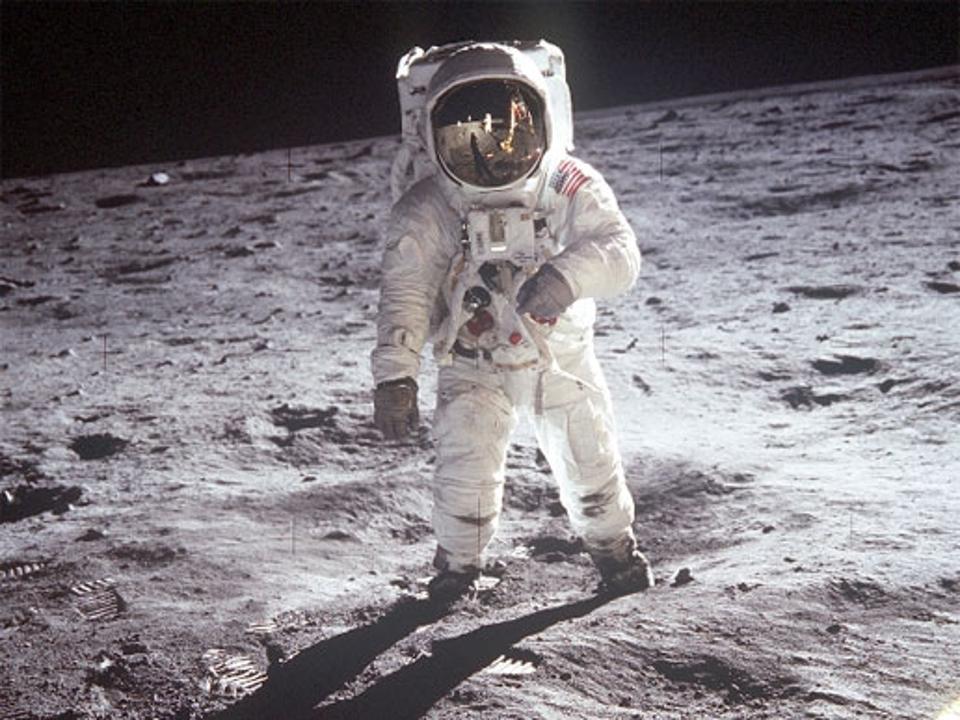
July 20, 1969, 50 years ago today: At 4:17 PM, U.S. Eastern Time, the lunar module Eagle, of the Apollo 11 mission, landed on the Sea of Tranquility, on the side of the Moon facing Earth.

The mission's commander was Lieutenant Junior Grade Neil Alden Armstrong, U.S. Navy, from Wapakoneta, in western Ohio, about halfway between Toledo and Dayton. In contact with Mission Control, in Houston, Texas, he spoke the 1st words any human had spoken from the surface of the Moon: "Houston, Tranquility Base here: The Eagle has landed."

With him, aboard Eagle, was the craft's pilot, Colonel Edwin Eugene Aldrin Jr., U.S. Air Force, known as Buzz, of the New York suburb of Montclair, Essex County, New Jersey. Orbiting the Moon above them, in the command module Columbia, was Colonel Michael Collins, U.S. Air Force, who grew up in many places around the world, as his father was a high-ranking U.S. Army officer.

All 3 men reached their 39th birthdays during the course of calendar year 1969, and each was taking part in his 2nd spaceflight.

At 10:56 PM, Armstrong stepped down the ladder on the side of Eagle, and put his left foot down on the surface of the Moon. He chose his 1st words very carefully, knowing that the whole world would remember them: "That's one small step for a man, one giant leap for mankind."

Except, between his Midwestern accent and the transmission of the words from the Moon to Houston, from Houston to the TV networks in New York, and from the networks in New York to the world, it sounded like he said, "One small step for man..." Which made no sense, as "man" and "mankind" were usually interchangeable.

It didn't matter. A man was standing on the Moon, and he was an American. Buzz Aldrin followed Armstrong a few minutes later. Four days later, they returned to Earth, and got a ticker-tape parade in New York City.

Every Summer, my grandparents rented a bungalow at South Seaside Park, on the Jersey Shore. This was that weekend for 1969. They, and my parents, watched the Moon landing at The Sand Bar. Not yet born, I tell people I had "an obstructed view." The bar is still there, and is now Chef Mike's Atlantic Bar & Grill, or "The ABG." It is 84 road miles south of Midtown Manhattan.

None of them ever went into space again. None had to.

Collins would be appointed an Assistant Secretary of State, and serve as the director of the Smithsonian Institution's National Air and Space Museum in Washington, D.C., where Columbia is on display. He is scheduled to turn 89 in October.

Aldrin battled clinical depression and alcoholism, recovered, and has become an advocate for recovery and for the space program. He is 89.

Armstrong was, for a time, the most famous man in the world, more so than the President, the Pope, or any athlete. He could have used his fame to make gobs of money. Basically a private person, he chose not to. He taught at the University of Cincinnati, and served on the commissions that investigated the near-disaster of Apollo 13 in 1970 and the explosion of the space shuttle Challenger in 1986.

In 1985, he was part of an expedition to the North Pole, led by a man who wanted to bring "the world's greatest explorers" together. Also on the expedition was Sir Edmund Hillary, the New Zealander who became the 1st man to reach the summit of the world's highest mountain, Mount Everest in Nepal, in 1953.

This would have been Hillary's 100th birthday, so the Moon landing was on his 50th.

Armstrong lived and worked on a farm near his Ohio hometown, and died of long-term heart trouble on August 25, 2012, at age 82.

*

Landing on the Moon. Reaching the highest mountain. Running a mile in under 4 minutes, as Roger Bannister became the 1st man to do in 1954. Flying between the mainlands of North America and Europe, as Charles Lindbergh became the 1st man to do in 1927. These were huge events. Big deals were made of them at the time.

I was born at the end of 1969, 5 months after this epochal event. My generation -- even people 4 or 5 years older than I am -- can't remember a time when there had never been a man on the Moon.

Of course, most of us can't remember there being a man on the Moon, as Apollo 17 left on December 14, 1972, and there hasn't been a manned Moon landing since, launched by any nation.

Fifty years. How long has that been?

On July 20, 1969, the Yankees defeated the Washington Senators 3-2 in 11 innings, at the old Yankee Stadium. No home runs were hit. The winning pitcher, in relief, was Jack Aker. Today, at the new Yankee Stadium, Aker was on hand, and caught the ceremonial first ball from a current astronaut, Mike Massimino.

Elsewhere in the American League: The Boston Red Sox beat the Baltimore Orioles 6-5 at Fenway Park. The Detroit Tigers split a doubleheader with the Cleveland Indians at Cleveland Municipal Stadium, the Tigers winning the 1st game 3-2, and the Tribe winning the 2nd game 5-4 in 10 innings. The Kansas City Royals swept a doubleheader with the Chicago White Sox at Comiskey Park, winning the 1st game 8-6, and the 2nd game 3-2 in 11 innings. The California Angels split a doubleheader with the Oakland Athletics at Anaheim Stadium: The Halos won the opener 7-3, and the A's won the nightcap 9-6. And the Minnesota Twins beat the Seattle Pilots 4-0 at Sick's Stadium.

While this great moment was occurring for all humanity, but mainly for America, the Mets weren't even in America. They split a doubleheader with the Montreal Expos at Jarry Park. They lost the 1st game 3-2, with Gary Gentry giving up 3 solo home runs; and won the 2nd game 4-3, as Ron Swoboda backed Don Cardwell up with 3 hits, including an RBI double.

Elsewhere in the National League, the Chicago Cubs swept a doubleheader from the Philadelphia Phillies at Connie Mack Stadium, 1-0 and 6-1. The Atlanta Braves beat the San Diego Padres 10-0 at Atlanta (-Fulton County) Stadium. And the San Francisco Giants beat their arch-rivals, the Los Angeles Dodgers, 7-3 at Candlestick Park. The Cincinnati Reds, the Houston Astros, the Pittsburgh Pirates and the St. Louis Cardinals got rained out. Why so many doubleheaders? It was a Sunday.

An urban legend says that, when he was rookie with the Giants in 1962, pitcher Gaylord Perry hit a home run in batting practice, and was told there would be a man on the Moon before he hit one in a real game, and that the landing was announced at Candlestick at around 8:00 Pacific Time, and then he hit a home run. The truth? We may never know if Perry was actually told that, but, that day, Perry did pitch, win, and hit a home run, but it was a day game.

Of the 24 Major League Baseball teams then playing, all but one, the Chicago Cubs, was playing their home games in stadiums with permanent lights. Only one, the Houston Astros, was playing on an artificial turf field, and only the Astros were playing under a dome (retractable or otherwise). There was no designated hitter, and no regular season interleague play.

Of the 24 ballparks used by MLB teams that year, only 5 are still in use by the teams then using them: Fenway Park in Boston, Wrigley Field in Chicago, Dodger Stadium and Angel Stadium in the Los Angeles area, and the Oakland Coliseum. The Astrodome in Houston and Robert F. Kennedy Stadium in Washington are no longer in use, but still stand.

There were 16 teams in the NFL and 10 in the AFL, and they were in the process of merging. Of those 26 teams, the only ones in the same stadiums they were in for the 1969 season are the Oakland Raiders (who left Oakland and returned), the Los Angeles Rams (who left Los Angeles and returned, and will leave the Coliseum a 2nd time next year, for a new stadium) and the Green Bay Packers (Lambeau Field).

From the NBA and the NHL combined, 1 one arena remains from the 1969-70 season that was about to begin: Madison Square Garden in New York, then billed as "the New Madison Square Garden Center," but now older than the "Old Garden" that it replaced. The Brooklyn Nets were known as the New York Nets, and were playing home games at the 5,200-seat Island Garden in Hempstead. It was demolished in 1973. The New York Islanders and the New Jersey Devils did not yet exist.

What were the defining baseball players of my childhood doing in July 1969? Reggie Jackson was in the middle of his 2nd full season, in which he hit 47 home runs. Thurman Munson and Carlton Fisk were about to make their big-league debuts. Tom Seaver and Nolan Ryan were helping the Mets to their Miracle – but, 20 days later, after it was completed, if you had bet then that neither one would ever win another World Championship, people would have laughed at you. (Of course, they also would have laughed if you had then bet that Ryan would win more games in the majors than Seaver.)

Pete Rose won his 2nd straight NL batting title, and his Cincinnati Reds teammate Johnny Bench had a pretty good season, but they hadn't yet won their 1st Pennant -- that would come the next season. Rod Carew was forging his 1st AL batting title, and there would be 6 more. Carl Yastrzemski hit 40 home runs and drove in 111 runs, but his Red Sox had already changed significantly from their "Impossible Dream" Pennant team of 2 years earlier. Steve Carlton was about to set a new NL record with 19 strikeouts -- but would still lose the game to the Mets. Willie Stargell had recently become the 1st player to hit a home run completely out of Dodger Stadium. Four years later, he would do it again.

Mike Schmidt was still playing at Ohio University (not to be confused with The… Ohio State University), and had yet to face a professional pitch. George Brett was still at El Segundo High School in Los Angeles County.

The current managers and head coaches of New York Tri-State Area teams? Barry Trotz of the Islanders and Domènec Torrent of NYCFC were 7 years old, Pat Shurmur of the Giants was 4, David Quinn of the Rangers was 3, Kenny Atkinson of the Nets was 2, and the rest weren't born yet: Chris Armas of the Red Bulls was born in 1972, Aaron Boone of the Yankees in 1973, David Fizdale of the Knicks and Katie Smith of the Liberty in 1974, Mickey Callaway of the Mets John Hynes of the Devils in 1975, and Adam Gase of the Jets in 1978.

The defending World Champions in the 4 major sports were the Detroit Tigers in baseball, the New York Jets (believe it) in football, the Boston Celtics in basketball and the Montreal Canadiens in hockey.

There was no official Heavyweight Champion of the World, as Muhammad Ali had been stripped of the title for refusing to be drafted, an unconstitutional measure that would take until October 30, 1974 to be fully rectified. Joe Frazier and Jimmy Ellis would soon fight in a "unification" bout to decide who was the official champion.

The Olympic Games have since been held in America 4 times, Canada 3 times, Japan twice, Russia twice, Korea twice, and once each in Germany, Austria, Bosnia, France, Spain, Norway, Australia, Greece, Italy, China, Britain and Brazil. The World Cup has since been held in Mexico and Germany twice each, and once each in America, Argentina, Spain, Italy, France, Japan, Korea, South Africa, Brazil and Russia.

There were then 25 Amendments to the Constitution. There was, as yet, no Environmental Protection Agency, OSHA, Title IX or legalized abortion. The Stonewall Riot had happened just a few weeks before. The last Justice of the U.S. Supreme Court in 1969 to still be on it was former football star Byron "Whizzer" White, in 1993. They are all dead now.

Richard Nixon was President of the United States. Harry Truman and Lyndon Johnson were still alive. So was the widow of Dwight D. Eisenhower, who had died earlier in the year. Gerald Ford was the Minority Leader of the U.S. House of Representatives. Jimmy Carter was a former State Senator in Georgia, about to run his second, much more successful, campaign for Governor. Ronald Reagan was in his first term as Governor of California.

George Herbert Walker Bush was a Congressman from Texas, and his son George had entered the Texas Air National Guard. Apparently, it was okay for him and his father to support the Vietnam War even if he didn't have to actually fight in it.

Bill Clinton was at Oxford University on a Rhodes Scholarship, and Hillary Rodham was about to be named valedictorian at Wellesley College. Al Gore was in the U.S. Army in Vietnam, while Dan Quayle was in the Indiana National Guard. Guess which one supported the war, and which one didn't.

Joe Biden was about to be admitted to the Delaware bar, and was too old to be drafted. Mitt Romney had just gotten married, and had gotten a draft deferment as a Mormon missionary. His father, George Romney, was President Nixon's Secretary of Housing & Urban Development.

Dick Cheney and Newt Gingrich both had teaching deferments. Rudy Giuliani got a deferment as a law clerk. John McCain did not have a deferment, and the Navy pilot was a prisoner of war in Vietnam. Mitch McConnell enlisted in the U.S. Army, and John Boehner enlisted in the U.S. Navy, but each later discharged for medical reasons. Barack Obama was not subject to the draft, being just 8 years old. Donald Trump claimed bone spurs.


The Governor of New York was Nelson Rockefeller, having made 3 unsuccessful runs for President. The Mayor of New York City was John Lindsay, who had just been denied renomination by the City’s Republican Party because of his poor handling of snow removal during the blizzard earlier in the year. But he would win a 2nd term as a 3rd-party nominee.

The Governor of New Jersey was Richard J. Hughes, about to wrap up his second term. Former Governor Robert B. Meyner would try to get the office back, but would fail, losing to South Jersey Congressman William T. Cahill.

Nancy Pelosi was about to move to San Francisco, where her brother-in-law was on the Board of Supervisors. Andrew Cuomo and Phil Murphy were 11 years old, and Bill de Blasio was 8.

There were still living veterans of America's Indian Wars, the Mahdist War, the Boer War and the Spanish-American War. There were still living survivors of the Johnstown Flood of 1889, the competitors of the 1st modern Olympics of 1896, and the players of the 1st World Series of 1903.

The Pope was Paul VI. Jorge Mario Bergoglio, the future Pope Francis, was about to be ordained as a priest. Canada's Prime Minister was Pierre Trudeau. He was young (50), dashing and charismatic. It was as if John F. Kennedy was singing lead for the Beatles -- in French. Canada had just gotten the Expos, their 1st Major League Baseball team. And a group called The Guess Who had just become Canada’s biggest rock band ever (to that point). For the first time ever, Canada was hip. Especially if you were an American worrying about being drafted. 

Elizabeth II was Queen of England -- that still hasn't changed -- but she was just 43 years old. Britain's Prime Minister was Harold Wilson. 
There have since been 9 Presidents of the United States, 9 Prime Ministers of Britain (soon, there will be a 10th), and 4 Popes.

The English Football League had just been won by Leeds United, and the FA Cup was won by Manchester City, the defending League Champions, beating Leicester City 1-0 on a goal by Neil Young – no, not that Neil Young. AC Milan, led by perhaps Italy's greatest player ever, Gianni Rivera, won their 2nd European Cup by beating Ajax Amsterdam, led by 21-year-old wunderkind Johan Cruijff. Ajax and their "Total Football" would be back, big-time.

Major novels of 1969 included The Godfather by Mario Puzo, Slaughterhouse-Five by Kurt Vonnegut, The Andromeda Strain by Michael Crichton, The French Lieutenant's Woman by John Fowles, Portnoy's Complaint by Philip Roth, Rich Man, Poor Man by Irwin Shaw, and The Seven Minutes by Irving Wallace (about a novel, of the same title, that was "the most banned book in history," containing a woman's thoughts during 7 minutes of sex).

Also published that year was Naked Came the Stranger by Peneleope Ashe. This was a name used for a composite of 24 authors, conspiring to see if a novel could be really, really bad, but still sell big if it had a lot of sex scenes in it. This was a truly late-Sixties kind of experiment – and, for better or for worse, it worked.

Major non-fiction books included the career-launching memoir I Know Why the Caged Bird Sings by Maya Angelou, and the career-launching historical work Mary, Queen of Scots by Antonia Fraser.

J.R.R. Tolkein was still alive. So was Jack Kerouac, but he died 3 months later as a result of his excessive drinking. Stephen King was at the University of Maine, George R.R. Martin was at Northwestern University, and J.K. Rowling was 4 years old. No one had yet heard of John Rambo, Spenser: For Hire, George Smiley, The Punisher, Rocky Balboa, T.S. Garp, Arthur Dent, Jason Bourne, Hannibal Lecter, Celie Harris, Kinsey Millhone, Jack Ryan, Forrest Gump, John McClane, Alex Cross, Bridget Jones, Robert Langdon, Bella Swan, Lisbeth Salander or Katniss Everdeen.

Major films of the Summer of '69 included the Westerns True Grit and The Wild Bunch, Easy Rider, Woody Allen's directorial debut Take the Money and Run, and a film that told the story of Arlo Guthrie's song Alice's Restaurant. And Charlton Heston played an aging quarterback in the film Number One.


James Bond was about to be played by George Lazenby for the 1st and only time, in On Her Majesty's Secret Service. Adam West's TV version of Batman had recently been canceled. Bob Holiday, in the 1966 Broadway musical It's a Bird... It's a Plane... It's Superman, was the most recent live-action Man of Steel. The Doctor Who franchise was in the process of regenerating from Patrick Troughton to Jon Pertwee. Michael Douglas (in his 2nd movie) and Peter Strauss (in his 1st) were about to premiere in Hail, Hero! Douglas' future wife, Catherine Zeta-Jones, was about to be born.

Star Trek had recently been canceled, and Gene Roddenberry had moved on to directing a sexploitation film, Pretty Maids All In a Row. George Lucas and Francis Ford Coppola had co-founded the film studio American Zoetrope, but Lucas had not yet directed a feature-length film. Nor had Steven Spielberg.

Television shows that debuted in the 1969-70 season that was about to begin included Room 222Marcus Welby, M.D., Medical CenterThe Brady Bunch, and kids' shows Sesame StreetH.R. Pufnstuf and Scooby-Doo, Where Are You? From Britain came the debuts of Monty Python's Flying Circus and The Benny Hill Show. Robert Kardashian was in law school, Bruce Jenner was playing college football in Iowa, Kristen Mary Houghton was about to turn 14, and none of them knew each other yet.

No one had yet heard of Carol Brady, Mary Richards, Keith Partridge, Archie Bunker, Kwai Chang Caine, Fred Sanford, Bob Hartley, Theo Kojak, Arthur Fonzarelli, Barney Miller, J.R. Ewing, Mork from Ork, William Adama, Arnold Jackson, Ken Reeves, Bo & Luke Duke, Mario & Luigi, Sam Malone, Christine Cagney & Mary Beth Lacey, He-Man, the Teenage Mutant Ninja Turtles, the Thundercats, Bart Simpson, Zack Morris, Hayden Fox, Dale Cooper, The Seinfeld Four, Buffy Summers, Fox Mulder & Dana Scully, Andy Sipowicz, Ross Geller & Rachel Greene, Doug Ross, Xena, Ash Kethcum, Carrie Bradshaw, Tony Soprano, Olivia Benson, Jed Bartlet, Master Chief, Jack Bauer, Omar Little, Leroy Jethro Gibbs, Michael Bluth, Michael Scott, Don Draper, Walter White, Jax Teller, Richard Castle, Leslie Knope, Sarah Manning, Jane "Eleven" Hopper or Maggie Bell.

The Number 1 song in America was "In the Year 2525" by Denny Zager & Rick Evans -- but it wasn't projecting a hopeful future. Brian Jones was fired from the Rolling Stones, and died just 2 days before the band's concert in London's Hyde Park. It went forward anyway, and 500,000 people attended. Another 500,000 attended the Woodstock Music and Art Festival on a dairy farm in the Catskill Mountains in Bethel, New York.

Frank Sinatra released "My Way." Elvis Presley was about to begin his live-in performances -- what would now be called a residency -- in Las Vegas. The Beatles were recording Abbey Road, and took the famous crosswalk picture on August 8. Bob Dylan had just released Nashville Skyline. Johnny Cash had just debuted his variety show, and Dylan was his 1st guest.

Michael Jackson and his brothers were about to make their national debut as the Jackson 5. He was 11 years old. So was Madonna, but she wouldn't have a hit for another 13 years. Billy Joel's 1st band, The Hassles, had just released its 2nd album, but was about to break up. Bruce Springsteen had just formed a band named Child, which would become Steel Mill, and would evolve into The E Street Band. Elton John was about to release his 1st album. David Bowie had released "Space Oddity," but had yet to suggest the legend he was to become. And Bryan Adams, who famously had a hit with a song titled "Summer of '69," was 9 years old.

Inflation was such that what $1.00 bought then, $6.96 would buy now. A U.S. postage stamp cost 6 cents, and a New York Subway ride 20 cents. The average price of a gallon of gas was 35 cents, a cup of coffee 42 cents, a McDonald's meal 79 cents (49 cents of that being the recently-introduced Big Mac, plus fries and a shake), a movie ticket $1.20, a new car around $2,300, and a new house $28,100. The Dow Jones Industrial Average closed the preceding Friday at 845.92.

The tallest building in the world was the Empire State Building in New York. Credit cards were still a relatively new thing, and there were no automatic teller machines in America. Nor were there personal computers or home video games. Steve Jobs, Bill Gates and Tim Berners-Lee were all 14 years old. There were heart transplants, liver transplants, lung transplants, kidney transplants and artificial kidneys, but no artificial hearts. There were birth control pills, but no Viagra.

In the Summer of 1969, in addition to the preceding, the Australian aircraft carrier HMAS Melbourne makes a mistake in joint maneuvers with the U.S. Navy, and crashes into the destroyer USS Frank E. Evans, killing 74 men. Fighting known as the Battle of the Bogside broke out in Northern Ireland. Britain removed the halfpenny coin from circulation. The Canadian Parliament made French equal to English throughout the nation. Honduras and neighboring El Salvador fought a 4-day war, sparked by a soccer game between their national teams. And President Richard Nixon made the 1st reduction in U.S. troops in Vietnam, giving the nation hope that he might actually keep his promise to end the war there. That hope wouldn't last.

In America, Warren Burger was sworn in to replace the retiring Earl Warren as Chief Justice of the Supreme Court. Hurricane Camille killed 248 people along the coast of the Gulf of Mexico. A militant faction of the Students for a Democratic Society (SDS) broke away, and renamed themselves the Weathermen, after a line in the Dylan song "Subterranean Homesick Blues": "You don't need a weatherman to know which way the wind blows." The Cuyahoga River, in downtown Cleveland, caught fire due to decades of pollution, helping to spur the creation of the EPA. The fish-based fast food chain Long John Silver's and the clothing chain The Gap opened their 1st stores.

Senator Ted Kennedy took a wrong turn driving a woman home from a party on Chappaquiddick Island, Massachusetts, and she died. His failure to report the accident for several hours damaged his reputation, and probably prevented him from ever becoming President. Members of a cult led by Charles Manson killed several people in Los Angeles, including actress Sharon Tate. And former Heavyweight Champion of the World Rocky Marciano was killed in a plane crash in Iowa.

Frank Loesser, and Ludwig Mies van der Rohe, and Bill Carrigan, who managed the Boston Red Sox to win the 1915 and 1916 World Series, died. Jennifer Lopez, and Troy Percival, and Joe Sakic were born.

July 20, 1969. Neil Armstrong becomes the 1st Earth person to walk on Earth's Moon. Never again would we be able to say no one had done it.

Of course, we've spent the last 50 years saying, "If we can put a man on the Moon, why can't we (do something comparatively simple)?"

And we haven't been back to the Moon for 47 years. When will it happen again? There's talk of it happening by 2024, but I wouldn't bet on it. Not without a better President than either Nixon or Trump.

10 Historical Moments That Were a Lot More Cynical Than You Realized

These are listed in chronological order.

1. 1200 BC (or thereabouts): The Ten Commandments. The late great comedian George Carlin, known for his antipathy to organized religion spelled it out:

"I am The Lord, thy God. Thou shalt not have strange gods before me." "Thou shalt not take the name of The Lord, thy God, in vain." "Thou shalt keep holy the Sabbath." Right off the bat, the first three, pure bullshit: "Sabbath day," "Lord's name," "strange gods." Spooky language! Spooky language, designed to scare and control primitive people.

"It's a political document," he said earlier in the bit. He eventually boiled the Commandments he thought humanity needed down to 2: "Thou shalt always be honest and faithful" -- a positive, rather than negative, combination of the prohibitions against adultery, stealing and lying -- and, "Thou shalt try real hard not to kill anyone, unless, of course, they pray to a different invisible man than the one you pray to."

Then again, "Thou shalt not commit adultery" was originally a guard against one man stealing another man's property, because wives were considered property.

2. 1453-1564: The Renaissance. I chose the dates as follows: The former for the Fall of Constantinople (now Istanbul, Turkey), a convenient ending date for the Middle Ages, and also for the start of the Age of Exploration; and the latter for the death of Michelangelo Buonarotti, the last survivor of the big names of the Renaissance.

A lot of what the great artists did was pandering to their patrons, most of whom weren't dark-skinned Italians from Rome, Naples, Apulia (the "heel" in "the boot of Italy"), Calabria (the "toe" in the "boot"), or Sicily. Rather, they were from Northern Italy, places like Venice, Florence, Milan and Turin. They were "white," more Germanic than what we would now consider "Italian."

To put it into a modern perspective, which wouldn't have made sense then, but it does give you an idea: Central Milan, in Lombardy, is 34 miles from Italy's border with Switzerland; while Turin, in the Piedmont, the Italian Alps, is 60 miles from the border with France. Florence is a bit further south, in Tuscany, about halfway between Milan and Rome.

But that geography is why we have a light-skinned man with long blond hair as our defining image of Jesus, rather than a swarthy man with short hair and bushy eyebrows, as most Jewish men living in "The Holy Land" would have been in the 1st Century AD. And Michelangelo's statue of King David, now in the Gallery of the Academy of Florence (Galleria dell'Accademia di Firenze), sure doesn't look Jewish, even though David is the leading hero of the people of the modern State of Israel.

3. 1590-1613: The Plays of William Shakespeare. Presuming he actually existed, and his plays were not written by someone else (as many have alleged, with flimsy evidence), Willy Shakes could pander with the best of them.

From his 1st staged plays, his cycle about King Henry VI (reigned from 1422 to 1461), until the death of Queen Elizabeth I in 1603, his acting troupe was known as The Lord Chamberlain's Men, and his plays made Elizabeth's family, the House of Tudor, and their predecessors, the House of Lancaster, look like heroes, or at least well-meaning in their failures; and made their arch-rivals, the House of York, especially King Richard III (1483 to 1485), look like villains.

When Elizabeth died, making King James VI of Scotland also King James I of England, Shakespeare turned coat faster than you can say, "Benedict Arnold." He renamed his troupe The King's Men. And Macbeth (the real one, apparently not a villain, reigned over Scotland not for a few weeks as the play suggests, but from 1040 to 1057) suggested a more noble lineage for James' family, the House of Stuart, than anyone had yet publicly alleged.

4. December 16, 1773: The Boston Tea Party. Was the dumping of the tea in Boston Harbor a patriotic act? Yes. Was it also a protest against taxation without representation? Yes. But it was more than that.

Keep in mind the science of the era. Water could be easily tainted, by man or nature (or, through improper sewage treatment, both). There was no real way to refrigerate liquids. The advent of pasteurization was about 90 years away, so milk did not last long before spoiling. Fruit juice, as we know it now, was not advisable, either.

So what did people drink back then? Liquids that did not need to be refrigerated. Tea. Coffee. Beer. Wine. Hard liquor. That's why they were so angry about the tax on tea: It wasn't just that it was done without their having a voting representative in the Parliament in London to weigh in on it, it made the stuff too expensive for them, and essentially took one of their few options away.

But who led the Boston Tea Party? Samuel Adams, the leading brewer of beer in British America at the time. And who was his best friend? John Hancock, the richest man in the colony of Massachusetts at the time. And how did Hancock get so rich? Shipping. Specifically, transporting liquor.

In other words, Adams was helping himself, and his pal Hancock, strike at their competition. The Boston Tea Party wasn't just good patriotism, it was good business. At least, until the British Army arrived. In that case, war was not good for business.

5. 1860-1865: Abe Lincoln and Slavery. Elected President in 1860, leading to the secession of 11 Southern States from the Union, Abraham Lincoln's goal in the American Civil War -- which the Confederacy, the South, started -- was to save the Union. The man's own words, in a letter to Horace Greeley, publisher of the New York Tribune and one of the nation's leading advocates for the abolition of slavery, dated August 22, 1862:

My paramount object in this struggle is to save the Union, and is not either to save or to destroy slavery. If I could save the Union without freeing any slave I would do it, and if I could save it by freeing all the slaves I would do it; and if I could save it by freeing some and leaving others alone I would also do that. What I do about slavery, and the colored race, I do because I believe it helps to save the Union; and what I forbear, I forbear because I do not believe it would help to save the Union. 

Sounds like "Honest Abe" should have kept the truth to himself.

A month later, on September 22, 1862, Lincoln issued the Emancipation Proclamation, to take effect on January 1, 1863:

On the first day of January in the year of our Lord, one thousand eight hundred and sixty-three, all persons held as slaves within any State, or designated part of a State, the people whereof shall then be in rebellion against the United States shall be then, thenceforward, and forever free. 

There was just one problem: At the time, the Confederate States of America was, however despicable its reason for existence and its operation may have been, a sovereign nation. Lincoln had no legal authority to free the slaves in those States.

In those States that still had slavery, but remained in the Union -- Delaware, Maryland, West Virginia, Kentucky and Missouri -- Lincoln left it alone.

Now, he did lobby for Congress to pass the 13th Amendment to the Constitution of the United States, which it did, and then passed on to the States for ratification, which they did -- the restored Georgia being the necessary 27th State to do so, on December 6, 1865, leading to Secretary of State William H. Seward declaring on December 18 that three-quarters of the States had done so, making the Amendment part of the Constitution, and it was on that date that slavery in America was abolished.

But Lincoln was assassinated on April 14, 1865, dying the next day. In other words, 8 months after he died, slavery was still not officially banned by the federal government. It can be argued that "the Great Emancipator," Abe Lincoln, never freed a single slave -- that it was the U.S. Army and Navy, and the Congress, and the States, that did so.

But they wouldn't have done so without him. Not without the words of his Inaugural Addresses in 1861 and 1865. Not without his Emancipation Proclamation of 1862. Not without his Gettysburg Address of 1863. Not without his re-election in 1864. And not without his lobbying for the Amendment.

6. 1933-1941: The New Deal. Accepting the Democratic nomination for President at Chicago Stadium on July 2, 1932, Governor Franklin D. Roosevelt of New York told the delegates, the spectators, and a nationwide radio audience, "I pledge you, I pledge myself, to a new deal for the American people."

"A new deal." It was a great phrase, embracing the reforms of his cousin, the late Republican President of a previous generation, Theodore Roosevelt; but also those of his own political mentor, the late Democratic President of a previous generation, Woodrow Wilson.

TR had called his platform the Square Deal, and his programs were still popular. Wilson had called his the New Freedom, and, while America's membership in his League of Nations was soundly rejected, his domestic reforms remained successful and accepted.

In fact, when FDR wrote down the words "New Deal," he had no idea of what specifics it would entail. He just knew he had to do something, and to be seen as willing to do something, because his Republican opponent, the incumbent, Herbert Hoover, was largely seen as having done nothing.

When he was sworn into office on March 4, 1933, he and his advisors, the so-called Brain Trust, essentially made things up as they went along. Some of what they did was, in fact, based on the achievements of TR and Wilson. Some of it was based on what FDR, and before him Alfred E. Smith, had done as Governor of New York.

And some of it was even based on the reforms of Hoover. Anyone who says Hoover did nothing to alleviate the Great Depression is wrong, although it is completely fair to say he didn't do enough. FDR recognized that some of what Hoover did had worked a little bit, and that, if Hoover had done more of it, the Depression would have eased and possibly ended sooner, and FDR himself wouldn't have had a chance in 1932.

Furthermore, a lot of what FDR did required compromises with the Southern Democrats who ran key committees in both houses of Congress. This required him to back off on civil rights measures that might really have helped. FDR might have had the political clout to move civil rights forward, but he didn't think he could, because he needed those Southern barons too much. He didn't even try to move civil rights forward that much during World War II, when he had more political clout than any president has had, possibly ever.

7. 1945-1947: The Signing of Jackie Robinson. Branch Rickey, then president of the Brooklyn Dodgers, knew by 1945 that racially reintegrating Major League Baseball was now possible, with the death of racist Commissioner Kenesaw Mountain Landis, and his replacement by the more amenable, though Southern, Albert "Happy" Chandler. Rickey knew it was the morally right thing to do. He also realized that it was the competitively right thing to do: Get the best possible players, regardless of race, and you'll win more games.

He also realized that it was the financially right thing to do: Do the preceding, win more games, and you'll get more fans. But even before the winning gets rolling, black fans will want to come out and see black players. It was good citizenship. It was good baseball. And it was good capitalism. Or, as Rickey himself, about whom it was once said, "He had money and he had players, and he did not like to see the two mix," might have called it, a Triple Crown.

8. September 24, 1957: Dwight D. Eisenhower and Civil Rights. When "Ike" sent the 101st Airborne, one of the most elite units of the U.S. Army, for whom he had once been Chief of Staff, to protect the 9 black teenagers attempting to enroll in, and thus racially integrate, Central High School in Little Rock, Arkansas, everyone who wasn't a bigot agreed that it was the right thing to do.

But Ike didn't do it because it was moral. He actually disagreed with the U.S. Supreme Court's unanimous decision, 3 years earlier, striking down all State and local laws segregating public school students. But, as President, he had taken an oath to "preserve, protect and defend the Constitution of the United States." Ike considered himself a man of his word, and he would protect the law, even though, in this case, he disagreed with it.

9. 1961-1963: John F. Kennedy and Civil Rights. JFK sent U.S. Marshals to Oxford, Mississippi to integrate the University of Mississippi in September 1962. When Governor Ross Barnett sent the Mississippi National Guard to stop them, JFK used his powers as Commander-in-Chief to federalize the National Guard, and there wasn't a damned thing Barnett could legally do.

In June 1963, another Southern Governor stood in the way, and he decided to make it literal: Governor George Wallace of Alabama made his "stand in the schoolhouse door," blocking the entrance to Foster Auditorium, the University of Alabama's basketball arena and registration building in Tuscaloosa, to prevent 2 black students from officially enrolling, which, under federal law, they had the right to do.

JFK's Attorney General, also his brother, Robert F. Kennedy, sent his Deputy, Nicholas Katzenbach, and some U.S. Marshals, down there, and Katzenbach told Wallace to get out or he would be arrested. Everyone remembers that Wallace stood there, but they tend to forget that, rather than be seen as a criminal, taken away in handcuffs, he backed down.

By this point, the Kennedy brothers had realized that assisting the progress of civil rights was the right thing to do in its own right. But they didn't always see it that way. They were Cold Warriors. JFK once said, "If we offer the developing world freedom, and the Communists offer them food, who are they going to turn to?"

It's worth going back to a speech that RFK made at the University of Georgia on May 6, 1961. That school's racial integration wasn't nearly as heated as would be "Ole Miss" the next year and "'Bama" the next. It was Law Day on the Athens, Georgia campus, and "UGa" wanted the nation's highest law enforcement official to speak. They got him, but they got something they hadn't bargained for: He framed integration as being not the product of interference from Communists abroad, as American racists had alleged, but as a weapon against such interference:

The time has long since arrived when loyal Americans must measure the impact of their actions beyond the limits of their own towns or States. For instance, we must be quite aware of the fact that 50 percent of the countries in the United Nations are not white; that, around the world in Africa, South America, and Asia, peoples whose skins are a different color than ours are on the move to gain their measure of freedom and of liberty.

From the Congo to Cuba, from South Vietnam to Algiers, in India, Brazil and Iran, men, women, and children are straightening their backs, and listening to the evil promises of Communist tyranny, and the honorable promises of Anglo-American liberty. And those people will decide not only their own future, but ours; how the cause of freedom fares around the world. That will be their decision.

In the United States, we are striving to establish a rule of law instead of a rule of force. In that forum, and elsewhere around the world, our deeds will speak for us.

In the worldwide struggle, the graduation at this university of Charlene Hunter and Hamilton Holmes will, without question, aid and assist the fight against Communist political infiltration, and even guerilla warfare.

When parents send their children to school this fall in Atlanta, peaceably and in accordance with the rule of law, barefoot Burmese and Congolese will see before their eyes Americans living by the rule of law.

It is possible to be noble and cynical at the same time. The Medicis proved it. So did Shakespeare. So did Samuel Adams, Lincoln, FDR, Branch Rickey and Eisenhower. Now, the Kennedys had proved it as well.

And John F. Kennedy would prove it one more time, although he would not live to see the final product, 50 years ago today:

10. July 20, 1969: The Moon Landing. On May 25, 1961, 43 days after Soviet pilot Yuri Gagarin became the 1st human in space, and 20 days after Alan Shepard became the 1st American in space, JFK delivered an address to a Joint Session of Congress -- officially, not a State of the Union Address:

I believe that this nation should commit itself to achieving the goal, before this decade is out, of landing a man on the Moon, and returning him safely to the Earth. No single space project in this period will be more impressive to mankind, or more important for the long-range exploration of space; and none will be so difficult or expensive to accomplish.

On September 12, 1962, he went to Rice University in Houston, Texas, the hometown of the space center that directed America's manned space missions, which took off at Cape Canaveral on the Atlantic Coast of Florida:

Why, some say, the Moon? Why choose this as our goal? And they may well ask, Why climb the highest mountain? Why, 35 years ago, fly the Atlantic? Why does Rice play Texas?

We choose to go to the Moon. We choose to go to the Moon in this decade, and do the other things, not because they are easy, but because they are hard! Because that goal will serve to organize and measure the best of our energies and skills. Because that challenge is one that we are willing to accept, one we are unwilling to postpone, and one which we intend to win, and the others, too.

In other words, "If we, as a nation, as a people, can do this, then we can do anything." Or, as we so often said after doing it, "If we can put a man on the Moon, why can't we (do something comparatively simple)?"

On July 20, 1969, at 4:17 PM U.S. Eastern Time, as part of the Apollo 11 mission, the lunar module Eagle landed on the lunar surface, on a part of the Moon that humans had named the Sea of Tranquility. Mission commander Neil Armstrong said, "Houston, Tranquility Base here. The Eagle has landed." At 10:56 PM Eastern Time, Armstrong climbed out, went down the Eagle's ladder, and put his left foot on the Moon's surface, saying, "That's one small step for a man, one giant leap for mankind."

Over the next 3 and a half years, a total of 6 missions would land on the Moon, and many scientific advancements would result. But on December 14, 1972, Apollo 17 left the Moon, and no human has been back since. We've talked about it, but we haven't done it.

Why? Because, as big as it seemed, landing on the Moon wasn't just an achievement. To Kennedy, it was a message. Not so much to us, as to them. As the greatest astronomer of the 20th Century, Carl Sagan, put it in a CBS documentary on the event's 25th Anniversary in 1994, "The whole point of landing on the Moon was to beat the Russians. Once we beat the Russians, there was no point to it."

Of course, Sagan, one of the most imaginative men of his time, disagreed with that principle. But he had to accept it as fact. The American space program stalled, because Richard Nixon was now President, and he didn't seem to care about the next step, whatever that might have been. His successors seemed to care little, too. By the time we got another genuine science guy in the White House, Bill Clinton, the program had already been set so far back that all momentum had been lost.

Maybe if JFK had lived, he could have put the next step in place. Or, if Nixon had pursued space exploration as much as he had pursued, say, Détente with the Soviet Union and China, then, by the time he died in 1994, we could have had a permanent base on the Moon (as seen on the TV show Space: 1999, hopefully without the tragic result of that show's pilot), and we might even have landed on Mars.

But it didn't happen. And we may well be considerably poorer, in resources and in morale, for it.

UPDATE: In 2022, I read an article that said that the slogan, "Breakfast is the most important meal of the day" was designed by the farm industry to sell more eggs. The slogan is true, especially in regard to protein, with which eggs are loaded. So the slogan is both good health and good capitalism.

Monday, January 16, 2017

Living People Who...

R.I.P. Gene Cernan, retired U.S. Navy Captain, commander of Apollo 17, and thus the last man to walk on the Moon. 1934-2017.

Living People Who...

* Walked on the Moon: 6 of the 12: Buzz Aldrin (Apollo 11), Alan Bean (Apollo 12), David Scott (Apollo 15), John Young and Charles Duke (Apollo 16), and Harrison Schmitt (Apollo 17). Duke is the youngest. He's 81.

* Survived the attack on Pearl Harbor: Unclear, but it could be around the number who died there: 2,403.

* Played in what we would now call Major League Baseball in the 1930s: 1: Bobby Doerr, Hall of Fame 2nd baseman for the Boston Red Sox.

* Played on World Series-winning teams in the 1940s: 5: Ed Mierkowicz of the 1945 Detroit Tigers, Red Schoendienst of the 1946 St. Louis Cardinals, Bobby Brown of the 1947 and 1949 New York Yankees, Eddie Robinson of the 1948 Cleveland Indians, and Charlie Silvera of the 1949 Yankees.

* Played in the All-America Football Conference of 1946-49: As far as I know, only 1: Ben Agajanian, who preceded Tom Dempsey as a man who placekicked professionally without a full complement of toes. He was also 1 of 2 men, Hardy Brown being the other, to play in the AAFC, the NFL and the 1960s version of the American Football League. And he played for a Los Angeles team in all 3: The 1947 and '48 Dons, the 1953 Rams, and the 1960 Chargers. He won an NFL Championship with the 1956 New York Giants. He was still kicking in 1964, with the Chargers in San Diego, at age 45, and is now 97.

* Won the Heisman Trophy in the 1940s: 1: Johnny Lujack, Notre Dame, 1947. The next-earliest is Howard "Hopalong" Cassady, Ohio State, 1955.

* Played on NFL Championship teams in the 1940s: 5: Charlie Trippi of the 1947 Chicago Cardinals; Neill Armstrong (no relation to the 1st man on the Moon), Bill Mackrides and Jack Myers of the 1948 and 1949 Philadelphia Eagles; and Clyde Scott of the 1949 Eagles.

* Played on NBA Championship teams in the 1940s: 3: Carl Meinhold of the 1948 Baltimore Bullets, and Arnie Ferrin and Donnie Forman of the 1949 Minneapolis Lakers.

* Played on Stanley Cup-winning teams in the 1940s: 4: Gerry Plamondon of the 1946 Montreal Canadiens; Howie Meeker of the 1947, 1948 and 1949 Toronto Maple Leafs; Phil Samis of the 1948 Toronto Maple Leafs; and Tod Sloan of the 1949 Toronto Maple Leafs.

* Played on FA Cup-winning teams in the 1940s: 1: Reg Harrison of the 1946 Derby County squad. The next-earliest survivor is Cyril Robinson, the last survivor of the 1953 Blackpool team that featured Stanley Matthews and Stan Mortensen.

* Played on the U.S. team that beat England at the 1950 World Cup: 1: Walter Bahr, whose sons Matt and Chris were placekickers on Super Bowl-winning teams.

* Played in "The Bobby Thomson Game" on October 3, 1951: 2: Willie Mays of the New York Giants and Don Newcombe of the Brooklyn Dodgers.

* Played in "The Don Larsen Game" on October 8, 1956: 1: Don Larsen himself.

* Played on World Cup winners in the 1950s: 4: Horst Eckel and Hans Schaefer of the "Miracle of Bern" West Germany team in 1954, and Mario Zagallo and Pelé of 1958 Brazil.

* Played on the 1st team to win the European Cup (the trophy kept the name, but the tournament is now called the UEFA Champions League), 1956 Real Madrid: 1: Francisco Gento. "Paco" Gento is also the only man to win the European Cup 6 times.

* Have won baseball's Triple Crown: 3: Frank Robinson, Carl Yastrzemski and Miguel Cabrera.

* Managed or coached teams in the New York Tri-State Area to a World Championship: 7: Davey Johnson of the 1986 Mets; Bill Parcells of the 1986 and 1990 Giants; Mike Keenan of the 1994 Rangers; Jacques Lemaire of the 1995 New Jersey Devils; Joe Torre of the 1996, 1998, 1999 and 2000 Yankees; Larry Robinson of the 2000 Devils; and Joe Girardi of the 2009 Yankees. That's it. Gil Hodges of the Mets, Weeb Ewbank of the Jets, Red Holzman of the Knicks, and Al Arbour of the Islanders are all dead.

* Managed Arsenal Football Club to major trophies: 3: Terry Neill, George Graham and Arsene Wenger. Between them, 16 trophies.

* Managed Tottenham Hotspur Football Club to major trophies: 4: Keith Burkinshaw, Terry Venables, George Graham (yes, the same one) and Juande Ramos. Between them, 6 trophies. If you don't count the League Cup as a major trophy, then it's down to 2, Burkinshaw and Venables.

* Served as regular hosts of The Tonight Show: 3: Jay Leno, Conan O'Brien and Jimmy Fallon. And Conan shouldn't even count.

* Appeared on The Honeymooners: As far as I know, only 1: Joyce Randolph, who played Trixie Norton. Even the child actors from the show have since died.

* Served as President of the United States: 5: Jimmy Carter, both George Bushes, Bill Clinton and Barack Obama. Come noon this Friday... that number will still be 5. Donald Trump may have the trappings of the office, but he sure as hell won't be serving anybody but himself. And maybe Vladimir Putin.

* Served as Prime Minister of Canada: 7: Joe Clark, John Turner, Brian Mulroney, Jean Chretien, Paul Martin, Stephen Harper and Justin Trudeau.

* Served as Prime Minister of Britain: 5: John Major, Tony Blair, Gordon Brown, David Cameron and Theresa May. All under 1 monarch, of course, Queen Elizabeth II, who has had 13 different PMs (not counting Harold Wilson, who lost the office to Edward Heath and then got it back).

* Served as Governor of the State of New York: 4: George Pataki, Eliot Spitzer, David Paterson and Andrew Cuomo.

* Served as Mayor of the City of New York: 4: David Dinkins, Rudy Giuliani, Mike Bloomberg and Bill de Blasio. de Blasio is up for re-election this year, although it's not yet clear who his Republican opponent will be. Regardless, it will be a tough fight, as "Blaz" is not nearly as popular as he was 4 years ago.

* Served as Governor of New Jersey: 8: Brendan Byrne, Tom Kean Sr., Jim Florio, Christine Todd Whitman, Jim McGreevey, Richard Codey, Jon Corzine and Chris Christie. This doesn't count the brief holders of the office when the preceding had to leave the State, or in the weird situation between Codey and Corzine due to McGreevey's resignation. Tom Kean Jr. is believed to be running for the Republican nomination for Governor this year, but he hasn't announced yet. Based solely on name recognition, he's got a chance. For the same reason, so does Lt. Governor Kim Guadagno, also a Republican. So does Democrat Phil Murphy, due to his incessant TV commercials and mailings.

Tuesday, July 20, 2010

Far Out Space Nuts

Tim McCarver said that the Yankees have "erased" Joe Torre from their history, the way the Nazis and Soviets used to do with former insiders, later "disgraced," in theirs.

I would have no problem with him comparing Yankee management to those totalitarian regimes... if what he said was true.

It's not. There are banners with Joe's picture on them in the new Yankee Stadium. True, Joe's Number 6 has not yet been retired, and his Plaque does not yet grace the new Monument Park... but neither has his Number 6 been given back out, either. (UPDATE: Torre received both honors on August 23, 2014.)

Nor has Bernie Williams' Number 51. But Roger Clemens' Number 22, Tino Martinez's Number 24, and David Cone's Number 36 remain in circulation. Goose Gossage's Number 54 and Dave Winfield's Number 31 have been continually given out; Reggie Jackson's Number 44 was worn by a number of coaches after he left, mainly Jeff Torborg and Mike Ferraro; and both Ron Guidry's Number 49 and Paul O'Neill's Number 21 were briefly given to pitchers who couldn't cut it, before the outrage was recognized and the numbers were taken away, and Gator's number has been retired, although Paulie's has not, yet.

Someone brought up the point that McCarver's best friend in baseball is his former St. Louis Cardinals and Philadelphia Phillies batterymate, Steve Carlton. Carlton was famous (or infamous, if you prefer) for not talking to reporters, leading to a joke in 1981: The two best pitchers in baseball don't speak English: Fernando Valenzuela and Steve Carlton.

But when Carlton did start speaking to the press, after his retirement, he said some far-out things. In 1994, prior to his induction to the Hall of Fame, he made comments about how the world is run by Jewish bankers in Switzerland, although he also suggested other groups such as the U.S. government, the Soviet government (guess he hadn't heard that the Soviets folded in 1991), British intelligence, and a committee of 300 in Rome (presumably Catholic rather than Jewish).

McCarver has suggested that Carlton's problem is that he reads a lot of things and believes them too easily. I find that doubtful: Carlton was one of the smartest players of my lifetime, and I can't believe he's that gullible.

I was at the 1994 Hall of Fame induction ceremony, because of Phil Rizzuto. Carlton was inducted at the same time, and a lot of people there were wondering if Carlton was going to, shall we saw, go off on a tangent in his acceptance speech. Or if he would choose not to talk at all. Instead, he spoke for a few minutes, solely about baseball and what it meant to him. He was fine, and gave no hint as to any eccentricity or controversy. He handled it with class.

Did listening to Carlton too much cause McCarver to make the statement he made last Saturday during the Fox broadcast? I don't know. I do know that, since the 1964 World Series (when he hit a big home run to help the Cards beat the Yanks), through his years broadcasting with the Mets, to a brief run on WNYW-Channel 5 where he did Yankee games but was highly critical of them, to his Fox national-network-broadcast tenure, he has been very anti-Yankee.

Well, that's his right... but he needs to get his facts straight. I don't know what would be worse for a man in his position: Lying, or being ridiculously, and easily proven, wrong. Probably the latter: Possibly the greatest insult you could give to McCarver is that he is insufficiently prepared.

On a somewhat related, and much lighter, note: One time, at the start of a Met game on WWOR-Channel 9, Ralph Kiner introduced him as "Tim MacArthur." That's not so strange, as Kiner had goofed many names over the years -- strangely, it's happened less often as he's gotten older -- and even called himself "Ralph Korner" on at least 2 verified occasions. At the end of the game, which the Mets lost, McCarver cited something said by the legendary general with whom Kiner had confused him:

McCarver: "You know, Ralph, Douglas MacArthur said, 'Chance favors the prepared mind,' and the Mets obviously weren't prepared today."

Kiner: "He also said, 'I shall return,' and so shall we, after these messages."

At least, on that occasion, Ralph didn't repeat a past mistake, by mangling the name of one of the Mets' sponsors, Manufacturer's Hanover, a bank since absorbed by Chemical Bank, itself now absorbed by Chase: "We'll be right back, after this message from Manufacturer's Hangover."

*

I should have done this last year, on the 40th Anniversary of the Moon landing.

Early in his career -- versions of the story disagree as to exactly when -- Gaylord Perry, a pretty good pitcher who made it to the Hall of Fame (some would say by cheating with illegal pitches), was taking batting practice, and someone said that man would land on the Moon before Perry hit a home run.

Well, Perry did indeed hit his 1st major league home run -- his 1st of 6, as it turned out -- on July 20, 1969, apparently just a few minutes after Apollo 11 landed on the Moon, but a few hours before Neil Armstrong stepped onto its surface. So did anyone actually make this dubious, but oh-so-slightly true, prediction? It's uncertain.

On July 20, 1969, the Yankees were playing the Washington Senators, managed by Ted Williams, at the old Yankee Stadium. In the bottom of the 11th inning, Roy White doubled, and Gene Michael (not exactly a clutch hitter, not exactly any kind of hitter for that matter) singled him home to win, 3-2.

Other games on Moonday:

* The Mets split a doubleheader with the expansion Montreal Expos at Jarry Park in Montreal. The Expos won the 1st game, 3-2, with a Mack Jones homer off Gary Gentry making a winner of Gary Waslewski. The Mets did recover pretty well from this one, starting with winning the 2nd game, 4-3, with a 10th-inning sequence very similar to the one the Yankees had in their game: A double by a starting outfielder with a lot of promise, in this case Ron Swoboda, followed by a game-winning single by a light-hitting infielder, in this case Bobby Pfeil. Don Cardwell started the nightcap for the Mets, but Ron Taylor blew a save before Jack DiLauro turned out to be the winning pitcher.

* The Phillies lost a doubleheader to the Chicago Cubs, 1-0 and 6-1 at Connie Mack Stadium, with Ferguson Jenkins outdueling Grant Jackson in the first game and Dick Selma beating Bill Champion in the second.

* The Boston Red Sox beat the Baltimore Orioles, 6-5 at Fenway Park.

* The California Angels split a doubleheader with the Oakland Athletics at Anaheim Stadium. The Angels took the first game, 7-3; the A's won the second game, 9-6.

* Another doubleheader was played at Cleveland Municipal Stadium. The Detroit Tigers beat the Cleveland Indians in the opener, 3-2; the Tribe took the nightcap, 5-4 in 10 innings.

* It must have rained all over the country the day before, because a 5th doubleheader was played, at Comiskey Park in Chicago. The expansion Kansas City Royals swept the White Sox, winning the first game 8-6, then taking the second 3-2 in 11. (It was a Monday, but not a holiday Monday, so there's no civic reason for 3 doubleheaders in one day.)

* The Minnesota Twins beat the expansion Seattle Pilots (soon to become the Milwaukee Brewers), 4-0 at Sick's Stadium in Seattle.

* The Atlanta Braves pounded the expansion San Diego Padres, 10-0 at what was then known as Atlanta Stadium (later Atlanta-Fulton County Stadium). Hank Aaron got 2 hits, but neither was a home run. The Braves did get a homer from a future Hall-of-Famer, Orlando Cepeda.

* And in the game where Perry hit his 1st big-league homer, the Giants were playing their arch-rivals, the Los Angeles Dodgers, at Candlestick Park in San Francisco. The Giants won, 7-3.

Far out, man. That's one long article for a man, one giant waste of time for you, the reader.