Showing posts with label john mcmullen. Show all posts

Wednesday, October 5, 2022

October 5, 1982: The New Jersey Devils Debut

October 5, 1982, 40 years ago: The New Jersey Devils play their 1st regular-season game, a 3-3 tie against the Pittsburgh Penguins at the Brendan Byrne Arena in East Rutherford, Bergen County, New Jersey. As a favor to his friend, team owner John McMullen, John Amirante, usually the National Anthem singer for the New York Rangers, sings the Anthem for this game.

The franchise had begun play in 1974, as the Kansas City Scouts. After 2 terrible seasons, they were sold to a group that moved them to Denver, Colorado, and renamed them the Colorado Rockies, a name that would later be given to Denver's Major League Baseball team.

The Rockies made the Playoffs in 1978, but only in that season. By 1982, they were losing money fast. McMullen, a native of Montclair in Essex County, a graduate of the U.S. Naval Academy who rose to the rank of Commander (the Academy went on to name their hockey rink for him), and a marine engineer in civilian life, bought the Rockies on May 27, 1982, and announced he would move them into the newly-constructed Meadowlands Arena, named for the recently-retired Governor who got it built.
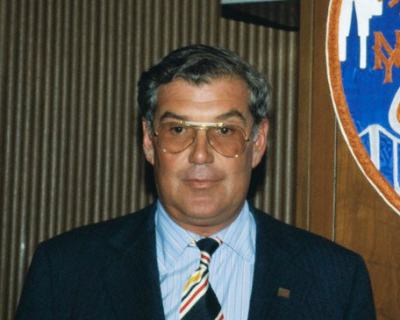
Dr. John McMullen with the Stanley Cup

McMullen, who was then also the owner of MLB's Houston Astros, also had to compensate the Rangers, the defending Stanley Cup Champion New York Islanders, and the Philadelphia Flyers for territorial indemnification. Doing this for the New York Knicks and the Philadelphia 76ers had almost sunk the owners of the ABA's New York, soon to be New Jersey, Nets when they joined the NBA in 1976, and they were still terrible when they moved into the Meadowlands in 1981. But McMullen could afford the $20 million or so that it took to buy the team, move it, and pay off the regional rivals.

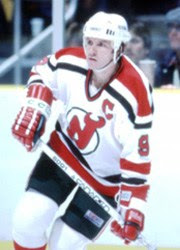
The 1st goal in team history was scored just 2 minutes and 21 seconds into the game, by team Captain Don Lever, a former Vancouver Canucks star, assisted by Steve Tambellini and Bob MacMillan. At 5:23, Hector Marini made it 2-0, assisted by Aaron Broten and Brent Ashton. At 6:31, Rick Kehoe brought the Pens within 2-1.
Don Lever

At 16:18 of the 2nd period, the Penguins went on a power play, and Pat Boutette fired past former New York Islanders backup goaltender Glenn "Chico" Resch to tie the game. Just 13 seconds into the 3rd period, Kehoe scored on another power play. But 5:03 in, the magically-named Merlin Malinowski tallied for New Jersey, assisted by Bob Lorimer and Marini. With no overtime in the regular season in those days, the game ended tied.

Three days later, also at home, the Devils played their 2nd game, and got their 1st win, against, appropriately enough, the Rangers. As of October 18, they were 3-1-3. Then they started playing like an expansion team, and went on a streak of 7 losses, followed by 3 ties, followed by 7 more losses and a tie, an 18-game winless streak, before finally winning again on November 27.

They finished with a record of 17 wins, 49 losses and 14 ties, for 48 points, finishing 5th in what was then named the Lester Patrick Division, ahead of only the Penguins. Of the 21 teams then in the NHL, they ranked 19th, ahead of only the Penguins and the Hartford Whalers.

Although Resch was a terrible goalie, he would become a beloved broadcaster for the team. Broten was the last remaining Original Devil, playing with them until 1990. His brothers Neal and Paul would also play for the Devils, and Neal, a member of the U.S. team that won the 1980 Olympic Gold Medal, would score the goal that secured the team's 1st Stanley Cup.

It would take until 1988 for the Devils to make the Playoffs, reaching Game 7 of the Conference Finals before falling. They did so again in 1994. They won the Stanley Cup in 1995, 2000 and 2003, losing in the Finals in 2001 and 2012. However, despite moving out of the Meadowlands and into their own building, the Prudential Center in downtown Newark in 2007, they have made the Playoffs only once since those 2012 Finals, and still look like they're going in circles.

Having watched the team grow up, become a contender, win 3 World Championships, fall from grace, have an unexpected run to a Finals during which they finally beat the Rangers, and then fall apart again, it should not feel like a surprise that I've now been watching them for 40 years. But the New York media still treats them like an expansion team, as inferior to the Rangers and even to the Islanders, when, since 1994, even with their recent struggles, the Devils have been far more successful than either.

Friday, May 27, 2022

Top 5 Reasons You Can’t Blame The Colorado Rockies for Moving to New Jersey

May 27, 1982, 40 years ago: The National Hockey League approves the move of the Colorado Rockies from Denver to the Meadowlands of East Rutherford, Bergen County, New Jersey. On June 30, a new name is selected: The New Jersey Devils.

Some people think the move was a bad one. After all, in Denver, the Rockies only had to compete with the NBA's Denver Nuggets in the Winter season. Whereas, in the New York Tri-State Area, they had to compete not only with the nearby, ancient New York Rangers and nearly-nearby, defending Stanley Cup Champion New York Islanders for hockey interest, but with the NBA's New York Knicks and New Jersey Nets for overall Winter sports interest.

Throw in the fact that the Philadelphia Flyers, a fairly successful hockey team at that point, were not that farther away, and it looked like moving the team to New Jersey was a fool's errand. And, just on the eve of the team's 1st Stanley Cup win in 1995, there was a rumor that the team would be sold and moved to Nashville. It came to nothing, but Devils fans have booed NHL Commissioner Gary Bettman ever since.

Indeed, neither good hockey nor good attendance were attached to the team for over 10 years. Then, general manager Lou Lamoriello and head coach Jacques Lemaire began building a team that won 3 Stanley Cups in a span of 9 years. They also lost 1 Stanley Cup Final in that period, ironically to the team that replaced them in Denver, the former Quebec Nordiques, now renamed the Colorado Avalanche.

Both the Avs and the Devils built new arenas to replace their inadequate old ones, and look like they're going to be in place for a long time. But was it really a bad idea to move the Rockies to New Jersey?

Top 5 Reasons You Can’t Blame The Colorado Rockies for Moving to New Jersey

5. The Ownership Situation. Peter Gilbert bought the Rockies from Jack Vickers in 1980, and it was the 2nd time the team was sold since 1976, when they first moved, having been the Kansas City Scouts in the 1974-75 and 1975-76 seasons. Gilbert lost money just like Vickers did, and needed a buyer.

He found one in McMullen, a naval engineer worth over $1 billion, who headed a group that included former Governor Brendan Byrne, for whom the Meadowlands arena was named from 1981 to 1996. Whatever else the Devils had going against them, they had an owner who could afford to keep the team afloat.
4. The Arena Situation. The McNichols Sports Arena opened in 1975, and it did its job: It kept the Nuggets in Denver, and lured a hockey team. Two, in fact: The World Hockey Association's Denver Spurs began play in 1975. But they quickly failed, moving to become the Ottawa Civics.
Named for William H. McNichols Jr., the Mayor who got it built, the McNichols Arena seated 16,061 for hockey, but was a bit cramped, and didn't have luxury suites. In contrast, the Meadowlands seated 19,040 for hockey, with wider seats, and had some luxury suites. It was also more accessible, as it was just off the New Jersey Turnpike, and a bus line came from Port Authority Bus Terminal in New York and went directly there.
As time told, the Meadowlands wasn't that much better a site. Being built for car and bus access led to nasty traffic. New Jersey Transit ended up building a rail spur. By the time it opened, the Devils had already gotten the Prudential Center built in downtown Newark, so the rail spur only helped football fans. Another major flaw: One level of concourse for two levels of seats simply doesn't work, and the Prudential fixed that as well.

But the Meadowlands was still a better arena than "Big Mac." A condition for the NHL allowing the Nordiques to move there was a new arena. After 3 seasons at McNichols, the Avs, along with the Nugs, moved into the downtown Pepsi Center, now the Ball Arena, a huge improvement.

3. Denver Didn't Care. It's true that the Devils didn't top 14,000 fans per home game for a season until 1989-90, or 15,000 (and then 16,000) until the 1st Cup season of 1994-95. But the Rockies would have considered even that to be a huge improvement. In their 6 seasons of play, they averaged 8,550, 8,923, 6,080, 9,788, 8,889 and 8,180. The Devils' lowest attendance ever, 11,049 in 1986-87 (the year a snowstorm that they refused to postpone a game for led to attendance of 334), topped the Rockies' best ever.

Not until the Nordiques arrived, becoming the Avalanche, as an already good team, did Denver put up good numbers at the hockey box office. They didn't seem to miss the NHL much from 1982 to 1995. After all, this is the skiing capital of America, the State of Aspen, Vail and Telluride.

2. It Worked -- for New Jersey. As bad as the Devils' attendance has looked, it's been better than it was in Colorado. It's never topped that for the Rangers, but it's frequently been better than that for the Islanders, and occasionally even that for the Flyers. Indeed, in the 30 seasons the Devils and the Nets were both in New Jersey -- and, in 27 of those, they played in the same building (the Meadowlands, 1982-2007; the Prudential Center, 2010-12) -- the Devils had the better attendance 18 times. The Nets had better attendance in 2002-03, the year both Meadowlands teams made their sports' respective Finals; but the season before, 2001-02, when the Nets made the NBA Finals for the 1st time, the Division-winning Devils had the higher attendance.

1. It Worked -- for Colorado, Too. The Centennial State loves its Avs, perhaps more than the Garden State loves its Devils, and they're not going anywhere anytime soon.

VERDICT: Not Guilty. Both places benefited from the move, and both teams benefited, too.


Tuesday, October 5, 2021

October 5, 1982: The New Jersey Devils Debut

October 5, 1982: The New Jersey Devils play their 1st regular-season game, a 3-3 tie against the Pittsburgh Penguins at the Brendan Byrne Arena in East Rutherford, Bergen County, New Jersey. As a favor to his friend, team owner John McMullen, John Amirante, usually the National Anthem singer for the New York Rangers, sings the Anthem for this game.

The franchise had begun play in 1974, as the Kansas City Scouts. After 2 terrible seasons, they were sold to a group that moved them to Denver, Colorado, and renamed them the Colorado Rockies, a name that would later be given to Denver's Major League Baseball team.

The Rockies made the Playoffs in 1978, but only in that season. By 1982, they were losing money fast. McMullen, a native of Montclair in Essex County, a graduate of the U.S. Naval Academy who rose to the rank of Commander (the Academy went on to name their hockey rink for him), and a marine engineer in civilian life, bought the Rockies on May 27, 1982, and announced he would move them into the newly-constructed Meadowlands Arena, named for the recently-retired Governor who got it built.
Dr. John McMullen with the Stanley Cup

McMullen, who was then also the owner of MLB's Houston Astros, also had to compensate the Rangers, the defending Stanley Cup Champion New York Islanders, and the Philadelphia Flyers for territorial indemnification. Doing this for the New York Knicks and the Philadelphia 76ers had almost sunk the owners of the ABA's New York, soon to be New Jersey, Nets when they joined the NBA in 1976, and they were still terrible when they moved into the Meadowlands in 1981. But McMullen could afford the $20 million or so that it took to buy the team, move it, and pay off the regional rivals.

The 1st goal in team history was scored just 2 minutes and 21 seconds into the game, by team Captain Don Lever, a former Vancouver Canucks star, assisted by Steve Tambellini and Bob MacMillan. At 5:23, Hector Marini made it 2-0, assisted by Aaron Broten and Brent Ashton. At 6:31, Rick Kehoe brought the Pens within 2-1.
Don Lever

At 16:18 of the 2nd period, the Penguins went on a power play, and Pat Boutette fired past former New York Islanders backup goaltender Glenn "Chico" Resch to tie the game. Just 13 seconds into the 3rd period, Kehoe scored on another power play. But 5:03 in, the magically-named Merlin Malinowski tallied for New Jersey, assisted by Bob Lorimer and Marini. With no overtime in the regular season in those days, the game ended tied.

Three days later, also at home, the Devils played their 2nd game and got their 1st win, against, appropriately enough, the Rangers. As of October 18, they were 3-1-3. Then they started playing like an expansion team, and went on a streak of 7 losses, followed by 3 ties, followed by 7 more losses and a tie, an 18-game winless streak, before finally winning again on November 27.

They finished with a record of 17 wins, 49 losses and 14 ties, for 48 points, finishing 5th in what was then named the Lester Patrick Division, ahead of only the Penguins. Of the 21 teams then in the NHL, they ranked 19th, ahead of only the Penguins and the Hartford Whalers.

Although Resch was a terrible goalie, he would become a beloved broadcaster for the team. Broten was the last remaining Original Devil, playing with them until 1990. His brothers Neal and Paul would also play for the Devils, and Neal, a member of the U.S. team that won the 1980 Olympic Gold Medal, would score the goal that secured the team's 1st Stanley Cup.

It would take until 1988 for the Devils to make the Playoffs, reaching Game 7 of the Conference Finals before falling. They did so again in 1994. They won the Stanley Cup in 1995, 2000 and 2003, losing in the Finals in 2001 and 2012. However, despite moving out of the Meadowlands and into their own building, the Prudential Center in downtown Newark in 2007, they have made the Playoffs only once since those 2012 Finals, and still look like they're going in circles.

Sunday, July 19, 2020

Top 10 Best Team Owners In New York Sports History

In late February 2013, I did Top 10 lists for the best and worst managers/head coaches in New York sports history. I also did them for the best and worst executives in New York sports history. Not necessarily the best team owners, but the people most responsible for personnel decisions, what has been known in modern times as the general manager.

It has occasionally been true that the person with the official title of "general manager" has reported to someone higher up, who makes the final decision. On fewer occasions still, that person has been someone between the GM and the team's majority stockholder or "owner."

It's been 7 years. A new decade, and an unexpected break in the action due to the COVID-19 pandemic, makes this as good a time as any to update the lists.

So I'm going to start with the team owners. First the best, then the worst. Then the executives, the personnel decision guys. Finally, the in-game leaders, the managers and head coaches.

I'm going to limit this to the "Big Four": Major League Baseball, the National Football League (and, in the case of the 1960-69 Titans/Jets, the American Football League), the National Basketball Association (and, should I decide to include representatives of the 1967-77 Americans/Nets, the American Basketball Association), and the National Hockey League.

I'm also going to limit "History" to 1920 onward, with "The Golden Age of Sports" effectively beginning the modern age of sports. So, on the lists of worst owners and executives, this exempts, if not absolves, Andrew Freedman, the nutcase who owned the Giants at the turn of the 20th Century; and Frank Farrell and Big Bill Devery, the ex-police commissioner and current bootlegger (or was it the other way around? Didn't matter, whichever had been Commish was pretty damn corrupt) who owned the New York Highlanders/Yankees from their 1903 founding until 1915.

Honestly, picking the best team owners is harder than picking the worst. As William Shakespeare put it, "The evil that men do lives after them. The good is oft interred with their bones."

Honorable Mention to the following:

* Tim Mara, Giants, 1925-59.
* Del Webb and Dan Topping, Yankees, 1945-64.
* Ned Irish, Knicks, 1946-74.
* Joan Payson, Mets, 1962-75.
* Roy Boe, Nets, 1969-78, and Islanders, 1972-78.
* John Pickett, Islanders, 1978-96.

Because, for the most part, these guys hired the right GMs and head coaches, and then stayed out of the way. And, in the cases of Webb with the Yankees, Pickett with the Islanders, and, considerably more reluctantly, Boe with the Nets (but not with the Islanders), they also sowed the seeds of their teams' ruination.

10. Bill Jennings, Rangers, 1962-81. As President of the Madison Square Garden Corporation, he ran the Blueshirts into a new area that saw the building of the New Garden in 1968, and made them a Playoff perennial, including reaching the 1972 Stanley Cup Finals.

That team got old by 1975, and, despite considerably backlash from the fans, he retooled them into another Playoff perennial, reaching the Finals again in 1979. He died in 1981, but the team was more secure than most NHL teams at that point.
9. John Mara, Giants, 2005-present. As hard as it is to believe, one of the best New York sports team owners is current. He picked up from where his father Wellington left off, and, with fellow half-owner Steve Tisch, (to whose father, Bob Tisch, Wellington had sold half the franchise), has kept them a class organization and won 2 Super Bowls.
8. Tex Rickard, Rangers, 1926-29. George Lewis Rickard only owned the Broadway Blueshirts for their 1st 2 1/2 seasons, but he made that time count. He had already built the 3rd Madison Square Garden, the building that would become known as "The Old Garden," because of his main business, promoting prizefights. He rented it out to the 1st NHL team in the City, the New York Americans, and saw how popular they were. So he bought his own franchise. Someone suggested they be called "Tex's Rangers," and the name stuck.

He hired Lester Patrick to run the team, and Patrick deserves most of the credit for the team's early success on the ice. But Rickard was a born promoter, and he made the Rangers the 2nd-most-popular sports team in the City, behind the Yankees.
It wasn't that hard: There were, as yet, no Jets, Knicks, Nets, Islanders, Liberty, Devils, Cosmos, Red Bulls, NYCFC or Sky Blue FC; the Amerks fell way behind the Rangers; the baseball Giants and the Dodgers were both in down periods; the football teams named for the Giants and the Yankees weren't doing great at the turnstiles; and none of the pro basketball teams in New York prior to the Knicks got much traction.

Nevertheless, The Garden on a hockey night became the place to be. Rickard took the "Broadway" part seriously, and treated every home game like a show, billing the team as "the classiest team in hockey." Calling the Rangers that from the late 1970s onward would be laughable, but, in the late 1920s and the early 1930s, fans got the message: Men showed up at The Garden in suits, women in furs. It wasn't just a place to see hockey, it was a place to be seen.

Complications of an appendicitis attack killed him at age 59. There were no antibiotics in those days. To put this in perspective: At the same age, George Steinbrenner owned the Yankees for another 21 years; Wellington Mara owned the Giants for another 30 years; Leon Hess owned the Jets for another 26 years; Branch Rickey had not yet become a part-owner of the Dodgers; Charles Dolan had not yet bought the Knicks and the Rangers; and John McMullen had not yet bought the NHL's Colorado Rockies and made them the New Jersey Devils.

The Rangers would reach the Stanley Cup Finals 5 times, winning twice, in the 12 years following Rickard's death, on top of the Cup they had already won in 1928. Had he lived to be at least 76 -- and all of those guys I mentioned in the previous paragraph did -- he would have been in position to be the 1st owner of the Knicks, who reached 3 NBA Finals before what would have been his 84th birthday. Who knows what Tex could have lassoed for New York sports had he lived longer?

7. Nelson Doubleday, Mets, 1980-2002. You'll notice that I am not including co-owner Fred Wilpon, who bought Doubleday's half out in 2002, on this list. He'll be on the worst owners' list.

Doubleday didn't just revamp the team by hiring Frank Cashen as GM. He also revamped Shea Stadium, turning the dank, dreary football stadium that had been nicknamed "Grant's Tomb" into a colorful amphitheatre that seemed, at times, like a good home for baseball. Shea became a place for families again, instead of a place even the Corleone family wouldn't want to hang out at.
During Doubleday's tenure, the Mets went from about as low as any New York baseball team has gotten since World War II -- even the early Mets, as bad as they were, were still fun to watch -- to a team that won a World Series and had another Playoff berth, then fell apart, then got rebuilt into a team that made back-to-back Playoff runs and won another Pennant. Given where he started from, that was pretty good.

6. Larry MacPhail, Dodgers, 1938-41, and Yankees, 1945-47. He quickly wore out his welcome wherever he went, but not before turning his genius into the modernization of 3 franchises: The Cincinnati Reds, the Brooklyn Dodgers, and the New York Yankees.
To all 3 teams, he brought the first true renovations of their stadiums, including lights. To all 3, he brought radio broadcasting. To all 3, he brought in modern scouting systems. Between the 3 teams, he can be linked to 25 Pennants and 13 World Series wins, even though he was only directly in charge for 2 Pennants with the Reds (including the 1940 World Championship), 1 Pennant with the Dodgers (1941), and 1 Pennant with the Yankees (winning the 1947 World Championship).

5. Branch Rickey, Dodgers, 1942-50. He also wasn't in Brooklyn all that long, but while he was, he didn't just change one baseball team. He changed the world, by signing one player, and sticking with him no matter what. The name of that player was Jackie Robinson.

He was the operating part-owner, and his own general manager, but not the sole or even the majority owner. This led to the end of his tenure. There were 4 equal shares in the team. Rickey had one. A bank, the Brooklyn Trust Company, had another, and hired Walter O'Malley to operate it. O'Malley bought that share out. Then, when a 3rd part-owner died, O'Malley bought him out, and gained the loyalty of the 4th part-owner. Rickey, who loved money as much as O'Malley did, cashed out.

O'Malley took credit for the Dodgers' success thereafter, but it was Rickey who built it, and can be credited with 6 Pennants and the 1955 World Championship -- all with Jackie Robinson as a key member, not just a token member.
4. John McMullen, Devils, 1982-2000. He was part of the ownership group that bought the Yankees in 1973, having gotten to know "managing general partner" George Steinbrenner through each's contacts in the shipbuilding industry. He sold his share in 1979, so he could buy another team, the Houston Astros, owning them until 1993. He said, "Few things in life are as limiting as being one of George's 'limited partners.'"

In 1982, he bought the NHL's Colorado Rockies, and moved them from Denver to the Meadowlands, making them the New Jersey Devils. He owned them until 2000, overseeing their rise from what Wayne Gretzky called "a Mickey Mouse operation" to a 2-time -- and, within his lifetime, a 3-time -- Stanley Cup winner.
He died in 2006. When the Devils established a Ring of Honor at the Prudential Center in 2017, he -- not Lou Lamoriello, not Jacques Lemaire, not Scott Stevens, not Martin Brodeur, not Mike Emrick -- was the 1st inductee.

3. Wellington Mara, Giants, 1965-2005. Nobody has owned a New York team longer -- and Knick and Ranger fans better hope that remains true, because if Charles Dolan is still the owner of those teams in 2034 (he'd be 107 years old, unlikely but not impossible), 40 years after buying them, it will mean that his son James is still running them.

Until 1978, Well Mara was one of the least successful owners in major league sports. He had taken over parts of the team after his father Tim's death in 1959 and his uncle Jack's death in 1965. But the Giants hadn't made the Playoffs since 1963, and "The Miracle of the Meadowlands" showed just how incompetent Giants management was.

His supporters could claim that he was responsible for the revenue-sharing plan that allowed smaller-market teams, even the Green Bay Packers, to survive, but that did Giant fans no good. His supporters could also claim that, by getting Giants Stadium built, he had given the team control over its own home field for the first time, but most fans didn't care about that, since the only way it had affected them had been starting the season with 3 road games due to the chance the Yankees would be in the World Series -- a chance that had fallen apart in the mid-1960s.

But he got the message. He hired George Young as GM, and Young made the personnel decisions that got the franchise back on its feet. It may not seem like it at the moment, but thanks to what Well did from 1978 to his death in 2005, the Giants have always had an aura of class and competence: No matter how bad things get on the field, there won't be any real scandals, and you have the sense that the team can snap out of it, if not this season, than next season.
2. George Steinbrenner, Yankees, 1973-2010. When George bought the Yankees on January 3, 1973, the price was $8.8 million. When he died on July 13, 2010, the team was estimated to be worth $1.15. billion. Factoring inflation in, that's an increase in worth of 26.6 times. Not 26 percent, 26 times.

Yes, he got suspended from operating the team due to making an illegal campaign contribution to President Richard Nixon. Yes, he got suspended again for hiring somebody to dig up dirt on one of his own players (unsuccessfully, it turned out). Yes, he was a raging egomaniac. Yes, he took the actions that led to the demolition of the original Yankee Stadium. And, yes, he seemed to fire, suspend and fine people for ridiculous reasons.

But, as he liked to say, "I never really fired anybody." Pretty much any manager, coach or executive he removed from a position, he either kept, or later welcomed back, putting him in a different position, and sometimes moving him back into the one he had previously held. And, as he frequently said, "I never ask anybody to work any harder than I do" -- and he did work hard to make the Yankees winners.

That work frequently didn't pay off, especially from 1982 to 1990, when he acted as pretty much his own GM. But when his work did pay off, the results were as follows: 20 Playoff berths, 16 American League Eastern Division titles, 13 trips to the AL Championship Series, 11 AL Pennants and 7 World Series wins. He also built the Yankees Entertainment & Sports (YES) Network and the new Yankee Stadium.

Say what you want about George Steinbrenner, and I've said plenty, and some of it has been rough, and most of that has been fair. But he loved the Yankees, and he loved New York City, and he loved Yankee Fans. He wanted to win for us as much as he wanted to win for himself. And he wanted to win as much as we did. That's what every fan of every team should expect from his team owner: Make the effort to bring success. George made the effort, and it succeeded more than anyone else over that time.

1. Jacob Ruppert, Yankees, 1915-39. He took the 3rd-most-popular team in The City and made it the greatest franchise in professional sports in the Western Hemisphere. And if you want to argue that Manchester United or Real Madrid are better, you'd better come with viable facts.

Put it this way: In 2012, Real Madrid played in Yankee Stadium, and it raised their profile in America. In 2019, the Yankees came to London, and it benefited the sport more than the team. Everybody in Europe already knows about the Yankees. The day that Arsenal clinched their unbeaten Premier League season, May 15, 2004, the camera panned the famous North Bank of Highbury, and there was a woman wearing a tank top, shades, and a Yankee cap.

In 1935, there was a tour of MLB players in Japan, and everybody in Japan wanted to see the man they, in their accents, called "Babu Rusu." All they knew about Babe Ruth was what they had seen in newsreels, but Japan knew who Babe Ruth was in 1935. America didn't know who Pelé was until the 1970 World Cup.

It was Jacob Ruppert who signed the 1st 2 great Yankee managers, Miller Huggins and Joe McCarthy. It was Ruppert who signed Ed Barrow, the 1st great personnel man in New York sports history. It was Ruppert whose ambition and money led to the building of the original Yankee Stadium, the greatest venue in the history of sports on planet Earth -- or, as it says on his Plaque in Monument Park, "this imposing edifice," even though the original edifice is gone now.
It was Ruppert who bought Babe Ruth and several other good players, helping to turn the 1910s Boston Red Sox machine into the 1920 New York Yankees Dynasty. It was Ruppert who signed Lou Gehrig. It was Ruppert who heard about Joe DiMaggio, heard that other teams were backing off on signing him due to an injury, and ordered his signing anyway.

The work he did in building the Yankees led to the team's 1st 13 Pennants and 10 World Series wins. The last of each being in 1943. By the next one, in 1947, it was very much a different organization, never mind roster: Ruppert was a swinging bachelor, but never married, and had no children, so control of the team went to his brother George and his sister Amanda, and, while letting Barrow make the decisions, they sold the team in 1945 to the triumverate of Dan Topping, Del Webb and Larry MacPhail.

There are 37 people affiliated with the Yankee organization in Monument Park. Of these, 11, including Ruppert himself, are honored there. So why did it take until 2012 for Ruppert to be elected (2013 to be inducted) to the Baseball Hall of Fame, which opened the year of his death, 73 years earlier? The only thing I can think of is that it was an oversight, that people may have failed to consider him because they thought he was already in.

Wednesday, January 15, 2014

What a New Jersey Devils Team Hall of Fame Could Look Like


The Yankees have Monument Park, honoring 27 individuals -- 17 as players and 10 as non-players. (There is some spillover, but while Phil Rizzuto was a broadcaster, he was honored as a player; and while Billy Martin played, he was honored for his contributions as a manager.)

This, of course, does not count the tribute to Jackie Robinson, the 3 Plaques honoring the Masses delivered by Popes at the old Yankee Stadium, or the Monument to the 9/11 victims & rescue workers. It does, however, count Mariano Rivera having had his Number 42 retired (along with Robinson's), but not yet getting his Plaque. I'm presuming they were waiting until his last season was finished, and thus his final career statistics were in the books.

The Yankees have played 111 seasons. Having honored 27 people, that's an average of 1 for every 4.11 seasons.

With Joe Torre having been elected to the Hall of Fame, Derek Jeter probably playing only one more season, and the thoughts that Plaques should be dedicated to them, and also to Paul O'Neill, Bernie Williams, Jorge Posada and Andy Pettitte, it is likely that the number will grow in the next few years, which would also seriously reduce the ratio.

*

The Mets have a team Hall of Fame, with plaques and other memorabilia in a room to the side of the Jackie Robinson Rotunda at Citi Field. Despite the fact that they have played less than half as many seasons, 52, they, too, have honored 27 people: 16 players, 11 non-players, 1 every 1.93 seasons.

Granted, the Mets have far fewer retired numbers, 3 to the Yankees' 17 (23 if you count the unofficially retired, including Derek Jeter's Number 2). But the Mets have a team HOFer for less than every 2 years? And people think the Yankees have honored too many guys?

If the Mets had honored individuals at the same rate as the Yankees, 1 every 4.11 seasons, they would, by now have honored 12.65 -- okay, round it up to 13 (1 every 4.00).

Included among the New York Mets Hall of Fame are Bud Harrelson and Jerry Grote. Look, I get it: Until Gary Carter (who is in), Grote was the greatest catcher in team history; until Jose Reyes (who will probably get in after he retires as an active player), Harrelson was the greatest shortstop, and (as the shortstop in 1969 and the 3rd base coach in 1986) he was the only man who was in uniform for both of the Mets' World Championships. (Although Davey Johnson, who is in as the manager of the 1986 Champions made the last out for the Baltimore Orioles in the 1969 World Series. A neat little turn of events there, as if the Yankees manager in 1996 had been not Joe Torre, but Ron Cey of the 1978 Dodgers.)

Carter arrived in Flushing Meadow in 1985, the Mets' 24th season of play. When the Yankees began their 24th season, 1926, their greatest catcher ever was Wally Schang. Okay, he was then still active, and the idea of a "team hall of fame" had never occurred to anybody yet. But would you elect Schang to Monument Park? I wouldn't: Good player, probably the 2nd-best catcher in the American League in the last half of the 1910s behind Ray Schalk and the best in the first half of the 1920s, but not as productive as Monument Park honorees Bill Dickey, Yogi Berra, Elston Howard and Thurman Munson -- or even, at least over a full career, as the yet-to-be-honored Jorge Posada. So, as the Mets have now had Carter and Mike Piazza, and they know what a truly productive catcher looks like, the inclusion of Grote seems a bit silly.

As for Harrelson, well, he was a good fielder, and by all accounts is a good guy. The Mets could certainly have done worse. (And they did: His replacement was Sergio Ferrer. His replacement was Frank Taveras, a good shortstop for the Pirates but atrocious as a Met.) But Bud couldn't hit the ground if he fell off a ladder. Let's face it, nobody would put Bucky Dent in Monument Park, and yet he did more in 16 days in October 1978 than Bud Harrelson did in 16 major league seasons.

The Mets also honored their founding owner, Joan Payson. The Yankees' founding owner was Frank Farrell, and he certainly isn't worthy of a Plaque. So the Mets got that right.

The Mets also (properly) honored Bill Shea, who did more than anyone to create the team. But the Yankees haven't honored his counterpart with them. That would be American League founder and president Ban Johnson, and considering he and owner Jacob Ruppert (who is in Monument Park) had a major falling-out, it's unlikely Johnson would have been similarly honored.

*

The local NFL teams never had a team Hall of Fame until MetLife Stadium opened in 2010. Then each established a Ring of Honor.

The Giants Ring of Honor has 35 men: 27 players, 8 non-players. This is 1 every 2.54 seasons. Not as bad as the Mets, and not nearly as bad when you consider we're talking about 24 different positions (11 on each side, plus kicker and punter, and then there's the non-players). But, still, it's more than the Yankees. Indeed, the Giants have honored as many players as the Yankees have honored people.

The Jets Ring of Honor has 12 players and 1 non-player, Super Bowl-winning coach Weeb Ewbank. So 54 seasons, 13 people, that's 1 every 4.15 seasons -- almost exactly the same as the Yankees.

*

Neither of the local basketball teams has a Hall of Fame. But both have retired some uniform numbers.

The Knicks have retired 9, including 1 non-player, Red Holzman, coach of the 1970 and '73 World Champions, with his number of coaching wins for them, 613, standing in for a uniform number. (Although Dick McGuire served the team in many capacities, he was honored by both the Knicks and the Basketball Hall of Fame for his playing.) 67 seasons, 9 people, 1 every 7.44 seasons.

The Nets have retired 7 numbers, all for players. 47 seasons, 7 people, 1 every 6.71 seasons. Compared to the Yankees, who have set the standard, both NBA teams could stand to retire more. Though it should be noted that the Nets have only just retired the Number 5 of Jason Kidd, now their head coach. They have yet to honor anyone else from their last good period in New Jersey, 2002-06: As of yet, no retirement of Kenyon Martin's 6, Richard Jefferson's 24, or Vince Carter's 15.

*

The hockey teams. The Islanders are the only one of the three that has an actual team Hall of Fame, with 11 players and 2 non-players, for a total of 13, in 43 seasons (I'm including the never-played 2004-05 season), 1 every 3.31 seasons. Less than the Yankees, but not as ridiculous as the Mets or the Giants.

The Rangers have honored 9 players with the retirement of their numbers. Over 87 seasons, that's 1 every 9.66 seasons. Clearly, they could honor others. For a fan base that talks a lot about their history (a history that is very, very lackluster), the club doesn't handle it very well.

Oddly, the most important figure in Ranger history, original head coach and general manager Lester Patrick, is not honored. Once a great defenseman, he did play a game for the Rangers, and it was one of the most famous in team history: At age 44, he stepped in as emergency goalie against the now-defunct Montreal Maroons during the 1928 Stanley Cup Finals, gave up just 1 goal, and the Rangers won it in overtime, on the way to winning the Cup in only their 2nd season of play. In that game, Patrick wore Number 16 -- an unusual one for a hockey player, but it may have been the lowest unused number at the time.

And finally, my hockey team, the New Jersey Devils. They now have some history, 33 seasons. But they have no team Hall of Fame, and only 3 retired numbers: 4, Scott Stevens; 3 Ken Daneyko; and 27, Scott Niedermayer. That's 1 every 11 seasons, and that's easily the most short-changed of any of the Tri-State Nine.

Team Seasons Players Non-Players Total 1 every
Mets 52 16 11 27 1.9
Giants 89 27 8 35 2.5
Islanders 43 11 2 13 3.3
Yankees 111 17 10 27 4.1
Jets 54 12 1 13 4.2
Nets 47 7 0 7 6.7
Knicks 67 8 1 9 7.4
Rangers 87 9 0 9 9.7
Devils 33 3 0 3 11.0

Yes, I get that the Mets wanted to honor their original broadcasting triad of Lindsey Nelson, Bob Murphy and Ralph Kiner. I have no objection to that. Or to the honoring of their founders, Mrs. Payson and Mr. Shea. But they've honored 11 non-players; the other 8 teams, combined, have honored just 23.

*

If the Nets, Knicks, Rangers and Devils were to bring their ratios down to the 4 or so that the Yankees and Jets have, who could they induct?

It seems to me that priority should go to players and non-players for their teams who have been inducted into their sports' Halls of Fame. How have the Tri-State Nine honored HOFers, and compared to non-HOFers?

Knicks 8 of 9 88.9
Rangers 8 of 9 88.9
Devils 2 of 3 66.7
Yankees 17 of 27 63.0
Islanders 7 of 13 53.8
Giants 16 of 35 45.7
Nets 2 of 7 28.6
Jets 3 of 13 23.1
Mets 6 of 27 22.2

Based on that, it's safe to say that, at least as far as priorities are concerned, the Knicks, Rangers, Devils and Yankees, and to a lesser extent the Islanders and Giants, know what they're doing. While the Nets, Jets and Mets do not.

(The Yankees' total of 17 HOFers includes Mariano Rivera, who now has his number retired, but is not yet in Cooperstown, but will be. It does not include Derek Jeter, who has not yet had his number retired. The Mets' total of 6 HOFers does not include Mike Piazza, although I do think he will get in within the next few years.)

The Nets would need to add 4 more to get to the Yanks' ratio; the Knicks, 7; the Rangers, 12.

The Devils, 5 more would give them 8 in 33 seasons, a ratio of 4.125, almost split right down the middle between the Yankees' 4.111 and the Jets' 4.154.

*

So who should the Devils' 5 more honorees' be?

Well, since they have not yet honored any non-players, let's start with the obvious ones.

They've won 3 Stanley Cups, with 3 different head coaches: Jacques Lemaire, Larry Robinson and the late Pat Burns. Then there's the general manager who put it all together, Lou Lamoriello. And the founding owner, John McMullen.

Okay, it seems silly to elect them all, without electing any new players. But the founder, the architect, and the difference-making coach should all get in.

That's 6. We need 2 more players. Keep in mind that Martin Brodeur is still active, and thus cannot yet be considered.

Players in the Hockey Hall of Fame who have played for the Devils, in addition to Stevens and Niedermayer, are Peter Stastny, Viachelsav Fetisov, Igor Larionov, Doug Gilmour, Joe Nieuwendyk and Brendan Shanahan.

In addition, Herb Brooks was head coach, and Adam Oates an assistant coach who was elected as a player but never played for the Devils. So let's take them out of consideration immediately.

Larionov played just 1 season, Gilmour and Nieuwendyk 2 each, Stastny 3 -- and, except for Nieuwendyk in 2003, none won a Cup with the Devils. So they're out.

Fetisov played 6 seasons with the Devils, Shanahan 5 -- but, again, neither won a Cup. So they're out.

Hmmmm, this is getting harder. We've just eliminated the Hall-of-Famers.

Jamie Langenbrunner announced his retirement today, and he could end up in the Hockey Hall of Fame -- but he won't be eligible for it until 2017, and so putting him on this list is also premature.

Okay, outside of HOFers, who represents the New Jersey Devils' spirit? That's why Daneyko is in the rafters, even though he wasn't, by any measure, a great player.

There's Claude Lemieux. There's Bobby Holik. There's Randy McKay. There's Sergei Brylin. There's Jim Dowd, the only New Jerseyan ever to play for the Devils, and the only one ever to play on a Cup-winner. There's Patrik Elias, but he's still active, so we can't consider him. There's Jason Arnott, who scored the biggest goal in team history (unless you want to count the still-active Adam Henrique).

And if Daneyko is in a team Hall of Fame, surely, you have to consider the other 2 guys who were around nearly at the beginning, and stayed long enough to contribute to the first Cup in 1995: John MacLean and Bruce Driver.

And there's one more Hockey Hall-of-Famer we haven't mentioned yet: Broadcaster Mike "Doc" Emrick, the Voice of the Devils.

No, I am not inducting Glenn "Chico" Resch. He's not a great broadcaster, and he was a lousy player. Why do you think the Islanders were willing to let him go at the team's arrival in New Jersey in 1982? Because he was the backupiest backup goalie in hockey history. Yes, Chico has been here for the good, the bad, and the ugly -- but he was responsible for a lot of the early ugly. (And that's got nothing to do with the hairpiece and mustache that makes him look like John Astin playing Gomez on The Addams Family.)

Anyway, who says they have to all be elected at once? And who says they have to conform exactly to the Yankees' ratio -- now, or in a few years? It's my list, my rules -- I can change my rules.

*

So here is my proposed list for a New Jersey Devils Hall of Fame -- or Honor Roll, or Ring of Honor, or Wall of Fame, or whatever you want to call it -- with proposed years of induction and (where applicable) uniform numbers:

2006 4 Scott Stevens
2006 3 Ken Daneyko
2011 27 Scott Niedermayer
2014 * John McMullen
2014 * Lou Lamoriello
2015 * Jacques Lemaire
2015 * Mike Emrick
2016 * Larry Robinson
2016 * Pat Burns
2017 15 Jamie Langenbrunner
2018 30 Martin Brodeur
2018 26 Patrik Elias
2019 22 Claude Lemieux
2020 25 Jason Arnott
2021 11 Jim Dowd
2022 15 John MacLean
2022 23 Bruce Driver

With Brodeur's 30 and Elias' 26 joining Stevens' 4, Daneyko's 3 and Niedermayer's 27 as retired numbers.

4 3 27 30 26

Or, if you prefer:

3 4 26 27 30

That's 17 figures. 11 players, 6 non-players. If we stagger the inductions over the next 8 seasons, making for 40 seasons, that would be 1 every 2.4 seasons. That may seem a little excessive, but then, by that point, the other area teams will have more inductions as well; if the Yankees give Plaques to Torre, Jeter, O'Neill, Williams, Posada and Pettitte (hardly unreasonable) over that same period, that would be 32 honorees in 120 seasons, or 1 every 3.6 seasons.

Also, none of these inductees -- not even Dowd, elected here mainly for his Jerseyness, even if he did score the late winner in Game 2 of the 1995 Finals -- is as lame a choice as the Mets putting in Harrelson and Grote.

Nor is any of them a memorial, as the Giants did for Al Blozis, a good player but he's honored (including the retirement of his Number 32) because he died in combat in World War II; and the Nets did for Wendell Ladner (Number 4), who was killed in a plane crash. On the other hand, Thurman Munson of the Yankees (Number 15) and Drazen Petrovic of the Nets (Number 3), while they died in transportation accidents, already deserved their honors. It is true that McMullen and Burns are dead, and that anyone could die at any time, hoping that none of the preceding do; but the Devils have been lucky in that none of their legends, or could-be legends, died while still in active service to the team (McMullen having sold the franchise, and Burns having retired from front-office work to focus on his health).

Note that the elections of MacLean and Driver would, in this "future history," come in the team's 40th Anniversary season; of Lemaire and Emrick, on the 20th Anniversary of the team's first Cup; and of Arnott, on the 20th Anniversary of his Cup-winning goal.

6 out of 17, 35 percent, would be non-players. This is a better ratio than both baseball teams. Presuming Elias makes the Hall (possible), Brodeur isn't caught doing something Pete Rose-stupid or Alex Rodriguez-stupid to keep himself out, and no other Devils figure is elected (it would be a surprise if any did), it will be 9 out of 17 in the Hockey Hall of Fame, or 58.3 percent, a better ratio than the Mets, Nets and both football teams.