Showing posts with label italy. Show all posts

Saturday, September 19, 2026

September 19, 1926: The San Siro Opens

September 19, 1926, 100 years ago: Nuovo Stadio Calcistico San Siro -- San Siro New Football Stadium -- opens in the San Siro section of Milan, Italy, about 3 miles west of the center of town. Unlike most sports stadiums in Europe at the time, it was designed specifically for soccer -- known in Italy as "calcio," not a variation of "football" -- without a running track.

The 1st match is a Milan Derby -- or Derby della Madonnina, as Milan is known as "The Madonna's City" -- and Internazionale Milano defeats Associazione Calcio Milan, 6-3. A full house of 35,000 attends.

A.C. Milan, known as simply Milan for short, and as the Rossoneri for their shirts of red and black stripes, have played their home games there ever since. Inter Milan, or just Inter, known as the Nerazzurri for their shirts of black and blue stripes, began playing home games there in 1947.

Expansions were undertaken in 1935 and 1955. In 1987, a renovation began to prepare the stadium for the 1990 World Cup. A minor renovation was undertaken in 2015-16. Current capacity is 75,817, making it the largest stadium in Italy, as well as the most famous.
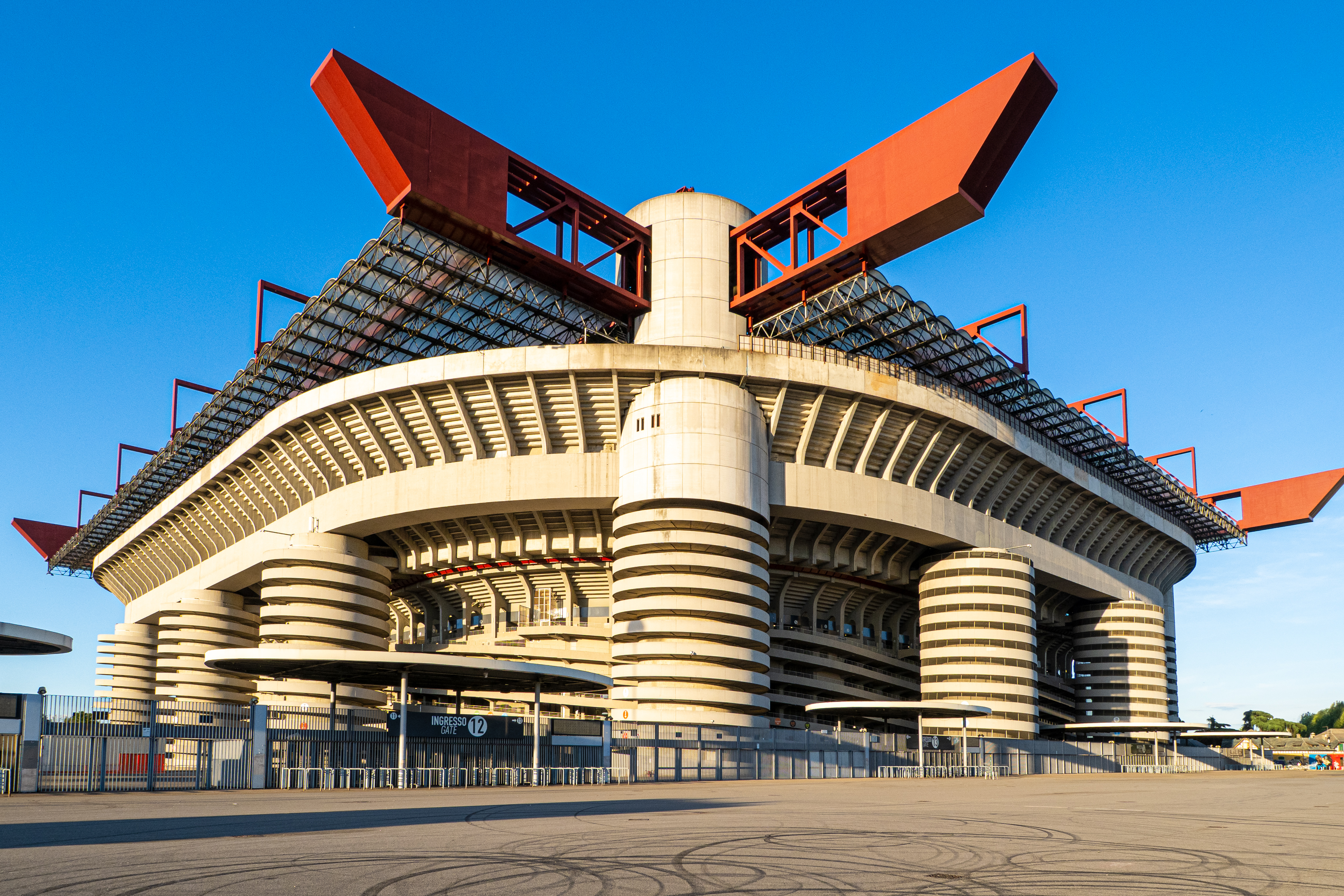
The stadium hosted 3 games of the 1934 World Cup, which Italy won, as they did in France in 1938, in large part due to Giuseppe Meazza, the Milan-born Inter striker. He died in 1979. The following year, the stadium was officially renamed Stadio Giuseppe Meazza. But it is still called "The San Siro" around the world, and it has surpassed the Duomo as Milan's most famous building.

Since moving in, both Milan teams have been remarkably successful. AC Milan have won 19 league titles, 16 of them in Italy's Serie A since moving in: 1951, 1955, 1957, 1959, 1962, 1968, 1979, 1988, 1992, 1993, 1994, 1996, 1999, 2004, 2011 and 2022. They have won the Coppa Italia 5 times: 1967, 1972, 1973, 1977 and 2003 -- although they've never won "The Double," the league and the cup in the same season. They've won the European Cup/UEFA Champions League 7 times, 2nd only to Real Madrid: 1963, 1969, 1989, 1990, 1994, 2003 and 2007.

Inter have won 21 titles, 2nd among Italian teams behind Juventus. They've won 16 since moving into the San Siro: 1953, 1954, 1963, 1965, 1966, 1971, 1980, 1989, 2006, 2007, 2008, 2009, 2010, 2021, 2024 and 2026. They've won the Coppa Italia 10 times, 9 since moving in: 1978, 1982, 2005, 2006, 2010, 2011, 2022, 2023 and 2026. This means they've won 2 Doubles, in 2006 and 2010. And they've won the European Cup/Champions League 3 times: Back-to-back titles in 1964 and 1965, and in 2010, making them the 1st, and still the only, Italian team to win a "European Treble."

The 1960s was the golden age of Italian soccer, with both Milan teams practicing "catenaccio," meaning "padlock," a supreme defensive strategy. Between them, Milan and "Il Grande Inter" won 4 European Cups, and Inter lost 1 other Final, in 7 seasons.

Milan's fans sit in the Curva Sud, the south end; Inter's in the Curva Nord, the north end. Unlike such other Italian rivalries as Roma-Lazio and Juventus-Torino, this rivalry tends to be mostly talk, and violence is rare.
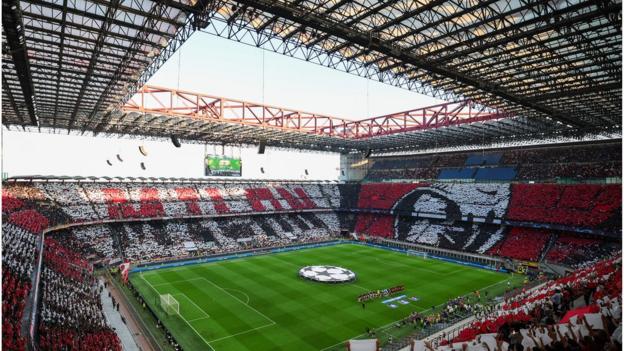
The San Siro hosted 3 games of UEFA Euro 1980, 6 games of the 1990 World Cup, and 4 Finals of the European Cup: 1965, 1970, 2001 and 2016. It was the main stadium for the 2026 Winter Olympics, which were divided between Milan and 1956 hosts Cortina d'Ampezzo.

By a coincidence that I, as a fan of theirs, have enjoyed, North London team Arsenal F.C. became the 1st British team to beat each of the hosts at the San Siro, both in Champions League play: Inter in 2003, and AC Milan in 2008.

In 2019, a plan to build a new 70,000-seat stadium next door, to be used by both teams, was put forward, intended to be ready for the 2022-23 season. It didn't happen. In 2023, AC Milan announced plans for a separate stadium, next to their club headquarters in the city's southern suburbs. This would have left the new San Siro to be home to Inter only. This plan also fell through.

In 2025, the two clubs announced an agreement on a new stadium, adjacent to the current one. Construction is set to begin in late 2027.

Monday, July 20, 2026

Each Country's Best Performance at the World Cup, 1930-2026

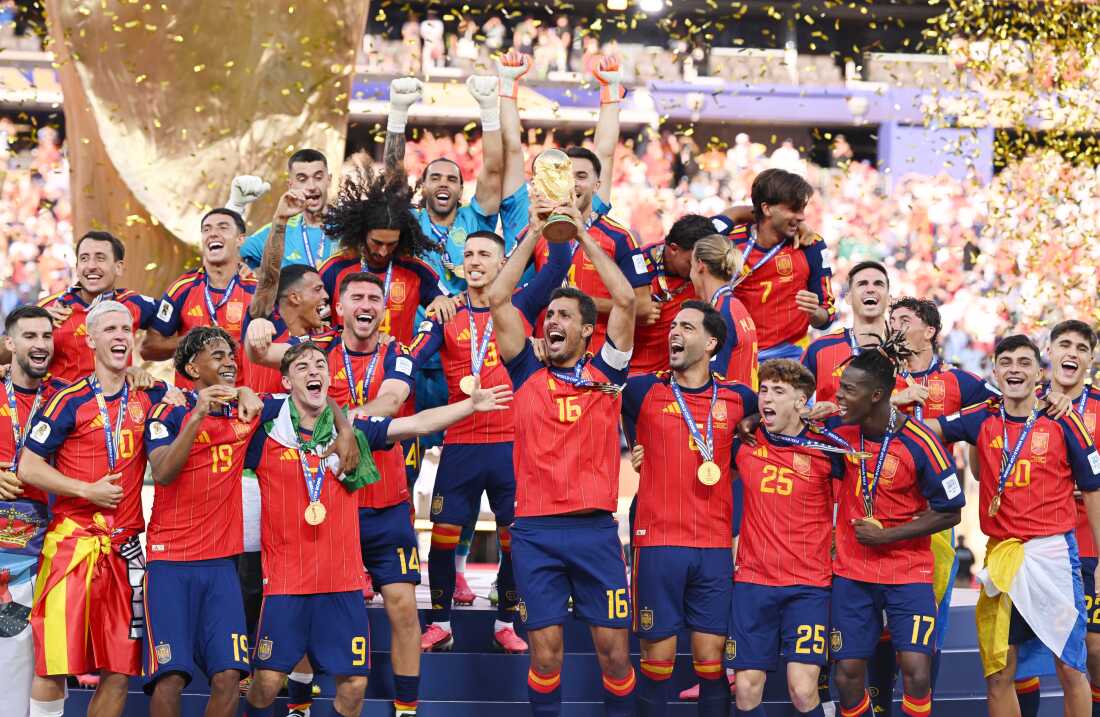
Congratulations, I guess, to Spain, winners of the 2026 World Cup. I didn't want them to win -- until the Final. With the possible exception of Russia, anybody would have been easier to root for than Argentina.

There have been 84 different countries that have competed in the World Cup, including some that no longer exist. Ties broken by most recent.

1. Brazil, 5 wins: 1958, 1962, 1970, 1994 and 2002
2. West Germany/Germany, 4 wins: 1954, 1974, 1990 and 2014
3. Italy, 4 wins: 1934, 1938, 1982 and 2006
4. Argentina, 3 wins: 1978, 1986 and 2022
5. Spain, 2 wins: 2010 and 2026
6. France, 2 wins: 1998 and 2018
7. Uruguay, 2 wins: 1930 and 1950
8. England, 1 win: 1966
-
9. Netherlands, 3 Finals, most recently in 2010
10. Czechoslovakia/Czechia, 2 Finals, most recently in 1962 
11. Hungary, 2 Finals, most recently in 1954 (Joint-best performance by a Communist country)
12. Croatia, Final in 2018 (Best performance by a former Yugoslav team)
13. Sweden, Final in 1958 (Best performance by a Scandinavian team)
-
14. Poland, 2 Semifinals, most recently in 1982
15. Yugoslavia/Serbia, 2 Semifinals, most recently in 1962
16. Morocco, Semifinal in 2022 (Best performance by an African team)
17. Belgium, Semifinal in 2018
18. South Korea, Semifinal in 2002 (Best performance by a Far East team)
19. Turkey, Semifinal in 2002 (Joint-best performance by an Asian team)
20. Bulgaria, Semifinal in 1994
21. Portugal, Semifinal in 1966
22. Soviet Union/Russia, Semifinal in 1966
23. Chile, Semifinal in 1962
24. Austria, Semifinal in 1954
25. America, Semifinal in 1930
-
26. Switzerland, 4 Quarterfinals, most recently in 2026
27. Mexico, 2 Quarterfinals, most recently in 1986
28. Peru, 2 Quarterfinals, most recently in 1978
29. Norway, Quarterfinal in 2026
30. Colombia, Quarterfinal in 2014
31. Costa Rica, Quarterfinal in 2014 (With Mexico, joint-best performance by a Central American team)
32. Paraguay, Quarterfinal in 2010
33. Ghana, Quarterfinal in 2010
34. Ukraine, Quarterfinal in 2006
35. Senegal, Quarterfinal in 2002
36. Denmark, Quarterfinal in 1998
37. Romania, Quarterfinal in 1994
38. Ireland, Quarterfinal in 1990
39. Cameroon, Quarterfinal in 1990 (With Ghana & Senegal, joint-best performande by a Sub-Saharan African team)
40. East Germany, Quarterfinal in 1974
41. North Korea, Quarterfinal in 1966
42. Wales, Quarterfinal in 1958
43. Northern Ireland, Quarterfinal in 1958
44. Cuba, Quarterfinal in 1938
-
45. Japan, Round of 16 4 times, most recently in 2022
46. Nigeria, Round of 16 3 times, most recently in 2014
47. Australia, Round of 16 twice, most recently in 2022
48. Egypt, Round of 16 in 2026 
49. Canada, Round of 16 in 2026
50. Greece, Round of 16 in 2014
51. Algeria, Round of 16 in 2014
52. Slovakia, Round of 16 in 2010 (Smallest nation to reach the Round of 16)
53. Ecuador, Round of 16 in 2006
54. Saudi Arabia, Round of 16 in 1994 (With Egypt, joint-best performance by a Middle Eastern team)
55. Indonesia, Round of 16 in 1938
-
56. Cabo Verde, Round of 32 in 2026 (Smallest nation to reach the Knockout stage)
57. Côte d'Ivoire, Round of 32 in 2026
58. South Africa, Round of 32 in 2026
59. Democratic Republic of the Congo, Round of 32 in 2026
60. Bosnia and Herzegovina, Round of 32 in 2026
61. Scotland, 7 times in Group Stage, most recently in 2026
62. Iran, 7 times in Group Stage, most recently in 2026
63. Tunisia, 7 times in Group Stage, most recently in 2026
64. New Zealand, 3 times in Group Stage, most recently in 2026
65. Honduras, 3 times in Group Stage, most recently in 2014
66. Bolivia, 3 times in Group Stage, most recently in 1994
67. Qatar, twice in Group Stage, most recently in 2026
68. Haiti, twice in Group Stage, most recently in 2026
69. Panama, twice in Group Stage, most recently in 2026
70. Iraq, twice in Group Stage, most recently in 2026
71. Slovenia, twice in Group Stage, most recently in 2010
72. El Salvador, twice in Group Stage, most recently in 1982
73. Curaçao, Group Stage in 2026
74. Jordan, Group Stage in 2026
75. Uzbekistan, Group Stage in 2026
76. Iceland, Group Stage in 2018
77. Togo, Group Stage in 2006
78. Trinidad and Tobago, Group Stage in 2006
79. Angola, Group Stage in 2006
80. China, Group Stage in 2002
81. Jamaica, Group Stage in 1998
82. United Arab Emirates, Group Stage in 1990
83. Kuwait, Group Stage in 1982
84. Israel, Group Stage in 1970

Thursday, July 9, 2026

July 9, 2006: Zinedine Zidane's "Coup de Boule"

July 9, 2006, 20 years ago: The World Cup Final is held at the Olympiastadion in Berlin. ABC broadcasts it in America. France play Italy. Both teams tend to wear blue, thus France are Les Bleus, and Italy are gli Azzurri. On this occasion, Italy wore blue, while France wore white.
The Olympiastadion is 1 of 4 stadiums to have hosted an Olympic Games, a World Cup Final and a UEFA European Cup/Champions League Final. The others are the Olympiastadion in Munich, the old Wembley Stadium in London, and the Stade de France outside Paris.

Italy were loaded with legends: Gianluigi Buffon, Fabio Cannavaro, Andrea Pirlo, Francesco Totti, Luca Toni. This was a team so good, Daniele De Rossi and Alessandro Del Piero did not start and had to come on as substitutes, Alessandro Nesta and Filippo Inzaghi remained on the bench, and Paolo Maldini, still starting for AC Milan at age 38, was not even selected.

But France were equally laden with starpower, many of them holdovers from their 1998 triumph: Fabien Barthez, Lilian Thuram, David Trezeguet, Patrick Vieira, Thierry Henry, and Captain Zinedine Zidane. Others had developed since that win: Claude Makélélé, Florent Malouda, Sylvain Wiltord, Lasanna Diarra, Éric Abidal, Franck Ribéry. 

The key was Zidane: The midfielder, who had starred for Girondins de Bordeaux in his homeland, Juventus in Turin, Italy, and Real Madrid in Spain, had put the team, indeed his entire country, on his back, and led them to victory in 1998.

The son of Kabyle immigrants from France's former colony of Algeria, he was a symbol of reconciliation, as both nations were still dealing with the nasty war that Algeria fought for its independence from 1954 to 1962 -- having ended only 36 years before.

Although light-skinned enough to appear white -- unlike several national side teammates, including Henry, Vieira, Thuram, Trezeguet, and his Real Madrid teammate Makélélé -- he had faced prejudicial gestures large and small, including the insinuation that he was not truly, or not wholly, French.

Yet he went into that 2006 Final once again having led the team to glory. It was to be his last game: At age 34, he had announced his retirement as a player. Win or lose, it would be all over when the final whistle blew for this game.

In the 7th minute, Malouda, then playing his club football for Olympique Lyonnais, was knocked down in the box by Marco Materazzi of Internazionale Milano. If Materazzi were a hockey player, he wouldn't be a "pest": A good player who frequently plays rough; he'd be a "goon": A player whose sole purpose is to play rough, because he can't do anything else.

Horacio Elizondo, the Argentine selected to referee the game (because he was from neither team's continent), correctly awarded a penalty, and Zidane converted it. France led, 1-0.

The lead did not last long. In the 19th minute, Pirlo, the AC Milan legend, sent a hellacious corner kick into the box, and Materazzi, of all people, headed it past Barthez, the famously bald goalkeeper who was back with Olympique de Marseille after starring for them, Toulouse, AS Monaco and Manchester United.

In the 2nd half, Luca Toni, then of Florence-based Fiorentina, hit the crossbar with a shot, and then correctly had a headed goal disallowed as having been offside. Malouda was tackled in the box by Juventus' Gianluca Zambrotta, but was incorrectly not awarded another penalty. Arsenal legend Henry was stopped by Juventus goalie Buffon. Malouda skied a shot over the bar. Pirlo just missed with a free kick.

In extra time, Ribéry, then with Marseille and later to star for Bayern Munich, just missed. Buffon just barely knocked a Zidane header away.

And then, in the 110th minute, Materazzi pulled on Zidane's jersey, they exchanged words, and Zidane head-butted Materazzi right in the chest. In French soccer, this is known as a coup de boule -- literally, "stroke of ball" or "blow of ball," but also meaning "play of head." (The more familiar phrase coup d'état means "blow of state," and refers to the overthrow of a government.)

Elizondo did not see the incident. The 4th official, Luis Medina Cantalejo -- so respected that he not only officiated at 3 games of that World Cup, but was one of the few Spanish referees to officiate at La Liga games between arch-rivals Real Madrid and Barcelona, a rivalry so intense that foreign referees are nearly always assigned to oversee it -- told Elizondo through his headset that it had happened.

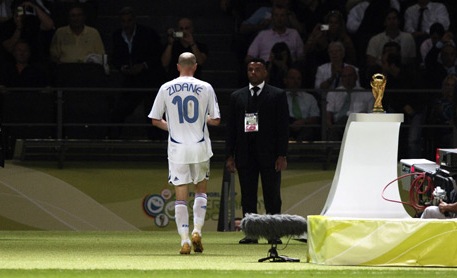
Elizondo properly showed Zidane a straight red card, making him the 4th player to be sent off in a World Cup Final, and the only player ever sent off in games of 2 separate World Cups. The scene of Zidane walking into the locker room, past the World Cup trophy but not even looking at it, is nearly as iconic as the coup de boule itself.
Extra time ended with the game still 1-1, so it went to penalties. Italy kicked first. Pirlo scored his penalty. Sylvain Wiltord, then with Lyon and previously the man whose goal past Barthez secured the League and Cup "Double" for Arsenal in 2002, made his. 1-1.

Materazzi was next for Italy, and made his penalty. Next for France was Trezeguet, facing his Juventus teammate Buffon. In extra time of the Euro 2000 Final, he had beaten Buffon with a shot. Under the rules then in place, it was a "golden goal": Automatic victory. This time, he was not a hero: He clanged his shot off the crossbar. 2-1 Italy.

De Rossi made his penalty. Abidal made his. Del Piero made his. Willy Sagnol made his for France. Finally, Fabio Grosso clinched the win for Italy: 5-3, with France's last shot not taken, seeing as how it would have been meaningless. Italia: Campioni del Mondo.
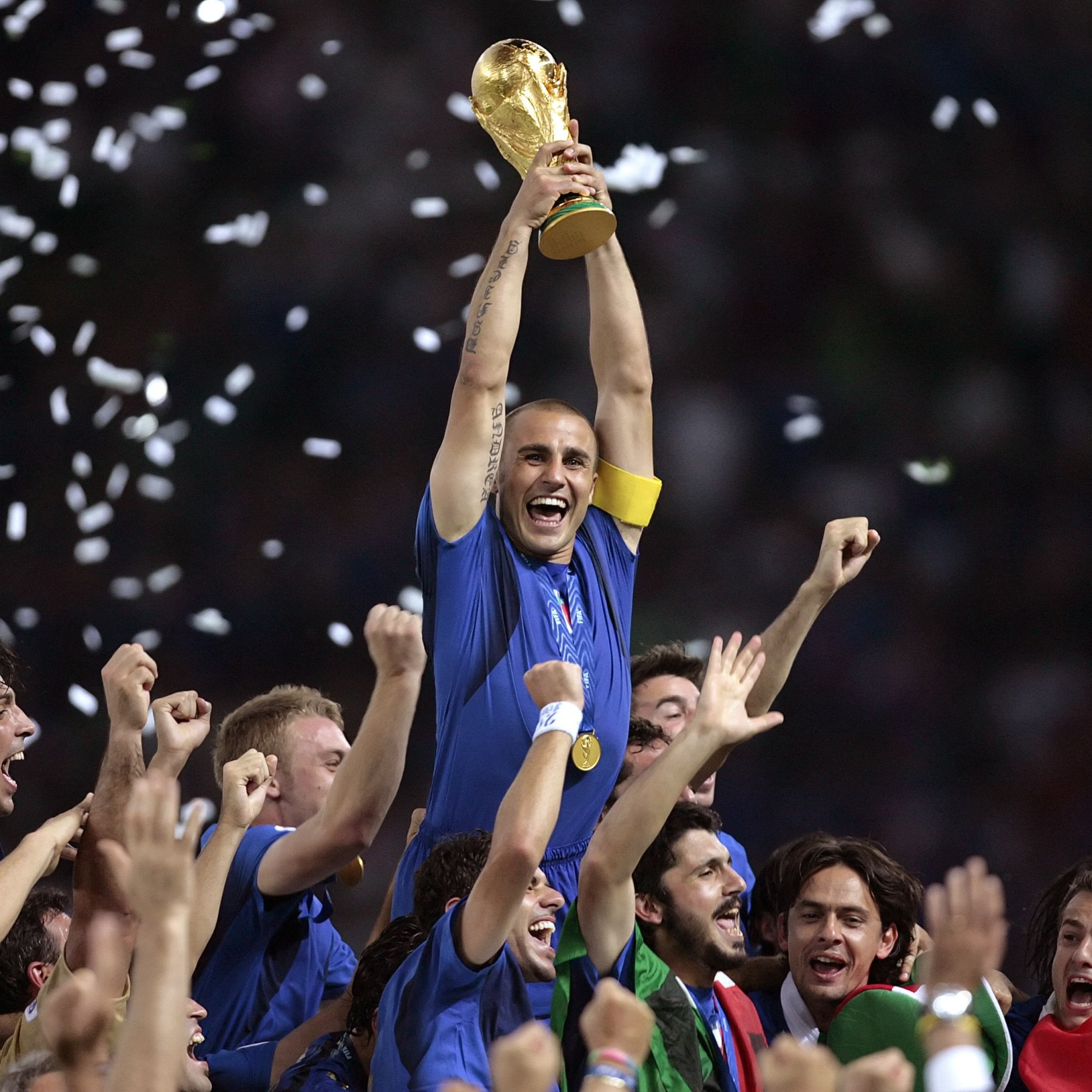
Fabio Cannavaro, as Captain, raising the Jules Rimet Trophy

Zidane, of course, was not available for the penalties.

Why did he do it? Three British newspapers -- The Times, The Sun, and the Daily Star, with varying degrees of reliability -- all hired lip-readers who were fluent in French and Italian to look at the tape, and to see what Materazzi had said to Zidane to provoke it. (Materazzi does not speak French, but Zidane played in Italy long enough to learn the language, and their exchange was entirely in Italian.)

The Times has a reputation for sterling journalism; The Sun and the Daily Star are considered lying right-wing propaganda rags. Yet the lip-readers hired by all 3 reported the exact same thing: They all said that Materazzi had called Zidane a "son of a terrorist whore."

It had been less than 5 years since the 9/11 attacks, and a year to the week after the 7/7 attacks on the London Underground (subway). Apparently, Materazzi was unaware that presuming that all Muslims are terrorists is not only bigoted, but stupid. To make matters worse, Zidane's mother was ill at the time.

Materazzi's version of events was a little different. He said he would never have insulted someone's mother, having lost his own when he was 15 years old. Without question, he had tugged on Zidane's shirt. The exchange of shirts is a postgame tradition that goes back decades, and Materazzi said that Zidane told him, "If you want my shirt, I will give it to you afterwards." Not an unreasonable request of a star of one of the finalists to one of the other finalist, and not an unreasonable response.

Materazzi said that his follow-up was, "I prefer the whore that is your sister." In other words, "Your sister puts out, and I'd like you to set me up with her." In other words, Materazzi admitted that he had gone too far.

But so had Zidane. There were about 10 minutes of play to go. Winning is the best revenge. A man as accomplished as Zidane -- 2 League titles in Italy and 1 in Spain, a Champions League win, a World Cup and a Euro title -- should have accepted this. Win the game, and you look like a champion, and the guy trying to provoke you looks like an idiot. Instead, the great Zizou looked like an easily provoked fool, and Materazzi an undeserved World Champion.

The play swept the world. Dozens of people posted their attempts at recreating it on the Internet. American TV shows parodied it. A song titled "Coup de Boule" hit Number 1 on the French music charts.

One moment can change not just a game, but a reputation, forever. Zidane stood to become the greatest hero in the history of French sport. Maybe he still is, anyway. But the first thing anyone thinks about when they hear his name is the coup de boule.

Sunday, May 31, 2026

May 31, 1976: The Bicentennial Cup

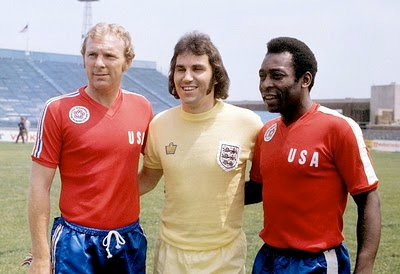
Left to right: Bobby Moore, Gerry Francis, Pelé

May 31, 1976, 50 years ago: The Bicentennial Cup concludes. Set up as one of the celebrations of the 200th Anniversary of American independence, it was not a good showcase for American soccer.

England and Italy were invited after they failed to qualify for Euro 76. Also invited was Brazil. The 4th team would be "Team America," made up of players in the North American Soccer League. That meant American players, who simply were not up to the task; and foreign players, who were mostly too old to play at a world class level anymore, such as Brazil's Pelé of the New York Cosmos and England's Bobby Moore of the San Antonio Thunder.

On May 23, Team America played Italy at Robert F. Kennedy Stadium in Washington. The crowd was decent: 33,445. The result was rather indecent: Italy won, 4-0. Fabio Capello scored in the 15th minute, and the U.S. was never really in it. A midfielder for Turin club Juventus, Capello would later win Serie A (Italian league) titles with A.C. Milan, A.S. Roma and Juventus; and La Liga titles with Real Madrid; total league titles, 9. He also led Milan to the UEFA Champions League title in 1994.

Also on May 23, Brazil beat England, 1-0 before 32,495 at the Los Angeles Memorial Coliseum. Carlos Roberto de Oliveira, a forward for Rio de Janeiro club Vasco da Gama, known as "Roberto Dinamite," won the game with a goal in the 89th minute.

On May 28, England beat Italy, 3-2 at Yankee Stadium; and Team America lost to Brazil, 2-0 at the new Kingdome in Seattle. Only 20,245 paid to get into the big gray toadstool in Seattle's Lower Downtown. For England vs. Italy in The Bronx, the attendance was 40,650. I would have expected more, given how many Italians live in and around New York City. But the vast majority of Italian-Americans are descended from people who left Italy before the country embraced soccer. For Italian New Yorkers of the 1970s, their sports were baseball, football and boxing.

At any rate, Francesco Graziani of the other Turin club, Torino F.C., scored 2 goals within 5 minutes early in the 1st half. But Mick Channon of Hampshire team Southampton scored 2 within 7 minutes early in the 2nd half, and Phil Thompson of Liverpool scored between those Channon goals.

On May 31, England beat Team America, 3-1 before 16,239 at John F. Kennedy Stadium, leaving over 87,000 empty seats at the big South Philadelphia horseshoe. Kevin Keegan of Liverpool scored twice within 6 minutes in the 1st half, and Trevor Francis of Birmingham City scored early in the 2nd half. Stuart Scullion, a Scottish winger playing for the Tampa Bay Rowdies, got a consolation goal for Team America in the 87th minute.

Later, 36,096 went into the Yale Bowl in New Haven, Connecticut, to see a copy of the 1970 World Cup Final: Brazil beat Italy, 4-1. Capello scored in the 2nd minute, but Gil (Gilberto Alves) of Rio club Fluminense, who had scored 2 against Team America, did it again against Italy.

Thursday, March 5, 2026

March 5, 1946: Winston Churchill's "Iron Curtain" Speech

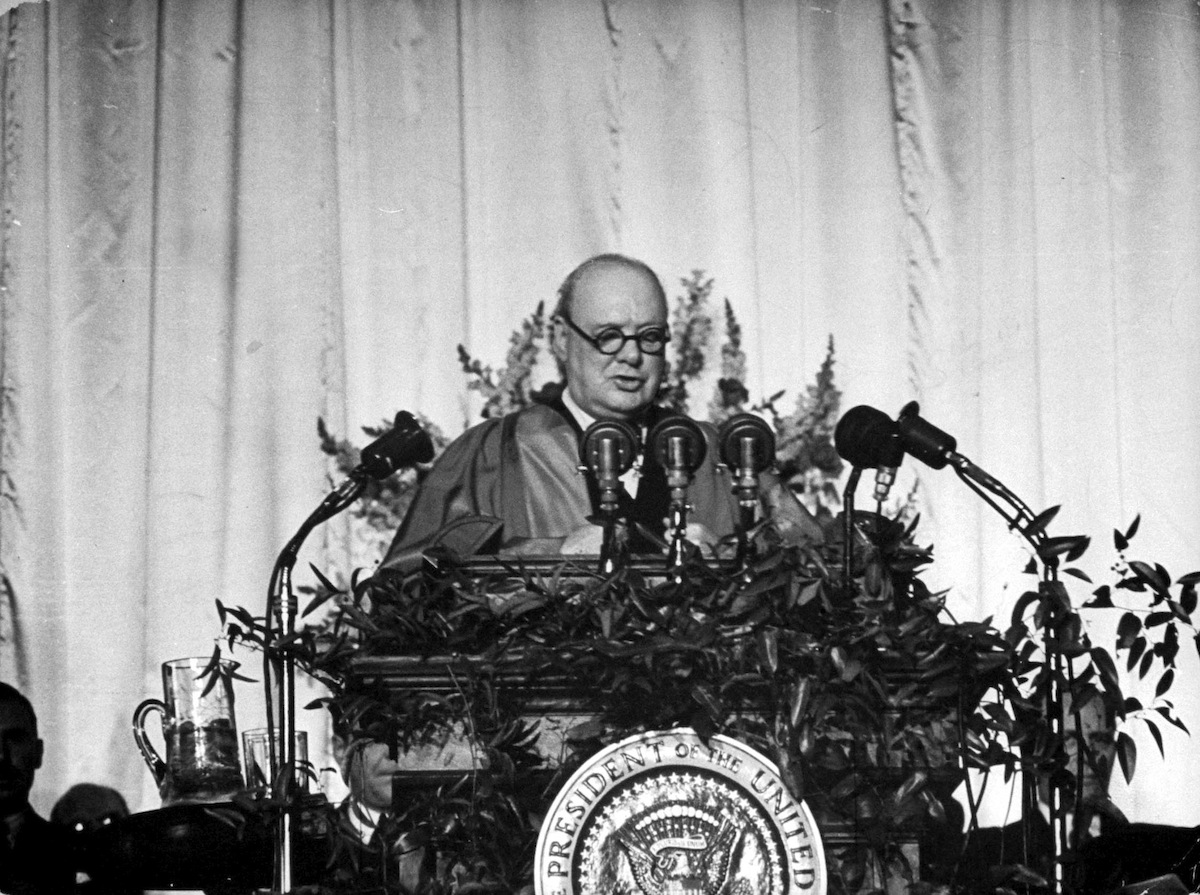
March 5, 1946, 80 years ago: Winston Churchill, as he had done many times before, turns a phrase that sticks in the collective consciousness of Western civilization.

Shortly after meeting with the new President of the United States, Harry Truman, at the Potsdam Conference outside Berlin in July 1945, he had to stand for election in Britain. His Conservative Party lost, and he had to resign as Prime Minister, although he was still Party Leader. He had more free time than before, and visited America the next year.

The British capital building is known as the Palace of Westminster. In Fulton, in Truman's home State of Missouri -- 111 miles west of St. Louis, 150 miles east of Kansas City, 23 miles southeast of the University of Missouri at Columbia, and 24 miles northeast of the State Capitol in Jefferson City -- there is a Westminster College. It offered Churchill an honorary degree, hoping he would come, accept, and deliver one of his rousing speeches, inspiring donations to the school. They couldn't have been more thrilled, because this is pretty much the only thing the school is known for today.

With Truman in attendance, Churchill gave a speech he had titled "Sinews of Peace." But that would not be the phrase anybody remembered.

Even by the time of the Yalta Conference in the Crimea in February 1945, when Churchill and the dying President Franklin D. Roosevelt met with Soviet Premier Joseph Stalin, the Soviet Union's Red Army was occupying much of Eastern Europe. After pushing Nazi Germany back, there was little willingness to start a World War III with Communism before World War II with Fascism was over. Churchill came up with a plan, but he knew it would never see the light of day. He proved this by naming it "Operation Unthinkable."

The term "iron curtain" had been used to describe safety curtains, installed on theater stages to slow the spread of fire. In 1918, Vasily Rozanov, an anti-Communist writer opposing the Bolshevik Revolution, wrote a book titled The Apocalypse of Our Time. When translated into English in 1920 -- Rozanov having died in the Russian famine then still ongoing -- Churchill would have read Rozanov's words as:

With clanging, creaking, and squeaking, an iron curtain is lowering over Russian History. "The performance is over." The audience got up. "Time to put on your fur coats and go home." We looked around, but the fur coats and homes were missing.

Already having both a taste for the theatrical and a predisposition to oppose Communism, Churchill would have approved of Rozanov's metaphors.
Germany had long been fond of iron metaphors. The founder of the German Empire, Otto von Bismarck, had begun the unification process with an 1862 speech titled "Blood and Iron" (Blud und Eisen), and so was known as "The Iron Chancellor." The country's top military decoration was the Iron Cross. And Adolf Hitler often invoked the legacy of Bismarck by speaking of "Blood and Iron" (or, alternatively, "Iron and Blood") So the Nazis, too, used the phrase "Iron Curtain."
A 1943 magazine named Signal discussed "the iron curtain that more than ever before separates the world from the Soviet Union." Nazi propaganda minister Joseph Goebbels wrote in Das Reich, on February 25, 1945, that, if Germany should lose the war, "An iron curtain would fall over this enormous territory controlled by the Soviet Union, behind which nations would be slaughtered." In that, if in little else, he was right.
Churchill's first recorded use of the term "iron curtain" came in a May 12, 1945 telegram he sent to Truman, regarding his concern about Soviet actions, stating "[a]n iron curtain is drawn down upon their front. We do not know what is going on behind." In another telegram to Truman, on June 4, he wrote of "...the descent of an iron curtain between us and everything to the eastward."
Now, at Westminster College, with Truman seated on the stage behind him, Churchill spoke of this new "border": 
From Stettin in the Baltic to Trieste in the Adriatic, an iron curtain has descended across the continent. Behind that line lie all the capitals of the ancient states of Central and Eastern Europe: Warsaw, Berlin, Prague, Vienna, Budapest, Belgrade, Bucharest and Sofia. All these famous cities and the populations around them lie in what I must call the Soviet sphere, and all are subject, in one form or another, not only to Soviet influence, but to a very high, and in some cases increasing, measure of control from Moscow.

Film of this speech shows that, at the words "iron curtain," he made a downward slashing motion with his left hand -- or, if you prefer, his left wing -- providing another fitting metaphor.

Churchill was a little off, geographically: Stettin, soon to be renamed Szczecin, as it was now part of Poland, was on the new border between Poland and East Germany; and Berlin, divided into 3 Allied and 1 Soviet sector, was to the west of that; while Trieste is in northeast Italy, on the border with what was then Yugoslavia, and is now Slovenia.

And Churchill (and, to be fair, Truman as well) did not yet realize that Yugoslavia's dictator, Josip Broz Tito, while he was a true believer in Communism, had already broken with Stalin, and thus his country was on the West's side of the Iron Curtain. And in 1955, Austria broke with the Soviets, and got away with it.

Nevertheless, the term had been used. The Cold War was on. As for that term, it appears to have been first used by George Orwell, in his 1945 essay, "You and the Atomic Bomb": He described a world living in fear of nuclear destruction, which he described as a "permanent state of 'cold war.'" Bernard Baruch, an advisor to Presidents Roosevelt and Truman, used the phrase in a speech on April 16, 1947, saying: "Let us not be deceived: We are today in the midst of a cold war." Later that year, journalist Walter Lippman wrote a book titled Cold War, which helped solidify the term's use in the public consciousness.

On March 5, 1953, 7 years later to the day after Churchill's speech, Stalin died. But the Iron Curtain would live on until 1989 when, one by one, the countries behind it lifted their portions of it.

The term would be adapted. The borders between North and South Korea, and North and South Vietnam, and the Sea of Japan between Japan and Red China, became known as the Bamboo Curtain. And in America, black writers suggested that there was a Cotton Curtain that separated the segregationist Southern States from the rest of the country.

Maybe a line can be drawn across New Jersey, westward from the Outerbridge Crossing in Perth Amboy, along State Route 440, to Interstate 287, to where it meets U.S. Route 22 in Bridgewater, on west to the Delaware River in Phillipsburg, and that can be the Pork Roll Curtain, as an unofficial divider between people south of it, who call the processed meat by its legal name, "pork roll"; and people north of it, who call it by its incorrect and officially (if not enforced) illegal name, "Taylor ham."

Monday, April 28, 2025

April 28-30, 1945: The Ends of the Dictators

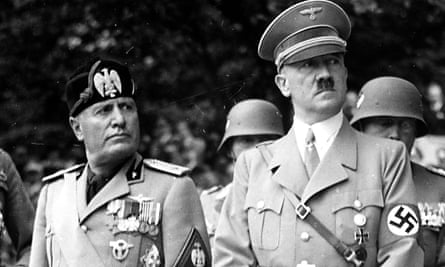
April 28, 1945, 80 years ago: Benito Mussolini, the fascist dictator of Italy from 1922 to 1943, is captured by Communist partisans and executed. He was 61 years old, and few wept for him.

Mussolini was originally a journalist who entered politics as a Socialist. He served in the Italian Army in World War I, and was wounded in 1917. His experience shifted him from left to right. On October 28, 1922, thinking the postwar Italian national government weak, he led the Fascists in a March On Rome. The government fell rather than oppose him with the Army, and King Victor Emmanuel III appointed Mussolini to be the country's youngest Prime Minister ever to that point. He became known as Il Duce (The Leader).

After removing all political opposition through his secret police, and outlawing labor strikes, Mussolini and his followers consolidated power through a series of laws that transformed the nation into a one-party dictatorship. In 1924, he ordered the assassination of Giacomo Matteotti, the Leader of the country's Socialist Party. In 1929, he signed the Lateran Treaty with the Holy See, to establish Vatican City.

His supporters, including in America, liked to say, "He made the trains run on time." In fact, they ran no better under him than under the previous government. They also liked to say he put an end to the Mafia. This also wasn't true. It would be more accurate to say that he made a deal with the Mafia, a non-aggression pact: Leave my officials -- including policemen, prosecutors and judges -- alone, let them do as they please, or, rather, as I please; and I'll do the same for you.

He also wanted to build a new Roman Empire. He established a protectorate over nearby Albania, and in 1935 invaded Ethiopia, annexing it into Italian East Africa (comprised of the current nations of Somalia and Eritrea). From 1936 to 1939, he and Adolf Hitler, the dictatorial Chancellor of Nazi Germany, aided fellow fascist Francisco Franco in his takeover of Spain.

(This included Hitler sending his air force, the Luftwaffe, to bomb opposing cities; and Mussolini sending troops, which became known as Franco's Italian Army. In the 1970s, this name would be adapted by Italian-American fans of the Pittsburgh Steelers, who formed a fan club for the half-Italian, half-black running back Franco Harris. Not to be outdone, a group of black fans honored defensive tackle Joe Greene with "Mean Joe Greene's Ethiopian Brigade." Given what Mussolini's men did in Spain and Ethiopia, both names should already have been considered cringeworthy.)

With the onset of World War II, Mussolini brought Italy into the Axis with Nazi Germany and Imperial Japan. But the reputation of Italy having a weak army -- which both Mussolini and Giuseppe Garibaldi had taken advantage of in the preceding 80 years -- still held, as British and American troops kicked them out of North Africa, and then invaded Sicily, and finally the Italian mainland.

On July 25, 1943, his own Grand Council of Fascism passed a vote of no confidence in him, and the King who had appointed him dismissed him as Prime Minister after 21 years, and ordered his arrest. The King then agreed to an armistice with the Allies.

German paratroopers broke Mussolini out of prison, resulting in a civil war. The Allies did not intervene, since their focus had moved to Western Europe. This time, Mussolini did not have enough troops to even oppose the regular Italian Army.

On April 25, 1945, Mussolini took his mistress, Clara Petacci -- leaving his wife and 6 children behind -- along with 13 others, including Clara's brother, who was posing as a Spanish consul, and fled. They set out for adjoining and neutral Switzerland, intending to board a plane and escape to also-neutral Spain, under Franco's protection.

But on April 27, they were stopped by Communist partisans near Lake Como, just 20 miles from the Swiss border. On April 28, instead of being turned over to the United Nations, as per Allied agreement in the event that he should be captured, they were executed in a village named Giulini de Mezzegra, on the orders of a partisan named Walter Audisio.

The witnesses' accounts of his last words differed. One said that he was defiant to the end, telling them, "Aim at my heart!" One said that he was a coward, yelling, "No! No!" The other said that Mussolini said nothing at all as the rifles were raised.

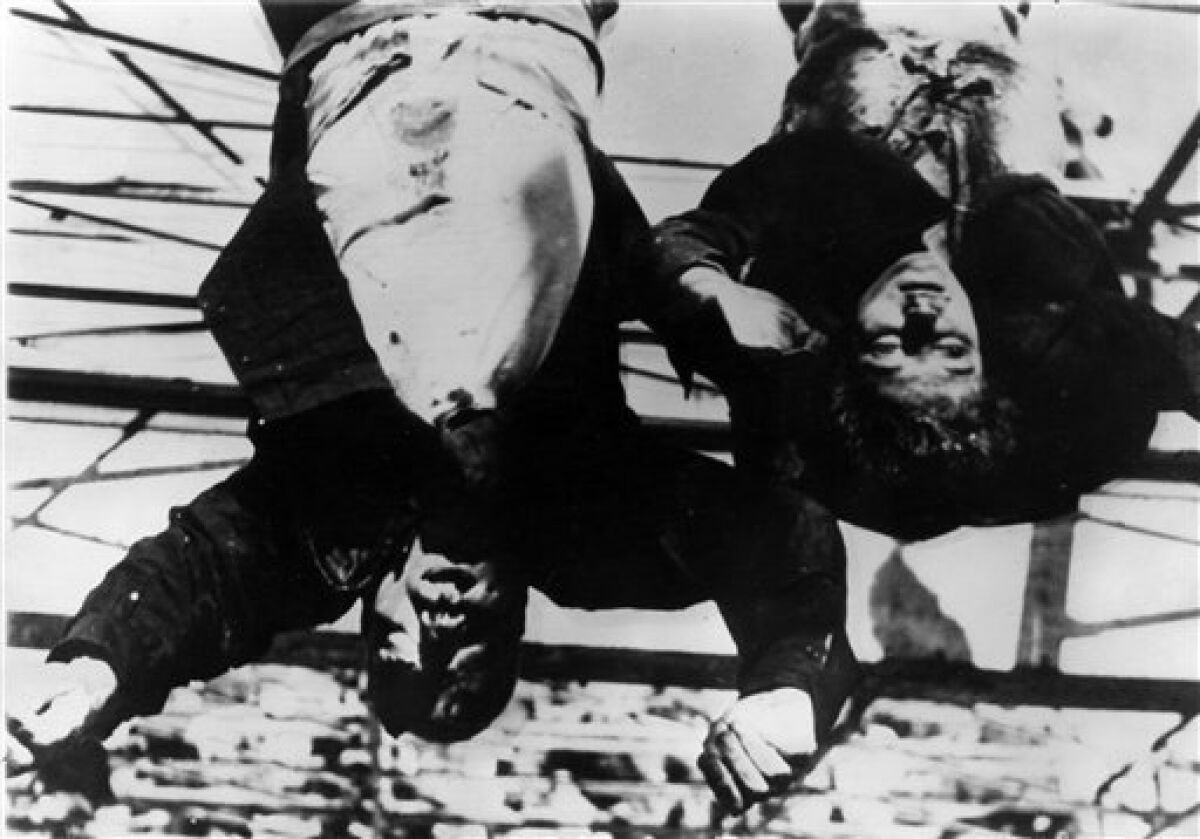
On April 29, the bodies of the executed were loaded in a van and moved to Milan, the largest city in northern Italy. They were dumped on the ground in the Piazzale Loreto, where people kicked them and spat on them. Finally, the bodies of Mussolini and the Petaccis were hung, upside-down, from the roof of an Esso gas station, and people threw stones at them.
Initially, Mussolini was buried in an unmarked grave. In 1946, his body was dug up and stolen by Fascist supporters. Four months later, it was recovered by the authorities, who then kept it hidden. In 1957, his remains were allowed to be interred in the Mussolini family crypt in his hometown of Predappio. His tomb has become a place of pilgrimage for neo-fascists, and the anniversary of his death is marked by neo-fascist rallies.

His granddaughter, Alessandra Mussolini, is a member of the European Parliament, and has been one of the leaders of far-right politics in Italy since the early 21st Century. Her son, Romano Mussolini, plays for SS Lazio, the Rome-based team known for a Fascist fan base. He says he has no interest in politics.

*

On April 30, upon hearing a report of what happened to Mussolini, and knowing that the Soviet Union's Red Army had Berlin surrounded, and that his own escape was unlikely, Hitler decided that he was not going to face the same fate. The Nazi dictator killed himself.
The famous, occasionally-imitated, Time cover

His wife, Eva Braun, had also committed suicide, with a cyanide pill. She was 33. The Nazi regime came to an end with the rump government's surrender 8 days later.

He knew the Red Army was closing in from the east. He knew the other Allies, America and Britain, were closing in from the west.

On April 22, he ordered General Felix Steiner to attack the Soviet troops attempting to encircle Berlin. Steiner could not raise enough troops to do so. Pretty much the only available fighters in Germany who weren't already in the Army were old men and children.

Steiner was no hero. He was arrested for war crimes, but after 3 years, he was released due to an inability to get enough evidence against him. He lived until 1966, still trying to rehabilitate the image of the German army, and in particular the SS.

In his Bunker, Hitler was told of Steiner's inability to raise troops, and he lost his composure. He now knew that defeat in World War II is inevitable. This event was dramatized in the 2004 German film Der Untergang, known as Downfall in the English-speaking world. Hitler was played by Austrian actor Bruno Ganz, and, since the scene was filmed in German, a language most non-Germans don’t understand, it became the basis for the "Hitler Rants Parodies" video series, with fake subtitles put on to match whatever joke the author wants to tell.

Hitler knew Berlin was surrounded. He had hoped to hold out until May 5, the anniversary of the death of Napoleon Bonaparte, his role model, who had come closer to conquering Russia than he had, actually reaching Moscow, but finding it burned and useless to him before returning.

But the reports that Hitler was getting suggested that the Soviets would get there sooner. And when he found out how his former Axis partner, Mussolini, had been treated after his capture, and especially after his execution, by Communists in his country, Hitler was determined to not fall into the hands of any of the Allied nations, especially the Soviets.

As the saying goes, the one service Hitler ever performed for humanity was to kill Hitler. But the regime he began on January 30, 1933, 12 years earlier -- including the war he started on September 3, 1939 -- had led to the deaths of 75 million people, military and civilian combined, including over 400,000 Americans.

The true depths of his depravity had already begun to reach the civilized world before word of his death had, as American, British and Soviet troops found the concentration camps where the Holocaust was carried out. In these camps, 11 million people died, some from murder, some from disease. And 6 million of those people who died, and many others who survived, were put there for no crime other than being Jewish.

So the death of Hitler could not be a wholly joyous occasion, because it was a reminder of all that he did, and all that he could have done had he won.

If you ever wonder which is worse, Fascism or Communism, consider this: The Soviets had the atomic bomb for 40 years, and never used it; the Chinese have had it for nearly 60 years, and have never used it; but if the Nazis had ever gotten it, there is no doubt that Hitler would have ordered its use.

His propaganda minister, Joseph Goebbels, and his wife, Magda, remained in the Bunker. On May 1, they fed their children poison, and then took their own lives. On May 2, Generals Hans Krebs and Wilhelm Burgdorf, both among those that Hitler asked to remain in the Bunker in the Downfall scene, committed suicide. The same day, Nazi Party Secretary Martin Bormann, who had fled the Bunker, realized capture by the Soviets was inevitable, and committed suicide. SS leader Heinrich Himmler escaped until he was captured by British troops, and committed suicide in their custody on May 23.

Most of the remaining Nazi high command was captured alive. They were tried in Nuremburg, site of some of the Party's infamous rallies, and convicted. These included Joachim von Ribbentrop, the Foreign Minister; Julius Streicher, the Nazis' top propaganda publisher; Hans Frank, Governor-General of occupied Poland; and the other 2 military leaders that Hitler had asked to stay in the Downfall scene, General Alfred Jodl, Chief of the Armed Forces, who had signed the surrender papers on V-E Day, and Field Marshal Wilhelm Keitel.

Not among the condemned, but scheduled to be so, was Reichsmarschall Hermann Göring, the highest-ranking Nazi official to have survived V-E Day. He had made an appeal, asking to be shot as a soldier instead of hanged as a common criminal, but the court refused. So he committed suicide with a potassium cyanide capsule the night before he was to be hanged.

Two more Fascist dictators, because they were neutral in The War, hung on: António Salazar had a stroke, and was removed from power in Portugal in 1968, dying in 1970, and democracy was restored in 1974; and Francisco Franco died in 1975, and, with the support of King Juan Carlos I, Spain went back to democracy.

Friday, March 14, 2025

March 14, 1950: A Senator Denounces Ingrid Bergman

March 14, 1950, 70 years ago: Swedish actress Ingrid Bergman is denounced on the floor of the U.S. Senate, for her "immorality."

Bergman had starred in Casablanca; the film version of Ernest Hemingway's For Whom the Bell Tolls; Alfred Hitchcock's films Gaslight (winning an Academy Award for Best Actress), Spellbound and Notorious; and had played a nun in The Bells of St. Mary's, and a saint in Joan of Arc. She was not only beloved around the world, but was viewed as worthy of those nun and saint roles. She was Catholic, but she was married, to neurosurgeon Petter Lindström, with a daughter, Pia.

In 1949, she wrote a letter to Italian director Roberto Rossellini, saying she admired his films and wanted to work with him. He invited her to star in his film Stromboli. They began filming, and they began an affair. As a result, she became pregnant.

On February 2, 1950, Renato Roberto Ranaldo Giusto Giuseppe Rossellini, nicknamed "Robin," was born. On February 9, Bergman obtained a "quickie" Mexican divorce from Lindström. On February 12, Stromboli was released in America. It did well in Europe, where their affair wasn't considered as big a deal. In spite of Italy being, historically, a very conservative country, the film was awarded the Rome Prize for Cinema as the best film of the year.

But in America, it was a box-office bomb. RKO Pictures, the American distributor, lost $200,000 on it. Most reviews suggested that the film was weak, but fell short of being nasty: American critics seemed willing to dislike it on merit.

On March 14, Senator Edwin C. Johnson, Democrat of Colorado, a baseball executive who built the original version of what became Mile High Stadium in Denver, denounced Bergman on the floor of the U.S. Senate. He said that she had once been his favorite actress. But now:

Now that the stupid film about a pregnant woman and a volcano has exploited America with the usual finesse, to the mutual delight of RKO and the debased Rossellini, are we merely to yawn wearily, greatly relieved that this hideous thing is finished, and then forget it? I hope not. A way must be found to protect the people in the future against that sort of gyp.
At this point, the Hays Code was still in effect, and cuts to Rossellini's film had been made to make it fit for American release. But Senator Johnson wanted to go further: He proposed a bill wherein movies would be approved for licenses based on the moral compasses of those behind the picture, insisting that Bergman "had perpetrated an assault upon the institution of marriage," and going so far as to call her "a powerful influence for evil."

There was a double standard at work: Male actors were able to work their way through the bedrooms of Southern California without being shamed into stopping. Her co-star in For Whom the Bell Tolls, Gary Cooper, slept with pretty much all of his female co-stars. So did her co-star in The Bells of St. Mary's, Bing Crosby -- who, in that film and its prequel, Going My Way, had played a priest, and was known as a Catholic moralist. The affairs of male actors may have been poorly-kept secrets in Hollywood, but the legitimate news outlets kept them quiet.

(Both Cooper and Crosby had co-starred with Grace Kelly, who fooled around with them, and with pretty much every male co-star she had. It's been suggested that the reason she was allowed to marry Prince Rainier III of Monaco was to cover up a coming revelation about her character.)

Bergman allowed nationally-syndicated columnist Art Buchwald to read her mail during the scandal. In an interview years later, he said, "Oh, that mail was bad: Ten, twelve, fourteen huge mail bags. 'Dirty whore.' 'Bitch.' 'Son of a bitch.' And they were all 'Christians' who wrote it." (Buchwald was Jewish.) Bergman later said, "People saw me in Joan of Arc, and declared me a saint. I'm not. I'm just a woman, another human being."

On May 24, she married Roberto Rossellini. On June 18, 1952, she gave birth to twin daughters, Isotta and Isabella. She could not return to America, but made the film Anastasia in 1956. It had been 6 years, and Ed Sullivan was willing to believe that America would welcome her back. He flew to Europe and filmed an interview with her, intending to air it on The Ed Sullivan Show. But when he got back to New York, CBS, which normally gave him a lot of leeway due to his show being the most popular one on the network, put its foot down, and said no, she could not appear, not even on film. Ed had wasted a lot of money, time and effort in a good cause.

But on March 27, 1957, she was announced as the winner of her 2nd Academy Award for the film, and the audience in the NBC Century Theatre in New York gave the announcement a rousing round of applause. Former co-star Cary Grant, one of the few celebrities to stick up for her all that time, accepted the award on her behalf, and brought it to her in London. She, Grant, Sullivan, and everyone else who had stood up for her were vindicated.

Later that year, she and Rossellini were divorced, following his affair with another actress; and she was reunited with her daughter Pia, in Rome. Petter Lindström, however, remained bitter towards Bergman. In 1958, Ingrid married Swedish theatrical producer Lars Schmidt. That marriage ended in divorce in 1975, the year she won a 3rd Oscar, for Best Supporting Actress for her role in Murder On the Orient Express.

She died in 1982, of cancer, on her 67th birthday. Rossellini had died in 1977. Lindström lived until 2000; Schmidt, until 2009. Pia Lindström became a journalist, Robin Rossellini a director like his father, Isabella Rossellini a model and an actress like her mother, and Isotta Rossellini became a literature professor. All 4 of Ingrid Bergman's children are still alive.

And Edwin C. Johnson? After serving 3 terms in the Senate, he did not run for a 4th in 1954, seeking to return to an office he had previously held, that of Governor of Colorado. He won, but did not run again in 1956, and never ran for office again. He died in 1970. In 1972, Senator Charles Percy, Republican of Illinois, officially entered an apology for Johnson's denunciation of Bergman into the Congressional Record.

Monday, December 16, 2024

December 16, 1899: Soccer Comes to Italy

Herbert Kilpin

December 16, 1899, 125 years ago: The Milan Foot-Ball and Cricket Club is founded in Milan, Lombardy. Its founder is an expatriate Englishman, Herbert Kilpin. It is the 1st professional soccer team in Italy.

Kilpin, a 29-year-old native of Nottingham, had played for Notts Olympic, and went to Italy to work for a textile merchant linked with his employer in Nottingham. There, he joined Internazionale FC Torino. (Both teams were defunct by 1916.) He founded the Milan club, giving it the English Cross of St. George as its crest, and shirts of red and black stripes, giving it the nickname Il Rossoneri, the Red and Black. He said, "We will be a team of devils. Our colours will be red like fire and black like the fear we will invoke in our opponents." 

He led the team to Italian titles in 1901, 1907 and 1909, and married an Italian woman, before dying from the effects of alcoholism in 1916, only 46 years old. In 1908, a dispute led to some players leaving the team, and forming a new one, Internazionale Milano, or "Inter." They chose black and blue stripes, making them Il Nerazzurri, the Black and Blue. The existing team became Associazione Calcio Milan, or "A.C. Milan," or just "Milan."

Since 1926, A.C. Milan have played their home games at a stadium in the San Siro neighborhood, and it is called "The San Siro." Inter have played there since 1947. Ironically, its official name is Estadio Giuseppe Meazza, after an Inter player who helped Italy win the 1934 and 1938 World Cups. Although it is the most famous sports venue in the country, both teams have expressed interest in replacing it, with plans being suggested that they would collaborate, or build separate stadiums.
The San Siro, prior to an AC Milan match
in the UEFA Champions League

Through the 2021-22 season, A.C. Milan have won Italy's national league, Serie A, 19 times, including in said 2021-22 season; the Coppa Italia, Italy's version of the FA Cup, 5 times, most recently in 2003;  and the European Cup/UEFA Champions League 7 times, more than any team except Real Madrid: In 1963, 1969, 1989, 1990, 1994, 2003 and 2007.

Inter have also won Serie A 19 times, and the Coppa Italia 8, including in 2021-22. Unlike A.C. Milan, they have won the League and Cup "Double," in 2006 and 2010. They have won the European Cup/Champions League 3 times, in 1964, 1965 and 2010 -- meaning that, in 2010, they won the only "European Treble" in Italian history. (UPDATE: In 2023, Inter won a 9th Coppa Italia; in 2024, a 20th Serie A title.)
Inter's badge

Both teams trail the 30 Serie A titles won by Turin-based Juventus Football Club, and their 14 Coppi Italia, althtough both have exceeded Juve's 2 Champions League titles, of 1985 and 1996. (UPDATE: Juve won a 15th Coppa Italia in 2024.)

Calendar year 1899 was a great year for soccer, as, in addition to A.C. Milan, several other legendary clubs were founded:

* January 8: SK Rapid Wien, in Vienna, Austria.
* March 8: Frankfurter Fußball-Club Victoria von 1899, the predecessor of Eintracht Frankfurt, in Frankfurt, Germany.
* May 3: Ferencvárosi Torna Club, commonly known as Ferencváros, in Budapest, Hungary.
* May 13: Esporte Clube Vitória, in Salvador, Brazil.
* May 14: Club Nacional de Football, in Montevideo, Uruguay.
* May 27: Rangers Football Club, in Glasgow, Scotland.
* August 31: Olympique de Marseille in Marseille, France.
* November 29: FC Barcelona in Barcelona, Spain.

December 16, 1899 was also the day that British actor and playwright Noël Coward was born. 

Thursday, November 14, 2024

November 14, 1934: The Battle of Highbury

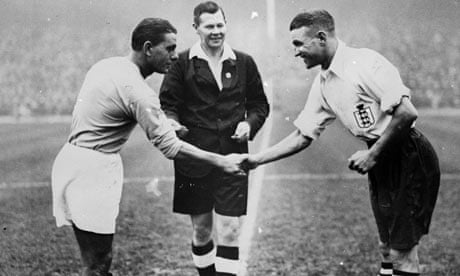
Left to right: Italy Captain Attilio Ferraris,
referee Otto Olsson, England Captain Eddie Hapgood

November 14, 1934, 90 years ago: The most-hyped soccer game ever to that point is played. And, while the competition lived up to the hype, everything else was horrible.

In 1928, a dispute with the governing body of world soccer, the Fédération internationale de Football Association (FIFA), England left their jurisdiction. The other "home nations" of the United Kingdom of Great Britain and Northern Ireland -- Wales, Scotland and Northern Ireland -- followed suit. (To this day, I don't know why they compete as a single united kingdom in the Olympics Games, but, for every other event, the home nations each have their own separate teams.)

This made the home nations ineligible to play in FIFA's signature tournament, the World Cup, which began in 1930, with Uruguay winning on home soil. The 1934 tournament would be the 1st held in Europe, in Italy, then ruled by fascist dictator Benito Mussolini. With a team dominated by players from Juventus FC of Turin and FC Internazionale Milano of Milan, Italy won it.

But England, which "invented football" (at the least, it did so in an organized way), still thought it had the best team in the world. So they challenged Italy in a game to decide "the real world championship." Italy accepted. The game would be in England, so Mussolini couldn't use his authority to cheat. But he did offer an incentive: If they won, each player would receive a new Alfa Romeo car and a cash prize which, converted into 2024 U.S. money, was about $7,500, a pretty good figure during the Great Depression.

Italy manager Vittorio Pozzo sent out this lineup (with neither side wearing uniform numbers):

* Goalkeeper: Carlo Ceresoli of Inter. This was a change from the World Cup, where his keeper, and his Captain, was Gianpiero Combi of Juventus.
* Right Back: Eraldo Monzeglio of Bologna FC.
* Left Back: Luigi Allemandi of Inter.
* Right Half: Attilio Ferraris of SS Lazio of Rome, Italy's Captain for this game.
* Center Half: Luis Monti of Juventus.
* Left Half: Luigi Bertolini of Juventus.
* Outside Right: Enrique Guaita of AS Roma of Rome.
* Inside Right: Pietro Serantoni of Juventus.
* Center Forward: Giuseppe Meazza of Inter. He had been the inside right in the World Cup, but was moved to center forward for this game, replacing Angelo Schiavio of Bologna. The Milan stadium used by both Inter and AC Milan, known worldwide as the San Siro for its neighborhood, is officially named for Meazza, as he was the greatest Italian player of his generation.
* Inside Left: Giovanni Ferrari of Juventus.
* Outside Left: Raimundo Orsi of Juventus.

At the time, England did not have a "manager" as we now understand that term. Essentially, the team Captain was the head coach. Rather, a board of directors selected the starting eleven:

* Goalkeeper: Frank Moss of Arsenal FC. Arsenal, of North London, were the dominant team in England in the 1930s, winning 5 Football League titles and 2 FA Cups.
* Right Back: George Male of Arsenal.
* Left Back: Eddie Hapgood of Arsenal. So respected by his peers was Hapgood that he was named Captain of his country before he was named Captain of his club: Arsenal's Captain at the time was the great Scottish forward Alex James.
* Right Half: Cliff Britton of Everton FC, based in Liverpool.
* Center Half: Jack Barker of Derby County FC, in the East Midlands.
* Left Half: Wilf Copping of Arsenal. A purely defensive player, he never scored a goal for Arsenal. But he was the most feared player in the league. Not that he was dirty: Not once was he ever booked for a foul. (This was before Mike Riley, a known Arsenal hater, was in charge of English referees.)
* Outside Right: Stanley Matthews of Stoke City FC. At 19, he was the youngest player on the team. He would eventually become the grand old man of English football, playing for Stoke in Division One at age 50. In between tenures at Stoke, he would play for Lancashire side Blackpool FC. Playing his career for struggling teams, "The Wizard of Dribble" only won 1 trophy in his career, the 1953 FA Cup. In that game, his teammate Stan Mortensen became the 1st, and remains the only, player to score 3 goals in an FA Cup Final. And yet, the game is still called "The Matthews Final," such was his dominance of the game.
* Inside Right: Ray Bowden of Arsenal.
* Center Forward: Ted Drake of Arsenal. Recently acquired from Hampshire team Southampton FC, he became the top scorer in the country. The following year, he would tie the League record by scoring 7 goals against Birmingham team Aston Villa.
* Inside Left: Cliff Bastin of Arsenal. Normally an outside left, he would score 178 goals for "The Gunners," a team record that would last until surpassed by Ian Wright in 1997. He finished with 185, which was surpassed by Thierry Henry with 228.
* Outside Left: Eric Brook of Manchester City FC.

Seven players from Arsenal. It remains the only time 1 team has had 7 players in the England starting XI. So the match was set for Arsenal's home, Arsenal Stadium, known for its neighborhood as "Highbury." Although having little experience at the international level, these players were battle-tested in the toughest league in the world.

The referee was Otto Olsson, of Sweden. The crowd was given as 56,044 people. England wore white shirts and navy blue shorts, while Italy wore sky blue shirts and white shorts.

But when the game began at 3:00 on that Wednesday afternoon -- 10:00 in the morning, U.S. Eastern Time -- it was pouring rain, and the rain continued throughout the game. And the Italians were dirty from the outset. In only the 1st minute of the game, Drake had a one-on-one with Ceresoli, who crashed into him. Olsson awarded a penalty, but it was taken by Brook, who missed it.

Just a minute later, Monti tackled Drake, and broke his own foot in the process. A minute later, Brook headed in a cross from Matthews, and it was one-nil to England. Shortly thereafter, Hapgood took an elbow to the face, breaking his nose. In the 10th minute, Brook fired a free kick that Matthews said was "like a thunderbolt." It was 2-0 England. Just 2 minutes later, Drake made it 3-0. It looked like a wipeout.

By the 15-minute mark, both Monti and Hapgood had to leave the pitch. Both sides were down to 10 men. Pozzo changed tactics, and the Italian defense got tighter. And dirtier: Drake was punched, Brook's arm was broken, and Bowden got his ankle hurt. Olsson booked none of these offenses.

The Italians kept their tactics up in the 2nd half, and the tide of the game turned. Meazza scored twice within 4 minutes on either side of the hour mark. He fought hard for an equalizer, denied by saves from Moss and once hitting the post. When Olsson blew his whistle for full-time, it was still England 3, Italy 2.

England claimed to be the true world champions, their "gentlemen" having defeated the World Cup winners at their dirtiest, in a match that Matthews, whose length and greatness of career can be compared to American baseball pitcher Nolan Ryan and Canadian hockey player Gordie Howe, called it the most violent match in which he had ever played.

But Italy received its players as heroes. Recognizing that they had played under completely unfavorable conditions, they were hailed as "The Lions of Highbury." Mussolini, not bound by his promise because of the defeat, followed through anyway, giving the players the cash prizes and the cars.

Ceresoli lived until 1995, making him the last surviving Italian player from this game. Matthews was the game's last survivor, living until February 23, 2000.

Italy would repeat as World Cup winners in 1938. World War II canceled the World Cup of 1942, and the inability to set up qualifying matches because the European phase of the war didn't come until 1945 forced the cancellation of the 1946 edition. FIFA and the British home nations settled their differences, and England entered the 1950 World Cup, but failed until hosting the tournament in 1966. That remains the only international tournament that England have ever won. Italy have won the World Cup again in 1982 and 2006; and the UEFA European Championships of 1968 and 2020.

Wednesday, July 17, 2024

July 17, 1994: The World Cup Final On American Soil

The Rose Bowl, Pasadena, California, July 17, 1994.
Attendance: 94,194.

July 17, 1994, 30 years ago: For the 1st time, the Final of soccer's World Cup is held on American soil.

There were 9 venues. From East to West:

* Foxboro Stadium, built in 1971, in the Boston suburb of Foxboro, Massachusetts, home of the NFL's New England Patriots. It had been the home of the North American Soccer League's Boston Minutemen and New England Tea Men, and would become the home of Major League Soccer's New England Revolution.

* Giants Stadium, 1976, in the New York suburb of East Rutherford, New Jersey, home of the NFL's New York Giants and New York Jets. It had been the home of the NASL's New York Cosmos, and would become the home of MLS' New York/New Jersey MetroStars, who became the New York Red Bulls.

* Robert F. Kennedy Memorial Stadium, known as District of Columbia Stadium from 1961 to 1969, in Washington, D.C., home of the NFL's Washington Redskins (now the Washington Commanders). It had been the home of the NASL's Washington Darts and Washington Diplomats, and would become the home of MLS' D.C. United.

* The Citrus Bowl, 1936, now named Camping World Stadium, in Orlando, Florida, the only venue not then the regular home of a professional or college football team. It was home of college football's annual Florida Citrus Bowl. It would later become the home of MLS' Orlando City Soccer Club.

* The Silverdome, 1975, in the Detroit suburb of Pontiac, Michigan, home of the NFL's Detroit Lions. It had been the home of the NASL's Detroit Express. Alone among these 9 metropolitan areas, Detroit has never had an MLS team.

* Soldier Field, 1924, in Chicago, home of the NFL's Chicago Bears. It had been the home of the NASL's Chicago Sting, and would become the home of MLS' Chicago Fire.

* The Cotton Bowl, 1930, in Dallas, home of the annual Cotton Bowl game, and the former home of the NFL's Dallas Cowboys. It had been the home of the NASL's Dallas Tornados, and would become the home of MLS' Dallas Burn, who became F.C. Dallas.

* The Rose Bowl, 1922, in the Los Angeles suburb of Pasadena, California, home of the football team at the University of California at Los Angeles (UCLA) and the annual Rose Bowl game. It had been the home of the NASL's Los Angeles Wolves and Los Angeles Aztecs, and would become the home of MLS' Los Angeles Galaxy.

* And Stanford Stadium, 1921, in the San Francisco suburb of Palo Alto, California, home of the football team at Stanford University.

Thus, the Silverdome, Soldier Field, the Rose Bowl and Stanford Stadium became the only stadiums to host both a Super Bowl and a World Cup match -- and the Rose Bowl would become the only one to host both a Super Bowl and a World Cup Final. 

This tournament remains the World Cup with the highest per-game attendance: 68,991. And what an array of talent, not dampened in the slightest by England, which still thinks of itself as the country in world "football," failing to qualify for the 1st time since 1978:

* From finalists Brazil: Romário, Ronaldo, Cafu, Bebeto, Dunga, Leonardo, and Claudio Taffarel.

* From finalists Italy: Franco Baresi, Paolo Maldini, Gianfranco Zola, Mauro Tassotti, Roberto Donadoni, Antonio Conte, and Roberto and Dino Baggio (not related).

* From semifinalists Sweden: Henrik Larsson and Tomas Brolin.

* From semifinalists Bulgaria: Hristo Stoichkov.

* From quarterfinalists the Netherlands: Frank Rijkaard, Ronald Koeman, Dennis Bergkamp, Marc Overmars, Danny Blind, Edwin van der Sar, and the twins Frank and Ronald de Boer. (Marco van Basten had already had to retire due to injury.)

* From quarterfinalists Germany: Lothar Matthäus, Jürgen Klinsmann, Jürgen Kohler, Rudi Völler, Thomas Häßler, Andreas Brehme, Matthias Sammer and Oliver Kahn.

* From quarterfinalists Romania: Gheorghe Hagi and Gheorghe Popsecu.

* From quarterfinalists Spain: Pep Guardiola and Luis Enrique.

* From the Round of 16: From Argentina: Diego Maradona (who ended up getting suspended for drugs), Gabriel Batistuta and Claudio Caniggia. From Ireland: Roy Keane, Paul McGrath, Ray Houghton, John Aldridge, Steve Staunton, Ronnie Whelan, Tony Cascarino and Packie Bonner. From Nigeria: Jay-Jay Okocha.

* From teams that didn't make it to the knockout round: Roger Milla from Cameroon, and Carlos Valderrama and his hair from Colombia.

* And from our own team, which did make it past the Group Stage for the 1st time since 1930: Alexi Lalas, Eric Wynalda, Cobi Jones, Marcelo Balboa, Paul Caligiuri and Jersey Boys Tony Meola, John Harkes, Tab Ramos and Claudio Reyna.

True, we got knocked out by Brazil, on home soil, on the 4th of July no less, at the old Stanford Stadium in the San Francisco suburb of Palo Alto, California. And we wore horrid uniforms. But it was still a big boost for American soccer, just what the upcoming founding of Major League Soccer (MLS) needed going into 1996.
Yes, we actually wore these things.

Certainly, we got the pageantry right. Having America play on the 4th of July worked out well, despite the loss. And the New York market got lucky, as 2 of the country's, and particularly the Tri-State Area's, biggest ethnic groups ended up having their ancestral homelands playing each other at the Meadowlands: The Republic of Ireland and Italy.
Ireland vs. Italy, Giants Stadium, June 18, 1994.
Attendance: 75,338. Ireland pulled the upset, winning 1-0.

But, from the American perspective, the 2 worst things that could have happened did happen. Someone got killed. Not in the stadium, or in the streets; it wasn't a fight between hooligans. Not even in the country. After his own goal sent Colombia down to defeat against us, Andrés Escobar of Atlético Nacional went back home to Medellín, and was shot and killed. He was only 27 years old.

The other was that the Final ended scoreless. There were the 2 best teams in the world, Brazil and Italy, and, after a full 90 minutes, plus extra time making it 120 minutes, the final score was 0-0. Nil-nil. Nothing to nothing. Americans like scoring, and any American watching this Final, not knowing all that goes into a soccer game, would have found it boring as hell. It probably set American interest in the sport back several years.

Roberto Baggio blasted a penalty kick over the crossbar, and Brazil won the penalty phase, 3-2. And Americans not already into soccer shrugged their shoulders, and either went back to watching baseball or began preparing for a new NFL season.
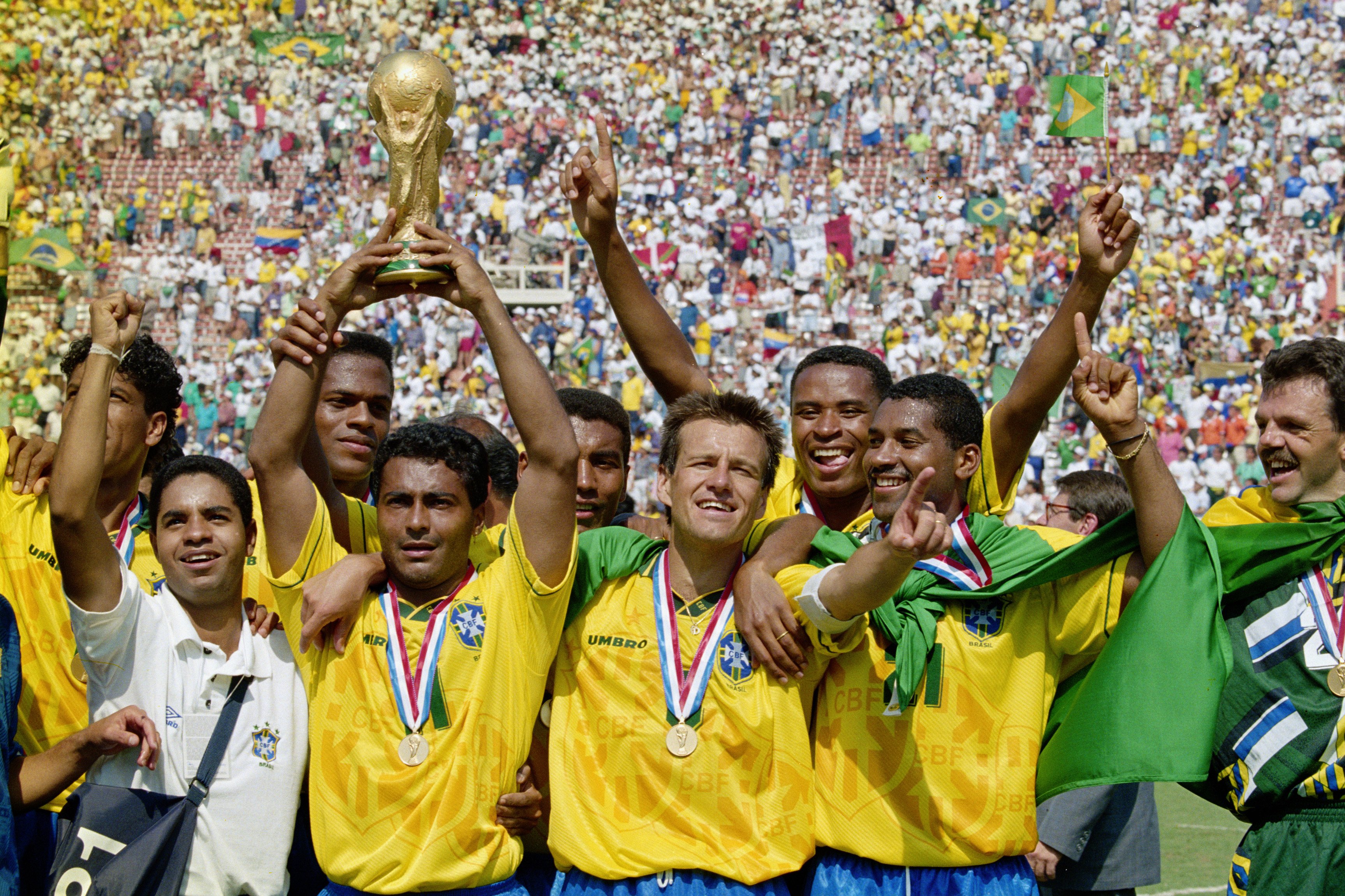
Romário (Number 11) lifts the Jules Rimet Trophy,
next to Dunga (8), the Captain

Foxboro Stadium was torn down in 2002, having been replaced by the next-door Gillette Stadium. Soldier Field was torn down in 2002, and replaced by a new stadium on the same site. Stanford Stadium was torn down in 2004, and replaced by a new stadium on the same site. Giants Stadium was torn down in 2010, having been replaced by the next-door MetLife Stadium. The Silverdome was torn down in 2017. RFK Stadium was torn down in 2023.

The 2026 World Cup was awarded jointly to all 3 North American nations: The United States, Canada (which has never hosted), and Mexico (which hosted in 1970 and 1986). Most of the host stadiums from 1994 are unlikely to host again in 2026, since they've been replaced. The Final was awarded to New York, and to MetLife Stadium. SoFi Stadium, outside Los Angeles, got a Quarterfinal; while the Semifinals went to Mercedes-Benz Stadium in Atlanta and AT&T Stadium outside Dallas.