Showing posts with label world war iii. Show all posts

Thursday, March 5, 2026

March 5, 1946: Winston Churchill's "Iron Curtain" Speech

March 5, 1946, 80 years ago: Winston Churchill, as he had done many times before, turns a phrase that sticks in the collective consciousness of Western civilization.

Shortly after meeting with the new President of the United States, Harry Truman, at the Potsdam Conference outside Berlin in July 1945, he had to stand for election in Britain. His Conservative Party lost, and he had to resign as Prime Minister, although he was still Party Leader. He had more free time than before, and visited America the next year.

The British capital building is known as the Palace of Westminster. In Fulton, in Truman's home State of Missouri -- 111 miles west of St. Louis, 150 miles east of Kansas City, 23 miles southeast of the University of Missouri at Columbia, and 24 miles northeast of the State Capitol in Jefferson City -- there is a Westminster College. It offered Churchill an honorary degree, hoping he would come, accept, and deliver one of his rousing speeches, inspiring donations to the school. They couldn't have been more thrilled, because this is pretty much the only thing the school is known for today.

With Truman in attendance, Churchill gave a speech he had titled "Sinews of Peace." But that would not be the phrase anybody remembered.

Even by the time of the Yalta Conference in the Crimea in February 1945, when Churchill and the dying President Franklin D. Roosevelt met with Soviet Premier Joseph Stalin, the Soviet Union's Red Army was occupying much of Eastern Europe. After pushing Nazi Germany back, there was little willingness to start a World War III with Communism before World War II with Fascism was over. Churchill came up with a plan, but he knew it would never see the light of day. He proved this by naming it "Operation Unthinkable."

The term "iron curtain" had been used to describe safety curtains, installed on theater stages to slow the spread of fire. In 1918, Vasily Rozanov, an anti-Communist writer opposing the Bolshevik Revolution, wrote a book titled The Apocalypse of Our Time. When translated into English in 1920 -- Rozanov having died in the Russian famine then still ongoing -- Churchill would have read Rozanov's words as:

With clanging, creaking, and squeaking, an iron curtain is lowering over Russian History. "The performance is over." The audience got up. "Time to put on your fur coats and go home." We looked around, but the fur coats and homes were missing.

Already having both a taste for the theatrical and a predisposition to oppose Communism, Churchill would have approved of Rozanov's metaphors.
Germany had long been fond of iron metaphors. The founder of the German Empire, Otto von Bismarck, had begun the unification process with an 1862 speech titled "Blood and Iron" (Blud und Eisen), and so was known as "The Iron Chancellor." The country's top military decoration was the Iron Cross. And Adolf Hitler often invoked the legacy of Bismarck by speaking of "Blood and Iron" (or, alternatively, "Iron and Blood") So the Nazis, too, used the phrase "Iron Curtain."
A 1943 magazine named Signal discussed "the iron curtain that more than ever before separates the world from the Soviet Union." Nazi propaganda minister Joseph Goebbels wrote in Das Reich, on February 25, 1945, that, if Germany should lose the war, "An iron curtain would fall over this enormous territory controlled by the Soviet Union, behind which nations would be slaughtered." In that, if in little else, he was right.
Churchill's first recorded use of the term "iron curtain" came in a May 12, 1945 telegram he sent to Truman, regarding his concern about Soviet actions, stating "[a]n iron curtain is drawn down upon their front. We do not know what is going on behind." In another telegram to Truman, on June 4, he wrote of "...the descent of an iron curtain between us and everything to the eastward."
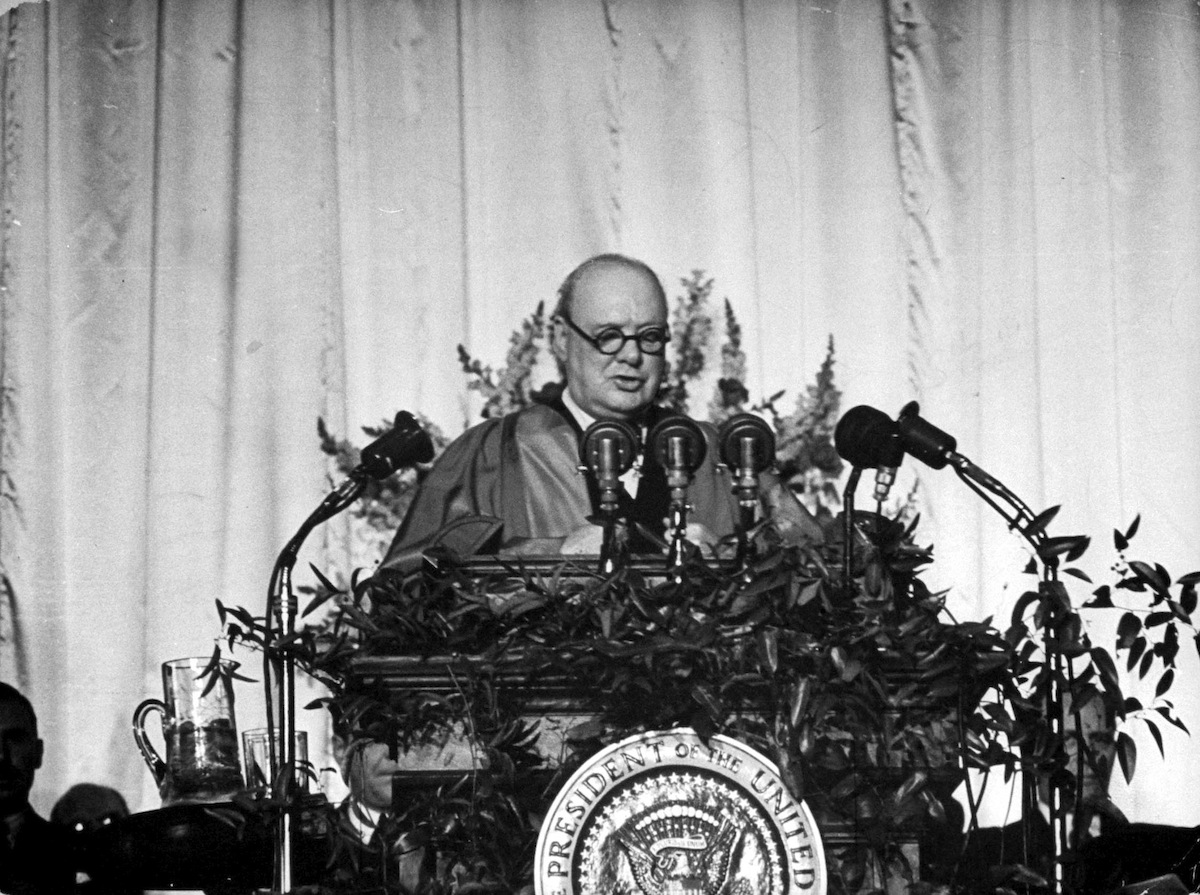
Now, at Westminster College, with Truman seated on the stage behind him, Churchill spoke of this new "border": 
From Stettin in the Baltic to Trieste in the Adriatic, an iron curtain has descended across the continent. Behind that line lie all the capitals of the ancient states of Central and Eastern Europe: Warsaw, Berlin, Prague, Vienna, Budapest, Belgrade, Bucharest and Sofia. All these famous cities and the populations around them lie in what I must call the Soviet sphere, and all are subject, in one form or another, not only to Soviet influence, but to a very high, and in some cases increasing, measure of control from Moscow.

Film of this speech shows that, at the words "iron curtain," he made a downward slashing motion with his left hand -- or, if you prefer, his left wing -- providing another fitting metaphor.

Churchill was a little off, geographically: Stettin, soon to be renamed Szczecin, as it was now part of Poland, was on the new border between Poland and East Germany; and Berlin, divided into 3 Allied and 1 Soviet sector, was to the west of that; while Trieste is in northeast Italy, on the border with what was then Yugoslavia, and is now Slovenia.

And Churchill (and, to be fair, Truman as well) did not yet realize that Yugoslavia's dictator, Josip Broz Tito, while he was a true believer in Communism, had already broken with Stalin, and thus his country was on the West's side of the Iron Curtain. And in 1955, Austria broke with the Soviets, and got away with it.

Nevertheless, the term had been used. The Cold War was on. As for that term, it appears to have been first used by George Orwell, in his 1945 essay, "You and the Atomic Bomb": He described a world living in fear of nuclear destruction, which he described as a "permanent state of 'cold war.'" Bernard Baruch, an advisor to Presidents Roosevelt and Truman, used the phrase in a speech on April 16, 1947, saying: "Let us not be deceived: We are today in the midst of a cold war." Later that year, journalist Walter Lippman wrote a book titled Cold War, which helped solidify the term's use in the public consciousness.

On March 5, 1953, 7 years later to the day after Churchill's speech, Stalin died. But the Iron Curtain would live on until 1989 when, one by one, the countries behind it lifted their portions of it.

The term would be adapted. The borders between North and South Korea, and North and South Vietnam, and the Sea of Japan between Japan and Red China, became known as the Bamboo Curtain. And in America, black writers suggested that there was a Cotton Curtain that separated the segregationist Southern States from the rest of the country.

Maybe a line can be drawn across New Jersey, westward from the Outerbridge Crossing in Perth Amboy, along State Route 440, to Interstate 287, to where it meets U.S. Route 22 in Bridgewater, on west to the Delaware River in Phillipsburg, and that can be the Pork Roll Curtain, as an unofficial divider between people south of it, who call the processed meat by its legal name, "pork roll"; and people north of it, who call it by its incorrect and officially (if not enforced) illegal name, "Taylor ham."

Thursday, September 25, 2025

September 25, 1965: "Eve of Destruction" Hits Number 1

September 25, 1965, 60 years ago: "Eve of Destruction" by Barry McGuire hits Number 1 on Billboard magazine's Hot 100 chart.

Barry McGuire (no middle name) was born on October 15, 1935 in Oklahoma City, and joined the folksinging group The New Christy Minstrels, co-writing, and singing lead on, their song "Green, Green," a Top 10 hit for them in 1963. But he left them in early 1965, looking for something more.

Philip Gary Schlein was born on September 18, 1945 in Manhattan, and grew up in Los Angeles, where his father changed the family name to Sloan, and Philip became known as "P.F." or "Flip" Sloan. The songs he wrote and recorded himself didn't go too far.

He began to write songs with Steven Barry Lipkin, a.k.a. Steve Barri, born on February 23, 1942, and also a New Yorker who went west to Los Angeles before the Brooklyn Dodgers did. Together, they would write such hits as "A Must to Avoid" by Herman's Hermits, "Secret Agent Man" by Johnny Rivers, and "You Baby" by The Turtles.

Early in 1965, "Eve of Destruction" was offered to The Byrds, who turned it down, and then The Turtles, who recorded it, but dropped the 3rd verse, in the hopes that it would get more airplay if it were a shorter song. It wasn't a hit for them.

Around that time, McGuire met with Sloan, and asked if he had any material. Sloan showed him some light fare, potential pop hits. McGuire said, "No, I'm looking for something that means something." Sloan showed him he songs that he thought "meant something." McGuire grabbed him by the face, kissed him, and said, "You're exactly what I'm looking for."

McGuire recorded "Eve of Destruction," and the album, on Dunhill Records, would carry the same title. Also on the album were "Sins of a Family," "Mr. Man on the Street" and "What's Exactly the Matter with Me," credited to Sloan alone; "You Never Had It So Good" and "Ain't No Way I'm Gonna Change My Mind," credited to Sloan and Barri; "Why Not Stop and Dig It While You Can," which McGuire wrote himself; and covers of Bob Dylan's "She Belongs to Me" and "It's All Over Now, Baby Blue," The We Five's "You Were On My Mind," "Try to Remember" from the Broadway musical The Fantasticks, and the folk song "Sloop John B."

"Eve of Destruction" was recorded on July 13, 1965, in Los Angeles. Only 3 musicians were on it: Sloan himself played guitar and harmonica, and, from Phil Spector's "Wrecking Crew," Larry Knechtel played bass guitar and Hal Blaine played drums. Sloan, Barri, and Dunhill owner Lou Adler were listed as the song's producers.

The lyrics referenced the Vietnam War, whose first major protest march had been held in New York in April; the fact that, a man could be drafted at age 18, but couldn't vote until he was 21, a fact that wouldn't be changed until the 26th Amendment was ratified in 1971; trouble in the Middle East; the threat of nuclear annihilation; Southern Senators' attempts to block civil rights legislation; a comparison of "all the hate there is in Red China" with that of the police of Selma, Alabama the preceding March; a comparison of being an astronaut to living on Earth; and the hypocrisy of American Christianity: "Hate your next-door neighbor, but don't forget to say 'Grace.'"

By some standards, it seemed like the high point of liberalism and progress in America. The Civil Rights Act of 1964 had been passed. Martin Luther King Jr. was the current holder of the Nobel Peace Prize. Of course, the Voting Rights Act of 1965, Medicare and Medicaid hadn't been signed into law yet, but would be as the song climbed the charts. Then again, the Watts race riot also happened right after that.

Blaine's drum opening, the spare arrangement, and Sloan's harmonica added to the song's hopeless atmosphere. A performance on ABC's variety show The Hollywood Palace showed McGuire singing in a junkyard while somber-looking dancers moved very slowly, with little of the joy associated with 1960s rock and roll dancing.

A vocal track was thrown on as a rough mix, and was not intended to be the final version. But a copy of the recording "leaked" out to a disc jockey. The song was an instant hit, and as a result, the more polished vocal track that was at first envisioned was never recorded. Many radio stations, thinking the song "un-American" or "anti-American," banned it. But it sold so many copies that, in its issue dated September 25, 1965, Billboard magazine ranked it Number 1 on its Hot 100 anyway.

The backlash affected McGuire more after the song came down the charts: He never had another Top 40 hit. The Spokesmen, including David White of Danny & The Juniors, and John Medora, who co-wrote "At the Hop" with White, recorded an answer song, "Dawn of Correction." It praised civil rights advances, decolonization, the Peace Corps and the United Nations, so it wasn't a straight-ahead right-wing response. Country singer Johnny Seay, under the name "Johnny Sea," also recorded a spoken-word piece, "Day for Decision," which acknowledged the problems, but suggested that patriotism was the answer, when it clearly wasn't. Both songs became hits, though not big ones.

In 1966, Staff Sergeant Barry Sadler, who had been a combat medic in Vietnam, recorded "The Ballad of the Green Berets." It wasn't an intentional answer song, but many people treated the considerably more patriotic song as such, and it hit Number 1.

In 1970, The Temptations recorded "Ball of Confusion." Being a Motown production, it was much more slickly-produced. It hit many of the same ideas, and used the words "eve of destruction." More a sequel than an answer song, it hit Number 3. In 1972, Don McLean's "American Pie" hit some of the same themes, and hit Number 1.

McGuire appeared in the original Broadway production of Hair in 1968. In 1971, he became a born-again Christian, and began recording Christian rock. By the 1990s, he was again willing to play his former hits. After a 1999 school shooting, McGuire took the line about China and Alabama, and changed it to, "Then take a look around at Columbine, Colorado."
Barry McGuire, 2023

Larry Knechtel died in 2009, Phil Sloan in 2015, and Hal Blaine in 2019. As of September 25, 2025, Barry McGuire, Steve Barri and Lou Adler are still alive, and McGuire is still performing.

Monday, August 25, 2025

August 25, 1945: The Death of John Birch

August 25, 1945, 80 years ago: John Birch dies. This was not widely known at the time, nor was he famous during his lifetime. Most Americans never knew he was alive until they knew he was dead, and they didn't know that right after his death, either.

John Morrison Birch was born on May 28, 1918 in Landour, India, where his parents were Presbyterian missionaries. The family returned to America in 1920, due to his father suffering from malaria. They lived in Vineland, New Jersey and Macon, Georgia.

He graduated from high school, and enrolled at Mercer University, a Baptist-affiliated school in Macon. His fellow students noted his zealotry at Mercer, as he opposed the theory of evolution, and he made some enemies there. He graduated in 1939. He then entered the Fundamental Baptist Bible Institute in Fort Worth, Texas, needing only 1 year to graduate. In high school, at Mercer, and at FBBI, each time, he graduated at the top of his class.

FBBI's founder, J. Frank Norris, had been a missionary in China. Having heard from Norris about his missionary work in China, and finding the Chinese receptive to the Gospel, especially having suffered under Japanese oppression since 1931, Birch wanted to go. When Norris and some 150 members of the church gathered to send Birch and a friend off to China, Norris said they went "fully informed as to the dangers that await them, but they go like the Apostle Paul when he knew that it meant death at Jerusalem." Birch left his family with the words "Goodbye, folks. If we don't meet again on Earth, we'll meet in Heaven."

He arrived, and quickly learned the Mandarin dialect of Chinese. After the Japanese attacked Pearl Harbor, bringing America into World War II, he wrote to the American Military Mission in China, offering to enlist in the U.S. Army and serve as a chaplain, but willing to "tote a rifle or whatever they tell me to do."

He enlisted, and rose to the rank of Captain. He was part of a rescue crew that saved Lieutenant Colonel Jimmy Doolittle and members of his squadron after they bailed out over China. Upon Doolittle's recommendation, Birch was transferred into the Army Air Forces, which would be separated from the Army as the U.S. Air Force in 1947.

Birch was a genuine war hero, setting up intelligence networks of sympathetic Chinese, and rescuing downed American pilots. Contrary to what conservative Americans would later suggest, that the Nationalist Chinese government of President Chiang Kai-shek was blameless and worth supporting at all costs, Birch wrote to a friend that it was "relatively small and unrepresentative," and cited its "abuses, intolerance and impotence."

He did, however, praise Chiang for his steadfastness of purpose. However, Birch considered the Communists of Mao Zedong, despite their having temporarily united with Chiang to fight the Japanese, an "equally small, non-representative group," "whose leaders I consider hypocritical thugs."

The Japanese surrendered on August 14, which was named V-J Day, Victory over Japan. Captain Birch was among the American officers assigned to go into Japanese-held territory to inform Japanese units of their government's surrender. But on August 25, having encountered a Communist group, Birch and his Nationalist Chinese aide were shot and killed. Birch was only 27 years old.

In spite of his work, Birch would probably be forgotten today, if not for Robert W. Welch Jr., a retired candy manufacturer and conservative political activist from the Boston suburb of Belmont, Massachusetts. In 1954, Welch wrote The Life of John Birch: In the Story of One American Boy, the Ordeal of His Age. On December 9, 1958, in Indianapolis, Welch founded the John Birch Society, naming his anti-Communist and (allegedly) pro-Christian group after Welch, calling him "the first American casualty of the Cold War."

Welch received permission from Birch's parents to name his Society after their son, and both parents participated in Society-related events. But in a memoir released after his 1993 death, Birch's friend, General Jimmy Doolittle, said of Birch, "He had no way of knowing that the John Birch Society, a highly vocal postwar anticommunist organization, would be named after him because its founders believed him to be the 'first casualty of World War III.' I feel sure he would not have approved."

Welch considered anybody not anti-Communist to his satisfaction to be a Communist sympathizer, and even called President Dwight D. Eisenhower "an active agent of the Communist conspiracy." After a few decisions of the Supreme Court that seemed to Welch to be pro-Communist and anti-religion, the Society sponsored billboards attacking the Chief Justice, reading: "IMPEACH EARL WARREN!"

In 1963, folk group The Chad Mitchell Trio recorded a song titled "The John Birch Society," which made the Society's members look not only excessively paranoid, but stupid:

We only hail the hero
from whom we get our name.
We're not sure what he did
but he's our hero just the same!

And there was this rhyme:

There's no one left but thee and we
and we're not sure of thee!

The song also included this verse:

Do you want Justice Warren
to be your Kommissar?
Do you want Mrs. Khruschchev in there
with the DAR?
You cannot trust your neighbors
or even next of kin!
If Mommy is a Commie
then you've got to turn her in!

There was no chance of the wife of Soviet Premier Nikita Khrushchev joining the Daughters of the American Revolution: He wasn't married at the time.