Wednesday, July 30, 2025

July 30, 1975: The Disappearance of Jimmy Hoffa

July 30, 1975, 50 years ago: Jimmy Hoffa goes to a meeting. Nobody knows the result of this meeting, because nobody ever saw Hoffa again. Anybody who did see him after this meeting hasn't been talking.

James Riddle Hoffa was born on February 14, 1913 in Brazil, Indiana, outside Terre Haute. Controversial Bishop James Pike was born the exact same day, and he would also disappear, although he was found -- dead. New York Yankees broadcaster Mel Allen was born the same day. So was Ohio State football coach Woody Hayes.

Hoffa was 7 when his father died, and at 11, his mother moved him to Detroit, where he lived for the rest of his life. He dropped out of school to go to work at age 14. Because of the abuses he sustained on his job, he was drawn to union activity. By 1932, he was a member of the International Brotherhood of Teamsters, which then represented truck drivers and chauffeurs, although it now represents a diverse group of blue-collar and professional workers.

Hoffa proved to be an organizing genius: In his rise through the Teamsters, they grew from 75,000 members in 1933 to 420,000 in 1939, actually growing despite the manpower drain of World War II (for which Hoffa's leadership role within the union got him a draft deferment), and topping 1 million in 1951. By 1952, Hoffa was the union's national vice president, and was elected president in 1957.

By this point, the actions of the Teamsters had attracted some inconvenient attention. The U.S. Senate's Select Committee on Improper Activities in Labor or Management Field, chaired by John McClellan of Arkansas (and thus remembered as "the McClellan Committee"), called Hoffa's predecessor, Dave Beck, to Capitol Hill to testify on organized crime's influence on the union. He invoked his right against self-incrimination under the 5th Amendment to the Constitution of the United States 140 times, and was subsequently indicted and convicted of embezzlement. (He served 2 1/2 years in prison, and died in 1993, at age 99.) That allowed Hoffa to rise to the union's presidency sooner than would have been expected.

One of the members of the McClellan Committee was John F. Kennedy of Massachusetts. The legal counsel for the Committee was Kennedy's brother, Robert F. Kennedy. Bobby had discovered several financial irregularities, including the misappropriation of $9.5 million in union funds  -- about $108 million in 2022 money.

The exchange between Robert Kennedy and Hoffa was so intense, it inspired Bobby's 1st book, titled The Enemy Within. I found the book once, and couldn't believe that the man who wrote it was the same man who ran for President in 1968 on a message of peace and brotherhood. This Robert Kennedy was incredibly belligerent, and he didn't seem to have a nice thing to say about anybody. It later inspired a 1983 TV-movie, titled Blood Feud, starring Robert Blake as Hoffa and Cotter Smith as Bobby.

Hoffa was indicted for bribery over this. He was acquitted, but the controversy led the AFL-CIO to expel the Teamsters from its ranks. This didn't stop Hoffa: He managed to bring airline workers and transport workers (bus drivers and subway motormen) under the Teamsters' umbrella.

John F. Kennedy was elected President in 1960, and appointed Bobby as his Attorney General. (A law has since been passed prohibiting nepotism by a President.) Bobby wanted Hoffa imprisoned, very badly, and failed in his 1st attempt, being acquitted of conspiracy in 1962. In May 1963, Bobby got Hoffa indicted for jury tampering. On November 22, 1963, before the case could go to trial, President Kennedy was assassinated. According to the TV-movie, Hoffa hated Bobby so much that, when he was told, "Kennedy's been shot!" he asked, "Which Kennedy?"

Hoffa was convicted on March 6, 1964, and sentenced to 13 years. After 3 years of appealing, he went to prison on March 6, 1967. On December 23, 1971, President Richard Nixon -- perhaps to spite the Kennedys, and the memories of Jack and Bobby -- commuted Hoffa's sentence to time served, and he was free.

But there was a catch: As part of the deal, he was forbidden to "engage in the direct or indirect management of any labor organization." He couldn't stay away, and in 1973, he sued to invalidate the restriction, but lost his case.

He also found that he had lost support in the union, even in his native Detroit, where Anthony Provenzano, a caporegime in New York's Genovese crime family, had become the power behind the throne, along with the brothers Anthony and Vito Giacalone, major figures in the "Detroit Partnership," as the local Mafia were known. By 1975, the back-and-forth between Hoffa and the mobsters was nasty enough that Hoffa's son, James P. Hoffa, said, "I was increasingly afraid that the Mob would do something about it."

They did: They set up an alleged peace meeting between Tony Giacalone and Hoffa, for July 30, at 2:00 PM, at Machus' Red Fox restaurant in suburban Bloomfield Township, Michigan. Between 2:15 and 2:30, Hoffa's wife, Josephine, received a phone call from him, made from a payphone in front of Damman Hardware, behind the Red Fox, telling her that Tony hadn't shown up, and that he'd been stood up. He said he'd be home at 4:00 to grill some steaks for dinner.

Two men later admitted that they saw Hoffa, shook his hand and talked to him, and walked away without harming him. Another witness said he saw Hoffa in the back of a maroon car, either a Lincoln or a Mercury, with 3 other people, around 2:45 or 2:50, but, at the time, with no indication that he was in any kind of trouble. Hoffa was never reported as having been seen again. He was 62 years old.

The FBI investigated, but found through their wiretaps that mobsters were unwilling to talk about Hoffa's disappearance. Theories about it abound, but pretty much all of them end with Hoffa being killed, rather than running off with money (or perhaps another woman) and living to a ripe old age.

One of the theories is that, after being murdered by mobsters, Hoffa was buried in an oil drum underneath the end zone at Giants Stadium, then under construction in the Meadowlands in East Rutherford, New Jersey. When the stadium was demolished, no oil drums were found. So, whatever happened to Hoffa, this wasn't it.

Spoiler alerts for films based on Hoffa. In 1978, Sylvester Stallone starred in F.I.S.T., in which he played Johnny Kovak, head of the Federation of Inter-State Truckers. At the end of the movie, he is shot by the Mob. The aforementioned Blood Feud, with Robert Blake, ends with the notation that Hoffa disappeared, but offers no explanation for it. In the 1992 film Hoffa, he is played by Jack Nicholson, and is shot in his car along with another man.

In the 2019 film The Irishman, the real-life hitman Frank Sheeran, played by Robert De Niro, claims that, as a friend of Hoffa's, he was the only man the Mob trusted to pull the trigger on Hoffa, played by Al Pacino. In this film, Hoffa is told that the meeting was moved to a house where Provenzano was waiting for them. This matches the story that Hoffa was seen in the back seat of a car with no apparent trouble. When he got there, Sheeran shot him, and worked with other men to have Hoffa cremated, which would explain why no trace of his body has ever been found. If this story is true, then Sheeran never paid for his crime, avoiding prison until his death in 2003, age 83.

The building that housed Machus' Red Fox, at 6676 Telegraph Road, a.k.a. U.S. Route 24, 22 miles northwest of downtown Detroit, still stands, and is still a restaurant, an Italian steakhouse named Andiamo.

James P. Hoffa, whose wedding reception -- before his father's disappearance -- was held at the Red Fox, was elected to his father's old job of President of the Teamsters in 1998, and was continually re-elected until leaving office on March 21, 2022, at age 81.

July 30, 1965: Medicare and Medicaid Become Law

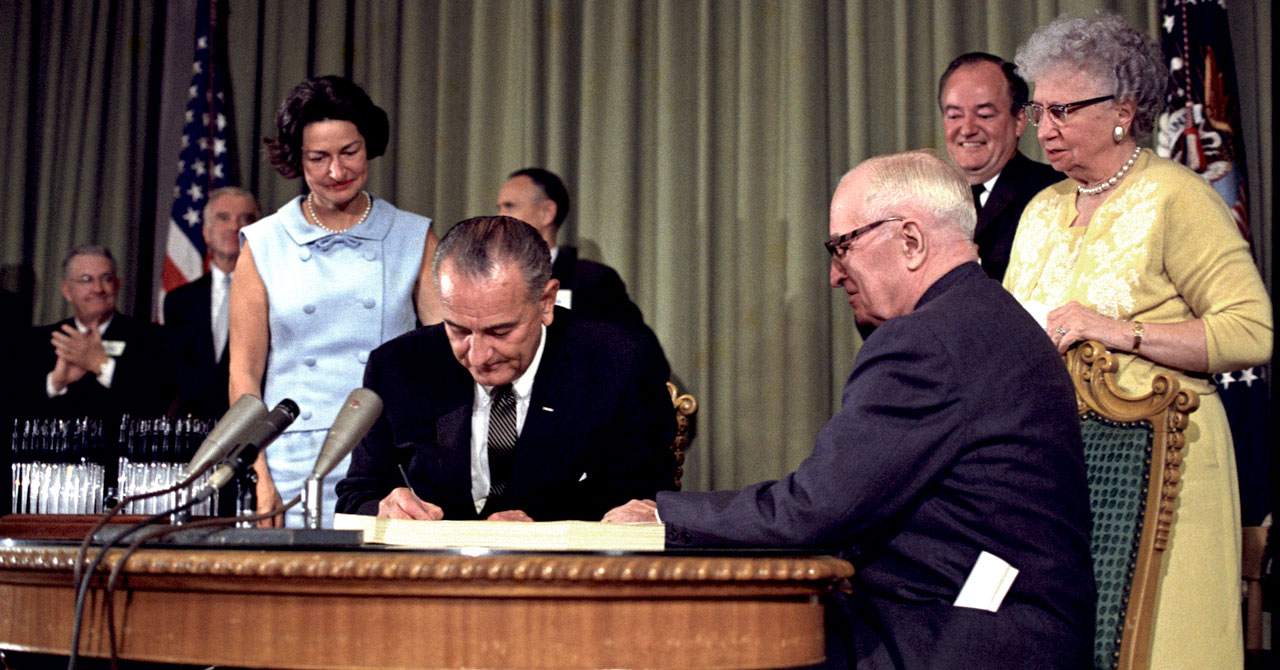
July 30, 1965, 60 years ago: President Lyndon B. Johnson signs the Social Security Amendments of 1965 into law, in a ceremony at the Harry S Truman Presidential Library and Museum, in Independence, Missouri, outside Kansas City.

Former President Truman had tried to get a national health service, offering universal coverage, similar to Britain's passed in 1949, but failed. Holding the signing ceremony at his library was a tribute to his efforts. Also in attendance were each man's wife, Claudia "Lady Bird" Johnson and Elizabeth "Bess" Truman; Vice President Hubert Humphrey, and Governor Warren Hearnes of Missouri, for whom the University of Missouri's arena is named.

Although the Amendments increased benefits for people who met the legal definition of being disabled, the two main components were Medicare and Medicaid. Medicare provides coverage for healthcare for people aged 65 and up. Medicaid helps with health care costs for people of limited income, including nursing home and personal care services, which Medicare doesn't cover.

Medicare and Medicaid joined the Office of Economic Opportunity (a.k.a. "the War On Poverty"), and two major education reform bills to form Johnson's "Great Society." Within days of signing this bill, LBJ would add the Voting Rights Act of 1965. It remains the high point of American liberalism.

Canada passed National Health Service with universal coverage in 1967. Australia did so in 1984. In both cases, they use the term Medicare. In America, however, that term is still limited to health care for senior citizens.

July 30, 1945: The Fate of the USS Indianapolis

July 30, 1945, 80 years ago: The USS Indianapolis is sunk. And that's far from the end of it for its crew.

The Indianapolis was a Portland-class heavy cruiser, launched in 1931. In July 1945, in what turned out to be the closing days of World War II -- of course, nobody knew that at the time, even President Harry Truman didn't know it for sure -- it made a top-secret trip to the Tinian Naval Base, to deliver uranium and other components for "Little Boy," which would become the 1st atomic bomb used in combat.

It then left for the Philippines, for training day. Shortly after midnight on July 30, the Japanese submarine I-58 torpedoed it, and it sank. There were 879 crewmen who died immediately. There were 890 left, in lifeboats in the open ocean. They faced exposure, dehydration, saltwater poisoning, and the threat of another Japanese attack.

None of that happened. But they were attacked, by sharks. Hundreds of them were drawn to the wreck by the noise of the explosions and the scent of blood in the water. After picking off the dead and wounded, they began attacking survivors. The number of deaths attributed to sharks ranges from a few dozen to 150. This would inspire the monologue by Quint, played by Robert Shaw, in the 1975 film Jaws.

Because the Indianapolis' mission was top secret, and they had to maintain radio silence at all costs, it took 4 days for the Navy to find out about them and rescue them. Only 316 men survived. It was the greatest loss of life at sea from a single ship in U.S. Navy history.

I-58, the Japanese submarine that sank Indianapolis, was taken over by U.S. forces, and scuttled in 1946. Her commanding officer, Commander Mochitsura Hashimoto, was never charged with war crimes. In fact, he became the 1st former enemy military man ever to testify in the court-martial of an American one. The Indianapolis' commander, Charles B. McVay III, was charged with negligence for his role in the ship's sinking. Hashimoto testified that there was nothing that McVay could have done that would have prevented I-58 from sinking his ship.

It ended up not mattering: McVay was convicted of negligence. To this day, he remains the only commander of a U.S. Navy ship to be subject to a court-martial for losing his ship in an act of war, let alone to be convicted for it. Despite a Silver Star and a Bronze Star to his credit, McVay was stripped of his seniority. This sentence was later overturned, but he never got over it, and took his own life in 1968. Hashimoto became a priest in Japan's Shinto religion, and lived until 2000.

Tuesday, July 29, 2025

Ryne Sandberg, 1959-2025

The Chicago Cubs are the oldest continuously-operating professional sports franchise in the United States of America, having been founded in 1870 as the Chicago White Stockings. They have had many heroes. Some have been problematic: Adrian "Cap" Anson, Mike "King" Kelly, Lewis "Hack" Wilson, "Slammin' Steroids" Sammy Sosa. Some have been golden: Frank Chance "The Peerless Leader," Charles "Gabby" Hartnett, "Mr. Cub" Ernie Banks.

Ryne Sandberg was one of the golden heroes of Chicago Cub baseball.

Ryne Dee Sandberg was born on September 18, 1959 in Spokane, Washington. His father, Derwent "Sandy" Sandberg, was a Yankee Fan, and named his son after the Yankees' top reliever at that time, Ryne Duren.

In the late 1970s, there were 3 great athletes in the Spokane area, each of them a high school star in baseball, in basketball, and as a quarterback in football: Ryne Sandberg of North Central; Mark Rypien of Shadle Park, North Central's arch-rivals, who went on to play for the Washington Redskins, and was the Most Valuable Player of Super Bowl XXVI; and John Stockton of Gonzaga Prep, who starred for the Utah Jazz.

Also graduates of North Central: Singer-actor Bing Crosby and actress Dyan Cannon. Shadle Park produced a few other pro athletes, including Rypien's brother Brett. Gonzaga Prep produced Pro Football Hall-of-Famer Ray Flaherty, House Speaker Tom Foley, actress Julia Sweeney, and Stockton's son David, who briefly played for the Sacramento Kings.

Like Rypien later did, Sandberg signed a letter of intent to play quarterback at Washington State University, in nearby Pullman. But he chose baseball instead, and was drafted by the Philadelphia Phillies in 1978. He debuted with them on September 2, 1981: Wearing Number 37, and pinch-running for Bob Boone in the top of the 9th inning, he was singled home by Pete Rose, but the Phils lost to the Atlanta Braves, 3-2 at Atlanta-Fulton County Stadium.

At this point, Sandberg was mainly a 3rd baseman. But it was too soon to need a successor to Mike Schmidt. So, on January 27, 1982, the Phillies traded him and starting shortstop Larry Bowa to the Chicago Cubs, for their starting shortstop, Iván de Jesús. Cub general manager Dallas Green, who had managed the Phillies to win the 1980 World Series, moved him to 2nd base, and gave him Number 23.

The 1984 season would be an epic one. The Cubs were now owned by The Tribune Company, which owned, among other things, the Chicago Tribune newspaper, radio station WGN (which stood for what the Trib used to call itself, "the World's Greatest Newspaper"), TV station WGN-Channel 9, and its new nationwide cable "SuperStation WGN."

Since Wrigley Field did not yet have lights, Cub home games were nationally broadcast in the afternoons. The whole country could hear broadcaster Harry Caray -- previously broadcasting for the crosstown Chicago White Sox, and, for many years before that, for the Cubs' arch-rivals, the St. Louis Cardinals -- the Cubs got off to a great start, and became a national phenomenon, far beyond the "Chicagoland" area.

On June 15, then the trading deadline, they picked up pitcher Rick Sutcliffe, and he went on to win the National League's Cy Young Award. On June 23, the Cubs played the Cardinals at Wrigley, and NBC covered it for their national Saturday Game of the Week.

In the 9th inning, and again in the 10th inning, Sandberg tied the game by hitting home runs off Bruce Sutter, the Hall of Fame reliever that the Cubs had let get away, helping the Cards win the 1982 World Series. The Cubs won it in the 11th inning, 12-11. Now, baseball fans who didn't have cable -- it wasn't even a majority of Americans yet -- had Cub fever. 

The fact that it turned out to be the New York Mets, who had been dreadful for several years, who bounced back and battled the Cubs for the NL Eastern Division title, thus the biggest and 3rd-biggest markets getting involved, made it an even bigger story. When they had their magical season of 1969, cut short by the Mets' own "Miracle," they made themselves beloved in the Chicago area; but in 1984, they excited the whole country.

And it turned out to be not that close: The Cubs went 96-65, and won the Division by 6 1/2 games. It was their 1st postseason appearance since winning the Pennant in 1945. Sandberg was named the NL's Most Valuable Player. He was named to the 1st of 10 All-Star Games. He won the 2nd of 9 Gold Gloves.

With that great 1984 season, Ryne Sandberg, Rick Sutcliffe and Harry Caray not only thrilled a nation, but saved Wrigley Field for at least two more generations. A fine legacy to leave. I was a Yankee Fan, and the fact that the Cubs were driving Met fans up the wall made it fun to watch. The 1984 Cubs
made a world that scared the hell out of an already-troubled 14-year-old kid, on multiple levels, a bit more bearable.

And they beat the NL Western Division Champions, the San Diego Padres, in their 1st postseason appearance, in the 1st 2 games of the NL Championship Series, in front of adoring crowds at Wrigley. But the Padres took all 3 games in San Diego, including a walkoff extra-inning home run by Steve Garvey in Game 4, and a key error by 1st baseman Leon Durham in Game 5 -- presaging the one 2 years later in the World Series, by former Cub 1st baseman Bill Buckner.

It was a result that was heartbreaking for anyone who didn't root for the Padres (or the Mets, or the White Sox, or the Cardinals), and as staggering as, the next month, Walter Mondale losing 49 out of 50 States to Ronald Reagan in the Presidential election.

The Cubs couldn't sustain it, and struggled for most of Sandberg's tenure with the team. Finally adding lights to Wrigley Field in 1988 didn't help much. They did win another NL East title in 1989. They lost the NLCS to the San Francisco Giants, although there was no heartbreaking moment: They simply got beat by a better team. In 1990, the Cubs hosted the All-Star Game, and Sandberg led the NL with 40 home runs, and reached 100 RBIs for the 1st time, but they were nowhere near a Playoff berth.

The switch to the 3-Division setup in 1994, and the move of the Cubs to the NL Central Division, didn't help much. Sandberg got off to a slow start, and on June 13, for reasons that had nothing to do with the upcoming strike, he announced his retirement at the age of 34. He admitted, "The reason I retired is simple: I lost the desire that got me ready to play on an everyday basis for so many years."

When the strike ended in 1995, he still sat out the entire season. He returned in 1996, and broke Joe Morgan's career record for home runs by a 2nd baseman. He played his last game on September 21, 1997. He finished with a .285 batting average, 2,386 hits, including 403 doubles, 76 triples (a very high figure for the post-1920 Lively Ball Era), 282 home runs, 277 of them as a 2nd baseman. (Jeff Kent now holds the record, with 351.)

He also stole 344 bases. Here's a list of the players with at least as many home runs and at least as many stolen bases as Ryne Sandberg, in chronological order: Bobby Bonds, Rickey Henderson, Barry Bonds, Craig Biggio and Bobby Abreu. That's it. That's the list. (Barry Bonds had already exceeded Sandberg in both categories before, it is believed, he started cheating. Willie Mays almost did it, stealing 339.)

The trade of Sandberg from The Vet to Wrigley has been called one of the most lopsided trades in baseball history. It's not. Let the record show that, from 1982 to 1997, when Sandberg played his last game, the Phillies won 2 Pennants, in 1983 and 1993; while the Cubs won none.

The Cubs retired his Number 23, and dedicated a statue of him outside Wrigley Field. In 1999, he was named as one of the 100 finalists to the Major League Baseball All-Century Team. In 2005, he was elected to the Baseball Hall of Fame. As a member, he lobbied for the election of fellow Cubs legends Ron Santo and Andre Dawson. Both were elected, but while Dawson lived long enough to see it (and is still alive as of this writing), Santo didn't.

In 2007, Sandberg returned to the Cubs' organization as a minor-league manager. In 2010, with the Des Moines-based Iowa Cubs, he was named the Pacific Coast League's Manager of the Year. (Iowa in the Pacific Coast League? Geography has never been baseball's strong suit. After all, the NL once had Chicago and St. Louis in the East, and Atlanta and Cincinnati in the West. The NFL has been even worse: They still have Dallas in the NFC East.)

In 2011, Sandberg returned to the Phillies' organization, and managed their top farm team, the Allentown, Pennsylvania-based Lehigh Valley IronPigs, to their 1st Playoff appearance. Baseball America magazine named him the 2011 Minor League Manager of the Year.

In 2013, he was named the Phils' 3rd base coach. When Charlie Manuel, who had managed them to win the 2008 World Series, was fired on August 16, Sandberg was named manager. But the timing was bad: The Phils' 2007-11 quasi-dynasty had collapsed, and there was little he could do. After the 2015 season, he was fired. His managerial record was 119-159.

In 2016, the Cubs named him a team ambassador. That was the year they finally won their 1st Pennant since 1945, and their 1st World Series since 1908. Like Billy Williams, Fergie Jenkins and Rick Sutcliffe, but unlike Ernie Banks, Ron Santo, Jack Brickhouse and Harry Caray, Ryne Sandberg had lived to see this magical moment.

He married twice. With his high school sweetheart, Cindy, he had son Justin and daughter Lindsey. With his 2nd wife, Margaret, he raised her 3 children from a previous marriage. Ryne's nephew, Jared Sandberg, played 3rd base for the Tampa Bay Devil Rays from 2001 to 2003.
Ryne and Margaret Sandberg, Opening Day 2024

Early in 2024, Ryne Sandberg announced that he had prostate cancer. He died yesterday, July 28, 2025, at his home in the Chicago suburbs, at the age of 65. Although he didn't win a Pennant with the Cubs, he remains one of the most beloved athletes in Chicago history.

Monday, July 28, 2025

Yanks Barely Survive Series With Phils

The Philadelphia Phillies are battling the Mets for the National League Eastern Division title. So it wasn't surprising that they gave the Yankees all they could handle this past weekend.

Still, they could have crossed The Bronx to Belmont, the Italian neighborhood around Arthur Avenue, and they still wouldn't have been served as many meatballs as the Yankee pitchers served them.

Will Warren started on Friday night. After 4 innings, the Yankees led, 2-0, on solo home runs by Cody Bellinger and Austin Wells. They led 3-2 after 6, thanks to a solo homer by Giancarlo Stanton. But Luke Weaver, who has been awful lately, began a bullpen meltdown that would also involve Ian Hamilton and Scott Effross. Over the last 4 innings, the Phillies' linescore was 20424. That's a ZIP Code in Washington, D.C. Despite an additional home run from Anthony Volpe, the Yankees lost, 12-5.

Marcus Stroman didn't get out of the 4th inning on Saturday, but it was only 4-1 Phillies after 5 innings. The bullpen fell apart again, as Alan Winans again showed that he does not belong in the major leagues. Despite another Stanton homer, this game ended Phillies 9, Yankees 4.

That's 21 runs in 2 days. When you score 9 runs in 2 days, you should expect to win at least 1 of the games. On May 28, the Yankees led the American League Eastern Division by 7 games. They had since gone 20-28, and trailed the Toronto Blue Jays by 6 1/2 games.

And a lot of Phillies fans took the train up, or drove up the New Jersey Turnpike. There were "Let's go, Phillies!" chants inside Yankee Stadium. During the 9th inning, the visiting fans even saluted their defending Super Bowl Champions, chanting, "E-A-G-L-E-S, Eagles!"

The only plus for the Yankees was the Pinstriped debut of infielder Ryan McMahon, who went 1-for-3 with a walk. He is best known for his fielding, and saved a run with a stop that would have made Phil Rizzuto say, "Holy cow!"

McMahon was obtained from the Colorado Rockies for a pair of prospects who will probably never pan out. He was brought in as a hopeful solution to the 3rd base problem, caused when Jazz Chisholm had to be moved to 2nd base, as a hopeful solution to the 2nd base problem, caused when Brian Cashman finally lost patience with his beloved Gleyber Torres (who made the All-Star Game as a Detroit Tiger) and DJ LeMahieu finally broke down.

On Sunday, came dreadful news: Aaron Judge had to go on the Injured List. Fortunately, it's only the 10-day version.

Carlos Rodón started, and gave up 3 home runs, 2 to Otto Kemp. No, I'd never heard of him, either. This time, though, the bullpen allowed just 1 hit and no walks over the last 4 2/3rds innings. McMahon went 2-for-3 with 2 RBIs, and was key to a 4-3 Yankee win.

*

The Yankees now trail those pesky Blue Jays by 5 1/2 games. Here's the OPS+'s, keeping in mind that 100 is exactly average, and the higher, the better: Ryan McMahon (over 2 games) 263, Aaron Judge 218, Giancarlo Stanton 141, Cody Bellinger 132, Jazz Chisholm 131, Trent Grisham 126, Ben Rice 115, Paul Goldschmidt 114, Jasson Domínguez 104, Austin Wells 96, Anthony Volpe 90, J.C. Escarra 78, Jorbit Vivas 48, Oswald Peraza (the starting 3rd baseman between Chisholm and McMahon) 27.

WHIPs for starting pitchers, keeping in mind that anything under 1.3 is good, and anything over 1.6 is unacceptable: Max Fried 1.037, Carlos Rodón 1.046, Clarke Schmidt 1.093, Will Warren 1.443, Cam Schlittler (in 2 starts) 1.548, Marcus Stroman 1.588.

WHIPs for relief pitchers, where the standard is a little different, and it should be under 1.2: Luke Weaver 0.846 (but he's done poorly lately), Fernando Cruz 1.000 even, Tim Hill 1.007, Devin Williams 1.093, JT Brubaker 1.154, Ryan Yarbrough 1.175, Ian Hamilton 1.210, Jonathan Loáisiga 1.481, Mark Leiter Jr. 1.573, Yerzy de los Santos 1.708, Scott Effross 1.781.

Projected Returns from Injury:

Luis Gil: Needs at least 1 more rehab start in the minor leagues. Probably back in early August.

Aaron Judge: Probably back in early August.

Mark Leiter Jr.: Has been throwing in the bullpen. Probably back in early August.

Fernando Cruz: Could return later in August.

Ryan Yarbrough: Hasn't yet thrown from a mound. Might be a September callup.

Oswaldo Cabrera: Might return this season, but probably won't. It was his ankle injury, not his terrible hitting, that really forced the Ryan McMahon acquisition.

Gerrit Cole: Had Tommy John surgery. Might return for 2026 Spring Training.

Clarke Schmidt: Had Tommy John surgery. Probably out until around the 2026 All-Star Break.

With all of that in mind, the trading deadline is 6:00 PM this Thursday, July 31. The biggest offensive need, a 3rd baseman, was filled. Pitching is key, especially with Cole and Schmidt both out for the season.

Tonight, the Tampa Bay Rays come into Yankee Stadium for a 4-game series, then, it's off to Florida to play an Interleague series with the Miami Marlins.

July 28, 1875: The 1st No-Hitter

July 28, 1875, 150 years ago: The Philadelphia White Stockings beat the Chicago White Stockings, 4-0, in a National Association game at the Jefferson Street Grounds in Philadelphia. Joe Borden pitches, and allows no hits. It is not merely the 1st no-hitter ever pitched in professional baseball: It is the 1st no-hitter than anyone can recall ever having been pitched, anywhere.

Despite the heroics of Al Spalding (later to be a manager, team executive, and sporting-goods magnate) and Candy Cummings (the apparent inventor of the curveball), at this point, the pitcher was considered the least important person on the field. This would pretty much remain so until overhand pitching was legalized in 1884. Before that, it was all underhand -- hence, "pitching" instead of "throwing."

Joseph Emley Borden was born on May 9, 1854 in Jacobstown, in North Hanover Township, Burlington County, New Jersey, about 40 miles northeast of Philadelphia. He was pitching for an amateur team in Philadelphia when the White Stockings -- also known as simply the Whites, and as the Phillies, a few years before the team now known by that name was founded -- needed a replacement pitcher, and the man they'd signed was not yet available.

He made his 1st appearance on July 24, and was beaten by the other Philadelphia team in the NA, the Philadelphia Athletics, 11-4. But on the 28th, he allowed no hits to the team that would one day be named the Chicago Cubs. He made 7 appearances, going just 2-4, but both wins were shutouts.

The Cubs-to-be did not yet have the players by whom they would be best known: Spalding was with the Boston Red Stockings (the team that would become the Braves), Mike "King" Kelly was with the Brooklyn Atlantics, and Adrian Anson, not yet a team captain and thus not yet known as "Cap," was with the Athletics. As a result, they had trouble putting runs together.

In fact, the earliest known game in which a team failed to score a run was by a Chicago team -- not the White Stockings/Cubs, but an earlier one -- and, from that point onward, a "Chicago game," or just a "Chicago," was one where a team got shut out.

But the White Stockings turned that around in the 1880s, with Anson at 1st base, Kelly catching, and both of them hitting. Indeed, in 1907 and 1908, the Cubs tied a major league record with 32 pitching shutouts in a season. The American League's Chicago White Sox had done it in 1906. All 3 of those teams won the World Series.

The Philadelphia White Stockings folded with the NA after the 1875 season. When the National League began in 1876, the Athletics joined. Borden signed with the Boston Red Stockings, and, on April 22, 1876, he pitched and won the 1st game in NL history, as the Red Stockings beat the Athletics, 6-5 at the Jefferson Street Grounds.

On May 23, the Red Stockings beat the Cincinnati Reds, 8-0. Borden was listed as allowing 2 hits. However, the scorecard shows that he allowed 2 walks, but no hits. The official scorekeeper, Cincinnati Enquirer writer O.P. Caylor, was one of the few writers who believed that walks should be counted as hits. Only in 1 season, 1887, has the NL ever counted them as such.

But the Boston Daily Globe reported that the Reds did get two clean hits, each for one base. If the pitcher's (at least, professional) hometown paper didn't give him the credit for a no-hitter, that would seem to settle it. Officially, the 1st NL no-hitter was by George Bradley of the St. Louis Brown Stockings, against the Hartford Dark Blues, on July 15, 1876.

Borden went 11-12 for the Red Stockings, losing his effectiveness by midseason, and feuding with manager-shortstop George Wright. He was released in August, and never appeared in another major league game.

He later became a shoemaker, a banker, and a successful trainer of hunting dogs. He was mistakenly listed with the dead in the Johnstown Flood in 1889. Instead, he lived until October 14, 1929, dying in the Philadelphia suburb of Yeadon, Pennsylvania, just 8 miles southwest of Shibe Park, where, that day, a more recent version of the Philadelphia Athletics were clinching the World Series over the Cubs.

*

July 28, 1875 was a Wednesday. There were 2 other games were played in the National Association that day. The Philadelphia Athletics beat the New York Mutuals, 11-2 at the Union Grounds in Brooklyn. Until 1898, Brooklyn was a separate city, but there would no ballpark on Manhattan Island capable of holding a decent crowd until the original Polo Grounds opened in 1880.

And the New Haven Elm Citys beat the St. Louis Brown Stockings, 7-3 at Hamilton Park in New Haven, Connecticut. Yale University played some of its early football games at Hamilton Park.

Friday, July 25, 2025

July 25, 2000: Luís Figo's Defection Begins the "Galácticos" Era

July 25, 2000, 25 years ago: Real Madrid Club de Fútbol sign Luís Figo to a contract. This begins the team's "Galácticos" Era.

The Spanish soccer team define themselves by the UEFA Champions League, the tournament known from its 1955 establishment until 1992 as the European Cup, which is still the name of the trophy given to the winner. They won the 1st 5 in a row, from 1956 to 1960. They won it again in 1966. Then they didn't win it again until 1998. From 1966 onward, managers have been fired for not winning it, even after seasons when they won Spain's La Liga.

They won it in 2000, in large part because they had signed one of the best players from England, Liverpool FC's Steve McManaman. Inspired by this, and newly installed as the team's president, Florentino Pérez was determined to keep it. So, hearing that Figo, the most popular player for their arch-rivals, FC Barcelona, was disgruntled and wanted to leave, they paid €62 million for him.

The reaction in Catalonia was fury and a sense of betrayal: One banner at an El Clásico match between the teams read, "We hate you so much, because we loved you so much."

Pérez also signed Claude Makélélé from Spanish team Celta Vigo. He and Figo were added to a team that already included Fernando Hierro, Raúl (González), Guti (real name: José María Gutiérrez), Roberto Carlos, Fernando Morientes, Míchel Salgado, and goalkeeper Iker Casillas.

But Real were eliminated from the 2001 Champions League in the Semifinal, by Germany's Bayern Munich. So Pérez poached perhaps the best player in the world at the time, spending €73.5 million to get French midfielder Zinedine Zidane from Italian team Juventus. It worked, as Zidane led Los Blancos to win the Champions League in 2002.

But enough was never enough. Pérez shelled out €45 million to get the world's best forward, 2002 World Cup winner Ronaldo of Brazil, from Italian team Internazionale Milano. A generation later, it can now truthfully be said that Cristiano Ronaldo is not even the greatest Ronaldo to play for Real Madrid in the 21st Century.

But in 2003, Juventus knocked Real out in the Semifinals. So Pérez splashed the cash again, giving English champions Manchester United €37.5 million for the most famous (though hardly the best) player in England, David Beckham. It wasn't enough: In 2004, AS Monaco eliminated Real on penalties in the Quarterfinal. So Pérez made another entreaty to England, getting Michael Owen from Liverpool. But the injuries that curtailed Owen's career were already taking effect. The era was fizzling out, and Real did not win the Champions League again until 2014 -- although that started a run of 5 in 9 years, giving them 14, twice as many as any other team.

The Galácticos concept inspired other teams. In 2003, Russian oligarch Roman Abramovich bought West London team Chelsea FC, and spent them to glory, including buying Makélélé. The royal family of the United Arab Emirates bought Manchester City, and did the same thing. The prices of players went up, up, up. A player whose talents might have cost €5 million in 2005 would, by 2015, have cost €50 million, leading to the joke, "Did somebody forget a decimal point?"

And, of course, teams in North American sports have tried the "superteam" concept. Long before most Americans knew Real Madrid even existed (I think a majority still don't know), the New York Yankees tried it in the 1920s, the 1930s, the 1950s, the late 1970s, and the late 1990s, with great success; and kept trying it in the 2000s, with limited success. The Los Angeles Lakers have tried it over that period, with some success, but also -- particularly in 2004 and since their 2020 title -- with considerable disappointment.

It's worked in the NBA for the 2008 Boston Celtics and the 2012-13 Miami Heat, but it failed for the early 2020s Brooklyn Nets. In the NHL it worked for the Toronto Maple Leafs in the 1960s, the Montreal Canadiens in the 1970s, the New York Rangers briefly in 1994, and the Detroit Red Wings in the late 1990s and early 2000s; but, since then, no other team has been bold enough to try it. And in the NFL, the New England Patriots did better when they didn't try it than it did when they did.

July 25, 1985: Rock Hudson's AIDS Diagnosis Is Revealed

July 25, 1985, 40 years ago: Yanou Collart, publicist for actor Rock Hudson, publicly confirms a rumor that had been swirling around show business circles: Hudson has AIDS, Acquired Immune Deficiency Syndrome. He was among the earliest mainstream celebrities to have been diagnosed with the disease.

Born on November 17, 1925 as Roy Harold Scherer Jr., in the Chicago suburb of Winnekta, Illinois, Hudson became a Hollywood star and heartthrob in 1954, in the film Magnificent Obsession. This was followed by Giant in 1956, in which he co-starred with Elizabeth Taylor and, in his last performance before the car crash that killed him, James Dean. In 1959, he began a series of romantic comedies with Doris Day, with Pillow Talk. In 1961, he starred with Italian bombshell Gina Lollobrigida in Come September

His dashing looks, and his co-starring with Taylor, Day and Lollobrigida, although all of them were married to others, made people imagine that women fell over themselves for him, and that he was happy to oblige. But Hudson was gay, and while the general public didn't know, it was one of the worst-kept secrets in Hollywood. In 1955, to help quash the rumor, Hudson's manager, Henry Willson, convinced his secretary, Phyllis Gates, and Hudson to marry. It lasted only 3 years, because she found out the truth. Neither ever married again.

Not happy with the films he was offered in the 1960s, Hudson turned to television, starring with Susan Saint James in the NBC crime drama McMillan & Wife from 1971 to 1977. But his years of heavy smoking and drinking began to catch up with him. In 1981, he began filming The Devlin Connection, a private-detective series for NBC, but had a massive heart attack, and his recovery pushed the show back a full year. The momentum was lost, and it was canceled after just 13 episodes.

In December 1984, he began appearing on the ABC evening soap opera Dynasty. But, unbeknownst to his castmates, he had been diagnosed with HIV, Human Immunodeficiency Virus, which causes AIDS, the preceding June 5. It is not known if he got it through sexual transmission or through tainted blood in a transfusion from his heart surgery. Regardless, his Dynasty co-stars easily saw the decline in his health. When it became clear that he could no longer continue, he was written out of the series, and his character was later said to have died.

Hudson traveled the world, looking for a cure, or at least a treatment to slow the progression of the disease. Nothing worked. On July 16, 1985, he joined his old friend Doris Day for a Hollywood press conference announcing the launch of her new TV cable show, Doris Day's Best Friends. She was 63 (although she usually lied about her age, claiming to be 2 years younger), and looked terrific; he was 59, and looked 10 years older.
Like her contemporary Betty White, Day was
an animal-rights activist who especially loved dogs.

On July 18, he went to Paris for another round of treatment. On July 21, he collapsed in his room at the Ritz Hotel. His American publicist, Dale Olson, released a statement to the media that he had inoperable liver cancer, and denied that he had AIDS. But on July 25, Hudson's French publicist, Yanou Collart, admitted the truth. On July 30, he was flown back to Los Angeles, and spent a month at UCLA Medical Center in Los Angeles. They released him to private hospice care at his home in nearby Beverly Hills, where he died on October 2.

Up until then, AIDS had been considered a disease of gay men only, which already wasn't true. Evangelicals considered it "God's punishment for homosexuality." As if gay people weren't facing enough bigoted nonsense.

Earlier that year, As Is, the 1st Broadway play to discuss AIDS, premiered. Its author, William M. Hoffman, said, "If Rock Hudson can have it, nice people can have it. It's just a disease, not a moral affliction." Comedian Joan Rivers, who had a devote gay fanbase, said, "Two years ago, when I hosted a benefit for AIDS, I couldn't get one major star to turn out. Rock's admission is a horrendous way to bring AIDS to the attention of the American public, but by doing so, Rock, in his life, has helped millions in the process. What Rock has done takes true courage." Actress Morgan Fairchild said, "Rock Hudson's death gave AIDS a face."

In a telegram Hudson sent to a September 1985 Hollywood AIDS benefit, Commitment to Life, which he was too ill to attend in person, he said: "I am not happy that I am sick. I am not happy that I have AIDS. But if that is helping others, I can at least know that my own misfortune has had some positive worth."

Shortly after his death, People magazine reported: "Since Hudson made his announcement, more than $1.8 million in private contributions (more than double the amount collected in 1984) has been raised to support AIDS research and to care for AIDS victims (5,523 reported in 1985 alone). A few days after Hudson died, Congress set aside $221 million to develop a cure for AIDS." Hudson's former co-star Elizabeth Taylor became a major fundraiser for AIDS research, as did openly gay rock star Elton John. Both began hosting fundraising "afterparties" following the annual Academy Awards.

But the stigma of AIDS still did not go away. It would take more, including the transfusion-induced illnesses of tennis star Arthur Ashe and teenager Ryan White, and the admission of the very heterosexual basketball star Earvin "Magic" Johnson, for people to understand that AIDS could happen to anybody.

President Ronald Reagan and his wife Nancy, both former actors and friends of Hudson's made no public statement concerning Hudson's condition. However, the President phoned Hudson privately in his Paris hospital room where he was being treated in July 1985 and released a condolence statement after his death.

Afterward, Reagan stopped ignoring AIDS, and asked Congress to increase federal funding for research into it. I call it "The Rock Hudson Principle": Conservatives never care about something that hurts others, until it begins to hurt someone they care about. (Then again, in 1981, Reagan was shot by a mentally ill man who should have had a gun, and nearly died, and in the 2020s, they still don't give a damn about gun control.)

The increased enabled new treatments to be developed, much of it under the National Institutes of Health, in a unit led by Dr. Anthony Fauci, who would later lead the fight against COVID-19.

A personal note: Online, I've talked to a few people who claimed to have met Rock Hudson. Some of them said they knew at the time that he was gay. Others said they didn't know. But they all said he was a wonderful person. Certainly, he didn't deserve to suffer the way he did.

July 25, 1965: Bob Dylan Goes Electric

July 25, 1965, 60 years ago: Bob Dylan crosses a rock and roll Rubicon. He performs with The Paul Butterfield Blues Band at the Newport Folk Festival in Newport, Rhode Island. They use electric instruments, something the festival had never allowed before, as folk music has traditionally been all-acoustic.

Dylan had been born Robert Allen Zimmerman on May 24, 1941 in Duluth, Minnesota. He grew up in Hibbing, Minnesota, but found life there dissatisfying on multiple levels. Early early rock and roll stars of the mid-1950s appealed to him, and so anyone who had studied his entire life from 1941 to 1965 should have seen this coming. But most people didn't know about that when they became fans of his in the early 1960s. 

In 1961, having dropped out of the University of Minnesota, he came to New York, renamed himself for Welsh poet Dylan Thomas, and started singing folk music in the clubs of Manhattan's Greenwich Village, where Thomas had lived and performed for the last few years of his life, dying there in 1953. (I have an entry for his death.)

Bob had adopted a persona like that of earlier folk singer Woody Guthrie, with scraggly clothes and a nasal twang. He combined traditional folk songs with his own new compositions, and it didn't seem to matter that he couldn't sing in the traditional sense, or that he wasn't an especially good-looking guy. People were mesmerized by his performances. Soon, men wanted to be him, and women just wanted him.

On April 16, 1962, at Gerde's Folk City at 11 West 4th Street, he first performed "Blowin' in the Wind," and it was a sensation, with its 3 short verses citing the civil rights and antiwar movements. This was less than a year after the Freedom Rides, but a year before American TV viewers saw the firehoses and police dogs of Birmingham, and most hadn't yet heard of Vietnam, let alone realized that we already had troops fighting, killing and dying there. To them, "war" still meant World War II, a "just war," or maybe the Korean War, which didn't seem worth it.

Bob's self-titled debut album had been released on Columbia Records the preceding March 19. Shortly after the Gerde's premiere, he began recording The Freewheelin' Bob Dylan. Released on May 27, 1963, it included "Blowin' in the Wind," "Masters of War," "A Hard Rain's A-Gonna Fall," and "Don't Think Twice, It's All Right" -- the latter the first in a long line of great breakup songs he would write. 

Any 1 of those 4 songs would have been a great triumph for any writer. Dylan had all 4 on 1 album. He was 3 days past his 22nd birthday, and he was already a musical legend.

That July, he appeared at Newport for the first time, along with the biggest active legend of folksinging, Pete Seeger. Guthrie, to whom Seeger had introduced Dylan, was still alive, but sidelined by the condition that would kill him 4 years later.

Also there were Peter, Paul and Mary (Peter Yarrow, Noel Paul Stookey and Mary Travers), the folksinging trio who recorded what remain the biggest hit versions of "Blowin' in the Wind" and "Don't Think Twice." So was Joan Baez, the leading female soloist of "the folk revolution," who helped make Bob famous, then became his girlfriend. Together, these and others closed the show by joining hands and singing a song Seeger, though he didn't write it, made the anthem of civil rights: "We Shall Overcome."

Dylan then began recording his next album, finishing it before President John F. Kennedy was assassinated, but not released until afterward, on January 13, 1964: The Times They Are A-Changin'. It included the title track, "Ballad of Hollis Brown," "With God On Our Side," "Only a Pawn In Their Game," "When the Ship Comes In," and "The Lonesome Death of Hattie Carroll." His previous burst of creativity was thus proven to be no fluke.

Just 25 days after that album's release, The Beatles arrived in America. They and Dylan each influenced the other tremendously, and it may have been The Beatles who influenced Dylan to switch to electric instruments.

Before he did though, he recorded Another Side of Bob Dylan. Released on August 8, 1964, he told Nat Hentoff, the music critic of The Village Voice, New York's underground weekly newspaper, "There ain't no finger-pointing songs." There was "All I Really Want to Do," "Chimes of Freedom," "It Ain't Me, Babe," and "My Back Pages," on which the 23-year old Dylan closed each of 6 verses by singing, "Ah, but I was so much older then. I'm younger than that now." 

The Byrds, who would record several of Bob's songs, recorded "My Back Pages," but, to cut it to single length, dropped the 3rd and 4th verses. Both they and Cher would have a hit with "All I Really Want to Do"; while "It Ain't Me, Babe" would be a hit on the pop chart for The Turtles (their first hit), and on the country chart for Johnny Cash.

Fame and the expectation of his peers were getting to Dylan. Until now, except for a couple of songs on the latest album where he had played piano, it had been just him, his guitar, and the harmonica he wore in a neck harness; with no other musicians. (The harmonica in the neck harness would be copied by many performers, most notably Neil Young and Billy Joel.) For his next album, he went electric, and it was titled Bringing It All Back Home.

Released on March 22, 1965, this was a revelation. It was a reminder of his rock and roll roots, about which his "folkie" fans seemed to know nothing. It began with "Subterranean Homesick Blues," with its angry declaration that, "You don't need a weatherman to know which way the wind blows." (This would inspire a radical offshoot of Students for a Democratic Society to call themselves the Weathermen, and later the Weather Underground.)

It included "Maggie's Farm," whose lyrics certainly suggested folk roots, but the electricity behind it give it a bigger punch. It included "Mr. Tambourine Man," which he recorded in 3/4 time, but The Byrds would later switch it to 4/4 time, and give him his 1st Number 1 hit as a writer. (The song has 4 verses, but Byrds lead singer Roger McGuinn sang only the 2nd between the choruses.)

It included "It's Alright Ma (I'm Only Bleeding)," with its declaration, "He not busy being born is busy dying." If that wasn't a message to the people who wanted him to remain the 22-year-old golden boy of the Greenwich Village clubs forever -- just as there were others who got upset when The Beatles moved beyond being "The Lovable Mop Tops" -- then the last song on the album certainly was: "It's All Over Now, Baby Blue." 

And on July 20, he released a standalone single, a 6-minute reminder of how their delusions of him, not himself, had let them down: "Like a Rolling Stone." (Rolling Stone magazine was named for this song, not the new British band of the same name.)

So when Dylan, backed by The Paul Butterfield Blues Band, took the stage at Newport on July 25, nobody knew what to expect. Here's what he gave them: "Maggie's Farm," "Like a Rolling Stone," and "It Takes a Lot to Laugh, It Takes a Train to Cry," each electric.

There was booing, but there's dispute over why. Some have said it wasn't because the electric instruments were blasphemy to the folkies, it was because the sound system was bad, and Bob and the band couldn't be heard properly. The surviving film suggests that this is true, because the songs don't sound much like they did on the records. 

Another legend, that Pete Seeger yelled at show producer George Wein to turn the amps off, and that, having been refused, the "purist" Seeger tried to chop the cord with an ax, were denied by Seeger himself. He admitted that the problem was the sound system, not Dylan's audacity. If any folkies felt betrayed that night, Seeger was not one of them.

Dylan played 2 more songs, just him, his guitar, and his harmonica: "Mr. Tambourine Man" and, providing a definitive last word for them, "It's All Over Now, Baby Blue." He soon wrote one of the nastiest songs ever written in the English language: "Positively 4th Street," opening with, "You got a lot of nerve to say you are my friend," and going on to really let them have it.

By this point, he had further enraged the folk music community by breaking up with Joan Baez, and marrying someone else, Sara Lowndes, for whom he wrote some of his more interesting songs thereafter.

Dylan would go through many more changes to his career, and did not appear at the Newport Folk Festival again until 2002. As of July 25, 2022, he is 81 years old, and still performing. Few people now doubt that going electric was good for him, and good for music.

Also, not counting individuals implied as being part of a group, like the Beatles and the performers at Woodstock, Bob Dylan is 1 of 4 people mentioned in Billy Joel's 1989 song "We Didn't Start the Fire" who are still alive. The others are Brigitte Bardot, Chubby Checker, and 1984 New York "subway vigilante" Bernhard Goetz.

Thursday, July 24, 2025

Yanks Do Not Send Message to Jays

The Yankees headed up to Toronto to face the Blue Jays, who have surged as the Yankees have stumbled, and were 3 games ahead of the Yankees in the American League Eastern Division.

The Yankees went into the Rogers Centre with a chance to send a message: "You've had your fun. Now, it's over. Remember who you are, and remember who we are. We're taking this Division back."

The Yankees did not write that message.

Carlos Rodón started on Friday night, got into and out of trouble in the 2nd and 4th innings, and got a 4th inning home run from Giancarlo Stanton, to lead 1-0 after 4. But the bottom of the 5th was a disaster: Walk, single, double; then a flyout and a popup; then a single and an error by shortstop Anthony Volpe. It was 4-1 Jays, and that's how it ended.

The Yankees took the field on Saturday night as if they meant to make the Jays pay dearly for that, with Jazz Chisholm hitting a 3-run homer off "Warrior God" Max Scherzer, to put them up 3-0 before the Jays even came to bat. But Cam Schlittler, making only his 2nd major league start -- it was Scherzer's 463rd -- allowed a run in the bottom of the 1st. Cody Bellinger hit a home run in the 5th, but the Jays worked their way back against the Yankee bullpen, and tied the game 4-4 in the 6th.

Ben Rice led off the top of the 9th with a home run, and Devin Williams nailed down the save for Ian Hamilton. Yankees 5, Blue Jays 4. It was the kind of game that would be nicknamed "The Ben Rice Game" -- if the Yankees end up winning the Pennant, and if Rice doesn't have a more dramatic moment along the way to a title.

The usually-reliable Max Fried started on Sunday afternoon, and, with Jasson Domínguez hitting a home run in the 2nd inning, took a 1-0 lead into the bottom of the 4th. But after getting a popup, he fell apart, allowing single, double, groundout, walk, single, single before getting out of the inning with a groundout. It was 2-1 Toronto.

Volpe tied the game with a home run in the 5th. But Fried got wild in the bottom half, walking 2 batters and making an error on which the go-ahead run scored. Officially, when the pitcher makes an error, any run that results is still charged as an unearned run.

Aaron Judge hit a 2-run homer in the 6th, to tie it at 4-4. But Fried allowed a triple and a double before Aaron Boone finally went to the bullpen, to no avail. It was 6-4 Jays at the end of the inning, and 8-4 Jays at the final.

The Yankees should have sent those pesky Blue Jays a message. They did not. They were nearly swept, and perhaps deserved to be. They left Toronto 4 games out of 1st place, with 60 to play. They have tonight off, and then the Philadelphia Phillies come into Yankee Stadium, which will be a tough series.

Top 10 Superhero Movie Lines of All Time

Rank. Title, Year, Screenplay Author. Explanation. Line. Further explanation, if necessary.

10. Batman & Robin, 1997, Akiva Goldman. At the beginning of the film, we discover that, after the destruction of the Batmobile in the previous film, Batman (George Clooney) hasn't built a new one in which he and Robin (Chris O'Donnell) can ride together, as in the comics and in the 1966-68 TV series.

Robin has a motorcycle, but says, "I want a car!" He knows Batman can afford it, but, instead, chooses to justify it by saying, "Chicks dig the car!" Batman responds by saying, "This is why Superman works alone."

Unlike the 1960s TV series, Christopher Nolan's Dark Knight Trilogy, and, so far, Matt Reeves' Epic Crime Saga, none of which make any suggestion that there are other superheroes in their world, this line confirms that there are other superheroes in the 2 Batman films directed by Joel Schumacher films, and implies the same for the earlier 2 films directed by Tim Burton. But it also suggests that there is, as yet, no Justice League.

It's a fun line. Unfortunately, the movie goes downhill from there.

9. The Dark Knight, 2008, brothers Christopher and Jonathan Nolan. Harvey Dent, the District Attorney, tells Bruce Wayne, who he doesn't know is Batman, "You either die a hero, or you live long enough to see yourself become the villain."

He already had a point. One of the last episodes of the Batman TV series, in 1968, featured a hypnotized, un-costumed Bruce doing the bidding of a villain. There was the synthetic-Kryptonite-affected Superman of Superman III in 1983. And, under a false impression, people had turned on Superman in a 1993 episode of Lois & Clark. After this, the Arrowverse of 2016-24 led to heroes seeing evil versions of themselves or their inspirations; the 2023 Flash movie saw an alternate version of the hero go too far; and the new Superman movie sees a clone used by Lex Luthor as the villain Ultraman.

In The Dark Knight, Dent ends up being tortured and tormented by the Joker, becoming the villain Two-Face. And, an order to save Dent's reputation, Batman has to let himself be publicly seen as the villain.

Dishonorable Mention, because it's delivered by a villain. In this case, though, it's not the Joker, but the secondary villain: Dr. Jonathan Crane, the evil psychiatrist who calls himself the Scarecrow.

Batman tries to break up a deal between Crane and some small-time crooks -- and two copycats try to do the same. He has to stop Crane, and he has to stop the "copybats" so they don't get hurt. One says, "We're trying to help you!" And Batman says, "I don't need help!" And Crane says, "Not my diagnosis!"

Honorable Mention: The next line is the copybat asking, "What gives you the right? What's the difference between you and me?" Batman says, "I'm not wearing hockey pads!" Translation: I'm wearing armor, you're not, so you're a lot more likely to get yourself killed by pretending to be me.

8. Spider-Man, 2002, David Koepp. It's not the hero who says it. Not Spider-Man, a.k.a. Peter Parker. It's his aunt, May Parker. After the Green Goblin attacks the Parker house, May is hospitalized, and Peter asks, "Can I do anything for you?" She says, "You do too much: College, a job, all this time with me. You're not Superman, you know." Proving that, at least in the universe where Spider-Man is played by Tobey Maguire, DC Comics exist.

Honorable Mention: Stan Lee wrote it at the end of the first Spider-Man story, in Amazing Fantasy #15 in 1962: "With great power, there must also come great responsibility." It a retcon, it's Peter's uncle, Ben Parker, who says it, and he says it in this film.

Dishonorable Mention, because it's said by the villain. And, Cliché Alert: The Goblin says to Spidey, "You and I are not so different." Spidey says, "I'm not like you. You're a murderer." And the Goblin says, "Well... to each his own."

7. Wonder Woman, 2017, Allen Heinberg. Why Wonder Woman's origin story was set in World War I, not World War II as usual, I don't know. At any rate, Steve Trevor warns her against trying to cross the "No Man's Land" between the Allies' and the Germans' territory, telling her, "We can't save everyone in this war. This is not what we came here to do." And she says, "No, but it's what I'm going to do." And she does.

6. The Avengers, 2012, Zak Penn and Joss Whedon. Iron Man, for the moment without any version of his armor, is taking a big risk by threatening Loki, who is determined to conquer the Earth with his Chitauri army. But the key line isn't when Tony responds to Loki's "I have an army" with "We have a Hulk."

It's right after that, when he tells an overconfident Loki, "You're missing the point. There's no throne. There is no version of this where you come out on top. Maybe your army comes, and maybe it's too much for us. But it's all on you. Because if we can't protect the Earth, you can be damned well sure we'll avenge it." (Which they ended up having to do, in Avengers: Endgame.)

The implication of Stark's line is, "If we lose to your army, we're coming after you, and your army won't be able to protect you from us."

Honorable Mention: A few minutes later, Loki tells the Hulk, "I am a god, you dull creature!" The Hulk grabs his leg and smashes him around the room, walks away, and says, "Puny god." (The Hulk calling opponents, real and perceived, "puny" is a common feature of the comics.)

Honorable Mention: Earlier in the movie, in Germany, Loki tells the people to kneel before him. And an old man, old enough to remember living under the rule of Adolf Hitler, stands, and says, "Not for men like you." Loki, who thinks of himself as a god, not just as a guy with super-powers, says, "There are no men like me." And the old man, correctly, says, "There are always men like you." 

Honorable Mention: Loki tries to blast the old man, and that's when Captain America arrives to deflect the blast with his shield. Cap tells Loki, "You know, the last time I was in Germany, I saw a man standing above everybody else. We ended up disagreeing."

5. The Incredible Hulk, 1977, Kenneth Johnson (who also directed). This film aired on CBS as a pilot for the TV series of the same name, so, even though it was never released in theaters, it counts.

The Hulk's origin story was re-written so that Dr. David Banner (not "Bruce" like in the comics) is believed dead in an explosion caused by the Hulk, so his story becomes a cross between Frankenstein and The Fugitive -- only, in this case, Dr. Frankenstein, Dr. Kimble, and the Monster are all the same person. Pursuing the man, the creature and the story is an investigative reporter for a trashy supermarket tabloid, Jack McGee.

In a clip that got played in the opening sequence of every episode, McGee makes Banner angry, and Banner, trying to stay calm, because he already knows what will happen if he doesn't, says, "Mr. McGee, don't make me angry. You wouldn't like me when I'm angry." The line has been associated with the Hulk ever since, and has been used, and even parodied, in the 21st Century Marvel movies.

4. Superman, 2025, James Gunn (who also directed). After he's beaten Lex Luthor, who still considers him not human and a threat to Earth -- or, at least, to Luthor's plans, and that much is true --  Superman explains it to him, in a way that not only affirms Superman's humanity, but exposes Luthor as full of shit: "I'm as human as anyone. I love. I get scared. I wake up every morning, and, despite not knowing what to do, I put one foot in front of the other, and I try to make the best choices I can. I screw up all the time. But that is being human. And that's my greatest strength."

3. Watchmen, 2009, David Hayter and Alex Tse. In prison, vigilante Walter Kovacs, a.k.a. Rorschach, has just defended himself from an attack by a fellow inmate in the cafeteria. Everyone is staring at him, and he says, "None of you seem to understand: I'm not locked in here with you, you're locked in here with me!"

2. The Dark Knight Rises, 2012, Christopher and Jonathan Nolan. Just before Batman (Christian Bale) takes off in the Batcopter to get the bomb away from Gotham City, Commissioner Jim Gordon (Gary Oldman) tells him, "I never cared who you were." Batman says, "And you were right."

Gordon: "But shouldn't the people know the hero who saved them?" Batman: "A hero can be anyone. Even a man doing something as simple and reassuring as putting a coat around a young boy's shoulders, to let him know that the world hadn't ended." That's when Gordon remembers being a young cop, 30 years earlier, putting his coat around a boy named Bruce Wayne, who had just lost his parents.

It's the kind of line we wouldn't expect from dark, brooding Batman. It's a reminder that, under the cowl, he's still human.

But we would expect that kind of line from Superman:

1. Superman, 1978, Mario Puzo. Superman (Christopher Reeve) catches a falling Lois Lane (Margot Kidder), and says, "Easy, Miss: I've got you." And she says, "You've got me? Who's got you?"

Honorable Mention: When the sequence is done, Lois asks, "Who are you?" Clark, not yet having chosen a name -- it's Lois who comes up with "Superman" -- simply says, "A friend."