Showing posts with label social security. Show all posts

Thursday, August 14, 2025

August 14, 1935: The Social Security Act

August 14, 1935, 90 years ago: President Franklin D. Roosevelt signs the Social Security Act into law. It becomes the keystone of his domestic program, the New Deal.

By the 1930s, America was the only modern industrial country without any national system of pensions for older people. In the depths of the Great Depression, a physician named Francis Townsend rallied support for a proposal to issue direct payments to the elderly.

Responding to that movement, Roosevelt organized a committee led by Secretary of Labor Frances Perkins to develop a major social welfare program proposal. Roosevelt presented the plan to Congress in January 1935. An ally of his from his tenure as Governor of New York, and from that of his predecessor in that office, Alfred E. Smith, FDR had made Perkins the 1st woman appointed to any post in the President's Cabinet, upon taking office in 1933.
The actual bill was written by Senator Robert F. Wagner, a fellow New Yorker, who would write another key piece of New Deal legislation, the National Labor Relations Act. His son, Robert F. Wagner Jr., would serve as Mayor of New York City from 1954 to 1965. However, these Robert Wagners were not related to the actor Robert Wagner.
The program was expanded to provide payments to widows and dependents of Social Security recipients. Job categories that were not covered by the act included workers in agricultural labor, domestic service, government employees, and many teachers, nurses, hospital employees, librarians, and social workers.

As a result, 65 percent of the African-American workforce, and 27 percent of white workers, were excluded from the initial Social Security program. Many of these workers were covered only later on, when Social Security was expanded in 1950, and again in 1954.

The program was funded through a newly-established payroll tax, which later became known as the Federal Insurance Contributions Act tax (FICA). Social Security taxes would be collected from employers by the States, with employers and employees contributing equally to the tax.

In addition to creating the program, the Social Security Act also established a state-administered unemployment insurance system and the Aid to Dependent Children, which provided aid to families headed by single mothers.

As with many other American "reforms," compared with the social security systems in Western Europe, the Social Security Act of 1935 was rather conservative. However, it was the first time that the federal government took responsibility for the economic security of the aged, the temporarily unemployed, dependent children, and the handicapped.

It's important to note that, in 1935, the average life expectancy for an American man was 67 years -- two years past the age when Social Security kicked in. This was a time before the wide availability of antibiotics, the polio vaccine, seat belts in cars, speed limits, raising the drinking age to 21, the prohibition of lead in paint, most environmental regulations, and the Surgeon General's warnings about the dangers of smoking.

FDR himself didn't even live to be 65: He died of a cerebral hemorrhage at 63, due in large part to his constant smoking, and the pressures of World War II, driving his blood pressure sky-high. The first person to receive a Social Security number also didn't make it: On November 24, 1936, SSN 055-09-0001 went to John Sweeney, a 23-year-old electrical supply clerk from New Rochelle, New York, who was scheduled to collect an estimated $85 per month beginning in 1978. Except he died in 1975, at the age of 61.

Senator Wagner lived to be 75, Secretary Perkins to be 85. In 1936, the Republican nominee for President, Governor Alfred M. Landon of Kansas, ran on a Party platform that called for the repeal of Social Security, and he lost 48 out of 50 States. Ironically, he lived to be 101, the longest-lived major-party nominee in the history of Presidential elections.

Today, with men and women just about equally in the workforce, the average life expectancy at around 79, and living to be 100 or more becoming less of a novelty, the Social Security age has been raised to 67.

Wednesday, July 30, 2025

July 30, 1965: Medicare and Medicaid Become Law

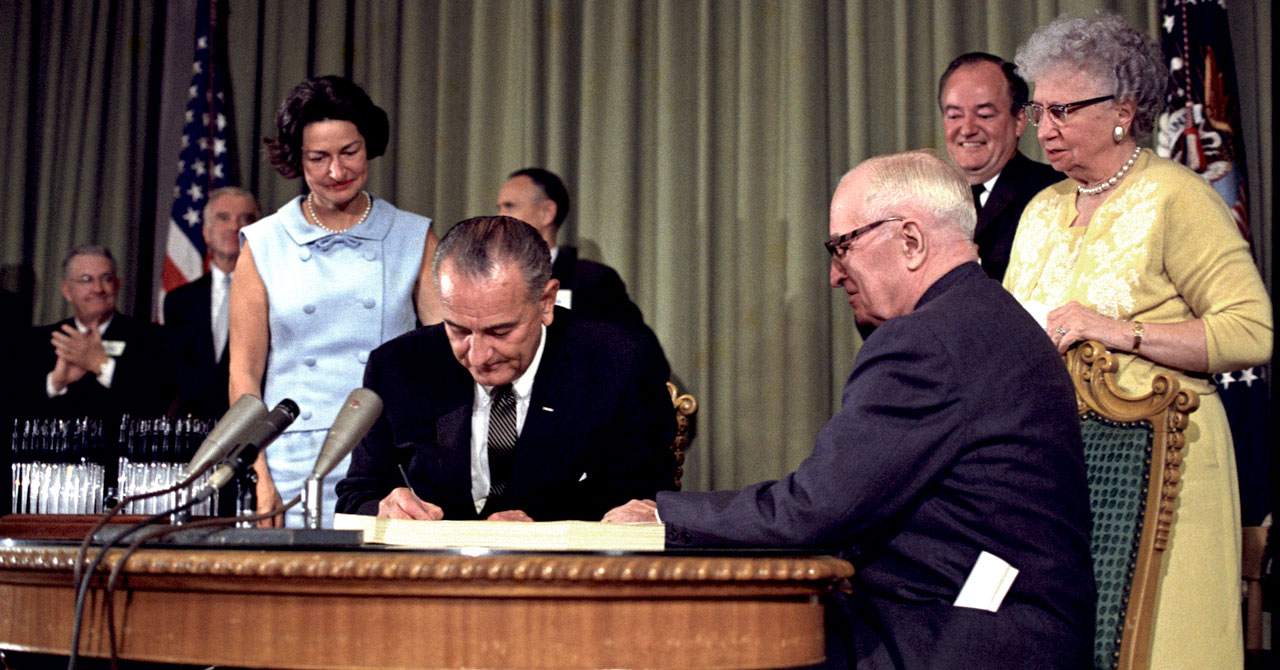
July 30, 1965, 60 years ago: President Lyndon B. Johnson signs the Social Security Amendments of 1965 into law, in a ceremony at the Harry S Truman Presidential Library and Museum, in Independence, Missouri, outside Kansas City.

Former President Truman had tried to get a national health service, offering universal coverage, similar to Britain's passed in 1949, but failed. Holding the signing ceremony at his library was a tribute to his efforts. Also in attendance were each man's wife, Claudia "Lady Bird" Johnson and Elizabeth "Bess" Truman; Vice President Hubert Humphrey, and Governor Warren Hearnes of Missouri, for whom the University of Missouri's arena is named.

Although the Amendments increased benefits for people who met the legal definition of being disabled, the two main components were Medicare and Medicaid. Medicare provides coverage for healthcare for people aged 65 and up. Medicaid helps with health care costs for people of limited income, including nursing home and personal care services, which Medicare doesn't cover.

Medicare and Medicaid joined the Office of Economic Opportunity (a.k.a. "the War On Poverty"), and two major education reform bills to form Johnson's "Great Society." Within days of signing this bill, LBJ would add the Voting Rights Act of 1965. It remains the high point of American liberalism.

Canada passed National Health Service with universal coverage in 1967. Australia did so in 1984. In both cases, they use the term Medicare. In America, however, that term is still limited to health care for senior citizens.

Thursday, June 12, 2025

It's Fun to Be With the AARP

AARP stands for "American Association of Retired Persons." Technically, I'm not retired. But I'm so old, I've been a member for over 5 years now. (You have to be 50, which isn't that old.)

Young man, there's no need to feel down. I say
Young man, pick yourself off the ground. I say
Young man, at your age you have found
there's no need to be unhappy!

Young man, there's a place I can go, I say
Young man, when I'm short on my dough. I say
Young man, I show them this red card.
Discount makes my money go far!

It's fun to be with the AARP!
They have everything for old men as they please!
You can hang out with all the geeze!

It's fun to be with the AARP!
You can stay at hotels!
You can have a good meal!
You can do whatever you feel!

Young man, are you listening to me? I say
Young man, it isn't quite all for free. But then
Young man, you can make real your dreams
But someday will need Ben-Gay cream!

Young man, someday you'll go online, I say
Young man, you'll be taking the time, I say
Young man, go to AARP
They can start your old folks' journey!

It's fun to be with the AARP!
They have everything for old men as they please!
You can hang out with all the geeze!

It's fun to be with the AARP!
You can stay at hotels!
You can have a good meal!
You can do whatever you feel!

Young man, I was once in your shoes, I say
I was aged at just 22, I thought
no man would let me into the bar
because they always checked my card!

Young man, now they check card of red, I say
Young man, don't you hear what I said, I say
Young man, I'm with AARP
I get discounts on nice whiskey!

It's fun to be with the AARP!
They have everything for old men as they please!
You can hang out with all the geeze!

AARP!
It's fun to be with the AARP!

Friday, August 14, 2015

August 14, 1935, The Social Security Act

August 14, 1935, 80 years ago: President Franklin D. Roosevelt signs the Social Security Act into law. It becomes the keystone of his domestic program, the New Deal.

By the 1930s, America was the only modern industrial country without any national system of pensions for older people. In the depths of the Great Depression, a physician named Francis Townsend rallied support for a proposal to issue direct payments to the elderly.

Responding to that movement, Roosevelt organized a committee led by Secretary of Labor Frances Perkins -- an ally of his from his tenure as Governor of New York, in 1933 he had made her the 1st woman appointed to any post in the President's Cabinet -- to develop a major social welfare program proposal. Roosevelt presented the plan to Congress in January 1935.

The actual bill was written by Senator Robert F. Wagner, a fellow New Yorker who would write another key piece of New Deal legislation, the National Labor Relations Act. He was not related to the actor Robert Wagner, but his son, Robert F. Wagner Jr., would serve as Mayor of New York City from 1954 to 1965.

The program was expanded to provide payments to widows and dependents of Social Security recipients. Job categories that were not covered by the act included workers in agricultural labor, domestic service, government employees, and many teachers, nurses, hospital employees, librarians, and social workers.

As a result, 65 percent of the African-American workforce, and 27 percent of white workers, were excluded from the initial Social Security program. Many of these workers were covered only later on, when Social Security was expanded in 1950, and again in 1954.

The program was funded through a newly-established payroll tax, which later became known as the Federal Insurance Contributions Act tax (FICA). Social Security taxes would be collected from employers by the states, with employers and employees contributing equally to the tax.

In addition to creating the program, the Social Security Act also established a state-administered unemployment insurance system and the Aid to dependent Children, which provided aid to families headed by single mothers.

As with many other American "reforms," compared with the social security systems in Western Europe, the Social Security Act of 1935 was rather conservative. However, it was the first time that the federal government took responsibility for the economic security of the aged, the temporarily unemployed, dependent children, and the handicapped.

It's important to note that, in 1935, the average life expectancy for an American man was 67 years -- two years past the age when Social Security kicked in. This was a time before antibiotics, seat belts in cars, the prohibition of lead in paint, most environmental regulations, and the Surgeon General's warnings about the dangers of smoking. FDR himself didn't even live to be 65, due in large part to his constant smoking. (Senator Wagner lived to be 75, Secretary Perkins to be 85.)

Today, with men and women just about equally in the workforce, the average life expectancy at around 79, and living to be 100 or more becoming less of a novelty, the Social Security age has been raised to 67.
*

August 14, 1935 was a Wednesday. It was the off-season for the NFL and the NHL, and the NBA hadn't been founded yet. But there was a full slate of Major League Baseball games played, and then some:

* The New York Yankees lost to the Cleveland Indians, 7-6 at League Park in Cleveland. The Yankees trailed 5-2 going into the 8th, then took a 6-5 lead into the bottom of the 9th, but the normally reliable reliever Johnny Murphy blew it.

* The New York Giants split a doubleheader with the St. Louis Cardinals at the Polo Grounds. The Jints won the 1st game 6-4, as King Carl Hubbell outpitched Paul "Daffy" Dean. But the defending World Champions struck back in the 2nd game, winning 3-0. Bill Hallahan allowed 10 hits and 4 walks, and Daffy had to step in and get the last 2 outs, but the Cards got the shutout. Daffy's brother Jay "Dizzy" Dean did not appear in either game. (It's worth noting that Diz didn't mind his nickname, but Paul hated his. He was a very smart and stable guy, not daffy in the slightest.)

* The Brooklyn Dodgers swept a doubleheader from the Chicago Cubs at Ebbets Field. Dem Bums took the 1st game 9-5, and the 2nd game 3-2.

* The Boston Braves swept a doubleheader from the Cincinnati Reds at Braves Field in Boston. The Braves won the 1st game 8-1, and the 2nd game 11-5. This may have been the highlight of the worst season in the Braves' 150-season history: They went 38-115.

* The Pittsburgh Pirates swept a doubleheader from the Philadelphia Phillies at Baker Bowl in Philadelphia. The Bucs won the opener 8-1, and the nightcap 7-4.

* The Detroit Tigers beat the Washington Senators, 18-2 at Navin Field in Detroit. That ballpark would be renamed Briggs Stadium in 1938 and Tiger Stadium in 1961.

* The Boston Red Sox beat the Chicago White Sox, 7-1 at Comiskey Park in Chicago.

* And the Philadelphia Athletics beat the St. Louis Browns, 8-2 at Sportsman's Park in St. Louis.