May 22, 1964, 60 years ago: President Lyndon B. Johnson gives the commencement address at the graduation ceremony at the University of Michigan, in Ann Arbor. Although he had already used the phrase "a Great Society" 15 days earlier, on the campus of Ohio University in Athens, this address becomes known as "the Great Society Speech."
Johnson had been a young aide to Representative Richard Kleberg of Texas in 1933 when President Franklin D. Roosevelt launched his "New Deal" in response to the Great Depression. The New Deal contained emergency measures, but some of them, such as banking insurance and Social Security, worked so well that they were kept in operation.
Johnson was a Congressman himself in 1944 when, with American troops marching toward victory in World War II, FDR created the G.I. Bill of Rights, allowing for a postwar economic boom.
With the economy booming again in the early 1960s, in part due to the measures enacted over the previous 3 years by the recently assassinated President John F. Kennedy, Johnson thought now was the time for another New Deal -- not out of necessity, like in 1933; or out of gratitude, like in 1944; but out of opportunity. There had never been a better chance for the American federal government to help the people who had "fallen through the cracks." He told the commencement crowd:
For a century, we labored to settle and to subdue a continent. For half a century, we called upon unbounded invention and untiring industry to create an order of plenty for all of our people.
The challenge of the next half century is whether we have the wisdom to use that wealth to enrich and elevate our national life, and to advance the quality of our American civilization.
Your imagination, your initiative, and your indignation will determine whether we build a society where progress is the servant of our needs, or a society where old values and new visions are buried under unbridled growth. For in your time we have the opportunity to move not only toward the rich society and the powerful society, but upward to the Great Society.
The Great Society rests on abundance and liberty for all. It demands an end to poverty and racial injustice, to which we are totally committed in our time. But that is just the beginning.
The Great Society is a place where every child can find knowledge to enrich his mind and to enlarge his talents. It is a place where leisure is a welcome chance to build and reflect, not a feared cause of boredom and restlessness. It is a place where the city of man serves not only the needs of the body and the demands of commerce but the desire for beauty and the hunger for community.
It is a place where man can renew contact with nature. It is a place which honors creation for its own sake and for what it adds to the understanding of the race. It is a place where men are more concerned with the quality of their goals than the quantity of their goods.
But most of all, the Great Society is not a safe harbor, a resting place, a final objective, a finished work. It is a challenge constantly renewed, beckoning us toward a destiny where the meaning of our lives matches the marvelous products of our labor.
Johnson had already declared "War On Poverty" in his State of the Union Address on the preceding January 8. That war, with the founding of the Office of Economic Opportunity (OEO), became a subset of the Great Society. He noted in his speech that the University of Michigan was the birthplace of the Peace Corps, and he added VISTA, Volunteers In Service To America, as a kind of "domestic Peace Corps" for poor places on our own shores, both urban and rural.
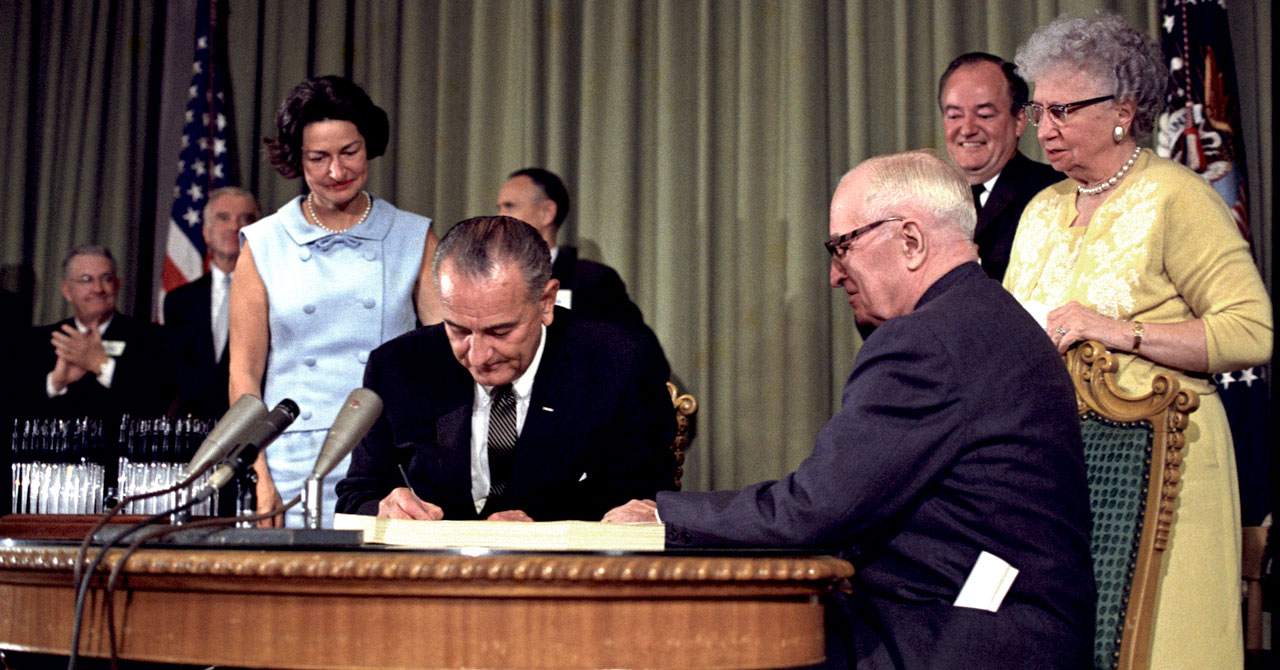
Head Start created better preschools for millions of children. His Higher Education Act of 1965 expanded college access. The Social Security Act of 1965 created Medicaid for the poor and Medicare for people age 65 and up.
Most of all, despite being a white Southerner, LBJ attacked the problem of racism. He created the Equal Employment Opportunity Commission (EEOC) to alleviate discrimination in hiring based on race and gender. He saw JFK's civil rights bill through to passage as the Civil Rights Act of 1964. He demanded, and got, the Voting Rights Act of 1965. And the Civil Rights Act of 1968, the Fair Housing Act, made it easier for black people to move into houses wherever they wanted, and to repair the homes they already had.
LBJ gave the speech just as the 1964 Republican Presidential Primaries were nearing their conclusion. Senator Barry Goldwater of Arizona won the nomination, and ran against the Great Society -- what had already been passed, and what LBJ had hinted -- and, beyond that, what the conservative movement suspected was yet to come -- as "overreach." He believed such things were unconstitutional, powers not specifically granted to the federal government by the Constitution of the United States.
It is likely that Johnson would have defeated Goldwater solidly even if Goldwater hadn't voted against the Civil Rights Act of 1964, which he challenged on constitutional grounds. He may have forgotten that the Constitution, in its very Preamble, says it was ordained an established in part to perform the rather vaguely worded tasks to "promote the general welfare and secure the blessings of liberty to ourselves and our posterity."
But the full term that Johnson won would be stricken with a different challenge: The Vietnam War. In essence, he got one full term as President, 4 years: From JFK's assassination on November 22, 1963 until November 30, 1967, when Senator Eugene McCarthy of Oregon announced he would challenge him in the 1968 Democratic Primaries, LBJ pretty much had free rein to govern how he wanted.
This was true in large part because he was backed by large Congressional majorities. In the 1964 election, led by LBJ as JFK's "heir," the Democrats gained 37 seats in the U.S. House of Representatives, giving them 295 seats for the 1965-66 term, which remains their highest total since the 1937-38 session. And they gained 2 Senate seats, giving them 68, which remains their highest total since 1939-40.
But in the 1966 elections, while they only lost 4 Senate seats, they lost 47 seats in the House, proving that LBJ was not invincible. And the public turned on him. So did the media: On August 1, 1967, Herbert Block, the editorial cartoonist for The Washington Post, under the name "Herblock," drew Johnson arm-in-arm with a trash-looking woman, whose mink stole was labeled "VIETNAM WAR," while he pointed a finger at a thin woman in a raggedy dress labeled "U.S. URBAN NEEDS," and tells her, "There's money enough to support both of you - Now doesn't that make you feel better?"
(In addition, Barbara Garson, one of the University of California students who was arrested during the "Free Speech Movement" protest of late 1964, wrote a satirical play titled MacBird! in 1966, imagining LBJ as Macbeth, assassinating JFK, and talking about his plan for "The Smooth Society." Interviewed in 2006, she said it was just a satire, and that she never believed that LBJ had anything to do with the assassination, adding, "If he did, it's the least of his crimes.")
The intraparty challenge by McCarthy made LBJ nervous. But then, JFK's brother, Senator Robert F. Kennedy of New York, got into the race. Unlike McCarthy, with his obsession with Vietnam, RFK was not a one-issue candidate, and could out-promise LBJ on issues connected with the Great Society, because, as his brother's Attorney General, he had a record on such issues, one that LBJ had built on.
On March 31, 1968, LBJ announced he wouldn't run for a 2nd full term. In June, RFK knocked McCarthy out, then was assassinated. LBJ's Vice President, Hubert Humphrey, was nominated, then lost the general election to former Vice President Richard Nixon.
How Nixon handled it depends on who you talk to. Most liberals thought that Nixon "dismantled" the Great Society. He did end the OEO, and cut spending on many programs. But many conservatives, especially those affiliated with the later Presidency of Ronald Reagan, thought that Nixon had let them down on the issue, especially with his institution of what became known as "Food Stamps": After Nixon's death in 1994, Fred Barnes of The New Republic said that Nixon "let the Great Society flower."
After leaving office, Johnson told his aide Doris Kearns -- who would later marry Richard Goodwin, author of the Great Society Speech -- with his usual away-from-microphones earthiness:
I knew from the start that I was bound to be crucified, either way I moved. If I left the woman I really loved, the Great Society, in order to get involved in that bitch of a war on the other side of the world, then I would lose everything at home. All my programs, all my hopes, all my dreams.
But if I left that war and let the Communists take over South Vietnam, then I would be seen as a coward, and my nation would be seen as an appeaser, and we would both find it impossible to accomplish anything, for anybody, anywhere on the entire globe.
Johnson died in 1973. Running for President in 1980, Reagan said in his speeches, "We fought a war on poverty, and poverty won." He wasn't lying, but he was far from completely correct: Just as FDR's New Deal had cut poverty in America by 1/3rd in its 1st 30 years, 1933 to 1963, so too did LBJ's Great Society cut poverty in America by another 1/3rd in its 1st 30 years, 1964 to 1994.