
Back row, left to right: Tom Stafford and Alexei Leonov.
Front row, left to right: Deke Slayton, Vance Brand and Valeri Kubasov.
July 17, 1975, 50 years ago: For the 1st time, the only 2 nations that have yet sent human beings into space team up.
The 1972 arms talks between American President Richard Nixon and Soviet Premier Leonid Brezhnev, and the subsequent end of the Vietnam War, improved relations between the United States of America and the Union of Soviet Socialist Republics, a condition that became known as Détente, a French word meaning "relaxation."
But a meeting of American and Soviet spacecraft, in space? There were issues beyond politics. Engineering, for one. Each side had concerns over the way the others' craft were designed, and whether they could actually work together. By 1975, these concerns were alleviated, and the combined Apollo-Soyuz flight could go forward.
The American commander was Thomas P. Stafford, who had flown on Gemini 6 and Gemini 9, and commanded Apollo 10. The command module pilot was Vance Brand, making his 1st spaceflight. And the docking module pilot was Donald K. Slayton.
"Deke" Slayton had been one of the original Mercury 7, the only one who hadn't flown in Project Mercury, as he was grounded for health reasons. He was cleared for spaceflight in 1972, but, by then, Project Apollo was winding down, and he didn't fly on any of the Skylab missions, either.
The Soviet commander was Alexei Leonov. In 1965, aboard Voskhod 2, he became the 1st person to make a spacewalk. He was chosen to be the 1st "cosmonaut" on the Moon, but mechanical issues led to the cancellation of the Soviet Moon-landing program. The "flight engineer" was Valery Kubasov, who had flown on Soyuz 6.
Soyuz 19 launched on July 15, 1975, at 8:20 AM U.S. Eastern Time, from the Baikonur Cosmodrome in Kazahkstan. Apollo 18 launched from Cape Canaveral, Florida, at 3:50 PM the same day. On July 17, at 12:12 PM Eastern, the capsules docked. At 3:17, Stafford and Leonov entered their respective docking capsules, opened the door between them, and shook hands, with the docked craft over Metz, France.
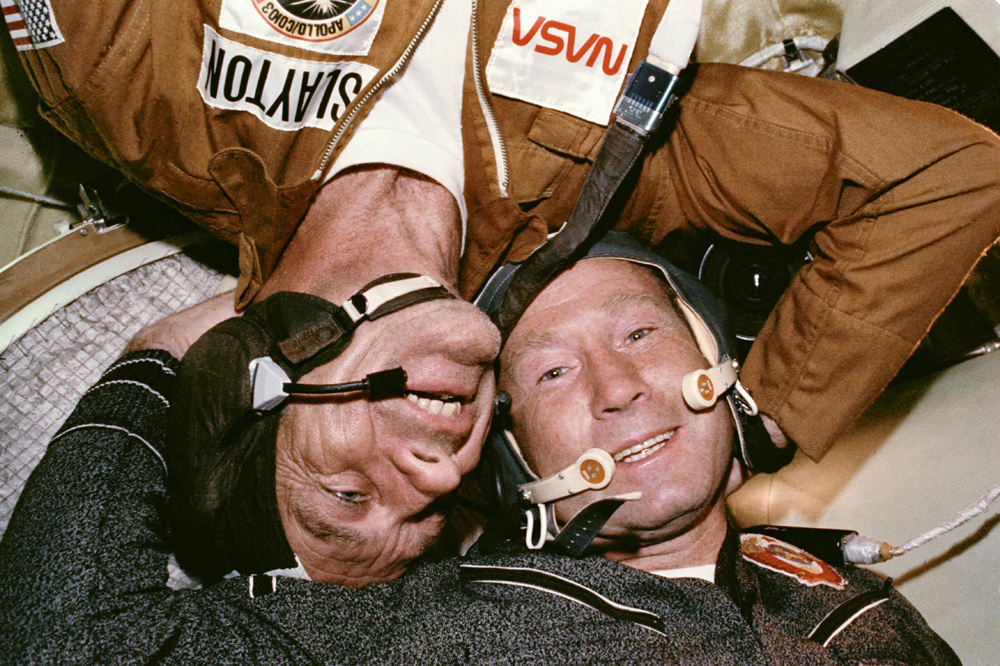
A few minutes later, Slayton and Leonov
posed for this zero-gravity picture.
Mission Control at the Lyndon B. Johnson Space Center in Houston patched in a phone call from President Gerald Ford. The Soviet equivalent read a message from Brezhnev. Music from each country was played: "Tenderness," a 1966 hit by Maya Kristalinskaya; and "Why Can't We Be Friends?" a recent hit with an ironic title by the funk band War.
Scientific experiments were conducted aboard each capsule, which couldn't have been easy, since each capsule had a seating capacity of three. Because of Stafford's drawl, Leonov said 3 languages were spoken on the mission: English, Russian and "Oklahomski."
They separated on July 19, both having stayed in Earth orbit without heading for the Moon. Soyuz 19 landed (the Soviets always landed on land) on July 21, and Apollo 18 splashed down (the Americans always landed on water) on July 24.
This was the end of Project Apollo. The decay of Skylab's orbit and delays on the Space Shuttle program meant that America did not return to spaceflight for 6 years.
The Apollo 18 command module is on display at the California Science Center, next-door to the Los Angeles Memorial Coliseum. The Space Shuttle Endeavour is also there. The Soyuz 19 descent module is at the RKK Energiya museum in Korolyov, outside Moscow. An Apollo module and a Soyuz module, but not the ones from this mission, are at the Smithsonian Institution's National Air and Space Museum in Washington.
In the 1983 film The Right Stuff, Slayton was played by Scott Paulin.
Kubasov was the only member of the Apollo-Soyuz crew who ever flew in space again, aboard Soyuz 36 in 1980. Slayton died in 1993, Kubasov in 2014, Leonov in 2019, Stafford in 2024. As of July 17, 2025, Brand is still alive, age 90. Stafford delivered one of the eulogies at Leonov's funeral.


No comments:
Post a Comment