Showing posts with label rhode island. Show all posts

Friday, July 25, 2025

July 25, 1965: Bob Dylan Goes Electric

July 25, 1965, 60 years ago: Bob Dylan crosses a rock and roll Rubicon. He performs with The Paul Butterfield Blues Band at the Newport Folk Festival in Newport, Rhode Island. They use electric instruments, something the festival had never allowed before, as folk music has traditionally been all-acoustic.

Dylan had been born Robert Allen Zimmerman on May 24, 1941 in Duluth, Minnesota. He grew up in Hibbing, Minnesota, but found life there dissatisfying on multiple levels. Early early rock and roll stars of the mid-1950s appealed to him, and so anyone who had studied his entire life from 1941 to 1965 should have seen this coming. But most people didn't know about that when they became fans of his in the early 1960s. 

In 1961, having dropped out of the University of Minnesota, he came to New York, renamed himself for Welsh poet Dylan Thomas, and started singing folk music in the clubs of Manhattan's Greenwich Village, where Thomas had lived and performed for the last few years of his life, dying there in 1953. (I have an entry for his death.)

Bob had adopted a persona like that of earlier folk singer Woody Guthrie, with scraggly clothes and a nasal twang. He combined traditional folk songs with his own new compositions, and it didn't seem to matter that he couldn't sing in the traditional sense, or that he wasn't an especially good-looking guy. People were mesmerized by his performances. Soon, men wanted to be him, and women just wanted him.

On April 16, 1962, at Gerde's Folk City at 11 West 4th Street, he first performed "Blowin' in the Wind," and it was a sensation, with its 3 short verses citing the civil rights and antiwar movements. This was less than a year after the Freedom Rides, but a year before American TV viewers saw the firehoses and police dogs of Birmingham, and most hadn't yet heard of Vietnam, let alone realized that we already had troops fighting, killing and dying there. To them, "war" still meant World War II, a "just war," or maybe the Korean War, which didn't seem worth it.

Bob's self-titled debut album had been released on Columbia Records the preceding March 19. Shortly after the Gerde's premiere, he began recording The Freewheelin' Bob Dylan. Released on May 27, 1963, it included "Blowin' in the Wind," "Masters of War," "A Hard Rain's A-Gonna Fall," and "Don't Think Twice, It's All Right" -- the latter the first in a long line of great breakup songs he would write. 

Any 1 of those 4 songs would have been a great triumph for any writer. Dylan had all 4 on 1 album. He was 3 days past his 22nd birthday, and he was already a musical legend.

That July, he appeared at Newport for the first time, along with the biggest active legend of folksinging, Pete Seeger. Guthrie, to whom Seeger had introduced Dylan, was still alive, but sidelined by the condition that would kill him 4 years later.

Also there were Peter, Paul and Mary (Peter Yarrow, Noel Paul Stookey and Mary Travers), the folksinging trio who recorded what remain the biggest hit versions of "Blowin' in the Wind" and "Don't Think Twice." So was Joan Baez, the leading female soloist of "the folk revolution," who helped make Bob famous, then became his girlfriend. Together, these and others closed the show by joining hands and singing a song Seeger, though he didn't write it, made the anthem of civil rights: "We Shall Overcome."

Dylan then began recording his next album, finishing it before President John F. Kennedy was assassinated, but not released until afterward, on January 13, 1964: The Times They Are A-Changin'. It included the title track, "Ballad of Hollis Brown," "With God On Our Side," "Only a Pawn In Their Game," "When the Ship Comes In," and "The Lonesome Death of Hattie Carroll." His previous burst of creativity was thus proven to be no fluke.

Just 25 days after that album's release, The Beatles arrived in America. They and Dylan each influenced the other tremendously, and it may have been The Beatles who influenced Dylan to switch to electric instruments.

Before he did though, he recorded Another Side of Bob Dylan. Released on August 8, 1964, he told Nat Hentoff, the music critic of The Village Voice, New York's underground weekly newspaper, "There ain't no finger-pointing songs." There was "All I Really Want to Do," "Chimes of Freedom," "It Ain't Me, Babe," and "My Back Pages," on which the 23-year old Dylan closed each of 6 verses by singing, "Ah, but I was so much older then. I'm younger than that now." 

The Byrds, who would record several of Bob's songs, recorded "My Back Pages," but, to cut it to single length, dropped the 3rd and 4th verses. Both they and Cher would have a hit with "All I Really Want to Do"; while "It Ain't Me, Babe" would be a hit on the pop chart for The Turtles (their first hit), and on the country chart for Johnny Cash.

Fame and the expectation of his peers were getting to Dylan. Until now, except for a couple of songs on the latest album where he had played piano, it had been just him, his guitar, and the harmonica he wore in a neck harness; with no other musicians. (The harmonica in the neck harness would be copied by many performers, most notably Neil Young and Billy Joel.) For his next album, he went electric, and it was titled Bringing It All Back Home.

Released on March 22, 1965, this was a revelation. It was a reminder of his rock and roll roots, about which his "folkie" fans seemed to know nothing. It began with "Subterranean Homesick Blues," with its angry declaration that, "You don't need a weatherman to know which way the wind blows." (This would inspire a radical offshoot of Students for a Democratic Society to call themselves the Weathermen, and later the Weather Underground.)

It included "Maggie's Farm," whose lyrics certainly suggested folk roots, but the electricity behind it give it a bigger punch. It included "Mr. Tambourine Man," which he recorded in 3/4 time, but The Byrds would later switch it to 4/4 time, and give him his 1st Number 1 hit as a writer. (The song has 4 verses, but Byrds lead singer Roger McGuinn sang only the 2nd between the choruses.)

It included "It's Alright Ma (I'm Only Bleeding)," with its declaration, "He not busy being born is busy dying." If that wasn't a message to the people who wanted him to remain the 22-year-old golden boy of the Greenwich Village clubs forever -- just as there were others who got upset when The Beatles moved beyond being "The Lovable Mop Tops" -- then the last song on the album certainly was: "It's All Over Now, Baby Blue." 

And on July 20, he released a standalone single, a 6-minute reminder of how their delusions of him, not himself, had let them down: "Like a Rolling Stone." (Rolling Stone magazine was named for this song, not the new British band of the same name.)

So when Dylan, backed by The Paul Butterfield Blues Band, took the stage at Newport on July 25, nobody knew what to expect. Here's what he gave them: "Maggie's Farm," "Like a Rolling Stone," and "It Takes a Lot to Laugh, It Takes a Train to Cry," each electric.

There was booing, but there's dispute over why. Some have said it wasn't because the electric instruments were blasphemy to the folkies, it was because the sound system was bad, and Bob and the band couldn't be heard properly. The surviving film suggests that this is true, because the songs don't sound much like they did on the records. 

Another legend, that Pete Seeger yelled at show producer George Wein to turn the amps off, and that, having been refused, the "purist" Seeger tried to chop the cord with an ax, were denied by Seeger himself. He admitted that the problem was the sound system, not Dylan's audacity. If any folkies felt betrayed that night, Seeger was not one of them.

Dylan played 2 more songs, just him, his guitar, and his harmonica: "Mr. Tambourine Man" and, providing a definitive last word for them, "It's All Over Now, Baby Blue." He soon wrote one of the nastiest songs ever written in the English language: "Positively 4th Street," opening with, "You got a lot of nerve to say you are my friend," and going on to really let them have it.

By this point, he had further enraged the folk music community by breaking up with Joan Baez, and marrying someone else, Sara Lowndes, for whom he wrote some of his more interesting songs thereafter.

Dylan would go through many more changes to his career, and did not appear at the Newport Folk Festival again until 2002. As of July 25, 2022, he is 81 years old, and still performing. Few people now doubt that going electric was good for him, and good for music.

Also, not counting individuals implied as being part of a group, like the Beatles and the performers at Woodstock, Bob Dylan is 1 of 4 people mentioned in Billy Joel's 1989 song "We Didn't Start the Fire" who are still alive. The others are Brigitte Bardot, Chubby Checker, and 1984 New York "subway vigilante" Bernhard Goetz.

Monday, May 29, 2017

Top 10 Athletes From Rhode Island


May 29, 1788: Rhode Island becomes the last of the original 13 States to ratify the Constitution, thus gaining true Statehood. Note the 13 stars on the State Flag.

Top 10 Athletes from Rhode Island

Honorable Mention to Chris Terreri of Warwick, whose backing up of Martin Brodeur in goal helped the New Jersey Devils win the 1995 and 2000 Stanley Cups.

Honorable Mention to Norman Taber of Providence. He won a Gold Medal in the 3,000-meter relay and a Bronze Medal in the 1,500 meters at the 1912 Olympics in Stockholm, Sweden. On July 16, 1915, he set a record in the mile run: 4 minutes, 12.6 seconds. The record stood for 8 years.

10. Ernie Calverley of Pawtucket. In 1944, the guard led all college basketball players in scoring average, and got the University of Rhode Island into the NIT Final, losing what was then still considered the real national championship to Kentucky by 1 point.

He played in the early NBA with Rhode Island's team, the Providence Steamrollers, and later coached URI to 2 NCAA Tournament bids in the 1960s.

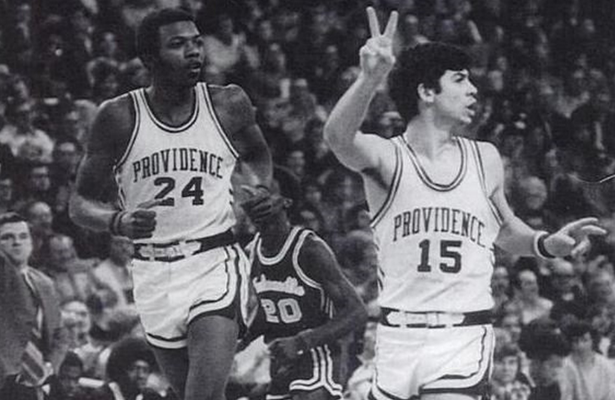
9. Marvin Barnes of South Providence. "Bad News" Barnes teamed with Ernie DiGregorio to lead coach Dave Gavitt's Providence College team to the NCAA Final Four in 1973. He became one of the stars of the ABA, playing for the Spirits of St. Louis, winning the league's Rookie of the Year in 1975 and making its '75 and '76 All-Star Games. He was later named to the ABA All-Time Team.

After the merger with the NBA, he played for the Detroit Pistons, the Buffalo Braves (after they let Ernie D go), the Boston Celtics (ditto) and the San Diego Clippers (whom the Braves became in 1978). His career was ruined by cocaine abuse, and, after getting clean, he became an anti-drug counselor. Providence retired his Number 24.

8. Steve Furness of Warwick. He starred for URI in football and track, and was invited to attend the 1972 U.S. Olympic trials for his success in the hammer throw. He turned it down, as it would have conflicted with attending training camp for the Pittsburgh Steelers.

He made the right choice: It's hard to imagine whatever he could have done in the Olympics, with the hammer thrown then dominated by steroid-ridden Eastern Europeans, with the 4 Super Bowl rings he won as a Steeler defensive tackle. When Steeler assistant coach George Perles was named head coach at Michigan State, he took Furness on his staff, and he helped them win 2 Big Ten titles.

7. Ernie DiGregorio of North Providence. Like Pistol Pete Maravich, Ernie D got a lot of hype in the 1970s, a time when the black takeover of the NBA was completed, for being a white basketball player with a lot of talent and a cool nickname.

In 1973, he and the aforementioned Marvin "Bad News" Barnes led Providence College to the Final Four. In 1974, playing for the Buffalo Braves (the team now known as the Los Angeles Clippers), he led the NBA in free throw percentage and assists per game, and was named Rookie of the Year. In 1977, he led in free throw percentage again.

Ultimately, though, his career was a disappointment. The Los Angeles Lakers acquired him for the 1977-78 season, hoping that he and Kareem Abdul-Jabbar could lead them back to the title, which he never got close to in Buffalo. But the bigger market proved him to be a big fish in a small pond. The Lakers waived him after only 25 games.

He was picked up by the Boston Celtics in 1978, and they soon let him go, too. By the time both teams had won the title again (the Lakers in 1980 and the Celtics in '81), Ernie D was finished, having played his last NBA game at age 27. In today's expansion-ridden league, he'd probably have hung on for a few more years.

He became a high school coach, including at a school for the deaf. He now works at Foxwoods Resort in Mashantucket, Connecticut, not far from his North Providence hometown. Providence retired his Number 15.
Bad News Barnes and Ernie D in 1973

6. Mark van Eeghen of Cranston. He set the single-season rushing record at Colgate University, and at the time of his retirement, he was the all-time leading rusher in Oakland Raiders history, winning Super Bowls XI and XV.

He returned to New England to finish his career with the Patriots, finishing with 6,651 yards rushing, 1,583 receiving, and 41 touchdowns. His daughter Amber van Eeghen became a Patriots cheerleader, and is married to Dan Koppen, a Pro Bowl center for the Patriots.

5. Gerry Philbin of Pawtucket. A defensive end, he was a member of the Jets' Super Bowl III team. He was twice named to the All-AFL team, and was named to the All-Time AFL Team and the New York Jets Ring of Honor.

4. Mathieu Schneider of Woonsocket. Although born in Manhattan, and spending part of his childhood in West New York, New Jersey, Rhode Island was where he was trained to play hockey. He won the 1993 Stanley Cup with the Montreal Canadiens, and the 1996 World Cup of Hockey with the U.S. team. In 22 NHL seasons, he scored 223 goals and had 520 assists, very good totals for a defenseman.

3. Vinny Pazienza of Cranston. He has since legally shortened his name to "Vinny Paz." I'm not going to argue with a man whose nickname was "The Pazmanian Devil."

He won the IBF Lightweight Championship by defeating Greg Haugen at the Providence Civic Center (now the Dunkin Donuts Center) on June 7, 1987. Just 8 months later, Haugen took the title back at Convention Hall in Atlantic City (another name change, it's now Boardwalk Hall). On October 1, 1991, he scored a TKO victory over Gilbert Dele to win the WBA Light Middleweight Championship at "The Dunk," a title he was later forced to forfeit when an injury made him back out of a defense.

Was it the hometown factor? Maybe not: While he was 12-0 in Rhode Island, he was a strong 19-3 in New Jersey, his other losses there being to Hector "Macho" Camacho and Roy Jones Jr. He also lost to Roger Mayweather (brother of Floyd Sr. and uncle of Floyd Jr.). Overall, he was 50-10, but was 40-5 as late as June 1995.

2. Davey Lopes of East Providence. He pronounces it as one syllable (Loaps), instead of the traditional two (LOH-pez). New England has a significant Portuguese community, and Portugal once had extensive colonial holdings in Africa, now independent nations. This included the islands of Cape Verde, and Lopes may be the most famous living American of Cape Verdean descent. This would not be true if Lisa "Left Eye" Lopes of TLC, not known to be related, were still alive. Wayne Fontes, who briefly played for the Jets in their early days as the Titans, and coached the Detroit Lions to 4 Playoff berths, is also of Cape Verdean descent.

The 2nd baseman and leadoff hitter for the 1970s Los Angeles Dodgers, he was a 4-time All-Star, led the National League in stolen bases in 1975 and '76, won a Gold Glove in 1978, and helped the Dodgers win the Pennant in 1977, '78 and '81, facing the Yankees in the World Series all 3 times, driving them nuts with his speed and surprising power (he hit 3 home runs in the '78 Series), finally winning it in 1981.

He was also a member of the 1984 Chicago Cubs and the 1986 Houston Astros, who won Division titles but lost in the NL Championship Series. He stole 551 bases in his career, and his steal percentage of 83 percent is 3rd-highest among all MLB players with at least 400 attempts.

The Dodgers and the Philadelphia Phillies have faced each other in the NLCS 5 times, and Lopes was involved in all 5. As a Dodger player, he won in 1977 and '78, and lost in '83. As a Phillie coach, he won in 2008 and '09, and the Phils won the Pennant both times, winning the World Series in 2008 and losing it to the Yankees in 2009.

He also reached the postseason on the coaching staffs of the San Diego Padres in 1996, '98 (reaching the World Series in '98 but losing to the Yankees) and 2005; the Phillies in 2007 and '10; the Dodgers in 2013, '14 and '15; and the Washington Nationals last year. (And they are on pace to get back in this year.) He has had one managing job, with the Milwaukee Brewers from 2000 to 2002.

1. Napoleon Lajoie of Woonsocket. That's pronounced LAH-zhoh-way. Known as Nap for short, the Frenchman for his ancestry, and Larry (I can't find the source of that nickname), he hasn't played a game in over 100 years, but he's still tops.

Charles Leo "Gabby" Hartnett, the great Chicago Cubs catcher who also managed them to the 1938 Pennant, was also born in Woonsocket, but grew up in nearby Millville, Massachusetts, and thus qualifies for that State.

In 1901, the American League's 1st season, playing for the Philadelphia Athletics, Nap became its 1st batting champion, and set a League record for batting average. For a long time, it was listed as .422. It was eventually checked, and revealed to be .426, the highest batting average for a single season in the 20th Century. He was also the AL's 1st leader in home runs and RBIs, thus winning him the Triple Crown.

Since he had jumped Leagues, having previously played for the Philadelphia Phillies, legal issues prevented him from playing in the State of Pennsylvania for any team but the Phillies. So the A's had to trade him in 1902, and he went to the Cleveland Blues. He proved so popular there that, in 1905, not only was he named player-manager, but they were renamed for him: The Cleveland Naps. (In 1915, after he left, they were renamed the Indians.)
A colorized photo

He won 3 AL batting titles. He batted .339 lifetime, and collected 3,252 hits. He wasn't as good as a manager, never coming closer to a Pennant than a near-miss in 1908. He was among the earliest inductees to the Baseball Hall of Fame, attending its opening ceremony in 1939, along with Tris Speaker, who may have succeeded him as the Indians' greatest player. He was also one of the most admired players of his time, but fans and opponents alike.

He was elected to the Baseball Hall of Fame in 1937, in its 2nd round of elections, the 1st player at 2nd base chosen. He is in the Cleveland Indians Hall of Fame, but, although he starred for both the Phillies and the A's, he has never been elected to the Philadelphia Baseball Wall of Fame. He played before there were All-Star Games, and also before there were uniform numbers, so, of course, there's no number to retire for him.

Nevertheless, Nap Lajoie is still on the short list for the title of greatest 2nd baseman who ever lived, and he's Rhode Island's greatest athlete.

Monday, January 23, 2017

How to Go to a Providence Basketball Game

In my OCD haze, I want to make sure I end up doing these trip guides for all 50 States. The most-honored sports team in the State of Rhode Island is the basketball team at Providence College, and they happen to be hosting New York City's own St. John's University on Wednesday. Thus giving me the opportunity to get 1 step closer to all 50. (I currently have 28, plus the District of Columbia.)

Before You Go. Mark Twain, who spent the last few years of his life in Hartford, Connecticut, famously said, "If you don't like the weather in New England, wait a minute." Providence is a little further north than New York. However, the weather won't be appreciably different. It's to the east of us, and thus still in the Eastern Time Zone, so you won't have to fiddle with your timepieces.

According to the website of the Providence Journal, by far the largest newspaper in the State, temperatures should be in the low 50s on Wednesday afternoon, and in the high 30s in the evening. Wear a winter jacket.

Tickets. The Dunkin' Donuts Center is not a large arena, seating only 12,410 for basketball. But this is a college game we're talking about, so it most likely won't be sold out.

The student sections are behind both baskets in the lower level, the 100 sections, so those seats are out, no matter how much you can spend. Center-court seats are $90, but they can be had in the corners for $37. In the upper level, the 200 sections, they're $37 between the baskets and $17 behind.

Getting There. It's 181 miles from Times Square in Midtown Manhattan to the Dunkin' Donuts Center in downtown Providence. If you're driving, you take Interstate 95 all the way there, getting off at Exit 21.

Providence is too close to fly into Theodore F. Green International Airport, named for a former Governor and U.S. Senator.

If you want to take Greyhound, the good news is that it's very cheap: $76 round-trip, but only $24 if you order advanced-purchase. The bad news is that it takes 6 hours, and you'd have to leave at 8:30 in the morning, arriving at 2:30 in the afternoon. The other option leaves at 12:01 PM and arrives at 6:20 -- just 10 minutes before tipoff, so that's no good. And the next bus after the game leaves the following morning. So that's no good. The station is at 1 Kennedy Square, bounded by Washington, Dorrance, Fulton and Exchange Streets.

If you want to take Amtrak, it's $132 round-trip. The station is at 100 Gaspee Street, in front of the State House. You can get a train back out between the game's end and midnight, at 10:22 PM, and arrive back at Penn Station at 2:30 AM.

Once In the City. Formerly the colony of "Rhode Island and Providence Plantations," Rhode Island was one of the Original 13 Colonies, and was the last of them to ratify the Constitution of the United States, on May 29, 1790, over a year after the Constitution went into effect.

Its capital, one of America's oldest cities, was founded in 1636, by Roger Williams, a religious dissident chased out of Massachusetts, probably for pointing out how the Puritans had deflated the footballs before the game against the Indians on the first Thanksgiving. He named it Providence, after the concept of divinely ordained events and outcomes, and it became a haven for other religious dissidents. (The great 20th Century jazz pianist Roger Williams was not related, as that was a stage name.)
The city is a State capital, home to about 180,000 people, and has a metropolitan area of about 1.6 million, although it can also be said to be part of the metro area of Boston, 50 miles to the northeast. The Massachusetts Bay Transportation Authority runs commuter rail service between the cities, and also gameday trains from both Boston and Providence to Gillette Stadium in Foxboro. The Rhode Island Public Transit Authority (RIPTA) handles bus service in the State. The cash fare is $2.00, and a daypass is $6.00.

ZIP Codes in Rhode Island begin with the digits 028 and 029. The Area Code is 401. Interstate 295 serves as a bypass for Providence, but not a beltway. Providence, 90 percent white as recently as 1970, is now 42 percent white, 38 percent Hispanic, 16 percent black and 6 percent Asian.

Providence is not known for racial strife. However, there was the Hardscrabble Riot in 1824. Several hundred white people, angry that the Industrial Revolution was pushing artisans like weavers and shoemakers into factory jobs, took their resentment out on poor African-Americans.

Then came the Snow Town Riot of 1831, triggered by the shooting death of a sailor. A white mob destroyed several black-owned homes, even though both the shooter and the victim were white. This time, the State Militia was called out, and killed 4 white rioters. The outcry among the "good" white people of Providence was such that a proper police force was established, and nothing like the preceding has happened there since.

Providence doesn't really have a "centerpoint," although downtown is at the confluence of the Providence and Woonasquatucket Rivers. The sales tax in the State of Rhode Island is 7 percent. National Grid provides the electricity.
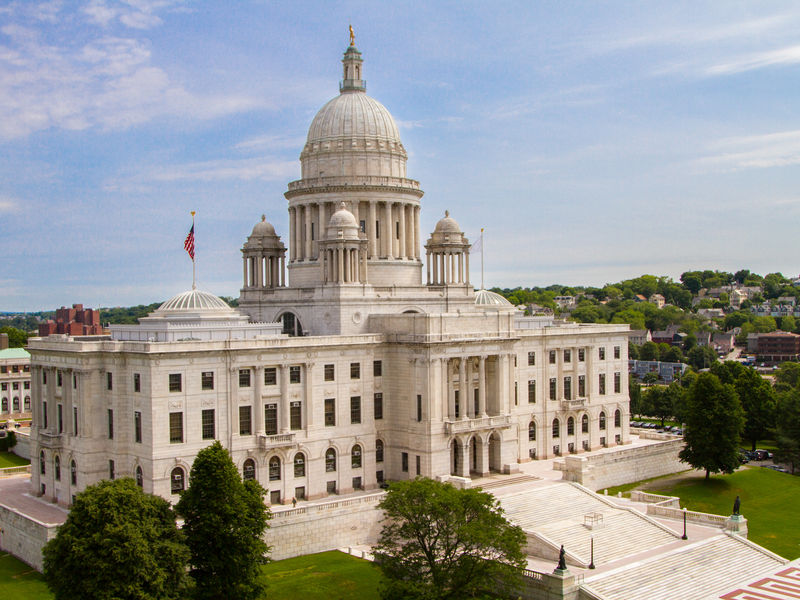
The State House

Providence College was found in 1917, by the Dominican Friars, and, as such, their teams are called the Friars. Aside from the basketball players to be mentioned shortly, notable graduates include:

* Baseball: A pair of Boston Red Sox notables, 1940s catcher George "Birdie" Tebbetts and turn of the 21st Century infielder Lou Merloni. Also Hank Soar, an umpire who also played in the NFL.

* Hockey: Former New Jersey Devils Chris Terreri, Randy Velischek, Jim Korn, and former general manager Lou Lamoriello, who also coached at PC; plus Ron Wilson and John Ferguson Jr.

* Sportscasting: Doris Burke.

* Entertainment: Director Peter Farrelly (his brother Bobby went to Rensselaer Polytechnic Institute), producer David Angel, comedian Janeane Garofalo, actor and game show host John O'Hurley.

* Politics: Former Senator from Rhode Island and U.S. Attorney General J. Howard McGrath, former Senators Tom and his son Chris Dodd of Connecticut, former Mayor Ray Flynn of Boston, former Mayor Richard M. Daley of Chicago, and former Congressmen from Rhode Island John E. Fogarty, Robert Tiernan and Patrick Kennedy (son of Ted, nephew of Jack and Bobby).

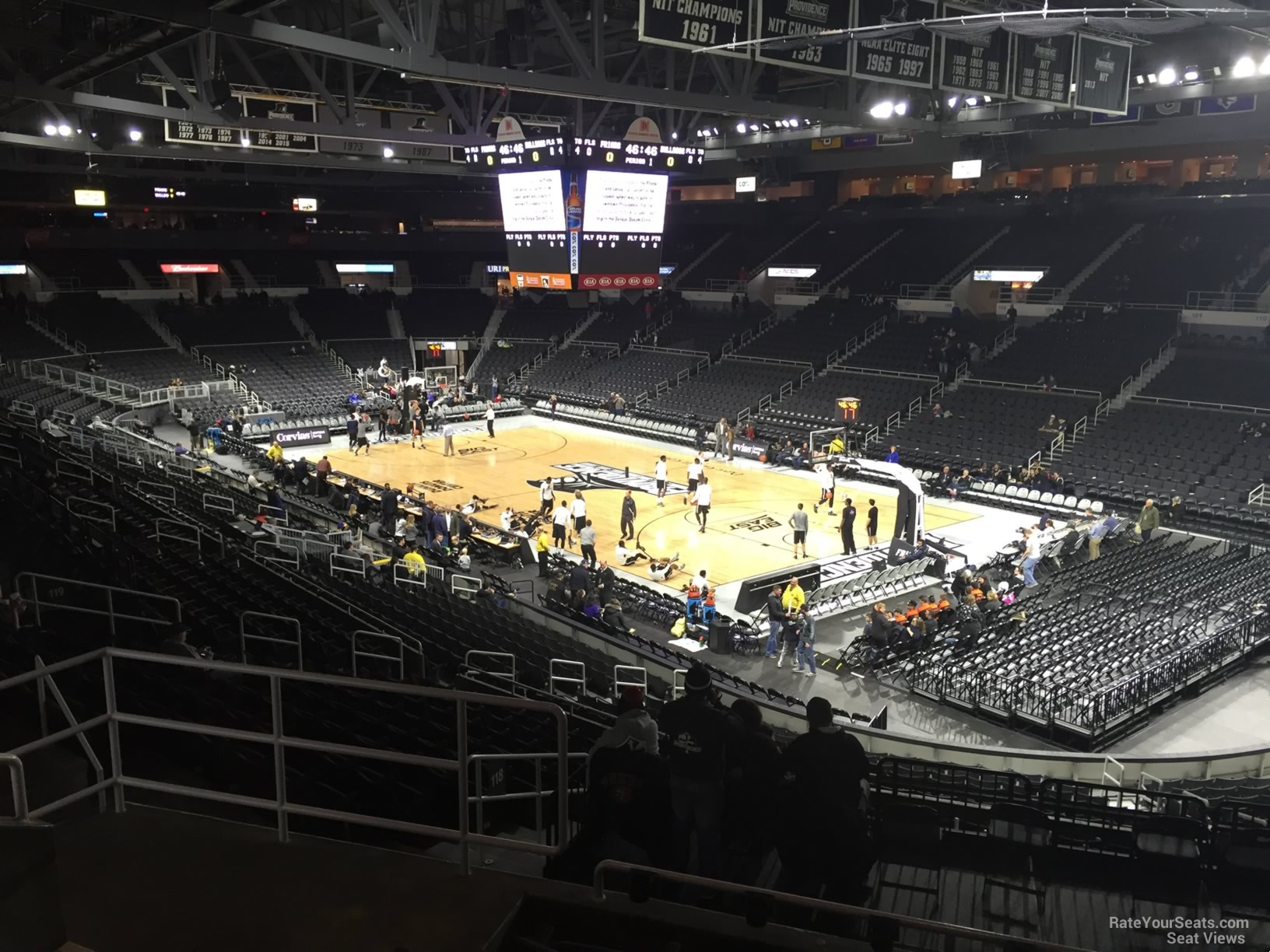
Going In. Opened in 1972 as the Providence Civic Center, and renamed the Dunkin' Donuts Center (or "The Dunk") in 2001, Providence's arena is at 101 Sabin Street, forming La Salle Square with Broadway and Empire Street.
Parking is available in 2 garages, adjacent to the Rhode Island Convention Center (RICC) and next to the Dunkin' Donuts Center. Located on West Exchange Street, parking is available 24 hours a day, 7 days a week. The North Garage Parking Lot is at 99 W. Exchange Street. It's pretty expensive, given that this is a college and minor-league sports arena: $17.

The court is aligned northwest to southeast. Providence College has played home basketball games there since it opened in 1972. The American Hockey League's Rhode Island Reds played there from 1972 to 1977, and the AHL's Providence Bruins (with their P logo a copy of the Bruins' B) since 1992. 
It has hosted NCAA Tournament games, arena football, indoor soccer and concerts. The NCAA has held its basketball Final Four, the Frozen Four, at The Dunk in 1978, 1980, 1982, 1986, 1995 and 2000. 

Elvis Presley sang at this arena, under its old name of the Providence Civic Center, on June 22, 1974; June 26, 1976; and May 23, 1977. The Beatles gave no concerts in Rhode Island.

Food. According to the arena's website, "Concession stands are located throughout Level 2 (Concourse Level) in the venue, offering a variety of foods from pizza to grilled hot dogs, hamburgers, assorted beers/liquors, soda and Dunkin' Donuts coffee." But, being a college/minor-league arena, don't expect the kind of food courts you would see at a major league facility.

Team History Displays. A Catholic school, Providence's teams are called the Friars. They've never won a conference's regular season title, but they won the Big East Tournament in 1994 and 2014. They reached the Final of the NIT in 1960, and won it in 1961 and 1963, at a time when that tourney was still a big deal.

They reached the NCAA Final Four in 1973, led by head coach Dave Gavitt, later the founder of the Big East Conference, and the All-American point guard from North Providence, Ernie DiGregorio. They reached the Final Four again in 1987, coached by Rick Pitino, and featuring Rockville Centre, Long Island native Billy Donovan, who would coach Florida to back-to-back National Championships and now coaches the Oklahoma City Thunder.

The Dunk has banners for the Friars' titles and Final Four berths, and for "Friars Legends":

* From the 1960s: Coach Joe Mullaney; Number 14, Brooklyn native Lenny Wilkens, Class of '60; 34, Johnny Egan '61; 10, Vin Ernst '63; 14, Raymond Flynn '63, later Mayor of Boston; and 24, Jimmy Walker '67.

* From the 1970s: Coach Dave Gavitt; 15, Ernie "Ernie D" DiGregorio '73; 24, Marvin "Bad News" Barnes '74; 27, Kevin Stacom '74; and 10, Joe Hassett '77.
Bad News and Ernie D

They have not honored any players from the last 40 years, but those would include Otis Thorpe '84, Billy Donovan '87, Eric Murdoch '91, Dickey Simpkins '94, Austin Croshere '97, God Shammgod (that's his actual birth name) '97, and current NBA players Ryan Gomes 2005, Marshon Brooks '11, Ricardo Ledo '13, and Kris Dunn and Ben Bentil from the Class of 2016.

PC's main rivalries are with their in-State opponents the University of Rhode Island (PC leads the all-time series 73-54) and their nearby fellow Catholic school, Boston College.

The Dunk also features the Providence Bruins' banners, including the 1999 Calder Cup and Division titles from 1993, 1999, 2003, 2008 and 2013. The P-Bruins do not, however, have any retired numbers, not even for Boston stars Brad Marchand, Tuukka Rask or Tim Thomas. They do have a banner honoring their predecessors, the Providence Reds: The Fontaine Cup in 1930, 1932 and 1934; and the Calder Cup in 1938, 1940, 1949 and 1956.
Stuff. Not being a major league arena, The Dunk doesn't have a big team store. It has smaller souvenir stands.

There are no videos I can find about Providence College basketball. The best available book appears to be Richard Coren's 2002 opus Providence College Basketball: The Friar Legacy.

During the Game. Aside from that brief stretch in the mid-1980s when St. John's vs. Georgetown was epic and nasty, college basketball rivalries in the Northeast are tame. This won't be North Carolina vs. Duke, Kentucky vs. Louisville, Indiana vs. Purdue, or Cincinnati vs. Xavier. The New York-New England animus isn't going to put you in danger for St. John's vs. Providence.

PC's teams are called the Friars because the school was founded by the Dominican Order. They have a mascot, but, rather than a student in a friar's robe and showing his face, they have a student wearing a costume with a big foam head. The character's name is Friar Dom, after the Order. And they have cheerleaders.
Friar Dom, having the cheerleaders check to see if his T-shirt gun is loaded.
And also struggling to remember that priests are supposed to be celibate.

After the Game. Again, your safety won't be an issue. Presuming you used a parking deck, this should also be the case for your car.

The Dunk is downtown, and there should be postgame food & drink places aplenty. Since it's a 6:30 tipoff, and it should be over by 8:30, you could walk up Sabin and Francis Streets to the Providence Place Mall, which has a food court, plus a Panera, a Pizzeria Uno, a P.F. Chang's and a Melting Pot.

If you were visiting Providence on a day of European soccer action, the place to be would be the English Cellar Alehouse, across the Providence River, at 165 Angell Street, just off the Brown campus.

Sidelights. Providence isn't a big city, but with a metro area of 1.6 million, it would rank ahead of Jacksonville and New Orleans in the NFL, and not that far behind Buffalo; New Orleans, Oklahoma City and Memphis in the NBA; and Ottawa, Calgary, Edmonton and Winnipeg (and not far behind Buffalo) in the NHL. But it would easily be dead last in baseball. Plus, the Boston teams would have to waive their territorial rights. Barring that (good luck), and a bigger and more modern arena than the Dunkin' Donuts Center (ditto), it's not going to have a major league team.

But the city does have some sports sites worth visiting:

* Messer Street Grounds site. In the late 19th Century, before Southern and Western expansion due to the invention of air-conditioning and the growth of the automobile, Providence was one of the largest cities in America. And from 1878 to 1885, it had a team in the National League, the Providence Grays.

They won the Pennant in 1879, led by manager and shortstop George Wright, who starred for the 1st openly professional team, the 1869-70 Cincinnati Red Stockings, and would be succeeded as Providence manager by his brother and Cincy teammate Harry Wright).
The 1879 Providence Grays, at the Messer Street Grounds

That 1879 team also had multi-positional superstar John Montgomery Ward; Lipman "Lip" Pike, pro baseball's 1st Jewish player; Joe Start, baseball's 1st great 1st baseman; and William Edward White, who played 1 game in place of Start on June 21, 1879, and may have been black but passing as white. (Evidence has him listed under each race, so it's not clear.) If he was black, or mixed, then he would have been not only the 1st black player in Major League Baseball, but also the only former slave to play in MLB.

The Grays won the Pennant again in 1884, on the resilient arm of pitcher Charles "Old Hoss" Radbourn and his 59 (some sources say 60) wins. They then faced the Champions of the American Association, the New York Metropolitans (and, yes, they were called the New York Mets for short), and swept them in 3 straight games, in what is now regarded as the 1st postseason baseball championship.

But the success of the nearby Boston Beaneaters (forerunners of the Atlanta Braves), drawing fans up the railroad to Boston, and the cost of running a team in what was already a too-small market did the club in after the 1885 season.

The Grays played at the Messer Street Grounds, which was demolished in 1887, and houses went up on the site, bounded by Willow Street on the north, Messer Street on the east, Wood Street on the south, and Ellery Street on the west. About 2 miles west of downtown. There is no historical marker at the site. Bus 19 to Westminster and Barton, then walk 3 blocks south on Messer.

* McCoy Stadium. Built in 1942, this 10,031-seat ballpark has been home to the Pawtucket Red Sox since 1970. The PawSox have been a Triple-A team, and the Boston club's top farm team, since 1973.
The PawSox have won the International League Pennant in 1973, 1984, 2012 and 2014. In the cases of each of the 1st 3, it was soon followed by a Red Sox Pennant: 1975, 1986 and 2013. Hopefully, that will not be the case for 2014 and 2017.

1 Columbus Avenue, in adjoining Pawtucket, about 6 miles northeast of downtown Providence. Bus 78 to Prospect and Linwood, then a 10-minute walk up Rhode Island Avenue.

* Kinsley Park site. Since 1971, the New England Patriots have played in Foxborough, Massachusetts, which is actually closer to downtown Providence (25 miles) than it is to downtown Boston (27 miles). That makes them the closest team in major league sports to Providence. But they weren't the 1st New England-based NFL Champions.

That would be the Providence Steam Roller -- "Steam Roller" as 2 words, and no S on the end. They began playing pro football in 1916, at Kinsley Park. They left after the 1924 season, but returned on November 6, 1929, for the 1st night game in NFL history, after a storm left the Cycledrome's field too waterlogged to play. The Steam Roller lost 16-0 to the Chicago Cardinals, but the gate receipts from 6,000 fans justified the move.

The site is bounded by Kinsley Avenue on the north, Dean Street on the east, Harris Avenue on the south, and Acorn Street on the west. About a mile west of downtown. The historic Nicholson File Company Mill is across Acorn Street. Bus 92 to Atwells and Harris, then a 10-minute walk up Harris.

* Cycledrome site. In 1925, the Cycledrome was built, as a bicycle racing track. That was a big sport in the 1920s. Needing a bigger stadium as they were entering the NFL, the Steam Roller moved in. However, a full field could not fit inside the track. As a result, the corners of the end zones were cut off.
The stadium only seated 10,000 people, and had no locker rooms. But n 1928, the Steam Roller won the NFL Championship. Head coach Jimmy Conzelman and early black star Fritz Pollard played on that team, and are members of the Pro Football Hall of Fame. But, like the Grays 40 years earlier, they struggled at the gate, and fell victim to the Great Depression, folding in 1931. The Cycledrome, no longer having a reason to exist, was torn down in 1938.

The site is now occupied by a Peter Pan Bus Terminal. Smithfield Avenue, just east of I-95, about 3 miles north of downtown. Bus R to Main and 3rd Streets, then a 10-minute walk up Frost and Cemetery Streets.

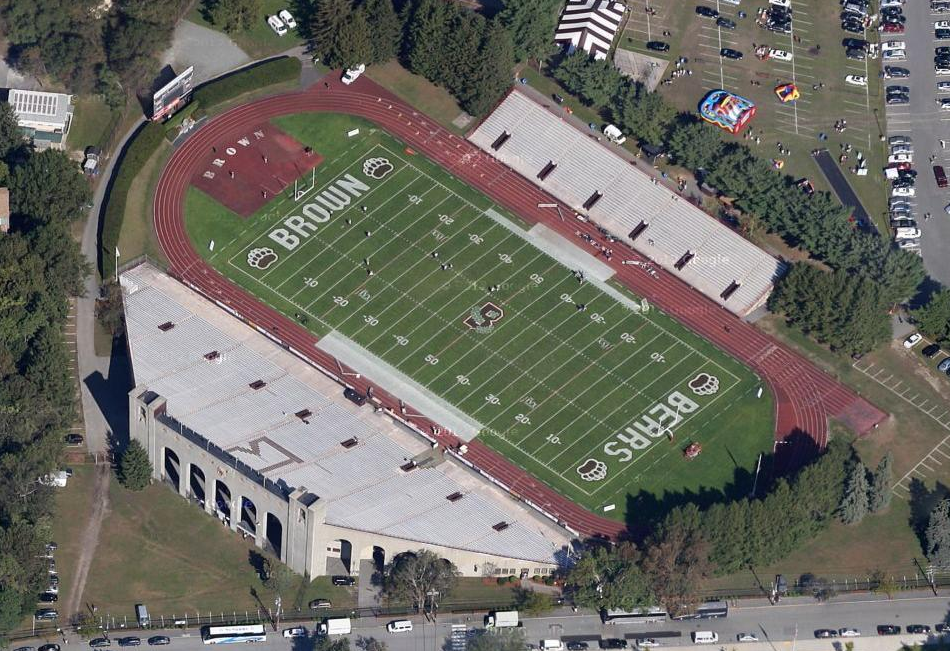
* Brown Stadium. Currently the largest stadium in the State of Rhode Island, the Bears of Brown University have played at this 20,000-seat facility since 1925. Their 1926 team went undefeated, and was known as the Iron Men, as the same 11 men played every minute of every game, except for the last 2 minutes of the season, when 2 seniors were sent in so they could earn their varsity letters.
Brown has won the Ivy League football title in 1976, 1999, 2005 and 2008. 400 Elmgrove Avenue, about 2 miles northeast of downtown. Bus 40 to Elmgrove and Sessions.

* Rhode Island Auditorium. The American Hockey League's Providence Reds played at this 5,300-seat location from 1926 to 1972. In the 1st 3 seasons of the Basketball Association of America, 1946 to 1949, a team called the Providence Steamrollers (1 word, S on the end) played there. When the BAA merged with the National Basketball League to form the NBA, the Steamrollers did not go into it, and folded. They remain the last major league sports team to have played regular season home games in Rhode Island. (While the Celtics played a few "home games" in Hartford from 1975 to 1995, they never did so in Providence.)
From 1968 to 1971, it hosted some of the legendary rock acts of the time: The Who, Cream, Jimi Hendrix, Sly & the Family Stone, Led Zeppelin on their 1st U.S. tour, the Grateful Dead, and Crosby, Stills, Nash & Young. But the construction of the Civic Center (now The Dunk) in 1972 made it obsolete. It was demolished in 1989.

A parking lot is on the site now. 1111 N. Main Street (U.S. Route 1), about 2 miles north of downtown. Bus R.

* Schneider Arena. Providence College opened this 3,030-seat arena for its hockey team in 1973, after playing at the Auditorium. In 2015, it won the National Championship. 331 Huxley Avenue, 3 blocks from the PC Bookstore, about 2 miles northwest of downtown. Bus 55.

* George V. Meehan Auditorium. Of similar size to Schneider Arena, 3,059 seats, but a bit older, Meehan Auditorium has been the home of Brown University hockey since 1961. It hosted what's now called the Frozen Four in 1965. 225 Hope Street, a mile east of downtown. Bus 1.

* International Tennis Hall of Fame. As tennis was once considered an elitist sport, its Hall of Fame is in the Rhode Island seaport city that was once the original "rich man's playground," Newport. The Newport Casino, opened in 1880, hosted the U.S. Open from its inception in 1881 to 1914. It was held in New York from 1915 to 1920, at Philadelphia's Germantown Cricket Club from 1921 to 1923, at the Forest Hills Stadium from 1924 to 1977, and the National Tennis Center in Flushing Meadow-Corona Park since 1978, first at the Louis Armstrong Stadium, and since 1997 at the Arthur Ashe Stadium.

Originally the word "casino" had nothing to do with gambling, it was simply a villa built for pleasure. The Newport Casino hosted tennis, archery, billiards, bowling, horse shows, dances and tea parties. All the sort of thing that the immigrants flooding into Providence, Boston and New York couldn't afford to do. The Hall of Fame was founded in 1954, and, aside from the annual Newport International Film Festival, is pretty much the only thing the Casino now houses.

194 Bellevue Avenue. Newport is about 30 miles south of downtown Providence, and can be reached from there by Bus 60 in an hour and 15 minutes.

* Museums & Historical Sites. No President has ever come from Rhode Island, nor any Vice President. President Dwight D. Eisenhower spent Summer vacations in Newport during his 2nd term, and was staying at (ironically, given his Army background) the Naval War College on September 24, 1957, when he ordered the 101st Airborne to Little Rock, Arkansas to enforce the desegregation of Central High School. 686 Cushing Road.

In 1958, '59 and '60, "Ike" stayed at Fort Adams, which became famous as the site of the Newport Jazz Festival (founded in 1954) and the Newport Folk Festival (1959), including its 1963 edition, famous for its performance of "We Shall Overcome" by Pete Seeger, Joan Baez, Bob Dylan and others; and its 1965 edition, when Dylan "went electric." The Folk Festival is annually held in the last weekend in July -- also Baseball Hall of Fame Induction Weekend. 80 Fort Adams Drive.

Many other historic sites, particularly relating to the U.S. Navy and great early American wealth, are in Newport, 33 miles to the south. Bus 60 from downtown Providence. Newport is also home to the main beaches for Rhode Island. There's also Narragansett Town Beach, also about 30 miles south of downtown Providence. Bus 66 to Salt Pond, then Bus 14.

There are memorials in Providence to historic figures Roger Williams, the colony's founder, at Park Row and Canal Street; and John Brown, leader of the failed 1859 slave revolt at Harper's Ferry, at 52 Power Street. Both are just across the Providence River from downtown.

The tallest building in Rhode Island was erected in 1927 as the Industrial Trust Tower. Oddly, it is now vacant, and known officially by its address, 111 Westminster Street. It is 428 feet high, and right across Kennedy Plaza from the Greyhound station.

From 1999 to 2002, the drama series Providence aired on NBC, starring Melina Kanakaredes as a city native who became a high profile plastic surgeon, but returned to the Rhode Island capital after her mother died to help her family and operate a general medical practice there. There were many sweeping shots that made the city look nice (and it wasn't much of a stretch), but all filming was done in Los Angeles.

Other TV shows set in Providence include Brotherhood, Doctor Doctor and Canterbury's Law. Ghost Hunters is set in neighboring Warwick. Another Period is set in Newport at the turn of the 20th Century. On The X-Files, Fox Mulder's family is said to come from the fictional Rhode Island town of Chepachet, and the animated Family Guy is set in the fictional Rhode Island town of Quahog. The ABC show Body of Proof was set in Philadelphia, but filmed in Providence.

Brothers Peter and Bobby Farrelly grew up outside Providence, in Cumberland, and made a film titled Outside Providence. They also set the Dumb and Dumber films, There's Something About Mary, Me, Myself and Irene, and Hall Pass in and around Providence. Other films set and/or filmed in Providence include The Witches of Eastwick, 27 Dresses, Dan In Real Life, and the 2007 live-action version of Underdog. Newport was used for filming High Society, the 1974 version of The Great Gatsby, Reversal of Fortune, Amistad and Mr. North.

*

Providence is not a big city, but it's a nice city. And, if you go there to see St. John's vs. Providence, you'll get all the New England sports passion without the dark side. Check it out.

Wednesday, April 2, 2014

New England's All-Time Baseball Team

If "Red Sox Nation" has borders -- and, as I've said before, we really need to deport some people back within those borders -- those borders contain the following States in their entirety: Massachusetts, Rhode Island, Vermont, New Hampshire and Maine.

Connecticut is usually included in the New England region. However, not all of Connecticut is in Red Sox territory. Connecticut has 8 Counties, and Fairfield and Litchfield are absolutely in the New York Tri-State Area. Middlesex, New London, Tolland and Windham are part of Red Sox Nation.

The wild card is New Haven County, with the city of New Haven, including Union Station (the terminus of the Metro-North Commuter Railroad's New Haven Line) and the campus of Yale University being kind of a "Romulan Neutral Zone" between Yankee/Met territory and Red Sox territory.

I've often joked that Connecticut is divided by what I call the Bristol Line, which goes from the northwest corner of the State, curving through Torrington, Bristol and Waterbury, before going down the Quinnipiac River into New Haven, New Haven Harbor and Long Island Sound.

Bristol is the home of ESPN's studios, 121 miles from Fenway Park and 100 miles from Yankee Stadium, yet their Red Sox bias seems so obvious to most Yankee Fans that we call it NESPN -- a combination of ESPN, Entertainment & Sports Programming Network (the "E" allows it to show events that are not real sports, such as golf, auto racing and "mixed martial arts"); and NESN, New England Sports Network.

Fortunately, having to decide who from New Haven County should be on the Red Sox territorial team, and who should be on the Yankees' or Mets' territorial team, proved unnecessary. While Yale has produced some great baseball players, there haven't been a whole lot of really good players from New Haven County. The best one that I could legitimately put in Red Sox Nation was Jack Barry, the shortstop, and least-heralded member, of the inaptly named "$100,000 Infield" of Connie Mack's 1910-14 Philadelphia Athletics dynasty. There is one New Haven County native in the Hall of Fame, and that's Roger Connor, but he played most of his career for the New York Giants, and thus was eligible for the Mets' territorial team, where I gave him an Honorable Mention.

3. New England's All-Time Baseball Team

I didn't find anyone from Maine, aside from a pair of 19th Century players who made the Honorable Mentions. Nor any players who grew up in Vermont, although I have three Honorable Mentions who were born there. For the record, there have been 651 Major League Baseball players who were born in Massachusetts, 193 in Connecticut, 77 in Maine, 75 in Rhode Island, 51 in New Hampshire and 37 in Vermont.

Strangely, this team, very solid at most positions, doesn't have an overwhelming pitching staff. It's got 3 starters in the Hall of Fame, and 1 more who maybe should be, but 2 of those starters pitched in baseball's Bronze Age, if not its Stone Age, so it's not clear that they would have been stars in the modern era.

In fact, of the 8 starting nonpitchers, only 1 played after 1937. So this really is an "all-time" team, but not really an "all times" team. Still, I wouldn't overlook the talent, even that part of it that played in the Administrations of Grover Cleveland, Benjamin Harrison and William McKinley.

1B Jeff Bagwell of Killingworth, Connecticut. (That's in their Middlesex County, definitely on "the Boston side of Connecticut.") The Red Sox could have had this local guy, who was actually born in the City of Boston. But, with Wade Boggs at 3rd base and Mo Vaughn at 1st, they thought he wasn't necessary. On August 30, 1990, while he was 22 years old andstill at Double-A New Britain, they traded him to the Houston Astros for reliever Larry Andersen.

Now, the Sox did need bullpen help, and they did win the American League Eastern Division that season, so it's not nearly as bad a trade as everyone thinks, 25 years on. Besides, if the Sox had kept Bags, would they have ever gotten David Ortiz?

Bags reached the Astros in 1991, the season after the trade, and was their regular 1st baseman for 15 years. His career OPS+ was 149, he collected 2,314 hits including 488 doubles and 449 home runs (easily the Astros' all-time leader). He won the National League's Rookie of the Year award in 1991 and its Most Valuable Player award in 1994, and nearly did so again in 1997 and 1999. Six times he batted .300, peaking at .368 in 1994. Eight times he had at least 100 RBIs, peaking at 135 in 1997. 

Without him, the Houston Colt .45's/Astros franchise has played 37 seasons and reached the postseason 3 times, with no postseason series wins to its credit; with him, 15 seasons, 6 trips to the postseason, and their first Pennant in 2005.

His Number 5 has been retired by the Astros, but he is not yet in the Hall of Fame, having gone through 4 elections without getting the necessary 75 percent of the vote. Baseball-Reference.com has him at 150 out of 100 on is Hall of Fame Monitor, and 59 out of 50 on its Hall of Fame Standards, both making him an easy choice.

On their 10 Most Similar Players to him, Frank Thomas and Willie Stargell are in; Albert Pujols probably will be; Fred McGriff should be; Carlos Delgado, Vladimir Guerrero and Todd Helton could be; Jason Giambi and Andres Galarraga won't get in; and David Ortiz might get in even though he's been exposed as a steroid cheat, simply because he's gotten away with it thus far. If the voters are not voting for Bagwell because they suspect him of steroid use, they need to know that he has never been seriously accused of it.

2B Napoleon "Nap" Lajoie of Woonsocket, Rhode Island. (Woonsocket was an Indian tribe in the era.) Also known as Larry, he starred for the Philadelphia Phillies in the late 1890s before jumping to the newly-formed American League in 1901. That year, he won the AL's 1st Triple Crown.

Depending on whose figures you believe, he either batted .422 for the highest average in AL history, or batted .426 for the highest average in either league since 1894. (See the outfielders.) Due to an injunction the Phillies got that prevented him from playing within the city limits of Philadelphia, he was traded to the Cleveland Blues, who made him player-manager and were renamed the Naps in his honor. (After he retired, they became the Indians -- see the right fielders below.)

In a particularly dead part of the Dead Ball Era, he had 4 100-RBI seasons. He had a lifetime batting average of .338 (5 batting titles, including, famously, a somewhat tainted one in a race with Ty Cobb in 1910), OPS+ 150, 3,242 hits, 657 doubles, 163 triples, 82 homers (good for the era), and 1,599 RBIs (great for the era).

He never managed a Pennant winner, but in 1908 got the Indians to within half a game of the Detroit Tigers. (No, I don't know why the Tigers didn't make up their 154th game.) He was one of the earliest inductees into the Hall of Fame. When The Sporting News announced its 100 Greatest Baseball Players in 1999, he came in at Number 29, even though he played his last game 83 years earlier.

Honorable Mention to Davey Lopes of East Providence, Rhode Island, a slick-fielding speedster who starred for the Dodgers before becoming one of the game's top coaches and briefly the manager of the Milwaukee Brewers.

Honorable Mention to Jerry Remy of Somerset, Massachusetts, who gave the Red Sox a few good years before becoming one of their broadcasters. As the fan-elected "President of Red Sox Nation," RemDawg has become Boston's answer to Phil Rizzuto in New York, Richie Ashburn in Philadelphia, Herb Score in Cleveland, Ron Santo in Chicago and Mike Shannon in St. Louis.

Honorable Mention to Frank Grant of Pittsfield, Massachusetts. Elected to the Hall of Fame in 2006 in an attempt to find overlooked black players who had been unable to play in the segregated pre-1947 major leagues, he may have been the first great black baseball player. Playing from 1886 to 1903 for teams in Buffalo, New York and Philadelphia, he may, due to length of time and segregation, have been the most-forgotten great player ever.

SS Walter "Rabbit" Maranville of Springfield, Massachusetts. In 1914, he helped his "hometown" Boston Braves go on a "Miracle" run and win the World Series. He remained one of the NL's best sortstops through the 1910s and '20s, leaving the Braves in 1921 and returning in 1929, staying long enough to play on their truly awful 1935 squad. He was never a great hitter, but he did get 2,605 hits, including 380 doubles and 117 triples, and his 291 steals were good for the era. He is in the Hall of Fame.

3B Harold "Pie" Traynor of Somerville, Massachusetts. For a long time, he was considered by many observers to be the best 3rd baseman of all time, mainly for his glove. There was no Gold Glove award in the 1920s and '30s, but his bat is quite capable of speaking for itself. He batted .320 lifetime, peaking with .366 in 1930, and had 2,416 hits and 7 100-RBI seasons, despite playing his home games at spacious Forbes Field.

He helped the Pittsburgh Pirates win the 1925 World Series and the 1927 Pennant. He was the NL's starting third baseman in the 1st 2 All-Star Games, 1933 and '34. He also managed the Pirates, and nearly got them a Pennant in 1938. (But see the catchers below.) Hall of Fame, Number 20 retired. When The Sporting News announced its 100 Greatest Baseball Players in 1999, he came in at Number 70.

Honorable Mention to Larry Gardner of Enosburg Falls, Vermont. He played on the Red Sox' World Champions of 1912, 1915 and 1916, before his former Boston teammate Tris Speaker, managing and playing center field for the Indians, traded for him, and together they won another World Series in 1920. A career .289 hitter, he had a 109 OPS+, 301 doubles, 165 stolen bases, and 2 100+ RBI seasons.

Is that really enough to get him on this list? Maybe not, but he singled home the winning run of the 1912 World Series. He later coached the baseball team at the University of Vermont, and is in both the Boston Red Sox and Vermont Sports Halls of Fame.

Honorable Mention to two New England guys who went on to star not for the Red Sox, but for the Yankees: Robert "Red" Rolfe of Penacook, New Hampshire, who starred on the Yanks' 1932-43 teams, and was named by Yankee broadcaster Mel Allen as the best 3rd basemen he ever saw; and Mike "Pags" Pagliarulo of Medford, Massachusetts, who kept them in the 1985-88 Pennant races with his great glove and lefty power.

LF Joe Kelley of Cambridge, Massachusetts. Starred with the Baltimore Orioles and Brooklyn Superbas (the Dodgers-to-be) of the 1890s (along with fellow Hall-of-Famer Wilbert Robinson of Bolton, Massachusetts, who nearly makes this team as a catcher or a manager), and then with the Cincinnati Reds of the 1900s.

He batted .317 lifetime, and had an OPS+ of 133 and 2,220 hits, despite having his last full season at age 34. He won Pennants in Baltimore in 1894, '95 and '96, and in Brooklyn in 1899 and 1900.

CF Hugh Duffy of Cranston, Rhode Island. That's him in the photo at the top of this post. He was a "hometown hero" who starred with the Boston Beaneaters (forerunners of the Braves) in the 1890s. In 1894, he was long believed to have batted .438, the highest batting average any player has ever had in a single major league season; a later check of the facts revealed it was in fact .440.

Lifetime, he hit .326, with a 122 OPS+, 2,293 hits and 8 100-RBI seasons, despite not having a full season after age 32. He helped the Beaneaters win Pennants in 1891, '92, '93, '97 and '98. Hall of Fame.

He later managed the Red Sox, White Sox and Phillies, and scouted for the Red Sox from 1924 until his death at age 87 in 1954, making him the last survivor of the 1890s Beaneaters. That's Duffy in the photo above.

Honorable Mention to George Gore of Hartland, Maine. Known as "Piano Legs," stolen base records from his era are incomplete, and we don't have totals for him from 1879 to 1885, but he's credited with 170 from 1886 to 1892, so his actual total may be roughly double that, well over 300.

He batted .301, had an OPS+ of 136, and in 1880 he led the NL with a .360 batting average. He won NL Pennants with the Chicago White Stockings (the franchise that became the Cubs, not the AL's White Sox) in 1880, '81, '82, '85 and '86, and with the New York Giants in 1888 and '89.

RF Tommy McCarthy of Boston, Massachusetts. He played with Duffy on the 1890s Beaneaters, and they were known as the Heavenly Twins. He batted "only" .292 lifetime (not that great in that era), and last played at age 32, so he may not belong in the Hall of Fame. So why is he in it? Well, 4 times he batted .300, he had a pair of 100-RBI seasons, and he stole 468 bases, great in any era.

Honorable Mention to Louis Sockalexis of Indian Island, Maine. A member of the Penobscot tribe, he may have been the 1st Native American to play in the major leagues (reports are sketchy on an earlier player named Jim Toy), at a time when the "Indian Wars" were still fresh in American memory. (The Wounded Knee Massacre happened less than 7 years before his big-league debut.)

He was a baseball star at the University of Notre Dame well before it became known as a football school. Debuting with the NL's Cleveland Spiders in 1897, he batted .338 with 3 homers, 42 RBIs and 16 stolen bases. So far, so good.

But on July 4 of that season, he jumped out of the window of a Cleveland brothel, and hurt his ankle when he fell. He was never the same player, and between his injury and his increasing drinking, he only lasted 2 more seasons. Drinking and tuberculosis led to heart trouble, and he died in 1913, only 42 years old.

The legend that the Cleveland Indians were named in his memory, and the one that they were named in memory of the Native Americans who once lived on the shore of Lake Erie, are bogus. After Lajoie left, they needed a new name for the 1915 season. The owners of the team asked sportswriters for their opinion. Since the Boston Braves were the defending World Champions, "Indians" was suggested, and the name stuck. It had nothing to do with Louis Sockalexis, "the original Cleveland Indian."

Honorable Mention to Tony Conigliaro of Revere, Massachusetts, whose day in the sun was longer than Sockalexis', but still all too brief. From April 16, 1964 to August 18, 1967, Tony C was the pride of the Boston metro area. He was just 22 years old, and already had 110 home runs for the Red Sox, including an AL-leading 32 in 1965. Then he was hit in the head with a pitch from California Angels pitcher Jack Hamilton, damaging his batting eye.

He missed the '67 run-in and World Series, and the entire '68 season. He came back strong in '69 and '70, but his eyesight began to fade, and despite a comeback attempt in '75, he was, as the U.S. version of Fever Pitch said, finished at 26. He auditioned to be a Sox broadcaster in 1982, but on the way back, he suffered a heart attack, and remained hospitalized until his death in 1990, only 45.

Of all the what-if stories in Sox history, his may well be the saddest. The team elected him to its Hall of Fame, but with good eyesight, and a righthanded swing tailor-made for the Green Monster, he could have made the big one in Cooperstown.

C Gordon "Mickey" Cochrane of Bridgewater, Massachusetts. What, not Carlton Fisk, born in Bellows Falls, Vermont and raised in Charlestown, New Hampshire? (Hall of Fame, Number 27 retired by the Red Sox and Number 72 retired by the White ones, who've also dedicated a statue of him at U.S. Cellular Field.)

Nor Rich Gedman of Worcester, Massachusetts and the '86 Red Sox? Not even Charles "Gabby" Hartnett of Woonsocket, Rhode Island, a Hall-of-Famer who backstopped the Cubs to 4 Pennants, including the great comeback and 20-game winning streak of 1935, and the comeback of 1938 when, as player-manager, he hit the "Homer in the Gloamin'" to put them in 1st place to stay?

No, as loaded as this position is for New England, none of those was ever considered the greatest catcher ever. Cochrane was, until surpassed by Bill Dickey (and then by Yogi Berra and possibly Johnny Bench). There were no Gold Gloves in those days, but he regarded as a great-fielding catcher. He batted .320 lifetime, with a 128 OPS+.

He led the Philadelphia Athletics to Pennants in 1929, '30 and '31, then was sold to the Detroit Tigers when Connie Mack needed a lot of cash, and led the Tigers to Pennants, as both manager and catcher, in '34 (MVP despite Lou Gehrig winning the Triple Crown) and '35. World Champion 1929, 1930 and 1935. Sadly, his career was ended in 1937 when Yankee pitcher Irving "Bump" Hadley (another Massachusetts guy, from Lynn) beaned him. Like Tony C, never really recovered, although he did live on until 1962.

Neither the A's (2) nor the Tigers (3) have ever retired his number, but the Hall-of-Famer has been honored by the Phillies with election to the Philadelphia Baseball Wall of Fame, and the Tigers with National Avenue, which ran behind the third-base stands at Tiger Stadium, being renamed Cochrane Avenue.

And in 1931, at the end of the A's dynasty, a young Oklahoma zinc miner named Elvin "Mutt" Mantle named his son after the great A's catcher. Fortunately, as the son said in his own Hall of Fame induction speech, he wasn't named Gordon Mantle. He was named Mickey Mantle. When The Sporting News announced its 100 Greatest Baseball Players in 1999, Mickey Cochrane came in at Number 65.

SP Tim Keefe of Cambridge, Massachusetts. It's hard to judge how good a pitcher was if he played his last game in 1893, the year the distance from the pitcher's mound to home plate was moved from 50 feet to 60 feet, 6 inches. He starred for the Giants, winning 42 games in 1886, and pitched them to NL Pennants in 1888 and '89. He finished 342-225, with an ERA of 2.63 (127 ERA+, meaning he was great compared to the other pitchers of his time), and a fine WHIP of 1.123.

But in that 1893 season, having gone 19-16 with a 2.36 ERA in 39 starts for the Phillies the year before, he dropped to 10-7 with a 4.40 ERA in just 22 starts. The new distance probably doomed him, but then, he was 36 and perhaps on the way down anyway. He is in the Hall of Fame.

SP John Clarkson of Cambridge, Massachusetts. He was 4 years younger than Keefe (although didn't live nearly as long, dying in 1909 at age 48), so they may have known each other well. Clarkson also benefited greatly from the 50-foot pitching distance. Nevertheless, he had a fine career record of 328-178, with a 2.81 ERA (134 ERA+), a WHIP of 1.209, and won NL Pennants with the Chicago White Stockings (Cubs) in 1885 and '86, and with the Boston Beaneaters (Braves) in 1891. 

With that shorter distance, he started 70 games in 1885, completed all of them, and won 53; in 1889, he started 73, completed all but one, and won 49. But in 1893, the 1st season of the sixty-and-six distance, he dropped from 17-10 to 16-17, and then to 8-10, and was done at age 32. Still, he is in the Hall of Fame.

SP Jack Chesbro of North Adams, Massachusetts. Happy Jack was a man. A man who won 49 games for the Pennant-winning Pittsburgh Pirates in 1901 and '02, then was part of the league-jumping that made the AL's solid footing possible. In 1903, as the first ace of the New York Highlanders (the team that became the Yankees), went 21-15.

Then, in 1904, he went 41-12, the most wins any pitcher has ever had under the 60-and-6 distance, although it should be noted that this was the Dead Ball Era, when there were not going to be any real home run threats, so pitchers didn't have to throw so many hard pitches and thus could pitch longer.

But he's best remembered not for any of those 41 wins, but for the 12th loss, as his 9th-inning wild pitch cost the Yankees the run that lost the opener of a final-day doubleheader to the Boston Puritans (Red Sox), clinching the Pennant not for Chesbro's employers but for his hometown team. 

He remained a terrific pitcher despite some not very good Highlander teams, but by 1909, age 35, he was burned out, pitching one last game… for the Red Sox. He finished 198-132, with a 2.68 ERA. He is in the Hall of Fame. And that's pronounced CHEESE-bro, not CHEZ-bro as I long believed.

SP Wild Bill Donovan of Lawrence, Massachusetts. He had cups of coffee with the Superbas (Dodgers) in their 1899 and 1900 Pennant seasons, then won 25 games with the 1901 Superbas (who didn't win the Pennant). He went an amazing 25-4 for the Tigers in 1907, and that doesn't include a performance in a September 30 game against the Athletics that was called due to darkness after 17 grueling innings, a game that, while the A's didn't lose it, pretty much exhausted them and ensured they wouldn't win the race.

The Tigers won 3 straight Pennants, 1907, '08 and '09, and over those seasons Donovan went 51-18 with an ERA of 2.17. He finished 185-139, 2.69 ERA, 1.245 WHIP. But he is not in the Hall of Fame, and, according to Baseball-Reference.com, of the 10 most statistically similar pitchers, only 1 is in: Chesbro. He later became a Yankee executive, but was killed in a train crash after the 1923 season.

SP Tom Glavine of Billerica, Massachusetts. He had a superb record of 305-203 in the majors, and is the only pitcher to win his 300th game in a Met uniform. Don't remind Met fans of that, though: Greg Prince of the blog Faith and Fear In Flushing calls him the Manchurian Brave. Glavine went 244-147 for Atlanta, and just 15-10 for Flushing, including the disastrous 2007 season finale, before returning to the Braves for 1 more season.

He had 5 20-win seasons for the Braves, and helped them reach the postseason season every year from 1991 to 2002 – except for 1994, of course. He pitched on 5 Pennant winners with the Braves (1991, '92, '95, '96 and '99) and nearly another with the Mets (2006). He was also an All-State hockey player at Billerica High School, but he chose his pro sport wisely. The Braves have retired his Number 47. He just got elected to the Hall of Fame, not that Met fans care.

Honorable Mention to Ray Fisher of Middlebury, Vermont. He pitched for the Highlanders/Yankees from 1910 to 1917, missed 1918 due to serving in World War I, then won the 1919 World Series with the Reds. His best season was 1915, going 18-11. From 1921 to 1958, he was the head coach at the University of Michigan. In 1982, shortly before his death at age 95, he was wheeled onto the field for Old-Timers' Day, and got a nice hand. It was the first time he had ever been inside Yankee Stadium.

Honorable Mention to Wilbur Wood of Belmont, Massachusetts. The knuckleballer went 164-156 for his career, and with an ERA+ of 114, I have to wonder what he could have done if he didn't spend most of his career with mediocre teams. He pitched most of his career with the White Sox, getting into Pennant races in 1967, '72 and '77, but most other years they were mediocre.

He won 106 games in just 5 seasons, 1971 to '75, including 24 each in '72 and '73. (In '73, he went 24-20; the only pitcher since to both win and lose 20 in the same season was, you guessed it, another knuckleballer, Phil Niekro.) He started at least 42 games in each of those 5 seasons, and we may never see another pitcher start 40 in a season unless they raise the mound back to its pre-1969 height of 15 inches.

Unfortunately, his string of workhorse seasons ended in 1976 when Ron LeFlore of the Detroit Tigers hit a comebacker that broke his kneecap. Wood retired after 2 more seasons. He was one of the few players ever who threw lefthanded but batted righthanded.

Honorable Mention to Chris Carpenter of Exeter, New Hampshire. After 6 seasons as basically a .500 pitcher with the Toronto Blue Jays, he was released, then picked up by the Cardinals. Good pickup: He went 21-5 in 2005 (winning the NL Cy Young Award) and 17-4 with a League-leading 2.24 ERA in 2009. A 3-time All-Star, he finished 144-94, and reached 5 postseasons with the Cards, including winning titles in 2006 and 2011.

RP Jeff Reardon of Dalton, Massachusetts. "The Terminator" didn't earn that nickname early in his career, because he didn't get the job done for the Mets. But then, how many save chances did the Mets give him from August 25, 1979 (his debut) until May 29, 1981, when they traded him? They sent him to the Montreal Expos, with Dan Norman (the 4th-best of the 4 guys they got for Tom Seaver), for former All-Star Ellis Valentine, and this was yet another BMT: Bonehead Met Trade: Valentine spent the rest of his career battling injuries, while Reardon retired as the major leagues’ all-time leader with 367 saves – 357 of them after leaving Flushing Meadow.

He had a career ERA+ of 122 and a WHIP of 1.199. He reached the postseason with the Expos in 1981, the Twins in 1987 (getting the final out of the World Series), the Red Sox in 1990 and the Braves in 1992. He just missed in 1994, as he closed his career with the Yankees, but the strike hit and that was it. He is eligible for the Hall of Fame, but I don't think he'll make it.

The all-time New England bullpen is pretty strong: Setting up Reardon can be Stu Miller of Northampton, Massachusetts; Steve "Bedrock" Bedrosian of Methuen, Massachusetts; Rob Dibble of Southington, Connecticut; and Brian Wilson of Londonderry, New Hampshire.

Bob Stanley was born in Portland, Maine, and went on to pitch for the Red Sox. Of course, he did give up the actual winning homer in the 1978 Playoff, to Reggie Jackson, and then throw those 2 fatal pitches toward Mookie Wilson in 1986. This is where Red Sox fans point out that "Steamer" is actually ineligible for this team, because, while he was born in New England, he actually went to high school in... Kearny, New Jersey. But do either the Yankees or the Mets want to claim him for their territorial teams? We may be crazy, but even Met fans aren't that stupid!

MGR Connie Mack of East Brookfield, Massachusetts. Born Cornelius Alexander McGillicuddy, he said he shortened his name so it would fit into a box score. It's hard to connect him to any city other than Philadelphia, even though, with his suits that never changed with the time and his thin, taciturn face and "Lace Curtain Irish" accent, he seemed like an old-time New England schoolmaster, or Parker Fennelly in those "Pepperidge Farm remembers" commercials.

A good catcher in the 1880s, he managed in the big leagues for 56 years, the last 50 with the Philadelphia Athletics from 1901 to 1950. Why so long? Because he was always at least a part-owner of the A's, and was sole owner from the early 1930s onward. Like George Steinbrenner, he built one dynasty (1910-14), messed it up, and then built another (1929-31). Unlike Steinbrenner, however, he messed up the second one, too, and both times over money: He had to dump salary because of the 1914-15 Federal League, and he lost all his savings in the 1929 stock market crash.

But his A's won 9 Pennants and 5 World Series: 1910, 1911, 1913, 1929 and 1930. He was elected to the Hall of Fame in 1937, its second class, while he was still an active owner and manager. After his increasing senility led to a family squabble that forced him out as manager and active owner, his sons were broke and forced to sell the team. But the Phillies remained in Shibe Park, renamed it Connie Mack Stadium, and erected a statue of him that now stands outside Citizens Bank Park.

I take Connie over Leo Durocher of West Springfield, Massachusetts. Although Leo was a winner, he was also a deeply evil man. Connie Mack may have been cheap, even when he didn't have to be, but he was a generous soul, and was beloved, known as the Grand Old Man of Baseball.

Tuesday, October 22, 2013

Top 10 Things This New Yorker Likes About New England

In your hands, my fellow citizens, more than mine, will rest the final success or failure of our course. Since this country was founded, each generation of Americans has been summoned to give testimony to its national loyalty. The graves of young Americans who answered the call to service surround the globe.

Now the trumpet summons us again. Not as a call to bear arms, though arms we need; not as a call to battle, though embattled we are; but a call to bear the burden of a long twilight struggle, year in and year out, "rejoicing in hope; patient in tribulation," a struggle against the common enemies of man: Tyranny, poverty, disease, and war itself.

Can we forge against these enemies a grand and global alliance, North and South, East and West, that can assure a more fruitful life for all mankind? Will you join in that historic effort? The energy, the faith, the devotion which we bring to this endeavor will light our country and all who serve it. And the glow from that fire can truly light the world.

And so, my fellow Americans, ask not what your country can do for you; ask what you can do for your country.
– President John F. Kennedy, January 20, 1961

*

Granted, I'm actually from New Jersey, not New York City, but the majority of the focus of this blog has been the New York Yankees, and a big chunk of that has been the Yankee-Red Sox rivalry, and the larger rivalry between the New York Tri-State Area and New England.

Therefore, with another World Series about to be played by the Red Sox, in the spirit of President Kennedy, I'm going to make this a blog entry of inclusion.

Top 10 Things This New Yorker Likes About New England

1. The Kennedy Family. I guess my opening made that easy enough to figure out. For over a century, dating back to John F. "Honey Fitz" Fitzgerald (who was Mayor of Boston 100 years ago and was in the U.S. Congress for the first time in 1895), the Kennedys and the various wings of their family (the Shrivers, the Smiths, the Lawfords, et al.) have lived by the motto of, "From those to whom much has been given, much will be expected."

The only remaining members of JFK's generation of Kennedys are sister Jean Kennedy Smith, Bobby's widow Ethel, and Ted's first wife Joan (his second wife Vicki is a bit younger). But their children, and theirs, fight on.

The haters, people who would've hated the Kennedys even if Ted and Mary Jo Kopechne had reached the mainland safely, will never accept that, yes, the Kennedys -- and the Roosevelts, and the Carters, and the Clintons, and by the time Barack and Michelle are out of the White House almost certainly the Obamas as well -- will always mean more to humanity than the Nixons, and the Reagans, and the Bushes, and whoever the next Republican President is and his (or her) entire family.

Liberalism is about "we," conservatism is about, "Me, me, MEEEE!" The Kennedys understood that in 1913. They understood it in 1963. They still understand that in 2013. Anyone who doesn't accept it can forget about having my respect, and doesn't deserve political office.

Some men see things as they are, and say, "Why?" I dream things that never were, and say, "Why not?"
-- George Bernard Shaw, frequently quoted by Senator Robert F. Kennedy

For all those whose cause has been our concern, the work goes on, the cause endures, the hope still lives and the dream shall never die.
-- Senator Edward M. (Ted) Kennedy, 1980 Democratic Convention

Okay, that's enough about politics. Well, maybe a little more. Politics is the main driver of history.

2. History. New England has always preserved its history better than New York. In New York, it so often seems like the past doesn't matter. But it does: As the saying goes, "If you don't know where you've been, how can you understand where you're going?"

New England gets this, from Mystic to Newport, from Hyannis to Plymouth, from Dorchester to Concord, and from Bennington to Old Orchard Beach. Particularly on the streets of Boston, you can feel the presence of Founding Fathers walking alongside you.

Oh, and, for the record: The leaders of the Boston Tea Party, such as Samuel Adams, were protesting an oppressive conservative government that was not listening to their concerns. Today's "Tea Partiers," had they been around then, would have wanted them hanged for being traitors to the British Empire.

Speaking of caffeinated drinks...

3. Dunkin Donuts. Founded in Quincy, Massachusetts by William Rosenberg in 1950, they are New England's best export since the Kennedys. How much do I love Dunkin Donuts, particularly their mocha swirl iced lattes and "coolatta" iced-coffee drinks? If Catherine Zeta-Jones appeared before me and said, "Let's go, he'll never know, but you have to promise to never visit a Dunkin Donuts again," I'd have to turn the magnificent woman down. (And spend the rest of the night crying in my coffee.)

Dunkin Donuts appears, through its employee Larry DelVerne, to have been the inventor of the little round pastry they call "Munchkins" -- others call them donut holes or pop-ems.

Dunkin Donuts is such a New England institution that the building formerly known as the Providence Civic Center -- home of the Providence Bruins minor-league hockey team, Providence College basketball, and the occasional NCAA Tournament basketball game -- is now named the Dunkin Donuts Center, a.k.a. The Dunk.

I like Tim Hortons. Krispy Kreme, not so much. And Starbucks, well, sometimes I like it, although it's not as direct a competitor as you might think. But I run on Dunkin.

4. New England is a great sports region. Say what you want about its teams (I certainly have), but when you consider that New England (Massachusetts, Maine, New Hampshire, Vermont, Rhode Island, and about 2/3 of Connecticut) has only half the people of the New York Tri-State Area, the amount of passion they generate, and the amount of titles they've won, is remarkable.

5. Fenway Park. It's a relic, but it's no dump. I mean, I've been there a few times, but I've never seen a rat there. Okay, I've seen a few Red Sox fans who resembled vermin... But most Sox fans, when sober, are good fans. They know and respect the game. And that thoughtfulness pervades Fenway. The 30,000 or so who come to see baseball generally refuse to let the 5,000 or so who come to get drunk and disorderly ruin the beautiful spectacle.

Besides, with Comiskey Park, Tiger Stadium and the original Yankee Stadium all gone -- and Wrigley Field being in the other league -- it's nice to be able to see a baseball game in a building whose field was once patrolled by Babe Ruth, Lou Gehrig, Joe DiMaggio, Ty Cobb, Tris Speaker, Ted Williams, Jimmie Foxx, Lefty Grove, Hank Greenberg and Bob Feller.

6. Respect for Summer. The Long Island Sound shore of Connecticut. The beaches of Newport, which (or so I've heard) makes Rhode Island the surfing capital of the Atlantic Coast. Martha's Vineyard. Nantucket. Cape Cod. Old Orchard Beach. Kennebunkport. What could be better than an 85-degree day on a New England beach, with beautiful women all around you, a bottle of beer to one side of you and a radio tuned to the Sox game on 850 WEEI to the other side? Well, maybe the Jersey Shore and the Yankee game tuned to 660 WFAN (they're switching there from 880 WCBS these last few years)... But this is not the time to get partisan.

7. Public Transportation. South Station is one of America's finest train stations, and the adjoining bus station might be the best one in the country -- it's almost as big as Port Authority in New York, and it's a hell of a lot cleaner. From there, on Greyhound, Peter Pan Bus, Cape Cod Transit, Vermont Transit, New England Trailways, Amtrak and the commuter rail service of the Massachusetts Bay Transportation Authority (MBTA), you can get almost anywhere in New England fairly quickly.

In addition, Boston's subway (the T) is easy, timely, and cheaper than New York's. And with a lot of stations on their lines having retail concession stands, including Dunkin Donuts, you don't have to go down to the Scollay Square (now Government Center) station at quarter past 2 to get a sandwich from Charlie's wife!

The one thing I don't like about the MBTA is that they don't provide service to Foxboro except on Patriots home gamedays. This is a problem if you don't have a car and you want to go to Gillette Stadium for a New England Revolution soccer game or shop at the adjoining Patriot Place Mall.  (I tried going to a Red Bulls-Revs game there in 2010.  I had to take cabs to and from the Walpole Station: $18 each way -- my game ticket was only $26.) Other than that, the MBTA provides great service.

8. Newspapers. The Boston Herald and the Manchester, New Hampshire-based Union Leader are right-wing rags. But the Boston Globe, the Providence Journal-Bulletin, the Concord Monitor (New Hampshire, not Massachusetts) and the Hartford Courant are all fine papers, determined to deliver honest, non-sloppy journalism.  (I'd add the New Haven Register, but New Haven is a "neutral zone" between people who tilt toward New York and those who tilt toward Boston.)

9. Respect for the Human Mind. Unlike certain other parts of the country -- and y'all know who you are -- New England knows it has a history of great books, great thought, and great educational service; and instead of running away from this tradition, they encourage it, and inspire others to reach it. Of the 8 Ivy League schools, half are in New England: Harvard, Yale, Brown and Dartmouth. To say nothing of MIT, Wellesley, Wesleyan, Northeastern, Tufts, and many others.

10. They Value Loyalty. Sometimes, those loyalties send people in the wrong direction.  Witness the 1974 busing controversy, where Ted Kennedy tried to tell the South Bostonians that public-school integration was good for America and they told him he was "a disgrace to the Irish." And then, today, you have Sox fans making steroid references to opponents, then cheering for David Ortiz with no sense of irony whatsoever.

But, for the most part, New Englanders remember who helped them when they were down, and they resolve to do the same when they have the chance to help -- and they do it. Not because of some message from their priest or their Mayor or their President, but because it's something that they feel in their bones is right.

So perhaps a tip of the hat from New York to New England is warranted today.

Or maybe not: They say that JFK's consistently walking around without a hat, unlike his predecessors Harry Truman and Dwight D. Eisenhower, killed the American hat industry. (Maybe for men: Jackie sure wore hats.)

I'd like to think JFK would have laughed at that.