Showing posts with label new hampshire. Show all posts

Wednesday, June 21, 2017

Top 10 Athletes From New Hampshire

June 21, 1788: New Hampshire becomes the 9th State to ratify the Constitution of the United States. This means that three-quarters of the States then in the Union have done so. This means that the Constitution goes into effect, and a 1st President and a 1st Congress can now be elected.

It was preceded by (in order) Delaware, Pennsylvania, New Jersey, Georgia, Maryland, Massachusetts, Maryland and South Carolina. Virginia will make it 10, New York 11, North Carolina 12 and Rhode Island 13, to complete the circuit.

Top 10 Athletes from New Hampshire

10. Penny Pitou of Gilford. A skier, she won 2 Silver Medals at the 1960 Winter Olympics in Squaw Valley, California. Hillary Clinton says Pitou taught her how to ski, and Pitou campaigned for her in the 2008 and 2016 New Hampshire Primaries.

9. Matt Bonner of Concord. An All-Conference forward and an Academic All-American at the University of Florida, he won the 2007 and 2014 NBA Championships with the San Antonio Spurs.

8. Bob Tewksbury of Penacook. In a trade so stupid, Brian Cashman could have made it, on July 13, 1987, the Yankees traded Bob and 2 others to the Chicago Cubs for Steve Trout. Trout was a disaster for the Yankees, while Bob won 110 games as a major league pitcher, mostly for the St. Louis Cardinals. (The Cubs let him get away through free agency.)

He made the National League All-Star Team in 1992, and reached the postseason with the 1996 San Diego Padres. In 1997, running out the string with the Minnesota Twins, he twice got Mark McGwire out on a blooper pitch. He is now the team psychologist for the Red Sox, works with the Boys and Girls Clubs of America, and is an accomplished artist.

But he's not the greatest baseball player on this list. He's not even the greatest Yankee from Penacook. The man at Number 2 is.

7. Greg Landry of Nashua. The Granite State hasn't produced many good football players, certainly not a Heisman Trophy winner or a Pro Football Hall-of-Famer. In fact, many of its high school football stars turned out to be better in other sports.

Landry nearly became an exception. He quarterbacked the Detroit Lions to the 1970 NFC Central Division Championship, was named to the Pro Bowl in 1971, and was named NFL Comeback Player of the Year in 1976. He later played in the USFL, and became a quarterbacking coach in the NFL.

6. Jenny Thompson of Dover. A swimmer, she won 2 Gold Medals and a Silver Medal at the 1992 Olympics in Barcelona.

5. Katie King of Salem. She won an Olympic Gold Medal in women's hockey at the 1998 Winter Olympics in Nagano, Japan, and an International Ice Hockey Federation Women's World Championship in 2005. Under her married name of Katie King-Crowley, she now coaches the women's hockey team at Boston College.

4. George "Birdie" Tebbetts of Nashua. As a child, he was said to have a voice like a chirping bird. But he excelled in high school as a catcher and a quarterback. He was a 4-time All-Star, twice with the Detroit Tigers, twice with the Boston Red Sox, but never got closer to the World Series than the ill-fated Red Sox of 1948 and '49.

Until, that is, he came to New York. Along with Yogi Berra, who coached for both teams, he may have been the only man to win World Series rings with both the 1969 Mets and the 1977-78 Yankees. He was a scout for both teams, and Reggie Jackson has said that Birdie's scouting reports enabled him to hit those 3 home runs in Game 6 of the '77 World Series. He was first involved in Major League Baseball in 1936 with the Tigers, and last in 1992 with the Baltimore Orioles. Not a Hall-of-Famer, but a great baseball life.

3. Mike Flanagan of Manchester. A winner of State Championships in high school baseball and basketball, he stuck with baseball, and won 167 games as a pitcher. He was a 1978 All-Star, and in 1979 won the American League Cy Young Award, leading the Baltimore Orioles to a Pennant. In 1983, he helped them win the World Series. He seemed to specialize in driving the Yankees crazy, one of the guys who set in stone the myth that "The Yankees can't hit lefthanded pitchers."

He became an Oriole broadcaster, but struggled with depression, and committed suicide in 2011. The Orioles have not retired his Number 46 -- they only officially retire numbers for Hall-of-Famers -- but have kept it out of circulation.

2. Robert "Red" Rolfe of Penacook. Yankee broadcaster Mel Allen called him the greatest 3rd baseman he ever saw. That's a bit of a stretch, but he was a 4-time All-Star in the pre-Gold Glove era, and helped the Yankees win Pennants in 1936, '37, '38, '39, '41 and '42, winning the World Series in all but the last.

He also coached the Toronto Huskies in the 1st season of the NBA, 1946-47 -- meaning he lost to the Knicks in the 1st game in NBA history. He later returned to New Hampshire as athletic director at Dartmouth College, whose baseball field is named for him.

1. Carlton Fisk of Charlestown. He was actually born in Bellows Falls, Vermont, just across the Connecticut River, but he says that's because it had the closest hospital to his New Hampshire hometown. He won a basketball scholarship to the University of New Hampshire, and Boston Celtics (and Bruins, and Garden) owner Walter Brown noticed him at a high school game. But Brown died soon thereafter, and in 1967, the Boston Red Sox drafted Fisk, who said, "I could never be a 6-foot-2 power forward and play for the Celtics."

But he could be an 11-time All-Star, a winner of both a Gold Glove and the American League's Rookie of the Year award in 1972, and one of the many heroes of the 1975 World Series (albeit, in his case, his walkoff home run in Game 6, with his accompanying wave, because a losing cause in Game 7). He hit more home runs and played more games at the position of catcher than anyone before him. He hit more home runs after age 40 than anyone before him. Although all of these records have been surpassed, he still holds the records for most hits and runs scored by a catcher.
The Boston Red Sox retired his Number 27. When a clerical mixup (or so they say) caused the Red Sox to lose him to free agency after the 1980 season, he signed with the Chicago White Sox, whose 27 was already worn by Ken Kravec, so Fisk flipped his number to 72. In spite of Kravec soon being traded, Fisk kept the number, and the White Sox retired it. The Red Sox elected him to their team Hall of Fame, and the White Sox dedicated a statue of him at Guaranteed Rate Field.

It is hard to believe, but true, that he played longer in Chicago than he did in Boston. But when he was elected to the Baseball Hall of Fame, his plaque showed him wearing a Red Sox cap. He is remembered as the ultimate New England sports warrior -- even if, with David Ortiz, Tom Brady, Bill Russell, Bobby Orr and a few others ahead of him, not New England's greatest sports hero.

Saturday, February 11, 2017

How to Go to a Hockey Game In New Hampshire

Continuing my bid to do trip guides for teams in all 50 States, it's New Hampshire's turn.

On Saturday, February 18, the University of New Hampshire will play hockey against their arch-rivals. No, not the University of Vermont or the University of Maine: Boston University. Apparently, the rest of New England treats Boston the way the rest of America treats New York: As the big mean dragon that needs to be slain.

Before You Go. Despite being in northern New England, the weather is not projected to be all that bad. Temperatures are predicted to be in the low 30s by day and the low 20s by night, with no rain or snow in the forecast.

New Hampshire is in the Eastern Time Zone, so there won't be any time change.

Tickets. The Whittemore Center seats 6,501 people. And, like all the Boston schools, BU has a good traveling fan base. Getting tickets may be difficult. Seats are $24 along the sidelines, and $16 behind the west goal. Forget about seats behind the east goal, as that's the student section.

Getting There. It's 271 miles from Midtown Manhattan to the UNH campus. It's too close to fly, but not easy by any other means. Portsmouth International Airport is 10 miles from the campus, and good luck getting a direct flight there from Newark, JFK or LaGuardia.

The good news is, Amtrak does go to Durham, and the arena is literally right next-door. The bad news is, the trip won't be direct. You can get from Penn Station in New York to South Station in Boston without changing trains. And you can get from North Station in Boston to Durham, New Hampshire without changing trains. But you have to get from South Station to North Station, and that will require getting off your train and taking the subway or a cab.
The good news: Amtrak's Downeaster, providing service to New Hampshire and Maine, takes about an hour and a half to get from North Station to Durham. And it's only $38 round-trip. The bad news is, you'd still have to get to Boston, and the last train of the night leaves Durham for Boston at 8:00 PM, during the game. So this is out.

More bad news: Greyhound doesn't go to Durham. It does go to Portsmouth, New Hampshire, but then you'd need to take 2 local buses to get to UNH, taking an hour and 20 minutes, so it's not worth it.

So it looks like you'll have to drive. Start out as if you're going to Boston: Take Interstate 95 North to New Haven. Take Exit 48, Interstate 91 North to Hartford. Take Exit 30, Interstate 84 East into Massachusetts. You'll merge with Interstate 90 East, the Massachusetts Turnpike, and take that until you reach Interstate 495, Boston's outer beltway.

But instead of continuing on the Mass Pike to Boston, take Exit 11A onto I-495 North, into Boston's northern suburbs, until you reunite with I-95 North at Salisbury, just before reaching the New Hampshire State Line. Once in New Hampshire, take Exit 4, onto U.S. Route 4, and follow that until you reach Madbury Road in Durham. Turn left, turn right on Edgewood Road, and turn right on Main Street. The station and the arena will be on your right.

If all goes well, you should be in New York State (not counting Manhattan) for half an hour, in Connecticut for 2 hours, in Massachusetts for an hour and 15 minutes, and New Hampshire for half an hour. Given a rest stop or 2, it should take about 5 and a half hours.

Once In the City. The State and the city are both named for historic counties in England. Ironically, at opposite ends of the country: Hampshire is on the South Coast, while Durham is in the North-East. Old Hampshire includes Portsmouth, which is also the name of a city in New Hampshire. The State's largest city, Manchester (158,000 people), is also named for a city in England.
More about that mountain later.

New Hampshire was one of the Original 13 Colonies, the 9th State to ratify the Constitution of the United States, putting it into effect, on June 21, 1788. As a whole, it is home to 1.3 million people, 92 percent of them white, 4 percent Hispanic, 2 percent Asian and 1 percent black. It was first settled by Europeans in 1623, and was the 1st of "the Original 13 Colonies" to declare independence, in January 1776. On June 21, 1788, it became the 9th State to ratify the Constitution of the United States, thus putting it into effect.
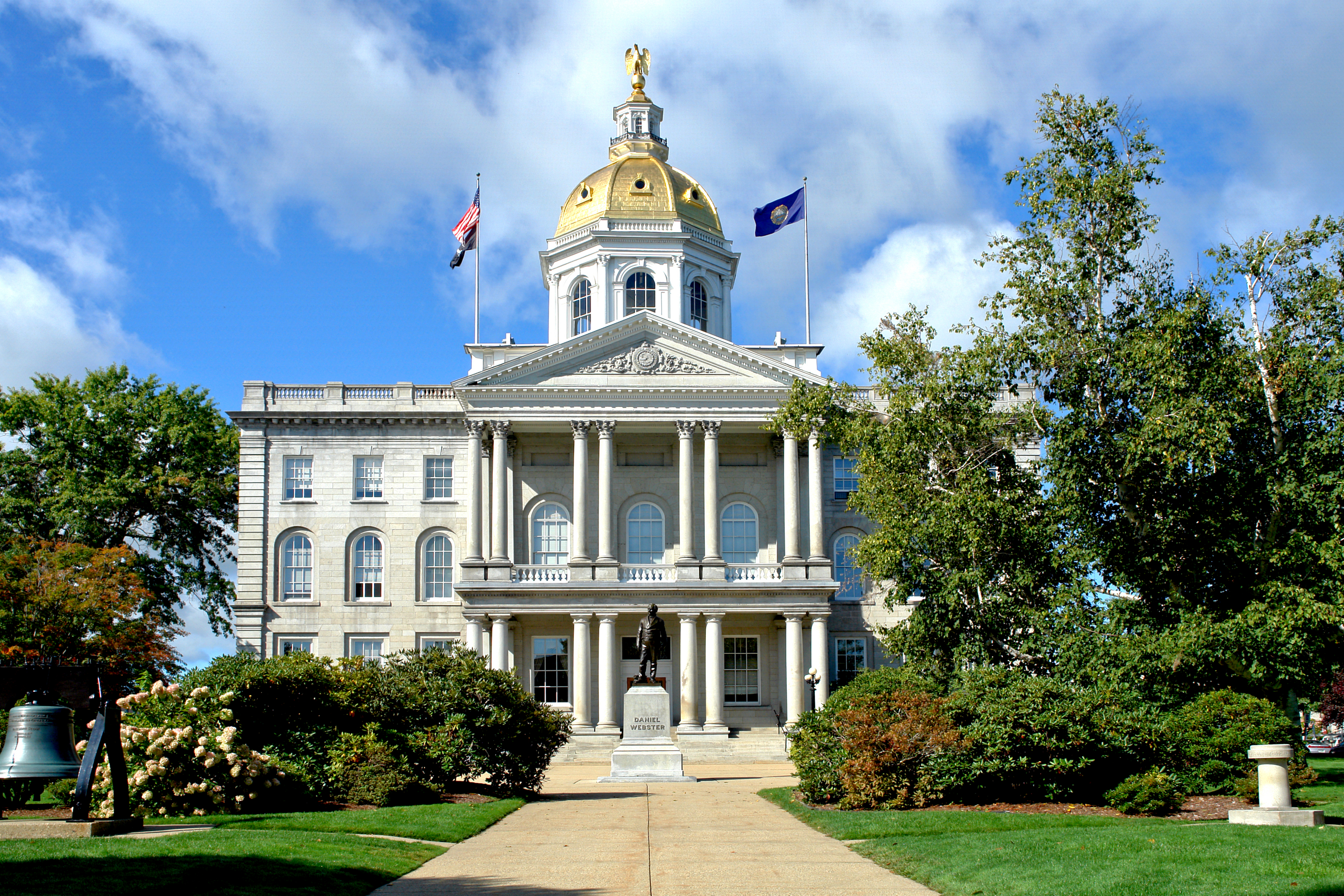
The New Hampshire State House in Concord

New Hampshire is probably best known for the New Hampshire Primary, held every 4 years as the nation's 1st (Iowa's preceding contest is "caucuses"), in March starting in 1952, in late February starting in 1976, then getting progressively earlier until 2008, when it was held on January 8. Last year, it was moved back to February 9. On the Democratic Party's side, it's usually won by a progressive. On the Republican Party's side, it's usually won by a candidate promising to cut the nation's taxes, as New Hampshire famously has no sales tax. Either way, it's usually won by a candidate good at "retail politics": Face-to-face meetings in places like breakfast-friendly diners, veterans' club halls, and the State's surviving factories.

The leading paper in the State is the Manchester-based Union Leader. But several other papers are also considered important enough by Presidential candidates to seek their endorsement, including The Concord Monitor, based in the State capital; The Telegraph of Nashua, and The Portsmouth Herald. ZIP Codes in the State begin with the digits 03. The Area Code is 603. The New Hampshire Electric Co-Op runs the State's electricity.

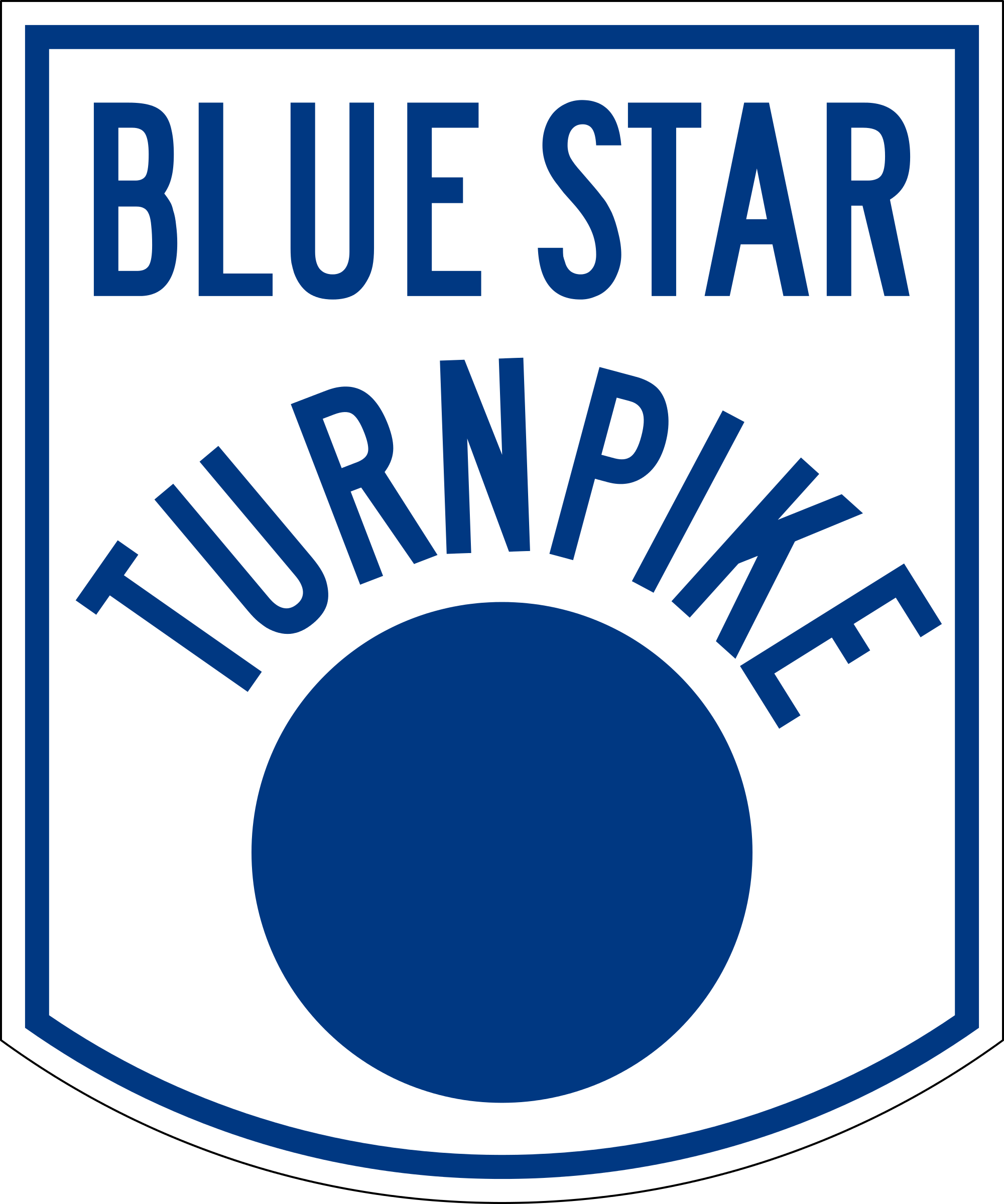
There is a New Hampshire Turnpike, a.k.a. the Blue Star Turnpike, but it runs only 16 miles along the coast, bannered as I-95 the whole way. The State has no beltway.
That is a circle, not a star.

New Hampshire often seems like a quiet place where very little happens, and it seems like the people like it that way. But on September 20, 1786, an event known as the Exeter Rebellion, or the Paper Money Riot, took place. The lack of paper money in circulation after the War of the American Revolution made the payment of debts difficult.

So they raised an amateur militia, but were dispersed by the regular militia. This was happening concurrently with Shays' Rebellion in neighboring Massachusetts, and both were among the reasons the Constitutional Convention was called the next year.

Durham, about 60 miles due north of Boston, is home to just 10,345 people, not counting UNH students. The University was founded in in 1866, as part of Dartmouth College, across the State in Hanover, and was separated and established in Durham in 1893. Bus service is available, at $1.50 per fare.

Portsmouth, a historic town of 21,000 about 10 miles east of Durham, is known for its Naval Shipyard, which is actually across the Piscataqua River in Kittery, Maine. It's only a little further to the Atlantic Ocean, but New Hampshire, with a short coastline, is not really known for its beaches.

Notable UNH graduates include novelist John Irving '65, television producer Marcy Carsey '66, actor Michael Ontkean '70, actor Peter Jurasik '72, sportswriter Jackie MacMullan '82, and actor Mike O'Malley '88. UNH also has a law school in Concord, and a campus in Manchester.

Going In. The Whittemore Center Arena, or "The Whitt," opened in 1995, and seats 6,501 people. The official address is 128 Main Street. The Hamel Student Recreation Center, UNH's former rink, is attached to the east end. If you drive in, parking is $10.
It was named for Frederick B. Whittemore, a longtime Morgan Stanley executive and major donor to UNH, although he is, himself, a Dartmouth graduate. The rink is laid out east-to-west. The Wildcats shoot twice toward the east goal. The arena, the State's largest until a larger one opened in Manchester in 2001, also hosts concerts, trade shows, and other events. It is frequently open for public ice skating.
Across Main Street are the school's basketball arena, Lundholm Gymnasium, and its 11,015-seat football facility, Wildcat Stadium, formerly Butch Cowell Stadium after their head coach from 1915 to 1936.
Food. College arenas are usually much smaller than those used for major league sports, and as a result their food options are considerably more limited. All that the school website can tell me is that they have concession stands, but nothing on specific foods and drinks.

Team History Displays. UNH has banners above the arena's north sideline. They've won the Hockey East regular-season title in 1992, 1997, 1999, 2002, 2003, 2007, 2008 and 2010; and the Conference Tournament in 2002 and 2003. They've reached the NCAA's hockey equivalent of the Final Four, the Frozen Four, in 1977, 1979, 1982, 1998, 1999, 2002 and 2003, and reach the Final in 1999 and 2003, although they've never won the National Championship. Their women's team did, in 1998.

UNH doesn't retire uniform numbers, but it does have an athletics hall of fame, which includes 57 figures from their hockey programs -- 45 men's and 12 women's. The names you are most likely to know are Albert Brodeur, Class of 1960, brother of Denis and uncle of Marty; Michel Goulet '69, Hall-of-Famer for the Quebec Nordiques; Michael Ontkean '70, who became an actor, including playing Ned Braden in the hockey film Slap Shot; Rod Langway '79, Hall-of-Famer for the Washington Capitals; and Andy Brickley '83, a member of the Devils' Patrick Division Playoff Champions of 1988. Among the other members of the UNH Wildcats Hall of Fame are Baseball Hall-of-Famer Carlton Fisk '63 and his brother Calvin Fisk '67.

Stuff. There is no team shop at The Whitt. If you want UNH merchandise, you should try the University Bookstore, at 83 Main Street, down the block from the athletic complex. Don't expect to find any team videos, but you might find the 2002 book Wildcat Hockey: Ice Hockey at the University of New Hampshire, by Elizabeth Slomba an William E. Ross.

During the Game. UNH fans are likely to be Red Sox, Patriots, Celtics and Bruins fans. If you don't express dislike for those teams, or promote a New York or a New Jersey team, you should be all right.

The Saturday night game is a promotion: "Blue Out for BU." Since Boston University wears red, and UNH wears the contrasting blue, the student section in the east end will be wearing blue, and the rest of the home fans are also encouraged to do so.

The band will play the National Anthem. The school has 3 fights songs; "On to Victory," "UNH Cheer" and "New Hampshire Colors."

Because of the name of the city, the school's teams were originally nicknamed the Durham Bulls. But since 1926, they've been the Wildcats. An opinion piece in the school newspaper, The New Hampshire, said:

The Wildcat is small and aggressive -- like New Hampshire. The actions of the wildcat are more symbolic of a New Hampshire team on the field than those of the sluggish bull. Furthermore, the actual mascot, if a wildcat, could be more easily transported from place to place than a bull.

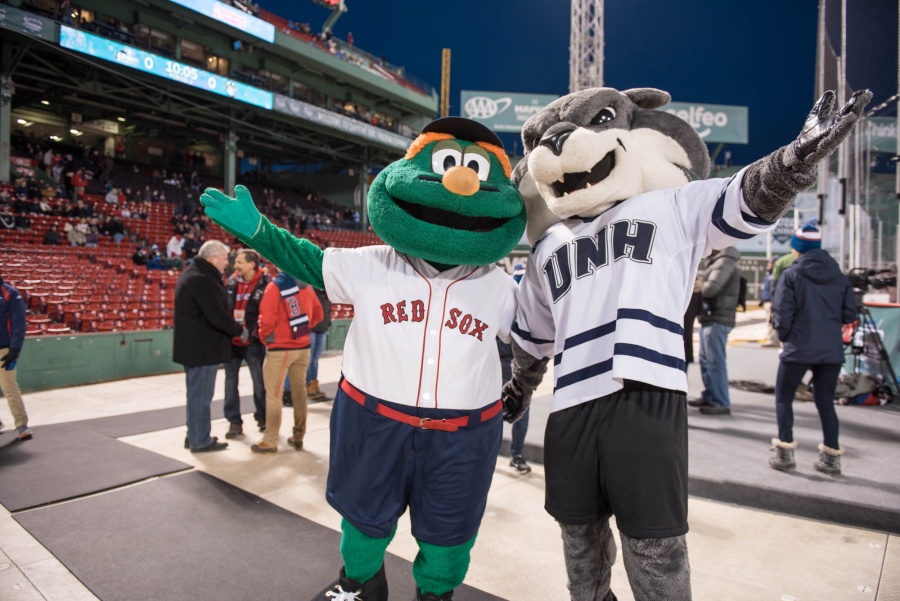
Experiments with live wildcat mascots have been short-lived, and, since 2008, "Gnarlz" has been a costumed mascot.
Gnarlz, meeting Wally the Green Monster
at Fenway Park's annual "Frozen Fenway" festival

Reflecting the Detroit Red Wings' tradition of throwing an octopus onto the ice, after UNH scores its 1st goal of the game, all fans turn their attention to the opposing team's net. Up and over the boards, a fish is thrown onto the ice. The crowd erupts in excitement.
According to Bob Norton, a former UNH assistant coach, the fish-tossing tradition began in the early 1970s. "It goes back to when we were playing a Division II team, and our program had gone way past theirs. I remember (the UNH fans) threw out this little dinky thing and they called it a Division II fish. I guess they were trying to tell them they weren't worthy of a first-rate fish."
This tradition caught on as the Zeta Chi fraternity made it a ritual to throw out the fish after UNH's first goal. The fish was used to resemble the visiting team, "fishing the puck out of the net."
Dick Umile, UNH head coach since 1990, recalls an incident from early in his tenure. At that time, the home team received a penalty if fans threw objects on the ice. "At all these different rinks people were throwing things – tennis balls, newspapers – and it was really holding up the game," Umile recalls. "It's the Maine weekend, and the cops won't let the kid in with the fish. I'm in the office before the game, and the students come to get me. So I go down there, get the fish from the cops, and we're walking in with the fish in the bag. The kids say, 'But coach, we're going to get a penalty.' I say, 'Don't worry about it. We'll kill the penalty. Just throw the fish.'"
After the Game. Safety will not be an issue, as long as you don't antagonize anyone. Yes, it's New England. Yes, it's hockey. No, they aren't looking for a fight.

Pretty much everything on Main Street to the north, south and west of the athletic complex is University property. Your best bet for a postgame meal is to head east, toward downtown. On Main Street alone you'll find Aroma Joe's Coffee at 72, Breaking New Grounds at 50, Young's Restaurant at 48, Libby's Bar & Grill at 47, and Village Pizza at 45. The Works Bakery Cafe is at 5A Mill Road, and Wildcat Pizza is at 3 Madbury Road. The nearest Dunkin Donuts is a bit further out, at 2 Dover Road, as Main Street splits into Durham Road and Newmarket Road.

If you visit the UNH campus during the European soccer season, which we are now in, there are 3 bars in nearby Portsmouth where you can probably watch your team, especially if it's English. The Ri Ra chain is at 22 Market Square, where Pleasant Street meets Custom House Lane. And The Coat of Arms Pub, a tribute to English-style pubs, is at 174 Fleet Street at Hanover Street. And The British Beer Company is at 103 Hanover Street.

Sidelights. New Hampshire's sports history isn't just UNH hockey. Dartmouth College, in Hanover on the Connecticut River, is the northernmost school in the Ivy League. They're 264 miles northeast of Times Square, and 126 miles northwest of Downtown Crossing in Boston.

Their football team plays at the 11,000-seat Memorial Field, built in 1923 at 4 Crosby Street. Since 1958, they've won 18 Ivy League football titles, most recently in 2015. That includes the 1970 season, when they went undefeated. Penn State fans still feel they were ripped off that year when their undefeated team wasn't named National Champions, but Dartmouth grads know that the Nittany Lions weren't even the best team in the East.
Joe Paterno was once put on the stand in a trial -- not Jerry Sandusky's -- and one of the attorneys, a Dartmouth grad, reminded him he was under oath, and asked him if he really thought his 1970 Penn State team was better than Dartmouth's. He said it was. He was not charged with perjury.

In 1942, their basketball team reached the NCAA Final, losing to Stanford. In 1944, they made it again, but lost to Utah. They haven't won the Ivy League title, and haven't made the NCAA Tournament since 1959. Their hockey team has reached the Frozen Four 4 times, most recently in 1980.

The New Hampshire Fisher Cats debuted in 2004, as a Class AA farm team of the Toronto Blue Jays, in the Eastern League, where they are opponents of New Jersey's Trenton Thunder. They won the Pennant in 2004 and 2011, having previously done so in 2000 as the New Haven Ravens. They play at Northeast Delta Dental Stadium, 1 Line Drive in Manchester, 245 miles northeast of Times Square and 55 miles northwest of Downtown Crossing.
The 4,000-seat Holman Stadium opened in Nashua in 1937. The Nashua Dodgers, a Brooklyn farm club, played there from 1946 to 1949. It was there that Roy Campanella and Don Newcombe made their white professional debuts, under manager Walter Alston. The Nashua Pride played there from 1998 to 2011, winning the Atlantic League Pennant in 2000 and the Can-Am League Pennant in 2007, but went out of business. It now hosts the Nashua Silver Knights of the Futures Collegiate Baseball League. 67 Amherst Street, 230 miles northeast of Times Square and 38 miles northwest of Downtown Crossing.
For most of New Hampshire, the closest major league teams are Boston's. You have to get as far north as Lancaster, past the White Mountain National Forest, before Montreal's Alouettes, Canadiens and Impact are closer than their NFL, NHL and MLS counterparts, the New England Patriots, the Boston Bruins and the New England Revolution. And the Boston Red Sox are still the closest in MLB, and the Boston Celtics the closest in the NBA.

The highest-ranking professional soccer team in New Hampshire is the Seacoast United Phantoms, playing in the National Premier Soccer League, U.S. soccer's 4th division. They also have a women's team, and both play at the football stadium of Portsmouth High School.
Neither Elvis Presley nor The Beatles ever performed in New Hampshire. The lack of major league teams meant a lack of venues capable of holding the crowds they would bring.

New Hampshire is a good museum State. Manchester has the Currier Museum of Art (150 Ash Street), and the Millyard Museum and the SEE Science Center (both at 200 Bedford Street). Portsmouth has the Strawberry Banke Museum, focusing on life in the seaport city (14 Hancock Street); and the USS Albacore Museum, a retired submarine (600 Market Street). Hanover has the Hood Museum of Art, part of Dartmouth College (6 E. Wheelock Street). Wolfeboro has the Wright Museum of World War II (77 Center Street).

And Concord has the McAuliffe-Shepard Discovery Center, a science museum named after Christa McAuliffe, the Concord teacher who died in the 1986 explosion of the Space Shuttle Challenger; and Alan Shepard, the Derry, New Hampshire native who was the 1st American in space (1961) and the commander of Apollo 14 (1971), when he not only walked, but hit a golf ball, on the Moon. (This did not, however, make him the 1st athlete on the Moon, because golf is not a sport.)

New Hampshire is known for 2 mountains, in the White Mountains, the northernmost part of the Appalachian Mountains. Mount Washington is the highest peak in the Northeastern U.S., 6,288 feet above sea level. It's 128 miles north of Manchester, 171 miles north of Boston, and 388 miles northeast of Midtown Manhattan. And you can't get there without a car. Is it really worth it to go all that way, just to get one of those bumper stickers?
I mean, it's not like it's Everest. Or Denali/Mount McKinley.
Or even Pike's Freakin' Peak.

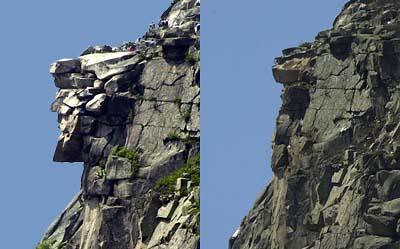
Then there is -- or, rather, was -- the Old Man of the Mountain. A series of cliff ledges on Cannon Mountain, 1,200 feet above sea level, looked like a profile of an old man. Daniel Webster spoke of it on the floor of the U.S. Senate, and Nathaniel Hawthorne wrote about it, coining the phrase "The Great Stone Face." It became iconic enough to put on New Hampshire's license plate and on its State Quarter.
That was in 2000. On May 3, 2003, it collapsed. No serious attempt has been put forward to recreate it. A museum has been set up as a memorial. 135 Tramway Drive, Franconia, 90 miles north of Manchester, 139 miles northwest of Boston, 334 miles northeast of Midtown, and 180 miles southeast of Montreal.
Before... and After

New Hampshire has produced a President, but he may have been the worst one ever. Yes, worse than Herbert Hoover, Richard Nixon, George W. Bush and (so far) Donald Trump. Franklin Pierce served the State in both houses of Congress and was a General in the Mexican-American War, and was elected in 1852. But on the way into Washington for his Inauguration, a train accident gave him and his wife Jane only minor injuries, but killed his last surviving child, 11-year-old Benjamin.

He took office as the 14th President on March 4, 1853, bitter and drinking heavily. A supporter of Southern economic interests, including slavery, despite his Northern background, he signed the Kansas-Nebraska Act of 1854, which nullified the Missouri Compromise of 1820 and the Compromise of 1850, and essentially made the Civil War inevitable. His economic policies essentially caused the Panic of 1857, just as he left office. He wasn't even considered for renomination by the Democratic Party in 1856, and died of cirrhosis in 1869, 65 years old and despised everywhere, including in New Hampshire.

Time has not exactly restored his reputation. He and his successor, James Buchanan, routinely rank among the worst Presidents in historical surveys. The log cabin where he was born, in Hillsboro, is long gone. The Franklin Pierce Homestead was built nearby, by his father, Governor Benjamin Pierce. 301 2nd New Hampshire Turnpike, about 40 miles northwest of Manchester. Not reachable without a car.

Franklin lived at the Homestead from 1804 to 1834. The Pierce Manse was his home from 1842 to 1848. 14 Horseshoe Pond Lane in Concord, 15 blocks north of the State House, 17 miles northwest of Manchester. The Pierces' residence from 1852 until Jane's death in 1863 and Franklin's death in 1869 burned down in 1981, and has not been reconstructed. 52 S. Main Street, 10 blocks south of the State House. The family is buried in the Old North Cemetery, on N. State Street, around the corner from the Pierce Manse. Greyhound goes from Manchester to Concord in 25 minutes, just $20 round-trip.

(The M*A*S*H character of Benjamin Franklin "Hawkeye" Pierce, from neighboring Maine and himself a prodigious drinker, was named in part for the President and, of course, Benjamin Franklin, and Hawkeye from James Fenimore Cooper's novel The Last of the Mohicans.)

The tallest building in the State of New Hampshire is One City Hall Plaza in Manchester, just 275 feet high. Elm Street (U.S. Route 3) & Stark Street.

Lots of TV shows have been set in New England, most of them in Boston and the surrounding towns. A few have been set in Connecticut and Rhode Island. Vermont had Newhart. Maine had Dark Shadows, Murder, She Wrote, Haven and Once Upon a Time. New Hampshire hasn't been so lucky.

David E. Kelley's CBS drama The Brotherhood of Poland, New Hampshire lasted 9 episodes in 2003. (So, throw in the Red Sox' failure, and it was not a good year for the State.) The Goodwin Games lasted 7 episodes in 2013. An animated version of the film Jumanji ran from 1996 to 1999, but, obviously, had no live-action scenes.

On The West Wing, Martin Sheen's President Josiah Bartlet had previously served as Governor and a Congressman from the State, and was descended from Dr. Josiah Bartlett, a Signer of the Declaration of Independence. There were 7 episodes with scenes in New Hampshire.

The State has seen several movies set there, including political-themed films The Devil and Daniel Webster, The Hotel New Hampshire and Primary Colors. Also taking place there, either wholly or in part, were The Devil's Disciple, Our Town, Lolita, On Golden Pond (all of these have been made twice), The World According to Garp, Scent of a Woman, What About Bob?, Urban Legend, To Die For, Click, The Rules of Attraction (set at fictional Conway College but based on author Bret Easton Ellis' experiences at Bennington College in Vermont), and the aforementioned Jumanji, whose sequel is about to be released. And the novels, films and TV series based on Grace Metalious' Peyton Place.

*

New Hampshire is a State for cultured minds and hardy souls, for people who like the nice things about New York and Boston but not the icky stuff, and, yes, for sports fans. Feel free to check it out.

Wednesday, April 2, 2014

New England's All-Time Baseball Team

If "Red Sox Nation" has borders -- and, as I've said before, we really need to deport some people back within those borders -- those borders contain the following States in their entirety: Massachusetts, Rhode Island, Vermont, New Hampshire and Maine.

Connecticut is usually included in the New England region. However, not all of Connecticut is in Red Sox territory. Connecticut has 8 Counties, and Fairfield and Litchfield are absolutely in the New York Tri-State Area. Middlesex, New London, Tolland and Windham are part of Red Sox Nation.

The wild card is New Haven County, with the city of New Haven, including Union Station (the terminus of the Metro-North Commuter Railroad's New Haven Line) and the campus of Yale University being kind of a "Romulan Neutral Zone" between Yankee/Met territory and Red Sox territory.

I've often joked that Connecticut is divided by what I call the Bristol Line, which goes from the northwest corner of the State, curving through Torrington, Bristol and Waterbury, before going down the Quinnipiac River into New Haven, New Haven Harbor and Long Island Sound.

Bristol is the home of ESPN's studios, 121 miles from Fenway Park and 100 miles from Yankee Stadium, yet their Red Sox bias seems so obvious to most Yankee Fans that we call it NESPN -- a combination of ESPN, Entertainment & Sports Programming Network (the "E" allows it to show events that are not real sports, such as golf, auto racing and "mixed martial arts"); and NESN, New England Sports Network.

Fortunately, having to decide who from New Haven County should be on the Red Sox territorial team, and who should be on the Yankees' or Mets' territorial team, proved unnecessary. While Yale has produced some great baseball players, there haven't been a whole lot of really good players from New Haven County. The best one that I could legitimately put in Red Sox Nation was Jack Barry, the shortstop, and least-heralded member, of the inaptly named "$100,000 Infield" of Connie Mack's 1910-14 Philadelphia Athletics dynasty. There is one New Haven County native in the Hall of Fame, and that's Roger Connor, but he played most of his career for the New York Giants, and thus was eligible for the Mets' territorial team, where I gave him an Honorable Mention.

3. New England's All-Time Baseball Team

I didn't find anyone from Maine, aside from a pair of 19th Century players who made the Honorable Mentions. Nor any players who grew up in Vermont, although I have three Honorable Mentions who were born there. For the record, there have been 651 Major League Baseball players who were born in Massachusetts, 193 in Connecticut, 77 in Maine, 75 in Rhode Island, 51 in New Hampshire and 37 in Vermont.

Strangely, this team, very solid at most positions, doesn't have an overwhelming pitching staff. It's got 3 starters in the Hall of Fame, and 1 more who maybe should be, but 2 of those starters pitched in baseball's Bronze Age, if not its Stone Age, so it's not clear that they would have been stars in the modern era.

In fact, of the 8 starting nonpitchers, only 1 played after 1937. So this really is an "all-time" team, but not really an "all times" team. Still, I wouldn't overlook the talent, even that part of it that played in the Administrations of Grover Cleveland, Benjamin Harrison and William McKinley.

1B Jeff Bagwell of Killingworth, Connecticut. (That's in their Middlesex County, definitely on "the Boston side of Connecticut.") The Red Sox could have had this local guy, who was actually born in the City of Boston. But, with Wade Boggs at 3rd base and Mo Vaughn at 1st, they thought he wasn't necessary. On August 30, 1990, while he was 22 years old andstill at Double-A New Britain, they traded him to the Houston Astros for reliever Larry Andersen.

Now, the Sox did need bullpen help, and they did win the American League Eastern Division that season, so it's not nearly as bad a trade as everyone thinks, 25 years on. Besides, if the Sox had kept Bags, would they have ever gotten David Ortiz?

Bags reached the Astros in 1991, the season after the trade, and was their regular 1st baseman for 15 years. His career OPS+ was 149, he collected 2,314 hits including 488 doubles and 449 home runs (easily the Astros' all-time leader). He won the National League's Rookie of the Year award in 1991 and its Most Valuable Player award in 1994, and nearly did so again in 1997 and 1999. Six times he batted .300, peaking at .368 in 1994. Eight times he had at least 100 RBIs, peaking at 135 in 1997. 

Without him, the Houston Colt .45's/Astros franchise has played 37 seasons and reached the postseason 3 times, with no postseason series wins to its credit; with him, 15 seasons, 6 trips to the postseason, and their first Pennant in 2005.

His Number 5 has been retired by the Astros, but he is not yet in the Hall of Fame, having gone through 4 elections without getting the necessary 75 percent of the vote. Baseball-Reference.com has him at 150 out of 100 on is Hall of Fame Monitor, and 59 out of 50 on its Hall of Fame Standards, both making him an easy choice.

On their 10 Most Similar Players to him, Frank Thomas and Willie Stargell are in; Albert Pujols probably will be; Fred McGriff should be; Carlos Delgado, Vladimir Guerrero and Todd Helton could be; Jason Giambi and Andres Galarraga won't get in; and David Ortiz might get in even though he's been exposed as a steroid cheat, simply because he's gotten away with it thus far. If the voters are not voting for Bagwell because they suspect him of steroid use, they need to know that he has never been seriously accused of it.

2B Napoleon "Nap" Lajoie of Woonsocket, Rhode Island. (Woonsocket was an Indian tribe in the era.) Also known as Larry, he starred for the Philadelphia Phillies in the late 1890s before jumping to the newly-formed American League in 1901. That year, he won the AL's 1st Triple Crown.

Depending on whose figures you believe, he either batted .422 for the highest average in AL history, or batted .426 for the highest average in either league since 1894. (See the outfielders.) Due to an injunction the Phillies got that prevented him from playing within the city limits of Philadelphia, he was traded to the Cleveland Blues, who made him player-manager and were renamed the Naps in his honor. (After he retired, they became the Indians -- see the right fielders below.)

In a particularly dead part of the Dead Ball Era, he had 4 100-RBI seasons. He had a lifetime batting average of .338 (5 batting titles, including, famously, a somewhat tainted one in a race with Ty Cobb in 1910), OPS+ 150, 3,242 hits, 657 doubles, 163 triples, 82 homers (good for the era), and 1,599 RBIs (great for the era).

He never managed a Pennant winner, but in 1908 got the Indians to within half a game of the Detroit Tigers. (No, I don't know why the Tigers didn't make up their 154th game.) He was one of the earliest inductees into the Hall of Fame. When The Sporting News announced its 100 Greatest Baseball Players in 1999, he came in at Number 29, even though he played his last game 83 years earlier.

Honorable Mention to Davey Lopes of East Providence, Rhode Island, a slick-fielding speedster who starred for the Dodgers before becoming one of the game's top coaches and briefly the manager of the Milwaukee Brewers.

Honorable Mention to Jerry Remy of Somerset, Massachusetts, who gave the Red Sox a few good years before becoming one of their broadcasters. As the fan-elected "President of Red Sox Nation," RemDawg has become Boston's answer to Phil Rizzuto in New York, Richie Ashburn in Philadelphia, Herb Score in Cleveland, Ron Santo in Chicago and Mike Shannon in St. Louis.

Honorable Mention to Frank Grant of Pittsfield, Massachusetts. Elected to the Hall of Fame in 2006 in an attempt to find overlooked black players who had been unable to play in the segregated pre-1947 major leagues, he may have been the first great black baseball player. Playing from 1886 to 1903 for teams in Buffalo, New York and Philadelphia, he may, due to length of time and segregation, have been the most-forgotten great player ever.

SS Walter "Rabbit" Maranville of Springfield, Massachusetts. In 1914, he helped his "hometown" Boston Braves go on a "Miracle" run and win the World Series. He remained one of the NL's best sortstops through the 1910s and '20s, leaving the Braves in 1921 and returning in 1929, staying long enough to play on their truly awful 1935 squad. He was never a great hitter, but he did get 2,605 hits, including 380 doubles and 117 triples, and his 291 steals were good for the era. He is in the Hall of Fame.

3B Harold "Pie" Traynor of Somerville, Massachusetts. For a long time, he was considered by many observers to be the best 3rd baseman of all time, mainly for his glove. There was no Gold Glove award in the 1920s and '30s, but his bat is quite capable of speaking for itself. He batted .320 lifetime, peaking with .366 in 1930, and had 2,416 hits and 7 100-RBI seasons, despite playing his home games at spacious Forbes Field.

He helped the Pittsburgh Pirates win the 1925 World Series and the 1927 Pennant. He was the NL's starting third baseman in the 1st 2 All-Star Games, 1933 and '34. He also managed the Pirates, and nearly got them a Pennant in 1938. (But see the catchers below.) Hall of Fame, Number 20 retired. When The Sporting News announced its 100 Greatest Baseball Players in 1999, he came in at Number 70.

Honorable Mention to Larry Gardner of Enosburg Falls, Vermont. He played on the Red Sox' World Champions of 1912, 1915 and 1916, before his former Boston teammate Tris Speaker, managing and playing center field for the Indians, traded for him, and together they won another World Series in 1920. A career .289 hitter, he had a 109 OPS+, 301 doubles, 165 stolen bases, and 2 100+ RBI seasons.

Is that really enough to get him on this list? Maybe not, but he singled home the winning run of the 1912 World Series. He later coached the baseball team at the University of Vermont, and is in both the Boston Red Sox and Vermont Sports Halls of Fame.

Honorable Mention to two New England guys who went on to star not for the Red Sox, but for the Yankees: Robert "Red" Rolfe of Penacook, New Hampshire, who starred on the Yanks' 1932-43 teams, and was named by Yankee broadcaster Mel Allen as the best 3rd basemen he ever saw; and Mike "Pags" Pagliarulo of Medford, Massachusetts, who kept them in the 1985-88 Pennant races with his great glove and lefty power.

LF Joe Kelley of Cambridge, Massachusetts. Starred with the Baltimore Orioles and Brooklyn Superbas (the Dodgers-to-be) of the 1890s (along with fellow Hall-of-Famer Wilbert Robinson of Bolton, Massachusetts, who nearly makes this team as a catcher or a manager), and then with the Cincinnati Reds of the 1900s.

He batted .317 lifetime, and had an OPS+ of 133 and 2,220 hits, despite having his last full season at age 34. He won Pennants in Baltimore in 1894, '95 and '96, and in Brooklyn in 1899 and 1900.

CF Hugh Duffy of Cranston, Rhode Island. That's him in the photo at the top of this post. He was a "hometown hero" who starred with the Boston Beaneaters (forerunners of the Braves) in the 1890s. In 1894, he was long believed to have batted .438, the highest batting average any player has ever had in a single major league season; a later check of the facts revealed it was in fact .440.

Lifetime, he hit .326, with a 122 OPS+, 2,293 hits and 8 100-RBI seasons, despite not having a full season after age 32. He helped the Beaneaters win Pennants in 1891, '92, '93, '97 and '98. Hall of Fame.

He later managed the Red Sox, White Sox and Phillies, and scouted for the Red Sox from 1924 until his death at age 87 in 1954, making him the last survivor of the 1890s Beaneaters. That's Duffy in the photo above.

Honorable Mention to George Gore of Hartland, Maine. Known as "Piano Legs," stolen base records from his era are incomplete, and we don't have totals for him from 1879 to 1885, but he's credited with 170 from 1886 to 1892, so his actual total may be roughly double that, well over 300.

He batted .301, had an OPS+ of 136, and in 1880 he led the NL with a .360 batting average. He won NL Pennants with the Chicago White Stockings (the franchise that became the Cubs, not the AL's White Sox) in 1880, '81, '82, '85 and '86, and with the New York Giants in 1888 and '89.

RF Tommy McCarthy of Boston, Massachusetts. He played with Duffy on the 1890s Beaneaters, and they were known as the Heavenly Twins. He batted "only" .292 lifetime (not that great in that era), and last played at age 32, so he may not belong in the Hall of Fame. So why is he in it? Well, 4 times he batted .300, he had a pair of 100-RBI seasons, and he stole 468 bases, great in any era.

Honorable Mention to Louis Sockalexis of Indian Island, Maine. A member of the Penobscot tribe, he may have been the 1st Native American to play in the major leagues (reports are sketchy on an earlier player named Jim Toy), at a time when the "Indian Wars" were still fresh in American memory. (The Wounded Knee Massacre happened less than 7 years before his big-league debut.)

He was a baseball star at the University of Notre Dame well before it became known as a football school. Debuting with the NL's Cleveland Spiders in 1897, he batted .338 with 3 homers, 42 RBIs and 16 stolen bases. So far, so good.

But on July 4 of that season, he jumped out of the window of a Cleveland brothel, and hurt his ankle when he fell. He was never the same player, and between his injury and his increasing drinking, he only lasted 2 more seasons. Drinking and tuberculosis led to heart trouble, and he died in 1913, only 42 years old.

The legend that the Cleveland Indians were named in his memory, and the one that they were named in memory of the Native Americans who once lived on the shore of Lake Erie, are bogus. After Lajoie left, they needed a new name for the 1915 season. The owners of the team asked sportswriters for their opinion. Since the Boston Braves were the defending World Champions, "Indians" was suggested, and the name stuck. It had nothing to do with Louis Sockalexis, "the original Cleveland Indian."

Honorable Mention to Tony Conigliaro of Revere, Massachusetts, whose day in the sun was longer than Sockalexis', but still all too brief. From April 16, 1964 to August 18, 1967, Tony C was the pride of the Boston metro area. He was just 22 years old, and already had 110 home runs for the Red Sox, including an AL-leading 32 in 1965. Then he was hit in the head with a pitch from California Angels pitcher Jack Hamilton, damaging his batting eye.

He missed the '67 run-in and World Series, and the entire '68 season. He came back strong in '69 and '70, but his eyesight began to fade, and despite a comeback attempt in '75, he was, as the U.S. version of Fever Pitch said, finished at 26. He auditioned to be a Sox broadcaster in 1982, but on the way back, he suffered a heart attack, and remained hospitalized until his death in 1990, only 45.

Of all the what-if stories in Sox history, his may well be the saddest. The team elected him to its Hall of Fame, but with good eyesight, and a righthanded swing tailor-made for the Green Monster, he could have made the big one in Cooperstown.

C Gordon "Mickey" Cochrane of Bridgewater, Massachusetts. What, not Carlton Fisk, born in Bellows Falls, Vermont and raised in Charlestown, New Hampshire? (Hall of Fame, Number 27 retired by the Red Sox and Number 72 retired by the White ones, who've also dedicated a statue of him at U.S. Cellular Field.)

Nor Rich Gedman of Worcester, Massachusetts and the '86 Red Sox? Not even Charles "Gabby" Hartnett of Woonsocket, Rhode Island, a Hall-of-Famer who backstopped the Cubs to 4 Pennants, including the great comeback and 20-game winning streak of 1935, and the comeback of 1938 when, as player-manager, he hit the "Homer in the Gloamin'" to put them in 1st place to stay?

No, as loaded as this position is for New England, none of those was ever considered the greatest catcher ever. Cochrane was, until surpassed by Bill Dickey (and then by Yogi Berra and possibly Johnny Bench). There were no Gold Gloves in those days, but he regarded as a great-fielding catcher. He batted .320 lifetime, with a 128 OPS+.

He led the Philadelphia Athletics to Pennants in 1929, '30 and '31, then was sold to the Detroit Tigers when Connie Mack needed a lot of cash, and led the Tigers to Pennants, as both manager and catcher, in '34 (MVP despite Lou Gehrig winning the Triple Crown) and '35. World Champion 1929, 1930 and 1935. Sadly, his career was ended in 1937 when Yankee pitcher Irving "Bump" Hadley (another Massachusetts guy, from Lynn) beaned him. Like Tony C, never really recovered, although he did live on until 1962.

Neither the A's (2) nor the Tigers (3) have ever retired his number, but the Hall-of-Famer has been honored by the Phillies with election to the Philadelphia Baseball Wall of Fame, and the Tigers with National Avenue, which ran behind the third-base stands at Tiger Stadium, being renamed Cochrane Avenue.

And in 1931, at the end of the A's dynasty, a young Oklahoma zinc miner named Elvin "Mutt" Mantle named his son after the great A's catcher. Fortunately, as the son said in his own Hall of Fame induction speech, he wasn't named Gordon Mantle. He was named Mickey Mantle. When The Sporting News announced its 100 Greatest Baseball Players in 1999, Mickey Cochrane came in at Number 65.

SP Tim Keefe of Cambridge, Massachusetts. It's hard to judge how good a pitcher was if he played his last game in 1893, the year the distance from the pitcher's mound to home plate was moved from 50 feet to 60 feet, 6 inches. He starred for the Giants, winning 42 games in 1886, and pitched them to NL Pennants in 1888 and '89. He finished 342-225, with an ERA of 2.63 (127 ERA+, meaning he was great compared to the other pitchers of his time), and a fine WHIP of 1.123.

But in that 1893 season, having gone 19-16 with a 2.36 ERA in 39 starts for the Phillies the year before, he dropped to 10-7 with a 4.40 ERA in just 22 starts. The new distance probably doomed him, but then, he was 36 and perhaps on the way down anyway. He is in the Hall of Fame.

SP John Clarkson of Cambridge, Massachusetts. He was 4 years younger than Keefe (although didn't live nearly as long, dying in 1909 at age 48), so they may have known each other well. Clarkson also benefited greatly from the 50-foot pitching distance. Nevertheless, he had a fine career record of 328-178, with a 2.81 ERA (134 ERA+), a WHIP of 1.209, and won NL Pennants with the Chicago White Stockings (Cubs) in 1885 and '86, and with the Boston Beaneaters (Braves) in 1891. 

With that shorter distance, he started 70 games in 1885, completed all of them, and won 53; in 1889, he started 73, completed all but one, and won 49. But in 1893, the 1st season of the sixty-and-six distance, he dropped from 17-10 to 16-17, and then to 8-10, and was done at age 32. Still, he is in the Hall of Fame.

SP Jack Chesbro of North Adams, Massachusetts. Happy Jack was a man. A man who won 49 games for the Pennant-winning Pittsburgh Pirates in 1901 and '02, then was part of the league-jumping that made the AL's solid footing possible. In 1903, as the first ace of the New York Highlanders (the team that became the Yankees), went 21-15.

Then, in 1904, he went 41-12, the most wins any pitcher has ever had under the 60-and-6 distance, although it should be noted that this was the Dead Ball Era, when there were not going to be any real home run threats, so pitchers didn't have to throw so many hard pitches and thus could pitch longer.

But he's best remembered not for any of those 41 wins, but for the 12th loss, as his 9th-inning wild pitch cost the Yankees the run that lost the opener of a final-day doubleheader to the Boston Puritans (Red Sox), clinching the Pennant not for Chesbro's employers but for his hometown team. 

He remained a terrific pitcher despite some not very good Highlander teams, but by 1909, age 35, he was burned out, pitching one last game… for the Red Sox. He finished 198-132, with a 2.68 ERA. He is in the Hall of Fame. And that's pronounced CHEESE-bro, not CHEZ-bro as I long believed.

SP Wild Bill Donovan of Lawrence, Massachusetts. He had cups of coffee with the Superbas (Dodgers) in their 1899 and 1900 Pennant seasons, then won 25 games with the 1901 Superbas (who didn't win the Pennant). He went an amazing 25-4 for the Tigers in 1907, and that doesn't include a performance in a September 30 game against the Athletics that was called due to darkness after 17 grueling innings, a game that, while the A's didn't lose it, pretty much exhausted them and ensured they wouldn't win the race.

The Tigers won 3 straight Pennants, 1907, '08 and '09, and over those seasons Donovan went 51-18 with an ERA of 2.17. He finished 185-139, 2.69 ERA, 1.245 WHIP. But he is not in the Hall of Fame, and, according to Baseball-Reference.com, of the 10 most statistically similar pitchers, only 1 is in: Chesbro. He later became a Yankee executive, but was killed in a train crash after the 1923 season.

SP Tom Glavine of Billerica, Massachusetts. He had a superb record of 305-203 in the majors, and is the only pitcher to win his 300th game in a Met uniform. Don't remind Met fans of that, though: Greg Prince of the blog Faith and Fear In Flushing calls him the Manchurian Brave. Glavine went 244-147 for Atlanta, and just 15-10 for Flushing, including the disastrous 2007 season finale, before returning to the Braves for 1 more season.

He had 5 20-win seasons for the Braves, and helped them reach the postseason season every year from 1991 to 2002 – except for 1994, of course. He pitched on 5 Pennant winners with the Braves (1991, '92, '95, '96 and '99) and nearly another with the Mets (2006). He was also an All-State hockey player at Billerica High School, but he chose his pro sport wisely. The Braves have retired his Number 47. He just got elected to the Hall of Fame, not that Met fans care.

Honorable Mention to Ray Fisher of Middlebury, Vermont. He pitched for the Highlanders/Yankees from 1910 to 1917, missed 1918 due to serving in World War I, then won the 1919 World Series with the Reds. His best season was 1915, going 18-11. From 1921 to 1958, he was the head coach at the University of Michigan. In 1982, shortly before his death at age 95, he was wheeled onto the field for Old-Timers' Day, and got a nice hand. It was the first time he had ever been inside Yankee Stadium.

Honorable Mention to Wilbur Wood of Belmont, Massachusetts. The knuckleballer went 164-156 for his career, and with an ERA+ of 114, I have to wonder what he could have done if he didn't spend most of his career with mediocre teams. He pitched most of his career with the White Sox, getting into Pennant races in 1967, '72 and '77, but most other years they were mediocre.

He won 106 games in just 5 seasons, 1971 to '75, including 24 each in '72 and '73. (In '73, he went 24-20; the only pitcher since to both win and lose 20 in the same season was, you guessed it, another knuckleballer, Phil Niekro.) He started at least 42 games in each of those 5 seasons, and we may never see another pitcher start 40 in a season unless they raise the mound back to its pre-1969 height of 15 inches.

Unfortunately, his string of workhorse seasons ended in 1976 when Ron LeFlore of the Detroit Tigers hit a comebacker that broke his kneecap. Wood retired after 2 more seasons. He was one of the few players ever who threw lefthanded but batted righthanded.

Honorable Mention to Chris Carpenter of Exeter, New Hampshire. After 6 seasons as basically a .500 pitcher with the Toronto Blue Jays, he was released, then picked up by the Cardinals. Good pickup: He went 21-5 in 2005 (winning the NL Cy Young Award) and 17-4 with a League-leading 2.24 ERA in 2009. A 3-time All-Star, he finished 144-94, and reached 5 postseasons with the Cards, including winning titles in 2006 and 2011.

RP Jeff Reardon of Dalton, Massachusetts. "The Terminator" didn't earn that nickname early in his career, because he didn't get the job done for the Mets. But then, how many save chances did the Mets give him from August 25, 1979 (his debut) until May 29, 1981, when they traded him? They sent him to the Montreal Expos, with Dan Norman (the 4th-best of the 4 guys they got for Tom Seaver), for former All-Star Ellis Valentine, and this was yet another BMT: Bonehead Met Trade: Valentine spent the rest of his career battling injuries, while Reardon retired as the major leagues’ all-time leader with 367 saves – 357 of them after leaving Flushing Meadow.

He had a career ERA+ of 122 and a WHIP of 1.199. He reached the postseason with the Expos in 1981, the Twins in 1987 (getting the final out of the World Series), the Red Sox in 1990 and the Braves in 1992. He just missed in 1994, as he closed his career with the Yankees, but the strike hit and that was it. He is eligible for the Hall of Fame, but I don't think he'll make it.

The all-time New England bullpen is pretty strong: Setting up Reardon can be Stu Miller of Northampton, Massachusetts; Steve "Bedrock" Bedrosian of Methuen, Massachusetts; Rob Dibble of Southington, Connecticut; and Brian Wilson of Londonderry, New Hampshire.

Bob Stanley was born in Portland, Maine, and went on to pitch for the Red Sox. Of course, he did give up the actual winning homer in the 1978 Playoff, to Reggie Jackson, and then throw those 2 fatal pitches toward Mookie Wilson in 1986. This is where Red Sox fans point out that "Steamer" is actually ineligible for this team, because, while he was born in New England, he actually went to high school in... Kearny, New Jersey. But do either the Yankees or the Mets want to claim him for their territorial teams? We may be crazy, but even Met fans aren't that stupid!

MGR Connie Mack of East Brookfield, Massachusetts. Born Cornelius Alexander McGillicuddy, he said he shortened his name so it would fit into a box score. It's hard to connect him to any city other than Philadelphia, even though, with his suits that never changed with the time and his thin, taciturn face and "Lace Curtain Irish" accent, he seemed like an old-time New England schoolmaster, or Parker Fennelly in those "Pepperidge Farm remembers" commercials.

A good catcher in the 1880s, he managed in the big leagues for 56 years, the last 50 with the Philadelphia Athletics from 1901 to 1950. Why so long? Because he was always at least a part-owner of the A's, and was sole owner from the early 1930s onward. Like George Steinbrenner, he built one dynasty (1910-14), messed it up, and then built another (1929-31). Unlike Steinbrenner, however, he messed up the second one, too, and both times over money: He had to dump salary because of the 1914-15 Federal League, and he lost all his savings in the 1929 stock market crash.

But his A's won 9 Pennants and 5 World Series: 1910, 1911, 1913, 1929 and 1930. He was elected to the Hall of Fame in 1937, its second class, while he was still an active owner and manager. After his increasing senility led to a family squabble that forced him out as manager and active owner, his sons were broke and forced to sell the team. But the Phillies remained in Shibe Park, renamed it Connie Mack Stadium, and erected a statue of him that now stands outside Citizens Bank Park.

I take Connie over Leo Durocher of West Springfield, Massachusetts. Although Leo was a winner, he was also a deeply evil man. Connie Mack may have been cheap, even when he didn't have to be, but he was a generous soul, and was beloved, known as the Grand Old Man of Baseball.
Tuesday, October 22, 2013

Top 10 Things This New Yorker Likes About New England

In your hands, my fellow citizens, more than mine, will rest the final success or failure of our course. Since this country was founded, each generation of Americans has been summoned to give testimony to its national loyalty. The graves of young Americans who answered the call to service surround the globe.

Now the trumpet summons us again. Not as a call to bear arms, though arms we need; not as a call to battle, though embattled we are; but a call to bear the burden of a long twilight struggle, year in and year out, "rejoicing in hope; patient in tribulation," a struggle against the common enemies of man: Tyranny, poverty, disease, and war itself.

Can we forge against these enemies a grand and global alliance, North and South, East and West, that can assure a more fruitful life for all mankind? Will you join in that historic effort? The energy, the faith, the devotion which we bring to this endeavor will light our country and all who serve it. And the glow from that fire can truly light the world.

And so, my fellow Americans, ask not what your country can do for you; ask what you can do for your country.
– President John F. Kennedy, January 20, 1961

*

Granted, I'm actually from New Jersey, not New York City, but the majority of the focus of this blog has been the New York Yankees, and a big chunk of that has been the Yankee-Red Sox rivalry, and the larger rivalry between the New York Tri-State Area and New England.

Therefore, with another World Series about to be played by the Red Sox, in the spirit of President Kennedy, I'm going to make this a blog entry of inclusion.

Top 10 Things This New Yorker Likes About New England

1. The Kennedy Family. I guess my opening made that easy enough to figure out. For over a century, dating back to John F. "Honey Fitz" Fitzgerald (who was Mayor of Boston 100 years ago and was in the U.S. Congress for the first time in 1895), the Kennedys and the various wings of their family (the Shrivers, the Smiths, the Lawfords, et al.) have lived by the motto of, "From those to whom much has been given, much will be expected."

The only remaining members of JFK's generation of Kennedys are sister Jean Kennedy Smith, Bobby's widow Ethel, and Ted's first wife Joan (his second wife Vicki is a bit younger). But their children, and theirs, fight on.

The haters, people who would've hated the Kennedys even if Ted and Mary Jo Kopechne had reached the mainland safely, will never accept that, yes, the Kennedys -- and the Roosevelts, and the Carters, and the Clintons, and by the time Barack and Michelle are out of the White House almost certainly the Obamas as well -- will always mean more to humanity than the Nixons, and the Reagans, and the Bushes, and whoever the next Republican President is and his (or her) entire family.

Liberalism is about "we," conservatism is about, "Me, me, MEEEE!" The Kennedys understood that in 1913. They understood it in 1963. They still understand that in 2013. Anyone who doesn't accept it can forget about having my respect, and doesn't deserve political office.

Some men see things as they are, and say, "Why?" I dream things that never were, and say, "Why not?"
-- George Bernard Shaw, frequently quoted by Senator Robert F. Kennedy

For all those whose cause has been our concern, the work goes on, the cause endures, the hope still lives and the dream shall never die.
-- Senator Edward M. (Ted) Kennedy, 1980 Democratic Convention

Okay, that's enough about politics. Well, maybe a little more. Politics is the main driver of history.

2. History. New England has always preserved its history better than New York. In New York, it so often seems like the past doesn't matter. But it does: As the saying goes, "If you don't know where you've been, how can you understand where you're going?"

New England gets this, from Mystic to Newport, from Hyannis to Plymouth, from Dorchester to Concord, and from Bennington to Old Orchard Beach. Particularly on the streets of Boston, you can feel the presence of Founding Fathers walking alongside you.

Oh, and, for the record: The leaders of the Boston Tea Party, such as Samuel Adams, were protesting an oppressive conservative government that was not listening to their concerns. Today's "Tea Partiers," had they been around then, would have wanted them hanged for being traitors to the British Empire.

Speaking of caffeinated drinks...

3. Dunkin Donuts. Founded in Quincy, Massachusetts by William Rosenberg in 1950, they are New England's best export since the Kennedys. How much do I love Dunkin Donuts, particularly their mocha swirl iced lattes and "coolatta" iced-coffee drinks? If Catherine Zeta-Jones appeared before me and said, "Let's go, he'll never know, but you have to promise to never visit a Dunkin Donuts again," I'd have to turn the magnificent woman down. (And spend the rest of the night crying in my coffee.)

Dunkin Donuts appears, through its employee Larry DelVerne, to have been the inventor of the little round pastry they call "Munchkins" -- others call them donut holes or pop-ems.

Dunkin Donuts is such a New England institution that the building formerly known as the Providence Civic Center -- home of the Providence Bruins minor-league hockey team, Providence College basketball, and the occasional NCAA Tournament basketball game -- is now named the Dunkin Donuts Center, a.k.a. The Dunk.

I like Tim Hortons. Krispy Kreme, not so much. And Starbucks, well, sometimes I like it, although it's not as direct a competitor as you might think. But I run on Dunkin.

4. New England is a great sports region. Say what you want about its teams (I certainly have), but when you consider that New England (Massachusetts, Maine, New Hampshire, Vermont, Rhode Island, and about 2/3 of Connecticut) has only half the people of the New York Tri-State Area, the amount of passion they generate, and the amount of titles they've won, is remarkable.

5. Fenway Park. It's a relic, but it's no dump. I mean, I've been there a few times, but I've never seen a rat there. Okay, I've seen a few Red Sox fans who resembled vermin... But most Sox fans, when sober, are good fans. They know and respect the game. And that thoughtfulness pervades Fenway. The 30,000 or so who come to see baseball generally refuse to let the 5,000 or so who come to get drunk and disorderly ruin the beautiful spectacle.

Besides, with Comiskey Park, Tiger Stadium and the original Yankee Stadium all gone -- and Wrigley Field being in the other league -- it's nice to be able to see a baseball game in a building whose field was once patrolled by Babe Ruth, Lou Gehrig, Joe DiMaggio, Ty Cobb, Tris Speaker, Ted Williams, Jimmie Foxx, Lefty Grove, Hank Greenberg and Bob Feller.

6. Respect for Summer. The Long Island Sound shore of Connecticut. The beaches of Newport, which (or so I've heard) makes Rhode Island the surfing capital of the Atlantic Coast. Martha's Vineyard. Nantucket. Cape Cod. Old Orchard Beach. Kennebunkport. What could be better than an 85-degree day on a New England beach, with beautiful women all around you, a bottle of beer to one side of you and a radio tuned to the Sox game on 850 WEEI to the other side? Well, maybe the Jersey Shore and the Yankee game tuned to 660 WFAN (they're switching there from 880 WCBS these last few years)... But this is not the time to get partisan.

7. Public Transportation. South Station is one of America's finest train stations, and the adjoining bus station might be the best one in the country -- it's almost as big as Port Authority in New York, and it's a hell of a lot cleaner. From there, on Greyhound, Peter Pan Bus, Cape Cod Transit, Vermont Transit, New England Trailways, Amtrak and the commuter rail service of the Massachusetts Bay Transportation Authority (MBTA), you can get almost anywhere in New England fairly quickly.

In addition, Boston's subway (the T) is easy, timely, and cheaper than New York's. And with a lot of stations on their lines having retail concession stands, including Dunkin Donuts, you don't have to go down to the Scollay Square (now Government Center) station at quarter past 2 to get a sandwich from Charlie's wife!

The one thing I don't like about the MBTA is that they don't provide service to Foxboro except on Patriots home gamedays. This is a problem if you don't have a car and you want to go to Gillette Stadium for a New England Revolution soccer game or shop at the adjoining Patriot Place Mall.  (I tried going to a Red Bulls-Revs game there in 2010.  I had to take cabs to and from the Walpole Station: $18 each way -- my game ticket was only $26.) Other than that, the MBTA provides great service.

8. Newspapers. The Boston Herald and the Manchester, New Hampshire-based Union Leader are right-wing rags. But the Boston Globe, the Providence Journal-Bulletin, the Concord Monitor (New Hampshire, not Massachusetts) and the Hartford Courant are all fine papers, determined to deliver honest, non-sloppy journalism.  (I'd add the New Haven Register, but New Haven is a "neutral zone" between people who tilt toward New York and those who tilt toward Boston.)

9. Respect for the Human Mind. Unlike certain other parts of the country -- and y'all know who you are -- New England knows it has a history of great books, great thought, and great educational service; and instead of running away from this tradition, they encourage it, and inspire others to reach it. Of the 8 Ivy League schools, half are in New England: Harvard, Yale, Brown and Dartmouth. To say nothing of MIT, Wellesley, Wesleyan, Northeastern, Tufts, and many others.

10. They Value Loyalty. Sometimes, those loyalties send people in the wrong direction.  Witness the 1974 busing controversy, where Ted Kennedy tried to tell the South Bostonians that public-school integration was good for America and they told him he was "a disgrace to the Irish." And then, today, you have Sox fans making steroid references to opponents, then cheering for David Ortiz with no sense of irony whatsoever.

But, for the most part, New Englanders remember who helped them when they were down, and they resolve to do the same when they have the chance to help -- and they do it. Not because of some message from their priest or their Mayor or their President, but because it's something that they feel in their bones is right.

So perhaps a tip of the hat from New York to New England is warranted today.

Or maybe not: They say that JFK's consistently walking around without a hat, unlike his predecessors Harry Truman and Dwight D. Eisenhower, killed the American hat industry. (Maybe for men: Jackie sure wore hats.)

I'd like to think JFK would have laughed at that.