Showing posts with label maine. Show all posts

Sunday, May 25, 2025

May 25, 1965: Ali-Liston II: The Phantom Punch

May 25, 1965, 60 years ago: A fight is held for the Heavyweight Championship of the World. It's not the greatest such fight. But it might be the most controversial. Certainly, it is the strangest.

Arguably, the most significant sports building in Maine is The Colisée in Lewiston, about 36 miles north of Portland. Not because it was home to the Maine Nordiques, a farm team of hockey's Quebec Nordiques, from 1973 to 1977. Not because it hosted the Lewiston Maineiacs of the Quebec Major Junior Hockey League from 2003 to 2011, before they moved to Sherbrooke from whence they came. Not because it hosted the Portland Pirates in the 2013-14 season while the Cross Insurance Arena in Portland was being renovated. Not because it is now home to another team named the Maine Nordiques, of the North American Hockey League.
No, it's because, after the Boston Garden balked at holding it due to both men's controversies, the rematch between Heavyweight Champion Muhammad Ali and former Champion Charles "Sonny" Liston as held at this arena, then known as the Central Maine Civic Center, on May 25, 1965. Built in 1958, it is the smallest building to host a Heavyweight Title fight: 3,677 seats.

Ali, born Cassius Clay, had taken the title from Liston on February 25, 1964 in Miami Beach. Shortly thereafter, he announced his name change and his conversion to Islam. Both men were shrouded in controversy: Ali due to his association with the Nation of Islam, Liston due to his status as an ex-convict and his suspected ties to organized crime. Lewiston was chosen as a site because boxing's governing bodies were committed to a New England venue, but nobody else in the 6-State region (Maine, New Hampshire, Vermont, Massachusetts, Rhode Island and Connecticut) seemed to want it.

To make matters worse, the fight, originally scheduled for November 16, 1964, had to be delayed, as Ali needed surgery due to a hernia. So it was delayed to May 25, 1965, allowing all the simmering resentments to come to a near boil. There was even talk that the fight was fixed -- though both men's fans were suggesting it was fixed for the other.

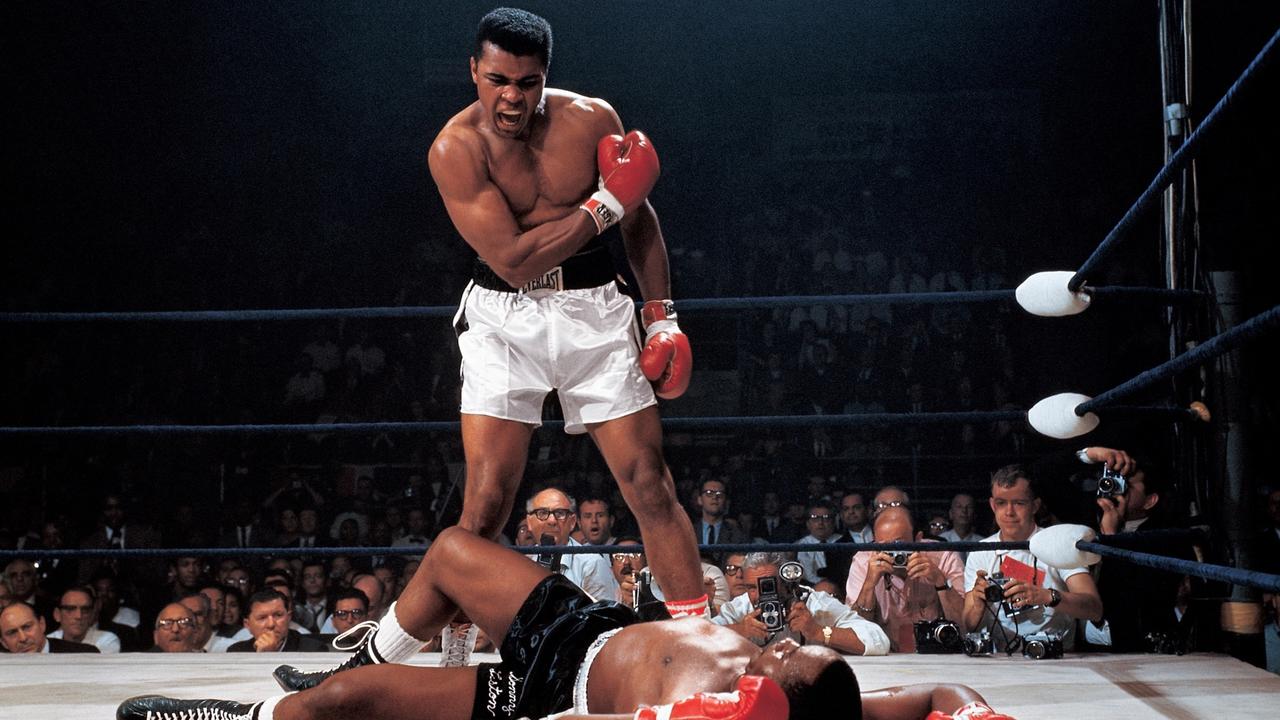
The referee was former Champion Jersey Joe Walcott. Both fighters were booed upon their introductions. Midway through the 1st round, Liston threw a left jab, and Ali went over it with a fast right, knocking the former Champion flat on his back. Liston rolled over, got to his right knee, and then fell on his back again.

Walcott had a hard time getting Ali to go to a neutral corner. Ali initially stood over Liston, yelling, "Get up, sucker!" At this point, Neil Leifer of Sports Illustrated took the picture above, one of the most famous photographs in sports history.

When Walcott got back to Liston, and looked at the knockdown timekeeper, Francis McDonough, to pick up the count, Liston had fallen back on the canvas. Walcott never did pick up the count. He said he could not hear McDonough, who did not have a microphone. Also, McDonough did not bang on the canvas or motion a number count with his fingers. McDonough, however, claimed Walcott was looking at the crowd and never at him.

After Liston arose, Walcott wiped off his gloves. He then left the fighters to go over to McDonough. Waltcott later said McDonough had told him, "I counted him out. The fight is over." Nat Fleischer, editor of The Ring magazine, had no authority over the fight, but he backed McDonough up, saying the fight should be over. Walcott then rushed back to the fighters, who had resumed boxing, and stopped the fight, awarding Ali a knockout victory.

It remains one of the quickest heavyweight title knockouts in history. Many in the small crowd had not even settled in their seats when the fight was stopped. The official time of the stoppage was announced as 1:00 into the first round, which was wrong. Liston went down at 1:44, got up at 1:56, and Walcott stopped the fight at 2:12.

McDonough and Fleischer were wrong in their interpretation of how the rule should have been applied. Under the rule, the timekeeper is supposed to start the count at the time of a knockdown. The referee's duty is to get the boxer scoring the knockdown to a neutral corner, pick up the count from the timekeeper. and continue it aloud for the knocked down boxer.

Nevertheless, Liston was down for 12 seconds -- 2 seconds fewer than Gene Tunney was down in his "Long Count" fight with Jack Dempsey in 1927. But Liston was no Tunney. He was more like the Mike Tyson of his era: Show him that you're not afraid of him, and that you can hit him, and he would fold, or even start cheating. In his 1st fight with Ali, he tainted his gloves to try to blind Ali. In the 2nd fight, he never got the chance to cheat.

Some people wondered if Ali had even hit Liston, or if Liston had gone down on his own, quitting the way he'd quit on his stool between the 6th and 7th rounds of their 1st fight. The suggestion was that he lost on purpose for more money from gamblers -- in ring parlance, "took a dive." The film shows this not to be the case: It clearly shows that Ali's punch was no "Phantom Punch." Instead, it had lifted Liston off the canvas entirely. Liston didn't dive: He fell, from being hit.

James Braddock was Heavyweight Champion from 1935 to 1937. He said of Ali, "I have a feeling that this guy is a lot better than any of us gave him credit for. It isn't the knockout punch that sticks in my mind as much as a punch he let go earlier... It was a right to Liston's jaw, and it shook him to his shoetops. For all we know, it could have been the one that set up the knockout."

Rocky Marciano was Heavyweight Champion from 1952 to 1955. After seeing the replay, he said, "I didn't think it was a powerful punch when I saw the fight from ringside. Now, I think Clay, seeing the opening, snapped the punch the last six inches." But he still didn't think the punch was hard enough to be a knockout, only a knockdown.

Liston had 16 more fights, winning 15 of them, 14 by knockout. So the suggestion that "He was never the same fighter" is ridiculous. But he never got another shot at the title, not even after Ali was stripped of it in 1967, following his refusal to accept being drafted into the U.S. Army. Of course, by then, Liston was officially 35 years old -- but Walcott had been 37 when he won the title. Liston died in 1970, also under mysterious circumstances.

McDonough died in 1968, Fleischer in 1972, Walcott in 1994.

Monday, November 2, 2020

Top 5 Reasons You Can't Blame Alf Landon for Losing 46 States in the 1936 Election

 
November 3, 1936: President Franklin D. Roosevelt defeats his Republican opponent, Governor Alfred M. Landon of Kansas, winning 46 out of 48 States, all but Vermont and Maine. He wins 523 Electoral Votes, Landon just 8. FDR wins 60.8 percent of the popular vote, to Landon's 36.5 percent.

Landon's next-best States? He won almost 48 percent in New Hampshire, almost 46 percent in his native Kansas, almost 45 percent in Delaware. If he had won those States, the Electoral Vote would have been 507-24 Roosevelt.

There were 8 other States where he got at least 40 percent. But even if he had won all of those, it would still have been 406-125 Roosevelt.
 
Top 5 Reasons You Can't Blame Alf Landon for Losing 46 States in the 1936 Election

5. The Curse of Herbert Hoover. The American people did not trust the Republican Party. It had been just 4 years since the depth of the Great Depression.

4. Landon's Supporters. There were crazy people on the right wing back then, too, and they made the GOP look not like the bunch of moderates their big names claimed to be, and Landon actually was, but like a bunch who couldn't be trusted.

3. The Media. The major newspaper chains were all Republican-owned, and behind Landon. And in an era when they were the entirety of the media, Landon might have been a great candidate. He was smart, honest, and understood that he served the public, not the other way around. But this was now the era of radio and newsreels. He wasn't well-suited to it. FDR was.

2. The Republican Field. The GOP didn't have anyone else who could beat FDR, either. Most of their big guns who had been elected in the Congressional elections of 1918, '20, '24 and '28 had been beaten in the elections of 1922, '26, '30, '32 and '34.

1. Franklin Delano Roosevelt. He was the master politician of his era, and his New Deal worked. Not perfectly, of course, but for the people for whom it did work, it was the difference between destitution and a living.
VERDICT: Not Guilty. Landon never had a chance. No matter what he had done, he would have lost.

FDR would be elected to a 3rd term in 1940, and a 4th in 1944, dying in office in 1945. Landon would serve out his term as Governor, return to the oil industry where he had made his money, and never ran for office again. He lived to be 100 years old, dying in 1987. His daughter, Nancy Landon Kassebaum, served Kansas in the U.S. Senate.

Thursday, March 15, 2018

Top 10 Athletes From Maine

And, completing the 50-State Sweep:

March 15, 1820: Maine is separated from Massachusetts, and admitted to the Union as the 23rd State, as part of the Missouri Compromise of 1820, with Missouri becoming the 24th State: 1 new State were slavery was legal, 1 where it was not.

Top 10 Athletes From Maine

Of the 26 NFL players born in Maine, the best was probably John Bunting of Portland, a linebacker who won an NFC Championship with the Philadelphia Eagles and a USFL Championship with the Philadelphia Stars, but he grew up in Silver Spring, Maryland, a D.C. suburb, so he's out. Nobody else looked like a good candidate.

Bob Stanley of the star-crossed 1978 and 1986 Boston Red Sox was born in Maine, and leads all such men with 132 saves, and also won 115 games. But he grew up in Kearny, Hudson County, New Jersey. Not that I, as a native of North Jersey, would want to claim him.

Jeff Turner is the only NBA player to have been born in Maine, in Bangor, and won a Gold Medal with the U.S. team at the 1984 Olympics in Los Angeles. But he grew up in Florida, so he qualifies there.

Honorable Mention to Louis Sockalexis of Old Town. A member of the Penobscot tribe, the outfielder starred with the Cleveland Spiders of the National League as a rookie in 1897, batting .338 with 16 stolen bases.

But his drinking problem, all too common among Native Americans, had already gotten him expelled from Notre Dame. And on July 4, when the brothel he was visiting was raided by the police, he jumped out of a 2nd-story window and wrecked his ankle. He was never the same player.

The circumstances surrounding the 1899 Cleveland Spiders are too convoluted to briefly summarize, but they were the worst team in Major League Baseball history, and they were his last major league team. (They released him on May 7. If they'd kept him, despite all his trouble -- he was hitting .273 -- maybe they wouldn't have finished 20-134.) He died of tuberculosis in 1913, only 42 years old.

It was long presumed that the Spiders' American League replacements, originally called the Blues, then the Broncos, and then the Naps in honor of 2nd baseman and manager Napoleon Lajoie, were renamed the Indians in 1915 in honor of either "Sock," the 1st Native American to play in the major leagues, or the tribes that once lined the shore of Lake Erie. Neither story is true: Baseball is a monkey-see-monkey-do game, like most sports, and the year before, the World Series had been won by the Boston Braves.

Honorable Mention to Bill Carrigan of Lewiston. A decent catcher, he wasn't much of a hitter. But he played on 3 World Series winners for the Boston Red Sox, in 1912, 1915 and 1916. For the last 2, he was player-manager, and is the only man since 1898 to manage a Boston baseball team to back-to-back Pennants. The Red Sox elected him to their team Hall of Fame.

Honorable Mention to Clyde Sukeforth of Washington. He was a good-field-no-hit catcher, although he did bat .354 in 262 plate appearances for the 1929 Cincinnati Reds. But he's best known for 2 contributions to the lore of the Brooklyn Dodgers -- 1 positive, 1 negative.

In 1945, team president and part-owner (the operational owner) Branch Rickey sent him around the country to scout Jackie Robinson, whom Rickey had heard could be the right man to be the 1st black player in modern baseball. Not only did Sukeforth send Rickey a good report, but he turned out to be Robinson's 1st major league manager -- albeit on an interim bases, following the suspension of Leo Durocher, managing only Opening Day 1947 before turning the team over to Burt Shotton.

In 1951, "Sukey" was in the bullpen watching pitchers warm up during the Playoff game that would decide the National League Pennant, between the Dodgers and their arch-rivals, the New York Giants. When Don Newcombe ran out of gas in the bottom of the 9th, manager Charlie Dressen called the bullpen and asked how the pitchers were doing. Sukeforth said that Carl Erskine was having control problems, but Ralph Branca was throwing well. Dressen told him to send in Branca.

Big mistake. The batter was Bobby Thomson, who could hit nothing but a fastball. Branca had nothing but a fastball. Although a year away from becoming a star, Erskine may already have had the best curveball in the NL. Had Sukeforth remembered that, or if he had realized Thomson was the next batter, Erskine might have gotten Thomson out, and the Dodgers might have won the Pennant, instead of Thomson hitting the most famous home run of all time.

Honorable Mention to Jim Beattie of South Portland, who helped the Yankees win the 1978 World Series. His career record as a pitcher was 52-87. He later served as general manager of the Montreal Expos and the Baltimore Orioles, and is now a scout with the Toronto Blue Jays.

Honorable Mention to Cindy Blodgett of Fairfield. She is the all-time leading scorer, male or female, in Maine high school basketball, leading Lawrence High School to an 84-4 record. At the University of Maine, she led women's college basketball in scoring all 4 seasons.

She played for the WNBA's Cleveland Rockers and Sacramento Monarchs, and later returned to UM as head coach. She is now an assistant coach at Boston University, under former Sacramento teammate Kady Steding.

10. Chet Bulger of Rumford. A 2-way tackle, he was a starter on the line of the Chicago Cardinals team that won the NFL Championship Game in 1947 and lost it in 1948.

9. Del Bissonnette of Winthrop. A 1st baseman, he got stuck in the minor leagues, not making his major league debut until he was 28, with the 1928 Brooklyn Dodgers. But had there been a Rookie of the Year award then, he surely would have won it, with a .320 batting average, 25 home runs and 106 RBIs.

Had there been an All-Star Game then, he would have made it every year through 1931. Then he got hurt, missed the entire 1932 season, and was never the same. He only played 35 games in 1933, never appeared in the majors again, and hung on in the minors for a while. His 66 home runs lead all Maine-born players, as does his .305 lifetime batting average for all Mainers with at least 400 major league plate appearances.

He managed the Hartford Chiefs to the 1944 Eastern League Pennant, and briefly managed the Boston Braves. But he was fired in 1946, never returned to the major leagues in any capacity, and committed suicide in 1972.

8. Eric Weinrich of Gardiner. Though born in Roanoke, Virginia, he grew up on the Kennebec River near the Maine State capital of Augusta, and had a 17-year career as an NHL defenseman, starting in 1989 with the New Jersey Devils and carrying through Chicago, Montreal, Boston, Philadelphia, St. Louis and Vancouver. He finished his career with 70 goals and 318 assists.

Of the 7 NHL players who were actually born in Maine, 2 active players, Brian Dumoulin of Biddeford and the Pittsburgh Penguins, and Garnet Hathaway of Kennebunkport and the Calgary Flames, have, between them, scored 63 points. Danny Bolduc of Waterville and the late 1970s Detroit Red Wings, had 41. The other 4 have a grand total of 1.

7. Freddy Parent of Sanford. He was the shortstop of the Boston Americans, forerunners of the Red Sox, that won the 1st World Series in 1903, and the American League Pennant again in 1904. He was the last survivor of those teams, living until 1972. In a 12-season major league career, he batted .262 with 184 stolen bases.

6. Mike Bordick of Winterport. A shortstop, he reached the World Series as a rookie with the 1990 Oakland Athletics, and the American League Championship Series with them that year and in 1992. He reached the ALCS again with the 1997 Baltimore Orioles, and made the All-Star Game and won a National League Pennant with the Mets in 2000. The Orioles named him to their team Hall of Fame.
Rip Black of Bailey Island.

He's lucky I don't have the sports journalism profile that Chris Berman, nicknamer par excellence, has, because I thought of what sounded like a sure "Bermanism": Mike "I Need Viagra For My Bored Dick."

5. Bill Swift of South Portland. With the 1992 San Francisco Giants, he went 10-4, and led the National League with a 2.08 ERA. In 1993, he went 21-8. In 1995, he helped the Colorado Rockies, in only their 3rd season, win the NL Wild Card. He finished 94-78, with 17 saves, and his 767 strikeouts lead all Maine-born pitchers.

4. Joey Gamache of Lewiston. The WBA briefly recognized him as Super Featherweight Chamion in 1991 and Lightweight Chamion in 1992.

3. Jack Coombs of Waterville. He was known as Colby Jack, because he attended Colby College in his hometown. Although he could throw some high cheese. He arrived with the Philadelphia Athletics in 1906, nearly helped them win the American League Pennant in 1907, and did help them win it in 1910, 1911, 1913 and 1914.

In 1910, he went 31-9, and won 3 more games in the World Series, leading the A's over the Chicago Cubs. The A's also won with him in 1911 and 1913, in each case over the New York Giants. In 1916, he won a National League Pennant with the Brooklyn Robins. (The once-and-future Dodgers were nicknamed for their manager, Wilbert Robinson.)

His final total was 158-110, making him the winningest Maine-born pitcher. He died in 1957, and the Phillies later named him to the Philadelphia Baseball Wall of Fame. His brothers Bobby and Danny were also major leaguers, albeit briefly.

2. George Gore of Hartland. A center fielder known as "Piano Legs," he starred for the Chicago White Stockings, forerunners of the Cubs. In 1880, he won the National League batting title, helping start a string of 5 Pennants in 7 seasons for the White Stockings. In 1881, he set a record with 7 stolen bases in a game; in 1885, another with 5 extra-base hits.

He last played in 1892, but his 1,612 career hits and his OPS+ of 136 still lead all Maine-born players. His lifetime batting average is .301. Nobody alive today saw him play, but he probably should be in the Baseball Hall of Fame. But, unlike his teammates Adrian "Cap" Anson, Mike "King" Kelly, Edward "Ned" Williamson, Frank "Silver" Flint and John Clarkson (no known nickname), his nickname was considerably more colorful than he was, and he got forgotten. (Anson, Kelly and Clarkson are in the Hall.)

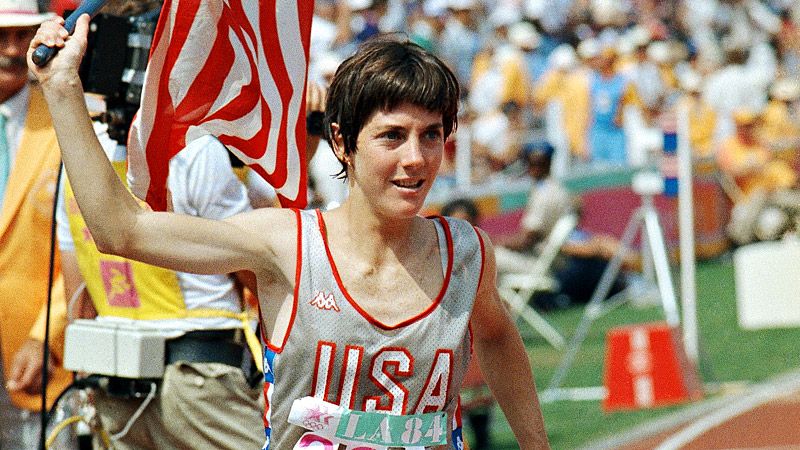
1. Joan Benoit of Cape Elizabeth. Although part of the large French-Canadian community in New England, she pronounces her name Benn-OYT instead of the proper French Benn-WAH. And she now goes by her married name, Joan Benoit Samuelson.
She won the Boston Marathon in 1979 and 1983, each time setting a new course record for women. She won the 1st-ever women's Olympic Marathon, in Los Angeles in 1984. In 1985, she received the James M. Sullivan Award, for the outstanding American amateur athlete of the year.

Thursday, February 16, 2017

How to Go to a Hockey Game In Maine

Continuing my bid to do trip guides for all 50 States, it's Maine's turn.

On Friday night, February 24, and Saturday night, February 25, the University of Maine will play hockey against Northeastern University of Boston.

Before You Go. Maine is in northern New England, and this is winter, so it's going to be cold. But maybe not cold by New York and New Jersey standards on the weekend in question. According to the State's largest newspaper, The Portland Press Herald, both Friday and Saturday are projected to be in the mid-30s in daylight. Friday night is forecast as being in the mid-20s, Saturday night in the low 30s. Saturday may have rain and/or snow, so that could be a problem.

Maine is in the Eastern Time Zone, so you won't have to make any timepiece adjustments. The University campus is 100 miles west of the Canadian border, so it doesn't make sense to make a side trip, for which you would have to bring your passport and change your money.

Tickets. Alfond Arena seats 5,641 people, and this is the most popular sports team in the State of Maine. And Northeastern, like all the Boston schools, has a fan base that travels well. Getting tickets may be difficult.

If you order them through the University website, center-ice seats are $35. All others are $20.

Getting There. It's 449 miles from Midtown Manhattan to the Maine campus in Orono. It's in that iffy zone: Too close, really, to fly, but too far to go any other way. And considering that you'll never get a nonstop flight from a New York Tri-State Area airport to Bangor International Airport, and that this is the closest airport to the campus, and that it's 12 miles, you're better off going by some other way.

The good news is, Amtrak does go to Maine, with Downeaster service. The bad news is, not only will going there from New York's Penn Station mean you'll have to get from South Station to North Station in Boston, but it doesn't go to Orono: nce you get to Portland, you'll have an hour and a half layover to get a bus to Orono. And it won't get there until 6:50 PM. So you will probably miss the opening puck-drop. So, forget Amtrak.

How about Greyhound? No, they too only go to Portland, not Orono. They go to Bangor, which is just 11 miles from Orono, but there's no public transit from Bangor to Orono. You want to take a taxi? In Maine? No?

So it looks like you'll have to drive. Start out as if you're going to Boston: Take Interstate 95 North to New Haven. Take Exit 48, Interstate 91 North to Hartford. Take Exit 30, Interstate 84 East into Massachusetts. You'll merge with Interstate 90 East, the Massachusetts Turnpike, and take that until you reach Interstate 495, Boston's outer beltway.

But instead of continuing on the Mass Pike to Boston, take Exit 11A onto I-495 North, into Boston's northern suburbs, until you reunite with I-95 North at Salisbury, just before reaching the New Hampshire State Line. You'll cross New Hampshire and go into Maine. A big chunk of I-95 in Maine, but not all of it, is the Maine Turnpike.
Exit 193 will take you onto Stillwater Avenue. Cross the Stillwater River, make a right on College Avenue (Alternate U.S. Route 2), and drive a mile south. The University's athletic complex will be on your right.

If all goes well, you should be in New York State (not counting Manhattan) for half an hour, in Connecticut for 2 hours, in Massachusetts for an hour and 15 minutes, New Hampshire for 15 minutes, and Maine for 3 and a half hours. Given rest stops near Hartford and right after crossing into Maine, it should take about 9 hours.

Once In the City. Maine, home to 1.3 million people, was named for a province in France, and much of it was part of New France, which would later be limited to Quebec, which borders it. It became part of the Massachusetts Bay Colony, though separated from present-day Massachusetts by New Hampshire. On March 15, 1820, as part of the Missouri Compromise, was added to the Union as the 23rd State, a free State to balance out the new slave State of Missouri.

Maine is overwhelmingly white, 94 percent. Only about 1.3 percent of its people are Hispanic, 1.1 percent black, 1.0 percent Asian, and 0.6 percent Native American.
Maine has several thriving seaport towns, including Portland, Boothbay Harbor, Old Orchard Beach, Bar Harbor, and Kennebunkport, known for Walker's Point, ancestral home of the Walker family that included George Herbert "Bert" Walker, one of the founders of Merrill Lynch; his son Herbie Walker, an original part-owner of the Mets; Bert's daughter, Dorothy Walker Bush; Dorothy's son, George Herbert Walker Bush; and the son of the preceding, George Walker Bush.
Despite the 43rd President's protests that he is a Texan through and through, and the 41st having lived most of his adult life in Texas, "Bush 41" was born in the Boston suburb of Milton, grew up in the New York suburb of Greenwich, Connecticut, and has always felt most at home at Walker's Point, with his boat, much as the Boston-based Kennedy family has always felt more at home at Hyannis Port, where Cape Cod begins, with their beach compound and their boats.

Most people who've never been to Maine know it for 2 things: Its seacoast and the lobsters obtained there. They may also know it for being a rural part of New England, where, in the accent, people tell outsiders, "Can't get theah from heah." And, away from the Atlantic Ocean, much of the State remains rural, hilly, forested, and unpopulated.

Indeed, 2 weeks before Charles Lindbergh made the 1st successful crossing from the New York Tri-State Area to Paris, winning a substantial prize, 2 other men tried to win the prize in the opposite direction. Charles Nungesser and Francois Coli, French heroes of World War I, took off from Paris and disappeared. The leading theory is that they crashed over Maine, but the forest is so dense, the remains of the men and their plane have still never been found, 90 years later.

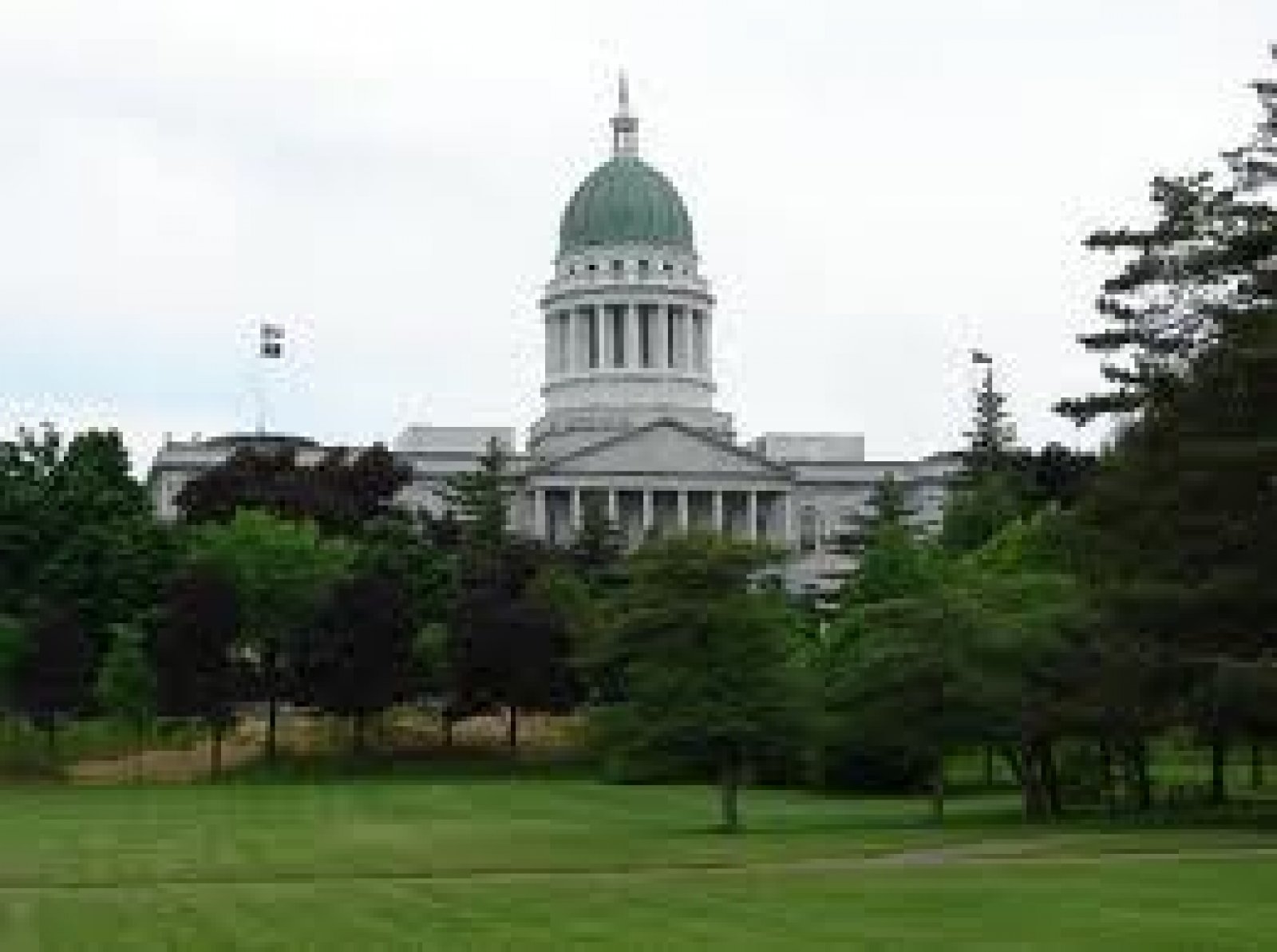
Although the small (19,000 people) city of Augusta is the State capital, its Supreme Court meets in its largest (67,000) city, Portland, for which what became the largest city in Oregon was named.
The State House and surrounding woods in Augusta

ZIP Codes in Maine start with the digits 04. The Area Code is 207. Electricity is run by the Central Maine Power Company.

Maine and Nebraska are the 2 States that apportion their Electoral Votes according to which candidate wins that District. As a result, in 2016, for the 1st time in the State's history, the Electoral Vote was split: The District that includes the population center of the south, including Portland, went for Hillary Clinton; but the rest of the State went for Donald Trump, giving him his 1 and only Electoral Vote in the Northeast. These are the people who elected the psychotic right-wing bigot Paul LePage Governor in 2010 and 2014.

Indeed, Maine and Vermont were the only States that Franklin Roosevelt never won, even going for Alf Landon in 1936; yet Maine has gone Democratic in every election since 1992. For the most part, Maine is tolerant, in ways that LePage isn't.
Portland, Maine

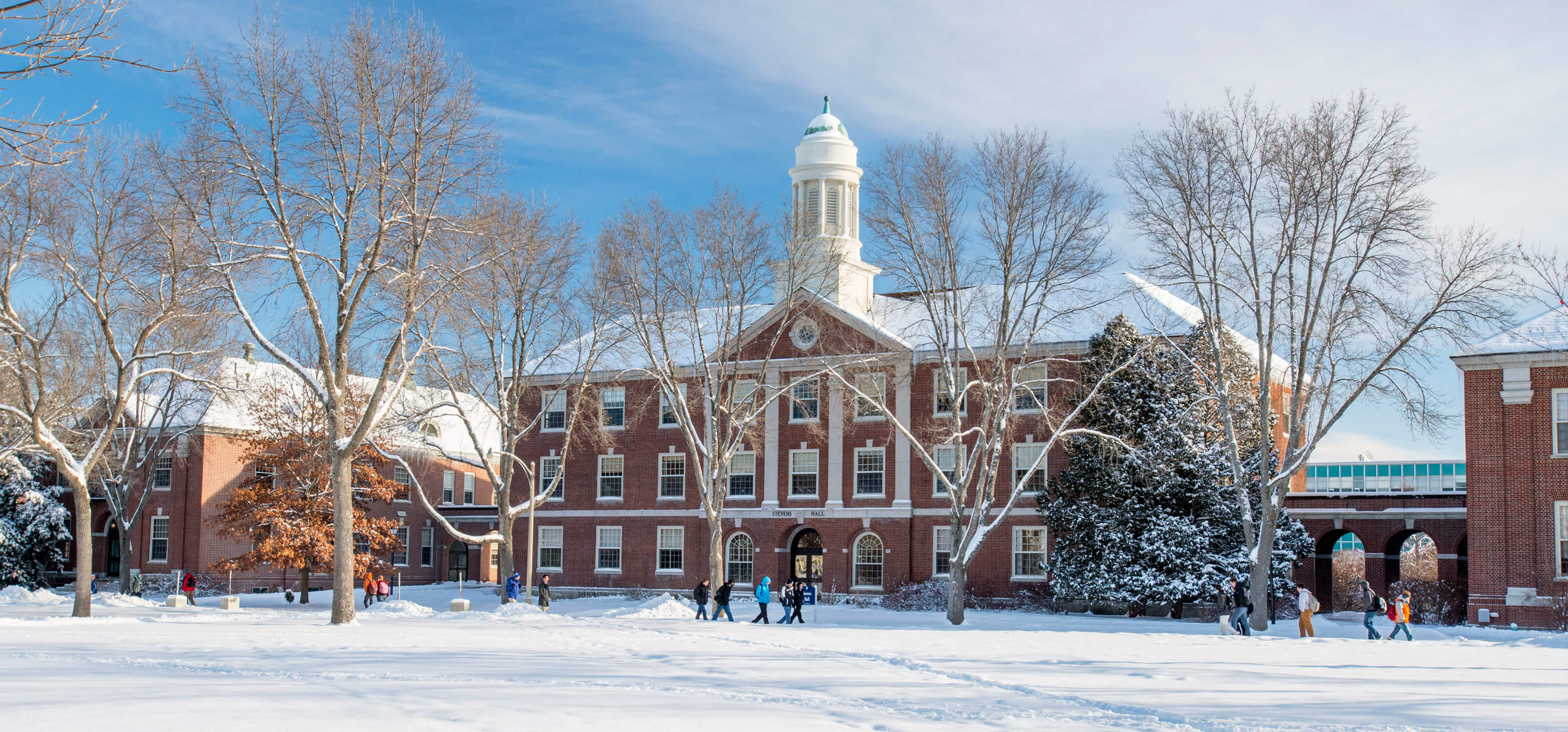
Orono (shown in the photo at the top), the seat of the University of Maine, is in Penobscot County, named for the dominant Native American tribe of Maine. One of their chiefs was Joseph Orono, who, as an old man, sided with the Americans against the English during the Revolution, and was alleged to be 113 years old when he died, and the town was named for him. The town is small, with only 10,000 permanent residents.
The Maine Folklife Center, the cultural center of the University

Situated on Marsh Island, between the Penobscot and Stillwater Rivers, the University of Maine is America's only "land grant college" on an island. It was founded in 1865.

The State's sales tax is 5 1/2 percent. Public transit is not good. You'd need Greyhound to get from Portland to Augusta or Bangor, and good luck getting anywhere else without a car. In an oddity due to the Interstate Highway System's numbering system, I-95 is Portland's beltway, while I-295 goes through downtown.

Maine is known for its coastline and its beaches. But they're not particularly close to the University: Bar Harbor is 59 miles to the southeast, Boothbay Harbor is 108 miles to the southwest, Old Orchard Beach is 156 miles to the southwest, and Kennebunkport is 165 miles to the southwest.

The University of Maine is known for its hockey program, which has produced brothers Paul and Steve Kariya, Bob Beers, Ben Bishop, Scott Darling, Dustin Penner, former Devils Eric Weinrich and Mike Dunham, former Rangers coach John Tortorella, Islanders coach Jack Capuano, former Islanders goalie, coach and general manager Garth Snow, and broadcaster Gary Thorne.

In other sports: Baseball players Mike Bordick, Bill Swift, and former Yankee manager Carl "Stump" Merrill; basketball players and coaches Rick Carlisle and Cindy Blodgett; and football players Justin Strelczyk, Jovan Belcher and Lofa Tatupu.

In other fields:

Science: Francis T. Crowe, Class of 1905, chief engineer of Hoover Dam.

Literature: Stephen King '70, and his wife Tabitha King '71.

Politics, representing Maine unless otherwise stated: Governors Joseph Brennan, John Baldacci and Paul LePage; Governor John "Jock" McKernan and his wife, Senator Olympia Snow; Governor and Senator Styles Bridges of New Hampshire, Senator Edwin Ladd of North Dakota, and Governor Wallace Farrington of Hawaii.

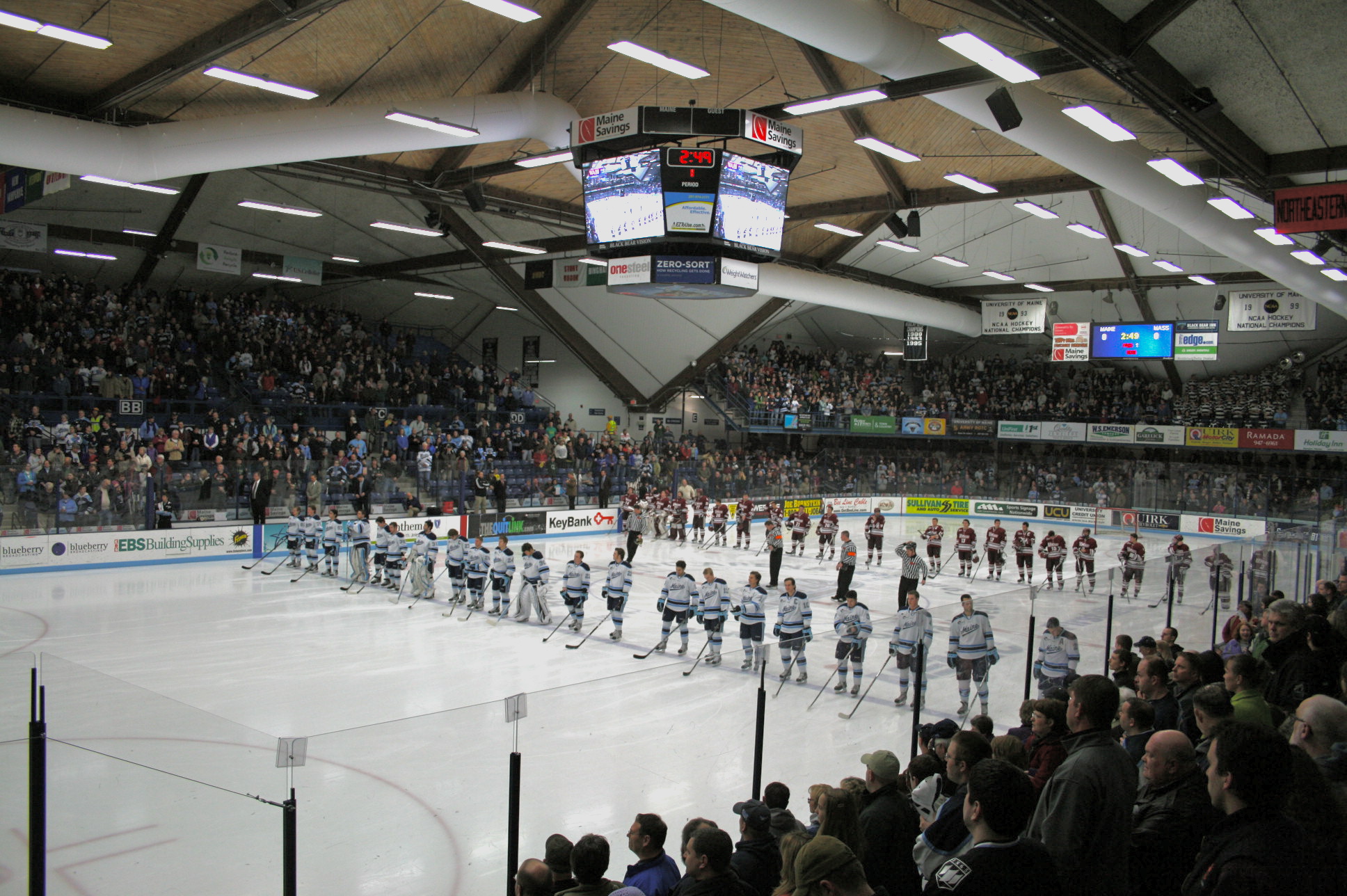
Going In. The Harold Alfond Sports Arena, with its distinctive pointed roof, opened in 1977, at Tunk Road at Long Road. Parking is free. It seats 5,641, and a next-door football stadium seating 10,000 is also named for Harold Alfond.
Alfond founded the Dexter Shoe Company in Dexter, Maine. He also invented the outlet store, donated heavily to the University of Maine, and since 1978 the Alfond family has owned a share of the Boston Red Sox, as the men operating the team for Jean Yawkey wanted investors from all over New England, and Harold Alfond seemed the obvious choice from Maine. (I guess the children of Leon Leonwood "L.L." Bean weren't interested.)

The student section and the band are behind the goal in the upper deck, in Section HH. If you're a New Jersey Devils fan, you might recognize the name of the Black Bears' head coach: Dennis "Red" Gendron, an assistant coach for the 1995 Stanley Cup winners, and the head coach of the Albany River Rats farm team during the Devils' 2000 and 2003 Cup wins.

Food. It's a college sports arena. It has small concession stands, with generic sports arena food, and that's it. Better to eat before or after the game.

Team History Displays. The University of Maine hasn't had much success in sports. Its football team has never won a conference title. Neither has its basketball team, nor has it ever been selected for the NCAA Tournament. Their best sport is hockey.

They've won Hockey East in the regular season in 1988, 1993 and 1995; won its tournament in 1989, 1992, 1993, 2000 and 2004; reached the NCAA Frozen Four in 1988, 1989, 1991, 1993, 1995, 1999, 2000, 2002, 2004, 2006 and 2007; and won the National Championship in 1993 and 1999. The 2 National Championship banners are hung at one end of the arena, the other banners at the other.
The 1988 and '89 Frozen Four teams included former New York Islanders head coach Jack Capuano and his brother Dave, and former Devil Eric Weinrich. The 1991 Frozen Four team included former Devil Scott Pellerin. The 1993 National Champions included Anaheim Ducks star Paul Kariya, former Devils backup goalie Mike Dunham, the twins Chris and Peter Ferraro, and former Philadelphia Flyers goalie and now Islanders general manager Garth Snow.

The 1999 National Champions included Paul's brother Steve Kariya. The 2004 Frozen Four team included Los Angeles Kings Stanley Cup winner Dustin Penner. Scott Darling of the 2010 Maine team won the Cup with the 2015 Chicago Blackhawks. And, graduating in 1981, John Tortorella didn't reach any Frozen Fours, but he coached the Tampa Bay Lightning to the 2004 Cup, and then coached the Rangers and now the Columbus Blue Jackets.

Stuff. The arena is too small for a big team store like a major league team would have, and only has a couple of small souvenir stands. If you'd like memorabilia, your best best is the University Bookstore, at the Memorial Union on Belgrade Road. There are no books about University of Maine hockey, but DVDs of the 1993 and 1999 National Championships are available.

During the Game. Maine has unique geography: It's the only State in the Union that borders only 1 other State. (Alaska and Hawaii don't border any other States.) As a result, their arch-rivals are the team in that other State, the University of New Hampshire. You're (probably) not from New Hampshire, so they may want to show off their State and their team, and be courteous to you as a visitor. Respond accordingly.

Maine's teams are called the Black Bears, for the beast that roams its vast northern forests. The mascot is named Bananas T. Bear (I'm presuming that the T. stands for "The"). This may seem odd for a school about as far from the tropics as you can get and still be in the continental United States. In 1914, a bear cub was given to a local police chief, who named it Jeff, and loaned it to the University as a football mascot. Jeff was taken into the auditorium for a pep rally, and stood on its head, and the local newspaper account said that the crowd "went bananas." The mascot costume is kept by the Alpha Delta fraternity, and its wearer is always a member.
They're not Chicago, but they are Da Bears.

After the Game. Safety almost certainly won't be an issue. Where to go for a postgame meal or snack might be. The Orono Farmer's Market is south of the arena and west of the main campus, at 300 College Avenue, and might be all right if you're coming out of an afternoon game. But these will be night games, so it will be closed.

Your best bet is to head back up north on College Avenue, to Stillwater Avenue (Alt Route 2) in Old Town, where you'll a McDonald's, a Tim Hortons, and Governor's Restaurant & Bakery.

Sidelights. Orono is far from pretty much anything: 60 miles from Bar Harbor, 87 from Augusta, 139 from Portland, 245 from Boston, 296 from Montreal, and 449 from Midtown Manhattan. To get anywhere, you gotta get out.

Maine has 2 professional baseball teams. The only one affiliated with a major league club is the Portland Sea Dogs of the Class AA Eastern League. They started in 1994 as a farm team of the Florida (now Miami) Marlins, but since 2003 have embraced their New England roots by being a part of the Red Sox' farm system. They've won 6 Division titles, most recently in 2014, but only 1 Pennant, in 2006.
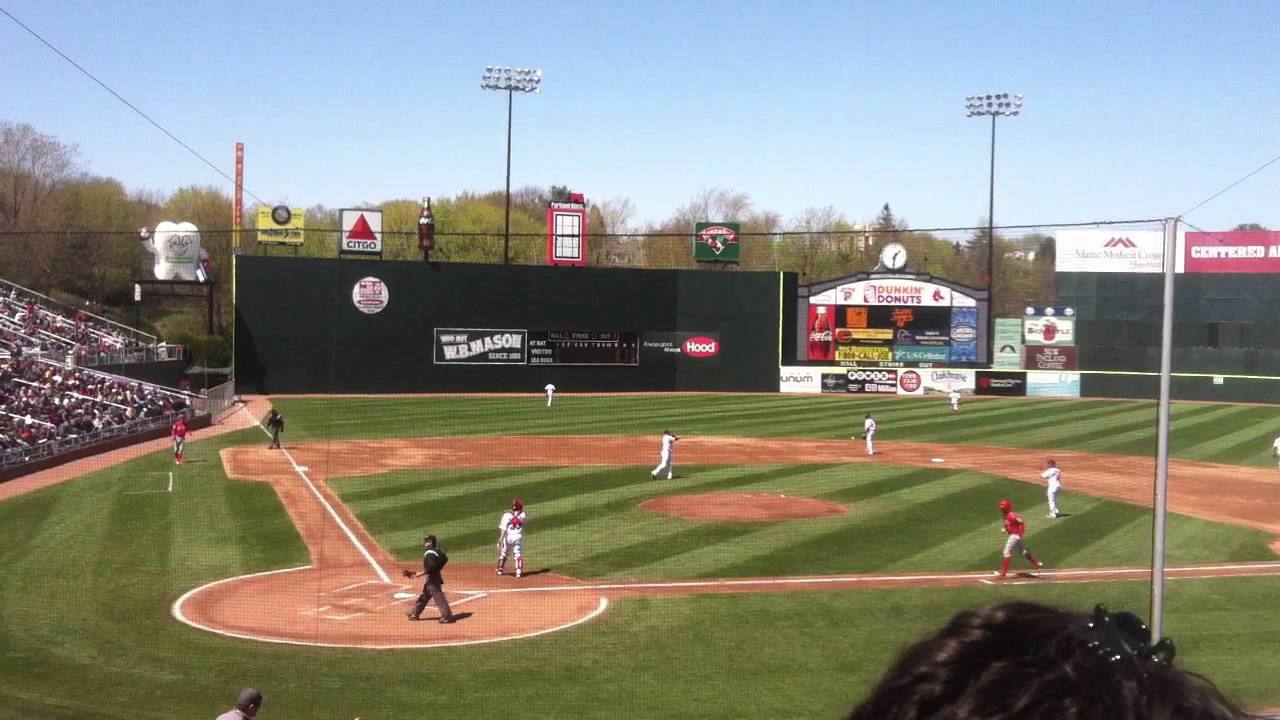
The Sea Dogs play at Hadlock Field. Seating 3,768, it opened in 1994, but is designed to look like an old ballpark. In 2003, following the switch to the Boston system, left field was remade to look like Fenway Park's, with a high wall called the Maine Monster, 315 feet from home plate to match the former posting at Fenway (it's now posted as 310), and replicas of the CITGO sign and the light tower Coke bottle.
It is part of a sports complex that includes the Portland Exposition Building (which appears to be trying to take the right side of the infield away), Fitzpatrick Stadium and the William B. Troubh Ice Arena. 271 Park Avenue, about a mile west of downtown.

The Exposition Building is home to the Maine Red Claws, the Boston Celtics' team in the D-League. It opened in 1914, and, behind Boston University's Matthews Arena, is believed to be the 2nd-oldest sports arena in America still in use. Fitzpatrick Stadium seats 6,300, and is mainly used for high school football. Troubh Arena, formerly the Portland Ice Arena, hosts high school hockey.

The Cross Insurance Arena, formerly the Cumberland County Civic Center, was home to the Maine Mariners from 1977 to 1992, and the Portland Pirates from 1993 to 2016. The Pirates have moved to Springfield, Massachusetts, and Portland is trying to get a new team for the arena. 1 Civic Center Square.
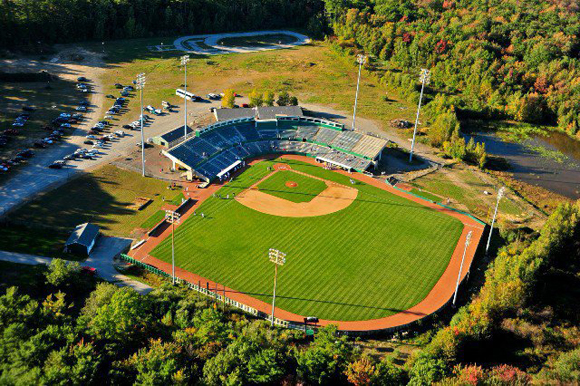
As for Maine's other pro baseball team, the independent Empire Professional Baseball League includes the Old Orchard Beach Surge, based at The Ball Park in Old Orchard Beach. A 6,000-seat facility with close foul poles (312 feet to left field and 327 to right), it opened in 1984 as the home of the Maine Guides, the Class AAA International League farm team of first the Cleveland Indians (1984-86), then the Philadelphia Phillies (1987-88).

The Phillies moved their top farm team to the Scranton area, due not to attendance, as Summer vacationers flocked to the place; but traffic and... flies. Never mind the Maine Black Bears: It's the Maine Black Flies that are truly a problem.

From 1990 to 2009, the place lay derelict, and appeared to be doomed. But it was restored, and began hosting high school, Summer collegiate league, and Red Sox alumni charity games. The Old Orchard Beach Raging Tide arrived in 2011, and gave them pro baseball for the 1st time in 22 years, followed by the Surge in 2015.

So far, no Pennants have been won at The Ball Park. But it is still the place where the State of Maine came the closest (1 level below) to having a major league sports team. It's certainly one of the nicer settings in pro baseball, especially when the leaves begin to change. 14 Emerson Cummings Blvd., 17 miles southwest of Portland and 157 miles southwest of Orono.
Arguably, the most significant sports building in Maine is the Androscoggin Bank Colisée in Lewiston. Not because it was home to the Maine Nordiques, a farm team of the Quebec Nordiques, from 1973 to 1977. Not because it hosted the Lewiston Maineiacs of the Quebec Major Junior Hockey League from 2003 to 2011, before they moved to Sherbrooke from whence they came. Not because it hosted the Portland Pirates in the 2013-14 season while the Cross Insurance Arena was being renovated. Not because it is now home to another junior team, the L/A Fighting Spirit. ("L/A" standing for Lewiston and neighboring Auburn.)
No, it's because, after the Boston Garden balked at holding it due to both men's controversies, the rematch between Heavyweight Champion Muhammad Ali and former champion Sonny Liston as held at this arena, then known as the Central Maine Civic Center, on May 25, 1965. Built in 1958, it is the smallest building to host a Heavyweight Title fight: 3,677 seats. Ali famously knocked Liston out in the 1st round. 190 Birch Street in Lewiston, about 36 miles north of Portland, and 116 miles southwest of Orono.

The highest-ranking soccer team in Maine is the Portland Phoenix, who play in the Premier Development League, the 4th division of American soccer. They play at the 5,200-seat Memorial Stadium, at Ludlow & Leland Streets in Portland, 4 blocks from at Deering High School, who use it as their stadium.

If you visit Maine during the European soccer season, the leading soccer bar in the State is an outlet of the Ri Ra chain at 72 Commercial Street, on the Portland waterfront.

The Beatles never played in Maine. Elvis Presley did, on his last tour, on May 24, 1977, at the 6,777-seat Augusta Civic Center. 76 Community Drive.

Maine is a terrific museum State. On the University of Maine campus, the Page Farm Home & Museum focuses on rural Maine life in the 19th Century, while the Hudson Museum contains many Native American artifacts. In nearby Old Town, at 12 Down Street, is the Penobscot Nation Museum. The University of Maine Museum of Art isn't actually on the campus; instead, it's at 10 Harlow Stret in downtown Bangor, 10 miles to the southwest.

In Portland, the Portland Science Center is at 68 Commercial Street, 2 doors down from Ri Ra. The Maine Historical Society Museum is at 489 Congress Street, and includes the Wadsworth-Longfellow House, home of poet Henry Wadsworth Longfellow. The Portland Museum of Art is downtown, at 7 Congress Square, at Free & High Streets, across from the historic State Theatre. Next-door is the Children's Museum of Maine, with a mailing address of 142 Free Street.

The Maine Maritime Museum oversees a historic shipyard at 243 Washington Street in Bath, 35 miles northeast of Portland. The Maine State Aquarium is at 194 McKown Point Road in Boothbay Harbor, 60 miles east of Portland.

The Kennebunkport History Center is at 125 North Street, 27 miles southwest of Portland. The Bush family compound is about 4 miles south, but as it is still a private residence, you probably won't be allowed to get very close. Unless you want to count Franklin Pierce (a cousin of Barbara Pierce Bush, Number 41's wife and Number 43's mother, and also a cousin of Longfellow) having attended Bowdoin College in Brunswick (as did Longfellow and their friend, novelist Nathaniel Hawthorne), the Bushes are the only Presidents with legitimate connections to Maine.

However, Roosevelt Campobello International Park, in Welshpool, New Brunswick, across a bridge from Lubec, Maine, was a Summer home for Franklin Delano Roosevelt, and it's where he was diagnosed with polio.

Also in Lubec, 6 miles from the bridge, is West Quoddy Head Lighthouse, at Quoddy Head State Park, the easternmost point in the continental United States. (If that sounds strange, like West Ham United being the soccer team of London's East End, I've looked it up: There is no "East Quoddy Head," Not even in the adjoining Canadian Province of New Brunswick.) 3 Lubec Road, 124 miles east of Orono, 234 miles northeast of Portland, 352 miles northeast of Boston, and 556 miles northeast of Times Square. As my Grandma would have said, "That's a fur piece."

The tallest building in Maine is Franklin Towers, a 175-foot, 16-story apartment complex built in Portland in 1969. 211 Cumberland Avenue.

Maine has a TV influence far beyond what its relatively small population of 1.3 million would suggest, and that's not even taking into account that its most famous fictional character, Dr. Benjamin Franklin "Hawkeye" Pierce, played by Alan Alda on M*A*S*H, was never shown as being in Maine -- or, with the except of the occasional scene in Tokyo, anywhere other than Korea.

(Other characters on the show had home movies showing their houses sent to the Army hospital in Korea. Dr. Richard Hornberger, who, under the name "Richard Hooker," wrote the novel on which the 1970 film and the 1972-83 TV series were based, was born and raised in Trenton, New Jersey, but went to Bowdoin, which he fictionalized as "Androscoggin College," and lived the rest of his civilian life in Maine.)

The 1966-71 vampire series Dark Shadows was set in Collinsport, which, like Hawkeye's hometown of Crabapple Cove, was a seaside community made up for its show. It was said to be 50 miles southeast of Bangor. (Hornberger lived in Pittsfield, with an hour's drive west of Orono and Bangor, and not a seaside community.)

Also fictional, and definitely on the sea, is Cabot Cove, home to mystery writer and amateur sleuth Jessica Fletcher, played by Angela Lansbury on Murder, She Wrote. Although Cabot Cove was said to be near Kennebunkport, its scenes were filmed in Mendocino, California. Storybrooke, the town in Once Upon a Time, is also a fictional seaside community.

Movies set in Maine, but not necessarily filmed there, include The Little Girl Who Lives Down the Lane, The Man Without a Face, Jumanji, Casper (about the Friendly Ghost, set in fictional Friendship), In the Bedroom, The Cider House Rules, Welcome to Mooseport, Empire Falls (filmed in Waterville), and the animated films Pete's Dragon and The Iron Giant. While the 1957 version of Peyton Place was set in New Hampshire, it was filmed in Camden, Maine. Carousel, the 1945 Broadway musical and 1956 film, is set in 1873 in the real resort town of Boothbay Harbor.

Maine is a popular setting for Summer resorts and camps, including the film A Summer Place, the 1961 and 1998 film versions of The Parent Trap, and the Disney Channel series Bunk'd.

The most famous real-life Mainer -- or, dare I say it, Maineiac -- is Stephen King. The horror writer was born in Portland and lives in Bangor, and has set much of his fiction in Maine, including Carrie, 'Salem's Lot, The Dead Zone, Graveyard Shift, Dreamcatcher, the TV shows Haven and Under the Dome, and, of course, The Shawshank Redemption.

*

Maine can be a nice place, and it can be a weird place. In real life, Paul LePage is much crazier than Stephen King. And the Portland Sea Dogs and the Maine Black Bears hockey team are worth a visit.

Wednesday, April 2, 2014

New England's All-Time Baseball Team

If "Red Sox Nation" has borders -- and, as I've said before, we really need to deport some people back within those borders -- those borders contain the following States in their entirety: Massachusetts, Rhode Island, Vermont, New Hampshire and Maine.

Connecticut is usually included in the New England region. However, not all of Connecticut is in Red Sox territory. Connecticut has 8 Counties, and Fairfield and Litchfield are absolutely in the New York Tri-State Area. Middlesex, New London, Tolland and Windham are part of Red Sox Nation.

The wild card is New Haven County, with the city of New Haven, including Union Station (the terminus of the Metro-North Commuter Railroad's New Haven Line) and the campus of Yale University being kind of a "Romulan Neutral Zone" between Yankee/Met territory and Red Sox territory.

I've often joked that Connecticut is divided by what I call the Bristol Line, which goes from the northwest corner of the State, curving through Torrington, Bristol and Waterbury, before going down the Quinnipiac River into New Haven, New Haven Harbor and Long Island Sound.

Bristol is the home of ESPN's studios, 121 miles from Fenway Park and 100 miles from Yankee Stadium, yet their Red Sox bias seems so obvious to most Yankee Fans that we call it NESPN -- a combination of ESPN, Entertainment & Sports Programming Network (the "E" allows it to show events that are not real sports, such as golf, auto racing and "mixed martial arts"); and NESN, New England Sports Network.

Fortunately, having to decide who from New Haven County should be on the Red Sox territorial team, and who should be on the Yankees' or Mets' territorial team, proved unnecessary. While Yale has produced some great baseball players, there haven't been a whole lot of really good players from New Haven County. The best one that I could legitimately put in Red Sox Nation was Jack Barry, the shortstop, and least-heralded member, of the inaptly named "$100,000 Infield" of Connie Mack's 1910-14 Philadelphia Athletics dynasty. There is one New Haven County native in the Hall of Fame, and that's Roger Connor, but he played most of his career for the New York Giants, and thus was eligible for the Mets' territorial team, where I gave him an Honorable Mention.

3. New England's All-Time Baseball Team

I didn't find anyone from Maine, aside from a pair of 19th Century players who made the Honorable Mentions. Nor any players who grew up in Vermont, although I have three Honorable Mentions who were born there. For the record, there have been 651 Major League Baseball players who were born in Massachusetts, 193 in Connecticut, 77 in Maine, 75 in Rhode Island, 51 in New Hampshire and 37 in Vermont.

Strangely, this team, very solid at most positions, doesn't have an overwhelming pitching staff. It's got 3 starters in the Hall of Fame, and 1 more who maybe should be, but 2 of those starters pitched in baseball's Bronze Age, if not its Stone Age, so it's not clear that they would have been stars in the modern era.

In fact, of the 8 starting nonpitchers, only 1 played after 1937. So this really is an "all-time" team, but not really an "all times" team. Still, I wouldn't overlook the talent, even that part of it that played in the Administrations of Grover Cleveland, Benjamin Harrison and William McKinley.

1B Jeff Bagwell of Killingworth, Connecticut. (That's in their Middlesex County, definitely on "the Boston side of Connecticut.") The Red Sox could have had this local guy, who was actually born in the City of Boston. But, with Wade Boggs at 3rd base and Mo Vaughn at 1st, they thought he wasn't necessary. On August 30, 1990, while he was 22 years old andstill at Double-A New Britain, they traded him to the Houston Astros for reliever Larry Andersen.

Now, the Sox did need bullpen help, and they did win the American League Eastern Division that season, so it's not nearly as bad a trade as everyone thinks, 25 years on. Besides, if the Sox had kept Bags, would they have ever gotten David Ortiz?

Bags reached the Astros in 1991, the season after the trade, and was their regular 1st baseman for 15 years. His career OPS+ was 149, he collected 2,314 hits including 488 doubles and 449 home runs (easily the Astros' all-time leader). He won the National League's Rookie of the Year award in 1991 and its Most Valuable Player award in 1994, and nearly did so again in 1997 and 1999. Six times he batted .300, peaking at .368 in 1994. Eight times he had at least 100 RBIs, peaking at 135 in 1997. 

Without him, the Houston Colt .45's/Astros franchise has played 37 seasons and reached the postseason 3 times, with no postseason series wins to its credit; with him, 15 seasons, 6 trips to the postseason, and their first Pennant in 2005.

His Number 5 has been retired by the Astros, but he is not yet in the Hall of Fame, having gone through 4 elections without getting the necessary 75 percent of the vote. Baseball-Reference.com has him at 150 out of 100 on is Hall of Fame Monitor, and 59 out of 50 on its Hall of Fame Standards, both making him an easy choice.

On their 10 Most Similar Players to him, Frank Thomas and Willie Stargell are in; Albert Pujols probably will be; Fred McGriff should be; Carlos Delgado, Vladimir Guerrero and Todd Helton could be; Jason Giambi and Andres Galarraga won't get in; and David Ortiz might get in even though he's been exposed as a steroid cheat, simply because he's gotten away with it thus far. If the voters are not voting for Bagwell because they suspect him of steroid use, they need to know that he has never been seriously accused of it.

2B Napoleon "Nap" Lajoie of Woonsocket, Rhode Island. (Woonsocket was an Indian tribe in the era.) Also known as Larry, he starred for the Philadelphia Phillies in the late 1890s before jumping to the newly-formed American League in 1901. That year, he won the AL's 1st Triple Crown.

Depending on whose figures you believe, he either batted .422 for the highest average in AL history, or batted .426 for the highest average in either league since 1894. (See the outfielders.) Due to an injunction the Phillies got that prevented him from playing within the city limits of Philadelphia, he was traded to the Cleveland Blues, who made him player-manager and were renamed the Naps in his honor. (After he retired, they became the Indians -- see the right fielders below.)

In a particularly dead part of the Dead Ball Era, he had 4 100-RBI seasons. He had a lifetime batting average of .338 (5 batting titles, including, famously, a somewhat tainted one in a race with Ty Cobb in 1910), OPS+ 150, 3,242 hits, 657 doubles, 163 triples, 82 homers (good for the era), and 1,599 RBIs (great for the era).

He never managed a Pennant winner, but in 1908 got the Indians to within half a game of the Detroit Tigers. (No, I don't know why the Tigers didn't make up their 154th game.) He was one of the earliest inductees into the Hall of Fame. When The Sporting News announced its 100 Greatest Baseball Players in 1999, he came in at Number 29, even though he played his last game 83 years earlier.

Honorable Mention to Davey Lopes of East Providence, Rhode Island, a slick-fielding speedster who starred for the Dodgers before becoming one of the game's top coaches and briefly the manager of the Milwaukee Brewers.

Honorable Mention to Jerry Remy of Somerset, Massachusetts, who gave the Red Sox a few good years before becoming one of their broadcasters. As the fan-elected "President of Red Sox Nation," RemDawg has become Boston's answer to Phil Rizzuto in New York, Richie Ashburn in Philadelphia, Herb Score in Cleveland, Ron Santo in Chicago and Mike Shannon in St. Louis.

Honorable Mention to Frank Grant of Pittsfield, Massachusetts. Elected to the Hall of Fame in 2006 in an attempt to find overlooked black players who had been unable to play in the segregated pre-1947 major leagues, he may have been the first great black baseball player. Playing from 1886 to 1903 for teams in Buffalo, New York and Philadelphia, he may, due to length of time and segregation, have been the most-forgotten great player ever.

SS Walter "Rabbit" Maranville of Springfield, Massachusetts. In 1914, he helped his "hometown" Boston Braves go on a "Miracle" run and win the World Series. He remained one of the NL's best sortstops through the 1910s and '20s, leaving the Braves in 1921 and returning in 1929, staying long enough to play on their truly awful 1935 squad. He was never a great hitter, but he did get 2,605 hits, including 380 doubles and 117 triples, and his 291 steals were good for the era. He is in the Hall of Fame.

3B Harold "Pie" Traynor of Somerville, Massachusetts. For a long time, he was considered by many observers to be the best 3rd baseman of all time, mainly for his glove. There was no Gold Glove award in the 1920s and '30s, but his bat is quite capable of speaking for itself. He batted .320 lifetime, peaking with .366 in 1930, and had 2,416 hits and 7 100-RBI seasons, despite playing his home games at spacious Forbes Field.

He helped the Pittsburgh Pirates win the 1925 World Series and the 1927 Pennant. He was the NL's starting third baseman in the 1st 2 All-Star Games, 1933 and '34. He also managed the Pirates, and nearly got them a Pennant in 1938. (But see the catchers below.) Hall of Fame, Number 20 retired. When The Sporting News announced its 100 Greatest Baseball Players in 1999, he came in at Number 70.

Honorable Mention to Larry Gardner of Enosburg Falls, Vermont. He played on the Red Sox' World Champions of 1912, 1915 and 1916, before his former Boston teammate Tris Speaker, managing and playing center field for the Indians, traded for him, and together they won another World Series in 1920. A career .289 hitter, he had a 109 OPS+, 301 doubles, 165 stolen bases, and 2 100+ RBI seasons.

Is that really enough to get him on this list? Maybe not, but he singled home the winning run of the 1912 World Series. He later coached the baseball team at the University of Vermont, and is in both the Boston Red Sox and Vermont Sports Halls of Fame.

Honorable Mention to two New England guys who went on to star not for the Red Sox, but for the Yankees: Robert "Red" Rolfe of Penacook, New Hampshire, who starred on the Yanks' 1932-43 teams, and was named by Yankee broadcaster Mel Allen as the best 3rd basemen he ever saw; and Mike "Pags" Pagliarulo of Medford, Massachusetts, who kept them in the 1985-88 Pennant races with his great glove and lefty power.

LF Joe Kelley of Cambridge, Massachusetts. Starred with the Baltimore Orioles and Brooklyn Superbas (the Dodgers-to-be) of the 1890s (along with fellow Hall-of-Famer Wilbert Robinson of Bolton, Massachusetts, who nearly makes this team as a catcher or a manager), and then with the Cincinnati Reds of the 1900s.

He batted .317 lifetime, and had an OPS+ of 133 and 2,220 hits, despite having his last full season at age 34. He won Pennants in Baltimore in 1894, '95 and '96, and in Brooklyn in 1899 and 1900.

CF Hugh Duffy of Cranston, Rhode Island. That's him in the photo at the top of this post. He was a "hometown hero" who starred with the Boston Beaneaters (forerunners of the Braves) in the 1890s. In 1894, he was long believed to have batted .438, the highest batting average any player has ever had in a single major league season; a later check of the facts revealed it was in fact .440.

Lifetime, he hit .326, with a 122 OPS+, 2,293 hits and 8 100-RBI seasons, despite not having a full season after age 32. He helped the Beaneaters win Pennants in 1891, '92, '93, '97 and '98. Hall of Fame.

He later managed the Red Sox, White Sox and Phillies, and scouted for the Red Sox from 1924 until his death at age 87 in 1954, making him the last survivor of the 1890s Beaneaters. That's Duffy in the photo above.

Honorable Mention to George Gore of Hartland, Maine. Known as "Piano Legs," stolen base records from his era are incomplete, and we don't have totals for him from 1879 to 1885, but he's credited with 170 from 1886 to 1892, so his actual total may be roughly double that, well over 300.

He batted .301, had an OPS+ of 136, and in 1880 he led the NL with a .360 batting average. He won NL Pennants with the Chicago White Stockings (the franchise that became the Cubs, not the AL's White Sox) in 1880, '81, '82, '85 and '86, and with the New York Giants in 1888 and '89.

RF Tommy McCarthy of Boston, Massachusetts. He played with Duffy on the 1890s Beaneaters, and they were known as the Heavenly Twins. He batted "only" .292 lifetime (not that great in that era), and last played at age 32, so he may not belong in the Hall of Fame. So why is he in it? Well, 4 times he batted .300, he had a pair of 100-RBI seasons, and he stole 468 bases, great in any era.

Honorable Mention to Louis Sockalexis of Indian Island, Maine. A member of the Penobscot tribe, he may have been the 1st Native American to play in the major leagues (reports are sketchy on an earlier player named Jim Toy), at a time when the "Indian Wars" were still fresh in American memory. (The Wounded Knee Massacre happened less than 7 years before his big-league debut.)

He was a baseball star at the University of Notre Dame well before it became known as a football school. Debuting with the NL's Cleveland Spiders in 1897, he batted .338 with 3 homers, 42 RBIs and 16 stolen bases. So far, so good.

But on July 4 of that season, he jumped out of the window of a Cleveland brothel, and hurt his ankle when he fell. He was never the same player, and between his injury and his increasing drinking, he only lasted 2 more seasons. Drinking and tuberculosis led to heart trouble, and he died in 1913, only 42 years old.

The legend that the Cleveland Indians were named in his memory, and the one that they were named in memory of the Native Americans who once lived on the shore of Lake Erie, are bogus. After Lajoie left, they needed a new name for the 1915 season. The owners of the team asked sportswriters for their opinion. Since the Boston Braves were the defending World Champions, "Indians" was suggested, and the name stuck. It had nothing to do with Louis Sockalexis, "the original Cleveland Indian."

Honorable Mention to Tony Conigliaro of Revere, Massachusetts, whose day in the sun was longer than Sockalexis', but still all too brief. From April 16, 1964 to August 18, 1967, Tony C was the pride of the Boston metro area. He was just 22 years old, and already had 110 home runs for the Red Sox, including an AL-leading 32 in 1965. Then he was hit in the head with a pitch from California Angels pitcher Jack Hamilton, damaging his batting eye.

He missed the '67 run-in and World Series, and the entire '68 season. He came back strong in '69 and '70, but his eyesight began to fade, and despite a comeback attempt in '75, he was, as the U.S. version of Fever Pitch said, finished at 26. He auditioned to be a Sox broadcaster in 1982, but on the way back, he suffered a heart attack, and remained hospitalized until his death in 1990, only 45.

Of all the what-if stories in Sox history, his may well be the saddest. The team elected him to its Hall of Fame, but with good eyesight, and a righthanded swing tailor-made for the Green Monster, he could have made the big one in Cooperstown.

C Gordon "Mickey" Cochrane of Bridgewater, Massachusetts. What, not Carlton Fisk, born in Bellows Falls, Vermont and raised in Charlestown, New Hampshire? (Hall of Fame, Number 27 retired by the Red Sox and Number 72 retired by the White ones, who've also dedicated a statue of him at U.S. Cellular Field.)

Nor Rich Gedman of Worcester, Massachusetts and the '86 Red Sox? Not even Charles "Gabby" Hartnett of Woonsocket, Rhode Island, a Hall-of-Famer who backstopped the Cubs to 4 Pennants, including the great comeback and 20-game winning streak of 1935, and the comeback of 1938 when, as player-manager, he hit the "Homer in the Gloamin'" to put them in 1st place to stay?

No, as loaded as this position is for New England, none of those was ever considered the greatest catcher ever. Cochrane was, until surpassed by Bill Dickey (and then by Yogi Berra and possibly Johnny Bench). There were no Gold Gloves in those days, but he regarded as a great-fielding catcher. He batted .320 lifetime, with a 128 OPS+.

He led the Philadelphia Athletics to Pennants in 1929, '30 and '31, then was sold to the Detroit Tigers when Connie Mack needed a lot of cash, and led the Tigers to Pennants, as both manager and catcher, in '34 (MVP despite Lou Gehrig winning the Triple Crown) and '35. World Champion 1929, 1930 and 1935. Sadly, his career was ended in 1937 when Yankee pitcher Irving "Bump" Hadley (another Massachusetts guy, from Lynn) beaned him. Like Tony C, never really recovered, although he did live on until 1962.

Neither the A's (2) nor the Tigers (3) have ever retired his number, but the Hall-of-Famer has been honored by the Phillies with election to the Philadelphia Baseball Wall of Fame, and the Tigers with National Avenue, which ran behind the third-base stands at Tiger Stadium, being renamed Cochrane Avenue.

And in 1931, at the end of the A's dynasty, a young Oklahoma zinc miner named Elvin "Mutt" Mantle named his son after the great A's catcher. Fortunately, as the son said in his own Hall of Fame induction speech, he wasn't named Gordon Mantle. He was named Mickey Mantle. When The Sporting News announced its 100 Greatest Baseball Players in 1999, Mickey Cochrane came in at Number 65.

SP Tim Keefe of Cambridge, Massachusetts. It's hard to judge how good a pitcher was if he played his last game in 1893, the year the distance from the pitcher's mound to home plate was moved from 50 feet to 60 feet, 6 inches. He starred for the Giants, winning 42 games in 1886, and pitched them to NL Pennants in 1888 and '89. He finished 342-225, with an ERA of 2.63 (127 ERA+, meaning he was great compared to the other pitchers of his time), and a fine WHIP of 1.123.

But in that 1893 season, having gone 19-16 with a 2.36 ERA in 39 starts for the Phillies the year before, he dropped to 10-7 with a 4.40 ERA in just 22 starts. The new distance probably doomed him, but then, he was 36 and perhaps on the way down anyway. He is in the Hall of Fame.

SP John Clarkson of Cambridge, Massachusetts. He was 4 years younger than Keefe (although didn't live nearly as long, dying in 1909 at age 48), so they may have known each other well. Clarkson also benefited greatly from the 50-foot pitching distance. Nevertheless, he had a fine career record of 328-178, with a 2.81 ERA (134 ERA+), a WHIP of 1.209, and won NL Pennants with the Chicago White Stockings (Cubs) in 1885 and '86, and with the Boston Beaneaters (Braves) in 1891. 

With that shorter distance, he started 70 games in 1885, completed all of them, and won 53; in 1889, he started 73, completed all but one, and won 49. But in 1893, the 1st season of the sixty-and-six distance, he dropped from 17-10 to 16-17, and then to 8-10, and was done at age 32. Still, he is in the Hall of Fame.

SP Jack Chesbro of North Adams, Massachusetts. Happy Jack was a man. A man who won 49 games for the Pennant-winning Pittsburgh Pirates in 1901 and '02, then was part of the league-jumping that made the AL's solid footing possible. In 1903, as the first ace of the New York Highlanders (the team that became the Yankees), went 21-15.

Then, in 1904, he went 41-12, the most wins any pitcher has ever had under the 60-and-6 distance, although it should be noted that this was the Dead Ball Era, when there were not going to be any real home run threats, so pitchers didn't have to throw so many hard pitches and thus could pitch longer.

But he's best remembered not for any of those 41 wins, but for the 12th loss, as his 9th-inning wild pitch cost the Yankees the run that lost the opener of a final-day doubleheader to the Boston Puritans (Red Sox), clinching the Pennant not for Chesbro's employers but for his hometown team. 

He remained a terrific pitcher despite some not very good Highlander teams, but by 1909, age 35, he was burned out, pitching one last game… for the Red Sox. He finished 198-132, with a 2.68 ERA. He is in the Hall of Fame. And that's pronounced CHEESE-bro, not CHEZ-bro as I long believed.

SP Wild Bill Donovan of Lawrence, Massachusetts. He had cups of coffee with the Superbas (Dodgers) in their 1899 and 1900 Pennant seasons, then won 25 games with the 1901 Superbas (who didn't win the Pennant). He went an amazing 25-4 for the Tigers in 1907, and that doesn't include a performance in a September 30 game against the Athletics that was called due to darkness after 17 grueling innings, a game that, while the A's didn't lose it, pretty much exhausted them and ensured they wouldn't win the race.

The Tigers won 3 straight Pennants, 1907, '08 and '09, and over those seasons Donovan went 51-18 with an ERA of 2.17. He finished 185-139, 2.69 ERA, 1.245 WHIP. But he is not in the Hall of Fame, and, according to Baseball-Reference.com, of the 10 most statistically similar pitchers, only 1 is in: Chesbro. He later became a Yankee executive, but was killed in a train crash after the 1923 season.

SP Tom Glavine of Billerica, Massachusetts. He had a superb record of 305-203 in the majors, and is the only pitcher to win his 300th game in a Met uniform. Don't remind Met fans of that, though: Greg Prince of the blog Faith and Fear In Flushing calls him the Manchurian Brave. Glavine went 244-147 for Atlanta, and just 15-10 for Flushing, including the disastrous 2007 season finale, before returning to the Braves for 1 more season.

He had 5 20-win seasons for the Braves, and helped them reach the postseason season every year from 1991 to 2002 – except for 1994, of course. He pitched on 5 Pennant winners with the Braves (1991, '92, '95, '96 and '99) and nearly another with the Mets (2006). He was also an All-State hockey player at Billerica High School, but he chose his pro sport wisely. The Braves have retired his Number 47. He just got elected to the Hall of Fame, not that Met fans care.

Honorable Mention to Ray Fisher of Middlebury, Vermont. He pitched for the Highlanders/Yankees from 1910 to 1917, missed 1918 due to serving in World War I, then won the 1919 World Series with the Reds. His best season was 1915, going 18-11. From 1921 to 1958, he was the head coach at the University of Michigan. In 1982, shortly before his death at age 95, he was wheeled onto the field for Old-Timers' Day, and got a nice hand. It was the first time he had ever been inside Yankee Stadium.

Honorable Mention to Wilbur Wood of Belmont, Massachusetts. The knuckleballer went 164-156 for his career, and with an ERA+ of 114, I have to wonder what he could have done if he didn't spend most of his career with mediocre teams. He pitched most of his career with the White Sox, getting into Pennant races in 1967, '72 and '77, but most other years they were mediocre.

He won 106 games in just 5 seasons, 1971 to '75, including 24 each in '72 and '73. (In '73, he went 24-20; the only pitcher since to both win and lose 20 in the same season was, you guessed it, another knuckleballer, Phil Niekro.) He started at least 42 games in each of those 5 seasons, and we may never see another pitcher start 40 in a season unless they raise the mound back to its pre-1969 height of 15 inches.

Unfortunately, his string of workhorse seasons ended in 1976 when Ron LeFlore of the Detroit Tigers hit a comebacker that broke his kneecap. Wood retired after 2 more seasons. He was one of the few players ever who threw lefthanded but batted righthanded.

Honorable Mention to Chris Carpenter of Exeter, New Hampshire. After 6 seasons as basically a .500 pitcher with the Toronto Blue Jays, he was released, then picked up by the Cardinals. Good pickup: He went 21-5 in 2005 (winning the NL Cy Young Award) and 17-4 with a League-leading 2.24 ERA in 2009. A 3-time All-Star, he finished 144-94, and reached 5 postseasons with the Cards, including winning titles in 2006 and 2011.

RP Jeff Reardon of Dalton, Massachusetts. "The Terminator" didn't earn that nickname early in his career, because he didn't get the job done for the Mets. But then, how many save chances did the Mets give him from August 25, 1979 (his debut) until May 29, 1981, when they traded him? They sent him to the Montreal Expos, with Dan Norman (the 4th-best of the 4 guys they got for Tom Seaver), for former All-Star Ellis Valentine, and this was yet another BMT: Bonehead Met Trade: Valentine spent the rest of his career battling injuries, while Reardon retired as the major leagues’ all-time leader with 367 saves – 357 of them after leaving Flushing Meadow.

He had a career ERA+ of 122 and a WHIP of 1.199. He reached the postseason with the Expos in 1981, the Twins in 1987 (getting the final out of the World Series), the Red Sox in 1990 and the Braves in 1992. He just missed in 1994, as he closed his career with the Yankees, but the strike hit and that was it. He is eligible for the Hall of Fame, but I don't think he'll make it.

The all-time New England bullpen is pretty strong: Setting up Reardon can be Stu Miller of Northampton, Massachusetts; Steve "Bedrock" Bedrosian of Methuen, Massachusetts; Rob Dibble of Southington, Connecticut; and Brian Wilson of Londonderry, New Hampshire.

Bob Stanley was born in Portland, Maine, and went on to pitch for the Red Sox. Of course, he did give up the actual winning homer in the 1978 Playoff, to Reggie Jackson, and then throw those 2 fatal pitches toward Mookie Wilson in 1986. This is where Red Sox fans point out that "Steamer" is actually ineligible for this team, because, while he was born in New England, he actually went to high school in... Kearny, New Jersey. But do either the Yankees or the Mets want to claim him for their territorial teams? We may be crazy, but even Met fans aren't that stupid!

MGR Connie Mack of East Brookfield, Massachusetts. Born Cornelius Alexander McGillicuddy, he said he shortened his name so it would fit into a box score. It's hard to connect him to any city other than Philadelphia, even though, with his suits that never changed with the time and his thin, taciturn face and "Lace Curtain Irish" accent, he seemed like an old-time New England schoolmaster, or Parker Fennelly in those "Pepperidge Farm remembers" commercials.

A good catcher in the 1880s, he managed in the big leagues for 56 years, the last 50 with the Philadelphia Athletics from 1901 to 1950. Why so long? Because he was always at least a part-owner of the A's, and was sole owner from the early 1930s onward. Like George Steinbrenner, he built one dynasty (1910-14), messed it up, and then built another (1929-31). Unlike Steinbrenner, however, he messed up the second one, too, and both times over money: He had to dump salary because of the 1914-15 Federal League, and he lost all his savings in the 1929 stock market crash.

But his A's won 9 Pennants and 5 World Series: 1910, 1911, 1913, 1929 and 1930. He was elected to the Hall of Fame in 1937, its second class, while he was still an active owner and manager. After his increasing senility led to a family squabble that forced him out as manager and active owner, his sons were broke and forced to sell the team. But the Phillies remained in Shibe Park, renamed it Connie Mack Stadium, and erected a statue of him that now stands outside Citizens Bank Park.

I take Connie over Leo Durocher of West Springfield, Massachusetts. Although Leo was a winner, he was also a deeply evil man. Connie Mack may have been cheap, even when he didn't have to be, but he was a generous soul, and was beloved, known as the Grand Old Man of Baseball.
Tuesday, October 22, 2013

Top 10 Things This New Yorker Likes About New England

In your hands, my fellow citizens, more than mine, will rest the final success or failure of our course. Since this country was founded, each generation of Americans has been summoned to give testimony to its national loyalty. The graves of young Americans who answered the call to service surround the globe.

Now the trumpet summons us again. Not as a call to bear arms, though arms we need; not as a call to battle, though embattled we are; but a call to bear the burden of a long twilight struggle, year in and year out, "rejoicing in hope; patient in tribulation," a struggle against the common enemies of man: Tyranny, poverty, disease, and war itself.

Can we forge against these enemies a grand and global alliance, North and South, East and West, that can assure a more fruitful life for all mankind? Will you join in that historic effort? The energy, the faith, the devotion which we bring to this endeavor will light our country and all who serve it. And the glow from that fire can truly light the world.

And so, my fellow Americans, ask not what your country can do for you; ask what you can do for your country.
– President John F. Kennedy, January 20, 1961

*

Granted, I'm actually from New Jersey, not New York City, but the majority of the focus of this blog has been the New York Yankees, and a big chunk of that has been the Yankee-Red Sox rivalry, and the larger rivalry between the New York Tri-State Area and New England.

Therefore, with another World Series about to be played by the Red Sox, in the spirit of President Kennedy, I'm going to make this a blog entry of inclusion.

Top 10 Things This New Yorker Likes About New England

1. The Kennedy Family. I guess my opening made that easy enough to figure out. For over a century, dating back to John F. "Honey Fitz" Fitzgerald (who was Mayor of Boston 100 years ago and was in the U.S. Congress for the first time in 1895), the Kennedys and the various wings of their family (the Shrivers, the Smiths, the Lawfords, et al.) have lived by the motto of, "From those to whom much has been given, much will be expected."

The only remaining members of JFK's generation of Kennedys are sister Jean Kennedy Smith, Bobby's widow Ethel, and Ted's first wife Joan (his second wife Vicki is a bit younger). But their children, and theirs, fight on.

The haters, people who would've hated the Kennedys even if Ted and Mary Jo Kopechne had reached the mainland safely, will never accept that, yes, the Kennedys -- and the Roosevelts, and the Carters, and the Clintons, and by the time Barack and Michelle are out of the White House almost certainly the Obamas as well -- will always mean more to humanity than the Nixons, and the Reagans, and the Bushes, and whoever the next Republican President is and his (or her) entire family.

Liberalism is about "we," conservatism is about, "Me, me, MEEEE!" The Kennedys understood that in 1913. They understood it in 1963. They still understand that in 2013. Anyone who doesn't accept it can forget about having my respect, and doesn't deserve political office.

Some men see things as they are, and say, "Why?" I dream things that never were, and say, "Why not?"
-- George Bernard Shaw, frequently quoted by Senator Robert F. Kennedy

For all those whose cause has been our concern, the work goes on, the cause endures, the hope still lives and the dream shall never die.
-- Senator Edward M. (Ted) Kennedy, 1980 Democratic Convention

Okay, that's enough about politics. Well, maybe a little more. Politics is the main driver of history.

2. History. New England has always preserved its history better than New York. In New York, it so often seems like the past doesn't matter. But it does: As the saying goes, "If you don't know where you've been, how can you understand where you're going?"

New England gets this, from Mystic to Newport, from Hyannis to Plymouth, from Dorchester to Concord, and from Bennington to Old Orchard Beach. Particularly on the streets of Boston, you can feel the presence of Founding Fathers walking alongside you.

Oh, and, for the record: The leaders of the Boston Tea Party, such as Samuel Adams, were protesting an oppressive conservative government that was not listening to their concerns. Today's "Tea Partiers," had they been around then, would have wanted them hanged for being traitors to the British Empire.

Speaking of caffeinated drinks...

3. Dunkin Donuts. Founded in Quincy, Massachusetts by William Rosenberg in 1950, they are New England's best export since the Kennedys. How much do I love Dunkin Donuts, particularly their mocha swirl iced lattes and "coolatta" iced-coffee drinks? If Catherine Zeta-Jones appeared before me and said, "Let's go, he'll never know, but you have to promise to never visit a Dunkin Donuts again," I'd have to turn the magnificent woman down. (And spend the rest of the night crying in my coffee.)

Dunkin Donuts appears, through its employee Larry DelVerne, to have been the inventor of the little round pastry they call "Munchkins" -- others call them donut holes or pop-ems.

Dunkin Donuts is such a New England institution that the building formerly known as the Providence Civic Center -- home of the Providence Bruins minor-league hockey team, Providence College basketball, and the occasional NCAA Tournament basketball game -- is now named the Dunkin Donuts Center, a.k.a. The Dunk.

I like Tim Hortons. Krispy Kreme, not so much. And Starbucks, well, sometimes I like it, although it's not as direct a competitor as you might think. But I run on Dunkin.

4. New England is a great sports region. Say what you want about its teams (I certainly have), but when you consider that New England (Massachusetts, Maine, New Hampshire, Vermont, Rhode Island, and about 2/3 of Connecticut) has only half the people of the New York Tri-State Area, the amount of passion they generate, and the amount of titles they've won, is remarkable.

5. Fenway Park. It's a relic, but it's no dump. I mean, I've been there a few times, but I've never seen a rat there. Okay, I've seen a few Red Sox fans who resembled vermin... But most Sox fans, when sober, are good fans. They know and respect the game. And that thoughtfulness pervades Fenway. The 30,000 or so who come to see baseball generally refuse to let the 5,000 or so who come to get drunk and disorderly ruin the beautiful spectacle.

Besides, with Comiskey Park, Tiger Stadium and the original Yankee Stadium all gone -- and Wrigley Field being in the other league -- it's nice to be able to see a baseball game in a building whose field was once patrolled by Babe Ruth, Lou Gehrig, Joe DiMaggio, Ty Cobb, Tris Speaker, Ted Williams, Jimmie Foxx, Lefty Grove, Hank Greenberg and Bob Feller.

6. Respect for Summer. The Long Island Sound shore of Connecticut. The beaches of Newport, which (or so I've heard) makes Rhode Island the surfing capital of the Atlantic Coast. Martha's Vineyard. Nantucket. Cape Cod. Old Orchard Beach. Kennebunkport. What could be better than an 85-degree day on a New England beach, with beautiful women all around you, a bottle of beer to one side of you and a radio tuned to the Sox game on 850 WEEI to the other side? Well, maybe the Jersey Shore and the Yankee game tuned to 660 WFAN (they're switching there from 880 WCBS these last few years)... But this is not the time to get partisan.

7. Public Transportation. South Station is one of America's finest train stations, and the adjoining bus station might be the best one in the country -- it's almost as big as Port Authority in New York, and it's a hell of a lot cleaner. From there, on Greyhound, Peter Pan Bus, Cape Cod Transit, Vermont Transit, New England Trailways, Amtrak and the commuter rail service of the Massachusetts Bay Transportation Authority (MBTA), you can get almost anywhere in New England fairly quickly.

In addition, Boston's subway (the T) is easy, timely, and cheaper than New York's. And with a lot of stations on their lines having retail concession stands, including Dunkin Donuts, you don't have to go down to the Scollay Square (now Government Center) station at quarter past 2 to get a sandwich from Charlie's wife!

The one thing I don't like about the MBTA is that they don't provide service to Foxboro except on Patriots home gamedays. This is a problem if you don't have a car and you want to go to Gillette Stadium for a New England Revolution soccer game or shop at the adjoining Patriot Place Mall.  (I tried going to a Red Bulls-Revs game there in 2010.  I had to take cabs to and from the Walpole Station: $18 each way -- my game ticket was only $26.) Other than that, the MBTA provides great service.

8. Newspapers. The Boston Herald and the Manchester, New Hampshire-based Union Leader are right-wing rags. But the Boston Globe, the Providence Journal-Bulletin, the Concord Monitor (New Hampshire, not Massachusetts) and the Hartford Courant are all fine papers, determined to deliver honest, non-sloppy journalism.  (I'd add the New Haven Register, but New Haven is a "neutral zone" between people who tilt toward New York and those who tilt toward Boston.)

9. Respect for the Human Mind. Unlike certain other parts of the country -- and y'all know who you are -- New England knows it has a history of great books, great thought, and great educational service; and instead of running away from this tradition, they encourage it, and inspire others to reach it. Of the 8 Ivy League schools, half are in New England: Harvard, Yale, Brown and Dartmouth. To say nothing of MIT, Wellesley, Wesleyan, Northeastern, Tufts, and many others.

10. They Value Loyalty. Sometimes, those loyalties send people in the wrong direction.  Witness the 1974 busing controversy, where Ted Kennedy tried to tell the South Bostonians that public-school integration was good for America and they told him he was "a disgrace to the Irish." And then, today, you have Sox fans making steroid references to opponents, then cheering for David Ortiz with no sense of irony whatsoever.

But, for the most part, New Englanders remember who helped them when they were down, and they resolve to do the same when they have the chance to help -- and they do it. Not because of some message from their priest or their Mayor or their President, but because it's something that they feel in their bones is right.

So perhaps a tip of the hat from New York to New England is warranted today.

Or maybe not: They say that JFK's consistently walking around without a hat, unlike his predecessors Harry Truman and Dwight D. Eisenhower, killed the American hat industry. (Maybe for men: Jackie sure wore hats.)

I'd like to think JFK would have laughed at that.