Showing posts with label herbert hoover. Show all posts

Tuesday, September 30, 2025

September 30, 1935: Hoover Dam Opens

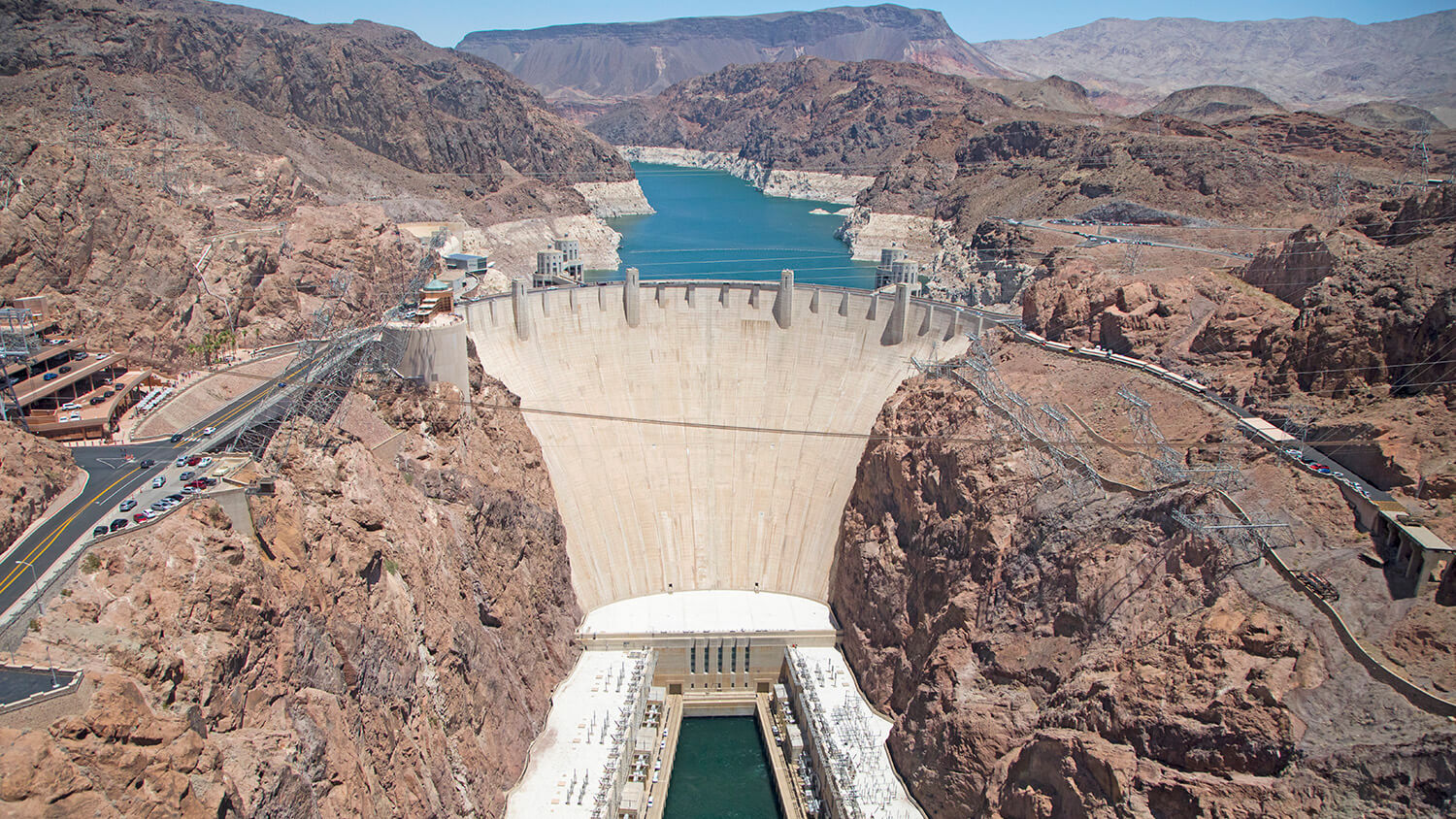
September 30, 1935, 90 years ago: Hoover Dam is dedicated, on the Colorado River between Boulder City, Nevada and Temple Bar Marina, Arizona, 33 miles southeast of Las Vegas. It provides electricity for Southern California. Without it, the rise of Los Angeles and San Diego would have been a lot harder.

It is a concrete gravity-arch dam, rising 726 feet above ground level, with a capacity of 3.25 million cubic yards. By damming up the river, it created Lake Mead, resulting also in Lake Mead National Recreation Area. There were 112 deaths among the construction workers, and a plaque memorializes them, saying, "They died to make the desert bloom."

President Herbert Hoover signed Congress' appropriation for it into law, and Secretary of the Interior Ray Wilbur, in charge of its construction, named it Hoover Dam. But after the 1932 election, President Franklin D. Roosevelt wanted to wipe Hoover and the depths of the Great Depression from the national memory, because, as one writer said, "The Great Engineer had quickly drained, ditched and dammed the country." FDR appointed a new Secretary, Harold Ickes, and, in 1933, he renamed it after Boulder City: Boulder Dam.

In his dedication speech, Ickes used the name "Boulder Dam" 5 times in 30 seconds. Also in the speech, he said that if it should be named after any one person, it should be Senator Hiram Johnson of California, who sponsored the bill, knowing that his State would benefit the most. And he was a Republican.

In 1947, after the Republicans took control of Congress for the 1st time since 1930, they passed bills through both houses restoring the name Hoover Dam. Unlike FDR, his successor, President Harry Truman, had no problem with the name, and signed it into law.

The top of the Dam was bannered as part of U.S. Route 93, but it was only 2 lanes. In 2010, a new bridge opened over the Colorado River, just downstream from the Dam. It was named the Mike O'Callaghan-Pat Tillman Memorial Bridge. O'Callaghan was Governor of Nevada from 1971 to 1979. Tillman was the Arizona State University and Arizona Cardinals safety who left the NFL to enlist in the U.S. Army after the 9/11 attacks, and was killed in action in Afghanistan.
Hoover Dam and the O'Callaghan-Tillman Bridge 

The new bridge is bannered as Interstate 11 and U.S. Route 93, while the top of the dam has been rebannered as Nevada Route 172.

Hoover Dam is one of those American icons that tends to get destroyed in disaster movies, including Superman: The Movie in 1978, Dante's Peak in 1997, 10.5: Apocalypse in 2006, San Andreas in 2015. In reality, it still stands, and supplies badly-needed water and electricity to the American Southwest. 

Tuesday, March 4, 2025

March 4, 1925: The Inauguration of Calvin Coolidge

March 4, 1925, 100 years ago: Calvin Coolidge, who became the 30th President of the United States upon the death of Warren Harding in 1923, and won a full term of his own in 1924, is sworn in as President. Charles G. Dawes, a former U.S. Ambassador to Britain, is sworn in as Vice President.

A 52-year-old native of Plymouth Notch, Vermont, and Governor of Massachusetts when he was elected Vice President in 1920, he is sworn in on the West Front of the Capitol Building, by the Chief Justice, himself a former President, William Howard Taft.

This was the 1st time that a former President swore in an incoming President. In spite of this, Taft goofed on the Oath of Office: Instead of asking Coolidge to "preserve, protect and defend the Constitution of the United States," it came out, "protect, preserve and defend." Four years later, for Herbert Hoover, Taft goofed again, making it "preserve, and maintain, and defend…"

His reputation as "Silent Cal" led to a story that two women at a White House party made a bet, and one walked up to Coolidge and said, "I made a bet with my friend that I could get you to say at least three words to me," and Coolidge said, "You lose." Belying this reputation, this speech was, and remains, the 6th-longest Inaugural Address of any President. His Inaugural Address is the 1st to be broadcast on radio. Unfortunately, no sound recording of the Address survives.

The Address is not especially memorable. He closes by saying, "America seeks no earthly empire built on blood and force. No ambition, no temptation, lures her to thought of foreign dominions. The legions which she sends forth are armed, not with the sword, but with the cross. The higher state to which she seeks the allegiance of all mankind is not of human, but of divine origin. She cherishes no purpose save to merit the favor of Almighty God."

The theme of his 1924 election campaign was "Keep Cool with Coolidge"; alternately, "Keep Cool and Keep Coolidge." The scandals of the late President Harding were forgotten: Coolidge was a model of propriety. And the country enjoyed "Coolidge Prosperity," and enjoyed an isolationist foreign policy: There were no international entanglements during his time in office.

On vacation in the Summer of 1927, he told the press, "I do not choose to run for President in 1928." Maybe he saw the writing on the wall, that an economic crash was coming. Herbert Hoover, Secretary of Commerce under Harding and Coolidge, was elected, and was left holding the bag for the Crash of 1929. Coolidge escaped blame for the Great Depression.

He died on January 5, 1933, 2 months before his 2nd full term, had he sought it and won it, would have ended. He remains the modern model for a boring President: When told he had died, theater critic Dorothy Parker said, "How can you tell?"

Thursday, November 2, 2023

November 2, 1948: "Dewey Defeats Truman"

November 2, 1948, 75 years ago: The most famous newspaper headline of all time? It might be the New York Daily News of October 30, 1975: "FORD TO CITY: DROP DEAD." Or it might be the one the Chicago Tribune (a proud Republican paper at the time) put up the morning after today's Presidential election.

As it turned out, despite all predictions and despite all polls, Governor Thomas E. Dewey of New York, the Republican nominee, did not defeat the incumbent Democrat, President Harry S Truman. This made Truman, the 33rd President of the United States, the patron saint of every Presidential underdog since.

The problem is, Harry was smarter than most of them. Which is why he's enjoying himself so much in the photo above: He fooled 'em all.

But Dewey was dumb to have blown what should have been a sure win. How dumb was he? Well, maybe not that dumb:
Dewey remains the only major-party Presidential nominee
with facial hair since the Republicans nominated Charles Evans Hughes in 1916.

The Republican Party didn't give him the support he needed, because they presumed he wouldn't need it. The polls all indicated a Dewey romp. 
Why? Because the Democratic Party had been splintered, from both wings. From the left: Henry A. Wallace, who had been Secretary of Agriculture in President Franklin D. Roosevelt's 1st 2 terms, Vice President in the 3rd, and Secretary of Commerce in FDR's 4th term before he died and it became Truman's 1st.

He was the darling of what's now called the progressive movement, but, then, it was an actual group named the Progressive Party. Aside from the name, it had no connection to the previous parties of that name, nominating Theodore Roosevelt in 1912 and Robert La Follette in 1924.
It was feared that Wallace would take the black vote. He did, but not as much as was feared. It was feared that he would take organized labor with him. He did, but not as much as was feared. It was feared that his campaign would swing New York to Dewey. It did. It was feared that his campaign would swing California to Dewey. It didn't. And it was feared that losing New York and California, with a combined 72 Electoral Votes, would cost Truman the election. Even if Truman had lost California's 25 EVs, he still would have won.

From the right: Strom Thurmond, Governor of South Carolina, who welcomed the Southern Delegates who walked out of the Democratic Convention in Philadelphia (both parties held their Conventions at the Philadelphia Civic Center that year), following a pro-civil rights speech by the Mayor of Minneapolis, who was running for the U.S. Senate, and won: Hubert Humphrey.

Thurmond was happy to accept the Presidential nomination of the States' Rights Party, a.k.a. the Dixiecrats. A precursor to the 1968 independent candidacy of George Wallace (no relation to Henry), he managed to win his home State of South Carolina, plus Alabama, Mississippi, Louisiana, and 1 Electoral Vote in Tennessee.
Later famously the oldest U.S. Senator ever,
Thurmond was just 45 years old at this point.
I don't think a picture of him looking young exists.

And Dewey himself seemed to be a great candidate. A crusading District Attorney in Manhattan, he had put some of the nation's nastiest organized crime bosses in prison. He was in his 2nd term as a successful, popular Governor. He had been the Republican nominee for President in 1944, running against wartime Commander-in-Chief Roosevelt, and had done well enough to earn himself a shot at a vulnerable peacetime President in Truman. And he was a young, good-looking guy: Just 46, and there was the thought that he could redeem the idea of mustaches after the bad reputation they had recently gotten from Adolf Hitler.

Surely, with Dewey popular, Thurmond splitting the formerly "Solid South," and Wallace moving New York and California from the Truman column to the Dewey column, Dewey would win. Interviewed in 1995, even Thurmond -- who wasn't even on the ballot in all 48 States, and knew he had no chance, but was willing to spoil things for Truman -- admitted, "I thought Dewey would win."

But the Republicans got too complacent. After all, Truman did win California after all, by a razor-thin margin of 18,000 votes. And there was no State that Thurmond threw from Truman to Dewey -- although Maryland was close enough, and its largest city Baltimore black enough, that Wallace, who got 10,000 votes there, might have thrown it to Dewey.

The Cold War was supposed to be Dewey's winning issue. Instead, it was Truman's, with the Truman Doctrine protecting Greece and Turkey from Communist takeover, the Marshall Plan aiding Western Europe before the Soviet Union could, and the Berlin Airlift preventing the Soviets from starving West Berlin into capitulation.

After 16 years, voters still didn't trust Republicans with the economy. Truman never mentioned Herbert Hoover, the last Republican President and the man who presided over the start of the Great Depression, by name, because they were on good terms. (Whereas Hoover was definitely not on good terms with FDR -- or with his own Republican predecessor, Calvin Coolidge.) So he blamed the Republicans in general for the Depression of the 1930s, and it worked.
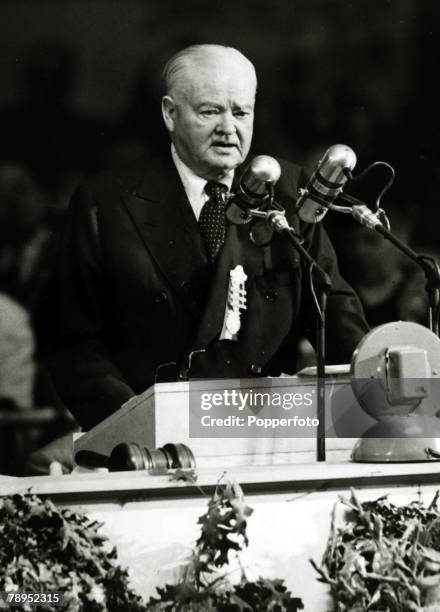
Hoover at the 1948 Republican Convention in Philadelphia.
They continued to invite him to every Convention,
and he kept coming until 1960.

From their days as fellow members of the U.S. Senate, Truman was good friends with Alben Barkley, the Kentuckian who was the Democrats' Senate Leader, and had no problem accepting him as the nominee for Vice President. But he hitched his wagon to the legacy of Franklin Delano Roosevelt, effectively making the New Deal his platform (his 1949 State of the Union Address would update it for the times as "the Fair Deal"), and FDR's ghost his running mate.
Truman and Roosevelt, at FDR's Hyde Park estate,
after the 1944 Democratic Convention

Truman knew he could win, and he knew how he could do it: By going to the people themselves, in what the GOP derisively called "a whistle-stop campaign," a phrase Truman ran with, and explaining the truth to people where they were, and in terms they could understand -- without talking down to them, as Donald Trump does today. He connected with people the same way FDR did, even though they were very different men. 

Ever since, Ol' Harry S has been the patron saint of political underdogs, of the people who are told they can't possibly win.

(There's no period on his middle initial, since it legally didn't stand for anything, as his parents couldn't agree on whether to name him after one of his grandfathers, Anderson Shippe Truman or Solomon Young. So his entire middle name was the letter S, with no period. His mother's brother was Harry Young, and the name was "Harry," not "Henry" or "Harrison." His legal name was "Harry S Truman.")

Even Republicans cite him as an inspiration. As Truman himself would have said, "Well, that's just political conversation." Or, as his only child, Margaret, who became a noted writer of mystery novels after a failed singing career, put it while editing one of her father's books, "My father originally used a shorter word here, but decided to change it."

Truman did love him some of what I like to call "George Carlin words." Legend has it that Harry and his wife Bess (formerly Elizabeth Wallace) toured a greenhouse, and Harry, a former farmer himself, told the owner, a woman, that she "must have used some good manure." The owner pulled Bess aside and said, "Can't you get the President to say, 'Fertilizer'?" And Bess said, "It's taken me this long just to get him to say, 'manure'!"

Truman won 24.1 million votes, Dewey 22.0 million, Thurmond 1,175,930, Wallace 1,157,328. Popular vote share: Truman 49.5 percent, Dewey 45.1, Thurmond 2.41, Wallace 2.37. States: Truman 28, Dewey 16, Thurmond 4, Wallace none. Electoral Votes, with 266 being a majority: Truman 303, Dewey 189, Thurmond 39, Wallace none. Wallace got 8.2 percent of the popular vote in New York, 4.7 percent in California, and less than 4 percent everywhere else.

The Democrats also swept back into power in Congress, taking 75 seats in the House of Representatives and 9 in the Senate. Notable newly-elected Senators included Democrats Humphrey, Estes Kefauver of Tennessee, Paul Douglas of Illinois, and Bob Kerr of Oklahoma. Only 2 new Republicans were elected: Margaret Chase Smith of Maine (making her the 1st woman to serve in both houses of Congress) and Robert Hendrickson of New Jersey.

If Dewey hadn't been so complacent, he would have realized that Truman was reaching the hearts and minds of the people. And he might have gone out to answer Truman's charges against him and "that do-nothing Republican 80th Congress." Maybe the Republicans, as a party, blew it for Dewey. But he also blew it for himself.

Truman could have run for what would have amounted to a 3rd term in 1952, but didn't. He went back to his hometown of Independence, Missouri, where he built, opened, operated, and lectured at his Presidential Library, until his death in 1972.

Dewey was elected to a 3rd term as Governor of New York in 1950, and left office after that 3rd term. The New York State Thruway is also known as the Governor Thomas E. Dewey Thruway. Despite being 17 years younger, he died a year before Truman.

Wallace drifted into obscurity, and wrote books about farming, his specialty. He died in 1965, of Lou Gehrig's disease. Thurmond was elected to the Senate in 1956, became a segregationist leader, switched to the Republican Party in 1964, and kept getting re-elected to the Senate until 2002, when, approaching his 100th birthday, even he had to admit that he wouldn't survive another term. He died the next year.

Thursday, August 3, 2023

Top 10 Myths About the Roaring Twenties

August 2, 1923, 100 years ago: President Warren G. Harding dies. When the 1920s began, he was elected President as a good-looking, charismatic man who would lead the nation into a new era of "normalcy," while, at the same time, letting us have as much fun as he was having behind the scenes.

By the time the 1920s were over, he had been posthumously exposed as an idiot, a womanizer, and the head of a really corrupt Administration. His reputation crashed every bit as hard as the stock market did.

His image was well-crafted, especially since he was seen as nice and healthy, unlike the physically and politically paralyzed outgoing President, Woodrow Wilson. Little did anyone know that Harding was, like Wilson before his 1919 stroke, already a lot sicker than he let on by the time his candidacy began.

So let's look at some myths about the uproarious decade, and see how close they were to the truth:

Top 10 Myths About the Roaring Twenties

1. Babe Ruth saved baseball. That is, his home runs in 1920 and onward made the nation forget about the Black Sox Scandal, which would have destroyed baseball otherwise.
Warren Gamaliel Harding and George Herman Ruth Jr.

Baseball had survived scandals and down periods before. Certainly, Ruth helped. But the scandal didn't break until the end of the 1920 season, nearly a year after the fixed World Series, and Ruth was already destroying previous home run records. Without it, baseball might have taken longer to bounce back, but it would have happened.

And if you had asked the Babe himself, he would admit that he hadn't "saved baseball," that baseball didn't need "saving." It didn't after the Black Sox Scandal, it didn't after the Strike of '81, it didn't after the Strike of '94, and it doesn't now.

*

2. Warren Harding was one of the worst Presidents. Did the 29th President of the United States get a bum rap? This website advertises "6 Major Accomplishments of Warren G. Harding." Let's check them out, and see if they hold water:

1. Before embarking on a political career as an ambitious Republican, he built a successful newspaper, The Marion Star. He did this, but that's hardly a major accomplishment, and it wasn't something he did as President. So we can't count it.

2. Warren Harding was the first sitting U.S. Senator to win the Presidency. This is true. Is it a major accomplishment? Certainly: Winning the Presidency is one, regardless of how you did it, unless you cheated -- and, as far as we can tell, he didn't. But it's not an accomplishment as President.

3. One of his earliest successes was the Washington Naval Conference in 1921–22. He managed to bring the major nations with significant naval might to agree on what was called the naval limitations program. The program was in place for a decade.

This could be considered a major accomplishment. Or, it could be attributable to his Secretary of State, Charles Evans Hughes, much as the Louisiana Purchase was less Thomas Jefferson than his negotiator, James Monroe; the Monroe Doctrine was less Monroe than Secretary of State (and successor as President) John Quincy Adams; and the Alaska Purchase was less Andrew Johnson than Secretary of State William Seward. But we can count it in Harding's favor.

4. Warren Harding passed the federal child welfare program, the first of its kind. He managed to lower taxes, increased the tax base, raised tariffs to create employment and he also managed to successfully negotiate with striking workers in mining and railroad companies, particularly the crisis in Blair Mountain and the Great Railroad Strike in 1922.

This is actually 4 separate actions. The child welfare program was, unquestionably, a good thing. But lowering taxes doesn't increase the tax base: By definition, it lowers it. Raising tariffs doesn't create employment, it reduces it. These things helped to set up the Great Depression of the 1930s.

And he had little to do with the Blair Mountain Crisis -- which wrecked the United Mine Workers for a decade. So that's 1 plus, 2 major minuses, and 1 flat-out lie that would have been a minus had it been true.

5. Warren Harding was vocal against lynching and the violence meted out to African Americans. He did bring in the anti-lynching bill only to see it fail at the hands of the Congress. Harding's Republican Party had control both houses of Congress, so, while his heart was in the right place, he failed as a leader on this issue.

6. President Harding signed a peace treaty with Austria and Germany post World War I. Big deal. Whoever was President was going to do that. It was a formality, since the war had ended 3 years earlier, and the Congress of Versailles had already happened. No one counts the proclamation officially ending World War II that he signed on December 31, 1946 -- 16 months after V-J Day -- as one of the accomplishments of Harry Truman. Ending the war in victory for the Allies, yes; the New Year's Eve '46 treaty, no.

So, to tally up: 9 actions, resulting in 2 major accomplishments, 1 piece of window dressing, 1 embarrassing failure, 2 harmful actions, and 3 actions that were not accomplishments of his Presidency at all.

And, yes, his economic policies, guided by Secretary of the Treasury Andrew Mellon, helped to set up the Great Depression. And, yes, the Teapot Dome scandal was the biggest piece of executive branch malfeasance ever, and would remain so for another half a century.

In other words: In 2 1/2 years in office, 2 big pluses, 1 very little plus, 3 minor minuses, 1 big minus, and 1 humongous minus.

Was America better off on August 2, 1923, when Harding left the Presidency through death, than it was on March 4, 1921, when he entered the Presidency? Yes. How responsible was he for that? Not much. And, by March 4, 1931, the 10th Anniversary of his Inauguration, it was obvious that he was one of the worst Presidents the country had ever had. That we have since had Herbert Hoover, Richard Nixon, Ronald Reagan, George W. Bush and Donald Trump, each of whom was even worse, by no means elevates Harding in history.

*

Let's move on:

3. The Great Gatsby symbolizes the good times of "The Jazz Age." This one is pure baloney. Both the 1925 novel by F. Scott Fitzgerald and the films based on it, including the Robert Redford version in 1974 and the Leonardo DiCaprio one in 2013, show that all the parties and other good times were hollow -- or, to use the expression I used for Harding's treaty "ending the war," window dressing -- and did nothing but take people's minds off the difficulties of life.
F. Scott Fitzgerald

A director with guts could easily do a version of Gatsby and set it over half a century later, in the Disco Period.

4. Charles Lindbergh was the 1st man to fly across the Atlantic Ocean. He was the 1st to do it solo, and the 1st to do it from the North American continent to the European continent. Certainly, that was worth celebrating. Perhaps not as much as it was celebrated in what a documentary about the 1920s called "The Age of Ballyhoo." But worth some celebration.
Lindbergh and his plane, Spirit of St. Louis

But Lindbergh wasn't the 1st to fly across the Atlantic, or even the 2nd. On June 15, 1919, British pilots John Alcock and Arthur Brown made the 1st air crossing of the Atlantic. To be fair to Lindbergh and his achievement, Alcock and Brown did not go full continent-to-continent. They chose the closest possible route: From St. John's, Newfoundland, the easternmost city in the Western Hemisphere, to the west coast of Ireland, the westernmost point in Europe.
Arthur Brown (left) and John Alcock

5. The Jazz Singer was the 1st "Talking Picture." It wasn't: Its star, Jolson, already a Broadway and recording legend, had sung in a much shorter film the year before. But it was the 1st feature-length motion picture with a synchronized recorded music score, and the 1st feature-length motion picture with lip-synchronous speech and singing.
6. "Coolidge Prosperity." Yes, there was an economic boom that began under Harding, ending the postwar drop under Wilson, which was definitely a recession and has been termed a "depression" by some. And it continued under Coolidge.
Calvin Coolidge

But looks can be deceiving. Using the Dow Jones Industrial Average as a guide: It was 64 on August 22, 1921. Not 6,400: Sixty-four. It reached 100 in October 1922, was at 87 when Harding died in August 1923, and was at 120 at the end of 1924, Coolidge's 1st full year in office. Proportionally speaking, that's significant improvement.

At the end of 1925, it was at 156. In September 1926, it reached 164, before dropping a little by the end of the year. It broke 200 at the end of 1927. The real surge began in July 1928, just as Hoover was running on "Republican prosperity." It hit 292 on November 26, 1928. After a drop in early December, it reached 300 on New Year's Eve. On June 10, 1929, it was 303. On September 3, it had surged to 381.17.

Then it started going down. The "Crash of '29" seems to have happened in a hurry, but, on October 23, the Dow was already down to 305.85. On the 24th, "Black Thursday," it fell to 299.47, and would have been worse if not for a late stock buy made by the famous "walk across the floor" of the New York Stock Exchange by J.P. Morgan banker Thomas W. Lamont. On Friday, the 25th, there was a slight rise, to 301.22.

But the weekend, as it frequently has in tough times since, bred worry. On Monday the 28th, the Dow fell to 260.64. The 29th was "Black Tuesday," and the Dow fell to 230.07. The chickens hatched by Harding, Coolidge and Mellon had come home to roost. As a poem of the time went:

Hoover blew the whistle
Mellon rang the bell
Wall Street gave the signal
and the country went to hell!

What about the other major gauge of how well the economy is doing, the unemployment rate? Here it is, at the end of each calendar year in the 1920s:

* 1920: 4.0 percent
* 1921: 11.9
* 1922: 7.6
* 1923: 3.2

Looks like the Harding-Mellon policy of cutting taxes is working. Let's see what the Coolidge of policy of "do nothing, because the business of America is business" does:

* 1924: 5.5
* 1925: 4.0
* 1926: 1.9

Is that for real? Or was somebody cooking the books? Let's continue:

* 1927: 4.1
* 1928: 4.4
* 1929: 3.2

In other words, while the Crash happened late in 1929, the Depression wasn't yet getting noticed around the country. But then:

* 1930: 8.9

That's bad, but not as bad as the hangover from the Wilson years. But it got much, much worse thanks to the Harding-Mellon-Coolidge-Hoover policies:

* 1931: 15.9
* 1932: 23.6
* 1933: 24.9

Yeah. America needed a new deal, capitalized or otherwise. Harding died, and Coolidge did "not choose to run for President in 1928." So they escaped the blame of "early drafts of history," and Hoover was "left holding the bag." It just seemed too convenient, just as it was to blame CBS for the collapse of the Yankees in 1965, without considering what harm selling owners Dan Topping and Del Webb had already done.

Calvin Coolidge was, at least domestically, the most conservative President America has ever had. Not a radical right-winger like Reagan, George W. Bush or Trump, but conservative in the old sense of the word. America paid the price for this, but he didn't.

7. Prohibition turned America into a giant gangland shooting gallery. The homicide rate did rise in the 1920s, but context is needed. A lot of potential murderers, and murder victims, were in the service in 1917 and 1918.

But there's no sign that Prohibition or organized crime accounted for most, or even much, of it. Hijackings of cars and trucks smuggling liquor was common, but the robbers usually didn't find it necessary to kill the drivers. Why cause more trouble than you need?

8. "Flappers" were women of loose morals. Smoking. Drinking. Showing skin, with the age of the corset being over.

There was no study done at the time to prove that flappers had more sex than their predecessors. They did have more opportunity for pre-marital sex, as well as an increasing knowledge of contraceptive practices. The easier access to cars carried young adults away from parental eyes to socials, parties, sporting events, and theaters, while Hollywood productions portrayed, and simultaneously manufactured, this modern courting culture.

But there seems to have been no major rise in pregnancies, births, abortions, or sexually-transmitted diseases. If there was, it's been kept quiet. And if you wonder how something can be kept quiet for 100 years, let the record show that I didn't find out about the Tulsa Massacre of 1921 until around 2000 or so, and didn't find out about the Ocoee Massacre in Florida in 1920 until its 100th Anniversary. And we still don't know what caused Babe Ruth's "Bellyache Heard 'Round the World" in 1925.

9. The Stock Market Crash of 1929 led to mass suicides. Since then, whenever there's a dip in the stock market, demonstrators go to the New York Stock Exchange at Broad and Wall Streets, and yell, "Jump! Jump! Jump!" Because they think that's what happened during and after the Crash of '29.

There is no record of a single stockbroker suicide, let alone one via jumping out of a window, in the wake of the Crash. In what remains the definitive book about the Crash, The Great Crash 1929, Pulitzer Prize-winning economist John Kenneth Galbraith wrote, "In the United States the suicide wave that followed the stock market is also part of the legend of 1929. In fact, there was none."

One of the more famous photos connected with the Crash is this one, showing Walter Thornton. He was one of the most successful male models of the early 20th Century. Today, though, he is best known for this photo, trying to sell his very nice car, a 1929 Chrysler Imperial 75 Roadster, for $100 -- about $1,784 in today's money.
Did Thornton get $100 for his car? I can find no reference to an answer. But he did return to his previous career, modeling, and soon started a modeling agency, and gained a new fortune from that. He lived until 1990.

10. The Crash of 1929 caused the Great Depression. That was part of it, but by no means all of it. The end of World War I meant that farmers, having lost a big chunk of their market, had already been in a depression since the Armistice, 11 years earlier.
The famous headline in
the film industry's "trade paper"

In his nationally-syndicated newspaper column, Will Rogers spent much of the "Roaring Twenties" saying how, for farmers, the decade didn't roar so much as mumble. He pointed out that the economic boom wasn't universal for the cities, either: In 1928, about a year before the Crash, he wrote, "Wall Street has never been better off, but Eighth Avenue has never been worse off."

When he was President, John F. Kennedy quoted an old saying: "A rising tide lifts all boats." Not a boat with a hole in it. And, of course, in the 1920s as now, some people didn't have boats, and some people couldn't even swim.

Even with the Crash, the Depression might have been sharp, but relatively short, if not for the Smoot-Hawley Tariff Act, which President Herbert Hoover signed into law on June 17, 1930. Named for its sponsors, Senator Reed Smoot of Utah and Representative Willis Hawley of Oregon, both Republicans, the law raised U.S. tariffs on over 20,000 imported goods.
Willis Hawley (left) and Reed Smoot

This prompted retaliatory tariffs by other countries against America. As a result, between 1929 and 1933, American exports dropped 61 percent, and American imports dropped by 66 percent. Between 1929 and 1932, real Gross Domestic Product fell 17 percent worldwide, and 26 percent in the United States.

Unemployment was 8 percent when the Act was passed. It doubled to 16 percent in 1931 -- already higher than any of the "recessions" since the Depression -- and 25 percent in 1932. It is suspected that, when FDR took office on March 4, 1933, it may have been as high as 31 percent. If the Crash was the biggest cause, Smoot-Hawley was a strong second.

The Roaring Twenties did roar. But not quite the way history tends to remember it.

Saturday, March 4, 2023

March 4, 1933: The New Deal Begins

March 4, 1933, 90 years ago: A new President is inaugurated, and it begins a new era in American history.

A few of our transfers of power have been fraught with worry:

* March 4, 1797: The 1st transfer of power, from George Washington to John Adams. It turned out not to be anything to worry about, but that was far from certain at the time, since no one, not even the brilliant and highly talented Adams, had Washington's gravitas.

* March 4, 1801: The 1st transfer of power from one party to another, from Adams, a member of the Federalist Party, to Thomas Jefferson, founder and leader of the Democratic-Republican Party, whose members called themselves "Republicans," but would eventually evolve into the Democratic Party. 

Once closely linked in the fight for independence, now estranged and bitter enemies, Adams had appointed what became known as "midnight judges" at the end of his Administration, with the intent of holding Jefferson back from perceived extreme measures. But Jefferson's 2 terms in office turned out to be comparatively peaceful. The friendship would later be restored.

* March 4, 1861: With the threat of civil war becoming very real, James Buchanan handed the Presidency over to Abraham Lincoln. Threats against Lincoln's life had already been made, and he practically had to sneak into Washington. He tried a conciliatory Inaugural Address. It didn't work.

* March 5, 1877: The disputed election that put Rutherford B. Hayes in as the next President, despite Samuel J. Tilden having received the most popular votes and, it appeared at first, the necessary Electoral votes, infuriated people to the point where another civil war seemed possible: The cry from the Democrats was "Tilden or blood!" And it wasn't officially settled until March 2. To complicate matters further, the usual Inauguration Day, March 4, fell on a Sunday: The official ceremony at the Capitol was set for the following day.

To simplify things, the outgoing President, Ulysses S. Grant, suggested that Hayes take the Oath of Office in the White House on March 3, taking effect at noon on March 4, so that he would already be the President on March 5, so that the Inaugural ceremonies would essentially be going through the motions for public display. There was no violence.

* January 20, 1981: The 20th Amendment to the Constitution, ratified in 1933, had moved Inauguration Day up, largely because of the events of 1932-33. President Jimmy Carter, a Democrat, and President-elect Ronald Reagan, a Republican who had overwhelmingly defeated him in a bitter election, were not friendly with each other. But that wasn't the problem.

The problem was that Carter was finally close to getting 52 hostages released by Iran, but the Iranian government decided to keep them in custody until after noon, U.S. Eastern Time, to deny Carter a full victory. Their plane ended up clearing Iranian airspace at 12:35 PM Eastern. While Carter went to meet them at the U.S. Air Force base in Weisbaden, West Germany, it was Reagan who welcomed them to the White House, making it look like he was taking credit for it. He did nothing to make their release happen.

* January 20, 1993: Despite a bitter campaign, President George H.W. Bush, Republican, and President-elect Bill Clinton, Democratic, had made peace with each other in the transition. But there was a situation involving Iraq on the last day of Bush's term. Bush suggested that his national security team remain in charge for a few hours more, and Clinton agreed. Bush signed an Executive Order extending their terms by 4 hours. The situation was settled, and Clinton's team began their terms.

* January 20, 2001: Bush's son, George W. Bush, had emerged victorious over Clinton's Vice President, Al Gore, under dubious circumstances. There were protestors at the Capitol for the Inauguration, but there was no violence.

* January 20, 2017: Again under dubious circumstances, a Republican who did not win the popular vote took the office. This time, it was Donald Trump, the most underqualified incoming President ever, and the most psychologically unfit. Violence was feared. There was none.

* January 20, 2021: Joe Biden had beaten Trump, but after the attack on the Capitol while the Electoral Votes were being certified on January 6, people were afraid that another attack would be launched. This time, there was enough of a deterrent force on hand that the would-be second-time insurrectors did the smart thing, and stayed away.

If anything, the events of March 4, 1933 were fraught with even more worry than 2021 -- or even 1861.

*

For it was the depth of the Great Depression. Within 8 months of taking office as President on March 4, 1929, Herbert Hoover saw the stock market crash on his watch. He wasn't responsible for it. And it would be unfair to say he did nothing about it. A fairer statement would be that he didn't do enough things, and that he didn't take the things he did do, which did help a little, far enough.

So, in the 1932 election, he lost in a massive landslide to the Governor of New York, a Democrat, Franklin Delano Roosevelt. The interregnum between the election on November 8 and the Inauguration on March 4 was interminable, as a bitter Hoover, like Trump with Biden 88 years later, shared nothing with FDR and his team. Essentially, Hoover sabotaged his own best chance at leaving office on a high note.

As a result, things got worse. Banks were failing all over the country. People were terrified. The American economy was on the brink of complete collapse, more so than it had been during the "panics" of 1791, 1819, 1837, 1857, 1869, 1873, 1893 and 1907, even more so than during the Crash of 1929. And, as it turned out, more than during the Crash of 1987, the economic free-fall of 2008, and the drop during Spring 2020's coronavirus crisis.

Inauguration Day fell on a Saturday, and this may have been for the best, as the banks would have been closed anyway.

Roosevelt was sworn in, and made the most important Inaugural Address in the history of the office. It wasn't just the conditions that were the problem, it was the fear of the problem that he wanted to address, the fear that was making things worse. On that subject, it is fair to say that Hoover did nothing. Roosevelt addressed this right off the bat:

President Hoover, Mr. Chief Justice, my friends: I am certain that my fellow Americans expect that, on my induction into the Presidency, I will address them with a candor and a decision which the present situation of our Nation impels.

This is preeminently the time to speak the truth, the whole truth, frankly and boldly. Nor need we shrink from honestly facing conditions in our country today. This great Nation will endure as it has endured, will revive and will prosper.

So, first of all, let me assert my firm belief that the only thing we have to fear is fear itself: Nameless, unreasoning, unjustified terror which paralyzes needed efforts to convert retreat into advance. 

Despite a light rain falling on Washington for most of the day, the Inaugural crowd may have been the biggest in history to that point, and a great cheer went up.

Roosevelt promised "action, and action now!" He acted on it. Over the weekend, he set in motion the policies that embodied what he called, during the campaign, "a new deal for the American people." His New Deal measures included keeping the banks closed for a week, so they could straighten out their own situations. When they reopened on March 12, they were secure, and the nation's recovery began.

It would be long and slow, but FDR's New Deal measures helped millions of people get by. Had he only served 2 terms, and someone else had led the nation through World War II, FDR would still be remembered as one of the nation's greatest and most important Presidents. His leadership during World War II would put him up there with Washington and Lincoln as 1 of the 3 greatest Presidents.

Franklin Delano Roosevelt was inaugurated as President of the United States just 33 days after Adolf Hitler was appointed Chancellor of Germany, and the Nazi regime began. No one knew it at the time, but FDR and Hitler were on a collision course. A little more than 12 years later, both would be dead -- but one of them would be victorious. And for most of those 12 years, it wasn't clear which one that would be.

There have been, essentially, 4 eras of American history:

* The Colonial era, beginning with the arrival of Christopher Columbus in 1492 (note that I'm not saying that he "discovered America"), and lasting until the Declaration of Independence in 1776.

* The Revolutionary era, from the Declaration until the end of the Civil War in 1865.

* The next era, whatever name you want to give it, lasting from the end of the Civil War until the start of the New Deal in 1933.

* And the era that began with the New Deal. If you want to say that, sometime since 1933, that 4th era ended and a 5th era has begun, I don't know what your line of demarcation would be. Neither the resignation of Richard Nixon in 1974, nor the Inauguration of Reagan in 1981, nor that of Clinton in 1993, nor the 9/11 attacks of 2001, nor the arrival of Trump in 2017, nor the leaving of Trump in 2021 carries the same amount of historical weight, nor is likely to. 

Top 10 Myths About the Great Depression

A bread line during the Depression

March 4, 1933, 90 years ago: Franklin Delano Roosevelt is inaugurated as the 32nd President of the United States, at the very depth of the Great Depression.

Top 10 Myths About the Great Depression

1. The Depression was caused by the Stock Market Crash of 1929. That was part of it, but by no means all of it. The end of World War I meant that farmers, having lost a big chunk of their market, had already been in a depression since the Armistice, 11 years earlier.
The famous headline in
the film industry's "trade paper"

In his nationally-syndicated newspaper column, Will Rogers spent much of the "Roaring Twenties" saying how, for farmers, the decade didn't roar so much as mumble. He pointed out that the economic boom wasn't universal for the cities, either: In 1928, about a year before the Crash, he wrote, "Wall Street has never been better off, but Eighth Avenue has never been worse off."

When he was President, John F. Kennedy quoted an old saying: "A rising tide lifts all boats." Not a boat with a hole in it. And, of course, in the 1920s as now, some people didn't have boats, and some people couldn't even swim.

Even with the Crash, the Depression might have been sharp, but relatively short, if not for the Smoot-Hawley Tariff Act, which President Herbert Hoover signed into law on June 17, 1930. Named for its sponsors, Senator Reed Smoot of Utah and Representative Willis Hawley of Oregon, both Republicans, the law raised U.S. tariffs on over 20,000 imported goods.
Willis Hawley (left) and Reed Smoot

This prompted retaliatory tariffs by other countries against America. As a result, between 1929 and 1933, American exports dropped 61 percent, and American imports dropped by 66 percent. Between 1929 and 1932, real Gross Domestic Product fell 17 percent worldwide, and 26 percent in the United States.

Unemployment was 8 percent when the Act was passed. It doubled to 16 percent in 1931 -- already higher than any of the "recessions" since the Depression -- and 25 percent in 1932. It is suspected that, when FDR took office on March 4, 1933, it may have been as high as 31 percent. If the Crash was the biggest cause, Smoot-Hawley was a strong second.

2. Stockbrokers and other ruined businessmen jumped out of windows to their deaths. Since then, whenever there's a dip in the stock market, demonstrators go to the New York Stock Exchange at Broad and Wall Streets, and yell, "Jump! Jump! Jump!" Because they think that's what happened during and after the Crash of '29.

There is no record of a single stockbroker suicide in the wake of the Crash, let alone one via jumping out of a window. In what remains the definitive book about the Crash, The Great Crash 1929, Pulitzer Prize-winning economist John Kenneth Galbraith wrote, "In the United States the suicide wave that followed the stock market is also part of the legend of 1929. In fact, there was none."

3. Herbert Hoover Was to Blame. The 31st President of the United States took office on March 4, 1929. Within 8 months, the crash came. But the policies that caused it were already in place. Hoover was a convenient scapegoat, because it happened on his watch.

When Warren Harding was elected President in 1920, he appointed Andrew Mellon as his Secretary of the Treasury. Harding died in 1923, and Calvin Coolidge became President. He kept Mellon. In 1927, Coolidge famously said, "I do not choose to run for President in 1928." Hoover did, and won. He also kept Mellon.
Andrew Mellon

Mellon's policies may have set up the post-World War I "paper prosperity," which became known as the "Coolidge Prosperity," but they also did the most to set the Depression up. If anybody can be called
"Mr. Depression," he's the one. Perhaps Coolidge knew the crash was coming, and left one step ahead of it, and left Hoover holding the bag. A sign at the 1932 Democratic Convention read:

Hoover blew the whistle
Mellon rang the bell
Wall St gave the signal
And the country went to hell.

4. Hoover did nothing about the Depression. This is a considerably fairer statement, but not completely fair. It would be more accurate to say that he tried something, but not enough of it.
One thing he tried was the Reconstruction Finance Corporation, although he didn't sign it into law until January 22, 1932. Had such a bill hit his desk 2 years earlier, it could have made a much bigger difference. The RFC -- a precursor to FDR's "alphabet soup" agencies in the New Deal -- provided financial support to State and local governments, and made loans to banks, railroads, mortgage associations, and other businesses.

The RFC became more prominent under the New Deal, and continued to operate through World War II. It was disbanded in 1957, when the federal government concluded that it no longer needed to stimulate lending.

Hoover's main problem is that he was a "strict constructionist" in regard to the Constitution of the United States, and didn't believe it offered him what FDR would, in his Inaugural Address, call "broad executive power to wage a war against the emergency, as great as the power that would be given to me if we were in fact invaded by a foreign foe."

5. The Depression was the Golden Age of Gangster Movies. This one is true. People could watch movies about the gangsters who troubled their cities, but, with the Hays Code in effect, could watch them get their comeuppance, as "sin" had to be punished for such a movie to be released. It started with Edward G. Robinson in Little Caesar, released on January 9, 1931. Paul Muni starred in the original version of Scarface in 1932, which also helped to make a star of George Raft.

James Cagney starred in The Public Enemy in 1931, Lady Killer and The Mayor of Hell in 1933, Angels with Dirty Faces in 1938, and The Roaring Twenties in 1939 -- perhaps the 1st film to treat the 1920s with nostalgia. Later, he would top them all with White Heat in 1949.
James Cagney

Raft -- who, unlike the others, really did consort with gangsters -- was another actor who played those guys with aplomb, in films like Quick Millions and Hush Money in 1931; Night World, Love Is a Racket and Madame Racketeer in 1932; The Bowery in 1933; Limehouse Blues in 1934; and I Stole a Million in 1939. He was in a few films with Cagney, but, ironically, in those films together, neither of them played gangsters. Both men actually got their starts as dancers, or "hoofers."

Incidentally, in the 1932 film Taxi!, Cagney played not a gangster, or even a cop, but a taxi driver, who, at one point, yells out, "Come out and take it, you dirty yellow-bellied rat!" This led to every impressionist to misquote him by saying, "You dirty rat!"

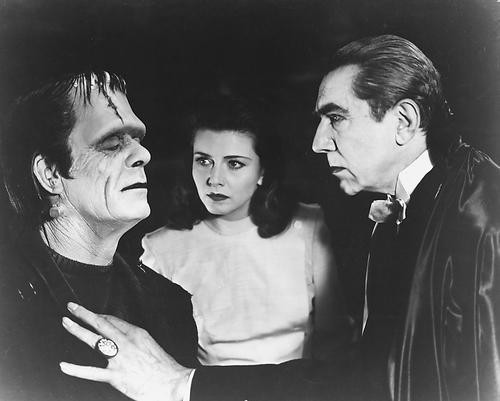
6. The Depression was the Golden Age of Monster Movies. This myth being true is a matter of opinion, but the way certain characters were depicted at this time defined those characters, possibly to this day. In 1931, Bela Lugosi starred in Dracula. Later in the year, Frankenstein introduced Boris Karloff as the monster, with Colin Clive as Dr. Frankenstein himself. (The monster was never named in the film, but has, himself, been mistakenly called "Frankenstein" ever since.)
Left to right: Boris Karloff, Maureen O'Sullivan and Bela Lugosi,
posing for the newsreel feature Screen Snapshots #11, 1934

King Kong, about a giant ape taken from his tropical island home to New York, breaking out and terrorizing the city, debuted in 1933. The same year, Karloff starred in The Mummy, and Claude Rains starred in The Invisible Man. In 1935, The Bride of Frankenstein premiered, with Karloff and Clive reprising their roles, and Elsa Lanchester cast in the title role. It wasn't the 1st film sequel, but it can safely be called the 1st good one.

And people identified with the struggles against these characters, as, unlike the Depression itself, they were an enemy that could actually be seen and heard. And, if they touched you, they could harm you in definitive ways, unlike the more subtle harms of the Depression.

And yet, both the Frankenstein monster and Kong were more victim than villain, and people could also sympathize with humanity's unwillingness to accept them. White Americans might not have seen either figure through the prism of civil rights, but they could see them through the prism of "the forgotten man," the man that the establishment didn't want to remember.

Lon Chaney (Leonidas Frank Chaney), who had starred in the silent films The Hunchback of Notre Dame in 1923 and The Phantom of the Opera in 1925, had died in 1930. His son, Lon Chaney Jr. (Creighton Tull Chaney), starred in The Wolf Man in 1941, toward the end of the Depression, so it can't be counted with these others.

But that started a new trend: With World War II coming up, people decided it was better to see these creatures fight each other, and even to laugh at them, than to be afraid of them. So films where they fought were produced, and there was a series of Abbott and Costello Meet... films with the monsters, some played by their 1930s portrayers.

7. The Depression ended "the Jazz Age." It is true that the term "Jazz Age" applies to the 1920s not just because of the music, but because of a lifestyle that included the happy dancing, the happy drinking, and the gangsterism that supported it. As the 1969 film They Shoot Horses, Don't They?, set in 1935, shows, the Depression showed going out and dancing to have become a very different thing during the Depression, and the 1933 repeal of Prohibition didn't change that. (That film also showed people dancing under a mirror ball, 40 years before the rise of disco music. In fact, the mirror ball had been invented in 1917.)

But, as for the music, if anything, the 1930s were the decade when jazz came out of the shadows of a black-only phenomenon and into the mainstream of white America. The best jazz groups remained black ones, led by pianist-composers Edward "Duke" Ellington, William "Count" Basie, and Thomas "Fats" Waller, trumpeter Louis Armstrong, and drummer Chick Webb. But bandleaders like Benny Goodman, Artie Shaw, and the brothers Tommy and Jimmy Dorsey -- first together, then separately after a feud, then occasionally together again after reconciling -- proved that white men could uphold the mantle of jazz as well.

By 1938, Goodman and Basie could appear together onstage -- at no less a classical music venue than Carnegie Hall in New York -- and be celebrated for it.
Count Basie, fronting Benny Goodman and Ethel Waters,
at the Stage Door Canteen, New York, 1943

8. Franklin D. Roosevelt's New Deal solved the Depression. Certainly, it made things better. By May 1937, early in his 2nd term, FDR had cut unemployment to 14 percent, approximately in half. But that's still worse than it has ever been since, with the brief exception of the height of the COVID epidemic. Even FDR's commitment and hard work, and the geniuses (genii?) of his "Brain Trust" couldn't get it lower than that.

9. The New Deal "made the Depression worse." This is what conservatives have wanted you to believe ever since. In May 1937, another downturn began, and by June 1938, unemployment was back up to 19 percent, back to where it was in 1935. The Democrats paid for this at the polls in 1938: The 336-88 advantage they had in the House of Representatives after 1936 dropped to 262-169, and their 77-15 Senate advantage (there were also 4 independents) fell to 69-23.

This had an interesting side effect: Just as the Congressional and gubernatorial elections of 1930, '32, '34 and '36 had wiped out many potential future Presidential candidates for the Republicans, so too did the '38 races knock out some potential Democratic candidates for 1940. As a result, neither party had much of a "bench" that could replace FDR. Without such a challenger to him, FDR knew there was no one who could seriously challenge Nazi Germany's Chancellor, Adolf Hitler, in his bid for world supremacy. FDR thought his Vice President, John Nance Garner, was too conservative to give Hitler the strenuous level of necessary opposition. So FDR ran for a 3rd term.

For most of 1939, unemployment was around 17 percent. By 1940, it had dropped back to 14; for 1941, 10. So what happened? Did FDR's New Deal programs make the Depression worse?

"Worse"? Worse than what? Worse than what he inherited on March 4, 1933? Don't be ridiculous. Republicans then, and conservatives now, want you to believe that "big government" does this. In fact, it was the exact opposite. In 1937, FDR was doing exactly what conservatives want the President to do: He was cutting back on spending. He thought he could do it because of the successes he'd had.

By 1938, he realized what a mistake this was, and, after his "First New Deal" of 1933 and his "Second New Deal" of 1935, he started a "Third New Deal." (His 1944 G.I. Bill of Rights has not been called a "Fourth New Deal," but it should be.) History has repeatedly proven it: The way to cause a recession is to have the federal government cut taxes and cut spending; and the way to get out of a recession is to have the federal government raise taxes and raise spending.

10. World War II was what really ended the Depression. This one is true. As stated, unemployment was still above 10 percent through most of 1941. On December 7, the Japanese attacked Pearl Harbor. The armed forces took on 16 million Americans, enlistees and draftees combined. Many jobs they left behind had been taken by those previously unemployed. And many businesses that were deemed vital to the war effort were running 24 hours a day, thus increasing the need for available workers. Because of this, by mid-1942, in a matter of months, unemployment was down to 3 percent. It remained there for the duration of The War.

FDR could not have been elected to a 3rd term in 1940 without the threat of war from Nazi Germany and/or Imperial Japan. He would not have run for a 3rd term without it. Could anyone else, elected in 1940, have brought unemployment back to 1929 levels without entering The War? It is incredibly unlikely.

The people who lived through the Great Depression are now either dead, or very old. They were the "forgotten man" and woman of their age. As my mother once pointed out, there were no support groups for survivors of the Depression, like her parents. There is no memorial specifically for them on the National Mall in Washington, although the FDR Memorial includes a tribute to them. They had their songs, and their movies, rather than tangible tributes.

We dare not forget them now. We have had hard recessions in 1973-76, 1980-83, 1990-93, 2001-03, 2007-10 and 2020-21. But not another Depression, because of the safeguards we put into place in the 1930s. If we fail to support these safeguards, then everything those people suffered through, and everything those who worked to help them did to do so, will have been in vain.

Saturday, November 6, 2021

Who Was President the Last Time Your Team Won a Title?

Every so often, I point out that the Yankees haven't won a World Series under a Republican President since 1958, when Dwight D. Eisenhower was in office. "The Ike Age."

Then again, having Joe Biden in office will matter for many things, but perhaps not this one: It's not who's running the country that matters to the Yankees' success, but who's running the team. As long as Brian Cashman is the Yankees' chief executive, they're not going to win another Pennant.

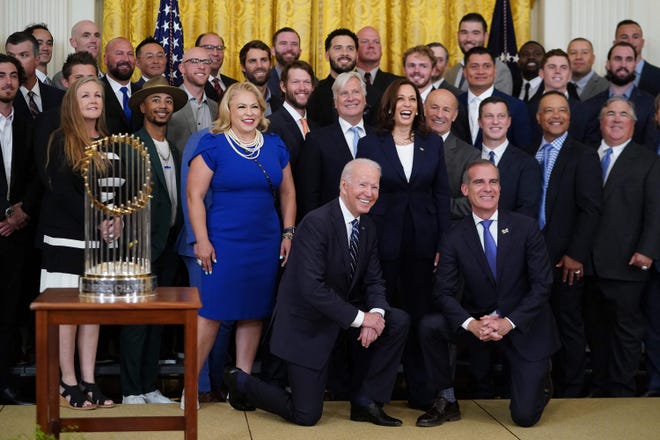
Major League Sports Teams that won their last World Championship when Joe Biden was President: The Atlanta Braves, the Milwaukee Bucks, the Tampa Bay Lightning, the Tampa Bay Buccaneers.

Donald Trump: The Los Angeles Dodgers, the Los Angeles Lakers, the Kansas City Chiefs, the Washington Nationals, the Toronto Raptors, the St. Louis Blues, the New England Patriots, the Boston Red Sox, the Golden State Warriors, the Washington Capitals, the Philadelphia Eagles, the Houston Astros, the Pittsburgh Penguins.

Barack Obama: The Chicago Cubs, the Cleveland Cavaliers, the Denver Broncos, the Kansas City Royals, the Chicago Blackhawks, the San Francisco Giants, the San Antonio Spurs, the Los Angeles Kings, the Seattle Seahawks, the Miami Heat, the Baltimore Ravens, the New York Giants, the St. Louis Cardinals, the Dallas Mavericks, the Boston Bruins, the Green Bay Packers, the New Orleans Saints, the New York Yankees, the Pittsburgh Steelers.

George W. Bush: The Philadelphia Phillies, the Boston Celtics, the Detroit Red Wings, the Anaheim Ducks, the Indianapolis Colts, the Carolina Hurricanes, the Chicago White Sox, the Detroit Pistons, the Miami Marlins, the New Jersey Devils, the Los Angeles Angels, the Arizona Diamondbacks, the Colorado Avalanche.

Bill Clinton: The St. Louis (now Los Angeles) Rams, the Dallas Stars, the Chicago Bulls, the Dallas Cowboys, the Houston Rockets, the San Francisco 49ers, the New York Rangers, the Toronto Blue Jays, the Montreal Canadiens.

George H.W. Bush: The Washington Redskins (now the Washington Football Team), the Minnesota Twins, the Cincinnati Reds, the Edmonton Oilers, the Oakland Athletics, the Calgary Flames.

Ronald Reagan: The New York Mets, the Chicago Bears, the Detroit Tigers, the Los Angeles (now Las Vegas) Raiders), the Baltimore Orioles, the Philadelphia 76ers, the New York Islanders.

Jimmy Carter: The Pittsburgh Pirates, the Seattle SuperSonics, the Washington Bullets, the Portland Trail Blazers.

Gerald Ford: The Philadelphia Flyers.

Richard Nixon: The Miami Dolphins, the New York Knicks.

Lyndon Johnson: The New York Jets, the Cleveland Browns.

Dwight D. Eisenhower: The St. Louis (now Atlanta) Hawks, the Detroit Lions.

Harry Truman: The Rochester Royals (now the Sacramento Kings), the Cleveland Indians (now the Cleveland Guardians), the Chicago (now Arizona) Cardinals.

If you don't see your favorite team in a particular sport here, it's because they've never won a World Championship. I didn't include MLS, its predecessor the NASL, or the WNBA.

*

November 6, 1816: James Monroe is elected President. Secretary of State to outgoing President James Madison, also formerly Secretary of War, Governor of Virginia, U.S. Ambassador to Britain and France, and Colonel in the Continental Army -- he's the young man seen holding the flag in the famous, if erroneous, painting Washington Crossing the Delaware -- the nominee of the Democratic-Republican Party wins 68 percent of the popular vote, and 183 Electoral Votes.

The Federalist Party disintegrated during the War of 1812, due to its having agitated the country into the war, and its feckless peace offerings during it. They had nominated Senator Rufus King of New York, who won just 31 percent of the vote, and 34 Electoral Votes. He turned out to be the last Federalist nominee for President. Soon, the Democratic-Republicans would split into the Democratic Party and the National Republican Party, later to become the Whig Party.


November 6, 1854: John Philip Sousa is born in Washington, D.C. Perhaps the most famous American of Portuguese descent, he conducted the U.S. Marine Band, playing for Presidents, then formed his own band. The Sousa Band toured from 1892 until 1931, and he died the next year.

"The March King" composed and conducted songs that are still remembered today, most notably "The Stars and Stripes Forever" (1897). In 1923, his band played "The Star-Spangled Banner" before the 1st game at Yankee Stadium. 

November 6, 1860: Abraham Lincoln is elected the 16th President of the United States. He is the 1st nominee of the Republican Party to win the Presidency, making the Republicans the 1st, and to this day the only, "third party" to elect a President.

Thanks to a split in the Democratic Party, and the Whig Party (to which Lincoln once belonged) totally dissolving, he wins with 39 percent of the vote, the lowest percentage of any winner in the election's history.

But the former Congressman from Illinois did win a majority of the Electoral Votes: 180. Vice President John C. Breckinridge of Kentucky won 72, Senator John Bell of Tennessee won 39, and Senator Stephen A. Douglas of Illinois -- who had beaten Lincoln for that office just 2 years earlier -- won 12. Douglas finished 2nd in the popular vote, with 29 percent. Breckinridge had 18, and Bell 12.

In spite of the fact that Lincoln said, at the time, that he didn't want to abolish slavery entirely, only stop it from spreading to new States and Territories, the Southern States began to secede the next month. Outgoing President James Buchanan, a moral coward who thought the Constitution didn't allow him to do anything to stop it, did nothing to stop it. The American Civil War began on April 12, 1861. It would take Lincoln 4 years to win it.

You've heard the saying, "Suppose they gave a war, and nobody came?" Well, in February 1861,
Douglas held a peace conference at Willard's Hotel in Washington, and nobody came. Despite their disagreements on several issues, including slavery, once the war began, Douglas took a train tour of the Midwest, rallying support for the Union cause. But he was stricken with typhoid fever, and died on June 3. He was only 48 years old, 4 years younger than Lincoln was.

Breckinridge was appointed to the U.S. Senate, but enlisted in the Confederate Army, and was expelled from the Senate. He was a terrible General, but President Jefferson Davis appointed him Secretary of War in February 1865. He urged Davis to surrender, but was refused. He escaped after the fall of Richmond, and lived abroad for 3 years, until Lincoln's successor Andrew Johnson extended amnesty to all former Confederates. Breckinridge died in 1875, at 54: He was 12 years younger than Lincoln, but died 2 years younger.

Bell was the only one who outlived Lincoln both in calendar years and in actual years. He supported the Union until the war began, then switched sides. He lived until 1869, age 73.

*

November 6, 1861, 160 years ago: James Naismith (no middle name) is born in Almonte (now part of Mississippi Mills), Ontario, outside the Canadian capital of Ottawa. He graduated from Montreal's McGill University, where he lettered in lacrosse, gymnastics, soccer, rugby, and the Canadian version of gridiron football. He was hired as McGill's athletic director in 1890, but just a year later, he was hired by the YMCA International Training School in Springfield, Massachusetts, what is now Springfield, College.

He was asked to invent a game that could be played indoors in the Winter, when baseball and football couldn't be played. He knew he should start with a ball, but a large, soft one, like a soccer ball, not a small, hard one like a baseball, which would be dangerous in the confined space of a gymnasium. He noted that most of the rough action took place around the goal: The goal in soccer, hockey or lacrosse, the end zone in football or rugby, or home plate in baseball. So he thought he could reduce the danger by raising the goal.

He asked the custodian to get him a box, because he had invented boxball. The custodian could only find a peach basket. So Dr. Naismith had invented basketball instead. The date was December 21, 1891.

Through the influence of the YMCA's worldwide organization, the word was spread. Naismith became the head coach at the University of Kansas, which became one of the great college basketball programs. He died in 1939, at the age of 78, at their Lawrence campus. Within the last 4 years of his life, he had seen the debut of sold-out doubleheaders involving national powers at Madison Square Garden, the debut of basketball as an official medal sport at the Olympic Games, and the foundation of the NIT and NCAA Tournament.

November 6, 1865: The last "grand match" of the baseball season takes place at the Capitoline Grounds in Brooklyn, before 15‚000. The Atlantics lead all the way to defeat fellow Brooklynites the Eckfords, 27-24‚ and claim the 1865 championship with a record of 17-0.

Henry Chadwick, America's 1st real sportswriter: "Is there another sport attractive enough to draw such attendance under such circumstances? In the summer it is not surprising as the weather is pleasant... but on a cold November day‚ in the busiest time of the year‚ it must be indeed an attractive sport to collect such an assemblage that is present on this occasion." 

Named for a famed hill in Rome, the Capitoline Grounds, a 5,000-seat wooden stadium opened in 1864, was meant to rival and surpass the Union Grounds. The Atlantics made it their home, and, like the Union Grounds, it became a skating rink in the winter.

But it was demolished in 1880. It was on a plot of land bounded by what's now Halsey Street, Marcy Street, Putnam Avenue and Nostrand Avenue, in Bedford-Stuyvesant. To visit, take the A or C train to Nostrand Avenue. While this neighborhood, notorious for crime not that long ago, should be safe during the day, definitely do not visit at night. 

November 6, 1869: What is generally recognized as the 1st college football game is played. Rutgers College plays the College of New Jersey, on Rutgers' campus in New Brunswick.

The game is essentially a very large soccer game, with a round leather ball, and 25 men on a side. The Rutgers men, finding the color inexpensive to obtain, wrap scarlet red cloth around their heads like turbans, so that they can tell each other apart on the field. Thus did they invent school colors and, in a way, the football helmet.

The men of Old Queens must have had less trouble telling team from team than did the men of Old Nassau, as Rutgers won, 6-4 -- that's 6 goals to 4, or 42-28 under today's scoring system.

The next week, the CNJ men returned the favor in Princeton, and won, 8-0. There was supposed to be a 3rd game, but the college presidents got together and decided that too much emphasis was being placed on athletics, and forbade it.

The field where "the first football game" was played is now the parking lot for Rutgers' College Avenue Gym. Rutgers played at College Field until 1891, then opened Neilson Field across the street, playing there until 1938, when Rutgers Stadium opened across the River in Piscataway. The Alexander Library, the school's main library, was built on the site of Neilson Field in 1953. Rutgers Stadium was replaced on the same site by what's now named SHI Stadium in 1994, while they played their 1993 home games, and many others from 1976 to 2009, at Giants Stadium.

George Large of Rutgers was the last surviving player from this game, living until August 15, 1939, age 88. The native of Readington, Hunterdon County played on the Rutgers side, and in 1888 served as President of the State Senate, making him the Acting Governor on a few occasions.

In 1874, Harvard University would accept a challenge from McGill University in Montreal, and discover on their arrival that by "football," McGill meant "rugby," not "soccer." Adjustments were made, Harvard liked the results, and convinced the other "football"-playing schools to join them in this adaptation of "football." In 1906, the forward pass was legalized and hashmarks prevented dangerous scrimmages close to the sideline. "Football" as America knows it now was on its way.

In 1896, the College of New Jersey changed its name to Princeton University, while a nearby school would later be founded as Trenton State College, and change its name to The College of New Jersey. Rutgers College would become, and remains, the centerpiece of the larger system of Rutgers, The State University of New Jersey.

Princeton's nickname, the Tigers, would inspire 2 professional team names: Baseball's Detroit Tigers and the Canadian Rugby Union's Hamilton Tigers, now the Canadian Football League's Hamilton Tiger-Cats.

Rutgers was known as "The Queensmen" until 1925, when they became the Chanticleers, after a fighting rooster. The school's literary magazine was already called The Chanticleer. But this carried the connotation of "chicken" -- and, as the University of South Carolina has found out with their similarly-named Gamecocks, they can be called "Cocks." In 1955, head coach Harvey Harman recommended the change to the Scarlet Knights, and such they have been ever since.

Rutgers and Princeton did not always play once a year, sometimes missing years, sometimes playing twice a year. But Rutgers did not beat Princeton again until 1938, the dedication game for the original Rutgers Stadium in Piscataway. breaking a 33-game losing streak over 69 years. Princeton still dominated until Rutgers won 4 straight from 1958 to 1961, the latter an undefeated season. Then, Princeton won another 6 straight.

Then Rutgers began to make what it called a commitment to big-time football. From 1968 onward, they went 9-3-1 against Princeton, which included winning the last 5 games by scores of 17-0, 10-6, 24-0, 38-14 and 44-13. This further included the 1st appearance by either school on national television, the 100th Anniversary Game at Rutgers Stadium on September 27, 1969, a 29-0 Rutgers win; and Rutgers' 1976 undefeated season.

Princeton decided that they couldn't remain in the Ivy League and also compete on the same level as Rutgers and the other schools that had formed the Big East Conference for all sports but football, and eventually would for football as well. (Most of those are now in the Atlantic Coast Conference, but Rutgers is in the Big Ten, and West Virginia is in the Big 12.) So Princeton called off the series, still holding an enormous 53-17-1 edge. The rivalry does continue in other sports.

Rutgers continues to bill itself as "The Birthplace of College Football," or simply "The Birthplace." You know the joke: Rutgers invented football in 1869, and they haven't done a damn thing since. It's not quite true, but it's bad enough. For example: On November 6, 2021, at home, Rutgers lost to Wisconsin 52-3.

November 6, 1888: Benjamin Harrison is elected the 23rd President of the United States. The former U.S. Senator from Indiana, and grandson of 9th President William Henry Harrison, wins 233 Electoral Votes, defeating incumbent President Grover Cleveland, who had 168.

But Cleveland won the popular vote, 48.6 percent to 47.8. Matthew Quay, Republican boss of Pennsylvania, practically came out and admitted that he had the State's 30 Electoral Votes stolen for Harrison. If true (and it probably is), then the vote should have been 203-198 in Harrison's favor. Meaning that, if 1 more State was "stolen," then Cleveland should have been re-elected.

Indeed, 4 years later, after a hard Presidency with recession and labor strife, Harrison lost his bid for re-election, and Cleveland became the only former President ever to regain the office.

*

November 6, 1900: President William McKinley is re-elected. As in 1896, he defeats Nebraska Congressman William Jennings Bryan, 51.6 percent of the popular vote to 45.5, and 292 Electoral votes to 156.

Garret Hobart, McKinley's 1st Vice President, had died in office in 1899, so he needed a new one. He chose Governor Theodore Roosevelt of New York, because his svengali, Ohio Republican boss Mark Hanna, though TR was making too much noise as Governor, thinking he'd be silenced as Vice President. He told McKinley he had to live, to keep "that damned cowboy" out of the White House.

On September 6, 1901, at the Pan-American Exposition, a World's Fair in Buffalo, McKinley was shot. He died 8 days later, and TR was President of the United States. In 1904, Hanna died, and TR won a term of his own.

November 6, 1927: Martin Nicholas Pavelich is born in Sault Sainte Marie, Ontario. A left wing, he played for the Detroit Red Wings, and was assigned as a "shadow," to shut down opposing teams' best attackers, particularly Maurice "The Rocket" Richard of the Montreal Canadiens.

He won 4 Stanley Cups with the Wings, and is the last surviving player from the 1950 Cup team, 1 of 4 surviving players from 1952, 1 of 4 from 1954, and 1 of 5 from 1955.

He appears not to be related to Mark Pavelich, a native of Eveleth, Minnesota who won the Olympic Gold Medal with the 1980 U.S. hockey team, and later played for the Rangers and Minnesota North Stars, and was an original 1991-92 San Jose Shark.

November 6, 1928: Secretary of Commerce Herbert Hoover is elected President, with a whopping 58 percent of the vote, and 444 Electoral Votes. The Democrats had nominated Governor Alfred E. Smith of New York, the 1st Catholic ever nominated by a major party. He won just 40.8 percent, a figure exceeded by all but 2 Democratic nominees since (George McGovern in 1972 and Walter Mondale in 1984), and took just 8 States, worth 87 Electoral Votes.

In his nationally-syndicated newspaper column, humorist Will Rogers wrote that Smith's supporters "are going to be shocked at how much of the country lives west of the Hudson River." He was right, as Smith was too New Yorky for the rest of the country, including most of New York State.

Indeed, New York was not 1 of the 8 States he won. He won the 2 most Catholic States in the nation, Massachusetts and Rhode Island; and 6 "Solid South" States that, at the time, would never go for a Republican, still thought of as "the Party of Lincoln": South Carolina, Georgia, Alabama, Mississippi, Arkansas and Louisiana. Smith didn't even get the entire South: Hoover won Virginia, North Carolina, Florida, Kentucky, Tennessee, Oklahoma and Texas.

Had Smith been a Protestant, from a small town rather than the biggest city, with a pleasant voice instead of a N'Yawk accent, in favor of keeping Prohibition rather than repealing it, and not connected to the corrupt Tammany Hall political machine that dominated New York State and especially New York City, he still would have lost, as Hoover rode the Republican prosperity of the Roaring Twenties.

Despite the Hoover landslide, Franklin D. Roosevelt, former Assistant Secretary of the Navy, 1920 Democratic nominee for Vice President, and cousin of the late former President Theodore Roosevelt, is narrowly elected to succeed Smith as Governor. Someone asked Smith if FDR, one of his biggest backers, was going to be a rival that would prevent him from getting the Democratic nomination again in 1932. Smith, noting that Roosevelt had been dealing with the effects of polio since 1921, said, "No, he will be dead within a year."

Within a year of the 1928 election, the stock market had crashed, and, barring a major scandal, the Democratic nominee was going to win in 1932. Smith tried for that nomination. He lost it. To FDR. FDR became President. Smith became one of his fiercest critics. And, in the end, in spite of FDR's health difficulties, Smith died 6 months before he did.

Also on this day, William Donald Wilson is born in Central City, Nebraska. A center fielder, Bill Wilson started with the Chicago White Sox, and was with the Philadelphia Athletics when they moved, hitting the 1st home run in Kansas City Athletics history on April 12, 1955. But that was to be his last season in the major leagues. He, Bobby Shantz and Bill Harrington are the last 3 living former Philadelphia Athletics.

November 6, 1929: With the field at the Cycledrome -- a 10,000-seat bicycle racing track with a football field almost fully squeezed into it -- so waterlogged that the referees will not permit play, the Providence Steam Roller, defending NFL Champions, move their scheduled game with the Chicago Cardinals to their former home, Kinsley Park. This 6,000-seat stadium has floodlights, and so, this becomes the 1st night game in NFL history.

The Cardinals win, 16-0, but the gate receipts from the sellout crowd count the same. And, with the stock market having crashed a few days ago, the Steam Roller need all the help they can get. As it turns out, it's not enough: The team gets through the 1930 and '31 NFL seasons, drops out, holds on in another league through 1933, and folds, a victim of the Great Depression. Kinsley Park was torn down in 1933, and no trace of it remains.

*

November 6, 1946, 75 years ago: Edward John DeBartolo Jr. is born in Youngstown, Ohio. He and his father Edward Sr. developed the Edward J. DeBartolo Group, which, under Eddie's leadership, became the Simon Property Group. It built in 1972, and still maintains, the Brunswick Square Mall in my native East Brunswick, New Jersey.

Also in New Jersey, it runs the Menlo Park Mall in Edison, Newport Centre in Jersey City, The Mills at Jersey Gardens in Elizabeth, the Ocean County Mall in Toms River, the Quaker Bridge Mall in Lawrence, Jersey Shore Premium Outlets in Tinton Falls, and Jackson Premium Outlets near Great Adventure. On Long Island, it runs Roosevelt Field in Garden City, and the Walt Whitman Mall in Huntington. In the Hudson Valley, it runs The Westchester in White Plains, The Shops at Nanuet, and Woodbury Common Premium Outlets.

But the DeBartolos are better known for their sports teams. Edward Sr. owned the NHL's Pittsburgh Penguins, and let his daughter Denise DeBartolo York run them, winning their 1st 2 Stanley Cups. Eddie owned the San Francisco 49ers, seeing them win 5 Super Bowls. A 1998 controversy led him to sell the team to his sister, her husband John York, and their son Jed York. (NFL rules prevent a majority owner of a team in another sport from being majority owner of an NFL team, so she had to sell the Penguins to become the 49ers' operational owner.)

Despite the troubles he got into, "Mr. D" is still one of the few NFL owners who was truly beloved by his players, and was recently elected to the Pro Football Hall of Fame. He is the only living current or former NFL team owner in the Hall. He is also a member of the Bay Area Sports Hall of Fame.

Also on this day, Sally Margaret Field is born in the Los Angeles suburb of Pasadena, California. We like her. We really, really like her.

November 6, 1947: Meet the Press debuts on NBC. It is still on the air after 74 years, making it the longest-running program in television history, anywhere in the world.

Oddly for its era, the 1st moderator was a woman, Martha Rountree. She was succeeded in 1953 by Ned Brooks, who held the post until 1965, Lawrence Spivak until 1975, Bill Monroe (not the country singer) until 1984, Marvin Kalb until 1987, Chris Wallace until 1989, Garrick Utley until 1991, and then its longest-running host, Tim Russert, until his death in 2008. He was succeeded by David Gregory, and then Chuck Todd was named host in 2014.

Herbert Hoover appeared on the show as an old man in 1955. Franklin Roosevelt, Harry Truman and Dwight D. Eisenhower never did. But every President since John F. Kennedy has, although as the incumbent President, only Jimmy Carter, Bill Clinton, George W. Bush and Barack Obama have. So far, Donald Trump has not, and I suspect it will stay that way, although he made 5 appearances before taking office, including in 1999, before he began to worm his way into politics.

Athletes do not usually appear on the show, often mocked as Meet the Depressed and Press the Meat.
But Russert, a Buffalo native, loved to interview them. During Autumn, he would conclude the show's usual tagline with a reference to his hometown team: "If it's Sunday, it's Meet the Press. Go Bills."

Russert liked to challenge Democrats and Republicans alike, and, with a graphic or a clip ready to go, made, "Senator, let me show you... " the 5 scariest words in Washington. Today, Todd shows an obvious favoritism toward conservatives, which has earned him the nickname "Chuck Toad."

*

November 6, 1951, 70 years ago: Louise Williams (no middle name) is born in Scranton, Pennsylvania. The actress, known professionally as Liberty Williams, got her start as Debbie Morgenstern, Rhoda's sister, on a 1973 episode of The Mary Tyler Moore Show. She was a regular on the short-lived series Bustin' Loose, 13 Queens Boulevard and Baby Makes Five. She appeared in 2 different episodes of Three's Company, in 2 different roles, 3 years apart.

She is best known as the voice of Jayna, the Wonder Twin who could take the form of any animal, on the Super Friends cartoons. Although she has had no acting credits since 1990, she is still alive.

November 6, 1956: President Dwight D. Eisenhower is re-elected. Despite concerns over his health (he'd had a heart attack in September 1955, and had been hospitalized again in June, possibly for another heart attack that the White House didn't want to talk about), the fitness for office of Vice President Richard Nixon, and how "Ike" had handled the recent crises in Hungary and Egypt, he wins 57 percent of the popular vote, and 457 Electoral Votes.

Former Governor Adlai E. Stevenson of Illinois fares no better in the rematch than he did in 1952, winning just 42 percent, and 73 Electoral Votes. Stevenson won only 7 States: North Carolina, South Carolina, Georgia, Alabama, Mississippi, Arkansas and Missouri. In the other 41 States, he comes close only in Tennessee.

November 6, 1981, 40 years ago: Larry Holmes defends the Heavyweight Championship of the World at the Civic Arena in Pittsburgh, against Renaldo Snipes. Snipes knocks Holmes down in the 7th round, but Holmes gets up at the count of 4, and knocks Snipes out in the 11th.

Snipes was 22-0 going into the fight, with his last 2 fights being wins over former WBA Light Heavyweight Champion Eddie Mustafa Muhammad and eventual WBA Heavyweight Champion Gerrie Coetzee.

But from here on out, he went just 17-8-1, fighting 3 future partial Heavyweight Champions, beating Trevor Berbick (WBC), but losing to Tim Witherspoon (WBC and WBA, though not at the same time, and who would, in 1983, come closer to beating Holmes) and Greg Page (WBA). He was supposed to fight Mike Tyson in 1990, but broke his hand, and it never happened. He was replaced as Tyson's opponent by James "Buster" Douglas, and the rest is history.

Snipes is now 65, and a charity fundraiser. He says, "I had a good career. I made good friends. I keep in contact with my friends, and I'm healthy." That's more than a lot of ex-boxers can say.

November 6, 1983: This is the date on which the sci-fi/fantasy series Stranger Things begins, with an attack from the dimension known as "The Upside Down" on the lab in Hawkins, Indiana that opened a portal to it.

November 6, 1991, 30 years ago: Arsenal host Benfica at Highbury in North London, in the 2nd leg of the 2nd round of what turns out to be the last European Cup tournament under that name. The following season, 1992-93, it was rebranded as the UEFA Champions League. Since the Heysel Ban kept defending Football League Champions Arsenal from playing in the 1989-90 edition, this was only their 2nd time in it, following a run to the Quarterfinal in 1971-72.

Two weeks earlier, Arsenal had gone to Lisbon, Portugal, and held Benfica, that country's most storied sports team, to a 1-1 draw (with Kevin Campbell scoring) in front of 120,000 people in their Estádio da Luz. In order to have a playing facility that met modern safety standards (no standing terraces, with dangerous overcrowding), that stadium was demolished and rebuilt on the same site in 2003, and its current capacity is 64,642. The English translation of the name, "Stadium of Light," was applied to North-East club Sunderland's new stadium built in 1997. The new Benfica stadium's design would eventually inspire the design of Arsenal's new Emirates Stadium, which opened in 2006.

With the tie level, and with an away goal, and this being a Benfica squad far beneath their European Cup winners of 1961 and 1962, Arsenal fans were confident of victory and advancement. But after a 1-1 halftime score (2-2 on aggregate, 1-1 on away goals), Arsenal's defense leaked twice, and Benfica won 3-1, to advance 4-2.

This was one of the most humiliating defeats in Arsenal's history, in literally the biggest game that George Graham ever managed. (Any European Cup/Champions League match is bigger than a European Cup Winners' Cup Final.) Ironically, the only Arsenal goal on this night was scored by Colin Pates, taking the Number 4 place in midfield vacated by Graham's foolish sale of Michael Thomas (to Liverpool, of all teams to send the 1989 title-clinching goalscorer to) the preceding off-season.

Fans who came of age in the Graham years (1986-95) loved to compare his record in European play with that of Arsène Wenger (1996-2018), who consistently kept the team in the Champions League, reaching the Final in 2006 and the Semifinal in 2009, but never won a European trophy, while Graham won the Cup Winners' Cup in 1994 -- a tournament so insignificant that UEFA folded it into the UEFA Cup (now the Europa League) in 1999.

But this game had everything they loved to hate about Wenger: An Arsenal side weakened due to selling off one of the team's best players, a poor defense, "shit tactics," and a spectacular failure in European competition, which could be called a loss to "farmers."

Just 9 weeks later came the 3rd Round of the FA Cup, a trip to North Wales that became known as "The Wrexham Disaster." That game, a loss to a team then in Division Four, has often been cited as Graham's most disgraceful defeat. Yes, it was bad. But it wasn't as bad as blowing a 2nd-leg home tie in a European Cup knockout round.

Graham was lucky that this happened before the Internet Age, before the dawn of social media, and before the starting of Arsenal Fan TV.

November 6, 1999: Conseco Fieldhouse opens in Indianapolis, replacing the Market Square Arena. The Indiana Pacers beat the Boston Celtics, 115-108, and go on to win the NBA Eastern Conference title for the 1st time. But they will lose the NBA Finals to the Los Angeles Lakers.

The building was renamed Bankers Life Fieldhouse in 2011, and Gainbridge Fieldhouse this year.

*

November 6, 2001, 20 years ago: Major League Baseball votes to contract its number of teams, something that hasn't happened in 102 years. The vote to contract from 30 teams to 28 is 28-2. It is not revealed who the 2 teams to vote against it were, but the rumor is that it's the 2 teams most often mentioned as the ones to be dropped: The Minnesota Twins and the Montreal Expos.

The 30-team setup remains in place, pending a new collective bargaining agreement, as the old one runs out in the 2002 season. But the CBA that is approved keeps all 30 teams. MLB ends up getting rid of the Expos anyway: After the 2004 season, they are moved, to become the Washington Nationals.

But the Twins make the most of their reprieve: They win the American League Central Division the next 3 seasons, and in 6 of the next 9, concluding in 2010, their 1st season in Target Field, after moving out of the oft-mocked Metrodome.

Today, both franchises are as strong as ever, at least business-wise, and MLB has again begun to consider expansion, from 30 teams to 32.

November 6, 2002: The West Wing airs the episode "Election Night." President Jed Bartlet (Martin Sheen) is re-elected, but shows signs that his multiple sclerosis will be an issue in his 2nd term. Also, Deputy White House Communications Director Sam Seaborn (Rob Lowe) discovers that he will have to keep a promise he made to the widow of the Democrat running for Congress in his home district in Southern California.

This episode debuts Joshua Malina as Will Bailey, and Danica McKellar as his half-sister and campaign assistant Elsie Snuffin.

This episode should not be confused with the episode "Election Day," which resolves the storyline from this next entry:

November 6, 2005: The West Wing airs the episode "The Debate." It is a live episode, and the only episode of the show that is broadcast on videotape instead of film. Running to replace Bartlet are Republican Senator Arnold Vinick of California (M*A*S*H's Alan Alda) and Democratic Congressman Matthew Santos of Texas (L.A. Law's Jimmy Smits).

This occurs only 3 years after the episode showing Bartlet's re-election, because in the 2003-04 TV season, the show jumped from the middle of Year 5 of his Administration to the middle of Year 6, due to the fact that the actors' contracts all ran out after the show's 7th season.