Showing posts with label calvin coolidge. Show all posts

Thursday, February 26, 2026

February 26, 1926: Louis Armstrong Gets the Heebie Jeebies

Left to right: Johnny Dodds, Louis Armstrong,
Johnny St. Cyr, Kid Ory and Lil Hardin Armstrong.

February 26, 1926, 100 years ago: Louis Armstrong gets the heebie jeebies.

His band was billed as "Louis Armstrong and His Hot Five." His wife, Lil Hardin Armstrong, played piano. It was she who "took the country out of him" and convinced him to assert himself, both on the bandstand and with money. This would end up working against her: Within a few years, he divorced her for spending too much of his money.

The others were musicians he'd previously worked with in his hometown of New Orleans: Edward "Kid" Ory on trombone, Johnny Dodds on clarinet, and Johnny St. Cyr on guitar, and sometimes banjo.

Although all of the Hot Five got their professional starts in New Orleans, their initial recording, on November 12, 1925, was in Chicago, at the studio of Okeh Records. He had previously recorded as the trumpet player in the jazz band of Joe "King" Oliver, but this was his 1st time recording a band he led. They recorded Louis' compositions "Yes! I'm in the Barrel" and "Gut Bucket Blues," and Lil's composition "My Heart."

Their next session was on February 26, 1926. Among the songs they recorded was "Heebie Jeebies," written by saxophone player Boyd Atkins. The term "heebie jeebies" was coined by Billy DeBeck, the cartoonist who wrote the Barney Google strip. It means a feeling of anxiety or apprehension.

In 1922, writer F. Scott Fitzgerald coined the phrase "The Jazz Age." The phrase "The Roaring Twenties" came much later.

In addition to playing trumpet like nobody's business, Louis, known as "Satchelmouth" for his big mouth, eventually shortened to "Satchmo" or "Satch," tried scat singing, and this made the record his first real hit.

Armstrong, Ory and St. Cyr would all later admit that the reason Armstrong was scatting -- something already well-known in jazz circles, but not on record -- is that he didn't know the words, and was reading them off a sheet of paper, and he dropped it, and had to improvise. His scatting was the defining "roar" of the Roaring Twenties.

(There's an old joke: "Why does a hummingbird hum? Because he doesn't know the words." And another: Musicians are playing in an apartment, and a woman in the apartment building next door opens her window and yells across the alley, "Don't you know people are trying to sleep?" And the bandleader, acting as if "People Are Trying to Sleep" is a song title, says, "No, but if you hum a few bars of it, we'll catch on!")

In 1928, Armstrong formed a new Hot Five, replacing everyone but himself with members of the Carroll Dickerson Orchestra: Fred Robinson on trombone, Jimmy Strong on clarinet and tenor saxophone, Earl Hines (later nicknamed "Fatha," short for "Father") on piano, Mancy Carr on banjo, and Arthur "Zutty" Singleton on drums. So now it really was Louis Armstrong and a Hot Five. It was this group that recorded the landmark instrumental "West End Blues" in 1928.

Louis Armstrong died on July 6, 1971, of heart trouble, in New York, a few days short of his 70th birthday. Lil Hardin Armstrong died a few weeks after that. Johnny Dodds, the greatest jazz clarinetist of the 1920s, was an alcoholic, and it gave him a fatal heart attack in 1940. Mancy Carr followed in 1946, Johnny St. Cyr in 1966, Kid Ory in 1973, Zutty Singleton in 1975, Jimmy Strong in 1977, Earl Hines in 1983, and Fred Robinson in 1984.

In 1956, rock and roll pioneer Little Richard recorded a different song titled "Heebie Jeebies." It was not a hit.

Friday, December 12, 2025

December 12, 1925: The Cardinal-Maroon Controversy

December 12, 1925, 100 years ago: The most controversial championship in the National Football League's history is awarded.

The Chicago Cardinals traced their founding to that of the Morgan Athletic Club, on the South Side of Chicago, in 1898. In 1920, they became charter members of the league that became the NFL. By 1925, head coach Norman Barry could call on some great talent: Backs John "Paddy" Driscoll (also one of the best placekickers of the era), Joseph "Red" Dunn, Bobby Koehler and Hal Erickson.
Paddy Driscoll, from his later tenure
with the Chicago Bears

They lost their opening game to the Hammond Pros, then rattled off 8 straight wins before a scoreless tie with the Chicago Bears, in the 1st NFL game played by Harold "Red" Grange. The Cardinals bounced back just 3 days later, beating the Rock Island Independents. But the following week, they lost 21-7 to the Pottsville Maroons.

Pottsville is about 100 miles northwest of Philadelphia, and around 50 miles northeast of Harrisburg. The Maroons were founded in 1920, and joined the NFL in 1925. At the time, their best player was end Charlie Berry, who also played 13 seasons in Major League Baseball, mostly as a catcher with the "nearby" Philadelphia Athletics.
They opened that season with a win over the Buffalo Bisons, lost 6-0 to the Providence Steam Roller, won 4 straight including a reversal of Providence, lost 20-0 to the Philadelphia-based Frankford Yellow Jackets, and then won 4 straight including a reversal of Frankford, before going to Comiskey Park and beating the Cardinals.

At that point, the Maroons were 10-2, the Cardinals 9-2-1. It was presumed that the NFL season was over, and that the Maroons' win over the Cardinals had clinched the Championship.

But scheduling was not fixed before the season -- one of the reasons why the early NFL was not exactly a "major league" operation. Teams could arrange additional games between them, and get them approved by the NFL office. Cardinals back Art Folz arranged a game with Ambrose McGuirk, owner the Milwaukee Badgers, who had finished 0-5, including an earlier 34-0 loss to the Cardinals. NFL President Joseph Carr approved the game for December 10, and the Cardinals won it, 58-0, lifting them to 10-2-1.

Then it got out that high school players had played for the Badgers under assumed names. McGuirk was ordered to sell the franchise, and it only lasted 1 more season. Folz was banned from the NFL for life. This ban was lifted after 1 year, but he chose not to return. Cardinals owner Chris O'Brien was fined $1,000. However, the game was allowed to remain in the official record. That was the wrong thing to do, but it was done.

Carr ordered both the Cardinals and the Maroons to play 1 more game. Just 2 days later, on December 12, the Cardinals played the only other team that had beaten them, the Hammond Pros -- Hammond is an industrial city in Indiana, just over the State Line from Chicago -- and beat them, 13-0 at Comiskey Park. Cardinals, 11-2-1.

On the same day, the Maroons played the Notre Dame All-Stars, a team of Notre Dame alumni (but not including any of the 1924 season's "Four Horsemen") at Shibe Park in Philadelphia. It was a sellout, and it made the Maroons, by the standards of the time, a lot of money. And they won, 9-7. Maroons, 11-2.

But Carr ruled that, since the All-Stars were not an NFL team, the game couldn't be counted in the NFL standings. Nor could their hastily-arranged game a week later, against the Atlantic City Roses at Bader Field, a field adjacent to the airport of the same name in Atlantic City. The Maroons won, 6-0, but it didn't count. So the final standings were:

1. Chicago Cardinals, 11-2-1
2. Pottsville Maroons, 10-2
3. Detroit Panthers, 8-2-2
4. New York Giants, 8-4 (Their 1st season in the league.)

Two other teams then in existence still are: The Bears finished 9-5-3, surprisingly only 3-3-1 after signing Grange; and the Green Bay Packers finished 8-5.

O'Brien never claimed the 1925 NFL Championship for the Cardinals. But in 1933, desperate for cash in the Great Depression, he sold the team to Charles Bidwill, who did claim it. 

For decades thereafter, the City of Pottsville sent representatives to NFL meetings to plead their case for being awarded the 1925 NFL Championship. They usually got the owners of the later Pennsylvania teams on their side: Art Rooney, and later his son Dan, owners of the Pittsburgh Steelers; and the owners of the Philadelphia Eagles. As recently as 2003, an appeal was made to NFL officials, and rejected.

Did the Cardinals win the title fairly? Yes: Like the Chicago Bears over the Buffalo All-Americans in "the Staley Swindle" of 1921, they didn't break the rules, they used the rules, as they stood at the time. The Maroons tried to use the rules, but it didn't work. Bob Carroll, a football historian, has summed it up properly: "The Cardinals didn't defy the league. Pottsville did. It was a great team, but the owner made a mistake."

The City of Pottsville, a coal-mining community, had a piece of anthracite coal carved into the shape of a football, turning it into a trophy, and labeled it, "POTTSVILLE MAROONS N.F.L. AND WORLD CHAMPIONS 1925." The Maroons folded after the 1929 season, victims of the Depression, and the trophy rested in City Hall until 1964. At that time, surviving members of the '25 Maroons donated it to the Pro Football Hall of Fame, where it remains on display.

The Cardinals never got close to the title again until 1947, when owner Charles Bidwill died. With his widow, Violet, becoming the NFL's 1st female owner, they faced the Eagles in back-to-back NFL Championships Games, winning in 1947 and losing in 1948.

In 1949, Violet married Walter Wolfner, a St. Louis-based businessman. In 1960, recognizing that they couldn't compete in Chicago with the Bears, they moved the Cardinals to St. Louis, even though there was already a baseball team named the St. Louis Cardinals.

Violet died in 1962, and her sons, Charles Jr. and Bill, cut their stepfather out of the operation of the team, resulting in Walter filing a lawsuit that turned nasty: He tried to have his adoption of them invalidated, which would turn control of Violet's team over to her husband, him. Except the court ruled that it didn't work that way: They were still her sons, and she left the team to them.

In 1972, Bill Bidwill bought his brother out. In 1974, 1975 and 1982, the Cardinals made the Playoffs, but didn't go far. In 1988, Bill moved them to the Phoenix area, renaming them the Phoenix Cardinals, and then the Arizona Cardinals in 1993. In 1998, they won a Playoff game for the 1st time in 51 years. In the 2008 season, they reached Super Bowl XLIII, but lost it to the Steelers. Bill died in 2019, and passed the team to his son Michael Bidwill. He still claims the 1925 NFL Championship for his team, 100 years after it was awarded, and 65 years after the team left the city where it was won.

Times change: As the Maroons, and the Chicago version of the Cardinals, faded from memory, and the Super Bowl took precedence, the fact that the Cardinals' titles came before the advent of the Super Bowl means that they get discounted: Even before the distance of time became what it is now, NFL fans have come to regard any title won before the Super Bowl -- in the NFL from 1920 to 1969, the AFL from 1960 to 1969, or the AAFC from 1946 to 1949 -- as not a "real" championship.

The Cardinals could have been named the Maroons. When the Morgan Athletic Club started its football team, they ordered used uniforms from the nearby University of Chicago, whose teams were named the Maroons. But when the uniforms arrived, they'd faded, and someone said the shade wasn't maroon, it was cardinal red. So the Cardinals they have been ever since.

Also on December 12, 1925, Theodore Samuel Kennedy was born in Port Colborne, Ontario, Canada. Despite having the same first and middle name as Ted Williams, he was not elected to the Baseball Hall of Fame. "Teeder" was, however, elected to the Hockey Hall of Fame, as a star for, and eventually Captain of, the Toronto Maple Leafs. And this Ted Kennedy's name really was Theodore, unlike Senator Edward Moore "Ted" Kennedy.

Friday, November 28, 2025

November 28, 1925: The "Old" Garden & the Grand Ole Opry

November 28, 1925, 100 years ago: Madison Square Garden, the 3rd building with the name, opens between 49th and 50th Streets, between 8th and 9th Avenues, in Midtown Manhattan, at the northern end of the Theater District. The front entrance is on 8th Avenue, topped by a marquee that will soon be world-famous.
The 1st Garden was built at the northeast corner of 26th Street and Madison Avenue, catty-corner from Madison Square Park, in 1879. It had no roof. It was replaced in 1890 with a Moorish-style building, designed by the renowned architect Stanford White, that not only had a roof, but a tower with a roof garden where shows were hosted, and an apartment for White atop that.

Atop that was a statue of Diana, the Roman goddess of the hunt. This statue, sculpted of gilt copper by Augustus Saint-Gaudens, was nude, and the hoity-toity critics of the day hated it. One of the nastiest reviews came from a Philadelphia newspaper. Ironically, when the 2nd Garden was demolished, the Diana statue was taken to the Philadelphia Museum of Art (you know, the one whose steps Rocky Balboa ran up), and is still there. A copy now stands in New York's equivalent, the Metropolitan Museum of Art.
For both versions, the bowstring has been lost.
Otherwise, they are intact.

White would take showgirls up to his rooftop apartment, for a pre-movies version of a "casting couch." One was Evelyn Nesbit, whom he then made a star. She left him for a man named Harry Thaw. On June 25, 1906, jealous over Evelyn still having feelings for "Stanny," Thaw went to the roof garden during a show, and shot White. Evelyn's star faded: Late in life, she said, "Stanny White died. My fate was worse: I lived."

The New York Life insurance company owned the mortgage on the 2nd Garden, and decided to tear it down to build their new headquarters. George "Tex" Rickard, the top boxing promoter of the era, decided to build his own arena, where he wouldn't have to worry about anybody else's whims. He was lucky that New York Life was willing to sell him the rights to the name "Madison Square Garden": It was already a valuable brand name, which is a big reason why the "new Garden" has never sold naming rights.

When his Garden proved successful, he decided to build 6 copies, all over America. It didn't work out that way: He built the Boston Madison Square Garden in 1928 -- soon, it became simply "The Boston Garden" -- but died early the next year. He had gone to Miami to escape the cold New York weather, and to make a deal on a prizefight featuring up-and-coming heavyweight Jack Sharkey (who would hold the title from mid-1932 to mid-1933), but came down with appendicitis. This was before antibiotics, and he was dead at age 59.

The 1st event at The Garden was a six-day bicycle race. It sounds ridiculous today, but this kind of competition was huge in the "Roaring Twenties," especially in Europe, where it's still popular 100 years later. Teams of 2 men take turns riding for 6 days straight, from 6:00 PM to 2:00 AM, and the winner is the team that completes the most laps.

The 1st prizefight was held on December 8, for the Light Heavyweight Championship of the World. Paul Berlenbach defended the title by winning a unanimous decision over Jack Delaney. The following July, Delaney took the title from Berlenbach in a rematch at Ebbets Field.

The Garden became known as "The Mecca of Boxing." Heavyweight Joe Louis, light heavyweight Archie Moore, middleweight Sugar Ray Robinson, lightweight Henry Armstrong, and more became internationally-known superstars from their fights at The Garden.

It would also be known as "The Mecca of Basketball," with collegiate doubleheaders starting in 1934. It became a secondary home court for the City's college teams: New York University (NYU), City College of New York (CCNY), Long Island University (LIU), Columbia, Fordham and St. John's.

It also hosted the annual National Invitational Tournament (NIT), starting in 1938. And it hosted what would now be called the NCAA Final Four in 1943, 1944, 1945, 1946, 1947, 1948 and 1950, the last of these won by CCNY, which also won the NIT that year, the only time this "double" was ever achieved. 

The point-shaving scandal the next year crippled college basketball in New York City, and not only led to St. John's, not accused in the scandal, being the only major program that has survived on that level, but the NCAA ruling that teams could no longer compete in both their tournament and the NIT. The Final Four did not return to the New York Tri-State Area until 1996, when it was held at the Meadowlands.

That scandal coincided with the 1st trip to the NBA Finals for the New York Knicks, who debuted at The Garden in 1946. The scandal may have saved the Knicks, and thus may also have saved the NBA: Hoop fans needed something to turn to.

Rickard, who didn't always do things on the up-and-up, offered use of The Garden to Big Bill Dwyer, a bootlegger, who founded a hockey team, the New York Americans. The 1st NHL team in New York debuted on December 15, 1925, losing to the Montreal Canadiens 3-1.

The "Amerks" did so well at the box office that Rickard, noting that New York had 3 Major League Baseball teams, decided that it could support 2 hockey teams. So he founded his own team, and when the media found out, they nicknamed the new team "Tex's Rangers." He decided to go with it, and the New York Rangers debuted at The Garden on November 16, 1926, beating the Montreal Maroons 1-0.

With Rickard's promotional skills, the Rangers proved even more successful than the Americans. World War II knocked the Amerks out, as the manpower drain caused by the American and Canadian military drafts forced them to suspend operations after the 1941-42 season, and they never returned.

But the Rangers, the Knicks, college basketball games, prizefights, circuses, musical performances, ice skating shows, rodeos, and an event that predated even the 1st Garden, the Westminster Kennel Club Dog Show, continued at The Garden through the 1930s, the '40s, and the '50s. Madison Square Garden was right up there with the Empire State Building and Grand Central Terminal as the most famous building in the City.

But poor sight lines, and the need for more space and more dates, proved the arena's undoing. In 1960, the Pennsylvania Railroad, desperate for money, sold the air rights above Pennsylvania Station, between 31st and 33rd Streets and 7th and 8th Avenues, to the Madison Square Garden Corporation. The plan was to build a new station on the site, and a new arena on top of that.

On the afternoon of February 11, 1968, the Rangers played their last game at "the Old Garden," a 3-3 tie with the Detroit Red Wings, which was followed by a final skate with several NHL legends, including the Wings' still-active Gordie Howe. That night, "the New Garden" opened with "The Night of the Century," a salute to the USO, the United Service Organizations, which since 1941 has worked with the armed forces to provide supplies and entertainment. The co-hosts were old film partners and golfing buddies Bob Hope and Bing Crosby.

The last event at the Old Garden was 2 days later, February 13, the Westminster Dog Show. Demolition soon began. The site became a parking lot while various parties haggled over what to build on the site. Finally, in 1989, the 778-foot office and residential tower Worldwide Plaza opened there. The Subway station at 50th Street includes a mural dedicated to the Old Garden.
Worldwide Plaza

*

On the same day, The Grand Ole Opry is first broadcast, on radio station WSM, 650 on the AM dial, in Nashville, Tennessee. The station itself was brand-new, having gone on the air the preceding October 5, its call letters standing for the slogan of its original owner, the National Life & Accident Insurance Company: "We Shield Millions."
The Opry stage at the Ryman

George Hay, an Indiana native, had been a reporter for what was then the largest-circulating newspaper in Tennessee, the Memphis-based The Commercial Appeal. When that paper founded a radio station in 1923 (many early radio stations were founded by newspapers), WMC, he was its first evening announcer. In 1924, he left for Chicago station WLS, and hosted a program titled National Barn Dance.

In 1925, he took the concept to Nashville and WSM. The original Opry, officially titled WSM Barn Dance, was a one-hour program, simulating a barn dance but broadcasting from a radio studio. The show's 1st performer was Uncle Jimmy Thompson, a fiddler, already 77 years old. In other words, he had been born in 1848, only 52 years after Tennessee had become a State. (He lived until 1931.)

Most of the early performers on the show wouldn't be recognizable names today, but among them was Bill Monroe, the fiddler considered the inventor of bluegrass music, who was still performing up until his death in 1996, and whose song "Blue Moon of Kentucky" would be on the B-side of "That's All Right," the 1st single release of Elvis Presley.

(Elvis only appeared on the Opry once, on October 2, 1954. The audience reacted politely, but Jim Denny, by then the show's manager, told him that his style did not suit the program. Also before becoming nationally known, Elvis made several appearances, and was received considerably better, on a well-known radio show out of Shreveport: The Louisiana Hayride.)

An early regular act was the Fruit Jar Drinkers, whom Hay wanted to close every show, because he liked their "red hot fiddle playing." They were led by a banjo player, Uncle Dave Macon, a.k.a. the Dixie Dewdrop. Music historian Charles Wolfe wrote, "If people call yodelling Jimmie Rodgers 'the father of country music,' then Uncle Dave must certainly be 'the grandfather of country music.'"

If you've ever wondered why, in his song "Blue Suede Shoes" (covered by Elvis), among the things he would forgive before he would accept you stepping on said footwear, Carl Perkins listed, "drink my liquor from an ole fruit jar," this was clearly a tribute to the Fruit Jar Drinkers.

In 1926, WSM joined the 1st American radio network, the National Broadcasting Company, or NBC. On December 10, 1927, after playing Music Appreciation Hour, a classical music show which, that night, had been playing selections from grand opera, WSM Barn Dance came on. And Hay introduced DeFord Bailey by saying, "For the past hour, we have been listening to music largely from grand opera. But, from now on, we will present 'The Grand Ole Opry.'" The name stuck, and has been used ever since.

The show became more popular, and made the City of Nashville synonymous with country music, and vice versa. People wanted to watch as they broadcast. The larger studio they built turned out not to be big enough. In 1934, they moved to the Hillsboro Theatre, so they could have a paying audience. They outgrew that, too. They moved to the Dixie Tabernacle in East Nashville in 1936. Then came the War Memorial Auditorium.

Finally, in 1943, they moved back downtown, to the 2,362-seat Ryman Auditorium, and it became known as "The Mother Church of Country Music."
It remained home to the show until 1974, when, due to cramped quarters, it was moved out to the new Grand Ole Opry House at the Opryland USA theme park. In 1997, the park closed, and the Opry Mills Mall was built on the site. All the while, the Opry House remained open.
The Ryman remained open, and was renovated with modern amenities in 1994. In 2010, the flooding of the Cumberland River damaged the Opry House, and the show temporarily moved back to the Ryman while repairs were made.

George Hay died in 1968, at the age of 72. The Opry lives on, sometimes alternating between the Ryman and the Opry House.

*

November 28, 1925 was a Saturday. The Army-Navy Game was played that day, at the Polo Grounds in Upper Manhattan. Army won, 10-3.

Monday, July 21, 2025

July 21, 1925: The Scopes Monkey Trial

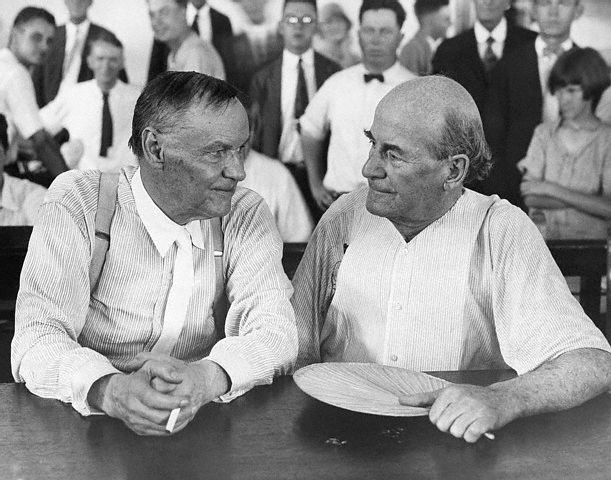
Clarence Darrow (left) and William Jennings Bryan

July 21, 1925, 100 years ago: A verdict is reached in the trial of The State of Tennessee vs. John Thomas Scopes, what has gone down in history as "The Scopes Monkey Trial."

Four months earlier, the Tennessee legislature passed the Butler Act, a law banning the teaching of evolution in its public schools, following news reports of children coming home from school and telling their parents, "The Bible is all nonsense." The law was named for its sponsor, State Representative John Washington Butler, who was also the head of the World Christian Fundamentals Association.

The American Civil Liberties Union chose to challenge this law. They found John Scopes, a 24-year-old Kentucky native who was teaching science and coaching football at Rhea County High School in Dayton, Tennessee, about 40 miles north of Chattanooga. Since the only penalty for teaching evolution in a public school in the State was a fine of $100 -- about $1,563 in today's money -- and he wouldn't be sent to prison, Scopes agreed to do it. On May 5, 1925, he was charged with violating the law.
John Scopes

Tom Stewart, a future U.S. Senator, was the lead prosecutor. Joining the prosecution team was William Jennings Bryan. The former Congressman from Nebraska had been nominated for President by the Democratic Party in 1896, 1900 and 1908, losing by a wider margin each time. He had served as Secretary of State in the 1st 2 years of Woodrow Wilson's Presidency, 1913-15.

In spite of an overall record that was very liberal for the time, he was a fundamentalist Presbyterian, and enthusiastically supported the law. His only misgiving was the fact that he hadn't tried a case in 36 years.

The ACLU needed a defense attorney. They wrote to H.G. Wells, the great science fiction writer, and a known Socialist and atheist. He wrote back and declined, saying that he had no legal training in his native Britain, let alone in America. John R. Neal, a professor at the University of Tennessee School of Law in Knoxville, volunteered.

But the ACLU thought he wasn't enough. So they called upon the foremost defense attorney of the day, Clarence Darrow. A year earlier, Darrow, a Chicago-based agnostic, had managed to save "thrill killers" Nathan Leopold and Richard Loeb from the death penalty for their brutal kidnapping and murder of a 14-year-old boy. The ACLU believed that, if he could argue effectively that the death penalty was wrong, they could argue that the law banning the teaching of evolution was wrong -- and that, while they were unlikely to win this case, they could later get the law overturned as unconstitutional.

Darrow was a brilliant man. At first, he turned them down, knowing that the Leopold-Loeb trial had become a media circus, and he didn't want the same thing to happen here. They talked him into realizing that this was a ship that had already sailed. The proceedings would be broadcast nationally on the new medium of radio.

Journalists had come from all over the world, including H.L. Mencken, the nationally-syndicated columnist from The Baltimore Sun, who had agreed to pay Scopes' legal fees. (But not his fine.) On the other hand, he had called the defendant "the infidel Scopes" in his column, and had also given the case the name it has had ever since: "The Monkey Trial."

Bryan, the foremost political speechmaker of his era -- an era that had certainly passed by this point -- decided to go with the circus atmosphere, as it suited his style. He mocked evolution as a theory, for teaching that humans were descended "not even from American monkeys, but from Old World monkeys."

As with the murderous Leopold and Loeb, Darrow knew that the nonviolent Scopes had, beyond any question, committed the crime for which he was charged. He knew there was no hope of winning the case -- in this round. But he understood the possibility of getting the Butler Act overturned as unconstitutional by a higher court.

So he went after it on that ground: He said that the Bible should be preserved in the realm of theology and morality, and not put into a course of science. Then he took the dramatic turn of attacking his opponent: He said that Bryan was waging "a duel to the death against evolution," and said, "There is never a duel with the truth."

On the 7th day of the trial, the Judge, John T. Raulston, ordered the proceedings moved to the lawn of the Rhea County Courthouse, because it was simply too hot inside: Air conditioning was still rare. On that day, Darrow took a truly radical step: He called Bryan, his opponent, to the stand, as "an expert on the Bible." Bryan made a key mistake: He accepted, mainly because his large ego had been bruised by Darrow's previous speech.

Darrow asked Bryan about some of the more fantastical stories in the Bible: Whether Eve was created from one of Adam's ribs, how their son Cain could have found a wife if Eve was still the only woman on Earth (Bryan: "I will leave the agnostics to hunt for her"), whether Joshua could make the Sun stand still in the sky, and so forth.

In 1955, Jerome Lawrence and Robert Edwin Lee wrote the play Inherit the Wind. Unfortunately, the best line from the play appears to have been made up for it, and didn't happen in real life. The Darrow character, named Henry Drummond, holds a rock, and asks the Bryan character, named Matthew Brady, how old the rock is. Brady says, "I am more interested in the Rock of Ages than in the age of rocks." 

In the play, Brady sticks to the "Biblical chronology" of the Irish archbishop James Ussher, who published a paper in 1654 stating that the Creation told in The Book of Genesis occurred in 4004 BC. Drummond said that the rock in question was not 6,000 years old, but millions of years old.

(For comparison's sake: Ussher said that Noah's Flood happened in 2348 BC, the Exodus in 1446 BC, and the death of King David and the accession of his son King Solomon in 970 BC. The most common date given for the destruction of Troy in the Trojan War is 1275 BC, and the founding of Rome is said to have been in 753 BC.)

After 2 hours of testimony, Bryan was looking forward to cross-examining Darrow, which, under most circumstances, he would have had the right to do. But Judge Raulston ruled that all the arguments against the Bible were immaterial to the case, and therefore irrelevant. He was right: Nothing that Darrow alleged in his statements and questions addressed the trial's central fact, which was whether or not Scopes broke the law as it then stood. The law's fairness was not at issue in the trial.

Bryan was furious: He had been denied his chance to make the speech of his life, surpassing even his pro-free silver "Cross of Gold" speech at the 1896 Democratic Convention in Chicago. Like so many old people -- he was now 65 -- he recognized that he had far more yesterdays than tomorrows, and was thinking more about death, and clinging more toward the hope that his religion gave him for an afterlife. As a result, he was now sounding more an more like a modern-day evangelical Republican than as the intellectual founding father of the modern Democratic Party, as he sometimes seems to be.

The trial took 8 days. The jury's deliberations took 9 minutes. They found Scopes guilty. Raulston ordered the $100 fine paid. He could have set the sentence aside, but he ordered it. Once he did, Scopes, who did not testify on his own behalf, spoke for the only time in the proceedings:

Your honor, I feel that I have been convicted of violating an unjust statute. I will continue in the future, as I have in the past, to oppose this law in any way I can. Any other action would be in violation of my ideal of academic freedom; that is, to teach the truth as guaranteed in our Constitution, of personal and religious freedom. I think the fine is unjust.

Nonetheless, the fine was levied. The ACLU, as they promised, paid it for him.

Over the next 5 days, Bryan delivered some speeches in Tennessee. But on July 26, 1925, he had a stroke, and died at his hotel in Dayton. Most people, at the time, thought that the trial had a deleterious effect on his health, although this was not proven, since there was no autopsy. He was buried at Arlington National Cemetery in Washington.

Darrow continued to practice law in Chicago until 1938, when he died of heart disease at age 80. Judge Raulston wanted to increase his political profile with the case, but was defeated for re-election in 1927. Representative Butler was also defeated for re-election in 1927. Neither ever won another office: Raulston ran for Governor and lost. He finally admitted that he no longer believed that the State should pass laws like the Butler Act. Butler died in 1952, Raulston in 1956.

Scopes lost his teaching career in the Great Depression, and he, his wife and 2 sons had to move in with his parents in Paducah. He entered politics, and ran for the State House of Representatives in 1932, as a Socialist, and lost. Then he did something very un-socialist: Having gotten a master's degree in geology, he worked, in Houston and later in Shreveport, Louisiana, for an energy company that would later be bought out by Pennzoil.

On October 10, 1960, he and two men claiming to be him were guests on the TV game show To Tell the Truth. Scopes was an ideal subject for that show: Since his fame came before the age of television, his name was well-known, but his face wasn't. He successfully stumped the panel of Don Ameche, Kitty Carlisle, Polly Bergen and Tom Poston.

In 1967, Gary Scott, a science teacher in Jacksboro, Tennessee, was fired for teaching evolution. He sued, following Darrow's idea that the law itself should one day be challenged as unconstitutional, and said that forbidding its teaching was a violation of the 1st Amendment's protection of speech. The school board got scared, and reinstated him. He didn't care: He went forward with his suit. Three days later, on May 18, 1967, 42 years after the Scopes Trial, the State legislature passed a law repealing the Butler Act. The same day, Governor Buford Ellington signed it into law. Scott dropped his suit.

Scopes' thoughts on the repeal are not recorded: He wrote a memoir, but it wasn't published until a few days after the repeal. He died of cancer in Shreveport in 1970, at 70.

As I mentioned, in 1955, the play Inherit the Wind was written, using a fictionalized version of the Scopes Trial as a critique of McCarthyism. Ironically, the title comes from the Bible: Proverbs 11:29 reads, "He that troubleth his own house shall inherit the wind, and the fool shall be servant to the wise of heart."

When it was first staged on Broadway, Darrow/Drummond was played by Paul Muni, and Bryan/Brady by Ed Begley Sr. A young Tony Randall was also in the cast. It was filmed in 1960 with Spencer Tracy and Fredric March. It was adapted for television in 1965, with Melvyn Douglas and Begley. (As far as I know, his son, Ed Begley Jr., has never appeared in a version of the play.)

A 1988 film for CBS had Jason Robards and Kirk Douglas. A 1996 Broadway revival had George C. Scott and Charles Durning. A 1999 movie airing on Showtime had Scott switching roles to play Bryan/Brady, and Jack Lemmon as Darrow/Drummond. A 2007 Broadway revival had Christopher Plummer and Brian Dennehy.

Tuesday, June 3, 2025

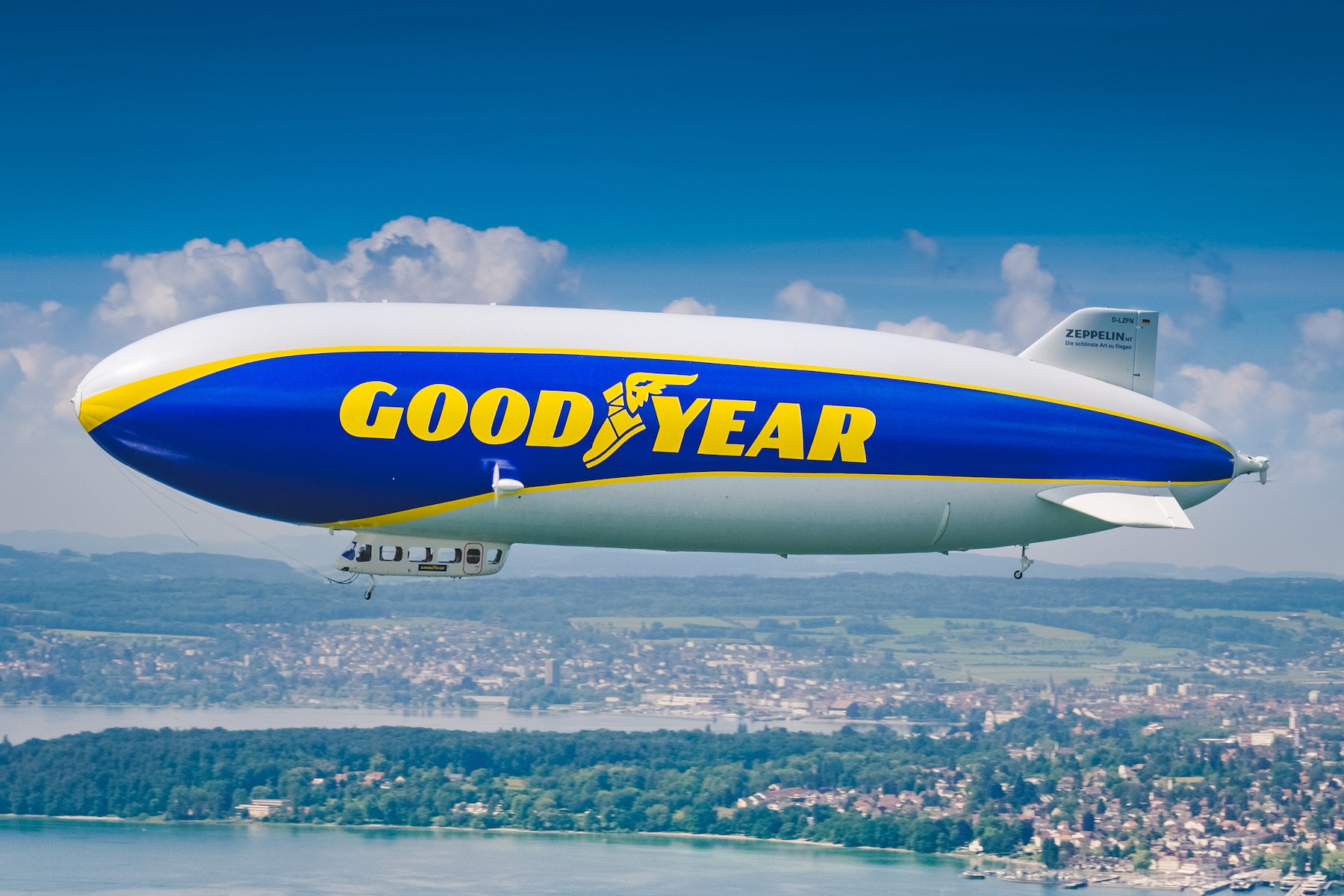
June 3, 1925: The 1st Goodyear Blimp

June 3, 1925, 100 years ago: The Goodyear Tire and Rubber Company launches the Pilgrim, its 1st advertising airship, from Akron, Ohio, near the company's headquarters. It is the 1st "Goodyear Blimp."

Starting in the 1930s, airships began to be flown over sports stadiums, to provide overhead views for film cameras. In the 1960s, this grew to television cameras. In the 1970s, they began to be equipped with lighted message boards, for use in night games.

In 1975, Thomas Harris, later to write the Hannibal Lecter novels, published his 1st novel, Black Sunday. Although he used a fictional company's name for the blimp, he used a sporting event, the Super Bowl, as the plot point: He was going to have a terrorist use the blimp to explode over Tulane Stadium in New Orleans, as the Miami Dolphins played the Washington Redskins below. (That matchup had happened in 1973, at the Los Angeles Coliseum. It would happen again in 1983, also in the L.A. area, at the Rose Bowl.)

In 1977, Black Sunday was filmed, with cooperation from both Goodyear, which allowed one of its blimps to be used; and the NFL, which permitted film of Super Bowl X to be used. That game saw the Pittsburgh Steelers beat the Dallas Cowboys, 21-17, at the Orange Bowl, so the story was rewritten to take place in Miami.

In 1985, with New York Mets legend Tom Seaver, then pitching for the Chicago White Sox, going for his 300th career win against the New York Yankees, Goodyear sent a blimp to cover the event at Yankee Stadium. I was at this game, and I saw the blimp begin drifting to its left, and looked like it might crash into the left-field stands. The pilot got it going forward again, and there was no Black Sunday situation, intentional or otherwise.

Eventually, other companies began to use blimps in advertising. Over the course of 2014 to 2017, Goodyear began retiring its older non-rigid airships, and replacing them with semi-rigid airships.

Also on June 3, 1925, Bernard Schwartz was born in The Bronx. We knew him as actor Tony Curtis, ex-husband of actress Janet Leigh, and father of actress Jamie Lee Curtis.

Tuesday, March 4, 2025

March 4, 1925: The Inauguration of Calvin Coolidge

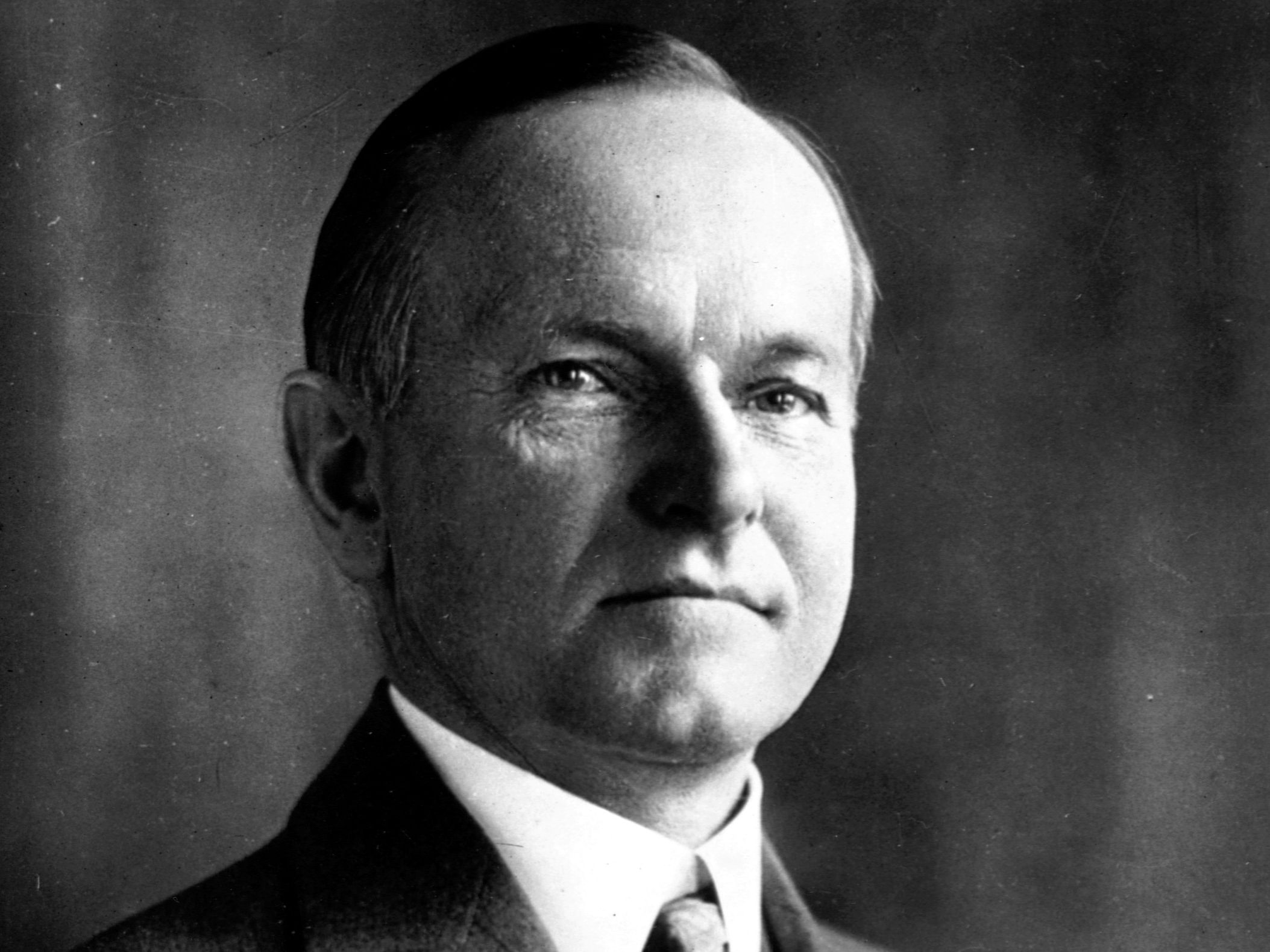
March 4, 1925, 100 years ago: Calvin Coolidge, who became the 30th President of the United States upon the death of Warren Harding in 1923, and won a full term of his own in 1924, is sworn in as President. Charles G. Dawes, a former U.S. Ambassador to Britain, is sworn in as Vice President.

A 52-year-old native of Plymouth Notch, Vermont, and Governor of Massachusetts when he was elected Vice President in 1920, he is sworn in on the West Front of the Capitol Building, by the Chief Justice, himself a former President, William Howard Taft.

This was the 1st time that a former President swore in an incoming President. In spite of this, Taft goofed on the Oath of Office: Instead of asking Coolidge to "preserve, protect and defend the Constitution of the United States," it came out, "protect, preserve and defend." Four years later, for Herbert Hoover, Taft goofed again, making it "preserve, and maintain, and defend…"

His reputation as "Silent Cal" led to a story that two women at a White House party made a bet, and one walked up to Coolidge and said, "I made a bet with my friend that I could get you to say at least three words to me," and Coolidge said, "You lose." Belying this reputation, this speech was, and remains, the 6th-longest Inaugural Address of any President. His Inaugural Address is the 1st to be broadcast on radio. Unfortunately, no sound recording of the Address survives.

The Address is not especially memorable. He closes by saying, "America seeks no earthly empire built on blood and force. No ambition, no temptation, lures her to thought of foreign dominions. The legions which she sends forth are armed, not with the sword, but with the cross. The higher state to which she seeks the allegiance of all mankind is not of human, but of divine origin. She cherishes no purpose save to merit the favor of Almighty God."

The theme of his 1924 election campaign was "Keep Cool with Coolidge"; alternately, "Keep Cool and Keep Coolidge." The scandals of the late President Harding were forgotten: Coolidge was a model of propriety. And the country enjoyed "Coolidge Prosperity," and enjoyed an isolationist foreign policy: There were no international entanglements during his time in office.

On vacation in the Summer of 1927, he told the press, "I do not choose to run for President in 1928." Maybe he saw the writing on the wall, that an economic crash was coming. Herbert Hoover, Secretary of Commerce under Harding and Coolidge, was elected, and was left holding the bag for the Crash of 1929. Coolidge escaped blame for the Great Depression.

He died on January 5, 1933, 2 months before his 2nd full term, had he sought it and won it, would have ended. He remains the modern model for a boring President: When told he had died, theater critic Dorothy Parker said, "How can you tell?"

Monday, November 4, 2024

November 4, 1924: Keeping Cool With Coolidge

November 4, 1924, 100 years ago: President Calvin Coolidge, who took the office on the death of Warren Harding the year before, is elected to a full term in his own right. The Republican, who had been Governor of Massachusetts before being Vice President, took advantage of a split in the Democratic Party that nullified a split in the Republican ranks.

The slogan was "Keep Cool with Coolidge" -- alternately, "Keep Cool and Keep Coolidge" -- and the nation agreed. He won 382 Electoral Votes, and 54 percent of the popular vote. John W. Davis, a former Congressman from West Virginia and U.S. Ambassador to Britain, won 136 Electoral Votes, but his 29 percent represents the lowest popular-vote percentage in the history of the Democratic Party. Senator Robert La Follette of Wisconsin, formerly a Republican but now the leader of the Progressive Party, won his home State for 13 Electoral Votes, and took 16 percent of the vote.
Charles G. Dawes was elected to fill the vacancy in the Vice Presidency, caused by Coolidge's ascendancy. A Mayflower descendant, and also a descendant of William Dawes, one of Paul Revere's co-riders, a Chicago utilities executive who had served as Harding's Budget Director.
The following year, his Dawes Plan for easing the payment of war reparations won him the Nobel Peace Prize. He was also a musical composer, and his "Melody in A Major" became popular upon publication in 1912. In 1951, Carl Sigman added lyrics to it, and it became "It's All In the Game." In 1958, black singer Tommy Edwards had a Number 1 hit with it. Dawes is the highest-ranking government official ever to have had a Number 1 hit.
Coolidge had recently lost his 16-year-old son John to an infection that could have been easily treated had antibiotics been invented. He had also recently watched the Washington Senators win the World Series. He did not like baseball, but his wife Grace did.
He was known as "Silent Cal" for his reticence. Legend has it that 2 women, seeing him at a party, made a bet. So one walked up to him and said, "I made a bet with my friend that I could get you to say 3 words to me." And Coolidge said, "You lose."
Even when he decided not to run for a 2nd full term, he was brief: He told the press simply, "I do not choose to run for President in 1928," and walked away. He may have seen the Crash of 1929 coming, and didn't want to get blamed for it. He should be, but he left his successor, Herbert Hoover, holding the bag.
Interestingly, Coolidge and Dawes did not get along, and when it was suggested at the 1928 Republican Convention that Dawes be nominated for a 2nd term as Vice President, along with Hoover, Coolidge stepped in and prevented it, and Senator Charles Curtis of Kansas was nominated instead, a choice both Coolidge and Hoover could live with.
Charles G. Dawes
As a consolation prize, Hoover appointed Dawes to be U.S. Ambassador to Britain. He didn't get along well with King George V, but the Prince of Wales, later King Edward VIII and the Duke of Windsor, liked him. As the Depression kept going, Hoover asked Dawes to come home, and run the Reconstruction Finance Corporation (RFC), which he did for the remainder of the term. He was offered the Vice Presidential nomination in 1932 and the Presidential nomination in 1936, as a reminder of the "good" Coolidge years, but declined both times. He died in 1951.
Despite Coolidge's landslide, Nellie Tayloe Ross, a Democrat, was elected Governor of Wyoming, to replace her late husband, William B. Ross. She was the 1st woman elected Governor of any State.

Thursday, October 10, 2024

October 10, 1924: The Washington Senators Win the World Series

October 10, 1924, 100 years ago: With the score tied at 3-3 and one out in the bottom of the 12th in Game 7 of the World Series at Griffith Stadium in Washington, Muddy Ruel, catcher for the Washington Senators, lifts a high catchable foul pop-up, which New York Giants catcher Hank Gowdy misses when he stumbles over his own mask.
Given a second chance, Ruel doubles. Earl McNeely then hits a grounder that strikes a pebble, and soars over the head of rookie Giant 3rd baseman Freddie Lindstrom, and drives home Ruel with the winning run making the Senators World Champions.
Walter Johnson, who had brilliantly toiled 18 seasons for a team known as "Washington: First in war, first in peace, and last in the American League," and had lost Games 1 and 4, pitched the 9th through 12th innings in relief, and not only had finally won a World Series game, but had won a World Series.
President Calvin Coolidge, running for a term in office in his own right after succeeding the late Warren Harding the year before, and his wife Grace were in attendance. He didn't like baseball, but Grace did.
The Senators had their 1st World Championship in 24 years of trying. Outfielder George "Showboat" Fisher was the last survivor of the 1924 Senators, living until 1994, age 95. It took 95 years for another Washington baseball team has won another postseason series, but Nationals, having squandered National League Eastern Division titles in 2012, '14, '16 and '17, won the 2019 World Series.
In 1981, baseball historian John Thorn published Baseball's 10 Greatest Games. He included this game as one of them.

Tuesday, July 9, 2024

July 9, 1924: The Democrats Need 103 Ballots

John W. Davis

July 9, 1924, 100 years ago: The Democratic Party nominates a candidate for President -- on the 103rd ballot. That's right: One hundred and three ballots. To put that into proper perspective: Neither they nor the Republican Party have even needed a 2nd ballot since 1952.

In 1920, Senator Warren Harding of Ohio led a Republican landslide, and won the Presidency. In 1923, the Teapot Dome scandal broke out, and it looked like it might damage Harding as he ran for re-election. Shortly after it broke out, Harding died, and was replaced by his Vice President, Calvin Coolidge.

It soon became clear that Coolidge would run for a term of his own in 1924, and the Democrats were confident: Except for Theodore Roosevelt in 1904, no "accidental President" had gone on to be elected in his own right, and the Republicans were tarred with scandal.

But unlike Harding and a few members of his Cabinet, Coolidge was not involved in Teapot Dome, or in any other scandal. And, under Republican leadership, the economy had recovered from the post-World War I depression. The slogans for 1924 were "Coolidge Prosperity" and "Keep Cool and Keep Coolidge."

That's the uphill fight that the Democrats had as they gathered for their Convention at Madison Square Garden in New York. This was the 2nd building with the name, built in 1891. It would be replaced the following year by the building that would eventually be known as "the Old Garden." That one hosted many political events, but never the National Convention of either major party. It was replaced in 1968 by the current building bearing the name, which has hosted the Democratic Convention in 1976, 1980 and 1992; and the Republican Convention in 2004.
Madison Square Garden II

Unlike the Republican Party, which only required a majority of its Delegates to nominate candidates for President and Vice President, the Democratic Party needed a two-thirds supermajority. This enabled the Southern States, which made up about one-third of the Democratic Delegates, to effectively have a veto over any candidate they felt insufficiently conservative, or too favorable to civil rights.

As a result, even after the American Civil War, most Democratic nominees for President turned out to be not all that liberal. Grover Cleveland was nominated in 1884, 1888 and 1892, and would be considered conservative by post-New Deal standards. William Jennings Bryan was nominated in 1896, 1900 and 1908, and while he was liberal on many issues, his support for farmers and his silence on civil rights made him acceptable to the South.

Woodrow Wilson was nominated in 1912 and 1916, and while he was progressive on many issues and had been Governor of a Northern State, New Jersey, he was a Southern native, and turned out to be the most regressive President this nation has ever had on the issue of race. Even Donald Trump didn't end up going as far backward on that issue as Wilson.

But by 1924, the Democratic Party had changed. Its youth, its energy, and its ideas were coming from big cities, from the labor movement, and from Catholic voters and the candidates they were electing. One of these was the Governor of New York, Alfred Emanuel Smith. Going into the 1924 Convention, the 50-year-old Al Smith had the support of the Northeastern and Midwestern cities, both big ones like New York and Chicago and smaller ones like Scranton, Pennsylvania and Akron, Ohio.
Alfred E. Smith

He projected an image of joy and optimism. In giving the speech nominating him, a fellow New Yorker, Franklin D. Roosevelt, called him "The Happy Warrior of the Political Battlefield." A former State Senator, a former Assistant Secretary of the Navy, and the Party's 1920 nominee for Vice President, FDR had seemingly been taken out of the Party's line of succession due to contracting polio in 1921, and made his way to the podium on crutches on this occasion. (The term "Happy Warrior" would also be applied to a later Democratic nominee for President, Hubert Humphrey.)

But Smith was too progressive for the South's taste. He was connected with the Democratic machine in the State of New York, Tammany Hall, long considered one of the most corrupt political organizations in the country. He was in favor of repealing the 18th Amendment to the Constitution, making it once again legal to produce, transport, sell and buy alcoholic beverages in America. (Pro-Prohibition people, as most Southerners and most Republicans were at the time, were called "drys"; and pro-repeal people, as Smith and most Catholics were, were called "wets.")

Smith had worked with black leaders, and was favorable to civil rights. The Southern States' individual Democratic Parties -- and even the Republican Party in the Northern, but Southern-bordering, States of Indiana and Illinois -- were then dominated by the Ku Klux Klan.

Most people from the 1950s onward, hearing of the Klan, have tended to think of their hatred and persecution of black people. But in the 1920s, most of their actions seemed to be against Catholics, the argument being that they bowed to a "foreign dictator" -- which, by the definition of each word, the Pope was, and remains. The Klan were also terribly anti-Semitic, although Jews had yet to become a significant voting bloc in America.

At that point, the Klan had never been stronger: It had over 3 million members, and regularly had well-attended parades down Pennsylvania Avenue in Washington, D.C. So they could have prevented the North's candidate from being nominated.
Klan Rally, Washington, August 9, 1925

Their candidate was William Gibbs McAdoo. At 60, McAdoo was a Southerner, born in Georgia, raised in Tennessee. He had run the company that built what's now known as the PATH subway train system in New York City and New Jersey. He had married Wilson's daughter Eleanor, and had served as Wilson's Secretary of the Treasury. So, at the least, he was qualified.
William G. McAdoo

He was now based in California, so he seemed to have the support of both the South and the West. His name had been put in nomination at the 1920 Convention, where the nomination was won by Governor James M. Cox of Ohio, so he had a solid base of support. Cox had been clobbered by Harding in the general election, and was not seriously considered for a 2nd nomination. So, if there were a "line of succession," this would seem to have moved McAdoo up to 1st in it.

The 1924 Convention's 1st ballot was held on June 30. McAdoo got 39.4 percent of the Delegates, Smith 22.0 percent. Most of the remaining ballots went to various "favorite son" candidates put up by the State delegations.

Ballot after ballot was taken on that first day, until it reached a 15th ballot: McAdoo 43.6, Smith 27.8, with some of the favorite sons having drifted away, and their supporters having chosen McAdoo or Smith. Big demonstrations were held during the 10th ballot, when Governor Jonathan M. Davis of Kansas dropped out, freeing his delegation to vote for McAdoo; and Governor George Silzer of New Jersey dropped out, freeing his delegation to vote for Smith.

The prevailing belief among the delegates was that the impasse could only be broken by the elimination of both McAdoo and Smith, and the selection of one of the other contenders. McAdoo told his supporters that he was willing to drop the 2/3rds rule, but, being Protestant and South-heavy, they preferred to keep their veto over Smith. At no point in the balloting did Smith receive more than a single vote from the South, and scarcely more than 20 votes from the States west of the Mississippi River.

After 20 ballots, the vote was McAdoo 39.5, Smith 28.0. Coming in 3rd, with 11.3 percent of the Delegates, was John William Davis. At 51, he was a conservative lawyer for Wall Street firms. In 1910 and 1912, he was elected to Congress from West Virginia. In 1913, Wilson appointed him Solicitor General of the United States. In 1918, Wilson appointed him U.S. Ambassador to Britain. Certainly, he was qualified for the Presidency, but he was hardly a star, capable of generating big national support on his reputation alone. But, to an increasing number of Delegates, he seemed like a reasonable compromise candidate.

Through the next 10 ballots, the percentages for McAdoo, Smith and Davis didn't change much. Daniel C. Roper, a South Carolina Delegate and formerly the nation's Commissioner of Internal Revenue, went to FDR, to ask him to talk Smith into dropping out and accepting the Vice Presidential nomination on McAdoo's ticket.

The New York delegation, controlled by Tammany, tried what might be called a "dirty trick": They tried to prolong the convention until the hotel bills were beyond the means of the Delegates who had traveled to New York, thus giving the advantage to the pro-Smith Northeastern delegates. The Smith backers also attempted to stampede the Delegates by packing the galleries with noisy rooters, the idea being to fool the other Delegates into thinking Smith had more support than he actually did. This had worked at a Convention before, and would again.

To counter these tactics, McAdoo and Bryan, the latter booed by the New York delegation when he tried to speak on McAdoo's behalf, both tried unsuccessfully to adjourn and then reconvene in another city. The Democrats hadn't done that since 1860, and the result that time was a Party split 3 ways, and Abraham Lincoln being elected with a majority of the Electoral Votes, but only 39 percent of the popular vote, a record low for any Presidential election winner.

By the 42nd ballot, Davis had faded to 6 percent, and McAdoo was gaining support, leading Smith 45.7 to 28.9 -- but still not a majority, let alone 2/3rds. McAdoo supporters introduced a motion to eliminate one candidate on each ballot until only five remained, but Smith Delegates, and those still supporting the hopeless candidacies of favorite sons, voted this down.

Smith countered by suggesting that all Delegates be released from their pledges. McAdoo agreed to this, on the condition that the 2/3rds rule be eliminated, and Smith was fine with that. But, as before, McAdoo's own supporters balked at that idea.

Senator David Walsh of Massachusetts, Smith's fellow urban Irish Catholic, said, "We must continue to do all that we can to nominate Smith. If it should develop that he cannot be nominated, then McAdoo cannot have it, either." A record 61st ballot was held, and the tide had turned back: McAdoo 42.6, Smith 30.5, Davis down to 5.4, and everybody else combined at 21.5. McAdoo still had the Solid South and what political columnist William Safire would one day name the Winning West.

A new name was placed in nomination: Samuel Moffett Ralston, Senator and former Governor of Indiana. Bryan's brother, Charles Bryan, at this point Governor of Nebraska, had written, "Ralston is the most promising of the compromise candidates." In 1922, Ralston had written an attack on parochial schools, gaining some support from the KKK. And McAdoo had previously voiced appreciation for him. Furthermore, like Davis, Ralston seemed to have few enemies: Previous compromise choices, in both parties, had gotten the nomination not because they were loved by many, but because they were hated by few.
Samuel Ralston

It seemed possible that McAdoo might drop out, throw his support to Ralston, and then enough supporters of Smith, Davis and the favorite sons might draw upon their memories of the 3 Bryan campaigns to make the difference and nominate Ralston. On the 52nd ballot, Ralston passed Davis for 3rd place.

But still, the deadlock was not broken. Ralston had taken votes away from McAdoo. On July 8, the 87th ballot showed Smith back in the lead: 32.8 percent, to McAdoo's 30.3, Ralston's 18.0 and Davis' 6.0. Thomas Taggart, Chairman of the Democratic Party of Indiana, later said, "We would have nominated Senator Ralston if he had not withdrawn his name at the last minute. It was a near certainty as anything in politics could be. We had pledges of enough delegates that would shift to Ralston on a certain ballot to have nominated him."

But Ralston, 66, was over 300 pounds, and both his wife and his son were ill. He was not willing to leave their sides to campaign for the Presidency. He sent the Convention a telegram, saying that he would not accept the nomination. As it turned out, he would be dead within a year and a half.

However brief, Ralston's candidacy broke McAdoo's. On July 9, a 100th ballot was taken. Smith led with 32.4, Davis had jumped to 2nd with 18.7, and McAdoo had fallen to 17.5. At this point, both Smith and McAdoo dropped out, although they still held some Delegates. Davis took the lead on the 101st ballot, with 28.7. Finally, on the 103rd ballot, Davis got 844 of the 1,098 Delegates, or 76.8 percent. He was nominated. Charles Bryan was, considerably more easily, nominated for Vice President.

In his acceptance speech, Davis made the perfunctory statement that he would enforce the Prohibition laws, but his conservatism prejudiced him in favor of personal liberty and home rule, and he was frequently denounced as a wet. After the Convention, he tried to satisfy both factions of his party, but his support came principally from the same city elements that had backed Cox in 1920.

By taking 103 ballots, and picking the qualified but colorless Davis, the Democrats ended up looking like a gang that couldn't shoot straight. They had all those chances to pick somebody good, and they picked somebody who wouldn't even be thought of as a Democrat within 10 years.

Occasions like this made Will Rogers, America's leading humorist, to say, "I don't belong to any organized political party. I'm a Democrat."

Complicating things was a 3rd-party candidacy, that of Senator Robert M. La Follette of Wisconsin, a former Republican who was the nominee of the Progressive Party. He picked up a lot of votes that would have gone to Smith had he been nominated. Of course, had Smith been nominated, the South might have nominated their own 3rd-party candidate, in an attempt to sabotage the liberal Democratic nominee. (They would later try that against Harry Truman in 1948, unsuccessfully; and Hubert Humphrey in 1968, successfully.)

The general election was held on November 4, and it was no contest. Popular vote: Coolidge 54, Davis 29, La Follette 16. Davis' 29 percent remains the lowest any Democratic nominee for President has ever gotten. States won, out of the 48 then in the Union: Coolidge 35, Davis 12, all in the South; La Follette 1, his home State of Wisconsin. Electoral Votes: Coolidge 382, Davis 136, La Follette 13.

Garland S. Tucker III, an investment manager, published a book about this election in 2010, titling it The High Tide of American Conservatism. His point was that both major party candidates campaigned for limited government, reduced taxes, and less regulation. By contrast, La Follette called for the gradual nationalization of the railroads and increased taxes on the wealthy. And so, the 2 conservative candidates got 84 percent of the popular vote, 47 out of 48 States, and 518 out of 531 Electoral Votes. Oddly, the cover of the book has a bigger photograph of Davis than it does of Coolidge.
Coolidge served out his 1 full term, and, in 1927, famously told the press, "I do not choose to run for President in 1928." Smith tried again, and became the 1st Catholic nominated for President by a major party. But he got clobbered by the Republican nominee, Herbert Hoover, because the country wasn't ready to step away from the Republicans' policies that had brought prosperity, or to elect a Catholic President, or to elect a President who wanted to repeal Prohibition. Despite the Republican landslide of that year, Roosevelt was narrowly elected Governor of New York.

In 1929, the stock market crashed. "Republican prosperity" was no more, and their Party was blamed for the Great Depression. In 1932, Smith tried again, but Roosevelt was nominated on the Democratic Convention's 3rd ballot. He annihilated Hoover in November.

Then he had the Democratic National Committee do away with the 2/3rds rule. As a result of this, only once since have the Democrats needed a 2nd ballot, or more, to nominate a candidate for President: 1952, in Chicago, needing 3 ballots to nominate Adlai Stevenson. The Republicans last needed to do so in 1948, in Philadelphia, needing 3 ballots to nominate Thomas E. Dewey.

Like Samuel Ralston, "Fighting Bob" La Follette and William Jennings Bryan died in 1925. Charles Bryan left the Governorship of Nebraska that year, but was elected to it again in 1930. Calvin Coolidge died in 1933, 2 months before his 2nd full term, had he won it, would have ended. Upon being told that the famously taciturn and nap-taking Coolidge had died, writer Dorothy Parker said, "How can you tell?"

Al Smith became terribly embittered at his 1928 loss and his eclipse by Franklin Roosevelt as the Democrats' leading light. He nominated FDR's 1936 opponent, Alf Landon, to no avail, and died in 1944. Charles Bryan died the next year. A few weeks later, so did FDR.

William G. McAdoo was elected a U.S. Senator for California in FDR's 1932 landslide, but lost renomination for the office in 1938, and died in 1941. Charles Dawes, elected Vice President on Coolidge's ticket in 1924, lived until 1951.

John W. Davis went back to the practice of law, and became increasingly conservative, and the Democratic Party, fully in line with FDR's New Deal, turned its back on him, as a former nominee both hopelessly unsuccessful and out of step with where the Party had gone. It has been alleged that he -- and Smith as well -- was a participant in the "Business Plot" that sought a military coup that would have removed FDR from power and installed a fascist President.

He argued many cases before the Supreme Court of the United States. He had previously done so as Solicitor General. Unfortunately, his 140th and last such case was for the side of public school segregation in Brown v. Board of Education in 1954, which he deservedly lost. He died the next year.

The last major participant of the 1924 election was Burton Wheeler: As a Senator from Montana, he briefly left the Democratic Party to be La Follette's running mate, and lived until 1975.

In 1927, the Ku Klux Klan held a rally in Queens, New York City. The police broke it up, and arrested a few members. One of them was a 22-year-old aspiring real estate executive named Fred Trump, later to be the father of Donald Trump.

In 2016, the Southern Poverty Law Center estimated that the KKK's membership was between 3,000 and 8,000. Despite the Presidency of Donald Trump, and the growth of other hate groups, there is no reason to believe that the KKK's numbers have significantly increased.

Thursday, August 3, 2023

Top 10 Myths About the Roaring Twenties

August 2, 1923, 100 years ago: President Warren G. Harding dies. When the 1920s began, he was elected President as a good-looking, charismatic man who would lead the nation into a new era of "normalcy," while, at the same time, letting us have as much fun as he was having behind the scenes.

By the time the 1920s were over, he had been posthumously exposed as an idiot, a womanizer, and the head of a really corrupt Administration. His reputation crashed every bit as hard as the stock market did.

His image was well-crafted, especially since he was seen as nice and healthy, unlike the physically and politically paralyzed outgoing President, Woodrow Wilson. Little did anyone know that Harding was, like Wilson before his 1919 stroke, already a lot sicker than he let on by the time his candidacy began.

So let's look at some myths about the uproarious decade, and see how close they were to the truth:

Top 10 Myths About the Roaring Twenties

1. Babe Ruth saved baseball. That is, his home runs in 1920 and onward made the nation forget about the Black Sox Scandal, which would have destroyed baseball otherwise.
Warren Gamaliel Harding and George Herman Ruth Jr.

Baseball had survived scandals and down periods before. Certainly, Ruth helped. But the scandal didn't break until the end of the 1920 season, nearly a year after the fixed World Series, and Ruth was already destroying previous home run records. Without it, baseball might have taken longer to bounce back, but it would have happened.

And if you had asked the Babe himself, he would admit that he hadn't "saved baseball," that baseball didn't need "saving." It didn't after the Black Sox Scandal, it didn't after the Strike of '81, it didn't after the Strike of '94, and it doesn't now.

*

2. Warren Harding was one of the worst Presidents. Did the 29th President of the United States get a bum rap? This website advertises "6 Major Accomplishments of Warren G. Harding." Let's check them out, and see if they hold water:

1. Before embarking on a political career as an ambitious Republican, he built a successful newspaper, The Marion Star. He did this, but that's hardly a major accomplishment, and it wasn't something he did as President. So we can't count it.

2. Warren Harding was the first sitting U.S. Senator to win the Presidency. This is true. Is it a major accomplishment? Certainly: Winning the Presidency is one, regardless of how you did it, unless you cheated -- and, as far as we can tell, he didn't. But it's not an accomplishment as President.

3. One of his earliest successes was the Washington Naval Conference in 1921–22. He managed to bring the major nations with significant naval might to agree on what was called the naval limitations program. The program was in place for a decade.

This could be considered a major accomplishment. Or, it could be attributable to his Secretary of State, Charles Evans Hughes, much as the Louisiana Purchase was less Thomas Jefferson than his negotiator, James Monroe; the Monroe Doctrine was less Monroe than Secretary of State (and successor as President) John Quincy Adams; and the Alaska Purchase was less Andrew Johnson than Secretary of State William Seward. But we can count it in Harding's favor.

4. Warren Harding passed the federal child welfare program, the first of its kind. He managed to lower taxes, increased the tax base, raised tariffs to create employment and he also managed to successfully negotiate with striking workers in mining and railroad companies, particularly the crisis in Blair Mountain and the Great Railroad Strike in 1922.

This is actually 4 separate actions. The child welfare program was, unquestionably, a good thing. But lowering taxes doesn't increase the tax base: By definition, it lowers it. Raising tariffs doesn't create employment, it reduces it. These things helped to set up the Great Depression of the 1930s.

And he had little to do with the Blair Mountain Crisis -- which wrecked the United Mine Workers for a decade. So that's 1 plus, 2 major minuses, and 1 flat-out lie that would have been a minus had it been true.

5. Warren Harding was vocal against lynching and the violence meted out to African Americans. He did bring in the anti-lynching bill only to see it fail at the hands of the Congress. Harding's Republican Party had control both houses of Congress, so, while his heart was in the right place, he failed as a leader on this issue.

6. President Harding signed a peace treaty with Austria and Germany post World War I. Big deal. Whoever was President was going to do that. It was a formality, since the war had ended 3 years earlier, and the Congress of Versailles had already happened. No one counts the proclamation officially ending World War II that he signed on December 31, 1946 -- 16 months after V-J Day -- as one of the accomplishments of Harry Truman. Ending the war in victory for the Allies, yes; the New Year's Eve '46 treaty, no.

So, to tally up: 9 actions, resulting in 2 major accomplishments, 1 piece of window dressing, 1 embarrassing failure, 2 harmful actions, and 3 actions that were not accomplishments of his Presidency at all.

And, yes, his economic policies, guided by Secretary of the Treasury Andrew Mellon, helped to set up the Great Depression. And, yes, the Teapot Dome scandal was the biggest piece of executive branch malfeasance ever, and would remain so for another half a century.

In other words: In 2 1/2 years in office, 2 big pluses, 1 very little plus, 3 minor minuses, 1 big minus, and 1 humongous minus.

Was America better off on August 2, 1923, when Harding left the Presidency through death, than it was on March 4, 1921, when he entered the Presidency? Yes. How responsible was he for that? Not much. And, by March 4, 1931, the 10th Anniversary of his Inauguration, it was obvious that he was one of the worst Presidents the country had ever had. That we have since had Herbert Hoover, Richard Nixon, Ronald Reagan, George W. Bush and Donald Trump, each of whom was even worse, by no means elevates Harding in history.

*

Let's move on:

3. The Great Gatsby symbolizes the good times of "The Jazz Age." This one is pure baloney. Both the 1925 novel by F. Scott Fitzgerald and the films based on it, including the Robert Redford version in 1974 and the Leonardo DiCaprio one in 2013, show that all the parties and other good times were hollow -- or, to use the expression I used for Harding's treaty "ending the war," window dressing -- and did nothing but take people's minds off the difficulties of life.
F. Scott Fitzgerald

A director with guts could easily do a version of Gatsby and set it over half a century later, in the Disco Period.

4. Charles Lindbergh was the 1st man to fly across the Atlantic Ocean. He was the 1st to do it solo, and the 1st to do it from the North American continent to the European continent. Certainly, that was worth celebrating. Perhaps not as much as it was celebrated in what a documentary about the 1920s called "The Age of Ballyhoo." But worth some celebration.
Lindbergh and his plane, Spirit of St. Louis

But Lindbergh wasn't the 1st to fly across the Atlantic, or even the 2nd. On June 15, 1919, British pilots John Alcock and Arthur Brown made the 1st air crossing of the Atlantic. To be fair to Lindbergh and his achievement, Alcock and Brown did not go full continent-to-continent. They chose the closest possible route: From St. John's, Newfoundland, the easternmost city in the Western Hemisphere, to the west coast of Ireland, the westernmost point in Europe.
Arthur Brown (left) and John Alcock

5. The Jazz Singer was the 1st "Talking Picture." It wasn't: Its star, Jolson, already a Broadway and recording legend, had sung in a much shorter film the year before. But it was the 1st feature-length motion picture with a synchronized recorded music score, and the 1st feature-length motion picture with lip-synchronous speech and singing.
6. "Coolidge Prosperity." Yes, there was an economic boom that began under Harding, ending the postwar drop under Wilson, which was definitely a recession and has been termed a "depression" by some. And it continued under Coolidge.
Calvin Coolidge

But looks can be deceiving. Using the Dow Jones Industrial Average as a guide: It was 64 on August 22, 1921. Not 6,400: Sixty-four. It reached 100 in October 1922, was at 87 when Harding died in August 1923, and was at 120 at the end of 1924, Coolidge's 1st full year in office. Proportionally speaking, that's significant improvement.

At the end of 1925, it was at 156. In September 1926, it reached 164, before dropping a little by the end of the year. It broke 200 at the end of 1927. The real surge began in July 1928, just as Hoover was running on "Republican prosperity." It hit 292 on November 26, 1928. After a drop in early December, it reached 300 on New Year's Eve. On June 10, 1929, it was 303. On September 3, it had surged to 381.17.

Then it started going down. The "Crash of '29" seems to have happened in a hurry, but, on October 23, the Dow was already down to 305.85. On the 24th, "Black Thursday," it fell to 299.47, and would have been worse if not for a late stock buy made by the famous "walk across the floor" of the New York Stock Exchange by J.P. Morgan banker Thomas W. Lamont. On Friday, the 25th, there was a slight rise, to 301.22.

But the weekend, as it frequently has in tough times since, bred worry. On Monday the 28th, the Dow fell to 260.64. The 29th was "Black Tuesday," and the Dow fell to 230.07. The chickens hatched by Harding, Coolidge and Mellon had come home to roost. As a poem of the time went:

Hoover blew the whistle
Mellon rang the bell
Wall Street gave the signal
and the country went to hell!

What about the other major gauge of how well the economy is doing, the unemployment rate? Here it is, at the end of each calendar year in the 1920s:

* 1920: 4.0 percent
* 1921: 11.9
* 1922: 7.6
* 1923: 3.2

Looks like the Harding-Mellon policy of cutting taxes is working. Let's see what the Coolidge of policy of "do nothing, because the business of America is business" does:

* 1924: 5.5
* 1925: 4.0
* 1926: 1.9

Is that for real? Or was somebody cooking the books? Let's continue:

* 1927: 4.1
* 1928: 4.4
* 1929: 3.2

In other words, while the Crash happened late in 1929, the Depression wasn't yet getting noticed around the country. But then:

* 1930: 8.9

That's bad, but not as bad as the hangover from the Wilson years. But it got much, much worse thanks to the Harding-Mellon-Coolidge-Hoover policies:

* 1931: 15.9
* 1932: 23.6
* 1933: 24.9

Yeah. America needed a new deal, capitalized or otherwise. Harding died, and Coolidge did "not choose to run for President in 1928." So they escaped the blame of "early drafts of history," and Hoover was "left holding the bag." It just seemed too convenient, just as it was to blame CBS for the collapse of the Yankees in 1965, without considering what harm selling owners Dan Topping and Del Webb had already done.

Calvin Coolidge was, at least domestically, the most conservative President America has ever had. Not a radical right-winger like Reagan, George W. Bush or Trump, but conservative in the old sense of the word. America paid the price for this, but he didn't.

7. Prohibition turned America into a giant gangland shooting gallery. The homicide rate did rise in the 1920s, but context is needed. A lot of potential murderers, and murder victims, were in the service in 1917 and 1918.

But there's no sign that Prohibition or organized crime accounted for most, or even much, of it. Hijackings of cars and trucks smuggling liquor was common, but the robbers usually didn't find it necessary to kill the drivers. Why cause more trouble than you need?

8. "Flappers" were women of loose morals. Smoking. Drinking. Showing skin, with the age of the corset being over.

There was no study done at the time to prove that flappers had more sex than their predecessors. They did have more opportunity for pre-marital sex, as well as an increasing knowledge of contraceptive practices. The easier access to cars carried young adults away from parental eyes to socials, parties, sporting events, and theaters, while Hollywood productions portrayed, and simultaneously manufactured, this modern courting culture.

But there seems to have been no major rise in pregnancies, births, abortions, or sexually-transmitted diseases. If there was, it's been kept quiet. And if you wonder how something can be kept quiet for 100 years, let the record show that I didn't find out about the Tulsa Massacre of 1921 until around 2000 or so, and didn't find out about the Ocoee Massacre in Florida in 1920 until its 100th Anniversary. And we still don't know what caused Babe Ruth's "Bellyache Heard 'Round the World" in 1925.

9. The Stock Market Crash of 1929 led to mass suicides. Since then, whenever there's a dip in the stock market, demonstrators go to the New York Stock Exchange at Broad and Wall Streets, and yell, "Jump! Jump! Jump!" Because they think that's what happened during and after the Crash of '29.

There is no record of a single stockbroker suicide, let alone one via jumping out of a window, in the wake of the Crash. In what remains the definitive book about the Crash, The Great Crash 1929, Pulitzer Prize-winning economist John Kenneth Galbraith wrote, "In the United States the suicide wave that followed the stock market is also part of the legend of 1929. In fact, there was none."

One of the more famous photos connected with the Crash is this one, showing Walter Thornton. He was one of the most successful male models of the early 20th Century. Today, though, he is best known for this photo, trying to sell his very nice car, a 1929 Chrysler Imperial 75 Roadster, for $100 -- about $1,784 in today's money.
Did Thornton get $100 for his car? I can find no reference to an answer. But he did return to his previous career, modeling, and soon started a modeling agency, and gained a new fortune from that. He lived until 1990.

10. The Crash of 1929 caused the Great Depression. That was part of it, but by no means all of it. The end of World War I meant that farmers, having lost a big chunk of their market, had already been in a depression since the Armistice, 11 years earlier.
The famous headline in
the film industry's "trade paper"

In his nationally-syndicated newspaper column, Will Rogers spent much of the "Roaring Twenties" saying how, for farmers, the decade didn't roar so much as mumble. He pointed out that the economic boom wasn't universal for the cities, either: In 1928, about a year before the Crash, he wrote, "Wall Street has never been better off, but Eighth Avenue has never been worse off."

When he was President, John F. Kennedy quoted an old saying: "A rising tide lifts all boats." Not a boat with a hole in it. And, of course, in the 1920s as now, some people didn't have boats, and some people couldn't even swim.

Even with the Crash, the Depression might have been sharp, but relatively short, if not for the Smoot-Hawley Tariff Act, which President Herbert Hoover signed into law on June 17, 1930. Named for its sponsors, Senator Reed Smoot of Utah and Representative Willis Hawley of Oregon, both Republicans, the law raised U.S. tariffs on over 20,000 imported goods.
Willis Hawley (left) and Reed Smoot

This prompted retaliatory tariffs by other countries against America. As a result, between 1929 and 1933, American exports dropped 61 percent, and American imports dropped by 66 percent. Between 1929 and 1932, real Gross Domestic Product fell 17 percent worldwide, and 26 percent in the United States.

Unemployment was 8 percent when the Act was passed. It doubled to 16 percent in 1931 -- already higher than any of the "recessions" since the Depression -- and 25 percent in 1932. It is suspected that, when FDR took office on March 4, 1933, it may have been as high as 31 percent. If the Crash was the biggest cause, Smoot-Hawley was a strong second.

The Roaring Twenties did roar. But not quite the way history tends to remember it.