Showing posts with label tex rickard. Show all posts

Friday, November 28, 2025

November 28, 1925: The "Old" Garden & the Grand Ole Opry

November 28, 1925, 100 years ago: Madison Square Garden, the 3rd building with the name, opens between 49th and 50th Streets, between 8th and 9th Avenues, in Midtown Manhattan, at the northern end of the Theater District. The front entrance is on 8th Avenue, topped by a marquee that will soon be world-famous.
The 1st Garden was built at the northeast corner of 26th Street and Madison Avenue, catty-corner from Madison Square Park, in 1879. It had no roof. It was replaced in 1890 with a Moorish-style building, designed by the renowned architect Stanford White, that not only had a roof, but a tower with a roof garden where shows were hosted, and an apartment for White atop that.

Atop that was a statue of Diana, the Roman goddess of the hunt. This statue, sculpted of gilt copper by Augustus Saint-Gaudens, was nude, and the hoity-toity critics of the day hated it. One of the nastiest reviews came from a Philadelphia newspaper. Ironically, when the 2nd Garden was demolished, the Diana statue was taken to the Philadelphia Museum of Art (you know, the one whose steps Rocky Balboa ran up), and is still there. A copy now stands in New York's equivalent, the Metropolitan Museum of Art.
For both versions, the bowstring has been lost.
Otherwise, they are intact.

White would take showgirls up to his rooftop apartment, for a pre-movies version of a "casting couch." One was Evelyn Nesbit, whom he then made a star. She left him for a man named Harry Thaw. On June 25, 1906, jealous over Evelyn still having feelings for "Stanny," Thaw went to the roof garden during a show, and shot White. Evelyn's star faded: Late in life, she said, "Stanny White died. My fate was worse: I lived."

The New York Life insurance company owned the mortgage on the 2nd Garden, and decided to tear it down to build their new headquarters. George "Tex" Rickard, the top boxing promoter of the era, decided to build his own arena, where he wouldn't have to worry about anybody else's whims. He was lucky that New York Life was willing to sell him the rights to the name "Madison Square Garden": It was already a valuable brand name, which is a big reason why the "new Garden" has never sold naming rights.

When his Garden proved successful, he decided to build 6 copies, all over America. It didn't work out that way: He built the Boston Madison Square Garden in 1928 -- soon, it became simply "The Boston Garden" -- but died early the next year. He had gone to Miami to escape the cold New York weather, and to make a deal on a prizefight featuring up-and-coming heavyweight Jack Sharkey (who would hold the title from mid-1932 to mid-1933), but came down with appendicitis. This was before antibiotics, and he was dead at age 59.

The 1st event at The Garden was a six-day bicycle race. It sounds ridiculous today, but this kind of competition was huge in the "Roaring Twenties," especially in Europe, where it's still popular 100 years later. Teams of 2 men take turns riding for 6 days straight, from 6:00 PM to 2:00 AM, and the winner is the team that completes the most laps.

The 1st prizefight was held on December 8, for the Light Heavyweight Championship of the World. Paul Berlenbach defended the title by winning a unanimous decision over Jack Delaney. The following July, Delaney took the title from Berlenbach in a rematch at Ebbets Field.

The Garden became known as "The Mecca of Boxing." Heavyweight Joe Louis, light heavyweight Archie Moore, middleweight Sugar Ray Robinson, lightweight Henry Armstrong, and more became internationally-known superstars from their fights at The Garden.

It would also be known as "The Mecca of Basketball," with collegiate doubleheaders starting in 1934. It became a secondary home court for the City's college teams: New York University (NYU), City College of New York (CCNY), Long Island University (LIU), Columbia, Fordham and St. John's.

It also hosted the annual National Invitational Tournament (NIT), starting in 1938. And it hosted what would now be called the NCAA Final Four in 1943, 1944, 1945, 1946, 1947, 1948 and 1950, the last of these won by CCNY, which also won the NIT that year, the only time this "double" was ever achieved. 

The point-shaving scandal the next year crippled college basketball in New York City, and not only led to St. John's, not accused in the scandal, being the only major program that has survived on that level, but the NCAA ruling that teams could no longer compete in both their tournament and the NIT. The Final Four did not return to the New York Tri-State Area until 1996, when it was held at the Meadowlands.

That scandal coincided with the 1st trip to the NBA Finals for the New York Knicks, who debuted at The Garden in 1946. The scandal may have saved the Knicks, and thus may also have saved the NBA: Hoop fans needed something to turn to.

Rickard, who didn't always do things on the up-and-up, offered use of The Garden to Big Bill Dwyer, a bootlegger, who founded a hockey team, the New York Americans. The 1st NHL team in New York debuted on December 15, 1925, losing to the Montreal Canadiens 3-1.

The "Amerks" did so well at the box office that Rickard, noting that New York had 3 Major League Baseball teams, decided that it could support 2 hockey teams. So he founded his own team, and when the media found out, they nicknamed the new team "Tex's Rangers." He decided to go with it, and the New York Rangers debuted at The Garden on November 16, 1926, beating the Montreal Maroons 1-0.

With Rickard's promotional skills, the Rangers proved even more successful than the Americans. World War II knocked the Amerks out, as the manpower drain caused by the American and Canadian military drafts forced them to suspend operations after the 1941-42 season, and they never returned.

But the Rangers, the Knicks, college basketball games, prizefights, circuses, musical performances, ice skating shows, rodeos, and an event that predated even the 1st Garden, the Westminster Kennel Club Dog Show, continued at The Garden through the 1930s, the '40s, and the '50s. Madison Square Garden was right up there with the Empire State Building and Grand Central Terminal as the most famous building in the City.

But poor sight lines, and the need for more space and more dates, proved the arena's undoing. In 1960, the Pennsylvania Railroad, desperate for money, sold the air rights above Pennsylvania Station, between 31st and 33rd Streets and 7th and 8th Avenues, to the Madison Square Garden Corporation. The plan was to build a new station on the site, and a new arena on top of that.

On the afternoon of February 11, 1968, the Rangers played their last game at "the Old Garden," a 3-3 tie with the Detroit Red Wings, which was followed by a final skate with several NHL legends, including the Wings' still-active Gordie Howe. That night, "the New Garden" opened with "The Night of the Century," a salute to the USO, the United Service Organizations, which since 1941 has worked with the armed forces to provide supplies and entertainment. The co-hosts were old film partners and golfing buddies Bob Hope and Bing Crosby.

The last event at the Old Garden was 2 days later, February 13, the Westminster Dog Show. Demolition soon began. The site became a parking lot while various parties haggled over what to build on the site. Finally, in 1989, the 778-foot office and residential tower Worldwide Plaza opened there. The Subway station at 50th Street includes a mural dedicated to the Old Garden.
Worldwide Plaza

*

On the same day, The Grand Ole Opry is first broadcast, on radio station WSM, 650 on the AM dial, in Nashville, Tennessee. The station itself was brand-new, having gone on the air the preceding October 5, its call letters standing for the slogan of its original owner, the National Life & Accident Insurance Company: "We Shield Millions."
The Opry stage at the Ryman

George Hay, an Indiana native, had been a reporter for what was then the largest-circulating newspaper in Tennessee, the Memphis-based The Commercial Appeal. When that paper founded a radio station in 1923 (many early radio stations were founded by newspapers), WMC, he was its first evening announcer. In 1924, he left for Chicago station WLS, and hosted a program titled National Barn Dance.

In 1925, he took the concept to Nashville and WSM. The original Opry, officially titled WSM Barn Dance, was a one-hour program, simulating a barn dance but broadcasting from a radio studio. The show's 1st performer was Uncle Jimmy Thompson, a fiddler, already 77 years old. In other words, he had been born in 1848, only 52 years after Tennessee had become a State. (He lived until 1931.)

Most of the early performers on the show wouldn't be recognizable names today, but among them was Bill Monroe, the fiddler considered the inventor of bluegrass music, who was still performing up until his death in 1996, and whose song "Blue Moon of Kentucky" would be on the B-side of "That's All Right," the 1st single release of Elvis Presley.

(Elvis only appeared on the Opry once, on October 2, 1954. The audience reacted politely, but Jim Denny, by then the show's manager, told him that his style did not suit the program. Also before becoming nationally known, Elvis made several appearances, and was received considerably better, on a well-known radio show out of Shreveport: The Louisiana Hayride.)

An early regular act was the Fruit Jar Drinkers, whom Hay wanted to close every show, because he liked their "red hot fiddle playing." They were led by a banjo player, Uncle Dave Macon, a.k.a. the Dixie Dewdrop. Music historian Charles Wolfe wrote, "If people call yodelling Jimmie Rodgers 'the father of country music,' then Uncle Dave must certainly be 'the grandfather of country music.'"

If you've ever wondered why, in his song "Blue Suede Shoes" (covered by Elvis), among the things he would forgive before he would accept you stepping on said footwear, Carl Perkins listed, "drink my liquor from an ole fruit jar," this was clearly a tribute to the Fruit Jar Drinkers.

In 1926, WSM joined the 1st American radio network, the National Broadcasting Company, or NBC. On December 10, 1927, after playing Music Appreciation Hour, a classical music show which, that night, had been playing selections from grand opera, WSM Barn Dance came on. And Hay introduced DeFord Bailey by saying, "For the past hour, we have been listening to music largely from grand opera. But, from now on, we will present 'The Grand Ole Opry.'" The name stuck, and has been used ever since.

The show became more popular, and made the City of Nashville synonymous with country music, and vice versa. People wanted to watch as they broadcast. The larger studio they built turned out not to be big enough. In 1934, they moved to the Hillsboro Theatre, so they could have a paying audience. They outgrew that, too. They moved to the Dixie Tabernacle in East Nashville in 1936. Then came the War Memorial Auditorium.

Finally, in 1943, they moved back downtown, to the 2,362-seat Ryman Auditorium, and it became known as "The Mother Church of Country Music."
It remained home to the show until 1974, when, due to cramped quarters, it was moved out to the new Grand Ole Opry House at the Opryland USA theme park. In 1997, the park closed, and the Opry Mills Mall was built on the site. All the while, the Opry House remained open.
The Ryman remained open, and was renovated with modern amenities in 1994. In 2010, the flooding of the Cumberland River damaged the Opry House, and the show temporarily moved back to the Ryman while repairs were made.

George Hay died in 1968, at the age of 72. The Opry lives on, sometimes alternating between the Ryman and the Opry House.

*

November 28, 1925 was a Saturday. The Army-Navy Game was played that day, at the Polo Grounds in Upper Manhattan. Army won, 10-3.

Friday, July 2, 2021

July 2, 1921: Boxing's 1st Million-Dollar Gate

July 2, 1921, 100 years ago: For the 1st time, a professional prizefight takes in more than $1 million in gate receipts. The era of the "Million-Dollar Gate" is on.

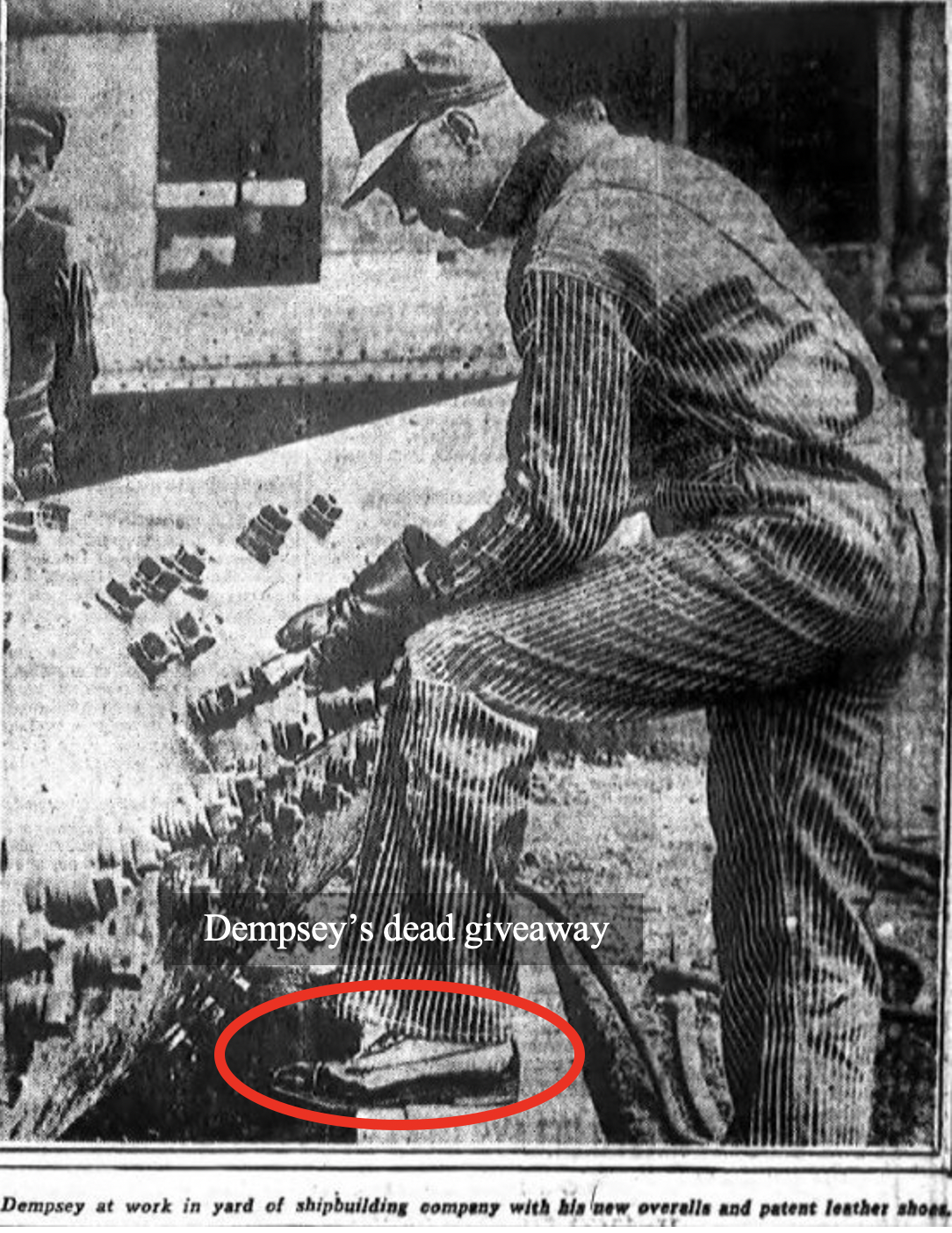
Jack Dempsey won the Heavyweight Championship in 1919, but he hadn't served in World War I. In 1920, a photo was produced showing Dempsey working in a shipyard, which should have ended the controversy right there. But someone noticed that he was wearing patent leather shoes in the photo, making some people think the photo was staged to take the curse off him.
Soon, evidence came to light that he had tried to enlist, but, despite being a very strong man for his size (he'd be classified as a cruiserweight today), the Army had classified him "4-F": "Registrant not acceptable for military service." This classification is nearly always applied to a person who fails either the physical or the psychological examination upon enlistment or reporting for the draft.
But some people still weren't satisfied. This became especially controversial in 1921, when he defended his title against the Light Heavyweight Champion, Georges Carpentier, a French pilot who had been awarded the Croix de Guerre and the Médaille Militaire. The contrast between the much-decorated Carpentier and the "slacker" Dempsey was staggering.
Professional boxing would still be illegal in the State of New York, not just the City of New York, for 2 more years. So George "Tex" Rickard, boxing's leading promoter, decided to put the fight as close to Midtown Manhattan as possible. He found a plot of land owned by John F. Boyle, a mile south of Journal Square in Jersey City, New Jersey, only 6 miles from Midtown Manhattan. There, Rickard built what was intended as a temporary structure, wooden bleachers to seat 90,000 people, calling it "Boyle's Thirty Acres."
Fire laws? We don't need no stinkin' fire laws.

The fight was a sellout, and generated $1,789,238, about $27 million in 2021 money. It was no contest: Dempsey knocked Carpentier out in the 4th round. Much of the crowd booed, but Carpentier showed no hard feelings. He kept the Light Heavyweight Championship for another year, and lived until 1975.

It wasn't until Dempsey was "robbed" in the "Long Count" fight against Gene Tunney in 1927 that he became a near-universal hero. He lived until 1983.

The year 1927 would also see the end of Boyle's Thirty Acres, having hosted boxing champions such as Dempsey, Benny Leonard and Jim Braddock, a Hudson County resident who would win the Heavyweight Championship in 1935. The site is now mixed residential and industrial. 

Sunday, July 19, 2020

Top 10 Best Team Owners In New York Sports History

In late February 2013, I did Top 10 lists for the best and worst managers/head coaches in New York sports history. I also did them for the best and worst executives in New York sports history. Not necessarily the best team owners, but the people most responsible for personnel decisions, what has been known in modern times as the general manager.

It has occasionally been true that the person with the official title of "general manager" has reported to someone higher up, who makes the final decision. On fewer occasions still, that person has been someone between the GM and the team's majority stockholder or "owner."

It's been 7 years. A new decade, and an unexpected break in the action due to the COVID-19 pandemic, makes this as good a time as any to update the lists.

So I'm going to start with the team owners. First the best, then the worst. Then the executives, the personnel decision guys. Finally, the in-game leaders, the managers and head coaches.

I'm going to limit this to the "Big Four": Major League Baseball, the National Football League (and, in the case of the 1960-69 Titans/Jets, the American Football League), the National Basketball Association (and, should I decide to include representatives of the 1967-77 Americans/Nets, the American Basketball Association), and the National Hockey League.

I'm also going to limit "History" to 1920 onward, with "The Golden Age of Sports" effectively beginning the modern age of sports. So, on the lists of worst owners and executives, this exempts, if not absolves, Andrew Freedman, the nutcase who owned the Giants at the turn of the 20th Century; and Frank Farrell and Big Bill Devery, the ex-police commissioner and current bootlegger (or was it the other way around? Didn't matter, whichever had been Commish was pretty damn corrupt) who owned the New York Highlanders/Yankees from their 1903 founding until 1915.

Honestly, picking the best team owners is harder than picking the worst. As William Shakespeare put it, "The evil that men do lives after them. The good is oft interred with their bones."

Honorable Mention to the following:

* Tim Mara, Giants, 1925-59.
* Del Webb and Dan Topping, Yankees, 1945-64.
* Ned Irish, Knicks, 1946-74.
* Joan Payson, Mets, 1962-75.
* Roy Boe, Nets, 1969-78, and Islanders, 1972-78.
* John Pickett, Islanders, 1978-96.

Because, for the most part, these guys hired the right GMs and head coaches, and then stayed out of the way. And, in the cases of Webb with the Yankees, Pickett with the Islanders, and, considerably more reluctantly, Boe with the Nets (but not with the Islanders), they also sowed the seeds of their teams' ruination.

10. Bill Jennings, Rangers, 1962-81. As President of the Madison Square Garden Corporation, he ran the Blueshirts into a new area that saw the building of the New Garden in 1968, and made them a Playoff perennial, including reaching the 1972 Stanley Cup Finals.

That team got old by 1975, and, despite considerably backlash from the fans, he retooled them into another Playoff perennial, reaching the Finals again in 1979. He died in 1981, but the team was more secure than most NHL teams at that point.
9. John Mara, Giants, 2005-present. As hard as it is to believe, one of the best New York sports team owners is current. He picked up from where his father Wellington left off, and, with fellow half-owner Steve Tisch, (to whose father, Bob Tisch, Wellington had sold half the franchise), has kept them a class organization and won 2 Super Bowls.
8. Tex Rickard, Rangers, 1926-29. George Lewis Rickard only owned the Broadway Blueshirts for their 1st 2 1/2 seasons, but he made that time count. He had already built the 3rd Madison Square Garden, the building that would become known as "The Old Garden," because of his main business, promoting prizefights. He rented it out to the 1st NHL team in the City, the New York Americans, and saw how popular they were. So he bought his own franchise. Someone suggested they be called "Tex's Rangers," and the name stuck.

He hired Lester Patrick to run the team, and Patrick deserves most of the credit for the team's early success on the ice. But Rickard was a born promoter, and he made the Rangers the 2nd-most-popular sports team in the City, behind the Yankees.
It wasn't that hard: There were, as yet, no Jets, Knicks, Nets, Islanders, Liberty, Devils, Cosmos, Red Bulls, NYCFC or Sky Blue FC; the Amerks fell way behind the Rangers; the baseball Giants and the Dodgers were both in down periods; the football teams named for the Giants and the Yankees weren't doing great at the turnstiles; and none of the pro basketball teams in New York prior to the Knicks got much traction.

Nevertheless, The Garden on a hockey night became the place to be. Rickard took the "Broadway" part seriously, and treated every home game like a show, billing the team as "the classiest team in hockey." Calling the Rangers that from the late 1970s onward would be laughable, but, in the late 1920s and the early 1930s, fans got the message: Men showed up at The Garden in suits, women in furs. It wasn't just a place to see hockey, it was a place to be seen.

Complications of an appendicitis attack killed him at age 59. There were no antibiotics in those days. To put this in perspective: At the same age, George Steinbrenner owned the Yankees for another 21 years; Wellington Mara owned the Giants for another 30 years; Leon Hess owned the Jets for another 26 years; Branch Rickey had not yet become a part-owner of the Dodgers; Charles Dolan had not yet bought the Knicks and the Rangers; and John McMullen had not yet bought the NHL's Colorado Rockies and made them the New Jersey Devils.

The Rangers would reach the Stanley Cup Finals 5 times, winning twice, in the 12 years following Rickard's death, on top of the Cup they had already won in 1928. Had he lived to be at least 76 -- and all of those guys I mentioned in the previous paragraph did -- he would have been in position to be the 1st owner of the Knicks, who reached 3 NBA Finals before what would have been his 84th birthday. Who knows what Tex could have lassoed for New York sports had he lived longer?

7. Nelson Doubleday, Mets, 1980-2002. You'll notice that I am not including co-owner Fred Wilpon, who bought Doubleday's half out in 2002, on this list. He'll be on the worst owners' list.

Doubleday didn't just revamp the team by hiring Frank Cashen as GM. He also revamped Shea Stadium, turning the dank, dreary football stadium that had been nicknamed "Grant's Tomb" into a colorful amphitheatre that seemed, at times, like a good home for baseball. Shea became a place for families again, instead of a place even the Corleone family wouldn't want to hang out at.
During Doubleday's tenure, the Mets went from about as low as any New York baseball team has gotten since World War II -- even the early Mets, as bad as they were, were still fun to watch -- to a team that won a World Series and had another Playoff berth, then fell apart, then got rebuilt into a team that made back-to-back Playoff runs and won another Pennant. Given where he started from, that was pretty good.

6. Larry MacPhail, Dodgers, 1938-41, and Yankees, 1945-47. He quickly wore out his welcome wherever he went, but not before turning his genius into the modernization of 3 franchises: The Cincinnati Reds, the Brooklyn Dodgers, and the New York Yankees.
To all 3 teams, he brought the first true renovations of their stadiums, including lights. To all 3, he brought radio broadcasting. To all 3, he brought in modern scouting systems. Between the 3 teams, he can be linked to 25 Pennants and 13 World Series wins, even though he was only directly in charge for 2 Pennants with the Reds (including the 1940 World Championship), 1 Pennant with the Dodgers (1941), and 1 Pennant with the Yankees (winning the 1947 World Championship).

5. Branch Rickey, Dodgers, 1942-50. He also wasn't in Brooklyn all that long, but while he was, he didn't just change one baseball team. He changed the world, by signing one player, and sticking with him no matter what. The name of that player was Jackie Robinson.

He was the operating part-owner, and his own general manager, but not the sole or even the majority owner. This led to the end of his tenure. There were 4 equal shares in the team. Rickey had one. A bank, the Brooklyn Trust Company, had another, and hired Walter O'Malley to operate it. O'Malley bought that share out. Then, when a 3rd part-owner died, O'Malley bought him out, and gained the loyalty of the 4th part-owner. Rickey, who loved money as much as O'Malley did, cashed out.

O'Malley took credit for the Dodgers' success thereafter, but it was Rickey who built it, and can be credited with 6 Pennants and the 1955 World Championship -- all with Jackie Robinson as a key member, not just a token member.
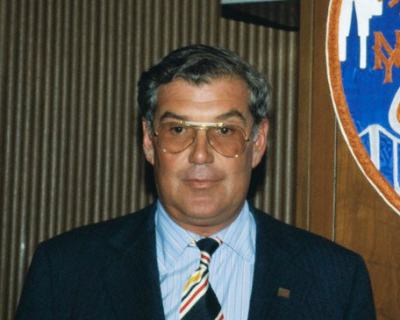
4. John McMullen, Devils, 1982-2000. He was part of the ownership group that bought the Yankees in 1973, having gotten to know "managing general partner" George Steinbrenner through each's contacts in the shipbuilding industry. He sold his share in 1979, so he could buy another team, the Houston Astros, owning them until 1993. He said, "Few things in life are as limiting as being one of George's 'limited partners.'"

In 1982, he bought the NHL's Colorado Rockies, and moved them from Denver to the Meadowlands, making them the New Jersey Devils. He owned them until 2000, overseeing their rise from what Wayne Gretzky called "a Mickey Mouse operation" to a 2-time -- and, within his lifetime, a 3-time -- Stanley Cup winner.
He died in 2006. When the Devils established a Ring of Honor at the Prudential Center in 2017, he -- not Lou Lamoriello, not Jacques Lemaire, not Scott Stevens, not Martin Brodeur, not Mike Emrick -- was the 1st inductee.

3. Wellington Mara, Giants, 1965-2005. Nobody has owned a New York team longer -- and Knick and Ranger fans better hope that remains true, because if Charles Dolan is still the owner of those teams in 2034 (he'd be 107 years old, unlikely but not impossible), 40 years after buying them, it will mean that his son James is still running them.

Until 1978, Well Mara was one of the least successful owners in major league sports. He had taken over parts of the team after his father Tim's death in 1959 and his uncle Jack's death in 1965. But the Giants hadn't made the Playoffs since 1963, and "The Miracle of the Meadowlands" showed just how incompetent Giants management was.

His supporters could claim that he was responsible for the revenue-sharing plan that allowed smaller-market teams, even the Green Bay Packers, to survive, but that did Giant fans no good. His supporters could also claim that, by getting Giants Stadium built, he had given the team control over its own home field for the first time, but most fans didn't care about that, since the only way it had affected them had been starting the season with 3 road games due to the chance the Yankees would be in the World Series -- a chance that had fallen apart in the mid-1960s.

But he got the message. He hired George Young as GM, and Young made the personnel decisions that got the franchise back on its feet. It may not seem like it at the moment, but thanks to what Well did from 1978 to his death in 2005, the Giants have always had an aura of class and competence: No matter how bad things get on the field, there won't be any real scandals, and you have the sense that the team can snap out of it, if not this season, than next season.
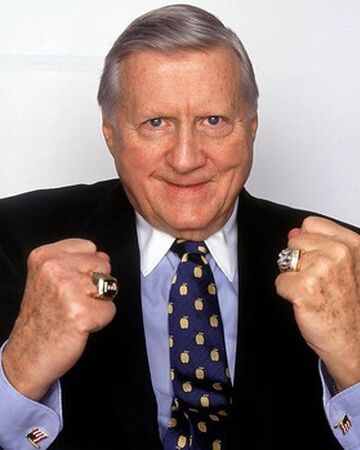
2. George Steinbrenner, Yankees, 1973-2010. When George bought the Yankees on January 3, 1973, the price was $8.8 million. When he died on July 13, 2010, the team was estimated to be worth $1.15. billion. Factoring inflation in, that's an increase in worth of 26.6 times. Not 26 percent, 26 times.

Yes, he got suspended from operating the team due to making an illegal campaign contribution to President Richard Nixon. Yes, he got suspended again for hiring somebody to dig up dirt on one of his own players (unsuccessfully, it turned out). Yes, he was a raging egomaniac. Yes, he took the actions that led to the demolition of the original Yankee Stadium. And, yes, he seemed to fire, suspend and fine people for ridiculous reasons.

But, as he liked to say, "I never really fired anybody." Pretty much any manager, coach or executive he removed from a position, he either kept, or later welcomed back, putting him in a different position, and sometimes moving him back into the one he had previously held. And, as he frequently said, "I never ask anybody to work any harder than I do" -- and he did work hard to make the Yankees winners.

That work frequently didn't pay off, especially from 1982 to 1990, when he acted as pretty much his own GM. But when his work did pay off, the results were as follows: 20 Playoff berths, 16 American League Eastern Division titles, 13 trips to the AL Championship Series, 11 AL Pennants and 7 World Series wins. He also built the Yankees Entertainment & Sports (YES) Network and the new Yankee Stadium.

Say what you want about George Steinbrenner, and I've said plenty, and some of it has been rough, and most of that has been fair. But he loved the Yankees, and he loved New York City, and he loved Yankee Fans. He wanted to win for us as much as he wanted to win for himself. And he wanted to win as much as we did. That's what every fan of every team should expect from his team owner: Make the effort to bring success. George made the effort, and it succeeded more than anyone else over that time.

1. Jacob Ruppert, Yankees, 1915-39. He took the 3rd-most-popular team in The City and made it the greatest franchise in professional sports in the Western Hemisphere. And if you want to argue that Manchester United or Real Madrid are better, you'd better come with viable facts.

Put it this way: In 2012, Real Madrid played in Yankee Stadium, and it raised their profile in America. In 2019, the Yankees came to London, and it benefited the sport more than the team. Everybody in Europe already knows about the Yankees. The day that Arsenal clinched their unbeaten Premier League season, May 15, 2004, the camera panned the famous North Bank of Highbury, and there was a woman wearing a tank top, shades, and a Yankee cap.

In 1935, there was a tour of MLB players in Japan, and everybody in Japan wanted to see the man they, in their accents, called "Babu Rusu." All they knew about Babe Ruth was what they had seen in newsreels, but Japan knew who Babe Ruth was in 1935. America didn't know who Pelé was until the 1970 World Cup.

It was Jacob Ruppert who signed the 1st 2 great Yankee managers, Miller Huggins and Joe McCarthy. It was Ruppert who signed Ed Barrow, the 1st great personnel man in New York sports history. It was Ruppert whose ambition and money led to the building of the original Yankee Stadium, the greatest venue in the history of sports on planet Earth -- or, as it says on his Plaque in Monument Park, "this imposing edifice," even though the original edifice is gone now.
It was Ruppert who bought Babe Ruth and several other good players, helping to turn the 1910s Boston Red Sox machine into the 1920 New York Yankees Dynasty. It was Ruppert who signed Lou Gehrig. It was Ruppert who heard about Joe DiMaggio, heard that other teams were backing off on signing him due to an injury, and ordered his signing anyway.

The work he did in building the Yankees led to the team's 1st 13 Pennants and 10 World Series wins. The last of each being in 1943. By the next one, in 1947, it was very much a different organization, never mind roster: Ruppert was a swinging bachelor, but never married, and had no children, so control of the team went to his brother George and his sister Amanda, and, while letting Barrow make the decisions, they sold the team in 1945 to the triumverate of Dan Topping, Del Webb and Larry MacPhail.

There are 37 people affiliated with the Yankee organization in Monument Park. Of these, 11, including Ruppert himself, are honored there. So why did it take until 2012 for Ruppert to be elected (2013 to be inducted) to the Baseball Hall of Fame, which opened the year of his death, 73 years earlier? The only thing I can think of is that it was an oversight, that people may have failed to consider him because they thought he was already in.