Showing posts with label griffith stadium. Show all posts

Wednesday, October 15, 2025

October 15, 1925: Walter Johnson's Rainy Last Stand

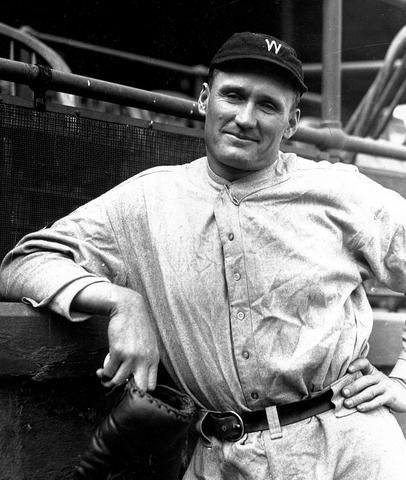
Walter Johnson

October 15, 1925, 100 years ago: The World Series comes to a soggy end at Forbes Field in Pittsburgh. It is one of the rare major league sports finals that is better remembered for the losing side, or for someone on it.

In the American League, the Washington Senators, winners of the previous season's World Series, won the Pennant again, by 8 1/2 games over the resurgent Philadelphia Athletics, getting into their 1st Pennant race in 11 years. Bucky Harris, their 28-year-old 2nd baseman and "Boy Manager," led a team highlighted by Walter Johnson, the "Big Train," one of the greatest pitchers who ever lived. The winningest pitcher in American League history finally became a World Series hero the year before, pitching innings 9 through 12 of Game 7 against the New York Giants.

The New York Yankees, who the Senators had edged the season before, and had won the previous 3 Pennants, fell apart: Babe Ruth developed a mysterious illness in Spring Training that kept him out for a month and a half, and several other established stars simply stopped hitting. They would be replaced by new players who would lead a new dynasty starting the next season, including Lou Gehrig.

In the National League, the Giants' 4-year run as Pennant winners came to an end, as they finished 8 1/2 games ahead of the Pittsburgh Pirates. Only pitcher Charles "Babe" Adams, now 43 but a rookie on their 1909 World Series winners, remained on that team. Their hitting stars included slick-fielding 3rd baseman Harold "Pie" Traynor, right fielder Hazen "Kiki" Cuyler, and speedy center fielder Max Carey, who was not well-known for his nickname, although it was "Scoops," which suggests he was a very good fielder.

*

October 7, 1925: Game 1 was played at Forbes Field. a Wednesday. Johnson started for the Senators, and he was aided by a home run by Joe Harris (no relation to Bucky), as the Senators win, 4-1. The only Pirate run came on a home run by Traynor. In the 5th inning, Peckinpaugh made an error, but it didn't amount to anything.

Late in the game, word reached the ballpark of the death that day of Christy Mathewson, the star pitcher for the Giants in the 1900s and 1910s. A series of lung ailments led to his death at the age of 45. The flag at Forbes Field was lowered to half-staff, and it remained so there and at Griffith Stadium in opposing Washington for the remainder of the Series. The Commissioner of Baseball, Kenesaw Mountain Landis, orders that black armbands be applied to both teams' uniforms, even though Mathewson had never been involved with either of the teams playing.

October 8, 1925: Game 2 was played at Forbes Field. Home runs were hit in the 2nd by the Senators' Joe Judge and in the 4th by the Pirates' Glenn Wright. In the 8th, Peckinpaugh made an error that did end up mattering, which that led to a home run by Cuyler. He made another error later in the inning, which did not matter. The Senators loaded the bases with nobody out in the top of the 9th, but they only got 1 run home, and the Senators won, 3-2. The Series was tied going to Washington.

*

October 10, 1925: Game 3 was played at Griffith Stadium. Peckinpaugh made his 4th error of the Series in the 6th, which led to an unearned run. Joe Harris singled home a run to put the Senators up 4-3 in the bottom of the 7th.

In the 8th, Earl Smith hit a drive to right-center field. Sam Rice leapt for it, and fell into the temporary stands that had been constructed. For a moment, a World Series crowd went silent, not knowing what had happened. Rice stood up, and held up the ball, indicating that he had made the catch. The umpires ruled the catch legal, and the Senators hung on to win, going up 2-1.
Sam Rice

Edgar Charles Rice (one of his minor-league managers changed his name to "Sam") is one of several great players virtually forgotten because their team no longer exists in its current form: They became the Minnesota Twins in 1961. And don't look for his retired uniform number anywhere: While he did last in the major leagues until 1934 and did wear numbers, none is retired for him, anywhere. If one was -- he wore 2 for the Senators in 1931 and 22 for them in 1932 and '33 -- he might be better remembered.

He might also be better remembered if he'd gotten into the 3,000 Hit Club. Instead, he fell just short: He collected 2,987 hits, the closest any player has gotten to 3,000 without getting it. (Unless you count Stan Ross, the Bernie Mac character in Mr. 3000.)

Rice later said, "The truth of the matter is, I did not even know how many hits I had. A couple of years after I quit, (Senators owner) Clark Griffith told me about it, and asked me if I'd care to have a comeback with the Senators and pick up those 13 hits. But I was out of shape, and didn't want to go through all that would have been necessary to make the effort. Nowadays, with radio and television announcers spouting records every time a player comes to bat, I would have known about my hits and probably would have stayed to make 3,000 of them."

He had a .322 lifetime batting average, a 112 OPS+, 498 doubles, 184 triples, and 351 stolen bases. He is in the Baseball Hall of Fame. But, today, when he is remembered at all, he is remembered for his 1925 World Series catch. Too bad there's no film of it: While a highlight film did capture some action in that Series, the catch is not part of it.

Also on October 10, the football team of the Olympic Club of San Francisco traveled across San Francisco Bay, and beat the University of California 15-0, in front of a crowd of 50,000 at California Memorial Stadium in Berkeley.

This ended a 50-game unbeaten streak for the Golden Bears, who had been 46-0-4. They hadn't lost since November 27, 1919, away to the University of Washington. The stadium was nicknamed "The House That Andy Built," as head coach Andy Smith made the team so good, ticket receipts alone covered the $1.4 million cost in 1923. It was seriously renovated in 2012.

Coaching took a severe toll on Smith, who went just 6-3 with Cal in 1925. On a visit to Philadelphia, where he had coached the University of Pennsylvania from 1909 to 1912, he was hospitalized with pneumonia, and died on January 8, 1926, only 49 years old. His career coaching record was 116-32-13, including 74-16-7 at Cal.

Also on this day, James Buchanan Duke died at his mansion at 1 East 78th Street, on 5th Avenue across from Central Park in New York. He was 68. "Buck" Duke is essentially the father of the American cigarette industry, and is thus responsible for the deaths of millions of people.

He's also responsible for the Duke Endowment, which contributed $40 million after his death (about $594 million in today's money) to Trinity College in his hometown of Durham, North Carolina. In his memory, it was renamed Duke University. So he's also responsible, if rather indirectly, for Coach K and the Cameron Crazies.

The James B. Duke House now hosts the New York University Institute of Fine Arts.
*

October 11, 1925: Game 4 was played at Griffith Stadium. Leon "Goose" Goslin, the greatest player ever to come from South Jersey -- he's in the Hall of Fame, and, as of the end of the 2025 regular season, Mike Trout does not yet have the career stats to get in -- and Joe Harris hit home runs. Johnson needed no more than that, as he pitched a 6-hit shutout. The Senators won, 4-0, and went up 3-1. Just 1 more win to go.

Washington baseball would not find that 1 more win for another 94 years.

On the same day, having already played some minor and semi-pro teams, the New York Giants football team plays its 1st game against an actual NFL team, although it's not one that most modern fans will recognize. At the Cycledrome in Providence, Rhode Island, a stadium built for bicycle racing (a big sport in the Roaring Twenties), they lose 14-0 to the Providence Steam Roller.

This team, officially having no S on the end, was no pushover, and deserves to be remembered today: It will win the NFL Championship in 1928 (73 years before the Patriots will win New England’s next NFL title), and host the NFL’s first night game in 1930 (5 years before Major League Baseball allows games to be played under lights), before the Great Depression put it out of business in 1931.

Although the Pawtucket Red Sox and the Providence Bruins are at the highest minor-league levels in their respective sports, the State of Rhode Island has never had another major league sports team: The closest they've come since is the Patriots, who since 1971 have played in stadiums in Foxboro, Massachusetts, 10 miles from the State Line, and closer to Kennedy Square in Providence than to Downtown Crossing in Boston.

Also on this day, Elmore John Leonard Jr. was born in New Orleans, but grew up in Detroit and was a hard-core Tigers fan. Or, perhaps I should say, "hard-boiled," as he was the writer of hard-boiled crime fiction.

Among his works that got turned into movies are Hombre (a Paul Newman film), 3:10 to Yuma
(made with Glenn Ford and Van Heflin in 1957, and Russell Crowe and Christian Bale in 2007), Mr. Majestyk (starring Charles Bronson), Get Shorty (with John Travolta), Out of Sight (in which George Clooney is a thief fooling around with the cop trying to catch him, played by Jennifer Lopez), and Rum Punch (which became the Quentin Tarantino film Jackie Brown starring Pam Grier). He is also responsible for the story that became the TV series Justified. He died in 2013.

*

October 12, 1925: The Senators wanted to wrap the Series up at home in Game 5. But the Pirates took a 2-1 lead in the 3rd, a 4-2 lead in the 7th, and won, 6-3, despite a 3rd homer in the Series by Joe Harris. Peckinpaugh made an error in the 6th inning, his 5th of the Series.

October 13, 1925: Game 6 was played back in Pittsburgh. Goslin hit a home run in the 1st inning, and the Senators made it 2-0 in the 2nd. But the Pirates tied the game in the 3rd, and Eddie Moore hit a home run in the 5th, giving the Pirates a 3-2 lead the held to the end, tying the Series. Peckinpaugh made his 6th error of the Series in the 7th inning.

Also on this day, Leonard Alfred Schneider was born in Mineola, Long Island, New York. We knew him as Lenny Bruce. According to sportswriter Dick Schaap, who collaborated with Lenny on his book Stamp Help Out!, Lenny attended only 1 Major League Baseball game in his short life (he died from drugs on August 3, 1966). It was as Schaap's guest, as a birthday present. It was October 13, 1960, and it was Game 7 of the World Series, the Bill Mazeroski Game, another World Series that the Pirates won in improbable fashion. Lenny wasn't a baseball fan, but he told Schaap he liked the drama.

Also on this day, Margaret Hilda Roberts was born in Grantham, Lincolnshire, England. How about that: Lenny Bruce and Margaret Thatcher were born on the exact same day. He didn't live long enough to have heard of her. If he had, with his sick sense of humor, I suspect there would have been a few jokes about her sex life (possibly suggesting that she had none), and about Bobby Sands (possibly, "For letting him starve, she can eat me!") and the Brighton Bombing.

One thing's for sure: In serving as Prime Minister of Britain, the 1st woman to do so, from 1979 to 1990, "The Iron Lady" treated all English soccer fans as if they were hooligans. She is widely believed to have been involved in the cover-up of the police's actions, both the negligent ones and the intentionally harmful ones, at the Hillsborough Stadium Disaster on April 15, 1989.

When her friend and fellow 1980s conservative icon, Ronald Reagan, died in 2004, most of his political opponents maintained a respectful silence. When the Iron Bitch died in 2013, a majority of Great Britain cheered, and was more than willing to say what a horrible person she was.

October 14, 1925: Game 7 was supposed to be played at Forbes Field, but the game was called off due to rain. They would have to try again tomorrow.

*

October 15, 1925: A steady downpour, continuing from the day before into this day, has left the field at Forbes Field a muddy mess, as Game 7 of the World Series is scheduled to be played. The weather forecast suggested rain for the next 3 days for both cities involved, Pittsburgh and Washington. So moving the game to Washington would have been pointless, and Commissioner Landis was anxious to get it over with. So, they would play through the rain.

I've never seen film of this game. I don't even know if any survives, although YouTube has footage from earlier in the Series, and of the Game 7s of 1924 and 1926. Maybe the film crews didn't want to risk getting electrocuted in the rain. At any rate, all we have to go on for the inclement weather are news reports.

On August 8, 2025, as commemorations for the 100th Anniversary of this Series began, I saw a photograph of a rather dubious method of drying the infield: Dousing it with gasoline and setting it on fire.
This insane tactic actually happened. It wasn't the only time, either.

But it would have been just plain wrong to play if the rain were as bad as what Philadelphia and Tampa Bay faced when Game 5 of the 2008 Series was suspended. There was a 6-day delay due to rain in 1911, and there were 3-day delays in 1962 and 1975. It could have been done again.

It was a short day for Pirate starter Vic Aldridge: 3 walks and 2 hits‚ and he was out of there with just 1 out in the 1st. Walter Johnson took a 4-0 lead to the mound. In what became known as "Johnson's Last Stand," the Bucs clobbered the 38-year-old Big Train for 15 hits‚ good for 24 total bases. Max Carey's 4-for-5 gave him a Series-high batting average of .458.

The Senators made the most of 7 hits‚ scoring 7 runs. But in the bottom of the 7th, Eddie Moore led off with a grounder to short, and Peckinpaugh made his 7th error. Carey doubled the run home. Cuyler bunted Carey over to 3rd base. Clyde Barnhart grounded out, and Carey couldn't score. But Traynor hit a triple down the right-field line, and that scored Carey. Traynor tried to stretch it into an inside-the-park home run, but was thrown out at the plate.

In the top of the 8th, Peckinpaugh hit a home run‚ the 12th homer of the Series by both teams combined‚ then a Series record, despite Forbes Field and Washington's Griffith Stadium both having some of the most distant fences in the game. That made it 7-6 Senators.

With the rain still coming down, Johnson got the 1st 2 outs in the bottom of the 8th. But Earl Smith doubled, and Pirate manager Owen "Donie" Bush sent Emil Yde (that's "EE-dee"), normally a pitcher, in to pinch-run for him. Johnson walked Moore. Carey grounded to short, and Peckinpaugh tried to turn a force play at 2nd. But he made a bad throw, his 8th error. The bases were loaded, and Cuyler cleared them with a double down the right field line. Red Oldham, in relief of Ray Kremer, got the Senators out 1-2-3 in the 9th, and the Pirates were 9-7 victors.
Roger Peckinpaugh

They became the 1st team to come from 3 games to 1 down to win a World Series. They would also be the 3rd and the 4th, in 1971 and 1979, respectively, both times against the Baltimore Orioles. The 2nd would be the 1958 Yankees, against the Milwaukee Braves.

Peckinpaugh's 8 errors are still a record for a single World Series. The rest of the Senators combined only made 1 error in the 7 games.

In the next day's New York Times, James Harrison wrote, "In a grave of mud was buried Walter Johnson's ambition to join the select panel of pitchers who have won three victories in one World Series. With mud shackling his ankles and water running down his neck, the grand old man of baseball succumbed to weariness, a sore leg, wretched support and the most miserable weather conditions that ever confronted a pitcher."

The last surviving member of the 1925 Pirates was shortstop Glenn Wright, who lived until 1984.

Monday, August 4, 2025

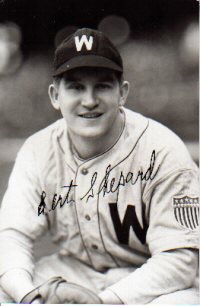
August 4, 1945: The Bert Shepard Game

August 4, 1945, 80 years ago: Bert Shepard pitches in a game in what would later be called Major League Baseball. This was incredibly unlikely, because he had only one leg.

Bert Robert Shepard was born on June 28, 1920 in Dana, Indiana, hard by the Illinois State Line, and home to a museum dedicated to another native who became a hero of World War II, journalist Ernie Pyle. A lefthanded pitcher, Shepard grew up in nearby Clifton, Indiana, and made his professional debut in the Detroit Tigers' organization in 1939. But by the conclusion of the 1942 season, he hadn't risen above Class C ball (roughly equivalent to "Long A" today).

He enlisted in the U.S. Army Air Forces in World War II, became a pilot, and achieved the rank of 1st Lieutenant. On May 21, 1944, his fighter group was strafing a German airfield northwest of Berlin, when his plane, a Lockheed P-38 Lightning, was hit. He crashed, and was thrown clear, saving his life, as the plane exploded in flames.

He was found by 1st Lieutenant Ladislaus Loidl, an Austrian doctor in the Nazis' air force, the Luftwaffe. Although Shepard's right foot had already been severed, Loidl managed to save his life. Although the Nazis were the enemy, Shepard would always be grateful for the medical services the Germans provided him, even as he recovered in a prisoner-of-war camp.

He was released in a prisoner exchange in February 1945, and he was determined to resume his baseball career. Part of his rehabilitation was spent at the Walter Reed Army Medical Center in Washington. There, he met Under Secretary of War Robert Patterson, and told him of his desire to keep playing baseball despite needing an prosthesis for his right leg. Patterson told Clark Griffith, owner of the Washington Senators, and himself a Hall of Fame pitcher.

On March 29, Griffith signed Shepard, then only 24 years old, as a pitching coach, thinking it would be good publicity. All season long, with his prosthesis being the leg on which he landed in his pitching motion, he pitched batting practice, and visited veterans' hospitals, offering encouragement to other wounded soldiers. On July 10, he pitched 4 innings against the Brooklyn Dodgers in an exhibition game for the War Relief Fund.

However, the Senators couldn't simply put him in a game just for the publicity. Despite their reputation as legendary losers -- the saying was, "Washington: First in war, first in peace, and last in the American League" -- this was a rare season in which they were in the Pennant race. When dawn arrived on August 4, 1945, the Detroit Tigers led the American League, the Senators were only 3 games behind, the New York Yankees were 4 back, and every other team except the Philadelphia Athletics was within 9 1/2 games. The AL race was still anybody's ballgame, and the Senators had as good a chance at the Pennant as anybody.

But despite World War II winding down -- V-E Day was 3 months earlier, and, while no one yet knew it, V-J Day would come in 10 days -- wartime travel restrictions, designed to save fuel for the war effort, were very much in place, to the point where that season's All-Star Game had been canceled, the only time since the game was founded in 1933 that it happened until the COVID epidemic in 2020. This led to teams staying in place longer than usual.

And, in early August, the Senators had a run of 5 straight days of doubleheaders, with the 4th being the 4th of them. Throw in the war's "manpower drain," and finding "warm bodies" was difficult, especially to flesh out a pitching staff. Shepard's time had come.

The 1st game that day was a 4-0 Senators win over the Boston Red Sox. Wally Holborow did the best thing he could for his team: He went the distance, and allowed just 2 hits. In the 2nd game, the Senators wouldn't be so lucky: Even with such talent as Ted Williams, Bobby Doerr, Dom DiMaggio and Johnny Pesky all in the service, the Sox knocked starting pitcher Sandy Ullrich out of the box in the 4th inning.

Senators manager Ossie Bluege brought in Joe Cleary, who was another player who was only playing due to The War's manpower drain. It was his only big-league appearance as well, and he only got 1 batter out, allowing 7 runs on 5 hits and 3 walks. There are pitchers who allowed baserunners and didn't get anybody out, thus having an earned run average of infinity. Cleary has the highest career ERA of anybody who did actually get someone out: 189.00. The Red Sox scored 12 runs in the top of the 4th, and were up 14-2. Tom McBride tied a major league record for most RBIs in an inning: 6, in the 4th, all off Cleary.

So Bluege brought in Shepard, wearing Number 34. There is a sad connection here: Elmer Gedeon, 1 of the 2 MLB players who ended up being killed in World War II (Harry O'Neill of the 1939 Athletics was the other), had also worn 34 for the Senators, playing 5 games in the outfield in 1939. Shepard being assigned 34 was probably a coincidence.

The 1st batter that Shepard faced was George "Catfish" Metkovich, a center fielder who had a decent 10-season career in the majors. Shepard struck him out. He pitched the rest of the way, going 5 1/3rd innings, allowing 1 run on 3 hits, walking 1 and striking out 2. The Red Sox won, 15-4.

The Senators remained in the race until the final day of the season, and finished 1 game behind the Tigers, who then beat the Chicago Cubs to win the World Series. Bluege never brought Shepard into another game. Who knows, that may have cost the Senators the Pennant. They hadn't won one since 1933, they left town in 1971, and no Washington team would win another major league Pennant until the 2019 Nationals.

In 1946, the veteran players returned home, and, war hero or no, there was no place for Shepard on the major league roster. He pitched in the minors that season, and was released by the Senators afterward. He pitched semi-pro ball in 1947, but needed further surgery on his leg, causing him to miss the 1948 season. In 1949, he was a player-manager in Class B ball, going 5-6.

He became a typewriter salesman, making brief comebacks in 1952 and 1955. Then he got back into aeronautics, becoming a safety engineer for Hughes Aircraft, one of Howard Hughes' companies. He won competitions for amputees in both running and golf, even in his 70s.
In 1993, This Week In Baseball did a piece on him, nearly half a century after the fact, covering his trip back to Europe, following his return to the site of his crash, and to a reunion with Dr. Loidl again, where he thanked him for saving his life, and (if only for 1 game) his baseball career.

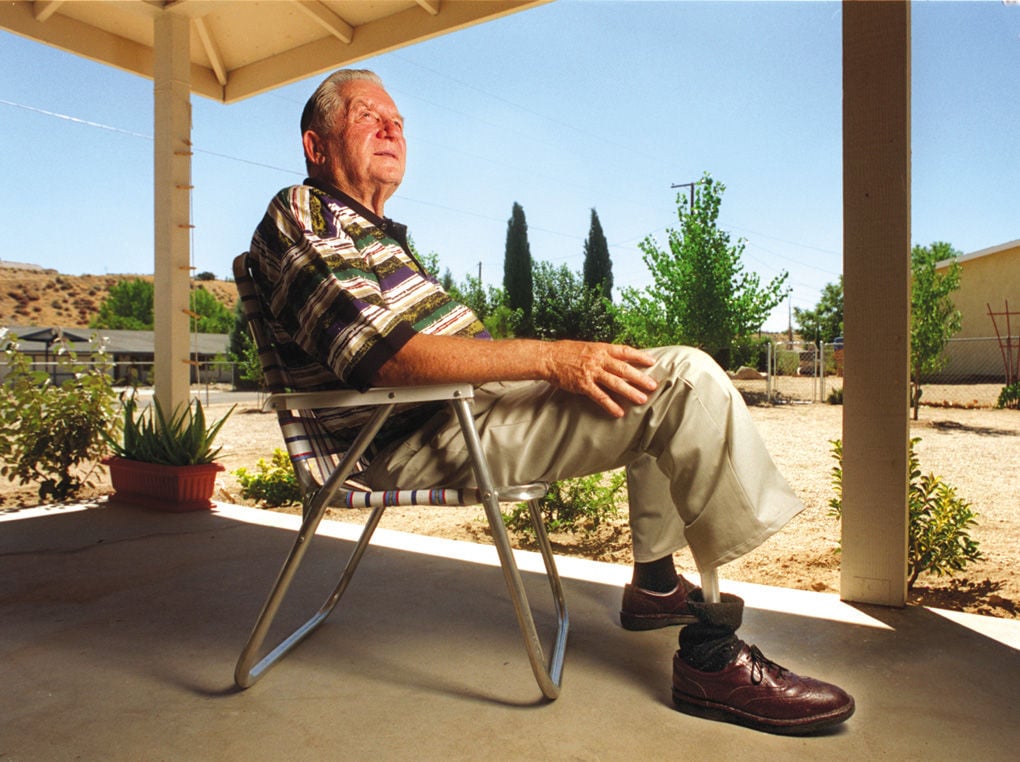
Bert Shepard died on June 16, 2008 in Highland, California, outside San Bernardino. He was 87 years old, and was survived by his wife and their 2 daughters. Senators center fielder José Zardón was the last surviving player from his lone big-league appearance, living until 2017. I can find no record of how long Loidl lived, beyond 1993. It is possible that he is still alive as of August 4, 2025.

Thursday, October 10, 2024

October 10, 1924: The Washington Senators Win the World Series

October 10, 1924, 100 years ago: With the score tied at 3-3 and one out in the bottom of the 12th in Game 7 of the World Series at Griffith Stadium in Washington, Muddy Ruel, catcher for the Washington Senators, lifts a high catchable foul pop-up, which New York Giants catcher Hank Gowdy misses when he stumbles over his own mask.
Given a second chance, Ruel doubles. Earl McNeely then hits a grounder that strikes a pebble, and soars over the head of rookie Giant 3rd baseman Freddie Lindstrom, and drives home Ruel with the winning run making the Senators World Champions.
Walter Johnson, who had brilliantly toiled 18 seasons for a team known as "Washington: First in war, first in peace, and last in the American League," and had lost Games 1 and 4, pitched the 9th through 12th innings in relief, and not only had finally won a World Series game, but had won a World Series.
President Calvin Coolidge, running for a term in office in his own right after succeeding the late Warren Harding the year before, and his wife Grace were in attendance. He didn't like baseball, but Grace did.
The Senators had their 1st World Championship in 24 years of trying. Outfielder George "Showboat" Fisher was the last survivor of the 1924 Senators, living until 1994, age 95. It took 95 years for another Washington baseball team has won another postseason series, but Nationals, having squandered National League Eastern Division titles in 2012, '14, '16 and '17, won the 2019 World Series.
In 1981, baseball historian John Thorn published Baseball's 10 Greatest Games. He included this game as one of them.

Saturday, October 7, 2023

October 7, 1933: Mel Ott Homers the Giants to the Title

October 7, 1933, 90 years ago: Prior to Game 5 of the World Series‚ at Griffith Stadium in Washington, flags are lowered to half-staff to honor William L. Veeck‚ president of the Chicago Cubs, who died suddenly. He is not well remembered with the passage of more than 80 years, but his son, Bill Veeck, already working in the Cubs' front office by 1933, will become one of baseball’s most remarkable men.

In the meantime, the Series comes to a close when Mel Ott homers in the top of the 10th inning, for a 4-3 New York Giants victory over the Washington Senators. Adolfo "Dolf" Luque, Cuban but light-skinned enough to play in the majors of the time, gets the win in relief. The Giants are World Champions for the 4th time, tying the Yankees and the Philadelphia Athletics for the most all-time.
However, it was the 1st title for the Giants with a manager other than John McGraw. The previous year, he had handed the job over to his 1st baseman, Bill Terry. Terry, Ott, shortstop Travis Jackson and pitcher Carl Hubbell would all be elected to the Baseball Hall of Fame.
Terry retired as a player after the 1936 season, having led the Giants to another Pennant. He led them to another in 1937. However, on both of those occasions, the Giants lost the World Series to the New York Yankees. They would win one more World Series in New York, in 1954, before moving to San Francisco for the 1958 season. And then, they wouldn't win another until 2010.
Because the Giants didn't have a Roger Kahn to write a book about them, the way the Brooklyn Dodgers did in The Boys of Summer, their achievements tend to get forgotten. Few people are alive today who remember the 3 Pennants and the World Series that the Giants won in the 1930s. Fans not old enough to remember them in New York at all tend to overlook Ott, Terry, Hubbell, and earlier stars like Frankie Frisch, Ross Youngs and Christy Mathewson. Because of the clips we've seen on TV, time and time again, we tend to limit our thinking of the New York baseball Giants to only the Bobby Thomson home run of 1951 and the Willie Mays catch of 1954.
And that's not fair: The Giants achieved a great deal in New York, and should be remembered.
For 86 years, this was the last World Series game played by a Washington team, and the last one played in the District of Columbia. The Washington Nationals finally put an end to that in 2019.
The last surviving member of the 1933 Giants was left fielder Joseph "Jo-Jo" Moore, who lived until 2001.

Monday, April 17, 2023

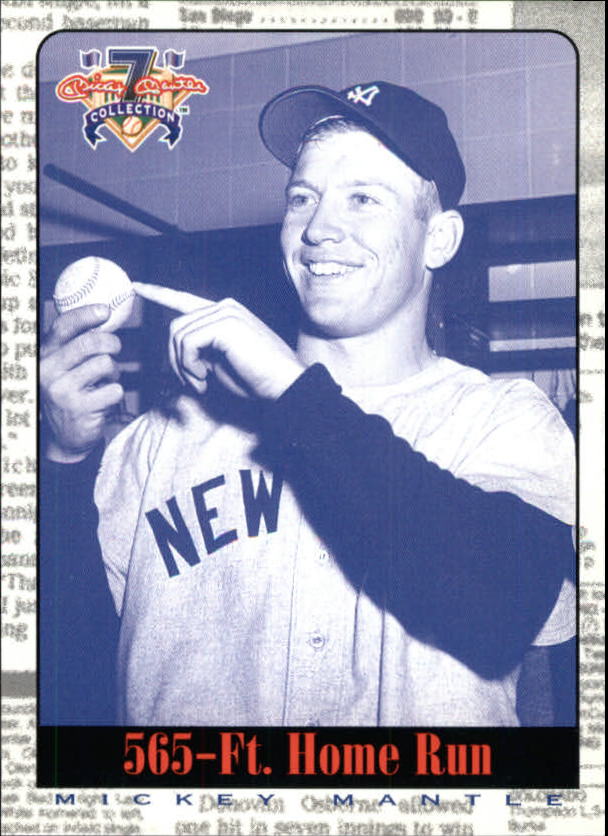
April 17, 1953: Mickey Mantle's "565-Foot" Home Run

April 17, 1953, 70 years ago: The New York Yankees beat the Washington Senators, 7-3 at Griffith Stadium. It was 2 days after Opening Day, when the new President, Dwight D. Eisenhower, threw out the ceremonial first ball. So instead of a sellout of around 30,000 people, only 4,206 fans attended.

Eddie Lopat went 8 innings to get the win for the Yankees. Billy Martin and Gene Woodling each had 2 hits. So did Mickey Mantle, the Yankees' 21-year-old center field phenom. One of Martin's hit's was a home run. So was one of Mantle's.

It was 2 years to the day after Mantle's major league debut, and he found a way to celebrate the anniversary. In the top of the 5th, with 2 out and Yogi Berra on 1st base, the switch-hitting Mantle batted righthanded against Chuck Stobbs, a lefthander.

Mantle admitted that he was a better hitter for average from the left side, but he clearly had more power from the right side. Stobbs threw him a fastball, and he hit one of the most powerful drives anyone had ever seen. It glanced off a scoreboard at the back of the bleachers, a 460-foot drive. The ball caromed off the board, and kept going.

Arthur "Red" Patterson, then the Yankees' public-relations director, noted that nobody had ever hit a ball out of the left side of Griffith Stadium. This probably was not true: Josh Gibson, whose Homestead Grays divided their Negro League home games between Washington and Pittsburgh, probably did it a few times.

Patterson left the ballpark, and looked for the ball. He finally found a 10-year-old boy, in the backyard of a house at 434 Oakdale Place NW, across 5th Street from the left-field bleachers. Patterson asked for the ball. The boy wanted 75 cents -- about the standard price at the time for a fresh baseball from a store. Patterson gave him a dollar and got the ball.

Then he paced off the distance to the wall of the bleachers. Then he got the width of the bleachers. Then he saw the 391-foot marker on the wall where the ball had crossed the fence. He put it all together, and decided that Mantle had hit the ball 565 feet.

He did not use a tape measure. But, later in the season, Mantle would also hit long home runs over the left field pavilion at Sportsman's Park in St. Louis and the double-decked left field bleachers at Connie Mack Stadium in Philadelphia. Patterson did use a tape measure for those, and so, whenever Mantle hit a particularly long home run, it became known as a "tape measure home run."

The ball Mantle hit in Washington on this date went into The Guinness Book of World Records for the longest home run ever hit in a Major League Baseball game. In fact, he did not hit the ball 565 feet. A batted ball is supposed to be measured from home plate to where it first hit something. The ball made contact with the scoreboard, 460 feet away. Still, that is a very long drive, and it would remain the longest home run in that ballpark's history.

Did Mantle hit a baseball 565 feet, ever? Possibly: In addition to the preceding, he hit 2 drives over the left-field roof at Comiskey Park in Chicago, which probably exceeded 550 feet. He hit one over the right field roof at Tiger Stadium in Detroit that may have gone that far, although the 643-foot distance suggested by Mark Gallagher in Explosion!, a book about Mantle's home runs, is almost certainly a gross miscalculation. (Gallagher admitted he'd used trigonometry to determine the distance.)

And there were at least 3 occasions when Mantle hit the facade atop the right field roof at the old Yankee Stadium, which came close to clearing the roof. It's been suggested that, had those balls been just a little higher, they would have gone over 600 feet.

Did Mantle hit the longest home run in baseball history? The evidence is flimsy. Home runs were not measured in the 1920s and 1930s, when Babe Ruth was hitting them lefthanded, and Jimmie Foxx was hitting them righthanded -- in each case, further than anybody had that way until Mantle. Ruth has been suggested as having hit them further than 565, sometimes even 600.

One thing is for sure: At a time when pitching was paramount, but a few sluggers hit the ball over 500 feet -- including Luke Easter, Frank Howard, Frank Robinson, Harmon Killebrew, Dick Allen, and the player most often compared to Mantle, Willie Mays -- Mickey Mantle hit the ball further than anybody. Despite a seemingly unending run of injuries, he played 18 seasons, and finished his career with 536 home runs. At the time, he was 3rd on the all-time list, behind Ruth and Mays.

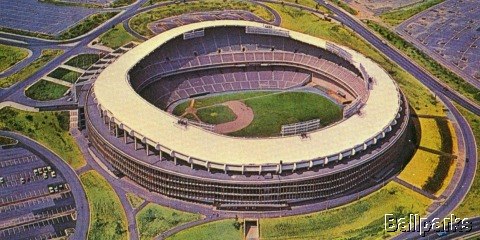
Griffith Stadium was replaced by District of Columbia Stadium in 1961, and torn down in 1965. The Howard University Hospital was built on the site. D.C. Stadium became Robert F. Kennedy Stadium in 1969. 

Tuesday, December 8, 2020

December 8, 1940: Bears 73, Redskins 0

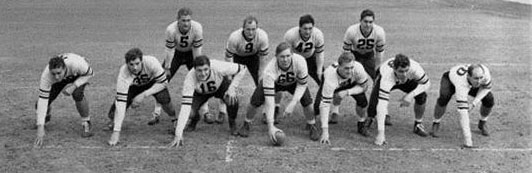
The 1940 Chicago Bears, the Monsters of the Midway.
Back row, left to right: 5, George McAfee; 9, Bill Osmanski;
42, Sid Luckman; and 25, Ray Nolting.
Front low, left to right: 4, Harry Clarke; 35, Lee Artoe; 16, George Musso; 
66, Clyde "Bulldog" Turner; 7, Edgar "Eggs" Manske;
28, Chet Chesney; and 30, George Wilson.

December 8, 1940, 80 years ago: A score that doesn't seem possible in a sports final happened. Even Bill Belichick and Tom Brady -- together or separately -- haven't been able to cheat their way to this.

George Halas, founding owner, general manager and head coach of the Chicago Bears, had built a new T-formation offense, led by quarterback Sid Luckman. The T had been around for a while, but Halas put in some new features, from a friend, Stanford University head coach Clark Shaughnessy. They got off to a 6-1 start, then dropped 2 straight, away to the Detroit Lions and away to the Washington Redskins.

Redskins owner George Preston Marshall and head coach Ray Flaherty had the other great quarterback of the era, Sammy Baugh. When Baugh was a rookie in 1937, he led the Redskins to victory over the Bears in the NFL Championship Game. He remains the only rookie quarterback ever to win the NFL title, either before or during the Super Bowl era.

In 1940, the Redskins won their 1st 7 games, before losing to the football version of the Brooklyn Dodgers. On November 17, at Griffith Stadium in Washington, the Redskins beat the Bears, 7-3. In one of the earliest examples in sports of what would one day be called "trash-talking," Marshall let it loose with the Washington newspapers: "The Bears are a bunch of crybabies," "They're frontrunners. They can't take defeat," and "rulebook weepers" following an official's call that went against them. He punctuated it all by saying, "The Bears are quitters when the going gets tough."

Halas was a tough and proud man, and he didn't like that. He thought Marshall was a friend. Between the 2 of them, they had done more to make the National Football League what it was -- for good and for ill. But now, Halas was mad.

He put a couple of extra tweaks into the T, and they beat the Cleveland Rams 47-25 and the Chicago Cardinals 31-23, to clinch the NFL Western Division. The Redskins lost their next game, to the New York Giants, before winning their season finale against the Philadelphia Eagles. So they won the Eastern Division title.

The Bears were 8-3, the Redskins 9-2. But home-field advantage was not determined by better record at the time: Under the system then in use, since it was an even-numbered year, the Eastern Division Champions hosted the Championship Game. So it was a return trip to Washington, 3 weeks after Marshall said the Bears had "quit."

Marshall certainly didn't quit: He told the press that teams from the West were "definitely inferior to our brand of football." One of the titles of a newspaper article in the leadup to the game was, "Gutless Bears Hit Capitol."

Halas didn't waste his time talking to the press. He talked to Shaughnessy. Shaughnessy had looked at film of the Redskins, and noticed their linebacker shifts. He gave Halas ideas to counter them. Halas trusted Shaughnessy completely. Shaughnessy was in the process of becoming football's 1st real offensive coordinator, and I don't think he and Halas even met face-to-face during the season.

As the Bears prepared for the rematch, Halas showed his team newspaper articles containing Marshall's comments, then said, "Gentlemen, this is what George Preston Marshall thinks of you. Well, I think you're a great football team! Now, go out there and prove it!"

They went out there, all right: Luckman said the team was so fired up that they broke down the locker room doors on their way to the field for kickoff.

Kickoff was 1:30 PM Eastern Time. The attendance was 36,034. That doesn't sound like much, but that's all that would fit into Griffith Stadium. And moving the game to a larger stadium was not an option: There was no larger stadium anywhere near the District of Columbia. (Georgetown and the University of Maryland had small stadiums at the time. Municipal Stadium in Baltimore seated 70,000, but that was too far away.) There was no television coverage, but the Mutual Broadcasting System sent it coast-to-coast over radio, with Red Barber as the announcer.

On the Bears' 2nd play from scrimmage, Bill Osmanski ran 68 yards for a touchdown. Baugh was unfazed, driving the Redskins to the Bears' 26-yard line. On the next play, he saw Charlie Malone uncovered in the end zone, and threw to him. But Malone dropped the pass that, presuming a successful extra point, would have made it 7-7.

Luckman didn't need a written invitation to capitalize on this gridiron faux pas by Washington. He drove the Bears back down the field, and scored himself on a 1-yard run. The Redskins could do nothing on their next drive, and before the 1st quarter ended, the Bears had a 21-0 lead, on a 42-yard touchdown run by Joe Maniaci.

The 2nd quarter was relatively quiet: The only score was a 30-yard touchdown pass from Luckman to Ken Kavanaugh. But, at 28-0 at the half, the game was pretty much over. Halas recognized that Marshall and his team had been punished enough, so he took his starters out.

But his reserves had their pride, too. Baugh threw 3 interceptions that the Bears returned for touchdowns in the 3rd quarter: Hampton Pool for 15 yards, George McAfee for 35, and Clyde "Bulldog" Turner for 20. And Ray Nolting ran 23 yards for a touchdown. All that was in a span of 14 minutes. Two missed extra points made it 54-0, instead of 56-0.

The reserves couldn't stop scoring. Harry Clarke scored on a 44-yard run, to make it 60-0, before another PAT attempt was missed. Now, referee Red Friesall made a request of Halas that no referee had ever had to ask of a coach before -- and, with this game in mind, provisions were made so that the request would never have to be made again: He told Halas that the officials were running out of footballs; so, in the event that they scored any more touchdowns, they should run or pass for the PAT, instead of kicking the ball into the stands. Halas, always with an eye on saving money, agreed.

And, at that point, it wasn't a ridiculous request. Gary Famiglietti scored on a 2-yard run. For the conversion, Solly Sherman threw a pass to Maniaci. (Sid Luckman and Solly Sherman: The 1940 Bears remain the only team in NFL history to have 2 Jewish quarterbacks play in a single game. Finally, Clarke scored another touchdown, on a 1-yard run.

The Bears had 501 yards of total offense, including 382 rushing yards. They intercepted Baugh 8 times. The final score was 73-0. That is not a typographical error: The Bears scored seventy-three points, and the Redskins scored none.

When Friesall fired his gun to signal the end of the game, a sportswriter yelled, "Marshall just shot himself!" Nevertheless, Marshall was man enough to face the press, and he said, "We needed a 50-man line against their power." 

Baugh also faced the media after the game. He was asked if the game would have been different if, when it was still only 7-0 Bears, Malone had not dropped a sure touchdown pass. Baugh said, "Sure. The final score would have been 73-7."

One more note about the game: Dick Plasman played in this game for the Bears, without a helmet. It was the last time an NFL player played without a helmet. Plasman played 4 more seasons, with a helmet, and eventually became one of the earliest recognized examples of football-related head injuries causing permanent damage, in his case both blindness and dementia. He died in 1981.

And Clark Shaughnessy's Stanford? They used the T formation to finish 9-0 and beat Nebraska in the Rose Bowl, to win the National Championship.

The Bears' 73-0 win was the biggest, most shocking win in NFL history. The biggest previous win in the League's history was a 64-0 win by the Philadelphia Eagles over the football version of the Cincinnati Reds on November 6, 1934. And it's worth repeating that the Bears' starters scored 28, and their reserves scored 45. The media, which had called the Bears all kinds of uncomplimentary things after their 7-3 loss to the Redskins, now gave them the nickname "The Monsters of the Midway."

John Siegal, a rookie that season, became a 3-time Pro Bowl end, and lived until 2015, making him the last surviving player from the 1940 NFL Championship Game.

The Bears won the NFL Championship again in 1941, defeating the Giants in the Championship Game. In 1942, they went undefeated during the regular season, but the Redskins got revenge in the Championship Game.

In 1943, Baugh had the single greatest season any player has ever had. He led the NFL in passing yards, interceptions by a defensive player, and punting yardage. He got the Redskins into another Championship Game. The Bears had lost several players to the World War II draft, but they had Bronko Nagurski, 35 years old and 6 years after a back injury led to his 1st retirement, coming back, and they beat the Redskins.

Neither team made it to the Championship Game in 1944. The Redskins made it in 1945, but lost to the Cleveland Rams, who still couldn't draw fans in a football city, and moved to Los Angeles the next season. In that 1946 season, the Bears won another title, beating the Giants.

From the 1940s Bears, Sid Luckman, George McAfee, Danny Fortmann, Bulldog Turner, George Musso, Joe Stydahar, Bronko Nagurski and George Halas were eventually elected to the Pro Football Hall of Fame. For the 1940s Redskins, Sammy Baugh, Wayne Millner, head coach Ray Flaherty and owner George Preston Marshall were elected -- although Flaherty was elected for his playing with the Giants.

There have been 2 other examples of an NFL team scoring 70 or more points in a game. On October 22, 1950, the Los Angeles Rams beat the Baltimore Colts, 70-27 at the Los Angeles Memorial Coliseum. The '50 Rams set a record for most points per game in an NFL season: 38.8. And the '50 Colts set a record for most points allowed per game in an NFL season: 38.5. Both of those records still stand, so we know what would happen if "the best offense in NFL history" met "the worst defense in NFL history."

The Colts went 1-11, while the Rams -- coached by 1940s Bear Stydahar -- reached the NFL Championship Game, losing it to the Cleveland Browns, a loss they would avenge the following season, almost breaking their record for most points per game.

And on November 27, 1966, the Redskins beat the New York Giants, 72-41 at Griffith Stadium's successor, District of Columbia Stadium (now Robert F. Kennedy Stadium). Since then, the highest point total for a single team in a single game is 62, on 5 occasions: By the 1972 Giants, the 1973 Atlanta Falcons, the 1985 New York Jets, the 1999 Jacksonville Jaguars and the 2011 New Orleans Saints.

The most points scored in an NFL Championship Game since? 59, by the 1957 Detroit Lions. The most in a Super Bowl? 55, by the 1989-90 San Francisco 49ers. Biggest margin of victory in an NFL Championship Game since 1940? 46, when the 1954 Cleveland Browns beat the Lions, 56-10. In the Super Bowl era? 45, when the aforementioned 49ers beat the Denver Broncos 55-10.

Wednesday, October 2, 2019

Living Former Original Washington Senators

Jim Kaat of the Washington Senators

October 2, 1960: The "original" or "old" Washington Senators play their last game, losing 2-1 to the Baltimore Orioles at Griffith Stadium in Washington. Only 4,768 came out for the wake.

They lost their last 7 games, and 11 of their last 12, turning a respectable 72-70 record into 73-81, good for 5th in the American League, but 24 games behind the Pennant-winning Yankees.

In 1955, their longtime owner, Clark Griffith, once a Hall of Fame pitcher for the team now known as the Chicago Cubs, winner of the 1st AL Pennant as manager of the Chicago White Sox, and the 1st manager of the team that would become the Yankees, died, leaving the team to his nephew, Calvin Griffith. In 1956, Calvin publicly promised that he would never move the Senators.

In 1960, Calvin announced he was moving the Senators to Minneapolis, to become the Minnesota Twins. He had a good reason: Griffith Stadium only seated 27,000 people, and was hastily built in 1911 after a fire destroyed the previous ballpark on the site. And he didn't know if it would be a good idea to share what would become Robert F. Kennedy Stadium with the NFL's Washington Redskins.

He had another good reason: Just up the Baltimore-Washington Parkway, the Orioles had taken a big chunk of the Senators' fanbase, not just in the Baltimore area, but in D.C.'s Maryland suburbs. He simply couldn't compete -- as Bob Short found out, and he moved the expansion team given to the District as "the new Senators" in 1961 to the Dallas area after the 1971 season, to become the Texas Rangers.

Calvin Griffith also had a bad reason to break his promise and move the team: The neighborhood around Griffith Stadium, LeDroit Park, north of downtown, had already been majority-black since the Civil War nearly a century earlier. Howard University had built its campus nearby, and would end up building its hospital on the site of the ballpark. Griffith wanted to move his team to a place that didn't have many black people. At the time, Minneapolis was about as white as you could get and still be in a large American city.

There are currently 28 living former Original Washington Senators:

* Gilbert "Gil" Coan, 87, from Monroe, North Carolina, outside Charlotte. A left fielder, he debuted with the Senators in 1946, stayed with them through 1953, became an original Baltimore Oriole in 1954, and is also a surviving New York Giant. He retired in 1956, and opened an insurance agency in Brevard, North Carolina, which his son and grandson now run.

* Eddie Robinson, 98, from Paris, Texas, outside Dallas. A 1st baseman, he debuted with the Cleveland Indians in 1942, missed the next 3 seasons serving in the U.S. Navy in World War II, returned in 1946, and helped the Indians win the 1948 World Series. He is the last living person to have played on a Cleveland team that won a World Series.

He played for the Senators in 1949 and 1950, then was traded to the Chicago White Sox, then the Philadelphia Athletics, 1 of 10 surviving players of theirs. He made the All-Star Game in 1949, '51, '52 and '53, mainly because every team had to have at least 1 All-Star. He was a Yankee from 1954 to mid-1956, winning an American League Pennant in 1955, before going back to the A's, by then in Kansas City. He split the 1957 season with the Detroit Tigers, the Indians again, and the Baltimore Orioles, and that was it for him. He batted .268 lifetime, with 172 home runs.

He is currently the oldest living ex-Yankee, and the 2nd-oldest former MLB player, trailing Val Heim of the 1942 White Sox by 41 days. After playing, he worked as both a coach and in the front office for pitcher-turned executive Paul Richards with the Orioles, the Houston Astros and the Atlanta Braves. In between jobs with Richards, he ran the A's farm system. He was the Braves' general manager from 1972 to 1976, and the Texas Rangers' GM from 1977 to 1982.

His last job in baseball was scouting for the Boston Red Sox, the only one of the original 8 AL franchises he didn't play for. The Indians honored him at Game 6 of the 2016 World Series.

* Floyd Robert "Bob" Ross, 90, from the Los Angeles suburb of Fullerton, California. A pitcher, he debuted with 6 games with the Senators in 1950, was up with them for 11 games in 1951, and then missed the next 2 seasons due to serving in the Korean War. He didn't appear in the major leagues again, except in 1956 for 3 games with the Philadelphia Phillies.

He pitched in professional baseball from 1945 to 1959, going 80-85 in the minor leagues, but only 0-2 in the majors, and threw his last professional pitch right before turning 31. Aside from his name, he appears to have no connection to the famous TV painter Bob Ross.

* Irv Noren, 94, born in Jamestown, in Western New York State. Like Jackie Robinson, 6 years younger, he grew up in the Los Angeles suburb of Pasadena, California, attended Pasadena City College, and serving in the U.S. Army in World War II. Unlike Jackie, he did not also star at a 4-year college (in Jackie's case, UCLA), and he didn't have to face racial prejudice.

An outfielder, he debuted with the Senators in 1950, and was traded to the Yankees in 1952. He is the last surviving player from the 1952 World Series winners, and 1 of 3 from the 1953 World Series winners, along with Whitey Ford and Art Schallock. (Bobby Brown was serving in the Korean War in both seasons, Ford in '52.)

He was named an All-Star in 1954, and was a Series winner again in 1956, 1 of 3 survivors from that team, along with Ford and Don Larsen. He also played for the St. Louis Cardinals, the Chicago Cubs, and the Los Angeles Dodgers, last playing in the major leagues in 1960. He was a coach under Dick Williams on the 1972 and 1973 World Champion Oakland Athletics. His last uniformed job was as a coach with the 1975 Chicago Cubs.

* Jerry Snyder, 90, from Jenks, Oklahoma, outside Tulsa. A middle infielder, he was a backup for the Senators from 1952 to 1958.

* Wayne Terwilliger, about to turn 94, from Clare, Michigan. A 2nd baseman, he served in the Marines in World War II. He debuted with the Chicago Cubs in 1949. After they traded him in 1951, he spent the rest of his career with teams that no longer exist in those forms: The Brooklyn Dodgers, the New York Giants, the Washington Senators and the Kansas City Athletics, with whom he played his last game, in 1960. He was with the Senators in 1953 and '54.

He became a longtime minor league manager and major league coach, and was on Tom Kelly's staff when the Minnesota Twins won the World Series in 1987 and 1991. He won an independent league's Pennant as manager of the revived Fort Worth Cats in 2005.

* Ed Fitz Gerald, 95, from Santa Ynez, California, outside Santa Barbara. A catcher, he reached the majors with the 1948 Pittsburgh Pirates, played for the Senators from 1953 to 1959, and closed with the Cleveland Indians in 1959. He then coached for the Indians, Kansas City Athletics, and Twins.

* Bob Oldis, 91, from Iowa City, Iowa. A catcher, he debuted with the Senators in 1953, and remained with them through 1955. After 4 seasons in the minor leagues, he resurfaced with the Pittsburgh Pirates in 1960, and they won the World Series. He is 1 of 12 surviving players from that team. He finished his career in 1962 with the Philadelphia Phillies.

He later coached under Gene Mauch on the ill-fated 1964 Phillies and the 1969 Montreal Expos, where he was the 1st 1st-base coach in team history. He remained with the Expos until 2002, when the ownership switch of Jeffrey Loria transferred their scouting department to the Florida (now Miami) Marlins. Oldis is officially still one of the Marlins' coaches.

* Camilo Pascual, 85, from Havana, Cuba. The 1st of several players from Cuba brought to the Senators by scout Joe Cambria, he was probably the best, remaining with the franchise until 1966, and then playing 3 years with the "New Senators," lasting in the majors until 1971 with the Cleveland Indians. With one of the best curveballs of the era, he made 7 All-Star Games, led the AL in strikeouts 3 straight years from 1961 to 1963, and forged a career record of 174-170 with 2,167 strikeouts, despite mostly pitching for struggling teams.

He helped the Twins win the 1965 Pennant, and is a member of their team Hall of Fame, the Cuban Baseball Hall of Fame, the Latino Baseball Hall of Fame, and the Caribbean Baseball Hall of Fame. Like many exiled Cubans, he settled in Miami. He was pitching coach under Gene Mauch when he managed the Twins from 1978 to 1980. He has scouted for the Oakland Athletics, the New York Mets and, currently, for Venezuela, the Los Angeles Dodgers. His biggest signing is fellow Miami Cuban Jose Canseco.

* Bobby Kline, 90, from St. Petersburg, Florida. A shortstop, he played 77 major league games, all with the 1955 Senators.

* Johnny Groth, 93, from Chicago. A center fielder, he debuted with the 1946 Detroit Tigers, and ended with the Tigers in 1960. In between, he played for 3 teams that no longer exist in their present form: The St. Louis Browns in their last season of 1953 (he is 1 of 9 living former Browns), the Senators in 1955, and the Kansas City Athletics in 1956 and '57.

* Julio Bécquer, 86, from Havana, Cuba. A 1st baseman, he was part of the Senators' Cuban Connection, reaching the majors in 1955, and remaining with them until 1960. He was left unprotected in the expansion draft, being drafted by the Los Angeles Angels. But the Angels traded him to the Twins in midseason, making him an original Angel and an original Twin. He remained with the Twins through the 1963 season, and still lives in Minneapolis, a vast difference in climate from his homeland.

* José Valdivielso, 85, from Matanzas Cuba. A shortstop, he was another member of the Cuban Connection that arrived in D.C. in 1955. He remained with the franchise until 1961, the 1st Minnesota season.

* Pedro Ramos, 84, from Pinar del Río, Cuba. A pitcher, he was another from the Cuban Connection, arriving in 1955, making the All-Star Team in 1959, and remaining through the 1961 move. After 2 1/2 seasons with the Cleveland Indians, the Yankees traded for him, and converted him to a reliever. This turned out to be a key in their winning the 1964 Pennant.

After going to the Phillies, Pirates and Reds, Ramos finished his career where it began, with the "New Senators," in 1970, He finished 117-160 with 54 saves. He later scouted for the team then known as the California Angels.

* Dick Hyde, 91, from Hindsboro, Illinois. A pitcher, he was with the Senators from 1955 to 1960, and the Orioles in 1961, when a sore arm doomed his career. In 1958, he went 10-3, and led the AL in saves with 19 and games finished with 44. But for his career, he was just 17-14 with 25 saves.

* Dorrel Norman Elvert "Whitey" Herzog, 87, from the St. Louis suburb of New Athens, Illinois. Like Edward Charles Ford and Don Richard Ashburn, who also had the nickname, his hair was very blond. "Herzog" is German for "Duke," so he could also have been nicknamed "Duke."

He had quite a baseball career, and is in the Hall of Fame -- but not for anything he did as an outfielder for the Senators from 1956 to 1958. Or for the Kansas City Athletics, the Baltimore Orioles or the Detroit Tigers. He played 634 games, an average of 79 per season, and batted .257. An unremarkable player.

He became a scout and a coach for the A's, then the 3rd base coach and director of player development for the Mets. He did have a hand, if not a uniformed one, in helping them win the 1969 World Series and the 1973 National League Pennant. When Gil Hodges died just before the start of the 1972 season, the manager's job was given to Yogi Berra. It worked, but Whitey viewed it as a snub, and chose to take the 1st managing job that came along.

That was with the Texas Rangers in 1973. No luck. Nor with the 1974 California Angels. In 1975, he was hired by the Kansas City Royals, and managed them to 3 AL Western Division titles, but no Pennants. The St. Louis Cardinals hired him, and he became almost certainly the last man MLB will ever see to be a success as field manager and general manager at the same time, winning 3 National League Pennants and the 1982 World Series. His last baseball job was as GM of the 1993-94 Angels.

* Garland Shifflett, 84, from Elkton, Virginia. A pitcher, he appeared in 6 games for the franchise as the 1957 Senators, and 10 for them as the 1964 Twins. The bulk of his career was spent with the Charlotte Hornets, a minor-league baseball team that preceded the World Football League and NBA teams with those names.

* Vito Valentinetti, 90, from Manhattan. A pitcher, he pitched for both Chicago teams, the White Sox in 1954 and the Cubs in 1956 and '57, before becoming a Senator in 1958 and '59. He finished with a major league record of 13-14.

* Ken Aspromonte, 87, from Brooklyn. A 2nd baseman, he came to the Senators from the Boston Red Sox in 1958, but was traded to the Cleveland Indians in the middle of the last season, 1960. Like Bécquer, he was an original Angel in 1961. He last played in the majors in 1963, then played in Japan until 1966. He managed the Indians from 1972 to 1974. His brother Bob Aspromonte retired in 1971, making him the last active player who had played for the Brooklyn Dodgers.

* Bobby Malkmus, 88, from Newark. A graduate of South Side High School (renamed Malcolm X Shabazz High School in 1972 -- yes, for that Malcolm X, although the school is usually called "Shabazz"), he was a reserve infielder who debuted in 1957, playing 13 games for the Milwuakee Braves, who won the World Series that year, but he was not on the Series roster. Still, he is 1 of 11 surviving players for that team. He then played 47 games for the Senators in 1958 and '59.

His only season as a semi-regular was in 1961, for the Philadelphia Phillies, the year they lost 23 straight games, still the most in the major leagues since 1899. The aforementioned Bob Oldis was also on that team. He closed with the Phillies in 1962. He became a minor-league manager, and is still a scout for the Cleveland Indians.

* Albert "Albie" Pearson, 85, from the Los Angeles satellite city of El Monte, California. An outfielder, he debuted for the Senators in 1958, and played 9 seasons in the major league despite being only 5-foot-6. He was AL Rookie of the Year for the Senators in 1958, but was traded up the road to the Orioles in 1959, and they left him unprotected in the expansion draft. This allowed him to be an original Los Angeles Angel, from 1961 to 1966. In 1963, he was an All-Star, and he finished his career with a .270 batting average.

He later became a minister, and has opened churches, orphanages and camps for abused and sick children in America, South America (Ecuador) and Africa (Zambia).

* Ron Samford, 89, from Dallas. A shortstop, he closed his career with the 1959 Senators, and hit a home run in his last at-bat.

* Dan Dobbek, 84, from Ontonagon, Michigan, on the Upper Peninsula. An outfielder, he was with the Senators/Twins franchise from 1959 to 1961, including the move. Ironically, given the Senators' Cuban connection, his biggest success in baseball was in Cuba -- after the Castro Revolution, winning the 1960 Caribbean Series with Elefantes de Cienfuegos.

* J.W. "Jay" Porter, 86, from Shawnee, Oklahoma. As with Johnny Cash, who was born simply "J.R.," and later Kansas City Royals shortstop U L Washington (no periods), his initials don't stand for anything. But the J got emphasized so much that "Jay" became his nickname.

A catcher, he debuted with the St. Louis Browns in 1952, so he is not only 1 of 28 living former Old Senators, he is also 1 of 9 living former Browns. He got traded to the Detroit Tigers, and spent the 1953 and '54 seasons in the minors before being called up. His last season was 1959, splitting it between the Senators and the St. Louis Cardinals, finishing with a .228 batting average.

* Jim Kaat, 80, from Zeeland, Michigan. A pitcher, he debuted with the team in 1959, helped them win the 1965 Pennant and the 1969 and '70 AL Western Division titles. He was still with them in 1973, making him the last Senator still with the Twins.

"Kitty" then pitched for the Chicago White Sox, helped the Philadelphia Phillies win 3 straight NL Eastern Division titles, pitched in late 1979 and early 1980 with the Yankees, and then 3 1/2 seasons with the St. Louis Cardinals, finally getting a World Series ring in 1982, just before turning 44. He retired after the 1983 season, making him the last former Old Senator still playing.

He finished with a career record of 283-237, 32,461 strikeouts, 3 All-Star berths, and 16 Gold Gloves, a record for pitchers since broken by Greg Maddux. The Twins have elected him to their team Hall of Fame. He also became an esteemed broadcaster. But he has not been elected to the Baseball Hall of Fame in either category. He should be elected in at least one.

* Billy Gardner, 92, from Waterford, Connecticut, outside New London. A 2nd baseman, he played for the Senators/Twins as they moved in 1960-61. He is also 1 of 10 surviving 1961 World Champion Yankees. He managed the Twins from 1981 to 1985, and the Kansas City Royals in 1987.

Terwilliger, Samford and Gardner are 3 of the 17 surviving former New York baseball Giants. Samford, Gardner, Willie Mays and Johnny Antonelli are the last 4 survivors of the Giants' 1954 World Champions.

* Rudy Hernández, 87, from Santiago de los Caballeros, Dominican Republic. He was the 1st Dominican native to pitch in the major leagues, preceding Juan Marichal by 16 days. Oddly, he played for the last edition of the Old Senators in 1960 (21 games), and the first edition of the New Senators in 1961 (7 games), and for no other teams in any other seasons. As far as I know, he's the only player only to play for each edition of the Senators and no other MLB team.

* Don Lee, 85, from Globe, Arizona. A pitcher, he was in the major leagues from 1957 (Tigers) to 1966 (Cubs), including with the Senators/Twins from 1960 to 1962. He finished 40-44 for his career.

UPDATE: Irv Noren died on November 14, 2019. In 2020: Gil Coan died on February 4, Dick Hyde on April 15, Garland Shifflett on May 13, Ed Fitz Gerald on June 14, Jay Porter on October 11, and Julio Bécquer on November 21.

In 2021, Ron Samford died on January 14, Wayne Terwilliger on February 3, Vito Valentinetti on August 5, Johnny Groth on August 7, Eddie Robinson on October 4, and Bobby Kline on October 26. In 2022, Jerry Snyder died on January 31, and . In 2023, Albie Pearson died on February 21, and Dan Dobbek died on November 28, and Rudy Hernández died on November 23. In 2024, Billy Gardner died on January 3, and White Herzog died on April 15.

This dropped the number to 7: Bob Ross, Bob Oldis, Camilo Pascual, José Valdivielso, Ken Aspromonte, Bobby Malkmus, Jim Kaat and Don Lee.

Jim Kaat was finally elected to the Baseball Hall of Fame in 2022, as a player.

Monday, February 15, 2016

Top 5 Reasons You Can't Blame the Washington Senators for Moving to Minnesota

George Washington was said by a contemporary, General Henry "Light-Horse Harry" Lee, to have been "First in war, first in peace, and first in the hearts of his countrymen."

But the Washington Senators were a historically bad baseball team, said to have been "First in war, first in peace, and last in the American League."

From the 1901 foundation of the AL until 1960, only 18 times out of 60 did the Senators finish with a record of .500 or better. Only 14 times did they finish as high as 3rd in the AL. Only 6 times did they finish within 7 games of 1st place. They won Pennants in 1924, 1925 and 1933, but 1924 remains the only World Series won by a Washington baseball team. After the 1933 Pennant, only once in 27 years did they even get within 13 games of the Pennant: In 1945, they finished a game and a half out.

The Senators were so identified with losing that, in 1954, Douglas Wallop made them the protagonists of his novel, titled The Year the Yankees Lost the Pennant. The St. Louis Browns had already moved to Baltimore, but, for 1 more season, the Athletics would still be in Philadelphia. He also could have used a fictional team in a city that didn't yet have a big-league ballclub. Or he could have used the Brooklyn Dodgers and had them beat the Yankees in the World Series, which didn't happen in real life until 1955.

It was a retelling of the Faust legend: In Wallop's imagined, as-yet-future 1958, a frustrated middle-aged Senators fan named Joe Boyd says he'd sell his soul to the Devil if it meant that the Senators would win the Pennant. The Devil shows up, and takes him up on the offer, turning him into powerful young slugger Joe Hardy, who arrives in Washington and sparks the Senators on a run. (It may have been influenced by Bernard Malamud's The Natural: His story of mysterious slugger Roy Hobbs came out 2 years earlier. And both players were power-hitting right fielders.)

Spoiler alert: Just when it all seems to be going wrong, the tables get turned, and the Senators win the Pennant anyway.

Ironically, in 1954, for the 1st time since 1948, the Yankees did lose the Pennant. In 1955, the novel was turned into a Broadway musical, titled Damn Yankees. In 1958, it was filmed. It came very close to violating the Hays Code that censored movies at the time: Not only was "damn" considered a profanity (Gone With the Wind got in trouble for having Clark Gable say, "Frankly, my dear, I don't give a damn," but since the line was in the book, it was kept for the film), and a song-and-dance number shows men copying a chorus line, including doing high kicks, while wearing only towels.
Tab Hunter as Joe Hardy, and Gwen Verdon as Lola,
in the film version

In real life, Clark Griffith owned the Senators in part starting in 1912, and in a controlling interest from 1919, until his death in 1955. He was a former player, legitimately a Hall-of-Famer based on his pitching, but was essentially elected for his role in founding the American League. His street cred as a great pitcher lent status to the fledgling League, convincing several players to jump from the National League.

He was the 1st manager of the Chicago White Sox, won the League's 1st Pennant in 1901, then in 1903 became the manager of the New York Highlanders, pieced together from the remnants of the dissolved Baltimore Orioles, and nearly got them to the Pennant in 1904, and to another 2nd place finish in 1906, before retiring as a player and being fired as manager. That team, of course, became the Yankees.

"The Old Fox" had no income aside from the Senators, the ballpark he renamed Griffith Stadium, and his Montana ranch. He had to run the team on a shoestring. If not for mortgaging his ranch and receiving rent from the NFL's Washington Redskins, he would have been wiped out.

In spite of his childhood in segregated Missouri, Griffith had no problem integrating his team. Unlike his tenant, George Preston Marshall, who kept the Redskins as the last all-white team in American professional sports (not counting the mostly-Canadian, and thus mostly-white, NHL), he was willing to add black players, and had already been a pioneer in Latin America by adding white Cubans, eventually adding black Cubans, too.

Griffith died in 1955. He had no children, but had raised 4 nephews and 2 nieces as his own. One of the nieces, Mildred Robertson, married Joe Cronin, who was the shortstop and manager of the 1933 Pennant-winning Senators. When Red Sox owner Tom Yawkey offered Griffith a bundle to take Cronin as shortstop and manager, Griffith, cash-short as always, could not resist.

Yawkey's friendship with Cronin meant that Griffith couldn't lure him back as his heir as Red Sox owner. The conflict of interest also prevented Mildred from being heir, and women in sports leadership roles were frowned upon then, anyway. This is why the other niece, Thelma Griffith Haynes (who, like Mildred, married a Senators player, pitcher Joe Haynes), wasn't made the heir. One of the nephews, Sherry Robertson, was a Senators player and coach, and 2 others, Jimmy and Billy, were minor executives, but none was trusted as the heir.

That left the oldest of the nephews as heir: Calvin Griffith, who took his uncle's family name. He made Thelma the club treasurer, and she gave him her vote on all matters of importance, thus giving him control of 52 percent of club ownership.

By the time teams started moving to other cities in the 1950s, the Senators were a target for minor-league cities looking to move up. In 1958, Calvin Griffith publicly promised he would never move the Senators. Two years later, he broke that promise, moving to the "Twin Cities" of Minneapolis-St. Paul, becoming the Minnesota Twins.

The timing turned out great for Minnesota, and lousy for Washington. By their 2nd season, 1962, the Twins finished 2nd in the AL. In 1965, they won the Pennant. They came close again in 1967, and when Divisional Play began, they won the AL Western Division in 1969 and 1970.

Meanwhile, the replacement team the AL put in Washington, also named the Senators, was, as is typical for expansion teams, terrible, and didn't have a winning season until 1969, and moved after the 1971 season to become the Texas Rangers.

But the Twins declined, because, like his uncle, Griffith wouldn't spend on the team. This time, though, it wasn't out of necessity. It was by choice.

Walleyes are a popular fish in Minnesota. So much so that Griffith successfully appealed to the AL to always have the Twins be scheduled for a roadtrip on the 2nd weekend of May, which is the start of the walleye fishing season. Griffith was so cheap (How cheap was he?), a joke made the rounds that he would go out that weekend, catch his legal limit of walleyes, then take them to the supermarket, and trade them for a year's supply of Mrs. Paul's fish sticks.

Like most MLB owners of the era, he didn't put up with dissent at all. This, more than a late-season fight with one of his players, is why Billy Martin, despite winning the AL West in 1969, his 1st season as a big-league manager, was fired right thereafter. And when star players such as Tony Oliva and later Rod Carew demanded more money, they were marginalized.
In 1978, Griffith was a featured guest at a Lions Club dinner in the Minneapolis suburb of Waseca. And he told them this:

I'll tell you why we came to Minnesota. It was when we found out you only had 15,000 blacks here. Black people don't go to ballgames, but they'll fill up a rassling ring and put up such a chant it'll scare you to death. We came here because you've got good, hardworking white people here. 

This is in contrast to Washington: Aside from federal government employees, the District of Columbia's residents had already become majority-black by the time Griffith inherited the team in 1955. Indeed, the site of Griffith Stadium is now occupied by Howard University Hospital, the medical center and medical school, of the leading "historically black college" in America, a.k.a. "the Black Harvard."

Not only was the neighborhood around Griffith Stadium almost totally black by 1955, but the one around the site of the planned new stadium, the one opened in 1961 as District of Columbia Stadium and known since 1969 as Robert F. Kennedy Stadium, was also mostly black. And, to Griffith, that meant poverty and crime, affecting the mostly-white Senators fans.

When Carew heard that Griffith had said what he said at the Lions Club dinner, he said he would never play for him again. Before the 1979 season, he was traded.

In 1984, fed up with the rising costs of running a Major League Baseball team, Griffith sold the Twins to Carl Pohlad, a billionaire financier -- who still ran the team very cheaply, but spent enough to win the World Series in 1987 and 1991.

Griffith died in 1999, and, today, a statue of him stands outside Target Field, home of the Twins since 2010. The statue is warranted, as, technically, he's the father of the franchise. On the other hand, he was a racist asshole. So it's a bit poetic that the statue is bronze, and thus very dark.
Calvin Griffith, the way he preferred to be: Surrounded by white.

After more than a generation of failures for the old Senators, 11 years of it for the new Senators, an interregnum of more than a third of a century, and now the slow climb and postseason failures of the Nationals, Washington, D.C, still hasn't won a Pennant, in either League, since 1933, or a World Series since 1924.

It could be argued that Griffith screwed over both D.C. and Minnesota. After all, not only did D.C. get the short end of the stick, but Minnesota fans had to sit through 21 years of cold Aprils outdoors at Metropolitan Stadium, and then had to endure the Metrodome, one of the worst stadiums ever to host big-league baseball. And, let's not forget, the team didn't win a World Series throughout his ownership, in either place, 1956 to 1984.

And, considering they had a new stadium -- 2, in fact, 1 in suburban Bloomington for the Minneapolis Millers and 1 in St. Paul for the St. Paul Saints -- the Twin Cities were going to get a major league team whether the Senators moved there or not. So we can't say, "Minnesota wouldn't have gotten a Major League Baseball team if not for Calvin Griffith."

But this isn't about whether he was a good guy. (He wasn't.) Or even about whether he was a good owner. (He wasn't.) It's about whether the move was the right idea. (Even if he publicly gave an evil reason for it.) Was moving the Senators, and moving them to Minnesota, justified, for non-racist reasons? Let's find out: You've heard the case for the prosecution. Here's the case for the defense:

Top 5 Reasons You Can't Blame the Washington Senators for Moving to Minnesota

5. Ballparks. What became known as Griffith Stadium opened in 1911, on the site of the Senators' 1st home, which burned down early that year. (The same thing happened with the Polo Grounds in New York that year.) The new stadium was built in concrete and steel, and by Opening Day -- only a month after the fire -- 16,000 seats were ready and filled by fans, among them President William Howard Taft. (In a retroactive irony, considering Calvin Griffith, the stadium was built mostly by black construction workers.)

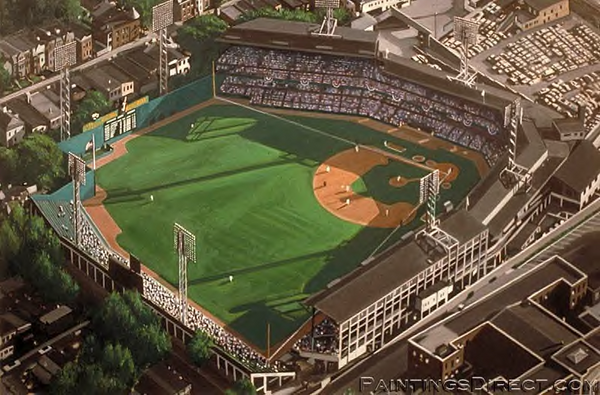
Construction was declared complete in late July. The stadium was expanded in 1924, just in time for their World Championship season. This expansion gave the double decks down the baseline a greater height than those behind home plate. This, plus the angling of the center field fence around a tree, resulted in a very strange look for the stadium.
Even with a bleacher section in front of the left field wall, in addition to the one behind it, for football, the stadium's capacity topped out at around 35,000. (Redskin fans complaining about RFK Stadium having just 56,000 fans, and wondering when they'd get a larger stadium, forgot that RFK was the larger stadium.) For baseball, Griffith Stadium's capacity was 27,410, the lowest in the major leagues after the Cleveland Indians stopped playing home games in 21,000-seat League Park after 1946 and moved all their games into the 85,000-seat Municipal Stadium.
A painting based on a black & white photo.
The center field "notch" can be clearly seen.

In contrast, in 1956, Metropolitan Stadium opened -- advertised as being equidistant from the downtowns of both Minneapolis and St. Paul, thus appealing to both cities without slighting either -- with 18,000 seats. By 1960, it had been expanded to 30,000 seats, with potential for more. (It was 40,000 by the 1965 Pennant season and 45,914 for the Playoff season of 1970. But it never seated more than 48,446 for football, which, combined with Minnesota's cold weather, led to the building of the Metrodome.)

The Met also had a weird look: One deck along the 3rd base line and in center and right field, two decks down the 1st base line and in left field, and three decks behind home plate. Somebody said it looked like an Erector set that a kid was playing with, and then his mother called him away to dinner, and he never finished it.
A postcard of The Met

The D.C. government, then under the control of the federal government, wouldn't build the Senators a new ballpark. But the federal government, through its Department of the Interior, was willing to, and did build D.C. Stadium, which originally seated 43,500 for baseball and would peak at 45,596. (The Department of the Interior still runs what's now Robert F. Kennedy Memorial Stadium.)

But it wouldn't be ready for baseball until April 1962 (it was ready for football in October 1961), and so Griffith needed a more appropriate stadium as soon as possible. Minnesota had one. It also had a real hunger for the majors, as you'll see next.

4. The Twin Cities. The Minneapolis Millers and the St. Paul Saints battled it out for local, and American Association, supremacy throughout the 1st 6 decades of the 20th Century. The Millers won 10 Pennants, in 1896, 1910, '11, '12, '15, '32, '35, '55, '58 and '59. The Saints won 2, in 1924 and '48.

The Millers were a Boston Red Sox farm team in 1938, so Ted Williams played for them. They were a New York Giants farm team in 1951, so they became Willie Mays' last team before reaching the majors. Other Millers who went on to major league success include Roger Bresnahan, Jimmy Collins, Gavvy Cravath, Red Faber, Zack Wheat, Hoyt Wilhelm, Bill White, Orlando Cepeda, Felipe Alou and Carl Yastrzemski. (They were again a Red Sox farm team when the Twins arrived.) Great players for the Saints included Ginger Beaumont, Lefty Gomez, Duke Snider and Roy Campanella.

In addition to their natural geographical rivalry, for a time, the Millers were a farm team of the Giants, and the Saints of the Brooklyn Dodgers, and the Giant-Dodger rivalry also came into play there.

Minnesota wanted major league ball very badly. They almost got it for the 1958 season: As the Millers' parent club, and wanting to get out of the Polo Grounds and its deteriorating Washington Heights neighborhood, Giants owner Horace Stoneham decided in 1957 to move to Minneapolis and Metropolitan Stadium. But Dodger owner Walter O'Malley decided to move to Los Angeles, and talked Stoneham into going to San Francisco instead. (This also explained the Giants giving up the Millers as their top farm club.)
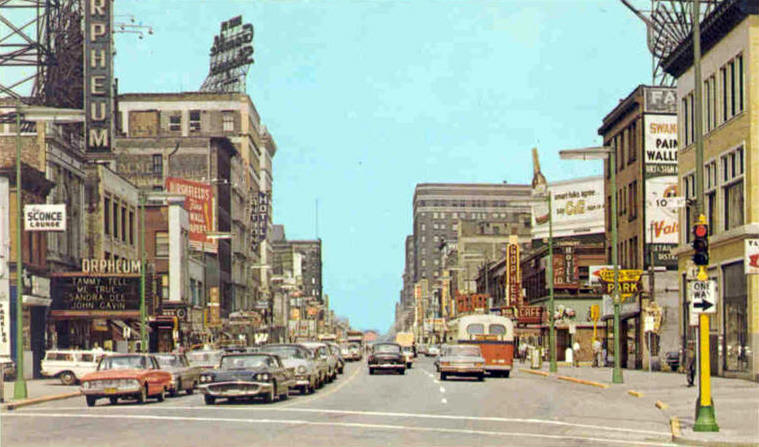
Hennepin Avenue, downtown Minneapolis, 1961

The Twins came in for the 1961 season, and, despite the team being in what turned out to be the last year of noncontention, attendance went up from 9,655 per home game in the last Washington season to 15,611, over 2,000 more than they had ever gotten in Washington. (They peaked at 13,254 in the baseball-hungry 1st season after World War II, 1946.)

And the fan bases of the Millers and the Saints came together to root for one team, just as the Giant and Dodger fan bases would soon do for the Mets. Indeed, the original Twins logo, which has been revived and updated at Target Field, reflects this. Note the M and StP monograms as they reach across the river to form a human bridge. Their names are Minnie and Paul.
And while the Minneapolis Lakers got moved to Los Angeles in the summer of 1960, the NFL brought the Land of Lakes into the fold with the Minnesota Vikings in 1961. And the NHL's 1967 expansion included the Minnesota North Stars. Both the ABA and the WHA would put teams in Minnesota, and it was the problems with the leagues, not the Twin Cities market, that doomed those teams.

No, if you were an MLB team owner in the 1950s, and you wanted to move, Minneapolis-St. Paul was a great place to go. Whatever their flaws, Horace Stoneham and Calvin Griffith both knew this.

3. The Baltimore Orioles. It's only 40 miles between the sites of Memorial Stadium in Baltimore and Griffith Stadium in Washington. The arrival of the O's in 1954 ate up a lot of the Senators' support in the suburbs of Maryland.

It wasn't just the difference in talent that emerged, with the O's becoming contenders in 1960, coming close to the Pennant in 1964, winning the whole thing in 1966 and 1970, and also winning Pennants in 1969 and 1971. In the 18 seasons from the Orioles' arrival in 1954, as very much still an extension of the sad-sack Browns, until the Senators left in 1971, there was never a season in which Washington topped Baltimore in per-game attendance.

And while the Orioles had a more modern stadium with a serious advantage in parking from 1954 to 1961, the last season of Griffith Stadium, that advantage was more than wiped out by Opening Day 1962: D.C. Stadium had more parking. And the neighborhood advantage was also eliminated: People talk about how bad the neighborhood around RFK Stadium is, but it's never been as bad as was faced at Yankee Stadium, or Comiskey Park in Chicago, or Tiger Stadium in Detroit were in those stadiums' last few decades. And it's not like there isn't a ghetto between downtown Baltimore and Memorial Stadium.

It also didn't help that the Orioles and the Senators were in the same league. With the former exception of New York, which had 3 teams from 1903 to 1957, every other 2-team city had their teams split between the Leagues: Boston (1901-1952), St. Louis (1902-1953), Philadelphia (1901-1954), Chicago (1901-present), Los Angeles (1961-present), New York (1962-present), San Francisco/Oakland (1968-present).

Even in different cities in the same State, it worked out that way: Ohio (1901-present), Missouri (1955-67 and 1969-present), Florida (1998-present), Texas (1972-2013). Until the Houston Astros got bumped over to the American League in 2014, Pennsylvania was the only exception among 2-team States. (California, of course, has 5 teams: 3 in the NL, 2 in the AL.)

But when the Orioles arrived in 1954, from then until 1971, there were 2 teams in the same League within 40 miles. Had they been in different Leagues, as the O's and Nats have been since 2005, fans could see American League games and players in Baltimore, and National League games and players in Washington. (Or, had things turned out differently, vice versa.)

Just as Orioles owner Peter Angelos stood in the way of an expansion or moved team in Washington in the 1990s, claiming he would lose 1/4 of his fan base if that happened, Calvin Griffith knew in the latter half of the 1950s that a lot of Marylanders were going to Baltimore instead of Washington to get their baseball. And the newly-arrived Orioles weren't going anywhere. So the old Senators had to go.

As it turned out, Angelos was wrong: The Orioles' attendance took a nosedive in 2002, 3 years before the Nationals arrived. Why? Because 2001 was Cal Ripken's last year. The loyalty of a lot of fans, both in the Baltimore area and in the Washington area, was to him, not to the Orange & Black. Once Cal retired, not nearly as many fans started coming up from Prince Georges County, the District, or Virginia to see the Orioles, who no longer provided either Cal or winning baseball.

Maybe that's why Angelos dropped his objection when Commissioner Bud Selig announced that the Montreal Expos were being moved to Washington: He knew his best excuse had been exposed as a bad guess.

2. They Were Immediately Replaced. The American League, under pressure from the politicians who wanted easy access to baseball, added an expansion team to Washington, along with the Los Angeles Angels, for the 1961 season. So it's not like Washington was without baseball, however bad it may have been. (The "New Senators" were so bad that, as the Vietnam War escalated and D.C. became a cauldron of protest, they were called "last in war, last in peace, and last in the American League.")
RFK Stadium, set up or baseball, in the "New Senators" era

No, Washington still had a baseball team. Until 1971. And you can't blame Calvin Griffith for that move:

1. Washington, D.C. It simply wasn't a good baseball town at the time. Essentially, there were 2 things that mattered in D.C.: The federal government and the Redskins. President Richard Nixon said, "All anybody in Washington cares about is the Redskins. They don't give a damn about the Smithsonian or the Kennedy Center." (And that wasn't just sour grapes over losing to John F. Kennedy in 1960: Government officials might have cared about it, but Washingtonians never really have.)

The fans who tended to show up, first at Griffith Stadium, and then at D.C./RFK Stadium, were middle-class federal government employees, who came from all over the country. Even when they did go to games, it was usually to root for their hometown teams. A Congressional aide from Chicago going to see the Senators play the Chicago White Sox was going to root for the White Sox. An Army Lieutenant from New Hampshire, working at the Pentagon, getting an evening's pass would go to the ballpark and root for the Boston Red Sox to beat the Senators.

When Bob Short -- who, oddly enough, was also the owner who moved the Lakers out of Minnesota in 1960 -- announced that the new Senators were moving to Dallas after the 1971 season, Congress did not pressure the baseball establishment to get them a new team. Commissioner Bowie Kuhn, despite growing up in D.C., did nothing to stop that move. When the final home game was played on September 30, 1971, only 14,461 fans showed up. (And rioted at the end, blowing a win for the Senators and getting the game forfeited to the Yankees.) And when a deal to move the San Diego Padres to Washington for the 1974 season began to fall apart, neither Kuhn nor Congress stepped in to save it.

It also didn't help that the locations weren't great. It wasn't just that Griffith Stadium and, later, RFK Stadium were built in black neighborhoods. It was that the public transportation wasn't great. It wasn't until 1976 that Washington's Metro opened, with the Stadium-Armory stop making it easy to get from anywhere in the metro area to RFK. It wouldn't be until 1991 that the Shaw-Howard University stop opened, providing access to the former location of Griffith Stadium.

It was even worse if you were trying to get to a University of Maryland football or basketball game: The College Park station didn't open until 1993. And Largo Town Center, the Landover station used for the Redskins' new stadium, didn't open until 2004, 7 years after the Bullets/Wizards and Capitals left that area and moved into downtown Washington -- and the Redskins moved out there, across the Beltway from the Capital Centre site.

Despite the old Senators/Twins franchise's ups and downs, the worst season the Twins have ever had for per-game attendance, 8,129 in 1974, is still better than what they got in 51 of their 60 seasons in Washington. And despite the ups and downs of the new Senators/Rangers, the best per-game attendance they got in their 11 seasons in Washington, 11,335 in 1969, has been topped in all but their 1st 2 seasons in Arlington, Texas. (Not since 1988 have they even gotten below 24,000.)

Today, with the Nationals in town, a relatively new ballpark (Nationals Park opened in 2008), easily accessible via public transportation (the Navy Yard station on the Green Line), a heavily-grown market due to the explosion of the D.C. suburbs in both Maryland and Virginia, a growing white middle class and a growing black middle class, a regional TV network (MASN) to drum up local support, and a promotions arm of Major League Baseball that knows a hell of a lot more of what it's doing than it did in 1960 and 1971, would anyone even think of moving the current MLB team out of Washington? As their biggest current star, Bryce Harper, might say, "That's a clown question, bro."
A recent full house at Nationals Park

It was not a clown question in 1960, or in 1971. Now, no one would move the Nationals. But can Calvin Griffith -- guilty though he was of racism and cheapness -- be blamed for moving the old Senators to Minnesota in 1960?

VERDICT: Not Guilty.

In 2015, with both teams in Playoff contention most of the way, and good public transportation to both Nationals Park in Washington and the 1992-opened Oriole Park at Camden Yards in Baltimore, the Nationals averaged 32,343 fans per game; the Orioles, 29,374 -- in each case, better than the O's got in the days in which they drove the new Senators to Texas, and a lot better than the O's got in the days in which they drove the old Senators to Minnesota.