Showing posts with label forbes field. Show all posts

Saturday, February 21, 2026

Bill Mazeroski, 1936-2026

Only one human being, living or dead, has ever hit a home run in the bottom of the 9th inning of a Game 7 to win a World Series. Now, he is no longer living.

And the odd thing is, he was a great fielder first, and a timely hitter second.

William Stanley Mazeroski was born on September 5, 1936 in Wheeling, West Virginia, and grew up on the other side of the Ohio River, in Tiltsonville, Ohio. He starred in baseball and basketball in high school.

In 1988, Sports Illustrated published an article on "The Valley Boys." The were all from the same area in southeastern Ohio: Mazeroski, knuckleballing baseball pitchers Phil and Joe Niekro, basketball star Alex Groza, his football-playing brother Lou Groza, and basketball star John Havlicek. Mazeroski turned out to be the last survivor of that group.

Also contemporaries from that place and time, but not mentioned in the article: Bill's Pirate teammate Gene Freese, football coach Lou Holtz, and football stars Bob Gain, Calvin Jones, Chuck Howley and Bob Jeter. Baseball relief pitcher Rollie Fingers, a bit younger, moved with his family to California before he reached high school.

Mazeroski turned down college scholarship offers from nearby schools Duquesne, Ohio State and West Virginia to play baseball. He signed with the Pittsburgh Pirates as a shortstop, but made a lot of errors. Branch Rickey, running the Pirates after building winners of multiple Pennants with the St. Louis Cardinals and then the Brooklyn Dodgers, saw how good he was at turning double plays, and had him moved to second base. It was a decision that changed the history of baseball.

He made his major league debut on July 7, 1956, at the Polo Grounds in New York. Batting 8th, playing 2nd base, and wearing the Number 9 he would wear throughout his career, he went 1-for-3, as the Pirates lost to the New York Giants, 3-2.

In 1958, despite playing his home games at Pittsburgh's Forbes Field, whose dimensions were similar to those of the pre-renovation original Yankee Stadium -- 300 feet to right field, but 457 to center, and 360 to left, not good for a righthanded hitter like Mazeroski or his teammate Roberto Clemente -- Mazeroski hit 19 home runs, which would remain his career high. He batted .275 with 68 RBIs. It was the 1st of 7 seasons that would see him reach the All-Star Game, and the 1st of 8 in which he would win the National League's Gold Glove at 2nd base.

After a dropoff in 1959, in 1960, he batted .273, with 11 home runs and 64 RBIs. He helped the Pirates win their 1st NL Pennant since 1927 -- 33 years. They hadn't won a World Series since 1925, and were facing the team that had beaten them in 1927, the New York Yankees, who were heavily favored.

The Yankees won Game 2, 16-3. They won Game 3, 10-0. They won Game 6, 12-0. But the Pirates won Game 1, 6-4. They won Game 4, 3-2. And they won Game 5, 5-2. The Series went to a Game 7. On that Thursday afternoon, 36,683 people jammed themselves into Forbes Field. Millions more listened to Pirates announcer Bob Prince and Yankees announcer Mel Allen call the game for television on NBC. Still more millions listened to NBC radio, with Baltimore Orioles announcer Chuck Thompson and Chicago Cubs announcer Jack Quinlan.
Forbes Field

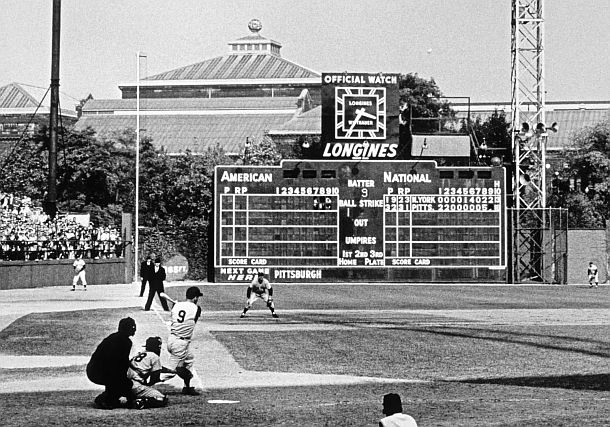
The game went back and forth, and was tied, 9-9, going to the bottom of the 9th inning. On NBC radio, Chuck Thompson, usually the voice of the Baltimore Orioles, said, "Well, a little while ago, when we said this one was going right down to the wire, little did we know." Mazeroski led off, against Yankee pitcher Ralph Terry. His 1st pitch was high, ball 1. Terry threw a 2nd pitch. The time was 3:36 PM. Thompson's call on radio:

Here's a swing, and a high fly ball, going deep to left, this may do it! Back to the wall goes Berra, it is over the fence, home run, the Pirates win!
In case you're curious, the building behind the scoreboard
is the Carnegie Library of Pittsburgh.

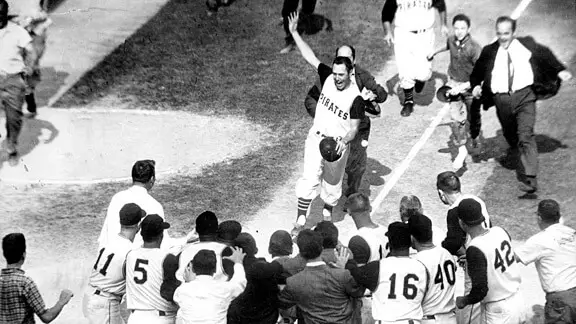
"I don't know it's out," Mazeroski recalled during a Pirates telecast in 2015, 55 years after the fact. "I don’t know it's a home run. But I know I;m going to end up on third if he misplays that ball off the wall. So I;m busting my tail getting around there, and by the time I hit second base, I looked down the line and the fans went crazy. From second base, I didn't touch the ground all the way in."

After pausing to let the cheering be heard, Thompson started again, and was so excited, he got the score wrong at first:

Ladies and gentlemen, Mazeroski has hit a one-nothing pitch over the left field fence at Forbes Field to win the 1960 World Series for the Pittsburgh Pirates by a score of ten to nothing! Once again, that final score, the Pittsburgh Pirates, the 1960 World Champions, defeat the New York Yankees. The Pirates ten, and the Yankees nine! And Forbes Field is an insane asylum!

Mel Allen, so often accused of being a "homer" for the Yankees, called it this way on TV for NBC:

There's a drive into deep left field, look out now! That ball is going, going, gone! And the World Series is over! Mazeroski hits it over the left field fence, and the Pirates win it, 10–9, and win the World Series!

The ball went over Berra's head, at around the 406-foot mark in left field, and landed among the cherry trees in Schenley Park. Mazeroski took off his batting helmet and swung it around as he circled the bases. 
The ball was found by Andy Jerpe, 14 years old. Mazeroski would sign the ball for him, but he foolishly used the ball in a neighborhood game, and it was lost. No one knows where it is now. The Pirates don't have it. Neither does the Baseball Hall of Fame.

The Yankees outscored the Pirates 55-27 during the Series, but the Pirates won it, 4 games to 3. Richardson had a Series record 12 RBIs, and remains the only player from a losing side to be named the MVP of a World Series. Mazeroski? He batted .320 in that Series, and that was his 2nd homer in it, for his 5th RBI in it, and he played his usual good games in the field. He got robbed. But I'm sure he'd rather have the title.

Not being old enough to remember 1960, I can hardly begrudge the Pirates that amazing victory. But there are Yankee Fans who are old enough to remember, and it still hurts. It shouldn't: They won the next two World Series, and another seven since. And Mazeroski was always a good guy.

There's a bronze statue of a young Mazeroski -- arms outstretched, cap in his right hand, right leg kicked up behind him -- along the Allegheny River outside PNC Park. The likeness is surrounded by a brick wall that includes an actual section of the outfield wall over which Mazeroski homered; the 406-foot marker is still visible in white.

Another part of Forbes Field's outfield wall still stands in place in Pittsburgh's Oakland neighborhood, just off Roberto Clemente Drive, and there’s a plaque recognizing the spot where Mazeroski homered. Every Oct. 13, the "Game 7 Gang" gathers at that site, listens to the radio broadcast and celebrates the anniversary of Mazeroski's famous home run at exactly 3:36 PM.
"That doesn't happen anywhere else, does it?" Mazeroski said with a smile in February 2020, approaching the 60th Anniversary of the event.

*

He never again batted higher .271. He never again hit more than 16 home runs in a season. He peaked at 82 RBIs in 1966. But it's as a fielder that he became best-known. He led NL 2nd basemen in double plays turned every year from 1960 to 1967. He led them in fielding percentage in 1960, '65 and '66, and retired with a career .983 fielding percentage. He led them in assists 9 times, and led all of the big leagues in 5 of those seasons. He still holds the Major League record for double plays turned by a 2nd baseman, with 1,706.

For the record, the holders at the other positions are: 1st base, Mickey Vernon, 2,044; shortstop, Omar Vizquel, 1,734; 3rd base, Brooks Robinson, 618; catcher, Ray Schalk, 222; center field, Tris Speaker, 146; pitcher, Greg Maddux, 98; right field, Harry Hooper, 86; left field, Joe Vosmik, 23.

Mazeroski was involved in 2 triple plays in his career, in 1966 and 1968. He never hit into one in real life. But on June 27, 1967, at Shea Stadium, he was filmed staging such an event for the film version of The Odd Couple: Just before the regular game, he was filmed batting against Jack Fisher of the Mets. The play required 2 takes, as he hit the 1st ball foul. The point of the scene was that a phone call from Felix Ungar (played by Jack Lemmon) to Oscar Madison (Walter Matthau) in the press box at Shea causes Oscar to miss a triple play that ends the game in victory for the Mets. (Felix's surname was spelled "Ungar" in the play and the film, "Unger" in the TV show.)

Mazeroski and Clemente were the only 1960 Pirates still there when they won the World Series again in 1971. Mazeroski retired after the 1972 season, with a lifetime batting average of .260, and 2,016 hits including 138 home runs.

For many years, he was considered one of the best players not in the Baseball Hall of Fame. The argument for him was that the best-fielding player, ever, at every position should be in, and he was the best-fielding 2nd baseman ever. The argument against him is that he wasn't good enough of a hitter, and that nobody's defense made enough of a difference to put him over the top. In 2001, he was finally elected.

People who were against his election to the Hall have claimed that the real reason he's in is that home run. I would make the exact opposite argument: 

I think the home run changed people's perception of him. Think about it: The 1st thing that comes to mind when you hear his name is, "He hit the home run that won the 1960 World Series." Imagine that the Series had ended any other way, even one favorable to the Pirates. Suppose Mazeroski had led the inning off with a single, and scored the title-winning run on somebody else's hit. Then, the 1st thing that would come to mind when you hear his name is, "He's the greatest-fielding 2nd baseman who ever lived." He probably would have gotten in much sooner.
At a still-standing, ivy-covered piece of the
Forbes Field outfield wall, October 13, 2010,
the 50th Anniversary of the home run.


The Pirates retired his Number 9, and dedicated a statue of him outside PNC Park, depicting him running around the bases, swinging his batting helmet around. They also elected him to their team Hall of Fame. He was also elected to the National Polish-American Sports Hall of Fame.


He retired to a suburb of Pittsburgh. In 1987, he ran for the Democratic Party's nomination for Westmoreland County Commissioner, but lost. Eventually, he and his wife the former Milene Nicholson, moved to Panama City, Florida, enabling him to go down to Bradenton to serve as a Spring Training instructor for the Pirates. They had 2 sons: Darren, who became a college baseball coach; and Dave, an atmospheric scientist.


On October 23, 1993, Joe Carter became the 2nd player to end a World Series by hitting a home run, for the Toronto Blue Jays over the Philadelphia Phillies, at the SkyDome (now named the Rogers Centre) in Toronto. However, that was in a Game 6, not a Game 7. It appears that Mazeroski and Carter never met.


Bill Mazeroski died yesterday, February 20, 2026, in the Pittsburgh suburb of Landsale, Pennsylvania. He was 89 years old.


With his death, there are 3 surviving players from the 1960 World Champion Pittsburgh Pirates: Bob Skinner, Vernon Law and Bennie Daniels.


There are 4 surviving players who played in Game 7 of that World Series: Skinner and Law of the Pirates, and Bobby Richardson and Tony Kubek of the Yankees. Kubek, famously, had to leave the game when a ground ball hit a pebble in Forbes Field's poor infield and struck him in the throat, helping to keep the Pirates' 8th-inning rally alive, and make Mazeroski's 9th-inning heroism possible.


And there are 11 surviving players from the 1971 World Champion Pittsburgh Pirates: Al Oliver, Steve Blass, Manny Sanguillén, Bob Robertson, Gene Alley, Richie Hebner, Luke Walker, Bob Johnson, Milt May, Dave Cash and Carl Taylor.


How did Mazeroski want his career to be remembered: For his Hall of Fame defense, or for hitting arguably the greatest home run of all time?


"Oh," he said, laughing, "I'll take the home run."


If it had been me, so would I.

Wednesday, October 15, 2025

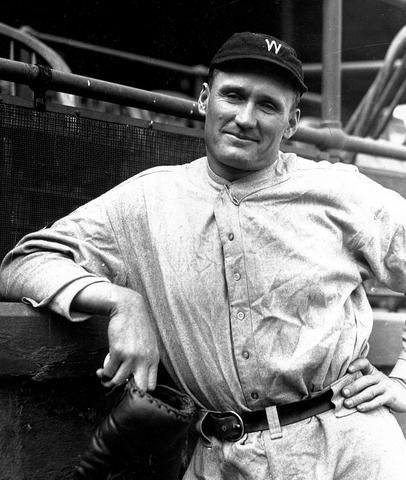
October 15, 1925: Walter Johnson's Rainy Last Stand

Walter Johnson

October 15, 1925, 100 years ago: The World Series comes to a soggy end at Forbes Field in Pittsburgh. It is one of the rare major league sports finals that is better remembered for the losing side, or for someone on it.

In the American League, the Washington Senators, winners of the previous season's World Series, won the Pennant again, by 8 1/2 games over the resurgent Philadelphia Athletics, getting into their 1st Pennant race in 11 years. Bucky Harris, their 28-year-old 2nd baseman and "Boy Manager," led a team highlighted by Walter Johnson, the "Big Train," one of the greatest pitchers who ever lived. The winningest pitcher in American League history finally became a World Series hero the year before, pitching innings 9 through 12 of Game 7 against the New York Giants.

The New York Yankees, who the Senators had edged the season before, and had won the previous 3 Pennants, fell apart: Babe Ruth developed a mysterious illness in Spring Training that kept him out for a month and a half, and several other established stars simply stopped hitting. They would be replaced by new players who would lead a new dynasty starting the next season, including Lou Gehrig.

In the National League, the Giants' 4-year run as Pennant winners came to an end, as they finished 8 1/2 games ahead of the Pittsburgh Pirates. Only pitcher Charles "Babe" Adams, now 43 but a rookie on their 1909 World Series winners, remained on that team. Their hitting stars included slick-fielding 3rd baseman Harold "Pie" Traynor, right fielder Hazen "Kiki" Cuyler, and speedy center fielder Max Carey, who was not well-known for his nickname, although it was "Scoops," which suggests he was a very good fielder.

*

October 7, 1925: Game 1 was played at Forbes Field. a Wednesday. Johnson started for the Senators, and he was aided by a home run by Joe Harris (no relation to Bucky), as the Senators win, 4-1. The only Pirate run came on a home run by Traynor. In the 5th inning, Peckinpaugh made an error, but it didn't amount to anything.

Late in the game, word reached the ballpark of the death that day of Christy Mathewson, the star pitcher for the Giants in the 1900s and 1910s. A series of lung ailments led to his death at the age of 45. The flag at Forbes Field was lowered to half-staff, and it remained so there and at Griffith Stadium in opposing Washington for the remainder of the Series. The Commissioner of Baseball, Kenesaw Mountain Landis, orders that black armbands be applied to both teams' uniforms, even though Mathewson had never been involved with either of the teams playing.

October 8, 1925: Game 2 was played at Forbes Field. Home runs were hit in the 2nd by the Senators' Joe Judge and in the 4th by the Pirates' Glenn Wright. In the 8th, Peckinpaugh made an error that did end up mattering, which that led to a home run by Cuyler. He made another error later in the inning, which did not matter. The Senators loaded the bases with nobody out in the top of the 9th, but they only got 1 run home, and the Senators won, 3-2. The Series was tied going to Washington.

*

October 10, 1925: Game 3 was played at Griffith Stadium. Peckinpaugh made his 4th error of the Series in the 6th, which led to an unearned run. Joe Harris singled home a run to put the Senators up 4-3 in the bottom of the 7th.

In the 8th, Earl Smith hit a drive to right-center field. Sam Rice leapt for it, and fell into the temporary stands that had been constructed. For a moment, a World Series crowd went silent, not knowing what had happened. Rice stood up, and held up the ball, indicating that he had made the catch. The umpires ruled the catch legal, and the Senators hung on to win, going up 2-1.
Sam Rice

Edgar Charles Rice (one of his minor-league managers changed his name to "Sam") is one of several great players virtually forgotten because their team no longer exists in its current form: They became the Minnesota Twins in 1961. And don't look for his retired uniform number anywhere: While he did last in the major leagues until 1934 and did wear numbers, none is retired for him, anywhere. If one was -- he wore 2 for the Senators in 1931 and 22 for them in 1932 and '33 -- he might be better remembered.

He might also be better remembered if he'd gotten into the 3,000 Hit Club. Instead, he fell just short: He collected 2,987 hits, the closest any player has gotten to 3,000 without getting it. (Unless you count Stan Ross, the Bernie Mac character in Mr. 3000.)

Rice later said, "The truth of the matter is, I did not even know how many hits I had. A couple of years after I quit, (Senators owner) Clark Griffith told me about it, and asked me if I'd care to have a comeback with the Senators and pick up those 13 hits. But I was out of shape, and didn't want to go through all that would have been necessary to make the effort. Nowadays, with radio and television announcers spouting records every time a player comes to bat, I would have known about my hits and probably would have stayed to make 3,000 of them."

He had a .322 lifetime batting average, a 112 OPS+, 498 doubles, 184 triples, and 351 stolen bases. He is in the Baseball Hall of Fame. But, today, when he is remembered at all, he is remembered for his 1925 World Series catch. Too bad there's no film of it: While a highlight film did capture some action in that Series, the catch is not part of it.

Also on October 10, the football team of the Olympic Club of San Francisco traveled across San Francisco Bay, and beat the University of California 15-0, in front of a crowd of 50,000 at California Memorial Stadium in Berkeley.

This ended a 50-game unbeaten streak for the Golden Bears, who had been 46-0-4. They hadn't lost since November 27, 1919, away to the University of Washington. The stadium was nicknamed "The House That Andy Built," as head coach Andy Smith made the team so good, ticket receipts alone covered the $1.4 million cost in 1923. It was seriously renovated in 2012.

Coaching took a severe toll on Smith, who went just 6-3 with Cal in 1925. On a visit to Philadelphia, where he had coached the University of Pennsylvania from 1909 to 1912, he was hospitalized with pneumonia, and died on January 8, 1926, only 49 years old. His career coaching record was 116-32-13, including 74-16-7 at Cal.

Also on this day, James Buchanan Duke died at his mansion at 1 East 78th Street, on 5th Avenue across from Central Park in New York. He was 68. "Buck" Duke is essentially the father of the American cigarette industry, and is thus responsible for the deaths of millions of people.

He's also responsible for the Duke Endowment, which contributed $40 million after his death (about $594 million in today's money) to Trinity College in his hometown of Durham, North Carolina. In his memory, it was renamed Duke University. So he's also responsible, if rather indirectly, for Coach K and the Cameron Crazies.

The James B. Duke House now hosts the New York University Institute of Fine Arts.
*

October 11, 1925: Game 4 was played at Griffith Stadium. Leon "Goose" Goslin, the greatest player ever to come from South Jersey -- he's in the Hall of Fame, and, as of the end of the 2025 regular season, Mike Trout does not yet have the career stats to get in -- and Joe Harris hit home runs. Johnson needed no more than that, as he pitched a 6-hit shutout. The Senators won, 4-0, and went up 3-1. Just 1 more win to go.

Washington baseball would not find that 1 more win for another 94 years.

On the same day, having already played some minor and semi-pro teams, the New York Giants football team plays its 1st game against an actual NFL team, although it's not one that most modern fans will recognize. At the Cycledrome in Providence, Rhode Island, a stadium built for bicycle racing (a big sport in the Roaring Twenties), they lose 14-0 to the Providence Steam Roller.

This team, officially having no S on the end, was no pushover, and deserves to be remembered today: It will win the NFL Championship in 1928 (73 years before the Patriots will win New England’s next NFL title), and host the NFL’s first night game in 1930 (5 years before Major League Baseball allows games to be played under lights), before the Great Depression put it out of business in 1931.

Although the Pawtucket Red Sox and the Providence Bruins are at the highest minor-league levels in their respective sports, the State of Rhode Island has never had another major league sports team: The closest they've come since is the Patriots, who since 1971 have played in stadiums in Foxboro, Massachusetts, 10 miles from the State Line, and closer to Kennedy Square in Providence than to Downtown Crossing in Boston.

Also on this day, Elmore John Leonard Jr. was born in New Orleans, but grew up in Detroit and was a hard-core Tigers fan. Or, perhaps I should say, "hard-boiled," as he was the writer of hard-boiled crime fiction.

Among his works that got turned into movies are Hombre (a Paul Newman film), 3:10 to Yuma
(made with Glenn Ford and Van Heflin in 1957, and Russell Crowe and Christian Bale in 2007), Mr. Majestyk (starring Charles Bronson), Get Shorty (with John Travolta), Out of Sight (in which George Clooney is a thief fooling around with the cop trying to catch him, played by Jennifer Lopez), and Rum Punch (which became the Quentin Tarantino film Jackie Brown starring Pam Grier). He is also responsible for the story that became the TV series Justified. He died in 2013.

*

October 12, 1925: The Senators wanted to wrap the Series up at home in Game 5. But the Pirates took a 2-1 lead in the 3rd, a 4-2 lead in the 7th, and won, 6-3, despite a 3rd homer in the Series by Joe Harris. Peckinpaugh made an error in the 6th inning, his 5th of the Series.

October 13, 1925: Game 6 was played back in Pittsburgh. Goslin hit a home run in the 1st inning, and the Senators made it 2-0 in the 2nd. But the Pirates tied the game in the 3rd, and Eddie Moore hit a home run in the 5th, giving the Pirates a 3-2 lead the held to the end, tying the Series. Peckinpaugh made his 6th error of the Series in the 7th inning.

Also on this day, Leonard Alfred Schneider was born in Mineola, Long Island, New York. We knew him as Lenny Bruce. According to sportswriter Dick Schaap, who collaborated with Lenny on his book Stamp Help Out!, Lenny attended only 1 Major League Baseball game in his short life (he died from drugs on August 3, 1966). It was as Schaap's guest, as a birthday present. It was October 13, 1960, and it was Game 7 of the World Series, the Bill Mazeroski Game, another World Series that the Pirates won in improbable fashion. Lenny wasn't a baseball fan, but he told Schaap he liked the drama.

Also on this day, Margaret Hilda Roberts was born in Grantham, Lincolnshire, England. How about that: Lenny Bruce and Margaret Thatcher were born on the exact same day. He didn't live long enough to have heard of her. If he had, with his sick sense of humor, I suspect there would have been a few jokes about her sex life (possibly suggesting that she had none), and about Bobby Sands (possibly, "For letting him starve, she can eat me!") and the Brighton Bombing.

One thing's for sure: In serving as Prime Minister of Britain, the 1st woman to do so, from 1979 to 1990, "The Iron Lady" treated all English soccer fans as if they were hooligans. She is widely believed to have been involved in the cover-up of the police's actions, both the negligent ones and the intentionally harmful ones, at the Hillsborough Stadium Disaster on April 15, 1989.

When her friend and fellow 1980s conservative icon, Ronald Reagan, died in 2004, most of his political opponents maintained a respectful silence. When the Iron Bitch died in 2013, a majority of Great Britain cheered, and was more than willing to say what a horrible person she was.

October 14, 1925: Game 7 was supposed to be played at Forbes Field, but the game was called off due to rain. They would have to try again tomorrow.

*

October 15, 1925: A steady downpour, continuing from the day before into this day, has left the field at Forbes Field a muddy mess, as Game 7 of the World Series is scheduled to be played. The weather forecast suggested rain for the next 3 days for both cities involved, Pittsburgh and Washington. So moving the game to Washington would have been pointless, and Commissioner Landis was anxious to get it over with. So, they would play through the rain.

I've never seen film of this game. I don't even know if any survives, although YouTube has footage from earlier in the Series, and of the Game 7s of 1924 and 1926. Maybe the film crews didn't want to risk getting electrocuted in the rain. At any rate, all we have to go on for the inclement weather are news reports.

On August 8, 2025, as commemorations for the 100th Anniversary of this Series began, I saw a photograph of a rather dubious method of drying the infield: Dousing it with gasoline and setting it on fire.
This insane tactic actually happened. It wasn't the only time, either.

But it would have been just plain wrong to play if the rain were as bad as what Philadelphia and Tampa Bay faced when Game 5 of the 2008 Series was suspended. There was a 6-day delay due to rain in 1911, and there were 3-day delays in 1962 and 1975. It could have been done again.

It was a short day for Pirate starter Vic Aldridge: 3 walks and 2 hits‚ and he was out of there with just 1 out in the 1st. Walter Johnson took a 4-0 lead to the mound. In what became known as "Johnson's Last Stand," the Bucs clobbered the 38-year-old Big Train for 15 hits‚ good for 24 total bases. Max Carey's 4-for-5 gave him a Series-high batting average of .458.

The Senators made the most of 7 hits‚ scoring 7 runs. But in the bottom of the 7th, Eddie Moore led off with a grounder to short, and Peckinpaugh made his 7th error. Carey doubled the run home. Cuyler bunted Carey over to 3rd base. Clyde Barnhart grounded out, and Carey couldn't score. But Traynor hit a triple down the right-field line, and that scored Carey. Traynor tried to stretch it into an inside-the-park home run, but was thrown out at the plate.

In the top of the 8th, Peckinpaugh hit a home run‚ the 12th homer of the Series by both teams combined‚ then a Series record, despite Forbes Field and Washington's Griffith Stadium both having some of the most distant fences in the game. That made it 7-6 Senators.

With the rain still coming down, Johnson got the 1st 2 outs in the bottom of the 8th. But Earl Smith doubled, and Pirate manager Owen "Donie" Bush sent Emil Yde (that's "EE-dee"), normally a pitcher, in to pinch-run for him. Johnson walked Moore. Carey grounded to short, and Peckinpaugh tried to turn a force play at 2nd. But he made a bad throw, his 8th error. The bases were loaded, and Cuyler cleared them with a double down the right field line. Red Oldham, in relief of Ray Kremer, got the Senators out 1-2-3 in the 9th, and the Pirates were 9-7 victors.
Roger Peckinpaugh

They became the 1st team to come from 3 games to 1 down to win a World Series. They would also be the 3rd and the 4th, in 1971 and 1979, respectively, both times against the Baltimore Orioles. The 2nd would be the 1958 Yankees, against the Milwaukee Braves.

Peckinpaugh's 8 errors are still a record for a single World Series. The rest of the Senators combined only made 1 error in the 7 games.

In the next day's New York Times, James Harrison wrote, "In a grave of mud was buried Walter Johnson's ambition to join the select panel of pitchers who have won three victories in one World Series. With mud shackling his ankles and water running down his neck, the grand old man of baseball succumbed to weariness, a sore leg, wretched support and the most miserable weather conditions that ever confronted a pitcher."

The last surviving member of the 1925 Pirates was shortstop Glenn Wright, who lived until 1984.

Sunday, May 25, 2025

May 25, 1935: Babe Ruth's Last Hurrah

May 25, 1935, 90 years ago: Babe Ruth has his last good game. It is the icing on the cake of his legend.

George Herman Ruth Jr. had started his career in Boston, with the 1914 Red Sox. He became a star with them, and was sold to the New York Yankees for the 1920 season, becoming the biggest star in the history of North American sports.

But he wanted to manage, and the Yankees wouldn't let him. After the 1934 season, Yankee owner Jacob Ruppert gave him his release, so that he could seek a managing job elsewhere. Judge Emil Fuchs, owner of the Braves, desperate for attendance in the Great Depression, told Ruth he would be "assistant manager" to Bill McKechnie for 1935, and would become manager for 1936, with the promise of a part-ownership of the team. The Sultan of Swat jumped at the chance, and returned to Boston.

The Babe was often very gullible, but he wasn't stupid. He soon saw that McKechnie wasn't listening to him in the slightest -- not that he needed to, having already won a World Series managing the Pittsburgh Pirates in 1925 -- and that the Braves had absolutely no intention of making him the manager the next season. (McKechnie remained their manager through 1937, and won another World Series managing the Cincinnati Reds in 1940.) The Great Bambino was nothing more than a drawing card to the Braves, and he figured it out.

To make matters worse, the 40-year-old Ruth hurt his elbow, making it difficult to swing. When he wasn't in pain, he could still hit. He hit a home run on Opening Day, April 16, giving the Braves a win over the New York Giants. He hit another on April 21. But then the injury got worse, and he went into a slump. By the time he hit his next home run, an entire month later, he was batting just .149.

On May 25, the Braves played the Pirates at Forbes Field in Pittsburgh. In the top of the 1st inning, Ruth came to bat against Charles "Red" Lucas, and hit a home run off him, making the score 2-0. Lucas pitched to only 5 batters, getting 1 out, before Harold "Pie" Traynor, the Pirates' Hall of Fame 3rd baseman now also serving as manager, took him out due to a nagging injury that had already cost him all but 1 of his 1st 8 starts, and would cost him 3 more in June.

Guy Bush ("Guy" was his real first name, not a nickname) was brought in, and he pitched the next 6 innings, although not very effectively. Ruth batted against him in the 3rd inning, and hit another 2-run homer. Ruth singled home another run in the 5th. In the top of the 7th, once more against Bush, Ruth hit a drive over the right-field stands at Forbes Field, making him the 1st player ever to do that. It was considered the longest home run ever hit there, and it was the 714th home run of his career, and his 2,873rd hit. Overall, he went 4-for-6 with 6 RBIs on the day.

It wasn't enough: The Pirates won, 11-7. The Pirates' last pitcher, and the winning pitcher, was Ruth's former Yankee teammate, eventually a fellow Hall-of-Famer, Waite Hoyt.

Legend has it that, thinking it wasn't going to get any better than that, he retired right after that game. Maybe he should have. But he didn't. The next day, he pulled a muscle playing the field. He continued to try to play every day, but that homer over the Forbes Field roof wasn't just his last home run, it was his last hit.

On May 30, at Baker Bowl in Philadelphia, the Braves were swept in a Memorial Day doubleheader by the Philadelphia Phillies, 11-6 and 9-3. It wasn't much of a matchup. The Braves would finish 8th and last, winning only 38 games and losing 115, the most of any NL team between the 1899 Cleveland Spiders and the 1962 New York Mets. The Phillies were much better, but still finished 7th, at 64-89 -- and, by their standards, that was a good finish.

The Braves' season was so bad, that for the 1936 season, they decided to, as would be said today, rebrand: They changed their name to the Boston Bees, and the name of their ballpark from Braves Field to National League Park, a.k.a. the Bee Hive. The new names never caught on, and the old ones were restored in 1941.

Basically, the only reason to go to these games was to see Ruth -- and he didn't play long. He started the 1st game, in left field, batting in his usual 3rd position. In the top of the 1st inning, batting against rookie Jim Bivin, he grounded to 1st baseman Dolph Camilli, who made the putout himself.

In the bottom of the 1st, Ruth was unable to get to a fly ball, and it dropped in for a hit. The next batter, Lou Chiozza, hit another fly to left. Not only couldn't the Babe catch it, but it rolled past him, all the way to the wall. While he wasn't always the fat man of the public imagination, by this point, his gut and his pulled muscle rendered him as slow as molasses.

When he finally got to the ball, Chiozza was trying to stretch it into an inside-the-park home run. With the left arm that had won 94 games as a pitcher still strong, Ruth threw the ball to 3rd baseman Pinky Whitney, who threw to catcher Al Spohrer, and Chiozza was out. Ruth got credit for an assist.

It was his last statistic. Instead of going back to the dugout, he walked to center field, where both teams' clubhouses were located. The fans, realizing he was taking himself out of the game, gave him a standing ovation. Three days later, he announced his retirement.

Ruth was lucky that there was no constant replaying of his fielding, so he wasn't embarrassed the way Willie Mays was with the New York Mets, and Johnny Unitas was with the San Diego Chargers, both in 1973. Or Joe Namath was with the 1977 Los Angeles Rams. Or any number of boxers having one last fight too many, like Muhammad Ali against Larry Holmes in 1980. There was no ESPN to show him as a Boston Brave, the way they showed Michael Jordan as a Washington Wizard, or Jerry Rice as a Denver Bronco, or Roger Clemens in his 2nd go-round with the Yankees.

The Babe never did get an offer to manage a major league team. The Brooklyn Dodgers hired him as 1st base coach in 1938, but they really hired him to hit pregame batting practice, as they were in a rebuilding year, and were desperate for attendance. Ruth played in old-timers' games to raise money for war bonds at Yankee Stadium in 1942 and 1943, batting against Walter Johnson, and that was it. He died of cancer in 1948.

Saturday, February 24, 2024

February 24, 1874: The Flying Dutchman

February 24, 1874, 150 years ago: John Peter Wagner is born outside Pittsburgh in Carnegie, Pennsylvania. The public knew him as Honus Wagner, the Flying Dutchman. ("Honus" was a variation of "Hans," the German form of "John.") With his big nose, sticking-out ears, and bowed legs, he did not look like a great athlete.

But those legs were fast, and his mighty forearms allowed him to hit, and he became the greatest player that baseball had yet seen. In the American Magazine, Chicago-based sportswriter Hugh Fullerton wrote, "If a man with a voice loud enough to make himself heard all over the United States should stand on top of Pike's Peak and ask 'Who is the greatest ballplayer?' 27,806,009 persons would shout 'Wagner!'"

He helped his hometown Pittsburgh Pirates win Pennants in 1901, 1902, 1903 and 1909, losing the 1st World Series to Cy Young's Boston Americans (Red Sox) in 1903, but winning the Series over Ty Cobb's Detroit Tigers in 1909. He won more NL batting titles than anyone, 8, a record since tied by Tony Gwynn; and led the NL in RBIs and stolen bases 5 times each.

His lifetime batting average was .328, his OPS+ 151, his career RBIs 1,732 (a record at the time), and he collected 3,420 hits. Remember the fuss made when Pete Rose broke Cobb's career record for hits? Well, somebody had to have the record before Cobb, and it was Wagner. He was a great defensive player, too, and could play every position except catcher: He played 1,887 games at shortstop, 248 at 1st base, 210 at 3rd base, 96 in right field, 57 at 2nd base, 32 in left field, 15 in center field, and 2 as a pitcher, pitching 8 1/3rd innings, allowing no runs.

He later coached with the Pirates, wearing Number 33 in this role, and it was retired for him. The team also dedicated a statue of Wagner outside Forbes Field in 1954, moving it to Three Rivers Stadium in 1970 and to PNC Park in 2001.
With Cobb, Ruth, Christy Mathewson and Walter Johnson, he was 1 of the 1st 5 players elected to the Baseball Hall of Fame in 1936. In 1999, 82 years after his last game and 44 years after his death, The Sporting News placed him 13th on its 100 Greatest Baseball Players list, 1st among shortstops, and fans voted him onto the MLB All-Century Team. In 2022, ESPN did a 100 Greatest Baseball Players list, and, despite an entire new generation of players having arisen, Wagner rose to 12th.

Friday, September 15, 2023

September 15, 1963: The Alou Brothers Game

Left to right: Matty, Felipe and Jesús Alou

September 15, 1963, 60 years ago: For the 1st time, a major league outfield is made up entirely of three brothers.

All 3 brothers were from Haina, in the Dominican Republic. Felipe Rojas Alou was born on May 12, 1935. He arrived in the major leagues in 1958, with the San Francisco Giants, who were in their 1st season in San Francisco, after moving from New York. Mateo Rojas Alou was born on December 22, 1938. He debuted with the Giants in 1960. Jesús María Rojas Alou was born on March 24, 1942. He debuted with the Giants on September 10, 1963.

Five days later, the Giants played the Pittsburgh Pirates at Forbes Field in Pittsburgh. The Giants jumped out to a 3-0 lead in the 1st inning, thanks to a home run by Willie Mays, who, as would be expected, was playing center field. Willie McCovey, whose preferred position was 1st base, was playing left field, because Orlando Cepeda was a 1st baseman and he had seniority, if only by 1 year. And the starting right fielder was Felipe Alou.

The Pirates tied the game in the bottom of the 5th. But the Giants scored 5 runs in the 7th inning, including Felipe, having drawn a walk, scoring on a McCovey single; and 4 runs in the 8th, including Felipe, having singled and driven in shortstop José Pagán, scoring on a single by Mays.

For the bottom of the 7th, Giant manager Alvin Dark moved Felipe to left field, replacing McCovey in the field; and Jesús Alou was brought in to play right field, replacing McCovey in the batting order. For the bottom of the 8th, Dark rearranged the chessboard some more: He replaced Cepeda at 1st base with Norm Larker, took Mays out, moved Felipe Alou to center field, and put Matty Alou in left field.

Thus, the outfield now consisted of Matty Alou in left, Felipe Alou in center, and Jesús Alou in right. This game became one of the great baseball trivia questions: "What was the only all-brother outfield in Major League Baseball history?"

Years later, a question occurred to me: "What happened to Willie Mays? Why wasn't he playing center field for the Giants that day? Was he injured? Did he simply get the day off?"

Nothing of the kind. Indeed, Mays started in center field, and was the big hitting star of the game, going 2-for-4, with a home run, driving in 4 runs and scoring 3. It was only in the 8th inning that he was replaced, with Felipe moving from left field to center field, and Matty going into left field. So the great trivia question is flawed: The 3 brothers didn't all start the game together, and were only in the field together for 2 innings.

For the record: Felipe went 1-for-5 with a walk, an RBI and a run scored, and had 2 putouts in the field; Jesús went 0-for-2, and had no fielding chances; and Matty had neither a plate appearance nor a fielding chance.

The Giants won the game, 13-5. Billy O'Dell went the distance, and was the winning pitcher. For the Pirates, Roberto Clemente went 0-for-4, although Willie Stargell went 2-for-4 with an RBI.

Felipe would be traded to the Milwaukee Braves, and was with them when they moved to Atlanta in 1966. He returned to the postseason in 1969, when the Braves won the National League Western Division title. He made 3 All-Star Games, and last played in 1974 with the Milwaukee Brewers.

He later managed the Montreal Expos, being named NL Manager of the Year in 1994, when the Strike of '94 cut short the Expos' fine chance at a title. In 2003, he managed the Giants to an NL West title. The Giants have elected him to their Wall of Fame. As of September 15, 2002, he is still alive, at age 87.

His son Moisés played for him in Montreal and San Francisco, and was arguably the best player in the family. Another son, who goes by "Luis Rojas" instead of "Luis Alou," due to a clerical error at the start of his playing career, never played in the major leagues, but has managed the New York Mets, and has coached for both them and the New York Yankees. (Felipe and Matty both played for the Yankees. Jesús did not, but did play in New York, for the Mets.)

Matty won the NL batting title in 1966, while playing for the Pittsburgh Pirates. In 1969, he led the major leagues in hits and doubles. He made 2 All-Star Games, and won a World Series with the Oakland Athletics in 1972. He last played in the majors in 1974, with the San Diego Padres, before playing 2 more seasons in Japan. He died on November 3, 2011, at the age of 72.

Jesús was the last to leave the Giants, in 1968. With Matty having been traded by then, he was acquired by the A's, and was a member of their 1973 and 1974 World Series winners. Having been with the Houston Astros during their Ball Four season of 1969, he returned to them, and last played in the majors with them in 1979. He later scouted for major league teams, including the Expos under Felipe. He died on March 10, 2023.

Thursday, October 27, 2022

October 27, 1922: Ralph Kiner Is Born

October 27, 1922, 100 years ago: Ralph McPherran Kiner is born in Santa Rita, New Mexico, about 150 miles northwest of El Paso, Texas. He was 4 years old when his father died, and his mother moved him to the Los Angeles suburb of Alhambra, California, and he grew up there.

As his contemporary Duke Snider pointed out, the Southern California weather enabled kids to play baseball all year long, which led to the Pacific Coast League (including the less-weather-friendly Oregon and Washington State) producing a seemingly endless stream of baseball talent, which continues to this day. It's why the College World Series is dominated by the Sun Belt: California teams, Arizona teams, Texas teams, Louisiana State, Mississippi State, Alabama, Auburn, Georgia Tech, Florida teams.

Ralph was signed by the Pittsburgh Pirates, played in the low minors in 1941 and '42, and in 1943 was a member of the first sports team to be named the Toronto Maple Leafs, then the Pirates' top farm team. But World War II was raging, and his country called.

When he came back from serving as a pilot in the U.S. Navy, he was 23 years old, and ready to make the big club. On April 16, 1946, he made his major league debut for the Pirates, against the St. Louis Cardinals at Sportsman's Park. Batting 3rd and playing center field, he had a single and a walk in 5 trips to the plate. The Pirates won, 6-4, a bump in the road for the Cardinals, as they went on to win their 4th Pennant and 3rd World Series in a 5-year stretch. He hit his 1st major league home run 2 days later, on April 18, in the top of the 8th off the Cardinals' Howie Pollet. But the Cards won that game, 6-2, as Stan Musial also homered.

After that, Ralph was mainly a left fielder. He wore Number 43 in his rookie season, the last year in which the Pirates wore red, white & blue uniforms. In 1947, he was given Number 4, and the Pirates wore blue & white. In 1948, they switched to black & gold, the same colors as the football team that had been named for them but was now called the Steelers, and they have worn those colors ever since.

In that 1st season, 1946, he led the National League by hitting 23 home runs, a pretty good total for a man whose home games were in Pittsburgh's Forbes Field. "The Old Lady of Schenley Park," home to the Buccos from 1909 to 1970, had dimensions very close to those of the pre-renovation, 1923-73 version of Yankee Stadium: Close in the right-field corner, but pretty distant everywhere else. Left field was 360 feet away, its furthest point was 462 to left-center, and straightaway center was 442. Terrible conditions for a righthanded hitter, which Ralph was.

But in '46, Ralph was just getting warmed up. In 1947, the Pirates brought in Hank Greenberg, the great slugger of the Detroit Tigers, making him baseball's 1st $100,000 a year player. (That's about $1.33 million in today's money, meaning, compared to today's players, even the highest-paid player in the game's history to that point was underpaid.) To help him out, the Pirates put an inner fence in left field, in front of Forbes' familiar scoreboard, reducing the left-field pole from 360 to 335. The area between the fences was called Greenberg Gardens. After playing in '47, Greenberg retired, and the area was renamed Kiner's Korner. The inner fence was removed after he was traded.

Kiner always credited Greenberg with making him a better hitter, and the results speak for themselves: 23, 51, 40, 54, 47, 42, 37, 35. Those were his seasonal home run totals from 1946 to 1953, making him easily the best slugger in the National League during the Truman Administration.

Those 54 homers in 1949 were the most by a National Leaguer between Hack Wilson's 56 in 1930 and Mark McGwire's 70* in 1998. It's a total that was never reached by Lou Gehrig, Joe DiMaggio, Ted Williams, Stan Musial, Willie Mays, Ernie Banks, Hank Aaron, Frank Robinson, Harmon Killebrew, Reggie Jackson or Mike Schmidt -- and only once by Mickey Mantle.

Indeed, from 1938, when Greenberg hit 58, until 1997, when steroids allowed McGwire and others to rewrite the record book, the only player who hit more than that in a season was Roger Maris, his "61 in '61" breaking Babe Ruth's 1927 record of 60.

As Hall of Fame pitcher Warren Spahn said, "Ralph Kiner could wipe out your lead with one swing."

The Pirates' broadcasters at the time were Bob Prince, a.k.a. "The Gunner," and Albert "Rosey" Rowswell, the man who nicknamed the Pirates "the Buccos." (A "buccaneer" was a kind of privateer, not quite a pirate.) These men were the other kind of "homers," broadcasters favoring the home team, to the extent that they made Yankee mikemen Mel Allen, Phil Rizzuto and John Sterling sound objective by comparison. Rosey, who grew up outside Pittsburgh, claimed not to have missed a Pirates home game since 1909, the year Forbes Field opened and Honus Wagner led them to win the World Series for the first time.

Rosey had a trick: When a Pirate hitter, more often Kiner than anyone else, would hit a ball that looked like it would be a home run, he imagined an old lady whose house faced Forbes Field, and he would yell, "Open the window, Aunt Minnie, here it comes!" Then Prince, or whoever was handy at the moment, would drop a box full of items to make it sound like glass was breaking, and say, "Too late!" (I've also heard that Rosey would smash a light bulb there in the broadcast booth, but that sounds a little too dangerous.)

On Opening Day of the 1948 season, the year after Kiner hit 51 to set a club record (which he would break in '49), entertainer Bing Crosby, a minority owner of the Pirates, was in the booth with Rosey, but he kept talking through a Kiner swing, and Rosey had to interrupt him: "Open the window, Aunt Minnie!... There it goes, clean clear over the scoreboard! Home run for Ralph Kiner, his first of the 1948 season! Let's hope it's the first of 61!"

Rosey died on the eve of the 1955 season, by which point his Aunt Minnie routine could be seen as just an act, because television was beginning to take over, and fans watching at home could see that there was nothing but parkland for a few blocks beyond the left and center field fence, until the Carnegie Museum, which can be seen behind that scoreboard in the famous photo of Bill Mazeroski's home run that won the 1960 World Series.

In spite of Ralph's home run heroics, the Pirates were a bad team. In 1952, they lost 112 games, the most of any NL team between the 115 of the 1935 Boston Braves and the 120 of the 1962 Mets. In The Road to Bali, one of the "Road Pictures" he made with his pal Bob Hope (himself a minority owner of the Cleveland Indians at the time), Dorothy Lamour asked Bing, "Do you still have pirates in America?" And Der Bingle said, "Yes, but they're in the basement."

Branch Rickey, the man who built championship teams in St. Louis and Brooklyn, and was now the general manager in Pittsburgh. It was said, "He had money and players, and didn't like to see them mix."

And on June 4, 1953, Rickey traded Ralph to the Chicago Cubs, along with fellow future broadcaster Joe Garagiola, George "Catfish" Metkovich, and, ironically, the man who had given up Ralph's first homer, Howie Pollet.

In exchange, he got 6 players and $150,000. The only player of the 6 who might be familiar to a New York fan was the former Brooklyn outfielder Gene Hermanski, by then washed up. Rickey wanted Hermanski to take over in left field, but he really wanted the money, and Cubs owner Phil Wrigley, he of the chewing-gum fortune, was one of the few among the 16 team owners who was willing to spend it -- not that it did him much good after 1945.

Ralph didn't want to go. He liked Pittsburgh. The Pittsburgh fans loved him. But he made $90,000 in 1952 -- the highest in the game at that point, as Greenberg and Joe DiMaggio, the 2nd $100,000 man, had retired; and Ted Williams, the 3rd, only got about $25,000 of his scheduled $125,000 that year before the Marines called him to Korea. Ralph's 1952 $90,000 works out to a shade over $1 million today.

Looking to not have to pay him a similarly huge sum, or more, in the future, Rickey told him, keeping in mind that 8th place was last in the League at the time, "We finished 8th with you, and we can finish 8th without you."

Of course, putting a power hitter in Chicago's Wrigley Field, with its close power alleys and its wind frequently blowing out, should have helped Ralph a lot. It did, at first. And, like Greenberg did for him, he was able to help out a young player just coming up: Ernie Banks, who would go on to become one of the best sluggers in baseball in the late 1950s and all through the 1960s.

But a back injury made it hard for Ralph to swing. After the 1954 season, the Cubs sent him to the Cleveland Indians for pitcher Sam Jones. A rare good move for the Cubs, as Jones, that next season, became the 1st black pitcher to throw a no-hitter in the major leagues.

But the Indians' GM at this point was Ralph's mentor, Greenberg, and he thought Ralph could help the Tribe, who had won the American League Pennant, but were under no illusions about the Yankees trying to reclaim it (which they did).

Ralph wore Number 9 for the Indians, but his back injury limited him to 390 plate appearances. That, and the distant fences at Cleveland Municipal Stadium, limited him to a .243 average, 18 homers and 54 RBIs. In other words, when he could play at all, he could still hit the ball a long way. But, like Greenberg, a bad back led him to call it a career early.

The same thing would happen to his Indians teammate, Al Rosen. Those back injuries meant that none of them got the career statistics necessary to get them into the Hall of Fame in the early years of their eligibility. Greenberg and Kiner lived long enough to make it and enjoy it. Supporters of Rosen, also dead now, are still waiting.

Kiner was just short of 33 years old when he played his last game, on September 25, 1955 -- 3 days before Jackie Robinson stole home plate, in the World Series, 5 days before James Dean was killed in a car crash, 6 days before The Honeymooners premiered on CBS, and 8 days before the Dodgers won Brooklyn's only World Series.

Years later, I was watching a Mets game, and a player had hit his first major league home run. And Tim McCarver said something shocking: "I don't remember my first major league home run. You'd think I would, since I didn't hit very many of them!" Ralph said, "I remember my first home run. I don't remember my last home run. Because, at the time, I didn't think it would be my last!"

His last home run was on September 10, 1955, off Ellis Kinder of the Red Sox at Fenway, and it was significant, since it was part of a 5-run 7th inning that gave the Wahoos a 10-7 win, their 5th straight win, moving them to a game and a half ahead of the Yankees. But they only went 6-7 the rest of the way, and finished 3 games back. It was the only Pennant race Ralph ever played in. (Ted Williams didn't homer in the game, but he did go 3-for-5 with an RBI.)

Greenberg didn't forget his friend, though, and appointed him as GM of the Indians' top farm team at the time, the San Diego Padres of the PCL. (The major league team with that name replaced them in 1969.) He'd be working a 2 1/2-hour drive from home in Los Angeles. It looked like, again, Ralph was following Hank's path.

But in 1961, the Chicago White Sox -- for whom Greenberg was now the GM -- offered him a broadcasting post. This was something Greenberg hadn't done. The next year, the expansion New York Mets offered him one of their initial broadcasting slots.

*

Ralph was a one-dimensional player. He couldn't hit for average. He was one of the slowest players in the game at the time. He didn't embarrass himself in the field, but had he played in the AL after 1973, he would likely have been a designated hitter.

But what a job he did in that one dimension. He led the NL in homers every season from 1946 to 1951, had 7 100+ RBI seasons including a League-leading 127 in 1949, led the NL in on-base percentage once and in slugging percentage 3 times.

His career home run total was 369. That may not sound like much, but, keep in mind, he was limited -- by war at the beginning, and by injury at the end -- to just 10 seasons. Now, doubling his career to 20 seasons wouldn't necessarily have doubled his career total to 738 -- more than Babe Ruth had, but less than Hank Aaron and Barry Bonds ended up with -- but 500 certainly wasn't out of the realm of possibility, even if he had played the rest of his career in "Cavernous Cleveland Stadium."

Knowing Greenberg, he might have brought Ralph to the White Sox, whose Comiskey Park wasn't exactly conducive to sluggers, although, in 1959, with Ted Kluszewski bopping 'em out, they won the Pennant. A healthy Ralph Kiner, then approaching his 37th birthday, could have made a difference in the World Series, even if only in a veteran's pinch-hitting role like the Yankees had in that decade with Johnny Mize and Enos Slaughter.

To put those 369 homers in another light: At the time he retired, in 1955, it was 6th all-time, behind Ruth's 714, Jimmie Foxx's 534, Mel Ott's 511, Gehrig's 493, and the still-active Williams' 394 (of the 521 with which he would finish). Among righthanded hitters, only Foxx had more; among NL hitters, only Ott did. DiMaggio had 361, Mize 359. Musial would end up with 475, but, at the time, had only 325. Kiner's homer rate was, until the Steroid Era, 2nd only to Ruth's.

Ralph has often been cited as being the player who said, "Home run hitters drive Cadillacs, singles hitters drive Fords." The line actually predates him, but he did add to it, by explaining why he wouldn't choke up on the bat to try to raise his average: "Cadillacs are down at the end of the bat."

Hits: 1,451 -- meaning he should have had about 2,500, which wouldn't have gotten him into the magic circle of 3,000, but would have put him ahead of Mantle's 2,415 and DiMaggio's 2,245. Batting average: .279, nothing special. On-base percentage: .398, which is very good. (He walked at least 98 times in 7 different seasons.) Slugging percentage: .548 -- at the time, 10th, trailing only Ruth, Williams, Gehrig, Foxx, Greenberg, DiMaggio, Rogers Hornsby, Mize and Musial. OPS+: 149, meaning he was 49 percent better at producing runs than the average player in his time.

Unfortunately, that shortened career, and people by that point knowing him mainly as a broadcaster, nearly kept him out of the Baseball Hall of Fame. Those 10 seasons in the major leagues meant that he met the minimum requirement for election (which has been waived in a few special cases, such as Negro League players). And by 1971, by which point 11 players had joined the 500 Home Run Club, his 369 no longer seemed like such a big number.

It wasn't until 1975, his 15th and last year on the Baseball Writers' Association of America (BBWAA) ballot, that he got the necessary 75 percent of the ballots to be elected -- and, even then, he got 273 votes, 2 more than the 75 percent needed. (Had he missed out that time, he would have had to wait a few years, until he was eligible through the Veterans' Committee.)

Even then, he had to wait 45 minutes to find out. Why? Because Jack Lang, the sportswriter whose job it then was to call the newly-elected to tell them that they had, in fact, been newly elected, kept calling him, and calling him, and calling him, but kept getting a busy signal. Why? As Ralph explained when Jack finally got through to him, his mother-in-law had been calling him every 5 minutes to ask if he'd made it on this last try.

The Pirates would eventually retire his Number 4. The Sporting News listed him at Number 90 on their end-of-the-century list of the 100 Greatest Players, and he was a finalist for the Major League Baseball All-Century Team. In 1995, in his book Ted Williams' Hit List, Ted named him one of the Top 20 Hitters of all time. He has been honored with a statue in his hometown of Alhambra.

He was introduced, along with many of the All-Century Team finalists, before the 1999 All-Star Game at Fenway Park, and with 48 of the other 60 living Hall-of-Famers before the 2008 All-Star Game at Yankee Stadium.

*

Bing, knowing Ralph was both a Southern Californian and a highly-paid, highly-eligible bachelor, set him up with some of Hollywood's finest. In 1949, he accompanied 17-year-old Elizabeth Taylor to the premiere of Twelve O'Clock High. He dated Ava Gardner, before she married Frank Sinatra.

You may remember the 1994 film Angels In the Outfield, which used the California Angels as the team that needed divine intervention. It was a remake of a 1951 film, which used the then-downtrodden Pirates, and Ralph was in it. It starred Janet Leigh -- before she married and divorced Tony Curtis, became the mother of Jamie Lee Curtis, and got hacked to death in Psycho by Anthony Perkins, who played ballplayer and eventual broadcaster Jimmy Piersall in Fear Strikes Out -- and Ralph was her date for the premiere.

Shortly after that premiere, Ralph got married for the 1st of 3 times, to tennis player Nancy Chaffee.
Greenberg was his best man. That year, Nancy was ranked Number 4 in the world among female players, and she and Patricia Todd reached the Finals in the U.S. Open ladies' doubles. The year before, she'd reached the Semifinals of ladies' singles at the U.S. Open and the Quarterfinals at Wimbledon. But that was as close as she ever got to winning a major, since, by her own admission, she now liked Ralph more than she liked tennis.
Together, she and Ralph had 3 children. Possibly encouraged by Greenberg, who was good at the game, he took up tennis as well. In a memoir, Baseball Forever, Ralph mentioned that he once beat her in tennis. Only once. "Of course," he added, "she was 8 months pregnant at the time." They eventually divorced, and she married another sportscaster, Jack Whitaker. She even became an announcer herself. She died of cancer in 2002, at the age of 73.

Ralph later married a woman named Barbara George, which also ended in divorce. A 3rd marriage, to DiAnn Shugart, lasted for the rest of her life. He would eventually have 5 children, who, between them, presented him with 12 grandchildren.

*

Like Phil Rizzuto, Richie Ashburn, Herb Score, and some other players, it could be said that the demarcation line between whether you're old yet or not could be if you remember Ralph Kiner as a player, or only as a broadcaster. That's no longer the case: If you remember him as a player, you're probably at least 75 years old.
But 3 generations of New York sports fans got to know him only as a broadcaster -- although, unlike those other men, not for any of the teams for which he played. He joined the original Mets broadcast team, with Lindsey Nelson and Bob Murphy. As those 2 men were eventually honored with the Hall of Fame's recognition for broadcasters, the Ford Frick Award, it could be said that the Mets had an all-Hall of Fame broadcast team from 1962 to 1979 -- 18 seasons.

Ralph broadcast with Lindsey and Murph on WOR-Channel 9, which had been the Dodgers' station from 1950 until they left Brooklyn after the 1957 season. That triad took Met fans through the awful beginnings of the team at the Polo Grounds, the early days when the biggest draw at the brand-new Shea Stadium was the stadium itself; and on through the "miracle" World Championship season of 1969, the Pennant year of 1973, and the collapse of 1977, caused by team president M. Donald Grant's salary dumps, by which point attendance dropped so much, Shea began to be called "Grant's Tomb."

In 1980, Nelson Doubleday and Fred Wilpon bought the team, and brought in Frank Cashen as GM, and the Mets began to climb out of the hole. With Nelson retiring, and Murphy now mainly doing radio, there was a new team of Kiner, former major league catcher Tim McCarver, and Steve Zabriskie. Upon his retirement as a player, Rusty Staub joined them on Channel 9, which became WWOR in 1987.

This was the Mets' greatest period, where they finished 1st or 2nd in the NL Eastern Division every year from 1984 to 1990, including the 1986 World Championship, which remains the franchise's last. In fact, a one-day's delay due to rain meant that they won it on October 27, which was Ralph's 64th birthday.

Starting in 1963, Channel 9 began airing Kiner's Korner, hosted by Ralph, usually as a postgame show or between games of doubleheaders. The show ran until 1995, and old episodes can now be seen on SNY -- something you can't see on the Yankees' YES Network, since they had no equivalent show on WPIX-Channel 11; or, if they did, none of the broadcasts have survived.
Bob Murphy, Lindsey Nelson in one of his hideous sportsjackets,
and Ralph in the Kiner's Korner studio at Shea Stadium

Ralph was an expert interviewer, and occasionally a great caller of games. He was credited with a line that actually originated with Dan Hafner of the Los Angeles Times in 1978: Saluting the Gold Glove center fielder for the Philadelphia Phillies, by saying, "Two-thirds of the Earth is covered by water. The other third is covered by Garry Maddox."

It's lucky he didn't goof, and call him "Elliott Maddox." It would have been an easy mistake to make, since Elliott played center field for the Mets, and Ralph saw him a lot more.

It would have been especially easy for Ralph to make that mistake. Like Herb Score of the Indians, Jerry Coleman of the Yankees and Padres, and a few others, he dropped some beauts in his time on the air. A few times, he began a broadcast with, "Hello again, everybody, and welcome to New York Mets baseball. I'm Ralph Korner."

Another time, he opened a broadcast with, "Hello, again, everybody. Welcome to New York Mets baseball. I'm Ralph Kiner, along with Tim MacArthur." After the game, which the Mets lost, Tim McCarver said, "You know, Ralph, Douglas MacArthur said, 'Chance favors the prepared mind,' and the Mets obviously weren't prepared tonight." Ralph said, "He also said, 'I shall return,' and so shall we, right after these messages."

You know the old legal disclaimer given during baseball telecasts? "This copyrighted telecast is presented by the authority of Major League Baseball, and is intended solely for the private, noncommercial use of our audience. Any rebroadcast or retransmission of the pictures, descriptions and accounts of this game, without the expressed written consent of the New York Mets and Major League Baseball, is similarly prohibited." Ralph had trouble with the word "similarly," until he changed it to "likewise prohibited." (I always heard Yankee announcers Phil Rizzuto, Frank Messer and Bill White say it as "strictly prohibited.")

Among the inept early Mets was 1st baseman Marv Throneberry. Among the Mets who didn't make it to the 1986 title was former Cincinnati Reds slugger George Foster. Once, Ralph called Darryl Strawberry "Darryl Throneberry"; another time, "George Strawberry." On another occasion, Ralph got Darryl's name right, but one of his achievements wrong: "Darryl Strawberry has been voted to the Hall of Fame five years in a row." (He meant the All-Star Team. Darryl has not been elected to the Hall of Fame, and probably never will be.)

He once had Hubie Brooks as a guest on Kiner's Korner, but kept calling him "Mookie," as in Wilson. And he also called Hubie "Foster Brooks." (It wasn't just confusion with George Foster: Foster Brooks was a comedian who, in spite of being a teetotaler in real life, was known for his drunk act.) Calling Sid Fernandez "Sid Hernandez" was easy enough, since Keith Hernandez was also on the Mets at the time. He also once called Gary Carter "Gary Cooper." (Well, Cooper did play a Hall-of-Famer, Lou Gehrig in The Pride of the Yankees.)

When Vince Coleman was on the Mets, Ralph called him "Gary Coleman" a few times. I'm surprised he didn't call him "Ronald Colman," after an actor who was a contemporary of Gary Cooper's. But he never called him "Choo Choo Coleman," after an early Met catcher.

In a mistake that happened to Ralph, rather than because of him, he asked Choo-Choo, whose real name was Clarence, "Tell us about your wife: What's her name, and what's she like?" Choo-Choo said, "Her name is Mrs. Coleman, and she likes me." Choo-Choo and attended the Mets' 50th Anniversary celebrations in 2012, at which point, he denied that he said the famous line. The broadcast is lost, so we can't prove it either way, but it was cited in early accounts of the team. (He died in 2016.)

Ralph doubled down on one, in a game against the Pirates: Dale Berra, Yogi's son, was coming around to score. Rather than make the mistake of calling him "Yogi," he instead confused him with Pirate catcher Ed Ott (I don't see how, they looked nothing alike), and called him Mel Ott. (No relation to Ed.)

Some more choice Kinerisms:

"Tickets to all Mets home games are available in advance from Tricketron." (Admittedly hard to say, Ticketron was bought out by Ticketmaster in 1991.)

"The reason the Mets have played so well at Shea this year is, they have the best home record in baseball."

(On the other side of the coin) "All of the Mets' road wins against the Dodgers this year occurred at Dodger Stadium." (I once heard Bobby Murcer say on a Yankee broadcast, "The Detroit Tigers are very tough at home, especially when they play at Tiger Stadium.")

(On a slump by Dodger pitcher Don Sutton) "Sutton lost 13 games in a row without winning a ballgame."

"The Pirates will be a very competitive team this season because they made some great off-season accusations." (He meant "acquisitions.") 

"The Mets have gotten their leadoff batter on only once this inning." (He meant "this game.")

(Seeing Hall of Fame reliever Bruce Sutter get hurt) He's going to be out of action for the rest of his career. (He meant "the rest of the season.")

"Solo homers usually come with no one on base." (Can't argue with that one!)

"All of Rick Aguilera's saves have come in relief appearances." (Ditto.)

"Kevin McReynolds stops at 3rd, and he scores." (This is similar to "He slides into 2nd with a standup double." Both Score and Coleman are said to have used that one, but Ralph apparently never did.)

(Discussing a new Hall-of-Famer, who allegedly called himself "the straw that stirs the drink")
"Reggie Jackson called himself the spoon that stirred the cup."

(Seeing Jesse Jackson, a friend of Reggie's but not a relative of his, in the stands) "We'd like to give the Reverend Reggie Jackson a warm Shea Stadium welcome."

(Seeing the Bronx-Whitestone Bridge, visible in the distance from Shea) "It reminds me of the Golden State Bridge." (Okay, the Golden Gate Bridge is in the Golden State, but it's painted flame-red, not battleship-gray like the Whitestone.)

"Tony Gwynn was named Player of the Year for April." (He meant Player of the Month.)

"The Mets just had their first .500-or-better April since July of 1992." (I think he meant their first .500-or-better month.)

"The Mets are winless in the month of Atlanta."

(Seeing Jason Isringhausen start against Todd Stottlemyre) "This will go down in history as the game where the pitchers have the most initials." (He meant "letters.")

Ralph once blamed his malaprops on having to listen to original Met manager Casey Stengel (1962-65), and also Yogi Berra during his time as Met coach (1965-71) and manager (1972-75). Casey and Yogi, of course, were also known for their mangled syntax, although Yogi is on record as having said some doozies before he ever met Casey. And, indeed, Ralph once said, on the air, "If Casey Stengel were alive today, he'd be spinning in his grave." (He may have gotten that one from President Gerald Ford, who allegedly said it about Abraham Lincoln.)

Ralph's usual home run call was, "It is going, it is going, it is gone, goodbye!" But, like Mel Allen with, "It is going, it is going, it is gone!" and John Sterling with, "It is high, it is far, it is gone!" he would occasionally futz it up: "This one deep to right, and it is way back, going, going, it is gone, no, off of the top of the wall."

The line most often cited as the biggest Kinerism is, "On this Father's Day, we again wish you all Happy Birthday." Along the same lines, he once said of a father-and-son pair of players, "There's a lot of heredity in that family."

But the all-timer came in the late 1970s, when both the Yankees and the Mets had Manufacturers Hanover -- a.k.a. Manny Hanny, later bought out by Chemical Bank and then Chase -- as a broadcast sponsor. Anyway, Ralph ended an inning by saying, "We'll be right back, after this message from Manufacturers Hangover."

(One of Manny Hanny's previous incarnations was the Brooklyn Trust Company, which, due to the Dodgers' financial difficulties in the 1930s, owned a 1/4th share of the team's stock. In 1942, they needed to appoint a new trustee to oversee that share. They chose a 38-year-old lawyer for the company: Walter Francis O'Malley. In 1944, O'Malley bought that quarter-share from his employers, and the rest is history. The other man they considered, among the lawyers working for them, was a 35-year-old former Georgetown basketball player named William Alfred Shea. Yes, the same Bill Shea that Mayor Robert Wagner would turn to in order to help bring National League baseball back to New York, for whom the Mets' stadium was named, and who became a good friend of Kiner's. As Mel Allen would say, "How about that?")

*

Ralph attended every induction ceremony for the Hall of Fame from his own in 1975 until 2013. Of course, he even managed to goof on that on the air: "The Hall of Fame ceremonies are on the 31st and 32nd of July."

In 1986, my grandmother and I attended the induction ceremony for the first time. Ralph was seated next to Ted Williams, and all through the ceremony (at which the inductees were Willie McCovey, Bobby Doerr and Ernie Lombardi), Ted kept talking to Ralph. At one point, Ralph turned to talk to whoever was sitting on his other side... and Ted reached over and, literally, bent his ear, to turn his attention back to him. For the rest of her life, Grandma wondered what Ted was saying to Ralph.

(I attended 2 more induction ceremonies, but will never go to another. Unless a player you absolutely loved is going in, don't go. By all means, go to Cooperstown, visit the Hall and the area's other attractions. But Induction Weekend is the absolute worst time to go: A town of 1,794 (as of the 2020 Cenus) simply can't handle 100 times that many people visiting.) 

In 1995, Ralph suffered a stroke, and developed Bell's palsy. This affected the muscles in his face, leading to a small but noticeable change in his voice. Other than that, though, he continued to broadcast.

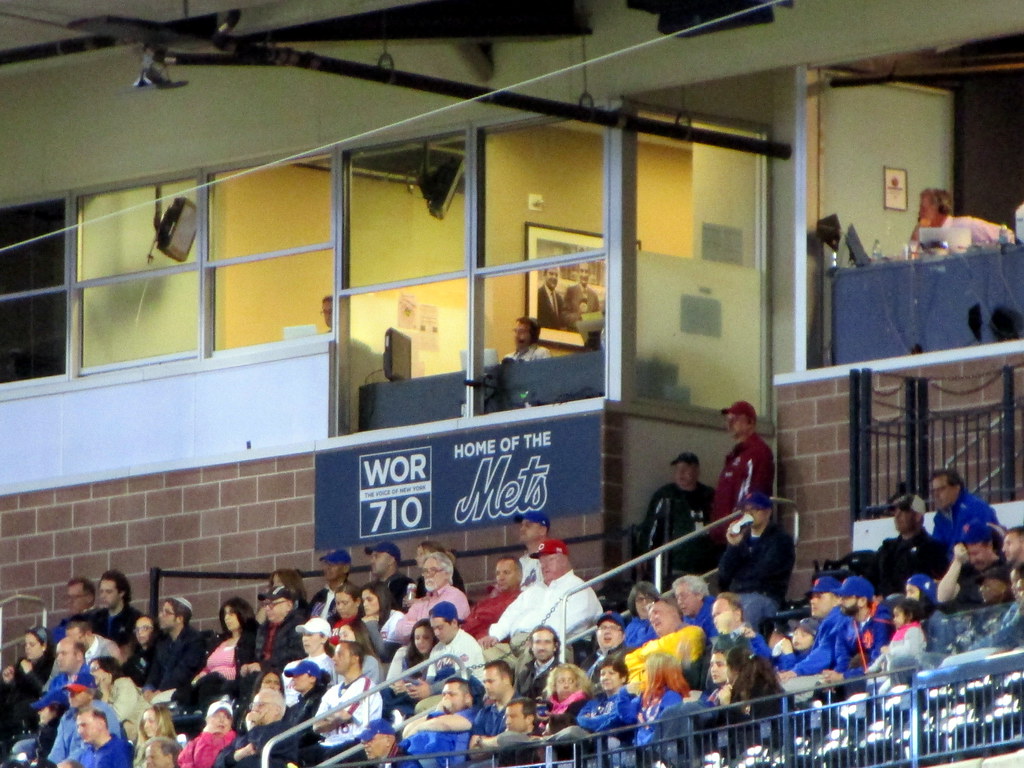
But like a lot of aging broadcasters, he began to cut back, doing only home games, and, in the last few years, going into the booth only on Friday nights or on special occasions. When Citi Field opened in 2009, the TV booth was named in his honor, and the radio booth was named in Murphy's memory.
  
Ralph Kiner died on February 6, 2014, at his home in Rancho Mirage, California. He was 91 years old. It was a remarkable life, and a career that spanned so much of baseball history. Although he had left New Mexico at age 4, he was buried there, at Greenlawn Cemetery in Farmington. 

When he played his first professional game in 1941, men like Jimmie Foxx, Lefty Grove and Mel Ott, who had begun in the 1920s, were still playing. When he broadcast his last game in 2013, he was watching players who could still be playing into the mid-2030s. That's a span of over 100 years.

Baseball Forever was the title of his memoir. "Baseball Forever," indeed.