Showing posts with label sam rice. Show all posts

Wednesday, October 15, 2025

October 15, 1925: Walter Johnson's Rainy Last Stand

Walter Johnson

October 15, 1925, 100 years ago: The World Series comes to a soggy end at Forbes Field in Pittsburgh. It is one of the rare major league sports finals that is better remembered for the losing side, or for someone on it.

In the American League, the Washington Senators, winners of the previous season's World Series, won the Pennant again, by 8 1/2 games over the resurgent Philadelphia Athletics, getting into their 1st Pennant race in 11 years. Bucky Harris, their 28-year-old 2nd baseman and "Boy Manager," led a team highlighted by Walter Johnson, the "Big Train," one of the greatest pitchers who ever lived. The winningest pitcher in American League history finally became a World Series hero the year before, pitching innings 9 through 12 of Game 7 against the New York Giants.

The New York Yankees, who the Senators had edged the season before, and had won the previous 3 Pennants, fell apart: Babe Ruth developed a mysterious illness in Spring Training that kept him out for a month and a half, and several other established stars simply stopped hitting. They would be replaced by new players who would lead a new dynasty starting the next season, including Lou Gehrig.

In the National League, the Giants' 4-year run as Pennant winners came to an end, as they finished 8 1/2 games ahead of the Pittsburgh Pirates. Only pitcher Charles "Babe" Adams, now 43 but a rookie on their 1909 World Series winners, remained on that team. Their hitting stars included slick-fielding 3rd baseman Harold "Pie" Traynor, right fielder Hazen "Kiki" Cuyler, and speedy center fielder Max Carey, who was not well-known for his nickname, although it was "Scoops," which suggests he was a very good fielder.

*

October 7, 1925: Game 1 was played at Forbes Field. a Wednesday. Johnson started for the Senators, and he was aided by a home run by Joe Harris (no relation to Bucky), as the Senators win, 4-1. The only Pirate run came on a home run by Traynor. In the 5th inning, Peckinpaugh made an error, but it didn't amount to anything.

Late in the game, word reached the ballpark of the death that day of Christy Mathewson, the star pitcher for the Giants in the 1900s and 1910s. A series of lung ailments led to his death at the age of 45. The flag at Forbes Field was lowered to half-staff, and it remained so there and at Griffith Stadium in opposing Washington for the remainder of the Series. The Commissioner of Baseball, Kenesaw Mountain Landis, orders that black armbands be applied to both teams' uniforms, even though Mathewson had never been involved with either of the teams playing.

October 8, 1925: Game 2 was played at Forbes Field. Home runs were hit in the 2nd by the Senators' Joe Judge and in the 4th by the Pirates' Glenn Wright. In the 8th, Peckinpaugh made an error that did end up mattering, which that led to a home run by Cuyler. He made another error later in the inning, which did not matter. The Senators loaded the bases with nobody out in the top of the 9th, but they only got 1 run home, and the Senators won, 3-2. The Series was tied going to Washington.

*

October 10, 1925: Game 3 was played at Griffith Stadium. Peckinpaugh made his 4th error of the Series in the 6th, which led to an unearned run. Joe Harris singled home a run to put the Senators up 4-3 in the bottom of the 7th.

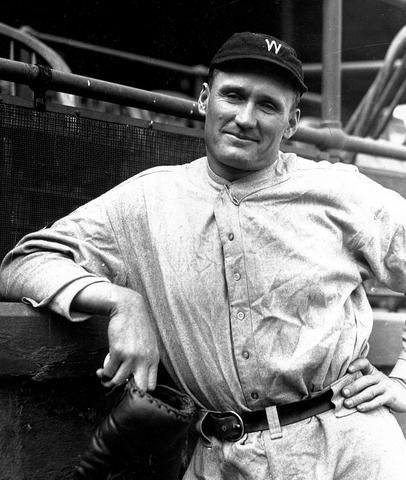
In the 8th, Earl Smith hit a drive to right-center field. Sam Rice leapt for it, and fell into the temporary stands that had been constructed. For a moment, a World Series crowd went silent, not knowing what had happened. Rice stood up, and held up the ball, indicating that he had made the catch. The umpires ruled the catch legal, and the Senators hung on to win, going up 2-1.
Sam Rice

Edgar Charles Rice (one of his minor-league managers changed his name to "Sam") is one of several great players virtually forgotten because their team no longer exists in its current form: They became the Minnesota Twins in 1961. And don't look for his retired uniform number anywhere: While he did last in the major leagues until 1934 and did wear numbers, none is retired for him, anywhere. If one was -- he wore 2 for the Senators in 1931 and 22 for them in 1932 and '33 -- he might be better remembered.

He might also be better remembered if he'd gotten into the 3,000 Hit Club. Instead, he fell just short: He collected 2,987 hits, the closest any player has gotten to 3,000 without getting it. (Unless you count Stan Ross, the Bernie Mac character in Mr. 3000.)

Rice later said, "The truth of the matter is, I did not even know how many hits I had. A couple of years after I quit, (Senators owner) Clark Griffith told me about it, and asked me if I'd care to have a comeback with the Senators and pick up those 13 hits. But I was out of shape, and didn't want to go through all that would have been necessary to make the effort. Nowadays, with radio and television announcers spouting records every time a player comes to bat, I would have known about my hits and probably would have stayed to make 3,000 of them."

He had a .322 lifetime batting average, a 112 OPS+, 498 doubles, 184 triples, and 351 stolen bases. He is in the Baseball Hall of Fame. But, today, when he is remembered at all, he is remembered for his 1925 World Series catch. Too bad there's no film of it: While a highlight film did capture some action in that Series, the catch is not part of it.

Also on October 10, the football team of the Olympic Club of San Francisco traveled across San Francisco Bay, and beat the University of California 15-0, in front of a crowd of 50,000 at California Memorial Stadium in Berkeley.

This ended a 50-game unbeaten streak for the Golden Bears, who had been 46-0-4. They hadn't lost since November 27, 1919, away to the University of Washington. The stadium was nicknamed "The House That Andy Built," as head coach Andy Smith made the team so good, ticket receipts alone covered the $1.4 million cost in 1923. It was seriously renovated in 2012.

Coaching took a severe toll on Smith, who went just 6-3 with Cal in 1925. On a visit to Philadelphia, where he had coached the University of Pennsylvania from 1909 to 1912, he was hospitalized with pneumonia, and died on January 8, 1926, only 49 years old. His career coaching record was 116-32-13, including 74-16-7 at Cal.

Also on this day, James Buchanan Duke died at his mansion at 1 East 78th Street, on 5th Avenue across from Central Park in New York. He was 68. "Buck" Duke is essentially the father of the American cigarette industry, and is thus responsible for the deaths of millions of people.

He's also responsible for the Duke Endowment, which contributed $40 million after his death (about $594 million in today's money) to Trinity College in his hometown of Durham, North Carolina. In his memory, it was renamed Duke University. So he's also responsible, if rather indirectly, for Coach K and the Cameron Crazies.

The James B. Duke House now hosts the New York University Institute of Fine Arts.
*

October 11, 1925: Game 4 was played at Griffith Stadium. Leon "Goose" Goslin, the greatest player ever to come from South Jersey -- he's in the Hall of Fame, and, as of the end of the 2025 regular season, Mike Trout does not yet have the career stats to get in -- and Joe Harris hit home runs. Johnson needed no more than that, as he pitched a 6-hit shutout. The Senators won, 4-0, and went up 3-1. Just 1 more win to go.

Washington baseball would not find that 1 more win for another 94 years.

On the same day, having already played some minor and semi-pro teams, the New York Giants football team plays its 1st game against an actual NFL team, although it's not one that most modern fans will recognize. At the Cycledrome in Providence, Rhode Island, a stadium built for bicycle racing (a big sport in the Roaring Twenties), they lose 14-0 to the Providence Steam Roller.

This team, officially having no S on the end, was no pushover, and deserves to be remembered today: It will win the NFL Championship in 1928 (73 years before the Patriots will win New England’s next NFL title), and host the NFL’s first night game in 1930 (5 years before Major League Baseball allows games to be played under lights), before the Great Depression put it out of business in 1931.

Although the Pawtucket Red Sox and the Providence Bruins are at the highest minor-league levels in their respective sports, the State of Rhode Island has never had another major league sports team: The closest they've come since is the Patriots, who since 1971 have played in stadiums in Foxboro, Massachusetts, 10 miles from the State Line, and closer to Kennedy Square in Providence than to Downtown Crossing in Boston.

Also on this day, Elmore John Leonard Jr. was born in New Orleans, but grew up in Detroit and was a hard-core Tigers fan. Or, perhaps I should say, "hard-boiled," as he was the writer of hard-boiled crime fiction.

Among his works that got turned into movies are Hombre (a Paul Newman film), 3:10 to Yuma
(made with Glenn Ford and Van Heflin in 1957, and Russell Crowe and Christian Bale in 2007), Mr. Majestyk (starring Charles Bronson), Get Shorty (with John Travolta), Out of Sight (in which George Clooney is a thief fooling around with the cop trying to catch him, played by Jennifer Lopez), and Rum Punch (which became the Quentin Tarantino film Jackie Brown starring Pam Grier). He is also responsible for the story that became the TV series Justified. He died in 2013.

*

October 12, 1925: The Senators wanted to wrap the Series up at home in Game 5. But the Pirates took a 2-1 lead in the 3rd, a 4-2 lead in the 7th, and won, 6-3, despite a 3rd homer in the Series by Joe Harris. Peckinpaugh made an error in the 6th inning, his 5th of the Series.

October 13, 1925: Game 6 was played back in Pittsburgh. Goslin hit a home run in the 1st inning, and the Senators made it 2-0 in the 2nd. But the Pirates tied the game in the 3rd, and Eddie Moore hit a home run in the 5th, giving the Pirates a 3-2 lead the held to the end, tying the Series. Peckinpaugh made his 6th error of the Series in the 7th inning.

Also on this day, Leonard Alfred Schneider was born in Mineola, Long Island, New York. We knew him as Lenny Bruce. According to sportswriter Dick Schaap, who collaborated with Lenny on his book Stamp Help Out!, Lenny attended only 1 Major League Baseball game in his short life (he died from drugs on August 3, 1966). It was as Schaap's guest, as a birthday present. It was October 13, 1960, and it was Game 7 of the World Series, the Bill Mazeroski Game, another World Series that the Pirates won in improbable fashion. Lenny wasn't a baseball fan, but he told Schaap he liked the drama.

Also on this day, Margaret Hilda Roberts was born in Grantham, Lincolnshire, England. How about that: Lenny Bruce and Margaret Thatcher were born on the exact same day. He didn't live long enough to have heard of her. If he had, with his sick sense of humor, I suspect there would have been a few jokes about her sex life (possibly suggesting that she had none), and about Bobby Sands (possibly, "For letting him starve, she can eat me!") and the Brighton Bombing.

One thing's for sure: In serving as Prime Minister of Britain, the 1st woman to do so, from 1979 to 1990, "The Iron Lady" treated all English soccer fans as if they were hooligans. She is widely believed to have been involved in the cover-up of the police's actions, both the negligent ones and the intentionally harmful ones, at the Hillsborough Stadium Disaster on April 15, 1989.

When her friend and fellow 1980s conservative icon, Ronald Reagan, died in 2004, most of his political opponents maintained a respectful silence. When the Iron Bitch died in 2013, a majority of Great Britain cheered, and was more than willing to say what a horrible person she was.

October 14, 1925: Game 7 was supposed to be played at Forbes Field, but the game was called off due to rain. They would have to try again tomorrow.

*

October 15, 1925: A steady downpour, continuing from the day before into this day, has left the field at Forbes Field a muddy mess, as Game 7 of the World Series is scheduled to be played. The weather forecast suggested rain for the next 3 days for both cities involved, Pittsburgh and Washington. So moving the game to Washington would have been pointless, and Commissioner Landis was anxious to get it over with. So, they would play through the rain.

I've never seen film of this game. I don't even know if any survives, although YouTube has footage from earlier in the Series, and of the Game 7s of 1924 and 1926. Maybe the film crews didn't want to risk getting electrocuted in the rain. At any rate, all we have to go on for the inclement weather are news reports.

On August 8, 2025, as commemorations for the 100th Anniversary of this Series began, I saw a photograph of a rather dubious method of drying the infield: Dousing it with gasoline and setting it on fire.
This insane tactic actually happened. It wasn't the only time, either.

But it would have been just plain wrong to play if the rain were as bad as what Philadelphia and Tampa Bay faced when Game 5 of the 2008 Series was suspended. There was a 6-day delay due to rain in 1911, and there were 3-day delays in 1962 and 1975. It could have been done again.

It was a short day for Pirate starter Vic Aldridge: 3 walks and 2 hits‚ and he was out of there with just 1 out in the 1st. Walter Johnson took a 4-0 lead to the mound. In what became known as "Johnson's Last Stand," the Bucs clobbered the 38-year-old Big Train for 15 hits‚ good for 24 total bases. Max Carey's 4-for-5 gave him a Series-high batting average of .458.

The Senators made the most of 7 hits‚ scoring 7 runs. But in the bottom of the 7th, Eddie Moore led off with a grounder to short, and Peckinpaugh made his 7th error. Carey doubled the run home. Cuyler bunted Carey over to 3rd base. Clyde Barnhart grounded out, and Carey couldn't score. But Traynor hit a triple down the right-field line, and that scored Carey. Traynor tried to stretch it into an inside-the-park home run, but was thrown out at the plate.

In the top of the 8th, Peckinpaugh hit a home run‚ the 12th homer of the Series by both teams combined‚ then a Series record, despite Forbes Field and Washington's Griffith Stadium both having some of the most distant fences in the game. That made it 7-6 Senators.

With the rain still coming down, Johnson got the 1st 2 outs in the bottom of the 8th. But Earl Smith doubled, and Pirate manager Owen "Donie" Bush sent Emil Yde (that's "EE-dee"), normally a pitcher, in to pinch-run for him. Johnson walked Moore. Carey grounded to short, and Peckinpaugh tried to turn a force play at 2nd. But he made a bad throw, his 8th error. The bases were loaded, and Cuyler cleared them with a double down the right field line. Red Oldham, in relief of Ray Kremer, got the Senators out 1-2-3 in the 9th, and the Pirates were 9-7 victors.
Roger Peckinpaugh

They became the 1st team to come from 3 games to 1 down to win a World Series. They would also be the 3rd and the 4th, in 1971 and 1979, respectively, both times against the Baltimore Orioles. The 2nd would be the 1958 Yankees, against the Milwaukee Braves.

Peckinpaugh's 8 errors are still a record for a single World Series. The rest of the Senators combined only made 1 error in the 7 games.

In the next day's New York Times, James Harrison wrote, "In a grave of mud was buried Walter Johnson's ambition to join the select panel of pitchers who have won three victories in one World Series. With mud shackling his ankles and water running down his neck, the grand old man of baseball succumbed to weariness, a sore leg, wretched support and the most miserable weather conditions that ever confronted a pitcher."

The last surviving member of the 1925 Pirates was shortstop Glenn Wright, who lived until 1984.

Monday, March 31, 2014

Chicago White Sox' All-Time Regional Team

Sam Rice

The 1st time around, in the summer of 2010, in making out the all-time teams from the Cubs' and White Sox' regions, the easy part for me was deciding what part of Illinois a particular player was from: North, which meant they were either in the Cubs' or White Sox' territory; or South, which meant I had probably already listed them with, or considered and then rejected them for, the St. Louis Cardinals.

The hard part was deciding whether to put a player who qualifies for Chicago's region on the Cubs' or Sox' all-time regional team. If they -- whether from Illinois, Iowa or Indiana -- were associated with one or the other, it was easy. If they publicly stated a youthful preference for either team, that also helped.

If neither of those factors applied, then I had to guess. From Illinois, and north of the Chicago River? Cubs. South of it? Sox. In that western region of Northern Illinois between the river's branches? Split it down the middle. If I guessed wrong – if a guy was from, say, Bolingbrook, and I listed him with the Sox team, and he actually grew up a Cub fan, well, tough cookies, he should have told me.

Then there were the other 2 States. Iowa was easy: Despite its connection to the White Sox through the film Field of Dreams, Des Moines, the State Capital, is home to the Triple-A Iowa Cubs since 1981 – although Des Moines was a White Sox farm club, the Iowa Oaks, from 1973 to 1980! As for Indiana, the southwestern tail, including Evansville and Terre Haute, I gave to the Cardinals, while the southern half, including the city of Indianapolis, will go to the Cincinnati Reds.

But the northwestern quarter is White Sox territory. How do I know? That's in tribute to Jean Shepherd, the legendary author and radio show host, whose book In God We Trust, All Others Pay Cash became the basis for the film A Christmas Story, which he narrated. (He also played a middle-aged man at the department store who told Ralphie, based on his younger self, where the real back of the line was.) Although filmed in Cleveland, that city is a stand-in for Chicago, and his home town was Hammond, Indiana, just across the State Line.

Jean Shepherd liked to say, "If I was a colonel in some horrible war, and I needed volunteers for a suicide mission to take an enemy pillbox, I'd call out, 'Any of you White Sox fans? Follow me!' And those White Sox fans would follow me, and we'd take that pillbox! Because White Sox fans are special. Fifty years without a Pennant? A hundred years? Doesn't matter. We're loyal."

So loyal that, when the new ballpark was rising across 35th Street in 1990, fans hung a banner from the upper deck of the old one, reading, "WE LOVE THIS COMISKEY PARK." And with the White Sox in the AL West race until nearly the end of that season, attendance spiked, and some fans hung a banner that read, "YUPPIE SCUM GO BACK TO WRIGLEY."

White Sox fans hate the Cubs, and especially Cub fans, a lot more than Cub fans hate the White Sox and their fans. To a Cub fan, a White Sox fan is a greasy, dirty, uncouth hood who likes heavy metal and marijuana -- an image probably ingrained due to the South Side's gritty reputation and Disco Demolition Night in 1979.

To a White Sox fan, a Cub fan is a prissy, effete intellectual who is willing to accept losing so long as he has his ivy and his beer -- and, occasionally, his marijuana. In other words, except for the substance abuse part, George Will.

Jean Shepherd has been dead for a few years, but I'll bet he didn't like George Will. Will is still alive, and I'll bet he was never a Jean Shepherd fan, either. Will has long been a part of what Shepherd would have called "creeping meatballism."

I think part of the Cub/Sox divide -- that is, the Sox fans hate the Cubs and their fans more than the Cub fans hate the Sox and their fans -- is partly due to the Cub-Cardinal rivalry. Cub fans have someone they hate more than they hate the White Sox.

The move of the Milwaukee Brewers, considerably closer to Chicago than St. Louis is, to the National League has killed the Sox-Brewers rivalry, which was never all that strong, but neither has it made Cub fans hate the Brewers all that much. In contrast, Brewers fans have grown to hate Cub fans, mainly because they were probably already sick of hearing about Cub fans, Wrigley Field and Harry Caray on "Superstation" WGN.

Hopefully, the White Sox' 2000s resurgence under manager Ozzie Guillen (now gone) and general manager Kenny Williams (since kicked upstairs) will help them build rivalries with AL Central opponents Detroit, Cleveland and Minnesota, and they can have better attendance as a result of both the winning and the rivalries.

After all, the Sox won a Pennant in 2005, something the Cubs still haven't done since 1945; and won the World Series that season, something the Cubs still haven't done since 1908. And yet the Sox are still "the Second Team in the Second City." The Cubs have outdrawn the Sox every season since 1993 -- even though the Sox won the AL West (in their last season before realignment). Actually, that's not that strange, as in 1984, with the Sox coming off an AL West title, they outdrew the Cubs that season even as the Cubs won the old NL East.

But the Sox' per-game attendance has not never surpassed their 2006 peak of 36,511. The Cubs topped that for 10 straight years before not doing so last season, 32,626, their lowest in 15 years; while the White Sox were down to 21,832, their lowest in 11 years.

So what does a team have to do? Maybe the White Sox need to put this lineup out there:

10. The Chicago White Sox All-Time Regional Team

1B Ted Kluszewski of Argo, Illinois. Big Klu was best known as a Cincinnati Red, and they retired his Number 18, and have dedicated a statue to him outside Great American Ballpark, their post-Riverfront Stadium home. In 1954, he was 2nd in the National League's Most Valuable Player voting behind Willie Mays, and led the NL with 49 homers and 141 RBIs. He had a 123 career OPS+, 7 .300 seasons (and just missed 2 others), 5 100-RBI seasons, and 279 career home runs, despite injuries taking their toll to the point where his last full season came at age 31.

He didn't win a Pennant with the Reds, but he was acquired by his "hometown" White Sox to provide a little pop to their "Go-Go" squad that won the team's first Pennant in 40 years. He hit 2 home runs in the ChiSox's 11-0 Game 1 win over the Los Angeles Dodgers, and another in their Game 6 loss. Along with a homer by Sox catcher Sherman Lollar in Game 4, these would be the only homers hit by a Chicago player in World Series play between Phil Cavarretta in Game 1 in 1945 and Joe Crede in Game 1 60 years later.

Klu finished his career with the American League's expansion Los Angeles Angels in 1961, as his former club the Reds were winning the NL Pennant. He coached for the Reds until heart trouble forced him to retire, and he died in 1988. One of the most popular players in Cincinnati history, and well-deserved.

An urban legend is that the misspelling of his name in a box score as "KLUSEWSXI" (or something like that) is what led White Sox owner Bill Veeck to start putting players' names on the backs of their jerseys in 1960. What is not a legend is that, due to his biceps (no weight training then, either), he had to cut off the sleeves of his Reds jerseys so they'd fit him. This began the trend of the sleeveless, vest-style jerseys often seen in the 1960s, most notably worn by the Pittsburgh Pirates in the 1960 World Series.

2B Ben Zobrist of Eureka, Illinois. He's also played a bit of right field and shortstop, but has played more at 2nd base, and if I didn't pick him, I'd have to cheat a little, and take Dickie Thon, who grew up in Puerto Rico, but was born in South Bend, Indiana while his father was teaching at Notre Dame.

He'll be 33 in May, but he's already a 2-time All-Star, has a career OPS+ of 117, has 3 20-homer seasons, twice has gotten to 91 RBIs, has had at least 28 doubles in each of the last 5 seasons (topping out, so far, at 46 in 2011) led the AL in sacrifice hits in 2010, and has helped the Tampa Bay Rays to reach all 4 of their postseason appearances (2008, '10, '11 and '13, including the 2008 World Series).

SS Billy Rogell of Fenger H.S. in Chicago. I originally had Robin Yount as the shortstop on this team, but while he was born in Danville, he didn't grow up in Illinois. Fortunately, I found Rogell, who could also play 3rd base and 2nd base.

They didn't give out Gold Gloves in Rogell's day, but he would have won a few. He wasn't a great hitter, but he did bat .303 for the Detroit Tigers in 1931. In 1934, he batted .296 and hit only 3 home runs, but had 100 runs batted in -- part of the only infield in baseball history to all have at least 100 RBIs.

He helped the Tigers win the 1934 Pennant and the 1935 World Series. He hit only 42 homers, but had 256 doubles in what amounted to 10 full seasons. He stayed in the Detroit area after he retired, and in 1999, when Tiger Stadium closed, he was involved in the closing ceremony. He died in 2003, age 98.

3B Oswald "Ossie" Bluege of Carl Schurz H.S. in Chicago. No Washington baseball team has ever won a Pennant without him -- and, at the rate the Nationals are handling Stephen Strasburg, that's likely to remain the case for a while. He helped the Senators win the 1924 World Series and the 1925 and 1933 AL Pennants.

Known mainly for his glove, it didn't help him that the Senators' ballpark, Griffith Stadium, had notoriously faraway fences which limited power-hitting potential. Had the All-Star Game begun sooner, he would have made more than the one he reached in 1935. He is honored on the Washington Wall of Stars at Nationals Park.

LF Greg Luzinski of Niles, Illinois. The Bull was a 4-time All-Star for the Phillies, and in 1975 he led the NL in RBIs with 120, total bases with 322 and intentional walks with 17, and finished 2nd in the MVP voting to Joe Morgan. The next year, the Phillies began a string of 4 NL East titles in 5 years, culminating with the 1980 World Championship. It wasn't one of his best seasons, as his weight began to catch up with him, and the Phils saw their future and decided it included Lonnie Smith (born in Chicago, but grew up in L.A.).

Fortunately, Luzinski's hometown White Sox picked up him, although the joke was that Comiskey Park's obstructed-view seats included any along 1st base when he played there. Still, in 1983, he clubbed 32 homers at a pitchers' park, and helped the White Sox to their only 1st-place finish between 1959 and 1993.

He finished with 307 home runs, served a few years as the head baseball coach at Holy Cross High School in Delran, New Jersey, and now runs Bull's BBQ stand at Citizens Bank Park, where he's also honored on the Philadelphia Baseball Wall of Fame.

CF Kirby Puckett of Calumet City, Illinois. It was humbling to see a fat guy hustle this much. For a generation, as Harmon Killebrew and Rod Carew had been before him, he was the Minnesota Twins. He helped them with the 1987 World Series, and in Game 6 of the 1991 Series, he saved the Twins with a great catch and a walkoff homer in the bottom of the 11th, leading to their Game 7 win. He reached 10 All-Star Games, won the 1989 AL batting title (a rare feat for a righthanded hitter), and led the AL in hits 4 times.

He was so admired in Minnesota that the address of the Metrodome was changed to 34 Kirby Puckett Place, the Twins retired his Number 34, and they dedicated a statue of him outside their new ballpark, Target Field, when it opened in 2010. He was elected to the Hall of Fame despite playing only 12 seasons, with a .318 lifetime batting average, a 124 OPS+, 2,304 hits and 207 home runs. When The Sporting News announced its 100 Greatest Baseball Players in 1999, he came in at Number 86.

Regrettably, glaucoma ended his career when he was just 36 years old. Things went from bad to worse. His weight ballooned, and his health suffered. He was arrested on a morals charge, and, though acquitted, his reputation was forever stained by a Sports Illustrated article which seemed intent on convicting him in the court of public opinion -- written by Frank Deford, who should have accepted the jury's verdict and not risked his own fine reputation.

Kirby suffered a stroke and died in 2006, age 45 -- aside from Lou Gehrig, the youngest already-elected Hall-of-Famer ever to die. Every time I see Tony Gwynn now, and see how much weight he's gained, I worry he'll suffer the same fate -- medically, that is, not judicially. Kirby was also the man who gave Don Mattingly the nickname "Donnie Baseball" after seeing how much batting practice he took.

Honorable Mention to Curtis Granderson of Lansing, Illinois. He is unlikely to reach the postseason again unless the Mets get rid of him, but he's already made it 4 times, with the 2006 Tigers (Pennant), and the 2010, '11 and '12 Yankees. He just turned 33, and is already a 3-time All-Star, with a 117 OPS+ and 217 home runs. He's led the AL in triples twice and RBIs once.

RF Sam Rice of Morocco, Indiana. A teammate of Bluege's on the Senators' 1924 World Champions and '25 and '33 Pennant winners, Edgar Charles Rice (not sure why he became "Sam") is one of several great players virtually forgotten because their team no longer exists in its current form. (They became the Twins in 1961.)

He collected 2,987 hits, the closest any player has gotten to 3,000 without getting it. (Unless you count Stan Ross, the Bernie Mac character in Mr. 3000.) Rice later said, "The truth of the matter is I did not even know how many hits I had. A couple of years after I quit, (Senators owner) Clark Griffith told me about it, and asked me if I'd care to have a comeback with the Senators and pick up those 13 hits. But I was out of shape, and didn't want to go through all that would have been necessary to make the effort. Nowadays, with radio and television announcers spouting records every time a player comes to bat, I would have known about my hits and probably would have stayed to make 3,000 of them."

He had a .322 lifetime batting average, a 112 OPS+, 498 doubles, 184 triples, and 351 stole bases. When this Hall-of-Famer is remembered at all, he is remembered for an amazing catch he made in the 1925 World Series, robbing Earl Smith of the Pirates of a home run to preserve the Senators' win in Game 3. He fell over the short fence at Griffith Stadium, then emerged with the ball. The Pirates and their fans were sure he'd dropped the ball as he tumbled over the fence, but the umpire ruled he had possession, so the ball was dead even if Rice did lose the ball when he fell. Too bad there's no film of this catch: While a highlight film did capture some action in that Series, the catch is not part of it.

DH Jim Thome of Bartonville, Illinois. The Thome-nator is our generation's Harmon Killebrew, albeit lefthanded: A big, chunky guy with enormous power, he started at 3rd base, couldn't field there, but his bat had to be in the lineup, and he was moved to 1st, a little better.

He went from the Cleveland Indians to the Phillies, where he helped revitalize that franchise, before injuries led to the rise of Ryan Howard. That made Thome expendable, and he went to his home-State White Sox as a DH (an option not available to Killebrew until he was 36), and bounced-back big-time from his Philly injury. He went from team to team in his latter years, including a brief return to the Phillies in 2012, his last season.

He made 5 All-Star teams. His career OPS+ is an amazing 147. He hit 612 home runs, meaning he trails only Hank Aaron, Babe Ruth, Willie Mays and Ken Griffey Jr. among honest players -- and Barry Bonds, Sammy Sosa and Mark McGwire among steroid users. Did Thome use steroids? Many have speculated, none have proven; after all, he had pretty much the same body type throughout his career, and aside from 2005 he was remarkably injury-free and consistent, hitting at least 30 homers every season but that one from 1996 to 2008.

He was a winner, too. He made 10 postseason appearances: With the Indians in 1995, '96, '97, '98, '99 and 2001; the White Sox in 2008; the Dodges in 2009; the Twins in 2010; and closed his career with the Orioles in the 2012 AL Division Series. Only Manny Ramirez (steroids), Bernie Williams, Derek Jeter, Albert Pujols, Reggie Jackson (who played when there were just 2 postseason rounds) and Mickey Mantle (who played when there was just the World Series) have more postseason homers than Thome's 17. David Ortiz (steroids) also has 17.

For all that, though, he played on just 2 Pennant winners, the 1995 and '97 Indians, and he never won a ring. And with 2,548 strikeouts, he nearly surpassed Reggie as the all-time leader there. But, barring a steroid outing, he'll make the Hall of Fame (he'll be eligible in 2018), and the Indians should retire his Number 25, as he is their all-time home run leader with 334.

That's Thome as a White Sock in the photo above. He has since been hired by their front office. Last November, after a tornado struck Washington, Illinois, just 15 miles from his hometown, he and his wife donated $100,000 to relief efforts.

C Tom Haller of Lockport, Illinois. A University of Illinois graduate, he was one of the few players to be a good one on both sides of the Giant-Dodger rivalry (especially since the revival of the Brooklyn edition of the Dodgers in 1941, never mind both clubs' move to the West Coast).

A 2-time All-Star, he had 18 homers and 55 RBIs with the 1962 Giants, despite being a rookie, only 331 plate appearances, and playing his home games in wind-swept Candlestick Park. The Giants won the Pennant that year, and it certainly wasn't Haller's fault that the Giants had near-misses in '65 and '66 -- particularly in the latter year, when he had career highs with 27 homers and 67 RBIs.

For a catcher in his era, playing most of his home games in Candlestick and Dodger Stadium, 134 homers was pretty good, and his 113 career OPS+ reflects this. He closed his career in 1972 with one more postseason appearance, backing up Bill Freehan on the AL East-winning Detroit Tigers. He once caught a game where his brother Bill Haller, a longtime NL umpire, was behind the plate; there is now a rule that an umpire cannot be assigned to a game where a relative is eligible to play or manage.

SP Urban "Red" Faber of Cascade, Iowa. A member of the White Sox teams that won the 1917 World Series and the 1919 Pennant, an injury prevented him from appearing in the 1919 World Series; his catcher Ray Schalk said that, had Faber been available, he would have taken starts from either Eddie Cicotte or Lefty Williams, and the fix would've been a lot tougher to pull off.

Bouncing back, he won 23 games in 1920, and after the "Eight Men Out" were suspended and later banned for life, he won 25 games in 1921 and 21 in 1922, and led the AL in ERA both seasons, despite the decimated Pale Hose winning just 62 and 77 games respectively as a team.

He was basically a .500 pitcher for the rest of his career, as the team's inadequacy caught up to him. But his career record of 254-213 is backed by an ERA+ of 119. He's in the Hall of Fame, although the White Sox have never retired the Number 18 he hung around long enough to wear.

SP Paul "Dizzy" Trout of Sandcut, Indiana. He won 20 games in 1943 and 27 in 1944 (leading the AL with a 2.18 ERA) for the Tigers, forming a superb righty-lefty tandem with MVP Hal Newhouser. He won Game 4 of the 1945 World Series, which the Tigers won in 7. When the Yankees', Red Sox' and Indians' best players came back from the War, the Tigers' performance suffered, and Trout was a part of that, although he did go 13-5 in 1950 when the Tigers finished 2nd, their best performance between 1945 and 1961. His career record was just 170-161, but his ERA+ was a strong 124.

His son Steve Trout became a lefthanded pitcher for both Chicago teams (but was a bust with the Yankees and Seattle Mariners afterward), and although I considered him for this team, his career record of 88-92 and a 96 ERA+ weren't good enough. Steve's son Steven Trout was briefly a minor league infielder.

SP Bob Friend of West Lafayette, Indiana. Having grown up in the town that's home to Purdue University, he went to that school before reaching the majors. He's the only pitcher ever to lose 200 games in the majors without winning 200: 197-230. But that was mainly due to the Pittsburgh Pirates being terrible for most of his tenure, including their disastrous 52-112 season in 1952, when Friend was 7-17. When they got good, so did he.

He went 22-14 in 1958, and in their 1960 World Championship season he went 18-12. He had another 18-win season in 1962 and 17 the next year. But he got old in a hurry. In 1966, he closed his career by becoming the first player ever to play for the Yankees and the Mets in the same season. (In 1977, Dave Kingman became the 2nd, although he started the season with the Mets, then went to the Padres and Angels before the Yanks became his 4th team of the season.)

SP Jim O'Toole of Leo H.S. in Chicago. His career was relatively brief, with an injury knocking him out at age 30. In Ball Four, Jim Bouton wrote of O'Toole trying a comeback with the expansion 1969 Seattle Pilots, and ending up with a semi-pro team back in the Chicago area. But he went 19-9 for the Cincinnati Reds as they won the 1961 Pennant, and 17-7 in 1964 as they nearly did it again. He was 98-84 for his career, and deserved better.

SP Mark Mulder of South Holland, Illinois. Another one knocked out early by injury, he had his last full season at age 27 and he retired in 2008 at 30. But in 2001, at 23, he went 21-8 for the Oakland Athletics, and 19-7 the next season. How many guys win 40 games over a 2-year span in this era of 5-man rotations -- especially at age 25?

Part of Oakland's "Big 3" along with Tim Hudson and Barry Zito, he helped the A's reach the postseason in each of his first 4 seasons (2000-03), and was 88-40 from 2001 to 2005. The injury that struck in 2006 did not stop him from winning that year's World Series with the St. Louis Cardinals, but it did limit his career record to just 103-60, still a fine .632 percentage.

Dishonorable Mention to Denny McLain of Mount Carmel H.S. in Chicago. He could have been the most talented of these pitchers. In fact, Dennis Dale McLain could have been one of the greatest pitchers of all time. The White Sox had this native South Sider in their system, but let him go to the Tigers.

Huge mistake: In 1964, at age 20, he was just 4-5, but with a stronger lineup behind him, his 1.210 WHIP might've helped put the White Sox over the top, as they finished 1 game behind the Yankees. He blossomed to 16-6 in '65 and 20-14 in '66, and in '67, when the White Sox finished just 3 games behind the Red Sox, the Tigers finished just 1 back, due in large part to McLain's 17 wins.

Considering that the White Sox have won just 2 Pennants since 1919, what do you think their fans would have given to have 2 of his '64 wins, and 2 of his '67 wins? It would have doubled their Pennant haul since the Black Sox scandal, and maybe the 1964-67 White Sox would be better remembered than the beloved but ill-fated 1969 Cubs.

In 1968, the Year of the Pitcher, McLain went 31-6, which makes him, since the death of Smokey Joe Wood in 1985, the only living person to win 30 games in a major league season. His ERA was 1.96, and his WHIP was 0.905, so he didn't just benefit from the Tigers' hitting. They won the World Series that year, despite him being outdueled by Bob Gibson of the Cardinals in Games 1 and 4 -- McLain did win Game 6 on 2 days' rest. He was named the AL's MVP and Cy Young Award winner. In 1969, he went 24-9, and in a tie vote shared the AL Cy Young with Mike Cuellar.

Denny McLain was 25, great, charismatic, and enormously popular. He was 114-57. He had gigs playing the organ in Las Vegas hotels, and a recording contract as a result, with 2 decent-selling albums already under his belt. And he was married to the daughter of Hall-of-Famer Lou Boudreau. He had it all. The sky was the limit.

He did not reach the sky. Legal trouble and injuries meant that his career would end just before the 1973 season, right after his 29th birthday, and he went just 21-41 the rest of the way, for a total of 131-91, although his career WHIP remained fine at 1.163. He was traded to the Washington Senators, then the Oakland Athletics, and finally the Atlanta Braves. When he was able to pitch without pain, he was still great, but that became rarer and rarer, until he could no longer pitch at all.

The pain of his shoulder became nothing compared to what happened when he trusted the wrong people and made the wrong business moves. Twice, he was convicted of crimes and served time in prison, including once after he had seemingly rehabilitated himself by becoming a popular host on a Detroit sports-talk station. His second conviction was later reversed, but only after he'd been in the joint for a few years. He just turned 70, and now writes a column for In Play!, a Detroit-based sports magazine.

In an amazing twist of events, McLain's last big-league appearance was on September 12, 1972, for the Braves against the Reds. The last batter he ever faced in the majors? Pete Rose, eventually even more scandalous. Rose never batted against Roger Clemens, as they were in different Leagues. In his last season as a player, 1986, Rose managed against a rookie named Barry Bonds, but they never played in the same game.

RP Ed Farmer of Evergreen Park, Illinois. A journeyman, he did manage to save 30 games for his hometown White Sox in 1980. But his luck was bad: He left the Phillies right before they started winning NL East titles, the Orioles right before their 1979 AL Pennant, the Brewers just as they were getting good, the White Sox right before their 1983 AL West title, and the Phils decided to get him back, then traded him in a deadline deal that helped them win the 1993 NL Pennant. He's now a broadcaster for the White Sox.

RP Don Stanhouse of Du Quoin, Illinois. Now, here is a twist of events: When McLain went from Washington to Oakland, one of the guys he was traded for was Stanhouse, then a mere prospect. But the Senators, who then became the Texas Rangers, didn't know what to do with this stereotypically weird pitcher.

They sent him to the Montreal Expos, where he did well as both a starter and a reliever. Then they sent him to the Orioles, and he did great for them out of the pen, helping them win the 1979 Pennant. He became a very popular figure, for his success and his weirdness, gaining the nickname "Stan the Man Unusual."

But an injury knocked him out (is there an echo?), and he was basically finished at 30. In 1991, when the Orioles closed Memorial Stadium, they invited several former players back for the finale, and each wore a uniform contemporary to his period in Baltimore. Stanhouse was the only one who wore one of those hideous bright orange Oriole jerseys with black lettering. Why? Because he was Stan the Man Unusual, that's why. (He was only 40: Given good health, he could still have been pitching.)

MGR Charlie Comiskey of Chicago. While playing for the team then known as the St. Louis Brown Stockings of the American Association (they moved to the NL in 1892 and became the Cardinals in 1901 as their uniform color changed, and are not to be confused with the AL's St. Louis Browns), he practically invented the way the position of 1st base was played.

As player-manager, he led the proto-Cards to 4 straight AA Pennants from 1885 to 1888. "The Old Roman" helped found the American League, and, leaving the managing to others, the White Sox he owned won the first AL Pennant in 1901, the World Series in 1906 and 1917, and another Pennant in 1919.

How much he knew of the 1919 World Series fix has been debated. What's not debated is that he was a cheap bastard -- in spite of the fact that he was, himself, a player and a damn good one by the standards of his time. How cheap? His players were already called the Black Sox by 1917, not for the fix that was yet to come, but because their uniforms were always dirty, since Comiskey wouldn't shell out the cash to get them laundered on the road.

The ballpark he built in 1910 would bear his name, and beyond his death in 1931, his family would continue to own the team in full until 1959 and still in a small part today. He was not a good person. But for his contributions to the game, as a player, a manager and an owner, he does deserve his place in the Hall of Fame. Although the White Sox' new home no longer bears his name as the old one did, and is now called U.S. Cellular Field, the park has a statue of him, and a concession stand called Old Roman's Pizza -- even though Comiskey was Irish, not Italian.

Friday, August 27, 2010

The Chicago White Sox All-Time Regional Team

Sam Rice

The Yankees begin a 3-game series against the Chicago White Sox at U.S. Cellular Field, formerly named the new Comiskey Park.

The easy part was deciding what part of Illinois a particularly player was from: North, which means they're either in the Cubs' or White Sox' territory; or South, which means I've probably already listed them with, or considered and then rejected them for, the St. Louis Cardinals.

The hard part was deciding whether to put a player who qualifies for Chicago's region on the Cubs' or Sox' all-time regional team. If they -- whether from Illinois, Iowa or Indiana -- were associated with one or the other, it was easy. If they publicly stated a youthful preference for either team, that also helped.

If neither of those factors applied, then I had to guess. From Illinois, and north of the Chicago River? Cubs. South of it? Sox. In that western region of Northern Illinois between the river's branches? Split it down the middle. If I guessed wrong – if a guy was from, say, Bolingbrook, and I listed him with the Sox team, and he actually grew up a Cub fan, well, tough cookies, he should have told me.

Then there were the other 2 States. Iowa was easy: Despite its connection to the White Sox through the film Field of Dreams, Des Moines, the State Capital, is home to the Triple-A Iowa Cubs since 1981 – although Des Moines was a White Sox farm club, the Iowa Oaks, from 1973 to 1980! As for Indiana, the southwestern tail, including Evansville and Terre Haute, I gave to the Cardinals, while the southern half, including the city of Indianapolis, will go to the Cincinnati Reds.

But the northwestern quarter is White Sox territory. How do I know? That’s in tribute to Jean Shepherd, the legendary author and radio show host, whose book In God We Trust, All Others Pay Cash became the basis for the film A Christmas Story, which he narrated. (He also played a middle-aged man at the department store who told Ralphie, based on his younger self, where the real back of the line was.) Although filmed in Cleveland, that city is a stand-in for Chicago, and his home town was Hammond, Indiana, just across the State Line.

Jean Shepherd liked to say, "If I was a colonel in some horrible war, and I needed volunteers for a suicide mission to take an enemy pillbox, I'd call out, 'Are any of you White Sox fans? Follow me!' And those White Sox fans would follow me, and we'd take that pillbox! Because White Sox fans are special. Fifty years without a Pennant? A hundred years? Doesn't matter. We're loyal."

So loyal that, when the new ballpark was rising across 35th Street in 1990, fans hung a banner from the upper deck of the old one, reading, "WE LOVE THIS COMISKEY PARK." And with the White Sox in the AL West race until nearly the end of that season, attendance spiked, and some fans hung a banner that read, "YUPPIE SCUM GO BACK TO WRIGLEY."

White Sox fans hate the Cubs, and especially Cub fans, a lot more than Cub fans hate the White Sox and their fans. To a Cub fan, a White Sox fan is a greasy, dirty, uncouth hood who likes heavy metal and marijuana -- an image probably ingrained due to the South Side's gritty reputation and Disco Demolition Night in 1979. To a White Sox fan, a Cub fan is a prissy, effete intellectual who is willing to accept losing so long as he has his ivy and his beer -- and, occasionally, his marijuana. In other words, except for the substance abuse part, George Will.

Jean Shepherd has been dead for a few years, but I'll bet he didn't like George Will. Will is still alive, and I'll bet he was never a Jean Shepherd fan, either. Will likes to talk about "creeping socialism"; Shepherd once wrote an article about squares who pushed the unfair parts of the Establishment's agenda, calling them "meatballs" and titling the article "Creeping Meatballism."

I think part of the Cub/Sox divide -- that is, the Sox fans hate the Cubs and their fans more than the Cub fans hate the Sox and their fans -- is partly due to the Cub-Cardinal rivalry. Cub fans have someone they hate more than they hate the White Sox.

The move of the Milwaukee Brewers, considerably closer to Chicago than St. Louis is, to the National League has killed the Sox-Brewers rivalry, which was never all that strong, but neither has it made Cub fans hate the Brewers all that much. In contrast, Brewers fans have grown to hate Cub fans, mainly because they were probably already sick of hearing about Cub fans, Wrigley Field and Harry Caray on "Superstation" WGN.

Hopefully, the White Sox' resurgence under manager Ozzie Guillen and general manager Kenny Williams will help them build rivalries with AL Central opponents Detroit, Cleveland and Minnesota, and they can have better attendance as a result of both the winning and the rivalries.

After all, the Sox won a Pennant in 2005, something the Cubs still haven't done since 1945; and won the World Series that season, something the Cubs still haven't done since 1908. And yet the Sox are still "the Second Team in the Second City." The Cubs have outdrawn the Sox every season since 1993 -- even though the Sox won the AL West (in their last season before realignment). Actually, that's not that strange, as in 1984, with the Sox coming off an AL West title, they outdrew the Cubs that season even as the Cubs won the old NL East.

But the Sox' per-game attendance has not never surpassed their 2006 peak of 36,511. The Cubs have topped that figure the last 7 years in a row, and will make it 8: Their average in this season is currently 38,453, while the Sox' is at 27,352. The Cubs rank 7th in the majors, 4th in the NL; the Sox rank 17th, 7th in the AL, ranking behind the Cubs, San Francisco, Boston, Detroit and the new Minnesota park despite their having smaller seating capacities.

So what does a team have to do? Maybe they need to put this lineup out there:

The Chicago White Sox All-Time Regional Team

1B Ted Kluszewski of Argo, Illinois. Big Klu was best known as a Cincinnati Red, and they retired his Number 18, and have dedicated a statue to him outside Great American Ballpark, their post-Riverfront Stadium home. In 1954, he was 2nd in the National League's Most Valuable Player voting behind Willie Mays, and led the NL with 49 homers and 141 RBIs. He had a 123 career OPS+, 7 .300 seasons (and just missed 2 others), 5 100-RBI seasons, and 279 career home runs, despite injuries taking their toll to the point where his last full season came at age 31.

He didn't win a Pennant with the Reds, but arrived at his "hometown" White Sox to provide a little pop to their "Go-Go" squad that won the team's first Pennant in 40 years. He hit 2 home runs in the ChiSox's 11-0 Game 1 win over the Los Angeles Dodgers, and another in their Game 6 loss. Along with a homer by Sox catcher Sherman Lollar in Game 4, these would be the only homers hit by a Chicago player in World Series play between Phil Cavarretta in Game 1 in 1945 and Joe Crede in Game 1 60 years later.

Klu finished his career with the American League's expansion Los Angeles Angels in 1961, as his Reds were winning the NL Pennant. He coached for the Reds until heart trouble forced him to retire, and he died in 1988. One of the most popular players in Cincinnati history, and well-deserved.

An urban legend is that the misspelling of his name in a box score as "KLUSEWSXI" (or something like that) is what led White Sox owner Bill Veeck to start putting players' names on the backs of their jerseys in 1960. What is not a legend is that, due to his biceps (no weight training then, either), he had to cut off the sleeves of his Reds jerseys so they'd fit him. This began the trend of the sleeveless, vest-style jerseys often seen in the 1960s, most notably worn by the Pittsburgh Pirates in the 1960 World Series.

2B Dickie Thon of South Bend, Indiana. Richard William Thon actually grew up in Puerto Rico (his father had been teaching at Notre Dame in South Bend), and played more shortstop than 2nd base, but I needed to fill out the roster.

In 1982, the Houston Astro led the NL in triples. In 1983, he had 28 doubles, 9 triples, 20 homers and 79 RBIs. As a shortstop. Playing his home games in the Astrodome, which, unlike most later domes, was a pitchers' park. He stole a total of 71 bases in those 2 seasons, which sounds more like an Astrodome (or at least Astroturf) feat. He was 25 and appeared headed for legend.

But on April 8, 1984, he was hit in the face with a pitch by Mike Torrez, the 1977 Yankee hero and 1978 Red Sox goat, then pitching for the Mets, at Shea Stadium. He returned in the 1985 season, and recovered enough to hit 15 homers and drive in 60 runs with the 1989 Philadelphia Phillies. But 4 years later his vision problems returned, and he hung 'em up. His son Dickie Joe Thon is now in the Toronto Blue Jays' farm system.

SS Robin Yount of Danville, Illinois. Another slight cheat, as he went to Taft High School in the Woodland Hills section of Los Angeles. But this guy never got the credit he deserved. He and Hank Greenberg are the only players to win MVPs at 2 different positions, Yount doing so at shortstop in 1982, when he led the Milwaukee Brewers to what is still their only Pennant, and in center field in 1989.

Playing in Milwaukee instead of Chicago or another bigger city meant he only made 3 All-Star Games, but after debuting in 1974 at age 18, he gave the Brewers 20 years, 3,142 hits including 583 doubles, 126 triples and 251 home runs, and 271 stolen bases.

Of all players with at least as many stolen bases as he has, only Willie Mays has at least as many home runs and at least as many hits, although Yount has more doubles than Mays (but not more hits, triples, homers or steals), his ex-teammate Paul Molitor has more hits and steals and nearly as many homers, and Alex Rodriguez has a shot at joining them. His career OPS+ is 115.

The Brewers have retired Yount's Number 19, which Molitor wore to honor him went he went to the Toronto Blue Jays and found his Brewers number, 4, was already being worn. The Brewers also dedicated a statue of Yount outside Miller Park.

He was easily elected to the Hall of Fame, and while he's not the most popular player in Milwaukee baseball history -- both Hank Aaron and Eddie Mathews were more celebrated there -- if you're a Wisconsinian my age or younger, he's the best you've ever had. (The Brewers play the Mets late in September, so the Milwaukee All-Time Baseball Team will probably be the last I do before the two New York squads.)

3B Oswald "Ossie" Bluege of Carl Schurz High School in Chicago. No Washington baseball team has ever won a Pennant without him -- and, at the rate the Nationals are going, that's likely to remain the case for a while. He helped the Senators win the 1924 World Series and the 1925 and 1933 AL Pennants.

Known mainly for his glove, it didn't help him that the Senators' ballpark, Griffith Stadium, had notoriously faraway fences which limited power-hitting potential. Had the All-Star Game begun sooner, he would have made more than the one he reached in 1935. He is honored on the Washington Wall of Stars at Nationals Park.

LF Greg Luzinski of Niles, Illinois. The Bull was a 4-time All-Star for the Phillies, and in 1975 he led the NL in RBIs with 120, total bases with 322 and intentional walks with 17, and finished 2nd in the MVP voting to Joe Morgan. The next year, the Phillies began a string of 4 NL East titles in 5 years, culminating with the 1980 World Championship. It wasn't one of his best seasons, as his weight began to catch up with him, and the Phils saw their future and decided it included Lonnie Smith (born in Chicago, but grew up in L.A.).

Fortunately, Luzinski's hometown White Sox picked up him, although the joke was that Comiskey Park's obstructed-view seats included any along 1st base when he played there. Still, in 1983, he clubbed 32 homers at a pitchers' park, and helped the White Sox to their only 1st-place finish between 1959 and 1993.

He finished with 307 home runs, served a few years as the head baseball coach at Holy Cross High School in Delran, New Jersey, and now runs Bull's BBQ stand at Citizens Bank Park, where he's also honored on the Philadelphia Baseball Wall of Fame.

CF Kirby Puckett of Calumet City, Illinois. It was humbling to see a fat guy hustle this much. For a generation, as Harmon Killebrew and Rod Carew had been before him, he was the Minnesota Twins. He helped them with the 1987 World Series, and in Game 6 of the 1991 Series, he saved the Twins with a great catch and a walkoff homer in the bottom of the 11th, leading to their Game 7 win. He reached 10 All-Star Games, won the 1989 AL batting title (a rare feat for a righthanded hitter), and led the AL in hits 4 times.

He was so admired in Minnesota that the address of the Metrodome was changed to 34 Kirby Puckett Place, the Twins retired his Number 34, and they dedicated a statue of him outside their new ballpark, Target Field, this past April. He was elected to the Hall of Fame despite playing only 12 seasons, with a .318 lifetime batting average, a 124 OPS+, 2,304 hits and 207 home runs.

Regrettably, glaucoma ended his career when he was just 36 years old. Things went from bad to worse. His weight ballooned, and his health suffered. He was arrested on a morals charge, and, though acquitted, his reputation was forever stained by a Sports Illustrated article which seemed intent on convicting him in the court of public opinion -- written by Frank Deford, who should have accepted the jury's verdict and not risked his own fine reputation.

Kirby suffered a stroke and died in 2006, age 45 -- aside from Lou Gehrig, the youngest Hall-of-Famer ever to die, not counting those who died young and were elected to the Hall later, such as Roberto Clemente.

Every time I see Tony Gwynn now, and see how much weight he's gained, I worry he'll suffer the same fate -- medically, that is, not judicially. Kirby was also the man who gave Don Mattingly the nickname "Donnie Baseball" after seeing how much batting practice he took.

UPDATE: Gwynn did die young, at 54 -- but from cancer, although his weight didn't help his compromised health.

RF Sam Rice of Morocco, Indiana. A teammate of Bluege's on the Washington Senators' 1924 World Champions and '25 and '33 Pennant winners, Edgar Charles Rice (it's not clear why he became "Sam") is one of several great players virtually forgotten because their team no longer exists in its current form. (They became the Minnesota Twins in 1961.)

He collected 2,987 hits, the closest any player has gotten to 3,000 without getting it. (Unless you count Stan Ross, the Bernie Mac character in Mr. 3000 -- who, if he actually existed, would have replaced Big Klu as the 1st baseman on this team.) Rice later said, "The truth of the matter, is I did not even know how many hits I had. A couple of years after I quit, (Senators owner) Clark Griffith told me about it, and asked me if I'd care to have a comeback with the Senators and pick up those 13 hits. But I was out of shape, and didn't want to go through all that would have been necessary to make the effort. Nowadays, with radio and television announcers spouting records every time a player comes to bat, I would have known about my hits, and probably would have stayed to make 3,000 of them."

He had a .322 lifetime batting average, a 112 OPS+, 498 doubles, 184 triples, and 351 stole bases. However, when this Hall-of-Famer is remembered at all, he is remembered for an amazing catch he made in the 1925 World Series, robbing Earl Smith of the Pirates of a home run to preserve the Senators' win in Game 3. He fell over the short fence at Griffith Stadium, then emerged with the ball. The Pirates and their fans were sure he'd dropped the ball as he tumbled over the fence, but the umpire ruled he had possession, so the ball was dead even if Rice did lose the ball when he fell. Too bad there's no film of this catch: While a highlight film did capture some action in that Series, the catch is not part of it.

DH Jim Thome of Bartonville, Illinois. The Thome-nator is our generation's Harmon Killebrew, albeit lefthanded: A big, chunky guy with enormous power, he started at 3rd base, couldn't field there, but his bat had to be in the lineup, and he was moved to 1st, where he was a little better.

He went from the Cleveland Indians to the Phillies, where he helped revitalize that franchise, before his injuries led to the rise of Ryan Howard. That made Thome expendable, and he went to his home-State White Sox as a DH (an option not available to Killebrew until he was 36), and bounced back big-time from his Philly injury. After a brief interlude with the Los Angeles Dodgers last season, he's now with the Minnesota Twins. At 39, he's slowed down, but he's still contributing.

He's made 5 All-Star teams. His career OPS+ is an amazing 147. He's got 582 home runs, meaning he trails only Hank Aaron, Babe Ruth, Willie Mays, Ken Griffey Jr. and (barely) Frank Robinson among honest players -- and Barry Bonds, Sammy Sosa and Mark McGwire among steroid users. Has Thome used steroids? Many have speculated, none have proven; after all, he's had pretty much the same body type throughout his career, and, aside from 2005, he has been remarkably injury-free and consistent, hitting at least 30 homers every season but that one from 1996 to 2008.

He's been a winner, too: 8 postseason appearances, and it's likely to be 9 with this year's Twins. Only Manny Ramirez (steroids), Bernie Williams, Derek Jeter, Reggie Jackson (who played when there were just 2 postseason rounds) and Mickey Mantle (who played when there was just the World Series) have more postseason homers than Thome's 17.

For all that, though, Thome has played on just 2 Pennant winners, the 1995 and '97 Indians, and he has never won a ring. And with 2,386 strikeouts, he's only 212 away from surpassing Reggie Jackson as the all-time leader there. But, barring a steroid outing, he'll make the Hall of Fame, and the Indians should retire his Number 25, as he is their all-time home run leader with 334.

C Tom Haller of Lockport, Illinois. A University of Illinois graduate, he was one of the few players to be a good one on both sides of the Giant-Dodger rivalry (especially since the revival of the Brooklyn edition of the Dodgers in 1941, never mind both clubs' move to the West Coast). A 2-time All-Star, he had 18 homers and 55 RBIs with the 1962 Giants, despite being a rookie, only 331 plate appearances, and playing his home games in wind-swept Candlestick Park. The Giants won the Pennant that year, and it certainly wasn't Haller's fault that the Giants had near-misses in '65 and '66 -- particularly in the latter year, when he had career highs with 27 homers and 67 RBIs.

For a catcher in his era, playing most of his home games in Candlestick and Dodger Stadium, 134 homers was pretty good, and his 113 career OPS+ reflects this. He closed his career in 1972 with one more postseason appearance, backing up Bill Freehan on the AL East-winning Detroit Tigers. He once caught a game where his brother Bill Haller, a longtime NL umpire, was behind the plate; there is now a rule that an umpire cannot be assigned to a game where a relative is eligible to play or manage.

SP Urban "Red" Faber of Cascade, Iowa. A member of the White Sox teams that won the 1917 World Series and the 1919 Pennant, he did not appear in the 1919 World Series and can't be considered one of the players who "threw" it. Bouncing back, he won 23 games in 1920, and after the "Eight Men Out" were suspended and later banned for life, he won 25 games in 1921 and 21 in 1922 (and led the AL in ERA both seasons), despite the decimated Pale Hose winning just 62 and 77 games respectively as a team.

He was basically a .500 pitcher for the rest of his career, as the team's inadequacy caught up to him. But his career record of 254-213 is backed by an ERA+ of 119. He's in the Hall of Fame, although the White Sox have never retired the Number 18 he hung around long enough to wear.

SP Paul "Dizzy" Trout of Sandcut, Indiana. He didn't have a full season until he was 27, and got that mainly because he was 4-F during World War II. But he made the most of the chance he got, winning 20 games in 1943 and 27 in 1944 (leading the AL with a 2.18 ERA) for the Detroit Tigers, forming a superb righty-lefty tandem with MVP Hal Newhouser. He won Game 4 of the 1945 World Series, which the Tigers won.

When the Yankees', Red Sox' and Indians' best players came back from the War, the Tigers' performance suffered, and Trout was a part of that, although he did go 13-5 in 1950 when the Tigers finished 2nd, their best performance between 1945 and 1961. His career record was just 170-161, but his ERA+ was a strong 124.

His son Steve Trout became a lefthanded pitcher for both Chicago teams (but was a bust with the Yankees and Seattle Mariners afterward), and although I considered him for this team, his career record of 88-92 and a 96 ERA+ weren't good enough. And his son Steven Trout was briefly a minor league infielder.

SP Bob Friend of West Lafayette, Indiana. Having grown up in the town that's home to Purdue University, he went to that school before reaching the majors. He's the only pitcher ever to lose 200 games in the majors without winning 200: 197-230. But that was mainly due to the Pittsburgh Pirates being terrible for most of his tenure, including their disastrous 52-112 season in 1952, when Friend was 7-17.

When they got good, so did he. He went 22-14 in 1958, and in their 1960 World Championship season, he went 18-12. He had another 18-win season in 1962 and 17 the next year. But he got old in a hurry. In 1966, he closed his career by becoming the 1st player ever to play for the Yankees and the Mets in the same season. (In 1977, Dave Kingman became the 2nd, although he started the season with the Mets, then went to the Padres and Angels before the Yanks became his 4th team of the season.)

SP Jim O’Toole of Leo High School in Chicago. His career was relatively brief, with an injury knocking him out at age 30. In Ball Four, Jim Bouton wrote of O'Toole trying a comeback with the expansion 1969 Seattle Pilots, and ending up with a semi-pro team back in the Chicago area. But he went 19-9 for the Cincinnati Reds as they won the 1961 Pennant, and 17-7 in 1964 as they nearly did it again. He was 98-84 for his career, and deserved better.

SP Mark Mulder of South Holland, Illinois. Another one knocked out early by injury, he had his last full season at age 27 and he retired in 2008 at age 30. But in 2001, at age 23, he went 21-8 for the Oakland Athletics, and 19-7 the next season. How many guys win 40 games over a 2-year span in this era of 5-man rotations -- especially at age 25? Part of the "Big 3" along with Tim Hudson and Barry Zito, he helped the A's reach the postseason in each of his 1st 4 seasons (2000-03), and was 88-40 from 2001 to 2005.

The injury that struck in 2006 did not stop him from winning that year's World Series with the St. Louis Cardinals, but it did limit his career record to just 103-60, still a .632 percentage.

Dishonorable Mention to Denny McLain of Mount Carmel High School in Chicago. He could have been the most talented of these. In fact, Dennis Dale McLain could have been one of the greatest pitchers of all time. The White Sox had this native South Sider in their system, but let him go to the Tigers. Huge mistake: In 1964, at age 20, he was just 4-5, but with a stronger lineup behind him, his 1.210 WHIP might've helped put the White Sox over the top, as they finished 1 game behind the Yankees. He blossomed to 16-6 in '65 and 20-14 in '66, and in '67, when the White Sox finished just 3 games behind the Red Sox, the Tigers finished just 1 back, due in large part to McLain's 17 wins.

In 1968, the Year of the Pitcher, he went 31-6, which makes him, now, the only living person to win 30 games in a major league season. His ERA was 1.96, and his WHIP was 0.905, so he didn't just benefit from the Tigers' hitting. They won the World Series that year, despite him being outdueled by Bob Gibson of the Cardinals in Games 1 and 4 -- McLain did win Game 6 on 2 days' rest. He was named the AL's MVP and Cy Young Award winner.

In 1969, he went 24-9, and, in a tie vote, shared the AL Cy Young with Mike Cuellar. He was 25, great, charismatic, and enormously popular. He was 114-57. And he was married to the daughter of Hall-of-Famer Lou Boudreau. He had it all. The sky was the limit.

He did not reach the sky. Legal trouble and injuries meant that his career would end just before the 1973 season, right after his 29th birthday, and he went just 21-41 the rest of the way, for a total of 131-91, although his career WHIP remained fine at 1.163. He was traded to the Washington Senators, then the Oakland Athletics, and finally the Atlanta Braves. When he was able to pitch without pain, he was still great.

But the pain of his shoulder became nothing compared to what happened when he trusted the wrong people and made the wrong business moves. Twice, he was convicted of crimes and served time in prison, including once after he had seemingly rehabilitated himself by becoming a popular host on a Detroit sports-talk radio station. His 2nd conviction was later reversed, but only after he'd been in the joint for a few years. He now writes a column for In Play!, a Detroit-based sports magazine.

In an amazing twist of events, McLain's last big-league appearance was on September 12, 1972, for the Braves against the Reds. The last batter he ever faced in the majors? Pete Rose, eventually even more scandalous. Rose never batted against Roger Clemens, as they were in different Leagues. In his last season as a player, 1986, Rose managed against a rookie named Barry Bonds, but they never played in the same game.

RP Ed Farmer of Evergreen Park, Illinois. A journeyman, he did manage to save 30 games for his hometown White Sox in 1980. But his luck was bad: He left the Phillies right before they started winning NL East titles, the Orioles right before their 1979 AL Pennant, the Brewers just as they were getting good, the White Sox right before their 1983 AL West title, and the Phils decided to get him back, then traded him in a deadline deal that helped them win the 1993 NL Pennant. He's now a broadcaster for the White Sox.

RP Don Stanhouse of Du Quoin, Illinois. Now, here is a twist of events: When McLain went from Washington to Oakland, one of the guys he was traded for was Stanhouse, then a mere prospect. But the Senators, who then became the Texas Rangers, didn't know what to do with this stereotypically weird pitcher. They sent him to the Montreal Expos where he did well as both a starter and a reliever. Then they sent him to the Baltimore Orioles, and he did great for them out of the pen, helping them win the 1979 Pennant. He became a very popular figure, for his success and his weirdness, gaining the nickname "Stan the Man Unusual."

But an injury knocked him out (is there an echo?), and he was basically finished at 30. In 1991, when the Orioles closed Memorial Stadium, they invited several former players back for the finale, and each wore a uniform contemporary to his period in Baltimore. Stanhouse was the only one who wore one of those hideous bright orange Oriole jerseys with black lettering. Why? Because he was Stan the Man Unusual, that's why. (He was only 40: Given good health, he could still have been pitching.)

MGR Charlie Comiskey of Chicago. While playing for the team then known as the St. Louis Brown Stockings of the American Association (they moved to the NL in 1892 and became the Cardinals in 1901 as their uniform color changed, and are not to be confused with the AL's St. Louis Browns), he practically invented the way the position of 1st base was played.

As a player-manager, he led the proto-Cards to 4 straight AA Pennants from 1885 to 1888. "The Old Roman" helped found the American League, and, leaving the managing to others, the White Sox he owned won the 1st AL Pennant in 1901, the World Series in 1906 and 1917, and another Pennant in 1919.

How much he knew of the World Series fix has been debated. What's not debated is that he was a cheap bastard -- in spite of the fact that he was, himself, a player and a damn good one by the standards of his time. Supposedly, his players were already called the Black Sox by 1917, not for the fix that was yet to come, but because their uniforms were always dirty, since Comiskey wouldn't shell out the cash to get them laundered on the road.

The ballpark he built in 1910 would bear his name, and beyond his death in 1931, his family would continue to own the team in full until 1959 and still in a small part today. He was not a good person. But for his contributions to the game, as a player, a manager and an owner, he does deserve his place in the Hall of Fame.

Although the White Sox' new home no longer bears his name as the old one did, and is now called U.S. Cellular Field, the park has a statue of him, and a concession stand called Old Roman's Pizza -- even though Comiskey was Irish, not Italian.