Showing posts with label west virginia. Show all posts

Saturday, February 21, 2026

Bill Mazeroski, 1936-2026

Only one human being, living or dead, has ever hit a home run in the bottom of the 9th inning of a Game 7 to win a World Series. Now, he is no longer living.

And the odd thing is, he was a great fielder first, and a timely hitter second.

William Stanley Mazeroski was born on September 5, 1936 in Wheeling, West Virginia, and grew up on the other side of the Ohio River, in Tiltsonville, Ohio. He starred in baseball and basketball in high school.

In 1988, Sports Illustrated published an article on "The Valley Boys." The were all from the same area in southeastern Ohio: Mazeroski, knuckleballing baseball pitchers Phil and Joe Niekro, basketball star Alex Groza, his football-playing brother Lou Groza, and basketball star John Havlicek. Mazeroski turned out to be the last survivor of that group.

Also contemporaries from that place and time, but not mentioned in the article: Bill's Pirate teammate Gene Freese, football coach Lou Holtz, and football stars Bob Gain, Calvin Jones, Chuck Howley and Bob Jeter. Baseball relief pitcher Rollie Fingers, a bit younger, moved with his family to California before he reached high school.

Mazeroski turned down college scholarship offers from nearby schools Duquesne, Ohio State and West Virginia to play baseball. He signed with the Pittsburgh Pirates as a shortstop, but made a lot of errors. Branch Rickey, running the Pirates after building winners of multiple Pennants with the St. Louis Cardinals and then the Brooklyn Dodgers, saw how good he was at turning double plays, and had him moved to second base. It was a decision that changed the history of baseball.

He made his major league debut on July 7, 1956, at the Polo Grounds in New York. Batting 8th, playing 2nd base, and wearing the Number 9 he would wear throughout his career, he went 1-for-3, as the Pirates lost to the New York Giants, 3-2.

In 1958, despite playing his home games at Pittsburgh's Forbes Field, whose dimensions were similar to those of the pre-renovation original Yankee Stadium -- 300 feet to right field, but 457 to center, and 360 to left, not good for a righthanded hitter like Mazeroski or his teammate Roberto Clemente -- Mazeroski hit 19 home runs, which would remain his career high. He batted .275 with 68 RBIs. It was the 1st of 7 seasons that would see him reach the All-Star Game, and the 1st of 8 in which he would win the National League's Gold Glove at 2nd base.

After a dropoff in 1959, in 1960, he batted .273, with 11 home runs and 64 RBIs. He helped the Pirates win their 1st NL Pennant since 1927 -- 33 years. They hadn't won a World Series since 1925, and were facing the team that had beaten them in 1927, the New York Yankees, who were heavily favored.

The Yankees won Game 2, 16-3. They won Game 3, 10-0. They won Game 6, 12-0. But the Pirates won Game 1, 6-4. They won Game 4, 3-2. And they won Game 5, 5-2. The Series went to a Game 7. On that Thursday afternoon, 36,683 people jammed themselves into Forbes Field. Millions more listened to Pirates announcer Bob Prince and Yankees announcer Mel Allen call the game for television on NBC. Still more millions listened to NBC radio, with Baltimore Orioles announcer Chuck Thompson and Chicago Cubs announcer Jack Quinlan.
Forbes Field

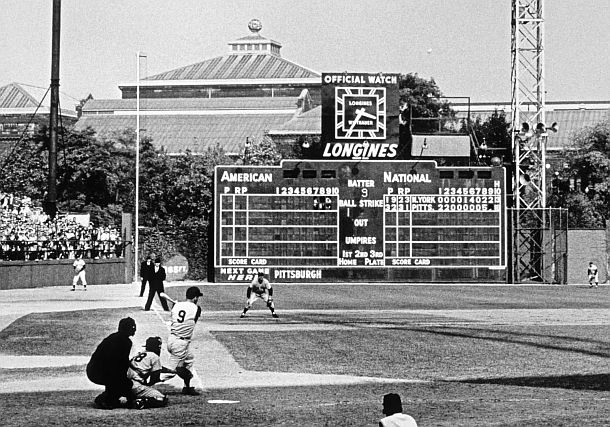
The game went back and forth, and was tied, 9-9, going to the bottom of the 9th inning. On NBC radio, Chuck Thompson, usually the voice of the Baltimore Orioles, said, "Well, a little while ago, when we said this one was going right down to the wire, little did we know." Mazeroski led off, against Yankee pitcher Ralph Terry. His 1st pitch was high, ball 1. Terry threw a 2nd pitch. The time was 3:36 PM. Thompson's call on radio:

Here's a swing, and a high fly ball, going deep to left, this may do it! Back to the wall goes Berra, it is over the fence, home run, the Pirates win!
In case you're curious, the building behind the scoreboard
is the Carnegie Library of Pittsburgh.

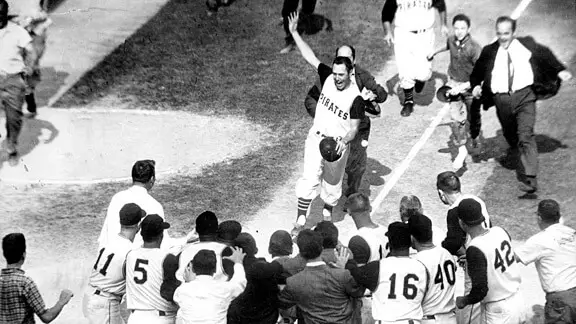
"I don't know it's out," Mazeroski recalled during a Pirates telecast in 2015, 55 years after the fact. "I don’t know it's a home run. But I know I;m going to end up on third if he misplays that ball off the wall. So I;m busting my tail getting around there, and by the time I hit second base, I looked down the line and the fans went crazy. From second base, I didn't touch the ground all the way in."

After pausing to let the cheering be heard, Thompson started again, and was so excited, he got the score wrong at first:

Ladies and gentlemen, Mazeroski has hit a one-nothing pitch over the left field fence at Forbes Field to win the 1960 World Series for the Pittsburgh Pirates by a score of ten to nothing! Once again, that final score, the Pittsburgh Pirates, the 1960 World Champions, defeat the New York Yankees. The Pirates ten, and the Yankees nine! And Forbes Field is an insane asylum!

Mel Allen, so often accused of being a "homer" for the Yankees, called it this way on TV for NBC:

There's a drive into deep left field, look out now! That ball is going, going, gone! And the World Series is over! Mazeroski hits it over the left field fence, and the Pirates win it, 10–9, and win the World Series!

The ball went over Berra's head, at around the 406-foot mark in left field, and landed among the cherry trees in Schenley Park. Mazeroski took off his batting helmet and swung it around as he circled the bases. 
The ball was found by Andy Jerpe, 14 years old. Mazeroski would sign the ball for him, but he foolishly used the ball in a neighborhood game, and it was lost. No one knows where it is now. The Pirates don't have it. Neither does the Baseball Hall of Fame.

The Yankees outscored the Pirates 55-27 during the Series, but the Pirates won it, 4 games to 3. Richardson had a Series record 12 RBIs, and remains the only player from a losing side to be named the MVP of a World Series. Mazeroski? He batted .320 in that Series, and that was his 2nd homer in it, for his 5th RBI in it, and he played his usual good games in the field. He got robbed. But I'm sure he'd rather have the title.

Not being old enough to remember 1960, I can hardly begrudge the Pirates that amazing victory. But there are Yankee Fans who are old enough to remember, and it still hurts. It shouldn't: They won the next two World Series, and another seven since. And Mazeroski was always a good guy.

There's a bronze statue of a young Mazeroski -- arms outstretched, cap in his right hand, right leg kicked up behind him -- along the Allegheny River outside PNC Park. The likeness is surrounded by a brick wall that includes an actual section of the outfield wall over which Mazeroski homered; the 406-foot marker is still visible in white.

Another part of Forbes Field's outfield wall still stands in place in Pittsburgh's Oakland neighborhood, just off Roberto Clemente Drive, and there’s a plaque recognizing the spot where Mazeroski homered. Every Oct. 13, the "Game 7 Gang" gathers at that site, listens to the radio broadcast and celebrates the anniversary of Mazeroski's famous home run at exactly 3:36 PM.
"That doesn't happen anywhere else, does it?" Mazeroski said with a smile in February 2020, approaching the 60th Anniversary of the event.

*

He never again batted higher .271. He never again hit more than 16 home runs in a season. He peaked at 82 RBIs in 1966. But it's as a fielder that he became best-known. He led NL 2nd basemen in double plays turned every year from 1960 to 1967. He led them in fielding percentage in 1960, '65 and '66, and retired with a career .983 fielding percentage. He led them in assists 9 times, and led all of the big leagues in 5 of those seasons. He still holds the Major League record for double plays turned by a 2nd baseman, with 1,706.

For the record, the holders at the other positions are: 1st base, Mickey Vernon, 2,044; shortstop, Omar Vizquel, 1,734; 3rd base, Brooks Robinson, 618; catcher, Ray Schalk, 222; center field, Tris Speaker, 146; pitcher, Greg Maddux, 98; right field, Harry Hooper, 86; left field, Joe Vosmik, 23.

Mazeroski was involved in 2 triple plays in his career, in 1966 and 1968. He never hit into one in real life. But on June 27, 1967, at Shea Stadium, he was filmed staging such an event for the film version of The Odd Couple: Just before the regular game, he was filmed batting against Jack Fisher of the Mets. The play required 2 takes, as he hit the 1st ball foul. The point of the scene was that a phone call from Felix Ungar (played by Jack Lemmon) to Oscar Madison (Walter Matthau) in the press box at Shea causes Oscar to miss a triple play that ends the game in victory for the Mets. (Felix's surname was spelled "Ungar" in the play and the film, "Unger" in the TV show.)

Mazeroski and Clemente were the only 1960 Pirates still there when they won the World Series again in 1971. Mazeroski retired after the 1972 season, with a lifetime batting average of .260, and 2,016 hits including 138 home runs.

For many years, he was considered one of the best players not in the Baseball Hall of Fame. The argument for him was that the best-fielding player, ever, at every position should be in, and he was the best-fielding 2nd baseman ever. The argument against him is that he wasn't good enough of a hitter, and that nobody's defense made enough of a difference to put him over the top. In 2001, he was finally elected.

People who were against his election to the Hall have claimed that the real reason he's in is that home run. I would make the exact opposite argument: 

I think the home run changed people's perception of him. Think about it: The 1st thing that comes to mind when you hear his name is, "He hit the home run that won the 1960 World Series." Imagine that the Series had ended any other way, even one favorable to the Pirates. Suppose Mazeroski had led the inning off with a single, and scored the title-winning run on somebody else's hit. Then, the 1st thing that would come to mind when you hear his name is, "He's the greatest-fielding 2nd baseman who ever lived." He probably would have gotten in much sooner.
At a still-standing, ivy-covered piece of the
Forbes Field outfield wall, October 13, 2010,
the 50th Anniversary of the home run.


The Pirates retired his Number 9, and dedicated a statue of him outside PNC Park, depicting him running around the bases, swinging his batting helmet around. They also elected him to their team Hall of Fame. He was also elected to the National Polish-American Sports Hall of Fame.


He retired to a suburb of Pittsburgh. In 1987, he ran for the Democratic Party's nomination for Westmoreland County Commissioner, but lost. Eventually, he and his wife the former Milene Nicholson, moved to Panama City, Florida, enabling him to go down to Bradenton to serve as a Spring Training instructor for the Pirates. They had 2 sons: Darren, who became a college baseball coach; and Dave, an atmospheric scientist.


On October 23, 1993, Joe Carter became the 2nd player to end a World Series by hitting a home run, for the Toronto Blue Jays over the Philadelphia Phillies, at the SkyDome (now named the Rogers Centre) in Toronto. However, that was in a Game 6, not a Game 7. It appears that Mazeroski and Carter never met.


Bill Mazeroski died yesterday, February 20, 2026, in the Pittsburgh suburb of Landsale, Pennsylvania. He was 89 years old.


With his death, there are 3 surviving players from the 1960 World Champion Pittsburgh Pirates: Bob Skinner, Vernon Law and Bennie Daniels.


There are 4 surviving players who played in Game 7 of that World Series: Skinner and Law of the Pirates, and Bobby Richardson and Tony Kubek of the Yankees. Kubek, famously, had to leave the game when a ground ball hit a pebble in Forbes Field's poor infield and struck him in the throat, helping to keep the Pirates' 8th-inning rally alive, and make Mazeroski's 9th-inning heroism possible.


And there are 11 surviving players from the 1971 World Champion Pittsburgh Pirates: Al Oliver, Steve Blass, Manny Sanguillén, Bob Robertson, Gene Alley, Richie Hebner, Luke Walker, Bob Johnson, Milt May, Dave Cash and Carl Taylor.


How did Mazeroski want his career to be remembered: For his Hall of Fame defense, or for hitting arguably the greatest home run of all time?


"Oh," he said, laughing, "I'll take the home run."


If it had been me, so would I.

Wednesday, June 12, 2024

Jerry West, 1938-2024

The two greatest figures in the history of the National Basketball Association are Red Auerbach and Jerry West. That cannot be disputed.

Wilt Chamberlain was a greater player. So were Magic Johnson and Michael Jordan. Phil Jackson was a better coach. Maurice Podoloff, the 1st Commissioner, and David Stern, the longest-serving Commissioner, shaped the league more in an official capacity. But in terms of shaping the history of the league, it's Red and Jerry.

Jerome Allen West was born on May 28, 1938 in Chelyan, West Virginia, 17 miles up the Kanawha River from the State capitol of Charleston, and on the bank of Cabin Creek, leading to a hick nickname he hated, "Zeke from Cabin Creek." He had an abusive father, and his brother was killed in the Korean War, a combination he later admitted made him introverted. He was cut by the head basketball coach at East Bank High School for being too short.

He grew to 6 feet even, and his endless practice made him the best basketball player, maybe the best athlete, in his State's history. On March 24, 1956, he led East Bank to the State Championship. Thereafter, every year on March 24, until the school closed in 1999, the name of the school was changed for the day to West Bank High School.

He got West Virginia University into the NCAA Final Four in 1959, losing to the University of California, coached by Pete Newell and led by Darrall Imhoff, in the Final. He was an easy selection for the U.S. team at the 1960 Olympics in Rome, coached by Newell. Not only did they win the Gold Medal, but that entire team was collectively elected to the Basketball Hall of Fame. Meaning that some of them were elected twice: Newell, West, Oscar Robertson, Jerry Lucas and Walt Bellamy.

The rest of the team: Imhoff, Jay Arnette, Bob Boozer, Terry Dischinger, Allen Kelley, Lester Lane, Adrian "Odie" Smith, and a holdover from the 1956 Gold Medalists, Burdette Haldorson. This was the best basketball team ever assembled, until the "Dream Team" of 1992. How good were they? Lucas' Ohio State teammate John Havlicek only made it as an alternate.

He was drafted by the Los Angeles Lakers, and was a rookie in their 1st season after moving from Minneapolis, 1960-61, joining Elgin Baylor. He was an All-Star in all 14 seasons in which he played in the NBA, and became known as one of the best shooters, and one of the best passers, in NBA history. He was named Most Valuable Player of the 1969 Finals, even though the Lakers lost, the only player from the losing team ever so honored.

In 1970, despite the team eventually losing the game and the series, he launched a 60-foot shot to send Game 3 of the Finals into overtime. In spite of the defeat, it's considered one of the greatest shots in NBA history. Shots like that gave him a much better nickname than "Zeke from Cabin Creek," or the one that Baylor gave him because of his country accent, "Tweety Bird." Shots like that gave him the nickname "Mr. Clutch."

And he is "The Logo": In 1969, Alan Siegel, following up his design of the Major League Baseball logo that bears a resemblance to Harmon Killebrew, used a photograph of West dribbling with his left hand, to design the NBA logo. There is some dispute about the picture: Siegel claimed it was by Wen Roberts, but it appears the photo at the top of this post is the one, and that photo is credited to the great Sports Illustrated photographer Walter Iooss Jr. So when you hear of someone being called an "icon," know that this term is usually used as an exaggeration. Jerry West was The Logo: He was literally an icon.

In the 1971-72 season, with Baylor retiring, the Lakers finally put it all together. Coach Bill Sharman, as West's predecessor as the game's best shooter while with the Boston Celtics, led West, Wilt Chamberlain, Gail Goodrich, Keith Erickson and Jim McMillian -- and a backup guard named Pat Riley -- to the team's 1st NBA Championship in Los Angeles, after going 0-7 in the Finals, 0-8 if you count their last Finals defeat in Minneapolis.

This run included a 33-game winning streak, the longest in the history of major league sports. (While the 1979-80 Philadelphia Flyers, and some European soccer teams, have had longer unbeaten streaks, that included ties.) They avenged their 1970 defeat to the New York Knicks.

*

But the legacy of Jerry West was just getting warmed up. He was the Lakers' head coach from 1976 to 1979, chief scout from 1979 to 1982, and general manager from 1982 to 2002. He built the Laker dynasties of 1980-91 and 2002-10. At the 2001 title parade, Kobe Bryant, whom West talked the Lakers into acquiring in a trade after the Charlotte Hornets drafted him out of high school, wore West's Number 44 jersey instead of his own Number 8.

He wanted a new challenge, and moved on to the Memphis Grizzlies. He had no luck there, retiring in 2007, but in 2011 he joined the board of the Golden State Warriors, who won 4 titles as a result of his involvement. He went back to Los Angeles, with the Clippers, whom he got to their 1st-ever trip to the Western Conference Finals in 2021.

After going 1-for-9 in the Finals as a player, he officially had 9 rings, though he had a hand in building 15 titles. That's the most of anybody in NBA history except for longtime Boston Celtics head coach, general manager and team president Red Auerbach, who won 16.
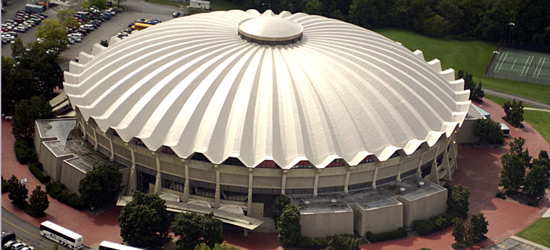
His Number 44 has been retired by both WVU and the Lakers, and statues of him are outside the WVU Coliseum in Morgantown and the Crypto.com Arena. The stretch of U.S. Route 19 that runs past the Coliseum, named Monongahela Boulevard for most of its run, is named Jerry West Boulevard. (Elsewhere in town, U.S. Route 119 is named for another WVU graduate: Don Knotts Boulevard.)

He was named to the Basketball Hall of Fame and the NBA's 50th Anniversary 50 Greatest Players. When the ceremony for the 50 Greatest was held at the 1997 All-Star Game in Cleveland, 47 players showed up. One, Pete Maravich, was already dead. One, Shaquille O'Neal, was injured, couldn't play in the game, and simply refused to show up. His name was heavily booed when it was announced. The other was West, who was in the hospital, recovering from surgery.

He was able to attend the 2022 ceremony for the 75th Anniversary 75 Greatest Players. That same year, The Athletic ranked him 14th on their list of the greatest players ever. In 2019, in a rare decision of his that I agreed with, Donald Trump awarded him the Presidential Medal of Freedom.

He married his college sweetheart, Martha Jane Kane, in 1960. They divorced in 1976. They had three sons: David, Mark, and Michael. Jerry married his second wife, Kristine "Karen" Bua, in 1978. They had two sons, Ryan and Jonnie. Jonnie played guard for West Virginia, like his father, and married professional golfer Michelle Wie in 2019.

After being in ill health for a year, Jerry West died today, June 12, 2024. He was 86 years old.

NBA Commissioner Adam Silver: "Jerry West was a basketball genius and a defining figure in our league for more than 60 years. He distinguished himself not only as an NBA champion and an All-Star in all 14 of his playing seasons, but also as a consummate competitor who embraced the biggest moments."

Kareem Abdul-Jabbar: "The reason Jerry West is the logo for the NBA is because he embodied the qualities we admire in our best athletes: skills as a player, dedication as a teammate, and integrity as a person. He was my coach, and my advisor, but mostly he was my friend."

Byron Scott, part of the Laker dynasty of the 1980s, who later coached the New Jersey Nets to the 2002 and '03 Finals: "It’s because of Jerry West that there was even 'Showtime.' It’s because of you that I am who I am today. You believed in me when no one else did and for that I’m forever grateful. You will always be my 'Basketball Dad'. I love you Logo my heart is broken. You will be missed."

Adrian Wojnarowski, ESPN: "Jerry West lived a profound basketball and American life — iconic as a player, executive and looming figure in the history of the game. He was an MVP, a champion, a gold medalist, a dynasty-builder and literally the league’s logo. His loss leaves a massive void."

Michael Jordan: "I am so deeply saddened at the news of Jerry's passing. He was truly a friend and a mentor. Like an older brother to me. ... Rest in Peace, Logo."

Paul George, Clippers All-Star: "We will always remember you for your undeniable legacy, and more importantly, greatness as a human being."

LeBron James: "My thoughts and prayers goes out to your wonderful family! Forever love Jerry! Rest in Paradise my guy!"

Wednesday, November 15, 2017

How to Go to a West Virginia Football Game

44 States down, 6 to go. This Saturday, the football team at West Virginia University plays a home game in the Big 12 Conference -- not, geographically speaking, the league you would expect them to be in -- against the University of Texas.

Before You Go. Morgantown, seat of West Virginia University, is a bit further south than New York City. That won't be a factor in mid-November. But the weather is forecast to be, if you don't mind my using a technical term, yucky. It's going to rain on Saturday, and snow on Sunday. Saturday will start out in the mid-50s, but will drop to the high 30s at night, and it's not going to get any warmer on Sunday.

West Virginia is in the Eastern Time Zone, so you won't have to change your clocks, watches, or whatever.

Tickets. WVU home football games have been ranging between 50,000 and 60,000 in attendance, with 60,000 being a full house. Tickets may be difficult to get. They'll be $65 throughout the stadium.

Getting There. It's 380 miles from Times Square in Midtown Manhattan to Mountaineer Field in Morgantown, West Virginia. That's tricky: In that range of "too close to fly, but too far to go any other way." And since it's not a big city, or even, really, a small city, I'd say forget about flying. Even if you flew to Pittsburgh and wanted to drive the rest of the way, bad idea.

Amtrak doesn't go to Morgantown. Greyhound does, but there's only 1 bus per day going from Port Authority to Morgantown. It leaves at 7:30 AM, and arrives at 4:40 PM. The return trip leaves at 5:15 PM, and gets back at 4:15 AM on a Sunday. Meaning you'd have to get up and the crack of dawn on Friday, spend Friday-into-Saturday overnight in Morgantown, have maybe an hour and a half to get out of the stadium and back to the Greyhound station, and then arrive back at Port Authority at perhaps the creepiest time of night. And, in each direction, you'd have to change buses once, in Pittsburgh. Put it all together, and, Oh, joy. Round-trip fare is $222.

If you want to drive, take Interstate 78 West across New Jersey to Harrisburg, Pennsylvania. There, switch to Interstate 81 South to Williamsport, Maryland. There, switch to Interstate 68 West into West Virginia. Take Exit 7, onto U.S. Route 119, a.k.a. (ominously) Cheat Road. Route 119 will become Mileground Road, then turn right on State Route 705, a.k.a. "201st INF/FA Memorial Way." That stands for Infantry/Field Artillery. Then left on Willowdale Road, a.k.a. Don Nehlen Drive. The stadium will soon be on your right.

If you do it right, you should spend an hour and 15 minutes in New Jersey, 2 hours and 45 minutes in Pennsylvania, an hour and a half in Maryland, and half an hour in West Virginia, for a total of 6 hours. Counting rest stops, it's more like 8 hours.

Once In the State. There are 2 things that everyone thinks they know about West Virginia, and neither of them is true:

1. The 1971 hit song by John Denver, "Take Me Home, Country Roads," is about West Virginia. Indeed, the 1st 2 words of the song are, "Almost Heaven, West Virginia." They even put the words "Almost Heaven" on their license plates, although for a few years now, the plates' slogan has been "Wild, Wonderful."
Denver wrote the song with Bill Danoff and Mary "Taffy" Nivert, who were then married, and later formed half of The Starland Vocal Band. The other half was also married to each other: Jon Carroll and Margo Chapman. Together, they had a Number 1 hit in 1976 with "Afternoon Delight." Both couples eventually broke up. Denver didn't stay married to Annie Martell, the subject of several of his songs (including "Annie's Song"), either.

Except the song isn't about West Virginia. Nivert was from Germantown, Maryland, in the State's western Panhandle, which borders West Virginia's eastern Panhandle, in the Appalachian Mountains. Bill was taken by the scenery, but "Maryland" didn't fit the rhythm of the melody he'd written. "Massachusetts," his home State, did, and, thinking of the Berkshire Mountains (also a range within the Appalachian chain), he almost used Massachusetts.

The couple decided "West Virginia" worked better. Yes, much of West Virginia is beautiful. But as far as the song goes, it was just a construction piece.

2. The State is full of gun-toting, inbred, sadistic hillbillies, like you saw in the 1972 movie Deliverance. Well, West Virginia is mostly rural, and they do like their guns -- which is why the State has gone Republican in every Presidential election since 2000, sticking with the Democrats long enough to side with Arkansas country boy Bill Clinton, but not Tennessee-raised Al Gore. But Deliverance was both filmed and set in Georgia, home State of its star, Burt Reynolds.

Nevertheless, from 1863 to 1891, the Hatfield-McCoy Feud raged, along the Big Sandy River, a State Line. The feud basically started because the Hatfield family was on the Virginia side, loyal to the Union; and the McCoy family was on the Kentucky side, and loyal to the Confederacy. The war ended, but the feud went on, and helped to mark both States as hillbilly territory.
The State House, at 1900 Kanawha Blvd. East,
on the Kanawha River in Charleston.
At 293 feet, it is the tallest building in the State.

West Virginia is the only State that seceded from the Confederate States of America. After Virginia seceded from the Union on April 17, 1861, 5 days after the attack on Fort Sumter, the Wheeling Convention was convened, and on October 24, 1861, 41 Counties voted to secede from Virginia and the C.S.A., and applied to Washington to return to the Union. On June 20, 1863, West Virginia was admitted as the 35th State. Once Virginia was readmitted to the Union after the Civil War, West Virginia remained separate.

The State is home to about 1.8 million people. Charleston, the capital and largest city, has about 51,000. Morgantown has about 31,000 permanent residents, so a WVU football sellout would nearly double the population of the rest of the town, and be the largest "city" in the State. West Virginia University -- not "the University of West Virginia" or "UWV," but "WVU" -- was founded in 1867, 4 years after Statehood, so they celebrated their 150th Anniversary this year.
The State's Area Code is 304. ZIP Codes in the State start with the digits 247, 248, 249, 25 or 26. In Morgantown, it's 26505. The sales tax is 6 percent. Notable newspapers include the Charleston Gazette-Mail and The State Journal, The Herald-Dispatch of Huntington, The Wheeling News-Reigster and The Intelligencer, and, in Morgantown, The Dominion Post.

Settled in 1772 by Colonel Zackquill Morgan of the British Army, and incorporated in 1838, Morgantown was named for Street addresses rise going eastward from the Monongahela River, and going northward. Although WVU has a campus bus system and even a monorail, known as the Morgantown Personal Rapid Transit, Morgantown proper does not have public bus service. Nor does the town have a freeway "beltway."
The WVU PRT runs from Walnut & Chestnut Streets,
5 stops north to the WVU medical school.

Because of its unusual beginnings, West Virginia tends to defy description. A person could visit Morgantown with its science-oriented University, or the eastern Panhandle with its D.C. commuters, and say that it's a Northeastern State, like Pennsylvania or Maryland. A different person could visit Wheeling in the north, or Huntington in the southwest, with their hard-edged industry, and say that it's a Midwestern State, like Ohio. Yet another person could visit Charleston, Princeton or Bluefield in the southern part, and see how rural it is, and say that it's a Southeastern State, like Virginia or Kentucky. And they'd all come close to being right, but none would quite get there.

Notable WVU graduates include: 

* Entertainment: Actors Don Knotts, Paul Dooley, Chris Sarandon, Conchata Ferrell and Taylor Kinney; and country singer Kathy Mattea.

* Journalism: Frank Kearns and Michael Tomasky.

* Politics, representing West Virginia unless otherwise stated: Governors William E. Glasscock, Ephraim Morgan, Howard M. Gore (no relation to the Tennessee Gores), William G. Conley, Matthew Neely, William C. Marland, Cecil Underwood, William Wallace Barron, Arch Moore and Joe Manchin, and Joseph M. Devine of North Dakota; and Senators Manchin and Harley Kilgore.

Underwood was elected Governor in 1956, but the State Constitution then prohibited a Governor from serving consecutive terms. He was elected again in 1996, and could run again in 2000, but lost. He entered the office for the 1st time at age 34, and left it for the last time at age 78, making him, still, both the youngest and the oldest Governor in State history. Eat your heart out, Jerry Brown of California.

Going In. The official address of WVU's stadium is 900 Willowdale Road, about a mile and a half north of downtown. If you drive in, parking is a whopping $40.

It opened in 1980, on the site of the former Morgantown Country Club, as Mountaineer Field, the same name as their previous stadium. In 2004, Milan Puskar, a son of Serbian immigrants who set up pharmaceutical company Mylan Inc. in Morgantown, made a $20 million donation to WVU -- even though he was a graduate of Youngstown State University in nearby Youngstown, Ohio -- and, while the name of the playing surface was kept, the complex was renamed Mountaineer Field at Milan Puskar Stadium.
Originally seating 50,000 people, it was expanded to 57,500 in 1985, and to 63,500 in 1986. Puskar's gift allowed it to reopen with wider seats in 2004, dropping capacity to 60,000. The field has always been artificial, and runs northwest-to-southeast.

It also hosts high school football, including the State's high school football finals and, formerly, the rivalry game between Morgantown's 2 public high schools, Morgantown and University. In 1998, the Pittsburgh Steelers and the Atlanta Falcons played a game there.
Food. The University website isn't clear on this. They say there's concession stands on the east stand, behind Sections 105, 202, 204, 208 and 210; on the west stand, behind 125, 128, 213, 215, 219 and 221; at the south end, at 97 and 131; and at the north end, on the east side of the concourse. But that's it.

Team History Displays. West Virginia won the Southern Conference Championship in 1953, 1954, 1955, 1956, 1958, 1964, 1965 and 1967. Then they made the mistake of becoming an independent meaning they were unable to win a title despite going 10-1 in 1969, 9-3 in 1975, or 9-3 3 straight years from 1981 to 1983.

In 1988, head coach Don Nehlen got them an undefeated regular season, but, of course, there was no Big East Conference for football yet. He did, however, get them a Number 2 ranking, and a Fiesta Bowl matchup with Number 1 Notre Dame, for the National Championship, but the Mountaineers lost, 34-21.

West Virginia soon joined the Big East, and won Conference Championships in 1993, 2003, 2004, 2005, 2007, 2010 and 2011. So that's 8 in the Southern Conference, and 7 in the Big East, for a total of 15 league titles. With the breakup of the Big East, instead of joining fellow Big Easters Pitt, Virginia Tech, Syracuse, Boston College and Miami in the ACC, they went west, to the Big 12, which makes even less geographic sense than the Big East's Rutgers and the ACC's Maryland joining the Big 10.

West Virginia has been awarded the Lambert Trophy as "the best college football team in the East" in 1988, 1993, 2007 and 2011. Their move to the Big 12 has not changed their eligibility for it.

Incredibly, they went to only 1 bowl game prior to 1982, and a total 8 through the 2004 season, and lost them all. But they've won their last 4: The 2005 Sugar Bowl, the 2006 Gator Bowl, the 2007 Fiesta Bowl, and the 2011 Orange Bowl -- the last 2 a 48-28 pounding of then-Number 3 Oklahoma and a 70-33 smacking of Number 14 Clemson.

The Mountaineers have retired 3 numbers. Number 21, Ira Rodgers, was a back in the 1910s, and had 2 tenures as head coach, 1925-30 and 1943-45. He was also head baseball coach from 1921 to 1946. The great 1950s linebacker Sam Huff doesn't have his Number 70 retired by the Giants, but he does have his Number 75 retired by the Mountaineers. And Bruce Bosley, a 4-time Pro Bowl guard with the San Francisco 49ers, was a 1950s teammate of Huff, and his Number 77 has been retired.

There are 13 Mountaineers in the College Football Hall of Fame. They include Rodgers, Huff and Bosley. Also included as West Virginia players are Joe Stydahaar, a 1930s tackle who went on to star for the 1940s Chicago Bears dynasty and coach the Los Angeles Rams to the 1951 NFL Championship; Darryl Talley, an early 1980s linebacker who played on the Buffalo Bills' 4 straight AFC Championship teams; and Major Harris, quarterback of the 1988 team, who never reached the NFL but did play in Canada.

Stydahar and Huff are also in the Pro Football Hall of Fame. Huff, along with basketball star Jerry West, remains the most famous athlete in WVU history.
Sam Huff, with a replica of his era's Mountaineer helmet
and a current jersey with his number

Nehlen is also in the Hall. Also elected, and having played or coached at WVU, but elected on the basis of what they did elsewhere, are Michigan coach Fielding Yost, Minnesota coach Clarence "Doc" Spears, Philadelphia Eagles coach Earle "Greasy" Neale," Syracuse coach Ben Schwartzalder, Florida State coach Bobby Bowden, and Frank Cignetti, who coached the Mountaineers from 1976 to 1979, between Bowden and Nehlen, and who won Division II titles with Indiana University of Pennsylvania.
There is no notation for any of these honors viewable from the stands. But Willowdale Road, the street the stadium is on, is also named Don Nehlen Drive. The street to the south of the stadium is Ira Errett Rodgers Drive.

It's also worth noting that Nehlen's son-in-law is Jeff Hostetler, who was one of his quarterbacks, and who stepped in for the injured Phil Simms to win the NFC Championship Game and Super Bowl XXV with the Giants in 1991.

West Virginia's greatest rivalry is not with the other Football Bowl Subdivision (FBS, formerly Division I-A) school in the State, Marshall University, 209 miles to the southwest in Huntington. They met 4 times from 1911 to 1923, then not again until 1997, when Marshall became a big-time program, and then annually from 2006 to 2012, and not since. The Mountaineers have won all 12 "Friends of Coal Bowl" games against the Thundering Herd, the last by a score of 69-34. Ouch.

It's with the University of Pittsburgh, 77 miles up Interstate 77 North. "The Backyard Brawl" is mean. How mean is it? In 1994, the public-address announcer at Pitt Stadium announced, "There is no smoking allowed inside Pitt Stadium, and that includes corncob pipes!" He later announced, "There is a tractor in the parking lot with its lights on, West Virginia license plate EIEIO!"

(As if great swaths of Pennsylvania aren't rural as hell, hence the term "Pennsyltucky." The 2016 election was the 1st one since 1988 that they managed to outvote Philadelphia and Pittsburgh to swing the State to the Republican nominee, because of his appeals to "coal country" -- which also worked in West Virginia, but they were already Republican because of "God, guns and gays.")

West Virginia and Pitt first played each other in 1895, and up until 1952, Pitt led the series 34-9-1. Then came head coach Art "Pappy" Lewis, and he turned things around in the rivalry. But since 1962, the Mountaineers have a 26-22-2 edge over the Panthers, including a 9-2-1 run from 1988 to 1999. The breakup of the Big East means that they haven't met since 2011, and Pitt leads 61-40-3. They are scheduled to meet again starting in 2022.

West Virginia has a minor rivalry with neighboring Maryland, 205 miles to the southeast, leading 28-22-2, but because of conference realignments, they haven't met since 2015. The rivalry with fellow rural school Virginia Tech, 254 miles to the south, should have been a natural, but conference realignments messed that up. At the start of this season, they met for the 1st time since 2005, and Tech won, but West Virginia leads 28-23-1.

They also had a rivalry with Penn State, 181 miles to the northeast, but the Nittany Lions had an overwhelming edge, 48-9-2, including winning every game from 1959 to 1983. The last meeting was in 1992, and they are set to meet again in 2023.

Stuff. There's no big team store at Mountaineer Field. Your best bet is the Mountainlair, at 1550 University Avenue, at the downtown part of the campus in Morgantown. The Mountaineer statue stands in front of it. There's also Mountaineer World, at 166 Barnett Run Road in Bridgeport, 33 miles down I-79 South.
The Mountaineer statue, in front of the Mountainlair

John Antonik wrote Saturday Snapshots: West Virginia University Football in 2015, but that's more of a coffee table book than a good look at the history of the program. He also explored the Pitt rivalry in his 2012 book The Backyard Brawl. There's a few season-in-review videos available about the team.

During the Game. Don't make hillbilly jokes. Don't make "gun nut" jokes. Avoid that, and you should be fine as far as your safety is concerned.

When the team takes the field, they run to the east end, and each player rubs a 350-pound chunk of coal donated by Alpha Natural Resources. This has been done since 2011, as a tribute to the 29 victims of the Upper Big Branch Mine disaster, which occurred in Montcoal, West Virginia on April 5, 2010, the worst mining disaster in America since 1970. (The CEO of the mining company served a year in prison for his willful negligence. You may not know about this, since the coal industry has a public-relations arm that's very good at telling you about their achievements while covering up their crimes.)
To the tune of "Fight Mountaineers," the Pride of West Virginia Marching Band forms the team's "Flying WV" logo, then forms the State outline to the tune of "Hail, West Virginia." They also play "Take Me Home, Country Roads."

When the stadium opened on September 6, 1980 -- also Don Nehlen's 1st game as head coach, a 41-27 win over the University of Cincinnati -- John Denver was on hand to sing it himself, just as he had sung "Thank God I'm a Country Boy" on top of the Baltimore Orioles' dugout during the previous year's World Series, starting one of the odder traditions in sports. (Much of Maryland is rural, but Baltimore is a big, tough city.)

The east stand will shout, "Let's go!" followed by the west stand shouting, "Mountaineers!" A new Mountaineer mascot is chosen every year (since 1937), with a new version of the buckskin costume and coonskin cap tailored to fit him. He fires (blanks) from his musket every time the team scores. If he does not already have a beard, he grows one in time for the new season. (There have been 2 female exceptions: Natalie Tennant in 1990 and Rebecca Durst in 2009.) Ironically, the Mountaineer statue in front of the Mountainlair doesn't have a beard.
Troy Clemons, the 2014 Mountaineer.
I chose his photo solely because his
showed up the most on Google Images.

One home game a year is designated a "True Blue" game, where fans are asked to wear blue. One is designated a "Gold Rush" game, where fans are asked to wear gold -- or "yellow," if you're not a Mountaineer fan. And one is designated a "Stripe the Stadium" game, where the proper color T-shirt is left at each seat for the fans to wear.
"Stripe the Stadium." See that little sliver of orange
in the far corner, amongst the blue & gold?
That's about 2,000 Syracuse fans.

If the Mountaineers win, they will go over to the student section, known as the Mountaineer Maniacs, and lead them in one more chorus of "Take Me Home, Country Roads," a tradition since 1972, the year after the song came out.

After the Game. Mountaineer fans are not known for excessive celebrations, or for taking defeats out on opposing fans. You (and, if you drove in, your car) will be safe.

Far likelier to be a problem is where to go after the game. Mountaineer Field is nearly surrounded by campus buildings, not by places to get a postgame meal. The Varsity Club is at 910 Willowdale Road, across from the stadium to the east. Other than that, you'll probably have to go back downtown.

Or you could go to Chestnut Ridge Road, about a mile north of the stadium, around the medical school and hospital complex. There's a number of places there, including a Dunkin Donuts, a Sheetz (a convenience store chain native to the Ohio Valley), and, at 735 Chestnut Ridge Road, Kegler's, a bar that shows European soccer matches.  

Sidelights. Like Syracuse, but unlike Rutgers, West Virginia replaced an old stadium with a new one when they had both the chance and the motive, in the late 1970s. The original Mountaineer Field, known as the Jewel of the Mountains, opened in 1924, at the downtown campus.
It seated 38,000, and fit the University's needs until TV revenue became a factor in the 1970s. It even hosted a preseason exhibition game in 1968, in the years of the AFL-NFL merger process, between the NFL's Pittsburgh Steelers and the AFL's Cincinnati Bengals, representing the 2 pro football teams closest to West Virginia.

Due to its cramped location, it could not be expanded, and so a bigger stadium was needed. Its last game was the 1979 Backyard Brawl, a loss to Pitt. It was demolished in 1987, and the Life Sciences Building opened on the site. A monument to the old stadium was erected in 2005. 51 Campus Drive, at University Avenue.

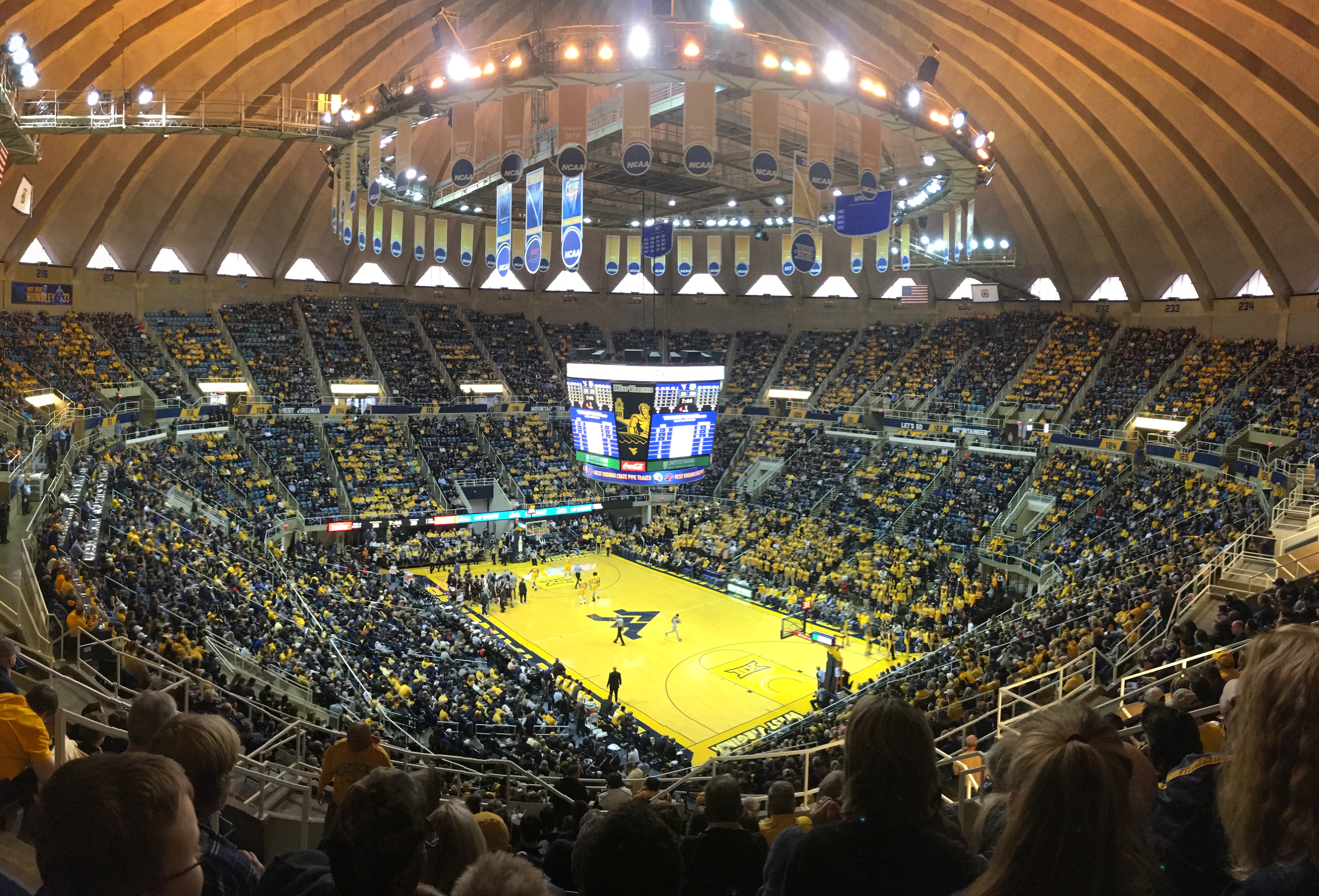
The Mountaineers play basketball at the WVU Coliseum, a.k.a. the West Virginia Coliseum, built in 1970 and seating 14,000. 3450 Monongahela Blvd., along with the rest of the WVU athletic complex, about 2 miles west of the stadium and 2 miles northwest of downtown.
Since moving in, the Mountaineers have won the Atlantic-10 Conference in the regular season in 1977, 1982, 1985 and 1989; the Atlantic-10 Tournament in 1983 and 1984; and the Big East Tournament and an NCAA Final Four berth in 2010.
From 1928 to 1970, they played basketball at the 6,000-seat West Virginia Fieldhouse, now named Stansbury Hall. This was where the Mountaineers won 11 regular-season Conference Championships: In 1935, 1952, 1955, 1956, 1957, 1958, 1959, 1961, 1962, 1963 and 1967. They also won 10 Conference Tournments: In 1955, 1956, 1957, 1958, 1959, 1960, 1962, 1963, 1965 and 1967. And, led by Jerry West, they reached the NCAA Final in 1959, losing to the University of California. So that's 15 regular-season Conference Championships, 13 Conference Tournaments, and 2 trips to the Final Four.
Built in 1928, the University has announced that it will demolish it, and replace it with a new building for the College of Buisness and Economics. History out, money in. 100 Beechurst Avenue, downtown.

Morgantown is 75 miles south of Pittsburgh, 216 miles west of Baltimore, 204 miles northwest of Washington, 202 miles southeast of Cleveland, 204 miles east of Columbus, and 308 miles east of Cincinnati. The closest MLB, NFL and NHL teams are in Pittsburgh, the closest NBA team is the Cleveland Cavaliers, and among MLS teams, the Columbus Crew are slightly closer than D.C. United.

The easternmost tip of the Panhandle tilts toward the Washington teams: The Nationals, the Redskins, the Wizards and the Capitals. Most of West Virginia is aligned toward Pittsburgh: Even the parts closer to Cincinnati and Columbus seem to favor MLB's Pirates over the Reds, the NFL's Steelers over the Bengals, and the NHL's Penguins over the Blue Jackets, even as they say they hate the Pitt Panthers and the Penn State Nittany Lions. But since there's no NBA team in Pittsburgh, Columbus or Cincinnati, and LeBron James is back in Cleveland, the Cavaliers are their favorite hoops team.

Marshall University is the other big-time college football program in the State, 206 miles to the southwest, in Huntington, across the Ohio River from Proctorville, Ohio, and not far from easternmost Kentucky.

The Marshall Thundering Herd are, sadly, best known for the November 14, 1970 plane crash that killed 75 passengers, including 37 of their players. In 2006, the crash, its aftermath, and the rebuilding of the Marshall program were depicted in both the documentary Ashes to Glory and the feature film We Are Marshall.

From 1927 to 1990, including the crash and its aftermath, they played at the 18,000-seat Fairfield Stadium, now occupied by a park at 14th Street and Huntington Avenue. Since 1991, they have played at James F. Edwards Field at Joan C. Edwards Stadium, which seats 38,227. The couple have donated heavily to the school. 2001 3rd Avenue. Memorials to the crash victims stand there, at the student union, and at Spring Hill Cemetery.
West Virginia is home to 4 minor-league baseball teams. The closest to Morgantown is the West Virginia Black Bears, who play in the short-season Class A New York-Penn League, at Monongalia County Ballpark, at 2040 Gyorko Drive, 5 miles across the Monongahela River in Granville. It opened in 2015, seats 2,500, and is home to both the Black Bears, who won the Pennant in their 1st season there, and the WVU baseball team.
"Mon County Ballpark"

The highest-ranking team in the State is the West Virginia Power, of the Class A South Atlantic League (SAL or "Sally League"). They play at the 4,500-seat Appalachian Power Park, a.k.a. "Rowdy Alley," at 601 Morris Street in the State capital of Charleston, 158 miles southwest of Morgantown and 50 miles east of Huntington. (UPDATE: As of the 2021 season, the ballpark is home to the Charleston Dirty Birds of the Atlantic League, not to be confused with the South Atlantic League.)
Appalachian Power Park opened in 2005, replacing the 4,474-seat Watt Powell Park, which had opened in 1948. It was demolished in 2005, and the Charleston Area Medical Center, across the street, built its cancer clinic on the site. 3415 MacCorkle Avenue SE.
Charleston has won the following Pennants: The 1914 Charleston Senators in the Class D Ohio State League, the 1932 Senators in the Class C Middle Atlantic League, the 1963 Charleston Indians of the Class A (now AA) Eastern League, the 1977 Charleston Charlies of the Class AAA International League, and the 1990 Charleston Alley Cats of the SAL. That's 5 Pennants. The Alley Cats have not won a Pennant since they changed their name to the West Virginia Power.

Bowen Field at Peters Park was built in 1939, and rebuilt after a 1975 fire. It has been home to a much more successful team than Charleston's. Pennants have been won there, all in the Appalachian League (once Class D, now a "Rookie League") by the Bluefield Blue-Grays in the Class D Appalachian League in 1949, 1950 and 1954; the Bluefield Dodgers in 1957; and the Bluefield Orioles, a.k.a. the Baby Birds or the Baby O's, in 1962, 1963, 1967, 1970, 1971, 1982, 1992, 1996, 1997 and 2001.

Bowen Field is now home to the Bluefield Blue Jays, who won their Division this year. Oddly, while the team represents the city of Bluefield, West Virginia, and the city owns the stadium, it's actually just over the State Line, in Bluefield, Virginia, at 3000 College Drive. 108 miles southeast of Charleston, and 222 miles southwest of Morgantown.

The 1,700-seat H.P. Hunnicutt Field in Princeton has hosted minor-league baseball since 1988. The Princeton Reds won the 1994 Appalachian League Pennant there. The current team is known as the Princeton Rays. 205 Old Bluefield Road, only 13 miles from the Bluefield ballpark.

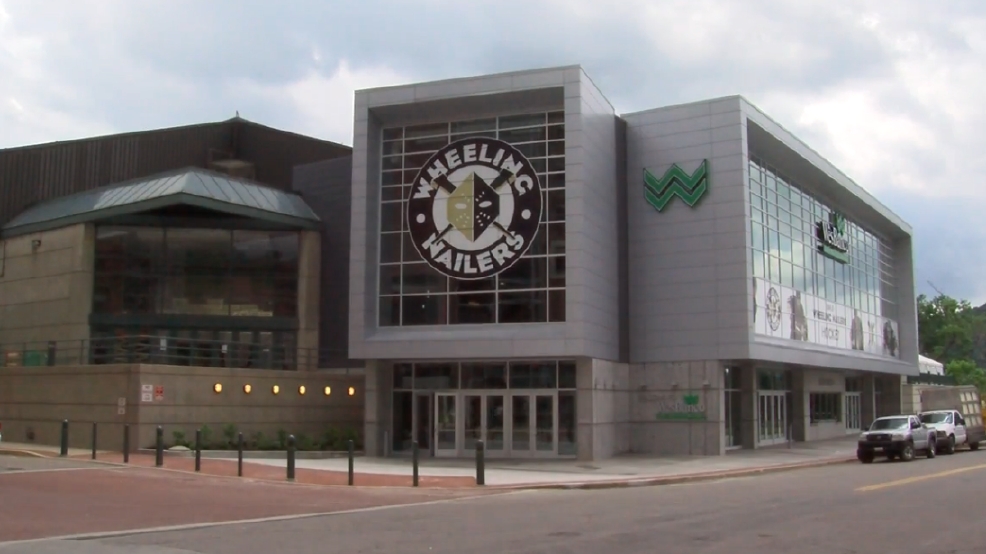
West Virginia has a minor-league hockey team, the Wheeling Nailers of the ECHL. They play at the 5,400-seat WesBanco Arena, built in 1977 as the Wheeling Civic Center, and have won regular-season league titles in 1993 and 1995, although never a Playoff title.
2 14th Street, in Wheeling, across the Ohio River from Martin's Ferry, Ohio, an area that is home to Bill Mazeroski, John Havlicek, the brothers Phil and Joe Niekro, and the brothers Lou and Alex Groza -- all but Joe Hall-of-Famers in their respective sports. That's 78 miles northwest of Morgantown, 59 miles southwest of Pittsburgh, 167 miles southeast of Cleveland, and 127 miles east of Columbus.

The State's highest-ranking soccer team is the West Virginia Chaos, who play in the Premier Development League, the 4th level of American soccer. They play at the 6,000-seat Schoenbaum Stadium. 2000 Coonskin Drive, 5 miles northeast of downtown Charleston.

There are 2 historically black colleges and universities (HBCUs) in the State to have won black college National Championships. Bluefield State College won it in 1927 and 1928. The school has completed changed since integration, with a student body that is now 80 percent white and only 13 percent black. The Big Blues now compete in NCAA Division II. 900 Pulaski Street in Bluefield, just a mile east of the Virginia-West Virginia State Line.

The other is West Virginia State University, which won the title in 1936. The Yellow Jackets maintain a mostly-black student body, and they also compete in Division II. Curtis Square in Dunbar, 10 miles up the Kanawha River, northwest of Charleston, and 164 miles southwest of Morgantown.

West Virginia has never produced a President. The closest they came was when John D. Rockefeller IV, a.k.a. Jay Rockefeller, Governor from 1977 to 1985 and U.S. Senator from then until 2015, briefly ran for President in the 2008 campaign, but won no Delegates.

Which is not to say that West Virginia doesn't have its heroes. In addition to the aforementioned Sam Huff and Jerry West, sports heroes from West Virginia include Baseball Hall-of-Famer Jesse Burkett, baseball players Steve Swisher and his son Nick Swisher, Pro Football Hall-of-Famers Gino Marchetti and Frank Gatski, possible future Hall-of-Famer Randy Moss, Washington Redskins founder (but notorious racist) George Preston Marshall, Basketball Hall-of-Famer Hal Greer, former Knicks coach Mike D'Antoni, gymnast Mary Lou Retton, and famous coaches Fielding Yost, Clair Bee, Ben Schwartzwalder, John McKay, Lou Holtz and Nick Saban.

(Nick grew up in West Virginia when his father Lou, from Illinois, was coaching in Pittsburgh. Bill Mazeroski was born there, but grew up across the river in Ohio. George Brett was born there, but grew up in Southern California.)

(UPDATE: Three months later, Randy Moss was elected to the Pro Football Hall of Fame.)

Also writers Pearl S. Buck and Henry Louis Gates Jr., labor leaders Mary Harris "Mother" Jones and Walter Reuther, scientists Homer Hickham and John Forbes Nash Jr., sound-barrier breaker Chuck Yeager, last surviving U.S. veteran of World War I Frank Buckles, and Iraq War hero Jessica Lynch.

Also singers Red Sovine, Little Jimmy Dickens, Frankie Yankovic, Garnet Mimms, Bill Withers, Johnny Paycheck, Michael W. Smith, Kathy Mattea, Brad Paisley; comedians Soupy Sales and Steve Harvey; game-show host Peter Marshall; directors Lawrence Kasdan and Morgan Spurlock; and actors Joanne Dru, Don Knotts, Paul Dooley, Ted Cassidy, Bernie Casey, Conchata Ferrell, Chris Sarandon, Joyce DeWitt, Brad Dourif, John Corbett and Jennifer Garner. In Morgantown, outh of Deckers Creek, University Avenue is named for the city's favorite son, Don Knotts Boulevard.

The Beatles never played in West Virginia. Elvis Presley did, at the 11,000-seat Charleston Civic Center, which opened in 1959: On July 11 and 12, 1975, and on July 24, 1976. 200 Civic Center Drive, downtown, across from the Charleston Town Center Mall, where the Elk River flows into the Kanawha River.

West Virginia is not big on museums. There's a State Museum next-door to the State Capitol, at 1900 Kanawha Blvd. East. Back in the seat of WVU, there's the Morgantown History Museum, at 175 Kirk Street, downtown. Just to the east of the Coliseum and the rest of the athletic complex, the Art Museum of West Virginia University, at 2 Fine Arts Drive; and the mineral-themed Royce J. and Caroline B. Watts Museum, at 401 Evansdale Drive.

Not having a President, or a major Revolutionary, Civil or Indian War battle within its borders, the most historic site in West Virginia is Harpers Ferry National Historical Park -- and it wasn't even in West Virginia at the time, since the separate State did not yet exist. 

It is the site of John Brown's raid of October 16-18, 1859, a raid on a federal arsenal intended to aid a slave rebellion. It failed because Brown didn't have enough manpower, firepower (hence, the raid), or brainpower: He wasn't stupid, but he was nuts, believing himself to be the instrument of God, and thus immune to failure.

He was captured by a force commanded by U.S. Army Colonel Robert E. Lee. He was tried, convicted and executed at nearby Charles Town, West Virginia, his hanging occurring on December 2, 1859, attended by a volunteer militia called the Richmond Grays, one of them being 21-year-old actor John Wilkes Booth. If the American Civil War was still a question of "If" before the raid, afterward, it was only a question of "When."

Amtrak goes to Harpers Ferry. (So does MARC, MAryland Rail Commuter, but only on weekday rush hours.) It's where the Shenandoah River splits off from the Potomac River, with 3 States coming together: Maryland, Virginia and West Virginia. 767 Shenandoah Street. 60 miles northwest of Washington, and 163 miles southeast of Morgantown.

There haven't been many TV shows set in West Virginia. The most notable may be The Americans -- not the current Cold War spy thriller of that title, but a 1961 NBC Civil War drama set in Harpers Ferry.

Movies? As I said, Deliverance was filmed and set not in West Virginia, but in Georgia. But Night of the Hunter, Matewan, Big Business, Patch Adams, The Mothman Prophecies, Win a Date with Tad Hamilton!, Super 8, and the Wrong Turn series are set there. So was the aforementioned We Are Marshall, and part of the film about John Forbes Nash Jr., A Beautiful Mind. Probably the most famous West Virginia native in fiction is FBI Special Agent Clarice Starling of the Hannibal Lecter films.

*

Everything you think you know about West Virginia is open to question. One thing that isn't is the West Virginia University football experience. Check it out.