Showing posts with label new mexico. Show all posts

Wednesday, July 16, 2025

July 16, 1945: The Trinity Test

July 16, 1945, 80 years ago: The Trinity test takes place. It is successful.

In June 1942, the U.S. Army Corps of Engineers started the Manhattan Project. This walled-off, super-secure facility in Los Alamos, New Mexico was kept as secret as they could, in order to keep Nazi Germany from knowing what they were doing. As it turned out, the real worry was with the Soviet Union, and their spies.

Due to the Allied bombings of German facilities, the Nazis never came close to developing an atomic bomb. They surrendered on May 8, 1945. But the new President, Harry Truman, wanted to avoid a full-scale invasion of the remaining enemy, Japan, if at all possible. The atomic bomb was the solution.

The Project's director was J. Robert Oppenheimer. He had a concern that the bomb might ignite the atmosphere and eliminate all life on Earth. But he said the chance of that happening was "near zero."
The first bomb was completed, and its test, codenamed "Trinity," was set for July 16, 1945, at what is now White Sands Missile Range, in a sparsely populated area outside Bingham, New Mexico. The detonation was at 5:29 AM Mountain Time, 7:29 U.S. Eastern Time. The test was successful. But every witness knew that this was both good news in the short term and, potentially, very bad news in the long run. They knew that America wouldn't have a monopoly on the bomb forever. Oppenheimer later said:

We knew the world would not be the same. A few people laughed, a few people cried. Most people were silent. I remembered the line from the Hindu scripture, the Bhagavad Gita. Vishnu is trying to persuade the Prince that he should do his duty, and, to impress him, takes on his multi-armed form, and says, "Now, I am become Death, the destroyer of worlds." I suppose we all thought that, one way or another.

On August 6, Truman ordered the dropping of the 1st available atomic bomb on Hiroshima, Japan. On August 9, he ordered another, dropped on Nagasaki. On August 14, Japan surrendered.

In 1949, the Soviets announced that they had successfully tested an atomic bomb.

Tuesday, December 3, 2024

Ballgame Over for Democrats? Not Yet

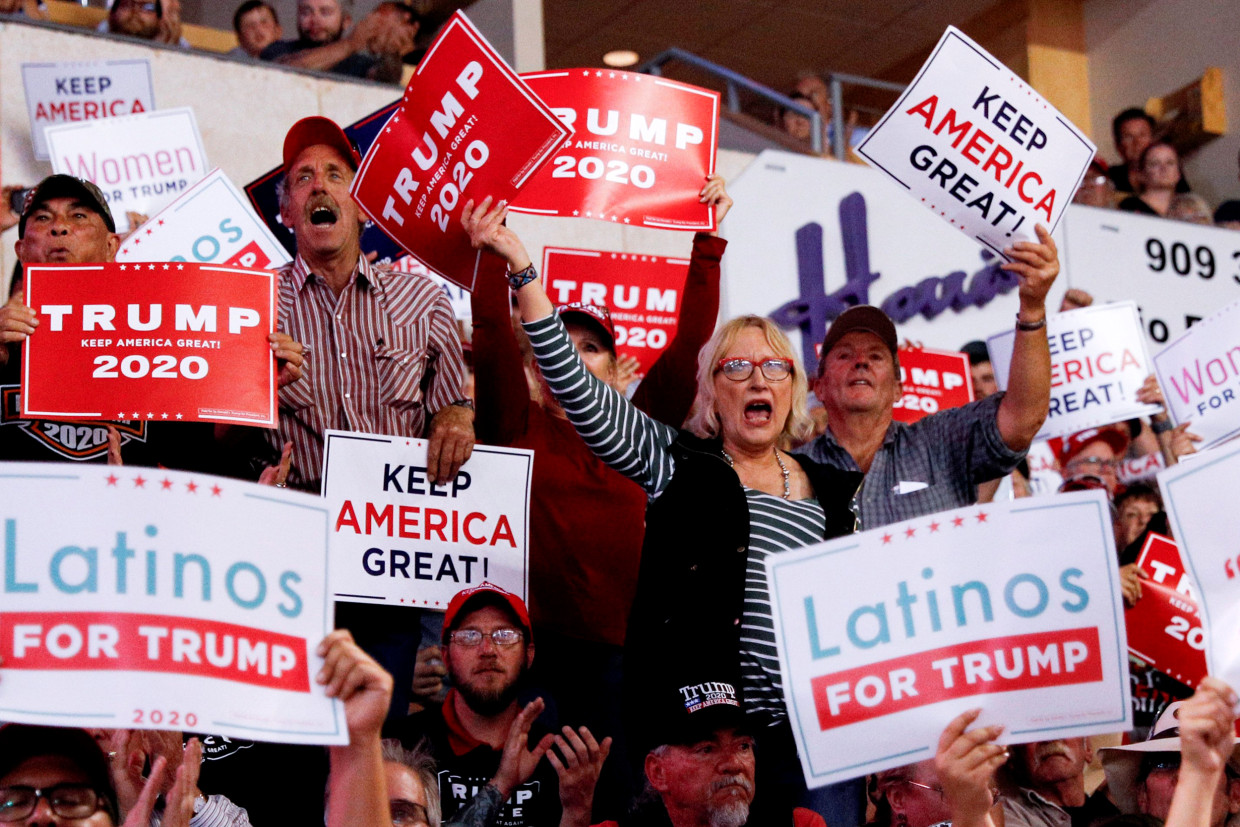
In 1988, Michael Dukakis got about 40 percent of the white vote, and 111 Electoral Votes. In 2008, Barack Obama got about 43 percent of the white vote, yet won 365 Electoral Votes. The difference was the rise in the Hispanic vote, especially in the Western States, like Colorado, New Mexico, Nevada and Arizona.

In 1988, all 4 of those States went Republican, as they had in most elections from 1968 onward. In 1992, Bill Clinton won all of them but Arizona. In 1996, Clinton won all of them except Colorado, becoming the 1st Democratic nominee to win Arizona since Harry Truman in 1948. (As Barry Goldwater's home State, it was the only State outside the South that didn't go for Lyndon Johnson in 1964.)

In 2000, out of those 4 States, Al Gore won only New Mexico. In 2004, John Kerry lost them all. But in 2008, Obama won all of them except Arizona, and probably would have won that if it hadn't been the home State of his opponent, John McCain. In 2012, again, Obama won all but Arizona. In 2016, Hillary Clinton won all but Arizona. In 2020, Joe Biden won all 4.

Obama turning those States in 2008 led to the thought that, by 2020, the Democrats could take Florida and Texas. If so, it would have been ballgame over for the Republicans -- and also for the Electoral College, because the only things saving them from total wipeout were Florida and Texas, so they would have supported scrapping it.

Now we see that Florida and Texas are lost causes. And if the Republicans can hold the Hispanic male vote in 2028, that means the Democrats can no longer count on the cities to save certain States for them, and it's ballgame over for them.

What can Democrats do between now and November 7, 2028? First, watch as Trump's policies hurt everybody. Second, show the Hispanic men that those policies have particularly hurt them and their families. And nominate someone who can, both literally and figuratively, speak their language. Then, the Democrats can get back to where they were from 2008 to 2020.

Thursday, October 27, 2022

October 27, 1922: Ralph Kiner Is Born

October 27, 1922, 100 years ago: Ralph McPherran Kiner is born in Santa Rita, New Mexico, about 150 miles northwest of El Paso, Texas. He was 4 years old when his father died, and his mother moved him to the Los Angeles suburb of Alhambra, California, and he grew up there.

As his contemporary Duke Snider pointed out, the Southern California weather enabled kids to play baseball all year long, which led to the Pacific Coast League (including the less-weather-friendly Oregon and Washington State) producing a seemingly endless stream of baseball talent, which continues to this day. It's why the College World Series is dominated by the Sun Belt: California teams, Arizona teams, Texas teams, Louisiana State, Mississippi State, Alabama, Auburn, Georgia Tech, Florida teams.

Ralph was signed by the Pittsburgh Pirates, played in the low minors in 1941 and '42, and in 1943 was a member of the first sports team to be named the Toronto Maple Leafs, then the Pirates' top farm team. But World War II was raging, and his country called.

When he came back from serving as a pilot in the U.S. Navy, he was 23 years old, and ready to make the big club. On April 16, 1946, he made his major league debut for the Pirates, against the St. Louis Cardinals at Sportsman's Park. Batting 3rd and playing center field, he had a single and a walk in 5 trips to the plate. The Pirates won, 6-4, a bump in the road for the Cardinals, as they went on to win their 4th Pennant and 3rd World Series in a 5-year stretch. He hit his 1st major league home run 2 days later, on April 18, in the top of the 8th off the Cardinals' Howie Pollet. But the Cards won that game, 6-2, as Stan Musial also homered.

After that, Ralph was mainly a left fielder. He wore Number 43 in his rookie season, the last year in which the Pirates wore red, white & blue uniforms. In 1947, he was given Number 4, and the Pirates wore blue & white. In 1948, they switched to black & gold, the same colors as the football team that had been named for them but was now called the Steelers, and they have worn those colors ever since.

In that 1st season, 1946, he led the National League by hitting 23 home runs, a pretty good total for a man whose home games were in Pittsburgh's Forbes Field. "The Old Lady of Schenley Park," home to the Buccos from 1909 to 1970, had dimensions very close to those of the pre-renovation, 1923-73 version of Yankee Stadium: Close in the right-field corner, but pretty distant everywhere else. Left field was 360 feet away, its furthest point was 462 to left-center, and straightaway center was 442. Terrible conditions for a righthanded hitter, which Ralph was.

But in '46, Ralph was just getting warmed up. In 1947, the Pirates brought in Hank Greenberg, the great slugger of the Detroit Tigers, making him baseball's 1st $100,000 a year player. (That's about $1.33 million in today's money, meaning, compared to today's players, even the highest-paid player in the game's history to that point was underpaid.) To help him out, the Pirates put an inner fence in left field, in front of Forbes' familiar scoreboard, reducing the left-field pole from 360 to 335. The area between the fences was called Greenberg Gardens. After playing in '47, Greenberg retired, and the area was renamed Kiner's Korner. The inner fence was removed after he was traded.

Kiner always credited Greenberg with making him a better hitter, and the results speak for themselves: 23, 51, 40, 54, 47, 42, 37, 35. Those were his seasonal home run totals from 1946 to 1953, making him easily the best slugger in the National League during the Truman Administration.

Those 54 homers in 1949 were the most by a National Leaguer between Hack Wilson's 56 in 1930 and Mark McGwire's 70* in 1998. It's a total that was never reached by Lou Gehrig, Joe DiMaggio, Ted Williams, Stan Musial, Willie Mays, Ernie Banks, Hank Aaron, Frank Robinson, Harmon Killebrew, Reggie Jackson or Mike Schmidt -- and only once by Mickey Mantle.

Indeed, from 1938, when Greenberg hit 58, until 1997, when steroids allowed McGwire and others to rewrite the record book, the only player who hit more than that in a season was Roger Maris, his "61 in '61" breaking Babe Ruth's 1927 record of 60.

As Hall of Fame pitcher Warren Spahn said, "Ralph Kiner could wipe out your lead with one swing."

The Pirates' broadcasters at the time were Bob Prince, a.k.a. "The Gunner," and Albert "Rosey" Rowswell, the man who nicknamed the Pirates "the Buccos." (A "buccaneer" was a kind of privateer, not quite a pirate.) These men were the other kind of "homers," broadcasters favoring the home team, to the extent that they made Yankee mikemen Mel Allen, Phil Rizzuto and John Sterling sound objective by comparison. Rosey, who grew up outside Pittsburgh, claimed not to have missed a Pirates home game since 1909, the year Forbes Field opened and Honus Wagner led them to win the World Series for the first time.

Rosey had a trick: When a Pirate hitter, more often Kiner than anyone else, would hit a ball that looked like it would be a home run, he imagined an old lady whose house faced Forbes Field, and he would yell, "Open the window, Aunt Minnie, here it comes!" Then Prince, or whoever was handy at the moment, would drop a box full of items to make it sound like glass was breaking, and say, "Too late!" (I've also heard that Rosey would smash a light bulb there in the broadcast booth, but that sounds a little too dangerous.)

On Opening Day of the 1948 season, the year after Kiner hit 51 to set a club record (which he would break in '49), entertainer Bing Crosby, a minority owner of the Pirates, was in the booth with Rosey, but he kept talking through a Kiner swing, and Rosey had to interrupt him: "Open the window, Aunt Minnie!... There it goes, clean clear over the scoreboard! Home run for Ralph Kiner, his first of the 1948 season! Let's hope it's the first of 61!"

Rosey died on the eve of the 1955 season, by which point his Aunt Minnie routine could be seen as just an act, because television was beginning to take over, and fans watching at home could see that there was nothing but parkland for a few blocks beyond the left and center field fence, until the Carnegie Museum, which can be seen behind that scoreboard in the famous photo of Bill Mazeroski's home run that won the 1960 World Series.

In spite of Ralph's home run heroics, the Pirates were a bad team. In 1952, they lost 112 games, the most of any NL team between the 115 of the 1935 Boston Braves and the 120 of the 1962 Mets. In The Road to Bali, one of the "Road Pictures" he made with his pal Bob Hope (himself a minority owner of the Cleveland Indians at the time), Dorothy Lamour asked Bing, "Do you still have pirates in America?" And Der Bingle said, "Yes, but they're in the basement."

Branch Rickey, the man who built championship teams in St. Louis and Brooklyn, and was now the general manager in Pittsburgh. It was said, "He had money and players, and didn't like to see them mix."

And on June 4, 1953, Rickey traded Ralph to the Chicago Cubs, along with fellow future broadcaster Joe Garagiola, George "Catfish" Metkovich, and, ironically, the man who had given up Ralph's first homer, Howie Pollet.

In exchange, he got 6 players and $150,000. The only player of the 6 who might be familiar to a New York fan was the former Brooklyn outfielder Gene Hermanski, by then washed up. Rickey wanted Hermanski to take over in left field, but he really wanted the money, and Cubs owner Phil Wrigley, he of the chewing-gum fortune, was one of the few among the 16 team owners who was willing to spend it -- not that it did him much good after 1945.

Ralph didn't want to go. He liked Pittsburgh. The Pittsburgh fans loved him. But he made $90,000 in 1952 -- the highest in the game at that point, as Greenberg and Joe DiMaggio, the 2nd $100,000 man, had retired; and Ted Williams, the 3rd, only got about $25,000 of his scheduled $125,000 that year before the Marines called him to Korea. Ralph's 1952 $90,000 works out to a shade over $1 million today.

Looking to not have to pay him a similarly huge sum, or more, in the future, Rickey told him, keeping in mind that 8th place was last in the League at the time, "We finished 8th with you, and we can finish 8th without you."

Of course, putting a power hitter in Chicago's Wrigley Field, with its close power alleys and its wind frequently blowing out, should have helped Ralph a lot. It did, at first. And, like Greenberg did for him, he was able to help out a young player just coming up: Ernie Banks, who would go on to become one of the best sluggers in baseball in the late 1950s and all through the 1960s.

But a back injury made it hard for Ralph to swing. After the 1954 season, the Cubs sent him to the Cleveland Indians for pitcher Sam Jones. A rare good move for the Cubs, as Jones, that next season, became the 1st black pitcher to throw a no-hitter in the major leagues.

But the Indians' GM at this point was Ralph's mentor, Greenberg, and he thought Ralph could help the Tribe, who had won the American League Pennant, but were under no illusions about the Yankees trying to reclaim it (which they did).

Ralph wore Number 9 for the Indians, but his back injury limited him to 390 plate appearances. That, and the distant fences at Cleveland Municipal Stadium, limited him to a .243 average, 18 homers and 54 RBIs. In other words, when he could play at all, he could still hit the ball a long way. But, like Greenberg, a bad back led him to call it a career early.

The same thing would happen to his Indians teammate, Al Rosen. Those back injuries meant that none of them got the career statistics necessary to get them into the Hall of Fame in the early years of their eligibility. Greenberg and Kiner lived long enough to make it and enjoy it. Supporters of Rosen, also dead now, are still waiting.

Kiner was just short of 33 years old when he played his last game, on September 25, 1955 -- 3 days before Jackie Robinson stole home plate, in the World Series, 5 days before James Dean was killed in a car crash, 6 days before The Honeymooners premiered on CBS, and 8 days before the Dodgers won Brooklyn's only World Series.

Years later, I was watching a Mets game, and a player had hit his first major league home run. And Tim McCarver said something shocking: "I don't remember my first major league home run. You'd think I would, since I didn't hit very many of them!" Ralph said, "I remember my first home run. I don't remember my last home run. Because, at the time, I didn't think it would be my last!"

His last home run was on September 10, 1955, off Ellis Kinder of the Red Sox at Fenway, and it was significant, since it was part of a 5-run 7th inning that gave the Wahoos a 10-7 win, their 5th straight win, moving them to a game and a half ahead of the Yankees. But they only went 6-7 the rest of the way, and finished 3 games back. It was the only Pennant race Ralph ever played in. (Ted Williams didn't homer in the game, but he did go 3-for-5 with an RBI.)

Greenberg didn't forget his friend, though, and appointed him as GM of the Indians' top farm team at the time, the San Diego Padres of the PCL. (The major league team with that name replaced them in 1969.) He'd be working a 2 1/2-hour drive from home in Los Angeles. It looked like, again, Ralph was following Hank's path.

But in 1961, the Chicago White Sox -- for whom Greenberg was now the GM -- offered him a broadcasting post. This was something Greenberg hadn't done. The next year, the expansion New York Mets offered him one of their initial broadcasting slots.

*

Ralph was a one-dimensional player. He couldn't hit for average. He was one of the slowest players in the game at the time. He didn't embarrass himself in the field, but had he played in the AL after 1973, he would likely have been a designated hitter.

But what a job he did in that one dimension. He led the NL in homers every season from 1946 to 1951, had 7 100+ RBI seasons including a League-leading 127 in 1949, led the NL in on-base percentage once and in slugging percentage 3 times.

His career home run total was 369. That may not sound like much, but, keep in mind, he was limited -- by war at the beginning, and by injury at the end -- to just 10 seasons. Now, doubling his career to 20 seasons wouldn't necessarily have doubled his career total to 738 -- more than Babe Ruth had, but less than Hank Aaron and Barry Bonds ended up with -- but 500 certainly wasn't out of the realm of possibility, even if he had played the rest of his career in "Cavernous Cleveland Stadium."

Knowing Greenberg, he might have brought Ralph to the White Sox, whose Comiskey Park wasn't exactly conducive to sluggers, although, in 1959, with Ted Kluszewski bopping 'em out, they won the Pennant. A healthy Ralph Kiner, then approaching his 37th birthday, could have made a difference in the World Series, even if only in a veteran's pinch-hitting role like the Yankees had in that decade with Johnny Mize and Enos Slaughter.

To put those 369 homers in another light: At the time he retired, in 1955, it was 6th all-time, behind Ruth's 714, Jimmie Foxx's 534, Mel Ott's 511, Gehrig's 493, and the still-active Williams' 394 (of the 521 with which he would finish). Among righthanded hitters, only Foxx had more; among NL hitters, only Ott did. DiMaggio had 361, Mize 359. Musial would end up with 475, but, at the time, had only 325. Kiner's homer rate was, until the Steroid Era, 2nd only to Ruth's.

Ralph has often been cited as being the player who said, "Home run hitters drive Cadillacs, singles hitters drive Fords." The line actually predates him, but he did add to it, by explaining why he wouldn't choke up on the bat to try to raise his average: "Cadillacs are down at the end of the bat."

Hits: 1,451 -- meaning he should have had about 2,500, which wouldn't have gotten him into the magic circle of 3,000, but would have put him ahead of Mantle's 2,415 and DiMaggio's 2,245. Batting average: .279, nothing special. On-base percentage: .398, which is very good. (He walked at least 98 times in 7 different seasons.) Slugging percentage: .548 -- at the time, 10th, trailing only Ruth, Williams, Gehrig, Foxx, Greenberg, DiMaggio, Rogers Hornsby, Mize and Musial. OPS+: 149, meaning he was 49 percent better at producing runs than the average player in his time.

Unfortunately, that shortened career, and people by that point knowing him mainly as a broadcaster, nearly kept him out of the Baseball Hall of Fame. Those 10 seasons in the major leagues meant that he met the minimum requirement for election (which has been waived in a few special cases, such as Negro League players). And by 1971, by which point 11 players had joined the 500 Home Run Club, his 369 no longer seemed like such a big number.

It wasn't until 1975, his 15th and last year on the Baseball Writers' Association of America (BBWAA) ballot, that he got the necessary 75 percent of the ballots to be elected -- and, even then, he got 273 votes, 2 more than the 75 percent needed. (Had he missed out that time, he would have had to wait a few years, until he was eligible through the Veterans' Committee.)

Even then, he had to wait 45 minutes to find out. Why? Because Jack Lang, the sportswriter whose job it then was to call the newly-elected to tell them that they had, in fact, been newly elected, kept calling him, and calling him, and calling him, but kept getting a busy signal. Why? As Ralph explained when Jack finally got through to him, his mother-in-law had been calling him every 5 minutes to ask if he'd made it on this last try.

The Pirates would eventually retire his Number 4. The Sporting News listed him at Number 90 on their end-of-the-century list of the 100 Greatest Players, and he was a finalist for the Major League Baseball All-Century Team. In 1995, in his book Ted Williams' Hit List, Ted named him one of the Top 20 Hitters of all time. He has been honored with a statue in his hometown of Alhambra.

He was introduced, along with many of the All-Century Team finalists, before the 1999 All-Star Game at Fenway Park, and with 48 of the other 60 living Hall-of-Famers before the 2008 All-Star Game at Yankee Stadium.

*

Bing, knowing Ralph was both a Southern Californian and a highly-paid, highly-eligible bachelor, set him up with some of Hollywood's finest. In 1949, he accompanied 17-year-old Elizabeth Taylor to the premiere of Twelve O'Clock High. He dated Ava Gardner, before she married Frank Sinatra.

You may remember the 1994 film Angels In the Outfield, which used the California Angels as the team that needed divine intervention. It was a remake of a 1951 film, which used the then-downtrodden Pirates, and Ralph was in it. It starred Janet Leigh -- before she married and divorced Tony Curtis, became the mother of Jamie Lee Curtis, and got hacked to death in Psycho by Anthony Perkins, who played ballplayer and eventual broadcaster Jimmy Piersall in Fear Strikes Out -- and Ralph was her date for the premiere.

Shortly after that premiere, Ralph got married for the 1st of 3 times, to tennis player Nancy Chaffee.
Greenberg was his best man. That year, Nancy was ranked Number 4 in the world among female players, and she and Patricia Todd reached the Finals in the U.S. Open ladies' doubles. The year before, she'd reached the Semifinals of ladies' singles at the U.S. Open and the Quarterfinals at Wimbledon. But that was as close as she ever got to winning a major, since, by her own admission, she now liked Ralph more than she liked tennis.
Together, she and Ralph had 3 children. Possibly encouraged by Greenberg, who was good at the game, he took up tennis as well. In a memoir, Baseball Forever, Ralph mentioned that he once beat her in tennis. Only once. "Of course," he added, "she was 8 months pregnant at the time." They eventually divorced, and she married another sportscaster, Jack Whitaker. She even became an announcer herself. She died of cancer in 2002, at the age of 73.

Ralph later married a woman named Barbara George, which also ended in divorce. A 3rd marriage, to DiAnn Shugart, lasted for the rest of her life. He would eventually have 5 children, who, between them, presented him with 12 grandchildren.

*

Like Phil Rizzuto, Richie Ashburn, Herb Score, and some other players, it could be said that the demarcation line between whether you're old yet or not could be if you remember Ralph Kiner as a player, or only as a broadcaster. That's no longer the case: If you remember him as a player, you're probably at least 75 years old.
But 3 generations of New York sports fans got to know him only as a broadcaster -- although, unlike those other men, not for any of the teams for which he played. He joined the original Mets broadcast team, with Lindsey Nelson and Bob Murphy. As those 2 men were eventually honored with the Hall of Fame's recognition for broadcasters, the Ford Frick Award, it could be said that the Mets had an all-Hall of Fame broadcast team from 1962 to 1979 -- 18 seasons.

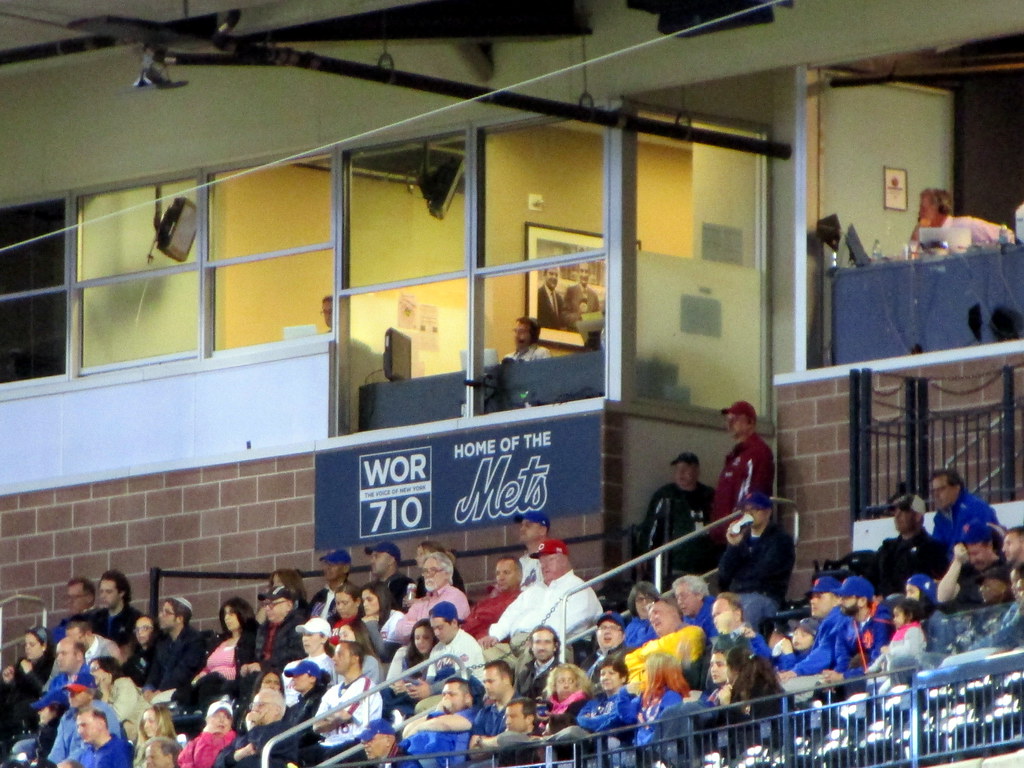
Ralph broadcast with Lindsey and Murph on WOR-Channel 9, which had been the Dodgers' station from 1950 until they left Brooklyn after the 1957 season. That triad took Met fans through the awful beginnings of the team at the Polo Grounds, the early days when the biggest draw at the brand-new Shea Stadium was the stadium itself; and on through the "miracle" World Championship season of 1969, the Pennant year of 1973, and the collapse of 1977, caused by team president M. Donald Grant's salary dumps, by which point attendance dropped so much, Shea began to be called "Grant's Tomb."

In 1980, Nelson Doubleday and Fred Wilpon bought the team, and brought in Frank Cashen as GM, and the Mets began to climb out of the hole. With Nelson retiring, and Murphy now mainly doing radio, there was a new team of Kiner, former major league catcher Tim McCarver, and Steve Zabriskie. Upon his retirement as a player, Rusty Staub joined them on Channel 9, which became WWOR in 1987.

This was the Mets' greatest period, where they finished 1st or 2nd in the NL Eastern Division every year from 1984 to 1990, including the 1986 World Championship, which remains the franchise's last. In fact, a one-day's delay due to rain meant that they won it on October 27, which was Ralph's 64th birthday.

Starting in 1963, Channel 9 began airing Kiner's Korner, hosted by Ralph, usually as a postgame show or between games of doubleheaders. The show ran until 1995, and old episodes can now be seen on SNY -- something you can't see on the Yankees' YES Network, since they had no equivalent show on WPIX-Channel 11; or, if they did, none of the broadcasts have survived.
Bob Murphy, Lindsey Nelson in one of his hideous sportsjackets,
and Ralph in the Kiner's Korner studio at Shea Stadium

Ralph was an expert interviewer, and occasionally a great caller of games. He was credited with a line that actually originated with Dan Hafner of the Los Angeles Times in 1978: Saluting the Gold Glove center fielder for the Philadelphia Phillies, by saying, "Two-thirds of the Earth is covered by water. The other third is covered by Garry Maddox."

It's lucky he didn't goof, and call him "Elliott Maddox." It would have been an easy mistake to make, since Elliott played center field for the Mets, and Ralph saw him a lot more.

It would have been especially easy for Ralph to make that mistake. Like Herb Score of the Indians, Jerry Coleman of the Yankees and Padres, and a few others, he dropped some beauts in his time on the air. A few times, he began a broadcast with, "Hello again, everybody, and welcome to New York Mets baseball. I'm Ralph Korner."

Another time, he opened a broadcast with, "Hello, again, everybody. Welcome to New York Mets baseball. I'm Ralph Kiner, along with Tim MacArthur." After the game, which the Mets lost, Tim McCarver said, "You know, Ralph, Douglas MacArthur said, 'Chance favors the prepared mind,' and the Mets obviously weren't prepared tonight." Ralph said, "He also said, 'I shall return,' and so shall we, right after these messages."

You know the old legal disclaimer given during baseball telecasts? "This copyrighted telecast is presented by the authority of Major League Baseball, and is intended solely for the private, noncommercial use of our audience. Any rebroadcast or retransmission of the pictures, descriptions and accounts of this game, without the expressed written consent of the New York Mets and Major League Baseball, is similarly prohibited." Ralph had trouble with the word "similarly," until he changed it to "likewise prohibited." (I always heard Yankee announcers Phil Rizzuto, Frank Messer and Bill White say it as "strictly prohibited.")

Among the inept early Mets was 1st baseman Marv Throneberry. Among the Mets who didn't make it to the 1986 title was former Cincinnati Reds slugger George Foster. Once, Ralph called Darryl Strawberry "Darryl Throneberry"; another time, "George Strawberry." On another occasion, Ralph got Darryl's name right, but one of his achievements wrong: "Darryl Strawberry has been voted to the Hall of Fame five years in a row." (He meant the All-Star Team. Darryl has not been elected to the Hall of Fame, and probably never will be.)

He once had Hubie Brooks as a guest on Kiner's Korner, but kept calling him "Mookie," as in Wilson. And he also called Hubie "Foster Brooks." (It wasn't just confusion with George Foster: Foster Brooks was a comedian who, in spite of being a teetotaler in real life, was known for his drunk act.) Calling Sid Fernandez "Sid Hernandez" was easy enough, since Keith Hernandez was also on the Mets at the time. He also once called Gary Carter "Gary Cooper." (Well, Cooper did play a Hall-of-Famer, Lou Gehrig in The Pride of the Yankees.)

When Vince Coleman was on the Mets, Ralph called him "Gary Coleman" a few times. I'm surprised he didn't call him "Ronald Colman," after an actor who was a contemporary of Gary Cooper's. But he never called him "Choo Choo Coleman," after an early Met catcher.

In a mistake that happened to Ralph, rather than because of him, he asked Choo-Choo, whose real name was Clarence, "Tell us about your wife: What's her name, and what's she like?" Choo-Choo said, "Her name is Mrs. Coleman, and she likes me." Choo-Choo and attended the Mets' 50th Anniversary celebrations in 2012, at which point, he denied that he said the famous line. The broadcast is lost, so we can't prove it either way, but it was cited in early accounts of the team. (He died in 2016.)

Ralph doubled down on one, in a game against the Pirates: Dale Berra, Yogi's son, was coming around to score. Rather than make the mistake of calling him "Yogi," he instead confused him with Pirate catcher Ed Ott (I don't see how, they looked nothing alike), and called him Mel Ott. (No relation to Ed.)

Some more choice Kinerisms:

"Tickets to all Mets home games are available in advance from Tricketron." (Admittedly hard to say, Ticketron was bought out by Ticketmaster in 1991.)

"The reason the Mets have played so well at Shea this year is, they have the best home record in baseball."

(On the other side of the coin) "All of the Mets' road wins against the Dodgers this year occurred at Dodger Stadium." (I once heard Bobby Murcer say on a Yankee broadcast, "The Detroit Tigers are very tough at home, especially when they play at Tiger Stadium.")

(On a slump by Dodger pitcher Don Sutton) "Sutton lost 13 games in a row without winning a ballgame."

"The Pirates will be a very competitive team this season because they made some great off-season accusations." (He meant "acquisitions.") 

"The Mets have gotten their leadoff batter on only once this inning." (He meant "this game.")

(Seeing Hall of Fame reliever Bruce Sutter get hurt) He's going to be out of action for the rest of his career. (He meant "the rest of the season.")

"Solo homers usually come with no one on base." (Can't argue with that one!)

"All of Rick Aguilera's saves have come in relief appearances." (Ditto.)

"Kevin McReynolds stops at 3rd, and he scores." (This is similar to "He slides into 2nd with a standup double." Both Score and Coleman are said to have used that one, but Ralph apparently never did.)

(Discussing a new Hall-of-Famer, who allegedly called himself "the straw that stirs the drink")
"Reggie Jackson called himself the spoon that stirred the cup."

(Seeing Jesse Jackson, a friend of Reggie's but not a relative of his, in the stands) "We'd like to give the Reverend Reggie Jackson a warm Shea Stadium welcome."

(Seeing the Bronx-Whitestone Bridge, visible in the distance from Shea) "It reminds me of the Golden State Bridge." (Okay, the Golden Gate Bridge is in the Golden State, but it's painted flame-red, not battleship-gray like the Whitestone.)

"Tony Gwynn was named Player of the Year for April." (He meant Player of the Month.)

"The Mets just had their first .500-or-better April since July of 1992." (I think he meant their first .500-or-better month.)

"The Mets are winless in the month of Atlanta."

(Seeing Jason Isringhausen start against Todd Stottlemyre) "This will go down in history as the game where the pitchers have the most initials." (He meant "letters.")

Ralph once blamed his malaprops on having to listen to original Met manager Casey Stengel (1962-65), and also Yogi Berra during his time as Met coach (1965-71) and manager (1972-75). Casey and Yogi, of course, were also known for their mangled syntax, although Yogi is on record as having said some doozies before he ever met Casey. And, indeed, Ralph once said, on the air, "If Casey Stengel were alive today, he'd be spinning in his grave." (He may have gotten that one from President Gerald Ford, who allegedly said it about Abraham Lincoln.)

Ralph's usual home run call was, "It is going, it is going, it is gone, goodbye!" But, like Mel Allen with, "It is going, it is going, it is gone!" and John Sterling with, "It is high, it is far, it is gone!" he would occasionally futz it up: "This one deep to right, and it is way back, going, going, it is gone, no, off of the top of the wall."

The line most often cited as the biggest Kinerism is, "On this Father's Day, we again wish you all Happy Birthday." Along the same lines, he once said of a father-and-son pair of players, "There's a lot of heredity in that family."

But the all-timer came in the late 1970s, when both the Yankees and the Mets had Manufacturers Hanover -- a.k.a. Manny Hanny, later bought out by Chemical Bank and then Chase -- as a broadcast sponsor. Anyway, Ralph ended an inning by saying, "We'll be right back, after this message from Manufacturers Hangover."

(One of Manny Hanny's previous incarnations was the Brooklyn Trust Company, which, due to the Dodgers' financial difficulties in the 1930s, owned a 1/4th share of the team's stock. In 1942, they needed to appoint a new trustee to oversee that share. They chose a 38-year-old lawyer for the company: Walter Francis O'Malley. In 1944, O'Malley bought that quarter-share from his employers, and the rest is history. The other man they considered, among the lawyers working for them, was a 35-year-old former Georgetown basketball player named William Alfred Shea. Yes, the same Bill Shea that Mayor Robert Wagner would turn to in order to help bring National League baseball back to New York, for whom the Mets' stadium was named, and who became a good friend of Kiner's. As Mel Allen would say, "How about that?")

*

Ralph attended every induction ceremony for the Hall of Fame from his own in 1975 until 2013. Of course, he even managed to goof on that on the air: "The Hall of Fame ceremonies are on the 31st and 32nd of July."

In 1986, my grandmother and I attended the induction ceremony for the first time. Ralph was seated next to Ted Williams, and all through the ceremony (at which the inductees were Willie McCovey, Bobby Doerr and Ernie Lombardi), Ted kept talking to Ralph. At one point, Ralph turned to talk to whoever was sitting on his other side... and Ted reached over and, literally, bent his ear, to turn his attention back to him. For the rest of her life, Grandma wondered what Ted was saying to Ralph.

(I attended 2 more induction ceremonies, but will never go to another. Unless a player you absolutely loved is going in, don't go. By all means, go to Cooperstown, visit the Hall and the area's other attractions. But Induction Weekend is the absolute worst time to go: A town of 1,794 (as of the 2020 Cenus) simply can't handle 100 times that many people visiting.) 

In 1995, Ralph suffered a stroke, and developed Bell's palsy. This affected the muscles in his face, leading to a small but noticeable change in his voice. Other than that, though, he continued to broadcast.

But like a lot of aging broadcasters, he began to cut back, doing only home games, and, in the last few years, going into the booth only on Friday nights or on special occasions. When Citi Field opened in 2009, the TV booth was named in his honor, and the radio booth was named in Murphy's memory.
  
Ralph Kiner died on February 6, 2014, at his home in Rancho Mirage, California. He was 91 years old. It was a remarkable life, and a career that spanned so much of baseball history. Although he had left New Mexico at age 4, he was buried there, at Greenlawn Cemetery in Farmington. 

When he played his first professional game in 1941, men like Jimmie Foxx, Lefty Grove and Mel Ott, who had begun in the 1920s, were still playing. When he broadcast his last game in 2013, he was watching players who could still be playing into the mid-2030s. That's a span of over 100 years.

Baseball Forever was the title of his memoir. "Baseball Forever," indeed.

Tuesday, September 25, 2018

Tommy McDonald, 1934-2018

One of the biggest characters, if smallest great players, in football history has left us.

Thomas Franklin McDonald was born on July 26, 1934 in Roy, New Mexico. This is a place where, to put it politely, and to use a line comedian Red Skelton once used about neighboring Texas, "They got miles and miles of nothing but miles and miles." The Census listed the population as 1,138 in 1940, and just 234 in 2010.

It's 142 miles west to Santa Fe, 174 miles southeast to Amarillo, 199 miles southwest to Albuquerque, 305 miles north to Denver, 430 miles east to Oklahoma City, 536 miles southeast to Dallas, and 614 miles southwest to Phoenix. And neither Denver, nor Oklahoma City, nor Dallas, nor Phoenix was a major league city when Tommy was growing up in the 1930s and '40s.

There ain't nothin' around by farms and ranches, and there ain't nothin' to do but work... and play football. When Tommy McDonald was in the 8th grade, his father suggested that he repeat it, because he was small and would have time to grow. Tommy agreed, so he got to Roy High School -- enrollment around 150 at the time, and long since closed because it wasn't worth keeping such a small school open -- a year behind his old classmates, but was physically and mentally a year ahead of his new classmates.

In 1950, the family moved to the big city: Albuquerque. As a sophomore, he transferred to Highland High School, but the size of the city (over 500,000) did not faze him, as he set a State points record in football, set a City scoring record in basketball, and won 5 Gold Medals in the State track meet. He could have written his own ticket, although, at the time, it would have made more sense to try for track & field at the 1956 Olympics than a sport like football or basketball, each of which puts a premium on size.

Bud Wilkinson, the football coach at the University of Oklahoma, didn't care, offering him a scholarship. Wilkinson was building one of the greatest college football teams ever, and McDonald would be one of the reasons they set a record that still stands with a 47-game winning streak, including the 1955 and 1956 National Championships. With Oklahoma's last loss coming while he was a freshman and ineligible to play on the varsity (September 26, 1953), and their next loss coming after he was already in the NFL (November 16, 1957) -- both losses were to Notre Dame -- he never played in a losing game in college.

He won the Maxwell Award as the nation's most outstanding college football player in 1956. In the voting for the better-known award, the Heisman Trophy, he finished 3rd behind Notre Dame quarterback Paul Hornung and Tennessee running back Johnny Majors. (Hornung would be better known as a Green Bay Packer running back, and Majors as the head coach at Tennessee and the University of Pittsburgh.)

McDonald was drafted by the Philadelphia Eagles in the 3rd round in 1957. Still small for a pro running back -- he was listed at 5-foot-9 and 178 pounds, but was actually just 5-foot-7 -- he was moved to wide receiver, and became a favorite target for quarterbacks Norm Van Brocklin and Sonny Jurgensen.

And he was tougher than his size would suggest. One play that survives on film shows him taking a pitchout from Van Brocklin, going around end, gaining a first down, getting hit, and spinning off the hit until he stumbles at the sideline, and knocks over a table loaded with cups of water. (No Gatorade in those days.)

"I don't like to let some big guy think he can hurt me, just because I'm small," he said. "If he gives me his best lick, and doesn't cave me in, he gets a little discouraged. I get a kick out of proving there's a place for a runt in pro ball."

The Eagle quarterbacks agreed. Van Brocklin said, "Tommy doesn't have to run a pass pattern against a defensive back. He just beats him." And Jurgensen said, "He was from another world."

In the opening game of the 1959 season, the facemaskless McDonald got his jaw broken on a hit. Doctors wired his jaw shut. He not only played the next week, he scored 4 touchdowns -- 3 receiving, 1 on a punt return -- personally outscoring the New York Giants as the Eagles beat them 49-21.

In the 1960 NFL Championship Game, against the Green Bay Packers, he caught a 35-yard touchdown pass from Van Brocklin and landed in a snowbank in the northern end of the Franklin Field horseshoe. The Eagles won, 17-13. In  1961 game against the New York Giants, he caught 7 passes for 237 yards, a team record that still stands, and 2 touchdowns.

In 1964, he was traded to the Dallas Cowboys, one of several dumb trades that new head coach and general manager Joe Kuharich made that angered Eagle fans. That season, McDonald played without a facemask, as he always had. This made him the last non-kicker to play without one. He was traded to the Los Angeles Rams in 1965, and he had to wear a facemask. He played for the Rams in 1965 and '66, the Atlanta Falcons in 1967, and the Cleveland Browns in 1968, by which point he was the NFL's active leader in receiving yards. (He was surpassed that season by Don Maynard of the Jets, but that was NFL and AFL stats combined.)

The Browns lost the 1968 NFL Championship Game to the Baltimore Colts (who then lost Super Bowl III to Maynard, Joe Namath and the New York Jets), and that was McDonald's last game. He retired the following March, 84 touchdowns receptions, then 2nd all-time, only to Don Hutson's 99. His 8,410 receiving yards were 4th, and his 495 catches were 6th. Indeed, while still an active player, in 1962, he wrote an autobiography, and titled it They Pay Me to Catch Footballs.

He was elected to the College Football Hall of Fame in 1985. In 1998, he was elected to the Pro Football Hall of Fame, way too late, but he was able to enjoy it for 20 years, and enjoy it, he certainly did. When the 5-foot-8 Barry Sanders was elected in 2004, it officially made him the shortest member of the Pro Football Hall, but since McDonald was really 5-foot-7, he was still the shortest.

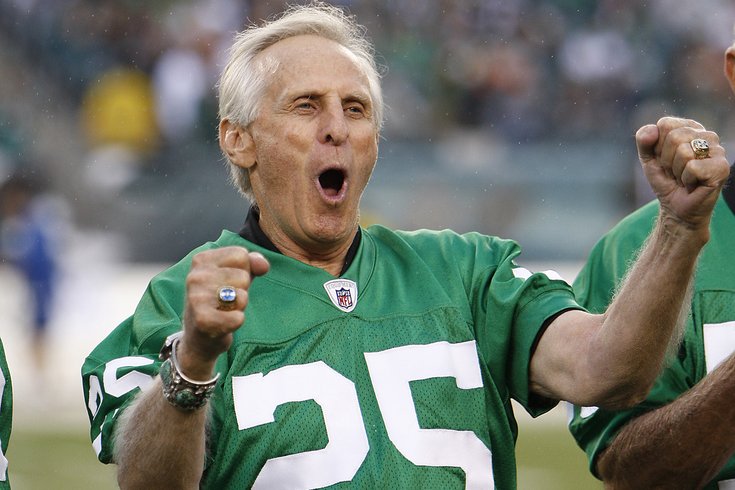
The Eagles named him to their team Hall of Fame and their 75th Anniversary Team, although his Number 25 remains in circulation. He attended the 1960 Champions' 25th, 30th and 40th celebrations at Veterans Stadium, and their 50th Anniversary celebration at Lincoln Financial Field. In spite of his size, and eventually his age, he would do backflips and chest-bumps at such gatherings in Philadelphia and Canton.
He and his wife Patricia raised 4 children in the Philadelphia suburb of King of Prussia, Pennsylvania. He became an artist, running a successful business providing portraits, particularly for athletes. In 2006, he sold a portrait of Joe DiMaggio that he painted for $4,000.

Tommy McDonald died yesterday, September 24, 2018, at age 84. He had lived long enough to finally see the Eagles end their 57-year championship drought by winning Super Bowl LII.
Eagles owner Jeffrey Lurie said, "Tommy McDonald played the game with a passion and energy that was second to nine. He will be remembered as one of the most exciting players ever to play his position. But what really separated him and made him so unique was the infections personality that he brought to his everyday life."

Rest in peace? Tommy McDonald didn't like to rest. Run in peace.

UPDATE: His final resting place is not publicly known.

Saturday, January 6, 2018

Top 10 Athletes From New Mexico

January 6, 1912: New Mexico is admitted to the Union as the 47th State.

Top 10 Athletes From New Mexico

Note: It's where they were trained to play their sport that matters, not where they were born. Sports Illustrated forgot that in 1999, when they named Ralph Kiner, born in Santa Rita, New Mexico, but grew up in Alhambra, California, as New Mexico's greatest athlete.

Auto racing is not a sport. So that eliminates the guys that SI picked 2nd (Al Unser), 5th (Bobby Unser), 8th (Al Unser Jr.) and 20th (Robby Unser, a.k.a. Bobby Unser Jr.). Golf is not a sport. So that eliminates their picks for 3rd (Nancy Lopez), 4th (Kathy Whitworth) and 15th (Rosie Jones). Rodeo is not a sport, so there goes their 6th (Everett Bowman).

So who the heck is left? Actually, it wasn't that hard to find 10 candidates. All of these people are from Albuquerque, unless otherwise stated.

10. Duane Ward of Farmington. The relief pitcher helped the Toronto Blue Jays win the 1992 and 1993 World Series. In 1993, he was an All-Star, and led the American League in saves. He retired with a record of 32-37, and 121 saves.

9. Cathy Carr. Not to be confused with the Bronx-born pop singer who used that stage name in the 1950s, this Cathy Carr swam her way to 2 Gold Medals at the 1972 Olympics in Munich. She is a member of the International Swimming Hall of Fame.

8. Ralph Neely of Farmington. An offensive tackle, he was a 4-time All-Pro who played on the Dallas Cowboys' Super Bowl VI and XII winners. He was named to the NFL's 1960s All-Decade Team.

7. Johnny Tapia. "The Baby-Faced Assassin" won his 1st boxing title in 1994, the WBO Super Flyweight title; and held his last in 2002, the IBF Featherweight title. Among the fighters he beat were WBA Bantamweight Champions John Michael Johnson, Nana Konadu and Jorge Eliécer Julio; and WBC and IBF Featherweight Champion Manuel Medina. His career record was 59-5-2.

6. Jim Everett. If you only know him from Nike's 1989 commercial with Bo Jackson (he was the guy saying, "Bo knows football"), and from kicking Jim Rome's ass on-camera when Rome called him "Chris Evert" (after being warned not to), you should know he was a terrific quarterback, one in a long line of them at Purdue University.

He led the Los Angeles Rams to the 1989 NFC Championship Game, and is the franchise's all-time leader in passing yards -- ahead of Bob Waterfield, Norm Van Brocklin, Roman Gabriel, Pat Haden, Vince Ferragamo, Jeff Kemp, Trent Green, Kurt Warner, Marc Bulger, Sam Bradford and, for the moment, Jared Goff. He made the Pro Bowl in 1990.

5. Brian Urlacher of Lovington. An All-American linebacker, the University of New Mexico retired his Number 44. Switching to Number 54 with the Chicago Bears, he was NFL Defensive Rookie of the Year in 2000, Defensive Player of the Year in 2005, and an 8-time Pro Bowler.

He helped the Bears win the 2006 NFC Championship, and was named to the NFL 2000s All-Decade Team. He is about to become eligible for the Pro Football Hall of Fame.

4. Tom Brookshier of Roswell. A 2-time Pro Bowl cornerback, he helped the Philadelphia Eagles win the 1960 NFL Championship. They retired his Number 40 and inducted him into their team Hall of Fame. But he is not yet in the Pro Football Hall of Fame, not even for his fine broadcasting career, and he is no longer alive to accept election.

3. Mike E. Smith of Roswell. In 1991, he became one of the few American thoroughbred jockeys to win a major European race, riding Fourstars Allstar to win the Irish 2,000 Guineas.

His 5,400 wins include the 1993 Preakness Stakes aboard Prairie Bayou, the 1997 Breeders' Cup Classic aboard Skip Away, the 2005 Kentucky Derby aboard 50-1 longshot Giacomo, the 2009 Breeders' Cup Classic aboard Zenyatta, the 2010 Belmont Stakes and the 2011 Breeders' Cup Classic aboard Drosselmeyer, the 2013 Belmont Stakes aboard Palace Malice, and the 2016 Breeders' Cup Classic aboard Arrogate.

He won the Eclipse Award for American jockey of the year in 1993 and 1994, and is a member of the National Museum of Racing and Hall of Fame.

2. Tommy McDonald of Roy. It's strange that New Mexico produced 2 members of the 1960 NFL Champion Philadelphia Eagles, due to the size of the State -- its population of 2.1 million is not much larger than that of the City of Philadelphia now, and it had fewer people than Philly then -- and the distance between the places. McDonald scored a touchdown in the Championship Game against the Green Bay Packers, falling into a snowbank at Franklin Field.

He played for the University of Oklahoma during its record 47-game winning streak, never losing a college game, and winning National Championships in 1955 and 1956. He finished 2nd in the voting for the 1956 Heisman Trophy, to Paul Hornung of Notre Dame, so that '60 title game win over Hornung and the Packers was a little bit of revenge for him.

He was a 6-time Pro Bowler. In 1964, by then playing for the Dallas Cowboys, he became the last man other than a kicker or a punter to play in the NFL without a facemask. He finished his career with 495 catches for 8,410 yards and 84 touchdowns, huge numbers for that era.

At 5-foot-9, he was the shortest player in the Pro Football Hall of Fame until Barry Sanders was elected, and he is also a member of the College Football and Philadelphia Eagles Halls of Fame. He is also an artist, and sold a portrait of Joe DiMaggio that he painted for $4,000.

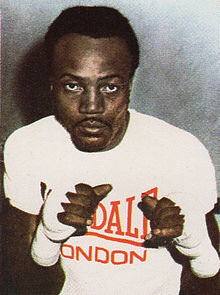
1. Bob Foster. "The Deputy Sheriff" was Light Heavyweight Champion of the World from 1968 to 1974, and retired rather than lost it. Among the fighters he beat were former Middleweight Champion Dick Tiger and WBA Light Heavyweight Champion Vicente Rondón.
In 1970, he fought Joe Frazier for the Heavyweight Championship, but lost. He also lost a non-title bout to Muhammad Ali in 1972. He is a member of the International Boxing Hall of Fame.

Saturday, September 2, 2017

How to Go to a Football Game in New Mexico

36 States down, 14 to do. On Saturday, September 9, the University of New Mexico hosts its cross-State rival, New Mexico State University, in football, in a matchup known as the Rio Grande Rivalry.

Before You Go. A very common, and very stupid, mistake is that New Mexico is part of Mexico. Not since the Treaty of Guadeloupe Hidalgo in 1848, it isn't. UNM is in Albuquerque, 268 miles from El Paso, Texas and the Mexican Border. NMSU is in Las Cruces, which is considerably closer: 44 miles. But that's still nearly an hour's drive north of the Border.

You do not need to bring a passport to visit either of these schools' campuses. (Campii?) Nor do you need to change your money, as they use American dollars. And while an ability to use a few Spanish phrases might help, a working knowledge of the language is hardly necessary.

New Mexico is mostly desert. In September, it's going to be hot. But by late October, the nights could be cool, and in November, actually cold. Be prepared.

New Mexico is in the Mountain Time Zone, 2 hours behind New York. (So is the El Paso region, the one part of Texas that's not in the Central Time Zone.) Adjust your timepieces accordingly.

Tickets. UNM averaged about 19,000 fans per home game last season, leaving their stadium only about half-full. NMSU did even worse: Last year's game between the teams was their only home game with more than 11,000 fans. Getting tickets will not be an issue.

At UNM, midfield seats cost $27 (bumped to $32 for the NMSU game), corner seats are $22 ($27), and general admission seats in the north end are $18 ($23).

At NMSU, most lower level seats are $15, and most upper level seats are $12.

Getting There. It's 1,995 miles from Times Square in New York to Albuquerque, and 2,125 miles to Las Cruces. Your first thought is going to be to fly. Well, you're not going to get a nonstop flight from the New York area to Albuquerque International Sunport ("Sunport"? That's what they call it), and you certainly aren't going to get one to Las Cruces. You'll have to change planes, probably in Denver or Dallas. But you might be able to get a round-trip flight for under $600.

You can leave New York's Penn Station on Amtrak's Lake Shore Limited at 3:40 PM on Wednesday, arrive at Union Station in Chicago at 9:45 AM on Thursday, leave on the Southwest Chief at 3:00 PM, and arrive in Albuquerque at 3:55 PM on Friday. Round-trip fare is $464. Greyhound costs $488, but it can drop to $366 on advanced purchase. Both Amtrak and Greyhound use the Alvarado Trannsporation Center, at 320 1st Street SW, at Silver Avenue.

Amtrak doesn't go to Las Cruces. Greyhound does, for $488, as little as $357 on advanced purchase. The station is at 800 Thorpe Road, at El Camino Real Road. Warning: There appears to be no public transportation in Las Cruces, so you're either going to have to rent a car, rent a bicycle, call for taxis, or do a lot of walking. It may not be worth it.

If you decide to drive, it's far enough that it will help to get someone to go with you and split the duties, and to trade off driving and sleeping. You'll need to get on the New Jersey Turnpike, and take Interstate 78 West across New Jersey, and at Harrisburg get on the Pennsylvania Turnpike, which at this point will be both I-70 and I-76. When the two Interstates split outside Pittsburgh, stay on I-70 west.

You'll cross the northern tip of West Virginia, and go all the way across Ohio (through Columbus), Indiana (through Indianapolis) and Illinois, and cross into Missouri over the new Stan Musial Veterans Memorial Bridge.

At St. Louis, switch to Interstate 44 West, which you'll use to cross Missouri, and into Oklahoma. When you get to Oklahoma City, switch to Interstate 40 West. You'll cross Western Oklahoma and the Texas Panhandle, and go into New Mexico to Albuquerque.

If you do it right, you should spend about an hour and 15 minutes in New Jersey, 5 hours in Pennsylvania, 15 minutes in West Virginia, 3 hours and 45 minutes in Ohio, 2 hours and 30 minutes in Indiana, 2 hours and 30 minutes in Illinois, 5 hours in Missouri, 5 and a half hours in Oklahoma, 3 hours in Texas, and 3 and a half hours in New Mexico. That's 32 hours and 15 minutes. Counting rest stops, you're looking at over 40 hours.

The best way to get from New York to Las Cruces is to use the directions for Albuquerque, and then turn south on Interstate 25, the Pan American Freeway, for nearly another 4 hours. So, we're talking about a total of 36 hours, maybe 41 hours with rest stops.

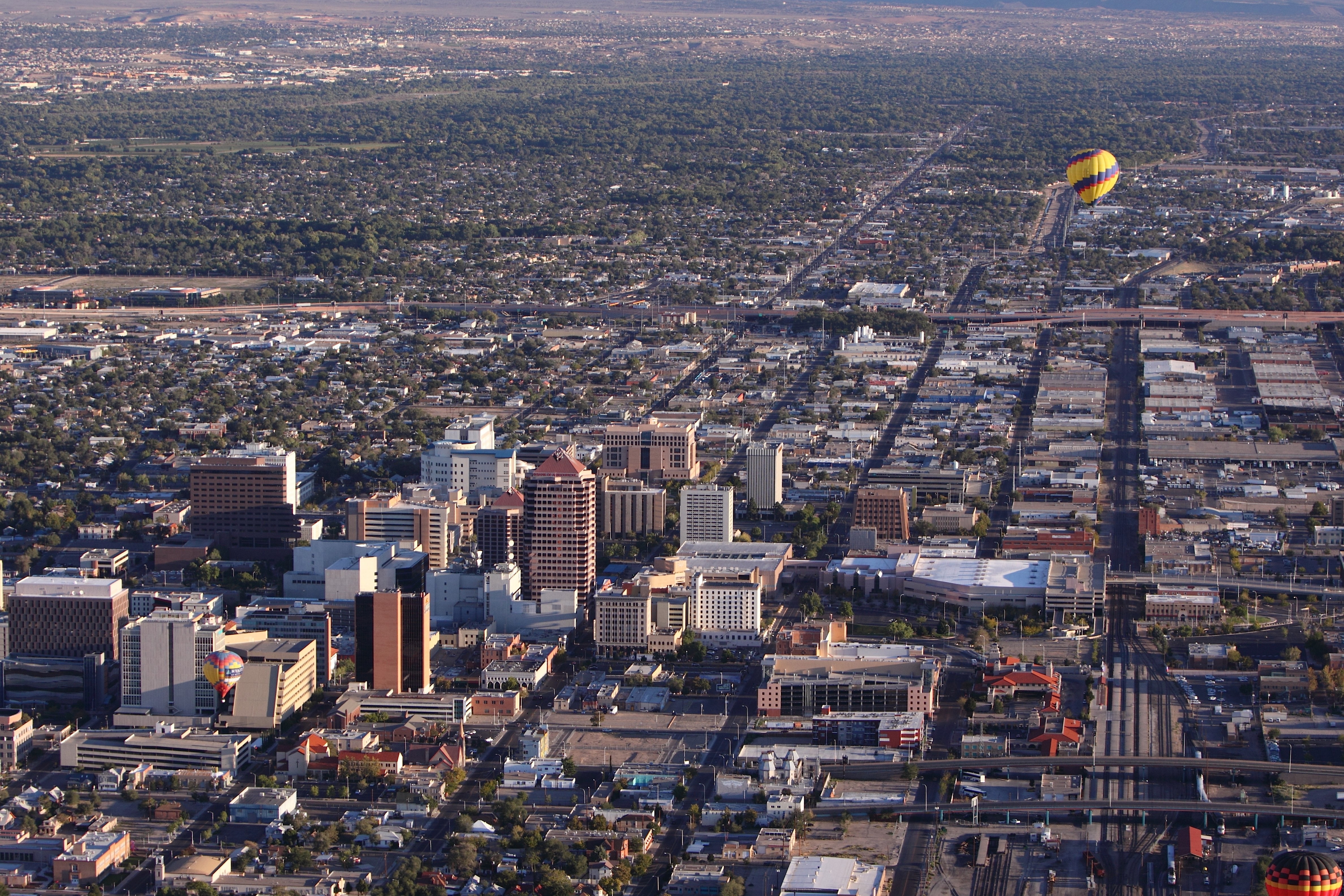
Once In the City. Obviously, New Mexico was named for Mexico. Gaining Statehood on January 6, 1912, it is home to about 2.1 million people, about 910,000 of whom live in the Albuquerque metropolitan area, and about 560,000 in the city proper.
Albuquerque, or "ABQ" for short, was named for the Dukes of Albuquerque, 2 of whom, father and son, both named Don Francisco, served as Viceroy of New Spain (including all the territory that would ever belong to Mexico, including California and the present-day American Southwest), the father from 1653 to 1660, the son from 1702 to 1710. In 1706, the son founded the city that bears the ducal name, which has stuck, long after history has recorded the father as a brutal suppressor of revolts in both North America and Europe, and long after Spain lost control of the region.
The much smaller Las Cruces is home to just under 100,000 people, was founded in 1849, and is supposedly named for 3 crosses that marked the graves of bandits on a hillside. It has been suggested that the name doesn't mean "the crosses," but "the crossroads," but, with Spanish being a gender-specific language, that would have made it the masculine form, Los Cruces.

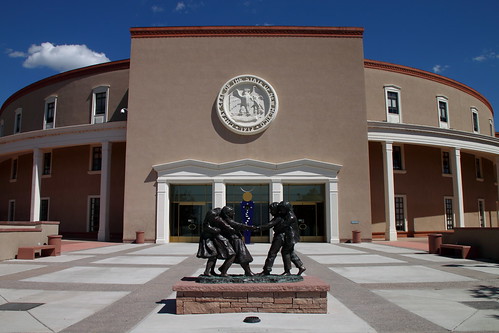
The largest newspaper in the State is the Albuquerque Journal. The State capitol is Santa Fe, about 64 miles northeast of Albuquerque, and 285 miles north of Las Cruces. A fascinating city in its own right, Santa Fe can be reached by Amtrak or Greyhound. The sales tax in New Mexico is 5.125 percent. ZIP Codes start with the digits 87 and 88, with Albuquerque using 870, 871 and 875; and Las Cruces using 880.
The State House in Santa Fe

The old Atchison, Topeka & Santa Fe Railroad (long called just "The Santa Fe" for short) divides street addresses into East and West, and Central Avenue into North and South. The city runs a commuter rail system called the New Mexico Rail Runner Express, and the ABQ Ride bus system, on which a single ride is $1.00. There is no freeway "beltway."
New Mexico Rail Runner Express, with its roadrunner logo,
at the Alvarado Transportation Center

Notable UNM graduates include:

* Sports other than Football: Basketball players Michael Cooper '78 and Luc Longley '91 and baseball player Scott Strickland '98.

* Literature: Edward Abbey '51, Rudolfo Anaya '63, historian Thomas Madden '86, historian Brian Jay Jones '89.

* Politics, representing New Mexico unless otherwise stated: Secretary of Education Shirley Hufstedler '45, Governor Bruce King '48, Governor Jerry Apodaca '53, Senator Pete Domenici '54, Governor Gary Johnson '75.

There aren't many notable NMSU graduates. The biggest one is probably the current CEO of Starbucks, Kevin Johnson.

Going In. The University of New Mexico was founded in 1880, 32 years before Statehood. Its teams are called the Lobos, Spanish for Wolves.

On May 3 of this year, Dreamstyle Remodeling, an Albuquerque-based construction business, bought the naming rights to both University Stadium and University Arena, renaming them Dreamstyle Stadium and Dreamstyle Arena.

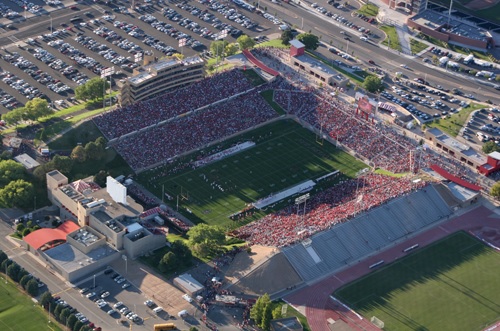
Dreamstyle Stadium is at 1414 University Blvd., about 2 miles southeast of downtown. Bus 36. Built in 1960, it replaced Zimmerman Field, a 16,000-seat stadium that was just south of the current Zimmerman Library -- almost making UNM what Rutgers is, a rare school that tore down a football stadium to build a library.
The 39,224-seat stadium has a horseshoe shape, open at the south end. The grass field was replaced with FieldTurf in 2012. Since 2006, it has hosted the New Mexico Bowl. It also hosted a 2005 friendly between the U.S. men's soccer team and Honduras, a 2004 qualifying match for the 2007 Women's World Cup between the U.S. and Mexico, and concerts by bands as big as the Rolling Stones, Led Zeppelin and Metallica.
UPDATE: On November 19, 2018, Moneywise compiled a list of their Worst College Football Stadiums, the bottom 19 percent of college football, 25 out of 129. Dreamstyle Stadium came in at Number 25. They cited the fact that the stadium has only bench seats, no actual chairs, and suggested that there's not much atmosphere, but also that there are some nice sunsets.

Las Cruces College was founded in 1888, 24 years before Statehood. The next year, it was renamed the New Mexico College of Agriculture and Mechanic Arts, or "New Mexico A&M." Like a lot of current and former "A&M" schools, its teams are called the Aggies. And it is one of a few of them (Oklahoma's and Mississippi's included) to go from being an A&M to a "State University," taking on the name New Mexico State University in 1960.

Aggie Memorial Stadium is at 1810 E. University Avenue, on the opposite side of Las Cruces, 9 miles south of the bus station, and 4 miles south of downtown. It opened in 1978, with a field that runs north-to-south, and artificial turf. It seats 30,343, but is rarely fille.
Food. Levy Restaurants runs the concessions at Dreamstyle Stadium. Both there and at Aggie Memorial Stadium, don't expect to find fancy stuff, although Mexican and Tex-Mex food being available wouldn't be surprising. Regardless, at both places, you're probably better off eating both before and after the game.

Team History Displays. UNM won the Border Conference in 1938; the Western Athletic Conference in 1962, 1963 and 1964; the Mountain Division of the WAC in 1997; and the Mountain Division of the Mountain West Conference last year, under Bob Davie, formerly head coach at Notre Dame.

They've never been in a major bowl game, didn't get invited to a bowl between 1961 and 1997, and didn't win a bowl between 1961 and 2007. But they did win the Sun Bowl in 1946 (beating Utah), the Aviation Bowl in 1961 (Western Michigan), and the New Mexico Bowl in 2007 (Nevada) and 2016 (Texas-San Antonio).

UNM doesn't retire uniform numbers. Notable players include running back Don Perkins (a 6-time Pro Bowler and a member of the Dallas Cowboys' Ring of Honor), defensive end Paul Smith (a 2-time Pro Bowler, played in a Super Bowl with the Denver Broncos), receiver Terance Mathis (receiver for the Jets, reached a Pro Bowl and played in a Super Bowl with the Atlanta Falcons), receiver Hank Baskett (played in a Super Bowl with the Indianapolis Colts, but probably now better known as the husband of reality-TV star Kendra Wilkinson), and, probably the best one they've had, linebacker Brian Urlacher (an 8-time Pro Bowler with the Chicago Bears, and a probably future Hall-of-Famer).

New Mexico A&M (now State) played in the inaugural Sun Bowl in nearby El Paso in 1936, playing Hardin-Simmons University of Abilene, Texas to a 14-14 tie. They returned to the Sun Bowl in 1959, beating North Texas; and 1960, beating Utah State. But they haven't been to a bowl game since, making this -- pardon the desert-themed pun -- the longest drought in NCAA FBS (Football Bowl Subdivision, what used to be called Division I-A).

They won the Border Intercollegiate Athletic Association title in 1938 and 1960, and the Missouri Valley Conference in 1976 and 1978. They now belong to the Sun Belt Conference. Their most notable former player is Charley Johnson, a quarterback with the St. Louis Cardinals, Houston Oilers and Denver Broncos in the 1960s and '70s.

The UNM-NMSU rivalry is described as "spirited." They've played each other since 1894, 18 years before Statehood, and Lobos lead it, 65-31-5. UNM also had a rough rivalry with the University of Arizona, but they stopped playing annually after the 1990 season, and now rarely play each other. NMSU's other major rival is the University of Texas at El Paso (UTEP).

UPDATE: Through the 2019 season, UNM now leads NMSU 67-31-5.

Stuff. Neither school has a big team store inside the stadium. You're better off going to the University Bookstores: UNM, at 2301 Central Avenue NE, at Cornell Street; and NMSU, at 1713 E. University Avenue, at Locust Street.

During the Game. You're a visitor, but not rooting for the visiting team. Your safety will not be an issue.

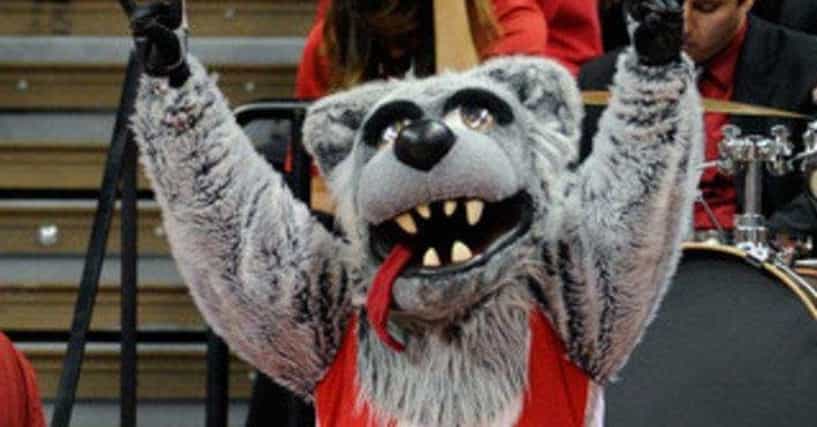
Both schools put their student sections on the east side of the stadium. The Lobos' mascot is a gray wolf named Lobo Louie, but, like Harvey the Hound at Calgary Flames games, he looks very silly with his tongue hanging out.
NMSU's slogan is "Aggie Up!" They use a cowboy, rather than a farmer as you might expect, as their "Aggie" mascot. And not just any cowboy: The costume, complete with fake mustache, is supposed resemble Frank Eaton, who was nicknamed Pistol Pete, and whose nickname would later descend on athletes Harold "Pete" Reiser and Pete Maravich. And so, NMSU's mascot is named Pistol Pete. Eaton also inspired the Cowboys mascots of Oklahoma State and the University of Wyoming.
After the Game. Assuming you didn't go out of your way to make a nuisance of yourself during the game, you will be safe on your way out.

There's not a lot of restaurants around the UNM athletic complex. You may need to go back to downtown Albuquerque.

International soccer isn't all that popular in New Mexico. Two Fools Tavern is the leading "football pub" in the State, at 3211 Central Avenue NE, about 3 miles east of downtown Albuquerque. Bus 66.

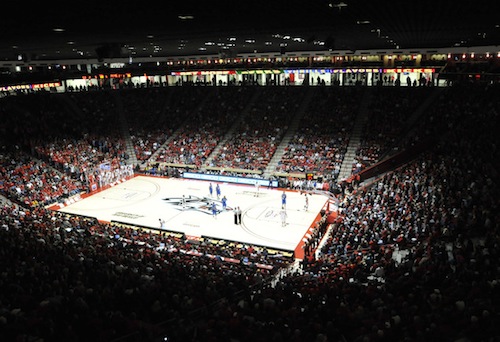
Sidelights. Dreamstyle Arena, formerly University Arena, is to the west of the Stadium, at 1111 University Blvd. SE. Most of it is below ground level, and so it is nicknamed The Pit.
The 15,411-seat arena opened in 1966, is one of the loudest venues in college basketball, and is best known as the site of the 1983 NCAA Final Four, won by North Carolina State in a big upset over the University of Houston.
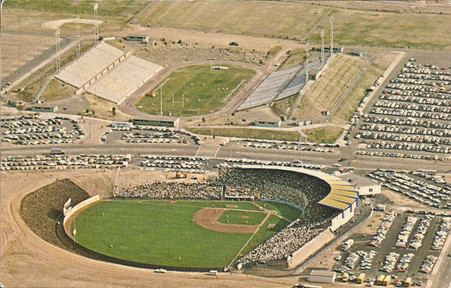
Isotopes Park is to the north of the stadium, at 1601 Avenida Cesar Chavez SE. (The legendary union leader once sold concessions at UNM's old stadium.) It was built on the site of the 10,500-seat Albuquerque Sports Stadium, which stood from 1969 to 2000.
Albuquerque Sports Stadium, with a pre-expanded
University Stadium in the background

The Albuquerque Dukes, doubly named for the city's founder, played from 1942 to 2000, winning Pennants in the West Texas-New Mexico League in 1949, 1950 and 1953; and, as the top farm team of the Los Angeles Dodgers, the Pacific Coast League in 1972, 1978, 1980, 1981, 1982, 1987, 1990 and 1994.

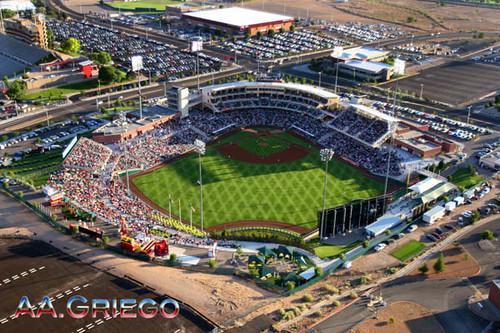
The new, 13,500-seat ballpark opened in 2003, as the home of the PCL's Albuquerque Isotopes, reflecting New Mexico's connection with nuclear power, but also as a tip of the cap to the Springfield Isotopes, the fictional team on The Simpsons. The 'Topes have won Division titles in 2003, 2009 and 2012, but, so far, no Pennants. So that's 11 Pennants for the city, but none since 1994.
Isotopes Park, with the Stadium and the Pit behind it

Until the mid-20th Century, Las Vegas, New Mexico had more people than Las Vegas, Nevada. LVNM hosted a Heavyweight Championship fight on July 4, 1912. Jack Johnson defended the title by beating Jim Flynn, when "the Fighting Fireman" was disqualified for head-butting the 1st black Heavyweight Champion. The stadium appears to have been a temporary one, with little record as to where it was. Las Vegas is 123 miles northeast of Albuquerque, and 67 miles east of Santa Fe.

Although he grew up in the Los Angeles suburbs, Pittsburgh Pirates slugger and Mets broadcaster Ralph Kiner is the all-time greatest athlete to have been born in New Mexico. He is buried at Greenlawn Cemetery, 1606 N. Dustin Avenue in Farmington, but that's 180 miles northwest of Albuquerque, near the "Four Corners," where New Mexico, Arizona, Utah and Colorado come together.

The New Mexico Museum of Natural History and Science is at 1801 Mountain Road NW. Bus 66. The National Hispanic Cultural Center is at 1701 4th Street SW. Bus 53. The Indian Pueblo Cultural Center is at 2401 12th Street NW. Bus 36. And ABQ BioPark Aquarium is at 2601 Central Avenue NW. Bus 66.

Before Breaking Bad, the most famous building in the State of New Mexico was the Norman Petty Recording Studio, home to Buddy Holly & the Crickets. 1313 W. 7th Street, in Clovis, 220 miles east of Albquerque, and 100 miles northwest of Holly's hometown, Lubbock, Texas.

Speaking of rock and roll, The Beatles never performed in New Mexico, but Elvis Presley did, mostly early in his career, when the North hadn't heard of him yet. He did an afternoon concert at the Sports Arena in Carlsbad (282 miles southeast of Albuquerque) on February 11, 1955, and then, that night, he did another show at the American Legion Hall in Hobbs, 70 miles to the east, on the Texas State Line.

The next day, he returned to Carlsbad for another show, at the Legion Hut. Two days after that, he played 2 shows at the North Junior High School Auditorium in Roswell, 200 miles southeast of Albuquerque. On April 27, 1955, he went back to the American Legion Hall in Hobbs.

He did 3 shows in Albuquerque. On April 12, 1956, he did 2 shows at the Armory (now demolished), at 5th Street and Silver Avenue, downtown. On April 19, 1972, he played Tingley Coliseum, at 300 San Pedro Drive NE, next to the Albuquerque Downs racetrack, 2 miles east of downtown. Bus 11. This 9,286-seat arena has hosted minor-league hockey, although it is mainly now used for concerts.

New Mexico has never produced a President, or a Vice President. The closest it's come is Bill Richardson, former Congressman, Governor, Secretary of Energy, and U.S. Ambassador to the United Nations, who ran for President in 2008.

The tallest building in New Mexico is the Albququerque Plaza Office Tower, at 201 3rd Street NW, downtown, just 351 feet tall.

The only well-known TV shows set, or filmed, in Albuquerque are Breaking Bad and its spinoff Better Call Saul. The house used as Walter White's residence is at 3828 Piermont Drive NE, about 6 miles northeast of downtown. Bus 8. It remains a private residence, so don't bother anyone, and especially don't throw a pizza on the roof. Seriously: The owner has publicly complained about people throwing pizzas onto his roof, like Walter did.

Most of the films set, and shot, in New Mexico have been Westerns, many of them involving outlaw Henry McCarty, a.k.a. William H. Bonney, a.k.a. Billy the Kid: The Outlaw, The Left Handed Gun, Pat Garrett and Billy the Kid, Young Guns. (Billy, the 1880 equivalent of a hitman, was actually righthanded, the misperception based on a reversed photograph of him, and probably killed no more than 4 men.)

Sergio Leone and Clint Eastwood filmed the Man With No Name Trilogy (For a Fistful of Dollars, For a Few Dollars More, and The Good, the Bad, and the Ugly) in New Mexico. Films about the alleged UFO crash in Roswell have been filmed nearby, although the alien-themed TV show Roswell was filmed in Southern California. And the High School Musical films were set at East High School in Albuquerque.

*

New Mexico doesn't have a lot of people, but its interest far exceeds that. And a football or basketball game at the University of Mexico can be a fun experience.

Tuesday, March 25, 2014

Arizona's All-Time Baseball Team

While the University of Arizona and Arizona State University have produced many great baseball players, this list only includes players who were trained (if not necessarily born) in Arizona or New Mexico -- plus El Paso, Texas, which is 429 miles from Phoenix but 747 miles from Houston.

And the lineup that this produces is far lesser than a combined Wildcats/Sun Devils team would be. Or even, by this point, an all-time Arizona Diamondbacks team.

22. Arizona's All-Time Baseball Team

Each of these players is from Arizona, rather than New Mexico or the El Paso area, unless otherwise stated.

1B Paul Konerko of Scottsdale. Having just turned 38, the Chicago White Sox slugger has announced his retirement at the end of this season. He comes into it with 434 home runs, a 119 OPS+, and 6 100-RBI seasons (nearly 7). He's a 6-time All-Star, and has helped the Pale Hose reach the postseason 3 times, including the 2005 World Championship.

2B Ian Kinsler of Oro Valley. After 8 years with the Texas Rangers, he was traded to the Detroit Tigers, even-up for Prince Fielder. A 3-time All-Star, he has 156 home runs. He got the Rangers into the 2010, '11 and '12 postseasons. Whether he can do the same for the Tigers remains to be seen.

Honorable Mention to Mark Grudzielanek of El Paso, Texas. Grudz only made 1 All-Star team and only won 1 Gold Glove, but he's got a .289 lifetime batting average, over 2,000 hits, and in 1997 led the NL in doubles with 54. Although best remembered as a Montreal Expo, he reached the postseason with the Chicago Cubs in 2003 and the St. Louis Cardinals in 2005.

SS J.J. Hardy of Tucson. Now 31, James Jerry Hardy has twice been named an All-Star and twice a Gold Glove. In 9 years, mostly with the Milwaukee Brewers and the Baltimore Orioles, he's got 158 home runs, including 77 the last 3 seasons.

3B Jack Howell of Tucson. He hit a few home runs for the California Angels (as the Anaheim team was officially known) in the 1980s, including, famously, a broken-bat shot at the old Yankee Stadium.

LF Billy Hatcher of Williams. An All-Star with the Houston Astros, he helped them win the National League Western Division in 1986. With the Cincinnati Reds, he was the MVP of the 1990 World Series, going 9-for-12 in the 4-game sweep of the Oakland Athletics.

CF Hank Lieber of Phoenix. He reached the New York Giants in 1933, too soon to be included on the roster of a team that won the World Series, but he did play in the 1936 and '37 Series that the Giants lost to the Yankees. Three times an All-Star, his best year was 1935, when he batted .331 with 22 homers and 107 RBI -- and, oddly, led the NL in both hit by pitch and grounding into double plays. He went off into World War II at age 31, and never again appeared in a professional game.

Honorable Mention to Cody Ross of Carlsabad, New Mexico. The best hitter ever to grow up in the Land of Enchantment, he now plays for the Diamondbacks. He's got 203 doubles and 130 home runs in 10 seasons.

He was not, however, the best player born in New Mexico. That would be Ralph Kiner, and the runner-up is Vern Stephens. However, these 2 star sluggers of the late 1940s and early 1950s left New Mexico as children and grew up in Southern California, Hall-of-Famer Kiner in Alhambra and All-Star Stephens in Long Beach. Fred Haney, who managed the Milwaukee Braves to the 1957 World Championship, was also born in New Mexico but grew up in Los Angeles.

RF Andre Ethier of Phoenix. About to turn 32, he's a 2-time All-Star, a Gold Glove winner, the holder of a .288 lifetime batting average and a 123 OPS+. In 8 years, he's hit 264 doubles and 141 home runs despite playing all his home games at pitcher's paradise Dodger Stadium. He's helped Los Angeles win 4 NL West titles.

C Tom Pagnozzi of Tucson. Not a great hitter, but he won 3 Gold Gloves with the 1990s Cardinals. Ron Hassey, another Tucsonian, is the backup (as he was so often), which shows you that the State is a little weak at the position.

UT Rex Hudler of Tempe. Gotta love Rex the Wonder Dog, who played every position in the major leagues, except catcher and pitcher. Too bad he couldn't hit at any of them, batting .261 lifetime with a 92 OPS+. He played 281 games at 2nd base, 123 in left field, 65 each in center and right field, 47 at shortstop, 38 at 1st base, and 11 at 3rd base.

I don't know if this is a record for a uniform number shift, but in 1985 Rex wore Number 56 for the Yankees, and in 1986 rose all the way to Number 1 for the Orioles. He's now a broadcaster for the Kansas City Royals.

SP Alex Kellner of Tucson. He once won 20 games for the Philadelphia Athletics. He did it for that franchise after 1932 (in 1949, to be precise), so, yes, it's a big deal. He was an All-Star that season, and finished 2nd to Roy Sievers in the AL Rookie of the Year voting.

SP Jim Palmer of Scottsdale. In Game 2 of the 1966 World Series, he pitched a shutout for the Orioles against the Dodgers -- beating Sandy Koufax, in what turned out to be Koufax' last game. He also won World Series games in 1970, '71 and '83 -- making him the only pitcher to win World Series games in 3 different decades.

He won 268 games in his career, and once said he didn't want to win his 300th while Earl Weaver was still the Baltimore manager, since Earl would take credit for it. But Thomas Boswell, who covered the Orioles (the closest MLB team to D.C. from 1972 to 2004) for The Washington Post, once said that Palmer wouldn't have won 50 games in the majors if it wasn't for Weaver. (I'm not sure: He'd already won 23 before Weaver managed a game in the majors.)

He won 20 games in 8 different seasons, made 6 All-Star teams, won 3 Cy Young Awards and 4 Gold Gloves. His career ERA+ was 125, his WHIP 1.180.

He is in the Hall of Fame, and his Number 22 was retired by the Orioles. When The Sporting News announced its 100 Greatest Baseball Players in 1999, he came in at Number 64. He did this in spite of his background: Two years ahead of him at Scottsdale High School was future Vice President Dan Quayle.

SP Gary Gentry of Phoenix. In 1969, as a rookie, he won 13 games for the Mets. On September 24 of that season, he tossed a 4-hit shutout against the Cardinals at Shea Stadium -- the Mets knocked future Hall-of-Famer Steve Carlton out of the box with 5 runs in the 1st, no less -- to clinch the NL Eastern Division title, the first-ever postseason berth for the Mets after their 1st 7 seasons -- as New York Post sportswriter Leonard Schecter put it in his book about the team, 7 years of bad luck evening out in one year.

Gentry also started and won Game 3 of the World Series. Unfortunately, he suffered an elbow injury, only won another 33 games in the majors, and was done at age 28, finishing at 48-49. Still, it's enough to get him on this team.

SP John Denny of Prescott. He struggled with the Cleveland Indians, but he won the 1983 NL Cy Young Award, leading the Philadelphia Phillies to a Pennant -- a rare occurrence before 2008. He finished 123-108.

SP Gil Heredia of Nogales. He won 15 games for the Oakland A's in 2000, as they won the AL West and nearly interrupted the Joe Torre Yankee dynasty. But he got hurt, only pitched one more season and was gone, finishing at 57-51. He was not related to Dominican Republic native Felix Heredia, who gave me some agita with the 2004 Yankees.

Honorable Mention to Matt Moore of Moriarty, New Mexico. He won't turn 25 until mid-June, but considering all of these starters except Denny, he's very likely to be in this rotation if I were to do this list again next year. He's gone 29-15 in 2 full seasons with the Tampa Bay Rays, making the All-Star team last year with a 17-4 record. He's helped the Rays reach the 2011 and '13 postseasons.

RP Duane Ward of Farmington, New Mexico. Probably the best pitcher to come from that State. The setup man for the Toronto Blue Jays in their 1992 World Championship season, he succeeded Tom Henke as their closer, and won another Series with them in 1993, also making the All-Star team that year with 45 saves. But he developed tendinitis, and appeared in only 4 more major league games, his career effectively over at age 30, with 121 saves. Still, he's on this team ahead of...

Somewhat honorable mention to Lerrin LaGrow of Scottsdale. In the 1972 AL Championship Series, pitching for the Tigers, he hit Bert Campaneris of the A's on the foot. Campaneris responded by throwing his bat back at the mound. LaGrow ducked, and wasn't hurt. He then went on to 8-19 and 7-14 seasons for the Tigers as the team got old in a hurry.

The White Sox converted him to a reliever, and he kept them in the 1977 AL West race for a while. He was also with the Phillies when they won the 1980 World Series, but wasn't on the postseason roster -- indeed, that inning where he hit Campaneris was the only postseason inning of his career.

LaGrow is now a real estate agent and business broker in Scottsdale. A few of years ago, my work resulted in me having to contact his office. How can I put this politely... I still think Campaneris overreacted, but I understand why he did it. LaGrow is not a nice person. But, for a little while, he was a good pitcher, saving 54 games.

MGR Solly Hemus of Phoenix. Actually, he grew up in San Diego, but this is a default, since he's the only man born in Arizona to have ever managed in the majors. And I'd rather not put him here, because of accusations of racism against him while he managed the Cardinals from 1959 to 1961.

Solomon Joseph Hemus was a decent player, spending 11 years in the majors, mainly as a utility infielder for the Cardinals in the 1950s. His best year was 1952, when he batted .268, hit a career-high 15 home runs, had 52 RBIs, and led the NL with 105 runs scored. If he lives to this coming April 17, he'll be 91.