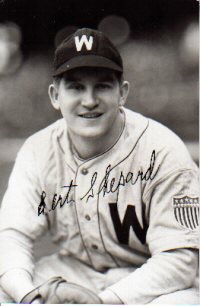
August 4, 1945, 80 years ago: Bert Shepard pitches in a game in what would later be called Major League Baseball. This was incredibly unlikely, because he had only one leg.
Bert Robert Shepard was born on June 28, 1920 in Dana, Indiana, hard by the Illinois State Line, and home to a museum dedicated to another native who became a hero of World War II, journalist Ernie Pyle. A lefthanded pitcher, Shepard grew up in nearby Clifton, Indiana, and made his professional debut in the Detroit Tigers' organization in 1939. But by the conclusion of the 1942 season, he hadn't risen above Class C ball (roughly equivalent to "Long A" today).
He enlisted in the U.S. Army Air Forces in World War II, became a pilot, and achieved the rank of 1st Lieutenant. On May 21, 1944, his fighter group was strafing a German airfield northwest of Berlin, when his plane, a Lockheed P-38 Lightning, was hit. He crashed, and was thrown clear, saving his life, as the plane exploded in flames.
He was found by 1st Lieutenant Ladislaus Loidl, an Austrian doctor in the Nazis' air force, the Luftwaffe. Although Shepard's right foot had already been severed, Loidl managed to save his life. Although the Nazis were the enemy, Shepard would always be grateful for the medical services the Germans provided him, even as he recovered in a prisoner-of-war camp.
He was released in a prisoner exchange in February 1945, and he was determined to resume his baseball career. Part of his rehabilitation was spent at the Walter Reed Army Medical Center in Washington. There, he met Under Secretary of War Robert Patterson, and told him of his desire to keep playing baseball despite needing an prosthesis for his right leg. Patterson told Clark Griffith, owner of the Washington Senators, and himself a Hall of Fame pitcher.
On March 29, Griffith signed Shepard, then only 24 years old, as a pitching coach, thinking it would be good publicity. All season long, with his prosthesis being the leg on which he landed in his pitching motion, he pitched batting practice, and visited veterans' hospitals, offering encouragement to other wounded soldiers. On July 10, he pitched 4 innings against the Brooklyn Dodgers in an exhibition game for the War Relief Fund.
However, the Senators couldn't simply put him in a game just for the publicity. Despite their reputation as legendary losers -- the saying was, "Washington: First in war, first in peace, and last in the American League" -- this was a rare season in which they were in the Pennant race. When dawn arrived on August 4, 1945, the Detroit Tigers led the American League, the Senators were only 3 games behind, the New York Yankees were 4 back, and every other team except the Philadelphia Athletics was within 9 1/2 games. The AL race was still anybody's ballgame, and the Senators had as good a chance at the Pennant as anybody.
But despite World War II winding down -- V-E Day was 3 months earlier, and, while no one yet knew it, V-J Day would come in 10 days -- wartime travel restrictions, designed to save fuel for the war effort, were very much in place, to the point where that season's All-Star Game had been canceled, the only time since the game was founded in 1933 that it happened until the COVID epidemic in 2020. This led to teams staying in place longer than usual.
And, in early August, the Senators had a run of 5 straight days of doubleheaders, with the 4th being the 4th of them. Throw in the war's "manpower drain," and finding "warm bodies" was difficult, especially to flesh out a pitching staff. Shepard's time had come.
The 1st game that day was a 4-0 Senators win over the Boston Red Sox. Wally Holborow did the best thing he could for his team: He went the distance, and allowed just 2 hits. In the 2nd game, the Senators wouldn't be so lucky: Even with such talent as Ted Williams, Bobby Doerr, Dom DiMaggio and Johnny Pesky all in the service, the Sox knocked starting pitcher Sandy Ullrich out of the box in the 4th inning.
Senators manager Ossie Bluege brought in Joe Cleary, who was another player who was only playing due to The War's manpower drain. It was his only big-league appearance as well, and he only got 1 batter out, allowing 7 runs on 5 hits and 3 walks. There are pitchers who allowed baserunners and didn't get anybody out, thus having an earned run average of infinity. Cleary has the highest career ERA of anybody who did actually get someone out: 189.00. The Red Sox scored 12 runs in the top of the 4th, and were up 14-2. Tom McBride tied a major league record for most RBIs in an inning: 6, in the 4th, all off Cleary.
So Bluege brought in Shepard, wearing Number 34. There is a sad connection here: Elmer Gedeon, 1 of the 2 MLB players who ended up being killed in World War II (Harry O'Neill of the 1939 Athletics was the other), had also worn 34 for the Senators, playing 5 games in the outfield in 1939. Shepard being assigned 34 was probably a coincidence.
The 1st batter that Shepard faced was George "Catfish" Metkovich, a center fielder who had a decent 10-season career in the majors. Shepard struck him out. He pitched the rest of the way, going 5 1/3rd innings, allowing 1 run on 3 hits, walking 1 and striking out 2. The Red Sox won, 15-4.
The Senators remained in the race until the final day of the season, and finished 1 game behind the Tigers, who then beat the Chicago Cubs to win the World Series. Bluege never brought Shepard into another game. Who knows, that may have cost the Senators the Pennant. They hadn't won one since 1933, they left town in 1971, and no Washington team would win another major league Pennant until the 2019 Nationals.
In 1946, the veteran players returned home, and, war hero or no, there was no place for Shepard on the major league roster. He pitched in the minors that season, and was released by the Senators afterward. He pitched semi-pro ball in 1947, but needed further surgery on his leg, causing him to miss the 1948 season. In 1949, he was a player-manager in Class B ball, going 5-6.
He became a typewriter salesman, making brief comebacks in 1952 and 1955. Then he got back into aeronautics, becoming a safety engineer for Hughes Aircraft, one of Howard Hughes' companies. He won competitions for amputees in both running and golf, even in his 70s.
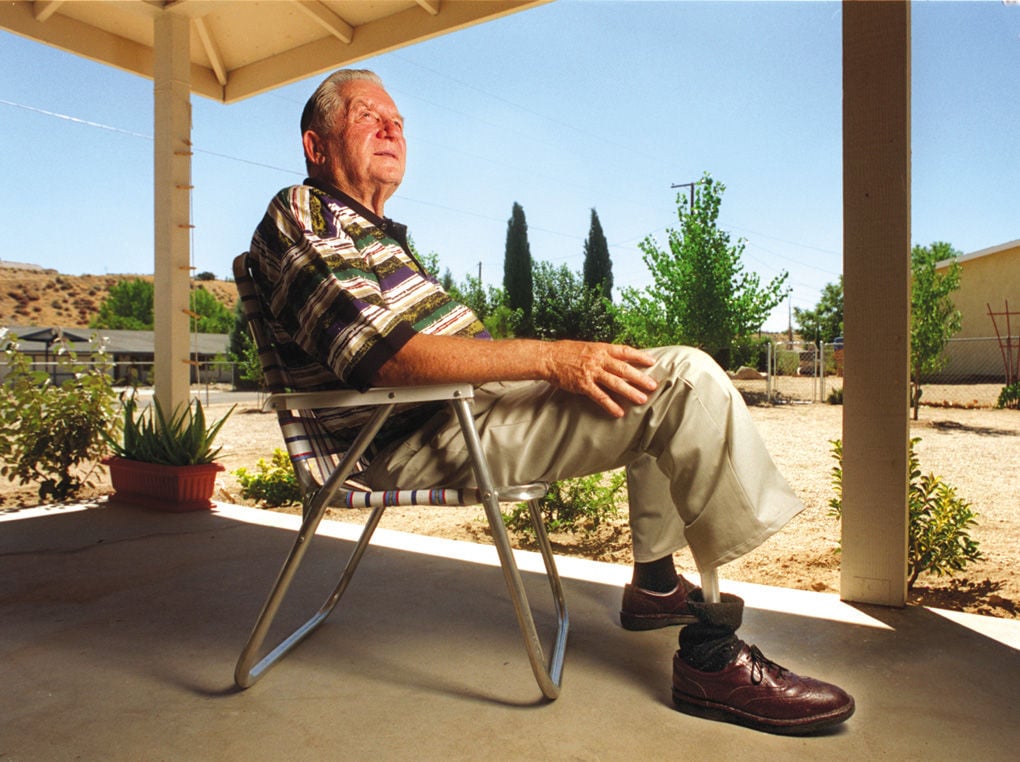
In 1993, This Week In Baseball did a piece on him, nearly half a century after the fact, covering his trip back to Europe, following his return to the site of his crash, and to a reunion with Dr. Loidl again, where he thanked him for saving his life, and (if only for 1 game) his baseball career.
Bert Shepard died on June 16, 2008 in Highland, California, outside San Bernardino. He was 87 years old, and was survived by his wife and their 2 daughters. Senators center fielder José Zardón was the last surviving player from his lone big-league appearance, living until 2017. I can find no record of how long Loidl lived, beyond 1993. It is possible that he is still alive as of August 4, 2025.


No comments:
Post a Comment