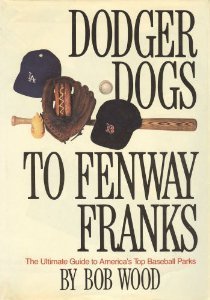
August 5, 1985: Bob Wood sees a baseball game. It's not a particularly noteworthy game. But it does complete a journey: He had set out to visit all 26 Major League Baseball stadiums then in use in one Summer, and had now done it.
Born in 1959 in Kalamazoo, Michigan, he started out as a Detroit Tigers fan. But a visit to Boston in 1975 converted him to the Boston Red Sox, and, while still retaining an affinity for the team that won him the World Series when he was 9 years old, he became one of the Fenway Faithful.
He went to Michigan State University, saw them win the Big Ten Conference title in football in 1978, and became a teacher. By 1985, he was teaching history at a junior high school in Seattle, and going to Mariners games at the Kingdome.
In 1977, he and a friend, Bob Matyas, drove from the MSU campus in East Lansing to Comiskey Park in Chicago, to watch the Red Sox play the White Sox. Sitting near them were two men who had gone to all 26 ballparks. Wood decided that, one day, he would do the same thing. Finally, in 1985, at the age of 26, he made out a schedule, and set out to do it.
He even wrote to all 26 teams, telling him of his plan, and asking for free tickets. After all, while it was Summer, and school was out, and he had the time, he still had a teacher's salary, and was going to be spending a lot of money on lodging and gas for his car. Some teams turned him down, though some sent him letters wishing him well on his trip. But he got free tickets from 12 out of 26: Both New York teams, both Los Angeles area teams, both Pennsylvania teams, both Texas teams, the White Sox, the San Francisco Giants, the Kansas City Royals, and the Milwaukee Brewers.
He also decided to grade every ballpark, like a teacher, judging them on certain categories: Layout and Upkeep, Ball Field, Seating, Scoreboard, Food (further breaking that down into accessibility, selection, cost and taste), Ballpark Employees, Facilities, and Atmosphere. Ballparks with artificial turf and, worse, domes suffered for "Atmosphere."
Having started with his adopted hometown of Seattle, he stopped a hotel in Williams, California, and awoke the next morning to find his hatchback's window shattered and his car robbed. The local police recovered his suitcases intact, but his valuable binoculars were too good for the thief to pass up. He got his window fixed, and moved on.
Later on, the threat of a players' strike suggested that he would fall one park short: The strike was to begin on August 6, the day he was supposed to make Atlanta his 26th and final park. And while the strike was settled after 3 days, he had no way of knowing that at the time: For all he knew, that would be the end of the season, as would eventually happen with the Strike of '94.
The day before the Strike of '85 was to start, Cincinnati was supposed to be Number 25. But he found an open date on his schedule, while he was going through the Midwest, and snuck Cincinnati in there, and move Atlanta up to August 5. He was going to make it -- if only there were no rainouts. As it turned out, there were none, and he made it. Here's how it turned out, with the results of the games, and a sampling of his assessments:
1. June 16, Kingdome, Seattle: "Buy a ticket, step inside, then leave. The place is depressing." Mariners 2, Royals 1.

2. June 19, Candlestick Park, San Francisco: "Nobody seems really intent on presenting baseball as it should be... Just the fact that the sky, whatever shade of gray it happens to be turning at the time, is not covered by a dome and the place has real grass, even if it is weird-looking, makes 'The Stick' bearable. And then just barely." Giants 5, Reds 2. Reds player-manager Pete Rose did not put himself into the game.
3. June 21, Oakland-Alameda County Coliseum: "If you like MTV and baseball, you'll love the way they go together in the Coliseum." (This was before "Mount Davis" was built in 1995-96.) A's 9, Indians 1. Don Sutton started for the A's, and collected his 286th career win. He would go on to win 324.
4. June 23, Dodger Stadium, Los Angeles: "I the custom that Arthur's Knights of the Round Table maintained, true to their principles even amid all the glory showered upon them, Dodger Stadium remains virtuous. In all its elegance it remains in touch with those simple qualities so necessary to the game." (Virtuous? It only exists because of Walter O'Malley's greed!) Dodgers 6, Astros 2.

5. June 24, Anaheim Stadium (now named Angel Stadium of Anaheim): "All the doubts I had rolling into Dodger Stadium -- the glitter, that Hollywood hollowness, that baseball just wouldn't be baseball -- hit home in Anaheim." Indians 2, Angels 1. Bert Blyleven was the winning pitcher.
6. June 26 and 27, Jack Murphy Stadium, San Diego: "Southern California's summer high finds a good friend in San Diego. A mixture of hot sun, fans that finally get up off their butts and cheer, and a scoreboard of such magnitude that it dwarfs all else inside make a game in Jack Murphy California's most energetic."
Padres 10, Dodgers 4; Padres 5, Dodgers 4. This was the 1st time on the trip that he saw 2 games in 1 park. The crowd jumped from 36,113 to a then-sellout of 47,482 for his 2nd game, because Fernando Valenzuela was starting for the Dodgers, and the facility originally known as San Diego Stadium and later as Qualcomm Stadium was only 19 miles from the Mexican border. (Its replacement, Petco Park, is 15 miles from the border.) But the Padres won. In 1996, Fernando started and won the 1st regular-season MLB game in Mexico, pitching for the Padres against the Mets.
7. July 2 and 3, Arlington Stadium, outside Dallas: "Something in the heart, a special sincerity, fights the head and makes the Rangers' home a happy one." Angels 7, Rangers 2; Angels 3, Rangers 2. This 2nd game was his 1st extra-inning game on the trip, going 11 innings.
Wood had been set to watch games in Houston on July 3 and 4, but was so taken with the Rangers' hospitality, they talked him into sticking around for a 2nd game there. After all, while the old Arlington Stadium was a frying pan, he knew that he wouldn't get cheated out of a game in Houston: It was impossible to get a rainout at the Astrodome. (With one exception, a 1976 game when the city was flooded.)
8. July 4, Astrodome, Houston: "To the baseball world Houston's tomb provides a new low in charisma, a bottom-of-the-ballpark barrel." It just didn't seem right to him to spend the 4th of July indoors. Expos 9, Astros 3, in 12 innings.
9. July 6, Royals Stadium (now named Kauffman Stadium), Kansas City: "A totally professional atmosphere makes Royals Stadium one of the majors' best... A first-class sight brings on that first-class air. Together they create a first-class feeling." Orioles 8, Royals 3.
10. July 7, Busch Memorial Stadium, St. Louis: "A fiery excitement flows through Busch. It can be found in many places. Loud and red, enthusiastic fans have fun under the push of the big city." Cardinals 7, Dodgers 1. This turned out to be a preview of the National League Championship Series, which the Cardinals also won, before losing the World Series to the cross-State Royals in controversial fashion.
11. July 9 and 10, Wrigley Field, Chicago: "As thick as they ivy that hugs its red brick walls, the very essence of baseball hangs in the atmosphere of Wrigley. Not only the ballpark itself, with its vine-covered walls and hand-operated scoreboard, but the folks that grace the place are why Chicago's North Side park is the purest in baseball." Cubs 7, Padres 3; Cubs 4, Padres 3.
After this one, he took a little decompression break, which included the All-Star Break, and visited his family in Kalamazoo, their house being a convenient home base for his Midwestern trips, not to mention free.
12. July 16, Hubert H. Humphrey Metrodome, Minneapolis: "Maybe the next time Minneapolis decides to put something up in their lovely city they won't mind adding in a few options, paying a few more dollars, and buying something other than the stripped-down economy model."
This was the All-Star Game: National League 6, American League 1. Jack Morris, a St. Paul native then with the Tigers, started and lost for the AL. But he would pitch a 10-inning shutout for the Twins in Game 7 of the 1991 World Series, the greatest moment in the Metrodome's history.
When Wood wrote Big Ten Country, and had to visit the Metrodome again to see a University of Minnesota home game, he doubled down: "Now, don't get me wrong. It's not that I don't like Minneapolis. How can you not like Minneapolis?... No, Minneapolis is lovely. It's the Metrodome that sucks!" He got his wish: UM moved back on-campus with Huntington Bank Stadium in 2009, the Twins built Target Field in 2010, and the Vikings played the 2014 and '15 seasons at UM's stadium while the Metrodome was demolished and U.S. Bank Stadium was built on the site. All 3 were vast improvements.
13. July 18, Milwaukee County Stadium: "Beer, bratwurst, and baseball -- what a combination!... From the players' rousing introduction to the organist's clap-alongs, a ball game at County Stadium is a treat for all the senses." Mariners 5, Brewers 2.
14. July 19, Comiskey Park, Chicago: "Like an enchanted castle, Comiskey infects those who pass through. It makes them a little crazier, a little looser, a little more fun-loving. It touches its visitors with a light heart and offers the kind of magic that only 75 years of good hard living can create."
White Sox 1, Indians 0. The only run came on a home run by one of Wood's former Boston heroes, Carlton Fisk. Tom Seaver outpitched Bert Blyleven, for his 298th career win. Both pitchers went the distance, despite Seaver being 40 years old, and Blyleven 36. Between them, they would win 598 games, and strike out 7,341 batters.
15. July 20, Riverfront Stadium, Cincinnati: "Talk about a transition. Comiskey bubbled with excitement. A full-housed Riverfront was almost soundless... Instead of a let-it-all-hang-out kind of spirit, we found a place that only a librarian could appreciate.... Their attitude, while commendable at the public library, was weird for a baseball game." Phillies 10, Reds 6. Despite being at home, Rose did not put himself into this game, either.
16. July 21, Tiger Stadium, Detroit: "At its heart, the park's a classic beauty. Entering through its gates, you make a special pact with baseball. The graceful spirit of Tiger Stadium makes up for all the frustrations along the way." Rangers 7, Tigers 5.
17. July 23, Canadian National Exhibition Stadium, Toronto: "Somehow, someway, baseball in Exhibition Stadium survives. On a silly-looking football field, surrounded by cold aluminum benches, the Blue Jays keep on winning. Blue Jay fans keep on coming. And the sea gulls keep on munching. All three should be awarded baseball's congressional medal of bravery -- players and fans for an iron will in taking on such an ugly place, and the gulls for having iron stomachs." Blue Jays 4, Mariners 2.
18. July 24, Olympic Stadium, Montreal: "Shaped like a spaceship, overhung by a death-ray concrete eye, surrounded inside by that silly-looking sprint-lined warning track, and filled with plastic seats and silent fans, in a strictly baseball sense... it's a disaster. Other factors are at work, though... I relished the idea that major league baseball was fortunate enough to enjoy the flavor of Montreal... as only it could be, both in French and English." Expos 3, Braves 1.
19. July 26 and 27, Fenway Park, Boston: "Boston's charming ballpark is surviving, and it does so without sacrificing integrity. Despite a little cosmetic primping, the very heart of the game, the people, and the park itself remain caught in time. Fenway today is baseball as it was in years past, and as pure as it will ever be again in the future." (This was, of course, before not just the various renovations that brought Fenway into the 21st Century, but before the cheating scandals that brought the Red Sox World Series glory at last, but also shame and scandal.)

Fenway Park as it appeared in 1985
His adopted "home team" and his adopted favorite team played each other, and each won a game: Red Sox 6, Mariners 2; Mariners 10, Red Sox 3.
20. July 28, Veterans Stadium, Philadelphia: "Despite an ugly ball field, housed by an ugly stadium, surrounded by an ugly parking lot, the game goes." Phillies 7, Braves 3.
21. July 29 and 30, Memorial Stadium, Baltimore: "Baseball in Baltimore is fun. A solid tradition, enjoyed by nice people, both sitting and serving, the game gets the sincerity it deserves." Blue Jays 4, Orioles 3; Orioles 4, Blue Jays 3. Both games went 10 innings.
22. July 31, William A. Shea Municipal Stadium, New York: "What the Queens park fails to do, and what Yankee Stadium, in a nastier section of town, does so well, is leave New York's ill feelings on the outside streets. Shea's not immune to the problems of the world, it's immersed in them." Mets 5, Expos 2.
23. August 2, Yankee Stadium, New York: This was the ultimate challenge -- not just for a Red Sox fan, but for any baseball fan: Yankee Stadium in The Bronx, during the bad old days of the Ed Koch Eighties in New York. Wood wrote: "Comiskey's neighborhood is nasty. Tiger Stadium has plenty of dangerous places nearby. And Oakland is a dive. The Bronx, though, is worse. It's slime... Yankee Stadium is a beauty, an oasis thriving in the ugliness of city slums, as well planned as any the burbs have... Yankee Stadium has it all: Sky, green grass, and good hard-core fans. Had it no history, I'd still have had a grand time. But the place adds something intangible, a spark that can't be bought by any ballpark. That great Yankee tradition hangs in the air."

I remember the game he saw. I had a nasty headache when it began, and, watching it on WNBC-Channel 4 -- a rare non-Saturday broadcast for the Peacock network -- it didn't get any better. In the bottom of the 7th inning, with the game tied 3-3, Rickey Henderson singled, but Bobby Meacham, not sure if the ball would be caught or not, got caught coming off 2nd base, and he ran for 3rd too late. Both he and Dale Berra, who had been on 1st, ran through the stop sign of 3rd base coach Gene Michael, allowing both of them to be tagged out by Chicago White Sox catcher Carlton Fisk, making for the strangest double play I've ever seen.
It cost the Yankees the game: Despite 2 home runs by Don Mattingly and another by Dave Winfield, the White Sox won, 6-5 in 11 innings. The winning run was scored by Ozzie Guillén, the ChiSox' shortstop and future manager, a genius/maniac every bit as much as the Yankee manager in this game, Billy Martin (on his 4th go-round). Attendance: 27,118.
It cost the Yankees the game: Despite 2 home runs by Don Mattingly and another by Dave Winfield, the White Sox won, 6-5 in 11 innings. The winning run was scored by Ozzie Guillén, the ChiSox' shortstop and future manager, a genius/maniac every bit as much as the Yankee manager in this game, Billy Martin (on his 4th go-round). Attendance: 27,118.
24. August 3, Three Rivers Stadium, Pittsburgh: "Just another three-level plastic clone, this one with a lousy team and hardly any fans around to watch 'em lose, the spirit inside Three Rivers challenges the Kingdome as baseball's biggest bore." Expos 6, Pirates 5.
25. August 4, Cleveland Municipal Stadium: "Baseball anywhere can be beautiful, even in a clumsy-looking, empty warehouse on the shores of Lake Erie." Orioles 5, Indians 4.
On this day, pitching for the White Sox against the Yankees at Yankee Stadium, Tom Seaver collected his 300th win. Across the country, playing for the Angels against his former team, the Twins, Rod Carew collected his 3,000th hit.
26. August 5, Atlanta-Fulton County Stadium, completing the journey: Noting that it was one of the 1960s multipurpose jobs, Wood was surprised to see real green grass and real red dirt. "After the dirt, though, the place deteriorates and its charm evaporates, drowned out in a circus of garbage and smoke. Well-planned walkways fill up with crap; well-ordered rest room ooze with wastepaper. Chain-smoking employees plod about like the junk isn't even there. Meanwhile, circus music fills the air. Clanging away, turned to only God knows what fake instrument, the organist's preludes seemed more in tune to high-wire trapeze acts than a baseball game. And the fans, the just quietly sat around like they didn't know the difference."

And the home team, the Atlanta Braves? They lost to the Los Angeles Dodgers, 6-1. Ken Landreaux hit a home run for the Dodgers. Jerry Reuss, who'd pitched a no-hitter for the Dodgers in 1980, outpitched Len Barker, who'd pitched a perfect game for Cleveland the following year. Barker was relieved by Rick Camp, who, a month earlier, had stepped to the plate in the bottom of the 18th inning, with a lifetime batting average of .060, because he was the last player on the roster, and hit a game-tying home run against the Mets, before losing in the 19th.
It was over. He'd done it: 26 ballparks, 31 games, 11,636 miles in 51 days. In the end, he ranked Dodger Stadium and Royals Stadium tied for 1st, and the Astrodome and Exhibition Stadium tied for last. After Royals Stadium, which no longer has the plastic stuff, the Olympic Stadium, 15th, was the highest-ranking artificial turf stadium; Candlestick Park, 24th, the lowest-ranking one with real grass. Yankee Stadium was 13th, Shea Stadium 19th. His beloved Fenway, 6th; his original home park, Tiger Stadium, 12th.
Aside from the All-Star Game in Minneapolis, with a sellout crowd of 54,960, the largest crowd on his trip was in San Diego: 47,482. The smallest was in San Francisco: 8,490. Even Cleveland had more, with their game being on a Sunday.
Wood completed his tour 3 days later, just ahead of the strike that began the next day, lasting 3 days. In 1988, he published his account of the trip, "Dodger Dogs to Fenway Franks." That year, the Michigan State University graduate went to all the Big Ten schools' football games, and, 2 years later, published "Big Ten Country." Now 66, he is retired from teaching.

at Nationals Park in Washington, in 2008.
Neither the team nor the stadium existed during his 1985 trip.
Since his trip, the Colorado Rockies, the Miami Marlins, the Arizona Diamondbacks and the Tampa Bay Rays have been added; and the Montreal Expos have moved, becoming the Washington Nationals. Of the 26 ballparks he went to, only 6 are still in use: Fenway, Wrigley, Royals/Kauffman Stadium, the Oakland Coliseum, and both Los Angeles-area stadiums. The Astrodome is still standing, but no one is using it. (UPDATE: The Athletics moved out of Oakland after the 2024 season, though the Coliseum still stands.)
And the various multipurpose stadiums of built in the 1960s and '70s have been replaced by "retro" ballparks designed to look like the ones built early in the 20th Century, and even the ones built with retractable roofs and end up looking like airplane hangars have old-timey touches like hand-operated scoreboards. Artificial turf has fallen out of fashion. And instead of being built on the outskirts of cities, or in the suburbs, downtown, making for non-car accessibility, has been the way to go, for all the major sports. Since Camden Yards opened in Baltimore in 1992, both comfort and atmosphere have been in.
Wood's book was not a best-seller, but it sold enough copies to inspire several fans to make their own journeys to all 26 ballparks -- after 1993, to all 28; and then, after 1998, all 30 -- and, in some cases, all in one season. A few rich and foolhardy souls who don't mind getting on a lot of planes have attempted 30 parks in 30 days. In the 2005, '06 and '07 seasons, the YES Network took 4 lucky fans (different ones each season) to see all 162 Yankee games, home and away, for a series titled Ultimate Road Trip.
I, myself, took Wood's book with me on my visits to Baltimore, Boston, Montreal, Toronto, Cleveland, Detroit, Chicago and Milwaukee, to use as a reference, despite it already being out of date. (In the cases of Toronto and Cleveland, the stadiums in question had already been replaced.)
Since there are 92 "clubs," in 4 Divisions, in England's Football League, some fans there have managed to "Do the 92." Despite the large number, it's not as hard as it sounds, because of the traveling: England is a considerably smaller country, and so, instead of 3,092 miles from Fenway Park in Boston to Oracle Park, current home of the San Francisco Giants, the longest roadtrip in English football is from Newcastle United's St. James' Park to Plymouth Argyle's Home Park, and that's only 408 miles. And England has better public transportation, whereas some U.S. sports venues have poor public transit links. And, since the schedule (or "fixture list," as they'd say over there) makes it impossible, nobody tries to do it all in one season.


No comments:
Post a Comment