Showing posts with label atlanta-fulton county stadium. Show all posts

Thursday, September 17, 2026

September 17, 1976: Bill Lucas Becomes the 1st Black GM In MLB

September 17, 1976, 50 years ago: The Atlanta Braves promote Bill Lucas to the office of general manager. This makes him the 1st black man to hold that position in Major League Baseball.

This came 2 years after Frank Robinson was appointed the 1st black manager, 14 years after Buck O'Neil became the 1st black coach, and 29 years after Jackie Robinson became the 1st black player since 1884.

William DeVaughn Lucas was born on January 25, 1936 in Jacksonville, graduated from the historically black Florida A&M University, and signed with the Milwaukee Braves in 1957 -- partly because his sister, Barbara, was married to Braves star Hank Aaron. (They later split up, and Aaron remarried.) An infielder, he never reached the major leagues, although he did miss 2 years as an officer in the U.S. Army. He joined the Braves' front office in 1965, as they were preparing their move to Atlanta for the next season.

In 1972, he was named director of their farm system, a common position from which teams have promoted men to the GM position. Atlanta was the hometown of Dr. Martin Luther King Jr., former Mayor William Hartsfield had billed it as "the City Too Busy to Hate," Maynard Jackson had been elected as its 1st black Mayor in 1973, and Aaron had broken the career home run record at Atlanta Stadium in 1974. (It was renamed Atlanta-Fulton County Stadium the following year.)

Lucas was in the process of building the team that would become the centerpiece of team owner Ted Turner's national "SuperStation TBS" over the next few years, including Dale Murphy, Bob Horner, Brett Butler and Steve Bedrosian.

But Lucas would not live to see his work come to fruition. On May 1, 1979, shortly after congratulating Braves ace Phil Niekro on his 200th career win (by phone, as Lucas was in Atlanta and the game was in Pittsburgh), he suffered a cerebral hemorrhage. He died 4 days later, only 43 years old.

Murphy said, "Bill's dream was for this organization to become a success. It is our sacred honor to be chosen to fulfill his dream." Maybe it would have been fulfilled had he lived. But it didn't happen: They won the National League Western Division title in 1982, and almost won another in 1983, but that's as close as they got. The Braves did not win a Pennant between 1958, when they were still in Milwaukee, and 1991, when a new GM, John Schuerholz, put together the team that dominated the NL in the 1990s.

For his contributions to their organization, the Braves named Lucas to their team Hall of Fame.

Sunday, April 12, 2026

April 12, 1966: Atlanta: "The City Too Busy to Hate"

Atlanta, 1966

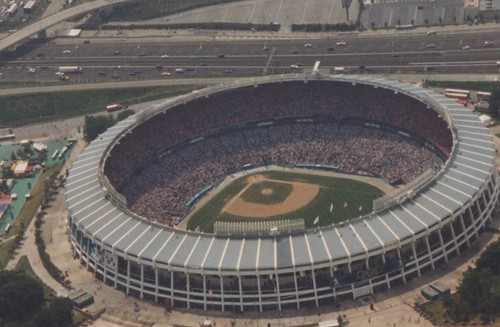
April 12, 1966, 60 years ago: The Braves play their 1st game in Atlanta. Joe Torre hits the 1st major league home run in Atlanta Stadium, but the Pittsburgh Pirates spoil the festivities in 13 innings, 3-1, on a home run by Willie Stargell. (The stadium was renamed Atlanta-Fulton County Stadium in 1975.)

The Braves announced their move to Atlanta in 1965. That year was the high-water mark of the Civil Rights Movement. The Voting Rights Act was signed into law. The Selma-to-Montgomery March had just happened. The Civil Rights Act had been signed into law the year before. The lunch-counter sit-ins, the Freedom Rides, the March On Washington for Jobs and Freedom, and the integrations of the universities of Georgia, Mississippi and Alabama had all taken place, with mixed success in some cases and total success in others. All this had happened within the last 5 years. And Dr. Martin Luther King Jr. was the current holder of the Nobel Peace Prize.

Dr. King was from Atlanta. The Mayor at the time was Ivan Allen Jr. He ran his father's office-supply company, and took it to new heights, making himself one of the South's richest men. He lived long enough to get an offer he couldn't refuse: Staples bought him out in 1999.

In 1961, Allen ran for Mayor against segregationist Lester Maddox, who would later be elected Governor of Georgia. Allen won, and began to build on the work of his predecessor, William Hartsfield, for whom the city's famous airport is named.

As a businessman, Allen understood that he had the chance to change the image of his city. More than that, he had the chance to help change perceptions of the State of Georgia and of the South itself. The city underwent its greatest construction phase since after its burning in the Civil War 100 years earlier. He built the Memorial (now the Woodruff) Arts Center, in effect Atlanta's version of New York's Lincoln Center. He created MARTA, the Metropolitan Atlanta Rapid Transit Authority, which reworked the city's bus system, and, after he left office, built its subway. He also got Interstate 285, a beltway, a.k.a. "The Perimeter" and "The O Around the A," built.

He got Atlanta Stadium (later Atlanta-Fulton County Stadium) built and, although it wouldn't open until after he left office, he got the Omni Coliseum approved. This enabled the city to go from no major league teams when he took office on January 1, 1962 to 3 of them when he left on January 1, 1970.
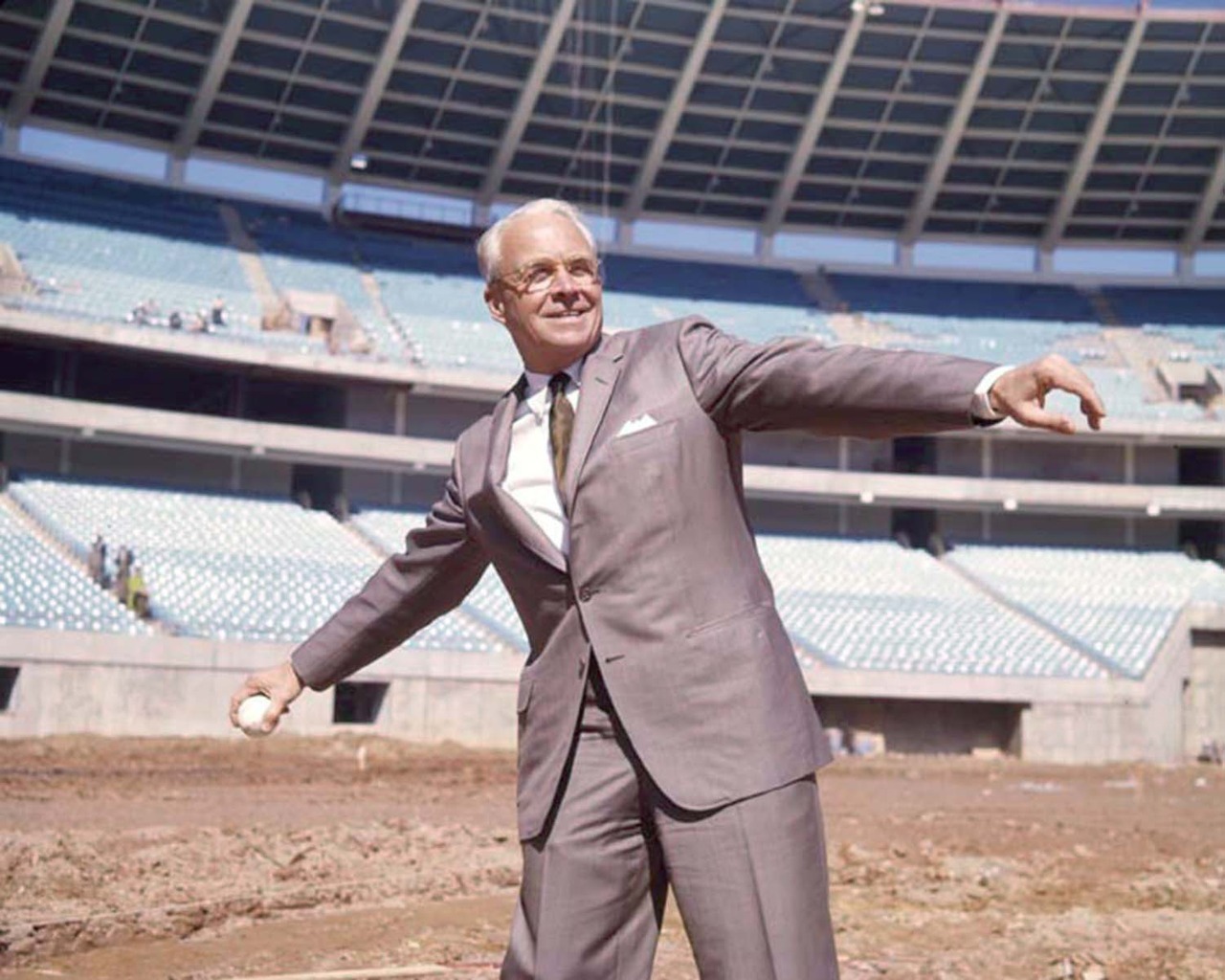
Allen posing inside the stadium his Administration was building, 1964.
It opened in 1965, and hosted the Beatles
before it hosted the Braves or the Falcons.

More low-income housing was built in his 8 years in office than in the previous 30. He needed to do this to alleviate the concerns of local black leaders, including Dr. Martin Luther King Sr., that he wasn't doing enough for the poor and was focusing too much on business, especially downtown -- a criticism since leveled at many urban mayors, black and white alike (including Newark's Sharpe James in the 1980s and '90s).

"It is wonderful to be idealistic and to speak about human values," Allen said, "but you are not going to be able to do one thing about them if you are not economically strong. If there is any one slogan I lived by as Mayor of Atlanta, that would be it."

So, with the concerns of both business and civil rights in mind, he brought the 2 concepts together. The day he was sworn in, he ordered all "WHITE" and "COLORED" signs removed from City Hall, and personally desegregated the City Hall cafeteria by dining with local black activists. He desegregated municipal hiring. He hired the city's first black firemen. He let it be known that black Atlanta policemen would be allowed to arrest white criminals. He desegregated the city's pools. By January 1964, 6 months before President Lyndon Johnson signed the Civil Rights Act into law, 14 Atlanta hotels had already desegregated themselves.

Allen billed Atlanta as "The City Too Busy to Hate." That made the sports establishments stand up and take notice. Atlanta also offered a bigger stadium, if not necessarily a better one, than Milwaukee County Stadium: 52,000 to 44,000. (Milwaukee County Stadium would later expand to 53,000.) Today, the Braves' team museum is named for Allen.

Atlanta-Fulton County Stadium was a multipurpose facility, designed to host both baseball and football, and it didn't do a good job with either one, so much so that, by 1997, both the Braves and the Falcons had gotten new stadiums and their 1st home was demolished. That process was repeated in 2017, as both teams abandoned their still relatively new stadiums for brand-new ones, the Falcons with a retractable-roof stadium next-door, the Braves for a "ballpark village" in the city's northwest suburbs.
Just another oversized concrete ashtray.
At least it had real grass, not artificial turf.

But Atlanta has seen little success. From 1966 to 1990, the Braves won just 2 Division titles and no Pennants. Then, they won their Division in every completed season from 1991 to 2005, and won 5 Pennants, but just 1 World Series. They eventually won another in 2021. The Falcons have been to just 2 Super Bowls, and lost both ignominiously.

The NBA's Hawks should be so lucky: They reached the Conference Finals their 1st 2 seasons after moving from St. Louis, 1968-69 and 1969-70; then didn't make the Conference Finals again until 2015, and again in 2021. They haven't made the NBA Finals since 1961, or won them since 1958, both times in St. Louis.

And the city has failed with 2 NHL teams: The Flames arrived in 1972 and moved to Calgary in 1980, and the Thrashers arrived in 1999 and moved to Winnipeg in 2011. A Sun Belt city that lost 2 teams to Canada: This is NHL Commissioner Gary Bettman's nightmare.

The city has had decent success with soccer. The Atlanta Chiefs won the North American Soccer League title in 1968, and reached the Final again in 1969. Atlanta United debuted in 2017, won the MLS Cup the next season, and won the U.S. Open Cup the year after that.

The Braves have a team Hall of Fame. Their inductees from their Atlanta years are: Players Hank Aaron, Rico Carty, Phil Niekro, Ralph Garr, Dale Murphy, Tom Glavine, John Smoltz, David Justice, Terry Pendleton, Javy López, Greg Maddux, Larry "Chipper" Jones, Andruw Jones (no relation) and Tim Hudson; plus managers Joe Torre and Bobby Cox, and coach Leo Mazzone; team owners Bill Bartholomay and Ted Turner; executives Bill Lucas, Paul Snyder and John Schuerholz; trainer Dave Pursley; and broadcasters Ernie Johnson Sr., Pete Van Wieren, Skip Caray, Don Sutton and Joe Simpson.

The Falcons have a Ring of Honor. Their inductees are: Tommy Nobis, Claude Humphrey, Jeff Van Note, Steve Bartkowski, Mike Kenn, William Andrews, Gerald Riggs, Jessie Tuggle, Deion Sanders, Todd McClure, Warrick Dunn, Roddy White, Matt Ryan, and team owner Arthur Blank.

The Hawks don't have a team Hall of Fame, but they do retire numbers: 9, for Bob Pettit from their St. Louis years; 21, Dominique Wilkins; 23, Lou Hudson; 44, Pete Maravich; and 55, Dikembe Mutombo. They have also witheld 40 from circulation since Jason Collier died as an active player. They also have banners honoring former owner Ted Turner and former Mayor Kasim Reed, who was involved in keeping the team from moving.

There is also a Georgia Sports Hall of Fame, in Macon. It honors State natives who excelled in sports, stars from colleges such as the University of Georgia and Georgia Tech, and these major league stars:

* Braves: Aaron, Nierko, Murphy, Smoltz, Glavine, both Joneses, Tim Hudson, Cox, Mazzone, Bartholomay, Turner, Lucas, Schuerholz, Johnson, Van Wieren, Caray, Bob Horner, Brian Jordan, Jeff Treadway (more for being a Georgia native than for being a Brave), Marquis Grissom, and executive Stan Kasten.

* Falcons: Nobis, Humphrey, Van Note, Bartkowski, Tuggle, Blank, Alfred Jenkins, Billy "White Shoes" Johnson, founding owner Rankin Smith, coach Mario Campbell, and coach Dan Reeves, elected more for being a Georgia native and a UGa player than for coaching the Falcons into their 1st Super Bowl.

* Hawks: Wilkins, Lou Hudson, Wayne "Tree" Rollins, and Shareef Abdur-Rahim.

* Through 2025, no Flames, Thrashers, Chiefs or Atlanta United have been honored.

Tuesday, October 28, 2025

October 28, 1995: The South Rises In the World Series

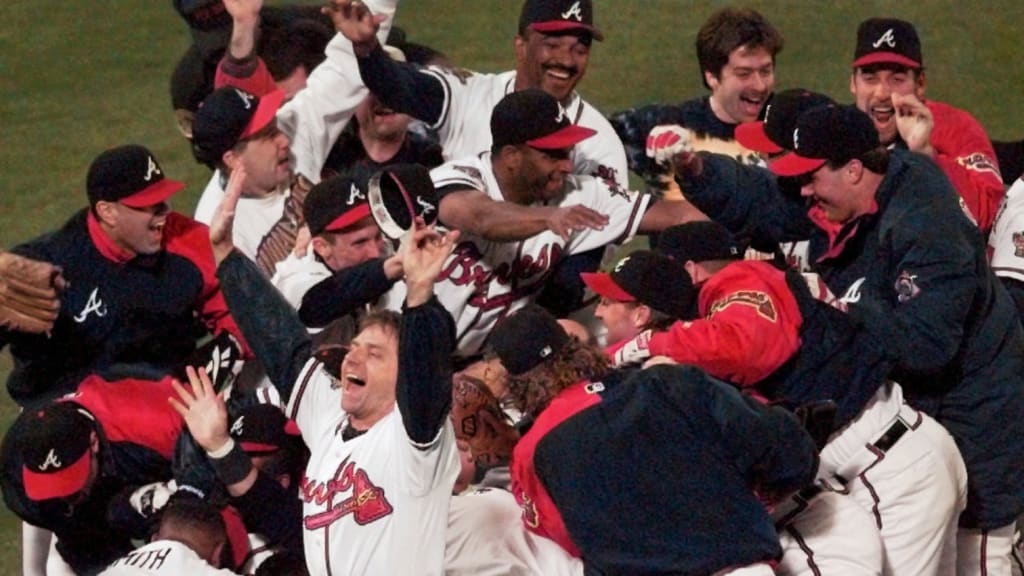
October 28, 1995, 30 years ago: The Atlanta Braves win Game 6 of the World Series, beating the Cleveland Indians, 1-0‚ on a combined 1-hitter by Tom Glavine and Mark Wohlers.

David Justice's 6th-inning home run accounts for the game's only run. Having noticed that Cleveland's Jacobs Field (renamed Progressive Field in 2007) seemed a lot louder in Games 3, 4 and 5 than Atlanta-Fulton County Stadium had in Games 1 and 2, Justice called on the Braves' fans to be louder for Game 6. They were, especially when he hit his homer.
Catcher Tony Peña's leadoff single in the 6th was Cleveland's only hit. The Indians, who won 100 games in the strike-shortened 144-game season, and won their 1st American League Pennant in 41 years, led the majors in homers and runs scored. But in this Series, they batted just .179‚ the lowest average for a 6-games series since 1911.

This was the 1st time that two of the "Big Four" sports' titles were held by Southern teams. The Houston Rockets had won the NBA title in June.

In winning‚ the Braves become the 1st team to win World Championships representing 3 different cities: Boston in 1914‚ Milwaukee in 1957‚ and Atlanta in 1995. It was their 30th season in Atlanta, and despite having had such talents as Hank Aaron, Phil Niekro and Dale Murphy, they mostly struggled through their 1st 25 years, winning Division titles in 1969 and 1982.

They won the National League Pennant in 1991 and 1992, but lost the World Series both times. They lost the NL Championship Series in 1993, and the 1994 season was cut short by a strike. In 1995, they won it all, led by their pitching "Big Three": Glavine went 16-7, Greg Maddux went 19-2, and John Smoltz went 16-7. Justice, Fred McGriff, Chipper Jones, Ryan Klesko and Javy López led the attack. And so, the Braves became the 1st team from a former Confederate State to win a World Series.

How key for the Braves was Justice? The following season, the Braves won the Pennant again, but he was injured for the World Series, and they lost it to the New York Yankees. Foolishly, the Braves let him go, to the Indians, and he helped them win the Pennant in 1997. He later helped the Yankees win the AL Pennant in 2000 (winning the World Series) and 2001 (losing it). Although he fell short of career stats for the Baseball Hall of Fame -- 1,571 hits, 305 of them home rums -- he was one of the top clutch performers of his era.

Tuesday, August 5, 2025

August 5, 1985: The "Dodger Dogs to Fenway Franks" Tour Is Completed

August 5, 1985: Bob Wood sees a baseball game. It's not a particularly noteworthy game. But it does complete a journey: He had set out to visit all 26 Major League Baseball stadiums then in use in one Summer, and had now done it.

Born in 1959 in Kalamazoo, Michigan, he started out as a Detroit Tigers fan. But a visit to Boston in 1975 converted him to the Boston Red Sox, and, while still retaining an affinity for the team that won him the World Series when he was 9 years old, he became one of the Fenway Faithful.

He went to Michigan State University, saw them win the Big Ten Conference title in football in 1978, and became a teacher. By 1985, he was teaching history at a junior high school in Seattle, and going to Mariners games at the Kingdome.

In 1977, he and a friend, Bob Matyas, drove from the MSU campus in East Lansing to Comiskey Park in Chicago, to watch the Red Sox play the White Sox. Sitting near them were two men who had gone to all 26 ballparks. Wood decided that, one day, he would do the same thing. Finally, in 1985, at the age of 26, he made out a schedule, and set out to do it.

He even wrote to all 26 teams, telling him of his plan, and asking for free tickets. After all, while it was Summer, and school was out, and he had the time, he still had a teacher's salary, and was going to be spending a lot of money on lodging and gas for his car. Some teams turned him down, though some sent him letters wishing him well on his trip. But he got free tickets from 12 out of 26: Both New York teams, both Los Angeles area teams, both Pennsylvania teams, both Texas teams, the White Sox, the San Francisco Giants, the Kansas City Royals, and the Milwaukee Brewers.

He also decided to grade every ballpark, like a teacher, judging them on certain categories: Layout and Upkeep, Ball Field, Seating, Scoreboard, Food (further breaking that down into accessibility, selection, cost and taste), Ballpark Employees, Facilities, and Atmosphere. Ballparks with artificial turf and, worse, domes suffered for "Atmosphere."

Having started with his adopted hometown of Seattle, he stopped a hotel in Williams, California, and awoke the next morning to find his hatchback's window shattered and his car robbed. The local police recovered his suitcases intact, but his valuable binoculars were too good for the thief to pass up. He got his window fixed, and moved on.

Later on, the threat of a players' strike suggested that he would fall one park short: The strike was to begin on August 6, the day he was supposed to make Atlanta his 26th and final park. And while the strike was settled after 3 days, he had no way of knowing that at the time: For all he knew, that would be the end of the season, as would eventually happen with the Strike of '94.

The day before the Strike of '85 was to start, Cincinnati was supposed to be Number 25. But he found an open date on his schedule, while he was going through the Midwest, and snuck Cincinnati in there, and move Atlanta up to August 5. He was going to make it -- if only there were no rainouts. As it turned out, there were none, and he made it. Here's how it turned out, with the results of the games, and a sampling of his assessments:

1. June 16, Kingdome, Seattle: "Buy a ticket, step inside, then leave. The place is depressing." Mariners 2, Royals 1.
2. June 19, Candlestick Park, San Francisco: "Nobody seems really intent on presenting baseball as it should be... Just the fact that the sky, whatever shade of gray it happens to be turning at the time, is not covered by a dome and the place has real grass, even if it is weird-looking, makes 'The Stick' bearable. And then just barely." Giants 5, Reds 2. Reds player-manager Pete Rose did not put himself into the game.

3. June 21, Oakland-Alameda County Coliseum: "If you like MTV and baseball, you'll love the way they go together in the Coliseum." (This was before "Mount Davis" was built in 1995-96.) A's 9, Indians 1. Don Sutton started for the A's, and collected his 286th career win. He would go on to win 324.

4. June 23, Dodger Stadium, Los Angeles: "I the custom that Arthur's Knights of the Round Table maintained, true to their principles even amid all the glory showered upon them, Dodger Stadium remains virtuous. In all its elegance it remains in touch with those simple qualities so necessary to the game." (Virtuous? It only exists because of Walter O'Malley's greed!) Dodgers 6, Astros 2.
5. June 24, Anaheim Stadium (now named Angel Stadium of Anaheim): "All the doubts I had rolling into Dodger Stadium -- the glitter, that Hollywood hollowness, that baseball just wouldn't be baseball -- hit home in Anaheim." Indians 2, Angels 1. Bert Blyleven was the winning pitcher.

6. June 26 and 27, Jack Murphy Stadium, San Diego: "Southern California's summer high finds a good friend in San Diego. A mixture of hot sun, fans that finally get up off their butts and cheer, and a scoreboard of such magnitude that it dwarfs all else inside make a game in Jack Murphy California's most energetic."

Padres 10, Dodgers 4; Padres 5, Dodgers 4. This was the 1st time on the trip that he saw 2 games in 1 park. The crowd jumped from 36,113 to a then-sellout of 47,482 for his 2nd game, because Fernando Valenzuela was starting for the Dodgers, and the facility originally known as San Diego Stadium and later as Qualcomm Stadium was only 19 miles from the Mexican border. (Its replacement, Petco Park, is 15 miles from the border.) But the Padres won. In 1996, Fernando started and won the 1st regular-season MLB game in Mexico, pitching for the Padres against the Mets.

7. July 2 and 3, Arlington Stadium, outside Dallas: "Something in the heart, a special sincerity, fights the head and makes the Rangers' home a happy one." Angels 7, Rangers 2; Angels 3, Rangers 2. This 2nd game was his 1st extra-inning game on the trip, going 11 innings.

Wood had been set to watch games in Houston on July 3 and 4, but was so taken with the Rangers' hospitality, they talked him into sticking around for a 2nd game there. After all, while the old Arlington Stadium was a frying pan, he knew that he wouldn't get cheated out of a game in Houston: It was impossible to get a rainout at the Astrodome. (With one exception, a 1976 game when the city was flooded.)

8. July 4, Astrodome, Houston: "To the baseball world Houston's tomb provides a new low in charisma, a bottom-of-the-ballpark barrel." It just didn't seem right to him to spend the 4th of July indoors. Expos 9, Astros 3, in 12 innings.

9. July 6, Royals Stadium (now named Kauffman Stadium), Kansas City: "A totally professional atmosphere makes Royals Stadium one of the majors' best... A first-class sight brings on that first-class air. Together they create a first-class feeling." Orioles 8, Royals 3.
Royals Stadium as it appeared in 1985

10. July 7, Busch Memorial Stadium, St. Louis: "A fiery excitement flows through Busch. It can be found in many places. Loud and red, enthusiastic fans have fun under the push of the big city." Cardinals 7, Dodgers 1. This turned out to be a preview of the National League Championship Series, which the Cardinals also won, before losing the World Series to the cross-State Royals in controversial fashion.

11. July 9 and 10, Wrigley Field, Chicago: "As thick as they ivy that hugs its red brick walls, the very essence of baseball hangs in the atmosphere of Wrigley. Not only the ballpark itself, with its vine-covered walls and hand-operated scoreboard, but the folks that grace the place are why Chicago's North Side park is the purest in baseball." Cubs 7, Padres 3; Cubs 4, Padres 3.

After this one, he took a little decompression break, which included the All-Star Break, and visited his family in Kalamazoo, their house being a convenient home base for his Midwestern trips, not to mention free.

12. July 16, Hubert H. Humphrey Metrodome, Minneapolis: "Maybe the next time Minneapolis decides to put something up in their lovely city they won't mind adding in a few options, paying a few more dollars, and buying something other than the stripped-down economy model."

This was the All-Star Game: National League 6, American League 1. Jack Morris, a St. Paul native then with the Tigers, started and lost for the AL. But he would pitch a 10-inning shutout for the Twins in Game 7 of the 1991 World Series, the greatest moment in the Metrodome's history.

When Wood wrote Big Ten Country, and had to visit the Metrodome again to see a University of Minnesota home game, he doubled down: "Now, don't get me wrong. It's not that I don't like Minneapolis. How can you not like Minneapolis?... No, Minneapolis is lovely. It's the Metrodome that sucks!" He got his wish: UM moved back on-campus with Huntington Bank Stadium in 2009, the Twins built Target Field in 2010, and the Vikings played the 2014 and '15 seasons at UM's stadium while the Metrodome was demolished and U.S. Bank Stadium was built on the site. All 3 were vast improvements.

13. July 18, Milwaukee County Stadium: "Beer, bratwurst, and baseball -- what a combination!... From the players' rousing introduction to the organist's clap-alongs, a ball game at County Stadium is a treat for all the senses." Mariners 5, Brewers 2.

14. July 19, Comiskey Park, Chicago: "Like an enchanted castle, Comiskey infects those who pass through. It makes them a little crazier, a little looser, a little more fun-loving. It touches its visitors with a light heart and offers the kind of magic that only 75 years of good hard living can create."

White Sox 1, Indians 0. The only run came on a home run by one of Wood's former Boston heroes, Carlton Fisk. Tom Seaver outpitched Bert Blyleven, for his 298th career win. Both pitchers went the distance, despite Seaver being 40 years old, and Blyleven 36. Between them, they would win 598 games, and strike out 7,341 batters.

15. July 20, Riverfront Stadium, Cincinnati: "Talk about a transition. Comiskey bubbled with excitement. A full-housed Riverfront was almost soundless... Instead of a let-it-all-hang-out kind of spirit, we found a place that only a librarian could appreciate.... Their attitude, while commendable at the public library, was weird for a baseball game." Phillies 10, Reds 6. Despite being at home, Rose did not put himself into this game, either.

16. July 21, Tiger Stadium, Detroit: "At its heart, the park's a classic beauty. Entering through its gates, you make a special pact with baseball. The graceful spirit of Tiger Stadium makes up for all the frustrations along the way." Rangers 7, Tigers 5.

17. July 23, Canadian National Exhibition Stadium, Toronto: "Somehow, someway, baseball in Exhibition Stadium survives. On a silly-looking football field, surrounded by cold aluminum benches, the Blue Jays keep on winning. Blue Jay fans keep on coming. And the sea gulls keep on munching. All three should be awarded baseball's congressional medal of bravery -- players and fans for an iron will in taking on such an ugly place, and the gulls for having iron stomachs." Blue Jays 4, Mariners 2.

18. July 24, Olympic Stadium, Montreal: "Shaped like a spaceship, overhung by a death-ray concrete eye, surrounded inside by that silly-looking sprint-lined warning track, and filled with plastic seats and silent fans, in a strictly baseball sense... it's a disaster. Other factors are at work, though... I relished the idea that major league baseball was fortunate enough to enjoy the flavor of Montreal... as only it could be, both in French and English." Expos 3, Braves 1.

19. July 26 and 27, Fenway Park, Boston: "Boston's charming ballpark is surviving, and it does so without sacrificing integrity. Despite a little cosmetic primping, the very heart of the game, the people, and the park itself remain caught in time. Fenway today is baseball as it was in years past, and as pure as it will ever be again in the future." (This was, of course, before not just the various renovations that brought Fenway into the 21st Century, but before the cheating scandals that brought the Red Sox World Series glory at last, but also shame and scandal.)
Fenway Park as it appeared in 1985

His adopted "home team" and his adopted favorite team played each other, and each won a game: Red Sox 6, Mariners 2; Mariners 10, Red Sox 3.

20. July 28, Veterans Stadium, Philadelphia: "Despite an ugly ball field, housed by an ugly stadium, surrounded by an ugly parking lot, the game goes." Phillies 7, Braves 3.

21. July 29 and 30, Memorial Stadium, Baltimore: "Baseball in Baltimore is fun. A solid tradition, enjoyed by nice people, both sitting and serving, the game gets the sincerity it deserves." Blue Jays 4, Orioles 3; Orioles 4, Blue Jays 3. Both games went 10 innings.

22. July 31, William A. Shea Municipal Stadium, New York: "What the Queens park fails to do, and what Yankee Stadium, in a nastier section of town, does so well, is leave New York's ill feelings on the outside streets. Shea's not immune to the problems of the world, it's immersed in them." Mets 5, Expos 2.

23. August 2, Yankee Stadium, New York: This was the ultimate challenge -- not just for a Red Sox fan, but for any baseball fan: Yankee Stadium in The Bronx, during the bad old days of the Ed Koch Eighties in New York. Wood wrote: "Comiskey's neighborhood is nasty. Tiger Stadium has plenty of dangerous places nearby. And Oakland is a dive. The Bronx, though, is worse. It's slime... Yankee Stadium is a beauty, an oasis thriving in the ugliness of city slums, as well planned as any the burbs have... Yankee Stadium has it all: Sky, green grass, and good hard-core fans. Had it no history, I'd still have had a grand time. But the place adds something intangible, a spark that can't be bought by any ballpark. That great Yankee tradition hangs in the air."
I remember the game he saw. I had a nasty headache when it began, and, watching it on WNBC-Channel 4 -- a rare non-Saturday broadcast for the Peacock network -- it didn't get any better. In the bottom of the 7th inning, with the game tied 3-3, Rickey Henderson singled, but Bobby Meacham, not sure if the ball would be caught or not, got caught coming off 2nd base, and he ran for 3rd too late. Both he and Dale Berra, who had been on 1st, ran through the stop sign of 3rd base coach Gene Michael, allowing both of them to be tagged out by Chicago White Sox catcher Carlton Fisk, making for the strangest double play I've ever seen.

It cost the Yankees the game: Despite 2 home runs by Don Mattingly and another by Dave Winfield, the White Sox won, 6-5 in 11 innings. The winning run was scored by Ozzie Guillén, the ChiSox' shortstop and future manager, a genius/maniac every bit as much as the Yankee manager in this game, Billy Martin (on his 4th go-round). Attendance: 27,118.

24. August 3, Three Rivers Stadium, Pittsburgh: "Just another three-level plastic clone, this one with a lousy team and hardly any fans around to watch 'em lose, the spirit inside Three Rivers challenges the Kingdome as baseball's biggest bore." Expos 6, Pirates 5.

25. August 4, Cleveland Municipal Stadium: "Baseball anywhere can be beautiful, even in a clumsy-looking, empty warehouse on the shores of Lake Erie." Orioles 5, Indians 4.

On this day, pitching for the White Sox against the Yankees at Yankee Stadium, Tom Seaver collected his 300th win. Across the country, playing for the Angels against his former team, the Twins, Rod Carew collected his 3,000th hit.

26. August 5, Atlanta-Fulton County Stadium, completing the journey: Noting that it was one of the 1960s multipurpose jobs, Wood was surprised to see real green grass and real red dirt. "After the dirt, though, the place deteriorates and its charm evaporates, drowned out in a circus of garbage and smoke. Well-planned walkways fill up with crap; well-ordered rest room ooze with wastepaper. Chain-smoking employees plod about like the junk isn't even there. Meanwhile, circus music fills the air. Clanging away, turned to only God knows what fake instrument, the organist's preludes seemed more in tune to high-wire trapeze acts than a baseball game. And the fans, the just quietly sat around like they didn't know the difference."
And the home team, the Atlanta Braves? They lost to the Los Angeles Dodgers, 6-1. Ken Landreaux hit a home run for the Dodgers. Jerry Reuss, who'd pitched a no-hitter for the Dodgers in 1980, outpitched Len Barker, who'd pitched a perfect game for Cleveland the following year. Barker was relieved by Rick Camp, who, a month earlier, had stepped to the plate in the bottom of the 18th inning, with a lifetime batting average of .060, because he was the last player on the roster, and hit a game-tying home run against the Mets, before losing in the 19th.

It was over. He'd done it: 26 ballparks, 31 games, 11,636 miles in 51 days. In the end, he ranked Dodger Stadium and Royals Stadium tied for 1st, and the Astrodome and Exhibition Stadium tied for last. After Royals Stadium, which no longer has the plastic stuff, the Olympic Stadium, 15th, was the highest-ranking artificial turf stadium; Candlestick Park, 24th, the lowest-ranking one with real grass. Yankee Stadium was 13th, Shea Stadium 19th. His beloved Fenway, 6th; his original home park, Tiger Stadium, 12th.

Aside from the All-Star Game in Minneapolis, with a sellout crowd of 54,960, the largest crowd on his trip was in San Diego: 47,482. The smallest was in San Francisco: 8,490. Even Cleveland had more, with their game being on a Sunday.

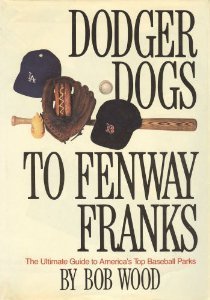
Wood completed his tour 3 days later, just ahead of the strike that began the next day, lasting 3 days. In 1988, he published his account of the trip, "Dodger Dogs to Fenway Franks." That year, the Michigan State University graduate went to all the Big Ten schools' football games, and, 2 years later, published "Big Ten Country." Now 66, he is retired from teaching.
Bob Wood, attending a Washington Nationals game
at Nationals Park in Washington, in 2008.
Neither the team nor the stadium existed during his 1985 trip.

Since his trip, the Colorado Rockies, the Miami Marlins, the Arizona Diamondbacks and the Tampa Bay Rays have been added; and the Montreal Expos have moved, becoming the Washington Nationals. Of the 26 ballparks he went to, only 6 are still in use: Fenway, Wrigley, Royals/Kauffman Stadium, the Oakland Coliseum, and both Los Angeles-area stadiums. The Astrodome is still standing, but no one is using it. (UPDATE: The Athletics moved out of Oakland after the 2024 season, though the Coliseum still stands.)

And the various multipurpose stadiums of built in the 1960s and '70s have been replaced by "retro" ballparks designed to look like the ones built early in the 20th Century, and even the ones built with retractable roofs and end up looking like airplane hangars have old-timey touches like hand-operated scoreboards. Artificial turf has fallen out of fashion. And instead of being built on the outskirts of cities, or in the suburbs, downtown, making for non-car accessibility, has been the way to go, for all the major sports. Since Camden Yards opened in Baltimore in 1992, both comfort and atmosphere have been in.

Wood's book was not a best-seller, but it sold enough copies to inspire several fans to make their own journeys to all 26 ballparks -- after 1993, to all 28; and then, after 1998, all 30 -- and, in some cases, all in one season. A few rich and foolhardy souls who don't mind getting on a lot of planes have attempted 30 parks in 30 days. In the 2005, '06 and '07 seasons, the YES Network took 4 lucky fans (different ones each season) to see all 162 Yankee games, home and away, for a series titled Ultimate Road Trip.

I, myself, took Wood's book with me on my visits to Baltimore, Boston, Montreal, Toronto, Cleveland, Detroit, Chicago and Milwaukee, to use as a reference, despite it already being out of date. (In the cases of Toronto and Cleveland, the stadiums in question had already been replaced.)

Since there are 92 "clubs," in 4 Divisions, in England's Football League, some fans there have managed to "Do the 92." Despite the large number, it's not as hard as it sounds, because of the traveling: England is a considerably smaller country, and so, instead of 3,092 miles from Fenway Park in Boston to Oracle Park, current home of the San Francisco Giants, the longest roadtrip in English football is from Newcastle United's St. James' Park to Plymouth Argyle's Home Park, and that's only 408 miles. And England has better public transportation, whereas some U.S. sports venues have poor public transit links. And, since the schedule (or "fixture list," as they'd say over there) makes it impossible, nobody tries to do it all in one season.

Friday, July 4, 2025

July 4, 1985: The Rick Camp Game

July 4, 1985, 40 years ago: For anybody who watched this baseball game, it was a 4th of July that will never, ever be forgot.

The Atlanta Braves were hosting the New York Mets at Atlanta-Fulton County Stadium, and Braves owner Ted Turner, showman that he was, scheduled a postgame 4th of July fireworks show. Paid attendance at the 52,007-seat concrete ashtray just south of downtown Atlanta was 44,947.

But the game was delayed by rain, and didn't start until 9:04 PM. Rick Mahler started for the Braves, and the Mets hit him hard, and he didn't get out of the 4th inning. Dwight Gooden started for the Mets, and, in a year when he seemed to be touched by God, he was no better. A second rain delay came, and Met manager Davey Johnson -- who hit 41 home runs as a 2nd baseman for the Braves in 1973 -- didn't take any chances, and he took Doctor K out.

Did I say Davey didn't take any chances? When they came back from the rain delay, he let Roger McDowell, normally a late-inning reliever, finish the bottom of the 3rd inning. Terry Leach pitched the 4th through the 8th, but Davey brought in Doug Sisk, and he let the Braves score 4 runs in that inning to take the lead, 8-7. This included a Keith Hernandez home run. But future Hall-of-Famer Bruce Sutter blew it in the 9th, and the game went to extra innings. At one point, Davey got thrown out of the game.

The Braves got 2 men on with 1 out in the bottom of the 11th, but the Mets got out of it with a double play. In the top of the 13th, with 2 out, Ray Knight singled, and Howard Johnson hit a home run. 10-8 Mets. But in the bottom of the 13th, Tom Gorman -- the only reliever the Mets had left -- allowed a leadoff single to Rafael Ramirez. He struck out Dale Murphy and Gerald Perry, but then gave up a home run to Terry Harper. 10-10. More "free baseball."

Gene Garber walked Lenny Dykstra and Hernandez in the top of the 14th, but got out of it. Knight singled for the Mets in the top of the 15th, but got no farther than 1st base. With 2 out in the bottom of the 16th, Ken Oberkfell singled off Gorman, and Bruce Benedict drew a walk. But Gorman got out of it.

Rick Camp, the Braves' last remaining reliever, came into the game in the top of the 17th, and walked Gary Carter, but then struck out Darryl Strawberry and Gorman, and got Knight to ground into a force play. Ramirez singled with 2 outs in the bottom of the 17th, but Gorman got out of it.

Top of the 18th. HoJo led off with a single. Danny Heep bunted, and Camp rushed it, and threw it away. 1st and 3rd, nobody out. Dykstra hit a sacrifice fly, and it was 11-10 Mets. There was nothing that Braves manager Eddie Haas could do, as Camp was it: The only pitchers he had left were starters, the same as the Mets.

Bottom of the 18th. Perry and Harper grounded out. That brought up Camp, as Haas couldn't pinch-hit for him. He had nobody left to bat or pitch. This pudgy bearded guy, wearing Number 37 for his home-State team, came up to bat. He came into that game 10-for-168 for his career -- a lifetime batting average of .060. He was 0-for-his-last-13. He hadn't gotten a hit since September 1, 1984, 10 months earlier.

John Sterling, who became the main voice for the New York Yankees in 1989, but then doing games for the Braves, turned to his broadcast partner, Ernie Johnson -- who pitched for the Braves in Milwaukee and was the father of basketball announcer Ernie Johnson Jr. -- and said, "I'll tell you, Ernie: If hits a home run to tie this game, this game will be certified as absolutely the nuttiest in the history of baseball."

What do you think happened? Have you ever heard 8,000 people make as much noise as 50,000? You did if you were watching TBS -- or WOR-Channel 9 -- that middle-of-the-night. I was watching on WOR, but, because of Sterling's call, it's the TBS version that seems to have been preserved for posterity and shown on highlights.

Sterling:

And he hits it to deep left! Heep goes back! It is... GONE! Holy cow! Oh my goodness! I don't believe it! I don't believe it! Rick Camp! Rick Camp! I told you Ernie, if he hits it out... That certifies this game as the wildest, wackiest, most improbable game in history!

Mets 11, Braves 11. And to make matters worse, Gorman walked the next batter, Benedict. But he got Paul Runge to ground into a force play, and we went to the 19th inning. (This Paul Runge is not related to the umpire of the same name, whose father Ed and son Brian have also been MLB umpires.)

The Mets play a game this long every few years. In 1964, they went 23 innings in a loss to the San Francisco Giants -- in the 2nd game of a doubleheader. In 1965, they went 18 innings in Philadelphia against the Phillies, before the game was called due to a curfew, and it was replayed. In 1968, they went 24 innings in a loss to the Houston Astros. In 1974, they went 25 innings in a loss to the St. Louis Cardinals.

In 1986, they played what was then the longest game in NLCS history, going 16 innings in beating Houston to clinch the Pennant. They went 20 innings in a 2010 win in St. Louis, 20 in a 2013 loss to the Miami Marlins, 18 in a 2015 loss in St. Louis, and 18 in a 2019 loss in Milwaukee to the Brewers. The 2020 introduction of the "ghost runner" rule makes another such marathon unlikely.

At some point in all this, Ralph Kiner, the great Pittsburgh Pirates slugger who'd been broadcasting for the Mets since the franchise began in 1962 (and still did one game a week until he died in 2014), left the stadium, returned to his hotel, and turned on the TV. He saw the game, and during the next Met broadcast, said that he thought it was a recap. Nope, the game was still going on.

Finally, at about 3:30 in the morning, with only about 8,000 people left in the stands, the Mets decided enough was enough, that they'd had it with these mother-freaking Braves in this mother-freaking game. They pounded Camp, who could not be relieved. Carter led off with a single. John Christensen, who'd pinch-hit for Strawberry, bunted him over to 2nd.

Whoever was managing the Mets at that point -- it might have been 1st base coach Bill Robinson -- decided to let the next day's starter, Ron Darling, pitch the bottom of the 19th, and a few innings thereafter if necessary, since who knew if this game had another 9 innings in it, and sent Rusty Staub, playing one of his last games, up to pinch-hit for the exhausted Gorman.

Haas ordered Camp to walk Staub intentionally to set up a double play, but it didn't work: Knight doubled home Carter and sent Staub to 3rd.  (Daniel Joseph Staub was known as Rusty for his hair, and Montreal Expos fans called him "Le Grand Orange." He wasn't fast even before he turned into a flame-haired Fat Elvis -- or, as Sterling called him in this game, "Babe Ruth.") HoJo was intentionally walked, and that didn't work, either: Heep singled home Staub and Knight, and the throw from the outfield was mishandled, and HoJo scored, too. Dykstra flew out, getting Heep to 3rd, and Wally Backman singled Heep home, before Camp finally got Hernandez to ground out.

Mets 16, Braves 11. This was the mid-1980s Mets. Surely, these Mets could hold a 5-run lead. Surely, the Braves wouldn't score 6 runs and win it in the bottom of the 19th. Or, potentially worse, score 5 runs and send the game to a 20th inning!

They were determined to give it a good shot. Darling came out, and got the 1st out, a groundout by Paul Zuvella. But Claudell Washington hit a bouncer to 1st that Hernandez mishandled. (No, Kramer and Newman from Seinfeld were not in the stands to yell, "Nice game, pretty boy!") Claudell and his long neck got to 2nd.

No problem, Darling would get out of it, right? Sure enough, he got Ramirez to pop up. One more out. That left only the dangerous Murphy, the 1982 & '83 National League Most Valuable Player, and still one of the most dangerous hitters in the game. But what could he do? A home run would only make it 16-13.

But Darling walked him. And then he walked Perry. And now the bases were loaded for Harper, who had already homered. And Harper singled. Washington and Murphy scored. Perry was on 3rd. It was 16-13 Mets. Men on 1st and 3rd. A home run would tie the game. Again.

And who was up? Rick Camp. Surely, he wouldn't do it again...

He didn't: Darling struck him out on a high fastball. Finally, mercifully, at long last, ballgame over.

Camp was the losing pitcher, but he won something more important than a single baseball game. He won a place in baseball lore. After all these years, we're still talking about this mind-boggling game, and not about any other game in which he ever pitched.

Oh yeah: Although the game was over, the night wasn't. The game ended at 3:55 AM. At 4:00 on the dot, Ted Turner kept his promise: The fireworks went off. The 8,000 or so fans who hadn't left cheered.

People living near the stadium did not. They heard booms and saw flashes of light, and they called the police, thinking that Atlanta was under attack.

Incredibly, Camp got 2 more hits that season, for a batting average of .231. He closed his career 13-for-175, .074. On-base percentage, .109. Slugging percentage, .114. OPS, .224. OPS+, -39. RBIs, 7. Home runs, 1.

After leaving baseball, Camp became a lobbyist. He got into legal trouble in 2005, indicted by a federal grand jury for conspiring to steal over $2 million from a mental health agency. He was convicted, and served 3 years in prison. But everyone who met him seemed to say he was a wonderful guy. Is it possible that, like Denny McLain, a pitcher who went to prison on a similar charge, he simply got in with the wrong people?

Camp died in 2013. He was 59 years old. He gave baseball fans a memory they might cherish, or they might not, but it is one that they will never, ever forget.

Monday, April 8, 2024

April 8, 1974: Hank Aaron Hits His 715th Home Run

April 8, 1974, 50 years ago: A testament to longevity, perseverance, strength of body and strength of character is finalized, as Hank Aaron becomes Major League Baseball's all-time home run leader.

Henry Louis Aaron was born on February 5, 1934 in Mobile, Alabama. Like Mickey Mantle, he had to play local semipro baseball because his high school did not have a baseball team. His timing was right: He was 13 years old when Jackie Robinson reintegrated what we would now call Major League Baseball, with the Brooklyn Dodgers. When he was 15, he got a tryout with the Dodgers, but did not get a pro contract. He remained with the Mobile Black Bears, earning $3.00 per game.

Also like Mantle, he began his professional career as a shortstop, but his fielding was such that he was switched to the outfield. In between, he was also tried at 2nd base. In 1952, he was signed by the Indianapolis Clowns of the Negro American League. He was soon noticed by the New York Giants, who already had former Negro League stars Willie Mays and Monte Irvin; and the Boston Braves, who had integrated with 1948 National League Rookie of the Year Sam Jethroe.

"I had the Giants' contract in my hand," Aaron would later say, "but the Braves offered $50 a month more. That's the only thing that kept Willie Mays and me from being teammates: Fifty dollars." $50 in 1952, with inflation, is about $579 in 2024 money. On such hinge moments does the history of a sport sometimes hang in the balance. On June 12, 1952, the Braves paid the Clowns $10,000 for his contract.

For the 1953 season, the Braves moved to Milwaukee. He made their major league roster in 1954. He made his major league debut on April 13, at Crosley Field in Cincinnati. Wearing Number 5, batting 5th, and playing left field, he went 0-for-5. Eddie Mathews hit 2 home runs, but the Cincinnati Reds beat the Braves, 9-8. On April 23, at Busch Stadium (formerly Sportsman's Park) in St. Louis, he hit his 1st career home run, off former Yankee Vic Raschi, by then with the St. Louis Cardinals.

For the 1955 season, he switched to Number 44, and was moved to right field. Don Davidson, the Braves' public relations director, began listing him as "Hank" in official releases. From then on, "Henry" and "Hank" would be used interchangeably. He even had competing nicknames: "Bad Henry" (being bad for pitchers to face) and "Hammerin' Hank" (a nickname previously given to Detroit Tigers Hall-of-Famer Hank Greenberg).

In 1956, he won his 1st batting title with a .328 average, and the Braves finished just 1 game behind the Brooklyn Dodgers for the Pennant. In 1957, the Braves won their 1st Pennant since 1914. They clinched on September 23, with Aaron hitting a game-winning home run in the bottom of the 11th, off Billy Muffett of the Cardinals. Aaron was also named the NL's Most Valuable Player. It would be his only MVP award.

They faced the Yankees in the World Series. Hank later said that Yankee Stadium intimidated them, but that the Yankees did not. The Braves won the Series in 7 games, clinching at Yankee Stadium. They won the Pennant again in 1958, but lost the Series to the Yankees.

In 1959, Hank won another batting title, but the Braves finished in a tie for the Pennant with the Dodgers, who had moved to Los Angeles, and the Dodgers won the subsequent Playoff. As it turned out, that would be the closest Hank would get to another World Series.

The Gold Glove Award for fielding excellence was first given in 1958, and Hank won it for National League right fielders in each of its 1st 3 seasons. He would never win another, through no fault of his own, as Frank Robinson and Roberto Clemente would dominate that award.

In the Winter of 1960, Hank appeared on the TV show Home Run Derby. He was the show's most successful player, winning 6 games. With the show's prizes, including bonuses for consecutive homers, he won $13,500. He had been paid $35,000 the season before.

By this point, he was already regarded as one of the best all-around players in the game, along with Mantle and Mays. Most observers, including Home Run Derby host Mark Scott, took note of how he was then a bit skinny, but had "quick wrists." At that point, if you had told longtime baseball people that he would end up with over 3,000 hits, they probably would have believed it. If you had told them he would hit 500 home runs, they might have believed that.

But if you had told them that Hank Aaron would be the man to break Babe Ruth's career record of 714 home runs, that would have never occurred to them. Most people thought that, if it ever happened, it would be either Mantle or Mays who did it.

The Braves remained in contention in the early 1960s, but didn't win another Pennant. The novelty of Milwaukee being in the major leagues began to wear off. And the arrival of the Minnesota Twins in 1961 took the States of Minnesota, North Dakota and South Dakota, and even westernmost Wisconsin, out of what would now be called the Braves' "market." Attendance dropped, and team owner Bill Bartholomay moved them to Atlanta for the 1966 season.

Hank led the NL in homers and RBIs again in 1966. He led it in homers, slugging, runs and total bases in 1967. Moving from Milwaukee County Stadium to Atlanta Stadium helped his hitting: Atlanta had the highest elevation of any major league city until Denver got the Colorado Rockies in 1993, and the ball flew out of the stadium. It became known as "The Launching Pad."

On July 14, 1968, at Atlanta Stadium, against Mike McCormick of the San Francisco Giants, Hank hit the 500th home run of his career. He was only the 8th player to reach that milestone, following Babe Ruth, Jimmie Foxx, Mel Ott, Ted Williams, Mays, Mantle, and Mathews.

He was only 34 years old, showed no sign of slowing down, and was playing in a great hitter's park. Mantle was succumbing to his injuries, and would retire just before the next season, with 536 home runs. Mays had surpassed Mantle, and had also surpassed Ott (511) to become the NL's all-time home run leader. He had surpassed Williams (521) and Foxx (534). With Mantle having fallen away, the consensus was that, if any player would surpass Ruth's all-time record of 714, it was going to be Mays. Suddenly, baseball fans had to reckon with the possibility that it could be Aaron. He ended the season with 510.

In 1969, the Divisional Play Era began. The Braves and the Reds were put into the NL's Western Division, and the Cubs and the Cardinals into the Eastern Division, despite Atlanta and Cincinnati being further east than Chicago and St. Louis. The Braves won the Division, as Hank matched his uniform number with 44 home runs in a season for the 4th time, including his 537th, to pass Mantle; and again led the NL in total bases. But the Braves were swept by the New York Mets in the 1st-ever NL Championship Series. It would be Hank's last postseason appearance. He now had 554 home runs.

On May 17, 1970, at Crosley Field in Cincinnati, off Wayne Simpson, he singled home Félix Millán. It was his 3,000th career hit. It made him the 1st player to reach both 3,000 hits and 500 home runs, beating Mays to the dual distinction by 2 months. Also in that game, he hit a home run, and singled and scored the winning run in the 10th inning. He finished the season with 592 home runs.

In 1971, Hank tied Mathews' franchise record with 47 home runs, including the 600th of his career, on April 27, off Gaylord Perry of the Giants at Atlanta Stadium. He finished the season with 641. It wasn't enough to lead the NL, as Willie Stargell of the Pittsburgh Pirates hit 48. But it was a career high: For all the homers he hit, he never hit 50 in a season. And he only shared the team record, with Mathews, until Andruw Jones hit 51 in 2005.

In 1972, Hank surpassed Musial's record of 6,134 total bases, joined Ruth as the only players with 2,000 career RBIs, and, on June 11, hit the 649th home run of his career, surpassing Mays for 2nd all-time. Mays would retire the next season, with 660.

When the 1972 season ended, Henry, or Hank (he answered to both), had 673. He would turn 39 in the off-season, but, except for his ankle injury as a rookie, he had never been seriously hurt. It was no longer a question of, "Can he do it?" Only of, "When?" and "Will anything short of a career-ending injury stop him?"

In 1973, it looked like no pitcher could stop him. He just kept slugging away. As America dealt with the fallout from the end of its role in the Vietnam War, and the drip-drip-drip of revelations of the Watergate scandal then engulfing President Richard Nixon, the chase for the record was a welcome distraction for baseball fans. On July 21, at Atlanta Stadium, against Ken Brett of the Phillies (whose brother George would soon make his major league debut for the Kansas City Royals), Hank tallied Number 700.

The attention mounted. Soon, he was getting more mail than anybody in America, except Nixon himself. But, as with Nixon, some of it was hate mail. And some of it was terribly racist in nature. I won't quote any of it here. But at a time when civil rights legislation was an established fact of life, black people were leading the way in popular music, and black directors were making some of the most popular movies (including "blaxploitation films" like Shaft, Superfly, Blacula, Foxy Brown, Cleopatra Jones and Uptown Saturday Night), some people were furious that a black man was in position to break Ruth's record.

Even some people who didn't seem to be racist didn't want the record broken, saying that Hank getting to 715 would make people "forget" Ruth. "I don't want them to forget Babe Ruth," Hank said. "I just want them to remember me."

It didn't help that Ruth was dead. He would have been 66 years old when Roger Maris of the Yankees broke the single-season record of 60 with his "61 in '61." He had a very unhealthy lifestyle, but had he taken care of himself, it wouldn't have been impossible for him to still be alive at age 78 in 1973, and offer his support. His widow, Claire Ruth, didn't want either 60 or 714 to fall. But it's easy to imagine a still-living Bambino saying, on either occasion, "This is good for baseball. And anything that's good for baseball is good for me."

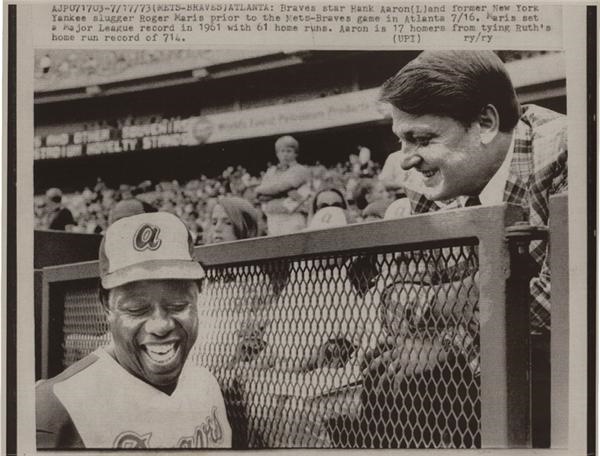
And with Jackie Robinson having died the preceding October, Maris, who got 100 men's shares of hate mail and phone calls, was the one man who had any idea of what Hank was going through. Now retired and running a beer distributorship in Gainesville, Florida, he made the 330-mile trip to Atlanta to meet Hank on July 16.
This photo is rare not just because it shows the two "home run kings" together,
but because it shows Roger Maris without his famous crew cut.

One thing Maris did not have to deal with in 1961 was racism. But he was mocked as "a .270 hitter." Aaron finished the 1973 season with a .301 average. Plagued by injuries, Maris retired in 1968, only 34 years old, with 275 home runs. Aaron was still going strong, in spite of the stress.

Hank realized he had another advantage. If Roger had fallen short, he would have had to start all over again the next year. If Hank fell short in 1973, he would still be able to break the record the next year. There was no pressure coming from the calendar. (It was coming from the haters.)

On September 29, the next-to-last day of the season, home to the Houston Astros, Hank hit Number 713 off Jerry Reuss. The Braves won, 7-0. On September 30, Hank had an RBI single in the 1st. He singled again in the 4th. He singled again in the 6th. Three hits, a successful game by almost anybody's standard. But now, it was almost impossible to break the record on this day. And he flew out in the 8th. The Astros won, 5-3.

The season was over, and Hank Aaron had 713 career home runs. And so began a long wait. And the threats kept coming in. There was even a mailed threat to kidnap his daughter at college. Hank hired a personal bodyguard, an Atlanta policeman named Calvin Wardlaw. He even stayed in a separate hotel from his teammates -- not because he wasn't allowed in the same hotel with his white teammates, as had been the case 20 years ago, but for his teammates' protection from anyone who might come after Hank.

On April 4, 1974, the Braves opened the new season against the Reds at Riverfront Stadium. In the top of the 1st inning, Hank drilled a pitch from Jack Billingham over the fence in left-center field. It was Number 714. When he got to 3rd base, he got a handshake from Pete Rose, who would have a similar moment on that field in 1985, when he officially surpassed Ty Cobb for most career hits. When Hank got to home plate, he received a handshake from Reds catcher Johnny Bench. Also on hand to offer his congratulations were Commissioner Bowie Kuhn and Vice President Gerald Ford -- but not Nixon.

April 8, 1974. Opening Night in Atlanta. The attendance was announced as 53,774, and it remains a home record for the Braves franchise, in any city. The game was broadcast live on NBC, just in case. The Braves were playing the Los Angeles Dodgers, who were wearing black armbands in memory of Bobbie McMullen, wife of Dodger 3rd baseman Ken McMullen. She had died of cancer 2 days earlier.

Commissioner Bowie Kuhn was not in attendance. Nor was Nixon, who was getting deeper and deeper into Watergate. But the Governor of Georgia, Jimmy Carter, was there. So was the Mayor of Atlanta, the city's 1st black man so elected, Maynard Jackson. So was Pearl Bailey, who sang the National Anthem, as she had for the Mets' World Series clincher in 1969. So was Sammy Davis Jr.: The great song-and-dance man said he would pay $25,000 -- about $125,000 in today's money -- for the record-breaking home run ball.

Al Downing was the starting pitcher for the Dodgers. The lefthander from Trenton, New Jersey had been the 1st black pitcher for the Yankees, in 1961. In 1964, he had led the American League in strikeouts, the 1st black pitcher to have done that. He had worn Number 24 for the Yankees, the same number that Mays had made famous with the Giants. Now, with the Dodgers, he was wearing 44, the same number as Aaron.

Hank led off the bottom of the 2nd, and drew a walk. Dusty Baker doubled him home, to give the Braves a 1-0 lead. The Dodgers took a 3-1 lead in the top of the 3rd, and still held it in the bottom of the 4th. Darrell Evans reached 1st base on an error. That brought Hank to the plate.

Downing threw a curveball, and it went into the dirt for ball 1. At 9:07 PM Eastern Daylight Time, he threw a fastball.
Milo Hamilton had the call for WGST, 920 on the AM dial (now WGKA):

Henry Aaron, in the second inning, walked and scored. He's sittin' on 714. Here's the pitch by Downing. Swinging. There's a drive into left-center field! That ball is gonna be... outta here! It's gone! It's 715! There's a new home run champion of all time, and it's Henry Aaron! The fireworks are going! Henry Aaron is coming around third! His teammates are at home plate! And listen to this crowd! This sellout crowd is cheering Henry Aaron, the home run king of all time!"

Because of Hamilton's call, Aaron would spend the rest of his life being called "the Home Run King," much more often than "the home run leader."

The Dodgers' telecast, on KTTV-Channel 11, had Vin Scully with the call. Having broadcast for the team since 1950, when they were still in Brooklyn, and still had black MLB pioneers like Jackie Robinson, Roy Campanella and Don Newcombe, he knew what the moment meant:

One ball and no strikes, Aaron waiting, the outfield deep to straightaway. Fastball, there's a high drive to deep left-center field! Buckner goes back, to the fence, it is gone!

Scully then paused, as Aaron got around the bases and reached home plate, then resumed:

What a marvelous moment for baseball. What a marvelous moment for Atlanta and the State of Georgia. What a marvelous moment for the country and the world: A black man is getting a standing ovation, in the Deep South, for breaking a record of an all-time baseball idol.

It was a marvelous moment, and it was embraced by 99.99 percent of baseball fans. Writing about the event 30 years later, Tom Stanton would title his book about the record chase Hank Aaron and the Home Run That Changed America.

Bill Buckner was the Dodgers' left fielder that night. He climbed the fence to try to catch the ball, but he had no chance. After his error allowed the winning run to score in the Mets' Game 6 win over the Boston Red Sox in the 1986 World Series, someone suggested that, in concert with "The Curse of the Bambino" on the Red Sox, Ruth was punishing Buckner for not catching the ball. This was stupid: How did this person explain all the other outfielders who failed to catch Aaron's home run balls, and weren't "punished"? Or Downing, and the other pitchers who gave them up?

There was a scary moment. With all of the death threats, including from some men claiming they would be in attendance with rifles to shoot Hank before he could reach home plate (as if the home run wouldn't have counted anyway), bodyguard Wardlaw was looking around with binoculars for men with guns, like a Secret Service agent, and had his own gun ready.

After all, it had been 11 years since the assassinations of President John F. Kennedy and civil rights leader Medgar Evers; 9 years since that of Malcolm X; 8 years since The Beatles had gotten death threats on their last tour; 6 years since the assassinations of Dr. Martin Luther King Jr. and Senator/Presidential candidate Robert F. Kennedy, and the shooting of painter Andy Warhol; 5 years since the murder of actress Sharon Tate and 3 of her friends; 4 years since an attempted assassination of Pope Paul VI; and 2 years since an attempted assassination of Governor George Wallace of Alabama during a Presidential campaign. People already knew that celebrities were not necessarily safe.

(There was also an attempt to assassinate Queen Elizabeth II of Britain in 1970, but this was not revealed until many years later. The year 1975 would see 2 failed attempts to assassinate new President Gerald Ford. Five years after that, former Beatle John Lennon would be shot and killed. Within 4 months of that, President Ronald Reagan would be shot and nearly killed.)

Wardlaw knew that Hank was still in danger. And Britt Gaston (on the left in the photo) and Cliff Courtenay, 2 long-haired 17-year-olds from Waycross, Georgia, ran onto the field, and patted Hank on the back. It happened quickly, and Wardlaw had to make a quick decision as to what do to. In 2005, he recalled:

People asked me afterward, "Where were you for the big moment, Calvin?" And I tell them that my instinct was, at that moment, that, even if I could have gotten out there, my man was not in danger. And I tell them something else: What if I had decided to shoot my two-barreled .38 at those two boys, if I thought he was in a life-threatening situation, and had hit Hank Aaron instead, on the night he hit No. 715?
Gaston and Courtenay were arrested for disorderly conduct and trespassing, but nothing worse than that. Gaston's father bailed them out of jail at 3:30 AM, paying $100 for each of them. The next morning, the charges were dropped.

Taking no chances, Estella Aaron wrapped her arms around her son right after he got to home plate, as if to say, "If you want to hurt my son, you'll have to go through me, first." Herbert Sr., and brothers Herbert Jr. and Tommie, were also there.

Gaston went on to run a graphics business in South Carolina, was a season-ticket holder for University of Georgia football, and died of cancer in 2012, at age 55. Courtenay is now 66 years old, and an optometrist in Valdosta. Both had become friends with Aaron.

The ball dropped in front of an ad for BankAmericard, whose name was changed to Visa in 1976. It landed in the Braves' bullpen, where it was caught by reliever Tom House. House left the bullpen, and presented Hank with the ball. It was not sold to Sammy Davis Jr. It now resides in the museum section of the Baseball Hall of Fame in Cooperstown, New York, as does the bat Hank hit it with, and so does the entire uniform that he wore that day.

Governor Carter gave him a Georgia license plate with his initials and the magic number: HLA 715. "Thank God it's over," Hank said. 
Jimmy, Hank and Billye

Oh, yes, the game: The Braves scored twice more in that bottom of the 4th inning, and went on to win, 7-4.

Hank finished the season with 20 home runs at age 40, and 733 for his career. That remains a record for home runs for a single team. (Ruth hit 659 for the Yankees.)

In 1970, Bud Selig, a Milwaukee car dealer who had been trying to bring MLB back to his hometown after the Braves left, had bought the bankrupt Seattle Pilots, moved them to Milwaukee County Stadium, and given them the name of every pro baseball team in the city before the Braves: The Milwaukee Brewers. At the time, they were in the American League, which, unlike the National League, had adopted the designated hitter.

On November 2, 1974, recognizing that even he had slowed down -- he had been mainly a 1st baseman from 1971 onward, and was playing left field the night he hit Number 715 -- the Braves traded Hank Aaron back to his 1st major league city. He went to the Brewers, who sent the Braves outfielder Dave May, who had been an All-Star in 1973; and Roger Alexander, a pitcher then in Class AA, who ended up never making the major leagues.

Milwaukee fans welcomed Hank back with open arms. But it soon became clear that he was at the end of the line. In 1975, he batted .234 with just 10 home runs, giving him 745. He was still selected to the All-Star Game, held in Milwaukee. It was his 24th, tying a record held by Musial and Mays.

In 1976, he batted .229. On July 20, batting at County Stadium against Dick Drago of the California Angels, he hit his 755th career home run. Nobody knew it at the time, but, with more than 2 months left in the season, it would be his last.

On October 3, the Brewers closed the season at home against the Tigers. Hank was the DH, and batted in his customary 4th position, despite all evidence that he was done. He singled home Charlie Moore in the bottom of the 6th, and was replaced by pinch-runner Jim Gantner, to a standing ovation.

It was his 3,771st career hit, then 2nd all-time behind only Ty Cobb. In other words, he had over 3,000 hits that weren't home runs. He had 1,477 extra-base hits, still a record: 624 doubles and 98 triples, to go with his 755 home runs. It was his 2,297th run batted in, also still a record. It gave him 6,856 total bases, also still a record.

He also retired with these statistics: A .305 batting average, a .374 on-base percentage, a .555 slugging percentage, and a 155 OPS+. And he retired with another interesting distinction: He was the last former Negro League player who was still playing Major League Baseball.

In 1982, his 1st year of eligibility, he was elected to the Baseball Hall of Fame. In 1999, The Sporting News named its 100 Greatest Baseball Players. Hank was ranked 5th, trailing Ruth, Mays, Cobb and Walter Johnson. In 2022, ESPN named its 100 Greatest Baseball Players. Hank actually rose, ranking 3rd behind Ruth and Mays.

When Turner Field opened for the 1997 season, its address was 755 Hank Aaron Drive. Atlanta-Fulton County Stadium (the name was changed in 1975) was torn down, to make way for parking for Turner Field, but the sign beyond the left field fence to mark where the record-breaking ball fell was restored to its former spot, on a fence.
In 2017, Turner Field was replaced by SunTrust Park, now named Truist Park, whose address is 755 Battery Avenue. Because the City of Atlanta didn't want to give up the Aaron statue outside Turner Field, a new statue of Hank was dedicated at Truist Park's Monument Garden. The Brewers also put up a statue of him at American Family Field, and both teams retired his Number 44.

In 1997, his hometown of Mobile opened the 6,000-seat Hank Aaron Stadium. Honoring him, but also a family of local activists, the address is 755 Bolling Brothers Boulevard. In 2002, President George W. Bush, a former owner of the Texas Rangers, gave him the Presidential Medal of Freedom.

After his retirement, Aaron was hired by the Braves' front office. Even more so than as an active player, he fought for more inclusiveness in baseball.

On August 7, 2007, Barry Bonds of the San Francisco Giants stepped to the plate against Mike Bascik of the Washington Nationals, and hit his 756th career home run. Already having the single-season home run record, with 73 in 2001, he now held the career record as well. He would finish the season with 763, and retire.

I did not see Hank hit Number 715. Even though it was only 9:07 PM Eastern Time, my mother made me go to bed. And, at the age of 4, I wouldn't have been aware of it, anyway.

I did not see Barry hit Number 756. It was 11:46 PM Eastern Time, but, at that point in my life, staying up late wasn't an issue. Nor was access: The game was on ESPN. I chose not to watch it, because I knew that Bonds had cheated, using performance-enhancing drugs. Aaron was a better sport about it than I was. Although he didn't go to San Francisco for the game, he taped a message to be played on the video board at what's now named Oracle Park:

I would like to offer my congratulations to Barry Bonds on becoming baseball's career home run leader. It is a great accomplishment which required skill, longevity, and determination. Throughout the past century, the home run has held a special place in baseball, and I have been privileged to hold this record for 33 of those years.

I move over now and offer my best wishes to Barry and his family on this historical achievement. My hope today, as it was on that April evening in 1974, is that the achievement of this record will inspire others to chase their own dreams. 

Bonds was now, and remains, and is likely to remain for a very long time, the all-time home run leader. But, for so many, Aaron was, and is, still the Home Run King. Including myself: Every time I look at a digital clock and see either 7:15 or 7:55, I think of Hank Aaron. Even though I wasn't old enough to have watched it, and have never lived anywhere near either Milwaukee or Atlanta.

Hank Aaron died in Atlanta on January 22, 2021, just short of his 87th birthday.