Showing posts with label watergate. Show all posts

Sunday, September 8, 2024

September 8, 1974: President Ford Pardons Former President Nixon

September 8, 1974, 50 years ago: President Gerald R. Ford issues a pardon to his predecessor, former President Richard M. Nixon. Here is the complete text:

Richard Nixon became the thirty-seventh President of the United States on January 20, 1969 and was reelected in 1972 for a second term by the electors of forty-nine of the fifty states. His term in office continued until his resignation on August 9, 1974.

Pursuant to resolutions of the House of Representatives, its Committee on the Judiciary conducted an inquiry and investigation on the impeachment of the President extending over more than eight months. The hearings of the Committee and its deliberations, which received wide national publicity over television, radio, and in printed media, resulted in votes adverse to Richard Nixon on recommended Articles of Impeachment.

As a result of certain acts or omissions occurring before his resignation from the Office of President, Richard Nixon has become liable to possible indictment and trial for offenses against the United States. Whether or not he shall be so prosecuted depends on findings of the appropriate grand jury and on the discretion of the authorized prosecutor. Should an indictment ensue, the accused shall then be entitled to a fair trial by an impartial jury, as guaranteed to every individual by the Constitution.

It is believed that a trial of Richard Nixon, if it became necessary, could not fairly begin until a year or more has elapsed. In the meantime, the tranquility to which this nation has been restored by the events of recent weeks could be irreparably lost by the prospects of bringing to trial a former President of the United States. The prospects of such trial will cause prolonged and divisive debate over the propriety of exposing to further punishment and degradation a man who has already paid the unprecedented penalty of relinquishing the highest elective office of the United States.

Now, THEREFORE, I, GERALD R. FORD, President of the United States, pursuant to the pardon power conferred upon me by Article II, Section 2, of the Constitution, have granted and by these presents do grant a full, free, and absolute pardon unto Richard Nixon for all offenses against the United States which he, Richard Nixon, has committed or may have committed or taken part in during the period from January 20, 1969 through August 9,1974.

IN WITNESS WHEREOF, I have hereunto set my hand this eighth day of September, in the year of our Lord nineteen hundred and seventy-four, and of the Independence of the United States of America the one hundred and ninety-ninth.

Despite several major figures in his Administration -- including his Chief of Staff, H.R. Haldeman; his White House Council, John Dean; and the 1st 2 of his 4 Attorneys General, John Mitchell and Richard Kleindienst -- being convicted of felonies and sentenced to federal prison for their various offenses that fell under the umbrella term "Watergate," Nixon would not be charged with any crimes. Whatever he did, whether publicly known now or not, he got away with it.

The backlash against Ford was immediate, and fierce. He had near-universal respect in his 1st month on the job, and was seen as a healing figure. He thought that this pardon would help with the healing process. Instead, some people thought he should have let the legal system take its course with Nixon. Others thought he was in on it, having accepted the Presidency in return for the promise of a pardon. He lost the trust of millions of people, and that pardon was clearly one of the reasons that he was defeated in his bid for a term of his own in 1976.

The Constitution gives the President the power, and the right, to pardon people for violating federal law. The President can do it for any reason. Or for no reason. And if he has a reason, he doesn't have to publicly reveal it. But Ford did have a reason, and it was a justifiable one: Friendship. 

Ford and Nixon had served together in the U.S. House of Representatives in 1949 and 1950. Ford had been House Minority Leader from 1965 to 1973, when Nixon rewarded his loyalty by appointing him Vice President, and, professionally, they remained allies until August 9, 1974. They had helped each other. Their families were friends. Ford didn't want to see his friend suffer any further.

There was also the Nixon family to consider. Whatever Tricky Dick did, there was no reason to make his wife Pat, their daughters Tricia and Julie, and the rest suffer through a criminal trial.

In his first speech after taking office, Ford said, "My fellow Americans, our long national nightmare is over." He knew that extending the Watergate story would place an even greater strain on the country. He wanted it over. Which is totally understandable.

On top of that, accepting the pardon was, by definition, a confirmation of guilt. Nixon could have refused the pardon, thus maintaining his stance that he was innocent of any legal wrongdoing, and taken his chance as a private citizen with the criminal justice system. Instead, within an hour of its issuance, he publicly announced that he had accepted it. By doing so, Nixon essentially pled guilty.
He never served a minute in prison. But, until May 31, 2024, he was the only President ever officially remembered as a criminal. Not a "crook," the word he used to defend himself on November 17, 1973. (His 1st Vice President, Spiro Agnew, was a crook.) As an actual criminal.

I used to think that the pardon was the right thing to do. I no longer think that. I still understand and respect Ford's reasoning. But the actions of Donald Trump, from the 2016 election with its interference from Russia through his actions after leaving office, show him to have been an even worse criminal than Nixon.

And, in between Nixon and Trump, there was Ronald Reagan with a whole slew of crimes, including the Iran-Contra Affair; the allegations about Bill Clinton, from Whitewater to his relationship with Monica Lewinsky; and George W. Bush, whose Administration was the shadiest one to that point.

If Nixon had faced prosecution, and had been convicted, and had served time -- even if it was just "house arrest," being confined to his house in San Clemente, California, with only occasional visits from family, and no one else, for a few years -- the message would have been sent to every President, and every would-be President, thereafter: "Do not do things like this, because you will get caught, and you will be punished for them."

Ford's pardon of Nixon sent the opposite message: "As President, you are above the law." Or, as Nixon told David Frost in his 1977 interview, "Well, when the President does it, that means it is not illegal."

Yes. It is. Regardless of what John Roberts, Clarence Thomas, Samuel Alito, Neal Gorsuch, Brett Kavanaugh and Amy Coney Barrett say. They lied.

Friday, August 9, 2024

August 9, 1974: President Richard Nixon Resigns

August 9, 1974, 50 years ago today: Richard Nixon resigns as President of the United States, due to the crimes he committed that fell under the umbrella term "Watergate."

We may never know for sure if Nixon authorized the break-in of the offices of the Democratic National Committee at the Watergate hotel and office complex on the Potomac River in Washington, D.C. on June 17, 1972. What we do know, thanks to the audiotaping system he had in the Oval Office at the White House, is that, on June 23, 6 days after the break-in, he told his White House Chief of Staff, H.R. "Bob" Haldeman, to tell the FBI to back off on their investigation of the break-in.

That was obstruction of justice. On July 27, 1974, the Committee on the Judiciary of the U.S. House of Representatives approved an Article of Impeachment against Nixon, on the charge of obstruction of justice. On July 29, they approved another, on the charge of abuse of power. On July 30, they approved a third, for contempt of congress.

On August 5, in United States v. Nixon, the U.S. Supreme Court ruled unanimously that Nixon had to turn over all the tapes. This 8-0 vote included 3 of the 4 Justices that Nixon himself had appointed: Chief Justice Warren Burger, Harry Blackmun and Lewis Powell. Nixon had also appointed William Rehnquist, who recused himself, because he had worked in the U.S. Department of Justice for the 1st 3 years of the Nixon Administration.

And the tape of the June 23, 1972 order from Nixon to Haldeman was made public. It became known as "the Smoking Gun Tape." On August 7, Republican Congressional leaders visited Nixon at the White House, and told him they didn't have the votes to save from from being impeached by the House, or convicted in a trial by the Senate. He would be removed from office, unless he did it by himself, by resigning.

On August 8, at 9:01 PM Eastern Time, he addressed the nation in prime time, and spoke for 16 minutes, telling the nation what it was more than ready to hear:

I have never been a quitter. To leave office before my term is completed is abhorrent to every instinct in my body. But as President, I must put the interest of America first.
America needs a full-time President and a full-time Congress, particularly at this time with problems we face, at home and abroad.
To continue to fight through the months ahead for my personal vindication would almost totally absorb the time and attention of both the President and the Congress in a period when our entire focus should be on the great issues of peace abroad and prosperity without inflation at home.
Therefore, I shall resign the Presidency effective at noon tomorrow. Vice President Ford will be sworn in as President at that hour in this office.
The next day, at 9:00 AM Eastern, Nixon gave a tearful Farewell Address to his staff in the East Room of the White House. After it, the President and First Lady Pat Nixon were escorted to a waiting helicopter, Marine One, by Vice President Ford and his wife Betty. Mrs. Nixon got in. Mr. Nixon got to the top step, gave a wave to his staff, and did one more "V for Victory" salute before boarding.

At 11:35 AM, a letter arrived at the office of U.S. Secretary of State Henry Kissinger, reading, in its entirety: "Dear Mr. Secretary: I hereby resign the office of President of the United States. Sincerely, Richard Nixon." As soon as Nixon received it, officially, Nixon was no longer in office, and Vice President Gerald Ford was now the President, regardless of whether there was an actual swearing-in.

At 12:05 PM, in the East Room, Gerald Rudolph Ford Jr. was sworn in as the 38th President of the United States by Chief Justice Warren Burger. He told the nation, "My fellow Americans, our long national nightmare is over. Our Constitution works. Our great republic is a government of laws, and not of men. Here, the people rule."

Nixon had been nominated at 5 different Republican Conventions: In 1952 and 1956 for Vice President; and in 1960, 1968 and 1972 for President. After 1972, he could never attend another. It would take until 2004, and Governor Arnold Schwarzenegger of California, for a speaker at a Republican Convention, to even mention him again, so toxic was his name considered to be, even in his own Party.

By 2004, of course, the Republicans had lurched so far to the right that, not only was it possible for Nixon's name to be both spoken aloud and cheered at a Republican Convention, but for people in the Republican Party to come to a consensus that Nixon did nothing wrong, except get caught.

UPDATE: It took me until 2024 to think of this, but the 1970s were Schrödinger's Decade. There was too much Republican competence, and too much crimefighting; and, at the same time, not enough of either of those things.

Nixon's Presidential Library was built adjacent to his birthplace in Yorba Linda, California, 30 miles southeast of downtown Los Angeles. Yorba Linda also has a Richard M. Nixon Parkway and a Richard M. Nixon Elementary School.

Comedians David Frye and Rich Little became famous for their impersonations of Nixon, among other political figures. Frye leaned on the phrase, "Let me just say this," while Little preferred, "Let me make this perfectly clear." Dan Aykroyd played Nixon as a bitter former President on Saturday Night Live, although he refused to shave the mustache he had at the time.

Nixon frequently features in time-travel and alternate-history pieces. These include Robert Wisdom as an alternate-history 5th-term Nixon in 1985 in the superhero film Watchmen in 2009, Stuart Milligan on Doctor Who in 2011, John H. Tobin in Transformers: Dark of the Moon the same year, Mark Camacho in X-Men: Days of Future Past in 2014, and Paul Ganus on DC's Legends of Tomorrow in 2019. Two films have been made about Nixon's 1970 meeting with Elvis Presley: He was played by Bob Gunton in Elvis Meets Nixon in 1997, and Kevin Spacey in Elvis & Nixon in 2016.

Among the other actors to play Nixon have been Rip Torn in Blind Ambition (based on the memoir of John Dean) in 1979, Philip Baker Hall in Secret Honor in 1984, Lane Smith in The Final Days in 1989, Anthony Hopkins in Oliver Stone's film Nixon in 1995,  Dan Hedaya in the comedy Dick in 1999, Frank Langella reprising his Tony Award-winning Broadway role in Frost/Nixon in 2008, and John Cusack in The Butler in 2013.

Ford is the only President whose Presidential Library and Presidential Museum are in 2 different locations: The former is at his alma mater, the University of Michigan; while the latter is in his hometown, Grand Rapids, Michigan. He has a statue in the Capitol Rotunda in Washington, and a House of Representatives Office Building is named for him, due to his service as House Minority Leader.

Despite looking and sounding nothing like Ford, Chevy Chase played him on Saturday Night Live. He was also played by Dick Crockett in The Pink Panther Strikes Again in 1976, Josef Sommer in The Betty Ford Story in 1987, Larry Lindsay in Hot Shots! Part Deux in 1993, Drew Snyder in Dark Skies in 1997, Jeffrey Ventimilia in That '70s Show in 1998, Corbin Bernsen in The Commission in 2003, and Bill Camp in Vice (about Ford's former Chief of Staff, Dick Cheney) in 2018.

The State where he was born, Nebraska, and the State where he grew up, Michigan, both have a Gerald R. Ford Freeway, and Interstate 70 in Eagle County in Colorado is the Gerald Ford Memorial Highway. In 2017, the USS Gerald R. Ford, a nuclear-powered aircraft carrier, CVN-78, was launched, and is the largest warship ever built. So far, despite also having served in the Navy during World War II, Nixon doesn't have a ship named for him. Maybe he'll get a pirate ship.

Wednesday, August 7, 2024

August 7, 1974: The Republican Leaders Tell President Nixon the Truth

Senator Hugh Scott addresses the media after the meeting.
Behind him is Senator Barry Goldwater.
Facing Scott is Representative John Rhodes.

August 7, 1974, 50 years ago: President Richard Nixon sees 3 leaders of the Republican Party at the White House: Representative John Rhodes of Arizona, the House Minority Leader; Senator Hugh Scott of Pennsylvania, the Senate Minority Leader Hugh Scott; and Senator Barry Goldwater of Arizona, the Party's 1964 nominee for President, and the unofficial leader of what had come to be known as "the conservative movement."

They had bad news for him.

On June 17, 1972, 5 men working for the Committee to Re-Elect the President had broken into the headquarters of the Democratic National Committee, at the Watergate hotel and office complex in Washington. Whether Nixon knew that this was going to happen, and approved of it, or not, only he knew for sure.

But, 6 days later, on June 23, he met with his White House Chief of Staff, Harry Robbins "Bob" Haldeman. The conversation was captured on an audiotape, in a system Nixon had installed in the Oval Office of the White House, for the purpose of historical records, because he didn't want anything to be distorted by outside historians. Ironically, this taping system would, instead, be his downfall, as it recorded these words, among others:

Haldeman: That the way to handle this now is for us to have Walters call Pat Gray and just say, "Stay the hell out of this… This is ah, business here, we don't want you to go any further on it."

Nixon: Just say this is sort of a comedy of errors, bizarre, without getting into it, "The President believes that it is going to open the whole Bay of Pigs thing up again. And, ah, because these people are plugging for, for keeps, and that they should call the FBI in and say that we wish for the country, don't go any further into this case, period!"

Haldeman: OK.

"Walters" was Vernon C. Walters, a former 3-star General in the U.S. Army, who was then the Deputy Director of the CIA. "Pat Gray" was L. Patrick Gray III, the Acting Director of the FBI following the death of J. Edgar Hoover on May 2, 1972.

In other words, Haldeman had suggested to Nixon that he tell the FBI to back off on investigating the scandal that had become known as "Watergate," Nixon had agreed to it, and Haldeman understood that Nixon had agreed to it. This was obstruction of justice. Given that there were two men discussing it, this was also conspiracy to obstruct justice. Each of these was a felony; and, in Nixon's case, an impeachable offense.

But no one else knew that at the time, and Nixon was overwhelmingly re-elected. But the scandal broke out at the start of his 2nd term, and the Senate began holding hearings. Alexander Butterfield, Director of the Federal Aviation Administration and a former Nixon White House aide, was asked by the Senate committee if he had installed a taping system in the Oval Office. He told the truth: He had.

The fight by Congress to get those tapes, and the fight by Nixon to keep Congress from getting them, went all the way to the Supreme Court. On August 5, 1974, the Court unanimously ruled that they had to be released. When the tape featuring Nixon agreeing to Haldeman's plan to get the FBI to back off was released, it was proof of felonious guilt. It became known as "The Smoking Gun Tape."

On July 27, the House Judiciary Committee voted 27-11 to approve 3 Articles of Impeachment against Nixon. All 11 voting against it were Republicans, On August 5, having heard the tape, all 11 of those Republicans said they would vote to impeach him when the Articles came to a vote before the full House.

And so, Rhodes, Scott and Goldwater went to see Nixon at the White House. Rhodes said he couldn't save Nixon from impeachment in the House, since only 30 Republicans were willing to vote against impeachment. Scott told him there might be half a dozen Senators willing to acquit, and that was with the remaining segregationist Democrats, a.k.a. Dixiecrats, being counted. And Goldwater told him the conservative movement, which had stopped trusting him during the 1960 Presidential campaign, wouldn't save him.

Upon leaving the White House, the three men then told the media that impeachment and conviction were a near-certainty, and that the only thing that could prevent it was if Nixon resigned the Presidency, and that they had told him this. They didn't tell Nixon that they thought he should resign, only that it was the only way to avoid impeachment and removal.

After talking it over with his family and his remaining loyalists the next day, August 8, Nixon spoke to the nation that night, and announced his resignation, effective at 12:00 Noon the next day, August 9.

Scott served out his term in the Senate, and left after the 1976 election. He died in 1994, 3 months after Nixon. Rhodes retired after the 1980 election, and lived until 2003. Goldwater was running for re-election in 1974, and won, and won again in 1980. He retired after the 1986 election, and died in 1998.

In 1998, when it looked like Bill Clinton might be impeached at the height (or depth, depending on your point of view) of the Monica Lewinsky scandal, there was speculation that Clinton might receive a similar visit: House Minority Leader Dick Gephardt of Missouri, Senate Minority Leader Tom Daschle of South Dakota, and Ted Kennedy of Massachusetts, the Senate's leading liberal and the brother of Clinton's hero, President John F. Kennedy.

But that delegation never came together, because Clinton was never in danger of being removed from office: The Republican-controlled house had enough hatred to impeach him, but the Senate had neither enough evidence nor enough Republicans to convict him.

In 2019, Donald Trump was impeached. But there would be no Republican delegation of House Minority Leader Kevin McCarthy of California, Senate Minority Leader Mitch McConnell of Kentucky, and the leader of the conservative movement, whoever that was then believed to be, going to tell Trump he had to resign -- not for the good of the country, not for the good of the Republican Party, not for the good of the conservative movement, and not even for Trump's own good. There didn't have to be: McConnell had a hammerlock on the Senate's Republican caucus, and the Senate acquitted Trump.

Trump got to serve out his term. He even got to come back and be nominated for another in 2024. Nobody in the Republican Party has had the courage -- moral or otherwise -- to tell him that he is unacceptable. For America, for the Party, for anything. We, the people, must show him that. We've done it before. We must do it again.

Monday, April 8, 2024

April 8, 1974: Hank Aaron Hits His 715th Home Run

April 8, 1974, 50 years ago: A testament to longevity, perseverance, strength of body and strength of character is finalized, as Hank Aaron becomes Major League Baseball's all-time home run leader.

Henry Louis Aaron was born on February 5, 1934 in Mobile, Alabama. Like Mickey Mantle, he had to play local semipro baseball because his high school did not have a baseball team. His timing was right: He was 13 years old when Jackie Robinson reintegrated what we would now call Major League Baseball, with the Brooklyn Dodgers. When he was 15, he got a tryout with the Dodgers, but did not get a pro contract. He remained with the Mobile Black Bears, earning $3.00 per game.

Also like Mantle, he began his professional career as a shortstop, but his fielding was such that he was switched to the outfield. In between, he was also tried at 2nd base. In 1952, he was signed by the Indianapolis Clowns of the Negro American League. He was soon noticed by the New York Giants, who already had former Negro League stars Willie Mays and Monte Irvin; and the Boston Braves, who had integrated with 1948 National League Rookie of the Year Sam Jethroe.

"I had the Giants' contract in my hand," Aaron would later say, "but the Braves offered $50 a month more. That's the only thing that kept Willie Mays and me from being teammates: Fifty dollars." $50 in 1952, with inflation, is about $579 in 2024 money. On such hinge moments does the history of a sport sometimes hang in the balance. On June 12, 1952, the Braves paid the Clowns $10,000 for his contract.

For the 1953 season, the Braves moved to Milwaukee. He made their major league roster in 1954. He made his major league debut on April 13, at Crosley Field in Cincinnati. Wearing Number 5, batting 5th, and playing left field, he went 0-for-5. Eddie Mathews hit 2 home runs, but the Cincinnati Reds beat the Braves, 9-8. On April 23, at Busch Stadium (formerly Sportsman's Park) in St. Louis, he hit his 1st career home run, off former Yankee Vic Raschi, by then with the St. Louis Cardinals.

For the 1955 season, he switched to Number 44, and was moved to right field. Don Davidson, the Braves' public relations director, began listing him as "Hank" in official releases. From then on, "Henry" and "Hank" would be used interchangeably. He even had competing nicknames: "Bad Henry" (being bad for pitchers to face) and "Hammerin' Hank" (a nickname previously given to Detroit Tigers Hall-of-Famer Hank Greenberg).

In 1956, he won his 1st batting title with a .328 average, and the Braves finished just 1 game behind the Brooklyn Dodgers for the Pennant. In 1957, the Braves won their 1st Pennant since 1914. They clinched on September 23, with Aaron hitting a game-winning home run in the bottom of the 11th, off Billy Muffett of the Cardinals. Aaron was also named the NL's Most Valuable Player. It would be his only MVP award.

They faced the Yankees in the World Series. Hank later said that Yankee Stadium intimidated them, but that the Yankees did not. The Braves won the Series in 7 games, clinching at Yankee Stadium. They won the Pennant again in 1958, but lost the Series to the Yankees.

In 1959, Hank won another batting title, but the Braves finished in a tie for the Pennant with the Dodgers, who had moved to Los Angeles, and the Dodgers won the subsequent Playoff. As it turned out, that would be the closest Hank would get to another World Series.

The Gold Glove Award for fielding excellence was first given in 1958, and Hank won it for National League right fielders in each of its 1st 3 seasons. He would never win another, through no fault of his own, as Frank Robinson and Roberto Clemente would dominate that award.

In the Winter of 1960, Hank appeared on the TV show Home Run Derby. He was the show's most successful player, winning 6 games. With the show's prizes, including bonuses for consecutive homers, he won $13,500. He had been paid $35,000 the season before.

By this point, he was already regarded as one of the best all-around players in the game, along with Mantle and Mays. Most observers, including Home Run Derby host Mark Scott, took note of how he was then a bit skinny, but had "quick wrists." At that point, if you had told longtime baseball people that he would end up with over 3,000 hits, they probably would have believed it. If you had told them he would hit 500 home runs, they might have believed that.

But if you had told them that Hank Aaron would be the man to break Babe Ruth's career record of 714 home runs, that would have never occurred to them. Most people thought that, if it ever happened, it would be either Mantle or Mays who did it.

The Braves remained in contention in the early 1960s, but didn't win another Pennant. The novelty of Milwaukee being in the major leagues began to wear off. And the arrival of the Minnesota Twins in 1961 took the States of Minnesota, North Dakota and South Dakota, and even westernmost Wisconsin, out of what would now be called the Braves' "market." Attendance dropped, and team owner Bill Bartholomay moved them to Atlanta for the 1966 season.

Hank led the NL in homers and RBIs again in 1966. He led it in homers, slugging, runs and total bases in 1967. Moving from Milwaukee County Stadium to Atlanta Stadium helped his hitting: Atlanta had the highest elevation of any major league city until Denver got the Colorado Rockies in 1993, and the ball flew out of the stadium. It became known as "The Launching Pad."

On July 14, 1968, at Atlanta Stadium, against Mike McCormick of the San Francisco Giants, Hank hit the 500th home run of his career. He was only the 8th player to reach that milestone, following Babe Ruth, Jimmie Foxx, Mel Ott, Ted Williams, Mays, Mantle, and Mathews.

He was only 34 years old, showed no sign of slowing down, and was playing in a great hitter's park. Mantle was succumbing to his injuries, and would retire just before the next season, with 536 home runs. Mays had surpassed Mantle, and had also surpassed Ott (511) to become the NL's all-time home run leader. He had surpassed Williams (521) and Foxx (534). With Mantle having fallen away, the consensus was that, if any player would surpass Ruth's all-time record of 714, it was going to be Mays. Suddenly, baseball fans had to reckon with the possibility that it could be Aaron. He ended the season with 510.

In 1969, the Divisional Play Era began. The Braves and the Reds were put into the NL's Western Division, and the Cubs and the Cardinals into the Eastern Division, despite Atlanta and Cincinnati being further east than Chicago and St. Louis. The Braves won the Division, as Hank matched his uniform number with 44 home runs in a season for the 4th time, including his 537th, to pass Mantle; and again led the NL in total bases. But the Braves were swept by the New York Mets in the 1st-ever NL Championship Series. It would be Hank's last postseason appearance. He now had 554 home runs.

On May 17, 1970, at Crosley Field in Cincinnati, off Wayne Simpson, he singled home Félix Millán. It was his 3,000th career hit. It made him the 1st player to reach both 3,000 hits and 500 home runs, beating Mays to the dual distinction by 2 months. Also in that game, he hit a home run, and singled and scored the winning run in the 10th inning. He finished the season with 592 home runs.

In 1971, Hank tied Mathews' franchise record with 47 home runs, including the 600th of his career, on April 27, off Gaylord Perry of the Giants at Atlanta Stadium. He finished the season with 641. It wasn't enough to lead the NL, as Willie Stargell of the Pittsburgh Pirates hit 48. But it was a career high: For all the homers he hit, he never hit 50 in a season. And he only shared the team record, with Mathews, until Andruw Jones hit 51 in 2005.

In 1972, Hank surpassed Musial's record of 6,134 total bases, joined Ruth as the only players with 2,000 career RBIs, and, on June 11, hit the 649th home run of his career, surpassing Mays for 2nd all-time. Mays would retire the next season, with 660.

When the 1972 season ended, Henry, or Hank (he answered to both), had 673. He would turn 39 in the off-season, but, except for his ankle injury as a rookie, he had never been seriously hurt. It was no longer a question of, "Can he do it?" Only of, "When?" and "Will anything short of a career-ending injury stop him?"

In 1973, it looked like no pitcher could stop him. He just kept slugging away. As America dealt with the fallout from the end of its role in the Vietnam War, and the drip-drip-drip of revelations of the Watergate scandal then engulfing President Richard Nixon, the chase for the record was a welcome distraction for baseball fans. On July 21, at Atlanta Stadium, against Ken Brett of the Phillies (whose brother George would soon make his major league debut for the Kansas City Royals), Hank tallied Number 700.

The attention mounted. Soon, he was getting more mail than anybody in America, except Nixon himself. But, as with Nixon, some of it was hate mail. And some of it was terribly racist in nature. I won't quote any of it here. But at a time when civil rights legislation was an established fact of life, black people were leading the way in popular music, and black directors were making some of the most popular movies (including "blaxploitation films" like Shaft, Superfly, Blacula, Foxy Brown, Cleopatra Jones and Uptown Saturday Night), some people were furious that a black man was in position to break Ruth's record.

Even some people who didn't seem to be racist didn't want the record broken, saying that Hank getting to 715 would make people "forget" Ruth. "I don't want them to forget Babe Ruth," Hank said. "I just want them to remember me."

It didn't help that Ruth was dead. He would have been 66 years old when Roger Maris of the Yankees broke the single-season record of 60 with his "61 in '61." He had a very unhealthy lifestyle, but had he taken care of himself, it wouldn't have been impossible for him to still be alive at age 78 in 1973, and offer his support. His widow, Claire Ruth, didn't want either 60 or 714 to fall. But it's easy to imagine a still-living Bambino saying, on either occasion, "This is good for baseball. And anything that's good for baseball is good for me."

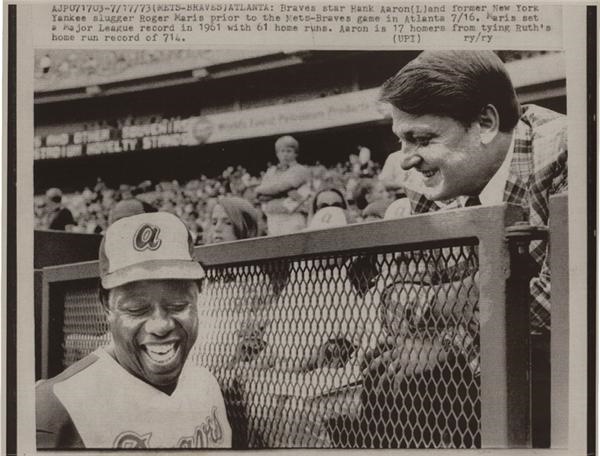
And with Jackie Robinson having died the preceding October, Maris, who got 100 men's shares of hate mail and phone calls, was the one man who had any idea of what Hank was going through. Now retired and running a beer distributorship in Gainesville, Florida, he made the 330-mile trip to Atlanta to meet Hank on July 16.
This photo is rare not just because it shows the two "home run kings" together,
but because it shows Roger Maris without his famous crew cut.

One thing Maris did not have to deal with in 1961 was racism. But he was mocked as "a .270 hitter." Aaron finished the 1973 season with a .301 average. Plagued by injuries, Maris retired in 1968, only 34 years old, with 275 home runs. Aaron was still going strong, in spite of the stress.

Hank realized he had another advantage. If Roger had fallen short, he would have had to start all over again the next year. If Hank fell short in 1973, he would still be able to break the record the next year. There was no pressure coming from the calendar. (It was coming from the haters.)

On September 29, the next-to-last day of the season, home to the Houston Astros, Hank hit Number 713 off Jerry Reuss. The Braves won, 7-0. On September 30, Hank had an RBI single in the 1st. He singled again in the 4th. He singled again in the 6th. Three hits, a successful game by almost anybody's standard. But now, it was almost impossible to break the record on this day. And he flew out in the 8th. The Astros won, 5-3.

The season was over, and Hank Aaron had 713 career home runs. And so began a long wait. And the threats kept coming in. There was even a mailed threat to kidnap his daughter at college. Hank hired a personal bodyguard, an Atlanta policeman named Calvin Wardlaw. He even stayed in a separate hotel from his teammates -- not because he wasn't allowed in the same hotel with his white teammates, as had been the case 20 years ago, but for his teammates' protection from anyone who might come after Hank.

On April 4, 1974, the Braves opened the new season against the Reds at Riverfront Stadium. In the top of the 1st inning, Hank drilled a pitch from Jack Billingham over the fence in left-center field. It was Number 714. When he got to 3rd base, he got a handshake from Pete Rose, who would have a similar moment on that field in 1985, when he officially surpassed Ty Cobb for most career hits. When Hank got to home plate, he received a handshake from Reds catcher Johnny Bench. Also on hand to offer his congratulations were Commissioner Bowie Kuhn and Vice President Gerald Ford -- but not Nixon.

April 8, 1974. Opening Night in Atlanta. The attendance was announced as 53,774, and it remains a home record for the Braves franchise, in any city. The game was broadcast live on NBC, just in case. The Braves were playing the Los Angeles Dodgers, who were wearing black armbands in memory of Bobbie McMullen, wife of Dodger 3rd baseman Ken McMullen. She had died of cancer 2 days earlier.

Commissioner Bowie Kuhn was not in attendance. Nor was Nixon, who was getting deeper and deeper into Watergate. But the Governor of Georgia, Jimmy Carter, was there. So was the Mayor of Atlanta, the city's 1st black man so elected, Maynard Jackson. So was Pearl Bailey, who sang the National Anthem, as she had for the Mets' World Series clincher in 1969. So was Sammy Davis Jr.: The great song-and-dance man said he would pay $25,000 -- about $125,000 in today's money -- for the record-breaking home run ball.

Al Downing was the starting pitcher for the Dodgers. The lefthander from Trenton, New Jersey had been the 1st black pitcher for the Yankees, in 1961. In 1964, he had led the American League in strikeouts, the 1st black pitcher to have done that. He had worn Number 24 for the Yankees, the same number that Mays had made famous with the Giants. Now, with the Dodgers, he was wearing 44, the same number as Aaron.

Hank led off the bottom of the 2nd, and drew a walk. Dusty Baker doubled him home, to give the Braves a 1-0 lead. The Dodgers took a 3-1 lead in the top of the 3rd, and still held it in the bottom of the 4th. Darrell Evans reached 1st base on an error. That brought Hank to the plate.

Downing threw a curveball, and it went into the dirt for ball 1. At 9:07 PM Eastern Daylight Time, he threw a fastball.
Milo Hamilton had the call for WGST, 920 on the AM dial (now WGKA):

Henry Aaron, in the second inning, walked and scored. He's sittin' on 714. Here's the pitch by Downing. Swinging. There's a drive into left-center field! That ball is gonna be... outta here! It's gone! It's 715! There's a new home run champion of all time, and it's Henry Aaron! The fireworks are going! Henry Aaron is coming around third! His teammates are at home plate! And listen to this crowd! This sellout crowd is cheering Henry Aaron, the home run king of all time!"

Because of Hamilton's call, Aaron would spend the rest of his life being called "the Home Run King," much more often than "the home run leader."

The Dodgers' telecast, on KTTV-Channel 11, had Vin Scully with the call. Having broadcast for the team since 1950, when they were still in Brooklyn, and still had black MLB pioneers like Jackie Robinson, Roy Campanella and Don Newcombe, he knew what the moment meant:

One ball and no strikes, Aaron waiting, the outfield deep to straightaway. Fastball, there's a high drive to deep left-center field! Buckner goes back, to the fence, it is gone!

Scully then paused, as Aaron got around the bases and reached home plate, then resumed:

What a marvelous moment for baseball. What a marvelous moment for Atlanta and the State of Georgia. What a marvelous moment for the country and the world: A black man is getting a standing ovation, in the Deep South, for breaking a record of an all-time baseball idol.

It was a marvelous moment, and it was embraced by 99.99 percent of baseball fans. Writing about the event 30 years later, Tom Stanton would title his book about the record chase Hank Aaron and the Home Run That Changed America.

Bill Buckner was the Dodgers' left fielder that night. He climbed the fence to try to catch the ball, but he had no chance. After his error allowed the winning run to score in the Mets' Game 6 win over the Boston Red Sox in the 1986 World Series, someone suggested that, in concert with "The Curse of the Bambino" on the Red Sox, Ruth was punishing Buckner for not catching the ball. This was stupid: How did this person explain all the other outfielders who failed to catch Aaron's home run balls, and weren't "punished"? Or Downing, and the other pitchers who gave them up?

There was a scary moment. With all of the death threats, including from some men claiming they would be in attendance with rifles to shoot Hank before he could reach home plate (as if the home run wouldn't have counted anyway), bodyguard Wardlaw was looking around with binoculars for men with guns, like a Secret Service agent, and had his own gun ready.

After all, it had been 11 years since the assassinations of President John F. Kennedy and civil rights leader Medgar Evers; 9 years since that of Malcolm X; 8 years since The Beatles had gotten death threats on their last tour; 6 years since the assassinations of Dr. Martin Luther King Jr. and Senator/Presidential candidate Robert F. Kennedy, and the shooting of painter Andy Warhol; 5 years since the murder of actress Sharon Tate and 3 of her friends; 4 years since an attempted assassination of Pope Paul VI; and 2 years since an attempted assassination of Governor George Wallace of Alabama during a Presidential campaign. People already knew that celebrities were not necessarily safe.

(There was also an attempt to assassinate Queen Elizabeth II of Britain in 1970, but this was not revealed until many years later. The year 1975 would see 2 failed attempts to assassinate new President Gerald Ford. Five years after that, former Beatle John Lennon would be shot and killed. Within 4 months of that, President Ronald Reagan would be shot and nearly killed.)

Wardlaw knew that Hank was still in danger. And Britt Gaston (on the left in the photo) and Cliff Courtenay, 2 long-haired 17-year-olds from Waycross, Georgia, ran onto the field, and patted Hank on the back. It happened quickly, and Wardlaw had to make a quick decision as to what do to. In 2005, he recalled:

People asked me afterward, "Where were you for the big moment, Calvin?" And I tell them that my instinct was, at that moment, that, even if I could have gotten out there, my man was not in danger. And I tell them something else: What if I had decided to shoot my two-barreled .38 at those two boys, if I thought he was in a life-threatening situation, and had hit Hank Aaron instead, on the night he hit No. 715?
Gaston and Courtenay were arrested for disorderly conduct and trespassing, but nothing worse than that. Gaston's father bailed them out of jail at 3:30 AM, paying $100 for each of them. The next morning, the charges were dropped.

Taking no chances, Estella Aaron wrapped her arms around her son right after he got to home plate, as if to say, "If you want to hurt my son, you'll have to go through me, first." Herbert Sr., and brothers Herbert Jr. and Tommie, were also there.

Gaston went on to run a graphics business in South Carolina, was a season-ticket holder for University of Georgia football, and died of cancer in 2012, at age 55. Courtenay is now 66 years old, and an optometrist in Valdosta. Both had become friends with Aaron.

The ball dropped in front of an ad for BankAmericard, whose name was changed to Visa in 1976. It landed in the Braves' bullpen, where it was caught by reliever Tom House. House left the bullpen, and presented Hank with the ball. It was not sold to Sammy Davis Jr. It now resides in the museum section of the Baseball Hall of Fame in Cooperstown, New York, as does the bat Hank hit it with, and so does the entire uniform that he wore that day.

Governor Carter gave him a Georgia license plate with his initials and the magic number: HLA 715. "Thank God it's over," Hank said. 
Jimmy, Hank and Billye

Oh, yes, the game: The Braves scored twice more in that bottom of the 4th inning, and went on to win, 7-4.

Hank finished the season with 20 home runs at age 40, and 733 for his career. That remains a record for home runs for a single team. (Ruth hit 659 for the Yankees.)

In 1970, Bud Selig, a Milwaukee car dealer who had been trying to bring MLB back to his hometown after the Braves left, had bought the bankrupt Seattle Pilots, moved them to Milwaukee County Stadium, and given them the name of every pro baseball team in the city before the Braves: The Milwaukee Brewers. At the time, they were in the American League, which, unlike the National League, had adopted the designated hitter.

On November 2, 1974, recognizing that even he had slowed down -- he had been mainly a 1st baseman from 1971 onward, and was playing left field the night he hit Number 715 -- the Braves traded Hank Aaron back to his 1st major league city. He went to the Brewers, who sent the Braves outfielder Dave May, who had been an All-Star in 1973; and Roger Alexander, a pitcher then in Class AA, who ended up never making the major leagues.

Milwaukee fans welcomed Hank back with open arms. But it soon became clear that he was at the end of the line. In 1975, he batted .234 with just 10 home runs, giving him 745. He was still selected to the All-Star Game, held in Milwaukee. It was his 24th, tying a record held by Musial and Mays.

In 1976, he batted .229. On July 20, batting at County Stadium against Dick Drago of the California Angels, he hit his 755th career home run. Nobody knew it at the time, but, with more than 2 months left in the season, it would be his last.

On October 3, the Brewers closed the season at home against the Tigers. Hank was the DH, and batted in his customary 4th position, despite all evidence that he was done. He singled home Charlie Moore in the bottom of the 6th, and was replaced by pinch-runner Jim Gantner, to a standing ovation.

It was his 3,771st career hit, then 2nd all-time behind only Ty Cobb. In other words, he had over 3,000 hits that weren't home runs. He had 1,477 extra-base hits, still a record: 624 doubles and 98 triples, to go with his 755 home runs. It was his 2,297th run batted in, also still a record. It gave him 6,856 total bases, also still a record.

He also retired with these statistics: A .305 batting average, a .374 on-base percentage, a .555 slugging percentage, and a 155 OPS+. And he retired with another interesting distinction: He was the last former Negro League player who was still playing Major League Baseball.

In 1982, his 1st year of eligibility, he was elected to the Baseball Hall of Fame. In 1999, The Sporting News named its 100 Greatest Baseball Players. Hank was ranked 5th, trailing Ruth, Mays, Cobb and Walter Johnson. In 2022, ESPN named its 100 Greatest Baseball Players. Hank actually rose, ranking 3rd behind Ruth and Mays.

When Turner Field opened for the 1997 season, its address was 755 Hank Aaron Drive. Atlanta-Fulton County Stadium (the name was changed in 1975) was torn down, to make way for parking for Turner Field, but the sign beyond the left field fence to mark where the record-breaking ball fell was restored to its former spot, on a fence.
In 2017, Turner Field was replaced by SunTrust Park, now named Truist Park, whose address is 755 Battery Avenue. Because the City of Atlanta didn't want to give up the Aaron statue outside Turner Field, a new statue of Hank was dedicated at Truist Park's Monument Garden. The Brewers also put up a statue of him at American Family Field, and both teams retired his Number 44.

In 1997, his hometown of Mobile opened the 6,000-seat Hank Aaron Stadium. Honoring him, but also a family of local activists, the address is 755 Bolling Brothers Boulevard. In 2002, President George W. Bush, a former owner of the Texas Rangers, gave him the Presidential Medal of Freedom.

After his retirement, Aaron was hired by the Braves' front office. Even more so than as an active player, he fought for more inclusiveness in baseball.

On August 7, 2007, Barry Bonds of the San Francisco Giants stepped to the plate against Mike Bascik of the Washington Nationals, and hit his 756th career home run. Already having the single-season home run record, with 73 in 2001, he now held the career record as well. He would finish the season with 763, and retire.

I did not see Hank hit Number 715. Even though it was only 9:07 PM Eastern Time, my mother made me go to bed. And, at the age of 4, I wouldn't have been aware of it, anyway.

I did not see Barry hit Number 756. It was 11:46 PM Eastern Time, but, at that point in my life, staying up late wasn't an issue. Nor was access: The game was on ESPN. I chose not to watch it, because I knew that Bonds had cheated, using performance-enhancing drugs. Aaron was a better sport about it than I was. Although he didn't go to San Francisco for the game, he taped a message to be played on the video board at what's now named Oracle Park:

I would like to offer my congratulations to Barry Bonds on becoming baseball's career home run leader. It is a great accomplishment which required skill, longevity, and determination. Throughout the past century, the home run has held a special place in baseball, and I have been privileged to hold this record for 33 of those years.

I move over now and offer my best wishes to Barry and his family on this historical achievement. My hope today, as it was on that April evening in 1974, is that the achievement of this record will inspire others to chase their own dreams. 

Bonds was now, and remains, and is likely to remain for a very long time, the all-time home run leader. But, for so many, Aaron was, and is, still the Home Run King. Including myself: Every time I look at a digital clock and see either 7:15 or 7:55, I think of Hank Aaron. Even though I wasn't old enough to have watched it, and have never lived anywhere near either Milwaukee or Atlanta.

Hank Aaron died in Atlanta on January 22, 2021, just short of his 87th birthday.

Friday, June 17, 2022

June 17, 1972, The Watergate Break-In

June 17, 1972, 50 years ago: There is a burglary at the offices of the Democratic National Committee, at the Watergate complex on the Potomac River in Washington, D.C.

Built in stages between 1963 and 1971, the Watergate consists of 6 buildings, including 2 office buildings, 1 of them at 2600 Virginia Avenue NW, where the burglary took place. There are also 3 apartment buildings, and a hotel.

Five men are arrested. As it turns out, they were hired by The Committee to Re-elect the President (CRP -- or, to the Democrats, "Creep"), as part of the "Special Investigations Unit," nicknamed the "Plumbers" because they were meant to stop "leaks," information getting out of the White House to the media.

They are:

* Bernard Barker, born in Cuba in 1917, to a Cuban father and a Jewish mother. In World War II, he joined the U.S. Army Air Force, serving as a bombardier on a B-17 bomber. He was shot down, and held as a prisoner of war by the Nazis for 15 months. He returned to Cuba, working for the secret police of dictator Fulgencio Batista, and for the FBI, and for the CIA. When Fidel Castro took over Cuba, Barker participated in the Bay of Pigs invasion that failed to overthrow him.

* Eugenio Martínez, born in Cuba in 1922. He was a real estate agent, and I didn't find a reference to him having participated in the Bay of Pigs.

* James McCord, born in Oklahoma in 1924. Like Barker, he was an Army Air Force bombardier in World War II. Also like Barker, he served with the FBI and the CIA, although not with the pre-Castro Cuban secret police. He appears not to have participated in the Bay of Pigs.

* Frank Sturgis, born in Norfolk, Virginia in 1924, and grew up in Philadelphia. A Marine in World War II, he later returned to Norfolk, and served in the city's police department, quitting when he saw how corrupt it was. He opened a bar that catered to the city's Cuban community. He infiltrated Castro's movement on behalf of the CIA, and claimed to have participated in the Bay of Pigs. 

* Virgilio Gonzalez, born in Cuba in 1926. A locksmith, he also joined the anti-Castro movement among Cuban exiles in America. He also participated in the Bay of Pigs.

Sturgis cooperated, served a little over a year in prison, and went on to aid anti-Communist rebels in Africa and Central America. He was the 1st of the burglars to die, in 1993. Barker pleaded guilty, was sentenced to 6 years in prison, served 1, moved to Miami, worked as a city building inspector, and died in 2009. Gonzalez also pleaded guilty, served just 1 year in prison, and moved to Miami, again working as a locksmith, and then as a mechanic. He died in 2014.

McCord cooperated with the investigators more than any of the other burglars, and was sentenced to 1 to 5 years, but was released after just 6 months. He founded a private security firm, and died in 2017. Martínez pleaded guilty, and served 15 months. He turned out to be the last survivor of the burglars, dying on January 30, 2021.

When asked about the crime, Ron Ziegler, White House Press Secretary to President Richard M. Nixon, called it "a third-rate burglary." And, for most of the 1972 Presidential campaign, few people seemed to care about it, and Nixon went on to win re-election in a landslide.

Two men who definitely cared about it were the reporters that The Washington Post sent to cover the story before anybody realized how big it would become: Bob Woodward and Carl Bernstein. Advised by a man he initially identified only with the code name "Deep Throat" (after a recent pornographic movie), later identified as high-ranking FBI official Mark Felt, Woodward chose to "follow the money." 

He and Bernstein got closer and closer, until the tide began to turn against Nixon. On April 30, 1973, Nixon fired his White House Chief of Staff, H.R. "Bob" Haldeman; his Assistant to the President for Domestic Affairs, John Ehrlichman; his White House Counsel, John Dean; and his Attorney General, Richard Kleindienst. He thought that this would stop the bleeding.

It didn't. The U.S. Senate began hearings into what was being called "The Watergate Matter" on May 17, chaired by Sam Ervin, a Democrat from North Carolina. On that first day, Howard Baker, a Republican from Tennessee, asked the key question about the burglary: "What did the President know, and when did he know it?"

A key to the answer was provided on July 17. Alexander Butterfield, then the head of the Federal Aviation Administration (FAA), but previously a Deputy White House Chief of Staff, testified that he had installed a tape-recording system in the Oval Office at the White House.

The tapes could prove Nixon's guilt. Or, they could prove his innocence. Or, they could provide reasonable doubt as to his guilt. They could prove that he didn't know about the burglary beforehand, or that he was presented with the idea and approved it, or that he even thought it up himself and ordered it. Or, they could prove absolutely nothing.

If Nixon were innocent of any crime connected to Watergate, he would have released all the tapes immediately. Instead, he did everything possible to stop the Special Prosecutor investigating the case, Archibald Cox, from getting his hands on them.

On October 20, he told his new Attorney General, Elliot Richardson, the man who had hired Cox and had the power to fire him, to fire him. Richardson refused, because he thought it would spark a Constitutional crisis. Nixon said do it or you're fired. Richardson did the honorable thing, and resigned his post.

So Nixon went to the next man in line, Richardson's Deputy Attorney General, William Ruckelshaus.  He told Ruckelshaus to fire Cox. He refused. Nixon said do it or you're fired. Ruckelshaus still refused, but did not resign. Nixon fired him. So with the top 2 men in the U.S. Department of Justice now gone, Nixon went to the Number 3 man, the Solicitor General, Robert Bork, and told him to fire Cox. He did.

Word quickly got out, and the Washington press corps quickly dubbed these events "The Saturday Night Massacre." People woke up the next morning to bold headlines in their Sunday papers. The Sunday morning news shows -- NBC's Meet the Press, CBS' Face the Nation, and ABC's Issues and Answers (the predecessor program to This Week) -- talked about nothing else.

The pressure on Congress to begin impeachment proceedings against Nixon vastly increased. Within days, Nixon realized what a blunder he has committed, and told Bork to appoint a new Special Prosecutor. That man would be Leon Jaworski. He kept pushing, and on August 5, 1974 -- 9 days after the House Judiciary Committee approved 3 Articles of Impeachment against Nixon -- the U.S. Supreme Court unanimously granted his request to order Nixon to turn over the tapes.

One tape became known as the "Smoking Gun," because it revealed that, on June 23, 1972, just 6 days after the break-in, Nixon told Haldeman to tell the FBI to drop its investigation of the break-in, due to the CIA being involved. That was obstruction of justice, one of the charges in the Articles of Impeachment.

Nixon's guilt was now beyond doubt. On August 7, the Republican leaders of Congress -- showing more love of country than their 2019 counterparts would when it was proven that Donald Trump was a criminal President -- went to see Nixon at the White House, and told him they couldn't prevent his impeachment by the full House of Representatives, and they couldn't stop his conviction and removal from office by the Senate.

The evening of the next day, Nixon announced he would resign the Presidency the next day. He did, the 1st President ever to do so, and still the only one.

There are so many weird things about Watergate, and its aftermath. The Chairman of the Republican National Committee at the time of the break-in was Bob Dole, then also a Senator from Kansas. Eventually, he would move into the Watergate apartments, and run for President himself, 3 times, winning his Party's nomination in 1996, losing to Bill Clinton.

In 1998, Clinton was impeached, although he was acquitted, the result of a sex scandal with a former White House intern named Monica Lewinsky. When the scandal broke, she was living at the Watergate apartments.
Watergate Complex (left) and Kennedy Center

The Watergate complex is practically next-door to the John F. Kennedy Center for the performing arts. Kennedy and Nixon are linked in so many ways, so it's not that surprising that JFK's official D.C. memorial and Nixon's unofficial one are next-door to each other.

Sunday, October 20, 2019

The Every Day and Every Night Massacre

October 20, 1973: The Sydney Opera House, Australia's most famous structure, opens. The Rolling Stones hit Number 1 on the U.S. singles charts with "Angie." The Six Million Dollar Man premieres on ABC, starring Lee Majors as astronaut-turned-bionic-federal-agent Steve Austin. (Definitely not to be confused with the Stone Cold "professional wrestler" using the same name.)

And Game 6 of the World Series is played at the Oakland Coliseum. The Mets just need to win 1 of the last 2 games against the Athletics in Oakland, and they will have their 2nd World Championship in 5 seasons -- it has been 11 years since the Yankees went all the way. And Tom Seaver, "The Franchise," is on the mound. What can go wrong?

This can go wrong: Met manager Yogi Berra has sent Seaver out on just 3 days' rest, hoping that "Tom Terrific" can close out the defending World Champions on their own patch, so that no Game 7 will be necessary.

But Reggie Jackson, not yet a New York baseball legend, hits 2 doubles, scores 1 run and knocks in 2. Jim "Catfish" Hunter, also a future Hall-of-Famer and a future New York baseball legend, pitches brilliantly. The A's beat the Mets 3-1. So there will be a Game 7 tomorrow.

To this day, many Met fans are angry at Yogi for starting Seaver on short rest. I'm sure some of them thought of Yogi as a Yankee and hated him for that reason alone. They shouldn't: There are only 5 human beings who have managed the Mets to a Pennant: Yogi, Gil Hodges, Davey Johnson, Bobby Valentine and Terry Collins. And only Johnson, Valentine and Collins are still alive.

Also on this day, the Capital Bullets -- who will change their name again to the Washington Bullets next season -- play their 1st home game after 10 years in Baltimore, at the Capital Centre in suburban Landover, Maryland. At this point, the Bullets are one of the better teams in the NBA, and they prove it, beating the Boston Celtics 96-87. Phil Chenier leads all scorers with 26 points.

But the big story of October 20, 1973 is, unlike that game, actually in Washington, and it has nothing to do with sports, unless you consider politics to be a "contact sport." The day before, in an effort to get away with whatever he did that was recorded on his Oval Office tapes, President Richard Nixon offered a compromise: He would allow Senator John Stennis to review the tapes, and present Special Prosecutor Archibald Cox with summaries.

On this day, Cox publicly refuses to accept this compromise. He knows that Stennis is not only a conservative from Mississippi and a supporter of Nixon's -- he's a conservative Southern Democrat, a.k.a. a "Dixiecrat," and no friend of mainstream Democrats -- but also hard of hearing. If those tapes reveal that Nixon committed an impeachable offense, Stennis might not hear it properly. And even if he does, he might refuse to admit it to Cox, and claim his poor hearing caused him to miss it. Cox isn't buying it, and has enough guts to press onward.

Nixon decides that, in order to survive as President, he has to fire Cox -- whom he had never fully trusted, as Cox had been Solicitor General under President John F. Kennedy and an old friend of JFK's, and thus a partisan Democrat.

So he instructs his Attorney General, Elliot Richardson, the man with the power to fire Cox, to do it.  Richardson refuses, because he thinks it will spark a Constitutional crisis. Nixon says do it or you're
fired. Richardson does the honorable thing, and resigns his post.

So Nixon goes to the next man in line, Richardson's Deputy Attorney General, William Ruckelshaus.  He tells Ruckelshaus to fire Cox. He refuses. Nixon says do it or you're fired. Ruckelshaus still refuses, but does not resign. Nixon fires him.

So with the top 2 men in the U.S. Department of Justice now gone, Nixon goes to the Number 3 man, the Solicitor General, and tells him to fire Cox. He does, because he values Nixon more than he values the Constitution.

Word quickly gets out, and the Washington press corps quickly dubs these events "The Saturday Night Massacre." People wake up the next morning to bold headlines in their Sunday papers. The Sunday morning news shows, NBC's Meet the Press, CBS' Face the Nation, and ABC's Issues and Answers (the predecessor program to This Week), can talk about nothing else.

The pressure on Congress to begin impeachment proceedings against Nixon vastly increases. And, with the Vice Presidency vacant, as Spiro Agnew has resigned and Gerald Ford has not yet been confirmed by either house of Congress as the new VP, the next man in line is the Speaker of the House of Representatives, Carl Albert -- a Democrat, and, while from a Southern State, Oklahoma, considerably more liberal than Stennis. This would have been a political earthquake, much bigger than the end of Nixon's Presidency actually turned out to be.

Within days, Nixon realizes what a blunder he has committed, and tells the Acting Attorney General to appoint a new Special Prosecutor. That man would be Leon Jaworski. By December 6, Ford would be confirmed by both houses and sworn in as Vice President, and the danger of Nixon being impeached and removed, and replaced by a President of the other party, was gone, and things calmed down in Watergate -- for a while.

There would be ramifications, of course -- some lasting much longer than the Nixon Administration itself. In 1987, President Ronald Reagan appointed that same former Acting Attorney General to the U.S. Supreme Court, as his judicial views fit the archconservative vision that Reagan had for the country. But his role in the Saturday Night Massacre was held against him -- although it's possible that he might have been rejected by the Senate anyway. His name was Robert Bork.

On April 26, 1974, the Yankees traded 4 pitchers to the Cleveland Indians: Fritz Peterson, Fred Beene, Steve Kline and Tom Buskey. Essentially sending away half their pitching staff, this became known as the Friday Night Massacre.

But the trade was necessary: It got rid of 4 pitchers who didn't take the game as seriously as they did their social lives, and it brought in 2 players who would be essential in the Yankees' late 1970s Pennants: 1st baseman Chris Chambliss and pitcher Dick Tidrow. (They also got pitcher Cecil Upshaw, but he was injured, turned out to be a nonfactor, and was traded after the season.)

On September 24, 1973, 26 days before the Saturday Night Massacre, Robert G. Dixon Jr., an Assistant Attorney General at the Office of Legal Counsel in the U.S. Department of Justice, wrote an internal memo, delivering the position that a sitting President cannot be indicted. The keys words were, "The indictment or criminal prosecution of a sitting President would unconstitutionally undermine the capacity of the executive branch to perform its constitutionally assigned functions."

This memo is why first Cox, then Jaworski, did not indict Nixon for any of the crimes that ended up falling under the umbrella term "Watergate." It is also why later Special Counsels did not indict sitting Presidents: Lawrence Walsh did not indict Ronald Reagan or George H.W. Bush for whatever they might have done in Iran-Contra, Kenneth Starr did not indict Bill Clinton for whatever he thought Clinton had done in Whitewater or the tangentially-connected Monica Lewinsky scandal, and Robert Mueller did not indict Donald Trump for his many crimes.

Except that this is just a memo. It is policy. It is not law. There is nothing in the Constitution of the United States that prohibits the indictment of the current President of the United States. The Constitution provides for the impeachment, in effect the indictment, of the President by the House of Representatives, with a simply majority (218 out of 435 members); and for the President to be tried in the Senate, and convicted and removed from office by a two-thirds majority (67 out of 100 members), and his subsequent replacement by the Vice President. But that does not, at all, exclude the incumbent President's criminal indictment.

On May 29, 2019, Mueller said, of the Office of Independent Counsel he was running within the Justice Department, "Charging the President with a crime was an option we could not consider." But he also said, "If we had had confidence that the President clearly did not commit a crime, we would have said so."

Mueller was seen by liberals as a white knight, a Republican hero on several counts (the Vietnam War, fighting crime, etc.), who would put country over party, and pave the way for Trump's removal from office before it would have to be put to the voters on November 3, 2020. Instead, he chose to follow a memo, rather than accept what the Constitution allowed him to do. The man we counted on to be a hero chickened out.

And that was before we knew about Trump's crime in connection with Ukraine, and his crime in letting Turkish troops attack not merely the Kurds in northern Syria, but our own troops.

Donald Trump is still massacring the law, not just on Saturdays, but every day and every night of the week.

*

October 20, 1597: Unusual for a play written by William Shakespeare, we have a definitive date for the 1st staging of The Tragedy of King Richard the Third. The former Duke of Gloucester sees his brother, King Edward IV, die on April 9, 1483, and is appointed Lord Protector of Edward's sons, 13-year-old King Edward V and 11-year-old Prince Richard. But he has them declared illegitimate, due to Edward's controversial marriage to Elizabeth Woodville, and imprisoned, and himself declared King on June 25, 1483.

In real life, "the Princes in the Tower" were never seen in public again. The play, not the 1st source to do so, implies that Richard III had them murdered in the Tower of London. He reigns for 2 years, tyrannically, before losing the Battle of Bosworth Field in Leicestershire on August 22, 1485.

Richard's opening monologue begins with oft-misunderstood words: "Now is the winter of our discontent made glorious summer by this sun of York!" He's not complaining, he's celebrating the Yorkist victory in the War of the Roses in 1471.

But then, he starts complaining, about being ugly and a hunchback, and thus unattractive to women: "And since I cannot prove a lover, I am determined to prove a villain." He did marry twice, though, both in life and on stage. When his skeleton was discovered in 2014, it was discovered that he had scoliosis, so that, while he did have a problem with his back, he was not a hunchback.

His last words, as he was struck down by soldiers of the Earl of Richmond, were the same word, over and over again: "Treason! Treason! Treason!" But the play, which shows him having had his horse killed, has him yell, "A horse! A horse! My kingdom for a horse!" In both versions, he was still willing to fight. Whatever else Richard was, in life or on stage, he was a brave soldier. Richmond became King Henry VII.

Noted actors who've played Richard III include Basil Rathbone in Tower of London in 1939, Laurence Olivier in Richard III in 1955, Vincent Price in Tower of London in 1962, Peter Cook on The Black Adder in 1983, and Ian McKellen in a 1995 version of Richard III set in an alternate-history fascist 1930s England, where, at the end, he calls for a horse after his car is wrecked.

October 20, 1803: The U.S. Senate ratifies the Louisiana Purchase, making possible the major-league cities of St. Louis, Kansas City, Minneapolis and Denver. If you count cities that have major-league teams in other sports but not baseball, add to the list New Orleans and Oklahoma City.

October 20, 1816: James Wilson Grimes is born in Deering, New Hampshire. He moved west to practice law in the Wisconsin Territory, settling in what became Burlington, Iowa. He was elected Governor in 1854 and to the Senate in 1859.

In 1868, he was one of the Senators who broke from the Republican Party and voted to acquit President Andrew Johnson in his impeachment trial. Like Johnson, he believed that the law that Johnson violated, the Tenure of Office Act, was unconstitutional, and said, "I cannot agree to destroy the harmonious working of the Constitution for the sake of getting rid of an Unacceptable President."

He died in 1872, 2 years after saying this of the Republican Party, which he had helped to found in 1854: "I believe it is the most debauched political party that ever existed." If only he could see it now.

October 20, 1819, 200 years ago: Daniel Edgar Sickles is born in Manhattan. A New York State Senator and later a Congressman, he was no hero in peacetime. Among other things, in 1859, he discovered that, as revenge for his infidelities, his wife was having an affair with Philip Barton Key, son of Francis Scott Key. Sickles shot and killed him. He was the 1st murder defendant in American history to use temporary insanity as a defense, and it worked: He was acquitted.

He rose to the rank of Major General (2 stars) in the American Civil War, but his blundering nearly lost the Battle of Gettysburg. He lost his leg there. He was, however, later awarded the Medal of Honor, and was returned to Congress. He died in 1914, at age 94.

October 20, 1864: Brigadier General Charles Russell Lowell dies in Middletown, Virginia, after having been wounded the day before in the Civil War's Battle of Cedar Creek. He was only 29, and ended up as the 2nd-highest-ranking Union officer to be killed in combat.

The highest-ranking? There were 2 2-star Generals killed in action. John F. Reynolds was killed at Gettysburg on the 1st day, July 1, 1863. The native of nearby Lancaster, Pennsylvania was 42. And at the Battle of Spotsylvania Court House on May 9, 1864, John Sedgwick was told to get down, and responded, "They couldn't hit an elephant at this distance!" He was immediately proven wrong, at age 50.

October 20, 1882: Béla Ferenc Dezső Blaskó is born in Lugos, in the Austro-Hungarian Empire. After World War I redrew the map of Europe, the town was named Lugoj, and placed in Romania. Bela was not Romanian, however: His father was Hungarian, and he identified as Hungarian throughout his life, while his mother was Serbian.

He went into acting, interrupting his career to serve in the Austro-Hungarian Army, was wounded on the Russian front, was decorated, and rose to the rank of Captain. The ever-changing political situation of Europe after the the war meant he moved to pursue his career: To Budapest, Hungary; to Vienna, Austria; to Berlin, Germany; and then, in 1920, to New Orleans, before settling in New York in 1921. He renamed himself for his hometown: Bela Lugosi.

He became a Broadway star, and was cast as Count Dracula -- with some irony, a character that came from Romania, from the Transylvania section -- in a 1927 play. It was a hit, and he toured America in it, staying in Los Angeles when the play finished its run there, so he could get into films.

When Dracula was filmed in 1931, several other actors were considered, before he was hired. His natural look and accent seemed to be perfect for the part, and have defined the character ever since, to the point where, when Bram Stoker's Dracula was released in 1992, and Gary Oldman was made to resemble the description given for the vampire Count in the 1897 Stoker novel, people were surprised by the contrast.

But Lugosi was typecast as horror characters and evil Europeans. And the pain from his wartime injuries led to an addition to painkillers. He died in 1956.

October 20, 1890: Sherman Minton (no middle name) is born in Georgetown, Indiana. The Democrat served a term in the U.S. Senate, and on the U.S. Supreme Court from 1949 to 1956, including the Brown v. Board of Education ruling that overturned public-accommodations segregation. He died in 1965.

Also on this day, Ferdinand Joseph LaMothe is born in New Orleans. The pianist became known as Jelly Roll Morton, and he was one of the 1st jazz performers and bandleaders. He was stabbed in 1938, and refused treatment by a nearby all-white hospital. By the time he was taken to a black hospital miles away, his condition had deteriorated, and he never recovered, lasting until 1941.

October 20, 1894, 125 years ago: Oliva Rena Duffy is born outside Pittsburgh in Charleroi, Pennsylvania. In 1914, using the name Olive Thomas, she went to New York, hoping to become a dancer in Broadway's Ziegfeld Follies. She did, and also won a contest to determine "The Most Beautiful Girl In New York City." She also did some modeling, including some nude poses.

In 1916, she went to the new Hollywood, and began making movies. She married actor Jack Pickford, brother of the biggest leading lady of the time, Mary Pickford. In 1920, she starred in The Flapper, and the title became a term that would be used to describe the "liberated woman" of the Roaring Twenties.

She would not get to be a part of it for very long. On September 5, 1920, she and her husband were in Paris, and, not able to read French, took a bottle belonging to him, thinking it containing an alcoholic beverage, and drank out of it. It contained mercury, and she died 5 days later, not quite 26 years old. It became one of the earliest Hollywood scandals, as suspicion fell on Jack. But no one was ever charged with anything.

*

October 20, 1904: Thomas Clement Douglas is born in Camelon, Falkirk, Scotland. No, Camelon was not the basis for the legend of Camelot. That is usually alleged to be based on Camlann, somewhere in England's West Country or Wales; or Camulodunum, now Colchester, in Essex, in London's northern suburbs. But don't let it be forgot:

At the age of 6, Tommy Douglas hurt his leg, and it was only through a pioneering orthopedist that it wasn't amputated. That inspired him to fight for health care later in life. Shortly after his hospitalization, he and his family moved to Canada, to Winnipeg, where he became an amateur boxing champion.

In 1935, he was elected to Canada's House of Commons, as a member of a left-wing party, the Co-operative Commonwealth Federation (CCF). In 1944, he was elected Premier of Saskatchewan, equivalent to the Governor of a State, and thus became the 1st democratically-elected Socialist head of government in North America. He held the office for 17 years, and instituted the 1st single-payer universal health care program on the continent.

He returned to Parliament in 1961, turning the CCF into the New Democratic Party, which remains the strongest Socialist party in North America. He remained its leader until 1971, and in Parliament until 1979. He died in 1986. In 2004, CBC polled its viewers, and he was named the winner of their TV special The Greatest Canadian.

Oh yes: His daughter, actress Shirley Douglas, married Canadian actor Donald Sutherland. So actor Kiefer Sutherland is his grandson.

October 20, 1907: Arline Francis Kazanjian is born in Boston. We knew her as Arlene Francis. A television pioneer, she was a regular panelist on the CBS show What's My Line? for its entire run, from 1950 to 1975. The 1st "mystery guest," on February 2, 1950, was Yankee shortstop Phil Rizzuto. In 1970, by then a Yankee broadcaster, the Scooter was the mystery guest again.

Arlene was also a frequently panelist on Match Game in its original 1962 to 1969 run. When it was revived and revamped in 1973, taping had been moved from New York to Los Angeles (Burbank, actually), and she was only an occasional panelist.

On the May 2, 1978 installment, she faced this question: "When the airline pilot died, he ended up in Heaven, but his luggage ended up in (Blank)." She had been on network television pretty much for its entire history, and now, she finally got to say the word, "Hell" on TV. It was a match. The next day, she finished up a week's worth of appearances, her last, making her the oldest panelist in the show's history: 70 years, 6 months and 14 days. She died in 2001.

*

October 20, 1910: The Philadelphia Athletics dispose of Chicago Cub starter Ed Reulbach in 2 innings‚ then pin the loss on reliever Harry McIntire‚ who lasts 1/3rd of a inning. A's pitcher Jack Coombs coasts on 1 day's rest‚ 12-5‚ and helps himself with 3 hits.

Cub manager/1st baseman Frank Chance becomes the 1st player ejected from a World Series game when umpire Tom Connolly chases him for protesting a Danny Murphy home run drive against a sign over the right field bleachers. Chance opines too loudly that it should be a ground-rule double.


Also on this day, Robert Leo Sheppard is born in Richmond Hill, Queens, the same neighborhood that would produce Rizzuto. He played quarterback for St. John's University in Queens, and later taught public speaking there.

In between, he taught public speaking at John Adams High School in the Ozone Park section of Queens. This means he could, arguably, have had, as one of his students, my Grandma. (Sadly, family concerns forced her to drop out, so she never did graduate.  And I didn't find out about the possibility until after both of them had died, so I couldn't ask either if Grandma had been taught by Sheppard.)

When the NFL had a team called the Brooklyn Dodgers, speech professor Sheppard did the public-address announcements for their games. Football Dodgers owner, and Yankees co-owner, Dan Topping heard him, and asked Sheppard to do the Yankees' games. He accepted, and from 1951 until 2007, he hardly ever missed a game. Ill health forced him to miss the 2008 and 2009 seasons, but… 57 years! On top of that, from 1956 to 2005, 50 years, he did the football Giants' games.

Sheppard was a generous gentleman and a complete professional, from sounding like an announcer, not a shameless shill (unlike such braying animals as Bob Casey of the Minnesota Twins, may he rest in peace, and Ray Clay of the Chicago Bulls); to accepting with humility the appellation that Reggie Jackson gave him: "The Voice of God."

Such was the appeal of Sheppard, and such is the pull of Derek Jeter, that Jeter asked that a recording of Sheppard introduce him before every at-bat, for the rest of his career, even after Sheppard died, which happened in 2010, just short of his 100th birthday. (A recording of Sheppard was also used to introduce Mariano Rivera when he came out for his final big-league appearance in 2013.)

He said he liked the Hispanic and Japanese names due to all the vowels, saying that they were "euphonious." But he said his favorite name to introduce was Mickey Mantle, with whom he shared his birthday. Mantle told Sheppard, "I got goose bumps when he introduced me." Sheppard said, "So did I."

Also on this day, Ben Hill Griffin Jr. is born in what's now Fort Meade, Florida. A citrus magnate, he served in both houses of the Florida legislature, and unsuccessfully ran for Governor in 1974. A graduate of the University of Florida, he donated heavily to it, with the result being the renaming of Florida Field at Ben Hill Griffin Stadium. He died in 1990.

Also on this day, David B. Hill dies of the kidney disorder Bright's disease in Albany, New York at age 67. He had been Lieutenant Governor of New York when Governor Grover Cleveland was elected President in 1884, making him Governor. He served in that office until he was elected to a vacant U.S. Senate seat in 1891, serving until 1897.

When the Democratic Party split into pro-gold standard and free silver factions at the 1896 Democratic Convention, he announced that he wouldn't be joining the "Goldbugs" -- including outgoing President Cleveland himself -- in supporting Republican nominee William McKinley, but he wouldn't be all that enthusiastic about supporting Democratic nominee William Jennings Bryan. He announced, "I am a Democrat still -- very still." Today, if he is remembered at all, it is for that quote.

October 20, 1914: George Rowlands Antonio is born in Whitchurch, Shropshire, England. A forward, he played most of his career for Staffordshire team Stoke City. He was in their lineup when they visited Bolton Wanderers for a 1946 FA Cup Quarterfinal, and a crush of fans at Burnden Park killed 66 people. He lived until 1997.

October 20, 1915: Hieronym Anthony Jacunski is born in the Hartford suburb of New Britain, Connecticut. An end, both offensive and defensive, he was a member of the Fordham University line known as the Seven Blocks of Granite, as were future Hall of Fame center Alex Wojciechowicz and guard, and future Hall of Fame coach, Vince Lombardi. They went 18-2-5 in his 3 years on the varsity, ranked 8th, 3rd and 18th in the nation.

Harry Jacunski became a Green Bay Packers legend well before Lombardi did: He was an All-Pro as a rookie in 1939, helping the Packers win the NFL Championship that year, and again in 1944. He was named to the Packers Hall of Fame. He later coached at Notre Dame, and at both Harvard and Yale, serving 33 years as a Bulldogs assistant.

When I was born, my parents lived in Bloomfield, New Jersey, next-door to Harry's son Dick, his wife Lynn, and their 3 daughters, Johanna, Elizabeth and Barbara. The families have been friends for over 50 years now. Although the wear and tear of early pro football left him in constant pain, Harry's mind was still clear when died on February 20, 2003, at age 87.

*

October 20, 1921: Manuel Leaonedas Ayulo is born in the Los Angeles suburb of Burbank, California. He began racing Formula 1 cars in the late 1940s, and was one of the earliest F1 drivers to move into "Indy car" racing. But he never won a race, and was killed in a crash at the 1955 Indianapolis 500. He was only 33.

October 20, 1923: Oklahoma Memorial Stadium opens on the campus of the University of Oklahoma in Norman. The Sooners defeat Washington University of St. Louis 62-7. The playing surface is later named Owen Field for longtime OU football and basketball coach Bennie Owen.

In 2002, after a gift from the Gaylord family, publishers of the State's largest newspaper, the Daily Oklahoman, the structure was renamed Gaylord Family Oklahoma Memorial Stadium. Its current listed seating capacity is 86,126.

Also on this day, Philip Glenn Whalen is born in Portland, Oregon. He was one of the poets who read their work at the Six Gallery in 1955, a reading that is credited with launching the Beat Generation literary movement. 

Although Gary Snyder, whose work was heavily influenced by Japanese poets and Buddhism, was the "headliner" and last performer, it was Allen Ginsberg, reading next-to-last, who stole the show, with what would later become the 1st part of his poem Howl: "I saw the best minds of my generation destroyed by madness, starving, hysterical, naked... "

Jack Kerouac, who was there but did not read his work, told of it in his novel The Dharma Bums, in which Whalen was represented by the character Warren Coughlin. Like several other Beats, he became a devotee of Zen Buddhism, and later led monasteries in New Mexico and Connecticut, until ill health forced him to retire. He died in 2002.

October 20, 1925: Thomas John Dowd is born in Manhattan. A recording studio engineer, he was a pioneer in multitrack recording, working at Atlantic Records. The 1st Number 1 hit he worked on came in 1950, Eileen Barton singing "If I Knew You Were Comin' I'd've Baked a Cake."

He recorded early rhythm & blues and rock & roll legends The Drifters, The Coasters and Ruth Brown; and jazz legends John Coltrane, Ornette Coleman, Thelonious Monk, Charles Mingus and Charlie Parker. In 1959, it was his idea to turn Ray Charles' improvised song "What'd I Say" into a double-sided hit. That same year, he arranged and recorded Bobby Darin's version of "Mack the Knife."

He went to Memphis in the 1960s, and went on to record Otis Redding, Booker T. & The M.G.'s, Aretha Franklin, Dusty Springfield, the Allman Brothers Band and Lynyrd Skynyrd. He lived until 2002.

October 20, 1926: Dan Luther Pippin is born in St. Louis, and grows up on a farm in Waynesville, Missouri. He starred as a guard on the basketball team at the University of Missouri, and captained the U.S. team that won the Gold Medal at the 1952 Olympics in Helsinki, Finland. He later played semipro basketball, and lived until 2005.

October 20, 1927: Arsenal sign Edris Albert Hapgood from Kettering Town for £1,000. A native of Bristol in England's West Country, he became the best left back in England's Football League, helping Arsenal win the FA Cup in 1930 and 1936; and the League title in 1931, 1933, 1934, 1935 and 1938.

Eddie Hapgood was so well-regarded, he captained his country before he became permanent Captain of his club. On November 14, 1934, he was chosen as Captain of the England team, along with 6 of his Arsenal teammates, to face recent World Cup winners Italy at the Arsenal Stadium, a.k.a. Highbury for its North London neighborhood. Since none of the British "Home Nations" played in the World Cup until 1950, this game was for an "unofficial world championship."

The game was played in a continuous rain, and was very dirty. Hapgood himself got his nose broken by a flying Italian elbow. Italy quickly went down to 10 men due to an injury, and England went up 3-0 in the 1st half. But Italy came back in the 2nd half, and England had just enough to hold them off, 3-2.

He also captained England in the May 14, 1938 match against Germany at the Olympiastadion in Berlin. British diplomats ordered the English players to give the German dignitaries the Nazi salute. All agreed, except for Stan Cullis, then playing for Wolverhampton Wanderers, and later to manage them. England won 6-3.

Hapgood was already 30 when World War II came, and served in the Royal Air Force. In 1944, with The War still going on, he and Arsenal management fell out. He was immediately hired as manager of Blackburn Rovers, and also managed Watford and Bath City. In 1945, he published one of the earliest footballer autobiographies, Football Ambassador.

But after losing the Bath City job in 1956, he fell into destitution. He wrote to Arsenal, asking for assistance. They sent him £30 -- with inflation, decimalisation and exchange rates, today, that's worth about £750, or $949 -- not even enough to pay a month's rent on a decent apartment in the suburbs, let alone in a city like London or New York. He later ran YMCA hostels, and died in Leamington Spa, Warwickshire on April 20, 1973, only 64 years old.

A shameful page in Arsenal's history. Today, however, Hapgood is one of the 32 Arsenal legends depicted in the "Heroes Together" murals outside the Emirates Stadium.

Also on this day, the Ford Motor Company, run by Henry Ford, finally updates its Model T, a.k.a. the Tin Lizzie, after 19 years. They release the Model A, with a commercial jingle that goes out over America's nascent radio broadcasting industry: "Henry's made a lady out of Lizzie." Nearly 5 million are sold in 4 years, before Ford replaces it with the Model B.

Also on this day, Joyce Diane Bauer is born in Manhattan, and grows up in Far Rockaway, Queens. We knew her as famed psychologist Dr. Joyce Brothers. She appeared on The $64,000 Question in 1955, and became the 1st and only woman ever to win the eponymous top prize -- worth about $610,000 in 2019 money. Her subject was boxing, and it led to her becoming the 1st female commentator for a televised prizefight, the middleweight championship fight on CBS on September 23, 1957, in which Carmen Basilio took the title from Sugar Ray Robinson at Yankee Stadium.

In 1958, she became the 1st advice columnist to have her own TV show. In 1974 (a pair of weeklong stands), 1976, and again in 1978, she was a panelist on Match Game. In 1981, she played herself as a guest on "James Brown's Celebrity Hot Tub Party" on Saturday Night Live, with Eddie Murphy playing "The Godfather of Soul and Hot Tub Man Number 1, James Brown!" Great sketch. Dr. Brothers died in 2013, at age 85.

October 20, 1928: David Jack -- or, to give his full legendary name, David Bone Nightingale Jack -- makes his debut for North London soccer team Arsenal. The inside forward -- today, we would call him a central midfielder -- helps Arsenal defeat North-East club Newcastle United, 3-0 at St. James Park in Newcastle. Leonard Thompson scored 2 goals (1 a penalty), and Jimmy Brain the other.

Jack previously played for his hometown club Bolton Wanderers, and scored the 1st goal at the original Wembley Stadium in the 1923 FA Cup Final, leading the Manchester-area club to defeat East London club West Ham United. He scored the only goal in the 1926 FA Cup Final as well, leading Bolton over Manchester City.

But with Wanderers in financial trouble, Arsenal snapped him up. He would help Arsenal win the Cup in 1930, and the Football League in 1931, 1933 and 1934, establishing Arsenal's dynasty under manager Herbert Chapman, who broke the English purchase record to get him. He then retired, and managed a few teams before dying in 1958, age 60.

*

October 20, 1931: Mickey Charles Mantle is born in Spavinaw, Oklahoma, and grows up in nearby Commerce. His father, Elvin "Mutt" Mantle, named him after his favorite baseball player, Philadelphia Athletics catcher Gordon "Mickey" Cochrane. Mickey would later say he was glad his father didn't name him Gordon. But he could have been "Gordie Mantle." The nickname "Gordie" certainly didn't hurt hockey player Gordon Howe.

In northeastern Oklahoma in the 1930s and '40s, there wasn't anything to do but work in the mines, and, until you were old enough to do that, play football and baseball. Mickey played baseball, and the rest is history.

"Baseball has been very good to me," he said on Mickey Mantle Day, June 8, 1969, with his Number 7 being retired and a Plaque in his honor dedicated, "and playing 18 years in Yankee Stadium for you folks is the greatest thing that could ever happen to a ballplayer."

Those 18 years in a Yankee uniform would stand as a club record until 2013, when both Derek Jeter and Mariano Rivera suited up for a 19th season. Mariano would retire after that, but Derek would play for a 20th season. Derek would also break Mantle's club record for games played, 2,401, extending it to 2,747.

Mickey's 270 home runs at Yankee Stadium, 4 more than Babe Ruth, remain a record. Overall, he hit 536 home runs, 3rd-most in history at the time of his retirement. He hit 18 in World Series play, still a record. He helped the Yankees win 12 Pennants and 7 World Series.

He was honored in Monument Park (with a Plaque at his retirement in 1969, and a Monument in 1996 after his death the year before), with election to the Baseball Hall of Fame in his 1st year of eligibility in 1974, and in 1999 with being named to The Sporting News' 100 Greatest Players (ranking 17th) and the Major League Baseball All-Century Team. A statue of him stands outside the Triple-A ballpark in Oklahoma City, on a street renamed for him.

Also on this day, Edmund Raymond Bratkowski is born in Danville, Illinois. A star quarterback at the University of Georgia, Zeke Bratkowski was the NCAA's career leader in passing yardage from 1949 to 1961. He spent 20 years in the NFL, mostly as a backup, first to George Blanda on the Chicago Bears, then to Frank Ryan and Roman Gabriel on the Los Angels Rams, and then to Bart Starr on the Green Bay Packers.

However, with Starr injured, he did lead the Pack to win a Playoff for the 1965 NFL Western Division title over the Baltimore Colts. Starr returned for the NFL Championship Game, and Zeke won 3 NFL Championship rings, including for the 1st 3 Super Bowls. He is still alive. (UPDATE: He died on November 11, 2019.)

On the same day, Richard S. Caliguiri (I don't have a record of what the S stands for) is born in Pittsburgh. He was elected Mayor in 1977, and served until his death in 1988. Although he was criticized for the continued decline of industry during his time in office, he did help set up Pittsburgh's rebirth as a technology and health care city.

He gathered a group that bought the Pirates and prevented them from moving to Miami. For the remainder of the 1988 season, the Pirates wore his initials RSC on their sleeves.

October 20, 1932: Roosevelt Brown is born in Charlottesville, Virginia. The greatest offensive tackle of his time, he anchored the New York Giants line that reached 6 NFL Championship Games in 8 years, including the 1956 World Championship.

Although his Number 79 has not been retired by the Giants, he is a member of their Ring of Honor at MetLife Stadium and the Pro Football Hall of Fame, and was named to the NFL's 75th Anniversary All-Time Team. In 1999, The Sporting News ranked him Number 57 on their list of the 100 Greatest Football Players. Still the greatest offensive lineman in the history of New York Tri-State Area football, he died in 2004.

Also on this day, William Christopher is born in the Chicago suburb of Evanston, Illinois. He made up for not being born with a middle name by playing Lieutenant, later Captain, John Patrick Francis Mulcahy, S.J, on M*A*S*H. He says he has often been asked near his Southern California home, "Father Mulcahy, say a prayer for the Dodgers." "I suppose I should actually say one for the Angels," he says, "but I do root for the Dodgers."

In a 1st-season episode, the officers are listening to Armed Forces Radio for the Army-Navy football game, when Mulcahy walks in with his Notre Dame pennant. He’' told Notre Dame, America's unofficial Catholic university due to its legendary football program, isn't playing today. "Then what's all the commotion?"

In another early episode, he is playing in a pickup game in camp, wearing a helmet that's Notre Dame gold, but anachronistically has a two-bar facemask. Hawkeye asks him how the game's going. He says, "Protestants 7, Catholics 3, but we'll get 'em!" He then catches a pass, and is tackled by the entire opposing team.

Mulcahy was also a big boxing fan, having coached boxing at the CYO in his native Philadelphia, and would minister to a former boxing champion who ended up dying at the 4077th while on a tour for the troops. But Christopher admitted knowing nothing about boxing.

Mulcahy also had "my sister the Sister," who took the nom de nun of Sister Angelica, who first played and then coached basketball at her all-girls' high school in Philly.

In 1975, Christopher played an Army doctor on Good Times -- an inside joke on CBS' part, I suppose. He later teamed up with castmate Jamie Farr in a stage version of The Odd Couple -- I'm presuming Christopher played Felix and Farr played Oscar -- and with Farr and Loretta Swit on Diagnosis Murder and Lois & Clark. He again played priests on Heaven Sent, Mad About You, and, in 2013, Days of Our Lives. He died of lung cancer in Pasadena, California, on December 31, 2016. He was 84.

Also on this day, Michael McClure (no middle name) is born in Marysville, Kansas. Like the aforementioned Philip Whalen, he was one of the poets who read their work at the Six Gallery in 1955. He and Gary Snyder are the last 2 survivors: Allen Ginsberg in 1997. Whalen in 2002, Lamantia in 2005. In Kerouac's The Dharma Bums, McClure is represented by the character of Pat McLear. (UPDATE: McClure died on May 4, 2020, leaving Snyder as the last survivor of the night's readers.)

McClure also read his poetry at another counterculture event in San Francisco: The Human Be-In, a gathering in Golden Gate Park on January 14, 1967.

October 20, 1933: Barrie Chase (apparently, her full name) is born in Kings Point, Long Island, New York. She became the last in a line of dancing partners of Fred Astaire, appearing with him on 4 TV specials in the 1960s. In 1963, she appeared in It's a Mad, Mad, Mad, Mad World, and is 1 of the last 4 surviving castmembers of that film. She retired from performing to raise a family in 1972.

October 20, 1934: Ted Drake, who had nearly signed for Tottenham as a teenager but was now in his 1st full season with their North London arch-rivals, Arsenal, scores 3 goals in a 5-1 win over Tottenham at White Hart Lane. He is the 1st Arsenal player ever to score a hat trick in a competitive match against Spurs. There has been only one other since, Alan Sunderland in 1978, and he also did it at The Lane.

Drake was just getting warmed up: A year later, on December 14, 1935, he would tie a league record for most goals in a Division One match, tallying 7 against Aston Villa. No player has matched or beaten that since.

In 1955, Drake would become the 1st man to win the League as both a non-managing player and a non-playing manager, taking Chelsea to the title. It was the only title in their 1st 99 seasons, and the only manager ever to take Chelsea to the League title without Roman Abrmovich's ill-gotten Russian energy billions is an Arsenal man.

October 20, 1935: Fabio Cudicini is born in Trieste, Italy. A goalkeeper, he helped AS Roma win the 1961 Inter-Cities Fairs Cup (the tournament now named the UEFA Europa League) and the 1964 Coppa Italia (Italy's version of the FA Cup). He then helped AC Milan with Serie A (the Italian league)and the European Cup Winners' Cup in 1968, the European Cup in 1969, and the Coppa Italia in 1972.

He was known as Il Ragno Nero, the Black Spider, which was also the nickname of the great Soviet goalkeeper Lev Yashin. But he never played for the Italian national team, because the Azzurri then had an embarrassment of riches in goal: Lorenzo Buffon of AC Milan, Internazionale and Genoa (a distant relative of Gianluigi Buffon); Enrico Albertosi of Internazionale and Cagliari; and Dino Zoff of Napoli and Juventus.

He is still alive. His father, Guglielmo Cudicini, was a defender for hometown club Ponziana Trieste. His son, Carlo Cudicini, was a star goalkeeper in England.

October 20, 1937: Juan Antonio Marichal Sánchez is born in Laguna Verde, Dominican Republic. Known for his high leg-kick during his windup, he won more games in the 1960s than any other pitcher, and until Dennis Martinez surpassed him, his 243 career wins were the most of any Hispanic pitcher.

He helped the San Francisco Giants to the 1962 National League Pennant and the 1971 NL Western Division title, although they fell just short a few other times while he was there. They have retired his Number 27, and dedicated a statue to him outside AT&T Park. He was the 1st Dominican player, and the 1st Hispanic pitcher (aside from Negro League star Martin DiHigo, who was not strictly a pitcher), elected to the Hall of Fame.

Sadly, like the other serious contender for the title of the greatest Hispanic pitcher, Pedro Martinez, he is best known for a moment of violence, hitting Dodger catcher John Roseboro over the head with his bat in a tight Pennant-race game in 1965. Unlike Pedro, however, this was out of character for Marichal, and Roseboro not only accepted his apology, but, after Marichal failed to be elected to the Hall in his 1st 4 years of eligibility, Roseboro spoke up on his behalf, and he was elected on the 5th try.

He went on to become a broadcaster for a Spanish-language network in the Caribbean, and called games in the 1990 World Series, including the 2 won by Cincinnati Reds pitcher Jose Rijo, who not only wore Number 27 in tribute to Marichal, but at the time was married to Marichal's daughter Rosie, who can be seen on the official highlight film, yelling from the stands, "Let's go, Rijo!"

October 20, 1938: James Charles Norton is born outside Los Angeles in Glendale, California, and grows up in nearby Fullerton. A safety and punter, he never played a down in the NFL, but played 9 seasons for the AFL's Houston Oilers, including 4 Championship Games, winning in 1960 and 1961, and losing in 1962 and 1967.

He was a 3-time AFL All-Star, and the Oilers retired his Number 43. When they moved to become the Tennessee Titans, they included him and the other Oilers retired number honorees on the Titans/Oilers Ring of Honor. He died in 2007.

*

October 20, 1940: John Talbut (no middle name) is born in Headington, Oxfordshire, England. A centreback, he helped Lancashire team Burnley win the 1960 Football League title, and Birmingham-area team West Bromwich Albion win the 1968 FA Cup. He later managed in Belgium. He is still alive.

Also on this day, Paul Edward Runge is born in St. Catharines, Ontario. His father Ed Runge was an American League umpire from 1954 to 1970. He went into the family business, first as a player, then as an umpire. The son of a former major league umpire becoming one himself is common these days -- indeed, Paul's son Brian made it 3 generations from 1999 to 2012 -- but when Paul did it in 1973, he was the 1st.

Paul worked in the National League, and tied Doug Harvey's record with 9 League Championship Series appearances. The record has since been broken by Bruce Froemming. Paul officiated at the 1979, 1984, 1989 and 1993 World Series; over no-hitters pitched by Charlie Lea of Montreal in 1981 and Mike Scott of Houston in 1986; and Orel Hershiser of Los Angeles breaking the major league record for consecutive scoreless innings pitched in 1988. Paul retired after the 1997 season, and is still alive.

October 20, 1941: Lieutenant Ken Farnes of the Royal Air Force is killed in a training flight near Chipping Warden, Oxfordshire. He was only 30 years old. Wisden's Cricketers' Almanack, a.k.a. The Bible of Cricket, had named him Cricketer of the Year in 1939.

October 20, 1943: Peter Spencer Lammons Jr. is born outside Dallas in Crockett, Texas, and grows up in nearby Jacksonville, Texas. A tight end, he played for the University of Texas team that won the 1963 National Championship. With the New York Jets, he made the 1967 AFL All-Star Game, won the 1968 AFL Championship, and played in their win in Super Bowl III. He also played a season for the Green Bay Packers, and is still alive.

Also on this day, Chris Lawler (his full name, not "Christopher") is born in Liverpool, Merseyside, England. A right back, he helped hometown club Liverpool FC win League titles in 1964, 1966 and 1973; the FA Cup in 1965 and 1974; and the UEFA Cup in 1973.

The retirement of manager Bill Shankly led to his assistant Bob Paisley taking over, and he made Phil Neal the regular Liverpool right back. Chris bounced around a bit, including playing for the Miami Toros of the old North American Soccer League in 1976. He has since served as an assistant coach and a scout for Liverpool, and also runs a children's soccer camp in Sweden.

October 20, 1944, 75 years ago: Keeping the promise he made 2 1/2 years earlier, General Douglas MacArthur returns to the Philippines, landing at Leyte Gulf. It will take until April 13, 1945 to get all Japanese troops out of the country.

The famous photo of MacArthur wading ashore, by Gaetano Faillace? It wasn't planned: A landing craft was unavailable, and "Big Mac" was furious. But when he saw the photo later, and how determined he and his men looked, he was glad it happened that way.

Faillace would later take another famous photo of MacArthur, standing next to Emperor Hirohito, to show the Japanese who was the bigger man: MacArthur was 6 feet even, while Hirohito was 5-foot-5.

In Europe, the Yugoslav capital of Belgrade is liberated from the fascists by Yugoslav Partisans. The following year, a professional soccer team will be named for them: Football Klub Partizan Belgrade.

But it's not all a good day: A gas leak causes an explosion that destroys a square mile of the East Side of Cleveland, killing 130 people.

October 20, 1945: It was a good idea for the England national football (soccer) team to play a series of "Victory International" matches against the national teams of Great Britain's other "Home Nations" following World War II. But it might not have been a good idea to play the match they played on this day.

They had begun on September 15, a month after V-J Day, beating Ireland -- a combined Republic and Northern Ireland team -- 1-0 at Windsor Park in Belfast, on a goal by Stan Mortensen. But, on this day, they played Wales at The Hawthorns, in West Bromwich, outside Birmingham, home ground of West Bromwich Albion, and lost 1-0.

This is the greatest victory that Wales has ever had over their far more storied neighbors, and would have remained so had they not done well in the 1958 World Cup and Euro 2016. The goal was scored by Aubrey Powell, a forward who played most of his career for Yorkshire team Leeds United, and turned out to be the last survivor of this Wales team, living until 2009.

England would go on to play 5 more Victory Internationals in 1946. On January 19, they beat Belgium 2-0 at the old Wembley Stadium in London. On April 13, they were stunned 1-0 by Scotland at Hampden Park in Glasgow. On May 11, they beat Switzerland 4-1 at Wembley. On May 19, they lost to France 2-1 at the Stade Colombes in Paris. (That's the main stadium from the 1924 Olympics, and it still stands.)

And on August 24, they played Scotland to a 2-2 draw at Maine Road in Manchester, then the home of both big clubs in Manchester, as Manchester City had invited Manchester United to "groundshare" while Old Trafford was repaired following the Nazis bombing it. Other stadiums, including Arsenal's Highbury in North London, had sustained Luftwaffe damage, but none nearly as bad as Old Trafford.

The last survivor of the England players from these Victory Internationals was Bert Williams, who went on to star as goalkeeper for the great Wolverhampton Wanderers teams of the 1950s, and lived until 2014.

Also on this day, Ronald Stephen Franz is born in Kansas City, Kansas. A forward, he never played a minute in the NBA. But he did play 6 seasons in the ABA, including in the league's 1st game, which his Oakland Oaks beat the Anaheim Amigos 134-129 at the Oakland Coliseum Arena (now the Oracle Arena). He is still alive.

October 20, 1949, 70 years ago: Dick Rudolph dies in The Bronx at the age of 62. In 1914, he was the ace of the pitching staff that helped the Boston Braves rise from last place in the National League on the 4th of July to the Pennant, the team that became known as the Miracle Braves. He won Game 1 and the clinching Game 4 of the World Series.

In 1920, he was 1 of 17 pitchers who was permitted to continue throwing the outlawed pitches that fell under the category of "spitball." He continued to do so until he retired in 1927.

Also on this day, Valeriy Pylypovych Borzov is born in Sambir, Ukraine. Competing for the Soviet Union, he won Gold Medals in the 100 and 200 meters at the 1972 Olympics in Munich. After the Soviet breakup, he served as Ukraine's Minister for Youth and Sports. He is still alive.

*

October 20, 1950: Thomas Earl Petty is born in Gainesville, Florida. The leader of Tom Petty & the Heartbreakers, and also "Charlie T. Wilbury Jr." of the Traveling Wilburys, died in 2017. But, as he promised, he stood his ground, and he didn't back down.

Also on this day, Edward J. Kelly dies in Chicago, which he served as Mayor from 1933 to 1947. As host of the 1940 Democratic Convention, to get the Delegates behind President Franklin D. Roosevelt for a 3rd term, he yelled into a microphone, "We want Roosevelt!" And a chant started, and FDR was off and running.

October 20, 1951: Alex Groza, Ralph Beard and Dale Barnstable of the Indianapolis Olympians are arrested for taking bribes from gamblers to "shave points" while they were at the University of Kentucky. When the dust settled in 1952, they were banned from the NBA for life. UK got its 1952-53 season canceled, and was banned from competing in the NCAA Tournament and the NIT in 1954.

UK went 25-0 in 1954, and the Helms Foundation declared them -- not NCAA Champion LaSalle or NIT Champion Holy Cross -- National Champions. Groza -- brother of Pro Football Hall-of-Famer Lou Groza -- would later coach in college and in the ABA. Barnstable later became a golfer, winning senior tournaments. But neither he nor Beard were ever involved in the NBA again, as their bans were never listed.

Also on this day, Drake University of Des Moines, Iowa plays football against Oklahoma A&M – the name will be changed to Oklahoma State in 1958 – at Lewis Field in Stillwater, Oklahoma. Drake quarterback Johnny Bright, one of the 1st black players to receive serious consideration for the Heisman Trophy, is assaulted by white A&M defensive tackle Wilbanks Smith. "Unnecessary roughness"? Smith knocked Bright unconscious 3 times in the 1st 7 minutes of the game, the last time breaking his jaw.

A&M won the game, 27-14. It was Drake's 1st loss of the season. Photographs of what becomes known as "the Johnny Bright Incident," by Don Ultang and John Robinson, were featured on the front page of the next day’s Des Moines Register, and won the Pulitzer Prize.

Neither his school nor the Missouri Valley Conference disciplined Smith, nor did the Conference discipline the school or any of its coaches, in any way. As a result, Drake left the league in protest. So did Bradley University of Peoria, Illinois, also integrated by that point. The NCAA issued new rules about blocking and tackling, and mandated better head protection, including facemasks for helmets.

Bright recovered, and finished 5th in the Heisman balloting, which was won by Dick Kazmaier of Princeton, who will likely remain the last Ivy Leaguer to win it. (Ed Marinaro of Cornell finished 2nd in 1971, and remains the last one to even come close. He later played a cop on Hill Street Blues.)

Drafted by the Philadelphia Eagles, Bright didn't want to play there -- not because he thought Philadelphia was a racist city (long before Dick Allen and Curt Flood thought so, and Jackie Robinson had been already notoriously subjected to racist abuse there), but because he knew there were a lot of Southern players in the NFL. He would play in Canada, and receive many honors (or, as they would spell it, "honours") there, including 3 straight Grey Cups with the Edmonton Eskimos.

When he retired in 1964, he was the CFL's all-time leading rusher, with 10,909 yards, a total then surpassed in the NFL only by Jim Brown, but Brown's amazing 5.2 yards per carry, often cited as a reason why he's the game's greatest ever player, never mind running back, is actually surpassed by Bright, with 5.5, making him North America's all-time leader in that stat at the time. Only 2 CFL players have passed him in rushing yardage since.

He is a member of the Eskimos' Wall of Honour, and the College Football and Canadian Football Halls of Fame. Drake retired his Number 43 (he wore 24 with the Esks) and named the field at Drake Stadium after him. After serving as a teacher and principal at an Edmonton high school, he died in 1983 from complications from surgery. Ernie Davis of Syracuse became the 1st black Heisman winner in 1961.

Also on this day, Claudio Ranieri (no middle name) is born in Rome. A centreback, he briefly appeared with hometown soccer club AS Roma, before helping Calabria club Catanzaro and Sicilian clubs Catania and Palermo win promotion to Serie A, Italy's top league.

He has managed 16 different clubs, including Roma, and Spanish club Valencia twice, and the national team of Greece. He got Sardinia club Cagliari promoted from Serie C1 to Serie A in the minimum 2 years, got Florence club Fiorentina promoted and won them the 1996 Coppa Italia, won Valencia the 1999 Copa del Rey, and got Monaco promoted back to France's Ligue 1 in 2013.

He's best known for his time at West London club Chelsea, managing them into the 2002 FA Cup Final and the 2004 Champions League Semifinal, but winning no trophies. He became known as the Tinkerman for his frequent rotation of his players. After the 2003-04 season, Roman Abramovich's 1st as club owner, "the Mad Russian" fired the Tinkerman, hiring Jose Mourinho.

In the 2015-16 season, he pulled off the 5,000-to-1 feat of managing Leicester City, who'd barely escaped relegation the season before, to the Premier League title. They succeeded Chelsea, who had brought Mourinho back, but had fired him again after dropping to 16th place in December. They eventually got back up to 10th. He has just been hired at Genoa team Sampdoria.

Also on this day, CBS debuts its "Eye" logo.

October 20, 1953: Keith Barlow Hernandez is born in San Francisco. Who does this guy think he is? "I'm Keith Hernandez!"

He also thinks he's the 1979 NL batting champion and co-MVP (a unique tied vote, shared with Willie Stargell), a member of World Series winners with the 1982 St. Louis Cardinals and the 1986 New York Mets, and one of the best-fielding 1st basemen ever.

These days, he thinks he's a broadcaster with the Mets. He also thinks he's really smart, which he is, but he's not nearly as smart as he thinks he is. Although his acquisition made the Mets a contender and then a champion again after some very dark years, they have strangely not retired his Number 17. Nor has he been elected to the Baseball Hall of Fame.

He famously appeared on a 2-part episode of Seinfeld in 1992, playing himself and dating Elaine Benes (Julia Louis-Dreyfus). She dumped him because he smoked. He has since quit.

Also on this day, Harry Cameron dies at age 63. A Stanley Cup winner with the 1914 Toronto Blueshirts, the 1918 Toronto Arenas (not the same team as 1914) and the 1922 Toronto St. Patrick's (the same team as 1918, and now known as the Maple Leafs), he was a pioneer of rushing defenseman and curved hockey stick blades. He was posthumously elected to the Hockey Hall of Fame.

On December 26, 1917, he had a goal and an assist, and won a fight, the 1st time in the history of the brand-new NHL that a player had what would later be called a "Gordie Howe Hat Trick" -- even though, in his incredibly long career, Howe only did that twice. The Arenas beat the Montreal Canadiens 7-5 at the Mutual Street Arena in Toronto.

Also on this day, General Mark Clark, the last commander of United Nations forces in the recently-ended Korean War, is given a ticker-tape parade in New York.

October 20, 1954: Lee Roy Selmon is born in Eufala, Oklahoma. Along with his brothers Lucious and Dewey, he was a star defensive lineman at the University of Oklahoma, winning the National Championship in 1974 and 1975. In 1975, he won the Lombardi Award as college football's best lineman, and the Outland Trophy as the best interior lineman.

In 1976, he and Dewey were original members of the Tampa Bay Buccaneers. They survived their 26-game losing streak to start their history, and helped them reach the 1979 NFC Championship Game. Lee Roy was named NFL Defensive Player of the Year, and Dewey was also named to the Pro Bowl.

A 6-time Pro Bowler, he was named to the Pro Football Hall of Fame, the NFL's 1980s All-Decade Team, the NFL Network's 100 Greatest Players in 2010, the Tampa Bay Buccaneers' Ring of Honor, and the Oklahoma Sports Hall of Fame. His Number 63 was the 1st retired by the team. He later served as athletic director at the University of South Florida in Tampa, and died of a stroke in 2011. He was nearly 57. Florida State Road 618, connecting downtown Tampa with MacDill Air Force Base, has been renamed the Lee Roy Selmon Expressway.

Lucious, the oldest brother, never played in the NFL, playing in the World Football League, and then going back to Oklahoma as an assistant coach, later working on NFL staffs in Denver, Jacksonville and Oakland. He is now 68. Dewey went back to Oklahoma and earned a Ph.D. He is about to turn 66.

October 20, 1955: Aaron Pryor (no middle name) is born in Cincinnati. The former Junior Middleweight Champion of the World overcame drug abuse, and is now an ordained minister and an anti-drug counselor. His sons Aaron Jr. and Stephan have also become professional boxers.

October 20, 1956: Arsenal defeat Tottenham 3-1 in a North London Derby at Highbury. This was to be Arsenal's last match with Tom Whittaker as manager. He died 4 days later. He and Herbert Chapman remain the only Arsenal managers to die in office.

Whittaker had played for them as a wing half from 1919 to 1925, until an injury ended his career. This inspired him to become a physiotherapist (we would say "trainer"), and he served Arsenal as such on their 1930s dynasty, and had managed them to the Football League title in 1948 and 1953 and the FA Cup in 1950.

October 20, 1958: David Michael Krieg is born in Iola, Wisconsin. A 3-time Pro Bowler, Dave quarterbacked the Seattle Seahawks to their 1st Conference Championship Game in 1983, and their 1st Division Championship in 1988. The Seahawks have elected him to their Ring of Honor. He is now a real estate investor in Phoenix.

October 20, 1959, 60 years ago: Washington Senators owner Calvin Griffith makes a public statement that he will not move the team. As Congressman Joe Wilson would say, 50 years later, to a better man than either of them, "YOU LIE!"

*

October 20, 1960: Ralph Houk, former Yankee catcher, former Yankee coach, and manager of the 1957 International League Champion Denver Bears, is officially named manager of the Yankees. He will lead them to the next 3 AL Pennants and the next 2 World Championships.

As callous as the Yankees seemed in firing Casey Stengel, they had to make Houk their manager.  With 2 new expansion teams coming into the American League for the 1961 season, and 2 more into the National League in 1962, and with plenty of teams changing managers during the course of a season, Houk would have been hired by somebody, so the Yankees needed to promote him in order to keep him. It was a matter of "Use it or lose it."

The results spoke for themselves -- until the farm system ran dry.

October 20, 1961: Ian James Rush is born in St. Asaph, Wales. He was a superstar in the English soccer league, leading Liverpool to 6 League titles. He scored more goals in FA Cup play than any player in the 20th Century, shares with 1966 World Cup hero Geoff Hurst the record for most goals scored in League Cup play, and is the all-time leading goalscorer in Merseyside derbies (Liverpool vs. Everton).

There was a daunting statistic that Liverpool had never lost a game in which Rush scored. That stat held until the 1987 League Cup Final at the old Wembley Stadium, when he scored, and then North London-based Arsenal came back with 2 goals by Charlie Nicholas to win, 2-1.

Rush had a difficult 2-year spell with Juventus in the Italian league, before returning to Liverpool.  Not the 1st British player to be a bust in Italy, nor the last, he was asked if the language barrier would be a problem. He denied it: "I don't even speak English that well." (The Welsh do have their own separate language, but Rush can be understood in English, unlike later Liverpool legend Jamie Carragher, whose Scouse accent is so thick he needs a translator.)

After a brief spell managing Chester City, which had been his 1st pro club as a player, he became a pundit for Sky Sports. He is now a club ambassador for Liverpool. With 346 goals, he is their all-time leading scorer.

October 20, 1962: Florida State University beats the University of Georgia, 18-0 at Sanford Stadium in Athens which has a hedge ring surrounding the field, and it is said that, there, football is played "Between the Hedges."

Dean Coyle Moore, a professor at Florida State and a member of the school's athletic board, had told the Seminoles, "Bring back some sod from Between the Hedges at Georgia." The victory complete, team captain Gene McDowell pulled a small piece of grass out, and showed it to Moore at the next football practice. Coach Bill Peterson took the grass to the practice facility, Harkins Field, and planted it. A plaque was made, and the Sod Cemetery was born.

Ever since, every time the Seminoles win an away game in which they are the underdog, or at the University of Florida, or at bowl games, or, since the Atlantic Coast Conference established a championship game, said game, the team captains cut out a small piece of the playing surface, and have it planted inside the gates of Harkins Field.

By 1970, it had been done 23 times in 9 seasons. But in the 5 seasons before Bobby Bowden arrived, 1971 to 1975, it hadn't been done at all. Although the 'Noles lost their 1st 3 games under Bowden, and 6 of their 1st 8, on October 9, 1976, they went up to The Hub and beat Boston College, and took a piece of Alumni Stadium turf home with them -- the 1st artificial turf to be planted there.

As of the 2017 Independence Bowl, the most recent such win, the Cemetery now includes 102 pieces of sod, from 42 different stadiums (the University of Florida's Ben Hill Griffin Stadium the most frequent victim, with 12), against 39 different opponents (UF the most often, 13), in 20 States (Florida easily the most with 44, Louisiana next with 8), in 10 different bowl games.

Also on this day, The Boston Celtics open the 1962-63 NBA season, the only one that will feature both Bob Cousy and John Havlicek on their roster. The veteran Cousy scores 7 points, the NBA debutant Havlicek 6, Bill Russell and Tommy Heinsohn 20 each, and Sam Jones 25. The Celtics beat the New York Knicks 149-116 at the Boston Garden.

Also on this day, Ray Childress is born. A 5-time Pro Bowler for the Houston Oilers, he made the NFL's end-of-season all-star game as both a defensive end and later as a defensive tackle. In a 1988 game against the Washington Redskins, he set an NFL record which has never been tied, let alone broken, recovering 3 fumbles.

He now runs an energy corporation, and the Childress Foundation to aid Houston high school students. He is also a part-owner of the Oilers' replacement franchise, the Houston Texans.

October 20, 1963: Stanislaus "Stan" Henricus Christina Valckx is born in Arcen, the Netherlands. A centreback, he won the Dutch league (Eredivisie) with PSV Eindhoven in 1989, 1991, 1992, 1997 and 2000; and the Dutch Cup (KNVB Beker) in 1989 (a Double), 190 and 1996. With Lisbon's Sporting Clube de Portugal, he won the Taça de Portugal in 1995.

Stan Valckx played for the Netherlands at the 1994 World Cup in America. He is now part of the management team at Venlose Voetbal Vereniging Venlo -- known as, no, not "VVVV" or "V4," but as "VVV-Venlo." (I didn't decide that, they did.)

October 20, 1964: Former President Herbert Hoover dies of a gastrointestinal ailment in his suite at the Waldorf Towers in New York. He was 90, older than any former President before him except John Adams. (He has since been surpassed by Gerald Ford, Jimmy Carter, Ronald Reagan and George W.H. Bush.)

Hoover was a member of Stanford University's 1st graduating class in 1895. He was student manager of their 1st baseball and football teams. Former President Benjamin Harrison was a founding professor of Stanford's law school, and wanted to attend a football game. Young Hoover made old Harrison pay the admission fee: 25 cents -- about $7.00 in today's money.

Hoover attended Game 5 of the 1929 World Series at Shibe Park in Philadelphia, and was cheered as he threw out the ceremonial first ball. Just a year earlier, he had been elected in one of the biggest landslides ever. Then the stock market crashed, and the Great Depression began. He threw out the first ball at Shibe Park for Game 1 of the 1930 World Series, and this time, fans plagued by the Depression and Prohibition booed him and chanted, "We want beer!" When the Philadelphia Athletics won the Pennant again in 1931, Hoover did not show up for the World Series. In 1932, he lost by an even greater margin than his 1928 win.

Also on this day, Kamala Devi Harris is born in Oakland, California. The daughter of a Jamaican father and a Tamil (India) mother, she was elected District Attorney of San Francisco in 2003 and 2007, Attorney General of California in 2010 and 2014, and U.S. Senator from California in 2016. She is running for President in the 2020 election.

October 20, 1965: Just 1 year after he helped the Cardinals win the World Series and was named NL Most Valuable Player, team Captain Ken Boyer is traded to the Mets, for pitcher Al Jackson and 3rd baseman Charlie Smith.

Jackson had been one of the few respectable players in the Mets' early years, while Smith is best known for getting traded by the Cardinals just a year later, even-up, for Roger Maris. An insult to Maris.

Also on this day, Chad William Hennings is born in Elberon, Iowa. A defensive tackle, he played at the U.S. Air Force Academy, and in 1987 won the Outland Trophy as "the nation's outstanding interior lineman." He was elected to the College Football Hall of Fame.

As an Academy graduate, he had a military obligation to fulfill. The Dallas Cowboys took a chance on him anyway, and chose him in the 11th round of the 1988 NFL Draft, knowing they would have the rights to sign him when he left the Air Force. He rose to the rank of Captain, and flew A-10 Thunderbolt II jets in the Persian Gulf War. When President George H.W. Bush downsized the armed forces at the war's conclusion, Hennings was moved into the U.S. Air Force Reserve, clearing him to hold a civilian job.

The timing couldn't have been better; The Cowboys still held his rights, and in 3 of his 1st 4 eligible seasons, he won Super Bowl rings. He remained with the Cowboys through the 2000 season. He now writes Christian motivational books.

Also on this day, Mikhail Alekseyevich Shtalenkov is born in Moscow. A Gold Medal winner as the starting goalie for the post-Soviet "Commonwealth of Independent States" team at the 1992 Winter Olympics, he starred for Dinamo Moscow, was an original Mighty Duck of Anaheim in 1993, and played in the NHL until 2000.

October 20, 1966: Allan Anthony Donald is born in Bloemfontein, South Africa. He is considered one of his country's all-time greatest cricket bowlers (pitchers). He recently managed of Royal Challengers Bangalore in the Indian Premier League, and is now an assistant coach at Kent County Cricket Club in England.

October 20, 1967: Having just moved the Kansas City Athletics to Oakland, owner Charlie Finley names Bob Kennedy as their 1st manager. He does not, however, try to trade for Yankee 3rd baseman John Kennedy. Nor does he try to hire Hockey Hall-of-Famer Ted Kennedy as a consultant.

Also on this day, the expansion Seattle SuperSonics make their home debut, at the Seattle Center Coliseum. They face the other expansion team, the San Diego Rockets, and lose 121-114. John Block scores 32 and Johnny Green 30 for the Rockets, who will move to Houston in 1971. Walt Hazzard scores 32 for the Sonics, who will win the 1979 NBA Championship and become the Oklahoma City Thunder in 2008.

Also on this day, The Patterson-Gimlin Film, a.k.a. The Bigfoot Film, is made outside Orleans, in the northwest corner of California. Roger Patterson died of cancer in 1972, and maintained until his death that he thought that what was shown in the film was real. Bob Gimlin, now 88 years old, doesn't quite go that far, but he does deny that it was a hoax.

Bigfoot is a hoax, based on the Native American folklore of the Sasquatch, similar to the Himalayan creature the Yeti, a.k.a. the Abominable Snowman. And yet, 2 sports teams -- the now-departed Sonics and the NHL's Colorado Avalanche -- have based their mascots on it.

Also on this day, Star Trek airs the episode "The Doomsday Machine." James Doohan, who played Lieutenant Commander Montgomery Scott, Chief Engineer of the USS Enterprise, called this his favorite episode. It's easy to see why: Not only does it give "Scotty" more to do than just about any episode, but it's superbly well-written by star science-fiction writer Norman Spinrad, and shows the Enterprise's Captain James T. Kirk (William Shatner) and the USS Constellation's Commodore Matt Decker (William Windom) dealing with the risks of commanding a ship.

The recent remastering of the Original Series episodes helps this episode more than any other. The "planet killer" looked pretty ridiculous in the Sixties. Now, it looks like a real threat. Also, the damage it did to the Constellation is shown to be much more stark, and the way the ships had to move in order to do what needed to be done to stop the machine was much better rendered.

October 20, 1969, 50 years ago: The Mets get their ticker-tape parade for winning the World Series.

Also on this day, Juan Alberto González Vázquez is born in Vega Baja, Puerto Rico. Known as Juan Gonzalez, the All-Star right fielder for the Texas Rangers hit 434 home runs in his career, won AL MVP awards in 1996 and 1998, and scared the hell out of us Yankee Fans by nearly ruining the 1996 season with his 3 home runs in the 1st 2 games of the ALDS. He hit 434 home runs in his career, from 1989 to 2005.

But injuries ruined his career, leading him to being traded repeatedly, and his nickname "Juan Gone" began to refer less to the balls he hit, and more to his propensity for being out of the lineup. He had his last productive season at 33, and he was done at 35. Wow, he really, really fits the steroid profile. Both Jose Canseco and the Mitchell Report accused him of using. He still denies it. He is eligible for the Baseball Hall of Fame, but he'll never get in. He has been elected to the Texas Rangers Hall of Fame.

*

October 20, 1970: Sander Bernard Jozef Boschker is born in Lichtenvoorde, the Netherlands. A goalkeeper, he won the KNVB Cup with Twente Enschede in 2001, won the Eredivisie with Ajax Amsterdam in 2004, then returned to Twente an won the 2010 Eredvisie and the 2011 KNVB Cup.

Sander Boschker backed up Maarten Stekelenburg on the Dutch team that lost the 2010 World Cup Final to Spain in extra time, but, as his backup, ended up making only 1 appearance for the national side, and it wasn't in that tournament. He is now retired.

October 20, 1971: Laura Mendez is born in San Juan, Puerto Rico. She is a lawyer, a fitness advocate, Mrs. Jorge Posada, and, through the experience of her son Jorge IV, a fundraiser for childhood facial and cranial difficulties. 
I met her once, at a YES Network function. As in, YES, she looks just as good in person. And, YES, she's as nice as you would hope someone who looks that good is. And, YES, he ended up with her.  So here's hope for all of us.

Also on this day, Eddie Charles Jones is born in Pompano Beach, Florida. (Why "Eddie Charles"? If you're going with Eddie instead of Edward, why not Charlie or Chuck instead of Charles?) The Temple University guard was the 1994 Atlantic 10 Conference Player of the Year and a 3-time NBA All-Star. But he had lousy luck, being traded away from both the Los Angeles Lakers (in 1999) and the Miami Heat (in 2005) a season before they won NBA titles.

Also on this day, Calvin Corodzar Broadus Jr. is born outside Los Angeles in Long Beach, California. The king of West Coast rap, Snoop Dogg -- he's also used "Snoop Doggy Dogg," "Tha Doggfather" and "Snoop Lion" -- is part of a family that includes P-Funk bass master Bootsy Collins, the late rapper Nate Dogg, WWE performer Sasha Banks, and brother-and-sister singers Brandy Norwood and Ray J. (Not to be confused with Bill Saluga, a.k.a. Raymond J. Johnson Jr., a.k.a. Mr. "You can call me Ray, or... ")

Mariah Carey, often called a diva, once did a duet with him, and said, "Snoop is a much bigger diva than I am." He also likes his herb: As Arsenio Hall said when Snoop and his mentor Dr. Dre appeared on his show in 1993, "They gave a whole new meaning to the term 'green room.'" He dropped references to his usage when he played Moses against Nice Peter's Santa Claus in an episode of Epic Rap Battles of History.

Like a lot of the 1980s and '90s L.A. rappers, he became a big fan of the Raiders, staying one even after they moved back to Oakland. He's also a Dodger, Laker and USC fan. He took classes to become a certified football coach, and coached his son Cordell Broadus, a receiver and defensive back, at John A. Rowland High School in the L.A. suburb of Rowland Heights. Ironically, Cordell went to USC's arch-rivals, UCLA, but has since left the football program, though not the school. He switched to UCLA's famous film school, and is now making movies.

October 20, 1972: William John Heaton Greenwood is born in Blackburn, Lancashire, England. Yeah, the place with the "4,000 holes." Will Greenwood found a few holes playing rugby for London club Harlequins and Leicester Tigers. He was a member of the England team that won the 2003 Rugby World Cup. He is now a rugby analyst for Sky Sports.

Also on this day, The Odd Couple airs the episode "I'm Dying of Unger." New York Herald sports columnist Oscar Madison (Jack Klugman) is trying to write a novel titled Knockout, about a boxer, but he has complete writer's block. His roommate Felix Unger (Tony Randall) figures out what's wrong: To survive in the ring, a boxer needs a "killer instinct," which Oscar, a rough guy but, at heart, a nice guy, doesn't have.

Also on this day, Allan Russell dies in his hometown of Baltimore. A pitcher, he debuted with the Yankees in 1915, but was never especially good. In 1919, he was part of the package the Yankees sent to the Boston Red Sox for Carl Mays, a key component of their 1st 3 Pennant winners.

"Rubberarm" Russell was 1 of 17 pitchers allowed to continue using one of the banned pitches that fell under the category of "spitball." In 1923, the Red Sox traded him Russell to the Washington Senators. He helped them win the Pennant in 1924 and 1925, and also the 1924 World Series, still the last World Championship won by a Washington baseball team. He finished his career after the Senators' defeat in the 1925 World Series, at 71-76.

He was righthanded, unlike his older brother, Clarence "Lefty" Russell, who was limited by a sore arm to 13 appearances for the Philadelphia Athletics in 1910, '11 and '12, going 1-5. Although the A's won the World Series in 1910 and '11, he did not appear in the Series either time.

*

October 20, 1976: Game 4 of the World Series is postponed by rain. Not that it will do the Yankees much good, as they trail the Cincinnati Reds 3 games to none.

Also on this day, the Long Island-based New York Nets are in trouble. Having to pay the NBA $3 million as an entry fee from the ABA, and having to pay the Knicks a $4.8 million "territorial indemnification fee," the Nets owe $7.8 million -- about $34.5 million in today's money.

The Nets offered their biggest star, Julius "Dr. J" Erving, to the Knicks in exchange for the Knicks waiving the territorial indemnification fee. This would have dropped the Nets' fees to $3 million. But the Knicks refused: They wanted the money more than the superstar. This was a tremendous mistake, as they had already fallen far from their 1970 and '73 NBA titles with the retirements of Willis Reed, Dave DeBusschere and Jerry Lucas, while Walt Frazier and Bill Bradley were clearly in decline, although Earl Monroe was still good. The Knicks went on to crash and burn.

But so did the Nets: On this day, they sell Erving to the Philadelphia 76ers for $3 million, leaving them with only the territorial indemnification fee of $4.8 million. Despite having picked up future Hall-of-Famer Nate "Tiny" Archibald, the Nets instantly went from the ABA Championship to the worst record in the NBA. It would take until 1981-82 to recover, by which point the Knicks had also begun to do so.

October 20, 1977: A Convair CV-300 plane carrying the rock band Lynyrd Skynyrd, taking off from Greenville, South Carolina, intended to land at Baton Rouge, Louisiana, crashes outside Gillsburg, Mississippi, killing lead singer Ronnie Van Zant, guitarist Steve Gaines, backup singer Cassie Gaines (Steve's sister), assistant road manager Dean Kilpatrick, pilot Walter McCreary, and co-pilot William Gray.

Also on board, surviving but badly hurt, were guitarists Allen Collins and Gary Rossington, bass guitarist Leon Wilkeson, keyboardist Billy Powell, drummer Artimus Pyle, backing vocalist Leslie Hawkins, road crew member Steve Lawler, band security manager Gene Odom, and road crew members Ken Peden and Marc Frank. Collins was, however, paralyzed. Odom was badly burned.

An engine malfunction caused the pilots to mistakenly dump the plane's extra fuel, instead of transferring it to another engine like they intended. That's right, the plane crashed because it ran out of gas. Maybe Neil Young was right after all, albeit in an incredibly different context: "Southern Man, better use your head."

To make matters worse, in a case of "Timing is everything," just 3 days earlier, Skynyrd had released a new album, titled Street Survivors. The cover shows them standing in the middle of a fire. One of the more familiar tracks on the album is titled "That Smell." The lyrics include the words, "Tomorrow might not be here for you," and, "The smell of death surrounds you."

The album would be repackaged, showing the band in front of a black background, and the original cover, much like the "Butcher Sleeve" of the 1966 Beatles compilation album Yesterday and Today, and the original cover of Electric Ladyland showing Jimmy Hendrix surrounded by naked women, has become a collector's item.

The band would regroup, with Ronnie's brother Johnny Van Zant singing lead. He had previously led the unimaginatively-titled Johnny Van Zant Band. Another brother, Donnie Van Zant, was the lead singer of another "Southern rock" band, .38 Special.

Collins was in another crash, of his car, in 1986, never fully recovered, and died in 1990. Wilkeson died in 2001, from lung and liver diseases. Powell died of natural causes in 2009. Rossington, Pyle, Hawkins, Odom, Peden and Frank are still alive. I can find no information on whether Lawler is.

October 20, 1978: Swedish auto racer Gunnar Nilsson dies, a month short of his 30th birthday -- not in a crash, but from cancer. He had won the 1977 Belgian Grand Prix.

Also on this day, Anthony Taylor (no middle name) is born in Manchester, England. Not all English soccer referees are bald, fat, incompetent, corrupt, or some combination thereof. Taylor, for example, is only bald and incompetent.

He began his professional officiating career in England's lower divisions in 2002, and in 2010 was promoted to the Premier League. In the opening week of the 2013-14 season, he gave Birmingham team Aston Villa a bogus penalty and sent off Arsenal centreback Laurent Koscielny for 2 dubious fouls, resulting in a 3-1 Villa win.

Arsenal fans have hated him ever since. In spite of this, he was the referee at the 2017 FA Cup Final, which Arsenal won over fellow Londoners Chelsea, and he was generally agreed to have not been all that bad that day. He also officiated at the 2015 League Cup Final, won by Chelsea over yet another London team, Tottenham Hotspur.

Also on this day, Virender Sehwag is born in Delhi, Indian. I don't know what makes a cricketer great, but his Wikipedia entry says he is "often considered as the most destructive batsman of the game." He holds the record for the highest score made by an Indian in Test cricket, 319 against South Africa at Chennai (the city formerly known as Madras) in 2008.

Having starred for the Delhi club for 17 years, he is now retired. 

October 20, 1979, 40 years ago: Paul Jeremiah O'Connell is born in Limerick, Ireland. He played 14 seasons for Munster Rugby, and in 4 Rugby World Cups for Ireland. He has captained both, and also the every-four-years-touring "British and Irish Lions." In 2009, 2014 and 2015, he was a member of the Ireland team that won the Six Nations.

Also on this day, John Burke Krasinski is born in Boston, and grows up in the suburb of Newton, Massachusetts. Best known as Jim Halpert on the U.S. version of The Office, he now plays Tom Clancy's titular hero in the Amazon TV series Jack Ryan.

He has a sports connection: He played the (fictional) early pro football star Carter "The Bullet" Rutherford in the 2008 film Leatherheads. Alas, in real life, he is true to his hometown, and roots for the Boston Red Sox. He is married to English actress Emily Blunt.

*

October 20, 1980: José Enger Veras Romero is born in Santo Domingo, Dominican Republic. The pitcher was a Yankee from 2006 to 2009, but was designated for assignment before he could pitch in that great postseason. He pitched for the Tigers in the 2013 ALCS, and is now retired.

Also on this day, U2 release their 1st album, Boy. The boy on the cover is Peter Rowen, who previous appeared on the cover of their EP Three, and would appear on their later album War. His brother Derek Rowen, a.k.a. Guggi, was a friend of U2's lead singer Paul Hewson, a.k.a. Bono.

October 20, 1981: Game 1 of the World Series at Yankee Stadium. A banner is hung from the upper deck:

DON'T THE
DODGERS
EVER LEARN

Not yet, they don't, as Bob Watson's 1st-inning homer and the pitching of Ron Guidry and Goose Gossage shut the Bums down, 5-3.

Also on this day, Dimitris Papadopoulos is born in Gagarin, Uzbekistan. His parents were Greek, and the forward has played mostly in Greece. He led Athens-based Panathinaikos to the Double, the Superleague Greece and the Greek Cup, in 2004. He then led Greece to victory at Euro 2004, and was named Greek Footballer of the Year. He won that award again in 2013 and 2014, and led Dinamo Zagreb to the Croatian First League title in 2010. He is now retired.

October 20, 1982: Game 7 of the World Series at Busch Memorial Stadium. The Cardinals, including birthday boy Keith Hernandez, rally for 3 runs in the 6th to defeat the Milwaukee Brewers, 6-3. As far as I know, Hernandez is the only player ever to appear in a World Series-winning game on his birthday.

The Cardinals win their 9th World Series, a total surpassed only by the Yankees. (Since then, if you combine their Philadelphia and Oakland titles, it has been matched by the A’s, although the Cards have now made it 11.)

The Cardinals will win 2 more Pennants in the decade, and have remained more or less competitive ever since. The Brewers have never played another World Series game, and did not even play another postseason game for 26 years.

But this is a dark day in the history of sports on planet Earth, for reasons that have nothing to do with the World Series. A UEFA Cup match was scheduled for the Grand Sports Arena of the Central Lenin Stadium, now named the Luzhniki Stadium. Spartak Moscow, the most popular sports team in the Soviet Union, hosted Dutch club HFC Haarlem.

Unlike some other soccer disasters, including the Hillsborough Disaster in Sheffield, England in 1989, the problem this time wasn't too many tickets being sold. Even by Russian standards, this was a cold day for October: 14 degrees below zero, Fahrenheit. As a result, a stadium that could then hold as many as 102,000 sold only 16,643 tickets.

Contrast that with the 1967 NFL Championship Game, known as "the Ice Bowl": It was 13 below at kickoff, but Lambeau Field in Green Bay was still filled to its capacity at the time, 50,861. An NFL Films voiceover covering it for the 1986 video The NFL's Greatest Games said, "It is called 'Russian Winter,' the kind of cold that made Napoleon and Hitler flee in terror from the doorstop of Moscow. But in Green Bay, it is known as 'Packer Weather.'" Are Wisconsans tougher than Russians?

It is believed that only 100 fans had come from the Netherlands to support Haarlem, despite having a young Ruud Gullit in their ranks. They won the Dutch league, the Eredivisie, in 1946 and had won promotion back into it in 1981 and qualified for the UEFA Cup in 1982. But they were relegated in 1990, and went bankrupt in 2010, and have had to start all over; the new club, named Haarlem Kennemerland, now plays in the Netherlands' 9th division.

Edgar Gess, a Tajik midfielder, scored in the 16th minute. The score remained 1-0 to Spartak nearly the rest of the way, and, not anticipating the poorly-supported visitors to get a late equalizer, hundreds of fans in the East Stand left their seats to leave the stadium and get to the Metro (Moscow's subway).

But in stoppage time, Georgian defender Sergei Shvetsov scored to make it 2-0. The fans leaving heard the remaining fans cheer, and, in the same setup as the Ibrox Disaster in Glasgow, Scotland in 1971, many of them turned around to head back and see what happened. This led to fans bumping into each other on the stairwell and falling like dominoes.

There is an alternate theory that the reaction to Shvetsov's goal had nothing to do with it: Rather, it was a young woman losing a shoe, going back to pick it up, getting trampled, and a few fans stopping to help her, thus, in trying to make a bad situation better, instead making it far worse: Good Samaritanism gone horribly wrong.

Initially, the Soviet government announced that the number of fatalities was a mere 3. Some had speculated that it was as high as 340. It wasn't until the fall of the Soviet Union, and the declassification of many documents, that the true number of deaths was revealed: 66 -- oddly, the exact same number as the similar Ibrox Disaster. It remains the greatest sporting disaster ever to happen on the European continent.

Four stadium officials, including the stadium's director and its top police officer, were charged. Two of them were never tried due to illness. The other two were imprisoned for 3 years.

On November 3, the 2nd leg of the UEFA Cup tie was played in Haarlem. Despite Haarlem taking a 1-0 lead, Spartak won the game 3-1, including another goal by Shvetsov, won the tie 5-1, and advanced. On October 20, 2007, the 25th Anniversary, the players gathered at Luzhniki Stadium again, playing a memorial match for charity.

October 20, 1983: Michel Armand Vorm is born in IJsselstein, the Netherlands. (That's not a misspelling: It is written with both the I and the J capitalied.) The goalkeeper starred in his homeland for Utrecht and in the English Premier League for Welsh club Swansea City.

He is now Hugo Lloris' backup on North London club Tottenham Hotspur, where his mistakes have led to the pun, "Vorm is temporary, class is permanent."

October 20, 1984: East Brunswick High School plays neighboring Sayreville in football. I was a sophomore at EBHS at the time. At halftime, the score was EB 40, Sayreville 6. Oddly, the Sayreville band performed at halftime. Usually, the home team's band does, while the visitors' band does so before the game.

The Sayreville band, then as always terrible, and in spite of their Bombers trailing the Bears by 5 touchdowns, brought out a sign that read, "BURY THE BEAR." The chant went up from the home stands at Jay Doyle Field: "Scorrrrrrrre-boarrrrrrrrd!"

The Bombers held the Bears to only a safety in the 2nd half, but it was hardly enough, as EB won 42-13.

Also on this day, Arsenal defeat Sunderland 3-2 at Highbury. Ian Allinson, Brian Talbot and Tommy Caton score. More of a historical note: Highbury debuts the 1st "big screen" video board at an England football ground -- what baseball fans of the time would call "DiamondVision."

Also on this day, Florent Stéphane Sinama Pongolle is born in Saint-Pierre, Réunion, an "overseas department" of France, off the coast of Madagascar in the Indian Ocean. The forward was a backup on the Liverpool team that won the 2005 UEFA Champions League and the 2006 FA Cup. He won the Russian Cup with Rostov in 2014, then played in America for the Chicago Fire, and last played in 2018, in Thailand's league.

Also on this day, Andrew Trimble (no middle name) is born in Belfast, Northern Ireland. He played for Ulster Rugby, and for the combined Ireland team, doing so in the 2007 and 2011 World Cups, and winning the Six Nations Championship 2009, 2014 and 2015. He is now retired.

Also on this day, on Saturday Night Live, Billy Crystal debuts his character of old-time comedian Buddy Young Jr., later to be the focus of his film Mr. Saturday Night. He and Christopher Guest also debut Willie & Frankie, the "I hate when that happens!" guys.

October 20, 1986: Tommy Walker dies. No, not the title character from "Tommy." This is a more important figure in the history of music. Both a placekicker on the University of Southern California football team and a trumpeter in their marching band in 1946, he composed, "Da da da DAT da DA! Charge!"

He later became an events producer, putting together the Opening Ceremony of the 1984 Olympics (like his home football games, at the Los Angeles Memorial Coliseum) and the 1986 Centennial of the Statue of Liberty. He was just short of turning 63 when he died.

October 20, 1987: Game 3 of the World Series. After losing the 1st 2 games to the Minnesota Twins at the Metrodome, the St. Louis Cardinals bounce back. A 2-run double by Vince Coleman backs up John Tudor, and the Cards win 3-1.

October 20, 1988: The Los Angeles Dodgers beat the Oakland Athletics 5-2 in Game 5 of the World Series at the Oakland Coliseum. This gives the Dodgers the World Championship in a tremendous upset, sparked by Kirk Gibson's home run that won Game 1.

Orel Hershiser, who grew up in Cherry Hill, Camden County, New Jersey, had already won Game 2, following a regular season that he concluded with a record that still stands, of 59 consecutive scoreless innings pitched. He allows just 4 hits in this game, and is named the Most Valuable Player of the Series. Mickey Hatcher starts the Dodger scoring with a 2-run homer in the 1st off Storm Davis‚ his 2nd homer of the Series.

The win gives the Dodgers a tremendous upset, and their 5th World Championship since moving to Los Angeles 30 years earlier, their 6th overall. It also caps a decade in which they had made the Playoffs 5 times, also winning the World Series in 1981.

But it would take them 29 years, until 2017, to win another Pennant. It couldn't have all been due to the Curse of Donnie Baseball: Don Mattingly was only there from 2008 (2011 as manager) until 2015.

Since buying the Dodgers in 2012, billionaire businessman and former basketball superstar Earvin "Magic" Johnson has done what the late Yankee owner George Steinbrenner did: He has spared no expense in his desire to build a World Series winner. It took George 5 seasons, 1973 to 1977. This is Magic's 9th season as owner, and he has gotten them 2 Pennants, but not a World Championship.

October 20, 1989, 30 years ago: Colin Wilson (no middle name) is born in Greenwich, Connecticut, near New York, where his father Carey Wilson is playing for the Rangers. His grandfather Jerry Wilson had briefly played for the Montreal Canadiens, and, as a scout for the Winnipeg Jets, had brought the 1st Swedish players to North American hockey. Having helped the Nashville Predators reach the 2017 Stanley Cup Finals, Colin is now a center for the Colorado Avalanche.

Also on this day, Jamie Lee Collins is born in McCall Creek, Mississippi. A linebacker for the New England Patriots, he made the 2015 Pro Bowl, and was with them when they won Super Bowl XLIX.

*

October 20, 1990: Arsenal defeat Manchester United, at United's ground of Old Trafford, 1-0, on a goal by new Swedish winger, Anders Limpar.

But late in the game, United's dirty left back Denis Irwin starts a fight that brings nearly every player on both teams into it. The Football Association deducted a point from United, and 2 from Arsenal. This had never happened before, and has not happened since.

This did not faze George Graham's Arsenal. Instead, it bred a siege mentality in them. They lost only 1 game the entire League season, and the following May 6, a Liverpool loss earlier in the day clinched the title for Arsenal. And who were they playing that night? Man United, of course, in the return fixture at Highbury. Alan Smith scored a hat trick to clinch the Golden Boot as the League's leading scorer. And, all game long, the Arsenal fans chanted, "You can shove yer fookin' two points up yer arse!"

On this same day, the talk of an Oakland dynasty is proven premature‚ as the Cincinnati Reds beat the Athletics 2-1, to complete one of the most stunning sweeps in World Series history. Series MVP Jose Rijo (2-0‚ 0.59 ERA) retires the last 20 batters he faces to give the Reds their 1st World Championship since 1976, their 5th overall.

However, the Reds have not won a Pennant since – in fact, they haven't even won an NLCS game in the quarter of a century since. Come to think of it, the A's haven't won an ALCS game since, either. Between them, these franchises won 24 Pennants from 1902 to 1990, and 11 Pennants from 1970 to 1990. But none since.

Not joining the celebration at the end is Eric Davis‚ who ruptures his kidney diving for a ball during the game, and is taken to the hospital. This is the 1st of several injuries that ended up derailing what could have been a great career, although he did play on until 2001 and hit 282 home runs.

He and Rickey Henderson are the only players to hit 25 home runs and steal 80 bases in a season, and he and Barry Bonds (before the steroids) are the only players to hit 30 homers and steal 50 bases in a season. He's now a roving instructor for the Reds, and they have elected him to their Hall of Fame. One of his teammates called him "the best hitter, best runner, best outfielder, best everything I've ever seen."

That teammate was Paul O'Neill. The Reds' manager was former Yankee great Lou Piniella. An intense right fielder who came up big in big moments, O'Neill reminded me even then of a lefthanded version of Sweet Lou, and I was thrilled when the Yankees traded for him. He would go on to win 4 more World Series with the Yankees, for a total of 5.

Also on this day, Saturday Night Live is hosted by George Steinbrenner, recently suspended by Baseball Commissioner Fay Vincent over the Howard Spira scandal. He announces that he's bought the Reds. He also plays the manager of a store, who is told by his division manager to fire an employee who's been goofing off, and, contrary to his real life, he says he can't bring himself to do it, that a man would have to be really rotten to be constantly firing people.

October 20, 1991: Game 2 of the World Series. The Minnesota Twins don't lose at home in the postseason. Chili Davis and Scott Leius hit home runs, and the Twins beat the Atlanta Braves 3-2, to take a 2-0 lead in the Series.

October 20, 1992: For the 1st time, a World Series game is played outside the United States of America, as Game 3 is played at the SkyDome (now known as the Rogers Centre) in Toronto. The Blue Jays take a 3-2 win over the Atlanta Braves on Candy Maldonado's bases-loaded single in the 9th inning. Duane Ward gets credit for the victory in relief of Juan Guzman‚ and Joe Carter and Kelly Gruber homer for Toronto.

By starting in right field‚ Toronto's Joe Carter becomes the 1st player to start the 1st 3 games of a World Series at 3 different positions. He started Game 1 at 1st base and Game 2 in left field. Little did he know that a bigger distinction was yet to come: Catching the last out of the Series. And an even bigger one the following season.

In the 4th inning‚ Jays center fielder Devon White's sensational catch nearly results in a triple play. Deion Sanders was ruled safe on the play‚ but replays show he should have been the 3rd out. It would have been only the 2nd triple play in Series history, after Bill Wambsganss' unassisted feat in 1920.

Braves manager Bobby Cox is ejected from the game in the 9th, for arguing a check-swing call. He would also be thrown out of a Series game in 1996, and he remains the only manager facing this punishment since 1985.

By a weird turn of events, the last player thrown out of a Series game was the unrelated Danny Cox, of the 1987 Cardinals. Only 2 men from New York teams have ever been thrown out of a World Series game, both in clinchers: Ralph Branca of the Dodgers, for bench-jockeying against the Yankees in Game 7 in 1952; and Yankee manager Billy Martin, for throwing a ball from the dugout onto the field in Game 4 in 1976.

October 20, 1993: Game 4 of the World Series at a rainy Veterans Stadium in Philadelphia. Charlie Williams becomes the 1st black man to serve as a home plate umpire in a World Series game.

The Phillies blow a 14-9 lead over the Blue Jays in the 8th inning, capped by a Devon White triple (he seems to like playing on October 20), and lose 15-14, the highest-scoring game in Series history, breaking the record of Game 2 of the 1936 Series, the Yankees beating the Giants 18-4.

If you're a Phillies fan, you should accept that this is when the Series was lost, not when Mitch Williams came in to relieve in Game 6. But then, if you're a Phillies fan, the 2007-11 quasi-dynasty may have helped you get over it.

October 20, 1994, 25 years ago: Burt Lancaster dies from the lingering effects of a stroke. The great actor had played football players and boxers, and might be best remembered for the title role in Jim Thorpe, All-American. His last film was as baseball player-turned-doctor Archie "Moonlight" Graham in Field of Dreams. He was 80.

Also on this day, Martinas Orlando Rankin is born in Jackson, Mississippi. An offensive tackle, he plays for the Kansas City Chiefs.

October 20, 1996: Game 1 of the World Series, the 1st Series game at Yankee Stadium in 15 years. The Atlanta Braves spoil the party with a 12-1 shellacking of Andy Pettitte and the Yankee bullpen. Andruw Jones, the Braves' 19-year-old sensation from the Dutch Caribbean island of Curaçao,
becomes the youngest player ever to hit a home run in a World Series game. In fact, he hits 2, joining Gene Tenace of the '72 A's as the only 2 players ever to homer in their 1st 2 Series at-bats.

After the game, George Steinbrenner barges into manager Joe Torre's office. George yells about how the Yankees were embarrassed -- which, if we're being honest, they were. But Torre, who formerly managed the Braves to a postseason berth, and had just been clobbered in the 1st World Series game of his life at age 56, is unfazed. He tells George that they'll probably lose Game 2 as well. "But we're heading down to Atlanta," he says, "and that's my hometown, and we'll win 3 straight there, and come back here and win it."

Joe later says, "He looked at me like I had 2 heads." (Well, Joe's head is rather large.) George later says he thought Joe was nuts, but he appreciated the confidence. That confidence will be rewarded.

And, as it turns out, Jones was no one-shot wonder: He would go on to hit 434 home runs and win 10 Gold Gloves in a career that, interestingly enough, ended with the 2011 and 2012 Yankees. He is now eligible for the Hall of Fame.

Also on this day, the 1st MLS Cup Final is played. This is not a spectacular miscalculation on Major League Soccer's part: This was supposed to be the day of Game 2 of the World Series, but rain pushed things back a day.

Unfortunately for MLS, the weather was still bad, as Hurricane Lili drenched the proceedings at Foxboro Stadium in the Boston suburbs, the neutral site chosen for the 1st Final. Washington-based D.C. United fall behind the Los Angeles Galaxy 2-0, thanks to a 4th minute goal by Ecuadorean forward Eduardo Hurtado and a 56th minute goal by American midfielder Chris Armas (now the manager of the New York Red Bulls). It looks like Cobi Jones and company will cruise to victory.

But, as they sing in England, "Two-nil, and you fucked it up!" Manager Bruce Arena makes a pair of substitutions that prove brilliant: Tony Sanneh in the 59th, and Shawn Medved in the 70th. Sanneh scores in the 72nd, and Medved does so in the 81st, and, with defenders Eddie Pope and Jeff Agoos and goalkeeper Mark Simpson holding the Gals off, the game goes to extra time.

At the time, the MLS Cup had a "golden goal" rule: First team to score in overtime wins. But it wasn't their Kearny, New Jersey-born midfielder and Captain John Harkes who scored the winning goal for DCU. Nor was it either of their Bolivian stars, Marco Etcheverry or Jamie Moreno. Instead, in the 94th minute, it is Pope who proves infallible.

DCU would win the League's 1st 2 titles, 3 of the 1st 4, and 4 of the 1st 9 (1996, 1997, 1999 and 2004). It has been argued that the 1st decade of MLS was the DC Era, and the 2nd decade was the LA Era, as the Gals would end up winning 5 Cups (2002, 2005, 2011, 2012 and 2014).

Also on this day, the Ice Palace opens in downtown Tampa, with a performance by the Royal Hanneford Circus. The NHL's Tampa Bay Lightning soon moved in, and remain there. The building's name was changed to the St. Pete Times Forum in 2002, the Tampa Bay Times Forum when the newspaper's name changed in 2012, and the Amalie Arena in 2014.

October 20, 1998: Game 3 of the World Series, in front of 64,667 at Jack Murphy – excuse me, Qualcomm Stadium in San Diego. Having hosted Super Bowl XXXII in January, this becomes the 1st time the Super Bowl and the World Series have been played in the same stadium -- or even in the same metropolitan area -- in the same calendar year.

The Metrodome in Minneapolis hosted the World Series in October 1991, Super Bowl XXVI in January 1992, and the NCAA Final Four in April 1992. But no stadium has hosted a Super Bowl and a World Series in the same calendar year since. Detroit in 2006, Dallas in 2011 and Houston in 2017 have hosted both in the same metro area in the same calendar year, but not in the same stadium.

In the pre-Super Bowl era, World Series and NFL Championship Games had been played in the same city in the same calendar year as follows: New York in 1936, 1938, 1956 and 1962; Detroit in 1935; and Cleveland in 1954.

The San Diego Padres take a 3-0 lead on the Yankees, but 3rd baseman Scott Brosius, having the season of his life, hits a home run to make it 3-2. In the top of the 8th, with the Yankees threatening with 2 men on, the Padres bring in their closer, Trevor Hoffman.

The Padre fans, believing him to be the world's greatest relief pitcher, wave their white towels and cheer wildly. The words, "IT'S TREVOR TIME" appear on the scoreboard. The public-address system blasts the song "Hell's Bells" by AC/DC.

Steinbrenner, not familiar with the hard rock music of the Seventies and Eighties -- and also not familiar with the legally-forced change of name to the WWE -- tells the New York beat writers, "When they played that death march, it sounded like the WWF, when The Undertaker comes in. That's who I thought they were bringing in!"

Certainly, for NL batters that season, Hoffman might as well have been an undertaker. The whole production had become one of the most intimidating scenes in baseball.

But these are not NL batters, these are the New York Yankees, and they fear nobody. Brosius takes him over the center field wall for a 5-3 Yankee lead, soon to be a 5-4 Yankee victory. The actual best closer in the game, Mariano Rivera, finishes it off, and the Yankees can wrap up the Series with a sweep tomorrow.

October 20, 1999, 20 years ago: Calvin Griffith dies at age 87 – 40 years to the day after he announced he wouldn't move the Washington Senators, before actually doing so a year after that. The nephew and adopted son of Hall-of-Fame pitcher and executive Clark Griffith, he inherited control of the Senators in 1955, and moved them to Minnesota to become the Twins in 1961.

In 1978, he told a Lions Club dinner why he took the Senators out of D.C., which was on its way to becoming a majority-black city: "I'll tell you why we came to Minnesota: It was when we found out you only had 15,000 blacks here. Black people don't go to ballgames, but they'll fill up a rassling ring, and put up such a chant it'll scare you to death. We came here because you've got good, hardworking white people here."

Although the Twins came within 1 win of the 1965 World Championship, later decisions left the team mediocre through most of the Seventies. Griffith was so cheap and shortsighted that he was said to have engaged in one of Minnesota’s great outdoor pastimes, hunting for a type of fish known as walleyes, in which he caught his legal limit, brought them to the supermarket, and traded them for a box of Mrs. Paul's fish sticks. He sold the Twins in 1984 to Carl Pohlad, a billionaire who, ironically, turned out to be nearly as cheap as Griffith.

Also on this day, The West Wing airs the episode "The Crackpots and These Women." It starts with a basketball game, the President's staff against him and some Secret Service agents. Losing, the President decides to bring in a ringer: Rodney Grant, whom he calls "an associate director of the President's Council on Physical Fitness."

White House Press Secretary Toby Ziegler (Richard Schiff) thinks he recognizes the name, and asks Grant if he'd ever played. Yes, he had, at Duke University. Toby, knowing his side has been cheated, yells: "This guy was in the Final Four!"

Ironically, Grant is played by Juwan Howard, then playing for the Washington Wizards, and thus available for the location shot. Howard was a member of the University of Michigan "Fab Five," so (despite it having been stricken from the record, for reasons that had nothing to do with him) he did play in the NCAA Final Four -- losing the 1992 Final to Duke, and the 1993 Final to North Carolina.

The episode also introduces "Big Block of Cheese Day," invented by White House Chief of Staff Leo McGarry (John Spencer), in honor of President Andrew Jackson opening up the White House to the people following his 1829 Inauguration, including the eponymous cheddar (which is a true story), telling them to interact with people they wouldn't ordinarily interact with, just because it's good public relations -- the "crackpots" of the title.


And Deputy Chief of Staff Josh Lyman (Bradley Whitford) finds out that he gets to survive World War III, and most of the cast does not. And he is not okay with that.

*

October 20, 2001: The New York Islanders retire the Number 19 of Hall-of-Fame center Bryan Trottier. This was a bit late: He'd played his last NHL game 7 years earlier, and his last game for the team 11 years earlier. The team had already retired 5 for Denis Potvin, 9 for Clark Gillies, 22 for Mike Bossy, 23 for Bobby Nystrom and 31 for Billy Smith.

Their game that night, at the Nassau Coliseum, against the San Jose Sharks, ends in a 2-2 tie. (No shootouts yet.)

But a much more important event is being held at Madison Square Garden: The Concert for New York City. Played just 6 weeks after the 9/11 attacks, emotions were still running deep. Most of the audience was cops, firemen, rescue workers, and people who had lost family members in the attacks, many of them holding up photos of the victims. Billy Crystal was the master of ceremonies.

David Bowie opened the show with Simon & Garfunkel's "America," then did his own "Heroes" with a full band. Also on hand: Bon Jovi, Jay-Z, Goo Goo Dolls, Destiny's Child (including
Beyoncé), Eric Clapton & Buddy Guy, the Backstreet Boys, Macy Gray, James Taylor, John Mellencamp & Kid Rock, Five For Fighting, and Janet Jackson.

Billy Joel showed up drunk, and went into rehab not long thereafter. Of course, he played "New York State of Mind." But first, he played "Miami 2017." On September 10, 2001, it looked like the apocalypse he'd predicted for The City in 1976 had been prevented. But on the 11th, it came far too close to reality: "I watched the mighty skyline fall" -- although it was the World Trade Center, not the Empire State Building, that he saw "laid low." He later joined Elton John, who had played his New Yorker-themed "Mona Lisas and Mad Hatters," for a performance of Elton's "Your Song."

Melissa Etheridge's microphone went out during her acoustic performance of "Come to My Window," but everybody was singing along anyway, and none of those hard-edged, blue-collar cops and firemen gave a damn that she was openly gay. Her mike went out again as she did an acoustic version of Springsteen's "Born to Run" -- and nobody flinched as she sang lines of love and passion to a woman named Wendy.

Mick Jagger and Keith Richards of the Rolling Stones sang "Salt of the Earth" and "Miss You" (with its reference to walking through Central Park in the '70s). When they were done, Mick said, "If there's one thing we've learned from all this, it's that you don't fuck with New York!" True.

The Who came out, with Ringo Starr's son Zak Starkey filling in on drums for the late Keith Moon, and it turned out to be bass player John Entwistle's last performance. They did a nasty "Who Are You," an intense "Baba O'Riley," a melancholy "Behind Blue Eyes," and a roaring "Won't Get Fooled Again." Crystal said, "I'd never seen The Who live before. It was great to see these middle-aged men get out on stage and kick ass."

With Elvis dead and unavailable, it was appropriate that the show closed with a surviving Beatle, Paul McCartney, who played, among others, "Yesterday," his new song "Freedom," and "Let It Be." 

October 20, 2002: Francisco Rodriguez, a 20-year-old righthanded reliever from Venezuela, becomes the youngest pitcher ever to win a World Series game. With just 15 days of major league experience, "K-Rod" throws 37 pitches, retiring 9 consecutive batters in 3 innings, to pick up the victory when the Angels outslug the Giants in Game 2 of the Fall Classic, 11-10.

He breaks the record of Jim Palmer, who was just short of turning 21 when he outpitched Sandy Koufax in Game 2 of the 1966 World Series -- Koufax' last game, as it turned out.

Also on this day, the Los Angeles Galaxy win their 1st MLS Cup, defeating the New England Revolution 1-0, at Gillette Stadium in Foxboro, 6 years to the day after the Galaxy lost the 1st MLS Cup Final at the old stadium that had been next-door.

Another match for that 1st Final was that the Gals won on a "golden goal," in the 113th minute, not by a superstar such as Cobi Jones or Alexi Lalas, but by Guatemalan striker Carlos Ruíz, known as Pescado (The Fish).

The Gals would also beat the Revs in the Final in 2014. The Revs are no longer the Buffalo Bills or the Minnesota Vikings of MLS: They have surpassed both of them, playing in 5 MLS Cup Finals, and losing them all.

October 20, 2004: The Red Sox ruin the anniversary of Mickey Mantle's birth. Unlike the 2003-18 Red Sox, Mickey didn't need no steroids to win baseball games. The chemicals he ingested were, most definitely, not performance-enhancing.

Having dropped 3 straight to the Sox to force a Game 7 at Yankee Stadium, the Yankees had nothing left, at least not emotionally. The Red Sox led 6-0 after 2 innings. It was 8-1 after 4. The final was 10-3.

This was not the kind of loss that crushes you because you had it won at the end, and blew it. We got beat early. From the 1st inning onward, we knew the Red Sox were going to win the game. We knew it, and their fans knew it. There was nothing that could be done. And we had to stick it out, all 9 innings, and hear those Red Sox fans give us the business in our house for, as it turned out, 3 hours and 31 minutes. Never mind what the clock said: This was the longest game in Yankee history.

It was 12:01 AM, October 21, when Ruben Sierra grounded to 2nd for the final out. So not only had the Sox ended the Curse of the Bambino, they had ruined the birthdays of both Mickey Mantle (dead since 1995) and Whitey Ford (then, as now, still alive).

Finally, after losing the Pennant to the Yankees on the final day in 1949, blowing the Division title to the Yankees in 1977 and 1978, losing the ALCS to the Yankees in 1999, and the shock of 2003, the Red Sox and their fans had their revenge over the Yankees.

On July 30, 2009, it was revealed that David Ortiz and Manny Ramirez, the 2 biggest reasons the Red Sox won the World Series in 2004 and again in 2007, had failed steroid tests. They hadn't earned a fucking thing. They'd cheated. Ortiz was still there when they won it all again in 2013. Those 3 titles are fake, and they goddamned well know it. 1918 * Forever.

They would say the Yankees "cheated" to win their titles. Really? The evidence against the 1996-2003 Yankees is incredibly flimsy. The evidence against the 2003-2013 Red Sox is overwhelming.

The baseball media, of course, will never give the Yankees the same benefit of the doubt that they give the Red Sox. Well, to hell with them. The world knows the truth, whether they accept it or not.

Lost in the excitement of the Red Sox' revenge over the Yankees, Jim Edmonds hits a home run in the bottom of the 12th inning, to give the Cardinals a 6-4 win over the Astros, and send the NLCS to a decisive Game 7.

Also on this day, Chuck Hiller dies in St. Petersburgh Beach, Florida at age 70. He was the Giants' starting 2nd baseman for their 1962 Pennant, and in Game 4 of the World Series he became the 1st NL player to hit a grand slam in Series play. He spent the 1965, '66 and '67 seasons with the Mets, and served as Whitey Herzog's 3rd base coach in Texas, Kansas City and St. Louis, finally winning a World Series ring with the '82 Cardinals. He was also the Mets' 3rd base coach in 1990.

October 20, 2005: Willie Sojourner is killed in a car crash in Rieti, outside Rome, where he was coaching local team Nuova AMG Sebastiani Basket Rieti in Italy's basketball league. He was 57. The Philadelphia native played at Weber State University in Utah, and they retired his Number 35. He also high-jumped 7 feet at the 1970 NCAA meet, good for 3rd place, and making him Weber State's 1st All-American athlete in any sport.

He was a teammate of Julius Erving with the ABA's Virginia Squires and New York Nets, winning the 1974 ABA Championship with the Nets. Supposedly, he gave Erving his nickname, "Doctor J." He later played in Italy, including for Sebastiani Rieti, whose arena is now named PalaSojourner in his memory.

October 20, 2007: The Prudential Center in Newark, about to become the home of the NHL's New Jersey Devils and the basketball team at South Orange's Seton Hall University, has what's known as a "soft opening." Essentially, it's a dress rehearsal: A concert by the Newark Boys Chorus.

Also on this day, Max McGee, trying to blow leaves off the roof of his Deephaven, Minnesota house with a leafblower, falls off, and is killed on impact. Why he was doing that himself at age 75, instead of hiring somebody to do it, is a secret he took to the grave. He could certainly afford to hire a professional: The North Texas native made millions as a co-founder of the Mexican restaurant chain Chi-Chi's.

But he's best known as a wide receiver for the Green Bay Packers, making the Pro Bowl for the 1961 season, and winning 5 NFL Championships: 1961, 1962, 1965, 1966 and 1967. In the 1st AFL-NFL World Championship Game, retroactively renamed Super Bowl I, at the Los Angeles Memorial Coliseum, he caught the 1st touchdown pass in Super Bowl history, from Bart Starr, helping the Pack beat the AFL Champion Kansas City Chiefs 35-10.

He caught 345 passes for 6,346 yards by the time he retired after Super Bowl II -- putting him among the all-time leaders at the time. The Packers elected him to their team Hall of Fame, and he later served as one of their broadcasters.

October 20, 2008: Gene Hickerson dies in Cleveland at age 73. The 6-time Pro Bowl guard and member of the Cleveland Browns' 1964 NFL Championship team lived long enough to be inducted into the Pro Football Hall of Fame in 2007.

Already suffering from the kind of ailments all too common among old football players -- he had dementia and was confined to a wheelchair due to injuries -- he was pushed onto the podium by 3 Browns running backs who were already Hall members, and the master of ceremonies said, "One last time, Gene Hickerson leads Bobby Mitchell, Jim Brown and Leroy Kelly."

October 20, 2009, 10 years ago: Game 4 of the ALCS in Anaheim. The Yankees not only are not affected by last night's 11th-inning loss to the Los Angeles Angels, but bounce back from it in a big way. Alex Rodriguez hits his 3rd home run of the series, tying a postseason record with RBIs in 8 straight games. Johnny Damon homers. Melky Cabrera has 4 RBIs.

Aside from a Kendry Morales homer in the 5th inning, CC Sabathia was nearly untouchable, going 8 innings on 3 days' rest, putting up a performance which, along with his win in Game 1, earned him the ALCS MVP. The Yankees win 10-1, and can wrap up the Pennant in Game 5 in 2 days.

October 20, 2011: Muammar Gaddafi is killed by Libyan rebels during the Battle of Sirte. Having been deposed 3 months earlier from his brutal, weird rule of the country that had begun in 1969, the ex-dictator was believed to be 69 years old. (Because his family kept no birth records, his age was not known for certain.)

October 20, 2012: Dave May dies of the combined effect of diabetes and cancer in Bear, Delaware. He was 68. An outfielder, he won a Pennant with the 1969 Baltimore Orioles, but was traded before their 1970 World Championship. He was named to the 1973 All-Star Game, though -- but that was because every team has to have at least 1 All-Star, and he was then the best player on the Milwaukee Brewers.

After the 1974 season, the Brewers traded him to the Atlanta Braves, so they could bring aging legend Hank Aaron back to Milwaukee, where the Braves played from 1953 to 1965. May closed his career with the 1978 Pittsburgh Pirates, but was released before they could win the 1979 World Series. His son Derrick May was also a major league outfielder, and is now the Cardinals' minor-league hitting instructor. Another son, David May Jr., is a scout for the Toronto Blue Jays.

October 20, 2013: Arsenal defeat Norfolk team Norwich City 4-1 at the Emirates Stadium, to go top of the League. Mesut Özil scores 2 goals and Theo Walcott one. The highlight is a 21-second, 6-pass, 6-man sequence that ends with a goal by Jack Wilshere.

Alas, they will drop from the top spot in January, and finish 4th -- but end their 9-year trophy drought by winning the FA Cup.

Also on this day, Don James dies of pancreatic cancer at his home in the Seattle suburb of Kirkland, Washington. He was 80. He was a quarterback at the University of Miami long before Jim Kelly, Bernie Kosar, Vinny Testaverde and Gino Torretta made that cool. But he enlisted in the U.S. Army after graduation, and never played in the NFL.

In 1956, he became an assistant coach at the University of Kansas, and worked his way up to his 1st head coaching position, at Kent State University outside Cleveland, in 1971, only a year and a half after the National Guard massacre there. He led them to the Mid-American Conference title and the Tangerine Bowl in 1972, their 1st title and 1st bowl game of any kind. He coached future Pittsburgh Steeler linebacker Jack Lambert and future LSU and Alabama coach Nick Saban there.

Comedian Arsenio Hall was a student there at the time, and would be followed a few years later by another comedian, Drew Carey. Yankee Legend Thurman Munson and future Cy Young Award winner Steve Stone had graduated together the year before the massacre.

In 1977, James was named head coach at the University of Washington. He won 6 Pacific-Ten Conference titles. He was named national Coach of the Year in 1977, 1984 and 1991. In 1984, he led them to an 11-1 season and a win over Number 2 Oklahoma in the Orange Bowl, but a loss to USC cost them not just the National but the Pac-10 Championship.

With their purple uniforms and the recent Prince album and film in mind, the Huskies became known as the Purple Reign. Sports Illustrated published a cartoon in one of their annual College Football Preview issues, saying that James' Huskies "don't rebuild, they reload," and showing a husky in a gold helmet with a black W on it being fired out of a cannon, with others waiting to go.

In 1990, the team began a 22-game winning streak that included an undefeated season and a long-awaited National Championship in 1991. But in 1992, allegations of improprieties came to light. Although neither James himself nor anyone on his coaching staff was cited for doing anything wrong, the team was put on probation. James retired after the season, citing a betrayal by the University administration that he thought had hung him out to dry. His career record was 178-76-3. He lived long enough to see his election to the College Football Hall of Fame.

October 20, 2017: Game 6 of the American League Championship Series, at Minute Maid Park in Houston. The Yankees could have clinched the Pennant on Mickey's Mantle's birthday. Before the game, on Twitter, somebody asked, given the Yankees' "rebuilding" project, did we, in our wildest dreams, imagine that we would be 1 win from a Pennant this season?

I told him, yes. I always dream of the Yankees winning the Pennant. And the World Series. And I do not consider the dream to be particularly wild. Even with Joe Girardi running the games and Brian Cashman running the transactions.

But the Yankees couldn't finish messing with Texas, as the Astros won 7-1. Unlike Cashman, Astro general manager Jeff Luhnow was willing to trade prospects to the Detroit Tigers for pitching ace Justin Verlander, and he pitched 7 shutout innings. In this series, in games started by Verlander, the Yankees were 0-2. In games started by other Houston pitchers, the Yankees were 3-2. Verlander made all the difference in the World (Series).

October 20, 2018: The Los Angeles Dodgers make it back-to-back National League Pennants, beating the Milwaukee Brewers 5-1 at Miller Park in Milwaukee in Game 7 of the NL Championship Series. Christian Yelich hits a home run in the bottom of the 1st to give the Brew Crew a 1-0 lead, but it's all L.A. from there, as Cody Bellinger and Yasiel Puig back Ryan Madson with homers.

For a Yankee Fan, this produced a World Series with a no-win scenario: The Boston Red Sox against the team that abandoned Brooklyn. There should have been a first ball thrown out by a Japanese baseball legend named Kobayashi Maru. (Yes, I am aware that "maru" is the Japanese word for "ship." "Kobayashi" is a common Japanese surname, meaning "small forest.")