
A bread line during the Depression
March 4, 1933, 90 years ago: Franklin Delano Roosevelt is inaugurated as the 32nd President of the United States, at the very depth of the Great Depression.
Top 10 Myths About the Great Depression
1. The Depression was caused by the Stock Market Crash of 1929. That was part of it, but by no means all of it. The end of World War I meant that farmers, having lost a big chunk of their market, had already been in a depression since the Armistice, 11 years earlier.

The famous headline in
the film industry's "trade paper"
In his nationally-syndicated newspaper column, Will Rogers spent much of the "Roaring Twenties" saying how, for farmers, the decade didn't roar so much as mumble. He pointed out that the economic boom wasn't universal for the cities, either: In 1928, about a year before the Crash, he wrote, "Wall Street has never been better off, but Eighth Avenue has never been worse off."
When he was President, John F. Kennedy quoted an old saying: "A rising tide lifts all boats." Not a boat with a hole in it. And, of course, in the 1920s as now, some people didn't have boats, and some people couldn't even swim.
Even with the Crash, the Depression might have been sharp, but relatively short, if not for the Smoot-Hawley Tariff Act, which President Herbert Hoover signed into law on June 17, 1930. Named for its sponsors, Senator Reed Smoot of Utah and Representative Willis Hawley of Oregon, both Republicans, the law raised U.S. tariffs on over 20,000 imported goods.

Willis Hawley (left) and Reed Smoot
This prompted retaliatory tariffs by other countries against America. As a result, between 1929 and 1933, American exports dropped 61 percent, and American imports dropped by 66 percent. Between 1929 and 1932, real Gross Domestic Product fell 17 percent worldwide, and 26 percent in the United States.
Unemployment was 8 percent when the Act was passed. It doubled to 16 percent in 1931 -- already higher than any of the "recessions" since the Depression -- and 25 percent in 1932. It is suspected that, when FDR took office on March 4, 1933, it may have been as high as 31 percent. If the Crash was the biggest cause, Smoot-Hawley was a strong second.
2. Stockbrokers and other ruined businessmen jumped out of windows to their deaths. Since then, whenever there's a dip in the stock market, demonstrators go to the New York Stock Exchange at Broad and Wall Streets, and yell, "Jump! Jump! Jump!" Because they think that's what happened during and after the Crash of '29.
There is no record of a single stockbroker suicide in the wake of the Crash, let alone one via jumping out of a window. In what remains the definitive book about the Crash, The Great Crash 1929, Pulitzer Prize-winning economist John Kenneth Galbraith wrote, "In the United States the suicide wave that followed the stock market is also part of the legend of 1929. In fact, there was none."
3. Herbert Hoover Was to Blame. The 31st President of the United States took office on March 4, 1929. Within 8 months, the crash came. But the policies that caused it were already in place. Hoover was a convenient scapegoat, because it happened on his watch.
When Warren Harding was elected President in 1920, he appointed Andrew Mellon as his Secretary of the Treasury. Harding died in 1923, and Calvin Coolidge became President. He kept Mellon. In 1927, Coolidge famously said, "I do not choose to run for President in 1928." Hoover did, and won. He also kept Mellon.

Andrew Mellon
Mellon's policies may have set up the post-World War I "paper prosperity," which became known as the "Coolidge Prosperity," but they also did the most to set the Depression up. If anybody can be called
"Mr. Depression," he's the one. Perhaps Coolidge knew the crash was coming, and left one step ahead of it, and left Hoover holding the bag. A sign at the 1932 Democratic Convention read:
"Mr. Depression," he's the one. Perhaps Coolidge knew the crash was coming, and left one step ahead of it, and left Hoover holding the bag. A sign at the 1932 Democratic Convention read:
Hoover blew the whistle
Mellon rang the bell
Wall St gave the signal
And the country went to hell.
4. Hoover did nothing about the Depression. This is a considerably fairer statement, but not completely fair. It would be more accurate to say that he tried something, but not enough of it.

One thing he tried was the Reconstruction Finance Corporation, although he didn't sign it into law until January 22, 1932. Had such a bill hit his desk 2 years earlier, it could have made a much bigger difference. The RFC -- a precursor to FDR's "alphabet soup" agencies in the New Deal -- provided financial support to State and local governments, and made loans to banks, railroads, mortgage associations, and other businesses.
The RFC became more prominent under the New Deal, and continued to operate through World War II. It was disbanded in 1957, when the federal government concluded that it no longer needed to stimulate lending.
Hoover's main problem is that he was a "strict constructionist" in regard to the Constitution of the United States, and didn't believe it offered him what FDR would, in his Inaugural Address, call "broad executive power to wage a war against the emergency, as great as the power that would be given to me if we were in fact invaded by a foreign foe."
5. The Depression was the Golden Age of Gangster Movies. This one is true. People could watch movies about the gangsters who troubled their cities, but, with the Hays Code in effect, could watch them get their comeuppance, as "sin" had to be punished for such a movie to be released. It started with Edward G. Robinson in Little Caesar, released on January 9, 1931. Paul Muni starred in the original version of Scarface in 1932, which also helped to make a star of George Raft.
James Cagney starred in The Public Enemy in 1931, Lady Killer and The Mayor of Hell in 1933, Angels with Dirty Faces in 1938, and The Roaring Twenties in 1939 -- perhaps the 1st film to treat the 1920s with nostalgia. Later, he would top them all with White Heat in 1949.

James Cagney
Raft -- who, unlike the others, really did consort with gangsters -- was another actor who played those guys with aplomb, in films like Quick Millions and Hush Money in 1931; Night World, Love Is a Racket and Madame Racketeer in 1932; The Bowery in 1933; Limehouse Blues in 1934; and I Stole a Million in 1939. He was in a few films with Cagney, but, ironically, in those films together, neither of them played gangsters. Both men actually got their starts as dancers, or "hoofers."
Incidentally, in the 1932 film Taxi!, Cagney played not a gangster, or even a cop, but a taxi driver, who, at one point, yells out, "Come out and take it, you dirty yellow-bellied rat!" This led to every impressionist to misquote him by saying, "You dirty rat!"
6. The Depression was the Golden Age of Monster Movies. This myth being true is a matter of opinion, but the way certain characters were depicted at this time defined those characters, possibly to this day. In 1931, Bela Lugosi starred in Dracula. Later in the year, Frankenstein introduced Boris Karloff as the monster, with Colin Clive as Dr. Frankenstein himself. (The monster was never named in the film, but has, himself, been mistakenly called "Frankenstein" ever since.)
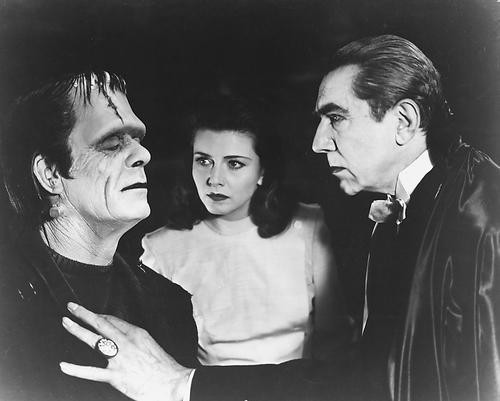
Left to right: Boris Karloff, Maureen O'Sullivan and Bela Lugosi,
posing for the newsreel feature Screen Snapshots #11, 1934
King Kong, about a giant ape taken from his tropical island home to New York, breaking out and terrorizing the city, debuted in 1933. The same year, Karloff starred in The Mummy, and Claude Rains starred in The Invisible Man. In 1935, The Bride of Frankenstein premiered, with Karloff and Clive reprising their roles, and Elsa Lanchester cast in the title role. It wasn't the 1st film sequel, but it can safely be called the 1st good one.
And people identified with the struggles against these characters, as, unlike the Depression itself, they were an enemy that could actually be seen and heard. And, if they touched you, they could harm you in definitive ways, unlike the more subtle harms of the Depression.
And yet, both the Frankenstein monster and Kong were more victim than villain, and people could also sympathize with humanity's unwillingness to accept them. White Americans might not have seen either figure through the prism of civil rights, but they could see them through the prism of "the forgotten man," the man that the establishment didn't want to remember.
Lon Chaney (Leonidas Frank Chaney), who had starred in the silent films The Hunchback of Notre Dame in 1923 and The Phantom of the Opera in 1925, had died in 1930. His son, Lon Chaney Jr. (Creighton Tull Chaney), starred in The Wolf Man in 1941, toward the end of the Depression, so it can't be counted with these others.
But that started a new trend: With World War II coming up, people decided it was better to see these creatures fight each other, and even to laugh at them, than to be afraid of them. So films where they fought were produced, and there was a series of Abbott and Costello Meet... films with the monsters, some played by their 1930s portrayers.
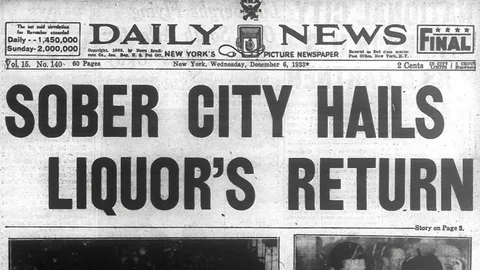
7. The Depression ended "the Jazz Age." It is true that the term "Jazz Age" applies to the 1920s not just because of the music, but because of a lifestyle that included the happy dancing, the happy drinking, and the gangsterism that supported it. As the 1969 film They Shoot Horses, Don't They?, set in 1935, shows, the Depression showed going out and dancing to have become a very different thing during the Depression, and the 1933 repeal of Prohibition didn't change that. (That film also showed people dancing under a mirror ball, 40 years before the rise of disco music. In fact, the mirror ball had been invented in 1917.)
But, as for the music, if anything, the 1930s were the decade when jazz came out of the shadows of a black-only phenomenon and into the mainstream of white America. The best jazz groups remained black ones, led by pianist-composers Edward "Duke" Ellington, William "Count" Basie, and Thomas "Fats" Waller, trumpeter Louis Armstrong, and drummer Chick Webb. But bandleaders like Benny Goodman, Artie Shaw, and the brothers Tommy and Jimmy Dorsey -- first together, then separately after a feud, then occasionally together again after reconciling -- proved that white men could uphold the mantle of jazz as well.
By 1938, Goodman and Basie could appear together onstage -- at no less a classical music venue than Carnegie Hall in New York -- and be celebrated for it.

Count Basie, fronting Benny Goodman and Ethel Waters,
at the Stage Door Canteen, New York, 1943
8. Franklin D. Roosevelt's New Deal solved the Depression. Certainly, it made things better. By May 1937, early in his 2nd term, FDR had cut unemployment to 14 percent, approximately in half. But that's still worse than it has ever been since, with the brief exception of the height of the COVID epidemic. Even FDR's commitment and hard work, and the geniuses (genii?) of his "Brain Trust" couldn't get it lower than that.
9. The New Deal "made the Depression worse." This is what conservatives have wanted you to believe ever since. In May 1937, another downturn began, and by June 1938, unemployment was back up to 19 percent, back to where it was in 1935. The Democrats paid for this at the polls in 1938: The 336-88 advantage they had in the House of Representatives after 1936 dropped to 262-169, and their 77-15 Senate advantage (there were also 4 independents) fell to 69-23.
This had an interesting side effect: Just as the Congressional and gubernatorial elections of 1930, '32, '34 and '36 had wiped out many potential future Presidential candidates for the Republicans, so too did the '38 races knock out some potential Democratic candidates for 1940. As a result, neither party had much of a "bench" that could replace FDR. Without such a challenger to him, FDR knew there was no one who could seriously challenge Nazi Germany's Chancellor, Adolf Hitler, in his bid for world supremacy. FDR thought his Vice President, John Nance Garner, was too conservative to give Hitler the strenuous level of necessary opposition. So FDR ran for a 3rd term.
For most of 1939, unemployment was around 17 percent. By 1940, it had dropped back to 14; for 1941, 10. So what happened? Did FDR's New Deal programs make the Depression worse?
"Worse"? Worse than what? Worse than what he inherited on March 4, 1933? Don't be ridiculous. Republicans then, and conservatives now, want you to believe that "big government" does this. In fact, it was the exact opposite. In 1937, FDR was doing exactly what conservatives want the President to do: He was cutting back on spending. He thought he could do it because of the successes he'd had.
By 1938, he realized what a mistake this was, and, after his "First New Deal" of 1933 and his "Second New Deal" of 1935, he started a "Third New Deal." (His 1944 G.I. Bill of Rights has not been called a "Fourth New Deal," but it should be.) History has repeatedly proven it: The way to cause a recession is to have the federal government cut taxes and cut spending; and the way to get out of a recession is to have the federal government raise taxes and raise spending.
10. World War II was what really ended the Depression. This one is true. As stated, unemployment was still above 10 percent through most of 1941. On December 7, the Japanese attacked Pearl Harbor. The armed forces took on 16 million Americans, enlistees and draftees combined. Many jobs they left behind had been taken by those previously unemployed. And many businesses that were deemed vital to the war effort were running 24 hours a day, thus increasing the need for available workers. Because of this, by mid-1942, in a matter of months, unemployment was down to 3 percent. It remained there for the duration of The War.
FDR could not have been elected to a 3rd term in 1940 without the threat of war from Nazi Germany and/or Imperial Japan. He would not have run for a 3rd term without it. Could anyone else, elected in 1940, have brought unemployment back to 1929 levels without entering The War? It is incredibly unlikely.
The people who lived through the Great Depression are now either dead, or very old. They were the "forgotten man" and woman of their age. As my mother once pointed out, there were no support groups for survivors of the Depression, like her parents. There is no memorial specifically for them on the National Mall in Washington, although the FDR Memorial includes a tribute to them. They had their songs, and their movies, rather than tangible tributes.
We dare not forget them now. We have had hard recessions in 1973-76, 1980-83, 1990-93, 2001-03, 2007-10 and 2020-21. But not another Depression, because of the safeguards we put into place in the 1930s. If we fail to support these safeguards, then everything those people suffered through, and everything those who worked to help them did to do so, will have been in vain.





/arc-anglerfish-arc2-prod-tronc.s3.amazonaws.com/public/EW6GNIQUWXID7KB2EW4QOAR4YE.jpg)
/arc-anglerfish-arc2-prod-tronc.s3.amazonaws.com/public/VDKJXHZDWSJN7HIMO7VH7KLYQI.jpg)








/arc-anglerfish-arc2-prod-tronc.s3.amazonaws.com/public/WQKNC3QU3DU7V25Z53FRQIDQGU.jpg)


