Showing posts with label william mckinley. Show all posts

Sunday, September 6, 2026

September 6-14, 1901: The Assassination and Death of William McKinley, the Rise of Theodore Roosevelt

The last known photograph of the 25th President of the United States,
William McKinley, walking into the Temple of Music, September 6, 1901.

September 6, 1901: President William McKinley is shot in Buffalo, New York. He dies 8 days later, at the age of 58.

A native of Canton, Ohio, McKinley had served in the Union Army in the American Civil War, and had served his home State in Congress and as Governor. Nominated for President by the Republican Party in 1896, with a depression going on, he ran on what his campaign chairman, Ohio political fixer Mark Hanna, called "the full dinner pail."

His Democratic opponent was Congressman William Jennings Bryan of Nebraska, who said the answer to America's economic woes was the free coinage of silver, as opposed to gold. This split the party, and painted Bryan and the Democrats as people playing games with the economy.

The election was on November 3, and many bosses told their employees, "If Bryan wins on Tuesday, don't come to work on Wednesday." It was a threat that workers could be fired for voting for Bryan, but it was also a scare tactic: If Bryan wins, this company won't survive. McKinley won in a landslide, as Bryan's "Populist" message simply didn't reach enough Americans.

McKinley's reforms did end the depression that had begun with a tariff bill in 1890 -- which he, as Congressman, had written -- but really got going with the stock market's Panic of 1893. (They didn't call them "crashes" until 1929.) He also launched the Spanish-American War of 1898, which further enriched the already-rich.

Still, there was lots of discontent. Bryan thought his Populist message would work in 1900, paired with anger over the imperialism of 1898. It didn't: McKinley won in an even bigger landslide.

In 1901, Buffalo was enjoying the fruits of the Industrial Revolution, and launched the Pan-American Exposition, a world's fair. McKinley attended, and gave a speech on September 5, producing one of the earliest voice recordings of any President.

The next day, September 6, he was at the Exposition's Temple of Music, shaking hands with well-wishers. One man did not wish him well: Leon Czolgosz a 28-year-old Polish-American steelworker from Michigan, who admitted his crime, saying that it wasn't fair that one man should have so much power when most people had so little. At 4:07 PM, he shot McKinley twice in the abdomen.
Leon Czolgosz

McKinley was taken to the house of the Exposition's president, prominent Buffalo lawyer John G. Milburn. Vice President Theodore Roosevelt had been vacationing with his family in the Adirondack Mountains of New York State when he received word that McKinley was shot. He rushed by train to Buffalo, visited McKinley, and was told by the doctors that the President would recover. He took them at their word, got on a train, and went back to his family.

For 8 days, doctors tried in vain to reach the bullet. As with the assassination of President James Garfield 20 years earlier, they may have done him more harm than good. He died at 2:15 AM on September 14, 1901.

Vice President Theodore Roosevelt came to Buffalo by train, and was sworn in at the home of another major Buffalo lawyer, Ansley Wilcox, 1 mile south of where McKinley was being treated. (The Wilcox House has been preserved, and it stands at 641 Delaware Avenue. The Milburn House, at 1140 Delaware Avenue, was not, and was demolished in 1957.)
Artist's depiction of the Inauguration.
No photographs were allowed.

Roosevelt made no speech, no "Inaugural Address," aside from his statement when Hazel asked him if he was ready to take the Oath: "I will take the oath. And in this hour of deep and terrible national bereavement, I wish to state that it shall be my aim to continue, absolutely without variance, the policy of President McKinley, for the peace and honor of our beloved country."

Under the Presidential Succession Act of 1886, from McKinley's death on September 14, 1901 until the next Presidential term began on March 4, 1905, the man next in line for the Presidency was the Secretary of State, John Hay.

It took just 7 weeks to try, convict and execute Czolgosz, and even his fellow anarchists turned on him, saying he did their cause more harm than good.

The great fear of McKinley loyalists is that TR wouldn't continue McKinley's policies. Senator Mark Hanna of Ohio, the political boss who did more than anyone else to turn McKinley from a failed Congressman into a popular Governor and then a beloved President, but had opposed Roosevelt's replacement of the late Garret Hobart as Vice President on the 1900 Republican ticket, said, "That damned cowboy is President now!"

TR managed to have it both ways: He continued McKinley's expansionist foreign policy, but was considerably more progressive in domestic policy, just as Hanna had feared. In many ways, he became the 1st modern President of the United States.
He hated the nickname "Teddy,"
although he didn't mind people using his initials, "TR."

Hanna despised Roosevelt, and may have put up a candidate to oppose him in the 1904 election, possibly himself. But he died early in the year, and TR rough-rode his way to a landslide win. On March 4, 1905, he got a real Inauguration, at the U.S. Capitol, and used the same Bible he used when he was sworn in as Governor of New York in 1899.

Ansley Wilcox died in 1930. His house, at 641 Delaware Avenue, has been preserved as Theodore Roosevelt Inaugural National Historic Site. Judge John Hazel lived until 1951.

It has been suggested that Buffalo never recovered from the assassination, and that a curse was placed on its sports teams ever since. They've never had a Major League Baseball team since, unless you count the Federal League of 1914 and 1915. They lost the NBA's Braves. The NHL's Sabres have played for over 50 years, and have never won a Stanley Cup. And although the Bills won 2 AFL Championships, they've never won one in the NFL. Nor has any Buffalo-area team won an NCAA football or basketball championship. Because of COVID restrictions, the Toronto Blue Jays played "home games" at Sahlen Field in Buffalo in 2020 and 2021.

The site of the Temple of Music is now a suburban housing development. There is a historical marker at the site, at 17 Fordham Drive. This is 4 miles north of the McKinley Monument, in Niagara Square, on which City Hall stands. City Hall has statues of the 2 Presidents who called Buffalo home, Millard Fillmore (1850-53) and Grover Cleveland (1885-89 and 1893-97). 
A recent photo of the site
 

Thursday, August 14, 2025

August 14, 1900: The Boxer Rebellion

August 14, 1900, 125 years ago: The Siege of the International Legations is broken by an "Eight-Nation Alliance." It is a turning point in the Chinese uprising that had become known as the "Boxer Rebellion."

After the Sino-Japanese War of 1895, villagers in North China feared the expansion of foreign spheres of influence, and resented the extension of privileges to Christian missionaries, who used them to shield their followers. In 1898, Northern China experienced several natural disasters, including the Yellow River flooding and droughts, which the uprisers blamed on foreign and Christian influence.

In objection to this influence, the Society of Righteous and Harmonious Fists -- Yìhéquán -- was formed. They were anti-foreign, anti-colonial, and anti-Christian. The use of "fists" in the name led to them being called "Boxers" in English, and to their uprising being called the Boxer Rebellion.

Beginning with the Battle of Senlou Temple on October 18, 1899, the Boxers clashed with troops of the federal government, ruled by the Qing Dynasty, officially led by the Guangxu Emperor, but actually led by his aunt, the Empress Dowager Cixi, widow of the Xianfeng Emperor.

The Boxers spread violence across Shandong and the North China Plain, destroying foreign property such as railroads, and attacking or murdering Christian missionaries and Chinese Christians. The events came to a head in June 1900 when Boxer fighters, convinced they were invulnerable to foreign weapons, converged on Beijing with the slogan "Support the Qing government and exterminate the foreigners."

Diplomats, missionaries, soldiers and some Chinese Christians took refuge in the diplomatic Legation Quarter in Peking. China has always called the city "Beijing," meaning "Northern Capital," but this name wasn't widely used in the West until Deng Xiaoping began insisting on it in 1979. Nanjing, meaning "Southern Capital," had previously been called "Nanking" by the West.

An Eight-Nation Alliance of American, Austro-Hungarian, British, French, German, Italian, Japanese and Russian troops moved into China to lift the siege, and on June 17, stormed the Dagu Fort at Tianjin. The Empress Dowager, who had initially been hesitant, now supported the Boxers. On June 21, she issued an Imperial Decree declaring war on the invading powers.

The Alliance, after initially being turned back by the Imperial Chinese military and Boxer militia, brought 20,000 armed troops to China. They defeated the Imperial Army in Tianjin, and arrived in Beijing on August 14, relieving the Siege of the International Legations. Plunder of the capital and the surrounding countryside ensued, along with summary execution of those suspected of being Boxers in retribution.

The Qing dynasty's handling of the Boxer Rebellion further weakened their control over China, and led the dynasty to attempt major governmental reforms in the aftermath. It didn't work, and the Chinese monarchy fell in 1911.

Thursday, November 21, 2024

November 21, 1899: The Death of Garret Hobart

November 21, 1899, 125 years ago: Garret Hobart dies of heart disease in Paterson, Passaic County, New Jersey. He was only 55 years old.

He was also the Vice President of the United States -- the only one, so far, from New Jersey. A statue of him stands outside Paterson's City Hall.

The native of Long Branch, Monmouth County, on the Jersey Shore – where President James Garfield died 2 months after being shot in 1881 – had led both houses of the State legislature, as Speaker of the Assembly and as President of the Senate. He was Chairman of the State's Republican Party from 1880 to 1891. He was chosen to run for Vice President on the Republican ticket with William McKinley in 1896.

Hobart's death left the Vice Presidency vacant until Inauguration Day 1901: Until the 25th Amendment to the Constitution was ratified in 1967, there was no legal mechanism for replacing the Vice President until the next Presidential election. Had he lived, Hobart would have been re-elected with McKinley in 1900, and then, upon McKinley's death by assassination on September 14, 1901, Hobart would have become the 26th President of the United States.

Instead, Theodore Roosevelt was elected Vice President in 1900, and became one of the most influential Presidents in the country's history, while Hobart has been forgotten. Had he become President, most of TR's progressive reforms probably wouldn't have happened, and there might have been a more fractious America in the early 20th Century.

Under the Presidential Succession Act of 1886, from Hobart's death on November 21, 1899 until McKinley's 2nd term on March 4, 1901, the man next in line for the Presidency was the Secretary of State, John Hay.

Saturday, November 6, 2021

Who Was President the Last Time Your Team Won a Title?

Every so often, I point out that the Yankees haven't won a World Series under a Republican President since 1958, when Dwight D. Eisenhower was in office. "The Ike Age."

Then again, having Joe Biden in office will matter for many things, but perhaps not this one: It's not who's running the country that matters to the Yankees' success, but who's running the team. As long as Brian Cashman is the Yankees' chief executive, they're not going to win another Pennant.

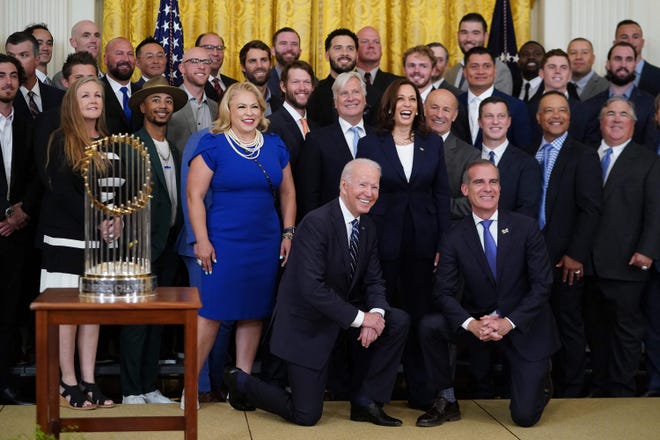
Major League Sports Teams that won their last World Championship when Joe Biden was President: The Atlanta Braves, the Milwaukee Bucks, the Tampa Bay Lightning, the Tampa Bay Buccaneers.

Donald Trump: The Los Angeles Dodgers, the Los Angeles Lakers, the Kansas City Chiefs, the Washington Nationals, the Toronto Raptors, the St. Louis Blues, the New England Patriots, the Boston Red Sox, the Golden State Warriors, the Washington Capitals, the Philadelphia Eagles, the Houston Astros, the Pittsburgh Penguins.

Barack Obama: The Chicago Cubs, the Cleveland Cavaliers, the Denver Broncos, the Kansas City Royals, the Chicago Blackhawks, the San Francisco Giants, the San Antonio Spurs, the Los Angeles Kings, the Seattle Seahawks, the Miami Heat, the Baltimore Ravens, the New York Giants, the St. Louis Cardinals, the Dallas Mavericks, the Boston Bruins, the Green Bay Packers, the New Orleans Saints, the New York Yankees, the Pittsburgh Steelers.

George W. Bush: The Philadelphia Phillies, the Boston Celtics, the Detroit Red Wings, the Anaheim Ducks, the Indianapolis Colts, the Carolina Hurricanes, the Chicago White Sox, the Detroit Pistons, the Miami Marlins, the New Jersey Devils, the Los Angeles Angels, the Arizona Diamondbacks, the Colorado Avalanche.

Bill Clinton: The St. Louis (now Los Angeles) Rams, the Dallas Stars, the Chicago Bulls, the Dallas Cowboys, the Houston Rockets, the San Francisco 49ers, the New York Rangers, the Toronto Blue Jays, the Montreal Canadiens.

George H.W. Bush: The Washington Redskins (now the Washington Football Team), the Minnesota Twins, the Cincinnati Reds, the Edmonton Oilers, the Oakland Athletics, the Calgary Flames.

Ronald Reagan: The New York Mets, the Chicago Bears, the Detroit Tigers, the Los Angeles (now Las Vegas) Raiders), the Baltimore Orioles, the Philadelphia 76ers, the New York Islanders.

Jimmy Carter: The Pittsburgh Pirates, the Seattle SuperSonics, the Washington Bullets, the Portland Trail Blazers.

Gerald Ford: The Philadelphia Flyers.

Richard Nixon: The Miami Dolphins, the New York Knicks.

Lyndon Johnson: The New York Jets, the Cleveland Browns.

Dwight D. Eisenhower: The St. Louis (now Atlanta) Hawks, the Detroit Lions.

Harry Truman: The Rochester Royals (now the Sacramento Kings), the Cleveland Indians (now the Cleveland Guardians), the Chicago (now Arizona) Cardinals.

If you don't see your favorite team in a particular sport here, it's because they've never won a World Championship. I didn't include MLS, its predecessor the NASL, or the WNBA.

*

November 6, 1816: James Monroe is elected President. Secretary of State to outgoing President James Madison, also formerly Secretary of War, Governor of Virginia, U.S. Ambassador to Britain and France, and Colonel in the Continental Army -- he's the young man seen holding the flag in the famous, if erroneous, painting Washington Crossing the Delaware -- the nominee of the Democratic-Republican Party wins 68 percent of the popular vote, and 183 Electoral Votes.

The Federalist Party disintegrated during the War of 1812, due to its having agitated the country into the war, and its feckless peace offerings during it. They had nominated Senator Rufus King of New York, who won just 31 percent of the vote, and 34 Electoral Votes. He turned out to be the last Federalist nominee for President. Soon, the Democratic-Republicans would split into the Democratic Party and the National Republican Party, later to become the Whig Party.


November 6, 1854: John Philip Sousa is born in Washington, D.C. Perhaps the most famous American of Portuguese descent, he conducted the U.S. Marine Band, playing for Presidents, then formed his own band. The Sousa Band toured from 1892 until 1931, and he died the next year.

"The March King" composed and conducted songs that are still remembered today, most notably "The Stars and Stripes Forever" (1897). In 1923, his band played "The Star-Spangled Banner" before the 1st game at Yankee Stadium. 

November 6, 1860: Abraham Lincoln is elected the 16th President of the United States. He is the 1st nominee of the Republican Party to win the Presidency, making the Republicans the 1st, and to this day the only, "third party" to elect a President.

Thanks to a split in the Democratic Party, and the Whig Party (to which Lincoln once belonged) totally dissolving, he wins with 39 percent of the vote, the lowest percentage of any winner in the election's history.

But the former Congressman from Illinois did win a majority of the Electoral Votes: 180. Vice President John C. Breckinridge of Kentucky won 72, Senator John Bell of Tennessee won 39, and Senator Stephen A. Douglas of Illinois -- who had beaten Lincoln for that office just 2 years earlier -- won 12. Douglas finished 2nd in the popular vote, with 29 percent. Breckinridge had 18, and Bell 12.

In spite of the fact that Lincoln said, at the time, that he didn't want to abolish slavery entirely, only stop it from spreading to new States and Territories, the Southern States began to secede the next month. Outgoing President James Buchanan, a moral coward who thought the Constitution didn't allow him to do anything to stop it, did nothing to stop it. The American Civil War began on April 12, 1861. It would take Lincoln 4 years to win it.

You've heard the saying, "Suppose they gave a war, and nobody came?" Well, in February 1861,
Douglas held a peace conference at Willard's Hotel in Washington, and nobody came. Despite their disagreements on several issues, including slavery, once the war began, Douglas took a train tour of the Midwest, rallying support for the Union cause. But he was stricken with typhoid fever, and died on June 3. He was only 48 years old, 4 years younger than Lincoln was.

Breckinridge was appointed to the U.S. Senate, but enlisted in the Confederate Army, and was expelled from the Senate. He was a terrible General, but President Jefferson Davis appointed him Secretary of War in February 1865. He urged Davis to surrender, but was refused. He escaped after the fall of Richmond, and lived abroad for 3 years, until Lincoln's successor Andrew Johnson extended amnesty to all former Confederates. Breckinridge died in 1875, at 54: He was 12 years younger than Lincoln, but died 2 years younger.

Bell was the only one who outlived Lincoln both in calendar years and in actual years. He supported the Union until the war began, then switched sides. He lived until 1869, age 73.

*

November 6, 1861, 160 years ago: James Naismith (no middle name) is born in Almonte (now part of Mississippi Mills), Ontario, outside the Canadian capital of Ottawa. He graduated from Montreal's McGill University, where he lettered in lacrosse, gymnastics, soccer, rugby, and the Canadian version of gridiron football. He was hired as McGill's athletic director in 1890, but just a year later, he was hired by the YMCA International Training School in Springfield, Massachusetts, what is now Springfield, College.

He was asked to invent a game that could be played indoors in the Winter, when baseball and football couldn't be played. He knew he should start with a ball, but a large, soft one, like a soccer ball, not a small, hard one like a baseball, which would be dangerous in the confined space of a gymnasium. He noted that most of the rough action took place around the goal: The goal in soccer, hockey or lacrosse, the end zone in football or rugby, or home plate in baseball. So he thought he could reduce the danger by raising the goal.

He asked the custodian to get him a box, because he had invented boxball. The custodian could only find a peach basket. So Dr. Naismith had invented basketball instead. The date was December 21, 1891.

Through the influence of the YMCA's worldwide organization, the word was spread. Naismith became the head coach at the University of Kansas, which became one of the great college basketball programs. He died in 1939, at the age of 78, at their Lawrence campus. Within the last 4 years of his life, he had seen the debut of sold-out doubleheaders involving national powers at Madison Square Garden, the debut of basketball as an official medal sport at the Olympic Games, and the foundation of the NIT and NCAA Tournament.

November 6, 1865: The last "grand match" of the baseball season takes place at the Capitoline Grounds in Brooklyn, before 15‚000. The Atlantics lead all the way to defeat fellow Brooklynites the Eckfords, 27-24‚ and claim the 1865 championship with a record of 17-0.

Henry Chadwick, America's 1st real sportswriter: "Is there another sport attractive enough to draw such attendance under such circumstances? In the summer it is not surprising as the weather is pleasant... but on a cold November day‚ in the busiest time of the year‚ it must be indeed an attractive sport to collect such an assemblage that is present on this occasion." 

Named for a famed hill in Rome, the Capitoline Grounds, a 5,000-seat wooden stadium opened in 1864, was meant to rival and surpass the Union Grounds. The Atlantics made it their home, and, like the Union Grounds, it became a skating rink in the winter.

But it was demolished in 1880. It was on a plot of land bounded by what's now Halsey Street, Marcy Street, Putnam Avenue and Nostrand Avenue, in Bedford-Stuyvesant. To visit, take the A or C train to Nostrand Avenue. While this neighborhood, notorious for crime not that long ago, should be safe during the day, definitely do not visit at night. 

November 6, 1869: What is generally recognized as the 1st college football game is played. Rutgers College plays the College of New Jersey, on Rutgers' campus in New Brunswick.

The game is essentially a very large soccer game, with a round leather ball, and 25 men on a side. The Rutgers men, finding the color inexpensive to obtain, wrap scarlet red cloth around their heads like turbans, so that they can tell each other apart on the field. Thus did they invent school colors and, in a way, the football helmet.

The men of Old Queens must have had less trouble telling team from team than did the men of Old Nassau, as Rutgers won, 6-4 -- that's 6 goals to 4, or 42-28 under today's scoring system.

The next week, the CNJ men returned the favor in Princeton, and won, 8-0. There was supposed to be a 3rd game, but the college presidents got together and decided that too much emphasis was being placed on athletics, and forbade it.

The field where "the first football game" was played is now the parking lot for Rutgers' College Avenue Gym. Rutgers played at College Field until 1891, then opened Neilson Field across the street, playing there until 1938, when Rutgers Stadium opened across the River in Piscataway. The Alexander Library, the school's main library, was built on the site of Neilson Field in 1953. Rutgers Stadium was replaced on the same site by what's now named SHI Stadium in 1994, while they played their 1993 home games, and many others from 1976 to 2009, at Giants Stadium.

George Large of Rutgers was the last surviving player from this game, living until August 15, 1939, age 88. The native of Readington, Hunterdon County played on the Rutgers side, and in 1888 served as President of the State Senate, making him the Acting Governor on a few occasions.

In 1874, Harvard University would accept a challenge from McGill University in Montreal, and discover on their arrival that by "football," McGill meant "rugby," not "soccer." Adjustments were made, Harvard liked the results, and convinced the other "football"-playing schools to join them in this adaptation of "football." In 1906, the forward pass was legalized and hashmarks prevented dangerous scrimmages close to the sideline. "Football" as America knows it now was on its way.

In 1896, the College of New Jersey changed its name to Princeton University, while a nearby school would later be founded as Trenton State College, and change its name to The College of New Jersey. Rutgers College would become, and remains, the centerpiece of the larger system of Rutgers, The State University of New Jersey.

Princeton's nickname, the Tigers, would inspire 2 professional team names: Baseball's Detroit Tigers and the Canadian Rugby Union's Hamilton Tigers, now the Canadian Football League's Hamilton Tiger-Cats.

Rutgers was known as "The Queensmen" until 1925, when they became the Chanticleers, after a fighting rooster. The school's literary magazine was already called The Chanticleer. But this carried the connotation of "chicken" -- and, as the University of South Carolina has found out with their similarly-named Gamecocks, they can be called "Cocks." In 1955, head coach Harvey Harman recommended the change to the Scarlet Knights, and such they have been ever since.

Rutgers and Princeton did not always play once a year, sometimes missing years, sometimes playing twice a year. But Rutgers did not beat Princeton again until 1938, the dedication game for the original Rutgers Stadium in Piscataway. breaking a 33-game losing streak over 69 years. Princeton still dominated until Rutgers won 4 straight from 1958 to 1961, the latter an undefeated season. Then, Princeton won another 6 straight.

Then Rutgers began to make what it called a commitment to big-time football. From 1968 onward, they went 9-3-1 against Princeton, which included winning the last 5 games by scores of 17-0, 10-6, 24-0, 38-14 and 44-13. This further included the 1st appearance by either school on national television, the 100th Anniversary Game at Rutgers Stadium on September 27, 1969, a 29-0 Rutgers win; and Rutgers' 1976 undefeated season.

Princeton decided that they couldn't remain in the Ivy League and also compete on the same level as Rutgers and the other schools that had formed the Big East Conference for all sports but football, and eventually would for football as well. (Most of those are now in the Atlantic Coast Conference, but Rutgers is in the Big Ten, and West Virginia is in the Big 12.) So Princeton called off the series, still holding an enormous 53-17-1 edge. The rivalry does continue in other sports.

Rutgers continues to bill itself as "The Birthplace of College Football," or simply "The Birthplace." You know the joke: Rutgers invented football in 1869, and they haven't done a damn thing since. It's not quite true, but it's bad enough. For example: On November 6, 2021, at home, Rutgers lost to Wisconsin 52-3.

November 6, 1888: Benjamin Harrison is elected the 23rd President of the United States. The former U.S. Senator from Indiana, and grandson of 9th President William Henry Harrison, wins 233 Electoral Votes, defeating incumbent President Grover Cleveland, who had 168.

But Cleveland won the popular vote, 48.6 percent to 47.8. Matthew Quay, Republican boss of Pennsylvania, practically came out and admitted that he had the State's 30 Electoral Votes stolen for Harrison. If true (and it probably is), then the vote should have been 203-198 in Harrison's favor. Meaning that, if 1 more State was "stolen," then Cleveland should have been re-elected.

Indeed, 4 years later, after a hard Presidency with recession and labor strife, Harrison lost his bid for re-election, and Cleveland became the only former President ever to regain the office.

*

November 6, 1900: President William McKinley is re-elected. As in 1896, he defeats Nebraska Congressman William Jennings Bryan, 51.6 percent of the popular vote to 45.5, and 292 Electoral votes to 156.

Garret Hobart, McKinley's 1st Vice President, had died in office in 1899, so he needed a new one. He chose Governor Theodore Roosevelt of New York, because his svengali, Ohio Republican boss Mark Hanna, though TR was making too much noise as Governor, thinking he'd be silenced as Vice President. He told McKinley he had to live, to keep "that damned cowboy" out of the White House.

On September 6, 1901, at the Pan-American Exposition, a World's Fair in Buffalo, McKinley was shot. He died 8 days later, and TR was President of the United States. In 1904, Hanna died, and TR won a term of his own.

November 6, 1927: Martin Nicholas Pavelich is born in Sault Sainte Marie, Ontario. A left wing, he played for the Detroit Red Wings, and was assigned as a "shadow," to shut down opposing teams' best attackers, particularly Maurice "The Rocket" Richard of the Montreal Canadiens.

He won 4 Stanley Cups with the Wings, and is the last surviving player from the 1950 Cup team, 1 of 4 surviving players from 1952, 1 of 4 from 1954, and 1 of 5 from 1955.

He appears not to be related to Mark Pavelich, a native of Eveleth, Minnesota who won the Olympic Gold Medal with the 1980 U.S. hockey team, and later played for the Rangers and Minnesota North Stars, and was an original 1991-92 San Jose Shark.

November 6, 1928: Secretary of Commerce Herbert Hoover is elected President, with a whopping 58 percent of the vote, and 444 Electoral Votes. The Democrats had nominated Governor Alfred E. Smith of New York, the 1st Catholic ever nominated by a major party. He won just 40.8 percent, a figure exceeded by all but 2 Democratic nominees since (George McGovern in 1972 and Walter Mondale in 1984), and took just 8 States, worth 87 Electoral Votes.

In his nationally-syndicated newspaper column, humorist Will Rogers wrote that Smith's supporters "are going to be shocked at how much of the country lives west of the Hudson River." He was right, as Smith was too New Yorky for the rest of the country, including most of New York State.

Indeed, New York was not 1 of the 8 States he won. He won the 2 most Catholic States in the nation, Massachusetts and Rhode Island; and 6 "Solid South" States that, at the time, would never go for a Republican, still thought of as "the Party of Lincoln": South Carolina, Georgia, Alabama, Mississippi, Arkansas and Louisiana. Smith didn't even get the entire South: Hoover won Virginia, North Carolina, Florida, Kentucky, Tennessee, Oklahoma and Texas.

Had Smith been a Protestant, from a small town rather than the biggest city, with a pleasant voice instead of a N'Yawk accent, in favor of keeping Prohibition rather than repealing it, and not connected to the corrupt Tammany Hall political machine that dominated New York State and especially New York City, he still would have lost, as Hoover rode the Republican prosperity of the Roaring Twenties.

Despite the Hoover landslide, Franklin D. Roosevelt, former Assistant Secretary of the Navy, 1920 Democratic nominee for Vice President, and cousin of the late former President Theodore Roosevelt, is narrowly elected to succeed Smith as Governor. Someone asked Smith if FDR, one of his biggest backers, was going to be a rival that would prevent him from getting the Democratic nomination again in 1932. Smith, noting that Roosevelt had been dealing with the effects of polio since 1921, said, "No, he will be dead within a year."

Within a year of the 1928 election, the stock market had crashed, and, barring a major scandal, the Democratic nominee was going to win in 1932. Smith tried for that nomination. He lost it. To FDR. FDR became President. Smith became one of his fiercest critics. And, in the end, in spite of FDR's health difficulties, Smith died 6 months before he did.

Also on this day, William Donald Wilson is born in Central City, Nebraska. A center fielder, Bill Wilson started with the Chicago White Sox, and was with the Philadelphia Athletics when they moved, hitting the 1st home run in Kansas City Athletics history on April 12, 1955. But that was to be his last season in the major leagues. He, Bobby Shantz and Bill Harrington are the last 3 living former Philadelphia Athletics.

November 6, 1929: With the field at the Cycledrome -- a 10,000-seat bicycle racing track with a football field almost fully squeezed into it -- so waterlogged that the referees will not permit play, the Providence Steam Roller, defending NFL Champions, move their scheduled game with the Chicago Cardinals to their former home, Kinsley Park. This 6,000-seat stadium has floodlights, and so, this becomes the 1st night game in NFL history.

The Cardinals win, 16-0, but the gate receipts from the sellout crowd count the same. And, with the stock market having crashed a few days ago, the Steam Roller need all the help they can get. As it turns out, it's not enough: The team gets through the 1930 and '31 NFL seasons, drops out, holds on in another league through 1933, and folds, a victim of the Great Depression. Kinsley Park was torn down in 1933, and no trace of it remains.

*

November 6, 1946, 75 years ago: Edward John DeBartolo Jr. is born in Youngstown, Ohio. He and his father Edward Sr. developed the Edward J. DeBartolo Group, which, under Eddie's leadership, became the Simon Property Group. It built in 1972, and still maintains, the Brunswick Square Mall in my native East Brunswick, New Jersey.

Also in New Jersey, it runs the Menlo Park Mall in Edison, Newport Centre in Jersey City, The Mills at Jersey Gardens in Elizabeth, the Ocean County Mall in Toms River, the Quaker Bridge Mall in Lawrence, Jersey Shore Premium Outlets in Tinton Falls, and Jackson Premium Outlets near Great Adventure. On Long Island, it runs Roosevelt Field in Garden City, and the Walt Whitman Mall in Huntington. In the Hudson Valley, it runs The Westchester in White Plains, The Shops at Nanuet, and Woodbury Common Premium Outlets.

But the DeBartolos are better known for their sports teams. Edward Sr. owned the NHL's Pittsburgh Penguins, and let his daughter Denise DeBartolo York run them, winning their 1st 2 Stanley Cups. Eddie owned the San Francisco 49ers, seeing them win 5 Super Bowls. A 1998 controversy led him to sell the team to his sister, her husband John York, and their son Jed York. (NFL rules prevent a majority owner of a team in another sport from being majority owner of an NFL team, so she had to sell the Penguins to become the 49ers' operational owner.)

Despite the troubles he got into, "Mr. D" is still one of the few NFL owners who was truly beloved by his players, and was recently elected to the Pro Football Hall of Fame. He is the only living current or former NFL team owner in the Hall. He is also a member of the Bay Area Sports Hall of Fame.

Also on this day, Sally Margaret Field is born in the Los Angeles suburb of Pasadena, California. We like her. We really, really like her.

November 6, 1947: Meet the Press debuts on NBC. It is still on the air after 74 years, making it the longest-running program in television history, anywhere in the world.

Oddly for its era, the 1st moderator was a woman, Martha Rountree. She was succeeded in 1953 by Ned Brooks, who held the post until 1965, Lawrence Spivak until 1975, Bill Monroe (not the country singer) until 1984, Marvin Kalb until 1987, Chris Wallace until 1989, Garrick Utley until 1991, and then its longest-running host, Tim Russert, until his death in 2008. He was succeeded by David Gregory, and then Chuck Todd was named host in 2014.

Herbert Hoover appeared on the show as an old man in 1955. Franklin Roosevelt, Harry Truman and Dwight D. Eisenhower never did. But every President since John F. Kennedy has, although as the incumbent President, only Jimmy Carter, Bill Clinton, George W. Bush and Barack Obama have. So far, Donald Trump has not, and I suspect it will stay that way, although he made 5 appearances before taking office, including in 1999, before he began to worm his way into politics.

Athletes do not usually appear on the show, often mocked as Meet the Depressed and Press the Meat.
But Russert, a Buffalo native, loved to interview them. During Autumn, he would conclude the show's usual tagline with a reference to his hometown team: "If it's Sunday, it's Meet the Press. Go Bills."

Russert liked to challenge Democrats and Republicans alike, and, with a graphic or a clip ready to go, made, "Senator, let me show you... " the 5 scariest words in Washington. Today, Todd shows an obvious favoritism toward conservatives, which has earned him the nickname "Chuck Toad."

*

November 6, 1951, 70 years ago: Louise Williams (no middle name) is born in Scranton, Pennsylvania. The actress, known professionally as Liberty Williams, got her start as Debbie Morgenstern, Rhoda's sister, on a 1973 episode of The Mary Tyler Moore Show. She was a regular on the short-lived series Bustin' Loose, 13 Queens Boulevard and Baby Makes Five. She appeared in 2 different episodes of Three's Company, in 2 different roles, 3 years apart.

She is best known as the voice of Jayna, the Wonder Twin who could take the form of any animal, on the Super Friends cartoons. Although she has had no acting credits since 1990, she is still alive.

November 6, 1956: President Dwight D. Eisenhower is re-elected. Despite concerns over his health (he'd had a heart attack in September 1955, and had been hospitalized again in June, possibly for another heart attack that the White House didn't want to talk about), the fitness for office of Vice President Richard Nixon, and how "Ike" had handled the recent crises in Hungary and Egypt, he wins 57 percent of the popular vote, and 457 Electoral Votes.

Former Governor Adlai E. Stevenson of Illinois fares no better in the rematch than he did in 1952, winning just 42 percent, and 73 Electoral Votes. Stevenson won only 7 States: North Carolina, South Carolina, Georgia, Alabama, Mississippi, Arkansas and Missouri. In the other 41 States, he comes close only in Tennessee.

November 6, 1981, 40 years ago: Larry Holmes defends the Heavyweight Championship of the World at the Civic Arena in Pittsburgh, against Renaldo Snipes. Snipes knocks Holmes down in the 7th round, but Holmes gets up at the count of 4, and knocks Snipes out in the 11th.

Snipes was 22-0 going into the fight, with his last 2 fights being wins over former WBA Light Heavyweight Champion Eddie Mustafa Muhammad and eventual WBA Heavyweight Champion Gerrie Coetzee.

But from here on out, he went just 17-8-1, fighting 3 future partial Heavyweight Champions, beating Trevor Berbick (WBC), but losing to Tim Witherspoon (WBC and WBA, though not at the same time, and who would, in 1983, come closer to beating Holmes) and Greg Page (WBA). He was supposed to fight Mike Tyson in 1990, but broke his hand, and it never happened. He was replaced as Tyson's opponent by James "Buster" Douglas, and the rest is history.

Snipes is now 65, and a charity fundraiser. He says, "I had a good career. I made good friends. I keep in contact with my friends, and I'm healthy." That's more than a lot of ex-boxers can say.

November 6, 1983: This is the date on which the sci-fi/fantasy series Stranger Things begins, with an attack from the dimension known as "The Upside Down" on the lab in Hawkins, Indiana that opened a portal to it.

November 6, 1991, 30 years ago: Arsenal host Benfica at Highbury in North London, in the 2nd leg of the 2nd round of what turns out to be the last European Cup tournament under that name. The following season, 1992-93, it was rebranded as the UEFA Champions League. Since the Heysel Ban kept defending Football League Champions Arsenal from playing in the 1989-90 edition, this was only their 2nd time in it, following a run to the Quarterfinal in 1971-72.

Two weeks earlier, Arsenal had gone to Lisbon, Portugal, and held Benfica, that country's most storied sports team, to a 1-1 draw (with Kevin Campbell scoring) in front of 120,000 people in their Estádio da Luz. In order to have a playing facility that met modern safety standards (no standing terraces, with dangerous overcrowding), that stadium was demolished and rebuilt on the same site in 2003, and its current capacity is 64,642. The English translation of the name, "Stadium of Light," was applied to North-East club Sunderland's new stadium built in 1997. The new Benfica stadium's design would eventually inspire the design of Arsenal's new Emirates Stadium, which opened in 2006.

With the tie level, and with an away goal, and this being a Benfica squad far beneath their European Cup winners of 1961 and 1962, Arsenal fans were confident of victory and advancement. But after a 1-1 halftime score (2-2 on aggregate, 1-1 on away goals), Arsenal's defense leaked twice, and Benfica won 3-1, to advance 4-2.

This was one of the most humiliating defeats in Arsenal's history, in literally the biggest game that George Graham ever managed. (Any European Cup/Champions League match is bigger than a European Cup Winners' Cup Final.) Ironically, the only Arsenal goal on this night was scored by Colin Pates, taking the Number 4 place in midfield vacated by Graham's foolish sale of Michael Thomas (to Liverpool, of all teams to send the 1989 title-clinching goalscorer to) the preceding off-season.

Fans who came of age in the Graham years (1986-95) loved to compare his record in European play with that of Arsène Wenger (1996-2018), who consistently kept the team in the Champions League, reaching the Final in 2006 and the Semifinal in 2009, but never won a European trophy, while Graham won the Cup Winners' Cup in 1994 -- a tournament so insignificant that UEFA folded it into the UEFA Cup (now the Europa League) in 1999.

But this game had everything they loved to hate about Wenger: An Arsenal side weakened due to selling off one of the team's best players, a poor defense, "shit tactics," and a spectacular failure in European competition, which could be called a loss to "farmers."

Just 9 weeks later came the 3rd Round of the FA Cup, a trip to North Wales that became known as "The Wrexham Disaster." That game, a loss to a team then in Division Four, has often been cited as Graham's most disgraceful defeat. Yes, it was bad. But it wasn't as bad as blowing a 2nd-leg home tie in a European Cup knockout round.

Graham was lucky that this happened before the Internet Age, before the dawn of social media, and before the starting of Arsenal Fan TV.

November 6, 1999: Conseco Fieldhouse opens in Indianapolis, replacing the Market Square Arena. The Indiana Pacers beat the Boston Celtics, 115-108, and go on to win the NBA Eastern Conference title for the 1st time. But they will lose the NBA Finals to the Los Angeles Lakers.

The building was renamed Bankers Life Fieldhouse in 2011, and Gainbridge Fieldhouse this year.

*

November 6, 2001, 20 years ago: Major League Baseball votes to contract its number of teams, something that hasn't happened in 102 years. The vote to contract from 30 teams to 28 is 28-2. It is not revealed who the 2 teams to vote against it were, but the rumor is that it's the 2 teams most often mentioned as the ones to be dropped: The Minnesota Twins and the Montreal Expos.

The 30-team setup remains in place, pending a new collective bargaining agreement, as the old one runs out in the 2002 season. But the CBA that is approved keeps all 30 teams. MLB ends up getting rid of the Expos anyway: After the 2004 season, they are moved, to become the Washington Nationals.

But the Twins make the most of their reprieve: They win the American League Central Division the next 3 seasons, and in 6 of the next 9, concluding in 2010, their 1st season in Target Field, after moving out of the oft-mocked Metrodome.

Today, both franchises are as strong as ever, at least business-wise, and MLB has again begun to consider expansion, from 30 teams to 32.

November 6, 2002: The West Wing airs the episode "Election Night." President Jed Bartlet (Martin Sheen) is re-elected, but shows signs that his multiple sclerosis will be an issue in his 2nd term. Also, Deputy White House Communications Director Sam Seaborn (Rob Lowe) discovers that he will have to keep a promise he made to the widow of the Democrat running for Congress in his home district in Southern California.

This episode debuts Joshua Malina as Will Bailey, and Danica McKellar as his half-sister and campaign assistant Elsie Snuffin.

This episode should not be confused with the episode "Election Day," which resolves the storyline from this next entry:

November 6, 2005: The West Wing airs the episode "The Debate." It is a live episode, and the only episode of the show that is broadcast on videotape instead of film. Running to replace Bartlet are Republican Senator Arnold Vinick of California (M*A*S*H's Alan Alda) and Democratic Congressman Matthew Santos of Texas (L.A. Law's Jimmy Smits).

This occurs only 3 years after the episode showing Bartlet's re-election, because in the 2003-04 TV season, the show jumped from the middle of Year 5 of his Administration to the middle of Year 6, due to the fact that the actors' contracts all ran out after the show's 7th season.

Wednesday, November 3, 2021

One Year Later

November 3, 2020, 1 year ago: I wrote, "This may turn out to be the most important day in American history. Vote like the whole world depends on it. Because it might."

Joe Biden was elected the 46th President of the United States, defeating Donald Trump. It wasn't called for 4 days, because several key States were close. It wasn't certified by Congress until January 6, 2021 -- which was supposed to happen, anyway, but this was one of the few times that it was ever in doubt. And there was an unprecedented attempt to prevent it. That attempt failed. It was finally made official on January 20, Inauguration Day, when Biden was sworn in as President.

Biden won 81,268,924 votes, to Trump's 74,216,154. Biden won 51.3 percent of the popular vote, to Trump's 46.9. Each candidate won 25 States, with Biden also winning the District of Columbia and 1 Electoral Vote in Nebraska; while Trump also won 1 Electoral Vote in Maine. (Maine and Nebraska allow their Congressional Districts to vote separately from the State as a whole.) Biden won 306 Electoral Votes, to Trump's 232.

Biden won nearly all the close States: Arizona by 10,457 votes, Georgia by 11,779, Wisconsin by 20,682, Nevada by 33,596,New Hampshire by 59,277, and Pennsylvania by 80,555. However, if Trump had won all of those States except Pennsylvania, with its 20 Electoral Votes, Biden still would have won.

Kamala Harris became the 1st female, the 1st African-American, and the 1st Asian-American Vice President of the United States. The Democrats kept control of the U.S. House of Representatives, and gained a 50-50 split in the U.S. Senate, which becomes a 51-50 majority in the Democrats' favor -- except 2 Democratic Senators, Joe Manchin of West Virginia and Kirsten Sinema of Arizona, have often stood in President Biden's way when it came to his agenda.

In the end, Biden didn't win because 250,000 Americans had died from COVID-19 -- a total since tripled, and it will increase further, though Biden's efforts will hold it down to less than it would have been if Trump had stayed in office. He won due to the get-out-the-vote effort in the key States, whose apparatus was already in place before COVID.

Biden won because he was the opposite of Trump. Because, while Trump appealed to bigotry and anger, Biden appealed to what Abraham Lincoln called "the better angels of our nature." Because he wanted to bring America healing, which is what America wanted. Because he spoke to "the soul of America." As he, a Catholic and a student of St. Francis of Assisi, is believed to have said:

Where there is hatred, let me sow love.
Where there is injury, pardon.
Where there is discord, union.
Where there is doubt, faith.
Where there is despair, hope.
Where there is darkness, light.
And where there is sadness, joy.

Conservatism, still led by Trump, is a darkness. Liberalism, currently led by Biden, is a light. And, for now, America wants light.

*

November 3, 1836: Vice President Martin Van Buren is elected the 8th President of the United States. He essentially rode the coattails of his friend and boss, President Andrew Jackson, to victory. It also helped that the Whig Party was regionally split: Van Buren won 170 Electoral Votes, William Henry Harrison 73, Hugh White 26, Daniel Webster 14, and Willie P. Mangum 11. So it was MVB 170, Whigs United 122.

Mangum won only South Carolina, Webster only his native Massachusetts, and White only Georgia and his native Tennessee -- which probably ticked fellow Tennesseean Jackson off.

In the popular vote, Van Buren won almost 51 percent, Harrison 36, White a little under 10, Webster less than 3, and Mangum wasn't actually on the ballot anywhere, but won South Carolina's Electoral Votes anyway.

November 3, 1868: Ulysses Simpson Grant, U.S. Secretary of War and the leading General of the Union during the American Civil War, is elected the 18th President of the United States. He defeats Horatio Seymour, a former Governor of New York. Grant won nearly 53 percent of the vote, Seymour 47. The Electoral Vote was not nearly as close, 214 to 80 in Grant's favor.

November 3, 1869: The Hamilton Football Club is founded in Hamilton, Ontario, Canada. This is the forerunner of the Hamilton Tigers, who in 1950 merged with the Hamilton Wildcats to become the Hamilton Tiger-Cats. This could, if you choose to define it this way, make the "Ticats" the oldest continuously operating professional sports team in North America.

Before the merger, the Tigers won 5 Grey Cups, the championship of Canadian football: 1913, 1915, 1928, 1929 and 1932. Since the merger, they've won 8: 1953, 1957, 1963, 1965, the Canadian Centennial Cup in 1967, 1972, 1986 and 1999. This is a total of 13. (The 1943 Grey Cup won by the Hamilton Flying Wildcats, as they were known during World War II since they were sponsored by the Royal Canadian Air Force, is generally not counted in the total.)

November 3, 1896, 125 years ago: Governor William McKinley of Ohio is elected the 25th President of the United States, defeating Congressman William Jennings Bryan of Nebraska. McKinley won 51 percent of the popular vote, and Bryan nearly 47. McKinley won 23 States to Bryan's 22. Those figures make the election sound close. But McKinley won bigger States than Bryan did, so he won the Electoral Vote 271-176.

The Panic of 1893, and the resulting depression, the nastiest the nation had yet suffered, doomed President Grover Cleveland's hopes of winning a 3rd term. But Bryan, at 36 the youngest major-party nominee ever, favored the free coinage of silver, as a means of ending the depression, rather than sticking to the gold standard.

At the Democratic Convention at the Chicago Coliseum, he said, "You shall not press down upon the brow of labor this crown of thorns. You shall not crucify mankind upon a cross of gold." Effectively, he was the Bernie Sanders of his time.

But that scared a lot of people, including a lot of Democrats. Cleveland refused to use whatever political capital he had left to endorse him, and a lot of "Gold Democrats" supported McKinley, who promised "a return to the full dinner pail." (The expression "a chicken in every pot" had been in existence for about 300 years.)

In addition, in the inner cities, and in smaller mill and mining towns, where lots of Catholics, many of them the sons of immigrants, worked in factories, many of them were told by their bosses, "If Bryan wins on Tuesday, don't come in on Wednesday" -- not that they would be fired, but that the factory would have to close.

*

November 3, 1901, 120 years ago: Frederick Lionel Hitchman is born in Toronto. After winning the 1923 Stanley Cup with the Ottawa Senators, Lionel Hitchman joined the Boston Bruins, and formed a great defensive pairing with Eddie Shore, captaining the team that won the 1929 Stanley Cup.

He served with the Royal Canadian Mounted Police in the off-season, and did so full-time after his 1934 retirement from hockey. Like a later Boston sports legend, Ted Williams, he became an accomplished fisherman, setting a record for largest salmon caught. He died in 1969. Although the Bruins retired his Number 3, and he was elected to the Ontario Sports hall of Fame, he has never been elected to the Hockey Hall of Fame.

November 3, 1908: William Howard Taft, Secretary of War, is elected the 27th President of the United States, defeating Bryan. Taft gets 51.6 percent of the popular vote, and wins the Electoral Vote 321 to 162.

Theodore Roosevelt chose not to run for what would have been a 3rd term, and chose Taft, who would really have preferred to have been named Chief Justice of the U.S. Supreme Court. TR warned Taft to not let the press take his picture on the golf course. Despite this warning, and his weight, which made him look ridiculous on the golf course, it happened, and TR called him onto the carpet.

Taft was a physical heavyweight, over 330 pounds, our heaviest President. He was no lightweight intellectually, either: A graduate of Yale, including of its law school. He stood up for himself, and said, "Mr. President, you play tennis. That's a more elitist sport than golf!" TR said, "Yes, but I don't let the press take my picture while I do it!"

Taft won anyway, mainly because Bryan was running for the 3rd time, and the issue that had first vaulted him to prominence, the free coinage of silver, was no longer as effective when there wasn't a depression on, as there was when he first ran in 1896. One of the Taft slogans was, "Vote for Taft this time. You can vote for Bryan anytime."

Taft would run his Presidency far from what TR had intended, and TR tried to regain it in 1912. But, as the incumbent, Taft controlled the party machinery. TR ran as a 3rd party candidate, and finished 2nd. They split the Republican vote, and Democrat Woodrow Wilson got elected as a plurality candidate. Wilson appointed Bryan his Secretary of State, but Bryan resigned in 1915, because he was a pacifist, Wilson seemed to be inching too closely to going to war.

Roosevelt and Taft patched things up, and Wilson's successor, Warren Harding, appointed Taft to be Chief Justice -- the only President to also have served on the Supreme Court. Today, "Teddy 26" and "Bill 27" are part of the Washington Nationals' "Racing Presidents."

Also on this day, Bronislau Nagurski is born in Rainy River, Ontario, and grows up in International Falls, Minnesota. "Bronko" wasn't big by today's standards, but, at 6-foot-3 and 230 pounds, he was enormous for his era. He could do it all: Block, run, catch, tackle, even throw every once in a while. He helped the Chicago Bears win the NFL Championship in 1932 and 1933, and, during the manpower shortage of World War II, came out of retirement to help them do it again in 1943.

He was a charter inductee into the Pro Football Hall of Fame in 1963. The University of Minnesota retired his Number 72, the Bears his Number 3. He was named to the NFL's 1930s All-Decade Team and its 75th Anniversary Team. As part of their 100th Season celebrations, the Bears named him to their 100 Greatest Players.

When John Madden named his "All-Madden All-Millennium Team" in 1999, the 1st 3 names he chose were Jim Thorpe, and the 1932 and '33 Chicago running tandem of Red Grange and Nagurski -- the prototypes, respectively, of the modern speedy halfback and the big, bruising fullback.

He was also heavyweight wrestling champion in the 1930s. Think of Dwayne "The Rock" Johnson sticking with football, and wrestling in the off-season. Although Bronko never became an actor, unless you count "professional wrestling" as acting, but Bronko was dead serious about it: He made more money at that than he did at football.

In a 1984 interview with Sports Illustrated writer Paul "Dr. Z" Zimmerman, when asked what position he would play if he were coming up in the present day, he said, "I would probably be a linebacker today. I wouldn't be carrying the ball 20 or 25 times a game."

The definitive Nagurski story tells of a touchdown he scored against the Washington Redskins at Wrigley Field. The Redskins didn't move to Washington until 1937, Nagurski's last season (not counting his war-induced 1943 comeback), and the teams didn't play at Wrigley in the regular season, only in the NFL Championship Game, and this story is not mentioned in connection with the title game, which leads me to think it's apocryphal: He brushed off 2 linebackers and practically ran through a cornerback and a safety, then bounced off a goalpost and, head still down, ran right through the end zone, headfirst into the brick wall of Wrigley's outfield. He got back to the huddle for the extra point, and said, "That last guy gave me a pretty good lick."

After his retirement from wrestling, he returned home to International Falls, and opened a service station. A local legend claims that Nagurski had the best repeat business in town because he would screw customers' gas caps down so tight after filling their tanks that no one else in town could unscrew them.

In spite of the roughness of his era, and how much he contributed to it (although he was never accused of playing dirty), he lived until 1990, age 81. His son, Bronko Nagurski Jr., played at Notre Dame, and won the 1963 and 1965 Grey Cups with the Hamilton Tiger-Cats.

Also on this day, soccer team Club Atlético Newell's Old Boys -- having an English name to attract some of the British sailors who had docked in Argentina, found the climate to their liking, and stayed there -- is founded in Rosario, in the province of Sante Fe. They have won 6 national league titles: In 1974, 1988, 1991, 1992, 2004 and 2003.

*

November 3, 1911, 110 years ago: John Joseph Keane is born in St. Louis. A shortstop, he was beaned in the minor leagues, and never reached the majors. Offered a chance to manage in the St. Louis Cardinals' farm system in 1938, he retired as a player. By 1959, he was a major league coach for them, and was named their manager in 1961. He led them to the World Championship in 1964.

But he feuded with management, and he came to believe that they were going to fire him after the season, no matter what. That is exactly what happened to the manager of the team he beat, Yogi Berra of the Yankees: Even if the Yankees had won, he was going to be fired. And they offered the job to Keane, who accepted and quit the Cardinals.

Keane was not well-suited to running the Yankees. The fall of the Dynasty was hardly his fault, as former general manager George Weiss had executed many trades sending multiple players to teams for a single player who could help the team win the Pennant that season. As a result, the farm system was nearly dry: Essentially, it was Bobby Murcer, Roy White, Mel Stottlemyre, and 100 guys named Steve Whitaker.

But Keane played his lousy hand badly, alienating veterans like Mickey Mantle, Whitey Ford and Roger Maris, but also upsetting younger players like Joe Pepitone and Jim Bouton. The Yankees finished 6th in 1965, and started the 1966 season just 4-16. He became the 1st Yankee manager fired in midseason in 56 years. He accepting a scouting post with the California Angels, but died at the start of 1967, before he could start the job. He was only 55, and the stress of his last 3 seasons as a manager, in St. Louis and New York, was what killed him.

Also on this day, the Chevrolet Motor Company is founded in Detroit. One founder, Louis Chevrolet, was a Swiss auto racing pioneer. The other, William C. Durant, had founded General Motors in 1908, but had been cast out of its management in 1910.

The two men had creative differences, and Chevrolet sold out to Durant in 1914, the year the company's familiar "bowtie" logo was introduced. Durant kept Chevrolet's name on the company, by 1917 had made so much money that he could also buy GM out and regain control. "Chevy" has been a GM brand ever since.

November 3, 1918: Robert William Andrew Feller is born in Van Meter, Iowa. "Rapid Robert" debuted with the Cleveland Indians in 1936, right after high school graduation. He soon struck out 17 batters in a game, tying the major league record. He struck out 17 at age 17. In 1938, just before turning 20, he struck out 18, which would remain a major league record for a 9-inning game until 1969.

He stayed through 1956, except for spending the entire 1942, '43 and '44 seasons, and most of '45, in the U.S. Navy during World War II. He was a "gun captain," and rose to the rank of Chief Petty Officer. Although he was in the Navy, the Army later named him an honorary Green Beret. As he put it, "Anybody who says sports is war has never been in a war."

Like Joe DiMaggio and Ted Williams, Bob Feller may have lost his best seasons in The War. These were the seasons when he was 23, 24, 25 and 26. In his last 3 seasons before, 1939 to '41, he went 76-33. In 9 games in his '45 return plus '46 and '47, he went 51-29. Even missing prime seasons, he won 266 games, losing just 162, and struck out 2,581 batters. He said he had no regrets about missing bigger numbers. The War was more important.

He pitched 3 no-hitters, in 1940, 1946 (against the Yankees) and 1951. In 1946, he struck out 348 batters, which was believed to be a major league record until someone discovered that Rube Waddell's 1904 count of 343 was wrong, and it was actually 349. He helped the Indians win the 1948 World Series, and another Pennant in 1954. The Indians also fell just short in 1940 and 1952 while he was there.

Williams, noted hater of pitchers (he liked to say, "All pitchers are dumb"), said Feller was "the fastest and best pitcher I saw during my career." Stan Musial said he was "probably the greatest pitcher of our era." He was elected to the Baseball Hall of Fame in 1962.

In 1999, The Sporting News ranked him 36th on their list of the 100 Greatest Baseball Players, 11th among pitchers, trailing Christy Mathewson, Grover Cleveland Alexander, Cy Young, Satchel Paige, Warren Spahn, Lefty Grove, Sandy Koufax, Steve Carlton, Bob Gibson and Tom Seaver. Only Spahn and Paige, the Negro League sensation who was his opponent on that 1945 tour and his teammate on the 1948 Indians, were in his generation. His Number 19 was the 1st one retired in all of Cleveland sports. A statue of him stands outside Progressive Field. He lived until 2010, 92 years old.

*

November 3, 1921, 100 years ago: Charles Dennis Buchinsky is born in Ehrenfeld, Pennsylvania, a tiny town east of Pittsburgh. We knew him as Charles Bronson. A Purple Heart recipient as a B-29 gunner in World War II, he had enough of being a tough guy, and spent the rest of his life only playing them. When his name came up in a question on the July 6, 1978 episode of Match Game, panelist Richard Dawson called him "one of the most gentle men I have ever met. And he plays such an animal. And he's a darling man."

"Animal"? He played the title 1930s gangster in Machine-Gun Kelly, Wild West gunman Bernardo O'Reilly in The Magnificent Seven, Lieutenant Danny Velinski in The Great Escape, Private Joseph Wladislaw in The Dirty Dozen, "Harmonica" in Once Upon a Time In the West, beans-spilling mobster Joseph Valachi in The Valachi Papers, Wild West gambler and gunman Wild Bill Hickok in The White Buffalo, and, most notably, urban vigilante Paul Kersey in the Death Wish films.

But he also played Francis Church, editor of the New York Sun, who in 1897 answered a child's letter with an editorial, in the 1991 film Yes, Virginia, There Is a Santa Claus. Maybe Dawson was right. Long married to actress Jill Ireland, and an activist against cancer during her illness and after her death, Bronson died in 2003.

*

November 3, 1933: Michael Stanley Dukakis is born in Brookline, Massachusetts. He played baseball, basketball and tennis, and ran cross-country, at Brookline High School. He was elected Governor of Massachusetts in 1974, lost his bid for re-election in 1978, regained the office in 1982, and won again in 1986.

In 1988, the Democratic Party nominated him for President. It looked like he was going to win. At their Convention at the Omni arena in Atlanta, he said, "This election is not about ideology. This election is about competence!"

And then he ran one of the most incompetent general election campaigns ever, and Vice President George H.W. Bush made it about ideology, and Dukakis got just 45.6 percent of the popular vote, and 111 Electoral Votes -- no Democratic nominee has done nearly so poorly since. (Four years later, Bill Clinton would get 43 percent of the vote in a 3-way race, but every Democratic nominee since has gotten at least 227 EVs.)

"The Duke" did not run for Governor again in 1990. Now 88 years old, he has since been a college professor and an advocate for improved public transportation. He was the 1st person I ever cast a vote for President for, and I remain proud of that vote.

November 3, 1945: Kenneth Dale Holtzman is born in St. Louis. Debuting with the Chicago Cubs in 1965, this Jewish lefthander was called "the new Sandy Koufax." In Koufax's 3rd-from-last regular-season appearance, on September 25, 1966, Ken Holtzman's Cubs beat Koufax's Dodgers, 2-1.

He didn't become the new Koufax, but he did go 174-150 in his career -- more wins than Koufax, although Koufax's career ended early due to elbow trouble. Included were 2 no-hitters (half as many as Koufax), in 1969 and 1971. He still holds the record for most games won by a Jewish pitcher.

He was a 2-time All-Star. With the Oakland Athletics, he won the World Series in 1972, '73 and '74. In the 1974 Series, he hit a home run, something only 1 pitcher has done in Series play since (Joe Blanton of the 2008 Phillies). He also won a Pennant with the Yankees in 1976 and another World Series with them in 1977. He later became an insurance salesman, and is still alive.

November 3, 1946, 75 years ago: Thomas Kenneth Heintzelman is born outside St. Louis in St. Charles, Missouri. The son of pitcher Ken Heintzelman, one of the oldest players on the 1950 Phillies "Whiz Kids," he was an infielder who layed for the Cardinals and the Giants from 1973 to 1978. His major league career had been delayed due to serving in the Vietnam War. He is still alive.

Also on this day, Garry Alton Hill is born in Rutherfordton, North Carolina, and grows up in nearby Charlotte. He itched in the minor leagues from 1967 to 1973, but  only appeared in 1 major league game. On June 12, 1969, he started for the Atlanta Braves gainst the Chicago Cubs, didn't get out of the 3rd inning, and left with a 15.43 earned run average. He died in 2017.

*

November 3, 1951, 70 years ago: Dwight Michael Evans is born in the Los Angeles suburb of Santa Monica, California. No, he's no relation to the preceding Michael Evans. The right fielder won 8 Gold Gloves for the Boston Red Sox, tied for the American League home run lead in the strike-shortened season of 1981, was a 3-time All-Star, and was a key member of the Sox' 1975 and 1986 Pennant winners.

Unfortunately for them, a beaning in 1978 left him with post-concussion syndrome, and he tried to come back too soon, and was practically useless down the stretch, to the point where the question of who would play left field, Carl Yastrzemski or Jim Rice, and who would play 1st base, Yaz or George Scott, was settled when Rice was moved over to right. In the Playoff game against the Yankees, "Dewey" only appeared as a pinch-hitter for Frank Duffy, flying to left for the 1st out in the 9th inning. (Jim Evans, no relation, was the 1st base umpire in that game.)

He hit 385 home runs in his career -- 3 more than Rice, who's in the Hall of Fame, and was not known as a good fielder. So why isn't Evans in the Hall of Fame?

You want to hear something even dumber than that? When I first visited Boston, I came out of South Station, and saw a sign for "Dewey Square." Not realizing it was named for George Dewey, the naval hero of the Spanish-American War, my first thought was, "Wow, this city is so crazy about its baseball team, they named a square after Dwight Evans."

November 3, 1953: Baseball's rules committee restores the pre-1939 rule which says that a sacrifice fly is not charged as a time at bat.

Also‚ the committee votes for the "no gloves on the field rule." Hank Greenberg‚ the Hall of Fame-to-be slugger who is now general manager of the Cleveland Indians, had proposed the change‚ saying, "Aside from the possibility of hindering the play‚ gloves on the field look sloppy." It also made it easy for opposing players to sneak creepy-crawly or otherwise disgusting things into the glove of an easily scared player, such as the Yankees' Phil Rizzuto.

The committee also makes a rule that any runner will be called out for deliberately running the bases backwards or even taking a lead off the base in the wrong direction.

A new balk rule is instituted which gives the batter an option: If he gets a hit after a balk is called‚ he has the option of accepting the outcome of the pitch‚ instead of being limited to the advance of the runner(s). This is the baseball equivalent of a football team that is the beneficiary of a penalty having the option to decline it, if the outcome of such is more advantageous to them than the outcome of the penalty.

Rule suggestions that are rejected include the re-legalization of the spitball‚ 2 bases for an intentional walk‚ and the option of declining ball 4.

November 3, 1954: The Yankees tour Japan, and draw a record crowd of 64‚000 when they play the 1st game against the All-Japan Stars at Nippon Life Stadium in Osaka. Andy Carey slugs 13 home runs‚ and catching prospect Elston Howard bats .468 on the 25-game tour. Each has thoroughly impressed the Yankee brass, and both get promoted to the Yankees for 1955 -- in Howard's case, making him the 1st black player for the Yankees in a regular-season game.

November 3, 1955: Phillip Martin Simms is born in Springfield, Kentucky, and grows up in nearby Louisville. His first few years as the Giants' quarterback were as rough -- with results and the fans' reactions -- as Terry Bradshaw's with the Pittsburgh Steelers. But, like that earlier "Blond Bomber," he led his team to a Super Bowl. In Super Bowl XXI, he threw 25 passes and completed 22 of them, an 88 percent completion percentage that remains a record for the NFL championship game under any name.

He got the Giants to the 1990 NFC Championship Game, but was injured in it, and it was Jeff Hostetler who led them to victory there and in Super Bowl XXV -- an injury that did not cost him a 2nd ring, but may well have cost him, thus far, election to the Pro Football Hall of Fame.

He is now a color commentator of CBS' NFL broadcasts. His son Chris Simms went into both family businesses, quarterbacking for the University of Texas and the Denver Broncos, and analyzing for CBS; and his son Matt Simms was a quarterback at the University of Tennessee and played last season for the Atlanta Falcons.

*

November 3, 1961, 60 years ago: The Blue Horizon opens, at 1314 North Broad Street, where Center City begins to turn into the North Philadelphia ghetto. The Ring magazine chose the 1,346-seat gym as the greatest boxing venue in the world. Philly boxers like Matthew Saad Muhammad, Tim Witherspoon and Bernard Hopkins trained there on the way to becoming champions. It was closed in 2010, but still stands.

Also on this day, The Twilight Zone airs the episode "It's a Good Life," adapted from a 1953 novel of the same title by Jerome Bixby. Charles William Mumy Jr., then billed as Billy Mumy, plays Anthony Fremont, a 6-year-old monster. Cloris Leachman, later a legend on The Mary Tyler Moore Show, plays his mother.

Bill Mumy, as he's been billed as an adult, is now best known for playing Will Robinson on Lost In Space. He also played Lennier, a Minbari Ambassador, on a later science fiction series, Babylon 5. In the 1983 film version of The Twilight Zone, "It's a Good Life" was 1 of the 4 segments produced, with Jeremy Licht as Anthony and Kathleen Quinlan as a teacher who helps to provide a considerably lighter, though not really "happy," ending.

In 2002, a revival of the show featured "It's Still a Good Life." Mumy and Leachman reprised their roles. Anthony is now middle-aged, having banished his father and his wife to the cornfield, and has a daughter named Audrey, played by Bill's daughter, Liliana Mumy, then 8. And not only has she inherited his powers, but she brings things he has banished back from the cornfield.

Jerome Bixby co-wrote the script for the 1966 science fiction film Fantastic Voyage, and 4 episodes of the original Star Trek series: "Mirror, Mirror," "By Any Other Name," "Day of the Dove" and "Requiem for Methuselah." He died in 1998, at age 74.

November 3, 1963: Ian Edward Wright is born in Woolwich, Southeast London. A son of Jamaican immigrants, he got off to a late start in his soccer career, not debuting in the Football League until 1985 with local club Crystal Palace. But he became one of the best strikers in England, and led them into the 1990 FA Cup Final, where they lost to Manchester United.

That got the attention of George Graham, the manager of Arsenal -- which also got their start in Woolwich, in 1886, before moving to Islington in North London in 1913. Wrighty helped Arsenal win the FA Cup and the League Cup in 1993 (England's 1st-ever "Cup Double"), the UEFA Cup Winners' Cup in 1994 (although he missed the Final due to yellow card accumulation), and the Double of the Premier League and the FA Cup in 1998 (again missing the Final, though he was in decline by this point).

He was one of the first English footballers to dance in celebration of his goals. He scored 185 of them for Arsenal, breaking the club record set by 1930s star Cliff Bastin, and has since been surpassed only by Thierry Henry.

He is now a pundit on BBC soccer broadcasts, but takes every opportunity to talk trash about the current Arsenal team. His sons Bradley Wright-Phillips and Shaun Wright-Phillips both played for the New York Red Bulls, and Bradley has become one of the biggest stars in Major League Soccer.

*

November 3, 1971, 50 years ago: Dwight Eversley Yorke is born in Canaan, Tobago. He helped Trinidad & Tobago win the 1989 Caribbean Cup at age 17, and played for his country in the 2006 World Cup at age 34. He won the League Cup with Birmingham-based Aston Villa in 1994 and 1996.

With Manchester United, he won the Premier League in 1999, 2000 and 2001, also winning the FA Cup and the UEFA Champions League in 1999, England's only "European Treble." With Sydney FC, he won the 2006 A-League title.

His brother Clint Yorke was a renowned cricket player in the West Indies. Dwight famously had a contentious relationship with model Katie Price, a.k.a. Jordan, and they have a son, Harvey, a special-needs child.

Also on this day, Unai Emery Extegoien is born in Hondarribia, in northeastern Spain's Basque Country, near the border with France. The son, nephew and grandson of pro soccer players, his own playing career didn't amount to much more than theirs. But as a manager, he won 3 straight UEFA Europa League titles with Sevilla.

This led to his being hired by Paris Saint-Germain, where he won the Coupe de France in 2017, and both the Coupe and Ligue 1 (the French league) for "The Double" in 2018. But PSG, desperate to win the UEFA Champions League, didn't get it, and when the manager's job at Arsenal opened up, they didn't lift a finger to try to keep him.

A small and stupid minority of Arsenal fans were glad to finally be rid of Arsène Wenger after 22 mostly successful years, and talked about the wonderful change at the club. In fact, things got worse: Emery alienated 2 of the key figures at Arsenal in recent years, centreback Laurent Koscielny and midfielder Aaron Ramsey, and both left after the 2019 season. He bought midfielders Lucas Torreira and Matteo Guendouzi, and proved he didn't have a clue as to how to use either one.

And he frequently refused to play Mesut Özil, Arsenal's best player, because "He doesn't fit the system." He never figured it out: If Mesut Özil doesn't fit your system, you need to change your system.

Emery had 5 chances to get Arsenal into the 2019-20 Champions League: The last 4 Premier League games of the 2019 season and the Europa League Final. Winning any one of those games would have done it. He won none of them. When Özil was substituted off in that Final, an embarrassing loss to Chelsea, he yelled at Emery, according to lip-readers, "Wallahi, you are no coach!" (A German-born Muslim of Turkish descent, Özil was using an Arabic word, essentially meaning, "I swear to God!")

Emery got Arsenal off to a horrendous start the next season. On November 29, 2019, following a run of 7 games without a win in all competitions, including a home loss to Eintracht Frankfurt in his beloved Europa League, he was fired.

Emery took Wenger's team, and built a side that finished 8th in 2020. Mikel Arteta, also Spanish but one of Wenger's players, took Emery's team, and won the 2020 FA Cup. Emery has gone back to Spain, hired as the manager of Villareal -- and, once again, won the Europa League.

*

November 3, 1981, 40 years ago: Jermaine Junior Jones is born in Frankfurt am Main, Hesse, Germany. The son of a German mother and a U.S. Army soldier stationed in Frankfurt, he grew up in his father's hometown of Chicago, before his parents divorced, and his mother took him back to Frankfurt.

A midfielder, he played in Germany for hometown club Eintracht Frankfurt, Bayer Leverkusen and Schalke; in England for Blackburn Rovers; and in America for the New England Revolution and the Colorado Rapids. He retired this year.

In 2009, having not yet chosen to play for Germany or America, he was eligible to play for either. He chose the U.S., and FIFA cleared him, opening the door for him to play for us in the 2010 World Cup. But an injury ruled him out, and he didn't make his senior U.S. debut until October 2010. He eventually played for the U.S. in the 2011 CONCACAF Gold Cup, the 2014 World Cup and the 2016 Copa América.

November 3, 1989: The NBA's expansion Minnesota Timberwolves play their 1st game. They lose 104-96 to the Seattle SuperSonics at Seattle Center Coliseum. Tyrone Corbin leads the T-Wolves with 20 points, while Dale Ellis of the Sonics leads all scorers with 33.
Also on this day, the Portland Trail Blazers retire the Number 32 of 1974-79 center Bill Walton. They beat the Sacramento Kings, 114-96 at the Portland Memorial Coliseum.

*

November 3, 1991, 30 years ago: The Vancouver Canucks retire the Number 12 of Stan Smyl, a.k.a. the Stanley Steamer. They beat the Edmonton Oilers 7-2 at the Pacific Coliseum.

November 3, 1992: The Yankees trade center fielder Roberto Kelly and 1st baseman Joe DeBerry to the Cincinnati Reds, in exchange for right fielder Paul O'Neill.

At the time, I thought this was a great trade for both teams. O'Neill was a good hitter and a good fielder, who had done well in Cincinnati, playing for an equally fiery right fielder, his manager, Yankee Legend Lou Piniella. (Sweet Lou doesn't have his Number 14 retired or a Plaque in Monument Park, but he helped the Yankees win 4 Pennants and the YES Network gave him a Yankeeography, so I'm calling him a Yankee Legend -- capital Y, capital L.) Playing in Yankee Stadium, with the short porch in right field, I figured O'Neill would hit more home runs than in the more neutral confines of Riverfront Stadium, and that Yankee Fans would love his intense personality.

I was right on both counts, as Paulie was our right fielder for the next 9 years, effectively taking the spot that many fans thought that Jay Buhner should have still had. In those 9 years, the Yankees made the Playoffs 7 times, winning 5 Pennants and 4 World Series. (He also won the Series with the Reds in 1990.) Although his Number 21 hasn't been officially retired, it's hardly been given out since. Last season, he got his Monument Park Plaque.

Jay Buhner for Ken Phelps has been mocked as a lousy trade. Think of it, instead, as Jay Buhner for Paul O'Neill: 5 Pennants for New York, none for Seattle.

I also figured that Kelly, a native of Panama and an All-Star in 1992, would find the Reds a better fit. He'd been held back by being a righthanded hitter in Yankee Stadium, where left-center and center fields, while not as pronounced as in the pre-renovation era, was known as Death Valley. Riverfront was not only friendlier to righthanders, but had artificial turf, accommodating his speed. I thought the Reds were getting a great player.

As it turned out, I was wrong on this count. Although he made another All-Star Team with the Reds in 1993, injuries plagued him, and while he was on postseason teams with the 1995 Los Angeles Dodgers, the 1997 Seattle Mariners, and the 1998 and 1999 Texas Rangers, he never played on a Pennant winner. In 2000, the Yankees brought him back, but released him in April, and he never played in the majors again.

A sad story? Not so fast. He managed in the minor leagues, and from 2008 to 2016 he was the 1st base coach and hitting instructor for the San Francisco Giants. With them, he won 3 World Series rings, only 2 fewer than O'Neill. Also on manager Bruce Bochy's staff were former Yankees Dave Righetti Hensley "Bam Bam" Meulens and Joe Lefebvre. How about that? Kelly now manages in the Mexican League.

Not that this gives the Reds any comfort: They still haven't won a Pennant, or even a National League Championship Series game, since 1990. "Curse of Paul O'Neill," Ohio Valley?

November 3, 1995: The NBA's expansion Toronto Raptors play their 1st game. Unlike the Timberwolves, their debut is at home, at the SkyDome (now named the Rogers Centre), and a win. They beat the New Jersey Nets, 94-79. Alvin Robertson scores 30 for the Raps, the only major league sports team ever named for a dinosaur.

Also on this day, after 48 seasons at the Boston Garden -- and a few games, early in their history, at what's now named the Matthews Arena -- the Boston Celtics play their 1st game at the FleetCenter, now named the TD Garden. They lose to the Milwaukee Bucks 101-100.

Also on this day, Kendall Nicole Jenner is born in Los Angeles, the daughter of former Olympic decathlon champion Bruce (now Caitlyn) Jenner and his wife Kris, and sister of Kourtney, Kim and Khloé Kardashian. She will be joined by sister Kylie Jenner 2 years later.

She is currently the world's highest-paid model. She is also the only one of the 5 Kardashian-Jenner sisters who has not yet had a child. She is also the only one who tends to keep her lovelife out of the spotlight. It would be unfair to say that the last 2 of these facts are connected, but it is interesting.

November 3, 1996, 25 years ago: Kobe Bryant makes his NBA debut at The Forum in Inglewood, California. He is just 18 years old, and the 2nd-youngest player in NBA history to that point. The son of former Philadelphia 76er Joe "Jellybean" Bryant plays just 6 minutes and does not score, nor does he record any assists, and grabs just 1 rebound.

He does, however, play on the winning side: Shaquille O'Neal, the former Orlando Magic star also playing his 1st game for the Lakers, drops 35 points on the Timberwolves, and the Lakers win 91-85.

*

November 3, 2001, 20 years ago: The Arizona Diamondbacks even the World Series at 3 games apiece with a 15-2 win over the Yankees in Game 6. Randy Johnson gets the win for Arizona, while Danny Bautista drives in 5 runs. Arizona knocks out a Series-record 22 hits‚ and scores 8 runs in the 3rd inning, knocking Andy Pettitte out of the box.
November 3, 2007: Having coached 1,499 NHL games, including 4 straight Stanley Cups with the New York Islanders from 1980 to 1983, Al Arbour returns to coach his 1,500th game, at the request of Islanders coach Ted Nolan, At age 75, he became the oldest man ever to coach an NHL game. The Islanders beat the Pittsburgh Penguins 3–2, giving Arbour his 740th win.

The 739-win banner honoring him was brought down from the Nassau Coliseum rafters, and was replaced with one with the number 1500.

Also on this day, a thriller of a football game is played in South Bend, Indiana. Navy beats host Notre Dame 46-44. It is the Midshipmen's 1st win over the Fighting Irish in 44 years. In the ensuing 43 games, only 7 times did Navy come within 8 points of winning.

November 3, 2009: Chris Christie, former U.S. Attorney for New Jersey, is elected Governor of New Jersey as a Republican, defeating the Democratic incumbent, Jon Corzine. I had hoped that he would be defeated in 2013, rendering my nickname for him, "The Four-Year Blimp," accurate. He wasn't.

Also on this day, having changed the law to allow him to run for one, Michael Bloomberg is elected to a 3rd term as Mayor of New York. I don't remember the troubled tenures of John Lindsay and Abe Beame, but I remember the Administrations of Ed Koch, David Dinkins and Rudy Giuliani, and now observe that of Bill de Blasio. I can say with full confidence that Mike Bloomberg is the worst Mayor of New York that I can remember.

Indeed, Bloomberg stands as the Republican proof that businessmen don't know anything about governing. Unfortunately for New Jersey, Corzine, a former Goldman Sachs executive who was a decent Senator before becoming a surprisingly weak Governor, stands as the Democratic proof.

November 3, 2012: The Nets make their Brooklyn debut, a little delayed due to Hurricane Sandy. The opponents are the Toronto Raptors, who played their 1st game at home to the Nets, 17 years to the day before.

This time, the Nets announce their freakin' presence with authority. Despite 28 points from the Raps' Kyle Lowry, the Nets win 107-100, led by 27 points from Brook Lopez. Attendance at the Barclays Center: 17,732.