Showing posts with label strom thurmond. Show all posts

Thursday, March 12, 2026

March 12, 1956: The Southern Manifesto

Southern Senators, led by Strom Thurmond of South Carolina

March 12, 1956, 70 years ago: The Declaration of Constitutional Principles is signed, by 19 members of the U.S. Senate and 82 members of the U.S. House of Representatives, all from States that had been in the Confederate States of America.

Since there was not a goddamned thing about it that was constitutional, it became known as the Southern Manifesto, allowing people on the right side of the struggle for civil rights to do what these rednecks had been doing to them for years: Comparing them to Communists.

The main author was Senator Strom Thurmond of South Carolina. In 1948, as his State's Governor, he had briefly left the Democratic Party to run as the nominee for President of the States' Rights Party. From that point onward, Southern Democrats who opposed civil rights were known as "Dixiecrats."

It was written in response to the unanimous decision of the U.S. Supreme Court, 2 years earlier, in Brown v. Board of Education of Topeka, Kansas, declaring that racial segregation in public schools was unconstitutional.

The Declaration included these words: "The unwarranted decision of the Supreme Court in the public school cases is now bearing the fruit always produced when men substitute naked power for established law."

This was a bald-faced lie: The decision was warranted, and it was a strike against naked power, in the form of "Jim Crow" laws that overturned established law.

It also said: "The original Constitution does not mention education. Neither does the 14th Amendment nor any other amendment. The debates preceding the submission of the 14th Amendment clearly show that there was no intent that it should affect the system of education maintained by the States."

This was true, but it covered up the text of the 14th Amendment: "No State shall make or enforce any law which shall...deny to any person within its jurisdiction the equal protection of the laws." This is known as the Equal Protection Clause.

It also said: "This unwarranted exercise of power by the Court, contrary to the Constitution, is creating chaos and confusion in the States principally affected. It is destroying the amicable relations between the white and Negro races that have been created through 90 years of patient effort by the good people of both races. It has planted hatred and suspicion where there has been heretofore friendship and understanding."

This was a lie: There had not been friendship. And the Court's decision didn't create confusion; it clarified the law.

Three Democratic Senators from Southern States did not sign: Albert Gore and Estes Kefauver of Tennessee, and the Majority Leader, Lyndon Johnson of Texas. In the House, 16 of 21 Democrats from Texas refused to sign it, including the Speaker of the House, Sam Rayburn, and a future Speaker, Jim Wright. Also refusing to sign were 3 of the 11 Democrats from North Carolina; and 1 of the 7 from Florida, Dante Fascell.

The following year, Thurmond launched the longest filibuster the Senate had yet seen, in a vain attempt to stop the Civil Rights Act of 1957. When the Civil Rights Act of 1964 was passed, he became the 1st Dixiecrat to switch to the Republican Party. There would be many more.

Thurmond turned out to be the last-serving member who signed the Southern Manifesto, serving until 2003, shortly after his 100th birthday, and dying a few months later. The last surviving signer was Richard Poff of Virginia, who died in 2011.

The last-serving member who refused to sign was Jack Brooks of Texas, who served until 1994. The last surviving refuser was the aforementioned Jim Wright, who died in 2015.

Thursday, November 2, 2023

November 2, 1948: "Dewey Defeats Truman"

November 2, 1948, 75 years ago: The most famous newspaper headline of all time? It might be the New York Daily News of October 30, 1975: "FORD TO CITY: DROP DEAD." Or it might be the one the Chicago Tribune (a proud Republican paper at the time) put up the morning after today's Presidential election.

As it turned out, despite all predictions and despite all polls, Governor Thomas E. Dewey of New York, the Republican nominee, did not defeat the incumbent Democrat, President Harry S Truman. This made Truman, the 33rd President of the United States, the patron saint of every Presidential underdog since.

The problem is, Harry was smarter than most of them. Which is why he's enjoying himself so much in the photo above: He fooled 'em all.

But Dewey was dumb to have blown what should have been a sure win. How dumb was he? Well, maybe not that dumb:
Dewey remains the only major-party Presidential nominee
with facial hair since the Republicans nominated Charles Evans Hughes in 1916.

The Republican Party didn't give him the support he needed, because they presumed he wouldn't need it. The polls all indicated a Dewey romp. 
Why? Because the Democratic Party had been splintered, from both wings. From the left: Henry A. Wallace, who had been Secretary of Agriculture in President Franklin D. Roosevelt's 1st 2 terms, Vice President in the 3rd, and Secretary of Commerce in FDR's 4th term before he died and it became Truman's 1st.

He was the darling of what's now called the progressive movement, but, then, it was an actual group named the Progressive Party. Aside from the name, it had no connection to the previous parties of that name, nominating Theodore Roosevelt in 1912 and Robert La Follette in 1924.
It was feared that Wallace would take the black vote. He did, but not as much as was feared. It was feared that he would take organized labor with him. He did, but not as much as was feared. It was feared that his campaign would swing New York to Dewey. It did. It was feared that his campaign would swing California to Dewey. It didn't. And it was feared that losing New York and California, with a combined 72 Electoral Votes, would cost Truman the election. Even if Truman had lost California's 25 EVs, he still would have won.

From the right: Strom Thurmond, Governor of South Carolina, who welcomed the Southern Delegates who walked out of the Democratic Convention in Philadelphia (both parties held their Conventions at the Philadelphia Civic Center that year), following a pro-civil rights speech by the Mayor of Minneapolis, who was running for the U.S. Senate, and won: Hubert Humphrey.

Thurmond was happy to accept the Presidential nomination of the States' Rights Party, a.k.a. the Dixiecrats. A precursor to the 1968 independent candidacy of George Wallace (no relation to Henry), he managed to win his home State of South Carolina, plus Alabama, Mississippi, Louisiana, and 1 Electoral Vote in Tennessee.
Later famously the oldest U.S. Senator ever,
Thurmond was just 45 years old at this point.
I don't think a picture of him looking young exists.

And Dewey himself seemed to be a great candidate. A crusading District Attorney in Manhattan, he had put some of the nation's nastiest organized crime bosses in prison. He was in his 2nd term as a successful, popular Governor. He had been the Republican nominee for President in 1944, running against wartime Commander-in-Chief Roosevelt, and had done well enough to earn himself a shot at a vulnerable peacetime President in Truman. And he was a young, good-looking guy: Just 46, and there was the thought that he could redeem the idea of mustaches after the bad reputation they had recently gotten from Adolf Hitler.

Surely, with Dewey popular, Thurmond splitting the formerly "Solid South," and Wallace moving New York and California from the Truman column to the Dewey column, Dewey would win. Interviewed in 1995, even Thurmond -- who wasn't even on the ballot in all 48 States, and knew he had no chance, but was willing to spoil things for Truman -- admitted, "I thought Dewey would win."

But the Republicans got too complacent. After all, Truman did win California after all, by a razor-thin margin of 18,000 votes. And there was no State that Thurmond threw from Truman to Dewey -- although Maryland was close enough, and its largest city Baltimore black enough, that Wallace, who got 10,000 votes there, might have thrown it to Dewey.

The Cold War was supposed to be Dewey's winning issue. Instead, it was Truman's, with the Truman Doctrine protecting Greece and Turkey from Communist takeover, the Marshall Plan aiding Western Europe before the Soviet Union could, and the Berlin Airlift preventing the Soviets from starving West Berlin into capitulation.

After 16 years, voters still didn't trust Republicans with the economy. Truman never mentioned Herbert Hoover, the last Republican President and the man who presided over the start of the Great Depression, by name, because they were on good terms. (Whereas Hoover was definitely not on good terms with FDR -- or with his own Republican predecessor, Calvin Coolidge.) So he blamed the Republicans in general for the Depression of the 1930s, and it worked.
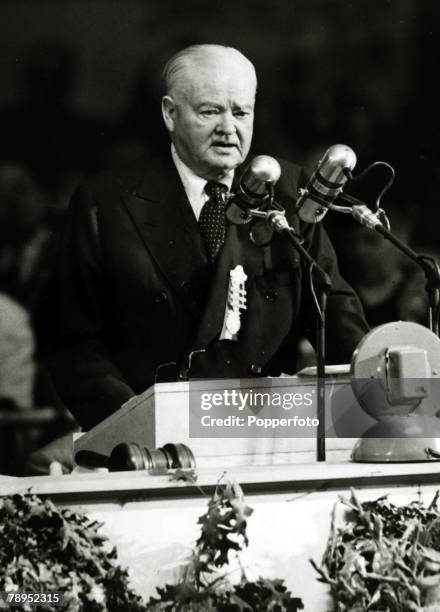
Hoover at the 1948 Republican Convention in Philadelphia.
They continued to invite him to every Convention,
and he kept coming until 1960.

From their days as fellow members of the U.S. Senate, Truman was good friends with Alben Barkley, the Kentuckian who was the Democrats' Senate Leader, and had no problem accepting him as the nominee for Vice President. But he hitched his wagon to the legacy of Franklin Delano Roosevelt, effectively making the New Deal his platform (his 1949 State of the Union Address would update it for the times as "the Fair Deal"), and FDR's ghost his running mate.
Truman and Roosevelt, at FDR's Hyde Park estate,
after the 1944 Democratic Convention

Truman knew he could win, and he knew how he could do it: By going to the people themselves, in what the GOP derisively called "a whistle-stop campaign," a phrase Truman ran with, and explaining the truth to people where they were, and in terms they could understand -- without talking down to them, as Donald Trump does today. He connected with people the same way FDR did, even though they were very different men. 

Ever since, Ol' Harry S has been the patron saint of political underdogs, of the people who are told they can't possibly win.

(There's no period on his middle initial, since it legally didn't stand for anything, as his parents couldn't agree on whether to name him after one of his grandfathers, Anderson Shippe Truman or Solomon Young. So his entire middle name was the letter S, with no period. His mother's brother was Harry Young, and the name was "Harry," not "Henry" or "Harrison." His legal name was "Harry S Truman.")

Even Republicans cite him as an inspiration. As Truman himself would have said, "Well, that's just political conversation." Or, as his only child, Margaret, who became a noted writer of mystery novels after a failed singing career, put it while editing one of her father's books, "My father originally used a shorter word here, but decided to change it."

Truman did love him some of what I like to call "George Carlin words." Legend has it that Harry and his wife Bess (formerly Elizabeth Wallace) toured a greenhouse, and Harry, a former farmer himself, told the owner, a woman, that she "must have used some good manure." The owner pulled Bess aside and said, "Can't you get the President to say, 'Fertilizer'?" And Bess said, "It's taken me this long just to get him to say, 'manure'!"

Truman won 24.1 million votes, Dewey 22.0 million, Thurmond 1,175,930, Wallace 1,157,328. Popular vote share: Truman 49.5 percent, Dewey 45.1, Thurmond 2.41, Wallace 2.37. States: Truman 28, Dewey 16, Thurmond 4, Wallace none. Electoral Votes, with 266 being a majority: Truman 303, Dewey 189, Thurmond 39, Wallace none. Wallace got 8.2 percent of the popular vote in New York, 4.7 percent in California, and less than 4 percent everywhere else.

The Democrats also swept back into power in Congress, taking 75 seats in the House of Representatives and 9 in the Senate. Notable newly-elected Senators included Democrats Humphrey, Estes Kefauver of Tennessee, Paul Douglas of Illinois, and Bob Kerr of Oklahoma. Only 2 new Republicans were elected: Margaret Chase Smith of Maine (making her the 1st woman to serve in both houses of Congress) and Robert Hendrickson of New Jersey.

If Dewey hadn't been so complacent, he would have realized that Truman was reaching the hearts and minds of the people. And he might have gone out to answer Truman's charges against him and "that do-nothing Republican 80th Congress." Maybe the Republicans, as a party, blew it for Dewey. But he also blew it for himself.

Truman could have run for what would have amounted to a 3rd term in 1952, but didn't. He went back to his hometown of Independence, Missouri, where he built, opened, operated, and lectured at his Presidential Library, until his death in 1972.

Dewey was elected to a 3rd term as Governor of New York in 1950, and left office after that 3rd term. The New York State Thruway is also known as the Governor Thomas E. Dewey Thruway. Despite being 17 years younger, he died a year before Truman.

Wallace drifted into obscurity, and wrote books about farming, his specialty. He died in 1965, of Lou Gehrig's disease. Thurmond was elected to the Senate in 1956, became a segregationist leader, switched to the Republican Party in 1964, and kept getting re-elected to the Senate until 2002, when, approaching his 100th birthday, even he had to admit that he wouldn't survive another term. He died the next year.

Monday, November 2, 2020

Top 5 Reasons You Can't Blame Thomas Dewey for Losing the 1948 Presidential Election

November 2, 1948: The most famous newspaper headline of all time? It might be the New York Daily News of October 30, 1975: "FORD TO CITY: DROP DEAD." Or it might be the one the Chicago Tribune (a proud Republican paper at the time) put up the morning after today's Presidential election.

As it turned out, despite all predictions and despite all polls, Governor Thomas E. Dewey of New York, the Republican nominee, did not defeat the incumbent Democrat, President Harry S Truman. This made Truman, the 33rd President of the United States, the patron saint of every Presidential underdog since.

The problem is, Harry was smarter than most of them. Which is why he's enjoying himself so much in the photo above: He fooled 'em all.

But Dewey was dumb to have blown what should have been a sure win. How dumb was he? Well, maybe not that dumb:
Dewey remains the only major-party Presidential nominee
with facial hair since the Republicans nominated Charles Evans Hughes in 1916.

Top 5 Reasons You Can't Blame Thomas Dewey for Losing the 1948 Presidential Election

5. Republican Complacency. They didn't give him the support he needed, because they presumed he wouldn't need it. The polls all indicated a Dewey romp. 
Why? Because the Democratic Party had been splintered, from both wings. From the left: Henry A. Wallace, who had been Secretary of Agriculture in President Franklin D. Roosevelt's 1st 2 terms, Vice President in the 3rd, and Secretary of Commerce in FDR's 4th term before he died and it became Truman's 1st.

He was the darling of what's now called the progressive movement, but, then, it was an actual group named the Progressive Party. Aside from the name, it had no connection to the previous parties of that name, nominating Theodore Roosevelt in 1912 and Robert La Follette in 1924.
It was feared that Wallace would take the black vote. He did, but not as much as was feared. It was feared that he would take organized labor with him. He did, but not as much as was feared. It was feared that his campaign would swing New York to Dewey. It did. It was feared that his campaign would swing California to Dewey. It didn't. And it was feared that losing New York and California, with a combined 72 Electoral Votes, would cost Truman the election. Even if Truman had lost California's 25 EVs, he still would have won.

From the right: Strom Thurmond, Governor of South Carolina, who welcomed the Southern Delegates who walked out of the Democratic Convention in Philadelphia (both parties held their Conventions at the Philadelphia Civic Center that year), following a pro-civil rights speech by the Mayor of Minneapolis, who was running for the U.S. Senate, and won: Hubert Humphrey.

Thurmond was happy to accept the Presidential nomination of the States' Rights Party, a.k.a. the Dixiecrats. A precursor to the 1968 independent candidacy of George Wallace (no relation to Henry), he managed to win his home State of South Carolina, plus Alabama, Mississippi, Louisiana, and 1 Electoral Vote in Tennessee.
Later famously the oldest U.S. Senator ever,
Thurmond was just 45 years old at this point.
I don't think a picture of him looking young exists.

And Dewey himself seemed to be a great candidate. A crusading District Attorney in Manhattan, he had put some of the nation's nastiest organized crime bosses in prison. He was in his 2nd term as a successful, popular Governor. He had been the Republican nominee for President in 1944, running against wartime Commander-in-Chief Roosevelt, and had done well enough to earn himself a shot at a vulnerable peacetime President in Truman. And he was a young, good-looking guy: Just 46, and there was the thought that he could redeem the idea of mustaches after the bad reputation they had recently gotten from Adolf Hitler.

Surely, with Dewey popular, Thurmond splitting the formerly "Solid South," and Wallace moving New York and California from the Truman column to the Dewey column, Dewey would win. Interviewed in 1995, even Thurmond -- who wasn't even on the ballot in all 48 States, and knew he had no chance, but was willing to spoil things for Truman -- admitted, "I thought Dewey would win."

But the Republicans got too complacent. After all, Truman did win California after all, by a razor-thin margin of 18,000 votes. And there was no State that Thurmond threw from Truman to Dewey -- although Maryland was close enough, and its largest city Baltimore black enough, that Wallace, who got 10,000 votes there, might have thrown it to Dewey.

4. The Cold War. It was supposed to be Dewey's winning issue. Instead, it was Truman's, with the Truman Doctrine protecting Greece and Turkey from Communist takeover, the Marshall Plan aiding Western Europe before the Soviet Union could, and the Berlin Airlift preventing the Soviets from starving West Berlin into capitulation.

3. The Curse of Herbert Hoover. After 16 years, voters still didn't trust Republicans with the economy. Truman never mentioned Hoover by name, because they were on good terms. (Whereas Hoover was definitely not on good terms with FDR -- or with his own Republican predecessor, Calvin Coolidge.) So he blamed the Republicans in general for the Depression of the 1930s, and it worked.
Hoover at the 1948 Republican Convention in Philadelphia.
They continued to invite him to every Convention,
and he kept coming until 1960.

2. The Ghost of FDR. From their days as fellow members of the U.S. Senate, Truman was good friends with Alben Barkley, the Kentuckian who was the Democrats' Senate Leader, and had no problem accepting him as the nominee for Vice President.

But he hitched his wagon to the legacy of Franklin Delano Roosevelt, effectively making the New Deal his platform (his 1949 State of the Union Address would update it for the times as the Fair Deal), and FDR's ghost his running mate.
Truman and Roosevelt, at FDR's Hyde Park estate,
after the 1944 Democratic Convention

1. Harry Truman. He knew he could win, and he knew how he could do it: By going to the people themselves, in what the GOP derisively called "a whistle-stop campaign," a phrase Truman ran with, and explaining the truth to people where they were, and in terms they could understand -- without talking down to them, as Donald Trump does today. He connected with people the same way FDR did, even though they were very different men. 

Ever since, Ol' Harry S has been the patron saint of political underdogs, of the people who are told they can't possibly win.

(There's no period on his middle initial, since it legally didn't stand for anything, as his parents couldn't agree on whether to name him after one of his grandfathers, Anderson Shippe Truman or Solomon Young. So his entire middle name was the letter S, with no period. His mother's brother was Harry Young, and the name was "Harry," not "Henry" or "Harrison." His legal name was "Harry S Truman.")

Even Republicans cite him as an inspiration. As Truman himself would have said, "Well, that's just political conversation." Or, as his only child, Margaret, who became a noted writer of mystery novels after a failed singing career, put it while editing one of her father's books, "My father originally used a shorter word here, but decided to change it."

Truman did love him some of what I like to call "George Carlin words." Legend has it that Harry and his wife Bess (formerly Elizabeth Wallace) toured a greenhouse, and Harry, a former farmer himself, told the owner, a woman, that she "must have used some good manure." The owner pulled Bess aside and said, "Can't you get the President to say, 'Fertilizer'?" And Bess said, "It's taken me this long just to get him to say, 'manure'!"

Truman won 24.1 million votes, Dewey 22.0 million, Thurmond 1,175,930, Wallace 1,157,328. Popular vote share: Truman 49.5 percent, Dewey 45.1, Thurmond 2.41, Wallace 2.37. States: Truman 28, Dewey 16, Thurmond 4, Wallace none. Electoral Votes, with 266 being a majority: Truman 303, Dewey 189, Thurmond 39, Wallace none. Wallace got 8.2 percent of the popular vote in New York, 4.7 percent in California, and less than 4 percent everywhere else. The Democrats also swept back into power in Congress, taking 75 seats in the House of Representatives and 9 in the Senate.

VERDICT: Guilty. If Dewey hadn't been so complacent, he would have realized that Truman was reaching the hearts and minds of the people. And he might have gone out to answer Truman's charges against him and "that do-nothing Republican 80th Congress."

Maybe the Republicans, as a party, blew it for Dewey. But he also blew it for himself.

Truman could have run for what would have amounted to a 3rd term in 1952, but didn't. He went back to his hometown of Independence, Missouri, where he built, opened, operated, and lectured at his Presidential Library, until his death in 1972.

Dewey was elected to a 3rd term as Governor of New York in 1950, and left office after that 3rd term. The New York State Thruway is also known as the Governor Thomas E. Dewey Thruway. Despite being 17 years younger, he died a year before Truman.

Wallace drifted into obscurity, and wrote books about farming, his specialty. He died in 1965, of Lou Gehrig's disease. Thurmond was elected to the Senate in 1956, became a segregationist leader, switched to the Republican Party in 1964, and kept getting re-elected to the Senate until 2002, when, approaching his 100th birthday, even he had to admit that he wouldn't survive another term. He died the next year.

*

November 2, 1948, like all modern Election Days in America, was a Tuesday. The baseball season was over. There were no football games played. The NBA season had started the day before, but there were no games on this day. And the NHL also had no games scheduled. So I can't do a "Scores On This Historic Day" feature for this event.