Showing posts with label supreme court. Show all posts

Tuesday, June 30, 2026

Conservatism Is a Racist Ideology

Today, the Supreme Court of the United States upheld "birthright citizenship."

In a case abbreviated as Trump v. Barbara, the Court recognized that it is explicitly guaranteed to anyone born under the legal "jurisdiction" of the U.S. federal government by the Citizenship Clause of the 14th Amendment to the Constitution of the United States, adopted on July 9, 1868), which states: "All persons born or naturalized in the United States, and subject to the jurisdiction thereof, are citizens of the United States and of the State wherein they reside."

The vote was narrow as hell, though: 5-4. As expected, Associate Justices Sonia Sotomayor, Elena Kagan and Katanji Brown Jackson, liberals appointed by Presidents of the Democratic Party, supported birthright citizenship. But so did Chief Justice John Roberts and Associate Justice Amy Coney Barrett, both conservative Justices appointed by Presidents of the Republican Party -- including Barrett, appointed by Donald Trump.

The other four Associate Justices, all archconservatives appointed by Republican Presidents, voted against it: Clarence Thomas, Samuel Alito, Neil Gorsuch and Brett Kavanaugh.

Once again, the Supreme Court matters. Trump -- or, if something happens to him, Vice President JD Vance taking his place -- has two and a half years left in his term. And Thomas is 78 years old, Alito is 76, Sotomayor is 72, and Roberts is 71. There's a huge chance that whoever is President between now and January 20, 2029 will have to replace one of them, and a good chance that he'll have to replace at least two. The President elected on November 7, 2028 and taking office on January 20, 2029 will almost certainly inherit those new Justices, and, if not, have to replace them and the others.

Since taking office for a 2nd term as President on January 20, 2025, Donald Trump has demanded that the U.S. Supreme Court ignore this vital part of the Constitution, and declare that only children born to parents who are both citizens of the U.S. shall be recognized as citizens of the U.S.

This is anti-immigration rhetoric, aimed largely at black and Spanish-speaking people. It is racist. It is disgusting. It is immoral. It is un-American. And, while the 1st Amendment means that this shouldn't be an issue, so many people claiming it to be true also lie and say they follow Jesus, so I'm going to add this: It is un-Christian.

*

Conservatism is the ideology of racism. From 1837 onward, after the populist Andrew Jackson left office, the Democratic Party was the party of conservatism. Then, after the American Civil War, without Abraham Lincoln to keep an eye on them any longer, the members of the Republican Party saw how much money they'd made on railroads and armaments, and decided they didn't want to pay taxes on that income, and became conservative. This led to the Compromise of 1877, which ended Reconstruction, and thus ended the official move for civil rights in America, for black people and for women. (Hispanics weren't even being considered, although there were moves, even then, to limit immigration from Asia.)

So, at this point, we had two conservative parties, to the point where the Republicans threw former President Theodore Roosevelt out in 1912, when he campaigned to return to the office, on things like universal health coverage and old-age pensions -- essentially, what became Social Security.

Starting in 1932, with Franklin Roosevelt and the New Deal, the Democratic Party returned to liberalism, except for their Southern wing, which, while taking in the money from New Deal's liberal projects, remained racist and conservative.

In 1964, the outside-the-South Democrats joined with reasonable Republicans to pass the Civil Rights Act. The most conservative Republicans appealed to the Southern Democrats, and say, "You don't like it? Join us." And they did. And that's where we are now.

So when Republicans call the Democrats the party of racism and the party of the Ku Klux Klan, it's no more true today than the Republicans being the party of Lincoln. Today's racists are united in their support of the Republicans, and of Donald Trump.

And let's drop this myth of "Conservatism is opposed to big government." Conservatives have always believed in big government when it comes to fighting their enemies. Since World War II, they've never had a problem with expanding the Department of Defense, or the CIA, or the FBI. Because that involves spending taxpayers' money. The only time they want smaller government is when bigger government makes them spend more of their own money.

Wednesday, April 29, 2026

All Right, You Primitive Screwheads...

In the words of the immortal Bruce Campbell, playing Ash Williams in the 1993 film Army of Darkness...

All right, you primitive screwheads, listen up!

An innocent man does whatever it takes to prove his innocence. He does not do whatever it takes to gain immunity from prosecution.

A President who has just faced an assassination attempt does not worry about his shoes, pump his fist, yell, "Fight! Fight! Fight!" or promote a ballroom project. A President who staged an assassination attempt does that.

When people tell you, "The Supreme Court is on the ballot," believe them.

Bernie Sanders was not robbed by the Democratic National Committee. Quite the opposite: Just by letting him into their Primaries, they bent over backwards to accommodate him. He wasn't robbed by the DNC. He was rejected by Democratic voters, who knew that he had been talking trash about their Party for half a century.

What Israel is doing is Gaza is bad, but it is not genocide. It is in response to an act of genocide.

What Russia is attempting in Ukraine is an attempt to not only conquer the country, but to wipe out its culture and impose its own. That is genocide.

The new Yankee Stadium is not a "little league park." The proof of this is that the Yankees can hit anywhere.

Derek Jeter was an excellent defensive shortstop. Your "defensive metrics" are meaningless.

Large amounts of money were never going to be enough to save the Mets.

"Wins Above Replacement" has no value. Actual winning has value.

No one has ever proven that Roger Clemens used steroids, and David Ortiz and Barry Bonds did each fail a steroid test.

The two biggest wastes of time that ESPN covers happen practically back-to-back: The Masters and the NFL Draft.

Aaron Rodgers may still be talented, but in the ways that matter, he is a bum.

The Liberty Mutual commercials -- both the ones at the Statue of Liberty and the LiMu Emu & Doug ads -- have run their course, and it's time to retire them.

Speaking of TV commercials: If it takes longer to mention the side effects of a drug than its benefits, and you need people to dance in your commercial, it's time to pull the drug. And the commercial. And do more testing on both.

That said, Zepbound has worked for me. I've lost 20 pounds. That said, I don't know if it, or any other drug, is right for you. Talk to your doctor.

Charles Barkley has lost over 100 pounds on a different GLP-1 drug, but just because a celebrity uses a product doesn't mean it's good. Shaquille O'Neal endorses Icy Hot, but it did nothing for me.

East Brunswick needs a Wegmans. I'll settle for New Brunswick, North Brunswick, Sayreville or Old Bridge. Manalapan, Woodbridge, Bridgewater and West Windsor are just too far.

It's "I couldn't care less," not "I could care less."
 
The past tense of "slay" is "slew," not "slayed."
 
Some of you literally don't know what "literally" means.
 
I'll relax when I'm ready. Telling me to relax makes me less relaxed.
 
And Dunkin tastes better than Starbucks. And it's cheaper, too.

As you were!

Thursday, March 12, 2026

March 12, 1956: The Southern Manifesto

Southern Senators, led by Strom Thurmond of South Carolina

March 12, 1956, 70 years ago: The Declaration of Constitutional Principles is signed, by 19 members of the U.S. Senate and 82 members of the U.S. House of Representatives, all from States that had been in the Confederate States of America.

Since there was not a goddamned thing about it that was constitutional, it became known as the Southern Manifesto, allowing people on the right side of the struggle for civil rights to do what these rednecks had been doing to them for years: Comparing them to Communists.

The main author was Senator Strom Thurmond of South Carolina. In 1948, as his State's Governor, he had briefly left the Democratic Party to run as the nominee for President of the States' Rights Party. From that point onward, Southern Democrats who opposed civil rights were known as "Dixiecrats."

It was written in response to the unanimous decision of the U.S. Supreme Court, 2 years earlier, in Brown v. Board of Education of Topeka, Kansas, declaring that racial segregation in public schools was unconstitutional.

The Declaration included these words: "The unwarranted decision of the Supreme Court in the public school cases is now bearing the fruit always produced when men substitute naked power for established law."

This was a bald-faced lie: The decision was warranted, and it was a strike against naked power, in the form of "Jim Crow" laws that overturned established law.

It also said: "The original Constitution does not mention education. Neither does the 14th Amendment nor any other amendment. The debates preceding the submission of the 14th Amendment clearly show that there was no intent that it should affect the system of education maintained by the States."

This was true, but it covered up the text of the 14th Amendment: "No State shall make or enforce any law which shall...deny to any person within its jurisdiction the equal protection of the laws." This is known as the Equal Protection Clause.

It also said: "This unwarranted exercise of power by the Court, contrary to the Constitution, is creating chaos and confusion in the States principally affected. It is destroying the amicable relations between the white and Negro races that have been created through 90 years of patient effort by the good people of both races. It has planted hatred and suspicion where there has been heretofore friendship and understanding."

This was a lie: There had not been friendship. And the Court's decision didn't create confusion; it clarified the law.

Three Democratic Senators from Southern States did not sign: Albert Gore and Estes Kefauver of Tennessee, and the Majority Leader, Lyndon Johnson of Texas. In the House, 16 of 21 Democrats from Texas refused to sign it, including the Speaker of the House, Sam Rayburn, and a future Speaker, Jim Wright. Also refusing to sign were 3 of the 11 Democrats from North Carolina; and 1 of the 7 from Florida, Dante Fascell.

The following year, Thurmond launched the longest filibuster the Senate had yet seen, in a vain attempt to stop the Civil Rights Act of 1957. When the Civil Rights Act of 1964 was passed, he became the 1st Dixiecrat to switch to the Republican Party. There would be many more.

Thurmond turned out to be the last-serving member who signed the Southern Manifesto, serving until 2003, shortly after his 100th birthday, and dying a few months later. The last surviving signer was Richard Poff of Virginia, who died in 2011.

The last-serving member who refused to sign was Jack Brooks of Texas, who served until 1994. The last surviving refuser was the aforementioned Jim Wright, who died in 2015.

Friday, December 12, 2025

December 12, 2000: Bush v. Gore

December 12, 2000, 25 years ago: The Supreme Court of the United States overrules the Supreme Court of the State of Florida. It is the case of Bush v. Gore.

In the Presidential election of November 7, the Democratic nominee for President of the United States, the then Vice President of the United States, Albert Arnold Gore Jr., got more popular votes than the Republican nominee, the Governor of Texas, George Walker Bush: Gore 50,999,897, Bush 50,456,002, a margin of 543,895 votes. Ralph Nader, famous as a consumer advocate since the 1960s, ran as the nominee of the Green Party. He got 2,882,955 votes. Gore got 48.4 percent of the popular vote; Bush, 47.9 percent, Nader, 2.7 percent.

Bush's brother, Governor John Ellis "Jeb" Bush of Florida, saw how close the vote was in his State, and tampered with the voting process, and that one State held everything up for 5 weeks. The best attempt at a recount, in downtown Miami, was interrupted on November 22 by what became known as the Brooks Brothers Riot. As a result, there were votes that were never counted. I don't mean they weren't recounted, I mean they were never counted, not even once.

On December 8, the Florida Supreme Court ruled that all 61,000 "undervotes" had to be counted. Had that happened, Gore surely would have won. The Bush campaign immediately appealed to the U.S. Supreme Court. SCOTUS ruled on December 12:

* Four Justices ruled that the recount had to go forward: John Paul Stevens, appointed by Republican President Gerald Ford; David Souter, appointed by Republican President George H.W. Bush, the current Republican nominee's father; Ruth Bader Ginsburg, appointed by the current President, Democrat Bill Clinton; and Stephen Breyer, also appointed by Clinton.

* Five Justices ruled that the recount had to stop immediately, all of them appointed by Republican Presidents: William Rehnquist, appointed by Richard Nixon, and promoted to Chief Justice by Ronald Reagan; Sandra Day O'Connor, appointed by Reagan; Antonin Scalia, appointed by Reagan; Anthony Kennedy, appointed by Reagan; and Clarence Thomas, appointed by the elder George Bush.

It was pretty easily guessed that all 4 Justices who voted to keep the recount going would do so; and that 3 Justices known for being archconservatives -- Rehnquist, Scalia and Thomas -- would vote to stop it.

The question marks were 2 moderates, both known as "swing votes": O'Connor and Kennedy. If either of them had voted to keep the recount going, it would have been kept going, and Gore would have won. Instead, both voted to stop it.

And so, in an election where over 104 million votes had been accepted as counted, only two votes ended up mattering: Those of O'Connor and Kennedy.

It may have been the ghastliest decision in the Court's history, aside from the 1857 decision in Dred Scott v. Sandford, that said that black people weren't citizens (a decision remedied by the 14th Amendment to the Constitution). It also marked perhaps the 1st time in the nation's history that political conservatives overruled a case based in part on a State's rights.

It may have been surpassed as the ghastliest decision in the Court's history by Trump v. United States in 2024, when the Court ruled that Presidents have immunity from criminal prosecution.

Gore conceded the election the next day, forever doomed to be "the 42nd 1/2 President of the United States" -- a President-elect, but never a President. On January 6, 2001, in his role as the outgoing Vice President, Gore properly read the Electoral Votes, including the 25 of the State of Florida. Whether those votes were properly arrived at is another matter. Congress then certified the Electoral Votes.

On that January 6, no Democrats stormed the U.S. Capitol Building in an attempt to stop that process.

Twenty years later, of course, when it was Republicans who didn't like the result, they did storm the Capitol, and attempt to stop the process. They only delayed the inevitable.

Rehnquist died in office in 2005. O'Connor retired right before that. Souter retired in 2009. Stevens retired in 2010, and died in 2019. Scalia died in office in 2016. Kennedy retired in 2018. Ginsburg died in office in 2020. Breyer retired in 2022. O'Connor died in 2023. Souter died in 2025. As of December 12, 2025, Kennedy, Thomas and Breyer are still alive; while Thomas is the only 1 of the 9 who is still on the Court.

Bush's 2 terms in office were an unmitigated disaster, both domestically (especially economically) and internationally. Had Gore been allowed to accept his victory, he would have governed completely differently, and most Americans, including the conservatives, would have been better off.

Thursday, June 26, 2025

June 26, 2015: Obergefell v. Hodges

June 26, 2015, 10 years ago: The U.S. Supreme Court rules in Obergefell v. Hodges that the fundamental right to marry is guaranteed to same-sex couples, by both the Due Process Clause and the Equal Protection Clause of the 14th Amendment to the Constitution of the United States.

Jim Obergefell was a high school German teacher in Sandusky, Ohio, who met IT director John Arthur in the early 1990s. Arthur developed ALS, a.k.a. Lou Gehrig's disease. Knowing he was dying, and wanting to make it legal and get the legal protections that came with it, the two men flew to Maryland, where same-sex marriage was legal, and were married on July 11, 2013. Arthur died on October 22, only 3 months later.
Jim Obergefell (left) and John Arthur, on the plane to Maryland

Due to Ohio's law banning same-sex marriage, Obergefell could not be listed as the legal spouse on Arthur's death certificate. So he sued Richard Hodges, who held the office denying Obergefell his rights, that of the Director of the Ohio Department of Health.

The Supreme Court's ruling struck down all State laws that barred same-sex marriage, most of which had been passed in the 2000s, during the Administration of evangelical "Christian" George W. Bush, as a backlash against the gains of the gay rights movement in the 1990s, during the Administration of President Bill Clinton.

It was a 5-4 vote. It was known from the beginning that Antonin Scalia, Clarence Thomas and Samuel Alito, all militantly conservative Catholics appointed by Republican Presidents, would vote to uphold their religious belief, and not the 14th Amendment.

It was known from the beginning that the 4 Justices who had been appointed by Democratic Presidents -- Sonia Sotomayor, a Catholic; and Ruth Bader Ginsburg, Stephen Breyer and Elena Kagan, all Jewish -- would recognize that the 14th Amendment took precedence over any State's law, and over anyone's prejudices, whether inspired by religion or not.

The question was over the remaining 2 Justices, both appointed by Republican Presidents: Chief Justice John Roberts and Anthony Kennedy. Kennedy had long been a "swing Justice," deciding cases that were otherwise split 4-4; and Roberts had sometimes surprised people who expected him to vote the conservative way, but ended up finding ways to reconcile the more liberal position with the Constitution.

Not only did both men side with Obergefell, but Kennedy wrote the majority opinion. He cited not merely "equal protection," but "equal dignity in the eyes of the law."

In the wake of the current Court's ruling in Dobbs v. Jackson Women's Health Organization in 2022, striking down the national right to an abortion, Justice Thomas has said that he wants the Court to re-examine certain decisions he called "wrong," including Obergefell v. Hodges. In other words, with the Court now having a 6-3 archconservative supermajority, the greatest victory in the history of the gay rights movement may not be final.

In 2022, Obergefell ran for the Ohio House of Representatives. Hodges served in that House from 1993 to 1999, albeit in a different district. Running as a Democrat against a Republican incumbent seeking a 3rd term, Obergefell lost the election.

Saturday, June 7, 2025

June 7, 1965: Griswold v. Connecticut

Estelle Griswold

June 7, 1965, 60 years ago: The Supreme Court of the United States, in the case of Estelle T. Griswold and C. Lee Buxton v. Connecticut -- usually shortened for easy reference to Griswold v. Connecticut -- rules that the Constitution of the United States protects the right of married couples to buy and use birth control, without restrictions from the federal government.

The case involved a State law in Connecticut that prohibited any person from using "any drug, medicinal article or instrument for the purpose of preventing conception." The plaintiffs were Estelle Griswold, executive director of the Planned Parenthood League of Connecticut; and Charles Lee Buxton, a gynecologist.

The Court held that the statute was unconstitutional, and that its effect was "to deny disadvantaged citizens... access to medical assistance and up-to-date information in respect to proper methods of birth control."

By a vote of 7–2, the Supreme Court invalidated the law on the grounds that it violated the "right to marital privacy," as expressed in the 14th Amendment to the Constitution, establishing the basis for that right with respect to "intimate practices" (in other words, anything that could be defined as "sexual activity").

Justice William O. Douglas wrote the majority opinion, asking, "Would we allow the police to search the sacred precincts of marital bedrooms for telltale signs of the use of contraceptives? The very idea is repulsive to the notions of privacy surrounding the marriage relationship." Justice Arthur Goldberg also invoked the 9th Amendment. Justice Byron White argued that Connecticut's law failed "the rational basis standard."

In addition to Douglas, Goldberg and White, Chief Justice Earl Warren and Justices John Marshall Harlan II, William J. Brennan and Tom C. Clark concurred, to form the majority opinion. The dissenting Justices were Hugo Black (which was unusual, as he tended to support such civil liberties cases) and Potter Stewart.

C. Lee Buxton died in 1969. Estelle Griswold lived until 1981. For the record, while both plaintiffs were married, Buxton had 4 children, but Griswold had none. The last remaining Justice on the Court from this case was Brennan, who served until 1990. White was the last surviving Justice from the case, living until 2002.

Griswold v. Connecticut and its commitment to a right to privacy were used as the basis for the argument to overturn State abortion laws in Roe v. Wade in 1973. (UPDATE: When Dobbs v. Jackson overturned Roe in 2022, some anti-abortion activists warned that overturning Griswold was now a priority.)

Tuesday, May 27, 2025

May 27, 1935: "Black Monday" vs. the New Deal

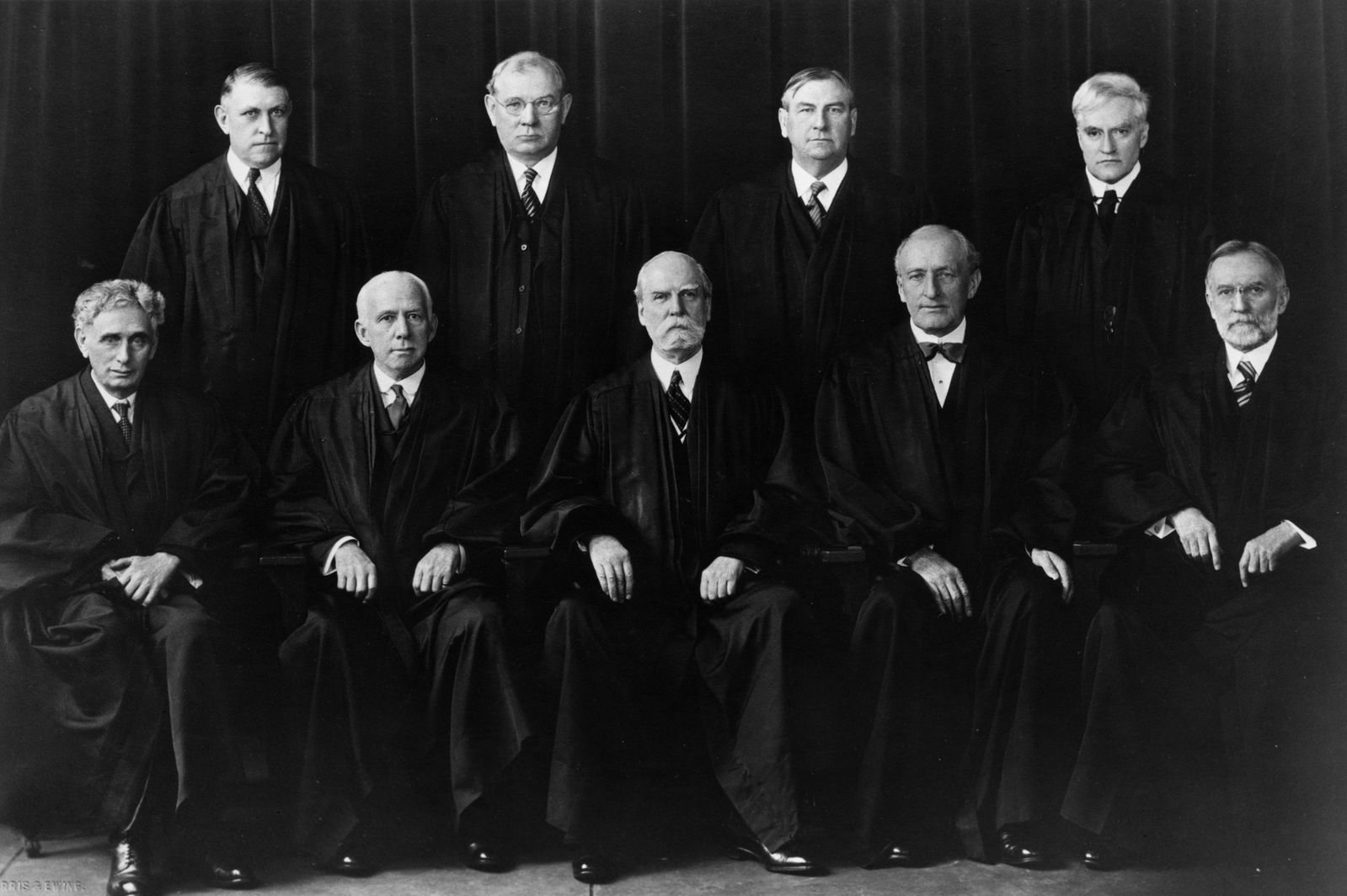
The Supreme Court, 1935. Top row, left to right:
Pierce Butler, Harlan Stone, Owen Roberts, Benjamin Cardozo.
Bottom row, left to right: Louis Brandeis, James McReynolds,
Chief Justice Charles Evans Hughes, Willis Van Devanter, George Sutherland.

May 27, 1935, 90 years ago: A bad day for President Franklin D. Roosevelt and his New Deal, at the Supreme Court of the United States. Among FDR's advisors, the "Brain Trust," it becomes known as "Black Monday."

In Humphrey's Executor v. United States, FDR, a Democrat, had fired William Humphrey, a Republican, from the Federal Trade Commission. Humphrey sued to get his job back, and to get back pay. He died before the case could be heard, so his wife, as the executor of his estate, kept the suit going. The Court ruled in favor of Mrs. Humphrey.

FDR was not used to losing. He had never lost an election in his own right: State Senator from Dutchess County in 1910 and 1912, Governor of New York in 1928 and 1930, President in 1932. He had been on the losing side of the 1920 Presidential election, but as the Democratic nominee for Vice President, with Governor James M. Cox of Ohio as the top of the ticket and the official loser. He'd even gained seats for the Democrats in the 1934 Congressional election. So, this hurt a little. If that had been the end of it, it probably would've been a footnote in the story of his Administration.

Then, the Court announced its ruling in Louisville Joint Stock Land Bank v. Radford. The Frazier-Lemke Farm Bankruptcy Act of 1934 was designed to give aid to debt-ridden farmers. But the Court ruled that it violated the "Takings Clause" of the 5th Amendment to the Constitution of the United States: While the States could not impair contract obligations, the federal government could, but it could not take property in such a manner without compensating the creditor. Two losses for FDR in one day. Unpleasant, but not really a big deal.

But the last decision the Court read was a very big deal. In A.L.A. Schechter Poultry Corporation v. United States, the Court struck down the National Industrial Recovery Act of 1933, a key piece of New Deal legislation, in its entirety.

The details of what became known as "the Sick Chicken Case" involved the Schechter brothers violating laws governing the sale of poultry in the State of New York, both State and federal, including the NIRA.

(Ironically, the symbol of the NIRA -- or just the NRA, at that point better-known than the National Rifle Association -- was a bird, a blue eagle. This inspired the naming of a professional football team that started play in 1933, which later switched its main color from blue to green: The Philadelphia Eagles. And until becoming contenders during World War II, they seemed to play more like sick chickens than soaring eagles.)

In a unanimous 9-0 vote, the Court ruled that the NIRA was in violation of both the Due Process Clause of the 5th Amendment, and also of the Commerce Clause of the Constitution (Article I, Section 8, Clause 3.)

If the 1st 2 cases rolled off FDR like water off a duck's back, this last one stung. Four days later, he held a press conference, saying Schechter had "relegated the nation to a horse-and-buggy-definition of interstate commerce.

At the time, there were 3 factions on the Court:

* The Four Horsemen were ultraconservative: Willis Van Devanter, appointed by William Howard Taft, a Republican; James McReynolds, appointed by Woodrow Wilson, a Democrat but a Southern one; and George Sutherland and Pierce Butler, both appointed by Warren Harding, a Republican.

* The Three Musketeers were liberal: Louis Brandeis, the 1st Jewish Justice on the Court, appointed by Wilson and considerably more liberal than McReynolds; Harlan Stone, appointed by Calvin Coolidge, a Republican; and Benjamin Cardozo, appointed by Herbert Hoover, a Republican. But both Stone and Cardozo tended to vote FDR's way. Not in Schechter, though.

* The swing votes were Charles Evans Hughes, once an Associate Justice appointed by Taft, a predecessor of FDR's as Governor of New York, the 1916 Republican nominee for President, very nearly beating Wilson, and appointed Chief Justice by Hoover, to replace Taft, who had been appointed by Harding; and Owen Roberts, another Hoover appointee.

FDR knew that the Four Horsemen were a threat to his legislation, and that the two swing votes were both Republicans. But he didn't expect a unanimous vote against the NIRA.

After being re-elected in 1936, FDR proposed what became known as "the Court-packing plan," allowing the President to appoint a Justice to the Supreme Court without there being a vacancy, one such Justice for every member of the Court that was at least 70 years old. In the Spring of 1937, that would have meant six, for a total of 15.

(Incidentally, the Constitution has never said, anywhere its text, either the original or the Amendments, how many Justices should be on the Supreme Court; only that the Court should exist, and what it should do. The number has been fixed at 9 since the Civil War, mainly because there were 9 "circuits" in the federal court system, although it was not traditional to have 1 Justice from each of the 9 circuits. Since 1981, there have been 11 circuits.)

But even the Democrats in Congress wouldn't go along with FDR on this one. It was too much of an overreach, and it seemed like a power grab, upsetting the separation of powers between the branches of the federal government. The plan was never even voted on by Congress.

FDR didn't get what he wanted, but he got the next-best thing: The plan struck fear into the Justices, and led them to look at his New Deal legislation more closely. On March 29, 1937, Justice Roberts (no relation to current Chief Justice John Roberts) voted with Hughes and the Three Musketeers in West Coast Hotel Company v. Parrish, upholding minimum wage laws.

He had been expected to vote the other way, which would have made the vote 5-4 against, striking all such laws down. It became known as "The Switch In Time That Saved Nine," and was a sign that the Court -- or, at least, that Roberts -- had gotten FDR's message.

Despite the many successes, some of them political landmarks, of his 1st term, FDR hadn't gotten a chance to replace any of the Justices. Starting with his 2nd term, his chances began to come:

1. On June 2, 1937, Van Devanter retired, and was replaced by Senator Hugo Black of Alabama. Despite having once been a member of the Ku Klux Klan, the inaptly-named Black became one of the Court's leading voices for the forward movement of civil rights.

2. On January 17, 1938, Sutherland retired, and was replaced by Stanley Reed, FDR's Solicitor General, the person who argues before the Supreme Court on behalf of the federal government -- in other words, FDR had appointed the man who lost the Black Monday cases to the Court.

3. On July 9, 1938, Cardozo died, and was replaced by Felix Frankfurter, one of the founders of the American Civil Liberties Union, and a longtime professor at Harvard Law School, FDR's alma mater.

4. On February 13, 1939, Brandeis retired, and was replaced by the Chairman of the Securities and Exchange Commission, William O. Douglas, who served longer on the Court than anyone yet has: 36 years.

5. On November 16, 1939, Butler died, and was replaced by Frank Murphy, who had been FDR's Attorney General, and, before that, Governor of Michigan and Mayor of Detroit.

6. On January 31, 1941, 11 days after FDR was sworn in for a 3rd term, McReynolds retired, and was replaced by Senator James F. Byrnes of South Carolina. In 1942, with World War II on, FDR decided Byrnes was more valuable in a different role, and replaced him with federal Judge Wiley Rutledge.

7. On June 30, 1941, Hughes retired, and FDR promoted Stone to Chief Justice.

8. To replace Stone as Associate Justice, FDR appointed Robert H. Jackson, who had replaced Murphy as U.S. Attorney General, and had replaced Reed as U.S. Solicitor General, and before that had been an Assistant Attorney General in the Tax and Antitrust Divisions.

FDR appointed 9 Justices -- but only replaced 8 of those he inherited. With some appropriateness, the only Justice he didn't replace was Roberts, who retired from the Court on July 31, 1945, 3 months after FDR died. President Harry Truman replaced him with Harold Burton, a Senator from Ohio and former Mayor of Cleveland, and a Republican, as a bipartisan gesture in the closing days of World War II.

Saturday, March 29, 2025

March 29, 1875: Minor v. Happersett Denies Women the Right to Vote

March 29, 1875, 150 years ago: The Supreme Court of the United States issues a ruling in the case of Minor v. Happersett. It states that, while women are no less citizens than men are, citizenship does not, by itself, confer a right to vote; therefore, State laws barring women from voting are constitutionally valid.

On October 15, 1872, in St. Louis County, Missouri (outside the City of St. Louis), Virginia Minor, a leader of the women's suffrage movement in Missouri, attempted to register to vote. She was refused, on the grounds that she was a woman. Her husband, Francis Minor, was a lawyer, and, together, they sued the registrar who rejected her application, Reese Happersett.

Happersett is not the villain of the story: He was just doing his job, upholding the law as it then stood. If he had registered Mrs. Minor, they would both have been arrested and put in jail.

The Minors' argument was that the provision of the Constitution of the State of Missouri that guaranteed the right to vote only to male citizens of the State was in violation of the recently-ratified 14th Amendment to the Constitution, which guaranteed citizenship to all people born in the United States, saying that citizenship included voting rights. They did not argue under the grounds of the 15th Amendment, which guaranteed the right to vote to all citizens.

The Missouri Supreme Court ruled in Happersett's favor, pointing out that the intent of the 14th Amendment was to give the rights of citizenship to former slaves, and had nothing to do with voting rights or gender. The Minors appealed all the way to the U.S. Supreme Court.

But all 9 Justices upheld the Missouri Supreme Court ruling: Chief Justice Morrison Waite (who wrote the official opinion), Nathan Clifford, Noah Swayne, Samuel F. Miller (who should have known better, as the F stood for "Freeman"), David Davis, Stephen J. Field, William Strong, Joseph P. Bradley and Ward Hunt.

In 1876, just 1 year after the case was decided, Reese Happersett died, only 38 years old. I can find no cause, but, medicine being what it was at the time, it could have been any number of things. Virginia Minor lived until 1894, at the age of 70. Her husband, Francis Minor, had died 2 years previously. The last remaining Justice on the Court who had ruled in Minor was Stephen J. Field, who retired in 1897. The last survivor of those Justices was also Field, who lived until 1899.

The 19th Amendment to the Constitution, guaranteeing America's female citizens age 21 and up the right to vote, was ratified in 1920, after all the participants had died. In 1971, the 26th Amendment lowered the voting age to 18.

Friday, May 17, 2024

May 17, 1954: Brown v. Board of Education

Thurgood Marshall in front of the Supreme Court Building, 1954

May 17, 1954, 70 years ago: In a unanimous 9-0 vote, the Supreme Court of the United States decides, in the case of Brown v. Board of Education, that segregation in public schools -- from kindergarten all the way up to State universities -- is unconstitutional.

Hail the wise men:

* Earl Warren, 63, from Oakland, California, the Chief Justice, formerly his State's Governor and Attorney General, and the Republican Party's nominee for Vice President in 1948. Appointed by the current President, Dwight D. Eisenhower, a Republican.

* Hugo Black, 68, from from Ashland, Alabama, formerly a Democratic U.S. Senator from his State. His was the most surprising vote of all: Not only was he a Southerner, but a former member of the Ku Klux Klan. Serving on the Court from 1937 until his death in 1971, his decisions seemed to be an effort to make up for his KKK membership. Appointed by President Franklin D. Roosevelt, a Democrat.

* Stanley F. Reed, 69, from Minerva, Kentucky, formerly U.S. Solicitor General under FDR, who appointed him to the Supreme Court. Another Southerner who turned his back on white supremacy.

* Felix Frankfurter, 71, born in Vienna, Austria, but grew up on the Lower East Side of Manhattan. He had previously been among the founders of the American Civil Liberties Union, and an adviser to FDR and his Administration. FDR appointed him, as well.

* William O. Douglas, 55, from Yakima, Washington, formerly Chairman of the Securities and Exchange Commission. He remains the longest-serving Justice in the Court's history, 36 years from 1939 to 1975. The current longest-serving Justice, Clarence Thomas, would have to serve until late 2027 to surpass him. Another FDR appointee.

* Robert H. Jackson, 62, from Frewsburg, Western New York, formerly U.S. Attorney General and Solicitor General, having succeeded Reed in that latter office. Another FDR appointee.

* Harold H. Burton, 65, from Boston, formerly U.S. Senator from Ohio and Mayor of Cleveland. FDR crossed Party lines to appoint Burton, a Republican, to the Court.

* Thomas C. Clark, 54, from Dallas, another former Attorney General under FDR. Another Southerner voting to strike down segregation. Appointed by President Harry S Truman, a Democrat.

* Sherman Minton, 64, from Georgetown, Indiana, formerly U.S. Senator from his State. Appointed by Truman.

The full name of the case was Oliver Brown et al. v. The Board of Education of Topeka, Kansas. The named plaintiff, Oliver Brown, was a welder working for a railroad, and an assistant pastor. His daughter, Linda Carol Brown, was in the 3rd grade, and had to walk 6 blocks to her school bus stop to ride to Monroe Elementary School in Topeka, an all-black school, 1 mile away. Sumner Elementary School, all-white, was just 7 blocks away -- 1 block longer than the walk to the bus.

Thurgood Marshall argued the case for the plaintiffs, as the general counsel for the National Association for the Advancement of Colored People (NAACP). The ruling overturned the case of Plessy v. Ferguson in 1896, which ruled that "separate but equal" facilities be provided in public places. In Brown v. Board, the Supreme Court ruled that "separate educational facilities are inherently unequal."

In 1967, President Lyndon B. Johnson decided to make Marshall the 1st black Justice on the Supreme Court. But there was no vacancy. So he decided to create one: He got Nicholas Katzenbach, his Attorney General, to take a post as an Under Secretary of State, and appointed Ramsey Clark to be the new Attorney General. In order to avoid a conflict of interest, Clark's father, Justice Tom Clark, retired.

Oliver Brown died of a heart attack in 1961, only 42 years old. Linda Carol Brown grew up to become a teacher and a civil rights advocate, and lived until 2018. Douglas was the last of the 9 Brown Justices to still be serving, in 1975; while Reed was the last survivor of those Justices, dying in 1980, 74 days after Douglas. Marshall lived until 1993. 

Sunday, January 22, 2023

January 22, 1973: Roe v. Wade, LBJ Dies, Down Goes Frazier

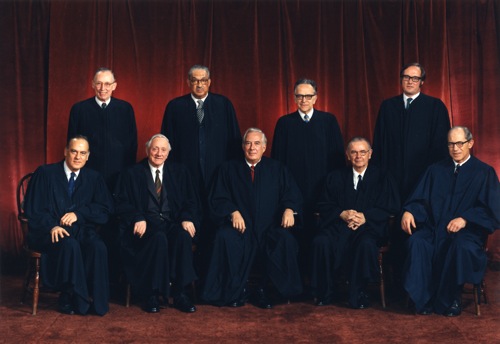
The Justices of the U.S. Supreme Court, 1973. Top row, left to right:
Lewis Powell, Thurgood Marshall, Harry Blackmun, William Rehnquist.
Bottom row, left to right: Potter Stewart, William O. Douglas,
Chief Justice Warren Burger, William J. Brennan, Byron White.

January 22, 1973, 50 years ago: The U.S. Supreme Court announces its decision in the case of Jane Roe, et al. v. Henry Wade, District Attorney of Dallas County -- heretoafter referred as Roe v. Wade for short.

It is the most controversial decision the Court has made since Dred Scott v. Sanford in 1857. And it is a story so big that it overshadows 2 other events on the same day: The death of a former President of the United States, and the Heavyweight Championship of the World changing hands on a spectacular knockout.

In 1968, Norma McCorvey, a 21-year-old Dallas resident, became pregnant for the 3rd time. She had given up her 2nd child for adoption willingly, and was tricked into doing the same for her 1st. She was divorced from the father of her 1st child, and had no means to raise a child.
She sought an abortion, but the law of the State of Texas prohibited in nearly all cases. The only exception was if giving birth would endanger the mother's life. She was referred to attorneys Sarah Weddington and Linda Coffee, who filed a lawsuit in U.S. federal court in March 1970, alleging that Texas' abortion laws were unconstitutional.

To keep her identity a secret, McCorvey was listed in court records with the placeholder name Jane Roe. (Legal placeholder names include John Doe, Jane Doe, Richard Roe, and, in this case, Jane Roe.) The defendant was the District Attorney for Dallas County, Henry Wade, previously best known for having successfully prosecuted Jack Ruby, who had murdered Lee Harvey Oswald before Oswald could be tried for the assassination of President John F. Kennedy.
Three months after filing the suit, on June 2, 1970, Norma McCorvey gave birth to her 3rd child, a girl, and put her up for adoption. A few months later, a 3-judge panel of the U.S. District Court for the Northern District of Texas heard the case, and ruled in her favor. Crawford Martin, the Attorney General of the State of Texas, appealed directly to the U.S. Supreme Court.

It took until January 22, 1973 for the High Court to issue a ruling. It was 7-2 in McCorvey's favor. The reasoning was that the Due Process Clause of the 14th Amendment to the Constitution of the United States provides a "right to privacy" that protects a pregnant woman's right to choose whether to have an abortion.

However, it also ruled that this right is not absolute, and tied the degree of any State's regulation to the trimester of pregnancy which is to be aborted. In other words, the Court provided a loophole which gave anti-abortion activists hope that, one day, the Roe v. Wade decision might be overturned.

The decision was written by Justice Harry Blackmun, who became, to anti-abortion activists, the most hated Justice in the Court's history. He was joined by Chief Justice Warren Burger, and Justices William O. Douglas, William J. Brennan, Potter Stewart, Thurgood Marshall and Lewis Powell.

Dissenting were Justices Byron White and William Rehnquist. Both were Catholic -- but so was Brennan, who supported the aforementioned citation of a right to privacy.

Appointed by Democratic Presidents: Douglas by Franklin D. Roosevelt in 1939, White by John F. Kennedy in 1962, and Marshall by Lyndon Johnson in 1967. The Democrats, ever since, have been the Party favoring abortion rights, but White did not vote that way.

Appointed by Republican Presidents: Dwight D. Eisenhower had appointed Brennan in 1956, and Stewart 1958; while the current President, Richard Nixon, had appointed Burger in 1969, Blackmun in 1970, and Powell and Rehnquist in 1972.

However, Brennan was a Democrat, whom Eisenhower had appointed as a gesture of bipartisanship. Of the other 5, only Rehnquist ruled against the right to an abortion. In 1986, when Burger retired as Chief Justice, President Ronald Reagan rewarded Rehnquist by promoting him to the Chief's chair.

Control of the Supreme Court has been seen as the anti-abortion movement's way of getting Roe overturned. Which is why, in 2016, when hard-core anti-abortion Justice Antonin Scalia died, Senate Majority Leader Mitch McConnell prevented President Barack Obama's appointee to the seat, Merrick Garland, from even getting a hearing in the Senate.

It was also why evangelical "Christian" Republicans, so often hypocritical, were willing to accept Donald Trump, a pathological liar, a man married 3 times and divorced twice, a serial adulterer, a confessor to serial sexual assault, and a man whose words and actions compare very poorly with those of Jesus of Nazareth, as the Republican nominee for President, because they knew he would appoint Justices to the Court that would be acceptable to McConnell, and thus acceptable to them. This allowed the Scalia seat to remain vacant until Trump took office, enabling him to appoint Neil Gorsuch to the seat.

Justice Anthony Kennedy, often the "swing vote" on cases, including the biggest challenge to Roe to that point, Planned Parenthood v. Casey in 1992, surprisingly retired in 2018, and Trump appointed Brett Kavanaugh as his replacement, an alcoholic with, like Trump himself, a record of sexual assault and hatred of women.

And when Justice Ruth Bader Ginsburg died in office in 2020, before Senate Minority Leader Chuck Schumer could do anything about it, McConnell rushed the confirmation of Trump's appointee, Amy Comey Barrett, through the Senate, giving the Court a 6-3 conservative majority that, Court-watchers believed, would overturn Roe when they reached a decision in Dobbs v. Jackson Women's Health Organization. 

Sure enough, that decision came on June 24, and it did overturn Roe. This angered American women so much that the predicted "Red Wave" of votes that was going to give the Republicans overwhelming control of both houses of Congress was counteracted by "Roevember." The result was that the Republicans did regain control of the House of Representatives, but with a majority of only 4 votes; and the Democrats actually gained a seat in the Senate.

After Roe v. Wade, Henry Wade did not see his reputation take a hit. Liberals didn't blame him for a law in place well before he ever took office, and conservatives did not hold it against him that he lost the case. He retired as District Attorney in 1987, after 36 years, and died in 2001.

Despite having slept around with men, Norma McCorvey more often identified as a lesbian, having spent most of her adult life with a single life-partner, Connie Gonzales, but constantly cheating on her. In 1989, she came forward as Jane Roe, and participated in abortion-rights rallies.

Then, in 1995, she switched sides, becoming an evangelical Catholic -- at least, officially -- and attending anti-abortion rallies. She wrote 2 books, 1 while on each side of the debate, and both of which were exposed for containing lies. She was never really an asset to either side. Apparently, the only thing she truly believed in was publicity.

In 2021, the baby that "Jane Roe" didn't want came forward for an article in the Atlantic Monthly magazine, and a subsequent book by Joshua Prager, The Family Roe. (Prager had gained the cooperation of McCorvey's 1st 2 children and her ex-partner.) 

Shelley Lynn Thornton grew up in the Dallas suburb of Mesquite, Texas, and later in the Seattle suburb of Kent, Washington, knowing that she was adopted and that she had 2 half-sisters living elsewhere. Shortly before her 19th birthday, she was told -- by a "reporter" for the National Enquirer -- who her birth mother was.

She freaked out. Not because she now knew that her birth mother wanted to end her life. But because, even at her age, she knew that both the Enquirer and the right-to-life movement would want to use her. In one of the few decent things the Enquirer has ever done, it kept Shelley's name out of the printed story.

In 1991, Shelley herself became pregnant. She was opposed to abortion, but, to her, "pro-life" meant the fanatics who terrorized women seeking a choice, and blew up clinics, killing people and making themselves hypocrites, and she wanted nothing to do with that label. She didn't want the "Right to Life" movement to use her in any way.

Unlike her mother, she had a supportive boyfriend, and they got married before their son was born. They moved to Tucson, Arizona, and added 2 daughters. She met both of her half-sisters, and got along well with them. But, despite 2 difficult phone calls, years apart, Shelley Thornton never met Norma McCorvey face-to-face.

McCorvey died on February 18, 2017, in the Houston suburb of Katy, Texas, of heart failure, at age 69. In what turned out to be a final interview, what abortion rights activists have called a "deathbed confession," she said she was paid to switch to the anti-abortion side: "I was the big fish. I think it was a mutual thing. I took their money, and they'd put me out in front of the cameras and tell me what to say. That's what I’d say." Making her, I suppose, the Anakin Skywalker of abortion politics.

However unreliable a narrator she may have been, I'll let her have the last word: "If a young woman wants to have an abortion, that's no skin off my ass. That’s why they call it 'choice.'"

Of the 9 Justices on the Court for Roe v. Wade, Rehnquist was the last one on the Court, dying in office in 2005. The last one who voted for reproductive rights was Harry Blackmun, who retired in 1994.

*

January 22, 1973 was a Monday. And Norma McCorvey was not the only Texas resident in the news that day. Former President Lyndon B. Johnson suffered a heart attack at his LBJ Ranch outside Johnson City. (The city was named for his grandfather, and the closest big city is Austin.) He had a private plane on the Ranch, and Secret Service agents loaded him onto it. He was flown to Brooke Army Medical Center at Fort Sam Houston, outside San Antonio, but he was pronounced dead on arrival.
The last known photo

He was 64, and had spent the last 4 years watching Nixon pick apart at his legacy. Actually, while Nixon did dismantle some "Great Society" programs, he kept some, and strengthened others.

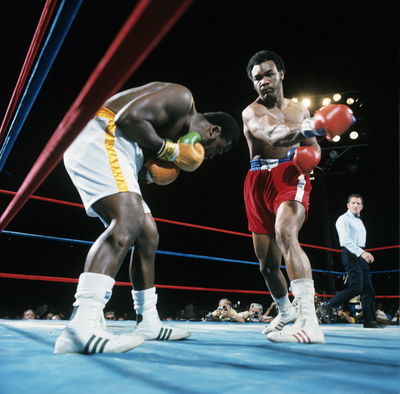
That night, at the National Stadium (now named Independence Park) in Kingston, Jamaica, Joe Frazier defended the Heavyweight Championship of the World. His opponent was George Foreman, from Houston. Both men were Olympic Gold Medalists: Frazier in Tokyo in 1964, Foreman in Mexico City in 1968. Both men were undefeated as professionals: Frazier was 29-0, and Foreman, despite being 5 years younger, was 37-0.

In what was known as the Sunshine Showdown (despite taking place at night), Foreman dominated from the opening bell. The rule mandating the fight be ended in the event of 3 knockdowns in 1 round was waived for this fight. Angelo Dundee, Muhammad Ali's trainer, who had also worked with Foreman, was seated at ringside, and, halfway through the 1st round, could be heard on ABC Sports' broadcast yelling, "Frazier's hurt!"

Sitting next to Dundee, Howard Cosell tried to tell the ABC audience what Dundee had said, but couldn't finish it, because Foreman delivered a knockdown blow: "Angie Dundee, Ali's trainer, right next to me, is saying it. You may hear it... Down goes Frazier! Down goes Frazier! Down goes Frazier! The Heavyweight Champion is taking the mandatory 8-count, and Foreman is as poised as can be in a neutral corner!"
Frazier got up at the count of 2, but took the 8-count, and resumed. With 16 seconds left in the 1st round, Foreman knocked Frazier down again. He got up. Just before the bell rang to end the round, Foreman knocked Frazier down for a 3rd time. There was no "saving by the bell": Had Frazier not gotten up, it would have been over then.

It should have been over then. Instead, referee Arthur Mercante, who had refereed the 1st Ali-Frazier fight in 1971, let the 2nd round begin. Frazier was knocked down a 4th time. Mercante didn't stop it. Frazier was knocked down a 5th time. Mercante didn't stop it. Frazier was knocked down a 6th time. Only then did Mercante stop it. Foreman was the Champion.

In his next fight, on September 1 at Budokan in Tokyo, Japan, Foreman knocked Puerto Rican fighter José "King" Roman out in the 1st round. Next up, on March 26, 1974 in Caracas, Venezuela, Foreman knocked Ken Norton out in the 2nd round.

Roman had never fought Ali. But, now, Foreman had destroyed the only 2 men to defeat Ali as professionals. Yet Ali wanted to fight him to regain the title. People were afraid that Foreman would badly hurt Ali, maybe even kill him. Instead, Ali knocked Foreman out in the 8th round, and proved that he was, indeed, what he had been saying he was: "The Greatest of All Tiiiiiiiime!"

Foreman retired in 1977, became a minister, and, in 1987, returned to boxing to raise money for his church. Discovering that he still had some punching power, he kept at it. He fought Evander Holyfield for the title in 1991, and while he didn't come close to winning, he went the distance and didn't get hurt.

Lots of people, myself included, thought he had proven his point, and that he should stop before he did get hurt. He didn't. In 1994, with the title now in the hands of Michael Moorer, Foreman knocked Moorer out, and, at 45, became the oldest Heavyweight Champion of the World ever.

Saturday, December 12, 2020

December 12, 2000: Bush v. Gore

December 12, 2000, 20 years ago: The Supreme Court of the United States overrules the Supreme Court of the State of Florida. It is the case of Bush v. Gore.

In the Presidential election of November 7, the Democratic nominee for President of the United States, the then Vice President of the United States, Albert Arnold Gore Jr., got more popular votes than the Republican nominee, Governor George W. Bush of Texas: Gore 51.0 million, Bush 50.4 million. Gore got 48.4 percent of the popular vote, Bush 47.9 percent. Ralph Nader, famous as a consumer advocate since the 1960s, ran as the nominee of the Green Party. He gets 2.9 million votes, or 2.7 percent.

Bush's brother, Governor John E. "Jeb" Bush of Florida, saw how close the vote was in his State, and tampered with the voting process, and that one State held everything up for 5 weeks. The best attempt at a recount, in downtown Miami, was interrupted on November 22 by what became known as the Brooks Brothers Riot. As a result, there were votes that were never counted. I don't mean they weren't recounted, I mean they were never counted once.

On December 8, the Florida Supreme Court ruled that all 61,000 "undervotes" had to be counted. Had that happened, Gore surely would have won. The Bush campaign immediately appealed to the U.S. Supreme Court. SCOTUS ruled on December 12:

* Four Justices ruled that the recount had to go forward: John Paul Stevens, appointed by Republican President Gerald Ford; David Souter, appointed by Republican President George H.W. Bush, the current Republican nominee's father; Ruth Bader Ginsburg, appointed by the current President, Democrat Bill Clinton; and Stephen Breyer, also appointed by Clinton.

* Five Justices ruled that the recount had to stop immediately, all of the appointed by Republican Presidents: William Rehnquist, appointed by Richard Nixon, and promoted to Chief Justice by Ronald Reagan; Sandra Day O'Connor, appointed by Reagan; Antonin Scalia, appointed by Reagan; Anthony Kennedy, appointed by Reagan; and Clarence Thomas, appointed by the elder George Bush.

It was pretty easily guessed that all 4 Justices who voted to keep the recount going would do so; and that 3 Justices known for being archconservatives -- Rehnquist, Scalia and Thomas -- would vote to stop it.

The question marks were 2 moderates: O'Connor and Kennedy. If either of them had voted to keep the recount going, it would have been kept going, and Gore would have won. Instead, both voted to stop it. And so, in an election where over 104 million votes had been accepted as counted, only two votes ended up mattering: Those of O'Connor and Kennedy.

It remains the ghastliest decision in the Court's history, aside from the 1857 decision in Dred Scott v. Sandford, that said that black people weren't citizens (a decision remedied by the 14th Amendment to the Constitution).

Gore conceded the election the next day, forever doomed to be "the 42nd 1/2 President of the United States" -- a President-elect, but never a President. On January 6, 2001, in his role as the outgoing Vice President, Gore properly read the Electoral Votes, including the 25 of the State of Florida. Whether those votes were properly arrived at is another matter.

(UPDATE: On that day, no Democrats stormed the U.S. Capitol Building in an attempt to stop the process. Twenty years later, of course, when it was Republicans who didn't like the result, they did storm the Capitol, and attempt to stop the process. They only delayed the inevitable.)

Rehnquist died in office in 2005. O'Connor retired right before that, and is still alive. Souter retired in 2009, and is still alive. Stevens retired in 2010, and died in 2019. Scalia died in office in 2016. Kennedy retired in 2018, and is still alive. Ginsburg died in office, 3 months ago. Thomas and Breyer are still on the Court.

Bush's term in office was an unmitigated disaster, both domestically (especially economically) and internationally. Had Gore been allowed to accept his victory, he would have governed completely differently, and most Americans, including the conservatives, would have been better off.

Monday, November 2, 2020

Top 5 Reasons You Can't Blame Ralph Nader for Al Gore Losing the 2000 Presidential Election

November 7, 2000, 20 years ago: November 7 is a bad day for Presidential election winners:
* 1848: Zachary Taylor wins, but dies in office.
* 1876: Samuel Tilden wins, but the Electoral Votes of 3 States are in dispute. He ends up with none of them, and loses to Rutherford B. Hayes by 1 Electoral vote, 185-184.
* 1916: Woodrow Wilson thought he lost, then won, and then won a war but lost the peace.
* 1944: Franklin Roosevelt wins in a landslide, but dies in office just 5 months later.
* 1972: Richard Nixon wins in a landslide, but his resignation was already set in motion.
* 2000: And now, Al Gore.
Then Vice President of the United States, Albert Arnold Gore Jr., gets more votes than Governor George W. Bush of Texas: Gore 51.0 million, Bush 50.4 million. Gore gets 48.4 percent of the popular vote, Bush 47.9 percent.
Ralph Nader, famous as a consumer advocate since the 1960s, runs as the nominee of the Green Party. He gets 2.9 million votes, or 2.7 percent.
Bush's brother, Governor John E. "Jeb" Bush of Florida, sees how close the vote is in his State, and tampers with the voting process, and that one State holds everything up for 5 weeks. 
When the U.S. Supreme Court finally rules on December 12 that the recounts must stop, and Bush be accepted as the winner, it is the ghastliest decision in the Court's history, aside from the Dred Scott
decision that said black people weren't citizens (a decision remedied by the 14th Amendment to the Constitution).

Nader, appealing to leftists who felt betrayed by Gore and President Bill Clinton over the last 8 years, won 97,488 votes in Florida. Bush's final lead in Florida was 537 votes. Nader won 22,198 votes in New Hampshire, which Bush won (as far as we know, without cheating) by 7,211 votes.
If Gore had won either State, he would have won beyond any doubt, and it couldn't have been stolen. But Nader's voters wanted their "pure" candidate, and the result was the most under-Nader-like Administration ever.
The lesson of 1968, when people disappointed over not getting Gene McCarthy or saddened over not getting Bobby Kennedy stayed home and didn't vote for Hubert Humphrey, this throwing the election to Richard Nixon, had not been learned.

Nor was either lesson learned in 2016, when leftists refused to accept that a vote for Jill Stein, or a vote for Gary Johnson, a vote for anybody but Hillary Clinton, or no vote at all, was a vote for Donald Trump, and everything he represents -- which a liberal, leftist or progressive voter, should opposed with everything they had.

But was the 2000 result really Nader's fault?
Top 5 Reasons You Can't Blame Ralph Nader for Al Gore Losing the 2000 Presidential Election

5. Joe Lieberman. He was a terrible Vice Presidential nominee, maybe the worst ever in terms of effect on the top of the ticket. He got into the Senate in 1988 by running to the right of liberal Republican incumbent Lowell Weicker. He had no enthusiasm for either Gore or the Democratic campaign. And he let Dick Cheney walk all over him in their debate.
4. George W. Bush. There are many occasions on which he looked stupid. But he handled his campaign like a genius, even brushing aside the drunk-driving revelation as if it didn't matter, much like Donald Trump would do with his scandals 16 years later.
3. Al Gore. He ran a weak campaign. And he pushed Bill Clinton, the most popular living American politician, away, because he didn't want to be tarred with the "immorality" tag. It was a cowardly thing to do. One joint appearance in Miami, and, quite literally, it would have made all the difference in the world.
2. The Supreme Court. John Paul Stevens, David Souter, Ruth Bader Ginsburg and Stephen Breyer were always going to vote to continue the recount, which was absolutely the moral thing to do, regardless of who it would have helped, and it almost certainly would have helped Gore. William Rehnquist, Antonin Scalia and Clarence Thomas were always going to vote to stop the recount, thus absolutely helping Bush.

So while the Democrats needed either Sandra Day O'Connor or Anthony Kennedy to break with the Republican Party, whose President Ronald Reagan appointed them, the Republicans needed both of them to stay loyal to their Party, if not to the Constitution. Both of them stayed loyal to their Party.

So over 100 million Americans – Bush's voters, as well as Gore's – essentially had their votes canceled by 2 voters: Sandra Day O'Connor and Anthony Kennedy.

1. The Bush Machine. Jeb Bush, Katherine Harris, Tom DeLay… They could have accepted the truth, which is that Gore won Florida, despite Bush and Harris having purged 55,000 people from the State's voter rolls, nearly all of them black men who'd been convicted of crimes, all of whom should still have legally had the right to vote. Instead, they needed to steal it, culminating in the Brooks Brothers Riot.
Jeb Bush

If not for that, there would now be a Gore Presidential Library in Carthage, Tennessee; Dubya would have gone back to Midland and had as much to drink as he wanted, and nobody outside his family would have cared; the World Trade Center would still stand; and if Iraq were in chaos after Saddam Hussein's overthrow by rebels, or after his natural death, it would be something that America would need to watch, but not something that America caused.